Ride Lonesome

A man needs a reason to ride this country…

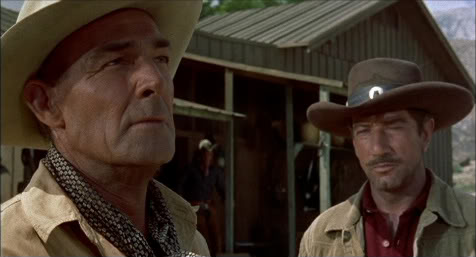
In Ride Lonesome (1959) the reasons are vengeance, bounty and amnesty. The penultimate Ranown western serves up all three but the focus remains firmly on the first. The notion of a lone man driven on by the pain of a past trauma is a recurring theme in Boetticher’s westerns, and is explored in depth in Ride Lonesome. Of the seven films Boetticher and star Randolph Scott made together, I would say this is the best; the plot, dialogue, imagery and performances all mesh to perfection. Nothing is wasted in this picture, where every shot, every gesture and every word is loaded with significance.

The viewer is immediately pitched into the action from the opening shot of the starkly familiar rocky landscape of Lone Pine, and the tension and pace never let up until the final credits roll. Ben Brigade (Scott) is introduced as a lone bounty hunter, and within minutes of appearing on screen has captured a young outlaw. Moving on to the nearest stagecoach swing station, with the outlaw’s brother in pursuit, he finds himself in another dangerous situation. The only occupants are the station master’s wife (Karen Steele) and two wanted men, Boone and Whit (Pernell Roberts and James Coburn), looking to find a way out of their current situation. Turning in the young prisoner would allow them to take advantage of an offer of amnesty, but that also necessitates their disposing of Brigade. The lone hero now finds himself part of an uneasy group and facing threats from three fronts; his new companions, the chasing pack of outlaws and a rampaging Mescalero war party. As the story progresses it becomes apparent that Brigade’s determination to see his captive to Santa Cruz, and an appointment with the hangman, is only part of his motivation. It’s fairly clear that the boy is merely the bait with which Brigade hopes to hook a bigger and more personal catch, although the exact reason for this isn’t revealed until the climax. In these moments, as Brigade stands and gazes impassively at the twisted hanging tree, the full power of the tale strikes home. The cold, unemotional hunter of men is no longer just a bounty killer but a figure lifted straight from classical tragedy.

Ride Lonesome offered Scott one of his harshest characters in Ben Brigade. There’s very little humour on display and even in those moments when he shows some modicum of tenderness towards Karen Steele it’s of the gruff and brusque variety. However, this is absolutely in keeping with a man who’s carrying around deep scars. Burt Kennedy supplied him with his finest, most distinctive dialogue and Scott delivers it in a suitably terse fashion. Pernell Roberts and James Coburn (in his screen debut) are excellent as the bad men who aren’t all bad – the real villain of the piece is Lee Van Cleef, and the only complaint that could be made about him is that he gets so little screen time. Karen Steele looks good and plays the typically tough and stoical Boetticher heroine whose only moment of weakness comes when she learns the fate of her missing husband. This was the director’s first film in cinemascope and he employs the wide lens to great effect. The action takes place exclusively outdoors and once again highlights Boetticher’s gift for disguising the limited budget he had to work with. There’s a Fordian quality to the tiny figures dwarfed by an expansive landscape which mirrors the scripts nods to the old master. Isn’t there something vaguely familiar about that story of the embittered, driven man on a vengeful quest only to find himself alone and apart from society at its end? There’s also a degree of religious symbolism in the climactic scenes with Scott standing before the hanging tree which resembles a crude cross. It’s as though he has borne his own cross for years and now returns to his personal Golgotha to lay the past to rest before the final cathartic act of burning the tree.

Ride Lonesome is another strong DVD transfer by Sony. Like the other titles in the Films of Budd Boetticher set, the colours are strong and true, and the picture looks suitably filmic. There  is a commentary track provided, and another of those short featurettes with Martin Scorsese. As I said earlier, I think this is the best of the lot – Boetticher’s finest film, and a real treat for western fans.
The Tall T

Some things a man can’t ride around…

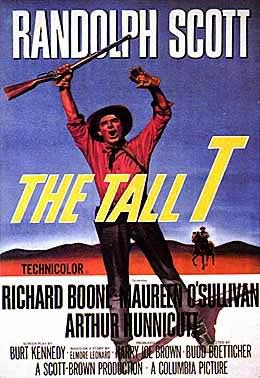
The first official entry in the Budd Boetticher / Ranown cycle of westerns is The Tall T (1957). The story here was adapted by Burt Kennedy from an Elmore Leonard short story called The Captives. That makes for an impressive set of credits and, in truth, the end result is a near perfect film. Once again Boetticher and Kennedy boil the western down to its absolute essentials, and the bulk of the action involves just five people and how they all relate to one another. Everything from location and plot to dialogue is pared right down and the film is all the better for that. What is left is a raw and visceral western with a strong moral current running through it and characters who we actually care about.

For a film with a short running time – under 80 minutes – it’s really a story with two distinct parts. The opening section introduces the character of Pat Brennan (Randolph Scott), a happy-go-lucky type in the process of building up his newly acquired ranch. He comes across as a gently charming sort who stops off on his way to town to pass the time of day with the local stationmaster and his young son. He even takes the time in town to pick up some candy for the boy as he had promised to do. When he visits his former employer, and loses his horse in an ill-judged wager, you start to wonder how such a hapless innocent could survive in a harsh environment. It is from this point on though that the depth of Brennan’s character begins to become apparent. Hitching a ride on a private stagecoach, hired for the honeymoon of Mrs. Mimms (Maureen O’Sullivan) and her gold-digging chiseller of a husband, he stops off to deliver the candy to the stationmaster’s boy. The station has been taken over by outlaw Frank (Richard Boone) and his two sidekicks (Henry Silva and Skip Homeier) with the aim of holding up the regular stage. Faced with the horror of what has just taken place, and the likely fate awaiting him and the other hostages, the character of Brennan undergoes a sea change. Almost immediately the easy-going ex-ramrod is transformed into a cool, calculating avenger who knows he must now play for time while waiting for the opportunity save himself and the woman. It’s a credit to all involved that this transition appears so natural as to be nearly seamless.

Scott’s flinty features once again blend in with the bleak Lone Pine locations which dominate the picture. The character shift I mentioned is magnificently achieved in the scene where the fate of the stationmaster and his boy is revealed in cold, matter-of-fact fashion by Henry Silva. Scott’s face hardens almost imperceptibly yet the meaning is all too clear. This kind of thing makes for great screen acting and the lead was a pastmaster in the art of underplayed emotion. Richard Boone was always interesting to watch, and in Frank he gives a fascinating performance as the outlaw you want to sympathise with. When he dispatches Mrs. Mimm’s husband, whose craven character offends his own personal morality, it’s difficult not to feel some grudging admiration. The two subsidiary villains are of less interest, but Silva manages to tap into a vaguely detached psychosis that works very well. Maureen O’Sullivan has an unglamorous role which offers her the chance to play something which is a cut above the standard damsel in distress. The fact that we get such well rounded characters in a short run time speaks volumes about the writing skills of Burt Kennedy. Boetticher again excels at making a cheaply produced picture look far more expensive. The framing and camera placement are miles away from the usual point and shoot style employed in low budget fare; this man had a real flair for the quirky and the unexpected. His handling of the action scenes is again exemplary, and they have both a frankly brutal quality and an odd humanity that make them stand out from other pictures of this vintage. There’s something deeply satisfying about Randolph Scott turning to the sobbing woman at his side, after the violent climax, and quietly intoning: Come on now, it’s gonna be a nice day.

Sony’s presentation of The Tall T on DVD is another excellent one. Some may carp at the amount of grain on view but I don’t regard that as a bad thing. The anamorphic widescreen picture is bright and colorful throughout. The disc also carries a short featurette with Martin Scorsese praising the film. Best of all, there’s the feature length documentary Budd Boetticher: A Man Can Do That. So, we get a great movie which is presented with care and respect – what more could you ask for.

Comanche Station

Lean and spare are the words often used to describe the westerns of Budd Boetticher and I won’t argue with that. Of course, budgetary constraints were generally the reason for the minimalist approach but Boetticher was masterful at disguising that fact. Burt Kennedy’s drum tight scripting and Boetticher’s control of the camera mean that you never stop to think that what’s on the screen was originally shot as a B picture. Between 1956 and 1960 the director made seven westerns with star Randolph Scott, all but the first produced by Scott’s Ranown. Shooting for the most part around Lone Pine gave these films a distinctive look and feel in much the same way that Monument Valley defined the westerns of Ford. Comanche Station (1960) was their last collaboration and Scott’s penultimate movie.

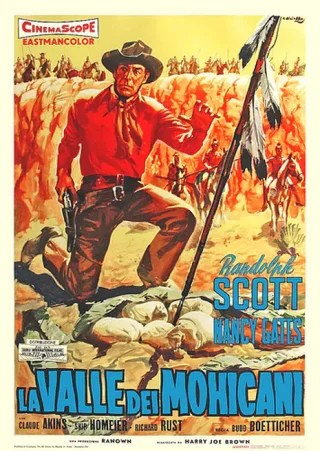
The plot is quite simple really, and that’s generally the strength of all the Ranown westerns; there’s no excess baggage, and the viewer only sees and hears what is absolutely necessary. Cody (Scott) is a lonely man, a former soldier, who has spent years wandering the west in search of his abducted wife. Whenever he hears a rumor of a white captive he sets off with a mule loaded with trade goods hoping that this time his quest may end. It is said that he’s rescued countless captives but it’s never the right one for Cody. This time will be no different. He trades with the Comanche for the freedom of one Mrs. Lowe (Nancy Gates) and aims to see her safely back to her husband. However, before he can do so, three men turn up and throw a spanner in the works. Lane, Frank and Dobie (Claude Akins, Skip Homeier and Richard Rust) are running from the Comanche, and Cody suspects it’s because they’re scalphunters. Cody’s distrust of Lane dates back to their years in the army, when he had the latter court-martialed for his role in an Indian massacre. It turns out that Mrs. Lowe’s husband has offered a $5000 reward for her return, dead or alive. While the viewer is immediately aware that Cody knew nothing of this, no-one else believes it. The challenge now is for him to save his own skin and that of the woman from both the Comanche and his new companions. As the story progresses it becomes very obvious where the greatest threat lies.

Randolph Scott’s lean and craggy appearance compliments both the landscape and Boetticher’s sparse morality tale. He looks every inch the laconic westerner who’s spent years scouring the scorched, barren land with only his pain and loss for company. The older he got the more adept he became at conveying a kind of buttoned-up emotion combined with an iron sense of personal honor. He was the first actor to draw me to the western as a child, and now I’m more convinced than ever that he may have been the greatest cowboy, surpassing even Wayne and Cooper. In fact all five actors in this film play off each other perfectly, and much of that comes down to the writing of Burt Kennedy. Everyone gets something to get their teeth into and it’s difficult not to feel even some sympathy for all of them. None of the villains in Boetticher’s westerns were ever one dimensional and Kennedy always managed to provide them with enough backstory or characteristic dialogue to keep the viewer interested. Boetticher does a fine job of moving his camera around to offer some unexpected shots and angles, and his use of the wide screen makes what is essentially a small picture look very big indeed.

After what seems like an eternity of waiting, Sony have finally released the five Ranown westerns in their possession onto DVD as The Films of Budd Boetticher. All the films come on their own discs and Comanche Station looks just wonderful. Like the other titles in the set, it boasts a healthy amount of film grain and sports a fine anamorphic transfer with good, strong color. The disc also carries a short featurette with Clint Eastwood offering a few thoughts on the movie. Sony have done a bang up job with this set – I have no hesitation in saying it’s the release of the year for me.

Frontier Marshal

72efsb7

Wyatt Earp was and is one of the most enduring figures in the mythology of the Old West. I’ve always enjoyed seeing how such people were represented on film, how those representations have evolved over time, and how that evolution reflects changes in the western itself. I’d been planning on running a series of pieces on the various movie incarnations of Wyatt Earp – so here goes. I’m going to look at as many of the screen portrayals of the man as possible; both those that have the famous lawman as the main character, and those that only feature him incidentally. I don’t say that this will be an exhaustive list but it will deal with all the major films chronologically.

1939 was something of a defining year for the western, a turning point – the year the genre started to grow up. After the box office failure of The Big Trail (1930) the western found itself relegated to B movie status. Studios were unwilling to lavish money on what they saw as a bad risk, and so the western would languish on the bottom half of the bill for the remainder of the decade. 1939 was to change all that. John Ford’s Stagecoach, De Mille’s Union Pacific, and Henry King’s Jesse James showed that there was still gold to be found in ‘them thar hills’, and the western returned to A list respectability. Along with those illustrious titles came Allan Dwan’s Frontier Marshal.

I suppose I should start by saying that if you’re one of those who are sticklers for historical accuracy, then this is not the film for you. This adaptation of Stuart N. Lake’s book has a character called Wyatt Earp, who was a lawman in Tombstone – and that’s about as close to the real facts as it gets. In fact, the movie might just as well have been about any marshal in any burgeoning frontier town. There’s a nice little montage sequence at the beginning that establishes the birth and growth of Tombstone, before introducing Earp (Randolph Scott). It’s made abundantly clear that Tombstone is a wide open town where pretty much anything goes. Earp finds himself reluctantly roped into the job of marshal and, by extension, into conflict with the town’s less savoury elements – outlaw Curly Bill Brocius (Joe Sawyer) and his saloon-keeping ally Ben Carter (John Carradine). He also meets the notorious gunslinger Doc Holliday (Cesar Romero), although for some unfathomable reason the script chooses to refer to him as ‘Halliday’. Together, the two heroes take on the might of the criminals in an effort to bring law and order to the streets of Tombstone, culminating in the legendary gunfight at the OK Corral. This scene is pure fantasy since the only relationship to the truth here is that it involves Wyatt Earp and has some people getting shot.

Randolph Scott plays Earp as an arrow straight hero. It’s not a bad performance and more or less par for the course for the era. In later years, Scott would show his ability to play much more complex characters but he was rarely given the opportunity to do so at this stage in his career. Cesar Romero is surprisingly good as the guilt-ridden Doc, though it has to be said that the part has afforded the chance to shine to every actor who ever played the role. The outlaws are portrayed as the standard cardboard cutout villains, although John Carradine always lends a touch of class to any part. Some time I must do a count of how many films I own that feature Carradine, for he seems to turn up everywhere. And while I’m talking about ubiquitous actors, there are parts also for Ward Bond and Lon Chaney Jr. Binnie Barnes is the tough saloon singer in love with Doc, and competes for his affections with the more refined Nancy Kelly. One other interesting piece of casting has Eddie Foy Jr playing his own father, who was supposed to have been performing in Tombstone when the gunfight at the OK Corral took place.

Generally, this is a pretty decent western, and only fails if you expect to learn something about the real Wyatt Earp. There are no Clanton’s, no McLaury’s, and no Virgil or Morgan Earp. If you view it as simply another western about a marshal cleaning up the town, it works well enough. The film  is now available as a bonus feature on the recent R1 ‘Ford at Fox’ release of My Darling Clementine. While it is included in the smaller sub-set it is missing from the full box, but there was a mail-in to allow those who missed out on it to receive the film. The presentation of what is essentially just an extra is excellent, with a very nice, clean transfer. There’s even a trailer and stills gallery included – another fine piece of work from Fox.


Jesse James

zjdoxsb

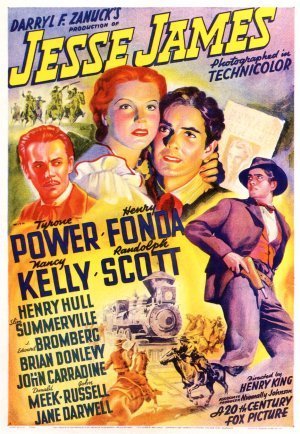
Having recently seen The Assassination of Jesse James, and having enjoyed it immensely, it occurred to me to go back and revisit some of the other movies based on the legendary outlaw. Along with William Bonney the name Jesse James has become an integral part of the myth of the west. For both of these men, questions of who and what they were and why they acted as they did have been endlessly explored and no truly satisfactory answers have emerged. But does that really matter? To me it doesn’t since the movies are and were, at heart, an entertainment and storytelling medium. It seems naive in the extreme to seek the whole truth in a dramatic form – if you want the real facts you need to look elsewhere. Henry King’s 1939 version of Jesse James certainly bends the truth more than a little, but that doesn’t mean the film is a poor one.

This movie opens in the years following the Civil War and portrays Jesse (Tyrone Power) and brother Frank (Henry Fonda) as peace loving farmers in Missouri. That’s the first of many inaccuracies, for the truth is that the brothers had already strayed into lawlessness during the war – Frank riding with Quantrill and Jesse with another group of guerrilla raiders. There is no doubt, right from the beginning, that the true villain here is the railroad and more specifically it’s representatives. The railroad, as in many westerns, is shown to be the product of the greedy and corrupt east. It is the actions of one of the railroad agents (Brian Donlevy) that causes the James bothers to turn their backs on the law. From this point on their fates are mapped out for them and further dissembling on the part of the big businessmen serves only to provide more justification for the brother’s criminal activities.

The movie is full of some fine set pieces such as the early train robbery with Jesse riding up to the rear, hauling himself aboard, and then proceeding along the roof for the whole length of the locomotive until he reaches the engine. The famous raid on the bank in Northfield could have been given more time but it does contain some great action shots – Jesse and Frank riding their horses through a store window to escape and then following that up with a dive off a cliff into a river below.

Power and Fonda play the brothers as essentially romantic and heroic figures, but the film is not above pointing out the less honorable aspects of Jesse’s character. At one point Randolph Scott’s sympathetic lawman makes it clear that Jesse’s initial justification has been superceded by simple, inexcusable criminality. Another scene, on the eve of the Northfield raid, shows Jesse to be a man on the verge of losing control and only the efforts of his more rational brother haul him back. Scott’s supporting role doesn’t offer much and I get the feeling that it was only included to show that all authority figures are not scheming back-stabbers. The notorious Bob Ford is played by John Carradine as a craven scoundrel with whom the viewer can feel no sympathy whatsoever. As a portrait of cowardly betrayal it’s well done but, as with all the villainous parts, remains one dimensional.

Fox issued the movie on DVD last year and the presentation is a good deal less than might have been hoped for. Frankly, the print is in poor condition and this is particularly evident for the first half hour or so where the age of the film becomes painfully obvious. Things do improve as it goes on but issues with the colour occasionally arise. The film clearly needs restoration work but, despite it’s shortcomings, I’m still very happy to at least have it in my collection.


Western Union

pxsblta

If you mention Fritz Lang’s name to most film fans they are most likely to think of expressionism, thrillers, and films such as M and Metropolis. It is not so typical to associate the German director’s name with classic Hollywood westerns but he did make a handful of these. To be exact, he made three westerns: The Return of Frank James (1940), Western Union (1941) and Rancho Notorious (1952). I think it would be fair to say that Western Union is the least known of them, but perhaps it deserves better. It is quite representative of 1940s westerns in that it tries to avoid some of the more juvenile aspects of the previous decade’s output but lacks the psychological depth that would come in the 50s. Although it may not bear the hallmarks of classic Lang, it does contain those of the classic western.

It’s not for nothing that the building of the railroad has figured so prominently in so many great westerns, from Ford’s The Iron Horse through to Leone’s Once Upon A Time In The West. It was this massive undertaking that at once opened up the west and also signalled the closing of the frontier way of life. For some film-makers it represented the advance of law, order and civil society; for others it stood only for the gradual encroachment of the corrupt influences of the east. Western Union deals not with the railroad but that other piece of progress that would drag America into the modern world and relegate the Old West to the realm of mythology – the laying of the transcontinental telegraph wire.

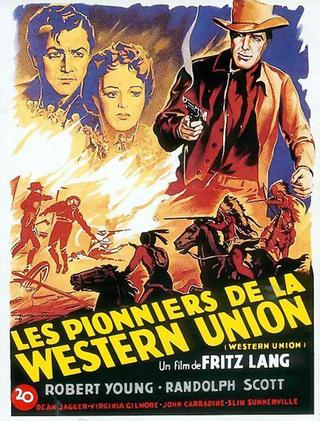
The film opens with outlaw Vance Shaw (Randolph Scott) attempting to outrun a posse and happening upon telegraph boss Edward Creighton (Dean Jagger). Creighton has been injured and is barely able to move with a busted ribcage. Shaw is desperate to evade capture and is on the point of taking Creighton’s horse and leaving the stricken man to his fate. However, his conscience pricks at him and he decides to take a risk and bring the helpless man along. That proves to be the turning point for Shaw, for when he later finds employment with the telegraph company as a scout it is Creighton who offers him the chance to go respectable. The other main character is the dandified easterner, Blake (Robert Young). Blake has come west to work for the telegraph, and soon enters into a rivalry with Shaw over Creighton’s sister. The movie, like the characters themselves, has a lot of ground to cover and is played out against the back-story of the Civil War. It includes a well-staged battle with some drunken Indians and a confrontation with a gang of renegade confederate raiders led by Shaw’s own brother.

£2

Randolph Scott is excellent as a man torn between a lingering loyalty to his brother and the old ways, and a desire to turn over a new leaf. If you’re under the impression that Scott would not come into his own until a decade later in the films of Budd Boetticher then think again – this is definitely one of his better performances. Dean Jagger’s part doesn’t call for much more than stoic determination and he does that just fine. As for Robert Young, he’s never been an actor that I’ve cared much for and this showing did little to change my opinion. The support cast features some great and familiar faces, not least Barton MacLane (who seemed to appear everywhere in the thirties and forties) as Scott’s thoroughly good-for-nothing brother. Add in an impossibly young looking Chill Wills as a tobacco-chewing (and spitting) telegraph man, and John Carradine as the company doctor and there’s not much to complain about. As I said above, there isn’t much to distinguish this as a Fritz Lang film, but he still delivers a polished, professional picture and does include a few typically dark moments – particularly the ‘shock’ climax.

The film is out on DVD in R2 from Optimum in their Western Classics line. The transfer is mediocre at best and has clearly undergone no restoration, with the colours looking quite washed out. Having said that, the movie is worth seeking out, but I can’t help wishing that Fox would see their way to releasing it in R1 with an improved transfer.


Ride the High Country

poster19_zpsa03d6774

Generally, when I’ve knocked out my thoughts on a film, I’ve tried to avoid those productions which have already been analyzed to death. Such is the case with the work of Sam Peckinpah, which has had more than its fair share of examination and re-examination. However, I have decided that I’m not going to ignore the movie that both provides the title of my own blog and also happens to be my favorite among Sam’s films. Made in 1962, Ride the High Country was the director’s second feature – although this piece by John Hodson helps to explain why the previous year’s The Deadly Companions isn’t a real Peckinpah picture. This film contains the elements that have come to be typically associated with Sam, namely the passing of the Old West, the nature of friendship and loyalty, and a reflection on one’s past deeds.

The whole thing revolves around the two leads, Randolph Scott and Joel McCrea. These two men are old friends and former partners who have come together one last time,  for one last job. McCrea is the very epitome of honour and personal integrity, whose only wish in life is to enter his house justified. His idealism hasn’t brought him any material rewards, his shabby suit in the early scenes being proof enough of that. Scott, on the other hand, has come to question the value of holding on to principles that lead only to poverty and a poorly attended funeral. And so it’s a question of whether McCrea’s quiet nobility or Scott’s cynical pragmatism will ultimately triumph. The guarding of a gold shipment will test the strength of their friendship to the full, but it is the climactic showdown with a family of degenerate rednecks that brings closure to all the moral issues that precede it.

Both Scott and McCrea play off each other beautifully and it’s a genuine pleasure to watch these two old hands clearly relishing what they must surely have recognised as the roles of a lifetime. Both men had spent the previous decade acting almost exclusively in westerns and that experience adds immeasurably to the authenticity of the film. For Scott and McCrea, Ride the High Country was to be the last hurrah; McCrea would make a few more movies and Scott, wisely I think, called it a day and bowed out with what is arguably his best role. Maybe it’s just my sentimentality, but I always get goosebumps when Scott speaks his final lines in cinema and tells McCrea “I’ll see you later..” – it’s a lovely understated way to bid farewell to a long and distinguished career. Randolph Scott is one of the reasons why I enjoy the western genre so much (I suspect I’m not alone, if that gag in Blazing Saddles is anything to go by) – when I was a child it seemed as though no Saturday afternoon was complete without a television showing of one of his films, so he was and is the personification of the western hero for me.

Ride the High Country is a marvelous looking picture due to Peckinpah’s direction and Lucien Ballard’s wonderful cinematography. The movie is full of memorable scenes, not the least of which being the climax, as Scott and McCrea stand shoulder to shoulder and walk out to confront the murderous Hammond clan and fate itself. Peckinpah would offer up a more elaborately staged and celebrated ‘walk’ in The Wild Bunch, but this one packs just as much punch for its simplicity.

Ride the High Country may have become overshadowed by the films that would follow from Peckinpah, but I don’t feel that that should be the case. Is it his best movie? Many would argue that it’s not and point instead to The Wild Bunch or Pat Garrett and Billy the Kid, but it is the one that I have a special affection for, and the one that I find myself returning to most often.