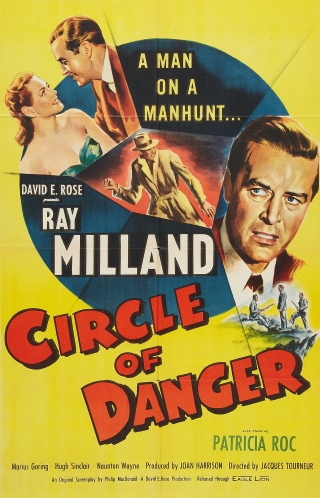
Circle of Danger

Trails followed by hunters have a nasty habit of going cold very fast, but how long does it take a dish to get correspondingly cold? After all, there is that popular tip about the ideal temperature for serving up revenge. One would have thought five or six years ought to do the trick, and that’s about the time Ray Milland’s character takes to get round to seeking out the man responsible for the death of his brother towards the end of WWII in Circle of Danger (1951). Yet revenge is such a corrosive business, rarely bringing any kind of satisfaction to those who most desire it, and then there’s always that thorny question of whether or not it’s actually justified.

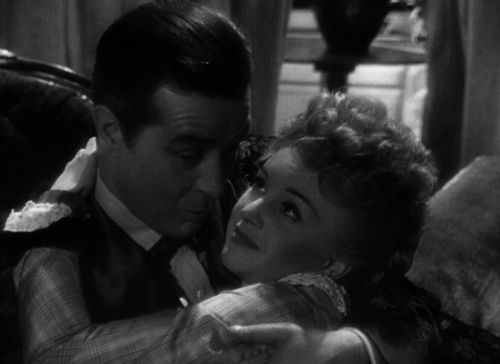
It’s perhaps a little unexpected to see a movie mainly shot in and featuring a cast and crew drawn largely from the UK opening on a salvage vessel operating off the Florida coast. Well that’s where we first come across Clay Douglas (Ray Milland) as he and his partner have just struck gold, or maybe I should say tungsten. This is the opportunity Douglas has been waiting for, five years of hard work finally paying off and allowing him to trade in his share in the business for thirty thousand dollars. He’s not looking to retire or anything, instead he’s been working to earn enough money to fund a trip to the UK in search of the truth about the demise of his younger brother. Despite his seemingly easy manner, Douglas is something of a driven man, fully focused on finding out how the kid brother he had almost single-handedly brought up came to die on a commando raid. People die all the time during major conflicts, even those plying trades nowhere near as perilous as that of a commando. So why would a man travel half way round the world to dig into this particular event? The fact is that the fog of war seems to lie especially thick around it all, and there was a rumor that the younger Douglas was dispatched by one of his own comrades in arms. The hunt for the truth has Clay Douglas cannoning round all the points of the compass, from London to the valleys of Wales and on to the Highlands of Scotland. Both the war and the subsequent passage of time has whittled the list of men who might be able to furnish him with the information he craves down to a mere handful. And it remains to be seen whether the tale that emerges is the one he had hoped to hear at the outset.

Straightforward revenge stories are never all that interesting. Sure there’s a certain visceral thrill to be tapped into if the elements are lined up in the right way, but such yarns tend to take on an exploitative feel which I generally find unappealing. The better examples, and I think Circle of Danger qualifies as such, raise questions that ought to make both the protagonist on the screen and the audience facing it a trifle uncomfortable. It all boils down to whether or not life’s thorny tangles can be adequately addressed in cut and dried, binary terms. I don’t think it’s giving too much away here to say that Philip MacDonald’s script turns the central quest back upon itself by the end, forcing not only the avenger to question himself, but also requiring the viewer to reassess a number of preconceptions we’ve been hitherto encouraged to blindly accept. This renders that three cornered confrontation on the Scottish moor all the more fascinating, and consequently leads to a resolution which is enriched by its acknowledgment of the sometimes ambiguous nature of justice. A delicate subject of this kind needs to be handled sensitively, not with a heavy lump hammer approach, so producers Joan Harrison and David E Rose deserve credit for securing the services of a director  with the lightness of touch and subtlety of Jacques Tourneur.

There has to be something steely and almost obsessive about a man who is prepared to hand over a significant chunk of his life in the pursuit of retribution. I wouldn’t want to claim it is a state of mind exclusive to the years following the Second World War but, in cinematic terms at least, it is a motif that was explored recurrently and came to characterize more than a few screen protagonists – James Stewart was a prime example of this phenomenon but he was certainly not the only one. This needs a quality of intensity to carry it off, something Ray Milland touches on throughout Circle of Danger, particularly in the climactic scenes in the Highlands, but probably not as consistently as he might have. That’s not to say his character is ever less than focused on the ultimate prize, but he does drift towards casualness bordering on nonchalance on occasion, not least when he’s flirting with Patricia Roc. She brings a freshness and vitality to the movie, a teasing allure that still allows her to switch to a more serious mode when she senses betrayal of one form or another. The other person vying for her attention is Hugh Sinclair’s reticent Scot, the one-time leader of the commando group and a man who seems none too keen on furnishing any more details on past than he can help. His is a key role and Sinclair does well in getting across both the caution of the man as well as what I can only term contained suffering. Then there is Marius Goring giving an energetic yet wholly credible performance as the man whose homosexuality is never openly stated (it is a 1951 movie after all) but which is very clearly alluded to. I think one of the most interesting aspects of the script in general is way it encourages the audience to make various initial assumptions about all three of the male characters before challenging these preconceptions and upending them.
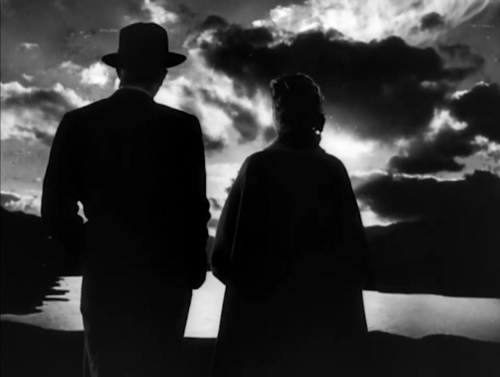
Circle of Danger had been released on DVD by the now defunct Network in what was an entirely acceptable edition. However, it has recently reappeared on Blu-ray via Studio Canal – I haven’t seen that transfer yet but I would expect it to enhance the visuals, and there are some fine looking shots in the film courtesy of cinematographer Oswald Morris. This is a good movie, deftly directed by Jacques Tourneur and cleverly written by Philip MacDonald, drawing the viewer in, setting up certain expectations and then neatly subverting them in a way that continually poses questions which tend to defy pat or convenient answers. It’s a film I’m happy to recommend.
So Evil My Love

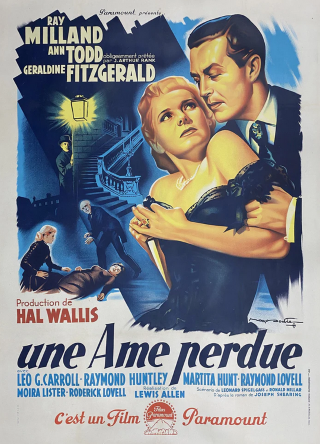
Guilt, corruption and obsession. That’s a heady mix for any movie, though it could be said to be nothing out of the ordinary for film noir. So Evil My Love (1948) is a kind of film noir, more Gothic melodrama I suppose yet it’s still dark and fatalistic enough, both visually and thematically, to just about make the cut as far as I’m concerned. It is something of a hybrid in more ways than one. Leaving aside any discussion of its noir credentials, the movie is one of those Hollywood funded and produced pictures that were made on location in the UK, and in this case making use of a cast of largely British and Irish actors – although all of the principals were working mainly in the US at this point. While there is much to enjoy and admire in the movie, there is a weakness which I feel ought to be mentioned. It has a marvelous visual sheen and well judged sense of atmosphere, but there’s also one central performance that I regard as deeply problematic, though fortunately it’s not as harmful overall as the issue that blighted Caught for me.

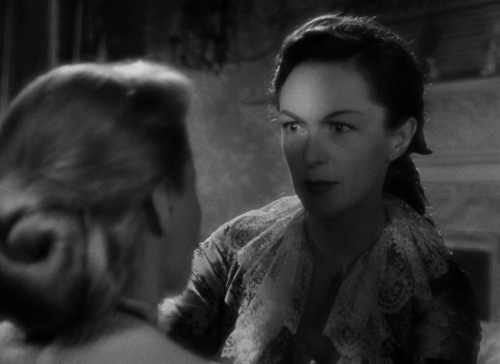
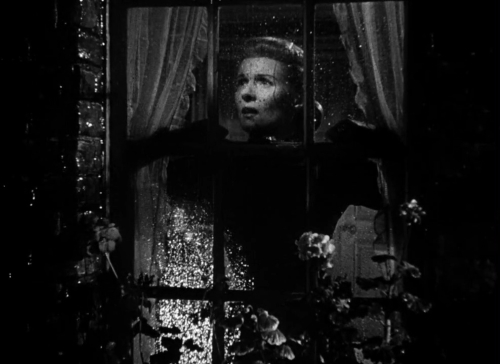
On a ship carving its way across the ocean from Jamaica to England a lone figure stands on deck, either oblivious to the spray on her face and the pitching deck beneath her or perhaps enjoying the experience. Olivia Harwood (Ann Todd) has been recently widowed, the death of her missionary husband leaving her with no option but to return home. She allows herself to be reluctantly coaxed into ministering to the ill on board the ship, chiefly one Mark Bellis (Ray Milland). On arrival in Liverpool it is immediately apparent to the viewer that Mark Bellis is perhaps not all he seems. He is ostensibly a painter, but his cautious probing to discover what, if anything, he revealed while in the throes of fever and then his determination to avoid the authorities set the alarm bells ringing. The fact is Mark Bellis (though that is merely one of the wide range of names he makes use of) is a genuine good-for-nothing, a swindler, a thief, a master manipulator, and apparently a murderer too. To such a man, a lonely, vulnerable and most likely gullible widow provides tempting game. And so it is he goes to work on Olivia Harwood, slowly worming his way into her heart while he sets about organizing his next robbery. However, the failure of that endeavor sees him altering his plans, and the beginning of his methodical and relentless corruption of Olivia. Under his tutelage, she finds herself not only taking advantage of an old friend, but also betraying and undermining her, taking a path that will inexorably lead to blackmail and murder.

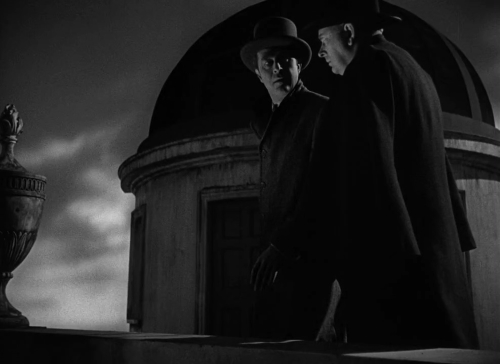
The film has bags of atmosphere, with ponies clipping along cobbled thoroughfares, discharging their silken passengers outside addresses that might be mean and unforgiving or forbidding in their splendor. Wherever the characters go, their surroundings seem to crowd them regardless of whether they are immense or cramped. Somehow there is a sense of all the hypocritical baggage of the late Victorian era forever pressing and suffocating. This feeds into or fuels the feeling of fatalism that pervades the movie. Right from that first scene on the deck of the ship there is an unmistakable air of characters trapped or hemmed in by a destiny shaped by their own weakness and frailty. Mark Bellis is unquestionably a bad lot and that is never in doubt, but it is Olivia’s downward spiral that is the focal point of it all. Director Lewis Allen made only a relatively small number of movies (just 18 over a period of fifteen years) but there are some real gems in among them – The Uninvited, The Unseen, Desert Fury, Suddenly and Another Time, Another Place are all good or better in my opinion.

This is was a fairly productive and successful period for Ray Milland, coming only a couple of years after his Oscar winning turn for Billy Wilder in The Lost Weekend and he would follow this up with a pair of strong films noir for John Farrow in The Big Clock and Alias Nick Beal. This type of role, an oily and calculating charmer, was a good fit for Milland. He had the polish to carry it off convincingly and was also able to tap into a rich seam of desperation when the whispers of his typically dormant conscience grew more insistent. Geraldine Fitzgerald is characteristically fine too as Olivia’s ill-fated friend, brittle and foolish, quick to trust in her hunger for companionship and kindness, and touchingly meek in her willingness to accept her guilt.

Nevertheless, as I alluded to above, there is an issue that damages the movie seriously. The behavior of Ann Todd’s character simply fails to convince me. She is right at the center of things, the heart of the movie in truth, and both her actions and the core characteristics need to ring true for it all to work. And for me this does not happen. I can accept that obsession and infatuation is capable of driving people to places they would not normally go, but I find Olivia’s sudden decision (remember, this is the widow of a Victorian missionary we’re talking about here) to betray her friend’s confidence and the consequent acceptance of the necessity for extortion to be so abrupt as to defy credibility. What’s more, there is then far too much inconsistency on display, the character’s morality and motivation shifting almost from scene to scene. This is a writing issue of course rather than an acting matter – the script is adapted from a story by Joseph Shearing (a pseudonym used by Marjorie Bowen) who also provided the source material for Blanche Fury and Moss Rose. The latter film does have some contrived or unrealistic elements, but there’s not that inconsistency which troubles me here.

On the other hand, there are some excellent supporting turns to help restore the balance. Martita Hunt is chillingly intense as the overprotective grande dame. It is a bit of a stretch to see Raymond Huntley as her son – he was only four years her junior after all – but his cold lack of compassion is neatly done. Moira Lister sashays in and out of the tale as a trashy model whose vanity and vulgarity bring matters to a head. Leo G Carroll’s low-key detective lurks around and does his bit to draw the net tighter. And Maureen Delany, Hugh Griffith and Finlay Currie all have small yet memorable parts.

All told, So Evil My Love is a movie that works in places. There is no doubt that it has style, and some of the acting is excellent – Geraldine Fitzgerald rarely fails to impress me, for example. Still, Ann Todd’s role is an issue. That zigzagging from demure respectability to coquettish scheming and back again on the way to grim vengeance is something I just can’t buy into. Others may well regard this as less problematic. As it stands, I guess it amounts to two thirds of a good movie, or maybe three quarters if I’m in a more generous frame of mind.

Copper Canyon

poster95_zpscxdhb44m

Do the stars of a movie need to be what we think of as genre regulars for it to a success? Back in its heyday the western attracted just about every leading player in Hollywood, some of them slotting in with ease and a number actually going on to carve out a niche for themselves within the genre. Frequently, when less familiar western stars were cast they were backed up by co-stars who had already grown accustomed to riding the cinematic range. However, Copper Canyon (1950) seems to be on of those more unusual productions where none of the three headline stars would have had a background in westerns when the movie was made. So does it succeed? I suppose it does to some extent, although you do have to wonder how much the relative inexperience of the cast hurt it.

The setting is the years following the Civil War, when the process of national healing had only just begun and the wounds remained raw. The whole plot revolves around the struggles of former Confederate miners and obstacles they are confronted with as rivals seek to drive them out of business. These men are in need of a champion, someone capable of figuratively rallying the troops and protecting them. It’s with this aim in mind that a small delegation is sent to sound out Johnny Carter (Ray Milland), a former Rebel officer who has changed his name and, in an attempt to reinvent himself, has become a trick shot artist working the saloon circuit. It is only with the greatest reluctance that he allows himself to be drawn back into conflict with anyone. But once he does the allure of saloon boss Lisa Roselle (Hedy Lamarr) and the challenge of facing down corrupt lawman Lane Travis (Macdonald Carey) are enough to keep him interested.

Copper Canyon offers few surprises  in its scripting. The story is typical fare dealing with the oppression of the little guy by the powerful, and a hero who endeavors to tip the  balance a little in the former’s favor. While this is a solid enough premise, I tend to think a touch of ambiguity can elevate such a tale into much more interesting territory. However, that’s not really offered here and so we’re left with the uneasy reconstruction angle and, to a lesser degree, the gimmick of Milland’s sharpshooting to provide a more distinctive flavor – both of which are well enough employed yet I can’t say I regard either as very compelling. On the other hand, the pacing is reasonable and director John Farrow composes some nice shots, favoring plenty of titled low-angles in the interiors. What’s more cameraman Charles Lang lights the interiors to maximize the atmosphere and captures some fine views of the Sedona locations.

As I mentioned at the start, the stars hadn’t much of a western pedigree when Copper Canyon was made. Ray Milland had a strong body of work behind him at this point and had an Oscar to his name but, with the exception of California (1947) which was also made with Farrow, he had mostly straight drama and noir roles among his credits. While he would go on to other material in the genre, notably the superior A Man Alone (1955), he was still something of a novice at this point. In a similar vein, Macdonald Carey had only made Streets of Laredo (1949) prior to this but he too would make a number of other westerns in the following years. Hedy Lamarr isn’t a woman anyone would automatically associate with the west (although that running gag in Blazing Saddles might suggest otherwise) and Copper Canyon was, aside from a few television appearances, her only foray into frontier drama. All three acquit themselves well enough, though I do wonder how contemporary audiences would have viewed that lineup. In support we do get more typical faces like Harry Carey Jr and Frank Faylen. In addition, there are parts for Mona Freeman, Peggy Knudsen and, in a truly startling red wig, the imposing figure of Hope Emerson.

Copper Canyon was a Paramount production and was released on DVD in the US by the same company years ago. Even though the disc was a bare bones affair, the transfer is quite a good one, bright and colorful with only minor damage on show. It’s a fairly entertaining movie but hardly what could be termed essential. There’s competent work from all in front of and behind the camera yet it also has to be said that all either did or would do much more memorable stuff on screen. So, let’s say it’s okay but not something you need go out of your way to see.


Lisbon

poster201_zpswll8j0rz

There were lots of changes taking place in filmmaking in the mid-50s. Actors were trying heir hand at directing and/or producing, location shooting was growing ever more popular and Europe, with the tax breaks offered, drew many, and then there were all the widescreen processes coming to the fore as the studios struggled to compete with the challenge posed by television. Lisbon (1956) is one movie which offers an illustration of all these factors at work. It’s a handsome-looking Cold War thriller made by Republic Pictures in the period when the studio was sliding into terminal decline and only a few years away from ending feature production altogether.

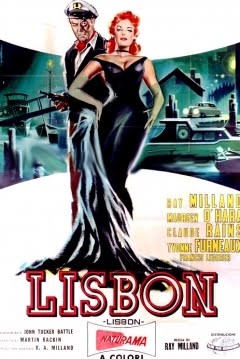
It’s early morning in a luxurious villa on the outskirts of Lisbon, and Aristides Mavros (Claude Rains) has just been awakened by his manservant. While sitting on the side of his bed, shaking the sleep out of his head, his attention is drawn by the gentle chirping of songbirds on the windowsill. Smiling indulgently, he sprinkles some seed for the birds to feed on and withdraws to the side. As the tiny creatures gather for the unexpected treat, Mavros brings a tennis racquet crashing down on them before offering the mangled bodies to his cat for breakfast. The wrong-footing of the audience, by turning a potentially sweet pastoral scene into something more macabre, is attempted a few more times throughout the movie, but never quite as successfully or shockingly. It is thus established that Mavros is a villain, although viewers will have to make up their own minds by the end if his brand of ruthlessness is any worse than that of other characters. The central plot is relatively straightforward as Cold War films go: Sylvia Merrill (Maureen O’Hara) is a rich American, whose elderly husband has been abducted and is being held somewhere behind the Iron Curtain. Mrs Merrill wants her husband back and is prepared to pay Mavros a substantial sum of money to arrange it all. For his part, Mavros engages the services of the one man in Lisbon with a boat fast enough to guarantee pick-up and delivery of the frail tycoon. Robert Evans (Ray Milland) is a smuggler using a converted torpedo boat to run whatever is profitable into Lisbon beneath the suspicious but powerless eyes of the Portuguese authorities. Evans’ usual cargo is the likes of perfume and tobacco, but he’s not above widening his interests to encompass people, as long as the price is right. As the complex business of negotiating and arranging the handover gets underway, trust and betrayal, those perennial bedfellows, come into the equation. Is Evans the kind of man to be relied on with so much money floating around? If Mavros is a crook, is he at least a dependable one? And what are Mrs Merrill’s real motives?

Lisbon was Ray Milland’s second feature as a director, following on from his impressive debut in A Man Alone, and it’s a reasonable effort, although it lacks the tightness of the earlier movie. Of Milland’s five feature films, I’ve now seen three (Hostile Witness is unwatched on my shelf and The Safecracker has eluded me so far) and I feel he was pretty good behind the camera. However, in my opinion, there’s a bit too much stodge in the middle here as the nature of the various relationships is explored and defined. While all this is necessary for the plot to make sense, the execution lacks a bit of snap but is just about rescued from descending into tedium by the very attractive location photography. As widescreen filmmaking became the norm, various studios were developing their own versions of the process. Republic Pictures came up with what they called Naturama, an anamorphic scope form, although the screencaps here show that the copy of the film I watched, sadly, didn’t provide the chance to see the full effect.

In all five of his directorial features, Milland also took top billing, a smart move for an actor nearing the end of his time as a leading man. His advancing years actually work out well enough here as he’s playing a slightly shopworn and tarnished hero. Overall, I wouldn’t call it a demanding role; there’s a smidgen of ambiguity, by dint of his character’s profession, but it’s standard action/romantic stuff for the most part. Claude Rains has the choice role – although my feeling is that even if it weren’t so written, he would still have managed to make himself the most interesting figure on view – and dominates every scene he’s in from first to last. Ever suave and urbane, Rains was also capable of adding a calculating, reptilian quality when the occasion demanded. His Mavros is a terrific piece of perverse sophistication, utterly unscrupulous and delighted by his own sadism; there’s a lovely moment when he orders the burning of two of his “secretary’s” favorite dresses because she had committed an indiscretion, and then changes his mind and makes it just one on learning that she also kicked the pompous manservant. I was less satisfied by Maureen O’Hara – not because of her acting, but due to the script having her character complete the kind of volte-face that seems far too abrupt to be credible. There’s a nice turn though from Yvonne Furneaux (The Mummy, Repulsion) as Mavros’ companion, who finds herself falling for Milland. In support we get Edward Chapman, Francis Lederer, Jay Novello and Percy Marmont.

Lisbon isn’t the most widely available title – I have this Spanish DVD, and I don’t think it’s been released anywhere else to date. However, as I mentioned above, the aspect ratio is compromised – the titles play in proper scope but switch to 16:9 as soon as the actual feature kicks in. The lack of headroom suggests cropping mainly at the sides of the image, although there may well be some zooming taking place too. I once caught a TV broadcast of the film, similarly cropped to fit a 16:9 screen, so I think it’s reasonable to suppose the DVD is derived from a master prepared for television. Under the circumstances, I can’t honestly recommend this as a purchase. The film is a reasonably entertaining thriller with a good opening and finish, but the mid-section is a bit slack. Despite some weaknesses, the location work and Claude Rains add lots of value – it’s just a shame a better version isn’t available.


The River’s Edge

Some movies are especially difficult to define or categorize. Allan Dwan’s The River’s Edge (1957) is certainly such a film; it’s a blend of modern western, noirish thriller, and lush and lusty 50s melodrama. While it’s possible to argue over which one of those labels comes closest to summing it up, it’s clear enough that this is a B movie which was given the glossy treatment. As such, this is an impressive piece of budget film production, dealing with those classic themes of money, greed, jealousy, love, and there’s a level of casual brutality not usually found in films of the period.

The story concerns three people: Ben Cameron (Anthony Quinn), his new wife Meg (Debra Paget), and Meg’s former lover Nardo Denning (Ray Milland). Right away we can see that Cameron’s relationship with his wife is not all it should be; she’s tottering around his ramshackle ranch house in high heeled slippers, struggling with the lack of modern conveniences, while he’s struggling with steers outside. The thing is Meg is a city girl, actually she’s con artist on the lam, while Cameron is a salt of the earth type whose greatest ambition is to make something out of his fledgling ranch. These two have hooked up together and are trying to make a go of it, but it’s starting to come unravelled. At the critical moment, who should turn up at Cameron’s door but his wife’s old flame Denning, apparently looking to hire a guide to take him on a hunting trip into Mexico. Meg takes off with Denning, at least as far as the nearest motel, and it’s unclear at this point whether she truly means to leave her husband for good. At any rate, she never gets to fully decide as a car ride results in Denning killing a border patrol man in a fairly shocking manner. With Meg now implicated in the crime, and with the knowledge that Denning is carrying a suitcase stuffed full of cash, Cameron has a change of heart and decides that he’ll take the two former partners over the border to safety. The rest of the film charts the shifting nature of the characters’ relationships and motives. At the begining none of them act out of anything but naked self interest: Denning just wants an out and doesn’t especially care who he has to buy or kill to achieve it, Meg wants to escape from the drudgery and dullness of the remote ranch, and Cameron has his hungry eyes on the cash. Everything is complicated by the fact that both men are still love with Meg, and she has no qualms about playing one off against the other and flitting back and forth between them. The real turning point, for her character at least, comes after she gets a serious infection from a cut arm. When Cameron hacks away the poisoned flesh in a storm ravaged cave it’s as though some of the poison also drains away from Meg’s heart. From then on, the positions are clearly defined and the only question remaining is who will survive the hazards of the wilderness and walk away with the money.

In the latter years of a very long career Allan Dwan specialised in churning out slick little B movies on a budget, and The River’s Edge is a good example of this work. He packs a whole lot of story into less than 90 minutes and makes it all look a good deal more expensive than it has any right to. The combination of location shooting and studio sets blends together well and the use of colour is stunning in places. He also displays what might be termed a more modern approach to violence and death than was normally the case at the time; the three killings which take place, although not graphic in the current sense, occur with an abruptness that retain the ability to shock. The three leads are very professional and do their level best to lift the movie above its pulp roots. Ray Milland was of course in his twilight years as a leading man but just about pulls it off, his charming sadist who may yet have a small grain of decency buried deep is effective enough to distract you from the fact that he was probably too old for the part. Debra Paget (with a flaming red hairdo) is a fine femme fatale who’s by turns calculating, ruthless and affectionate. Her character arguably goes through the greatest arc of the three, and she handles the move from a scheming bitch to a woman who’s regained some sense of honour quite capably. Anthony Quinn starts off as a basically weak loser who can’t even summon up the will to hang onto his woman, but by the end he comes good and redeems himself somewhat. I say somewhat because there’s still an element of doubt and a shadow of greed hanging over him.

The River’s Edge came out on DVD in the US a few years ago from Fox in a very attractive edition. The transfer is anamorphic scope and the print used is very clean and colourful. The disc has a commentary track from James Ursini and Alain Silver, and a few trailers and a gallery. This is the kind of movie that probably wouldn’t stand a cat in hell’s chance of seeing a DVD release in the current climate, all the more reason to appreciate its availability. There is no way that The River’s Edge could ever be termed a classic movie, but it is a tight and entertaining little thriller given a highly professional polish. Everything moves along at a lick and there are far worse ways of spending an hour and a half. All in all, it serves as a pretty good introduction to the later works of Allan Dwan.

Ministry of Fear

poster60

The ‘entertainments’ of Graham Greene have provided a rich source of material for makers of Film Noir. The Third Man, This Gun for Hire and Brighton Rock have all been derived from his works and, if you want to stretch the point, a case could also be made for the inclusion of The Fallen Idol and Confidential Agent. This all goes to prove that there is enough darkness and pessimism in Greene’s writings for them to lend themselves to the shadowy world of noir. And so we come to Fritz Lang’s 1944 adaptation of Ministry of Fear, where a frightened Ray Milland blunders through the bombed out streets of wartime London in pursuit of fifth columnists.

Stephen Neale (Milland) has just been released from an asylum after having been confined for the mercy killing of his wife and, naturally, is anxious to avoid any further entanglements with the law. As he waits to catch a train to London, he wanders into a charity fete where a palmist helps him to guess the weight of a cake and win it. With this seemingly innocuous incident Neale finds himself drawn into a nightmare world of murder and espionage. It turns out that the fake spiritualist had mistaken Neale for a Nazi agent (Dan Duryea) and that the cake contained something worth killing for. Neale’s curiosity leads him to follow up the matter in London where he attends a seance in the company of, among others, the aforementioned agent. When the spy is murdered Neale is falsely accused.  He believes that due to his past conviction no one will believe him innocent of the murder and so he goes on the run. His only assistance comes from an Austrian refugee (Marjorie Reynolds), and while the pair try to seek out the truth they are all the time dogged by a shadowy figure in a bowler hat.

Ray Milland’s star was in the ascendancy at this point and he would win an Oscar for his performance in The Lost Weekend the following year. His role here allows him to get in a bit of practice in psychological anguish and the natural affability of the man means that it’s easy to sympathize with the plight of his character. Marjorie Reynolds is fine as his Girl Friday but the forced Austrian accent does begin to grate a little at times. Dan Duryea is always good value as a villain and the only complaint that could be made is that his character is not given nearly enough screen time. Indeed the same could be said for much of the support cast who seem to breeze in and out of the picture, but all leave lasting impressions. A notable feature of so many films of this period is the marvellous gallery of eccentrics that cropped up time and again. These people, whose faces are immediately recognizable yet whose names escape us, were character specialists who usually played similar parts in every movie and their presence added enormously to the enjoyment.

Fritz Lang’s background in expressionist film-making serves him well here and is most notable in the early scenes of the picture. The charity fete provides that slightly surreal quality that continues throughout the film. The parts with the fake blind man on the train and the ensuing chase over the fogbound moor are also beautifully photographed. Everything seems to have been shot on studio sets but this is no criticism as it helps heighten the unreal, otherworldly feel of the movie.

Optimum released Ministry of Fear on DVD in R2 last year. The transfer is not bad but it could use a clean up. All in all, this is a highly enjoyable mix of noir and espionage and it’s always good to see more of Fritz Lang’s movies making it out onto the market.

The Big Clock

bpnijge

The Big Clock is a 1948 thriller about a race against time; a manhunt where the protagonist is essentially hunting himself. Does that sound complicated? Well, the plot is complex but it never becomes incomprehensible.

George Stroud (Ray Milland) is the overworked editor of a crime magazine who yearns for a holiday with his family. Just when this seems in sight his boss, time-obsessed media tycoon Earl Janoth (Charles Laughton), insists that he postpone his vacation and follow up on a breaking news story. In a fit of pique, he tenders his resignation and ends up spending a drunken evening with Janoth’s mistress. While exiting the girl’s apartment Stroud sees his boss arriving, while the boss sees only a silhouette. Goaded into a rage by the mistress, Janoth clubs her to death. On the advice of his reptilian chief executive (George Macready) he now plans to pin the deed on the shadowy stranger he glimpsed in the corridor. To this end, Stroud is recalled to co-ordinate the manhunt.

This is a great suspenseful picture, and you really sense Milland’s mounting horror as he is forced to use his own investigative team and techniques to gradually build up a profile of the mystery man; a man who he knows better than anyone. The two principal female roles are taken by Maureen O’Sullivan (who was married to director John Farrow) as Stroud’s wife, and Rita Johnson as the ill-fated mistress. I always enjoy anything with that inveterate scene stealer Charles Laughton, and he gives one of his more restrained performances here. There are lots of familiar faces in the support cast, not least Laughton’s real life spouse Elsa Lanchester as an eccentric artist and her turn damn near steals the whole show. Harry Morgan also shows up as a darkly menacing gunman on Janoth’s payroll, made all the more sinister by the fact that his character utters not a word on screen. Seasoned noir watchers may also recognise Harold Vermilyea who remains forever memorable, for me at least, as the doomed Waldo Evans from Sorry, Wrong Number.

If the plot to this movie seems slightly familiar that may be due to the fact that it was remade in the 80’s as No Way Out, with Kevin Costner and Gene Hackman in the Milland and Laughton roles respectively. That film was not bad but, to my mind at least, not a patch on the original – isn’t that usually the case?

The Big Clock is available in R1 as part of the now, apparently, defunct Universal Noir line. If any fans of classic noir/suspense don’t already own this, I can only ask – Why?