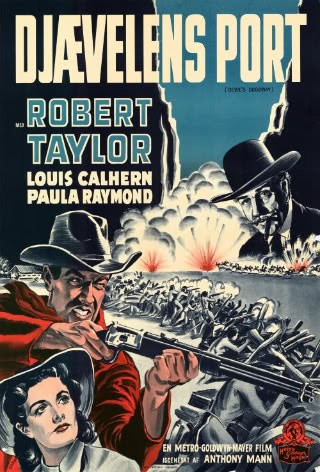
Devil’s Doorway

poster229

Before 1950 the injustices visited upon the Native American people were essentially ignored, or at the very least only touched on, in the cinema. However, in the space of a year two major Hollywood productions would use the plight of the Indian as their central theme. Delmer Daves’ Broken Arrow was notable for its sympathetic portrayal of the Apache, but Anthony Mann’s Devil’s Doorway (1950) went even further by concentrating on the naked and ugly racism confronting those Indians who had done their best to embrace the ways and laws of the white man. It’s a much more tragic film than Broken Arrow and consequently more powerful; the fact that this power remains undiminished even for a modern audience demonstrates just how radical a picture this must have been sixty years ago.

Lance Poole (Robert Taylor) is a Shoshone who has decided to adopt the classic American mindset i.e. looking to the future rather than dwelling on the past. Not only has he anglicized his name but he has also taken a huge leap of faith by enlisting in the white man’s army and fighting in the Civil War. Returning home to Wyoming as a highly decorated veteran (having won the Congressional Medal of Honor no less), he is full of optimism and hopes for a bright future. He’s confident that the recent horrors of the battlefield will have purged the nation of its desire for further bloodshed. However, soon after his triumphant return he has to face the fact that not everything or everyone has changed as much as he might have hoped. The old grudges and prejudices still live on in the hearts of some, notably an eastern lawyer, Verne Coolan (Louis Calhern), who’s moved to Wyoming for his health. Coolan’s snide comments are only a foretaste of what’s to come though, as the local doctor’s refusal to attend to Poole’s ailing father until it’s too late proves. While Poole busies himself building up his cattle ranch and his fortune, Coolan is angling for a chance to seize the ancestral land and teach the red man a lesson on climbing above his station in life. Coolan’s opportunity comes with the Homestead Act, which allowed for the breaking up of former tribal land into individual claims, and he encourages a mass migration of sheepmen in the hopes of forcing Poole off his land. Although Poole is  initially persuaded to hold his fire and try for a compromise by female lawyer, Orrie Masters (Paula Raymond), the scene is set for violent confrontation between the Shoshone and the sheepmen that Coolan is ruthlessly manipulating. As tensions rise, and the viewer’s outrage at the double standards and open bigotry on display similarly escalate, Poole must finally concede that his dreams of peaceful co-existence are nothing more than the foolish longings of a man too eager to buy into the glib promises of pragmatic politicians. When he dons his old uniform, with his medal proudly pinned in place, to face the same army that he once served with distinction there is a poignancy and irony that drives the message of the film home most eloquently.
£20

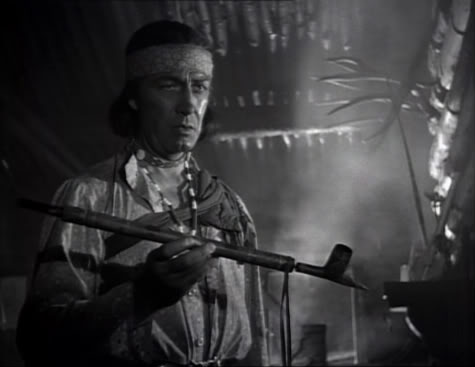
Anthony Mann had spent the 40s building up his reputation with a series of tight little noirs frequently lensed by master cameraman John Alton. Both men brought their style and sensibility to a western setting in Devil’s Doorway. Given Mann and Alton’s background it’s not altogether surprising that the movie has both the look and feel of a film noir; there are plenty of dark, shadowy scenes and an abundance of low angle shots. One scene that highlights this perfectly is the fist fight that Poole is goaded into in the saloon by Coolan and one of his cohorts. Everything is shot in the cramped confines of the bar with smoke and shadow blending together as the two men hammer each other savagely – there’s no musical accompaniment to distract from the sound of the punches landing, and the quick cutting alternates between the increasingly battered faces of the fighters and the even more grotesque visages of the rubbernecking customers. Having said that, there’s no shortage of more traditional genre imagery either, and Mann demonstrates a breadth of vision and skill with large-scale action scenes that would be further developed in both his later westerns and epics. For me, Robert Taylor was convincing as the Shoshone warrior caught between two camps. He injected a huge amount of humanity into the role of Lance Poole and produced a fully rounded character that transcended the “noble savage” caricature. I guess the black and white photography helps, but I never caught myself thinking that this was just a guy in dark make-up playacting. Louis Calhern also did sterling work as the slimy lawyer who uses convenient statutes as a means of disguising his own prejudices. Paula Raymond was good enough as the woman caught in the middle, but the script shies away from depicting an all-out romance with Poole – the movie was in all honesty already pushing the envelope as far as could be expected for the era. I might also mention the strong support particularly from Spring Byington and Edgar Buchanan.

Currently, there are only two editions of Devil’s Doorway available on DVD. There is an MOD disc from the Warner Archive in the US and a Region 2 pressed disc from Warner/Impulso in Spain. From the perspective of international customers neither one is ideal – the US disc being both expensive to acquire and on potentially suspect media, while the Spanish release is exclusive to El Corte Ingles for who knows how long with the attendant shipping costs. I viewed the Spanish disc, and the transfer is generally a strong one with good contrast and detail. However, it is unrestored and there are the usual scratches, nicks and blemishes – though never to the point of distraction. There is English and Spanish audio with removable Spanish subs. The disc comes in a slip case with a 34 page booklet, in Spanish naturally, that contains a very nice selection of still photographs and original advertising material. When one considers the development of the western, and the career of Anthony Mann too, this is an important title. As such, it’s disappointing that it should be marketed so restrictively on both sides of the Atlantic. However, the Spanish disc does at least afford the film a degree of respect that’s lacking in the US release. Devil’s Doorway seems to have got lost between Mann’s earlier noir pictures and his subsequent psychological westerns, but it actually acts as something of a bridge. It’s a film that’s intellectually and emotionally satisfying while it also provides solid western entertainment. Recommended.
The Tin Star

zufohaj

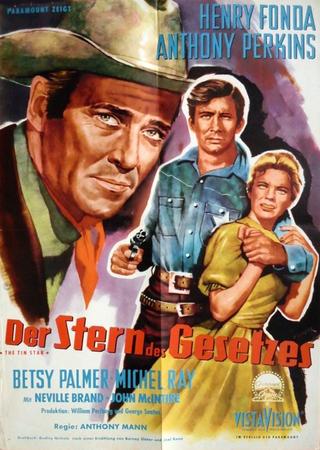
The westerns of Anthony Mann are generally among the highest regarded in the canon. It’s therefore a little odd that one of the movies he made during his purple patch in the 50s is frequently overlooked when his work is discussed. However, this certainly seems to be the case with The Tin Star (1957). I think this may be partly due to one of the casting decisions and, to a lesser extent, to the ending that is just too upbeat and out of touch with the events that preceded it.

The dominant theme in The Tin Star is justice: the definition, mechanics and importance of justice in a frontier environment where civilization was still in its infancy. Parallel to this is the theme of maturity; the need for a man to learn judgement from those who have gone before, and by extension the need for a new society to learn from the past and thus achieve maturity. Ben Owens (Anthony Perkins) is a young sheriff who’s so green he’s unlikely to hold the position – or indeed stay in one piece – for long if someone doesn’t come to his aid fast. His saviour turns up in the unlikely guise of a professional bounty hunter called Morgan Hickman (Henry Fonda). When Hickman rides into town to deliver a corpse and collect the bounty he finds the sheriff in the back of his office practising his draw, looking for all the world like an overgrown schoolboy playing at being a grown-up. The truth is Owens isn’t much more than a juvenile when it comes to law enforcement and has only got his job because no one else wanted it. That’s not strictly true, there was one other candidate – local loudmouth and rabble-rouser Bart Bogardus (Neville Brand). Sooner or later a confrontation between Bogardus and Owens will have to take place, and it falls to Hickman to tutor the young lawman in the art of reading men and facing down threatening situations.

Along the way we learn more about the enigmatic Hickman; he too was once a sheriff before the callousness and hypocrisy of his employers drove him out of the job. Owens is danger not only of becoming the victim of Bogardus’ desire for his badge but also of suffering the same fate Hickman once did. The murder of one of the town’s prominent citizens leads to the capture of two outlaw brothers and the organisation of a lynch mob by Bogardus. It’s at this point that the townsmen show their true colours and, reminiscent of High Noon, turn tail and abdicate all responsibility for justice or law. There’s also a nasty undercurrent of racism running through this settlement, personified by the bullying and hate-filled Bogardus but tacitly accepted by the so-called pillars of society too. The two prisoners are stated to be half breeds (and almost damned for that reason alone) and the woman who Hickman’s been lodging with is an outcast due to her having married an Indian and borne his child. The fact that the movie ends on such a positive, optimistic note after Owens has had to prove himself to the craven and distasteful inhabitants of his town strikes a false note.

£18

Anthony Mann mixed up the location and studio work to good effect and produced a western that’s full of important ideas punctuated with the occasional burst of violent action. There are some nice stylistic touches too, such as the climactic duel with the loser falling back into the camera. At the beginning I mentioned what I felt were the two biggest flaws with the film; I’ve already alluded to the unsatisfactory ending, but the casting of Anthony Perkins in the central role of the naive young sheriff didn’t work for me. It’s understandable that an actor was required who could be convincing as a nervy greenhorn lacking in self-confidence, but Perkins does that so well that his later development into a competent town tamer just jars too much. Neville Brand played Bogardus as some kind of malign force of nature, bellowing and bullying his way to the head of a bloodthirsty mob. Again he nailed this perfectly, so much so that it’s really stretching credibility to have the slight figure of Perkins striding across a night time street to slap him into galled submission.

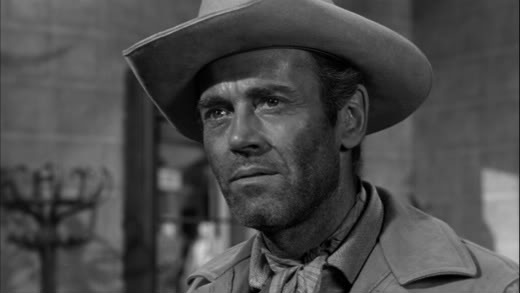
Henry Fonda was always at home in western roles and Morgan Hickman is another of his top class performances. He manages to invest some genuine sadness and melancholy into the role of a man who’s lost his family and seen his ideals bruised. There’s tenderness on view too, especially in the scenes where he interacts with the half Indian son of his landlady, and to round it all off he has the necessary mettle to be believable as a bounty killer. It’s also worth noting that while the bounty hunter came to be seen as a staple of the genre (particularly with the rise of the spaghetti western), that certainly wasn’t the case in 1957 and Fonda’s role was something of an exception.

The Tin Star is a Paramount property, and their R1 DVD provides a handsome 1.78:1 anamorphic presentation of the movie. The image is strong and clean with good contrast but the disc itself is totally barebones. Anthony Mann made better known, and indeed better, films than this but it’s still a remarkably strong western that’s only let down by the softened climax and less than convincing character arc of Perkins’ sheriff. It could have offered a scathing critique of a society that would rather pass on the dirty work of law enforcement to those it can then despise (and it does flirt with the notion) but bottled out in the end. Still, Mann’s direction of the material can’t be criticised and Fonda’s powerful performance anchors everything firmly. All things considered, there are more positives than negatives on show and this is a film I would definitely recommend.

A Dandy in Aspic

poster19

Anthony Mann’s career as a director could be divided into three broad phases; his noirs of the forties, his westerns of the fifties, and his epics of the sixties. I think it’s fair to say that he mastered all of these and brought something new to each. A Dandy in Aspic (1968) would be his first Cold War spy thriller, although ironically it would also be his last film and he died before it was completed. Had he lived, I think it’s unlikely that he would have embraced the genre if this film is anything to go by. All told, it’s a tired, glum effort which offers nothing fresh; it falls back on endless cliches and tries to be too clever for its own good.

It opens brightly enough with a nice credits sequence featuring a puppet dancing on a string to the accompaniment of a cool Quincy Jones score. Alex Eberlin is a British spy who we are informed is a remote, sexless snob. Personally, I found this tidbit of information superfluous as the part was being played by Laurence Harvey, and those are the very words that spring to mind when I think of him. It turns out that Eberlin is really a double agent and a KGB assassin who has been living in Britain for twenty years but longs to return home. However, his controllers don’t want him to return just yet since he’s been performing well enough for them. A bigger problem for him, though, is the fact that his superiors in British Intelligence want him to take on a new task. They have grown weary of their operatives being knocked off and Eberlin is handed the job of eliminating the assassin, in other words eliminating himself. To this end, he is packed off to Berlin in the company of another agent, the openly hostile Gatiss (Tom Courtenay). There follows a series of confusing double-crosses, shot against a drab looking Berlin cityscape, until everything winds down to a vaguely unsatisfying twist ending. Along the way, there is time for a romance with an English photographer, Mia Farrow. I’m not quite sure what purpose this relationship is supposed to serve other than to add some swinging sixties atmosphere – if it’s supposed to help the viewer to connect with these characters in some way, then it fails.

The movie is essentially hamstrung with the casting Harvey and Farrow. Harvey’s role is hardly a sympathetic one to begin with as he shows no remorse for his betrayals, and he kills and uses people simply to preserve his own hide. On top of this, he was the kind of actor who could make the furniture around him seem interesting, those pinched facial reactions conveying all the intensity of a mild case of indigestion. Farrow is just vacant, although, in all fairness, she’s handed such a non-role that there’s no real opportunity to do anything with it. Tom Courtenay’s embittered, and belligerent Gatiss is better but it’s still pretty much a one note performance. He gets to stump around on his cane (which doubles as a rifle – shades of Bond amid all the dourness) and spit out his lines with a perpetual scowl on his face but there’s never any explanation for his anger. Lionel Stander has a clownish part as the cigar chomping KGB man in Berlin, and John Bird does his patented mugging act that will be familiar to anyone who’s ever seen a Rory Bremner show. Oh, and Peter Cook (who always seemed to find himself funnier than I ever thought he was) pops up for a small yet irritating role. One of my biggest regrets was that Harry Andrews wasn’t given more to do than chair a claustrophobic briefing session.

There are some interesting shots in the film which illustrate Anthony Mann’s good eye for strong composition, and there’s a nice set piece climax at a motor circuit, but they’re not enough. The plot is close to incomprehensible with all the twists and turns it takes and, in the end, it falls between two stools by trying to marry the grim aspects with too much contrived buffoonery. I think one’s fondness or lack of it for this film may come down to one’s level of tolerance for the performers involved, and I think I’ve made it clear enough where I stand. Basically, I feel I’ve seen all this done before and better but, if you’re a fan of this type of story or any of the actors, it is worth a look. For myself, I only wish Anthony Mann had signed off on a better note.

A Dandy in Aspic is available on DVD in R2 from Sony in a barebones edition, but it does have a pretty good anamorphic scope transfer.


Winchester 73

Down through the years there have been a number of significant collaborations between directors and actors, such as Ford and Fonda, Ford and Wayne, and Huston and Bogart. In 1950 another such partnership was born, that of Anthony Mann and James Stewart. Their work together was to change the direction of both their careers, and produce some of the best cinema of the decade. Anthony Mann had made his reputation with a series of fine noirs in the last half of the 40s, but he had never done a western. James Stewart’s name had been built on the light leading man roles he excelled in before the war; with the exception of the comedic Destry Rides Again he was another relative stranger to the Old West. However, as a result of the success of Winchester 73 the names of both men would be forever linked to the oldest genre of them all. They went on to make eight films together, five of them westerns.

The story concerns Lin McAdam (Stewart) who arrives in Dodge City on July 4th 1876 and enters a sharpshooting contest presided over by none other than Wyatt Earp (Will Geer), Virgil Earp and Bat Masterson. The contest’s first prize is the famous rifle of the title, and it soon comes down to a run-off between McAdam and Dutch Henry Brown (Stephen McNally). There’s clearly a history of bad blood between the two men, and when McAdam wins it’s not long before Dutch Henry robs him and makes off with the gun. The film then chronicles McAdam’s search for his stolen rifle, and his pursuit of the man who took it. But that’s really only a plot device, a kind of Hitchcockian McGuffin – something of greater significance to the characters than it is to the audience. While the gun is admired, valued and coveted by everyone who comes across it, it is not the sole, nor even the most important reason for McAdam’s dogged quest. This is a dark tale of revenge and the settling of old scores and, despite the dropping of a number of hints, the cause is not stated explicitly until the end.

James Stewart’s pre-war career consisted mainly of Mr Nice Guy roles, while the years following his return found him floundering around in search of a niche. Although It’s a Wonderful Life and Rope offered him roles with a greater complexity, Lin McAdam was a complete departure for him. This part, and subsequent ones with Mann, allowed him to display a cold ruthlessness that the public hadn’t seen before. In addition, he seems so completely at home in the saddle that it’s hard to believe this was his first serious western character. The film boasts a marvellous cast of character actors and up and coming talent: Stephen McNally and Dan Duryea (playing Waco Johnny Dean – lots of exotic character names in this movie) as villains, Shelley Winters as a luckless saloon girl, Millard Mitchell, John McIntire, Jay C. Flippen, and early parts for Tony Curtis and Rock Hudson.

The character of Wyatt Earp is really only incidental to the story here. His appearance is limited to the first twenty minutes or so and doesn’t add much to the narrative. Earp was an assistant marshal in Dodge at around the time the story takes place but the film suggests he was the principal lawman in the city. Will Geer portrays him as a folksy, down home type which seems at odds with the popular conception of the man. When McAdam challenges his authority early on, he fumbles around in his vest pocket for his tin star before almost sheepishly revealing his identity. One would have expected the real Earp to have kicked the upstart’s butt up and down the street.

Winchester 73 is a Universal release on DVD in R1 and R2, and it’s a fine looking disc. Not only is the transfer clean and tight, but there’s one fantastic extra. The film comes with a feature length scene specific commentary by James Stewart. I’m not usually one who gets too excited by extras in general, especially commentaries – but this kind of stuff is cinematic gold dust. Most of the stars of this period were long gone by the time the idea of recording commentaries occurred to anyone, so this is one to be treasured.