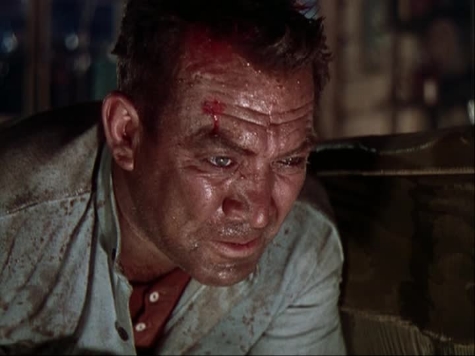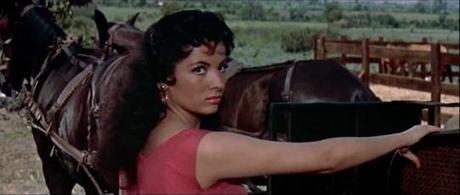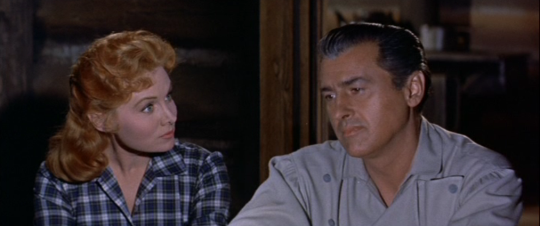
Shake Hands with the Devil

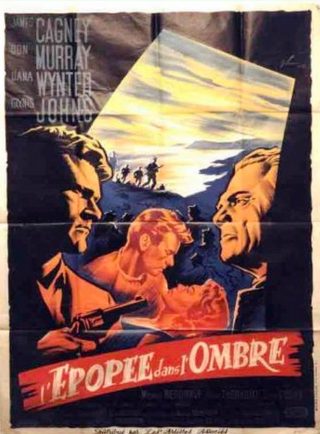
The conflict in Ireland has provided the backdrop for a number of quality movies over the years, and I’ve covered a few of them on this site: Odd Man Out & The Gentle Gunman. Those two films dealt mainly with the smaller mid-century campaigns in Northern Ireland or around the border. Shake Hands with the Devil (1959) steps a little further back to the early 20s and the War of Independence, concentrating on the south of the country. The “Tan War”, so named after the involvement of the British irregulars recruited to strengthen the RIC, remains an emotive subject in Ireland due to the atrocities perpetrated against the civilian population. I can clearly remember people of my grandparents’ generation, who lived through those turbulent and violent times, speaking with undisguised venom about the Tans. The film under examination here reflects that hostility, but doesn’t shy away from depicting the implacable fanaticism that characterized some elements within the Irish rebel movement at that time either.

The prologue makes it clear that the Ireland of 1921 was a country in a state of war. The opening then takes place in a Dublin cemetery where a solemn funeral procession makes its way along paths lined with tombstones. Suddenly, a squad of Black and Tans appear and the cortege scatters amid the jarring sound of gunfire, leaving behind an upturned coffin spilling its load of rifles. This brief scene succinctly illustrates the nature of the war being fought: a covert organization facing off against a determined and ruthless enemy. The most interesting films dealing with the Irish conflict feature those caught somewhere in the middle, dragged into the fighting in spite of themselves. Kerry O’Shea (Don Murray) is such a man, an Irish-American studying medicine in Dublin in fulfillment of his late mother’s wishes. O’Shea happens to be visiting his parents’ grave when the Tans’ raid takes place, and he will find himself drawn deeper into the war as the story progresses. O’Shea’s father had been an old-time republican and he had fought in WWI himself; as such, we see a young man who has had his fill of killing. Still, circumstances don’t always allow a man to follow the path he would prefer – sometimes just being in the wrong place at the wrong time alters the course of a life. This is what occurs with O’Shea; he is walking along a street when an IRA ambush leads to the shooting of his friend and the subsequent leaving behind of his notebook at the scene during his flight from the violence. A direct consequence of this is the revelation that O’Shea’s lecturer and eminent surgeon Sean Lenihan (James Cagney) is a commandant in the IRA. As O’Shea, now regarded as a suspected terrorist, goes on the run, the combination of the brutality of the Black and Tans and the fact that Lenihan once saved his father convinces the young student that his place is standing shoulder to shoulder with the rebels. Yet despite O’Shea’s belief in the essential nobility of his cause, he becomes increasingly disturbed by the harsh, fanatical side of Lenihan. This feeling of unease is further strengthened when Lenihan’s customary dislike for and distrust of women is magnified after the taking of an important hostage; Jennifer Curtis (Dana Wynter), the daughter of a high British official, is abducted in reprisal for the imprisonment of an elderly republican sympathizer. Lenihan’s near pathological hatred of the young woman, and his keenness to see her executed, may prove the ultimate test of O’Shea’s loyalty.

Politically, Shake Hands with the Devil wears its heart on its sleeve, and makes no bones about its critical appraisal of the role of the Black and Tans in Ireland. The Tans are explicitly cast as the villains of the piece, their commander being portrayed as a quasi-fascist figure with a strong sadistic streak. The way O’Shea’s interrogation and beating is photographed, in a highly subjective manner, emphasizes the cold brutality of his tormentor. However, if there is a sustained effort to romanticize the rebels – most notable in the characterizations of Cyril Cusack, Michael Redgrave and Sybil Thorndike – it needs to be pointed out that we’re not looking at a whitewash job either. The internal discipline mechanisms of the IRA are shown in all their toughness, and the unyielding aspect of what would become the anti-Treaty forces – as represented by Cagney – is one of the major themes of the film.

Michael Anderson was a director capable of great visual flair – I’ve commented in the past on the Hitchcock-style touches present in a couple of his films – and Shake Hands with the Devil offers further evidence of his eye for interesting compositions. Aside from having a knack for capturing the correct mood, he staged and shot the action sequences very fluidly.  The early part of the movie was shot on location in a mean and moody Dublin, all expressionistic shadows and dripping in noir atmosphere. Later, the action moves out of the city to Bray and the coast, and again Anderson, aided by cameraman Erwin Hillier, makes the most of the windswept seaboard. The use of the lighthouse, where the rebels have set up a makeshift headquarters, gives a nice claustrophobic feel to the scenes where Dana Wynter is held captive. Generally, the authentic locations contribute to the sense of realism and, while the script does meander a little in the middle, Anderson’s assured and inventive direction holds the attention throughout.
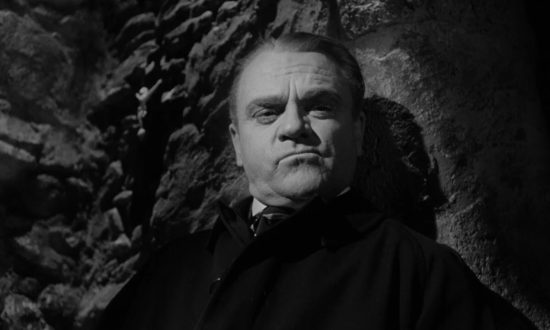
What can one say about James Cagney? From gangster to song and dance man, and just about everything in between, he was and remains one of the greatest Hollywood stars ever. Shake Hands with the Devil was one of his last films before entering a retirement that he refused to be persuaded out of for over twenty years. The film saw him surrounded by top class performers and expert scene stealers, yet it’s Cagney who carries it and he’s the one who sticks in your mind. The tough little New York Irish pug had been strutting and swaggering across the screen for thirty years by that time and his presence was such that it positively demanded you sit up and pay attention. He was always an actor capable of great intensity, although there was always a liberal sprinkling of charm and humor just below the surface too, and he honed and perfected that quality over the years. The part of Sean Lenihan gave Cagney a chance to flex his not inconsiderable acting muscles; it’s a complex role where the character alternates between a sympathetic, gutsy figure and a dangerous obsessive with deep and dark personal issues.

Cagney was certainly the name at the top of the bill, but there was a long list of talented and big name performers filling the other roles. Michael Redgrave was credited simply as The General, a character who seems to have been based on the real life Michael Collins. Aside from a moment of ruthlessness, Redgrave imbues this man with a sense of dignity, nobility, and just the appropriate touch of tragedy. There’s also an excellent turn from Cyril Cusack as the poet turned revolutionary who befriends the lead; it’s a thoughtful performance and a pivotal one, anchoring the film and acting as a bridge between the driven Cagney and the more reluctant Murray. Frankly, Don Murray was handed something of a thankless task when he had to square off against such a battery of talent. Having said that, Murray is good enough and, while he hadn’t the same depth of experience as some of his co-stars, acquits himself very well indeed. Richard Harris would of course go on to great things and his part as one of the more thuggish and self-absorbed rebels was an early opportunity to show what he was capable of. As for the women, Glynis Johns and Dana Wynter have the meatiest parts. Johns was the loose and brassy barmaid while Wynter was the demure and well-bred gentlewoman. Both actresses were convincing and quite touching in these contrasting roles, coaxing the best and worst from the male characters. As has already been stated, the supporting players in this movie makes for impressive reading: Sybil Thorndike, Niall MacGinnis, Harry H Corbett, William Hartnell, Ray McAnally, John Le Mesurier, Allan Cuthbertson and Noel Purcell.

Shake Hands with the Devil is available on DVD in the UK via Metrodome. The film is presented in Academy ratio, which can’t be right for a 1959 production. I did try zooming to around 1.66:1 at a number of points and the image generally looked fine so I guess we’re looking at an open matte transfer here. Leaving aside the matter of the aspect ratio, the transfer isn’t bad in other respects – print damage is minimal and contrast levels and sharpness all look acceptable. The only extra features on the disc are a handful of trailers for other Metrodome releases. Regular visitors to this site will be aware that I try to highlight movies that aren’t always widely acclaimed. Naturally, some are of better quality than others and I feel comfortable in asserting that Shake Hands with the Devil really is something of a forgotten gem. It’s an interesting film from a historical perspective, focusing on a conflict and period that doesn’t get a lot of attention. Michael Anderson’s smooth direction is very attractive with the imagery frequently reminiscent of film noir. Add in some excellent acting and complex characterization, especially from Cagney, and we’re talking about a first-rate thriller.
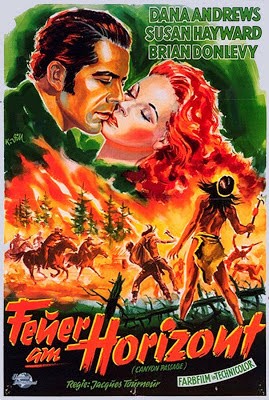
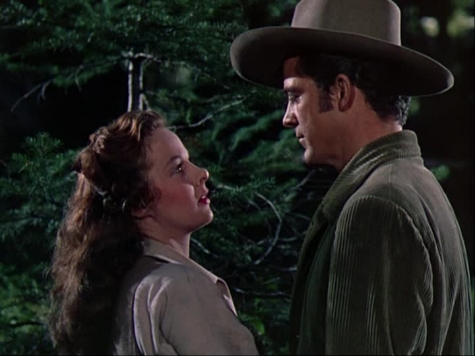
Canyon Passage

poster10_zps537a0a41

The western is a genre which, although it’s certainly not the only one, is sometimes accused of being overburdened by clichés.  This is understandable enough; genre pictures by definition have to feature elements that are immediately recognizable to viewers. Canyon Passage (1946) could be said to contain its fair share of these well-worn tropes (crooked financiers, restless wandering types, hostile natives) but part of what raises this film up among the best examples of the genre is the way they are handled. There’s an  air of authenticity about it all, and that filters through into some stock characters and situations, bestowing on them an originality that sets the whole production apart.

While I don’t have any statistics at hand to prove this one way or the other, I reckon it’s safe to say most westerns take place within a rough thirty year period beginning at the outbreak of the Civil War. Sure you’ll get examples set both before and after these dates, but they do appear to be slightly thinner on the ground. Canyon Passage tells a tale of Oregon in 1856, a time of growth and expansion before conflict engulfed the nation. Logan Stuart (Dana Andrews) is one of those thrusting, entrepreneurial types, never satisfied with what he has and always on the lookout for new opportunities to add to his fortune. Still, he’s not a greedy or grasping man; his ambition is just an integral part of his character, a restless need to range further and in some ways a reflection of the pioneering spirit of his country. Stuart is a man who is going places in every sense: his business is booming, he’s respected within the community and he’s courting Caroline Marsh (Patricia Roc), a beautiful English settler. However, there’s almost always a fly in the ointment, two in this case. The biggest and ugliest comes in the shape of the brutish Honey Bragg (Ward Bond), a muscle-bound giant of a man and an amoral counterpoint to Stuart. A further source of anxiety is George Camrose (Brian Donlevy), the local banker and Stuart’s best friend. Camrose is a compulsive gambler, a dangerous trait in a financier in any circumstances but doubly worrying when he’s caught in a run of spectacularly bad luck. While Camrose attempts a precarious balancing act his fiancée, Lucy Overmire (Susan Hayward), is increasingly  attracted to Stuart. Granted none of this is making his life any easier, but it pales into relative insignificance in comparison to the physical threat represented by Bragg. The hulking bully is borderline obsessive in his rivalry with Stuart, further enraged and embittered by his knowledge that his foe had (and passed up) the opportunity to see him hang. Fueled by hate and frustration, Bragg gives in to his animal instincts and thus imperils not only Stuart but the whole community when his base behavior sparks off a tragic Indian uprising.

£3

Adapted from a novel by prolific western author Ernest Haycox (Stagecoach, Union Pacific, Bugles in the Afternoon, Man in the Saddle etc) Canyon Passage was the first foray into the genre for director Jacques Tourneur. The versatile Frenchman took to westerns right from the beginning, crafting an intimate portrait of frontier society that comes close to the affectionate and mythic vision of John Ford. Cameraman Edward Cronjager captured some truly beautiful and breathtaking Technicolor images that Tourneur then directed with an expert touch. The sequence of the cabin raising is an ode to communal effort and gives a real sense of how inextricably linked the lives of these people were to those of their neighbours. Everything in the movie – the texture of the buildings, the condition of the streets, the language and attitudes of the characters – smacks of a realism that isn’t always present. However, the movie is more than a celebration of pioneering spirit and the social dynamic of the time. Above all, Tourneur was a master of atmosphere and an extraordinarily subtle, understated director. There is plenty of rousing action accompanying the narrative, and again the authentic feel comes across in the depiction of the violence. No doubt Tourneur’s experience working in Val Lewton’s horror unit at RKO shaped his approach to filming the more horrific scenes. There is very little explicit violence shown on screen, the director preferring to cut away or obscure the more visceral moments. Yet the effect, as was the case in those Lewton movies, is to force the viewer’s imagination to take over. In my opinion anyway, having to visualize the acts just off screen is more unsettling than seeing some unconvincing mock-up.

With strong source material and first class people operating behind the cameras, the final vital ingredient is the performers. Dana Andrews produced another of those deceptively quiet turns as Logan Stuart. Initially, you’d be forgiven for thinking this man was no more than a hard-nosed and pragmatic businessman. However, as the story progresses, Andrews, as he so often did, reveals new layers to the character. His early scenes with Patricia Roc hint at a tenderness of heart not apparent from his stoic visage, and this aspect is further developed as his relationship with Hayward grows. But really it’s his loyalty to Donlevy that proves how deep his humanity runs. Although Donlevy was of course a great heavy in countless movies, I wouldn’t actually class his George Camrose as a fully fledged villain. Despite some thoroughly reprehensible behavior, Donlevy brought a weakness and frailty to the role, a touch of corrupt romanticism if you like, which helps explain why Andrews stuck by him all the way. No, the real bad guy here comes courtesy of Ward Bond’s portrayal of the monstrous Honey Bragg. Bond did a fantastic job in capturing the physical power, the depravity and animal cunning of this figure. The two main female roles – those of Patricia Roc and Susan Hayward – are careful studies of contrasting women. Roc had the right kind of brittle gentility for an Englishwoman suddenly thrust into a new and dangerous world; her dazed and distant reaction to the aftermath of the Indian massacres struck just the right tone. Hayward, on the other hand, was feisty, tough and earthy – a true frontier gal. In supporting roles, there is some good work from Lloyd Bridges, Andy Devine, Onslow Stevens, and the wonderful Hoagy Carmichael.

£4

Canyon Passage is a Universal film, and there are plenty of DVD editions on the market from a variety of territories. I have the version included in Universal’s Classic Western Round-Up Vol. 1 which was released a number of years ago. The film shares disc space with The Texas Rangers but I can’t say I was aware that the presentation suffered from any compression issues. For the most part, the image is very strong with the Technicolor cinematography looking frankly spectacular at times. There are no extra features whatsoever available on the disc, something I think is disappointing as the movie is most certainly deserving of a commentary track at the very least. Regardless of that, this movie remains among one of the very best westerns made in the 1940s. Jacques Tourneur would go on to make a number of high quality pictures in the genre, though I feel this represents him right at the top of his game. There’s a complexity and maturity to the characters and their interactions that help distinguish the movie. Not only would I recommend Canyon Passage to anyone with an interest in westerns, I would go so far as to say it’s essential viewing.


The Last of the Fast Guns

I’ve met a lot of men in my time. A woman they forget, a mine busting with gold, even the faces of their own children. But I’ve never met a man who forgot a grave he dug.

The Last of the Fast Guns (1958) is set mostly in Mexico, and as a result it belongs to a smallish group of westerns that transplant their heroes south of the border. Generally, these films involve men searching for something or someone. In this case, the hunt is ostensibly for a man, but the reality is that the hero is on an altogether different quest – as he chases after shadows and memories he’s actually trying to pin down a kind of inner peace, looking to come to terms with his own demons and violent nature as the country changes around him.

The opening is stark, brutal and a little shocking in its cold abruptness. The first image we see is a cemetery with a freshly dug grave, and a man quietly riding away from it. At first glance, this scene has an almost supernatural quality, as though the rider has just risen from the earth before mounting up and moving off. However, the truth is that Brad Ellison (Jock Mahoney) has been making preparations, quite literally doing the spade work before heading off to find an occupant for that new grave. He enters the neighboring town and calmly guns down an unnamed man in a brief duel. Right away we know the type of character we’re dealing with, a man of few words with a dangerous reputation that can make him a fortune but is also something of a curse. No sooner has he removed a threat than he’s presented with a proposition: head over the border and track down a man named Forbes. The reason is Forbes’ brother is a wealthy man in poor health and wants to find him to avoid his estate passing on to a treacherous partner. The thing is men like Ellison don’t get hired unless there’s a high risk factor, and the disappearance of two previous messengers is testament to that. Forbes is an elusive figure, someone who’s spoken of in hushed, almost reverential and awed tones, and his shadowy, spectral presence hangs over the picture. Ellison’s mission brings him into contact with four people: Michael O’Reilly (Lorne Greene), his daughter Maria (Linda Cristal), his foreman Miles Lang (Gilbert Roland) and an old padre (Eduard Franz). These four, in different ways, have a powerful effect on Ellison, shaping his destiny as they help and hinder his efforts to catch up with the mysterious Forbes.

The Last of the Fast Guns is a very interesting piece of work from director George Sherman. It’s one of those late 50s westerns that is very much in the classical mold, but also looks forward to and anticipates some of the trends that would surface in the following decade. The dialogue is terse and economical, rapped out with the kind of staccato rhythm that wouldn’t seem out of place in a film noir, and loaded with existential undertones. The hero is much more of an anti-heroic figure than one typically associates with the 50s – the black clad, mercenary Mahoney recalling Burt Lancaster’s grinning rogue form Aldrich’s Vera Cruz, but not quite achieving the amorality that would characterize the bounty killers peopling many 60s westerns. In a sense the link here is not so much with the approaching spaghetti westerns as the regretful nihilism of Peckinpah. That aspect was reinforced for me by an early scene which sees Ellison stopping off at a type of outlaw refuge when he’s just entered Mexico. This is a lovely interlude as he sits around with James Younger and Johnny Ringo, reminiscing about the past and lamenting the passing of Jesse James and Billy the Kid. For all that, The Last of the Fast Guns is at heart a classic 50s production, concerning itself with notions of rebirth and redemption. And that brings me back to that haunting opening. Ellison can in fact be seen as something of a resurrected soul, a man striving to leave death behind him, to achieve or earn his place among the living. Perhaps it’s telling too that, like in The Wonderful Country, the implication is that this can only be realized in Mexico.

Former stuntman Jock Mahoney is probably best known for playing Tarzan, but he made a number of good westerns from the mid to late 50s. I guess it’s fair to say he wasn’t the most expressive actor around but he did have a lot of physical presence and was a good fit in westerns. His laconic style works very well here where he’s taking on the role of a tough gunman and killer. In complete contrast – even down to the predominantly white costume – Gilbert Roland is typically swaggering and arrogant. Roland cuts a much more ambiguous figure, leaving the viewer guessing for long periods of time just whose side he’s really on. Together, Mahoney and Roland balance each other out and their friendship/rivalry is one of the most attractive parts of the film. The casting also has a strong television connection: Lorne Greene being forever associated with Bonanza and Linda Cristal evoking memories of The High Chaparral for me at least. Personally, I don’t feel Ms Cristal had a huge amount of screen chemistry with Mahoney, although there is just about enough there for her role as his spiritual savior to work.

As far as I’m aware there are only two DVD editions of The Last of the Fast Guns available at present, from France and Spain. I have the Spanish release from Llamentol (currently on sale at a fairly good price here) which presents the movie in anamorphic scope and clearly comes from a strong source print. As is usual with this company’s releases, there are no extra features on the disc and subtitles can be removed via the main menu. I reckon a lot of George Sherman’s work is underrated and there’s a rich selection of material waiting to be mined for those unfamiliar with him. The Last of the Fast Guns is a good example of Sherman’s deceptively relaxed filmmaking style. The movie is a visual treat, runs for a lean 80 minutes and has a lot more depth than you might expect. Recommended.

Will Penny

It’s just a case of too soon old and too late smart.

Choices and chances – life offers its fair share of both to all of us as it meanders along, and the way we react to them is frequently determined by timing. This could be regarded as no more than everyday stuff, but all good drama has such apparently mundane concerns as its foundation. In fact, the best examples of drama all have a timeless quality, containing some basic truth that transcends their age. Westerns, one could argue, are very much rooted in the time period they depict. Again though, the best western movies have at their core a theme that goes beyond time and place, one which addresses contemporary issues while also remaining relevant to modern life. Will Penny (1968) is one such film, focusing on a set of circumstances arising directly from its Old West setting, and also speaking to audiences of matters that are constants of the human condition.

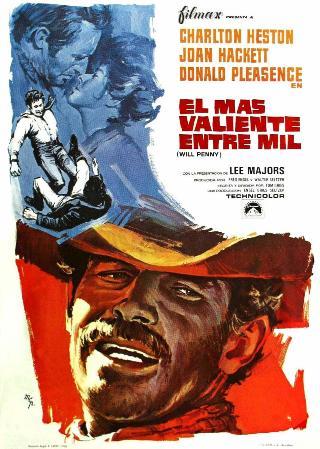
Will Penny is a film that can be approached, and which works, on three different yet interrelated levels. It’s an absorbing adventure, an examination of a way of life approaching its twilight stages, and a tale about the power and promise of human relationships. Will Penny (Charlton Heston) is the archetypical western hero, a man alone, a self-reliant and capable character shaped by the landscape he occupies and the job he does. But Will is a man who’s growing old and, like the frontier itself, is fast approaching a point where he is going to be consigned to the past – tellingly, he’s the only rider at the end of the round-up who is illiterate to the extent he has to sign his name by marking a crude X in the ledger. Whatever the reality may have been, the fictional cowboy has always been a figure of nobility, a kind of latter-day knight bound by a personal code of honor. The first example of this, and also the first of a number of fateful decisions taken, comes when Will passes up the opportunity to move on to Kansas City and continued employment to make way for a younger man who wants to see his ailing father. Instead, Will sets off with two companions (Anthony Zerbe & Lee Majors) with only the slimmest of hopes of finding work to see them through the winter. In the course of their journey two significant events occur, one leading on directly from the other. Firstly, a fatal misunderstanding over the shooting of an elk sparks a feud with a crazed old man, Preacher Quint (Donald Pleasence), and his degenerate family. This violent encounter leaves one of the men seriously wounded, and necessitates a stopover at a remote swing station. It’s here that the seeds of the second, and more interesting strand, of the story are planted. Catherine Allen (Joan Hackett) is traveling west with her young son, and Will has his first, semi-comedic, meeting with this slightly prim woman as he tries to secure medical attention for his wounded companion. We come across all kinds of people all the time, and Will naturally thinks nothing more of it. However, having found employment as a line rider for a nearby ranch, Will chances upon the woman a second time, now occupying the cabin assigned to him for the long winter months ahead. Despite having explicit instructions to ensure that travelers must move on as soon as possible, Will lets his innate nobility get the better of him once again. His decision to let the woman and her son stay on till spring, coupled with the fact that the Quint clan remain loose and thirsty for revenge, is to have a profound effect on Will’s whole take on his life. As I said in the opening, everything boils down to chances, choices and timing.

Before 1968 Tom Gries worked extensively on television, and Will Penny – which he both wrote and directed – allowed him to break through into the cinema. It remains his best piece of work, mainly due to its authenticity. The movie captures the look and feel of its era very successfully – the loneliness, the drudgery of everyday life, and the sense of times changing fast. More significant than any of that though is the authenticity that Gries managed to draw from his characters and how they related to one another. It often feels like romantic sub-plots are injected into dramas almost as an afterthought, and consequently seem fake, forced and superfluous. Here however, the relationship that gradually builds between Will and Catherine, and her son, constitutes the beating heart of the picture. This touching and deeply affecting portrayal of lonely people glimpsing an opportunity for love and companionship is the factor that raises Will Penny up and lends it that timeless quality I referred to earlier. Historically speaking, Will Penny occupies that nebulous zone, as do many westerns of the 60s, straddling the classical and revisionist periods. The clear delineation of heroes and villains, and the focus on a kind of selfless nobility hark back to the likes of Shane and Hondo from the preceding decade. On the other hand, there’s also that melancholy feeling of a disappearing era that would be explored further in films such as Monte Walsh and Pat Garrett and Billy the Kid in the years to come.

Will Penny features a first-rate cast, and I don’t believe there’s a poor performance anywhere – Ben Johnson, Donald Pleasence, Slim Pickens, Bruce Dern, Lee Majors and Anthony Zerbe all do good work. Having said that, both Charlton Heston and Joan Hackett seem to connect with their respective roles in a way that elevates them far above those all around them. There are those who would assert that Heston wasn’t much of an actor – similarly ill-informed accusations are often leveled at John Wayne and Gary Cooper – and was more of an icon than a performer. In Heston’s case, this probably comes from his frequent casting as larger than life heroic figures. Will Penny saw him playing a simple human being though, the most reluctant of heroes, and was reportedly his favorite role. Heston gets deep inside his character here, investing him with an astonishing level of credibility. There’s genuine modesty on display, a kind of faltering fallibility about this performance that can be seen in all kinds of ways – the barely concealed shame over his illiteracy and lack of education, the physical suffering he undergoes, and his struggle to come to terms with an emotional awakening that has taken him completely by surprise. Joan Hackett didn’t possess traditional Hollywood glamor, but she too reached inside to find an inner truth that characterizes her performance. The fact that Heston was able to produce something so touching is largely down to Hackett’s playing opposite him. For me, there are two standout scenes: that sweet and beautiful business involving the Christmas tree and the boy; and the climactic scene in the cabin where Hackett and Heston bare their souls and break your heart. The resolution of the movie could be seen as a firm rejection of the standard happy ending, but that doesn’t necessarily mean it’s a downer. Personally, I like to think of it in positive terms; the overriding message for me is that there’s always hope for even the loneliest and unhappiest individuals. Whether one seizes that hope is, of course, another matter entirely.

Will Penny is a Paramount picture and the UK DVD, despite being released a long time ago now, is still a very strong disc. The film is given an excellent anamorphic widescreen transfer with natural colors and was obviously taken from a very clean print. There are two short features included on the casting and making of the film, with contributions from Charlton Heston and Jon Gries, the director’s son who also played Joan Hackett’s little boy in the movie. Will Penny probably represents Charlton Heston’s finest screen work, and the film is an immensely satisfying experience. It’s thoughtful, mature, at times exciting, and always affecting. For anyone who has yet to see the film, I recommend it wholeheartedly.

Gun Glory

gun-glory-l-malf8w_zpsixbzd7ku

I happened to be involved in an online discussion elsewhere today, and the talk turned to how certain movies can be categorized. To be specific, we were chewing the fat over those films that fall at the extreme ends of the spectrum, the great and the shockingly bad. Now I’ve long been of the opinion that few movies truly belong in either of those positions; the vast majority occupy some kind of middle ground, with some of us drawn to particular virtues that appeal to us while others are less enamored. I’ve pointed out before that I’m a little uncomfortable with the term “masterpiece”, mainly due to all its high-pressure implications, but I’m no fonder of the label “turkey” either. Anyway, all of this put me in the mood to hammer out a short piece on a film that I think it’s fair to call average. Gun Glory (1957) is what I would think of as an extremely typical film, nothing special but entertaining enough and with at least a handful of positive things in its favor.

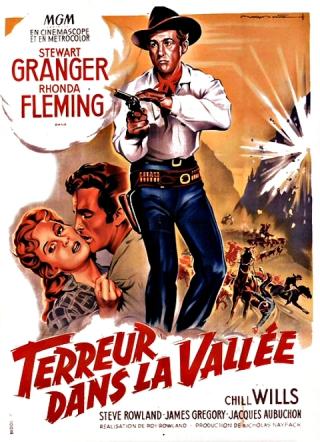
The return of the prodigal is an ancient story, although the variant in question here sees the father rather than the son cast as the errant figure. Tom Early (Stewart Granger) is a man who abandoned his wife and son, a gambler and gunman of great notoriety. The film opens with this character making his way back towards the home he has long neglected. A brief stop off in the neighboring town shows that his reputation precedes him, but his optimism remains undimmed as he happily purchases a trinket as a gift for his wife. However, his arrival at his ranch brings him down to earth and back to reality with a jolt. His son, Tom Jr (Steve Rowland), is less than impressed, and then there’s the sickening realization that the woman he once loved has passed away in his absence. Still and all, blood ties are powerful and the father and son come to a kind of edgy understanding – the wrongs and mistakes of the past can never be forgotten, but it’s human nature to try to forgive and move on. Therefore, the two men make an effort to piece together their relationship, Tom Sr being especially keen to win back the trust and respect of his son that he so casually squandered before. He even takes in a lonely widow, Jo (Rhonda Fleming), as his housekeeper in an attempt to restore something of a family atmosphere. The western genre is packed with stories of men desperate to outrun their past ans sooner or later these guys come to realize that it’s an impossible task – the past must be faced squarely and dealt with before any door to the future can be opened. In this instance, the past is represented by the arrival of a ruthless cattleman, Grimsell (James Gregory), bent on driving his herd through town and obliterating it in the process. As such, it’s both an opportunity and a challenge for Tom Early Sr – an opportunity to prove himself and do something decent, but also a challenge to his desire to leave his violent ways behind him.

gun-glory-l-gn39y3_zpst0sy4i5a


Roy Rowland was what you might call an efficient director of programmers, movies that were a cut above B pictures but just shy of being A list features. He handled a couple of pretty good westerns in the 1950s (Bugles in the Afternoon and The Outriders) alongside a very strong film noir (Rogue Cop). Films like this called for a brisk, no-nonsense style and Rowland was well suited to that kind of role. A good proportion of the action takes place indoors but there are opportunities for location work too, and the director showed that he was more than capable of composing attractive setups for the wide lens. Gun Glory, which was adapted from a novel by Philip Yordan, isn’t one of those non-stop action movies but when it does come along, Rowland shoots it well with a good sense of spatial awareness. More than anything though, this follows the classic 50s western template of a remorseful man seeking to make amends for his errors.

Stewart Granger was building on his successful western role in Richard Brooks’ The Last Hunt which had been made a year before. He seemed very much at ease in the frontier setting, showing off some highly impressive horsemanship skills in the process. In fact, it’s Granger’s strong central performance that is the greatest strength of the film. It’s clear enough that he’s playing a man carrying around a heavy burden of guilt – blaming himself for not being there when his wife died, and for failing to support his son during his formative years – but he never lays it on too thick. Still, there can be no doubt how he feels about himself; the short scenes of him visiting his late wife’s grave tell us all we need to know without the need for dull, expository dialogue. Rhonda Fleming was given a strong part in the movie as the widow who works her way into the lives and hearts of the two Early men. Her role served the important function of drawing both of these men out and helping them achieve a true reconciliation. I think it’s also worth pointing out the romance that develops between the characters of Granger and Fleming is nicely judged, mature and realistic. To be honest, I felt that Steve Rowland (the director’s son) presented one of the weak links in the film. Again, the part of Tom Jr was a pivotal one yet Rowland never felt convincing to me. As for the supporting players, Chill Wills pops up once again and gives a warm performance as the town preacher and one of Granger’s few allies. James Gregory was another of those familiar faces, a character actor many will recognize straight away, and he provided a nice foe for Granger. There’s also a semi-villainous role for Jacques Aubuchon as a crippled storekeeper with his eye on Fleming.

gun-glory-l-d2khp0_zpsxp06e7yk


Gun Glory is available as a MOD disc from the Warner Archive in the US and there’s also a Warner/Impulso pressed disc from Spain. I have that Spanish release, and it presents the film very strongly. The transfer is anamorphic scope taken from a very clean and sharp print. I can’t say I was aware of any noticeable damage and the colors are well rendered. All told, there’s really nothing to complain about on that score. The disc offers no extra features whatsoever and subtitles are removable, despite the main menu suggesting that this is not the case. Anyway, we get a very attractive looking film with two good performances  from the stars. The story itself is engaging enough, although there’s nothing on show that genre fans won’t have seen before. As I mentioned above, the direction is capable and professional without being particularly memorable. All told, this is a moderate western – interesting and entertaining but not exactly essential.

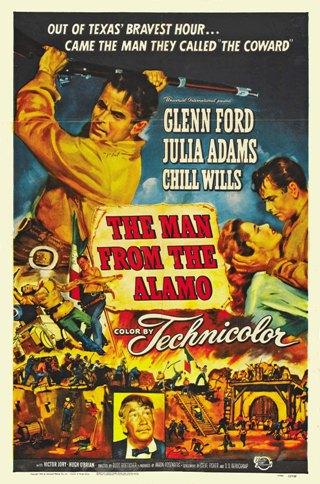
The Man from the Alamo

The worst that can happen to you is that somebody will say you died a hero. That man’s going to be called a coward the rest of his life.

That quote essentially sums up what The Man from the Alamo (1953) is all about – the way that courage can be misrepresented and misunderstood, how casual labeling can lead to blind, unjustified persecution. While this idea is central to the film, it’s mixed in with a standard revenge tale, and set against a backdrop of historically significant events. One could say there are the makings of an epic story here but, in the hands of Budd Boetticher, the end result is a short, tightly paced western that rarely pauses for breath and never outstays its welcome.

The opening section plunges the audience straight into the latter stages of the siege of the Alamo, with Travis’ volunteers holed up in the old adobe mission and Santa Anna’s forces massing for the final assault outside. These events have become part of American lore, and far beyond the borders of the US too if the truth be told, coming to represent grit, determination and heroic self-sacrifice. Occasions such as this have the potential to make legends of all involved, to see names honored for generations to come. However, as always, there’s a flip side to the coin. Where circumstances can see one man’s reputation soar, they can equally see that of another cast into the mud. Which brings us to John Stroud (Glenn Ford), one of the defenders of the Alamo and a man who has already proved his mettle in the heat of battle. It’s bad enough when news arrives that no relief will be forthcoming, but the situation is exacerbated for some by reports that enemy sympathizers are raiding the unprotected homesteads to the north. As a result, a handful of defenders draw lots to see who will undertake the thankless task of leaving the mission and heading off to take care of the vulnerable families. The dubious honor falls to Stroud, who accepts his fate and rides off into potential ignominy. The crucial point here is that the viewer knows that Stroud had no other choice, that he was simply dealt a lousy hand and could do nothing but play it. As it turns out, his gesture proves futile – the guerrillas have been and gone, leaving nothing in their wake but charred homes and shallow graves. Stroud is now a man bereft: his home and family are gone, and his name has become a byword for cowardice and dishonor among those not privy to all the details. All that is left is a thirst for revenge, a desire to track down and punish the renegades who have taken all he held dear. At best Stroud finds himself shunned by a contemptuous town, and at worst he risks a lynching by the more hot-headed elements. Yet, despite the threats and insults, he is committed to tracking down the real villains and, in so doing, redeeming himself in the eyes of his suspicious traveling companions while also coming to terms with his own feelings of guilt and shame.

A brief glance at the credits for The Man from the Alamo provides ample proof of its pedigree: Niven Busch and Steve Fisher feature among the writers, Russell Metty handled the photography, and Budd Boetticher occupied the director’s chair. Boetticher’s status rests mainly on the Ranown films, those pared down masterpieces with Randolph Scott. However, directors, like actors, don’t just arrive fully formed. When you come to examine almost any artist’s finest work, there’s generally a progression that can be traced leading up to that point. And so it was with Boetticher; the Ranown westerns may represent the peak of his achievements, but his earlier pictures were pointing in that direction. As I mentioned at the beginning, the ingredients were in place for a “big” movie. However, Boetticher, and the writers, trim away all the unnecessary flab to leave us with a lean piece that focuses on a driven character, an emotionally damaged outsider who measures words and actions carefully. That inner torment that Scott would so successfully portray a few years down the line isn’t quite so fully developed in The Man from the Alamo, but it’s there in embryonic form at least. I think it’s fair to say that Boetticher did his best work when he was out shooting on location. This film doesn’t have the benefit of the iconic Lone Pine locations yet the exteriors all look suitably handsome. Actually, a fair bit of the filming took place on the Universal backlot, and still looks attractive. The opening in the Alamo is extremely atmospheric, with the guttering candlelight creating a kind of grim claustrophobia, punctuated occasionally by the harsh flashes of the artillery. Generally, all of the action, and there’s no shortage of it, is well handled – the scene with the wagon train in full flight near the end is a good example of the director’s talent for exciting outdoor sequences.

Glenn Ford started his post-war career strongly with Gilda and built on it very successfully in the years that followed. By the 1950s he was getting better and better, and The Man from the Alamo was made at a time when he was approaching his peak. While there are plenty of good actors around him in this movie, a lot rests on his central performance. Ford’s experience working in film noir stands to him here as there’s more than a touch of bad luck and the cruelty of fate surrounding his character. He was always good in these kinds of roles – the outsider who’s vaguely uncomfortable with himself – and uses that ability to get properly into the character of Stroud. He could also, when he wanted, project a type of self-effacing affability and that helps draw the sympathy of the audience. If you’re going to tell a story like this – about a wronged man whose sense of personal and public honor is questioned – then it’s vital to have an everyman type like Ford whose real qualities are apparent to the viewer. Julia Adams was handed a strong role too as the woman who overcomes her initial skepticism to become Stroud’s main ally. Not only does she bring a lot of dignity to her part, but she handles the physical demands very well too. Every western needs a suitable villain and Victor Jory was an expert at playing cunning and ruthless types. Besides looking shifty and slippery, Jory had a voice that just oozed malevolence. Neville Brand was another of those perennial bad guys and is impressive in a small but memorable role. In support there are worthwhile turns from Hugh O’Brian as a priggish Texan officer who gets to eat some humble pie, and Chill Wills as the one-armed newspaperman forced to put his blustering prejudice aside.

I actually have two copies of The Man from the Alamo on DVD: the UK edition that came out first and the US release that came as part of a four movie set a few years later. Both are Universal releases, and there’s not a lot to choose between them regarding the transfer. Both are in reasonable condition with no major print damage evident, although the colors look a little muted here and there. The UK disc has a variety of language dubs and subtitles available, but the US version represents better value since three other films come with it. Certain names bring raised expectations with them, and Budd Boetticher is one of those. It would be unwise to approach The Man from the Alamo in the hope of seeing a movie of the quality of any of the Ranown pictures, but that doesn’t mean it’s an inferior movie. Frankly, it’s a good little western on its own terms, but it’s also interesting as an indication of the direction in which Boetticher was unmistakably moving at this stage in his career.

Two Flags West

Civil War films have a reputation for doing poor business, which is probably why the era tends to have been approached somewhat obliquely by Hollywood. There are plenty of movies which feature the war as a kind of background element, something always present in the minds of the characters yet rarely directly shown on the screen. Westerns, perhaps on geographical grounds as much as anything, often used the Civil War and its legacy mainly as a plot device to provide motivation. Students of literature, stretching right back to Aristotle, have recognized conflict as the mainstay of drama – the essential element if you like. Two Flags West (1950) is a film positively brimming with conflict, and not just the obvious Confederate/Union rivalry that is central to the story. That of course is interesting enough in itself, but it’s the personal antagonism among the leads (and indeed within their own hearts) that adds depth and substance.

Two Flags West is one of a small group of westerns – along with Escape from Fort Bravo and Major Dundee – which have soldiers of the Civil War’s two opposing sides forced to co-operate on the frontier. The story here is inspired by the proclamation which allowed Confederate POWs to gain a pardon and have their citizenship restored if they agreed to defend the frontier in the name of the Union. The controversial and divisive nature of this choice is made apparent right from the beginning, when the rebel cavalrymen under the command of Colonel Tucker (Joseph Cotten) are shown to be genuinely torn between the notion of betraying their homeland and remaining true to ideals that are slowly killing them. Faced with the prospect of succumbing to disease and malnutrition, these men narrowly vote to accept the Northern offer and move west to New Mexico where a different war is being fought. Asking a man to turn his back on a cause is one thing, asking him to turn his guns against it is entirely different. Therefore, it’s with the understanding that they will not be forced to take up arms against their former comrades that these men agree to wear the blue tunics of their enemies. The western frontier is virtually defenseless, its outposts manned by a rag-tag bunch of wounded and poorly trained troops. In contrast, the new recruits are skilled cavalrymen and hardened combat veterans.

One would think the presence of such seasoned troops would be welcomed by the men they are coming to reinforce. Indeed, that’s the early impression given by Captain Bradford (Cornel Wilde), the affable liaison officer who makes the initial offer and leads Tucker (now demoted to Lieutenant) and his men west. However, their new commanding officer, Major Kenniston (Jeff Chandler), presents a very different face. Kenniston is a man whose external wounds are as nothing compared to the scars he carries inside. Here is a tortured soul, a man consumed by hatred of the enemy, professional disillusionment and personal frustration. His open animosity towards Tucker and his men, and his frank distrust of their loyalty is immediately apparent. It’s only a matter of time before he forces Tucker’s hand by arranging for the new recruits to carry out the execution of men they later discover were actually Confederate spies. Tucker naturally sees this as a breach of the terms he agreed to, and sets in motion a plan to desert. Now, there’s plenty of dramatic conflict in play at this point, but that’s only one aspect of the story. While questions of loyalty, trust and honor are being thrashed out, there’s also the matter of the Major’s widowed sister-in-law to be considered. Elena (Linda Darnell) is a woman desperate to reach California and her relatives, but that desperation stems from her desire to escape the brooding obsession of her late husband’s brother. To complicate matters further, Bradford is clearly in love with Elena and so has an even more delicate balancing act to master. In short, this isolated fort is like a powder keg waiting to explode, and the fuse that will touch it all off is provided by the mass of hostile Indians raiding beyond its walls.

In writing about Robert Wise’s first western, Blood on the Moon, some time back, I mentioned how his time spent working for Orson Welles and Val Lewton was reflected in the imagery he used. While Two Flags West has fewer overtly noir touches, both Wise and cameraman Leon Shamroy use light and shadow very effectively, especially in the interiors. The opening scenes in the prison camp are enhanced by this technique, although the atmospheric photography can be seen all through the movie. I think the image above is a pretty good example of the artistic lighting and composition which is characteristic of this film: the grim faces of Cotten and the prisoners dominate the frame, while the shafts of sunlight stabbing through the boarded-up windows in the background suggest rays of hope and salvation reaching out to them. However, the film offers more than just moody and suggestive imagery. The climactic Indian assault on the fort is excitingly filmed and gets across the frenzied determination of the defenders facing overwhelming odds, and their consequent sense of hopelessness. Earlier, I referred to Major Dundee as another film whose plot hinged on the uneasy alliance of former enemies facing a common foe. Aside from that similarity in the basic story, it’s also interesting to note that Two Flags West foreshadows Peckinpah’s later picture by featuring scenes where both the Confederate and Union troops sing their respective songs simultaneously. As far as the script is concerned, the writers credited are Casey Robinson, Curtis Kenyon and Frank Nugent. The latter ought to be a recognizable name for anyone who is familiar with the films of John Ford – Nugent was a writer on both Fort Apache and She Wore a Yellow Ribbon. This movie doesn’t paint as intimate a picture of life in an isolated fort as Ford’s cavalry films do, but there are still some parallels to be seen.

Two Flags West is a movie with a very attractive headline cast. Despite stiff competition from his co-stars, I think Jeff Chandler makes the strongest impression. I suppose his early death is a contributory factor but I feel Chandler rarely gets much credit for his screen work these days. He wasn’t a particularly showy actor nor was he one for extravagant displays of emotion. Instead he was another of those brooding types who seemed to keep a lot locked away inside, only rarely letting his feelings bubble up towards the surface. The role of Major Kenniston was therefore an appropriate one for him. Chandler created a very convincing portrait of a man whose personal and professional failings are eating away at his soul, whose own self-loathing is weakening his judgement. Frankly, Kenniston is a martinet and there’s not much to like about him. Having said that, Chandler invests him with great dignity, and his final scene is actually quite moving regardless of how poorly he has conducted himself up to that point. Cast against such an unsympathetic figure, Joseph Cotten’s Confederate officer ought to be the one we’re rooting for. And yet, that’s not really the case either. Cotten had a knack for playing disgruntled, troubled figures, and his portrayal of Tucker taps into that. Yet there’s a kind of sly ambiguity to his role, a slippery irony about him that means we can never be entirely sure of his motives. The result is that while he may be more sympathetic that Kenniston, the viewer can’t fully get behind him. All of this means that the audience is asked to identify most strongly with Cornel Wilde and Linda Darnell. I reckon Darnell’s part is the more successful one, not due solely to her acting talents – both Wilde and Darnell turn in good performances in my opinion – but perhaps as a result of Wilde’s being absent from the screen for long stretches. Among the supporting cast, there’s are nice turns from Jay C Flippen, Dale Robertson and Noah Beery Jr.

As far as I’m aware, the only DVD edition of Two Flags West currently available is this Spanish release from Fox/Impulso. It’s one of the label’s better efforts, boasting a generally strong transfer, although there is some print damage evident, generally confined to a kind of slight ripple or blur that appears sporadically on the right side of the frame. The release is English-friendly with the original soundtrack included and optional subtitles that can be deselected via the setup menu. The extra features consist of a gallery and a few text screens listing cast & crew. Anyone looking to pick up a copy of this movie might do well to hold off a little longer though. Koch Media in Germany are due to put the title out on both DVD and Blu-ray on July 26 – it’s worth bearing in mind that Koch’s products tend to be of very good quality. I like to highlight forgotten and/or neglected films whenever possible, and I think Two Flags West fits the bill. For one reason or another, it’s not a movie one hears about too often and that’s a shame. There’s a good plot with plenty of tension and a fair bit of depth, strong performances and fine visuals. Overall, it’s an enjoyable experience and a title deserving of some renewed attention.

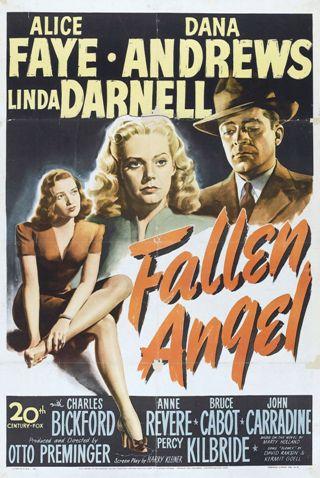
Fallen Angel

We were born to tread the earth as angels, to seek out Heaven this side of the sky. But they who race above shall stumble in the dark and fall from grace. Then love alone can make the fallen angel rise. For only two together can enter Paradise.

Film noir is primarily an urban-based style of filmmaking, and derives many of its motifs from the faceless anonymity and frequently hostile isolation that characterize big city life. However, it would be a mistake to think that noir cannot exist outside of this particular environment. There are plenty of examples of the form to be found in a variety of settings – it’s this flexibility that is one of its strengths. While the metropolitan sprawl may well offer enhanced opportunities for portraying bleak, fatalistic tales, the small town, with all its attendant possibilities, represents another fertile setting. The more limited environment may not suggest the kind of impersonal alienation of larger urban surroundings, but the sense of community that exists (regardless of whether it’s shown in a positive or negative light) has its own claustrophobic atmosphere. Otto Preminger’s Fallen Angel (1945) occupies a kind of middle ground, with the majority of the action taking place in a small tightly knit settlement but also featuring short interludes in San Francisco.

The film actually opens at a sort of geographical mid-point, one could almost say the middle of nowhere. After the credits, inventively flashed up on screen as a series of road signs seen through the windshield of a bus speeding through the night, we’re introduced to Eric Stanton (Dana Andrews), and it’s immediately obvious that this is a down on his luck chancer. Not having enough money to ride the bus any further, Stanton finds himself tossed onto the road. With just a dollar in his pocket, he’s stranded in a small town, halfway between Los Angeles and San Francisco. It’s one of those sleepy little places where everybody knows each other and there’s not much to do. Stanton wanders into the local diner, right in the middle of what appears to be some kind of investigation. The owner, Pop (Percy Kilbride), is an anxious man – his waitress has apparently gone missing and he’s clearly distressed. A local cop and a former New York lawman, Judd (Charles Bickford), listen sympathetically and offers reassurance. As Stanton orders some food, the door of the diner opens and a weary but flashily dressed young woman strolls in. This is Stella (Linda Darnell), the source of all the panic a moment earlier. What’s immediately apparent is that Stella is arguably the hottest property in town; Pop is fawning and all puppy-dog eyes, Judd looks on with something approaching warmth, and Stanton too is unmistakably drawn to her. Stanton may be down to his last buck but he’s also the consummate opportunist. Spotting an advertisement for a visiting spiritualist, Stanton talks his way into acting as the promoter for the upcoming spook show. While Stanton might seem like the cat that always lands on its feet, this latest piece of maneuvering will actually drop him right into the centre of a maelstrom of passion lurking beneath the deceptively calm surface of the little coastal town. In falling for the insolent and sensual charms of Stella, he hits upon what he thinks is the perfect plan to win her over; Stella is no fool and wants a man who is willing and able to marry her and take her out of the dead-end job in this backwater. To this end, Stanton hatches a scheme to court and marry a rich heiress, June Mills (Alice Faye), divorce her and run off with Stella. However, it won’t be that easy. Too many men want Stella for themselves, June really falls for Stanton, and a murder will take place. I’m not going to reveal who dies or who did the deed, I’ll say only that Stanton becomes the prime suspect and he will have to unravel the tangled web of deceit and thwarted desire if he’s to have any chance of clearing his name.

Otto Preminger had made his mark with the highly successful Laura, and Fallen Angel can be seen as an effort to build on that, reuniting the director with Dana Andrews along with cameraman Joseph LaShelle and composer David Raksin. There are those who argue that Laura isn’t full-blown noir; while I wouldn’t necessarily go along with that assessment I can see where it’s coming from. With Fallen Angel, however, there can be no doubt about its categorization. The plot, themes, milieu and cinematography are all characteristically noir. In visual terms, this style of cinema is all about light and shadow – thematically, faith and despair are the key. Fallen Angel checks all the boxes on this score. Film noir concerns itself with dissatisfaction and the desire of individuals to escape their circumstances more than anything else. Escape is certainly the prime motivation of all the characters in this movie: we’re taken on a tour of a world populated by people desperate to break free of social constraints, unfulfilling relationships, financial difficulties, and just plain old bad luck. If you watch enough of these kinds of films then, time and again, you run across characters in the concrete jungles champing at the bit to return to the land or to emigrate, while those in the country yearn for the perceived glamor and excitement of brightly lit cities. This is very much the case with Fallen Angel – everybody in the picture has dreams and aspirations, and all of these inevitably descend into nightmare.

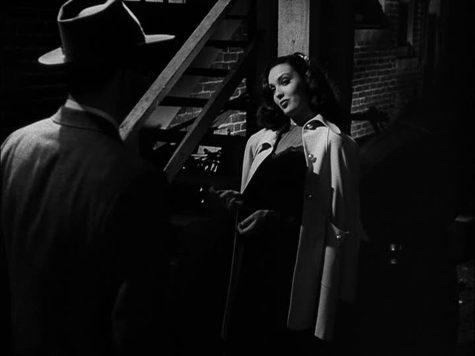
Preminger and LaShelle created some wonderful images on the screen, and drew a nice contrast between the small town, where the bulk of the action unfolds, and San Francisco. Contrary to what one might expect, it’s the scenes in the city that have a crisp, clear look whereas the little coastal settlement exists mainly in shadow, reflecting the moral ambiguities and hidden passions that lurk there. It’s also worth drawing attention to the skill and ease with which Preminger moves his camera around, at once building tension and drama, revealing secrets and objectifying characters. There’s one particular scene that illustrates what I’m talking about here, taking place on Stanton’s wedding night. Having slipped out of the house to meet with Stella, he quarrels with her and she storms off to keep her date with her current beau. As Stella strides away, Preminger pulls the camera back to show her getting into her lover’s car before tracking forward to focus briefly on Stanton’s scowling features. Instead of allowing the camera to remain there though, the director maintains the forward movement and passes by Stanton to come to rest on the shadowy background, out of which steps the new groom’s disappointed sister-in-law – a masterfully composed shot.

I’ve written at length about Dana Andrews’ abilities before and Fallen Angel proves yet again what a strong screen presence he had. He did some very memorable work throughout the 40s, and Preminger in particular seemed able to get the best out of him. The noir pictures they made together are all quality productions and all of them offered Andrews the opportunity to explore something different. While he had good support in this movie, his was the central role and he remains the main focus. What we have is an essentially insecure individual who cloaks his own recognized inadequacies with smart patter. It’s only relatively late in proceedings, when he’s on the run and panicked, that he reveals his true character. The nonchalant, worldly veneer that he employs to gloss over his fears and paranoia is stripped away and we get a glimpse of the real man, basically a frightened guy who’s been running from danger all his life. In a sense, the beauty of this film stems from the way Andrews’ character develops as a result of his interaction with two very different women. Of the two, Linda Darnell’s Stella is the one that catches the eye; sultry and seductive, Darnell might at first appear to be the fallen angel of the title but that’s not at all the case. Darnell was a genuine beauty and had an earthy charm that is highlighted in this film. All the main characters are stuck on her, but she flits round them all like a firefly, drawing the best and worst out of them. However, it’s Alice Faye’s June that exerts the most powerful influence on Andrews’ drifter. Darnell provokes the conflict among the men but Faye recognizes and draws forth the humanity and half-remembered decency in Andrews. Not being a fan of musicals, I have to admit that I’m not all that familiar with the work of Alice Faye. Nevertheless, I remain highly impressed with her performance in this film. I understand that a good deal of her role ended up on the cutting room floor, prompting her to walk off the Fox lot, but what we’re left with indicates that she had great dramatic potential. I could go on about the depth and talent involved in the supporting cast, but I’ll confine myself to a few words about Charles Bickford. His role here is a pivotal one, maybe as complex as that of the leads and he carries it off very effectively. For a variety of reasons I want to be brief here, so I’ll just say that Bickford does a marvelous job of conveying reassuring menace.

Back when Fox were running their noir line the choices for inclusion sometimes seemed a little arbitrary. Having said that, Fallen Angel is the real deal, a genuine slice of film noir. The R1 DVD is an excellent presentation of the film – it’s sharp, crisp and boasts very strong contrast that really shows off LaShelle’s cinematography. The extra features consist of a commentary track by Eddie Muller and Susan Andrews (the actor’s daughter), a series of galleries and brief liner notes. If one wanted to be critical, then I guess the plot could be viewed as rather contrived. Even so, the whole thing adds up to a highly polished and attractive package. I don’t believe Preminger ever made a poor noir picture, although I’ll have to qualify that by pointing out that I’ve yet to see The 13th Letter, and Fallen Angel must rate among the better ones. As a drama, a thriller, a film noir, or a kind of cock-eyed romance the movie comes highly recommended.

Bend of the River

bend-of-the-river1_zpshdbfrbte

You’ll be seeing me. You’ll be seeing me. Every time you bed down for the night, you’ll look back to the darkness and wonder if I’m there. And some night, I will be. You’ll be seeing me.

If you watch enough westerns, from almost any era, it soon becomes apparent that certain themes and subtexts crop up time and again. The one that I feel is the most constant, that seems to almost define the genre as a whole, is the concept of change. It literally pervades the genre: changes to the landscape, control of the country, the law, social organization, transport, the notion of freedom and opportunity, and so on. Of course some of these aspects either increased or decreased in popularity in relation to the time at which they were produced. So it’s no accident that the 50s, with that decade’s frequent meditations on the idea of personal redemption, should see a tendency to focus on changes in the hearts of men. Bend of the River (1952) concerns itself with atonement for the sins of the past and the desire to change the course of one’s life, along with the associated obstacles and prejudices that need to be overcome.

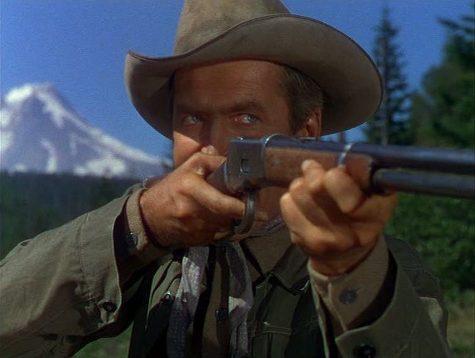
The Civil War has ended and the westward push is on, the drive to roll back the frontier and build something new and fresh. Over the opening credits a wagon train makes its way through the unspoiled beauty of Oregon. The settlers, headed up by Jeremy Baile (Jay C Flippen), are full of hope and a determined pioneering spirit. There’s a kind of wholesome enthusiasm that radiates from these people, and it’s reflected too in the man who’s guiding them, Glyn McLyntock (James Stewart). When he rides ahead to scout the trail we get the first indication that McLyntock isn’t the unsullied character his traveling companions believe. Topping a rise, he stumbles upon a nasty little scene in the clearing below. There’s a lynching in progress for a horse thief. Seeing as a man’s horse was often his most valuable possession and could mean the difference between survival and death in a hostile environment, frontier justice dictated that the rope was all one could expect for such a heinous crime. Still and all, lynching is a dirty little business, and it’s no surprise that McLyntock intervenes and saves the life of the condemned man. No, that in itself is entirely understandable – what is telling though is the reaction of McLyntock just before he draws his gun. His features register violent revulsion but there’s something of the hunted man that flashes briefly from his eyes. It transpires that the man at the end of the rope is Emerson Cole (Arthur Kennedy), a former border raider whose name is familiar to McLyntock. It’s soon revealed that Cole has also heard of McLyntock, both of them having been in the same line of business so to speak. While these two men with a dark past may have some things in common, there is one crucial difference. The devil-may-care Cole has no regrets about his actions whereas McLyntock is a deeply troubled figure, a man trying to bury his unsavory deeds and make a new beginning among people who trust him. When the wagon train rolls into Portland Cole and McLyntock bid each other farewell – Cole thinking only of how best to make his fortune while McLyntock is bound for the clean air and anonymity of the high country. However, these two are destined to cross paths again. The settlers need supplies shipped to them to see them through their first winter and have paid for delivery in advance. As is often the case though, circumstances change dramatically when greed rears its ugly head. A trip back to Portland sees McLyntock and Cole renewing their acquaintance. But theirs is an uneasy relationship, their friendship balanced rather precariously at all times. The shadows of the past are never far away, beckoning enticingly to Cole while pointing accusingly at McLyntock. On the run from new enemies in Portland, it remains to be seen how fast the friendship of these men will be, and whether McLyntock will be allowed to prove to his companions and himself that a man can truly change his ways.

bend-of-the-river2_zpspgtwuziy

Bend of the River was Anthony Mann’s second western with James Stewart, continuing what was to become a highly influential cycle of movies and further developing the persona of the tortured lead. One of the key visual motifs in Mann’s work was the continual striving upwards of his characters, the drive to rise above base instincts and cares. Although this feature isn’t quite as pronounced in Bend of the River as it is in some of his other movies, it is still there. The wagon train, and most especially McLyntock, view the mountain country as a kind of promised land where social and spiritual rebirth are possible. Irving Glassberg photographed the stunning Oregon locations beautifully, and the contrast between the crisp freshness and purity of the mountains is contrasted strongly with the darker, more restrictive and corrupt feeling of the town gripped by gold fever. The central theme of a man desperate for change and redemption is well handled by Mann, working from a Borden Chase script. Additionally, there’s a fairly complex notion of duality at work too. In essence, Cole and McLyntock are mirror images. The inevitable confrontation represents McLyntock squaring off against his own darker nature as much as anything else.

bend-of-the-river3_zps1bxsqtei

I think it’s impossible to overemphasize how instrumental Mann was in shaping James Stewart into one of the major post-war movie stars, although both Hitchcock and Capra had a hand in the process too. For much of the time Stewart is, superficially at least, in amiable mode, yet there’s always an unease there. This of course is entirely appropriate as his character is burdened by a tremendous sense of guilt and also a sort of slow burning dread that his past will be revealed and lead to his being rejected. As usual Mann managed to get Stewart to dig deep within himself and draw on his reserves. There are three notable occasions where Stewart’s consuming rage threatens to overcome him. The first is the momentary rush of emotion at the sight of the lynching. The next occurs when the rebellious laborers hired in Portland drop the full weight of a jacked up wagon on Baile – the startling intensity of Stewart’s fury rendering him speechless and inarticulate. However, it’s the final outpouring that carries the greatest impact. With the mutiny complete and Cole having shown his true colors, the emotionally distraught Stewart delivers those lines which I featured at the top of the article. Written down in black and white, they lack the power with which Stewart invests them in his cold, calculated and measured way. With his voice threatening to crack under the strain of maintaining self-control, no-one is left in any doubt that the gloves are off, the Rubicon has been crossed and there’s no going back.

Arthur Kennedy proved a splendid foil for Stewart; where Stewart was all inner conflict and suppressed emotion, Kennedy was a man very much at ease with his own villainy. However, that’s not to say his performance was one-note or lacking in nuance. He starts off as something of a rogue, but not an entirely unattractive one. It’s his innate greed and an inability to rise above his own self-interest that sees him develop into a fully fledged villain. As such, we don’t get the same shock as would be the case a few years later when Kennedy again teamed up with Stewart and Mann to make The Man from Laramie. Here, Kennedy’s character is clearly morally corrupted from the beginning and it’s only the extent that’s in question. The supporting cast in Bend of the River is a remarkably strong one starting with Julia Adams, Rock Hudson and the great Jay C Flippen. This was one of the star making roles for the rising Hudson, a vigorous, heroic part as the young gambler who signs on with the wagon train. Hudson’s good enough at what he’s asked to do, but really it’s not very demanding stuff and he makes only a limited impression. Julia Adams’ beautiful presence graced many a movie for Universal during the 50s and I always like to see her name in the credits. This film offered her a good part as the girl who initially falls for Kennedy’s charm before finally seeing him for what he is and switching her affections to Stewart. And there’s no shortage of familiar faces to add to the villainy ranged against Stewart – Howard Petrie, Royal Dano, Jack Lambert and Harry Morgan all put in good performances. And then there’s Stepin Fetchit, an actor whose characterizations remain controversial to this day. I think it’s worth noting that both Scott Nollen (whose latest book I reviewed last week) and Joseph McBride have interesting things to say about this performer, namely the way John Ford and he tried to actually subvert racial stereotypes in their work together.

I think Bend of the River is available on DVD pretty much everywhere these days – it’s certainly been out in both the UK and the US via Universal for many years now. The UK disc I have is a completely bare bones affair with nothing at all in the way of extra features. However, the transfer of the film is very good indeed, with excellent color and no print damage worth mentioning. In the past I’ve tried broadly rating or comparing the westerns that Mann and Stewart made together, but it’s essentially a pointless exercise. These are all strong and rewarding movies that can be watched repeatedly without losing any of their power or freshness. Let’s just say that this is one of the top-tier westerns from a great team and leave it at that.

I would just like to add a brief postscript here to let anyone who’s interested in such things know that this has been the 250th film which I’ve had the pleasure of writing about on this site.

Fury

pound4_zpsxshxmhmk

I’ll give them a chance that they didn’t give me. They will get a legal trial in a legal courtroom. They will have a legal judge and a legal defense. They will get a legal sentence and a legal death.

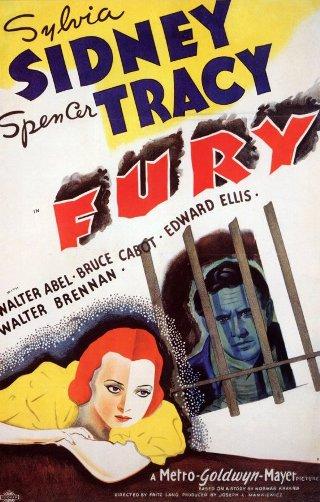
The 1930s arguably represent the true golden age of Hollywood. Cinema had emerged from its infancy and stood virtually unchallenged as the premier entertainment medium. The decade conjures up a host of cinematic images: the musicals of Busby Berkeley and Astaire & Rogers, the Gothic nightmares of James Whale, the screwball comedies and the sophistication of Lubitsch, the swashbucklers of Curtiz & Flynn, and so on. But there was something else there too, something that began to drift in from Europe, gaining momentum as the decade wore on and the ranks of the refugees swelled. They brought with them a darker sensibility, partly rooted in German expressionism, and partly a result of their experiences on a continent slowly sliding into political and social turmoil. The seeds of what would grow into film noir were being planted during these years and, despite only the vaguest shoots being visible at that stage, would finally come to full fruition in the 40s. There can be little doubt that the films of Fritz Lang were a major influence on the growth of this movement, and his first feature in the US, Fury (1936), points the way towards what was to come. However this is no film noir; instead it’s a powerful piece of social commentary, a pitiless probing of the darker and less savory aspects of human nature and, ultimately, a classic morality tale.

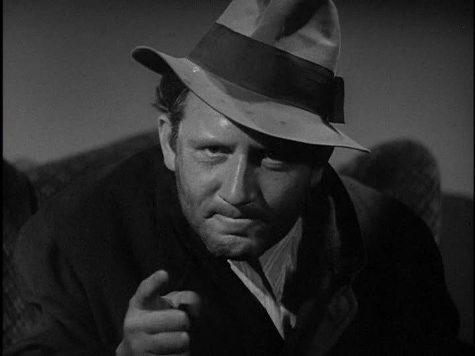
The story concerns an ordinary guy, a guy named Joe. In this case it’s Joe Wilson (Spencer Tracy), a man struggling to get along during The Depression. Times may be tough but Joe isn’t without hopes and dreams, mainly centered on his fiancée Katherine (Sylvia Sidney). Joe and Katherine are in love and naturally want to marry, but that takes money. The film opens with their last moments together, strolling along the city sidewalks and musing about their future as they gaze at the unattainable luxuries in the store windows. Joe is sending Katherine west with a view to joining her and settling down once he has made enough money. Time passes, Katherine pines, and Joe and his brothers make enough from their gas station for him to realize his dream. There’s optimism in the air as Joe sets out on the long drive west and Katherine makes plans for his arrival. Yet all this comes to an abrupt end as Joe is flagged down by a slow-witted, shotgun-wielding deputy (Walter Brennan) from a hick town. It’s at this point that the Kafkaesque nightmare that will ultimately draw in all the characters begins to develop. It turns out there’s been a kidnapping and Joe, as a stranger unable to give a satisfactory account of his movements, is pulled in for questioning as a suspect. There’s only the flimsiest of circumstantial evidence but he’s held until the DA an arrive. However, the gossipy mentality of the small town soon takes over, and the Chinese whispers that ensue have a snowball effect that sees the local citizenry gradually transformed into an unreasoning and rampaging mob. First they lay siege to the jail, then storm it, set it ablaze and finally dynamite what remains. All the while Joe, an innocent man, is trapped inside and growing increasingly panicked. With the building reduced to rubble, it looks as though Joe has perished. The effects are immediate on all concerned – Kathrine, who arrived just in time to witness the final moments, suffers an emotional breakdown, Joe’s brothers are angry and devastated, while the townsfolk begin to feel the first pangs of collective guilt. However, there’s a sting in the tail. Joe survived the conflagration but has physical and, more importantly, psychological scars that are deep rooted. Stripped of his former sense of fair play, he and his brothers set in motion a plan to achieve what he sees as poetic justice.

pound5_zps5o6fowlo

The fury of the title can be interpreted on two levels, that of the baying mob outside the jail and also that of the man they think they have burnt alive. In both cases, Fritz Lang captured the build-up to and subsequent manifestation of this fury perfectly. The gradual spread of tittle-tattle among the townsfolk is treated in an almost comical fashion at first – the shots of chattering ladies intercut with images of cackling hens – before taking on an ever more menacing character. It all culminates in the wonderfully realized assault on the jail by the frenzied mob. Lang uses montage and lighting to great effect here, cutting rapidly between the faces of the citizens, joyously looking on with an almost religious fervor, and the alternately despairing and stricken features of Joe and Katherine. In this way Lang provokes a combination of horror, pity and moral outrage in the viewer. What we have witnessed is a great injustice, a perversion of the ideals of civilized society. It’s natural therefore to empathize with Joe and the gut reaction is to take pleasure in seeing this victim turn persecutor. However, the film is a critique of the veneer of respectability and civilization that we adopt both as individuals and as a society. As such, Lang does not take us down a morally bankrupt route, choosing instead to focus on the opportunity for personal and collective redemption. In the end the film’s message is that conscience is the real victor, punishing the guilty more effectively than any court of law and hauling a fundamentally decent man back from the brink at the eleventh hour. Again, Lang uses visuals as much as words to make his point, showing how Joe has cut himself off from humanity and the mental anguish that such actions must inevitably arouse. He cuts a poignant figure as Lang shows him alone and bitter, haunted by the voices in his mind and the images of the condemned which float in and out of his consciousness.

Beyond this the film also has some salient points to make about of the role of the law and ultimately affirms the notion of its being one of our fundamental social pillars. However, Lang first takes its weaknesses to task. The fragility of the law is demonstrated by the way the corrupt tendencies of politicians is instrumental in allowing the situation to spiral out of control in the first place. It is also implied, in the disgruntled and disparaging way the citizens of the town speak about the machinations and trickery of lawyers, that the faith of the ordinary man in the legal system has been shaken to such an extent that respect for the law itself is threatened. As is so often the case, it takes the dispassionate eye of the outsider, the immigrant Lang, to draw attention to both the flaws and strengths inherent in the system. Indeed, the point is reinforced early on when one of the minor characters, an immigrant barber, corrects a local on his misunderstanding of the terms of the constitution – his knowledge and respect for the document arising from his being obliged to learn its contents.

pound6_zpsmwsyjuyw

If one were to make a list of the greatest screen actors of all time, then Spencer Tracy would surely have to figure high up. Personally, I reckon there’s a case to be made for placing him right at the top. He was probably the greatest exponent of naturalism on screen, rarely, if ever, allowing the audience to catch him acting. As a result, Tracy brought an earnest believability to the varied roles he took on over the years. As he aged he attained something of a statesmanlike quality, becoming the very epitome of the best elements of the American character. Still, even as a younger man, he had that air of honesty and plainness about him, tempered somewhat by an underlying sense of implacability. In brief, the lead in Fury was an ideal role for Tracy, drawing on both sides of his character. He dominates the movie from beginning to end and takes the transition from down to earth guy to hate-fueled avenger smoothly in his stride. And it’s that transition that lends the film so much of its power; the progression from humble amiability through bewildered terror, and then cruel vindictiveness. His reappearance in the aftermath of the jail burning, like some kind of malignant resurrection, is a shocking moment. Not only has he become hard and driven, but there’s a different cast to his whole physical appearance – not some prosthetic alteration but a subtle shift in posture and body language.

Despite Tracy’s powerhouse performance, top billing in Fury went to Sylvia Sidney. Of course Sidney was a big star at the time, making movies for Lang, Hitchcock and Wyler before seeing her career take a downturn. While she doesn’t make the same impression as Tracy, her role is vital to the development of the story and it’s her influence that keeps her man from going over the edge. Sidney’s greatest asset was her wonderfully expressive features, especially those huge eyes. Lang made good use of this by employing frequent close-ups of her, notably as she looks on in horror at the actions of the mob and then later when a shattering realization dawns upon her. The supporting cast is full of memorable turns from a range of familiar faces. I think Bruce Cabot, Walter Brennan, Edward Ellis and Walter Abel all deserve particular attention though – they all make significant contributions as the loud-mouthed rabble-rouser, the gormless deputy, the sour but conflicted sheriff and the determined DA respectively.

Fury came out on DVD some years ago via Warner Brothers, and it’s very well presented on disc. There is a bit of age related damage on view, but the film looks remarkably fine for its vintage. Lang’s movies were always visual treats and the lighting and use of shadows and contrast were particularly important features. The Warner Brothers DVD represents this aspect very well indeed and viewing the movie is a pleasure. The extra features consist of the theatrical trailer and a commentary track by Peter Bogdanovich that includes excerpts from an interview with Fritz Lang. Although Fury is now over 75 years old, the points it makes about society, the law and human nature remain relevant today. That type of timeless quality is a large part of what makes it a classic, but it’s not the whole story. Lang’s striking imagery and Tracy’s unaffected performance are major factors here too. This is one of Lang’s major works, a compelling tale that is emotionally absorbing and also engages the intellect. Definitely recommended.