Bend of the River

bend-of-the-river1_zpshdbfrbte

You’ll be seeing me. You’ll be seeing me. Every time you bed down for the night, you’ll look back to the darkness and wonder if I’m there. And some night, I will be. You’ll be seeing me.

If you watch enough westerns, from almost any era, it soon becomes apparent that certain themes and subtexts crop up time and again. The one that I feel is the most constant, that seems to almost define the genre as a whole, is the concept of change. It literally pervades the genre: changes to the landscape, control of the country, the law, social organization, transport, the notion of freedom and opportunity, and so on. Of course some of these aspects either increased or decreased in popularity in relation to the time at which they were produced. So it’s no accident that the 50s, with that decade’s frequent meditations on the idea of personal redemption, should see a tendency to focus on changes in the hearts of men. Bend of the River (1952) concerns itself with atonement for the sins of the past and the desire to change the course of one’s life, along with the associated obstacles and prejudices that need to be overcome.

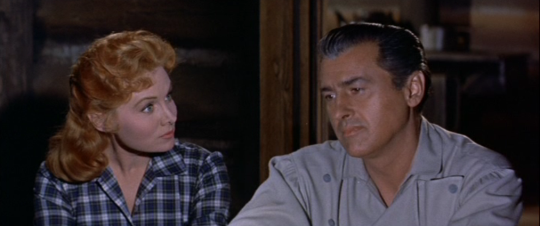
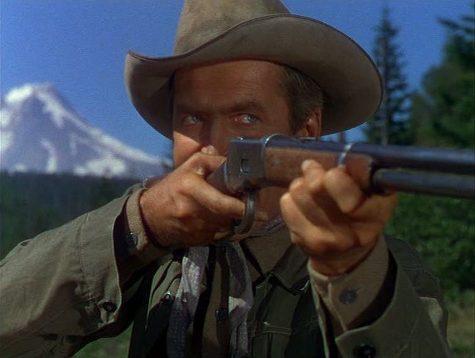
The Civil War has ended and the westward push is on, the drive to roll back the frontier and build something new and fresh. Over the opening credits a wagon train makes its way through the unspoiled beauty of Oregon. The settlers, headed up by Jeremy Baile (Jay C Flippen), are full of hope and a determined pioneering spirit. There’s a kind of wholesome enthusiasm that radiates from these people, and it’s reflected too in the man who’s guiding them, Glyn McLyntock (James Stewart). When he rides ahead to scout the trail we get the first indication that McLyntock isn’t the unsullied character his traveling companions believe. Topping a rise, he stumbles upon a nasty little scene in the clearing below. There’s a lynching in progress for a horse thief. Seeing as a man’s horse was often his most valuable possession and could mean the difference between survival and death in a hostile environment, frontier justice dictated that the rope was all one could expect for such a heinous crime. Still and all, lynching is a dirty little business, and it’s no surprise that McLyntock intervenes and saves the life of the condemned man. No, that in itself is entirely understandable – what is telling though is the reaction of McLyntock just before he draws his gun. His features register violent revulsion but there’s something of the hunted man that flashes briefly from his eyes. It transpires that the man at the end of the rope is Emerson Cole (Arthur Kennedy), a former border raider whose name is familiar to McLyntock. It’s soon revealed that Cole has also heard of McLyntock, both of them having been in the same line of business so to speak. While these two men with a dark past may have some things in common, there is one crucial difference. The devil-may-care Cole has no regrets about his actions whereas McLyntock is a deeply troubled figure, a man trying to bury his unsavory deeds and make a new beginning among people who trust him. When the wagon train rolls into Portland Cole and McLyntock bid each other farewell – Cole thinking only of how best to make his fortune while McLyntock is bound for the clean air and anonymity of the high country. However, these two are destined to cross paths again. The settlers need supplies shipped to them to see them through their first winter and have paid for delivery in advance. As is often the case though, circumstances change dramatically when greed rears its ugly head. A trip back to Portland sees McLyntock and Cole renewing their acquaintance. But theirs is an uneasy relationship, their friendship balanced rather precariously at all times. The shadows of the past are never far away, beckoning enticingly to Cole while pointing accusingly at McLyntock. On the run from new enemies in Portland, it remains to be seen how fast the friendship of these men will be, and whether McLyntock will be allowed to prove to his companions and himself that a man can truly change his ways.

bend-of-the-river2_zpspgtwuziy

Bend of the River was Anthony Mann’s second western with James Stewart, continuing what was to become a highly influential cycle of movies and further developing the persona of the tortured lead. One of the key visual motifs in Mann’s work was the continual striving upwards of his characters, the drive to rise above base instincts and cares. Although this feature isn’t quite as pronounced in Bend of the River as it is in some of his other movies, it is still there. The wagon train, and most especially McLyntock, view the mountain country as a kind of promised land where social and spiritual rebirth are possible. Irving Glassberg photographed the stunning Oregon locations beautifully, and the contrast between the crisp freshness and purity of the mountains is contrasted strongly with the darker, more restrictive and corrupt feeling of the town gripped by gold fever. The central theme of a man desperate for change and redemption is well handled by Mann, working from a Borden Chase script. Additionally, there’s a fairly complex notion of duality at work too. In essence, Cole and McLyntock are mirror images. The inevitable confrontation represents McLyntock squaring off against his own darker nature as much as anything else.

bend-of-the-river3_zps1bxsqtei

I think it’s impossible to overemphasize how instrumental Mann was in shaping James Stewart into one of the major post-war movie stars, although both Hitchcock and Capra had a hand in the process too. For much of the time Stewart is, superficially at least, in amiable mode, yet there’s always an unease there. This of course is entirely appropriate as his character is burdened by a tremendous sense of guilt and also a sort of slow burning dread that his past will be revealed and lead to his being rejected. As usual Mann managed to get Stewart to dig deep within himself and draw on his reserves. There are three notable occasions where Stewart’s consuming rage threatens to overcome him. The first is the momentary rush of emotion at the sight of the lynching. The next occurs when the rebellious laborers hired in Portland drop the full weight of a jacked up wagon on Baile – the startling intensity of Stewart’s fury rendering him speechless and inarticulate. However, it’s the final outpouring that carries the greatest impact. With the mutiny complete and Cole having shown his true colors, the emotionally distraught Stewart delivers those lines which I featured at the top of the article. Written down in black and white, they lack the power with which Stewart invests them in his cold, calculated and measured way. With his voice threatening to crack under the strain of maintaining self-control, no-one is left in any doubt that the gloves are off, the Rubicon has been crossed and there’s no going back.

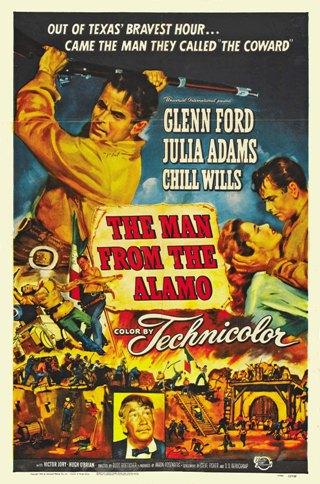
Arthur Kennedy proved a splendid foil for Stewart; where Stewart was all inner conflict and suppressed emotion, Kennedy was a man very much at ease with his own villainy. However, that’s not to say his performance was one-note or lacking in nuance. He starts off as something of a rogue, but not an entirely unattractive one. It’s his innate greed and an inability to rise above his own self-interest that sees him develop into a fully fledged villain. As such, we don’t get the same shock as would be the case a few years later when Kennedy again teamed up with Stewart and Mann to make The Man from Laramie. Here, Kennedy’s character is clearly morally corrupted from the beginning and it’s only the extent that’s in question. The supporting cast in Bend of the River is a remarkably strong one starting with Julia Adams, Rock Hudson and the great Jay C Flippen. This was one of the star making roles for the rising Hudson, a vigorous, heroic part as the young gambler who signs on with the wagon train. Hudson’s good enough at what he’s asked to do, but really it’s not very demanding stuff and he makes only a limited impression. Julia Adams’ beautiful presence graced many a movie for Universal during the 50s and I always like to see her name in the credits. This film offered her a good part as the girl who initially falls for Kennedy’s charm before finally seeing him for what he is and switching her affections to Stewart. And there’s no shortage of familiar faces to add to the villainy ranged against Stewart – Howard Petrie, Royal Dano, Jack Lambert and Harry Morgan all put in good performances. And then there’s Stepin Fetchit, an actor whose characterizations remain controversial to this day. I think it’s worth noting that both Scott Nollen (whose latest book I reviewed last week) and Joseph McBride have interesting things to say about this performer, namely the way John Ford and he tried to actually subvert racial stereotypes in their work together.

I think Bend of the River is available on DVD pretty much everywhere these days – it’s certainly been out in both the UK and the US via Universal for many years now. The UK disc I have is a completely bare bones affair with nothing at all in the way of extra features. However, the transfer of the film is very good indeed, with excellent color and no print damage worth mentioning. In the past I’ve tried broadly rating or comparing the westerns that Mann and Stewart made together, but it’s essentially a pointless exercise. These are all strong and rewarding movies that can be watched repeatedly without losing any of their power or freshness. Let’s just say that this is one of the top-tier westerns from a great team and leave it at that.

I would just like to add a brief postscript here to let anyone who’s interested in such things know that this has been the 250th film which I’ve had the pleasure of writing about on this site.

Fury

pound4_zpsxshxmhmk

I’ll give them a chance that they didn’t give me. They will get a legal trial in a legal courtroom. They will have a legal judge and a legal defense. They will get a legal sentence and a legal death.

The 1930s arguably represent the true golden age of Hollywood. Cinema had emerged from its infancy and stood virtually unchallenged as the premier entertainment medium. The decade conjures up a host of cinematic images: the musicals of Busby Berkeley and Astaire & Rogers, the Gothic nightmares of James Whale, the screwball comedies and the sophistication of Lubitsch, the swashbucklers of Curtiz & Flynn, and so on. But there was something else there too, something that began to drift in from Europe, gaining momentum as the decade wore on and the ranks of the refugees swelled. They brought with them a darker sensibility, partly rooted in German expressionism, and partly a result of their experiences on a continent slowly sliding into political and social turmoil. The seeds of what would grow into film noir were being planted during these years and, despite only the vaguest shoots being visible at that stage, would finally come to full fruition in the 40s. There can be little doubt that the films of Fritz Lang were a major influence on the growth of this movement, and his first feature in the US, Fury (1936), points the way towards what was to come. However this is no film noir; instead it’s a powerful piece of social commentary, a pitiless probing of the darker and less savory aspects of human nature and, ultimately, a classic morality tale.

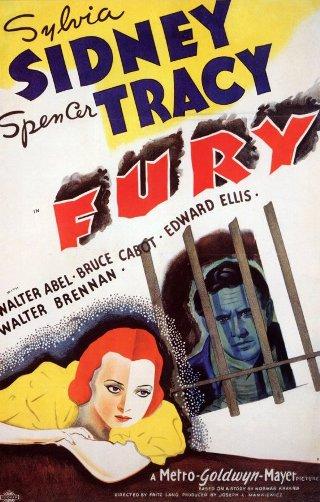
The story concerns an ordinary guy, a guy named Joe. In this case it’s Joe Wilson (Spencer Tracy), a man struggling to get along during The Depression. Times may be tough but Joe isn’t without hopes and dreams, mainly centered on his fiancée Katherine (Sylvia Sidney). Joe and Katherine are in love and naturally want to marry, but that takes money. The film opens with their last moments together, strolling along the city sidewalks and musing about their future as they gaze at the unattainable luxuries in the store windows. Joe is sending Katherine west with a view to joining her and settling down once he has made enough money. Time passes, Katherine pines, and Joe and his brothers make enough from their gas station for him to realize his dream. There’s optimism in the air as Joe sets out on the long drive west and Katherine makes plans for his arrival. Yet all this comes to an abrupt end as Joe is flagged down by a slow-witted, shotgun-wielding deputy (Walter Brennan) from a hick town. It’s at this point that the Kafkaesque nightmare that will ultimately draw in all the characters begins to develop. It turns out there’s been a kidnapping and Joe, as a stranger unable to give a satisfactory account of his movements, is pulled in for questioning as a suspect. There’s only the flimsiest of circumstantial evidence but he’s held until the DA an arrive. However, the gossipy mentality of the small town soon takes over, and the Chinese whispers that ensue have a snowball effect that sees the local citizenry gradually transformed into an unreasoning and rampaging mob. First they lay siege to the jail, then storm it, set it ablaze and finally dynamite what remains. All the while Joe, an innocent man, is trapped inside and growing increasingly panicked. With the building reduced to rubble, it looks as though Joe has perished. The effects are immediate on all concerned – Kathrine, who arrived just in time to witness the final moments, suffers an emotional breakdown, Joe’s brothers are angry and devastated, while the townsfolk begin to feel the first pangs of collective guilt. However, there’s a sting in the tail. Joe survived the conflagration but has physical and, more importantly, psychological scars that are deep rooted. Stripped of his former sense of fair play, he and his brothers set in motion a plan to achieve what he sees as poetic justice.

pound5_zps5o6fowlo

The fury of the title can be interpreted on two levels, that of the baying mob outside the jail and also that of the man they think they have burnt alive. In both cases, Fritz Lang captured the build-up to and subsequent manifestation of this fury perfectly. The gradual spread of tittle-tattle among the townsfolk is treated in an almost comical fashion at first – the shots of chattering ladies intercut with images of cackling hens – before taking on an ever more menacing character. It all culminates in the wonderfully realized assault on the jail by the frenzied mob. Lang uses montage and lighting to great effect here, cutting rapidly between the faces of the citizens, joyously looking on with an almost religious fervor, and the alternately despairing and stricken features of Joe and Katherine. In this way Lang provokes a combination of horror, pity and moral outrage in the viewer. What we have witnessed is a great injustice, a perversion of the ideals of civilized society. It’s natural therefore to empathize with Joe and the gut reaction is to take pleasure in seeing this victim turn persecutor. However, the film is a critique of the veneer of respectability and civilization that we adopt both as individuals and as a society. As such, Lang does not take us down a morally bankrupt route, choosing instead to focus on the opportunity for personal and collective redemption. In the end the film’s message is that conscience is the real victor, punishing the guilty more effectively than any court of law and hauling a fundamentally decent man back from the brink at the eleventh hour. Again, Lang uses visuals as much as words to make his point, showing how Joe has cut himself off from humanity and the mental anguish that such actions must inevitably arouse. He cuts a poignant figure as Lang shows him alone and bitter, haunted by the voices in his mind and the images of the condemned which float in and out of his consciousness.

Beyond this the film also has some salient points to make about of the role of the law and ultimately affirms the notion of its being one of our fundamental social pillars. However, Lang first takes its weaknesses to task. The fragility of the law is demonstrated by the way the corrupt tendencies of politicians is instrumental in allowing the situation to spiral out of control in the first place. It is also implied, in the disgruntled and disparaging way the citizens of the town speak about the machinations and trickery of lawyers, that the faith of the ordinary man in the legal system has been shaken to such an extent that respect for the law itself is threatened. As is so often the case, it takes the dispassionate eye of the outsider, the immigrant Lang, to draw attention to both the flaws and strengths inherent in the system. Indeed, the point is reinforced early on when one of the minor characters, an immigrant barber, corrects a local on his misunderstanding of the terms of the constitution – his knowledge and respect for the document arising from his being obliged to learn its contents.

pound6_zpsmwsyjuyw

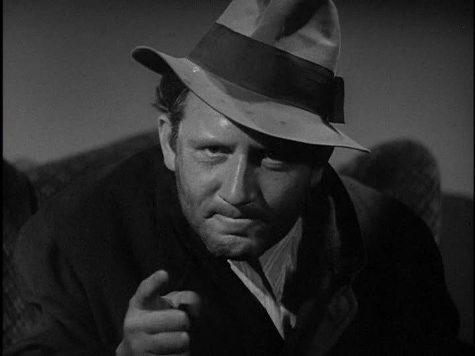
If one were to make a list of the greatest screen actors of all time, then Spencer Tracy would surely have to figure high up. Personally, I reckon there’s a case to be made for placing him right at the top. He was probably the greatest exponent of naturalism on screen, rarely, if ever, allowing the audience to catch him acting. As a result, Tracy brought an earnest believability to the varied roles he took on over the years. As he aged he attained something of a statesmanlike quality, becoming the very epitome of the best elements of the American character. Still, even as a younger man, he had that air of honesty and plainness about him, tempered somewhat by an underlying sense of implacability. In brief, the lead in Fury was an ideal role for Tracy, drawing on both sides of his character. He dominates the movie from beginning to end and takes the transition from down to earth guy to hate-fueled avenger smoothly in his stride. And it’s that transition that lends the film so much of its power; the progression from humble amiability through bewildered terror, and then cruel vindictiveness. His reappearance in the aftermath of the jail burning, like some kind of malignant resurrection, is a shocking moment. Not only has he become hard and driven, but there’s a different cast to his whole physical appearance – not some prosthetic alteration but a subtle shift in posture and body language.

Despite Tracy’s powerhouse performance, top billing in Fury went to Sylvia Sidney. Of course Sidney was a big star at the time, making movies for Lang, Hitchcock and Wyler before seeing her career take a downturn. While she doesn’t make the same impression as Tracy, her role is vital to the development of the story and it’s her influence that keeps her man from going over the edge. Sidney’s greatest asset was her wonderfully expressive features, especially those huge eyes. Lang made good use of this by employing frequent close-ups of her, notably as she looks on in horror at the actions of the mob and then later when a shattering realization dawns upon her. The supporting cast is full of memorable turns from a range of familiar faces. I think Bruce Cabot, Walter Brennan, Edward Ellis and Walter Abel all deserve particular attention though – they all make significant contributions as the loud-mouthed rabble-rouser, the gormless deputy, the sour but conflicted sheriff and the determined DA respectively.

Fury came out on DVD some years ago via Warner Brothers, and it’s very well presented on disc. There is a bit of age related damage on view, but the film looks remarkably fine for its vintage. Lang’s movies were always visual treats and the lighting and use of shadows and contrast were particularly important features. The Warner Brothers DVD represents this aspect very well indeed and viewing the movie is a pleasure. The extra features consist of the theatrical trailer and a commentary track by Peter Bogdanovich that includes excerpts from an interview with Fritz Lang. Although Fury is now over 75 years old, the points it makes about society, the law and human nature remain relevant today. That type of timeless quality is a large part of what makes it a classic, but it’s not the whole story. Lang’s striking imagery and Tracy’s unaffected performance are major factors here too. This is one of Lang’s major works, a compelling tale that is emotionally absorbing and also engages the intellect. Definitely recommended.

Party Girl

Last time, I had a look at a gangster/noir crossover movie, an early example of the emergence of a darker sensibility in crime movies in Hollywood. Let’s jump ahead almost two decades, to the point at which film noir was nearing the end of the classic cycle. Again, the film in question is something of a hybrid, a fusion of styles and influences, but the principal elements remain the gangster story and shadowy world of the dark cinema. A lot of film noir throughout the 1950s featured the involvement of organized crime so Party Girl (1958), despite abandoning the more usual contemporary setting, can be viewed as a continuation of that trend. Having said that, the movie could be classed as a marginal entry – it’s shot in lurid technicolor and at times resembles a hard-boiled variation of the classic studio musical. However, in spite of what sound like stylistic contradictions, Party Girl is categorized by many writers as a genuine film noir, and I guess its themes do have the requisite darkness and ambiguity to qualify it for inclusion.

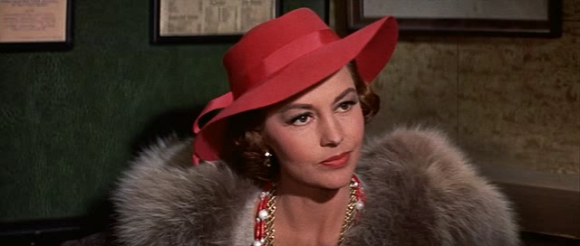
Chicago in the early 30s – Tommy Farrell (Robert Taylor) is a mob lawyer, and a successful one. He’s respected and feared by judges and prosecutors not simply due to his connections but because he’s the top man in his line. Farrell is first glimpsed at a party thrown by crime kingpin Rico Angelo (Lee J Cobb) – actually it’s as much a wake as a party since Rico is laying to rest a broken heart on hearing the news that Jean Harlow, whom he’s adored from afar, is to be wed – and he’s surrounded by a group of city dignitaries hanging onto his every word. One might assume that Farrell has it made, but this is only the silver lining obscuring the cloud. Farrell is almost a cripple, his hip and leg twisted as a result of a youthful escapade gone wrong. It is often the case in movies that physical imperfections are mirrored by deeper psychological scars, and so it is with Tommy Farrell. This man who glides effortlessly through the powerful social milieu in spite of his pronounced limp is emotionally wounded. His beautiful but callous wife left him since she couldn’t overcome her disgust at his physical deformity, and Farrell has been unable to heal that emotional wound. However, his rehabilitation begins at Rico’s party when he agrees to escort home Vicki Gaye (Cyd Charisse), a dancer and one of the “party girls” hired for the evening. Although the evening ends with a rather gruesome discovery, Farrell and Vicki do make a connection that will blossom despite a few bumpy stretches along the way. The whole movie is principally concerned with Farrell’s rediscovery of his self-respect after years of loathing himself. Running parallel to the developing relationship with Vicki is the thread that follows Farrell’s attempts to distance himself from Rico and the corrupt and violent world he inhabits. Just when it looks like the hero may have achieved the spiritual peace he’s long been seeking, Rico’s machinations and threats haul him back to defend one of his paymaster’s psychotic associates. However, having had a taste of life beyond the cheap neon glamour of the underworld, Farrell is determined to get out for good. The trick is to find a way to protect Vicki, bring down Rico, and save his own skin at the same time.

Nostalgia for certain periods tends to come in waves, and the late 50s saw a resurgence of interest in the old gangster movies. Party Girl tapped into that vibe and director Nicholas ray added his own personal touch to it. Ray only made a handful of noir pictures altogether – all are interesting in their own way, and two (In a Lonely Place and On Dangerous Ground) are pure bred classics. All of Ray’s best movies dealt with those who were in some way removed from the mainstream of society, and Party Girl follows that template. Farrell is superficially a man at the heart of city life. Yet, he’s an outsider in every sense; a lawyer who essentially makes a mockery of the law, an apparent mob insider who is revolted by the crassness and brutality around him, and a man bedeviled by his own sense of inadequacy. Aside from the fact that the mobsters and hoodlums who populate the film are themselves social pariahs, Vicki is another character existing at the periphery of decency. The struggle which Farrell and Vicki undertake to break free of the dark influences that threaten to drag them down is classic Ray material. Another feature common to Ray’s work, and seen in abundance here, is the unrestrained use of color. Party Girl is a riot of technicolor hues that seem to allude to the heightened emotional state of the characters.

Even though I’m a great admirer of his work in general, I think it’s fair to say Robert Taylor gave an excellent performance as Farrell. As he aged, and his looks took on more character, he did some first-rate work in westerns, and the same can be said about his noir pictures. He brought a dour toughness to his role as the tortured lawyer, and worked well with Charisse. For her own part, Charisse adopted the right kind of world-weary air that befits a woman who has spent her time dodging unwanted passes and living off dubious handouts in seedy nightclubs. She was of course an immensely talented dancer, one of the greats, and the movie features a couple of set piece numbers designed to show off her moves. With the club setting, and her character’s profession, these sequences are blended seamlessly into the narrative. They may capture the look and feel of a musical yet they never have that jarring, artificial sense that such movies frequently evoke. The other big hitter in the cast was Lee J Cobb. This was an actor who could explode out of the screen at times, his inherent power always in danger of turning into bombast. In Party Girl, Ray managed to get the right kind of balance from Cobb for the most part. Sure there are instances where he drifts awfully close to scenery chewing, but there are some quietly effective moments too – his chat with Taylor where he blackmails the lawyer into cooperating under the threat of disfiguring his girlfriend is all the more chilling due to Cobb’s restraint. The supporting cast was headed up by the ever reliable John Ireland as Cobb’s slimy and dangerous right hand man. Also featured were Kent Smith – despite his long and varied career, I’ll always associate him with one of his earliest roles in Val Lewton & Jacques Tourneur’s Cat People – as the straight arrow prosecutor, and a manic Corey Allen as the unbalanced hood Cookie La Motte.

For a long time, Party Girl wasn’t the easiest movie to see. However, it has been released on DVD in France and Spain and as a MOD disc via the Warner Archive in the US. I have the old French Warner Brothers DVD which is pretty good. The film is presented in anamorphic scope and the print used for the transfer seems in good shape. There’s plenty of clarity, the colors are strong and quite vibrant, and damage (if there is any) is so slight I can’t say I noticed. There are no extra features on the disc – subtitles are optional and can be disabled via the setup menu. The blending of styles and genres just about works in the movie, drawing in elements of melodrama, the musical and a crime tale to create a fairly unique film noir. Aside from a trio of good performances, what holds the whole thing together is the direction of Nicholas Ray. In the hands of a lesser director, the disparate elements could well have pulled the movie apart. As it stands, Party Girl remains one of Ray’s interesting experiments which I feel more or less succeeds. Of course much of this depends on how one reacts to Ray as a filmmaker; as such, it’s another of those films that I’d cautiously recommend.

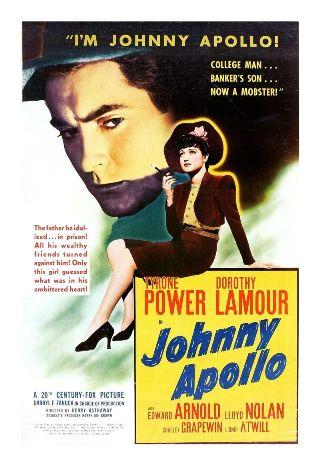
Johnny Apollo

It seems that I’m drawn back, time and again, to what we can term transitional works, be they westerns or any other genre. I suppose that reflects my own interest in observing the general shape of cinematic development, and the progress of popular culture overall. The more hyperbolic aspects of marketing might like to encourage the perception that new styles or movements suddenly explode onto the scene without warning and forever change the face of entertainment. However, that’s not the case at all, and I doubt it ever will be. No, all things grow out of and build upon what came before, some in a more radical fashion than others. Film noir was the great game changer in Hollywood in the 1940s, and it’s evolution fits the trend I’ve mentioned here. The French critics of the post-war period may have noticed what looked to them like a dramatic new direction in cinema after years of being starved of new US movies. Still, that was just an altered perception resulting from a unique set of circumstances; film noir took form just as gradually as any other cinematic movement. Johnny Apollo (1940) is one of those movies that shows the transition happening, borrowing heavily from the socially aware gangster films of the 30s and blending in the makings of a darker, more fatalistic tone.

The film follows the ups and downs of Bob Cain Jr (Tyrone Power), a carefree member of the wealthy elite who sees his life take a dramatic downward turn. The opening is pure 30s, as a frenetic Stock Exchange suspends trading amid accusations that Cain Sr (Edward Arnold) is an embezzler. This fact, along with his father’s indictment and subsequent imprisonment, leaves the younger Cain in a spot. His privileged upbringing has left him unprepared for such a rapid downfall. His initial reaction is a combination of naivety and a kind of spoiled petulance – how could his father disgrace him and damage his social standing in such a way? At this point, we’re looking at a deeply unsympathetic character, and I think one issue with the film as a whole is the fact that this initial selfishness is never quite overcome. However, Cain Jr soon feels the chill wind of reality as his attempts to make his way in the world get scuppered again and again by his father’s new notoriety. It would appear that all those friends and contacts were all of the fair weather variety. In one curiously satisfying twist, Cain finds himself shown the door by a boss who finds his concealment of his identity particularly distasteful – his own old man having died a drunk in prison. So, with his options running out fast, Cain finds himself drawn into the shady underworld of Mickey Dwyer (Lloyd Nolan), a big-time gangster. It’s here that Cain undergoes a major transformation, adopting the pseudonym Johnny Apollo and using every illicit means at his disposal to rise through the ranks of the underworld, all in the hope of securing his father’s release from prison. Personally, my biggest problem with all this is the matter of plausibility. Gangster movies of the classic 30s period did see honest men drawn into a life of crime by a mixture of social pressure and a desire to strike it rich. The crucial difference though is that those 30s movies generally featured lower class guys whose choices were dictated by their poor backgrounds. Johnny Apollo asks the viewer to accept that such circumstances could lead the wealthy down a similar path. Frankly, I have a hard time buying into that idea, and although the incongruity does recede somewhat as the story moves along it’s difficult to shake it off completely.

Was Henry Hathaway one of the most versatile directors ever? Even a brief scan of his credits would suggest that he may well have been. Hathaway’s career was long, varied and successful, with examples of top class work in just about every genre. It seems that to be considered among the great director’s one needs to have either a recognizable motif, or to have concentrated in one particular genre. Hathaway was one of those thoroughgoing professionals whose dedication to his craft seemed to preclude any of the personal touches we associate with the more highly regarded figures in cinema. From a critical perspective, it was also his misfortune to be such an adaptable filmmaker – it’s much more difficult to put any kind of personal stamp on movies when the style varies so greatly. However, Hathaway remains one of my favorite directors, and I don’t think I’ve ever been completely disappointed by one of his movies. Johnny Apollo is well shot throughout, but the jailbreak finale is probably the real highlight and really ramps up the excitement. Unfortunately, from my point of view anyway, we get a coda tagged on which looks like it’s just there to provide a weak happy ending.

While I’ve admitted that I’m not altogether happy with the plausibility of the central character’s development, I can’t lay the blame for that at Tyrone Power’s feet. I feel he managed to nail the shift quite effectively – from fresh-faced enthusiasm to dismay, and finally a kind of ruthless single-mindedness. His interaction with Edward Arnold was well handled too, and this is crucial since the father son dynamic, and expectations of each, forms the basis of the story. Arnold had the more sympathetic part though; he may be an actor we don’t normally think of in such a light, but he brought a great deal of quiet dignity to his role as the fallen tycoon. However, as is often the case, Lloyd Nolan nearly steals the picture from under everyone’s noses. Nolan was a terrific actor, whose distinctive delivery and likeable demeanor, even when he was being vile, always adds something special to a film. In Johnny Apollo, Nolan was vicious, mean and hypocritical, but you can’t help rooting for him just a bit. I find it difficult to think of Dorothy Lamour without recalling her films with Bob Hope and Bing Crosby. She’s good enough as Nolan’s put upon moll, and Power’s object of desire, but the Hope and Crosby connection makes her seem a little out of place in a straight drama like this. I’ll add a word of praise too for fine supporting turns from Lionel Atwill, Marc Lawrence and, most particularly, Charley Grapewin.

I’m pretty sure Johnny Apollo was only ever released on DVD in the US as part of a Tyrone Power box set from Fox. I never picked up that set since the other movies contained didn’t especially appeal to me. Instead I bought the movie when Bounty in Australia put it out as part of their noir line. The film is licensed from Fox and boasts a very strong transfer – it’s sharp, clean and has good contrast levels. The disc is a bare bones effort though with no extra features at all offered. Even though Bounty have marketed the film as noir, as I said in the introduction, this is very much a transitional picture. Frankly, the whole thing has more in common with 30s movies, but the seeds of noir are there too, with the last third delving deeper into the ambiguities of dark cinema. If the film is approached purely as a film noir then it’s likely to prove disappointing. Viewed as a kind of bridge in the evolution of the thriller, it’s altogether more satisfying.

99 River Street

There are worse things than murder. You can kill someone an inch at a time.

I guess it’s no secret that I have a real fondness for low budget movies; there’s something fascinating about seeing how filmmakers are able to stretch their resources. There have been a fair few highly successful films noir that fall into this category, and that shouldn’t be all that surprising. Noir is arguably the type of movie best suited to budget filmmaking, relying less on location and high production values than almost any other style of picture. In truth, a clever director and cameraman can not only transcend the limitations of a tight budget, but can actually turn it to their advantage. Those directors who spent much of their early careers working in the B units were able to capitalize on their years of experience, and the better ones could make a virtue out of austerity. Phil Karlson was one of those who managed to make quality movies even when the finances were severely restricted. 99 River Street (1953) may be his best film noir, Kansas City Confidential would possibly challenge it for that honor though, and it’s certainly among his better films.

For Ernie Driscoll (John Payne) it wasn’t so much that he could have been a contender – he was. The opening sees Driscoll slugging it out in the ring during a world heavyweight title fight. He actually floors the champion and is just ten seconds away from glory. However, Driscoll is a classic noir protagonist – fate has got his number – so his opponent picks himself up, lands a lucky punch that opens a bad wound over his eye, and wins the bout on a TKO. Just to underline Driscoll’s fall from the big time, the camera pulls back to reveal that the fight scene we’ve been watching is in reality a syndicated rerun on TV. Driscoll’s sitting there, reliving every blow traded, torturing himself, as the pain flickers across his battle-scarred features. With his boxing career in tatters, Driscoll makes a living as a cab driver. He’s not exactly thrilled with this, but that’s nothing compared to the contempt felt by his disgruntled wife Pauline (Peggie Castle). Pauline is a former showgirl, bitterly disappointed at the way things have turned out and convinced that Driscoll is nothing but a loser. She may have a point too; not only is Pauline about to run off with a small time hood, Victor Rawlins (Brad Dexter), but Driscoll finds himself suckered into believing a melodramatic tale spun by an aspiring Broadway actress, Linda James (Evelyn Keyes). The point here is that Driscoll is one of those eternal fall guys, the kind of man who has bad things happen to him just because. As such, it’s no major surprise, least of all to Driscoll himself I guess, when he finds himself framed for murder and on the run. Nevertheless, he does have a few things in his favor – a kind of two-fisted toughness and never say die tenacity, and a couple of friends in his boss (Frank Faylen) and a repentant Linda. With the odds heavily stacked against him, and time running short, Driscoll has no option but to scour the city at night in pursuit of the real murderer in the hopes of catching up with him before he skips the country.

Lots of movies tend to get tagged as gritty, and not all of them deserve it. 99 River Street is the real deal though – positively brimming with lowlife characters, sudden and brutal violence, and the stench of hard luck. Driscoll is marked as a loser right from the first scene, but just about every character we meet fits that description to a greater or lesser extent. The strongest examples of film noir introduced viewers to a gallery of misfits, chiselers, cheats, and saps. 99 River Street seems to have nothing else but such people, and director Phil Karlson positively revels in the sordid, seedy world these guys inhabit. The movie studiously avoids any sense of glamor, telling its tale against a backdrop of run down stores, dingy back rooms and waterfront bars. The decrepit city setting was a staple of many a noir picture, and Karlson uses it well to evoke a world of lost hopes and broken dreams. He also keeps the pace brisk and that helps add to the sense of urgency of Driscoll’s quest. Stylistically, the film only intermittently features what could be termed classic noir visuals in the first half – the “confession” by Linda in a deserted theater being one example – but cameraman Franz Planer does turn it on as the climax approaches. The final chase and fight along the dockside makes use of a selection of long, medium and close-up shots, and bathes them all in atmospheric, inky shadows. Karlson was doing some great work in the 50s, and a movie like 99 River Street genuinely celebrates the meanness and toughness of film noir at its best. It’s also interesting to note the way the movie plays around with the viewer’s perceptions of reality – the opening sequence that turns out to be a television recording, and the theater scene that tricks both the audience and the lead character.

John Payne is something of a forgotten man these days, probably due to the fact that most of his best work was done in B movies and programmers. Starting with The Crooked Way in 1949 though, he made a series of tough and entertaining noirs and westerns, frequently working for Karlson or Allan Dwan. He had a rough, lived-in look about him that made him believable in these movies, and 99 River Street drew on that weary, beaten appearance. Payne gave a very edgy performance, full of rage, frustration and a kind of bitter misogyny. He completely convinced as a man who knew himself for a sap, who allowed himself to be strung along by the wrong kind of women all his life, and despised himself and them for it. His sudden bursts of violence when provoked too far had a ring of authenticity to them – whenever he landed a punch you could tell he meant it to do the maximum damage. Of course, a hard character like this needs something or someone to balance them, to ground them and stop them sliding too far into macho aggression. Evelyn Keyes was nearing the end of her big screen career, having hit the heights in Gone with the Wind, and so had just the right kind of faded disillusionment for her role. Initially, she comes across as slightly skittish and flaky, but soon proves her worth when the chips are down. There’s a common misconception that the only interesting women in film noir are those who play the femme fatale. However, I’m of the opinion that the frequently unsung Girl-Friday parts are every bit as significant. Keyes’ role here is vital in eliciting sympathy for Payne – without her presence and loyalty, there’s a danger of his less attractive qualities running out of control. That’s not to say the femme fatale, Peggie Castle in this case, is unimportant here. However, her role is much more one-dimensional and consequently less interesting. The film features a particularly strong supporting line-up: Frank Faylen is very likeable as Payne’s stoic boss, and Brad Dexter does a nice line in smarm and self-interest. Rounding out the cast is Jay Adler as a vindictive fence and Jack Lambert as his strong-arm sidekick.

There are a few options as far as DVD editions of 99 River Street are concerned. The film has been released as a MOD disc in the US via MGM, and it’s also available on pressed disc in Spain from Art House/Paycom. I have the Spanish release, and the transfer is pretty good. There are some instances of softness here and there, but it’s clean and sharp for the most part. One criticism I do have is that I found the sound a little low at times – not very poor, but noticeable. The disc has no extra features and subtitles are not forced – they can be disabled from the setup menu. All in all, I think 99 River Street is a fine example of early 50s film noir, exhibiting a harder edge than the usual 40s variety. It also shows off Karlson’s ability to shoot lean, tight little movies economically. He’s a director who’s not really known outside of film buff circles and I think his stronger films, such as this one, deserve a bit more attention. It’s worth checking out.

The Last Wagon

There she lies…as far into the west as your eyes can see, and then some – The Canyon of Death. The Indians say you can hear cries in the night down there that you’ll hear all your life…usually it’s only the wind.

The more I watch Delmer Daves’ westerns, the higher they rise in my estimation. As a body of work, they work on so many levels and manage to weave a variety of themes into their plots. In terms of basic structure, The Last Wagon (1956) has a simple and straightforward plot – a tough outsider uses his knowledge of the frontier to lead a group of greenhorns to safety. Yet within this fairly standard framework, there are a number of interesting elements vying for the viewer’s attention. The film can be enjoyed as a kind of outdoor survivalist epic; however, it’s also a critique of race and prejudice, a celebration of the positive influence of women, a revenge tale, and ultimately a journey towards redemption. Above all though, and this is the case with most of Daves’ pictures, there is an overriding sense of optimism that pervades the movie. In short, and characteristic of the best westerns of the 50s, it’s an affirmation of the essentially positive aspects of human nature, making it a very American film.

It’s Arizona in 1873, and a rider makes his way down towards a river. The camera pulls back to reveal another figure, a rifleman clad in buckskins concealed on the near bank. He calmly takes aim and drops the rider before wading across to confirm his kill. This dramatic pre-credits sequence introduces Comanche Todd (Richard Widmark) in ambiguous terms – is this silent, ruthless killer the hunter or the hunted? It’s soon established that he falls into the latter category, a fugitive being pursued by a relentless posse. Still, Todd is no hapless or helpless victim – he’s an accomplished survivor, having been raised by and lived among the Comanche for twenty years. Nevertheless, he’s not some invulnerable superhuman either, and soon finds himself the bound captive of a brutal sheriff (George Mathews), the last of the posse members. Now all this is just a build-up to the main events of the story, which kick in when the two men cross paths with a wagon train of settlers. In one of the most memorable images from the movie, Todd finds himself shackled to the spokes of a wagon wheel as the settlers reluctantly agree to allow the sheriff and his prisoner to accompany them. Todd’s presence stirs a mixed reaction; the hero-worship of a young boy (Tommy Rettig), a vague attraction in the kid’s elder sister and guardian (Felicia Farr), and bitter resentment among two half sisters – one of whom is part Indian (Susan Kohner) and the other (Stephanie Griffin) a spoiled and overt racist. All of these elements are explored and probed more deeply after disaster befalls the camp. While the young people sneak off for a midnight swim, an Apache raiding party descends on the settlers and kills everyone. Everyone except Todd, whose wagon they roll over a cliff with him still attached. Miraculously, the plunge doesn’t kill him and leaves him in a position to take charge of the frightened and confused group of young people. It’s now down to this wanted killer to lead his raw companions through the Canyon of Death, and on to safety. Aside from the ever-present danger, Todd’s progress is made more difficult by the suspicion of the group and their internal wrangling. What’s more, every step closer to salvation for the youngsters brings Todd nearer a date with the hangman.

As I said back at the beginning, one of the notable features of much of Delmer Daves’ work is its optimism. I’ve mentioned before a tendency in Daves’ films towards endings that can appear weak in relation to what has preceded. However, as a result of some discussions we’ve had on this site, I’ve been reassessing this position. If Daves’ films are viewed as pieces whose aim is to project a positive take on humanity, then the relatively upbeat endings make a lot more sense and actually fit the narrative thrust better. Additionally, and I’m referring particularly to the westerns here, Daves’ best films are all from the 50s, and this progression towards a positive resolution for his anti-heroic protagonists mirrors the general trend in the genre during that decade. In The Last Wagon, Todd starts out as a man driven on by his thirst for revenge against those who destroyed his family. Although he’s never fully drawn back to white society, he is offered a new perspective on life. It’s the combination of a boy’s devotion and loyalty, and the burgeoning love of a girl that maps out a more hopeful future for him. It’s only through his acknowledgment of these two factors that Todd is able to seek out and achieve the personal redemption that gives meaning to the story. From a purely technical point of view, Daves’ work on The Last Wagon is as good as anything he did. The director, along with cameraman Wilfrid Cline, shot the film almost exclusively on location in Arizona, and the use of landscape is spectacular at times. There are many instances of wide, long shots looking down on and across the vast expanses dotted with canyons and buttes. These shots emphasize both the freedom of the country, and also the isolation and relative insignificance of the characters. It all makes for a wonderful contrast with the tight, intimate feeling conveyed by the scenes showing the group interacting whenever they stop to make camp.

As far as performances are concerned, the film really belongs to both Widmark and Felicia Farr. What is most remarkable about Widmark’s playing in The Last Wagon is his physicality. For an actor whose distinctive voice and looks are such a large part of his repertoire, Widmark made less use of them here  than in his other movies. Instead, it’s his cat-like grace and spatial awareness that are to the fore. One would expect a man who has lived his adult life in harmony with the wilderness to appear comfortable and almost at one with his natural surroundings. Such is the case with Widmark as he pads round soundlessly and deftly skips across the rocks and sand. Widmark brought a genuine physical confidence to this role, and his fight scenes – especially his duel, using knife and manacle, with two Apache warriors – have a ring of authenticity to them. On top of that, there’s a raw frankness that Widmark achieves in his scenes together with Felicia Farr. The actress made three films for Delmer Daves, and the quality of the work she did makes me regret they hadn’t collaborated more. In westerns, femininity is seen as a civilizing force, balancing masculine individualism and aggression, and Daves was very good at highlighting this vital aspect. As in her other two films for the director, Farr plays a pivotal role in drawing out the hero and humanizing him. Daves seemed to have a knack for tapping into Farr’s strengths and mining her attractive vulnerability. Just like in Jubal and 3:10 to Yuma, Farr’s intimate scenes with the hero are poignant and beautifully memorable.

While the central character of Comanche Todd, and his deep respect for native ways, plays a large part in getting the anti-racist message of the movie across, it’s by no means the only one. Perhaps equally important are the roles of Susan Kohner and Stephanie Griffin. The latter’s open hostility towards her half-sister, based purely on her disdain for her Indian blood, exposes the ugliness that is only disguised by her superficial beauty. Again, the redemptive nature of the western story is emphasized through the gradual transformation of this hate fueled character into a more human and understanding figure by the end. In contrast to Griffin’s naked bigotry, Kohner is the very epitome of dignity and self-deprecation. If Griffin’s character develops in an interesting way, then Kohner’s goes on an equally fascinating journey. It’s through her character, more so even than Widmark’s, that the whole question of identity is addressed. The point being made in the movie is the importance of pride in oneself, and the crucial fact that one can be proud without allowing apparently conflicting social identities to displace each other.

The Last Wagon has been widely available on DVD in most territories for some time now. I have the US release from Fox, and it features a fine anamorphic scope transfer. The disc is one of those odd, from my perspective at least, ones which has the widescreen version on one side and a pan & scan copy on the other. Personally, I see 4:3 versions of scope movies as redundant and can’t really understand the need to include them. Extra features amount to a series of galleries and a selection of trailers for other Fox westerns. The movie comes from Delmer Daves’ strongest period, when he could hardly put a foot wrong, and has to rate among his best work. Like all the best films, The Last Wagon works fine if viewed simply as a piece of entertainment. However, its real strength is the way, as all great westerns do, it turns the focus on other issues and themes, and so encourages the viewer to think. The fact that both Jubal and 3:10 to Yuma are about to get released on Blu-ray by Criterion brought this film back to my attention –  I’d love to think those releases might lead to a critical and popular reappraisal of the strengths of Delmer Daves in particular and the western in general.

Tomahawk

poster209-1

Over the years I’ve tried to turn the spotlight where possible on those films which I reckon have either been unfairly maligned or, more commonly, just fallen between the cracks and slipped off the radar of movie fans. As a lover of westerns, I’ve found that the genre provides an especially rich vein to mine with respect to neglected gems. This is partly down to the sheer volume of pictures made during the western’s heyday, and also the gradual decline in interest in the genre, not least from a critical perspective. In my own small way, I’ve looked to draw a little attention back towards westerns and maybe encourage others to explore a little deeper. I particularly like the more socially aware pictures of the early 50s, those movies which did their best to offer entertainment and simultaneously encourage thought on the part of their audience. George Sherman’s Tomahawk (1951) is one such film – it’s a handsome looking, well paced work that not only contains a potted history lesson but also approaches the Indian Wars in a mature and intelligent way.

The film is bookended by one of those strident, self-important and frankly grating narrations that became fashionable in the documentary-style noir pictures of the post-war years. In many ways this is an inauspicious opening and one that doesn’t really blend in with the rest of the film. The time and context are established but I feel that this could have been achieved just as well, and with a good deal less piety, via the more traditional method of using rolling captions. Anyway, it’s Wyoming in 1866, at the time the Bozeman Trail is drawing in settlers and prospectors. The fact that this route west passes through Sioux hunting grounds, and violates previous treaty pledges, has the potential to spark off a major conflict with Red Cloud’s warriors. The problem is exacerbated by the government’s decision to build Fort Phil Kearny as a garrison to house an army detachment and offer protection to travelers. The construction proved a sore point with the Sioux, and the film concentrates on a compressed version of the bloody events that ensued, namely the Fetterman Massacre and the Wagon Box Fight. It includes all the major players in those battles and gives the story a new twist by adding in a revenge aspect. Everything unfolds from the perspective of Jim Bridger (Van Heflin), a trapper and former scout who allows himself to be coaxed back into service for personal reasons. Bridger is disparagingly referred to by some as a “Squaw Man” – a man who has taken an Indian girl as his wife – and it’s this status that forms the basis for his decision to return to scouting duties. The Sand Creek Massacre of 1864 is one of the most notorious atrocities to take place on the frontier, when Colonel Chivington led his irregular cavalry in a raid on a Cheyenne village, butchering and mutilating in the region of 150 of the inhabitants, the majority of whom were women and children. Bridger, who suffered a grievous loss in this massacre, has spent the intervening years hunting those responsible. When the young Cheyenne girl, Monahseetah (Susan Cabot), with whom he’s traveling believes she has recognized one of Chivington’s men among the troops detailed to the new fort, Bridger takes up the offer to scout for the army once again. At first, there exists an uneasy truce between the Sioux and the soldiers, Red Cloud being shown as a man willing to compromise so long as his people aren’t faced with aggression. However, the hotheaded hatred of the Indians by a young officer, Lieutenant Dancy (Alex Nicol), leads to an inevitable killing and matters start to spiral ever downward. The new fort soon finds itself under effective siege, with Dancy and Captain Fetterman (Arthur Space) seeking to discredit Bridger in the eyes of the garrison commander and downplay his estimate of the strength of Red Cloud’s forces. The movie covers the essentials concerning the build up to and aftermath of the Fetterman Massacre but alters some details for the purposes of storytelling – most notably by compressing the timeline and shifting some of the responsibility away from Fetterman himself.

£11

George Sherman has never really got his due as a director; he worked in a variety of genres but his westerns for Universal in the 1950s in particular constitutes a strong body of work. His movies tend to be well paced and, more often than not, play around with interesting themes. Tomahawk packs a lot of story into its 80 minutes yet, despite moving at a fair clip, never sacrifices coherence. Aside from the standard cavalry versus Indians stand-off at the heart of the tale, there’s a revenge story and a commentary on the dubious treatment of the Indians blended in too. I think it’s a credit to Sherman’s skill that all these elements are handled well, and that the finished film is never less than entertaining. The majority of the action takes place outdoors, with Sherman and cameraman Charles P Boyle making the most of the Dakota locations. Sherman manages to convey the beauty and expansiveness of the landscape, leaving the viewer in no doubt why men like Red Cloud were prepared to fight and die if necessary to safeguard their ancestral lands. The film makes no bones about where its sympathies lie; the character of Bridger is as much of a guide for the viewer as he is for the army. It’s through his eyes that we’re invited to see things, and this allows us to experience the personal conflict of a man torn by his love for and understanding of the Indian way of life, and his sense of duty to the country of his birth. As such, the film never shies away from depicting the duplicity and inherent racism of Indian policy at the time, yet does its best to address the complexity of the situation too. I feel it slots nicely into that cycle of early 50s westerns that tried to come to terms with a particularly tumultuous period of US history.

Van Heflin’s stoic presence is the glue that holds the picture together. He had that lived in look that was just right for playing a toughened frontier scout, and the necessary physicality to make the action scenes seem authentic. I think one of his strengths as an actor was the thoughtful, introspective quality that he was able to bring to his roles, and the character of Bridger allowed him to explore that. You could argue that the revenge motif that runs throughout the movie was a tacked on extra, but it’s very important in helping to flesh out the character of Bridger and explain his motivation. Without the whole Sand Creek back story, Bridger would be just another westerner with a fondness for Indians. The scene where he explains his background to Yvonne De Carlo not only provides something for Van Heflin to get his teeth into, but it also makes it clear to the viewer where his passionate advocacy of the Indian stems from. Heflin rarely gave a poor performance in any movie, and Tomahawk saw him touch on grief, compassion, love and fury convincingly – a real three-dimensional figure rather than a caricature or stereotype. Yvonne De Carlo always brought a kind of tough glamour to whatever part she played, and some of the technicolor movies she made in the late 40s and 50s really highlighted her beauty. Although she was essentially playing the love interest in this film, her character’s real purpose was to draw out Heflin. Therefore, the romantic aspects never actually overwhelm the main focus of the story, serving to complement it instead. The chief villain of the piece was Alex Nicol as the sneering racist. He always seemed at his best playing the bad guy (check out The Man from Laramie for another performance that’s certainly interesting), and Tomahawk gave him the chance to indulge in some great rodent-like nastiness. The film boasts an extremely strong supporting cast, including a small part as a trooper for a young Rock Hudson. Susan Cabot met a very tragic end in real life but she was a very attractive screen presence in her time. I thought she brought a really sweet allure to the role of Monahseetah. In addition, there are well-judged turns from Jack Oakie, Preston Foster and Tom Tully.

£10

Tomahawk is available on DVD in a number of territories, including the US (as part of Universal’s MOD programme) and the UK. Before those editions were released Mondo Entertainment in Germany put the title out as part of a licensing arrangement with Universal, and that’s the copy I have. I have to say that the transfer on that disc is fantastic – it’s sharp, clean and has the kind of eye-watering colours that show the cinematography off to great effect. The film is offered with a choice of the original audio or a German dub, and no subtitles of any kind are present. Extras are confined to text biographies of Yvonne De Carlo and Rock Hudson (Hudson’s name gets prominent billing on the cover too despite his minor role – no mention of Heflin at all) and advertisements for other titles in the range. All told, I feel Tomahawk is an excellent little film that rarely seems to get a mention. Sherman paints some lovely images, packs in the action, tackles tough themes, coaxes solid performances from his cast and entertains all the way. Frankly, this really ought to be better known and more widely seen. It’s definitely a movie to check out if you get the opportunity – I don’t think it will disappoint.


A Fistful of Dynamite

I know what I am talking about when I am talking about the revolutions. The people who read the books go to the people who can’t read the books, the poor people, and say, “We have to have a change.” So, the poor people make the change, ah? And then, the people who read the books, they all sit around the big polished tables, and they talk and talk and talk and eat and eat and eat, eh? But what has happened to the poor people? They’re dead! That’s your revolution.

For someone who has dedicated so much time to writing about westerns, I’ll have to admit I have thus far neglected one of the best known directors of the genre: Sergio Leone. The truth is that, outside of Leone’s work, I cannot claim to be a huge fan of the spaghetti western sub-genre. So, while I have reservations about the Euro western in general, I have no hesitation at all acknowledging the artistry and sensibility of Leone. He didn’t actually make a large number of westerns, but those which he did have been highly influential. Once Upon a Time in the West has probably come to be accepted as his crowning achievement. While I have no intention of challenging that assertion, I do believe that A Fistful of Dynamite (1971) runs it a very close second in terms of emotional and intellectual depth.

The setting is Mexico during the revolution, and this provides the ideal background for Leone to lay out his thoughts. It affords him the opportunity to make points of both a political and personal nature, and weave them together into a critique of the direction of contemporary filmmaking. If Ford and Peckinpah had helped deconstruct the myth of the west, and paved the way for the emergence of the spaghetti western, then Leone (critically lauded as a cinematic revolutionary) set about the deconstruction of the myth of revolution itself. The film opens with Mao’s quotation describing revolution as being essentially an act of violence, and the events that unfold on the screen back up this assertion. Yet Leone, in his depiction of the frequent and mindless violence, never glories in the bloodshed. The film we see is a tragedy, a very human one, but at the same time it’s a celebration of friendship and kinship. We follow the fortunes of two men, John Mallory (James Coburn) and Juan Miranda (Rod Steiger) as they navigate the danger and treachery of a country in upheaval. John is an IRA man, an explosives expert on the run from his native land plying his trade in the silver mines. Juan is a bandit, a simple peasant content to live off whatever pickings come his way. A chance meeting draws these two contrasting characters together and binds their fates inextricably. Initially, each man views the other as a kind of dupe, a tool to be made use of to further their individual ends. Juan sees the Irishman as the means by which he can finally crack the famed bank in Mesa Verde, while John regards the Mexican as someone he can trick into serving the revolutionary cause. The first half of the movie takes us through the twists and turns of his mismatched duo’s effort to stay one step ahead of the other. The tone is light, bordering on the comedic at times, but the clouds are gathering in the background. The aftermath of the Mesa Verde escapade ushers in the second, darker part of the story. It’s here that the full import of the political situation starts to become clear. Where the violence of the earlier section had a cartoonish quality, the deaths that follow (and there are many) are cruel, and they have consequences. The romance of revolution is laid bare before us, both in words (see the opening quotation above) and actions, and it’s not a pretty spectacle. Leone’s controversial assessment seems to be that betrayal and loss – of family, friends and ideals – are both the result and foundation of revolution. That’s a brave and daring position to adopt at any time, and even more so in 1971 following hot on the heels of the previous decade’s climate of political, cultural and social change.

For the most part, A Fistful of Dynamite follows a traditional, linear narrative structure. However, there are teasing flashbacks interspersed throughout, each one adding to and expanding on those that precede it. These flashbacks relate to John’s past life in Ireland, and show Leone’s gift for inventiveness by gradually revealing the character. In fact, they work on two levels: (i) they act as an homage to Ford, by evoking the Irish preoccupation with betrayal as seen in The Informer and (ii) they delineate the background of John, simultaneously marking him out as a western hero in the classical mold. Leone was greatly influenced by Ford – a section in Christopher Frayling’s first class Once Upon a Time in Italy reprints a 1983 interview Leone gave an Italian newspaper, where he details his reverence for Ford and tells how he had a framed photo the latter had signed and inscribed in his honour occupy pride of place on his wall. In purely narrative terms, the flashbacks not only flesh out the character of John but they help explain why and how he came to this place in his life. John is essentially an enigmatic character, a man whose motivations are hard to divine, yet the brief interludes in Ireland allow us to build up a near complete picture of him by the end. By charting his descent from romantic idealist to disillusioned technician, the flashbacks both fill in the gaps and establish his western credentials. At first glance, an Irish bomber involved in the Mexican revolution might not appear to be a traditional western figure, but an examination of his character arc – betrayal, revenge, guilt and the quest for spiritual redemption – tells the tale. This lone figure, this outsider with a heart full of regret, searching for a way to bury his past is a recurrent one in the classic western. As such, John moves from apparent cypher to an incredibly complex man, a walking tragedy who seems destined to enter a new cycle of guilt and remorse – his involvement of Juan in his schemes brings only misfortune, and the matter of betrayal once again rears its head. The explosive finale, therefore, represents the only possible way for him to achieve a form of closure and inner peace. Coburn really got under the skin of John, maybe not quite reaching the levels of self-disgust he managed when playing Pat Garrett for Peckinpah but not far off either. The climactic scene on the engine plate with the traitor Villega (Romolo Valli), where he vows never to pass judgement on another man again, is a masterclass in bitterness and loathing.

By contrast, Juan is a much more straightforward character, a simple man with simple dreams. However, he too has to suffer at the hands of idealism. He’s well aware of the hypocrisies and false promises held out by the revolutionaries, yet he allows himself to be drawn ever deeper into the machinations of John and Villega. His casual vulgarity and lack of sophistication mark him as a semi-comedic everyman, someone whose attachment to family allows the audience to sympathize with him despite his being a common criminal. By having the audience view proceedings mainly from Juan’s perspective, Leone manages to hammer home the abrupt shift in tone at the halfway point much more effectively. The fate of his extended family, a direct consequence of his greedy foolishness and unwitting embroilment in politics, hits both him and us hard. The scene in the cave, with a bewildered and grief-stricken Juan stumbling around amid the carnage, is extremely moving no matter how often it’s seen. It brings both the film and the character to a new level, and neither one is ever the same again. Juan is transformed form a gregarious rogue with grandiose plans first to an image of despair, and then to something harder and colder. As an actor, Rod Steiger generally had a tendency to overcook it, to chew up the scenery before moving on to the props for afters. That is certainly in evidence in the early stages, where he is essentially a caricature of a Mexican bandit. However, he was capable of greater subtlety when the occasion demanded, and his reaction to the discovery in the cave, and all that follows, bears testimony to that. Steiger managed to tap into the development of his character, the journey he has taken, but still hold onto a touch of the innocence that makes him endearing. The final fadeout, with Juan’s moon face staring dumbly into the camera lens as his question is heard and the answer flashes before us, underlines Leone’s feelings and highlights the pitiful quandary faced by all of us.

Of course it would be impossible to discuss any Sergio Leone film without also referring to the music of Ennio Morricone. To any film fan, the names of the director and composer are inseparable, and the two men seemed to draw the best from each other. Morricone’s scores are always distinctive, primal pieces that complement the harsh landscapes and off-center characters in Leone’s films. For A Fistful of Dynamite, Morricone created music that was quite unlike the work he did on the previous Leone collaborations. There’s a light, jaunty quality to the scoring in the early scenes that matches the initial buffoonery of Juan and the ribbing of John. This gives way to the lush romanticism of the pastoral flashbacks and the ethereal vocals repeating the name Sean over and over. And finally, the more somber variation on that theme as the flashbacks grow darker and knowledge of what John did to his friend (Sean?) becomes apparent. One of the features on the DVD actually raises that question – who is Sean, and why does John call himself that at first? Of course, Sean is often used in Ireland as the Gaelic form of John, but Leone’s cutting of that scene and the use of the music therein does suggest some kind of transference is taking place, that John’s guilt is subconsciously driving him to adopt the name of his friend.

And finally, a word on the title. This movie has been known under a number of titles: Giù La Testa, Duck, You Sucker!, Once Upon a Time in the Revolution and A Fistful of Dynamite. The original Italian title arguably captures Leone’s message most succinctly – a plea to keep a low profile and thus avoid unwanted political attention and trouble – but the translation into English loses much of that and actually suggests some light-hearted romp. The other two alternatives both represent attempts to draw connections to and capitalize on Leone’s previous successes, but neither is really satisfactory either. In the end, I opted to use A Fistful of Dynamite to head the piece here mainly because that’s the one I’m most familiar with, and it’s also emblazoned across the cover of my DVD.

A Fistful of Dynamite is a movie that has been released in different forms over the years, but the 2-disc DVD from MGM presents the definitive cut. It restores the full, extended flashback at the end of the film and the title of Duck, You Sucker as it fades out. That full flashback, with its dreamy feel, is vital in fully understanding the relationship between John and his friend back in Ireland, and adds a different twist, a shade more ambiguity, to his actions. I’d hate to be without it. The edition is stacked with fascinating extras, not the least of which is an excellent commentary track from Sir Christopher Frayling. I have no particular complaints about the anamorphic scope transfer but I still feel it’s a pity it has yet to be released on Blu-ray. Among Leone’s films, this title sits alongside Once Upon a Time in the West in my affections, and might just edge it out. Objectively, it may not be the better film, but it has a kind of romanticism, and disillusionment – and what’s disillusionment but wounded romanticism anyway – that stirs something in my Irish blood. I don’t know, it’s a film I love – that’s as much as I can say.

Robbery

£27

Films centered around heists generally fall into two categories – those which take a light-hearted, comedic approach such as Ocean’s Eleven, The Italian Job or Gambit, and the darker morality tales to be found in film noir like The Asphalt Jungle, The Killing and others. Peter Yates’ Robbery (1967) takes an entirely different tack, and tells its tale in a semi-documentary style. The movie is inspired by (and I use that term deliberately rather than saying it’s based on real events) the Great Train Robbery of 1963. Yates’ film uses the famous crime as a template but it shouldn’t be seen as an exact reconstruction of what happened. The style of storytelling used is probably the strength of the production, but I think it’s fair to say that it also accounts for its main weakness.

The bulk of the running time concentrates on the planning and execution of the raid on the mail train, and merely touches on its aftermath right at the end. The first quarter-hour sets the exciting yet impersonal tone of what is to follow by detailing a daring diamond snatch in central London. The purpose is to secure sufficient funds to set everything in motion, and it’s a terrific piece of filmmaking. The highlight is the intensely shot car chase that takes place after the diamonds have been grabbed. The whole idea of a car chase is one that has been used, and arguably overused to the point of cliché, in countless thrillers over the years. There are, however, instances where this standard element has been shot and employed to great effect, and Robbery is certainly one of those. After this heart-pounding sequence, the pace relaxes somewhat as we watch Paul Clifton (Stanley Baker), a recently released convict, begin to piece together the team of underworld types he needs to pull off the one big score that will allow him to bow out and retire. However, such things never run entirely to plan and little obstacles and issues arise right from the beginning. Taken in isolation, none of these flaws or setbacks amount to much in themselves; however, the cumulative effect as the story develops is what ultimately counts. While we’re afforded glimpses into the lives of all the principals involved, most of the action plays out from the perspective of Clifton and the policeman, Langdon (James Booth), who is on his trail from early on. The robbery itself is carried out in the style of a military operation, with everyone having their roles clearly defined and the timing judged to the second. As viewers, we’re just as aware as the protagonists of the importance of all the details falling into place and the risks inherent in any deviation from the plan. This knowledge, and the script’s focus on it, is what creates the tension on which the story relies. Nevertheless, despite the most meticulous preparation, such things inevitably start to unravel. As I mentioned before, there are numerous weaknesses in the plan that build up and become magnified over the course of the movie, and it’s impossible to identify any one as the most critical. I found the ending of the film quite satisfactory – it has the kind of moral ambiguity that both fits the era in which it was made and also acts as a truer reflection of real life.

£25

I guess Peter Yates really made his name as a director when he took charge of Bullitt. That film featured an iconic car chase sequence through San Francisco, and it appears that his work directing the opening chase in Robbery played an important part in securing his participation in the McQueen movie. In terms of visuals and pacing, it’s hard to fault Yates – the film has a gritty and realistic feel and moves smoothly along. The main set piece, the actually taking of the mail train, is superbly filmed and cut together to heighten the sense of urgency of the gang. The same can also be said of the subsequent sorting and dividing up of the takings in the bunkers below a disused air force base; the claustrophobic set is used to good effect to emphasize the isolation of the gang and their distance, emotionally at least, from the dragnet that has been cast. Generally, the film does a good job of capturing the flavor of that late 60s era, not the swinging, carefree one which seems to be the popular perception now, but the grim and tough one that was familiar to most working-class people. I said in the introduction that one of the picture’s strengths, perhaps its greatest, was the brisk, documentary tone which simultaneously, and paradoxically, weakens it too. The point is that by concentrating on the nuts and bolts aspects of the robbery a lot of the human drama is absent. We don’t really learn a great deal about the characters involved, aside from their role within the gang, and this means we never get the opportunity to feel strongly for them. I don’t think this is a failing of Yates really as some of his subsequent work, especially The Friends of Eddie Coyle, is basically character driven.

Robbery features a strong line up of British actors, although the focus is mainly on Stanley Baker and James Booth (both of whom, coincidentally, starred in producer Joseph E Levine’s earlier movie Zulu) and they dominate proceedings. Booth is pretty good as the man from the Flying Squad who cottons on to what may be happening before anyone else. Having said that though, the script allows for no sense of who this man is beyond his job – he’s just a cop, albeit a likeable one. Baker does get a little more back story to help flesh out his character, but again this is strictly limited. Baker was a fine actor, one of the best Britain produced, yet he’s handed a fairly one-dimensional part here. We do learn that he’s desperate to avoid a return to prison, and the scenes between him and his wife (a very attractive Joanna Pettet) give at least a glimpse of the private man. Still, by and large, Baker spends most of his time playing it strong, silent and tough. I guess the most rounded character is to be found among the supporting players – Frank Finlay is excellent as the timid banker, an embezzler who finds himself drawn into Baker’s scheme. Finlay gives a very sensitive portrayal of a man torn by personal guilt and his longing to contact his wife, even for the briefest moment, is quite touching. Barry Foster is underused as one of the senior gang members, although William Marlowe gets a slightly meatier part as Baker’s right hand man.

£26

A few years ago, Robbery was released on DVD in the UK by Optimum. Despite its faults, it’s a movie I’ve always liked a lot and so I was keen to pick it up. However, I was disappointed to find that Optimum’s disc had a full frame, open-matte presentation of the film. Anyway, I had to make do with that compromised edition since there didn’t appear to be any other option available. Recently though, I noticed that Regia Films in Spain had put out a disc, and I decided to take a chance and see if it was any improvement. I was pleasantly surprised to find an excellent transfer of the film that presented it in the 1.66:1 ratio with anamorphic enhancement. The disc has no extra features whatsoever, but the subtitles don’t cause any problems and can be switched off from the setup menu. The fact that the movie is now available in anamorphic widescreen is the most important advance as far as I’m concerned. I don’t think the film is a perfect one, but it does have a fine cast and shows off Yates’ flair for action and tense situations. Despite its flaws, I’d still recommend this title to anyone keen on British crime pictures, or just crime movies in general.

The Big Sleep

But down these mean streets a man must go who is not himself mean, who is neither tarnished nor afraid. The detective in this kind of story must be such a man. He is the hero, he is everything. He must be a complete man and a common man and yet an unusual man. He must be, to use a rather weathered phrase, a man of honor, by instinct, by inevitability, without thought of it, and certainly without saying it. He must be the best man in his world and a good enough man for any world. I do not care much about his private life; he is neither a eunuch nor a satyr; I think he might seduce a duchess and I am quite sure he would not spoil a virgin; if he is a man of honor in one thing, he is that in all things. (Raymond Chandler, The Simple Art of Murder, 1950)

That quote from Chandler is a distillation of what he felt were the characteristics of the fictional private eye, and it’s a view that continues to endure. The reason for the popularity of this particular representation is understandable enough: not only does it portray the detective as the classical hero, it also allows the audience to identify with him, to see in him the kind of man they’d probably like to be themselves. Chandler’s knight errant Philip Marlowe has appeared on screen a number of times with varying degrees of success, but the incarnation that I, and I guess a lot of other people too, have the highest regard for is Humphrey Bogart’s take in Howard Hawks’ The Big Sleep (1946).

Some aspects of the plotting of The Big Sleep are notoriously complicated – the story goes that screenwriters William Faulkner and Leigh Brackett, along with director Hawks, were so confused about who committed one of the murders that they contacted Chandler for clarification. Apparently, the author found himself similarly stumped. The thing is that the murders, motives and twists of the plot pile up so relentlessly that it does take a fair bit of concentration on the part of the viewer to keep up with it all. However, that’s not really the point of the movie and the basic thrust of the narrative is easy enough to follow in itself. Philip Marlowe (Humphrey Bogart) is the private detective engaged by the ailing General Sternwood (Charles Waldron) to take care of a blackmailer who is putting the squeeze on Carmen (Martha Vickers), the younger and wilder of his two daughters. In the course of his investigation, which rapidly descends into a murder case, Marlowe finds that the elder sister, Vivian (Lauren Bacall), appears to be tangled up in things too. Vivian’s a cooler, more composed customer than her sister, yet her involvement with a shady gambler, Eddie Mars (John Ridgely), indicates that she too is keeping dangerous company. I’m not going to go into the labyrinthine twists and turns of the plot here, firstly to avoid spoilers, and secondly because it will likely serve to do nothing more than confuse readers. Suffice to say the stories of General Sternwood’s two girls eventually dovetail and all the various plot strands are drawn together satisfactorily. Yet, as I said before, you don’t watch The Big Sleep just to find out who did what to whom, when and for what reason. This is truly one of those movies where the journey is far more important than the destination. As we follow Marlowe around a moody and threatening Los Angeles, we go on a tour of the seedy underbelly of the city. Even though the time is spent in the company of high rollers and the glamorous set, it’s all merely a glittering veneer for a world of pornography, drugs, deviance, betrayal and violence.

Vivian: I don’t like your manners.

Marlowe: And I’m not crazy about yours. I didn’t ask to see you. I don’t mind if you don’t like my manners, I don’t like them myself. They are pretty bad. I grieve over them on long winter evenings. I don’t mind your ritzing me or drinking your lunch out of a bottle. But don’t waste your time trying to cross-examine me.

One of the great pleasures of The Big Sleep is the dialogue. Most of the memorable lines and passages, such as the little sample above, are lifted almost directly from the pages of Chandler’s novel. However, Brackett, Faulkner and Jules Furthman did have to make some alterations to turn in a workable script, both for storytelling reasons and to ensure the finished product was going to get past the Hays Office. Therefore, the more overt references to the unsavory nature of the blackmailer’s racket had to be toned down for example. The infamous production code is often criticized, and with good reason, for imposing draconian and logic-defying restrictions on what could be shown on the screen. The thing is though, a good deal could be implied if not directly stated, and clever writers could exploit this loophole. In a sort of perverse way, the very restrictiveness of the code meant that filmmakers were forced to be more creative in their efforts to circumvent it; I think The Big Sleep stands as an excellent example of this apparent paradox. The two houses in which much of the tale plays out are the Sternwood mansion and the home of Geiger, the blackmailer. Hawks and his crew succeed in bathing both locations in such an atmosphere of decadence and iniquity that it needs little imagination to appreciate the depravity lurking beneath the surface. Perhaps Hawks’ greatest triumph in the picture is the way he manages to ensure that style rises above substance throughout and he creates a crime story where the crimes and their resolution become secondary to our enjoyment of the ride through Chandler’s twilight world.

While The Big Sleep benefits enormously from a snappy script, strong source material and a first class director, what helps elevate it to true classic status is the casting. The second collaboration of Bogart and Bacall builds beautifully on the foundations already laid in To Have and Have Not. The movie took their on and off-screen courtship to new and more sophisticated levels, and the air fairly crackles whenever they share a scene. I think Bogart was born to play Marlowe, he perfectly encapsulates the weary nobility of Chandler’s creation like no other actor before or since. The part can be seen as an extension or refinement of Hammett’s Sam Spade from The Maltese Falcon, but there’s a greater sense of honour and less aggressive smugness this time. I already mentioned this in an earlier post, but Bogart’s delivery of his lines is perfect, so much so that it’s very hard to read the novel and not hear him saying the words. On the receiving end of much of Bogart’s wise-cracking, and pitching back every bit as good as she got, was Bacall. Watching her performance today, it’s hard to believe that Bacall wasn’t much past twenty years old when the movie was shot. There’s an air of assurance and worldliness about her that belies her years, the hard-boiled dialogue flowing smoothly as though from a woman who’d been around a long time and had seen all there was to see. In truth, the whole cast does excellent work, but the women in particular stand out. Martha Vickers is all coy treachery, and there are fine and memorable bit parts for Dorothy Malone and Sonia Darrin. Of the men, I feel Elisha Cook Jr deserves a mention for another of his characteristic turns as an unfortunate fall guy. I guess the only real weakness was John Ridgely, it’s not that he gives a poor performance but he never fully convinces as a dangerous mobster – having said that, he does get one fantastic send off.

The US R1 DVD of The Big Sleep contains two versions of the movie (as far as I know the R2 doesn’t offer this choice) – the preview version and the theatrical cut. I mention this mainly because there are some notable differences in the two cuts. I’m not going to laboriously list all the changes here, that information is readily available elsewhere online, but I will say that they change the feel of the movie significantly. In short, the preview cut is an altogether blander affair, although it helps to make the plot more comprehensible. The theatrical version is much more stylish, placing more emphasis on the Bogart/Bacall dynamic while sacrificing some of the narrative coherence. Personally, I far prefer the theatrical cut, and not just because it’s the more familiar of the two. While the preview version does offer more exposition, it throws the pacing off balance and fails to fully capitalize on the chemistry of the star pairing. It’s nice to have it available for comparison purposes but that’s about it for me. The transfer is reasonable enough, maybe not up there with the best that Warner Brothers have done in the past but it’s certainly not poor. The disc also offers a short feature on the differences between the versions of the movie, and is useful in giving an overview if you don’t feel inclined to watch both cuts all the way through. This movie and The Maltese Falcon helped cement Bogart’s image as the archetypical private eye. Others have played the part of Marlowe, and others have taken on the role of various private detectives, but Bogart nailed it. The film as a whole, can be viewed as a film noir (although of the lighter variety), a crime/detective story, or simply as an outstandingly well-crafted piece of classic Hollywood filmmaking. It comes most highly recommended.