Tomahawk

poster209-1

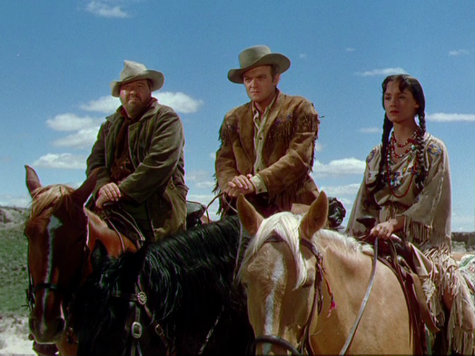
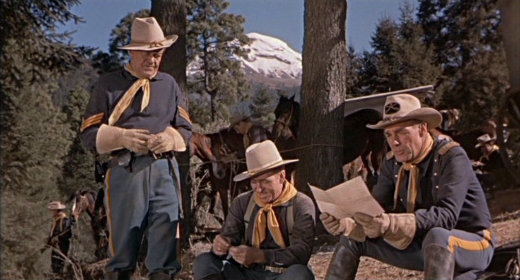
Over the years I’ve tried to turn the spotlight where possible on those films which I reckon have either been unfairly maligned or, more commonly, just fallen between the cracks and slipped off the radar of movie fans. As a lover of westerns, I’ve found that the genre provides an especially rich vein to mine with respect to neglected gems. This is partly down to the sheer volume of pictures made during the western’s heyday, and also the gradual decline in interest in the genre, not least from a critical perspective. In my own small way, I’ve looked to draw a little attention back towards westerns and maybe encourage others to explore a little deeper. I particularly like the more socially aware pictures of the early 50s, those movies which did their best to offer entertainment and simultaneously encourage thought on the part of their audience. George Sherman’s Tomahawk (1951) is one such film – it’s a handsome looking, well paced work that not only contains a potted history lesson but also approaches the Indian Wars in a mature and intelligent way.

The film is bookended by one of those strident, self-important and frankly grating narrations that became fashionable in the documentary-style noir pictures of the post-war years. In many ways this is an inauspicious opening and one that doesn’t really blend in with the rest of the film. The time and context are established but I feel that this could have been achieved just as well, and with a good deal less piety, via the more traditional method of using rolling captions. Anyway, it’s Wyoming in 1866, at the time the Bozeman Trail is drawing in settlers and prospectors. The fact that this route west passes through Sioux hunting grounds, and violates previous treaty pledges, has the potential to spark off a major conflict with Red Cloud’s warriors. The problem is exacerbated by the government’s decision to build Fort Phil Kearny as a garrison to house an army detachment and offer protection to travelers. The construction proved a sore point with the Sioux, and the film concentrates on a compressed version of the bloody events that ensued, namely the Fetterman Massacre and the Wagon Box Fight. It includes all the major players in those battles and gives the story a new twist by adding in a revenge aspect. Everything unfolds from the perspective of Jim Bridger (Van Heflin), a trapper and former scout who allows himself to be coaxed back into service for personal reasons. Bridger is disparagingly referred to by some as a “Squaw Man” – a man who has taken an Indian girl as his wife – and it’s this status that forms the basis for his decision to return to scouting duties. The Sand Creek Massacre of 1864 is one of the most notorious atrocities to take place on the frontier, when Colonel Chivington led his irregular cavalry in a raid on a Cheyenne village, butchering and mutilating in the region of 150 of the inhabitants, the majority of whom were women and children. Bridger, who suffered a grievous loss in this massacre, has spent the intervening years hunting those responsible. When the young Cheyenne girl, Monahseetah (Susan Cabot), with whom he’s traveling believes she has recognized one of Chivington’s men among the troops detailed to the new fort, Bridger takes up the offer to scout for the army once again. At first, there exists an uneasy truce between the Sioux and the soldiers, Red Cloud being shown as a man willing to compromise so long as his people aren’t faced with aggression. However, the hotheaded hatred of the Indians by a young officer, Lieutenant Dancy (Alex Nicol), leads to an inevitable killing and matters start to spiral ever downward. The new fort soon finds itself under effective siege, with Dancy and Captain Fetterman (Arthur Space) seeking to discredit Bridger in the eyes of the garrison commander and downplay his estimate of the strength of Red Cloud’s forces. The movie covers the essentials concerning the build up to and aftermath of the Fetterman Massacre but alters some details for the purposes of storytelling – most notably by compressing the timeline and shifting some of the responsibility away from Fetterman himself.

£11

George Sherman has never really got his due as a director; he worked in a variety of genres but his westerns for Universal in the 1950s in particular constitutes a strong body of work. His movies tend to be well paced and, more often than not, play around with interesting themes. Tomahawk packs a lot of story into its 80 minutes yet, despite moving at a fair clip, never sacrifices coherence. Aside from the standard cavalry versus Indians stand-off at the heart of the tale, there’s a revenge story and a commentary on the dubious treatment of the Indians blended in too. I think it’s a credit to Sherman’s skill that all these elements are handled well, and that the finished film is never less than entertaining. The majority of the action takes place outdoors, with Sherman and cameraman Charles P Boyle making the most of the Dakota locations. Sherman manages to convey the beauty and expansiveness of the landscape, leaving the viewer in no doubt why men like Red Cloud were prepared to fight and die if necessary to safeguard their ancestral lands. The film makes no bones about where its sympathies lie; the character of Bridger is as much of a guide for the viewer as he is for the army. It’s through his eyes that we’re invited to see things, and this allows us to experience the personal conflict of a man torn by his love for and understanding of the Indian way of life, and his sense of duty to the country of his birth. As such, the film never shies away from depicting the duplicity and inherent racism of Indian policy at the time, yet does its best to address the complexity of the situation too. I feel it slots nicely into that cycle of early 50s westerns that tried to come to terms with a particularly tumultuous period of US history.

Van Heflin’s stoic presence is the glue that holds the picture together. He had that lived in look that was just right for playing a toughened frontier scout, and the necessary physicality to make the action scenes seem authentic. I think one of his strengths as an actor was the thoughtful, introspective quality that he was able to bring to his roles, and the character of Bridger allowed him to explore that. You could argue that the revenge motif that runs throughout the movie was a tacked on extra, but it’s very important in helping to flesh out the character of Bridger and explain his motivation. Without the whole Sand Creek back story, Bridger would be just another westerner with a fondness for Indians. The scene where he explains his background to Yvonne De Carlo not only provides something for Van Heflin to get his teeth into, but it also makes it clear to the viewer where his passionate advocacy of the Indian stems from. Heflin rarely gave a poor performance in any movie, and Tomahawk saw him touch on grief, compassion, love and fury convincingly – a real three-dimensional figure rather than a caricature or stereotype. Yvonne De Carlo always brought a kind of tough glamour to whatever part she played, and some of the technicolor movies she made in the late 40s and 50s really highlighted her beauty. Although she was essentially playing the love interest in this film, her character’s real purpose was to draw out Heflin. Therefore, the romantic aspects never actually overwhelm the main focus of the story, serving to complement it instead. The chief villain of the piece was Alex Nicol as the sneering racist. He always seemed at his best playing the bad guy (check out The Man from Laramie for another performance that’s certainly interesting), and Tomahawk gave him the chance to indulge in some great rodent-like nastiness. The film boasts an extremely strong supporting cast, including a small part as a trooper for a young Rock Hudson. Susan Cabot met a very tragic end in real life but she was a very attractive screen presence in her time. I thought she brought a really sweet allure to the role of Monahseetah. In addition, there are well-judged turns from Jack Oakie, Preston Foster and Tom Tully.

£10

Tomahawk is available on DVD in a number of territories, including the US (as part of Universal’s MOD programme) and the UK. Before those editions were released Mondo Entertainment in Germany put the title out as part of a licensing arrangement with Universal, and that’s the copy I have. I have to say that the transfer on that disc is fantastic – it’s sharp, clean and has the kind of eye-watering colours that show the cinematography off to great effect. The film is offered with a choice of the original audio or a German dub, and no subtitles of any kind are present. Extras are confined to text biographies of Yvonne De Carlo and Rock Hudson (Hudson’s name gets prominent billing on the cover too despite his minor role – no mention of Heflin at all) and advertisements for other titles in the range. All told, I feel Tomahawk is an excellent little film that rarely seems to get a mention. Sherman paints some lovely images, packs in the action, tackles tough themes, coaxes solid performances from his cast and entertains all the way. Frankly, this really ought to be better known and more widely seen. It’s definitely a movie to check out if you get the opportunity – I don’t think it will disappoint.


A Fistful of Dynamite

I know what I am talking about when I am talking about the revolutions. The people who read the books go to the people who can’t read the books, the poor people, and say, “We have to have a change.” So, the poor people make the change, ah? And then, the people who read the books, they all sit around the big polished tables, and they talk and talk and talk and eat and eat and eat, eh? But what has happened to the poor people? They’re dead! That’s your revolution.

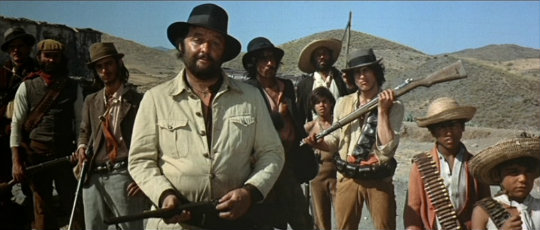
For someone who has dedicated so much time to writing about westerns, I’ll have to admit I have thus far neglected one of the best known directors of the genre: Sergio Leone. The truth is that, outside of Leone’s work, I cannot claim to be a huge fan of the spaghetti western sub-genre. So, while I have reservations about the Euro western in general, I have no hesitation at all acknowledging the artistry and sensibility of Leone. He didn’t actually make a large number of westerns, but those which he did have been highly influential. Once Upon a Time in the West has probably come to be accepted as his crowning achievement. While I have no intention of challenging that assertion, I do believe that A Fistful of Dynamite (1971) runs it a very close second in terms of emotional and intellectual depth.

The setting is Mexico during the revolution, and this provides the ideal background for Leone to lay out his thoughts. It affords him the opportunity to make points of both a political and personal nature, and weave them together into a critique of the direction of contemporary filmmaking. If Ford and Peckinpah had helped deconstruct the myth of the west, and paved the way for the emergence of the spaghetti western, then Leone (critically lauded as a cinematic revolutionary) set about the deconstruction of the myth of revolution itself. The film opens with Mao’s quotation describing revolution as being essentially an act of violence, and the events that unfold on the screen back up this assertion. Yet Leone, in his depiction of the frequent and mindless violence, never glories in the bloodshed. The film we see is a tragedy, a very human one, but at the same time it’s a celebration of friendship and kinship. We follow the fortunes of two men, John Mallory (James Coburn) and Juan Miranda (Rod Steiger) as they navigate the danger and treachery of a country in upheaval. John is an IRA man, an explosives expert on the run from his native land plying his trade in the silver mines. Juan is a bandit, a simple peasant content to live off whatever pickings come his way. A chance meeting draws these two contrasting characters together and binds their fates inextricably. Initially, each man views the other as a kind of dupe, a tool to be made use of to further their individual ends. Juan sees the Irishman as the means by which he can finally crack the famed bank in Mesa Verde, while John regards the Mexican as someone he can trick into serving the revolutionary cause. The first half of the movie takes us through the twists and turns of his mismatched duo’s effort to stay one step ahead of the other. The tone is light, bordering on the comedic at times, but the clouds are gathering in the background. The aftermath of the Mesa Verde escapade ushers in the second, darker part of the story. It’s here that the full import of the political situation starts to become clear. Where the violence of the earlier section had a cartoonish quality, the deaths that follow (and there are many) are cruel, and they have consequences. The romance of revolution is laid bare before us, both in words (see the opening quotation above) and actions, and it’s not a pretty spectacle. Leone’s controversial assessment seems to be that betrayal and loss – of family, friends and ideals – are both the result and foundation of revolution. That’s a brave and daring position to adopt at any time, and even more so in 1971 following hot on the heels of the previous decade’s climate of political, cultural and social change.

For the most part, A Fistful of Dynamite follows a traditional, linear narrative structure. However, there are teasing flashbacks interspersed throughout, each one adding to and expanding on those that precede it. These flashbacks relate to John’s past life in Ireland, and show Leone’s gift for inventiveness by gradually revealing the character. In fact, they work on two levels: (i) they act as an homage to Ford, by evoking the Irish preoccupation with betrayal as seen in The Informer and (ii) they delineate the background of John, simultaneously marking him out as a western hero in the classical mold. Leone was greatly influenced by Ford – a section in Christopher Frayling’s first class Once Upon a Time in Italy reprints a 1983 interview Leone gave an Italian newspaper, where he details his reverence for Ford and tells how he had a framed photo the latter had signed and inscribed in his honour occupy pride of place on his wall. In purely narrative terms, the flashbacks not only flesh out the character of John but they help explain why and how he came to this place in his life. John is essentially an enigmatic character, a man whose motivations are hard to divine, yet the brief interludes in Ireland allow us to build up a near complete picture of him by the end. By charting his descent from romantic idealist to disillusioned technician, the flashbacks both fill in the gaps and establish his western credentials. At first glance, an Irish bomber involved in the Mexican revolution might not appear to be a traditional western figure, but an examination of his character arc – betrayal, revenge, guilt and the quest for spiritual redemption – tells the tale. This lone figure, this outsider with a heart full of regret, searching for a way to bury his past is a recurrent one in the classic western. As such, John moves from apparent cypher to an incredibly complex man, a walking tragedy who seems destined to enter a new cycle of guilt and remorse – his involvement of Juan in his schemes brings only misfortune, and the matter of betrayal once again rears its head. The explosive finale, therefore, represents the only possible way for him to achieve a form of closure and inner peace. Coburn really got under the skin of John, maybe not quite reaching the levels of self-disgust he managed when playing Pat Garrett for Peckinpah but not far off either. The climactic scene on the engine plate with the traitor Villega (Romolo Valli), where he vows never to pass judgement on another man again, is a masterclass in bitterness and loathing.

By contrast, Juan is a much more straightforward character, a simple man with simple dreams. However, he too has to suffer at the hands of idealism. He’s well aware of the hypocrisies and false promises held out by the revolutionaries, yet he allows himself to be drawn ever deeper into the machinations of John and Villega. His casual vulgarity and lack of sophistication mark him as a semi-comedic everyman, someone whose attachment to family allows the audience to sympathize with him despite his being a common criminal. By having the audience view proceedings mainly from Juan’s perspective, Leone manages to hammer home the abrupt shift in tone at the halfway point much more effectively. The fate of his extended family, a direct consequence of his greedy foolishness and unwitting embroilment in politics, hits both him and us hard. The scene in the cave, with a bewildered and grief-stricken Juan stumbling around amid the carnage, is extremely moving no matter how often it’s seen. It brings both the film and the character to a new level, and neither one is ever the same again. Juan is transformed form a gregarious rogue with grandiose plans first to an image of despair, and then to something harder and colder. As an actor, Rod Steiger generally had a tendency to overcook it, to chew up the scenery before moving on to the props for afters. That is certainly in evidence in the early stages, where he is essentially a caricature of a Mexican bandit. However, he was capable of greater subtlety when the occasion demanded, and his reaction to the discovery in the cave, and all that follows, bears testimony to that. Steiger managed to tap into the development of his character, the journey he has taken, but still hold onto a touch of the innocence that makes him endearing. The final fadeout, with Juan’s moon face staring dumbly into the camera lens as his question is heard and the answer flashes before us, underlines Leone’s feelings and highlights the pitiful quandary faced by all of us.

Of course it would be impossible to discuss any Sergio Leone film without also referring to the music of Ennio Morricone. To any film fan, the names of the director and composer are inseparable, and the two men seemed to draw the best from each other. Morricone’s scores are always distinctive, primal pieces that complement the harsh landscapes and off-center characters in Leone’s films. For A Fistful of Dynamite, Morricone created music that was quite unlike the work he did on the previous Leone collaborations. There’s a light, jaunty quality to the scoring in the early scenes that matches the initial buffoonery of Juan and the ribbing of John. This gives way to the lush romanticism of the pastoral flashbacks and the ethereal vocals repeating the name Sean over and over. And finally, the more somber variation on that theme as the flashbacks grow darker and knowledge of what John did to his friend (Sean?) becomes apparent. One of the features on the DVD actually raises that question – who is Sean, and why does John call himself that at first? Of course, Sean is often used in Ireland as the Gaelic form of John, but Leone’s cutting of that scene and the use of the music therein does suggest some kind of transference is taking place, that John’s guilt is subconsciously driving him to adopt the name of his friend.

And finally, a word on the title. This movie has been known under a number of titles: Giù La Testa, Duck, You Sucker!, Once Upon a Time in the Revolution and A Fistful of Dynamite. The original Italian title arguably captures Leone’s message most succinctly – a plea to keep a low profile and thus avoid unwanted political attention and trouble – but the translation into English loses much of that and actually suggests some light-hearted romp. The other two alternatives both represent attempts to draw connections to and capitalize on Leone’s previous successes, but neither is really satisfactory either. In the end, I opted to use A Fistful of Dynamite to head the piece here mainly because that’s the one I’m most familiar with, and it’s also emblazoned across the cover of my DVD.

A Fistful of Dynamite is a movie that has been released in different forms over the years, but the 2-disc DVD from MGM presents the definitive cut. It restores the full, extended flashback at the end of the film and the title of Duck, You Sucker as it fades out. That full flashback, with its dreamy feel, is vital in fully understanding the relationship between John and his friend back in Ireland, and adds a different twist, a shade more ambiguity, to his actions. I’d hate to be without it. The edition is stacked with fascinating extras, not the least of which is an excellent commentary track from Sir Christopher Frayling. I have no particular complaints about the anamorphic scope transfer but I still feel it’s a pity it has yet to be released on Blu-ray. Among Leone’s films, this title sits alongside Once Upon a Time in the West in my affections, and might just edge it out. Objectively, it may not be the better film, but it has a kind of romanticism, and disillusionment – and what’s disillusionment but wounded romanticism anyway – that stirs something in my Irish blood. I don’t know, it’s a film I love – that’s as much as I can say.

Robbery

£27

Films centered around heists generally fall into two categories – those which take a light-hearted, comedic approach such as Ocean’s Eleven, The Italian Job or Gambit, and the darker morality tales to be found in film noir like The Asphalt Jungle, The Killing and others. Peter Yates’ Robbery (1967) takes an entirely different tack, and tells its tale in a semi-documentary style. The movie is inspired by (and I use that term deliberately rather than saying it’s based on real events) the Great Train Robbery of 1963. Yates’ film uses the famous crime as a template but it shouldn’t be seen as an exact reconstruction of what happened. The style of storytelling used is probably the strength of the production, but I think it’s fair to say that it also accounts for its main weakness.

The bulk of the running time concentrates on the planning and execution of the raid on the mail train, and merely touches on its aftermath right at the end. The first quarter-hour sets the exciting yet impersonal tone of what is to follow by detailing a daring diamond snatch in central London. The purpose is to secure sufficient funds to set everything in motion, and it’s a terrific piece of filmmaking. The highlight is the intensely shot car chase that takes place after the diamonds have been grabbed. The whole idea of a car chase is one that has been used, and arguably overused to the point of cliché, in countless thrillers over the years. There are, however, instances where this standard element has been shot and employed to great effect, and Robbery is certainly one of those. After this heart-pounding sequence, the pace relaxes somewhat as we watch Paul Clifton (Stanley Baker), a recently released convict, begin to piece together the team of underworld types he needs to pull off the one big score that will allow him to bow out and retire. However, such things never run entirely to plan and little obstacles and issues arise right from the beginning. Taken in isolation, none of these flaws or setbacks amount to much in themselves; however, the cumulative effect as the story develops is what ultimately counts. While we’re afforded glimpses into the lives of all the principals involved, most of the action plays out from the perspective of Clifton and the policeman, Langdon (James Booth), who is on his trail from early on. The robbery itself is carried out in the style of a military operation, with everyone having their roles clearly defined and the timing judged to the second. As viewers, we’re just as aware as the protagonists of the importance of all the details falling into place and the risks inherent in any deviation from the plan. This knowledge, and the script’s focus on it, is what creates the tension on which the story relies. Nevertheless, despite the most meticulous preparation, such things inevitably start to unravel. As I mentioned before, there are numerous weaknesses in the plan that build up and become magnified over the course of the movie, and it’s impossible to identify any one as the most critical. I found the ending of the film quite satisfactory – it has the kind of moral ambiguity that both fits the era in which it was made and also acts as a truer reflection of real life.

£25

I guess Peter Yates really made his name as a director when he took charge of Bullitt. That film featured an iconic car chase sequence through San Francisco, and it appears that his work directing the opening chase in Robbery played an important part in securing his participation in the McQueen movie. In terms of visuals and pacing, it’s hard to fault Yates – the film has a gritty and realistic feel and moves smoothly along. The main set piece, the actually taking of the mail train, is superbly filmed and cut together to heighten the sense of urgency of the gang. The same can also be said of the subsequent sorting and dividing up of the takings in the bunkers below a disused air force base; the claustrophobic set is used to good effect to emphasize the isolation of the gang and their distance, emotionally at least, from the dragnet that has been cast. Generally, the film does a good job of capturing the flavor of that late 60s era, not the swinging, carefree one which seems to be the popular perception now, but the grim and tough one that was familiar to most working-class people. I said in the introduction that one of the picture’s strengths, perhaps its greatest, was the brisk, documentary tone which simultaneously, and paradoxically, weakens it too. The point is that by concentrating on the nuts and bolts aspects of the robbery a lot of the human drama is absent. We don’t really learn a great deal about the characters involved, aside from their role within the gang, and this means we never get the opportunity to feel strongly for them. I don’t think this is a failing of Yates really as some of his subsequent work, especially The Friends of Eddie Coyle, is basically character driven.

Robbery features a strong line up of British actors, although the focus is mainly on Stanley Baker and James Booth (both of whom, coincidentally, starred in producer Joseph E Levine’s earlier movie Zulu) and they dominate proceedings. Booth is pretty good as the man from the Flying Squad who cottons on to what may be happening before anyone else. Having said that though, the script allows for no sense of who this man is beyond his job – he’s just a cop, albeit a likeable one. Baker does get a little more back story to help flesh out his character, but again this is strictly limited. Baker was a fine actor, one of the best Britain produced, yet he’s handed a fairly one-dimensional part here. We do learn that he’s desperate to avoid a return to prison, and the scenes between him and his wife (a very attractive Joanna Pettet) give at least a glimpse of the private man. Still, by and large, Baker spends most of his time playing it strong, silent and tough. I guess the most rounded character is to be found among the supporting players – Frank Finlay is excellent as the timid banker, an embezzler who finds himself drawn into Baker’s scheme. Finlay gives a very sensitive portrayal of a man torn by personal guilt and his longing to contact his wife, even for the briefest moment, is quite touching. Barry Foster is underused as one of the senior gang members, although William Marlowe gets a slightly meatier part as Baker’s right hand man.

£26

A few years ago, Robbery was released on DVD in the UK by Optimum. Despite its faults, it’s a movie I’ve always liked a lot and so I was keen to pick it up. However, I was disappointed to find that Optimum’s disc had a full frame, open-matte presentation of the film. Anyway, I had to make do with that compromised edition since there didn’t appear to be any other option available. Recently though, I noticed that Regia Films in Spain had put out a disc, and I decided to take a chance and see if it was any improvement. I was pleasantly surprised to find an excellent transfer of the film that presented it in the 1.66:1 ratio with anamorphic enhancement. The disc has no extra features whatsoever, but the subtitles don’t cause any problems and can be switched off from the setup menu. The fact that the movie is now available in anamorphic widescreen is the most important advance as far as I’m concerned. I don’t think the film is a perfect one, but it does have a fine cast and shows off Yates’ flair for action and tense situations. Despite its flaws, I’d still recommend this title to anyone keen on British crime pictures, or just crime movies in general.

The Big Sleep

But down these mean streets a man must go who is not himself mean, who is neither tarnished nor afraid. The detective in this kind of story must be such a man. He is the hero, he is everything. He must be a complete man and a common man and yet an unusual man. He must be, to use a rather weathered phrase, a man of honor, by instinct, by inevitability, without thought of it, and certainly without saying it. He must be the best man in his world and a good enough man for any world. I do not care much about his private life; he is neither a eunuch nor a satyr; I think he might seduce a duchess and I am quite sure he would not spoil a virgin; if he is a man of honor in one thing, he is that in all things. (Raymond Chandler, The Simple Art of Murder, 1950)

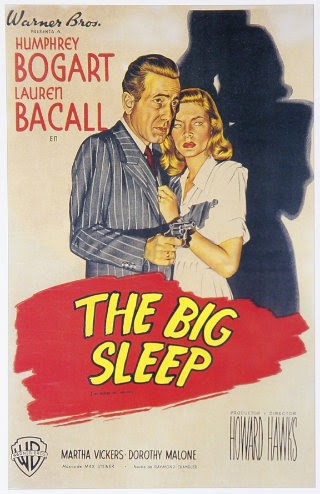
That quote from Chandler is a distillation of what he felt were the characteristics of the fictional private eye, and it’s a view that continues to endure. The reason for the popularity of this particular representation is understandable enough: not only does it portray the detective as the classical hero, it also allows the audience to identify with him, to see in him the kind of man they’d probably like to be themselves. Chandler’s knight errant Philip Marlowe has appeared on screen a number of times with varying degrees of success, but the incarnation that I, and I guess a lot of other people too, have the highest regard for is Humphrey Bogart’s take in Howard Hawks’ The Big Sleep (1946).

Some aspects of the plotting of The Big Sleep are notoriously complicated – the story goes that screenwriters William Faulkner and Leigh Brackett, along with director Hawks, were so confused about who committed one of the murders that they contacted Chandler for clarification. Apparently, the author found himself similarly stumped. The thing is that the murders, motives and twists of the plot pile up so relentlessly that it does take a fair bit of concentration on the part of the viewer to keep up with it all. However, that’s not really the point of the movie and the basic thrust of the narrative is easy enough to follow in itself. Philip Marlowe (Humphrey Bogart) is the private detective engaged by the ailing General Sternwood (Charles Waldron) to take care of a blackmailer who is putting the squeeze on Carmen (Martha Vickers), the younger and wilder of his two daughters. In the course of his investigation, which rapidly descends into a murder case, Marlowe finds that the elder sister, Vivian (Lauren Bacall), appears to be tangled up in things too. Vivian’s a cooler, more composed customer than her sister, yet her involvement with a shady gambler, Eddie Mars (John Ridgely), indicates that she too is keeping dangerous company. I’m not going to go into the labyrinthine twists and turns of the plot here, firstly to avoid spoilers, and secondly because it will likely serve to do nothing more than confuse readers. Suffice to say the stories of General Sternwood’s two girls eventually dovetail and all the various plot strands are drawn together satisfactorily. Yet, as I said before, you don’t watch The Big Sleep just to find out who did what to whom, when and for what reason. This is truly one of those movies where the journey is far more important than the destination. As we follow Marlowe around a moody and threatening Los Angeles, we go on a tour of the seedy underbelly of the city. Even though the time is spent in the company of high rollers and the glamorous set, it’s all merely a glittering veneer for a world of pornography, drugs, deviance, betrayal and violence.

Vivian: I don’t like your manners.

Marlowe: And I’m not crazy about yours. I didn’t ask to see you. I don’t mind if you don’t like my manners, I don’t like them myself. They are pretty bad. I grieve over them on long winter evenings. I don’t mind your ritzing me or drinking your lunch out of a bottle. But don’t waste your time trying to cross-examine me.

One of the great pleasures of The Big Sleep is the dialogue. Most of the memorable lines and passages, such as the little sample above, are lifted almost directly from the pages of Chandler’s novel. However, Brackett, Faulkner and Jules Furthman did have to make some alterations to turn in a workable script, both for storytelling reasons and to ensure the finished product was going to get past the Hays Office. Therefore, the more overt references to the unsavory nature of the blackmailer’s racket had to be toned down for example. The infamous production code is often criticized, and with good reason, for imposing draconian and logic-defying restrictions on what could be shown on the screen. The thing is though, a good deal could be implied if not directly stated, and clever writers could exploit this loophole. In a sort of perverse way, the very restrictiveness of the code meant that filmmakers were forced to be more creative in their efforts to circumvent it; I think The Big Sleep stands as an excellent example of this apparent paradox. The two houses in which much of the tale plays out are the Sternwood mansion and the home of Geiger, the blackmailer. Hawks and his crew succeed in bathing both locations in such an atmosphere of decadence and iniquity that it needs little imagination to appreciate the depravity lurking beneath the surface. Perhaps Hawks’ greatest triumph in the picture is the way he manages to ensure that style rises above substance throughout and he creates a crime story where the crimes and their resolution become secondary to our enjoyment of the ride through Chandler’s twilight world.

While The Big Sleep benefits enormously from a snappy script, strong source material and a first class director, what helps elevate it to true classic status is the casting. The second collaboration of Bogart and Bacall builds beautifully on the foundations already laid in To Have and Have Not. The movie took their on and off-screen courtship to new and more sophisticated levels, and the air fairly crackles whenever they share a scene. I think Bogart was born to play Marlowe, he perfectly encapsulates the weary nobility of Chandler’s creation like no other actor before or since. The part can be seen as an extension or refinement of Hammett’s Sam Spade from The Maltese Falcon, but there’s a greater sense of honour and less aggressive smugness this time. I already mentioned this in an earlier post, but Bogart’s delivery of his lines is perfect, so much so that it’s very hard to read the novel and not hear him saying the words. On the receiving end of much of Bogart’s wise-cracking, and pitching back every bit as good as she got, was Bacall. Watching her performance today, it’s hard to believe that Bacall wasn’t much past twenty years old when the movie was shot. There’s an air of assurance and worldliness about her that belies her years, the hard-boiled dialogue flowing smoothly as though from a woman who’d been around a long time and had seen all there was to see. In truth, the whole cast does excellent work, but the women in particular stand out. Martha Vickers is all coy treachery, and there are fine and memorable bit parts for Dorothy Malone and Sonia Darrin. Of the men, I feel Elisha Cook Jr deserves a mention for another of his characteristic turns as an unfortunate fall guy. I guess the only real weakness was John Ridgely, it’s not that he gives a poor performance but he never fully convinces as a dangerous mobster – having said that, he does get one fantastic send off.

The US R1 DVD of The Big Sleep contains two versions of the movie (as far as I know the R2 doesn’t offer this choice) – the preview version and the theatrical cut. I mention this mainly because there are some notable differences in the two cuts. I’m not going to laboriously list all the changes here, that information is readily available elsewhere online, but I will say that they change the feel of the movie significantly. In short, the preview cut is an altogether blander affair, although it helps to make the plot more comprehensible. The theatrical version is much more stylish, placing more emphasis on the Bogart/Bacall dynamic while sacrificing some of the narrative coherence. Personally, I far prefer the theatrical cut, and not just because it’s the more familiar of the two. While the preview version does offer more exposition, it throws the pacing off balance and fails to fully capitalize on the chemistry of the star pairing. It’s nice to have it available for comparison purposes but that’s about it for me. The transfer is reasonable enough, maybe not up there with the best that Warner Brothers have done in the past but it’s certainly not poor. The disc also offers a short feature on the differences between the versions of the movie, and is useful in giving an overview if you don’t feel inclined to watch both cuts all the way through. This movie and The Maltese Falcon helped cement Bogart’s image as the archetypical private eye. Others have played the part of Marlowe, and others have taken on the role of various private detectives, but Bogart nailed it. The film as a whole, can be viewed as a film noir (although of the lighter variety), a crime/detective story, or simply as an outstandingly well-crafted piece of classic Hollywood filmmaking. It comes most highly recommended.

7th Cavalry

poster200-1

On June 25 1876 Lt Col George Armstrong Custer led his famed 7th Cavalry into the valley of the Little Bighorn, and into the pages of history. Exactly how subsequent events unfolded have remained the subject of debate and conjecture to this day. What is certain is the result of that fateful engagement between Custer’s 7th and the enormous force of Indian warriors, largely Sioux and Cheyenne, ranged against them. Custer and his entire command were massacred, wiped out to a man. Over the years, that event has come to symbolize different things to different people: heroism, folly, retribution, or flawed judgement. A number of films have offered various interpretations of what transpired in the heat of battle, and a few have also turned their attention to the aftermath. 7th Cavalry (1956) is one of those movies that looks at what followed and, for a time at least, toys with the notion of saying something definitive about the actions of Custer. Ultimately though, it backs away from this – it’s essentially a film of two parts, with the potentially interesting beginning gradually giving way to a more familiar and standard outdoor adventure that’s nowhere near as satisfying as it could or should have been.

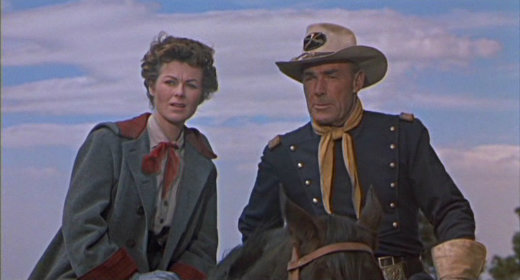
The story is told from the perspective of Captain Benson (Randolph Scott), apparently one of Custer’s favourites, who is first seen returning to Fort Lincoln in the company of his bride-to-be, Martha Kellogg (Barbara Hale), shortly after the ill-fated Little Bighorn expedition. At this stage Benson is unaware of what has befallen his regiment, but the uneasy silence hanging over the fort as he approaches it alerts him to the fact that something is badly wrong. These opening scenes are eerily atmospheric, as we follow Benson through the deserted fort, and share in his confusion and sense of foreboding. And then the full, horrific truth is revealed – the overwrought widow (Jeanette Nolan) of one of the slain soldiers confronts Benson and tells him of the massacre and the ugly fate of those who fell, practically accusing him of cowardice and deception in the process. What follows is the return of the surviving units, the establishment of a board of inquiry and the airing of various recriminations. The inquest into this military disaster is to be conducted by the father of Benson’s betrothed, a stiff and uncompromising army man of the old school (Russell Hicks) who has always regarded his potential son-in-law with suspicion at best. This section is where the film is at its strongest, holding out the possibility that a range of themes, ranging from the classic one of redemption through notions of honour and class prejudice, will be  delved into. Yet few of these, barring the former, are ever fully explored as the movie progresses. The second half sees the tone, emphasis and setting shift completely as the investigation winds up rapidly and Benson sets out on a suicidal mission to recover the remains of Custer and the other officers of his command. Here we retreat towards more standard fare as Benson picks a troop of “volunteers” made up of drunks and shirkers (Jay C Flippen, Denver Pyle, Leo Gordon, Frank Faylen et al) who also avoided the initial battle to undertake the perilous mission. Despite being weaker, this portion of the movie is not without its own points of interest, not least the introduction of the idea of spirituality. Sadly though, here’s another potentially fascinating avenue that’s left undeveloped and actually treated in a hokey fashion in order to facilitate a convenient climax.

£25

Over on his site on 50s westerns yesterday, Toby made a very good point when he mentioned Night Passage. If you follow that link you will see exactly what he was saying, and the essence of it is that the way we approach a film, or the weight of expectation that we bring along, can unfairly colour our assessment of it. It’s an idea that I’ve had buzzing around in my own head for a while too, and Toby’s reference to it made me wonder if it didn’t have some application to the movie in question here. What I mean is this: how far does one’s preconceptions based on cast, crew and subject matter impact on the evaluation of a movie? In this case, we have a mid-50s western starring Randolph Scott, directed by Joseph H Lewis, and dealing with one of the most controversial figures in western lore. I think all of these factors are bound to raise expectations in the minds of viewers, expectations on which the finished product doesn’t really deliver. Is that position fair though? On consideration, I think it is, or partially so at least. Lewis has a reputation for making tight and economical little B pictures that frequently transcend their modest production values and offer visual and thematic riches. I don’t think his direction is especially weak in 7th Cavalry, but the script, and its execution, tries to pack too much into a pretty brisk running time. There’s simply too much going on and too little time to expand upon any of it. Ultimately, we’re left with a first half that flatters to deceive, and a visually attractive follow-up (beautifully shot by Ray Rennahan) which leaves us short-changed. The specter of Custer hovers over proceedings throughout, and indeed helps effect a resolution which is far too pat for my liking. I do wonder if the film had had a director and star of lesser standing whether my overall reaction would have been different – I don’t know, but it is something to ponder.

And back again to expectations. Randolph Scott made 7th Cavalry just as his collaboration with Budd Boetticher was about to see his iconic status within the western genre fixed permanently. It’s difficult to put that thought to one side while watching the movie but, in all fairness, Scott acquits himself well enough despite the shortcomings elsewhere in the production. Anyone familiar with this site will be well aware of my admiration for Scott, and the roles he took on in the latter stages of his career are easily my favorites. No one ever played pride on screen quite so effectively as Scott, and that aspect forms the cornerstone of his portrayal of Benson. His quiet dignity and innate self-confidence are to the fore as he plays a man whose motives and character are called into question by almost everyone – it’s not quite the conflicted loner that he and Boetticher would so successfully explore but it’s not a million miles away either. As the principal female lead, Barbara Hale is fine, yet the role is limited in scope and offers her few opportunities. The supporting cast in the film is particularly strong – Jay C Flippen, Frank Faylen, Leo Gordon, Denver Pyle and Jeanette Nolan all have their chances to shine and deliver telling little performances, with Faylen and Flippen getting the more interesting and rounded roles. I also want to take this opportunity to mention the small (yet pivotal in terms of the plot) part played by the recently deceased Harry Carey Jr. Over the years, his presence contributed a lot to so many films, especially westerns, and his passing sees yet another link to the golden age of cinema severed. In 7th Cavalry, as in so many movies, Carey displayed an honesty and simplicity that always helped ground a picture and added a certain warmth.

£28

7th Cavalry is one of those films that has been hard to get hold of in an acceptable edition on DVD. There are a number of options available, but most are problematic in one way or another. There’s a French release by Sidonis that reportedly sports a fine transfer but forces subtitles on the original soundtrack, there’s a UK disc that I understand is of appalling quality, and there are no fewer than three editions in Spain. Of those Spanish releases, two are either full frame or non-anamorphic letterbox transfers. The one to go for is this edition by Regia Films, which sees the movie paired up on separate discs with another Lewis title Terror in a Texas Town. The disc has a good anamorphic widescreen transfer, with subtitles which can be deselected via the setup menu. The print used is in pretty good condition, without any noticeable damage, although the colours can appear slightly muted on occasion. In the final analysis, I’d have to say 7th Cavalry is a middling western; there is the promise of something different that’s never fulfilled, and that’s what I find most disappointing.


Blood on the Moon

Pa8uCNs

Having already covered a number of westerns which have crossed over into noir territory, it’s time to turn the spotlight on one more. If we regard the mid-late 1940s as the heyday of film noir proper, then it’s only reasonable to find one of the strongest western variants within that time period. Blood on the Moon (1948) follows all the typical western conventions but uses a recognizably noir figure as its protagonist and employs the dark cinema’s trademark shadowy photography to emphasize both the sense of danger and moral ambiguity implicit in the story. As is always the case with these genre straddling examples, the film stops just short of being noir at its purest – the essential pessimism of that form rarely blending naturally or completely into a western story.

Jim Garry (Robert Mitchum) is one of those guys who’s no stranger to bad luck, a drifter with an ill-defined past first seen traversing a bleak and rocky ridge in the middle of a driving rain storm. When you see a guy strike a frugal camp and bed down to rest his weary bones, gaining some respite from the harsh elements, only to have his outfit smashed to pulp by a wildly stampeding herd of cattle, it’s easy to tell fortune isn’t exactly smiling on him. The herd belongs to Lufton (Tom Tully), and when Garry is taken back to the cattleman’s campsite he receives a kind of backhanded welcome. The west of Blood on the Moon isn’t an open or warm place, rather it’s a world of shadows, suspicion and wariness. Garry has ridden into a developing range war, the classic stand-off between the ranchers and the homesteaders. On one side we have Lufton, a rancher with a herd of beef that the Indian agent has refused to buy and which is about to be seized by the army unless it’s removed from the reservation post-haste. The opposition is a ragtag bunch of settlers, organized and dominated by Tate Riling (Robert Preston), and bolstered in strength by a handful of hired gunmen. Riling is denying Lufton access to old grazing land, ostensibly on the pretext that he’s defending the rights of the settlers. However, his real motivation is the opportunity to force Lufton into selling to him on the cheap, thus allowing him to make a financial killing through his dealings with the crooked Indian agent (Frank Faylen). Garry and Riling are old friends, the former having arrived due to the promise of a job with Riling. Initially, Garry isn’t particularly thrilled with the role he’s been cast in but a job’s a job. Although he doesn’t put it into words, it clear enough that Garry is uneasy about the double-dealing of Riling. What’s more, he’s clearly more impressed by the apparent straightforwardness of Lufton, and then there’s the attraction he feels towards the rancher’s younger daughter, Amy (Barbara Bel Geddes). For Garry, the turning point arrives in the aftermath of a violent raid on Lufton’s encampment that leads to the tragic death of the son of a widowed settler (Walter Brennan). With his realization of the depth of Riling’s ruthlessness, Garry experiences a crisis of conscience and finds his allegiance shifting.

Apart from the strong cast, Blood on the Moon featured a wealth of talent behind the cameras too. The story was adapted from Luke Short’s novel Gunman’s Chance, and has a scripting credit for the author himself. It appears that story caught the attention of the up and coming Robert Wise and he persuaded Dore Schary to let him run with the project. Wise had served a long and telling apprenticeship at RKO, editing Citizen Kane for Orson Welles and directing a couple of pictures for Val Lewton. In learning his trade, Wise had been keeping some esteemed company, and the experience showed up in this his first stab at directing a western. With cameraman Nicholas Musuraca achieving beautiful effects with light and shadow, Wise produced a western that’s dark, moody and heavy on atmosphere. There’s some good use of Arizona locations for the exteriors, but the most memorable aspect of the film is the gloomy and claustrophobic interior work. The low ceilings of the buildings, illuminated by guttering oil lamps, seem to press down on the characters, squeezing them and restricting their options as much as their movements. Although there are a number of noteworthy scenes, the highlight is arguably the brawl between Mitchum and Preston in a deserted cantina. This isn’t the typical cartoon scrap that we find in countless westerns; instead it’s a vicious and visceral affair that sees the two combatants slugging it out realistically. There’s no music to distract from the thudding, crunching landing of blows, and the naturalistic half-light makes the bruised and bloody faces and hands all the more convincing.


The first scene we shot after Mitch got outfitted was in the barroom. Walter Brennan was sitting at a table with a couple of pals and Brennan was very interested in the Old West, it was a hobby of his. And I’ll never forget when Bob came on the set, just standing there, with the costume and the whole attitude that he gave to it, and Brennan got a look at him and was terribly impressed. He pointed at Mitchum and said, “That is the goddamndest realest cowboy I’ve ever seen!”  – Robert Mitchum – Baby, I Don’t Care by Lee Server, Faber & Faber 2001, p180

The above quote comes from Robert Wise and is as good an illustration as any of the degree of authenticity that Robert Mitchum brought to his western roles. Brennan’s observation was spot on for Mitchum does indeed look the real deal here and gives another of his deceptively easy performances. While he seemed to relish the physical stuff that I mentioned above the quieter scenes are played out with great subtlety and, throughout it all, he moved around the landscape and sets with tremendous grace. Robert Preston was good casting as Riling, turning on the false charm and grins when it suited and really bringing out the slippery side of the character. I thought Barbara Bel Geddes was impressive too, even though the western wasn’t a genre she did a lot of work in. Her role called for a fair bit of shooting and riding and she made for a game, independent heroine. The supporting cast is a long and starry one: Walter Brennan, Tom Tully, the wonderfully gritty Charles McGraw, Phyllis Thaxter, Frank Faylen and Clifton Young all doing good work and helping to flesh out the story.

Blood on the Moon is available on DVD from both Montparnasse in France and Odeon in the UK. Seeing as I have the two discs, I’m of the opinion that the transfers are identical – both sport the same significant print damage during the raid/stampede scene at around the half hour mark. In terms of extras, the French disc (with optional subs) has the usual disposable introduction, and the UK release has a gallery. Overall, I suppose the Odeon disc is marginally more attractive, at least in relation to its packaging which features a reproduction of the original poster art on the reverse of the sleeve. The aforementioned damage, along with various other nicks and scratches, show that no restoration work has been done and the transfer does tend to look a little soft. However, the feature is quite watchable and there are no better alternatives that I’m aware of anyway. The movie is an entertaining and striking one, a strong entry in the filmographies of both Mitchum and Wise. The development and resolution of the plot do dilute the noir credentials to an extent yet the strong visual style means it never strays too far either. Personally, I feel it hits the mark as a western and comes pretty close as a film noir too; as such, it’s recommended to fans of both types of movie.


Across the Wide Missouri

poster196-1

I’ve already featured a number of films that highlighted the trend in 1950s westerns towards a more sympathetic and mature view of the various native peoples and their relationships with the westward moving settlers. William Wellman’s contribution to this phenomenon can be seen in Across the Wide Missouri (1951), where his setting of the story in the 1820s and its focus on trappers and mountain men, as opposed to the later arrival of large groups of settlers, allows him to sidestep political issues and tell a more human tale. Wellman’s movie suffered from some overzealous editing that frankly hacked his work to pieces and leaves the version available to us today an imperfect one. The director was greatly displeased by this, virtually disowning the film, yet what remains is still a beautifully shot work that has some emotional punch, in spite of what was left on the cutting room floor.

The story is centered around Flint Mitchell (Clark Gable), a rough and ready mountain man and trapper, whose adventures we follow in the form of the narrated reminiscences of his grown-up son – voiced by an uncredited Howard Keel. Mitchell is in the process of putting together an expedition to head into Blackfoot country in search of lucrative beaver pelts. With most of the arrangements in place, Mitchell catches the attention of a young Blackfoot girl, Kamiah (Maria Elena Marques), who has been brought up by the Nez Perce. Despite being amused by her advances, he initially brushes her off. It’s only when he learns of the plans of Brecan (John Hodiak), a Scot who has become so enamored of the Blackfoot way of life that he’s literally “gone native” and been integrated into their tribe, to bring her back to her own people that he changes his tune. Kamiah is the granddaughter of Bear Ghost (Jack Holt), the tribe’s elder, and Mitchell sees an opportunity to gain favour. Of course the only way to take the girl from the Nez Perce is to marry her and bring her back as his wife. While Mitchell isn’t averse to the idea, he still regards Kamiah primarily as a bargaining chip at this stage. In the course of the long trek though he finds himself genuinely falling for her charms. Mitchell doesn’t speak a word of her language, nor she his, and all but the most basic communication has to be conducted through the medium of an interpreter, an old French trapper by the name of Pierre (Adolphe Menjou). One of the interesting aspects of the film is the fact that the Indian characters, and the many of the French too, speak exclusively in their own tongue, lending a touch of authenticity to it all. With much of the focus of the middle section of the movie on the arduous journey undertaken by Mitchell and his fellow hunters, it’s basically an outdoor adventure yarn with a romance woven into it. Although the adventurous elements occupy a lot of the running time, the real heart of the film comes from the interracial romance and the gradual development of cultural understanding that accompanies it. However, few tales succeed without the introduction of some kind of conflict, and that’s provided here by the appearance of a rising Blackfoot warrior, Ironshirt (Ricardo Montalban), whose enmity with Mitchell leads to the film taking a tragic turn at the end.


My father told me that for the first time, he saw these Indians as he had never seen them before – as people with homes and traditions and ways of their own. Suddenly they were no longer savages. They were people who laughed and loved and dreamed.

The above words, spoken by the narrator after Mitchell has come upon the Blackfoot settlement, might seem to be stating the obvious these days. However, they are quite potent when viewed in historical perspective. When Across the Wide Missouri was produced it was by no means a given to see some respect granted to Native American customs and ways of life. While it’s disingenuous to say that westerns before the 50s were uniformly dismissive of Indian culture, those that tended towards the kind of sympathetic treatment that grew in popularity as the decade went on were certainly thin on the ground. One could of course argue that the inclusion of the villainous character of Ironshirt shows the movie reverting to timeworn genre stereotypes, but that’s both lazy and a bit of a cheap shot. In the first place, the responsibility for the bad blood that arises can be traced back to both sides. Furthermore, it would be a misrepresentation of the times to suggest that everything was harmonious and that the thought of expelling perceived intruders from their territory never crossed the minds of the Indians. Finally, from a storytelling perspective, the presence of this character and his actions are a large part of what gives the film its emotional impact at the climax.

£10

Across the Wide Missouri must rate as a huge missed opportunity for William Wellman, though the director cannot be held responsible for the failings. The film had the makings of being one of the great frontier epics, a sweeping and intelligent analysis of cultural symbiosis. However, it appears that MGM bosses allowed themselves to be swayed by negative pre-release feedback and cut the movie down (allegedly from over two hours originally) to its current sub-80 minute running time. As such, we’re left with a slightly disjointed effort that nevertheless hints at what might have been. Despite the choppy rhythm, the development of the relationship between Mitchell and his Blackfoot maiden is a touch abrupt, there’s still a lot to admire. Wellman kept his cameras mainly outdoors to capture the splendor of the Colorado locations and, as a result of both the broadly comedic interludes and the incorporation of the landscape into the narrative, produced a film that’s reminiscent of the work of John Ford. Leaving aside the plot, the picture is a visual delight – William Mellor’s cinematography is frequently breathtaking and never less than beautiful.

Clark Gable had what could be termed a fairly lean run in westerns, with Raoul Walsh’s The Tall Men probably being his best showing in the genre. Across the Wide Missouri offered him a strong role though, one that played to his strengths and exploited his trademark roguish charm. In spite of his frequent casting in romantic parts, he had a certain goofball quality which, along with his inherent machismo, made him the ideal choice for a socially clumsy trapper. In addition, he performed very well in the handful of tender and reflective moments; no doubt he drew on his own sense of personal loss for the climactic scenes, and there’s a real dignity in the way he consoles his grief-stricken bride after the murder of her grandfather. As Kamiah, Mexican actress Maria Elena Marques is cute, spirited and gutsy. She barely utters a word of English throughout the film, save a few efforts in heavily accented pidgin, yet her feelings at any given point are abundantly clear. Her presence really drives the picture and gives it its purpose, and it’s refreshing to see the matter of fact acceptance of her relationship with Gable. After a promising start, John Hodiak’s career dipped swiftly and he died a very young man; this film was arguably his last memorable role before the decline set in fully. He had a dour thoughtfulness about him, a withdrawn sense that seems to match the character he plays ideally. There’s no real explanation given as to why Brecan left his own society to become assimilated into the Blackfoot tribe, and the actor’s own distance and remoteness adds to the air of mystery surrounding the character. Ricardo Montalban’s Ironshirt is a completely undeveloped part, although that may be due to the heavy cuts imposed by the studio, and he serves basically as a bogeyman figure. As for the supporting cast, the best work is done by Adolphe Menjou and Alan Napier.

£11

Across the Wide Missouri is now available in the US via the Warner Archive, and also on pressed disc in Europe from Warner Brothers in France. I have the French release of the film and I have to say the transfer is a very good one. The Technicolor hues come out very strongly, which is vital in a movie so heavily dependent on its outdoor photography and imagery, and the print is in pretty good condition. There are no extra features offered, and the French subtitles can be disabled from the language menu. In the final analysis, I’d have to say Across the Wide Missouri is a disappointing film. In doing so, I’m not saying it’s a poor movie, nor am I implying any criticism of the cast and crew. I feel there was a work of greater significance and cohesion here had the scissors not been applied so drastically. As it stands, this picture has fallen by the wayside somewhat when 50s westerns are discussed. Wellman was capable of producing work of considerable depth when the material was right, and the ingredients for something special were in place here. And that’s what disappoints me; we’re only seeing a fraction of the director’s vision. Even so, the movie is not without interest and is worth viewing for its visuals and its progressive storyline.

Just as an aside, it’s five years to the day since I first started blogging back on the old FilmJournal site. Time certainly flies.


The Verdict

poster192-1

Some films just seem to work for me, to click if you like. They need not necessarily be movies of any extraordinary depth or have any abiding influence. The Verdict (1946) is one of these; it’s a small movie, a B picture really, but through a happy combination of elements it just checks most of the boxes for me. Firstly, there’s the setting: Victorian London as only Hollywood of the 1940s could depict it. Then there’s the fact that the plot revolves around a classic impossible crime, a locked room puzzle. And finally, a star pairing who worked so well and so memorably in tandem that they almost created a little sub-genre of their own. Mixing all these ingredients together results in a delightful little film that has no pretensions of greatness, that seeks only to entertain, and achieves that, not inconsiderable, goal admirably.

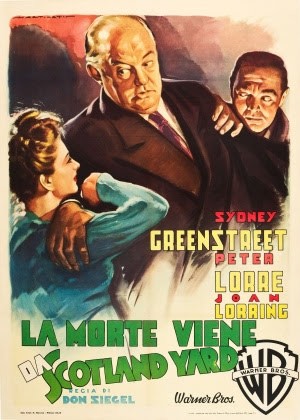
The opening is a first class piece of moody and atmospheric scene setting. The caption informs us that we’re in London in 1890, a dark and brooding place, as the camera tracks in to focus on Newgate prison, the last stop for many a condemned man. With the fog clinging to the gas street lamps and a bell solemnly tolling the hour of execution, the story’s protagonist looms into view. Superintendent Grodman (Sydney Greenstreet) is, quite literally, the big man in Scotland Yard. His lumbering bulk and sombre features speak of a man deeply contemplating his actions and his role in the world. Grodman’s latest investigation has drawn to a close and a convicted murderer is on his way to the gallows. Yet Grodman takes no pleasure in this, reflecting that success for a man in his position leaves only a bitter taste. In a sense, Grodman is condemned too, and we’re soon made aware of this paradox as the tale unfolds. Fate, circumstance and the pettiness of a rival have conspired to bring bout a dreadful miscarriage of justice. Grodman has sent an innocent man to the gallows. His professional disgrace is only one aspect of the matter though; a fine little montage succinctly sums up the guilt and paranoia Grodman suffers. Now settled into retirement, Grodman finds himself drawn back into his old life when a curious murder takes place in the boarding house opposite his own quarters. A reprehensible young man (Morton Lowry) had been found stabbed in his room under inexplicable circumstances: the door is locked from the inside and all the windows are sealed up. Grodman’s rival and successor at the Yard, Buckley (George Coulouris), is stumped and reluctantly calls on him for advice. Aside from the baffling mechanics of how the crime was committed, there are a clutch of fascinating suspects: Peter Lorre as an illustrator with a macabre sense of humour, Paul Cavanagh as a stiff-necked politician, June Lorring as Music Hall girl, and Rosalind Ivan’s hysterical housekeeper. Additionally, the possible motives for the murder form a complex web that encompasses jealousy, passion and blackmail. While Grodman strides in his stately manner through this labyrinth of suspicion, it emerges that history is in danger of repeating itself, with the possibility of another innocent victim being ground up by the wheels of blind justice.

The Verdict is adapted from The Big Bow Mystery by Israel Zangwill, one of the classic texts on the problem of the locked room – my thanks to Sergio of Tipping My Fedora for pointing out to me that this is available free as an e-book here & as an audiobook here. This particular form of impossible crime has been a staple of detective fiction for a long time, although its heyday was around the middle of the 20th century. At its best, the locked room problem depends more on the subtle art of misdirection than mechanical hoaxing. As such, this form of the detective story doesn’t always translate well to the screen and is generally far more effective in print. Still, I think Zangwill’s contribution to the canon does hit the mark and should succeed in confounding those not well-versed in this school of trickery. John Dickson Carr, the undisputed master of the locked room, also details the murder method used here in chapter 17 of The Three Coffins – the wonderful lecture on all things impossible delivered by Dr Fell – in case anyone wants spoilers without reading the Zangwill book.

The Verdict was Don Siegel’s first full length movie as director, although he had had extensive experience working in montage and the second unit in the years leading up to it. As a debut feature, it’s an impressive piece of work and demonstrates this was a talented individual with a future. While the film doesn’t bear much relation to what we might think of as a typical Siegel production, it does show that he already had a flair for visuals and pacing. The story is told economically, without unnecessary or tedious exposition, and maintains a consistent rhythm. With cameraman Ernest Haller making the most of the shadowy setups, Siegel uses a variety of interesting angles, dissolves and montage to keep things moving and strike the right tone. Aside from the excellent opening sequence, there’s a fine little section involving a late night exhumation that wouldn’t look out of place in a horror feature. The whole movie is a studio bound affair but, like the best B efforts, it turns this limitation to its advantage. The foggy London streets and mews where the action takes place may be no more than a Hollywood confection yet they have enormous charm, and the controlled environment leaves Siegel and Haller free to extract the maximum level of menace.

Peter Lorre and Sydney Greenstreet established a great on-screen partnership in the 1940s at Warner Brothers, earning themselves the nickname “The Laurel and Hardy of Crime”  – although that term seems to have been developed in retrospect. I remain of the opinion that The Mask of Dimitrios represents their best work together but The Verdict, their final collaboration, isn’t that far behind. Both these men had the knack of injecting a vein of comedy into their playing, of adding a human face to the menacing characters they so often portrayed. In this film, it’s Lorre who gets to indulge in a bit of sly black humour as the philandering cartoonist with a penchant for the gruesome. In contrast, Greenstreet cuts a much more tragic figure, his heavy features reflecting the regret and despair of his character. While Greenstreet’s huge physical presence, frequently emphasized by low angle shooting, dominates every frame he appears in, it’s the scenes he shares with Lorre that tend to be the most memorable. These two brought out the best in one another and seemed very comfortable working together. The main support came from George Coulouris, another actor who specialized in telling character roles, and he has just the right touch of venality as Buckley. In some ways he can be seen as the true villain of the piece, the blustering career cop whose inaction sets the whole affair in motion. Joan Lorring does fine as the blowsy entertainer who may know too much for her own good and ends up as one of Buckley’s chief suspects. Paul Cavanagh, who appeared in three Universal Sherlock Holmes films, has the ideal kind of patrician bearing for the part of the honour bound politician carrying around a guilty secret. Rosalind Ivan is essentially a caricature, a noisy, brittle busybody consumed by unfulfilled passion. The minor parts are filled by Morton Lowry as the slimy cad who becomes the murder victim and Arthur Shields playing yet another of his intense, tight-lipped clergymen.

The Verdict was made available on DVD in the US a while back through the Warner Archive. Additionally, the film has just recently been given a release on pressed disc by Sinister Films in Italy and that’s the edition I own. The transfer is pretty good, although there are plenty of minor speckles and blemishes on show. Some scenes are sharper than others but there’s no serious inconsistency or distraction either. The only extra on the disc is labeled as the theatrical trailer, but it’s actually the opening few minutes of the feature. The film is presented with three audio options: the original soundtrack and no subtitles, an Italian dub, or the original track with Italian subs. The movie is an excellent piece of entertainment, featuring fine central performances, atmospheric direction and an engrossing mystery story. It’s highly recommended for fans of Lorre and Greenstreet or those who like noirish thrillers. The fact that it features a classic locked room problem is an added bonus in my eyes, although those viewers especially familiar with that detective story variant shouldn’t have too much difficulty figuring out the method used.


Smoke Signal

poster254

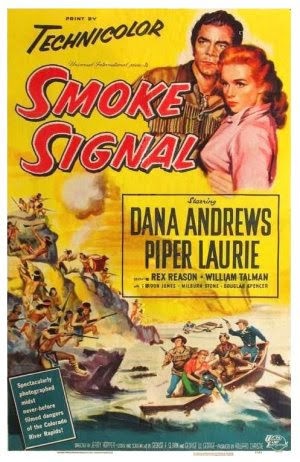
Films that adopted a pro-Indian stance can be found throughout the 50s, some more explicit in their sympathies than others. Smoke Signal (1955) offers an interesting variation on this trend; it would be inaccurate to refer to it as directly pro-Indian, rather it provides a critique of anti-Indian thinking. By casting a traditionally heroic actor in the central role and keeping his motivation slightly ambiguous for much of the running time – personally, I feel that greater ambiguity would have made the tale even more fascinating, but more on that later – it challenges our conventional genre perceptions. Add in an unusual setting, with the characters running the rapids of the Colorado River through the Grand Canyon, and the ingredients are in place for a compelling western.

The story is built around Brett Halliday (Dana Andrews), a former captain in the US Cavalry who deserted, joined the Utes and turned renegade. However, Halliday has been captured by the army and is being held prisoner at a remote fort until he can be transported for court-martial. The opening sees Captain Harper (William Talman) and his patrol coming upon the fort that’s currently under siege. Harper’s arrival puts him in command of the tiny garrison which has been whittled down by relentless attacks. He has a special interest in seeing the captive called to account since his brother was killed in a battle with a band of Utes led by Halliday. Apparently, these Utes have been massing and forming alliances with other tribes to stage a spectacular uprising. Harper is initially skeptical about this but when proof is provided it becomes evident that holding out in the fort is not going to be an option. Although reluctant to do so, he takes Halliday’s advice and decides to evacuate the fort, bringing some abandoned boats and making a break for it down the uncharted river. The majority of the running time is spent on this perilous journey, where the small band of survivors must fend off the harassing Utes and struggle to overcome the dangers posed by nature. While Halliday protests his innocence of the charges against him at the beginning, he avoids mention of this for most of the journey. Instead, we’re left to wonder and, like the desperate group around him, have our doubts raised only by his seemingly selfless actions and determination to see his captors to safety. Gradually, as Halliday’s knowledge of the Indians and their tactics proves more effective, he gains the trust of a few of his companions. His strongest allies are the late garrison commander’s daughter (Piper Laurie) and a grizzled old campaigner, Sergeant Miles (Milburn Stone), he once led. The turning point comes when the inflexible Harper, seemingly motivated by spite, orders Miles to undertake a suicidal mission. From here on, sympathy shifts to Halliday, the sole exception being the callous and brutal Lieutenant Ford (Rex Reason). The emphasis of the film is on the group dynamic as much as anything, and the shifting loyalties is an important part of what keeps the viewer’s interest alive. Who, if anyone, will make it to journey’s end is always uppermost in our thoughts and the battle for hearts and minds, ours as much as the characters on screen, ensure the tension is maintained right to the last scene.

Director Jerry Hopper made a series of good if fairly unremarkable movies in the 50s (Secret of the Incas perhaps being the most notable) before embarking on a long and successful career in a string of well-known TV shows. Hopper, and cameraman Clifford Stine, get good value from the Grand Canyon locations, the towering rock face being both visually impressive and also hammering home the bottled up, claustrophobic atmosphere. However, it has to be said that while the location work is extremely attractive, there’s far too much reliance on obvious and distracting back projection. Hopper’s handling of the action scenes is just fine, the sporadic battles and skirmishes blend well with the ever-present threat of the raging river and keep the story moving along. I think my biggest complaint relates to the script, and the ending in particular. For me, this was altogether too pat and slightly unsatisfactory – I feel that not only does Harper behave out of character but he gets off a bit lightly too.

Smoke Signal is really Dana Andrews’ picture all the way. Writing of this actor before, I commented on his tendency to internalize his feelings and play things down. That understated quality is highly appropriate for the character of Brett Halliday, a man to whom being true to his own inner convictions has brought only the distrust and enmity of others. I think Andrews was capable of hiding things so well that it’s a pity the scrip didn’t capitalize on this talent and keep the viewers guessing a little longer about the true nature of his character – it would have added more depth and uncertainty. There’s an excellent example of Andrews’ carefully modulated playing in one of the early scenes, when Halliday and Harper first meet. Harper, full of scorn and bitterness, reaches out to snatch away the native amulet Halliday wears round his neck. The flash of anger and resentment that briefly flits across Andrews’ momentarily clouded features, not much more than a twitch of muscle and a hardness of eye, tells us that this charm is special to him and that Harper’s action has gravely insulted him. When it comes to screen acting it’s the little things, those fleeting gestures and tics, that often speak loudest. William Talman tended to get cast in villainous, or at least unsympathetic, parts. He’ll always be remembered as Hamilton Burger, Perry Mason’s eternal foe, but he was exceptional as the psychotic bad guy in Ida Lupino’s The Hitch-Hiker. In this film though he portrayed a man bound by his own rigid code, a by the book disciplinarian with a narrow and inflexible perspective. Talman’s performance, alongside Rex Reason’s thuggish characterization, is what lends Smoke Signal its pro-Indian status. As such, it earns its credentials almost by default; the film paints the Utes’ opponents as deeply prejudiced rather than showing the Indians themselves in an especially positive light. As the only woman in the movie Piper Laurie spends much of her time torn between Andrews and Reason, but does well providing a non-partisan viewpoint. In supporting roles, there’s strong work from Milburn Stone, Robert J Wilke and Douglas Spencer.

Pegasus in the UK licensed Smoke Signal from Universal for their DVD release. The disc presents the film in a nicely framed 2:1 anamorphic transfer. The image looks a little soft in some places but there’s no real damage on show and the colours are bright and strong. There are no extra features whatsoever offered, just the main menu and scene selection. Anyway, the Pegasus release is the only one, so far as I’m aware, that presents the movie in the correct aspect ratio and with anamorphic enhancement. Universal westerns from the 50s are always worth seeking out – they’re generally attractive to look at and often feature plots that throw out something a little different. Smoke Signal is a solid, medium grade western that works pretty well. Andrews is dependable and credible, Hopper’s professional direction keeps it all moving along ensuring the pace never flags, and the location work is very welcome. Generally, this is a tight and entertaining mid 50s western that I’m happy to have in my collection.~

Experiment in Terror

poster286

The common consensus holds that classic film noir came to an end with Orson Welles’ Touch of Evil. Some argue it lasted a little longer, but it’s pretty much universally accepted that the movement was essentially defunct in the 60s. However, film styles rarely have rigidly defined start or stop points; the nature of filmmaking is too fluid for that, and this is especially true of something as nebulous as film noir. So, even if the new decade saw the emphasis shift and other sensibilities start to take hold, there was still some residue of the old noir influence at play. Blake Edwards’ Experiment in Terror (1962) pointed towards the way the thriller movie was to evolve in the coming years yet it still bore some of the hallmarks of the works that preceded it – a dangerous urban environment, a dour and downbeat mood, and ample use of striking, high contrast photography. I’ve always been fascinated by transitional cinema, those pieces which seem to straddle eras, and I enjoy seeing how different styles and movements merge, blend and grow. As such, I think Edwards’ film is an interesting example of the phenomenon.

A nighttime view of San Francisco accompanied by Henry Mancini’s cool and slightly menacing score opens the movie. Gradually the camera tracks in and focuses on one car and its driver; Kelly Sherwood (Lee Remick), a teller in a downtown bank, is making her way home to the suburbs – as it happens, my friend and fellow blogger Michael has just posted a piece on that very opening here on his site It Rains…You Get Wet, and you can check out his full review of the film here. To borrow his words: “…the high contrast images of traffic as lights dancing in the nightfall, beside the luminosity in the landscape of the city by the bay, established its film noir bona fides through pure dark imagery”. As she pulls into her garage a series of quick cuts and close-ups make it clear that something is not quite right. Kelly senses danger and, sure enough, a figure emerges from the shadows to grab the terrified girl and set her nightmare in motion. The intruder’s face is never fully visible but his rasping, asthmatic voice breathes his plans into his captive’s ear. Kelly’s job places her in a somewhat unique position – she has access to money, a lot of it, and  there’s nothing to stop her stashing away a tidy sum and simply walking off with it. And that’s exactly what her assailant wants; Kelly will leave her job with $100,000 in her purse and bring it to him. In return, he promises to cut her in for 20% of the takings, and his generosity even extends to letting her and her kid sister live. As this sinister figure melts back into the night, Kelly slowly starts to regain her senses after the initial trauma. She puts a call through to the FBI and gets connected to an agent, Ripley (Glenn Ford), before the connection’s broken and the wheezing mystery man, pinning her helplessly to the floor, makes it clear that the consequences of any further contact with the authorities will be most unpleasant. However, the Feds are no fools, and once that initial contact has been made it’s only a matter of time before they manage to track its source. Kelly now finds herself in the unenviable position of acting as both bait for the G-men and the stooge for her unseen intruder. What follows is a cat and mouse game with Ripley and his agents lurking the background hoping to use Kelly to draw the would-be bank robber into the open. Kelly’s taking one silkily threatening call after another and relaying them to the FBI, while they in turn are racing against time in an effort to identify and locate the suspect. The first part, the identification, proves reasonably easy – it’s a guy by the name of Red Lynch (Ross Martin) – but tracking him down is another matter entirely. The suspense builds slowly and inexorably as the pressure on Kelly mounts and Ripley’s men scour San Francisco for the whereabouts of Lynch. The tale powers its way along towards a memorable finale at a thronged baseball game at Candlestick Park.

Blake Edwards is arguably most famous for his comedic films, and the bulk of his work as a director lies in that area. Even though he created the iconic TV show Peter Gunn, I don’t believe many people associate him with crime stories. Regardless of that, Experiment in Terror offers strong and convincing evidence that he was more than capable of handling dark, suspenseful movies. The opening scenes of the film pitch the viewer straight into an edgy and unpredictable world where danger seems to lurk in even the most innocuous settings. I think there’s always something very effective about films which highlight the fact that characters can never feel genuinely secure even in their own homes. Here, Kelly Sherwood finds herself under virtual siege, and the proximity of FBI watchers does little to assuage the suspicions of the character, or the viewer, that Red Lynch can get to her any time he pleases. Edwards made great use of real San Francisco locations to help ground the movie but the interior work particularly stands out. There’s a palpable sense of menace throughout, but there are also moments that go beyond that and become positively creepy. I’m thinking mostly of the scenes in the apartment of one of Lynch’s girlfriends – a maker of mannequins whose home is more a chamber of horrors with dummy body parts and impassive visages literally stacked to the rafters. While I guess these scenes could be viewed as a stylistic indulgence that don’t do much to further the plot, they add a lot to the atmosphere of unease. Visually, the film is impressive from first to last and I feel that it’s only a few lapses in the writing that let it down somewhat. I’m referring here to characterization of the villain; Lynch is clearly a bad man, a felon with a long and varied record. Yet, the introduction of a young Asian woman and her son suggests there’s more depth here, another layer to Lynch that’s neither fully explored nor explained. Perhaps the novel from which the film was adapted went further into this aspect but, never having read it, I’m not able comment one way or the other.

Although Glenn Ford gets top billing in this one his is honestly more of a supporting role. He’d started to take on a middle-aged appearance by this time and brought a certain gravitas to the part of Ripley. Movies where menace and hysteria simmer just below the surface need a figure of stability to prevent everything from flying off into melodramatic territory. That’s essentially the function of Ford in Experiment in Terror, and he’s fine as that strong point of reference at the heart of it all. The two most significant roles are those of Lee Remick and Ross Martin, with the former having to do the lion’s share of the work and carry the film for long stretches. Remick didn’t always get the chance to show what she was capable of as an actress and sometimes found herself cast in indifferent roles. Experiment in Terror placed her front and centre though and gave her a meatier part. Rather than going for the easy option and playing it as a stereotypical damsel in distress, Remick brings a lot of welcome resilience to her character. By doing so, she gives a bit more punch to those scenes where she’s in real danger and fearing for her life. Ross Martin’s villain is excellent too, he looks the part and has just the right sinister air about him. Edwards’ decision to shoot his early scenes in a way that concealed his identity works very well and, although the script would have required a major revision to facilitate it, it’s a pity the faceless nature of Lynch couldn’t have been sustained for longer. There’s good support from a very young Stefanie Powers as Remick’s kid sister, one of the main levers Lynch uses to ensure compliance with his plans, and she brings an appropriate sense of innocence to her role. Ned Glass could usually be relied on to add a touch of sleazy charm to any movie he appeared in, and that’s exactly what he does as a chiseling reporter reluctantly helping the Feds. Finally, there’s a touching little cameo from Patricia Huston as Lynch’s ill-fated girlfriend – if nothing else, her presence serves to highlight the ruthless and callous nature of her lover.

Experiment in Terror, as a Columbia picture, is a Sony property. It was long out of print on DVD in the US but has been reissued as a MOD disc and there is a Blu-ray on the way from Twilight Time. I have the inexpensive Sony disc that’s been released in the UK, and I find it more than satisfactory. It’s quite a basic effort with no extra features but the image is very clean and sharp and is presented 1.85:1 with anamorphic enhancement. I think this is a first class example of the evolving nature of crime movies at the time, featuring some of the look and feel of earlier film noir while looking forward to the more explicit realism that was to come. A fine thriller that I strongly recommend checking out.