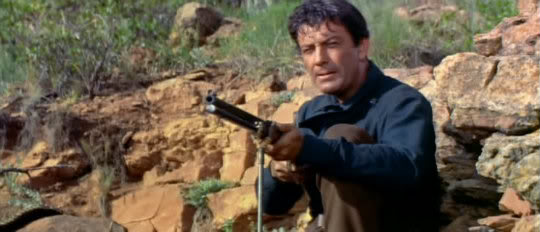
Across the Wide Missouri

poster196-1

I’ve already featured a number of films that highlighted the trend in 1950s westerns towards a more sympathetic and mature view of the various native peoples and their relationships with the westward moving settlers. William Wellman’s contribution to this phenomenon can be seen in Across the Wide Missouri (1951), where his setting of the story in the 1820s and its focus on trappers and mountain men, as opposed to the later arrival of large groups of settlers, allows him to sidestep political issues and tell a more human tale. Wellman’s movie suffered from some overzealous editing that frankly hacked his work to pieces and leaves the version available to us today an imperfect one. The director was greatly displeased by this, virtually disowning the film, yet what remains is still a beautifully shot work that has some emotional punch, in spite of what was left on the cutting room floor.

The story is centered around Flint Mitchell (Clark Gable), a rough and ready mountain man and trapper, whose adventures we follow in the form of the narrated reminiscences of his grown-up son – voiced by an uncredited Howard Keel. Mitchell is in the process of putting together an expedition to head into Blackfoot country in search of lucrative beaver pelts. With most of the arrangements in place, Mitchell catches the attention of a young Blackfoot girl, Kamiah (Maria Elena Marques), who has been brought up by the Nez Perce. Despite being amused by her advances, he initially brushes her off. It’s only when he learns of the plans of Brecan (John Hodiak), a Scot who has become so enamored of the Blackfoot way of life that he’s literally “gone native” and been integrated into their tribe, to bring her back to her own people that he changes his tune. Kamiah is the granddaughter of Bear Ghost (Jack Holt), the tribe’s elder, and Mitchell sees an opportunity to gain favour. Of course the only way to take the girl from the Nez Perce is to marry her and bring her back as his wife. While Mitchell isn’t averse to the idea, he still regards Kamiah primarily as a bargaining chip at this stage. In the course of the long trek though he finds himself genuinely falling for her charms. Mitchell doesn’t speak a word of her language, nor she his, and all but the most basic communication has to be conducted through the medium of an interpreter, an old French trapper by the name of Pierre (Adolphe Menjou). One of the interesting aspects of the film is the fact that the Indian characters, and the many of the French too, speak exclusively in their own tongue, lending a touch of authenticity to it all. With much of the focus of the middle section of the movie on the arduous journey undertaken by Mitchell and his fellow hunters, it’s basically an outdoor adventure yarn with a romance woven into it. Although the adventurous elements occupy a lot of the running time, the real heart of the film comes from the interracial romance and the gradual development of cultural understanding that accompanies it. However, few tales succeed without the introduction of some kind of conflict, and that’s provided here by the appearance of a rising Blackfoot warrior, Ironshirt (Ricardo Montalban), whose enmity with Mitchell leads to the film taking a tragic turn at the end.


My father told me that for the first time, he saw these Indians as he had never seen them before – as people with homes and traditions and ways of their own. Suddenly they were no longer savages. They were people who laughed and loved and dreamed.

The above words, spoken by the narrator after Mitchell has come upon the Blackfoot settlement, might seem to be stating the obvious these days. However, they are quite potent when viewed in historical perspective. When Across the Wide Missouri was produced it was by no means a given to see some respect granted to Native American customs and ways of life. While it’s disingenuous to say that westerns before the 50s were uniformly dismissive of Indian culture, those that tended towards the kind of sympathetic treatment that grew in popularity as the decade went on were certainly thin on the ground. One could of course argue that the inclusion of the villainous character of Ironshirt shows the movie reverting to timeworn genre stereotypes, but that’s both lazy and a bit of a cheap shot. In the first place, the responsibility for the bad blood that arises can be traced back to both sides. Furthermore, it would be a misrepresentation of the times to suggest that everything was harmonious and that the thought of expelling perceived intruders from their territory never crossed the minds of the Indians. Finally, from a storytelling perspective, the presence of this character and his actions are a large part of what gives the film its emotional impact at the climax.

£10

Across the Wide Missouri must rate as a huge missed opportunity for William Wellman, though the director cannot be held responsible for the failings. The film had the makings of being one of the great frontier epics, a sweeping and intelligent analysis of cultural symbiosis. However, it appears that MGM bosses allowed themselves to be swayed by negative pre-release feedback and cut the movie down (allegedly from over two hours originally) to its current sub-80 minute running time. As such, we’re left with a slightly disjointed effort that nevertheless hints at what might have been. Despite the choppy rhythm, the development of the relationship between Mitchell and his Blackfoot maiden is a touch abrupt, there’s still a lot to admire. Wellman kept his cameras mainly outdoors to capture the splendor of the Colorado locations and, as a result of both the broadly comedic interludes and the incorporation of the landscape into the narrative, produced a film that’s reminiscent of the work of John Ford. Leaving aside the plot, the picture is a visual delight – William Mellor’s cinematography is frequently breathtaking and never less than beautiful.

Clark Gable had what could be termed a fairly lean run in westerns, with Raoul Walsh’s The Tall Men probably being his best showing in the genre. Across the Wide Missouri offered him a strong role though, one that played to his strengths and exploited his trademark roguish charm. In spite of his frequent casting in romantic parts, he had a certain goofball quality which, along with his inherent machismo, made him the ideal choice for a socially clumsy trapper. In addition, he performed very well in the handful of tender and reflective moments; no doubt he drew on his own sense of personal loss for the climactic scenes, and there’s a real dignity in the way he consoles his grief-stricken bride after the murder of her grandfather. As Kamiah, Mexican actress Maria Elena Marques is cute, spirited and gutsy. She barely utters a word of English throughout the film, save a few efforts in heavily accented pidgin, yet her feelings at any given point are abundantly clear. Her presence really drives the picture and gives it its purpose, and it’s refreshing to see the matter of fact acceptance of her relationship with Gable. After a promising start, John Hodiak’s career dipped swiftly and he died a very young man; this film was arguably his last memorable role before the decline set in fully. He had a dour thoughtfulness about him, a withdrawn sense that seems to match the character he plays ideally. There’s no real explanation given as to why Brecan left his own society to become assimilated into the Blackfoot tribe, and the actor’s own distance and remoteness adds to the air of mystery surrounding the character. Ricardo Montalban’s Ironshirt is a completely undeveloped part, although that may be due to the heavy cuts imposed by the studio, and he serves basically as a bogeyman figure. As for the supporting cast, the best work is done by Adolphe Menjou and Alan Napier.

£11

Across the Wide Missouri is now available in the US via the Warner Archive, and also on pressed disc in Europe from Warner Brothers in France. I have the French release of the film and I have to say the transfer is a very good one. The Technicolor hues come out very strongly, which is vital in a movie so heavily dependent on its outdoor photography and imagery, and the print is in pretty good condition. There are no extra features offered, and the French subtitles can be disabled from the language menu. In the final analysis, I’d have to say Across the Wide Missouri is a disappointing film. In doing so, I’m not saying it’s a poor movie, nor am I implying any criticism of the cast and crew. I feel there was a work of greater significance and cohesion here had the scissors not been applied so drastically. As it stands, this picture has fallen by the wayside somewhat when 50s westerns are discussed. Wellman was capable of producing work of considerable depth when the material was right, and the ingredients for something special were in place here. And that’s what disappoints me; we’re only seeing a fraction of the director’s vision. Even so, the movie is not without interest and is worth viewing for its visuals and its progressive storyline.

Just as an aside, it’s five years to the day since I first started blogging back on the old FilmJournal site. Time certainly flies.
 

The Verdict

poster192-1

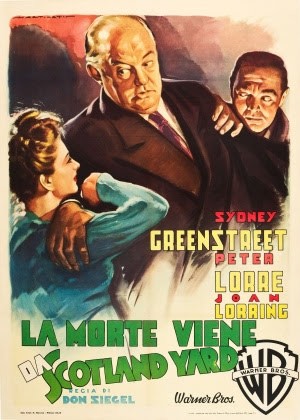
Some films just seem to work for me, to click if you like. They need not necessarily be movies of any extraordinary depth or have any abiding influence. The Verdict (1946) is one of these; it’s a small movie, a B picture really, but through a happy combination of elements it just checks most of the boxes for me. Firstly, there’s the setting: Victorian London as only Hollywood of the 1940s could depict it. Then there’s the fact that the plot revolves around a classic impossible crime, a locked room puzzle. And finally, a star pairing who worked so well and so memorably in tandem that they almost created a little sub-genre of their own. Mixing all these ingredients together results in a delightful little film that has no pretensions of greatness, that seeks only to entertain, and achieves that, not inconsiderable, goal admirably.

The opening is a first class piece of moody and atmospheric scene setting. The caption informs us that we’re in London in 1890, a dark and brooding place, as the camera tracks in to focus on Newgate prison, the last stop for many a condemned man. With the fog clinging to the gas street lamps and a bell solemnly tolling the hour of execution, the story’s protagonist looms into view. Superintendent Grodman (Sydney Greenstreet) is, quite literally, the big man in Scotland Yard. His lumbering bulk and sombre features speak of a man deeply contemplating his actions and his role in the world. Grodman’s latest investigation has drawn to a close and a convicted murderer is on his way to the gallows. Yet Grodman takes no pleasure in this, reflecting that success for a man in his position leaves only a bitter taste. In a sense, Grodman is condemned too, and we’re soon made aware of this paradox as the tale unfolds. Fate, circumstance and the pettiness of a rival have conspired to bring bout a dreadful miscarriage of justice. Grodman has sent an innocent man to the gallows. His professional disgrace is only one aspect of the matter though; a fine little montage succinctly sums up the guilt and paranoia Grodman suffers. Now settled into retirement, Grodman finds himself drawn back into his old life when a curious murder takes place in the boarding house opposite his own quarters. A reprehensible young man (Morton Lowry) had been found stabbed in his room under inexplicable circumstances: the door is locked from the inside and all the windows are sealed up. Grodman’s rival and successor at the Yard, Buckley (George Coulouris), is stumped and reluctantly calls on him for advice. Aside from the baffling mechanics of how the crime was committed, there are a clutch of fascinating suspects: Peter Lorre as an illustrator with a macabre sense of humour, Paul Cavanagh as a stiff-necked politician, June Lorring as Music Hall girl, and Rosalind Ivan’s hysterical housekeeper. Additionally, the possible motives for the murder form a complex web that encompasses jealousy, passion and blackmail. While Grodman strides in his stately manner through this labyrinth of suspicion, it emerges that history is in danger of repeating itself, with the possibility of another innocent victim being ground up by the wheels of blind justice.

The Verdict is adapted from The Big Bow Mystery by Israel Zangwill, one of the classic texts on the problem of the locked room – my thanks to Sergio of Tipping My Fedora for pointing out to me that this is available free as an e-book here & as an audiobook here. This particular form of impossible crime has been a staple of detective fiction for a long time, although its heyday was around the middle of the 20th century. At its best, the locked room problem depends more on the subtle art of misdirection than mechanical hoaxing. As such, this form of the detective story doesn’t always translate well to the screen and is generally far more effective in print. Still, I think Zangwill’s contribution to the canon does hit the mark and should succeed in confounding those not well-versed in this school of trickery. John Dickson Carr, the undisputed master of the locked room, also details the murder method used here in chapter 17 of The Three Coffins – the wonderful lecture on all things impossible delivered by Dr Fell – in case anyone wants spoilers without reading the Zangwill book.

The Verdict was Don Siegel’s first full length movie as director, although he had had extensive experience working in montage and the second unit in the years leading up to it. As a debut feature, it’s an impressive piece of work and demonstrates this was a talented individual with a future. While the film doesn’t bear much relation to what we might think of as a typical Siegel production, it does show that he already had a flair for visuals and pacing. The story is told economically, without unnecessary or tedious exposition, and maintains a consistent rhythm. With cameraman Ernest Haller making the most of the shadowy setups, Siegel uses a variety of interesting angles, dissolves and montage to keep things moving and strike the right tone. Aside from the excellent opening sequence, there’s a fine little section involving a late night exhumation that wouldn’t look out of place in a horror feature. The whole movie is a studio bound affair but, like the best B efforts, it turns this limitation to its advantage. The foggy London streets and mews where the action takes place may be no more than a Hollywood confection yet they have enormous charm, and the controlled environment leaves Siegel and Haller free to extract the maximum level of menace.

Peter Lorre and Sydney Greenstreet established a great on-screen partnership in the 1940s at Warner Brothers, earning themselves the nickname “The Laurel and Hardy of Crime”  – although that term seems to have been developed in retrospect. I remain of the opinion that The Mask of Dimitrios represents their best work together but The Verdict, their final collaboration, isn’t that far behind. Both these men had the knack of injecting a vein of comedy into their playing, of adding a human face to the menacing characters they so often portrayed. In this film, it’s Lorre who gets to indulge in a bit of sly black humour as the philandering cartoonist with a penchant for the gruesome. In contrast, Greenstreet cuts a much more tragic figure, his heavy features reflecting the regret and despair of his character. While Greenstreet’s huge physical presence, frequently emphasized by low angle shooting, dominates every frame he appears in, it’s the scenes he shares with Lorre that tend to be the most memorable. These two brought out the best in one another and seemed very comfortable working together. The main support came from George Coulouris, another actor who specialized in telling character roles, and he has just the right touch of venality as Buckley. In some ways he can be seen as the true villain of the piece, the blustering career cop whose inaction sets the whole affair in motion. Joan Lorring does fine as the blowsy entertainer who may know too much for her own good and ends up as one of Buckley’s chief suspects. Paul Cavanagh, who appeared in three Universal Sherlock Holmes films, has the ideal kind of patrician bearing for the part of the honour bound politician carrying around a guilty secret. Rosalind Ivan is essentially a caricature, a noisy, brittle busybody consumed by unfulfilled passion. The minor parts are filled by Morton Lowry as the slimy cad who becomes the murder victim and Arthur Shields playing yet another of his intense, tight-lipped clergymen.

The Verdict was made available on DVD in the US a while back through the Warner Archive. Additionally, the film has just recently been given a release on pressed disc by Sinister Films in Italy and that’s the edition I own. The transfer is pretty good, although there are plenty of minor speckles and blemishes on show. Some scenes are sharper than others but there’s no serious inconsistency or distraction either. The only extra on the disc is labeled as the theatrical trailer, but it’s actually the opening few minutes of the feature. The film is presented with three audio options: the original soundtrack and no subtitles, an Italian dub, or the original track with Italian subs. The movie is an excellent piece of entertainment, featuring fine central performances, atmospheric direction and an engrossing mystery story. It’s highly recommended for fans of Lorre and Greenstreet or those who like noirish thrillers. The fact that it features a classic locked room problem is an added bonus in my eyes, although those viewers especially familiar with that detective story variant shouldn’t have too much difficulty figuring out the method used.


Smoke Signal

poster254

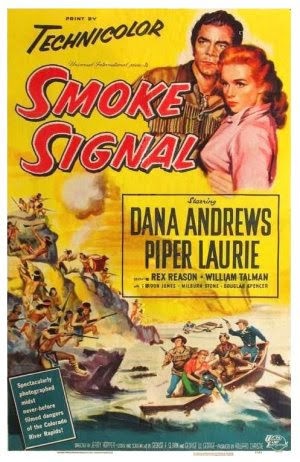
Films that adopted a pro-Indian stance can be found throughout the 50s, some more explicit in their sympathies than others. Smoke Signal (1955) offers an interesting variation on this trend; it would be inaccurate to refer to it as directly pro-Indian, rather it provides a critique of anti-Indian thinking. By casting a traditionally heroic actor in the central role and keeping his motivation slightly ambiguous for much of the running time – personally, I feel that greater ambiguity would have made the tale even more fascinating, but more on that later – it challenges our conventional genre perceptions. Add in an unusual setting, with the characters running the rapids of the Colorado River through the Grand Canyon, and the ingredients are in place for a compelling western.

The story is built around Brett Halliday (Dana Andrews), a former captain in the US Cavalry who deserted, joined the Utes and turned renegade. However, Halliday has been captured by the army and is being held prisoner at a remote fort until he can be transported for court-martial. The opening sees Captain Harper (William Talman) and his patrol coming upon the fort that’s currently under siege. Harper’s arrival puts him in command of the tiny garrison which has been whittled down by relentless attacks. He has a special interest in seeing the captive called to account since his brother was killed in a battle with a band of Utes led by Halliday. Apparently, these Utes have been massing and forming alliances with other tribes to stage a spectacular uprising. Harper is initially skeptical about this but when proof is provided it becomes evident that holding out in the fort is not going to be an option. Although reluctant to do so, he takes Halliday’s advice and decides to evacuate the fort, bringing some abandoned boats and making a break for it down the uncharted river. The majority of the running time is spent on this perilous journey, where the small band of survivors must fend off the harassing Utes and struggle to overcome the dangers posed by nature. While Halliday protests his innocence of the charges against him at the beginning, he avoids mention of this for most of the journey. Instead, we’re left to wonder and, like the desperate group around him, have our doubts raised only by his seemingly selfless actions and determination to see his captors to safety. Gradually, as Halliday’s knowledge of the Indians and their tactics proves more effective, he gains the trust of a few of his companions. His strongest allies are the late garrison commander’s daughter (Piper Laurie) and a grizzled old campaigner, Sergeant Miles (Milburn Stone), he once led. The turning point comes when the inflexible Harper, seemingly motivated by spite, orders Miles to undertake a suicidal mission. From here on, sympathy shifts to Halliday, the sole exception being the callous and brutal Lieutenant Ford (Rex Reason). The emphasis of the film is on the group dynamic as much as anything, and the shifting loyalties is an important part of what keeps the viewer’s interest alive. Who, if anyone, will make it to journey’s end is always uppermost in our thoughts and the battle for hearts and minds, ours as much as the characters on screen, ensure the tension is maintained right to the last scene.

Director Jerry Hopper made a series of good if fairly unremarkable movies in the 50s (Secret of the Incas perhaps being the most notable) before embarking on a long and successful career in a string of well-known TV shows. Hopper, and cameraman Clifford Stine, get good value from the Grand Canyon locations, the towering rock face being both visually impressive and also hammering home the bottled up, claustrophobic atmosphere. However, it has to be said that while the location work is extremely attractive, there’s far too much reliance on obvious and distracting back projection. Hopper’s handling of the action scenes is just fine, the sporadic battles and skirmishes blend well with the ever-present threat of the raging river and keep the story moving along. I think my biggest complaint relates to the script, and the ending in particular. For me, this was altogether too pat and slightly unsatisfactory – I feel that not only does Harper behave out of character but he gets off a bit lightly too.

Smoke Signal is really Dana Andrews’ picture all the way. Writing of this actor before, I commented on his tendency to internalize his feelings and play things down. That understated quality is highly appropriate for the character of Brett Halliday, a man to whom being true to his own inner convictions has brought only the distrust and enmity of others. I think Andrews was capable of hiding things so well that it’s a pity the scrip didn’t capitalize on this talent and keep the viewers guessing a little longer about the true nature of his character – it would have added more depth and uncertainty. There’s an excellent example of Andrews’ carefully modulated playing in one of the early scenes, when Halliday and Harper first meet. Harper, full of scorn and bitterness, reaches out to snatch away the native amulet Halliday wears round his neck. The flash of anger and resentment that briefly flits across Andrews’ momentarily clouded features, not much more than a twitch of muscle and a hardness of eye, tells us that this charm is special to him and that Harper’s action has gravely insulted him. When it comes to screen acting it’s the little things, those fleeting gestures and tics, that often speak loudest. William Talman tended to get cast in villainous, or at least unsympathetic, parts. He’ll always be remembered as Hamilton Burger, Perry Mason’s eternal foe, but he was exceptional as the psychotic bad guy in Ida Lupino’s The Hitch-Hiker. In this film though he portrayed a man bound by his own rigid code, a by the book disciplinarian with a narrow and inflexible perspective. Talman’s performance, alongside Rex Reason’s thuggish characterization, is what lends Smoke Signal its pro-Indian status. As such, it earns its credentials almost by default; the film paints the Utes’ opponents as deeply prejudiced rather than showing the Indians themselves in an especially positive light. As the only woman in the movie Piper Laurie spends much of her time torn between Andrews and Reason, but does well providing a non-partisan viewpoint. In supporting roles, there’s strong work from Milburn Stone, Robert J Wilke and Douglas Spencer.

Pegasus in the UK licensed Smoke Signal from Universal for their DVD release. The disc presents the film in a nicely framed 2:1 anamorphic transfer. The image looks a little soft in some places but there’s no real damage on show and the colours are bright and strong. There are no extra features whatsoever offered, just the main menu and scene selection. Anyway, the Pegasus release is the only one, so far as I’m aware, that presents the movie in the correct aspect ratio and with anamorphic enhancement. Universal westerns from the 50s are always worth seeking out – they’re generally attractive to look at and often feature plots that throw out something a little different. Smoke Signal is a solid, medium grade western that works pretty well. Andrews is dependable and credible, Hopper’s professional direction keeps it all moving along ensuring the pace never flags, and the location work is very welcome. Generally, this is a tight and entertaining mid 50s western that I’m happy to have in my collection.~

Experiment in Terror

poster286

The common consensus holds that classic film noir came to an end with Orson Welles’ Touch of Evil. Some argue it lasted a little longer, but it’s pretty much universally accepted that the movement was essentially defunct in the 60s. However, film styles rarely have rigidly defined start or stop points; the nature of filmmaking is too fluid for that, and this is especially true of something as nebulous as film noir. So, even if the new decade saw the emphasis shift and other sensibilities start to take hold, there was still some residue of the old noir influence at play. Blake Edwards’ Experiment in Terror (1962) pointed towards the way the thriller movie was to evolve in the coming years yet it still bore some of the hallmarks of the works that preceded it – a dangerous urban environment, a dour and downbeat mood, and ample use of striking, high contrast photography. I’ve always been fascinated by transitional cinema, those pieces which seem to straddle eras, and I enjoy seeing how different styles and movements merge, blend and grow. As such, I think Edwards’ film is an interesting example of the phenomenon.

A nighttime view of San Francisco accompanied by Henry Mancini’s cool and slightly menacing score opens the movie. Gradually the camera tracks in and focuses on one car and its driver; Kelly Sherwood (Lee Remick), a teller in a downtown bank, is making her way home to the suburbs – as it happens, my friend and fellow blogger Michael has just posted a piece on that very opening here on his site It Rains…You Get Wet, and you can check out his full review of the film here. To borrow his words: “…the high contrast images of traffic as lights dancing in the nightfall, beside the luminosity in the landscape of the city by the bay, established its film noir bona fides through pure dark imagery”. As she pulls into her garage a series of quick cuts and close-ups make it clear that something is not quite right. Kelly senses danger and, sure enough, a figure emerges from the shadows to grab the terrified girl and set her nightmare in motion. The intruder’s face is never fully visible but his rasping, asthmatic voice breathes his plans into his captive’s ear. Kelly’s job places her in a somewhat unique position – she has access to money, a lot of it, and  there’s nothing to stop her stashing away a tidy sum and simply walking off with it. And that’s exactly what her assailant wants; Kelly will leave her job with $100,000 in her purse and bring it to him. In return, he promises to cut her in for 20% of the takings, and his generosity even extends to letting her and her kid sister live. As this sinister figure melts back into the night, Kelly slowly starts to regain her senses after the initial trauma. She puts a call through to the FBI and gets connected to an agent, Ripley (Glenn Ford), before the connection’s broken and the wheezing mystery man, pinning her helplessly to the floor, makes it clear that the consequences of any further contact with the authorities will be most unpleasant. However, the Feds are no fools, and once that initial contact has been made it’s only a matter of time before they manage to track its source. Kelly now finds herself in the unenviable position of acting as both bait for the G-men and the stooge for her unseen intruder. What follows is a cat and mouse game with Ripley and his agents lurking the background hoping to use Kelly to draw the would-be bank robber into the open. Kelly’s taking one silkily threatening call after another and relaying them to the FBI, while they in turn are racing against time in an effort to identify and locate the suspect. The first part, the identification, proves reasonably easy – it’s a guy by the name of Red Lynch (Ross Martin) – but tracking him down is another matter entirely. The suspense builds slowly and inexorably as the pressure on Kelly mounts and Ripley’s men scour San Francisco for the whereabouts of Lynch. The tale powers its way along towards a memorable finale at a thronged baseball game at Candlestick Park.

Blake Edwards is arguably most famous for his comedic films, and the bulk of his work as a director lies in that area. Even though he created the iconic TV show Peter Gunn, I don’t believe many people associate him with crime stories. Regardless of that, Experiment in Terror offers strong and convincing evidence that he was more than capable of handling dark, suspenseful movies. The opening scenes of the film pitch the viewer straight into an edgy and unpredictable world where danger seems to lurk in even the most innocuous settings. I think there’s always something very effective about films which highlight the fact that characters can never feel genuinely secure even in their own homes. Here, Kelly Sherwood finds herself under virtual siege, and the proximity of FBI watchers does little to assuage the suspicions of the character, or the viewer, that Red Lynch can get to her any time he pleases. Edwards made great use of real San Francisco locations to help ground the movie but the interior work particularly stands out. There’s a palpable sense of menace throughout, but there are also moments that go beyond that and become positively creepy. I’m thinking mostly of the scenes in the apartment of one of Lynch’s girlfriends – a maker of mannequins whose home is more a chamber of horrors with dummy body parts and impassive visages literally stacked to the rafters. While I guess these scenes could be viewed as a stylistic indulgence that don’t do much to further the plot, they add a lot to the atmosphere of unease. Visually, the film is impressive from first to last and I feel that it’s only a few lapses in the writing that let it down somewhat. I’m referring here to characterization of the villain; Lynch is clearly a bad man, a felon with a long and varied record. Yet, the introduction of a young Asian woman and her son suggests there’s more depth here, another layer to Lynch that’s neither fully explored nor explained. Perhaps the novel from which the film was adapted went further into this aspect but, never having read it, I’m not able comment one way or the other.

Although Glenn Ford gets top billing in this one his is honestly more of a supporting role. He’d started to take on a middle-aged appearance by this time and brought a certain gravitas to the part of Ripley. Movies where menace and hysteria simmer just below the surface need a figure of stability to prevent everything from flying off into melodramatic territory. That’s essentially the function of Ford in Experiment in Terror, and he’s fine as that strong point of reference at the heart of it all. The two most significant roles are those of Lee Remick and Ross Martin, with the former having to do the lion’s share of the work and carry the film for long stretches. Remick didn’t always get the chance to show what she was capable of as an actress and sometimes found herself cast in indifferent roles. Experiment in Terror placed her front and centre though and gave her a meatier part. Rather than going for the easy option and playing it as a stereotypical damsel in distress, Remick brings a lot of welcome resilience to her character. By doing so, she gives a bit more punch to those scenes where she’s in real danger and fearing for her life. Ross Martin’s villain is excellent too, he looks the part and has just the right sinister air about him. Edwards’ decision to shoot his early scenes in a way that concealed his identity works very well and, although the script would have required a major revision to facilitate it, it’s a pity the faceless nature of Lynch couldn’t have been sustained for longer. There’s good support from a very young Stefanie Powers as Remick’s kid sister, one of the main levers Lynch uses to ensure compliance with his plans, and she brings an appropriate sense of innocence to her role. Ned Glass could usually be relied on to add a touch of sleazy charm to any movie he appeared in, and that’s exactly what he does as a chiseling reporter reluctantly helping the Feds. Finally, there’s a touching little cameo from Patricia Huston as Lynch’s ill-fated girlfriend – if nothing else, her presence serves to highlight the ruthless and callous nature of her lover.

Experiment in Terror, as a Columbia picture, is a Sony property. It was long out of print on DVD in the US but has been reissued as a MOD disc and there is a Blu-ray on the way from Twilight Time. I have the inexpensive Sony disc that’s been released in the UK, and I find it more than satisfactory. It’s quite a basic effort with no extra features but the image is very clean and sharp and is presented 1.85:1 with anamorphic enhancement. I think this is a first class example of the evolving nature of crime movies at the time, featuring some of the look and feel of earlier film noir while looking forward to the more explicit realism that was to come. A fine thriller that I strongly recommend checking out.


Wichita

poster2741

Some years ago I ran a short series of pieces on the various representations of Wyatt Earp in the movies*. I covered almost all the major productions, but one – Wichita (1955) – was omitted for the simple reason that I won’t ever write about a film which I haven’t had the opportunity to view recently. Well, now’s the time to fill in a notable gap in the aforementioned series. For a character whose name has become such an iconic part of the history and mythology of the old west, there is a good deal of variation when it comes to assessment of his motives. While some writers have sought to build up the man’s legend, others have dedicated their efforts to chipping away at it, and then there’s always the stories that Earp himself chose to spin. Despite the diversity of opinion on Earp in literature, I think it’s safe to say that cinema has, for the most part, chosen to cast him in a heroic mold. The historical veracity of those pictures where his character played a prominent part may be open to question, but there can be no doubt that Earp provided filmmakers with a rock solid basis for their portrayals of tough, unflinching lawmen.

Wyatt Earp (Joel McCrea) is introduced a man hoping to start up business in the burgeoning cow town/railhead of Wichita, Kansas. Two early scenes, one involving a couple of light-fingered cowboys and another depicting a foiled bank raid (where Sam Peckinpah appears uncredited as the teller), make it abundantly clear that Earp is a man skilled in the use of firearms. However, for all his adept gunplay, he has no interest in wearing a badge and using his talents to enforce the law. Wichita is shown to be a town facing something of a dilemma; the railroad is attracting the big cattle outfits and the money that they bring with them, but the town’s also faced with the challenge of lawlessness. Hard men who have spent long weeks riding dusty trails, deprived of liquor and female company, are only too eager to spend their earnings and blow off steam. Everyone of influence in Wichita knows what’s going to happen as soon as the first big cattle drive arrives. These town elders are anxious to fully exploit the financial gains, but they also need someone strong and reliable to ensure that some semblance of law and order is maintained too. Earp would appear to be the natural choice but, as the newspaper editor (Wallace Ford) points out, he hasn’t yet come to terms with his calling in life. It’s only after a child is killed by a stray bullet that Earp bows to the inevitable and pins on a badge.

The script doesn’t concern itself too much with the documented facts – having Earp team up with a fresh young reporter by the name of Bat Masterson (Keith Larsen) for example – but it does give at least a grudging nod in their direction. In reality, Earp finally left Wichita after political disagreements and headed for Dodge City to make money in some questionable ventures. The film ends with our hero setting off for Dodge in order to continue along what’s claimed to be his destined path as a dedicated peace officer. And the political disputes, albeit of an entirely different nature, do form a significant part of the plot. The script sees Earp come into conflict with the business interests in Wichita, men who are prepared to turn a blind eye to violence as long as the dollars keep rolling in. While some people may try to tell you that Hollywood productions of the 50s were generally right-wing in perspective, I’ve never seen too much evidence of that. Wichita is yet another film that champions basic morality above any narrow political consideration.

Wichita is very fine film, where both visuals and theme vie for the viewer’s attention. All of the great directors had the ability to move with ease between genres, and Jacques Tourneur was no exception. Having made what I have no hesitation in referring to as masterpieces in the horror and noir fields, he went on to prove that he was equally at home with westerns. Wichita was shot in scope and Tourneur handles the wide lens beautifully throughout. The opening, which highlights the vast open spaces of the frontier, quickly draws the eye to a tiny speck, a lone figure off on the horizon. This is the first view of Wyatt Earp, a fine visual introduction for a character who remains resolutely apart from the milieu throughout the film. Now that’s a considerable feat in my book, encapsulating the essence and core of a character through the use of one long shot. A good deal of the action in Wichita takes place in interiors, and again Tourneur employs the scope camera to great effect, altering angles to highlight the dominance and physicality of McCrea, to create a sense of chaos or remoteness as required, and generally positioning his actors within the frame in such a way as to focus on the emotional relationships between them. All of this, along with a strong sense of pacing, marks out the work of a top flight director.

With regard to theme, I’ve already mentioned the political sensibilities, but there’s more going on than that. The best classic westerns dealt with the internal struggles of their heroes, men trying to come to an understanding with themselves and to decide on the right path to follow. The Wyatt Earp of Wichita faces this eternal dilemma too, but with the added complication of unavoidable destiny thrown into the mix. Time and again the script makes reference to men being unable sidestep or ignore the responsibilities that fate has laid before them. If one bears in mind that Earp ultimately chooses to pursue what’s morally right then the picture has an uplifting quality. However, it’s not quite so simplistic; in order to fulfill his destiny the hero must do things that offend him personally. I think the minimalist artwork used for the poster sums up that aspect very well – a hunched, regretful figure, full of remorse in his moment of triumph, surveying the body of his slain opponent.

Joel McCrea was an excellent piece of casting as Earp. He may not bear any physical resemblance to the man but both his size and commanding presence ensure he dominates the picture. McCrea was one of the top half-dozen western stars, a man who simply belonged in the genre. He often brought a good deal of warmth to his characterizations, though his role in Wichita sacrifices that to an extent in order to play up other qualities. His Earp is a man who’s not quite satisfied with himself, a reluctant hero whose awareness of his deadly skills pains him. He communicates the dour, steely nature of his character well, and leaves no doubt in our minds as to why this man held such a fearsome reputation. Vera Miles was cast as the romantic interest, and she’s fine given the limitations of her role. The film isn’t a romance so Miles has few dramatic opportunities. Under the right circumstances, she was a very good actress – something like Hitchcock’s The Wrong Man should offer ample evidence – but she’s never stretched here. Lloyd Bridges and Edgar Buchanan played the main villains, the former as a vengeful cowhand and the latter as a conniving, duplicitous businessman, and provide solid opposition to McCrea. The supporting cast is filled with plenty of familiar faces: Peter Graves, Carl Benton Reid, Robert J Wilke, Wallace Ford, and the ever dependable Jack Elam.

Wichita is available as part of the Warner Archive in the US, but I recently picked up a release from La Casa del Cine in Spain that pairs the film with The Oklahoman. Both movies come on their own discs and Wichita looks very good. The film is presented in anamorphic scope and the print seems to be in excellent shape, without significant damage and boasting solid colours. There are no extra features offered but the two movies can be had for less than 5 Euro. Spanish subtitles are removable via the setup menu, however, I did notice that they seem to be burnt in during the opening credits for Tex Ritter’s theme song, and there’s a brief instance of a sign being similarly translated. I think this is an exceptionally good movie, intelligently scripted, beautifully directed by Tourneur and featuring a strong central performance by McCrea. Check this one out.


*Other films featuring the character of Wyatt Earp:

Frontier Marshal

My Darling Clementine

Winchester 73

Gunfight at the O.K. Corral

Cheyenne Autumn

Hour of the Gun

Tombstone

Wyatt Earp

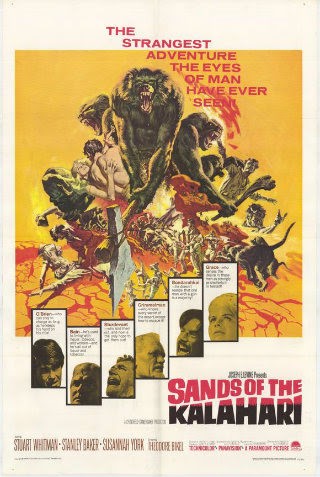
Sands of the Kalahari

poster2651

Desert wildernesses always provide an intriguing backdrop for movies. The vast emptiness of such settings, and their necessarily harsh conditions, has a minimalist quality that not only encourages but demands strong characterization. The barren, unforgiving landscape means that attention is easily focused on those who people it, and the various tribulations they must endure. As such, everything tends to appear heightened – dangers and relationships, strengths and weaknesses – and the potential exists for a rawer, more honest type of drama. Sands of the Kalahari (1965) is a survivalist epic, superficially an adventure story with a deceptively simple plot. As the tale unfolds both the group dynamic and human nature itself are explored, not always with palatable results, and the twists it takes are fascinating. It also benefits from an ending that is simultaneously bleak, shocking, and tantalizingly ambiguous.

A charter plane has a freak encounter with a swarm of locusts, forcing a crash landing deep in the Kalahari desert of Namibia. Six disparate individuals stumble from the burning wreckage and must find a way to survive beneath the equally scorching African sun. This will be a test of their resolve, their character and their inventiveness. Ultimately though, the trials ahead of them will ask some very fundamental questions about the humanity of all these people. Initially, it’s the pilot, Sturdevan (Nigel Davenport), who takes charge and sets about organizing the rag-tag group. However, this film never follows a predictable course, and Sturdevan is gradually revealed to be too venal to serve as a leader. It gradually becomes apparent that particular mantle is to be passed on to O’Brien (Stuart Whitman), a hunter and, crucially, the man with the gun. When Sturdevan decides to set off alone in an attempt to reach some settlement and alert them to their plight, O’Brien has no serious rivals for dominance. Of the other men, Grimmelman (Harry Andrews) is elderly, Bondrachai (Theodore Bikel) is too soft, and Bain (Stanley Baker) is a recovering drunk with a leg wound. The sole female is Grace Munkton (Susannah York), an attractive society type and a fish out of water. While this little band are fortunate enough to come upon shelter (a cave) and a plentiful water supply, the problem of acquiring food remains an ever-present threat. Their temporary refuge is situated in an area with a large baboon population but, as Grimmelman points out, eating these fearsome creatures would be a little too similar to cannibalism for anyone’s taste. O’Brien points out that the apes represent competition for the limited food available, and so he takes it upon himself to wipe out as many as possible. However, even as group begin to settle into a familiar routine, it begins to dawn on Bain in particular that O’Brien is not the kind of man to tolerate competition of any kind, from any quarter. And so the internal tensions, and threats, rise in tandem with the need to survive. As the story develops, what becomes more and more obvious is that the danger from within is as great as, and perhaps even greater than, that posed by the forces of nature.

So, aside from being a first-rate adventure yarn, what is Sands of the Kalahari about? Well, the idea that adversity brings out both the best and worst in everybody for a start. All of the six people who find themselves stranded in the back of beyond are tested in various ways, physically, psychologically and morally. It’s how each one responds to the challenges, what they learn about themselves and we about them, that constitutes the core of the drama. Those who eventually find a way out, and I don’t think it’s a major spoiler to say that not everyone does, have been altered by their experiences. In addition, as viewers we are forced to reassess our first impressions of each of the characters: the quiet, passive ones become more proactive, the weak demonstrate reserves of strength, and the strong have their weaknesses revealed. This kind of plotting keeps us forever on our toes, never allowing any sense of complacency regarding the perception of characters to set in. Just when we think we’ve got someone figured out, either the circumstances or the sheer perversity of human nature throws us for a loop. Of course the movie also raises questions about how civilized we really are, and how far we’ve actually traveled from our primitive ancestors. Even those who started out disparaging supposedly lesser peoples, and Sturdevan is a good example of this, gradually come to rely on the techniques and skills they had previously thought beneath them in order to survive. That’s viewing things from a positive  perspective; but there’s a darker flip side to this too. If there is a lesson about using our basic abilities to overcome difficulties then there’s another one relating to the dangers of regressing to the point of savagery. The evolution of O’Brien’s character is a perfect illustration of this, where he ultimately fails as a human being but, conversely, rises to become master of his barbaric environment.

Sands of the Kalahari was produced by the team of Stanley Baker and Cy Endfield after the actor and director had been successful with Zulu. Endfield, along with cameraman Erwin Hillier, really made the most of the location shooting. There are some beautiful long shots of the desert, and the old western staple of positioning tiny figures against a background of massive rock formations is an ideal way of emphasizing the pettiness of the struggle these people engage in, their relative insignificance in the grand scheme of things, and of course their isolation. Additionally, the close-up work in the interior of the cave highlights the  tightness of the group, and makes the betrayals and treachery that occur all the more powerful. I think it’s worth noting too how well Endfield made use of the baboons surrounding the survivors. These apes are presented as a kind of noisy yet brooding menace lurking just beyond the limits of the camp. The animals are frequently photographed from above, perched high on rocky outcrops, which suggests their surveillance of the movements of the human interlopers has both a remoteness and a disdainful quality.

Stanley Baker was one of the biggest stars that British cinema produced, and was possessed of a magical and rare combination of talents that allowed him to convincingly play sensitive and tough parts with equal assurance. His role as Bain, the drunken engineer from the Congo, afforded him the opportunity to touch on both. As I said earlier, none of the characters in the movie follow the path that their initial appearances allude to; Bain seems at first to be a washed-up loser, a physical and emotional cripple, a largely ineffectual presence. However, his trials trigger something of a rebirth, and he is gradually and credibly transformed into the most heroic figure in the cast. Squared off against Baker is Stuart Whitman, radiating pure machismo and the ultimate survivor. I’ve often been less than impressed by Whitman’s performances, feeling not so much that he was poor but more that he could have been a whole lot better. Sands of the Kalahari provided him with probably his best part, playing to his strengths and exploiting his physicality to great effect. He has all the attributes of the hero, and starts off looking like the man who we’re going to root for, the guy most likely to save the day. However, this ruthless hunter, the group’s self-proclaimed provider, turns out to be a very different beast. It’s he who displays the lightest veneer of civilization, who adapts most readily and successfully to the primal surroundings. Whilst his character’s progression, or perhaps regression is a more apt description, is entirely logical and maybe even predictable, this does nothing to diminish the shock of his final actions. I really don’t want to go into details regarding the ending of the movie for to do so would rob it of much of its power for those who haven’t seen it. Suffice to say that Whitman’s character fulfills his ultimate destiny, and the last shot leaves everything open to each individual viewer’s interpretation. Susannah York’s displaced socialite stands between Baker and Whitman, her presence representing both an enticement and a provocation. Although she plays a pivotal part in the drama I felt she was, ironically, the least rounded character; by the end of the film she, and her motivations, remained something of an enigma for me. The rest of the cast – Davenport, Andrews and Bikel – all did sterling work and I can’t think of a moment when I wasn’t gripped by their performances. Davenport in particular turns in a marvelously manipulative piece of work, pulling the viewer’s sympathy every which way as his lecherous pilot rises, falls and rises yet again in our estimation.

Sands of the Kalahari is a movie that seemed to be out of circulation for an awful long time. I can vividly remember catching a late night television broadcast of this some time in the late 80s and I can safely say I was enthralled. The film, and that jaw-dropping finale, remained lodged in my memory, but it never appeared again. To say I was delighted when I saw the announcement that Olive Films in the US, having licensed the title from Paramount, was putting it out on DVD would be a huge understatement. The movie is also available on Blu-ray, but I believe it’s locked to Region A. Anyway, I purchased the DVD and I certainly have no regrets – it was high up on my wish list for so many years. The DVD from Olive is a basic bare bones effort but the transfer should give no cause for complaint. It’s anamorphic scope and looks great – sharp, clean and colourful. If you have any affinity at all for adventure movies, especially those with exotic locales and compact casts, then this should push your buttons. What’s more, this is no brainless action flick; it’s a literate and thoughtful piece of work that will stay with you long after the credits roll. I recommend it, unreservedly.


Red Sundown

poster276_zps6a227718

Low budget westerns seem to occupy a place on the filmography of just about every Hollywood star at one time or another. For some actors, the relationship with the genre was little more than a flirtation, something they dipped in and out of without leaving any real or lasting impression. On the other hand, there were others who discovered their niche in such movies. Rory Calhoun belongs in that category; sure he made other types of movie, but it’s with the western, and the programmers in particular, that his name tends to be most often associated. Red Sundown (1956), directed by Jack Arnold, offered him a pretty good role in a standard tale of a man trying to reform and make a fresh start.

Alec Longmire (Calhoun) is a man with a violent past, a drifter with no particular plans. However, his aimless existence is about to take a sharp turn, precipitated by his stumbling upon a lone figure in the wilderness. Bud Purvis (James Millican) is another wandering gunslinger, running from the law and on his last legs. He’s already walked the same path Longmire is currently taking, and all he has to show for it is regret. An altercation with a group of roughnecks in the saloon of some nameless backwater leads to the two men riding out of town in a hurry, with company not far behind. By nightfall they’re under siege in an abandoned shack with no way out. Gutshot and dying, with their shelter already on fire, Purvis comes up with a unique plan that will allow one of them to escape. But he has one condition; the doomed gunman has the younger man give his word that he’ll hang up his weapons if he should make it out alive. Well, Longmire’s not the kind to break a promise, least of all one given to a dying man, and so determines to leave his past behind him. However, reputations have a way of catching up with people and, besides that, wiping the slate clean generally demands more than a sense of remorse and good intentions. And so Longmire, somewhat reluctantly, finds himself sworn in as deputy to Sheriff Murphy (Dean Jagger) in the town of Durango. Murphy’s not getting any younger, and badly needs some backup as he’s caught right slap in the middle of an escalating range war. On one side is big time rancher Henshaw (Robert Middleton), while on the other is a collection of squatters and homesteaders. The greatest threat posed to Longmire and Murphy is the arrival on the scene of Chet Swann (Grant Williams), a reckless killer hired by Henshaw. Longmire has to tread a fine line, maintaining the objectivity of the law while an unwanted showdown with the dangerous Swann looms ever closer.

Red Sundown was Jack Arnold’s second western and showed a lot of promise. That’s not to say it’s above criticism though. Restricted budgets generally meant short running times and pacy storytelling, and that’s more or less the case with this movie. I say more or less because the film fairly springs out of the gate and grabs the attention, tends to coast along in the middle, and then puts in a strong sprint finish. The opening benefits from a bit of added exterior shooting and a great turn from James Millican – this was to be his last film and he looks quite ill at times. The siege of the abandoned hut where he and Calhoun hole up looks good, has a sense of real tension, and a pay off that’s sad and uplifting at the same time. The slightly problematic mid-section, in contrast, suffers from too much interior work and a romantic angle with Martha Hyer  that never sparks or truly convinces. In short, this passage has too much talk, not enough action and relatively flat visuals. Having said all that, the character of Swann is introduced in a way that highlights his creepy ruthlessness, and his presence does create a bit of much needed tension. The ending, while a touch abrupt, sees the pace pick up for the climactic duel and allows for a little more inventiveness as far as the camerawork is concerned.

Rory Calhoun gives what I’d term a comfortable, easy performance as the former bad man trying to cut his ties with a violent past and turn over a new leaf. This is far from an unfamiliar theme within westerns, and I think it’s fair to say that Calhoun doesn’t bring anything new or startling to the table. However, he’s never less than believable in the role and has enough natural charm to carry the lead. I think there’s a bit of a misconception that playing a tough western character doesn’t require a lot of effort. The thing is, pushing the boat out too far means you end up with a caricature, while reining it in too much results in a limp character lacking in credibility. Personally, I feel Calhoun strikes the right balance; the whole look, posture and attitude he adopts never leaves the viewer in any doubt that he’s capable of handling himself in a tight situation, yet he never tips over into comic book antics.

In contrast, Grant Williams, as the hired killer Swann, doesn’t quite hit the mark. His first appearance, all smiles and mock geniality, really taps into a sinister, chilling quality that bodes well. However, he fails to maintain this, and the scene where he confronts Calhoun in his room doesn’t work at all. It’s something almost indefinable, but the way Williams delivers his lines is all wrong – there’s no threat behind them, none of the menace that’s desperately needed. I already referred to the unsatisfactory romance between Calhoun’s character and Martha Hyer’s, but I’ll bring it up here again simply because it highlights what I feel was a missed opportunity. There was the possibility of adding an intriguing triangle to the mix with the introduction of Lita Baron as Henshaw’s housekeeper, and Calhoun’s old flame, but it’s never truly exploited. The actress was married to Calhoun at the time and there is a chemistry at work whenever the pair share the screen. When you consider the fact that Lita Baron eventually sued for divorce and cited her husband’s having committed adultery with seventy-nine different women (yes, that’s right 79) as the grounds, it’s clear this must have been a turbulent relationship. If there are some weaknesses in a few of the performances, it’s just about balanced out by solid playing from two old pros, Dean Jagger and Robert Middleton – the latter even gets to slug it out in a fine saloon punch-up with Calhoun.

Red Sundown has always been one of the more difficult Jack Arnold westerns to get hold of, previously only being available in a pricey box set from Koch in Germany (more so if, like myself, you already had the other titles) or a French release afflicted with the dreaded forced subtitles. However, Llamentol in Spain have recently put out a nice-looking edition on DVD that’s competitively priced. The film is presented in the correct 2:1 ratio and is anamorphic. The image is generally pleasing, with strong colour and a clean print. As usual, there’s no problem with subtitles – they can be disabled via the setup menu. The disc boasts no extra features, but I’m just glad to have a decent looking copy for a reasonable price. The movie is a solid programmer, and never aspires to anything loftier. I won’t claim the film is some lost classic or anything, but what I will say is that it does provide 80 minutes of attractive entertainment.


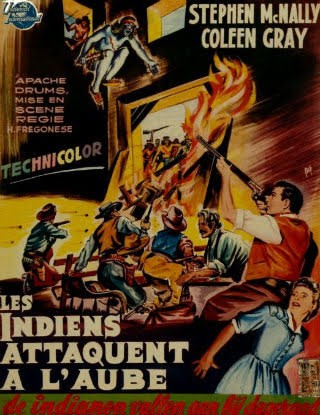
Apache Drums

Filmmakers assigned to B movie projects always faced an uphill struggle at the outset: inflexible and restrictive shooting schedules, budgets pared right down to the bone, and scripts that, as often as not, lacked any spark of originality. Still and all, there were a select few who seemed to thrive under such circumstances, who had the vision or the maybe even the guts to shape something worthwhile out of the modest resources before them. Fans of classic horror are familiar with, and hold in high regard, the name of Val Lewton. This was the man whose specialist unit at RKO managed to produce a series of classy, polished little nightmares that not only transcended their frugal budgets but actually succeeded because there was so little money available. Apache Drums (1951), made at Universal, was Lewton’s last feature as producer before his untimely death from a heart attack. The film is the only western he was involved in, and it’s such an effective and atmospheric little picture that I can’t help but wonder how he might have fared within the genre had his life not ended so prematurely.

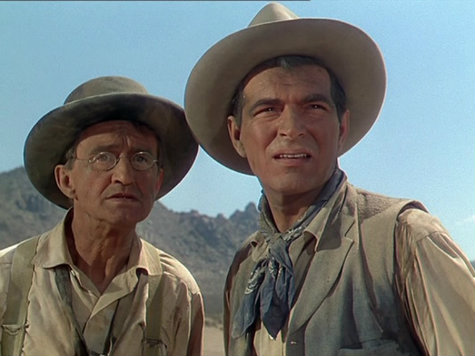
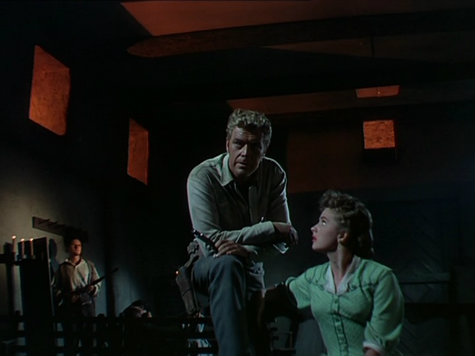
The story is derived from Harry Brown’s Stand at Spanish Boot, and it tells a fairly standard tale. Sam Leeds (Stephen McNally) is a gambler, a seemingly incorrigible ne’er-do-well (he’s even earned himself the unwelcome nickname “Slick”) who quite literally opens proceedings with a bang, shooting dead a rival card player in the stark saloon in the town of Spanish Boot. I found it a particularly nice touch that the shooting takes place off-screen as it immediately lends a sense of ambiguity to Sam’s character. He says it was self-defense and no-one seriously doubts that, still the seeds of suspicion are planted in our minds right from the off. The shooting comes at a bad time from Sam’s perspective: the mayor/blacksmith Joe Madden (Willard Parker) has been talked into a kind of moral crusade by the Welsh (the nationality has some significance later in the movie) parson Griffin (Arthur Shields) and Sam is given his marching orders. The fact that Madden is Sam’s rival for the affections of local girl Sally (Coleen Gray) rubs further salt into his wounds but he has no alternative. The dance hall girls have just been sent packing, and Sam is the next undesirable to be ejected. Thus we have the classic western staple of the outcast, shunned by the decent folk and driven out beyond the bounds of civilization. However, Sam’s exile is a short-lived one; he soon caches up with the wagon of girls, or rather their massacred remains. With his dying breath, the freshly scalped piano player who had been accompanying the spurned ladies tells of a formidable Apache raiding party appearing ghostlike and descending upon them. Sam gives his word to hightail it back to Spanish Boot and warn the solid citizens of the impending attack. The thing is he’s neither welcome nor trusted in his former home, the residents, with the tacit support of Madden, being on the point of riding him out of town on a rail before the arrival of a shot-up stagecoach bears out his words. It’s at this stage that the tension starts to build, as the Apache threat draws ever closer. Eventually, the net closes in to the point where all the survivors are holed up and under siege in the old church. Here, in the latter half of the movie, the camera never leaves the interior of the building and so heightens the feeling of helplessness and suspense, as the drums pound throughout the night and the defenders wait and watch for the Apache to leap howling through the high windows.

In writing about a lot of 50s westerns, one word crops up again and again – redemption. There’s no getting away from it; it quite literally pervades the genre throughout the decade, with even relatively humble and unpretentious efforts like Apache Drums having the concept at their core. All of the three main characters – Sam Leeds, Griffin and Madden – redeem themselves before the final fade out. Madden initially comes across as a vaguely priggish figure, allowing his preconceptions of Sam to colour his judgement and using his authority as means of furthering his own personal desires. But through enforced confinement with the man he regards as his opponent, he’s able to rise above his own inherent pettiness to attain a kind of nobility by the end. Griffin is a moral and religious absolutist, quick to judge and condemn all those who he considers to have strayed from the path of righteousness. Again, the circumstances he’s forced into lead to a reassessment of his former stance. There’s a marvelous little moment during the siege, where the preacher who had previously spoken in the most derogatory and disparaging terms about the Apache scout in their midst, Pedro-Peter (Armando Silvestre), moves across to kneel beside him. With the shadows of death creeping ever nearer, these two men pray to their respective deities side by side. And finally there’s Sam Leeds. He starts out expressing nothing but casual contempt for all those poor saps who slave away trying to earn an honest living and build a community. He’s of the opinion that he’s too smart for all that guff, that his only concern is his own welfare and comfort. Yet, he too (perhaps more than the others) finds that the threat from without carries a lesson for him. By putting aside his selfishness and obsession with self-preservation, he grows visibly as a human being. In their roles, Parker, Shields and McNally all manage to create rounded characters that are believable due to their respective weaknesses and prejudices. When you’re dealing with a low budget production such as this, good characterization, and the performers capable of achieving it, is a huge plus.

While the acting is important if you’re counting the pennies, it’s all likely to come to nothing if the technical expertise isn’t present behind the cameras. As I said in the introduction, producer Val Lewton was a past master at wringing the maximum out of limited resources. His RKO chillers all had a very distinctive look and feel, regarding shadow, darkness and the unseen and unknown as assets rather than obstacles. Such is the case with Apache Drums. Some of the most effective sequences follow on from events that the audience never get to see: both Sam’s deadly gunplay and the massacre of the saloon girls happen off-screen and the viewer only gets to witness the consequences of these events. The final section of the movie, which leaves the audience with no choice other than to view the action from the perspective of the terrified townsfolk means that we share in their sense of helplessness and dread. Of course Lewton was either clever or fortunate enough to work with talented directors on his projects. Between them the producer and director Hugo Fregonese work wonders in this section of the film: the image of garishly painted warriors springing through the high windows, backlit by the flames of the burning town, is like a vision out of hell, and retains a powerful shock value. I made brief mention earlier of the fact that Arthur Shields played a Welsh preacher. The reason for my drawing attention to his character’s nationality relates to a passage which takes place during the climactic siege. As the incessant beating of the war drums outside the walls begins to take its psychological toll on those inside, the decision is made to do something in an attempt to boost morale. Shields, playing a Welshman, leads the defenders in a chorus of Men of Harlech. In itself it’s a nice moment, but it’s also significant in that the scene would be mirrored in Cy Endfield’s Zulu over a decade later.

Apache Drums is a film that seemed quite difficult to see for many years. I caught a television broadcast back when I was a teenager and it stuck in my mind, probably because of the imagery as much as anything. At the moment, there are three DVD editions available: from France, Spain and Germany. From various comments I’ve seen, I get the impression they are all derived from the same source, though the French release will have forced subtitles. I have the Spanish DVD from Llamentol, which presents the film in the correct Academy ratio, and boasts a fine overall transfer – it’s sharp, colourful and well-defined. Subtitles are not an issue and can be turned off on the setup menu. The disc also offers the original theatrical trailer for the film, but that’s it in terms of extra features. I really like the film; it’s pacy, well structured and exciting. Aside from that, it looks good, with the kind of visual flair that’s typical of a Lewton production. A low budget sleeper that I happily recommend.

The Last Hunt

Westerns, especially the classics of the 50s, tackled just about every theme imaginable, often passing comment on universal concerns that transcend the genre itself. That of course is one of the western’s great strengths, it’s ability to resonate widely. However, the genre has also dealt with what might be termed more direct concerns too, actions and events that impacted  on the shaping of the frontier and the course of US history. Bearing in mind that the old west was essentially a wilderness, it’s no surprise that animals occupied such an important place in the minds of those who lived there. There are countless examples on film highlighting the importance to the native people and settlers alike of the horse. How many times have we witnessed the contempt and hatred directed towards horse thieves? In a primal landscape covering vast distances, the theft of a man’s sole means of transport was naturally one of the foulest crimes. However, the horse wasn’t the only animal which played a significant role in the development of the frontier. The buffalo, that great beast which sustained and dominated the lives of the plains Indians, was every bit as vital in its own way. As such, it’s perhaps surprising that The Last Hunt (1956) is one of the few westerns that concentrates on the fate of those creatures which once roamed in huge numbers across the continent.

The Last Hunt is the story of two quite different men, Sandy McKenzie (Stewart Granger) and Charlie Gilson (Robert Taylor), who enter into an uneasy partnership. Sandy is a famed buffalo hunter, but he’s also a man sickened by killing and has abandoned his old profession to turn his attention to the cattle business. However, fate has other ideas and, when a buffalo stampede wipes out his herd, a chance meeting with war veteran Charlie leads him reluctantly back to hunting. While Sandy has seen more than enough bloodshed, Charlie has something approaching an obsession with death. Charlie’s wartime experiences have clearly left a mark, and he seems to live to kill. The contrasting approaches of the two  men is highlighted during one of the hunt scenes. Having established a stand, the camera switches between this pair as they go about the slow, methodical business of picking off the buffalo herd. Charlie’s features are fixed in a mask of sadistic delight as one animal after another drops and breathes its last. Conversely, Sandy is stricken by conscience and is on the verge of breaking down and weeping at the thought of the devastation he’s participating in. If the radically different perspectives of the partners weren’t a great enough source of conflict, their rivalry is further complicated when Charlie captures a young Indian girl (Debra Paget) and takes her as his woman. Along with his wide sadistic streak, Charlie is also an unashamed racist with a deep suspicion and hatred of the Indian. He considers the girl to be his personal property, one of the spoils of war if you like, to be used or abused as he pleases. Not only does Sandy regard this kind of boorishness as an affront  to his sense of morality and civilized behaviour, but he also finds himself developing feelings for the girl himself. Charlie’s mounting paranoia and Sandy’s growing self-disgust, fueled both by their slaughter of the buffalo and the presence of the girl in their midst, see the tensions rise inexorably. Sooner or later, these two will have to face off and settle their scores, and the climax of the movie is a memorably chilling one in every sense as the final confrontation takes place during a freezing blizzard.

Richard Brooks started out as a writer, scripting films such as Brute Force, Crossfire and Key Largo before moving into directing with the Cary Grant suspenser Crisis in 1950. He didn’t work much within the western genre, making only Bite the Bullet, The Professionals and The Last Hunt. As a writer, he tended to tackle complex and controversial subjects and his first western as director (with a script credit too) saw him continue in a similar vein. The Last Hunt works in the theme of racism alongside its ecological message; the systematic elimination of the buffalo was essentially a government sponsored programme once the realization set in that the army wasn’t going to defeat the Indians through conventional military tactics. The buffalo had a special place within Indian culture, providing not only a source of food but also many of the essentials of life. The Indians used almost every part of the animals to make clothing, shelter, and tools. Therefore, it’s impossible to overestimate the status of these creatures as far as the native people were concerned. Brooks highlights the mysticism involved when he features a white buffalo, a sacred figure. This device also serves to draw attention again to the differences between Charlie and Sandy: Sandy is entranced by the sight of such a rarity, while Charlie sees only profit and immediately slays it. Although this is, superficially at least, a fairly simple tale, there’s a lot going on and Brooks blends it all together very successfully, ensuring that a brisk pace is maintained without sacrificing any of the necessary character development.

Robert Taylor is an actor whose work I’ve featured regularly on this site and The Last Hunt offered him one of his very best roles, maybe even the best. Generally, he played heroic figures but this film saw him take on the persona of an irredeemable rogue. I’ve read comments in the past which indicated Taylor had  doubts about his own abilities as a performer, but roles such as Charlie Gilson prove that there was no basis for such harsh self-criticism. I always feel the best and most effective movie villains have the knack of drawing a degree of sympathy or pity from the viewer, and that’s the case with Taylor’s portrayal here. There’s no question that Charlie is a bad lot, but Taylor brought a certain fragility to the part and that adds an interesting variation to what could have been a bland and routine character.

Stewart Granger might seem an odd choice for a western hero but here, in his second genre picture, he’s both comfortable and convincing. Apparently, Granger took to the whole western experience off-screen too and was well thought of by the crew. He’s very effective as the conscience-stricken counterbalance to Taylor’s killing machine and the two actors play well off each other. The Last Hunt is another of those movies with a small central cast; they’re usually quite successful at rounding out the characters and offering some more depth. In this case, the two protagonists benefit more from the increased focus though. Debra Paget as the captive Indian girl is never named and remains a slightly colourless presence throughout, albeit a strikingly attractive one. After appearing in Broken Arrow, this was Paget’s third outing as an Indian maiden and it must have looked like she was going to be permanently typecast at this point. Whatever you say about Paget, I don’t think anyone could mistake Russ Tamblyn for a native American. Nevertheless, he was cast as the half-breed hired by Sandy and Charlie, and his sympathetic presence is used to emphasize the blind bigotry of the latter and the relative enlightenment of the former. Best of all among the supporting players though is Lloyd Nolan, another initially questionable choice for a western. Nolan had a very  urban air about him and I tend to think of quick talking cops and the character of Michael Shayne whenever I see him. Still, he really embraced the part of the one-legged buffalo skinner and turned in a very  memorable performance.

For a long time The Last Hunt was only available on DVD in Europe. However, the film has recently made its US debut via the Warner Archive. I can’t comment on the quality of that particular transfer though as I don’t own a copy. I have the French release by WB, which looks reasonable although the scope image is letterboxed and non-anamorphic. In common with the majority of Warner titles released in Europe, it’s a bare bones affair with optional subtitles that can be deselected on the setup menu. The movie itself is a real keeper, a bit of a neglected gem that looks good, has fine performances, and makes a number of interesting points about man’s impact on the environment and race relations. The wider availability of this title on DVD may hopefully raise the profile of a film that’s well deserving of some renewed attention.

Gilda

Hate can be a very exciting emotion. Very exciting. Haven’t you noticed that?

I guess one of the defining characteristics of film noir is its subversive nature. It tends to take traditional scenarios and situations and casts its dark and cynical shadows over them, carrying the audience along on a journey into a murky and unfamiliar world. This subversion can apply to the legal system, social matters, or affairs of the heart. Gilda (1946) concentrates on the latter category, spinning its tale of three people locked into a romantic triangle, unable to decide if they love or hate each other and apparently unaware of the distinction between these powerful and conflicting emotions.

The story begins in Argentina at some unspecified point towards the end of WWII. But there’s a timeless, otherworldly quality to it all – the end of the war and the ensuing celebrations are mentioned in a throwaway fashion that’s surely meant to emphasize the detachment of the lead characters from the real world and the more mundane concerns of most people. These people seem to exist and operate within their own self-contained universe, a glamorous yet nightmarish demi-monde, where the bigger picture of world-changing events are relevant only as a kind of Hitchcockian MacGuffin. The opening shot of the movie introduces Johnny Farrell (Glenn Ford), a down on his luck grifter rolling dice on the waterfront and looking for easy marks. His strategy is a high risk one, not just because he’s a gambler but because his loaded dice are sure to attract the attention of disgruntled suckers sooner or later. When the inevitable happens, and Johnny finds himself the victim of a shakedown on a dark and forbidding wharf, his hide is saved by the intervention of a suave gentleman with a handy sword stick. This is Ballin Mundson (George Macready), a casino owner with an interest in shadier and even more profitable ventures. Johnny is nothing if not an opportunist and soon talks himself into employment, and a position of trust, with Ballin. For a time this mutually beneficial arrangement works and everything is sailing along smoothly on calm waters, until a woman appears and brews up a storm. Gilda (Rita Hayworth) is a sexual powerhouse, a woman whose passionate nature and provocative insolence seems to radiate from within. Her sudden and dramatic appearance as Ballin’s wife, after a whirlwind courtship, throws Johnny for a loop and irreversibly alters the dynamic of the relationship between the two men. Gilda’s arrival on the scene has an immediate and profound effect on Johnny – their introduction is a charged affair, and the confusion that Johnny’s barely able to disguise is shared by the audience. The rippling undercurrent of hostility gives rise to all sorts of questions about these people. I’m not giving away much here when I point out that it’s soon revealed that Gilda and Johnny were once lovers, before he walked out on her. And there we have our triangle: a cagey, duplicitous affair where the three protagonists circle each other warily and seem bent on mutual destruction. While it all develops nicely, I’ve always thought that the ending is weak – a little too abrupt and not all that convincing.

In my opinion, the reason Gilda is classified as a film noir is down to the theme more than the look. Cameraman Rudolph Maté does create some characteristically noir images – the waterfront opening, some of the nighttime casino scenes, and the way Ballin seems to blend and merge with the shadows – but much of the movie features bright, flat lighting. The edgy, darker tone stems largely from the setting and plot twists. A casino has a built-in sense of fatalism to it anyway, a place where fortune quite literally depends on the turn of a card or a throw of the dice. When this is combined with the South American setting, and the allusions to ex-Nazis involved in political and economic intrigue, it conjures up that sense of exotic danger that was very much in fashion in the mid to late 40s. Of course all this really only amounts to Casablanca style escapism; the key element that tips it over into the world of noir is the sadomasochistic relationship at the centre of the tale. The film is essentially a love story, but there’s a vicious, unpleasant side to the romance. Everything revolves around the title character, as she punishes both Johnny and Ballin, but in so doing she incurs arguably greater punishment at their hands in return.

The unquestionable star of the show is Rita Hayworth, the role becoming the one with which she would remain most closely identified for the rest of her life. Hayworth herself acknowledged this and it seems she had mixed feelings about it – her frank admission that the men in her life went to bed with Gilda and woke up with her is very telling. Whatever the personal legacy may have been, Hayworth certainly breathed life into what, in other hands, could have been a cardboard cutout character. She was excellent at getting across the contrast between the vivacious bravado that characterized Gilda’s public facade and the uncertainty and self-loathing she felt in more private moments. Her big scene, the one that is endlessly referenced in books and retrospectives, where she tries to provoke a reaction from Johnny with a knowing parody of a public striptease is justly famous. However, it also tends to overshadow the good work she did all through the movie.

While Rita Hayworth is the one most people will remember from the movie, Gilda worked wonders for the career of another of its stars. Glenn Ford, like a number of other actors, had seen service during the war, and Gilda was the film that gave him the boost he needed and raised his profile. Wartime experiences affected a lot of performers, it gave them a different air, a toughness and a touch of weariness too. Ford went on to work in some pretty good noir pictures, Lang’s The Big Heat being the best of them, and he did seem to belong in that world. As he did in his numerous western roles, Ford brought a kind of dissatisfaction with himself to his noir parts. Johnny Farrell has a veneer of cockiness and self-assurance to him, but Ford could always invest his characters with a nervy, slightly uncomfortable quality too. These may be little things yet they add up and make characters more believable and realistic. Although both Johnny and Gilda are flawed individuals, they’re not villainous. But a movie like this needs a bogeyman, and George Macready was a fine choice for the role of Ballin. Right from the beginning there’s a sinister air about him, and Macready’s innate charm and culture accentuates that. The repressed manner and wonderfully distinctive voice add to his calm menace – you honestly get the feeling that crossing this man would be an extremely foolish move. Of the supporting cast, I find Steven Geray the most memorable. This washroom attendant whose contempt for just about everyone, apart from Gilda, sees him making one flip comment after another seems to be given a lot of slack. I especially like the way we never find out exactly what leverage he has – the one time he’s about to reveal it he’s interrupted, and we’re left wondering.

I actually drafted this piece back in July, after I’d seen it one balmy Saturday night in an outdoor cinema in Athens – always a great way to enjoy a classic movie. However, I realized my holidays were fast approaching and so I decided to hold off publishing it. I though I might want to go back and tweak it some, but I’ve decided to leave it just as I’d written it a few days after watching the film. I’ve seen Gilda many times over the years and always enjoyed its dark romance. I wouldn’t say it’s one of those movies that reveals too many new things on repeated viewings yet it’s not the kind that grows stale either. It’s earned its classic status, and it’s well worth visiting or revisiting.