Hustle

37uwwis

I’m unsure how to categorise a film like Hustle (1975). Should I refer to it as neo-noir, post-noir, or use some other unwieldy title? Let’s just put it this way, if the movie had been made twenty years earlier it would have been classed as film noir. It has all the ingredients of classic era noir but it’s just not of the right vintage. As a result we’re left with a stylish 70s critique of a corrupt system and a world that’s lost its way. Incidentally, it’s also a damned fine film.

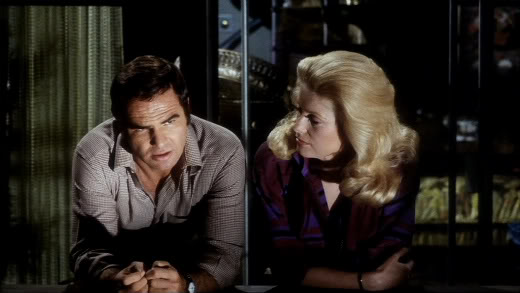
Phil Gaines (Burt Reynolds) is a homicide cop with a long list of things wrong in his life. At first glance everything might seem just dandy since we first see him reclining in bed and being pampered by his beautiful French girlfriend. However, his situation is far from ideal. The girlfriend, Nicole (Catherine Deneuve), works as an upmarket call girl and Gaines is just about dealing with this. The two of them plan and dream of hopping a jet and seeing out their days in Rome but neither one really has the ability to break away from their lifestyles. Nicole’s excuse is the need to earn a living and Gaines keeps putting it on the long finger, preferring to gaze at the fading photographic calender tacked on his office wall whilst indulging in idle fantasy. In addition, his job is increasingly getting on top of him and shows no signs of improving as his next case looms. The body of a young girl is found washed up on the beach and triggers an investigation that will eventually expose corruption in high places and drive Gaines to finally become more than a mere spectator. The girl in question was a hooker/dancer, a runaway whose life descended into seediness instead of the glamour she sought. Everyone appears inclined to write the whole thing off as another pathetic suicide, everyone except the girl’s father that is. Marty Hollinger (Ben Johnson) is a Korean War vet with an axe to grind and an obsessive streak. It’s his unwillingness to let the matter lie that pushes Gaines to dig ever deeper until the truth is exposed. By the end of the movie that truth is laid bare but, as in life, it doesn’t necessarily help anyone. The ending itself is a real choker and unapologetically noir in tone.
£4

Robert Aldrich generally invested his films with a brutal honesty and cynicism, and Hustle isn’t any exception in that regard. He never shies away from the unsavoury and paints a bleak picture of 1970s America, a place where average people are simply nobodies and the wealthy are hopelessly corrupt – in Phil Gaines words, “Guatemala with colour TV.” That rank degeneracy is best exemplified by the villain of the piece, a marvellously sleazy turn by Eddie Albert. In the lead, Burt Reynolds does very well and shows that, when the director and material were right, he was more than capable as an actor. He’s made an excessive number of fairly ropey films but, here and there, the odd gem turns up. He has some excellent moments in this movie, especially when his simmering jealously is dangerously near the surface as he tortures himself listening to Nicole take dirty phone calls from her faceless clients. Catherine Deneuve displayed the right kind of cool detachment that was necessary for her part, and she’s certainly very easy on the eyes. There’s plenty of great support from Paul Winfield, Eileen Brennan and Ernest Borgnine but Ben Johnson rises above them all. He turns in an absolute blinder as the emotionally scarred veteran who feels his country owes him something, and has allowed that massive chip on his shoulder to tear his family apart. The way he forces himself to confront the lifestyle his daughter adopted is as painful for the viewer to watch as it is for him to experience. A real class act was Mr Johnson.

Paramount’s R2 DVD of Hustle offers an excellent image, as was usually the case with that company. The 1.78:1 anamorphic transfer is clean and sharp throughout, and I can see no reason to criticise it. However, there’s absolutely nothing in the way of extra content and that is a little disappointing. Overall, I’d rate Hustle as a very fine example of modern noir from a highly accomplished director and a cast that’s uniformly good.
Two Rode Together

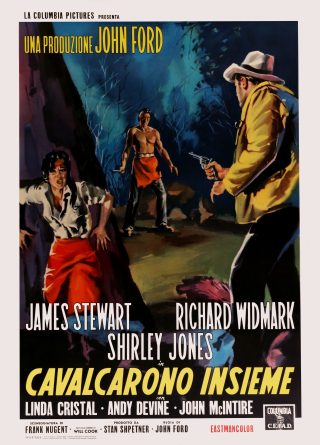
“The worst piece of crap I’ve done in twenty years.” Those were John Ford’s own words when assessing Two Rode Together (1961). Even now, critics never seem to have anything very positive to say about this film. Ford’s work in the 60s was certainly patchy, even more so when it’s held up for comparison against his earlier movies. I’m not sure this is as much of a dog as its reputation suggests; it’s a weak John Ford film for sure, but even a lesser work from the great man always had some points to recommend it.

Two Rode Together is frequently referred to as a rehash of themes explored in The Searchers, and that’s one of the problems identified right away. Where the earlier classic had depth, gravity and passion this film feels superficial and, at times, cartoonish. However, I’m not convinced the two movies ought to be compared too closely. For one thing, The Searchers focused on the quest and those involved in it, whereas Two Rode Together is really about the consequences of rehabilitation for the rescued captives. Guthrie McCabe (James Stewart) is a marshal in the town of Tascosa, an enviable position in that it entitles him to a 10% cut of everything in the place. His idyllic lifestyle is interrupted, however, when Lt. Jim Gary (Richard Widmark) and his troops arrive to escort the dissipated lawman back to the fort. The army intend to press the reluctant McCabe into acting as a scout/intermediary in order to make contact with the Comanche Quanah Parker (Henry Brandon) and trade for the release of white captives. McCabe is nothing if not a coldly realistic man, and he knows full well that what the army is asking is basically a fool’s errand. Although his cynicism is viewed with contempt by the soldiers, subsequent events will prove that it’s his assessment that’s more grounded in reality. Lt. Gary is sent along to keep a watchful eye on McCabe (he’s regarded as an amoral mercenary at best), and in so doing has his eyes opened and his preconceptions challenged. When it becomes apparent that the surviving captives have been so deeply integrated into Comanche life as to be unrecognizable the decision is taken to return with only two captives: a teenager, Running Wolf, and a Mexican woman, Elena (Linda Cristal). Instead of being greeted as heroes and saviors, both McCabe and Gary find themselves viewed as being partly responsible for the tragedy that ensues. The fear, hatred and suspicion of the Comanche are so deeply ingrained in the whites that there can be no happy homecoming for anyone, and McCabe’s cynicism and skepticism that were initially painted as repugnant are now seen to be vindicated.

John Ford’s penchant for broad, knockabout comedy is very much an acquired taste, and you’re either OK with it or you’re not. I mention this because Two Rode Together is liberally laced with instances of trademark Fordian humor. A good deal of this is centered around Andy Devine’s grossly overweight Sgt. Posey and it’s of the hit and miss variety. What’s altogether more successful is the gentle jibing that takes place between Widmark and Stewart as it helps to flesh out and humanize their characters. Ford’s direction is unaccountably flat in general, and really only strikes home in the scenes that focus on the desperation and emotional pain of the homesteaders who yearn for news of their loved ones. Even the landscapes look dull and uninspiring, which is atypical for a Ford film. Of course, news came through during shooting of the passing of the director’s old crony and frequent collaborator Ward Bond, and that may go some way to explaining the slightly detached feeling that permeates the whole picture. If it weren’t for the performances of Widmark and Stewart then this movie would be a real tough slog. Their scenes together constitute the core of the film and help keep it afloat. Widmark is good enough but I didn’t get the impression that he was operating at full throttle, whereas Jimmy Stewart throws himself into the part completely. By this time Stewart had mastered the art of icy indignation and half-suppressed emotion, and it serves him well in the later scenes where he confronts the ugly face of naked racism back at the fort. Of the female characters Shirley Jones received third billing but her part is an undeveloped one and seems to peter out just when it should have taken center stage. Linda Cristal fares much better as the former captive who’s deeply unsure of her place in society; her discomfort is nearly tangible when she’s paraded in front of the army wives, and she visibly wilts before their prying eyes.

Two Rode Together remains absent on DVD in the US but it’s widely available in R2. Sony’s UK disc offers an anamorphic widescreen transfer that’s goodish without being in any way exceptional. It could use a bit of a clean up but there aren’t any serious flaws. Both colors and sharpness are reasonable enough but, like the movie itself, don’t exactly pop off the screen. There are absolutely no extras at all but this title can be picked up very cheaply, so one shouldn’t complain too much. Well, this is a long way from classic Ford but the playing of the two leads does raise it above the mundane and lends some class. The truth is it’s not a bad little western – it’s just not a great John Ford western.

Gambit

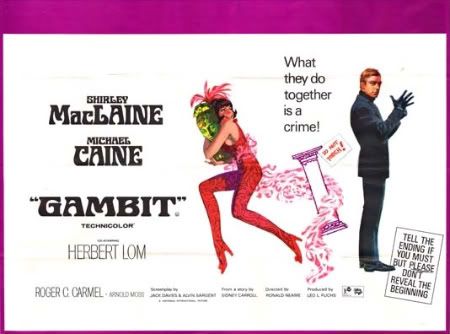
Poster

I’m not sure if the caper movie could be referred to as a genre in itself. It’s basically an offshoot of the heist movie, which in turn has its origins in the world of thrillers. To me a caper should be a humorous take on a criminal enterprise and it should have a certain gloss or stylishness about it. As such, the 1960s were arguably the ideal period for these films, and I’m of the opinion that the best examples are to be found in that decade. Gambit (1966) checks all the boxes as far as I’m concerned: it’s got a couple of glamorous stars in the lead roles, a slightly convoluted plot that never takes itself too seriously, pretty locations, and an abundance of charm and style.

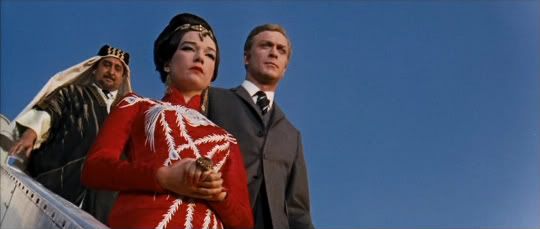
The structure of the film is one of its major assets, with the first half hour showing Harry Dean (Michael Caine) meticulously setting up the perfect crime before everything falls to pieces. Our hero has his sights on a priceless sculpture owned by a reclusive billionaire, Ahmad Shahbandar (Herbert Lom), and has planned what he thinks is a foolproof method of snatching it. For the final pieces of his scheme to fall into place he needs a woman to play the part of his wife. Of course it can’t be just any woman, he needs someone who closely resembles Shahbandar’s late wife. Enter Nicole Chang (Shirley MacLaine), an exotic dancer of Eurasian stock who just happens to be a ringer for the former Mrs Shahbandar. This is the leverage Harry hopes to use to get near enough to both the billionaire and his precious artifact. I don’t want to give away too much of the plot for anyone who hasn’t seen this, so I’ll stick to saying that the humour and suspense come not only from watching how the best laid plans come unstuck but how they can be pasted back together again.

Shirley MacLaine & Michael Caine 

Michael Caine had just done Alfie and The Ipcress File before this movie and had pretty much cornered the market for mouthy cockneys. It’s a lot of fun watching his Harry Dean go from the assured, smooth operator of the opening to the increasingly flustered and shouty blunderer of the rest of the film. Shirley MacLaine is probably even better as the would-be pawn who ends up bailing Harry out of a succession of uncomfortable situations. When one remembers that the actress doesn’t even open her mouth for the first half hour or so it just proves what a classy performer she is. Herbert Lom was another piece of great casting and always gave a memorable performance in every thing I’ve seen him in. He more or less plays two roles in this film and does so with the greatest of ease. Ronald Neame directed fluidly and kept the pace tight throughout. He also handled the combination of humour and suspense with a deft touch, maintaining a nice balance all the way. It’s also worth mentioning that this gentleman celebrated his 98th birthday last year since he’s one of the few remaining links to the golden age of cinema – here’s hoping he gets to celebrate many more.

Gambit is on DVD in the UK via Second Sight and they’ve done an excellent job on the presentation. The anamorphic scope transfer looks fantastic with strong, bright colours and a clean, sharp image. The disc has the added bonus of carrying a commentary track with the director, something I always appreciate on the rare occasion it’s available for older movies. This film is also now available in the US via Universal’s burn on demand programme – currently exclusive to Amazon. I have no idea how the editions stack up against each other but I will say that I managed to pick up my R2 on sale before Christmas for an absolute pittance. It remains to be seen whether the R1 counterpart will drop significantly in price. All told, I enjoyed the film enormously. It’s a delightful and fun piece right from the start, and I can’t say it disappoints on any level. The perfect tonic for those bleak evenings in the depths of winter – highly recommended.

Backlash

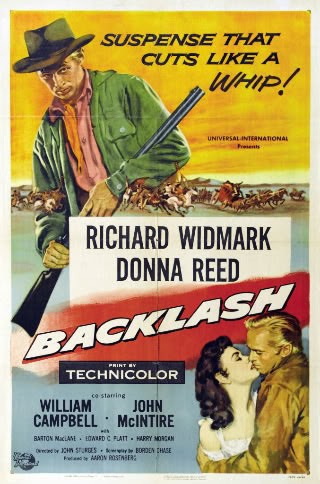
poster150

Backlash (1956) is one of those films that seems to have slipped through the cracks. I’m not sure if it would be correct to call it a forgotten film, but it’s certainly not one that you hear mentioned much when the genre’s notables come up for discussion. It fits neatly into the “psychological western” category due to its less than perfect hero and mature themes. At first glance it may appear to be just another tale of a man seeking revenge (not that that’s a bad thing in itself), but as the story develops it becomes clear that this is a film which is going to dig a little deeper.

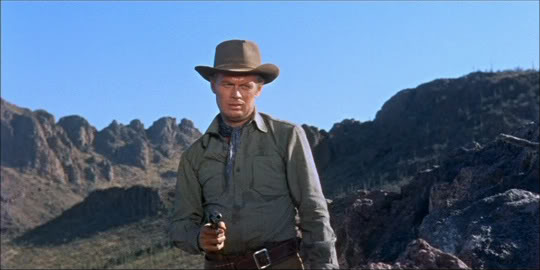
The opening shots of the film, with a lone rider traversing a rugged landscape to come upon a man filling in a grave, set the tone for the movie and establish the isolation of the two principal characters. The fact that both of them are soon under attack from a gunman perched in the rocks high above underlines the danger of the quest they are about to set out upon. There is also an undercurrent of suspicion and mistrust that will follow them now as neither one can be sure that the other isn’t responsible for setting the ambush. The rider is Karyl Orton (Donna Reed) and the gravedigger is Jim Slater (Richard Widmark); both are in search of the truth, and maybe $60,000 in gold. Years before, five men died at this spot at the hands of the Apache but one other escaped with his life and the gold, leaving his partners to their fate. Slater believes the father he never knew was one of the five, and Karyl believes her estranged husband to be another. With Slater seeking vengeance and closure, and the woman with her eyes on the gold they set out to identify and track down the mysterious sixth man. The manhunt pitches both these characters into one perilous situation after another, from a murderous Apache raid to a range war. Along the way their relationship slowly develops, although it’s no smooth ride for either of them – at one point Slater hauls off and belts Karyl full in the face for putting his life in danger, and she later takes an almost perverse pleasure in sealing up his wounds with a heated blade. By the end of the movie both these people will have to face down their own personal demons and maybe take something of real value away from the experience.

£11

Backlash was made at a time when Sturges’ and Widmark’s stars were on the rise. John Sturges had just come off the magnificent Bad Day at Black Rock and would shortly go on to make Gunfight at the O.K. Corral. He was close to his peak at this point and handled just about every aspect of the picture perfectly. Action and suspense blend seamlessly together and the Arizona locations look particularly fine through the wide lens. Widmark was also doing some of his best work around this time and this film must have helped him along nicely. His bony features and distinctive nasal giggle had landed him plenty of villainous roles but they were also ideally suited to playing the kind of damaged men that psychological westerns thrived on. He turns in a great performance here, obsessively digging into the past, searching for the truth and searching for himself – all the while fearing what he might learn yet unable to stop himself. Conversely, Donna Reed’s movie career was soon to end and she was close to moving into a successful run on television. With an impressive list of credits behind her she does well as the feisty, courageous woman-with-a-past. The support cast are solid too with Barton MacLane and an eye-rolling John McIntire standing out especially. A good screenplay is key to the success of any film and having Borden Chase’s name attached never hurt any. It struck me that the episodic structure and the underlying theme bore at least a passing resemblance to the writer’s earlier Winchester 73. 

Backlash has had a number of releases on DVD in R2 but the UK disc appears to be the only one with a proper widescreen image – there’s a R4 available but I’m not sure how it’s presented. Optimum’s UK disc has the movie looking very nice in a 2:1 anamorphic transfer, and I’ve been reliably informed that this is indeed the correct ratio for the film. There’s very little damage to be seen and colors and detail all looked excellent to my eyes. Surprisingly, for an Optimum release, the theatrical trailer is included but that’s it as far as extras go. However, when the main feature is there in OAR and looking good then I’m not about to complain. Backlash is a good example of a high quality mid 50s western – one that I rate and recommend.


Christmas Holiday

poster156

Following on from my previous post I’ve decided to have a look at another seasonal noir. Christmas Holiday (1944) is a movie that seems to slip under many people’s radar, and that may be partly down to both the title and the casting which are apt to give a false impression. At first glance, this is a film that might appear to be horribly miscast but the fact is it works very well. Having said that, the production remains a little odd, but I can’t quite put my finger on the reason. Like Lady in the Lake, the  story unfolds over Christmas but, once again, that’s really nothing more than an incidental detail – the timing could easily be changed without affecting the plot in the least.

On Christmas Eve, a newly commissioned army officer, Lt. Mason (Dean Harens), is preparing to fly to San Francisco to marry his sweetheart. However, just before he leaves, he receives a cable informing him that the deal’s off and she’s married someone else. Regardless, he decides to board his flight anyway but neither he nor the audience can be quite sure what he hopes to achieve. As it happens he never makes it to his destination, bad weather forcing his plane to make an unscheduled stop in New Orleans. He allows himself to be talked into visiting an out of town club (basically a bordello, but you couldn’t come right out and call it that under the production code) by the establishment’s PR man/pimp. It’s here that Mason meets Jackie Lamont (Deanna Durbin) and later hears her story. The character of Mason doesn’t really serve any purpose other than that of a narrative device – he’s simply there to provide an everyman perspective, the eyes and ears of the audience as a tale of deception, murder and obsession unfolds. Jackie explains that she’s been using an assumed name, her real one being Abigail Manette, since her husband’s conviction for murder. Via two separate flashbacks she relates how she met, fell in love with and married Robert Manette (Gene Kelly). Manette turned out to be a wastrel blueblood, fallen on hard times, with unsavoury characteristics that are mentioned only in the vaguest terms. This is all pretty standard fare for a noir thriller, but it’s the creepy relationship between Manette and his mother (the Spiderwoman herself, Gale Sondergaard) and the stifling home atmosphere that sets this movie apart. I’ve come across a few theories which try to explain exactly what’s “wrong” with Manette and the nature of his relationship with his mother, but I’m not entirely convinced by any of them. The script makes it clear enough that this is a man with a deeply flawed character but that’s about it. However, I haven’t read the Somerset Maugham story on which the film is based so I don’t know if that casts any further light on the subject.

£4

Deanna Durbin is credited with being the saviour of Universal as a result of the popularity of her lightweight musicals in the 40s but Christmas Holiday was a major departure from the usual formula for her. She does get to sing two songs, in her role as night club “hostess”, but this is a straight dramatic role. I thought she performed very well, and managed to handle the necessary transition from wide eyed innocent to world weary fallen woman quite convincingly. Gene Kelly is another performer not normally associated with dark, dubious characters but his Robert Manette is not at all bad. Seeing this jaunty, amiable figure jarringly transformed into a mother-fixated murderer has an unnerving quality that’s highly effective. Gale Sondergaard always brought an eerie, otherworldly feel to the parts she played and it fits right in here. The middle section of the film, told in flashback, takes place mainly in the confines of the Manette house, where Sondergaard seems completely at home amid the relics of a faded past. It’s this part of the movie that lends the slightly odd sense that I alluded to at the beginning. Maybe it’s the curious family dynamic, or the feeling of stepping into a world removed from the present – I honestly can’t say, but everything just feels a little off-centre in these sequences. This was Robert Siodmak’s second Hollywood noir, following on from Phantom Lady. It’s not quite up to the standard of his previous picture and lacks a little of the visual flair that he usually brought to the table. However, he does some good work in the club scenes, and the unusual architecture of the Manette house offers opportunities for some interesting shots.

As far as I know the only DVD of Christmas Holiday is the UK R2 from DDHE (EDIT – it appears there’s a Spanish release also available – see comment #1 below). It offers a pretty good transfer of the movie with no major damage or distraction on view. The only extra feature provided is a gallery of production stills. All in all, this a satisfying little noir that moves along nicely and has good performances from all the main players. For me, the casting of Kelly and Durbin worked, although I can see how it might lead to the film being ignored by some – fans of the two leads may be alienated by the atypical roles and storyline, and noir lovers may be put off by their presence. Nevertheless, I think the movie has a unique quality and is definitely worth a look.

With the Christmas juggernaut bearing down ominously, I doubt if I’ll find the time to post another piece before the holidays. So, I’d just like to take the opportunity to wish all those who have followed, commented on, or simply dropped by this blog from time to time the best of everything over the holiday period. Here’s hoping you all enjoy a happy and peaceful Christmas.


55 Days at Peking

£10

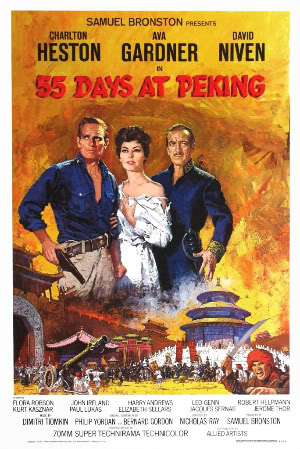
I generally steer clear of writing about huge sprawling epics on this blog, but that’s not to say I don’t like them. As it happens I’m extremely fond of such films and often feel that it’s a near impossible task to do them justice in a relatively short write up. When I was growing up the Samuel Bronston movies were always a source of marvellous entertainment to me, and represented some of the most spectacular scenes ever put on film. So, when I realised this would be my hundredth post here I thought maybe it was time to turn my attention for once to a genuinely big film. I could have chosen El Cid or The Fall of the Roman Empire but opted instead for one of the so-called lesser Bronston’s, 55 Days at Peking (1963).

The action takes place in the summer of 1900, during the latter stages of the Boxer Rebellion, when the foreign legations in Peking came under siege. Without wanting to get mired in historical detail, it seems safe to say that the Boxers found their roots in a sense of unease over the growing foreign influence in China. At the time this influence was most apparent in the area of religion, with Christianity usurping the local variety. The movie opens with a brief voiceover narration to the accompaniment of a cacophony of national anthems assaulting the eardrums. After a little more exposition in the Forbidden City, the camera cuts to the arrival of a column of dusty and weary US marines. At their head is the swaggering figure of Major Lewis (Charlton Heston), no mean feat while still on horseback. That the situation in China is spiralling out of control is immediately obvious when we see an English priest, strapped to a water wheel, being slowly tortured to death. Lewis’ attempts to buy the priest fail and the only thing he and his men accomplish is the killing of a Boxer. From here events move inexorably towards the inevitable crisis. Despite the best efforts of the British minister, Sir Arthur Robertson (David Niven), a state of war is fast approaching. In the midst of the mounting chaos Lewis finds himself drawn into a romance with a Russian aristocrat of dubious reputation (Ava Gardner). This slow build up occupies the first half of the film and it is quite heavy going. However, there are some visually impressive set pieces, such as the confrontation with a Boxer “theatrical” group during the Queen’s birthday celebrations, to keep it from becoming totally bogged down.

It’s only with the murder of the German envoy that things start to heat up on the screen. This is the point where the real action and spectacle take centre stage. Lewis’ romance starts to fade into the background as all attention is focused on the ever more desperate attempts to defend the foreign compound from wave after wave of attacks from the fanatical Boxers. It’s these marvellously choreographed scenes of pitched battles along the ramparts that really breathe life into the movie. The maniacal determination of the Chinese to breach the foreign defences forces the besieged men to come up with ever more ingenious ways to repel them. When the Boxers wheel a massive tower laden with explosives up to the perimeter, and proceed to bombard the exposed compound below, there’s a wonderful scene wherein a French priest (Harry Andrews) with a suspiciously strong Irish brogue supervises the construction of an improvised mortar to lob fireballs back at them. While this all sounds slightly deranged on paper it’s filmed and performed with enough style and conviction to remain gripping and tense throughout. Even though the seemingly endless assaults and counterattacks make for great cinema in themselves, there’s also a well filmed sequence of a night time raid on the Chinese arsenal which concludes with a magnificent and explosive payoff. The only false note is having the British minister tool up and join the raiding party on their sortie – although I’m guessing it was done to give David Niven the chance to get away from pottering fretfully around his study.


£2

One of the pleasures of watching the epic movies from this era is the knowledge that the sheer scale of the production wasn’t anything but real. Nowadays, in the age of CGI, the thought of something as financially prohibitive as building a full size replica of the besieged compound and filling it with literally thousands of swarming extras would be enough to give the average studio executive palpitations, if not an outright seizure. However, the fact that what you see on the screen in a movie like this is real and has actual physical mass adds something indefinable, a quality that’s now been lost. Somehow the very knowledge that you can now create pretty much any image imaginable on screen rubs away a little of the magic for me. To all intents and purposes 55 Days at Peking was Nicholas Ray’s last film, having walked away leaving it incomplete after one argument too many with Bronston he suffered a heart attack. It’s not his best work by any means and I don’t believe he was ideally suited to these kinds of large scale productions. Still, the striking use of colour throughout does seem to bear his hallmark. As far as the performers are concerned it’s Heston’s film all the way. Chuck was in the middle of that purple patch that would last another decade and he stamps his authority all over this picture. Though to be fair, while the film doesn’t develop his character to any meaningful degree it does offer ample opportunity for the kind of iconic posing only he could pull off convincingly. David Niven’s quiet, gentlemanly dignity is a welcome contrast (his casual flicking aside of the kneeling cushion when summoned before the Dowager Empress is a beautifully understated moment), and he even manages to make some fairly trite dialogue sound credible by adopting just the right amount of earnestness – a true professional. Ava Gardner was nearing the end of her days as a leading lady at this point and her performance is adequate but nothing more. I understand that she didn’t get along particularly well with Heston (they certainly don’t have a lot of on screen chemistry) so that may be part of the problem. Finally, a word about Dimitri Tiomkin’s score; his style is not to everyone’s taste and he’s sometimes criticised for being excessively bombastic, but I like it a lot and think it’s perfectly suited to this kind of larger than life movie.

55 Days at Peking is available on DVD from a number of sources worldwide, and the edition I have is one I picked up in Greece years ago. It was released on the PCV label and it’s got a fine anamorphic scope transfer that doesn’t suffer from any major damage or colour fading. The image is progressive and doesn’t look to me like it’s been manipulated excessively. I’ve had a look at the screencaps on the Beaver’s site and I’m fairly confident that my copy looks a good deal stronger than the Japanese one featured there. It’s R2 PAL, of course, and runs at 156 minutes including the overture, intermission, entre’acte and exit music. It’s a shame that reports of poor sales seem to have halted further releases in R1 of the Miriam Collection since the Bronston titles already out in that line are probably the best on the market. This is a movie that’s been neglected in more ways than one over the years and critics have rarely had many positive things to say about it. It is probably overlong and could use a little trimming in the first half, the use of Caucasian actors in the major Chinese roles is possibly a source of annoyance for some, but I still enjoy the movie immensely. Perhaps the fact that it’s a throwback to that vanished era of large scale, no holds barred filmmaking adds to its charm for me. I recommend it if you can get your hands on a decent copy.

Charley Varrick

Poster

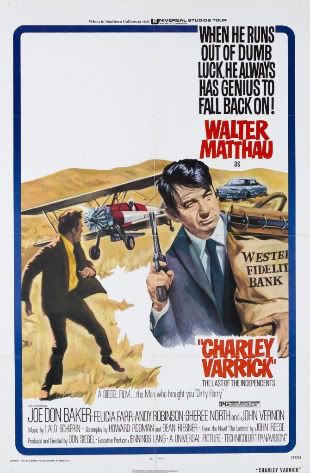
The term “underrated movie” is one that tends to get thrown around with abandon these days and its overuse is in danger of rendering it meaningless. However, there are times when that label is most certainly appropriate, and Charley Varrick (1973) is a prime example. I’ve no real explanation for this, but I do have a hunch that it frequently comes down to other work by the people involved dominating the thoughts of film fans. For most people (if they’ve heard the names at all) Don Siegel is identified with Dirty Harry, and Walter Matthau with comedic roles alongside Jack Lemmon. Without wishing to disparage any of those films, it is a shame that such thinking has lead to what is arguably the best work by both of these men being virtually forgotten.

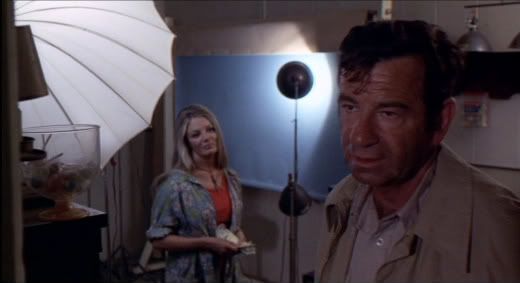
Charley Varrick (Matthau) calls himself The Last of the Independents, something that’s true on two levels – his crop dusting operation is in terminal decline due to the rise of the conglomerates, and the small-time criminal activities he’s turned to are overshadowed by organised crime. When the botched robbery of a tiny New Mexico bank yields a huge payday Charley realises that something is very badly wrong. His sole surviving partner, Harman (Andy Robinson), can’t believe their luck but Charley’s been around long enough to recognise the stench of mob money and the consequences of stealing it. When an apparently unstoppable hitman (Joe Don Baker) goes to work the chase is on, and Charley has to figure out a way of staying one step ahead of both the law and the mob. What follows is a violent and dangerous game of criminal chess played out amid the hick towns and trailer parks of the southwest. Charley Varrick starts out as a man who shouldn’t be expected to engage our sympathy (after all he is the leader of a gang of murderous thieves), but by the end of the film we’re rooting for him – when the odds are stacked so heavily against a man it’s hard not to find yourself taking his part. Added to this Charley is, almost perversely, the only figure who displays any real honour or integrity – this petty hood is the only honest one in a world of crooked bankers, sadistic killers, lowlife chiselers and sharp suited mafia front men.

Sheree North & Walter Matthau - Charley Varrick

Although Walter Matthau’s sourpuss features seem destined to remain forever associated with his comic roles he made a trio of tough crime pictures in the early seventies; The Laughing Policeman, The Taking of Pelham 123 and Charley Varrick. The fact that he was able to switch genres so effortlessly and credibly says much for the talent and versatility of the man. While he plays Charley Varrick as a cool and efficient veteran crook he still manages to fit in a few examples of his trademark deadpan humour. I’d have no hesitation in saying that this is the best I’ve seen of Matthau, and his career was by no means characterised by poor performances. The other standout member of the cast was Joe Don Baker as the smiling, heartless contract killer. Having said that, there is no particularly weak playing and John Vernon, Andy Robinson and Sheree North all give good solid support. Don Siegel rarely gets mentioned when top directors are discussed, but the fact remains that he regularly churned out tight intelligent films that eschewed pretension and made everything look deceptively simple. This and The Shootist are his two best films in my opinion, and I’d hate to have to choose between them. And last but not least, there’s a fine score from Lalo Schifrin that’s just about the ideal accompaniment for both the period and the mood.

As for the DVD, Charley Varrick is available in R2 in the UK from Fremantle in a nice anamorphic widescreen transfer (I think the R1 is an open-matte affair). It may not be pristine and it’s an almost barebones disc but there’s no major problems and the price is definitely right. All in all, Charley Varrick is a high class crime movie that really ought to be better known.

The Man Between

Having successfully treated audiences to the story of an innocent abroad in a war ravaged European city in The Third Man, director Carol Reed attempted to recapture some of that magic four years later with The Man Between (1953). That he didn’t quite manage to do so shouldn’t be seen as too harsh a criticism; while this film never achieves the consistency of style or suspense of his earlier work it still rates as a very fine movie.

Susanne Mallison (Claire Bloom) arrives in a devastated post-war Berlin to visit her brother Martin, a British army officer, and his new German wife Bettina (Hildegard Knef). Right from the beginning there is a sense that something is not quite right in this relationship, although the overworked husband appears blissfully unaware of any problems. With Bettina receiving mysterious telephone calls and messages Susanne’s suspicions are aroused. When the two women take in a visit to the Eastern zone (this was in the days before the wall went up), and just happen to run into an old acquaintance of Bettina’s, Susanne becomes convinced that her sister in law is having an affair. Ivo Kern (James Mason) is a charming yet ambiguous figure who has emerged from Bettina’s past and threatens to sabotage her future. However, despite early indications, the story is not some hackneyed love triangle with Ivo as the man between Bettina and her husband. That somewhat slow and predictable build-up is swept aside when the altogether more stylish second half of the film reveals itself to be a tense Cold War thriller that had merely been lurking in the shadows. As we learn who and what Ivo really is the movie develops into a cat and mouse chase through a bleak and menacing East Berlin.

Carol Reed had just made two bona fide masterpieces in Odd Man Out and The Third Man prior to The Man Between. The fact that this film featured the star of the former and a theme and setting similar to the latter often lead to its being judged more harshly than might normally be the case. Placed next to those two great works it does pale, but then most movies would. However, taken on its own terms, this film has much to recommend it. All the way through there is the distinctive visual style of Reed – tilted angles and deep shadow. The second half in particular takes the viewer on a tour of the city at night, a dark, dangerous place where friends are few and those deceptively close border crossings are always just out of reach. What saves the film from growing moribund in the first half, and adds to the tension and poignancy of the second half, are the performances of the two leads. Mason was a pastmaster at playing flawed and tarnished heroes, and his Ivo Kern is a fine creation. He is a man caught between past and present, East and West, self interest and honour. Claire Bloom, in a very early role, takes a character who starts out as a portrait of middle class primness and gradually develops her into a young woman on the cusp of maturity, learning bit by bit that her preconceptions about both herself and the world around her might not be as clear cut as they first appear. I’d also like to give a mention to the frankly excellent score by John Addison; it has a melancholy romanticism that lingers long in the memory.

If you’re looking to find The Man Between on DVD there are two choices available at the moment. I have the German edition from Kinowelt and it provides a very good transfer with optional subs that are removable via the main menu. The print is in fine condition with good contrast and blacks and no noticeable damage. The film is presented in Academy ratio and, although I’m certainly no expert on such matters, that looks correct to me. I mention this because the other option is the edition available in the UK from Optimum in their James Mason Icons set. While I don’t own that disc I do know that it presents the film in widescreen format, and I’m not convinced that that’s how it should be seen. It is notoriously difficult to pin down the correct aspect ratio for British films of this vintage as the UK wasn’t quite up to speed with the US in adopting widescreen. Apart from that, the framing on the German DVD just looks right, with no apparent cropping at the sides and no extraneous space at the top or bottom. Looked at in context, The Man Between is lesser Reed but, if you can put aside comparisons with his more celebrated works, it still makes for entertaining and rewarding viewing.

Fixed Bayonets!

22gbjrc

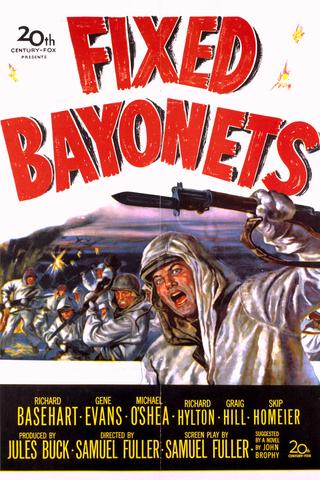
As I (not so) patiently wait for the new Sam Fuller box to roll up to my door I thought I might as well have a look at one of his other films to pass the time. It turned out to be a toss up between Forty Guns and Fixed Bayonets! (1951). Since I’ve been watching a lot of westerns lately and haven’t posted anything about war movies for a while it was the latter that won out in the end. This was Fuller’s first film for Fox, and it makes a nice companion piece to his earlier study of men in war The Steel Helmet – they’re both lean, unglamorous portrayals of the trials of enlisted men in Korea.

The plot is a very simple one – to cover the retreat of the division, a small detachment is left behind in the frozen wastes of Korea to carry out a rearguard action. This luckless group find themselves holed up in a narrow mountain pass, hoping to trick the Chinese into believing that they’re actually an advance party for the division. The focus is on Denno (Richard Basehart), a reluctant corporal who dropped out of officer training school because he didn’t want the responsibility. Not only that but he also has to deal with the fact that he finds himself unable to pull the trigger whenever he gets an enemy target in his sights. None of this would necessarily present a huge problem if it weren’t for the fact that Denno now has only three men between him and his greatest horror, the burden of command. In contrast to the sensitive, introspective corporal is Sergeant Rock (Gene Evans), the tough old pro who has stayed in the army but can’t quite put his finger on the reasons why. While the rest of the platoon have their doubts about Denno, Rock keeps faith with him as he feels he knows his man. As the Chinese press ever closer, and the casualties steadily mount, it’s obvious that sooner or later Denno will find himself the top man – the Ichiban Boy – and the only real question is how he’s going to handle it.

Gene Evans basically reprises his role from The Steel Helmet, but it’s almost the kind of part he was born to play. He really brings the battle-hardened Rock to life, full of fatalistic humour as he bullies and cajoles the grunts into doing what has to be done. If Rock is the beating heart of the platoon then Denno is the conscience, and Richard Basehart was well cast in that part. His quiet, dignified tone stands out among the casual slang of the other dog-faces around him. He was capable of that intense, repressed look that is ideal for a man being eaten up by inner turmoil. Some of the best scenes in the movie take place in the quiet moments in the cave when Rock and Denno chew the cud over the nature of soldiering and responsibility. Fuller directs these claustrophobic scenes with apparent ease, using a full 360 pan at one point to show the whole platoon (or what remains of it) looking on as the reluctant medic performs surgery on himself. He punctuates such scenes with bursts of jarring, unexpected violence and moments of incredible tension, such as Denno’s walk through a minefield at night to rescue a mortally wounded NCO. His sense of pacing and economy are spot on, with not a shot wasted as we rattle along to the climax.

The R1 DVD from Fox is a frugal affair with little in the way of extras but it does boast a generally strong transfer. Fixed Bayonets! is a fine early example of Fuller’s honest, no nonsense approach to film-making and has his unsentimental machismo stamped proudly all over it. I enjoyed it a hell of a lot – now if only that Sony boxset would turn up!


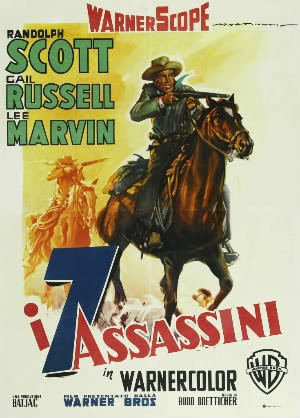
Seven Men from Now

poster161

I was just thinking the other day that it will soon be close to a year since I got my hands on Sony’s superlative set of Boetticher/Scott westerns. Those movies were at the very top of my most wanted list for so long, and it still gives me great pleasure to know that I can now pick them off my shelves and enjoy them any time I please. With that thought in mind, I decided to give Seven Men from Now (1956) another view. This film is of course not officially part of the Ranown group of titles, but it was the first to bring together Scott, Boetticher and Kennedy – so it is the movie that kicked off that cycle and it’s also the template for what was to follow.

As soon as the title credits have rolled the film immediately kicks into gear. Out of the darkness, and a violent storm, comes the lone figure of a man making his way towards the shelter of a nearby cave. It’s already occupied by two vaguely uneasy men, but they still offer the stranger a cup of coffee and a seat by the fire. A stilted conversation follows, but when a killing in the town of Silver Springs is brought up something snaps. The camera cuts away, gunfire is heard, and only one man will ride off. That man is Ben Stride (Randolph Scott), former sheriff of the aforementioned town and now a driven manhunter. Seven men robbed the Wells Fargo office in Silver Springs, killing Stride’s wife in the process. Now only five are left alive, and Stride spends the remainder of the movie blazing a trail across Arizona in his quest for vengeance. Along the way he runs into a couple of easterners, headed for California and a new life. The couple are Annie Greer (Gail Russell) and her less than capable husband John (Walter Reed). Stride’s inherent decency means that he can’t abandon these two greenhorns to their fate in hostile country, so he rides with them part of the way. By the time they reach a deserted relay station, the last important figure is introduced. This is Masters (Lee Marvin), an man of dubious character who Stride has had occasion to lock up in the past. However, Masters appears to bear him no ill will and makes it clear that his only interest is in finding the gold that was stolen from Silver Springs. When this oddly matched group sets out again the tensions begin to rise, and it seems only a matter of time before Stride and Masters will square off.

£8

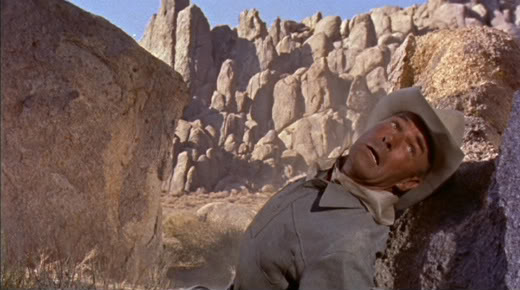
As I said in my introduction, Seven Men from Now was the seed from which the Ranown westerns were to grow. Just about every character, theme and situation would be revisited and honed to near perfection over the course of the next four years. Scott is the classical loner, haunted by the demons of his past and desperate to make up for the character flaws and inadequacies that brought him to his present state. He can be hard and ruthless when the circumstances demand but still retains a sensitivity to those who are dependent on him. Gail Russell was given a shot at a comeback with the reasonably meaty role of a woman who married a weak and ineffectual man but will stick by him for all that. Miss Russell’s story was a tragic one; were it not for a combination of insecurity and alcoholism she might have achieved much more than her appallingly short life permitted. Nevertheless, she plays her part perfectly here and it’s almost as if she was able to channel all the dissatisfaction with her own life into Annie Greer. It has to be said that Walter Reed is pretty colourless as the husband, but that’s not necessarily a bad thing when you’re looking to play a weak willed and essentially passive character. Lee Marvin, on the other hand, is all swaggering bravado and insidious charm. His nonchalant, sneering dandy with the long, green scarf and twin pistols is the perfect counterbalance to Scott’s underplaying. I’d say he actually steals the picture as he dominates every scene he’s in – the real standouts being his taunting provocation of Scott, Reed and Russell in the confines of a storm battered wagon, and the final one on one duel amid the barren rocks of Lone Pine.

Boetticher and Kennedy revisited this premise again and again in their movies: the small isolated group comprised of the obsessive avenger, the strong yet vulnerable woman, the expendable sidekicks and the villain that you half admire. Anyone familiar with Kennedy’s scripts will easily recognise the recurring dialogue, but the beauty of it is that it’s such iconic stuff it never actually sounds cliched. Boetticher’s direction here is first rate, making the most of the familiar Lone Pine locations – the bulk of the action in Seven Men from Now takes place outdoors and that’s a real blessing in any of his movies. There’s the usual mix of telling close-ups interspersed with glorious wide shots. The climax among the labyrinthine boulders creates a great sense of claustrophobia and allows for some marvellously framed images.

Paramount did western fans a real favour when they put Seven Men from Now out on a DVD a few years back. The R1 disc (I’m going to assume the R2 replicates it) is an excellent anamorphic transfer that I couldn’t fault. In addition to the main feature, there’s a boatload of great extras with the commentary track by Jim Kitses and the documentary Budd Boetticher – An American Original being especially worthy of mention. Seven Men from Now stands as a first class western on its own, but what makes it even more special is the knowledge that Boetticher, Scott and Kennedy would go on to produce still classier material in a very short space of time. If you haven’t seen this film then you really owe it to yourself to put that situation right as soon as possible – I can’t recommend it highly enough.