Fixed Bayonets!

22gbjrc

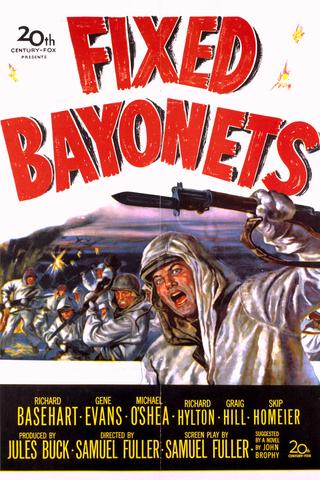
As I (not so) patiently wait for the new Sam Fuller box to roll up to my door I thought I might as well have a look at one of his other films to pass the time. It turned out to be a toss up between Forty Guns and Fixed Bayonets! (1951). Since I’ve been watching a lot of westerns lately and haven’t posted anything about war movies for a while it was the latter that won out in the end. This was Fuller’s first film for Fox, and it makes a nice companion piece to his earlier study of men in war The Steel Helmet – they’re both lean, unglamorous portrayals of the trials of enlisted men in Korea.

The plot is a very simple one – to cover the retreat of the division, a small detachment is left behind in the frozen wastes of Korea to carry out a rearguard action. This luckless group find themselves holed up in a narrow mountain pass, hoping to trick the Chinese into believing that they’re actually an advance party for the division. The focus is on Denno (Richard Basehart), a reluctant corporal who dropped out of officer training school because he didn’t want the responsibility. Not only that but he also has to deal with the fact that he finds himself unable to pull the trigger whenever he gets an enemy target in his sights. None of this would necessarily present a huge problem if it weren’t for the fact that Denno now has only three men between him and his greatest horror, the burden of command. In contrast to the sensitive, introspective corporal is Sergeant Rock (Gene Evans), the tough old pro who has stayed in the army but can’t quite put his finger on the reasons why. While the rest of the platoon have their doubts about Denno, Rock keeps faith with him as he feels he knows his man. As the Chinese press ever closer, and the casualties steadily mount, it’s obvious that sooner or later Denno will find himself the top man – the Ichiban Boy – and the only real question is how he’s going to handle it.

Gene Evans basically reprises his role from The Steel Helmet, but it’s almost the kind of part he was born to play. He really brings the battle-hardened Rock to life, full of fatalistic humour as he bullies and cajoles the grunts into doing what has to be done. If Rock is the beating heart of the platoon then Denno is the conscience, and Richard Basehart was well cast in that part. His quiet, dignified tone stands out among the casual slang of the other dog-faces around him. He was capable of that intense, repressed look that is ideal for a man being eaten up by inner turmoil. Some of the best scenes in the movie take place in the quiet moments in the cave when Rock and Denno chew the cud over the nature of soldiering and responsibility. Fuller directs these claustrophobic scenes with apparent ease, using a full 360 pan at one point to show the whole platoon (or what remains of it) looking on as the reluctant medic performs surgery on himself. He punctuates such scenes with bursts of jarring, unexpected violence and moments of incredible tension, such as Denno’s walk through a minefield at night to rescue a mortally wounded NCO. His sense of pacing and economy are spot on, with not a shot wasted as we rattle along to the climax.

The R1 DVD from Fox is a frugal affair with little in the way of extras but it does boast a generally strong transfer. Fixed Bayonets! is a fine early example of Fuller’s honest, no nonsense approach to film-making and has his unsentimental machismo stamped proudly all over it. I enjoyed it a hell of a lot – now if only that Sony boxset would turn up!


Seven Men from Now

poster161

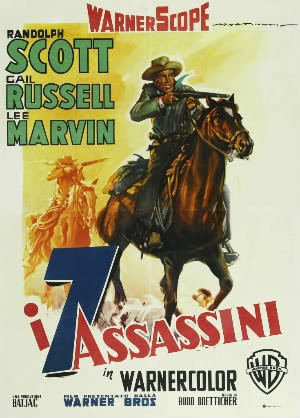
I was just thinking the other day that it will soon be close to a year since I got my hands on Sony’s superlative set of Boetticher/Scott westerns. Those movies were at the very top of my most wanted list for so long, and it still gives me great pleasure to know that I can now pick them off my shelves and enjoy them any time I please. With that thought in mind, I decided to give Seven Men from Now (1956) another view. This film is of course not officially part of the Ranown group of titles, but it was the first to bring together Scott, Boetticher and Kennedy – so it is the movie that kicked off that cycle and it’s also the template for what was to follow.

As soon as the title credits have rolled the film immediately kicks into gear. Out of the darkness, and a violent storm, comes the lone figure of a man making his way towards the shelter of a nearby cave. It’s already occupied by two vaguely uneasy men, but they still offer the stranger a cup of coffee and a seat by the fire. A stilted conversation follows, but when a killing in the town of Silver Springs is brought up something snaps. The camera cuts away, gunfire is heard, and only one man will ride off. That man is Ben Stride (Randolph Scott), former sheriff of the aforementioned town and now a driven manhunter. Seven men robbed the Wells Fargo office in Silver Springs, killing Stride’s wife in the process. Now only five are left alive, and Stride spends the remainder of the movie blazing a trail across Arizona in his quest for vengeance. Along the way he runs into a couple of easterners, headed for California and a new life. The couple are Annie Greer (Gail Russell) and her less than capable husband John (Walter Reed). Stride’s inherent decency means that he can’t abandon these two greenhorns to their fate in hostile country, so he rides with them part of the way. By the time they reach a deserted relay station, the last important figure is introduced. This is Masters (Lee Marvin), an man of dubious character who Stride has had occasion to lock up in the past. However, Masters appears to bear him no ill will and makes it clear that his only interest is in finding the gold that was stolen from Silver Springs. When this oddly matched group sets out again the tensions begin to rise, and it seems only a matter of time before Stride and Masters will square off.

£8

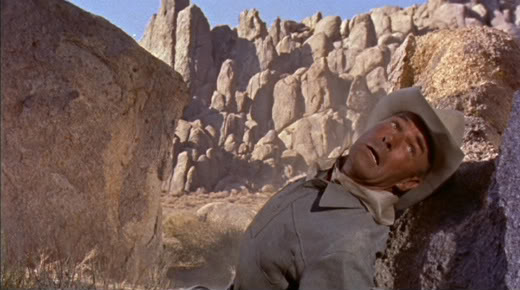
As I said in my introduction, Seven Men from Now was the seed from which the Ranown westerns were to grow. Just about every character, theme and situation would be revisited and honed to near perfection over the course of the next four years. Scott is the classical loner, haunted by the demons of his past and desperate to make up for the character flaws and inadequacies that brought him to his present state. He can be hard and ruthless when the circumstances demand but still retains a sensitivity to those who are dependent on him. Gail Russell was given a shot at a comeback with the reasonably meaty role of a woman who married a weak and ineffectual man but will stick by him for all that. Miss Russell’s story was a tragic one; were it not for a combination of insecurity and alcoholism she might have achieved much more than her appallingly short life permitted. Nevertheless, she plays her part perfectly here and it’s almost as if she was able to channel all the dissatisfaction with her own life into Annie Greer. It has to be said that Walter Reed is pretty colourless as the husband, but that’s not necessarily a bad thing when you’re looking to play a weak willed and essentially passive character. Lee Marvin, on the other hand, is all swaggering bravado and insidious charm. His nonchalant, sneering dandy with the long, green scarf and twin pistols is the perfect counterbalance to Scott’s underplaying. I’d say he actually steals the picture as he dominates every scene he’s in – the real standouts being his taunting provocation of Scott, Reed and Russell in the confines of a storm battered wagon, and the final one on one duel amid the barren rocks of Lone Pine.

Boetticher and Kennedy revisited this premise again and again in their movies: the small isolated group comprised of the obsessive avenger, the strong yet vulnerable woman, the expendable sidekicks and the villain that you half admire. Anyone familiar with Kennedy’s scripts will easily recognise the recurring dialogue, but the beauty of it is that it’s such iconic stuff it never actually sounds cliched. Boetticher’s direction here is first rate, making the most of the familiar Lone Pine locations – the bulk of the action in Seven Men from Now takes place outdoors and that’s a real blessing in any of his movies. There’s the usual mix of telling close-ups interspersed with glorious wide shots. The climax among the labyrinthine boulders creates a great sense of claustrophobia and allows for some marvellously framed images.

Paramount did western fans a real favour when they put Seven Men from Now out on a DVD a few years back. The R1 disc (I’m going to assume the R2 replicates it) is an excellent anamorphic transfer that I couldn’t fault. In addition to the main feature, there’s a boatload of great extras with the commentary track by Jim Kitses and the documentary Budd Boetticher – An American Original being especially worthy of mention. Seven Men from Now stands as a first class western on its own, but what makes it even more special is the knowledge that Boetticher, Scott and Kennedy would go on to produce still classier material in a very short space of time. If you haven’t seen this film then you really owe it to yourself to put that situation right as soon as possible – I can’t recommend it highly enough.

Inferno

£9

A little suffering is good for the soul – that would appear to be the message of Inferno (1953). It’s a classic tale of man against nature with a liberal sprinkling of deceit, infidelity and murder thrown in for good measure. The movie is generally regarded as a film noir and I suppose that’s fair enough given its themes, although the visuals (technicolor and wide open spaces) suggest it should be the antithesis of that style.

The opening pitches you right into the middle of the plot with no time wasted on backstory or build-up. Within a few minutes the viewer knows exactly what’s going on and what led up to it. A man has broken his leg out in the desert and his wife and her lover have decided to abandon him and let nature take its course. The unfortunate victim is one Don Carson (Robert Ryan), a hard drinking businessman with plenty of money but few friends. Carson has gone out to a remote part of the desert in the company of his faithless wife Gerry (Rhonda Fleming) and a mining engineer, Duncan (William Lundigan), to scout for manganese deposits. When an accident presents Gerry and Duncan with a heaven sent opportunity to rid themselves of Carson they grab it with both hands. All they need do is manipulate the evidence and cook up a story about Carson going off on an alcoholic bender to be home free. However, the scheming  lovers underestimate their victim and his resourcefulness – Carson may have led a pampered life of privilege but he has a powerful will to live and an instinct for survival. The film twists and turns its way to the conclusion and, as it does so, the character of Carson moves smoothly from being initially an unsympathetic boor to a man the viewer can both admire and root for. The best scenes in the movie have Carson battling against the merciless desert, with nothing but his thoughts to keep him company. There’s also some clever cutting to point up the contrasting fortunes of the protagonists: while the hero grows desperate for water there’s a sudden jump to a shot of Duncan diving into a crystal clear pool; and when Carson finds himself on the verge of starvation the next scene has his wife delicately carving a roast back at the LA mansion.

Inferno saw Robert Ryan near the top of his game in a career that had more than its fair share of highs. He spends the bulk of his screen time alone in the vast wilderness, crawling and dragging his broken body over the unforgiving terrain. There’s no one else present to play off and that fact makes it even more remarkable that he managed to develop his character into a fully rounded human being that we actually care about. He starts out as a spoiled, sullen drunk petulantly taking pot shots at a discarded whisky bottle, but by the end of the picture his trials and torments have transformed him into a man of character and humility. Rhonda Fleming was well cast as the devious Gerry, brimming with a kind of loathsome sexiness. She is the typically heartless femme fatale with a perverse sense of morality, who doesn’t bat an eye at the thought of leaving a man to a slow, aching death but baulks at the idea of shooting him. William Lundigan was a fairly bland actor but a capable enough one for all that. Although Inferno would be one of his last major roles before moving into television he does a reasonable job with a basically one dimensional character. Director Roy Ward Baker made a handful of movies in Hollywood in the early 50s before moving back to Britain. Inferno was the last of them and it wasn’t a bad one to finish on. He makes wonderful use of the desert locations to emphasise the harshness of the environment and the lonely struggle of the hero. Of course it doesn’t hurt to have a cameraman of the calibre of Lucien Ballard on hand, and the two of them managed to turn out a film that’s tense, uplifting and visually arresting. This movie was originally shot in 3D, a process that sometimes led to gimmicky effects shots, but it never really intrudes too much here – though a lantern is fired directly at the camera during the climax.

A while back, when Fox was still in the business of issuing DVDs, it was rumoured that Inferno was due a release in the US, possibly as part of the noir line but nothing ever came of it. However, it has been given a release in R2 in Spain by a company called Impulso. They have licensed a number of titles and market them as Fox Cinema Classics. The transfer for Inferno is a generally pleasing one. Viewed on a 37 inch screen I thought it looked fine for the most part – the image is mostly smooth and sharp but there are instances of heavy grain (especially during the titles). The colour is quite strong but it can take on a slight pinkish hue at times. The disc itself is pretty basic with the only extra of note being a gallery. All told, I was satisfied with this one and it is the only way to get your hands on this title at the time of writing. Inferno is a tight, pacy little movie that clocks in at 80 minutes and rarely stops to take a breath. I’d rate it highly as a noirish thriller in an unusual setting, boasting classy performances and excellent visuals.

Escape from Fort Bravo

Often a film will stick in one’s mind because of a certain scene or sequence. That’s certainly the case with Escape from Fort Bravo (1953), a movie I first saw many moons ago but whose climax lingered on as a fond memory down through the years. Under such circumstances revisits are a delicate matter, best approached with caution as disappointment is always ready to pounce. When I eventually got the chance to see this western again last year I was pleased to find that my memory hadn’t been playing tricks on me – I enjoyed it immensely. Digging it out and giving it a spin the other day, for the purposes of this piece, allowed me to recognise some of its weaknesses more clearly but still didn’t dilute any of the punch of the ending.

The action takes place in Arizona during the Civil War, where a group of Confederate prisoners are cooped up in the dusty Fort Bravo. Among the jailers is Captain Roper (William Holden), a hard-bitten man who thinks nothing of marching a recaptured prisoner back through the blazing desert heat as an example to the others. While such actions naturally stir resentment among the southerners, his own commander and peers don’t shirk away from expressing their disapproval either. The tensions within the stockade are only one aspect of the problem though, as the fort is right smack in the middle of hostile Mescalero territory. The threat posed by the Apache is an ever present one and is highlighted early on when a detachment is sent out to locate a delayed supply convoy, finding only burned wagons and dead drivers. On the return leg the troop encounter a stage and escort it back to the safety of the fort. This stage contains one Carla Forester (Eleanor Parker), who’s using the cover of a wedding invitation to facilitate the escape of the Confederate OC, Captain Marsh (John Forsythe). This leads into an unconvincing and undeveloped love triangle which, in combination with the less than riveting escape plan, could well have sunk the picture. Fortunately, the addition of some ripe dialogue and good support playing (William Demarest in particular) just about keep things afloat. The resulting escape and pursuit get things back on course again, and by the time Roper, Marsh et al find themselves surrounded by some of the most cunning Apaches ever seen on film the tension has been wound tight. Those scenes in the latter half of the film are worth the price of admission alone. Watching the small, isolated group, huddled in a desert crater, move from defiance to fearful realization and back again is quite powerful stuff. Adversity is said to bring out the best and the worst in men, and the sight of Roper striding out at dawn, a revolver in both fists, to meet fate head on is a marvellous image.

William Holden was arguably in his prime when Escape from Fort Bravo was made (the same year as Stalag 17) and he gave a very strong performance as the practical and ruthless Roper. He was ideally suited to playing tough cynics with a deep set yet true sense of personal honour. Watching Holden’s honest, warts-and-all portrayal of Roper really shows up the inadequacies of his co-star. John Forsythe is a likable enough actor but there’s a lightweight quality about him (it worked well enough in a movie like The Trouble with Harry, and Hitchcock obviously thought enough of him to cast him again in Topaz and in his TV show) that’s not quite right for the part of a tough veteran. I’ve always enjoyed watching Eleanor Parker, she had a sassiness that suggested she could hold her own in any company and give as good as she got. However, she’s poorly served by her role here and the aforementioned “love triangle that really isn’t” is largely responsible for that. It seems odd to refer to a director’s twentieth picture as his breakthrough, but in this case I believe that’s actually the case. John Sturges would go on to make a string of ever more successful films after this and showed that he was highly capable when it came to action. His best work is in the early and latter stages, when he made effective use of the Death Valley locations and avoided the studio mock-ups. It’s also notable that he wisely chose to shoot the key scenes without any musical accompaniment and they’re all the better for it.

When Warner released Escape from Fort Bravo in their Western Classics box there was a good deal of griping about the quality of the transfer. It seemed to be the general consensus that much of the blame could be laid at the door of the poor condition of the Ansco Color elements. In truth, the transfer isn’t that bad and the colour is actually fairly strong. The real problem is that the print used is very dirty and obviously had little or no work done on it. It’s available in the R1 box (probably the best value), and individually in both R1 and continental R2. Escape from Fort Bravo belongs to that small category of westerns, along with Two Flags West and Major Dundee, that has Yankees and Rebs fighting side by side against the Indians. I think it’s a fine little western whose strong opening and blinding finish certainly shore up a slightly sagging middle section. Recommended.

Berlin Express

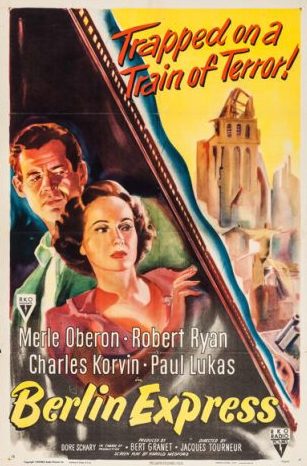
Post-war Europe was an excellent setting for a noir picture – the bombed out ruins and a displaced, despairing population provided a near perfect backdrop for such films. Jacques Tourneur’s Berlin Express (1948) is a mix of spy story, noir and propaganda piece. That latter element is the one thing that knocks it down a peg and damages its noir credentials slightly; those repeated attempts to inject a kind of brave new world optimism into what should be a fatalistic film really work against it in the end.

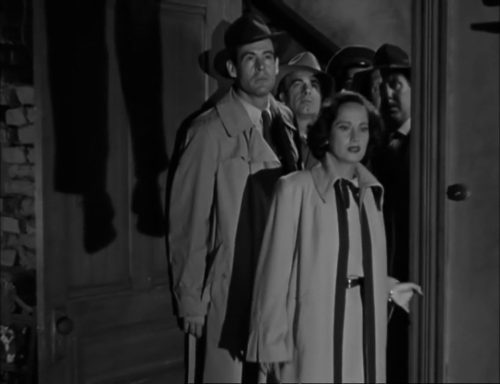
The movie opens in the documentary style that was popular at the time, complete with the “voice of God” narration to set the scene and introduce the main players. Normally, I’m not averse to a good voiceover but the somewhat strident, Mark Hellinger-style commentary employed here does start to grate pretty fast. Fortunately, it doesn’t dominate things for too long and, once it’s been established that we’re following a group of international travellers on the military express bound for Berlin, regular cinema storytelling techniques kick in. Robert Lindley (Robert Ryan) is an American agriculturalist on his way to take up a position with the occupying forces, and the plot unfolds through his eyes. His companions are an Englishman, a Frenchman and a Russian – representing the four powers. Apart from military personnel, there are also a number of German nationals on board – one of whom is in mortal danger. The gentleman in question is a diplomat with a noble plan for peaceful coexistence in Europe. When a makeshift bomb kills his decoy, his identity is revealed to the audience but the danger remains. No sooner has the train deposited its passengers in the ruins of Berlin than the eminent diplomat is abducted. So, the four just men, bowing to pressure from the captive’s secretary (Merle Oberon), take on the role of amateur sleuths and the chase is on. Their hunt leads them through the rubble and backstreet dives of the fallen capital, and leads the audience into the best segment of the movie. This is a twilight world, full of people driven to the very brink – scrambling for discarded cigarette butts, scanning the ever present lists of missing persons, and hanging around stations pathetically trying to hawk their meagre possessions. As Lindley and his companions grope their way through this decaying world the speechmaking and in-your-face social comment is mercifully kept to a minimum, letting the visuals make the point much more eloquently.

Robert Ryan plays a role here that is very much that of the everyman bumbling his way into a situation that is over his head. His craggy careworn features were well utilized over the years in countless noirs and westerns, and I always regard his presence in any film as a big recommendation. Merle Oberon, on the other hand was an actress that I could take or leave. Having said that, she does well enough as the French secretary determined to track down her kidnapped boss. For me though, the real stars of the movie were director Tourneur and cameraman Lucien Ballard. Together they manage to turn a middling spy story into a visual treat. The location work helps enormously of course, but there’s no end to the interesting angles and memorable shots served up – low angles, overheads, reflections etc. Tourneur also handles the various set pieces beautifully; from the cabaret scene (reminiscent of the Mr. Memory sequence in Hitchcock’s Thirty-Nine Steps) and the confrontation in the abandoned brewery, to the tense climax aboard the train once more. Only the happy ever after coda rings false, hindsight allowing us to see that forty years of conflict and subterfuge would be the order of the day rather than the spirit of cheerful comradeship and cooperation that the film alludes to.

Berlin Express was an RKO production and a few years ago that would have meant that there was always the possibility of a shiny new transfer on the cards from Warners in R1. Unfortunately, those days are now gone and this film is on its way to the dreaded Archive. However, there is an alternative in the shape of a R2 release from French company Montparnasse. The R2 disc is typical of the company’s fare, in that it’s neither exceptionally good nor exceptionally poor. The transfer is adequate, there’s no serious print damage but, equally, there’s no evidence of any restoration and it looks to be interlaced. Still, the Archive offering is unlikely to be any improvement and the pricing, suspect media and restricted availability weigh heavily against it. Berlin Express is a film that flirts around the boundaries of noir, but I feel that there’s enough in the story, cinematography and direction to warrant its inclusion in the category. While it may not be up there with the greats of dark cinema it should be a welcome addition to anyone’s collection.

The Bravados

There’s something so deeply satisfying about watching 1950s westerns that I sometimes feel I could dedicate an entire blog to them and still only scratch the surface. Just about every star and director of note managed to produce, at the very least, one quality western during those few short years. While the cinematography ran from monochrome and Academy ratio to technicolor drenched scope, one feature remained constant: maturity of theme.

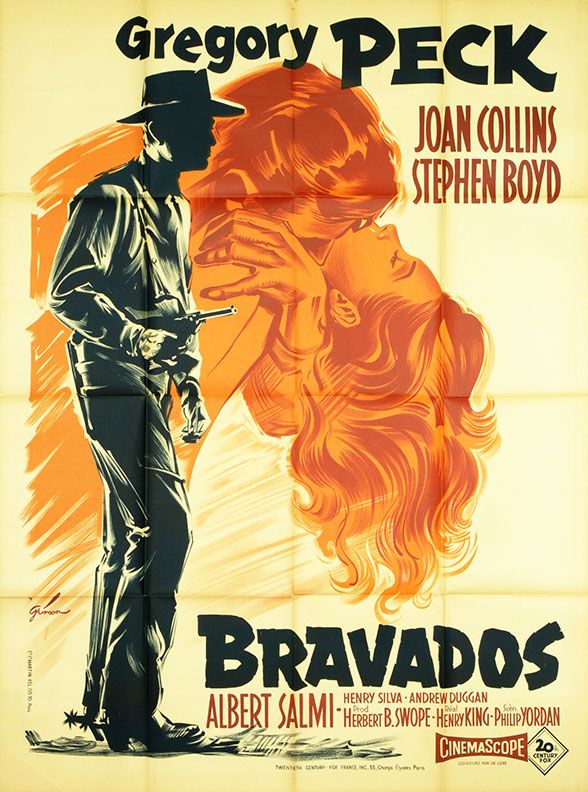
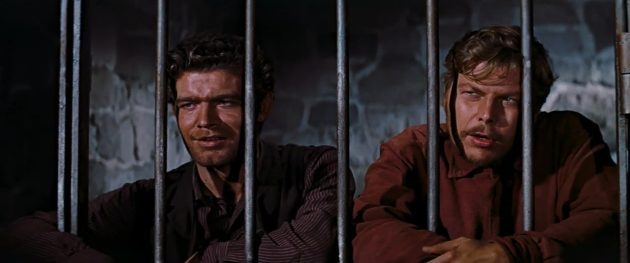
The Bravados (1958) opens in dramatic fashion with a silhouetted rider driving himself on through the night to the accompaniment of Lionel Newman’s pounding score while the blood red titles flash onto the screen. The rider is revealed to be Jim Douglass (Gregory Peck), a man obsessed enough to ride a hundred miles just to witness the execution of four men he’s never seen before (Stephen Boyd, Henry Silva, Lee Van Cleef and Albert Salmi). Initially there’s no explanation offered for Douglass’ desire to see these men keep their date with the hangman. The only thing that’s clear is that he’s nursing a deep and bitter hatred – perfectly realized in a wordless scene in the jail as Douglass walks along outside the bars and rakes each man in turn with a look of such malice that they flinch as though a lash had been applied. It’s only after the four have escaped, taking the storekeepers daughter hostage, that the reason for Douglass’ personal vendetta is revealed. It transpires that his wife has been raped and murdered and he believes that these men are the ones responsible. What follows is a tale of pursuit, revenge, realization, and finally a kind of sour redemption. The only false note in the picture is the introduction of an unnecessary and less than believable romance between Douglass and a Mexican rancher (a woefully miscast Joan Collins). This really adds nothing whatsoever to the film and actually serves to weaken it – the final ten minutes pack a powerful emotional punch but the last shot takes a good deal of the sting out of it. I think it’s also worth mentioning that I was left wondering if The Bravados had any influence on Sergio Leone. Maybe it’s just me but I couldn’t help but notice parallels with For a Few Dollars More: the taciturn anti-hero, the watch with his dead wife’s photo that Douglass carries and shows to his victims before killing them, the grimy and sadistic villains, and the ride along the deserted street of a Mexican pueblo before a showdown.

Gregory Peck gave a remarkably intense performance in a complex role that’s basically a study of bitterness, obsession and false conviction. His playing of a man who has cast aside his soul in the pursuit of vengeance is pitch perfect. As the story progresses the viewer understands that Douglass has become no better than the criminals he is ruthlessly hunting down, but it’s his own final realization of that fact that raises the movie to a higher class. Peck does a fine job of showing the psychological disintegration of a man who has his illusions stripped away and must henceforth look at himself in a new and disturbing light. Stephen Boyd clearly had a ball portraying the chief badman and slipped from smirking charm to menacing brutishness with ease. I’ve always been a big fan of Boyd and have enjoyed his performances in everything I’ve seen him in. His best work was as the villain and when the big lead parts came along he was a touch unlucky – a poorly written role and no chemistry with Sophia Loren in Fall of the Roman Empire, almost becoming James Bond, and having production delays force him to relinquish the role of Mark Antony to Richard Burton in Cleopatra. I was prepared to write some scathing comments about the wooden acting of Joan Collins in this movie but I can’t seem to work up the enthusiasm – although how anyone ever thought it was a good idea to cast her as a Mexican cattlewoman just beggars belief.

Henry King was one of those directors that the studio system seemed to have in abundance, the skilled craftsman who could effortlessly churn out quality pictures in just about every genre. His name is hardly a familiar one today but a glance at his filmography makes for impressive reading and contains far more hits than misses. King’s work on The Bravados is aided immeasurably by Leon Shamroy’s cinematography, which mixes stunning landscape views with moody day for night shooting to great effect.

The Bravados is available on DVD from Fox and their R2 Studio Classics version (I imagine the R1 is broadly similar) is a perfectly fine anamorphic scope transfer with nice colours. There’s not an extra feature in sight (I think the R1 has a trailer) but it is cheap. This is a movie that often gets overlooked and is rarely mentioned, but if you’re a fan of westerns from this era you need to see it. Highly recommended.

5 Fingers

£9

Much as I enjoy all the gadgetry and technology that seems to have become part and parcel of the espionage film over the years it’s refreshing nevertheless to watch something where the spy uses nothing more advanced than a pocket camera to accomplish his goal. 5 Fingers (1952) is just such a film, a slow burning suspense yarn that concentrates on character and the gradual building of tension. The fact that it’s supposedly based on a true story makes the whole, seemingly unlikely, series of events even more intriguing.

The story takes place in Ankara, Turkey during WWII and tells the story of an amazing scam carried out under the noses of the British embassy staff. Diello (James Mason) is an Albanian employed as a valet to the British ambassador, and is a man of intelligence, culture and ambition who realises the unique opportunity afforded him by his current employment. Not only is he the trusted companion of the senior diplomat, but he also has easy access to countless documents of the highest classification that routinely cross his master’s desk. To a patriotic man, or even a man of integrity, this might be regarded as a privilege but nothing more. However, Diello is neither; he is a pragmatist with two aims in life – a) to win the heart of the aristocratic widow of a former employer, and b) to have sufficient funds to emulate the life of a South American gentleman he once caught sight of in Rio. With this in mind, he approaches a German diplomat and makes an offer that’s hard to believe and even harder to turn down. He promises to ensure the delivery of a continual stream of top secret documents, but at his price and on his terms. He thus becomes a privately employed agent of the Nazis, under the code name Cicero, and the money starts to roll in. But, as I said, Diello is a very clever man, clever enough to know that he cannot keep popping around to the German embassy and hope to remain unnoticed. Needing both a partner and a safe meeting place, he strikes a bargain with an impoverished Polish countess (Danielle Darrieux) for whom he’s been carrying a torch. In return for funding her lifestyle Diello gets to use her home as a cover for meeting and carrying out transactions with a variety of high ranking Nazis. Of course such a scheme can’t last indefinitely and Diello eventually finds out that betrayal can be a double-edged sword.

£10

5 Fingers came out a mere seven years after the end of WWII and when you bear that fact in mind it’s quite surprising that the character of Diello is one the viewer actively roots for. Although it’s made clear that Diello is spying out of a desire for money and cares nothing for political ideology, the truth is that it’s Mason who makes the character such an appealing one. Both the British and German authorities are treated with a kind of suave condescension by the man. He always appears the master of his own destiny and, even with the earth falling away beneath him, you never really doubt that he’s the one in control of the situation. I never tire of watching James Mason, and there’s real pleasure to be found here in seeing him toss out casual insults to the Nazis in a marvellously supercilious tone. Danielle Darrieux is an actress I haven’t seen much of, but her fallen Polish aristocrat is a fine mix of allure, earthy sensuality and duplicity. Her scenes with Mason carry a sense of conviction and there’s certainly some chemistry between them. Michael Rennie has a somewhat thankless role as the secret service man hunting Cicero but he does well enough in the circumstances. Joseph L Mankiewicz wasn’t the most prolific director but I’ve always enjoyed his work and he handles this material very stylishly. The use of genuine Turkish exteriors helps lend some authenticity to the film but it’s the interior sequences that have the most power. The scene that leads up to the discovery of Cicero’s identity is a masterclass in the building of suspense – the way the camera follows a cleaner round an embassy corridor, while she tries to work out the source of a power failure and we know what the consequences of her actions will be, is a piece of film-making worthy of Hitchcock himself. And that neatly allows me to point out that the movie also benefits from a score by the great Bernard Herrmann.

5 Fingers is available on DVD in R2 from Optimum in the UK. Unfortunately, it’s one of their weaker efforts with a soft transfer that also suffers from being interlaced. It’s one of the usual barebones discs from this company with no extras whatsoever and no subtitle options. However, the one thing in its favour is that it’s cheap and it’s about the only option if you want to see this title – being a Fox property the chances of a R1 release are not good at present. Anyway, it’s a very classy film that won’t disappoint, and the final scene that fades out to the accompaniment of the kind of hollow, cynical laughter that recalls John Huston is almost worth the price on its own. The Optimum disc is definitely watchable despite its shortcomings and, since the movie itself is just so entertaining, I’d have no hesitation in recommending it.

Man Hunt

poster58

Popular wisdom holds that when a film is adapted from a novel the original source material is inevitably superior. I’m not sure how true that really is though. I suspect that this maxim has come to be as a result of the disappointment felt by a loyal readership when filmmakers have had to alter the material to make it work on the screen. We all naturally form a mental picture of characters and places when we read about them, but when others place their interpretation in front of us it can be an underwhelming and perplexing experience. Man Hunt (1941) is Fritz Lang’s interpretation of Geoffrey Household’s novel Rogue Male. Since I saw the movie first, many moons ago, and only later read the novel, my own preference is for the film version. In truth, I found the book to be a bit of a letdown – not that it’s actually bad or anything, but just because it lacks Lang’s little stylistic touches and the character interaction that helps the film pack a greater emotional punch.

The movie is basically a chase story which utilises that old chestnut of the hunter becoming the hunted. Alan Thorndike (Walter Pidgeon) is a big game hunter of some renown who has grown weary of the traditional prey. In Germany, on the eve of WWII, he finds himself closing in on the “most dangerous game” – man. And not just any man at that. Perched high on a hilltop, he focuses the cross-hairs of his hunting rifle on one Adolf Hitler. With a live round in the chamber, he has only to touch the trigger to forever alter the course of world history. However, for Thorndike this is merely a sporting stalk – an attempt to get close enough to the prey to make the kill itself a purely technical issue, for he has lost his taste for the taking of lives. But fate has other plans for Thorndike; such a simple and unexpected thing as a leaf falling across his telescopic sight causes him to twitch at the wrong moment and thus be discovered by a passing sentry. He is hauled away to be interrogated, tortured and presented with an ultimatum – his life in exchange for a signed confession that he was acting under orders from the British government to effect the assassination of Hitler. Realising the consequences of any such confession, Thorndike refuses and finds himself sentenced to death. Chance, and the natural world, once again comes into play when the faked accident that is supposed to claim his life doesn’t quite come off. From here on Thorndike must run for his life, first to a freighter and then to an England that is positively hiving with Nazi agents and fifth columnists all directed by the suave and sinister Quive-Smith (George Sanders).

hbthrd7

Fritz Lang brought a very noirish atmosphere to what is a fairly standard adventure thriller. The sets that represent London are bathed in deep, dark shadows that promise danger and death for the unwary. He has his hero ruthlessly driven further and further underground, his world shrinking by the minute, until he finally finds himself walled up within the very bowels of the earth. Walter Pidgeon performs well as Thorndike and effortlessly handles the character shift from a man who has achieved a degree of mastery over nature itself to one who becomes desperate, friendless and riddled with guilt. George Sanders made a career out of playing sophisticated and detached villains so the part of Quive-Smith was one he could manage with his eyes closed, but that’s not to take anything away from his performance. Joan Bennett would eventually make three films with Lang, of which Man Hunt was the first. Her role as the prostitute (never explicitly stated but clear enough all the same) who helps Thorndike and falls for him is a large part of what makes the film work, adding much needed humanity and a genuinely touching quality to a very dark tale. John Carradine also deserves a mention for his turn as the cadaverous assassin hounding Thorndike and leading to an excellently filmed confrontation within the London Underground system.

Man Hunt was long absent on DVD until Fox finally released it in R1 last month. The disc is up to the usual high standard from that company, sporting a sharp, clear image with wonderful contrast. There’s a commentary included by Patrick McGilligan along with a short featurette and advertising galleries. The only bad thing to say is that this title looks like it may well be the last classic release we’re going to see from Fox for some time, and that’s all the more galling given the high quality of their product. All told, Man Hunt is a fine film, first rate Lang, and a title that I’m just glad was able to make it out before Fox decided to shut up shop.

The Gentle Gunman

poster51_zpswesskv80

The Irish “Troubles” have gone through many stages of development, and most of those stages have been represented on film down the years. That little island on the periphery of Europe which, despite long absences, I still call home seems to exist in a permanent state of conflict. Although there are sporadic outbreaks of peace, one always feels that it’s only a matter of time before we retreat behind our respective barricades once again. The Gentle Gunman (1952) is set in the border country during WWII, a period of relative calm when compared to the frenzied blood-lust that overtook us in the 70s and 80s, and deals with those themes that go to the very heart of the Irish character – loyalty, betrayal and identity. I suppose it could be said that the film simplifies things a little, but that’s a criticism that can be levelled at a lot of movies. In fact, I always think it’s a bit unfair to fault filmmakers too much in that regard since trying to explain or understand the complexity of the conflict in Ireland, even for those of us who lived through the worst of the horrors, is an almost impossible task. The Gentle Gunman, by boiling the politics down to its essentials and focusing on two brothers, does a fair enough job.

Terry Sullivan (John Mills) is an IRA man who has been living in London for some time. When rumours start to drift back to the old country that Terry may have turned, his younger brother Matt (Dirk Bogarde) decides to pay him a visit and see if such slights on the family honour are justified. To his horror, Matt discovers that what he’s been hearing may well be true – Terry is no longer trusted and, in the aftermath of a botched bombing, seems to have become (that lowest of words in the Irish vocabulary) an informer. The arrest of two gang members is too much for Matt, and he warns his brother that if he values his life he’ll not set foot across the Irish Sea. However, Terry wouldn’t be much of an Irishman if weren’t stubborn and contrary, so he comes back to the land of his birth and the not so welcoming arms of former friends and relations. The roads and lanes along the Irish border have seen more than their fair share of death. The usual outcome of a charge of informing was a brief inquiry and a sentence handed down by a kangaroo court, before a man was taken for his last walk down a lonely road at dawn to get a bullet in the head and be dumped in a ditch. Why, therefore, would anyone take such a risk? The answer in this case is the bond of kinship. Terry sees that his younger brother is being groomed for a life on the run by local commander Shinto (Robert Beatty) and his own former fiancee, the fanatically patriotic Maureen (Elizabeth Sellars). The question is whether Terry can haul his brother back from the brink and prove his own innocence before his comrades in arms decide to dispose of him.

John Mills was at his peak when this film was made and it seemed he couldn’t put a foot wrong. He’d reached the age where he was perfect for the kind of roles that called for an idealism that had been tempered by bitter experience. The ability to convey much while seeming to do very little has always been the mark of the best actors and Mills had it in spades. At his best he was wonderful to watch, the cast of his eye or the fleeting shadow of a smile or a grimace saying so much more than pages of dialogue ever could. His Terry Sullivan is a first class combination of bravado and nervy unease that’s entirely appropriate for a man walking the tightrope of self doubt and political duplicity. Dirk Bogarde, here at the height of his matinee idol period, is less satisfactory as the young man torn between loyalty to his brother and the idealism that has always formed the cornerstone of his existence. In short, he’s a bit wet but that’s as much a criticism of the script as Bogarde’s performance. That same year, Elizabeth Sellars appeared with Mills (again as a former lover as it happens) in The Long Memory, and I was less than complimentary about her. I think her limitations work in her favour here though, her immobile features fitting the character of a woman more in love with an idea than with any man. When Maureen (who’s clearly spent far too much time poring over the writings of Padraig Pearce) speaks with passion of the near sacred act of bloodletting, the only truly apt word to describe her is terrible. As usual in films of this period, the supporting cast does a sterling job. Robert Beatty is very believable as the tough OC with an unshakable self-belief. Joseph Tomelty is just great as the rural doctor dispensing wisdom while he carries on an amicable war of words with his old friend Gilbert Harding. These two add a touch of light humour and get to deliver a great last line that’s pure blarney.

Basil Dearden does fine work as director, moving the camera around enough to help disguise the fact that this is an adaptation of a stage play. The opening scenes in London have a noirish quality with lots of deep shadow and uncomfortable angles. He also handles the attempted Tube bombing well and cranks up the suspense by having a group of kids dart innocently around Dirk Bogarde’s lethal, explosive-laden suitcase – although he does use essentially the same device again during the later ambush in Belfast. For the most part though, the action is confined to the lonely border garage which doubles as the IRA HQ. Instead of letting this be an encumbrance, Dearden turns it to his advantage by using the limited space and some clever lighting to focus on the claustrophobic atmosphere and ratchet up the tension.

The Gentle Gunman has been released on DVD in the UK by Optimum only as part of the John Mills – Screen Icons set. Optimum can be variable in the quality of their transfers, but this is one of their better ones. It’s presented in its correct academy ratio and, despite some speckles and light damage, is mostly clear and crisp with excellent blacks and contrast levels. I’m not sure how much resonance this film would have with viewers unfamiliar with the subject matter. I think it does a good job of telling a very human story and the performances and visuals are hard to fault. Given my own Northern Irish background, I’m probably a little biased in my judgement – but I loved it. There’s a lot of honesty in this little film, and a lot of themes that still hold true over fifty years later. As such, I give it a big thumbs up and recommend it wholeheartedly.


The Hound of the Baskervilles

£17

The Hound of the Baskervilles must surely be the most familiar and famous Sherlock Holmes story of all. With its mixture of mystery and horror elements, and consequent crossover appeal, it’s easy to see why Doyle’s story has attracted so many filmmakers down through the years. My own favourite adaptation of the story remains the Rathbone and Bruce effort from 1939, but Hammer’s 1959 production does come very close to being its equal. There are a number of liberties taken transferring this classic story from the page to film, but I think I’ve said before that this never especially bothered me since I often feel that, for all their classic status, there are aspects of Doyle’s original writings that can be a little tedious. Hammer certainly tweaked the material here and there but the essence of the story remains and, when all’s said and done, that’s as much as anyone should reasonably expect from a literary adaptation.

The story, for those unfamiliar with it, concerns the legend of a curse on the aristocratic Baskerville family, wherein the male heirs are doomed to meet a grisly fate visited upon them by the mythical hound from hell. When the penultimate holder of the title dies alone under mysterious circumstances on the bleak moors, the last of the Baskervilles, Sir Henry (Christopher Lee), returns to his ancestral home. Fearing for the safety of the new occupant of Baskerville Hall, a local physician, Dr Mortimer (Francis De Wolff), calls on the world’s greatest consulting detective (Peter Cushing) for advice. Mortimer’s account of the origin of the curse is told in flashback and forms the prologue of the film, setting things off at a storming pace that rarely lets up. The only slackness that occurs, and it’s very slight at that, is when Holmes sends Watson (Andre Morell) off alone to play nursemaid to Sir Henry. At this point Holmes is absent from the screen and the film suffers a little for it. However, this is a feature of the source material that can’t be avoided – anyway it offers the opportunity to see Watson acting on his own initiative for a change, and that alone means that it doesn’t deserve to be criticised too harshly. The scenes on the moors at night have an eerie, supernatural quality (lashings of mist and a soft green glow emanating from ruined buildings) that were the stock in trade of Hammer films and house director Terence Fisher. When Holmes eventually returns to the screen the film immediately gets a new lease of life, with Cushing lending a sense of urgency and energy. The final denouement takes place among the same spooky ruins that provided the backdrop for the opening, and this is the point where the movie disappoints a little. Until then the hound itself had never been as much as glimpsed, the characters only referring to it in hushed and fearful tones and it’s unearthly howls being heard echoing across the moors. Given the anticipation that such a build-up encourages, it’s hardly surprising that the beast struggles to live up to it in the flesh.

£2

The Hound of the Baskervilles is credited as being the first Holmes film in colour, and Hammer certainly did it proud. The opening is a riot of rich, vivid hues that look as pretty as anything the studio ever produced. James Bernard’s typically powerful score adds to the melodramatic atmosphere and Fisher’s direction is suspenseful and pacy (something which he’s occasionally been accused of neglecting in favour of atmosphere). Cushing and Morell were inspired casting, with the former providing one of the finest portrayals of the great detective on screen. He comes as close as anyone ever has to capturing the essence of the character, combining athleticism with erudition, waspish arrogance, and a sly humour. Morell moves Watson away from the bumbling foolishness of Nigel Bruce to offer a more serious sounding board for the wits of Holmes. Lee gives his usual professional performance as the last of the Baskervilles who falls for the sexy and feral Marla Landi, although he does succumb to a bout of the Elmer Fudds at one point (Come on now. Why did you wun away?). The support cast is as good as one would expect from a Hammer picture, with Miles Malleson doing a nice comic turn as a spider-loving clergyman while John Le Mesurier, Ewen Solon and Francis De Wolff lurk menacingly.

The Hound of the Baskervilles is one of MGM’s catalogue DVDs, and that means it’s just about adequate. The studio rarely seemed to consider it necessary to give their 1.66:1 titles an anamorphic transfer, and this release follows that pattern. There are also a variety of damage marks but none of them are seriously distracting. The R2 carries no extras save the theatrical trailer. Generally, this is an excellent Holmes film and, since it’s also one of Hammer’s best, it’s a pity the studio never followed it up and turned it into one of their series. Cushing and Morell had the makings of a fine team and it’s tempting to wonder what they could have done with the characters had they been given an extended run, but I understand the film just didn’t turn a big enough profit for Hammer to keep it going. However, they did leave us with a strong movie that holds up well to repeated viewings.