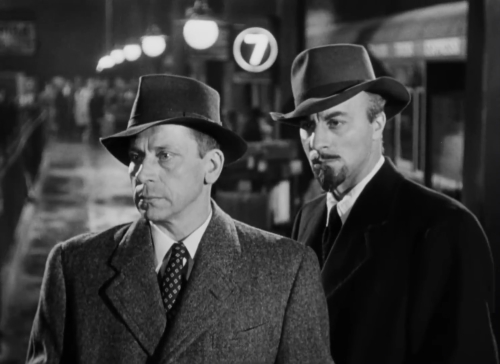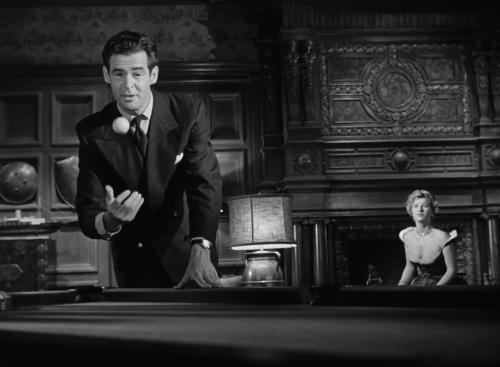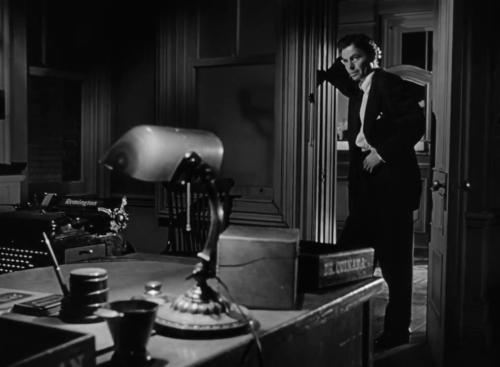
Circle of Danger

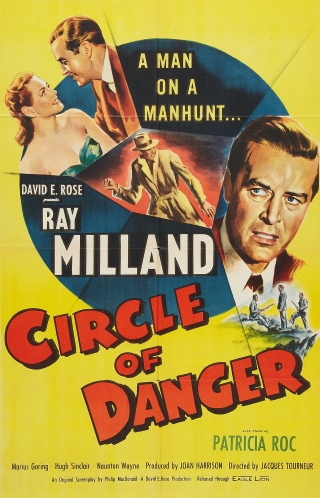
Trails followed by hunters have a nasty habit of going cold very fast, but how long does it take a dish to get correspondingly cold? After all, there is that popular tip about the ideal temperature for serving up revenge. One would have thought five or six years ought to do the trick, and that’s about the time Ray Milland’s character takes to get round to seeking out the man responsible for the death of his brother towards the end of WWII in Circle of Danger (1951). Yet revenge is such a corrosive business, rarely bringing any kind of satisfaction to those who most desire it, and then there’s always that thorny question of whether or not it’s actually justified.

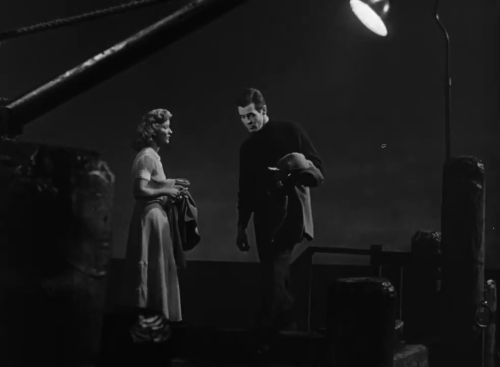
It’s perhaps a little unexpected to see a movie mainly shot in and featuring a cast and crew drawn largely from the UK opening on a salvage vessel operating off the Florida coast. Well that’s where we first come across Clay Douglas (Ray Milland) as he and his partner have just struck gold, or maybe I should say tungsten. This is the opportunity Douglas has been waiting for, five years of hard work finally paying off and allowing him to trade in his share in the business for thirty thousand dollars. He’s not looking to retire or anything, instead he’s been working to earn enough money to fund a trip to the UK in search of the truth about the demise of his younger brother. Despite his seemingly easy manner, Douglas is something of a driven man, fully focused on finding out how the kid brother he had almost single-handedly brought up came to die on a commando raid. People die all the time during major conflicts, even those plying trades nowhere near as perilous as that of a commando. So why would a man travel half way round the world to dig into this particular event? The fact is that the fog of war seems to lie especially thick around it all, and there was a rumor that the younger Douglas was dispatched by one of his own comrades in arms. The hunt for the truth has Clay Douglas cannoning round all the points of the compass, from London to the valleys of Wales and on to the Highlands of Scotland. Both the war and the subsequent passage of time has whittled the list of men who might be able to furnish him with the information he craves down to a mere handful. And it remains to be seen whether the tale that emerges is the one he had hoped to hear at the outset.

Straightforward revenge stories are never all that interesting. Sure there’s a certain visceral thrill to be tapped into if the elements are lined up in the right way, but such yarns tend to take on an exploitative feel which I generally find unappealing. The better examples, and I think Circle of Danger qualifies as such, raise questions that ought to make both the protagonist on the screen and the audience facing it a trifle uncomfortable. It all boils down to whether or not life’s thorny tangles can be adequately addressed in cut and dried, binary terms. I don’t think it’s giving too much away here to say that Philip MacDonald’s script turns the central quest back upon itself by the end, forcing not only the avenger to question himself, but also requiring the viewer to reassess a number of preconceptions we’ve been hitherto encouraged to blindly accept. This renders that three cornered confrontation on the Scottish moor all the more fascinating, and consequently leads to a resolution which is enriched by its acknowledgment of the sometimes ambiguous nature of justice. A delicate subject of this kind needs to be handled sensitively, not with a heavy lump hammer approach, so producers Joan Harrison and David E Rose deserve credit for securing the services of a director  with the lightness of touch and subtlety of Jacques Tourneur.

There has to be something steely and almost obsessive about a man who is prepared to hand over a significant chunk of his life in the pursuit of retribution. I wouldn’t want to claim it is a state of mind exclusive to the years following the Second World War but, in cinematic terms at least, it is a motif that was explored recurrently and came to characterize more than a few screen protagonists – James Stewart was a prime example of this phenomenon but he was certainly not the only one. This needs a quality of intensity to carry it off, something Ray Milland touches on throughout Circle of Danger, particularly in the climactic scenes in the Highlands, but probably not as consistently as he might have. That’s not to say his character is ever less than focused on the ultimate prize, but he does drift towards casualness bordering on nonchalance on occasion, not least when he’s flirting with Patricia Roc. She brings a freshness and vitality to the movie, a teasing allure that still allows her to switch to a more serious mode when she senses betrayal of one form or another. The other person vying for her attention is Hugh Sinclair’s reticent Scot, the one-time leader of the commando group and a man who seems none too keen on furnishing any more details on past than he can help. His is a key role and Sinclair does well in getting across both the caution of the man as well as what I can only term contained suffering. Then there is Marius Goring giving an energetic yet wholly credible performance as the man whose homosexuality is never openly stated (it is a 1951 movie after all) but which is very clearly alluded to. I think one of the most interesting aspects of the script in general is way it encourages the audience to make various initial assumptions about all three of the male characters before challenging these preconceptions and upending them.
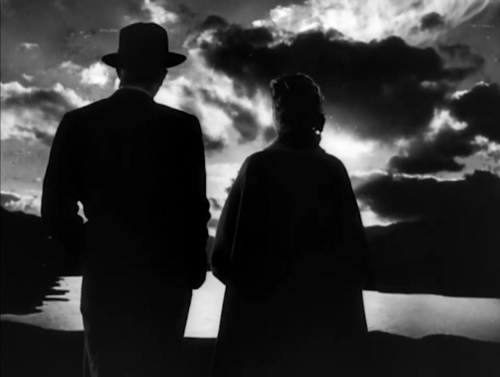
Circle of Danger had been released on DVD by the now defunct Network in what was an entirely acceptable edition. However, it has recently reappeared on Blu-ray via Studio Canal – I haven’t seen that transfer yet but I would expect it to enhance the visuals, and there are some fine looking shots in the film courtesy of cinematographer Oswald Morris. This is a good movie, deftly directed by Jacques Tourneur and cleverly written by Philip MacDonald, drawing the viewer in, setting up certain expectations and then neatly subverting them in a way that continually poses questions which tend to defy pat or convenient answers. It’s a film I’m happy to recommend.

Spy Hunt

Sampling the pleasures of the uncomplicated world of B movies is something I never tire of. Remember, despite what some glib types might tell you, a B movie does not mean a bad movie. There is an art to producing a slick and brisk piece of entertainment on a budget. Back in the days of the big studios, this was easier to do of course. There were specialized units dedicated to churning out support features and a large pool of talent on both sides of the camera who could be relied on to produce work that might not have cost a lot but was still polished and professional. Spy Hunt (1950) is an example of this, a 75 minute mystery adventure, shot with a certain elan by George Sherman using an attractive cast and benefiting from a script derived from a Victor Canning novel.

As soon as the titles appear on screen, it will be apparent to anyone familiar with films of this era that we’re in solid B territory. Those titles are accompanied by the immediately recognizable music that was used to introduce the Rathbone/Bruce Sherlock Holmes series for Universal throughout the 1940s.  Others may disagree, but I find something rather comforting in that, like meeting up with old friends after a long separation. Then the opening scene takes place on a train, even better a train speeding through the night to some unspecified destination – and so we are powered along from the sense of the familiar towards the unknown, with pace, urgency and mystery jogging by our side. A furtive figure locks himself in, and proceeds to conceal a strip of microfilm inside a cigarette. Disembarking on a platform in Milan, that same man lights up, takes a brief drag on the cigarette, and then discards it with elaborate casualness. He’s caught the attention of someone first, however. Someone who nonchalantly recovers that cigarette and saunters off alone. The someone in question is a woman by the name of Catherine (Marta Toren), a spy or courier for some government – the name is never revealed and it’s not something the viewer needs to know anyway as the microfilm itself is in the nature of a Hitchcockian MacGuffin, a plot device that is vital to the characters but of only  marginal importance to the audience. Some sly subterfuge on Catherine’s part ensures that said microfilm ends up secreted within the collar of one of a pair of panthers being transported across Europe and eventually on to a circus in the US.  To do so, she first has to distract the big cats’ escort, a drifter called Steve Quain (Howard Duff) who is keen to earn his passage back to the States. It all sounds like a neat if somewhat convoluted plan, but others are on to it and what ought to have been a harmless deception ends up with the freight car being uncoupled and derailed, two dangerous cats inadvertently released into the wilds of Switzerland, and Quain facing the threat posed by a ruthless but unidentified antagonist who is eager to reclaim the elusive microfilm.

The title says it all really, the film being essentially a pursuit by spies and assorted agents of a piece of damning evidence, blending in elements of the whodunit (the identity of the villain is deftly kept a matter of suspicion and conjecture till near the end) and the outdoor adventure. The fact that the escaped panthers pose a real danger to all who cross their path, animals and people alike, provides an original twist to what would otherwise be a fairly standard espionage yarn. While I’ve read a few Victor Canning novels and seen a number of adaptations of his work – Golden Salamander, Venetian Bird, The House of the Seven Hawks, and Hitchcock’s Family Plot – I’ve not yet had the opportunity to read Panther’s Moon, which was the basis of this film, but scanning a brief synopsis of its plot suggests the movie is quite faithful to the source material. George Sherman directs with assurance, wasting no time on the irrelevancies and managing to create a few notable setups that emphasize the suspense, from the atmospheric views of the railway siding by night to carefully composed overhead shots in the Swiss inn as well as some fine close-ups.

Howard Duff presents an honest, two-fisted likeability in the lead that was a trademark of his time at Universal. Marta Toren makes for a resourceful spy and an attractive headache for Duff. Neither one is stretched dramatically yet they turn in the type of work that makes it no chore whatsoever to spend an hour and a bit in their company. Robert Douglas and Philip Friend are dutifully suspicious in  support and are well backed up by Walter Slezak, Philip Dorn and Kurt Kreuger. Watching these actors do their thing had me thinking how I often find myself influenced by the roles I first saw certain performers take on. For instance, Slezak has a relatively benign part in this movie, but somewhere at the back of my mind (and this is despite my knowledge of his work in sympathetic roles such as that in Mankiewicz’s People Will Talk) I still associate him with sinister characters like those he played in Lifeboat or The Fallen Sparrow. Similarly, for better or worse, I find I forever associate Philip Dorn with Passage to Marseille and Kurt Kreuger with Preston Sturges’ Unfaithfully Yours.

Spy Hunt has been released by Kino in the US in one of their film noir sets. Previously, it had been a title, like so many Universal-International movies, that one read or heard about while wondering if a copy that was viewable would ever turn up. The last few years has seen some remarkable progress in that area and there are now far fewer of these “lost” rarities. Having said that, I do want to point out that I can see no real justification for marketing this movie as film noir. That’s not meant as a criticism of the film, just a footnote for those who haven’t seen it to make them aware that it’s an espionage mystery first and foremost. Of course if the film noir label makes it easier to market it and get it out there for people to see, then so be it.

The Professionals

La Revolución is like a great love affair. In the beginning, she is a goddess. A holy cause. But, every love affair has a terrible enemy: time. We see her as she is. La Revolución is not a goddess but a whore. She was never pure, never saintly, never perfect. And we run away, find another lover, another cause. Quick, sordid affairs. Lust, but no love. Passion, but no compassion. Without love, without a cause, we are nothing! We stay because we believe. We leave because we are disillusioned. We come back because we are lost. We die because we are committed.

Random musings on the nature of revolution, words which have an attractive feel, a weary patina lying somewhere just the right side of cynicism. That, I think, is the effect they are meant to convey, but therein is their problem, and by extension part of the problem of the movie they appear in. Hearing them spoken by Jack Palance’s wounded rebel and reading them back here leaves me with the impression that they have been crafted for just that, for effect rather than for truth or out of any real conviction. I watched The Professionals (1966) again the other day, a movie I’ve seen  fair few times now, and came away from it thinking it entertaining enough although somewhat lacking in substance. Like so many films by Richard Brooks, it doesn’t do much wrong, doing a lot right in fact, yet never actually amounts to as much as the filmmaker would have us believe.

During the latter half of the Mexican Revolution a group of four men, introduced via brief sketches during the opening credits, are hired by a wealthy businessman to get his kidnapped wife back. That’s the plot of the movie in a nutshell. It’s a simple enough setup, fleshed out by the colorful nature of a some of the leads as well as the dynamic created by their intertwined pasts, and of course the turbulent background of a country riven by internal conflict. The hired hands are led by Rico Fardan (Lee Marvin) a former associate of Pancho Villa, Bill Dolworth (Burt Lancaster) a womanizing rogue with a talent for blowing things up, Ehrengard (Robert Ryan) a diffident wrangler, and Jake (Woody Strode) a tracker and expert with a longbow. Their employer is one J W Grant (Ralph Bellamy), an ageing tycoon married to the much younger Maria (Claudia Cardinale). On the other side is Raza (Jack Palance), one of those bandits with a reputation approaching legendary status. The story is broken into a classic three act structure – the preparation and the journey out, the rescue, and the ride back leading to the denouement. If it sounds a bit formulaic, that’s because it is. There aren’t really too many surprises and the twist that is supposed to grab the viewer comes as more of a shock to the characters on screen.

This probably sounds more negative than I mean it to – the film is (as one would hope from the title) all very professionally shot and put together. It’s amiable and exciting in all the right places, the big set piece assault on Raza’s hacienda is filmed with style, the dialogue is peppered with memorable one-liners, and Conrad Hall photographs the desert locations beautifully. Yet when it all wraps up and the final credits roll, I can’t help feeling I’ve just had the cinematic equivalent of an attractively packaged fast food meal – pleasing and enjoyable while it’s there in front of you, but not something that is going to linger long in the memory when it’s finished.

A film scripted and directed by Richard Brooks (The Last Hunt) from a novel by Frank O’Rourke (The Bravados) inevitably raises expectations given the examples of the author’s and the director’s work cited. I guess that’s why it belongs in my own personal category of movies I like and enjoy even though I don’t believe they warrant an especially high rating. Films such as The Last Hunt and The Bravados stay with you long after they have been viewed, the performances and themes, the images and the very philosophy underpinning them have a way of boring into one’s consciousness and commanding attention. I guess what it comes down to is this – those are movies which touch on greatness, The Professionals is fun.

Lee Marvin and Jack Palance appeared in, by my count, four movies together – in additions to this, there’s Attack, I Died a Thousand Times and Monte Walsh. I feel confident that the latter is by far the best of them, closely followed by Aldrich’s intense study of men in war. The fact is all of the star players, and I’m counting Lancaster, Ryan, Cardinale, Strode and Bellamy here, all made much stronger films, all had roles that stretched them and highlighted their strengths to a greater degree than this. On the other hand, every one of these people are in essence playing types in The Professionals. This is not to say their performances are poor or weak, merely that the way the roles are written allow for next to no development – there are hints of back stories, mentions of experiences that would shape characters, but none of those characters grow over the course of the story. What we see at the start is pretty much the same as what we see at the end.

So, is The Professionals a good movie? The critics seem to have been kind over the years and its reputation remains strong. I like it well enough myself; I’ve watched it a number of times and I’m not in the habit of doing so with films which hold no appeal. Even so, I retain reservations about it, which I think is representative of my attitude to or how I respond to much of Richard Brooks’ work. Parts of his oeuvre hit the mark, have an impact beyond the immediate and provoke me in some way. On the other hand, all too often I find I’m left only half satisfied.

The Barefoot Contessa

“I suppose that when you spend most of your life in one profession you develop what could be called an occupational point of view.”

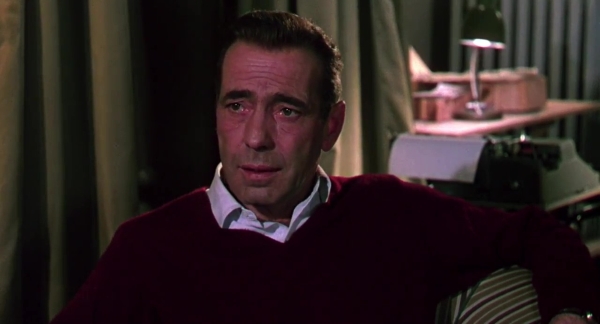
Write what you know. Isn’t that the classic line of advice offered to all budding scribes? When Humphrey Bogart’s character speaks those words above as the camera pans on the opening scene of The Barefoot Contessa (1954) there is at the very least a flavor of that sentiment on display.  And if Hollywood knows anything, it surely knows about the path to fame and about each and every pothole mining the route that leads there. Self-awareness, so long as it’s kept on a short enough rein to prevent its spinning off into self-indulgence, can be healthy; it grants perspective and that along with what I can only term soul are the essential ingredients of creativity. So “Hollywood on Hollywood” has been a productive sub-genre over the years, permitting the movies and their makers to take a look at themselves and inviting the viewer to peel back a corner of the mask for a glimpse of what lies behind. Such films generally fall into two categories, ranging from the celebratory to the acerbic. The Barefoot Contessa lands somewhere in the middle, perhaps because it is itself a story pitched halfway between Hollywood exposé and a meditation on fate.

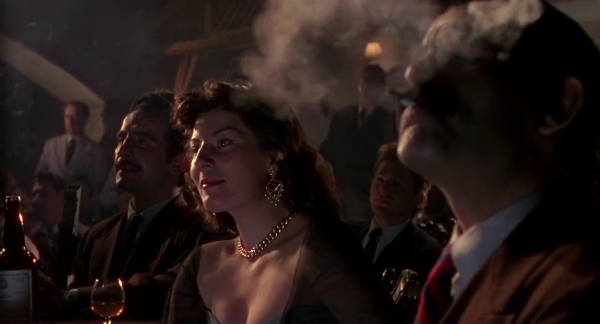
That air of fatalism pervades the movie, right from the rainswept introduction in an Italian cemetery, where a pensive Harry Dawes (Humphrey Bogart) casts his mind back over the few short years when he came to know the titular character. He stands a little apart, slightly detached from the other assorted mourners, although all of them are separated from each other in pairs and little clusters. This detachment is somehow appropriate, as fitting in its own way as the low key setting of this last farewell. These people have gathered to pay their respects to Maria Vargas (Ava Gardner), a one-time flamenco dancer from the back streets of Madrid who would later find fame on the screen as Maria D’Amato, before ending her life as the Contessa Torlato-Favrini. It’s appropriate because although the movie traces the brief rise and fall of Maria Vargas everything that is shown is filtered through the perceptions of others, those who tell her story to the viewer. Harry Dawes does the lion’s share of the telling, he was the one who was credited as having “discovered” her or mentored her in any case. As we segue into a flashback to the club in Madrid where Maria dances by night, the tone is set with great deftness. Her dancing is never observed, only the reactions of the audience provides a sense of her. While the camera roves around the assorted patrons, it becomes clear the woman who holds them all rapt is offering a reflection of what they all feel – the responses vary from frank admiration to surreptitious desire, as love, passion, frustration and shame flash across the screen and the faces of the assembled watchers in waves. And then it’s over, the dance is done and the star vanishes back to her own privacy as the beaded curtain swings back into position.

In what might be taken as a subtle dig at Hollywood forever playing catch-up with regard to popular trends, no sooner has the main attraction vacated the stage than the people from the movies arrive. The aforementioned Harry Dawes is tagging along with Kirk Edwards (Warren Stevens) a buttoned up producer reminiscent of Howard Hughes, Oscar Muldoon (Edmond O’Brien) whose glittering eyes and glistening face speak of perspiration and PR, and a burnished blonde courtesan by the name of Myrna (Mari Aldon). Kirk Edwards is a mean vulgarian, a shell of a man high on his own sanctimony and motivated only by the manipulative power of the dollar. He has flown his entourage all the way to Spain to see Maria Vargas dance and maybe offer her a contract. And now he has arrived too late, but such a man cannot countenance this kind of ill-fortune. He orders, savoring the humiliation the whole process entails, first Oscar and then Harry to fetch the aloof dancer to his table. While Oscar sweats and schmoozes Maria out of agreeing to a screen test, Harry is left with literally no option but to track down and persuade her to change her mind. Where Oscar’s sweat failed, Harry’s sincerity triumphs and Maria is on her way to stardom.

Exit Harry, temporarily. And enter Oscar, the vacuous nature of the publicity man firmly to the fore as he takes up the narration, charting the course of a life and spirit he freely admits he could never quite fathom. Of course Oscar doesn’t do depth, he does his master’s bidding. Partially due to the liberating effect of being around a woman who has no time for the fakery and front that stardom seems to demand, he sees his world view shifting ever so slightly. His remit is to guide us through the downfall of Kirk Edwards and Maria’s move on to the next phase of her life as the principal exhibit of Alberto Bravano (Marius Goring), a Latin playboy with no discernible character. This is a shorter interlude, a stepping stone on the way to Maria’s ultimate destination. Soon, the tale is taken up by Vincenzo Torlato-Favrini (Rossano Brazzi), the tortured aristocrat who is tragically incapable of real love, able only to venerate and deify. It is he who commissions the marble statue of Maria that will ultimately mark her final resting place, a cold approximation of beauty that is as cold and blank as his own helpless passivity.

Ava Gardner’s Maria Vargas drifts through the movie, and I use that term quite deliberately. As I said, at the beginning, the story is deeply fatalistic. Both by her words and her actions the lead character is presented as a woman unable to, or perhaps unwilling to, completely break from the past and take command of her destiny. The whole barefoot business ties into this, an explicit acknowledgment that the past is an integral part of oneself, functioning either as a brake on ambitions and aspirations or as a means of grounding one in reality. I don’t say this is a philosophy I particularly sympathize with, but it is there, it defines the whole mood of the piece and is well realized. Ava Gardner’s performance here is key to that realization and is almost a subversion of her typical screen persona. Earthy is the word that  frequently springs to mind when I think of her rather than ethereal yet it is the latter quality which she conveys throughout much of the film. Sure she has her moments of fire, but she never allows her natural vigor to overshadow that acceptance of a life directed by the golden threads of the Moirai.

The Barefoot Contessa is not a film that works for everybody, maybe due to that air of languor that grows out of its core fatalism. Then again it might be the wordiness of the script that bothers some, but I’d argue that anyone knowingly approaching a Joseph L Mankiewicz film and finding that aspect an issue ought to know better in the first place. Personally, I’m inclined to think that the third act, that beautifully shot and achingly poignant Italian interlude is most problematic. It is not a question of where the film is going or even where it ends up that hurts it, rather it is the playing of Rossano Brazzi that I think takes the edge off it all. Although I’ll concede he gets the futile desperation of his character across, I don’t think Brazzi was ever the most magnetic presence at the best of times and that becomes an issue here. It is undoubtedly a tricky part to carry off, but I just do not see him as the object of Gardner’s grand passion, the man who has that something which she never found elsewhere. Without that, one of the main props of the story is seriously weakened.

Bogart’s name was top of the bill and his bookending of the narrative is nicely judged. His later films weren’t always all they could have been, even if his own work was as strong as ever for the most part. His peak years were often characterized by that tough insolence that has spawned so many imitators, but he had more to him than that when he wanted or was allowed to show it. The Barefoot Contessa lets him reveal a warmer side than usual. Even if it’s tempered by the weariness and regret that came easily to him, there is an empathy on display which is very attractive. In support Edmond O’Brien sweet talked his way to an Oscar playing Oscar; there’s a degree of showiness as there nearly always is with award winning turns and he makes what is on paper a pretty miserable character more appealing than he probably ought to be, still it’s an engaging and memorable bit of work. Warren Stevens achieves an almost reptilian stillness as the soulless tycoon and it’s fun seeing him face off against a very theatrical Marius Goring in their big confrontation scene. Valentina Cortese, Elizabeth Sellars and Mari Aldon all have their moments even though their parts are relatively minor.

The Barefoot Contessa got a Blu-ray release in the US from the now defunct Twilight Time and then later in the UK via Eureka. I have that UK BD which now appears to have gone out of print and it’s a fine looking transfer of the movie that makes the most of Jack Cardiff’s beautiful cinematography. I don’t always mention scores or soundtracks, which I know is remiss of me, and so I want also to take the opportunity to draw attention to Mario Nascimbene’s evocative work on the movie. I wouldn’t want to claim The Barefoot Contessa is a flawless work as I am aware that it has its weaknesses and doesn’t appeal to all. However, it is and has long been a favorite of mine, ever since I stumbled on an early evening TV broadcast nearly forty years ago.

Well, that about wraps it up for 2023. I’d like to say thank you to everybody who came along for the ride over the last twelve months. Here’s to 2024 and here’s hoping it brings peace and happiness to us all. Happy New Year!

The Last Frontier

“Civilization is creepin’ up on us…”

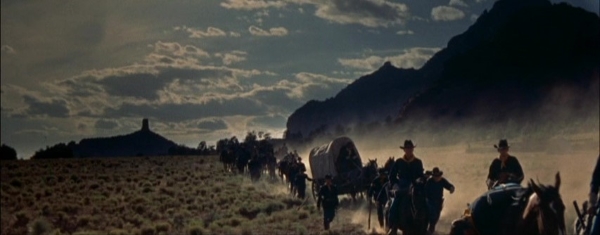
There’s a similar sentiment, and indeed similar words, expressed at the start of Raoul Walsh’s The Tall Men. Indeed it could be said that variations on this theme run all through the western genre. Can it be said then that the western is at heart an unfolding elegy? One would certainly be justified in applying that label to many of those movies made in the late 1960s and on into the following decade, what have come to be referred to as revisionist works. Yet the roots of that can be found in the classic era, the golden age of the genre in the 50s, when the spirit of celebration, of hope and redemption, were just beginning to be tinged with a hint of regret at the gradual drift away from an ideal. Even the title of Anthony Mann’s The Last Frontier (1955) catches a flavor of that crossing of the Rubicon. Granting that the notion of the Old West as some pastoral idyll was as much myth as reality, it seems fitting that the process which plays out before the viewer is not framed in terms of tragedy, although there are clearly tragic elements woven into it all, but is instead presented as a natural and perhaps desirable step towards the inevitable.

The opening of The Last Frontier presents an image of perfect wilderness, of a land largely untouched by man. Yet we see three men making their through the rocks and trees. This is Jed Cooper (Victor Mature) and his two companions Gus and Mungo (James Whitmore and Pat Hogan), and before long the earth around them seems to take on another form as an encircling band of Sioux rise up from the grass and scrub as though they were children of the soil itself. The thing is both groups, the trappers and the Sioux alike, give the impression of being just another natural extension of their environment. Nevertheless, the trappers are made aware of the fact they have come to represent the intruder, are promptly deprived of their weapons, horses and bearskins and warned to stay clear of the forests. Why? In brief, the arrival of the army and the construction of a fort has altered the way the Sioux now perceive them. Indignant and resigned yet still alive, Cooper makes for the fort in search of some form of compensation for the loss of a year’s worth of hides. What he gets, however, is the offer of employment as a scout under the young acting commander Captain Riordan (Guy Madison). Despite the reservations of his friends, Cooper is beguiled by the thought of a blue tunic with brass buttons and wonders if he might not get to wear one at some point. Thus he begins to fall under the spell of civilization, a feeling further enhanced when he makes the acquaintance (albeit in a drunken and rambunctious state) of Mrs Marston (Anne Bancroft), the wife of the absent senior officer. Colonel Marston (Robert Preston) is at that point on the other side of Red Cloud’s Sioux, which by Cooper’s calculation means he’s probably dead.

As it turns out he’s very much alive and Cooper’s efforts to guide him and what remains of his command back to the safety of the fort earn him little in the way of gratitude. Marston is far from being a well man, psychologically at least. He carries the scars of shame and defeat, haunted by the ghosts of the 1500 souls he led to their graves at Shiloh. The western is full of men in desperate need of redemption, though as often as not the wounds they seek to heal are neither so deep nor so raw as those which afflict Marston. His goal is to excise the pain of defeat through victory over Red Cloud. Unwittingly, Cooper’s growing need to embrace civilization and all he perceives it as offering leaves him pinned at the center of both an emotional and military crisis that Marston is hell bent on engineering. Ultimately, all the elements will be drawn together in a swirling maelstrom of dust and death.

The westerns of Anthony Mann are among the greatest of the classic era. They typically feature driven and obsessive heroes, and of course the concept of redemption is never far from the surface. That sense of redemption, of restoring oneself spiritually, of paying one’s debts and regaining one’s rightful path in life is a powerful one and Mann spent a decade exploring it. In The Last Frontier the character most noticeably driven is Marston, a man who has hounded himself to the brink of sanity and even of humanity. He is not the hero of the piece, though one could say that if he doesn’t quite redeem himself he does get to earn his peace, although it comes at a considerable cost to others. Cooper is the undoubted hero, a crude and unfinished product of nature, one who doesn’t need redemption in the sense of making atonement but rather one who has reached a critical point in life and requires guidance. I guess there’s something ironic in the figure of the pathfinder in the wilderness threshing around at the gates of civilization and needing help to regain his course. Yet that is what happens.

I think that the message of this movie is that no state or situation is to be sought in itself, that the myth of the free and open west is only sustainable and valid if it’s viewed as a stage in a process, an attractive stage in many ways but not a permanent destination. Marston’s relentless drive toward confrontation comes to the only end that it can, and of course history leaves us in no doubt that the staunch resistance to change of Red Cloud was similarly doomed. So what then of the other options? There is a strong feeling that the settler can only go so far till the siren call of civilization drowns out the pull of the untamed land. There is a pivotal moment late on when Mature, having abandoned the fort in the wake of one of those brutal fights so typical of a Mann film, must confront the fact that he can go no further. His journey is going to have to continue along a different path, one which leads back to civilization or whatever form of it he cares to shape for himself. Mungo, the native, is not restrained in the same way and is thus free to proceed on his own trek, one which is expressed in Mann’s characteristic cinematic language as a journey forever upwards, always ascending and always seeking to attain some higher place. Maybe both are heading for the same destination, just taking different routes to get there?

I haven’t given a lot of attention to the performances in this movie, which is a bit of a departure from my usual formula. That’s mainly due to my choosing to focus more on the themes and ideas underpinning the movie, as well as the fact that all of the principals are uniformly excellent. However, I would like to single out some remarkable work from the often maligned Victor Mature – he really gets into the character of the unpolished trapper, investing the part with a passion and raw energy that is wholly convincing as he cannons back and forth between confusion, wonder and enthusiasm. I think it’s a terrific performance. A word too for the cinematography of William C Mellor, where he and Mann fashion a neat juxtaposition of dark and claustrophobic conditions within the (confining, civilizing or both?) walls of the fort and the bright, open airiness of the surrounding landscape. As far as I know, the only Blu-ray release of The Last Frontier is the German edition. It is a good if not great transfer, certainly a step up from the rather indifferent DVD but I must say I’m mystified why this interesting Anthony Mann film remains unreleased in the US or UK with the kind of supplementary material it surely warrants.

As an aside, and for what it’s worth, yesterday marked sixteen years to the day since my first uncertain blog entry.

Drum Beat

The idea that in order to resolve a problem one ought to have first hand knowledge of it appears sound. That’s the theory that Drum Beat (1954) puts forward, that a the best man to negotiate a peace is one who has been intimately involved in the hostilities. It’s a variation of sorts on the notion of setting a thief to catch a thief, only imbued with the kind of latent optimism that characterizes the work of writer and director Delmer Daves. It takes some real events and people from the Modoc War and uses them as the basis for a story that champions the need for rapprochement, hammering home the point that the harder it is to win, the more meaningful it becomes. The movie shares some similarities with Daves’ groundbreaking Broken Arrow, although it’s not as good that earlier film. Nevertheless, all of the director’s westerns are worthwhile in my opinion and even if Drum Beat doesn’t quite measure up to his stronger efforts, that is not to say there is nothing to recommend it.

The movie opens in Washington, in the White House in fact. There’s a marvelous informality to this, something that is hard to conceive of nowadays, as Johnny MacKay (Alan Ladd) simply walks right in and states that he has an appointment to see President Grant. It’s all about a new initiative aimed at bringing the Modoc War to an end. Washington wants to see the conflict resolved through negotiation and diplomacy, and that is where McKay comes in. His brief is to make contact with the Modoc chief Captain Jack (Charles Bronson) and attempt to coax him back to the reservation. MacKay would appear to be an odd choice for the role of peacemaker given his history as a famed Indian fighter, not to mention the fact his family had been slaughtered in an earlier massacre. Yet he’s the one selected and it’s precisely because of his background that he has made the cut. Jack is not the type to be swayed by professional purveyors of platitudes, he too is a man of action and as such more likely to pay heed to someone whose fearsome reputation precedes him. MacKay is of course aware of the magnitude of the challenge facing him and once back on the frontier it quickly becomes apparent to the viewer too. When two antagonistic cultures are living in close proximity then resentment can easily flare into something much more dangerous as a result of pettiness and relatively minor gripes getting out of hand. That proves to be the case as slights and harsh words lead to aggression and then senseless killing, only to be followed up by more tit for tat revenge before exploding into full on warfare. All the while, MacKay has to maintain his own self-discipline and sense of duty, partly as he’s given his word and partly because he gradually realizes that his mission represents the only way out of the impasse.

Drum Beat was the second western for Delmer Daves, following on from Broken Arrow and sharing some common themes, including the quest for some kind of peaceful co-existence between settlers and the native population, and also the idea of interracial relationships. Broken Arrow dealt with both more effectively, perhaps because of the characterizations of Jeff Chandler and Charles Bronson as Cochise and Captain Jack respectively, and also because the leads in both films approached their roles in a different way, but I’ll come to that a little later. Daves would go on to write the script, but did not take on the director’s responsibilities, for the following year’s White Feather and that too is a more satisfying movie all round. While there are aspects of this movie which are less successful, what does work is the director’s eye for a beautiful composition. There are some terrific shots of the Arizona locations on view, the mythic landscape dominating the CinemaScope frame and the frequently minuscule figures within it in a way that recalls Ford.

I’ve read some critiques of the movie that state it presents a far less favorable image of the Modoc than Daves’ previous western. I can see how that impression can be formed and I’ll admit there are some grounds for it, but I’m not convinced it’s entirely accurate. Jack’s faction is shown as reckless, mercurial and belligerent, but that’s as much a reflection of the character of the man as anything. The other side of the coin is presented by Marisa Pavan and Anthony Caruso as the siblings who favor reaching some kind of accommodation. What’s more, the whole point of the story, as I see it at least, is the that the drive for peace between two implacable forces is never going to be an easy process and it’s difficult to convey such a message without emphasizing warlike tendencies. Admittedly, Jack’s Modocs do appear more violent and their grievances receive precious little attention while the inherent prejudice and shortsightedness of the other side is mainly confined to Robert Keith’s hot headed character. What Daves does eschew is piety and self-righteousness. The character of the easterner Dr Thomas is portrayed as pompous, priggish and ultimately ineffectual, while the preacher who attends Jack in his cell at the end is given short shrift.

What then can we say about the actors? Alan Ladd had just made one of the great westerns in Shane and his career was at its peak. For all that, his performance here is decidedly subdued, not just the usual quiet understatement he often brought to the screen, but a calm detachment that seems overdone. I get that his character is a man who has had to rein in his emotional reactions in order to fulfill the mission he’s been handed, but all the provocation, tragedy and bubbling passions that are erupting around him arguably call for a more dynamic response. Charles Bronson fares better in a showy part as the Modoc warlord, strutting and powerful and with a gleam in his eye. It’s an entertaining turn, but there’s not a lot of nuance to it. Daves typically got good results from the female cast members and I think Marisa Pavan in particular comes across well in her selfless devotion to Ladd’s character. I find it pleasing that Pavan (the twin sister of Pier Angeli) is still with us and I hope to feature more of her work here – The Midnight Story is a film I plan to get round to in the (hopefully) not too distant future. Happily, Dubliner Audrey Dalton is another screen veteran who is still going strong. She represented the other point in the romantic triangle alongside Pavan and Ladd, although I don’t feel that whole subplot really plays out in an especially compelling way. That coolness and distance displayed by Ladd does it no favors. As for support, we’re somewhat spoiled with a long list of names drifting in and out including Warner Anderson, Rodolfo Acosta, Elisha Cook Jr, Frank Ferguson, Willis Bouchey, Robert Keith, Isabel Jewell and more.

Drum Beat was impossible to see in its correct ‘Scope ratio  for a long time until it came out via the Warner Archive. I’ve not yet seen a movie by Daves that I dislike, and most of them are films I unreservedly love. However, Drum Beat is a bit disappointing, not least when it is set beside the towering achievements of his other westerns. It looks beautiful in places and it has that intuitive feel for the Old West that one expects. Still, his trademark sensitivity only appears sporadically, not surprisingly most evident in those scenes where his female characters are prominent – Pavan’s sacrifice and its aftermath, the dignity and regard she and Dalton extend to each other, Isabel Jewell’s cameo, and so on. I’d term it a good western for the most part, but only a moderate entry among this director’s credits.

Caught

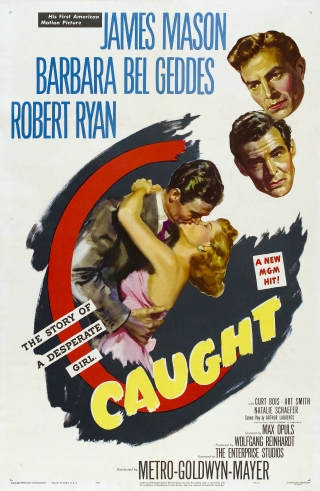
Seeing as Max Ophuls came up in some of the comments on the previous post, I decided to go back and have another look at one of his movies that I have struggled with in the past, namely the 1949 production of Caught. As a rule, I have enjoyed what I have seen of the director’s work, but this film has never worked for me. Anyway, with his name fresh in my mind, as well as the knowledge that the movie seems to be well regarded by many other viewers, I thought I should give it another chance. In brief, and this will be one of my shorter posts, I still have major issues with the movie. To be honest, the fact that I made it to the end was as much through a sense of obligation as anything.

The whole thing is an examination of wish fulfillment and the consequent importance of being very careful indeed of what one wishes for. It opens with two sisters in a shabby tenement mooning over glossy magazines and browsing for dreams, a gem encrusted necklace here, a platinum bracelet there, and so on. As ever, money and the power it bestows matters very much to those who have little of it. Leonora (Barbara Bel Geddes) wants the security and the comfort that comes with wealth, and it does come her way as the result of an invitation to a party on a yacht, an invitation she very nearly turns down. This is the thing with Leonora – she wants things and then doesn’t want them when their real cost becomes apparent. When she makes the acquaintance of Smith Ohlrig (Robert Ryan), a tycoon with a deeply disturbed character, she is soon on the fast track towards the high life on Long Island. However, this is where it all goes wrong for just about everyone involved. Ohlrig is a domineering, controlling and cruel man, an obsessive soul at war with himself and the world in general. Leonora soon comes to see the stew she’s landed herself in and, wisely one would say, moves out and ends up working as a receptionist in a slum neighborhood for Dr Quinada (James Mason). From here the movie devolves into a series of sorties back and forth for Leonora as her indecision along with a deep-seated conviction that she has to “improve herself” at all costs winds up being a good deal more expensive in emotional and physical terms than she’d bargained for.

Max Ophuls’ direction is a pleasure – his camera swooping, swinging and panning, following his characters and sometimes sweeping past them to draw attention to the variously opulent or cheap surroundings while they debate, argue or simply muse out of shot. It’s a distinctive style and Lee Garmes’ cinematography adds to the eye-catching visuals. Attractive as all this may be, it’s not enough to paper over the paucity of genuine character at the heart of the movie. Robert Ryan’s Howard Hughes inspired sociopath is a showy piece of work, neurotic and foul and yet also somehow pitiful in his inadequacy. However, there’s a big hole in the middle of it all for me, and that’s the result of the role played by Barbara Bel Geddes. I started off feeling for her as she struggled to dig herself out of the poverty trap. The fact is though that she’s a playing a woman with essentially no character, a whiny, vacillating type who seems to revel in helplessness and indecision. This is the person who is the main focus and it’s very hard to like a movie where the central role presents such a moral vacuum. And the less said about the “happy ending” we’re asked to buy into, the better. James Mason’s first Hollywood starring role is fair, but he’s given little to do to stretch him –  he does have at least one good scene in the garage confrontation with Ryan and Bel Geddes. The support is mainly an attractively homespun turn from Frank Ferguson and a well observed peek at degradation and dissipation by Curt (“Tough, darling, tough.“) Bois.

Max Ophuls made far better films than this – The Reckless Moment, again with Mason, came shortly afterwards and is superior in every respect, and there are his great French movies such as  The Earrings of Madame de… and La Ronde. I honestly wish I could like this film more, but it just does not do it for me.

River Lady

Movies that exist at the periphery regularly catch my attention. They may be movies that occupy a place on the margins of a particular genre, they may be transitional efforts that straddle different eras, or they may even be a bit of both. Such is the case with River Lady (1948) a film which is not entirely successful, partly as it’s difficult to pin down the genre – a hint of the western, a dash of riverboat melodrama, and a pinch of the frontier adventure – and partly due to the time it was made. While it might not be the kind of movie that broke new ground or made a strong enough impression to encourage frequent revisits, it is still engaging in the way so many of George Sherman’s titles are.

I’ve lost count of how many westerns have turned a spotlight on the encroachment of civilization on the frontier. Sometimes it’s a matter of the railroad hammering out an iron clad tattoo across the plains and relentlessly shoving the old world to one side. At other times it is the stringing of the telegraph line, or the gradual extension of the reach of the law itself. River Lady concerns itself with the expansion of organized business interests, in particular the conflict between small, independent logging outfits and the hungry syndicates. Nevertheless, corporate kerfuffles of any type have a limited appeal at best and it’s always advisable to bring the human drama and the human faces of the players and antagonists to the fore. So it is that attention is focused on a roughneck logger called Dan Corrigan (Rod Cameron) and Sequin (Yvonne De Carlo), the owner of the titular paddle boat and undisclosed boss of the syndicate which is buying up all the struggling outfits on the river. This allows for a double-edged conflict, both the tangled business affairs and the romantic tug-of-war between a hardheaded free spirit such as Corrigan and the ambitious and manipulative Sequin. And any time the mixture looks like drifting off the boil the silky and stealthy Beauvais (Dan Duryea) is on hand to stoke it up once again.

As has been stated, in terms of genre, there’s a fluidity to the movie that mirrors the flow of the timber down the river. I guess that could be seen as versatility in the script, or even as a determination to resist the imposition of boundaries on the part of the filmmakers. However, it makes it hard to get a handle on the movie, a situation I’ve found can crop up from time to time in mid to late 1940s westerns, where it’s possible to detect elements of breezier B pictures rubbing shoulders with themes that carried a bit more weight. One could even say something similar about George Sherman’s career trajectory itself at this point. The rights to the story drifted around Universal for many years before the movie was finally made and perhaps this fairly lengthy gestation period has something to do with the feeling that the finished product imparts.

Rod Cameron is third billed but has the leading role. He provides a strong physical presence, although he does end up on the receiving end of a terrific beating meted out by Duryea at one stage. His acting is adequate overall, but the way his character is written is problematic. I think it’s clear enough that the intention is for a redemptive arc to be traced, which is fine as far as it goes. The thing is though that, as written, Corrigan isn’t really a likeable figure for much of the film’s running time. He’s not just a man who is on a learning curve, he’s downright unpleasant to the women in his life and comes across as spoiled and petulant instead of grittily independent. Duryea, as the villain of the piece, actually brings more nuance and therefore more interest to his part. I suppose it comes down to the fact that Duryea, even when we was showboating shamelessly or backstabbing with the worst of them, had a soulful air about him. Top billing went to Yvonne De Carlo but she is off screen for far too long and her role ends up largely undeveloped. Helena Carter is her romantic rival for Cameron’s affections and actually gets the more rewarding part. In support, John McIntire, Florence Bates and Jack Lambert all have their moments.

As a Technicolor production, River Lady might be expected to look better than it does. I have a German DVD that is acceptable all told, but there is a certain muddiness to it too. Perhaps the fact the movie is part of a George Sherman box that has it packaged alongside solid Blu-ray versions of The Last of the Fast Guns and Red Canyon serves to draw attention to its weaknesses.

Viewing notes – in brief

Just a few very brief comments to ensure the place doesn’t stagnate completely, which I’ve posted elsewhere, all on some movies I’ve been revisiting lately. Normal service should be resumed soon. I hope.


The Magnificent Seven (1960)

God knows how many times I’ve seen this over the years. Even so, as soon as Bernstein’s famous score kicks in there’s that same tingle of excitement and anticipation I first experienced as a child. Even though John Sturges is almost certainly best remembered for his longer movies such as this and The Great Escape, I think he did his most effective work on the shorter and more tightly structured films he made in the previous decade. While the first half of this one has some terrific scenes and moments – Calvera’s initial appearance, the ride up to Boot Hill and back etc – there is padding there too.
Something else I’ve become aware of over time is the way Steve McQueen’s “look at me” performance has lost a lot of its appeal. I find it very self-conscious, mannered and less satisfying every time I see it. On the other hand, Brynner’s work stands up well while Bronson is crafty, subtle and quite affecting.


The 39 Steps (1935)

Donald Spoto reckoned this movie improved with age and familiarity and I fully agree. It’s the best version of Buchan’s story (not the most faithful by any means, but that’s neither here nor there) and I consider it the best of Hitchcock’s British movies. The Lady Vanishes might run it close, but it’s the little moments, what John Ford would refer to as grace notes, such as Peggy Ashcroft’s aching wistfulness or Lucie Mannheim’s doomed spy that elevate it.


The Wrong Man (1956)

More Hitchcock and this time a man trapped in the relentless and merciless machine that is the justice system. I’ve a hunch I only saw this film once before, and that was a very long time ago. In some ways it is atypical Hitchcock, stylistically anyway – measured, sober, with a gritty realism. In another sense, thematically, it’s very characteristic with the title itself telling us that and it’s also very Catholic, even more so than I Confess.

My memory was of a rather harsh and decidedly grim picture and that’s exactly what it is, and it’s possibly the reason why it’s so long since I revisited it. Still, it’s a terrific movie which is held together by two fine, understated performances. Henry Fonda was always an immensely dignified actor, even down to his posture and gait, that quality adding much to his portrayal of a shell-shocked regular guy. Of course the real gut punch comes from what happens to Vera Miles, something which can’t be easy to convey in such a controlled way.

Mister Cory

Another day, another movie that appears to defy categorization. Of course, there is no good reason why anyone ought to feel it is necessary to categorize a movie, but it is a pastime that we film fans like to indulge in.  Mister Cory (1957) does not comfortably wear any of the labels I’ve seen hung on it, not that there are many people who have actually commented on the film one way or another. It has been referred to variously as a crime picture, a drama, even as a film noir. I guess there are elements of all those genres and styles to be found there, but none of them are entirely satisfactory. Perhaps one could call it a Blake Edwards film. However, I’m not sure I would be able to define that either, certainly not for something coming at this early stage of his career as a director/writer. So what is it? There is a hint of The Great Gatsby about the setup, it maybe even casts a glance in the direction of Dreiser’s An American Tragedy (and Stevens’ adaptation A Place in the Sun), and there is too a touch of the humor that Edwards brought to so many of his films. If anyone can produce a convenient label out all that, I salute them. Frankly, I’m happy enough to just think of it as a good movie that is not as well known as it might be.

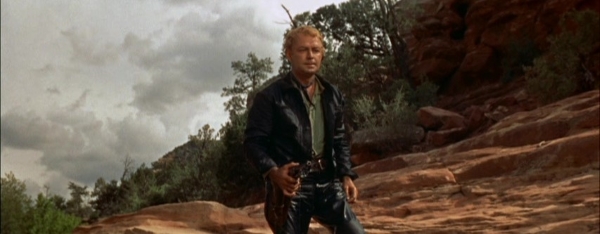
The first view of Cory (Tony Curtis) is of a young man making his way along a heaving sidewalk in Chicago, one of those tenement slums where all human life is to be found, the kind of place where hope can all too often wither or where the seeds of all-consuming ambition can take hold. Cory is a man with ambitions, and the first steps towards realizing them are going to see him keep right on walking out of the neighborhood he grew up in. They carry him out of the city to one of those exclusive lakeside resorts where only those with blue blood, deep pockets and an Ivy League education can afford to lunch and lounge with poise. Now Cory may not have any of the usual qualifications to hang out in such environs, but he does have poise, even if his is borne of audacity. He’s hired as a busboy, right down at the bottom of the pecking order. However, he has no intention of remaining in that lowly position and employs a combination of cunning and chutzpah to hobnob with the cream of society and keep an eye on the main chance. To be precise, he has set his sights on Abby Vollard (Martha Hyer), an ice cool society blonde, and for a time it looks as though he might just pull off the deception and bag the prize he so craves.

However, that would be too simple and dramatically, not to mention ethically, unsatisfying. No, a tale requires a twist if it’s not to become too predictable. So, with his imposture revealed and his scheme shattered, Cory is forced to move on. He does so, and moves far and wide, returning to his roots in a way as he falls back on the skills as a gambler he acquired early in life. All of which segues into the second part of the story, the rise of Cory as a slick and smooth front for Ruby Matrobe (Russ Morgan), a big man in the Chicago underworld. With money no longer an object, prestige and deference (even from those who once demanded the same of him) his constant companions, he would appear to have fulfilled his ambitions. Yet there is still the ever present itch that he yearns to scratch – Abby. That he is now in a position to woo her successfully is complicated by both the need to conduct the business and romantic equivalent of a high wire act. Her long time fiancé (William Reynolds) is the son of a man with significant political clout, capable of delivering a knockout blow to Cory’s backers and by extension to Cory himself. And then there is the sneaking suspicion he begins to have that maybe Abby’s now grown up sister Jen (Kathryn Grant) is the one he should have been pursuing.

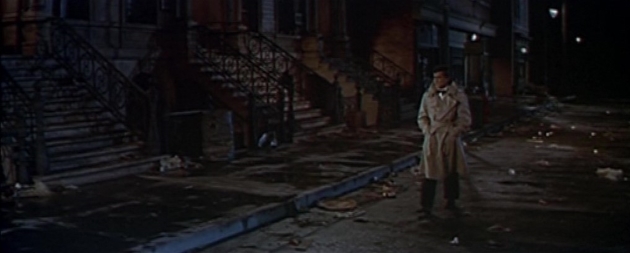
Mister Cory was adapted from a Leo Rosten novella, which Tony Curtis bought the rights to and had Blake Edwards adapt for the screen. It has a classic “rise and fall” structure that makes for good drama. There is a lot of emphasis placed on the nature of ambition, the old exhortation to be careful what one wishes for never being far from the surface, as well as other maxims regarding all that glitters and so on. This is all very well, but not that compelling at the same time. On the other hand, the movie is on much firmer ground when it posits the theory that human nature is immutable, rendering notions of grasping ambition, social climbing, and all the deceit and falseness that tend to accompany those wraiths redundant. At the heart of the story is the belief that running away from one’s true self, denial of one’s nature in essence, is a doomed enterprise. Sooner or later, this dawns on pretty much every character. It can be seen in Charles Bickford’s veteran gambler, a man who intuitively knows when the game has grown stale. Cory may be one of the last to fully grasp this, though it does grow on him gradually; there is a terrific scene where, with success won, he wanders back to the old neighborhood where he grew up, strolling down the middle of the empty nighttime street, gazing at the building he was born in, the locations that spelt loss and tragedy and the places he learnt his trade. Lost in the cool solitude of reminiscence, surrounded by the echoes of voices long gone and words drifting across time, his past and present knit together in a moment that marks the beginning of his acceptance of self.

Curtis deftly captures the many facets of the character, the roguish charm that never really deserts him, the drive concealed behind this, and the awareness that all the polish and front is simply that, a veneer that does nothing to shrink the distance between the one-time street urchin and the elegantly clad dream merchant he has cast himself as. Again, I’m drawn back to that scene I mentioned above, so much of the character is encapsulated in it after all, with Russell Metty’s camera tracking the lone figure via a crane shot that shifts from cool objectivity to intimacy and serves to highlight the contrast between the slick facade Cory has adopted and the grimy background that produced him. With the lens focused on his troubled features, it’s clear to see that he hasn’t traveled so very far. Martha Hyer was an actress who flirted with true stardom yet never quite broke through. Around this time she had roles in some good movies – Battle Hymn for Douglas Sirk, and she earned an Oscar nomination for her work in Minnelli’s Some Came Running. The part of Abby called for someone who was able to convey chilly snobbery in tandem with a weakness for slumming  and hypocrisy, which Hyer gets across successfully.

Kathryn Grant graced some fine films throughout the 1950s and she brings a liveliness that is quite infectious to the part of the younger Vollard sister. Playing the third arm of a romantic triangle frequently proves to be something of an unrewarding task, but William Reynolds takes it on manfully and achieves a degree of pathos as the flawed fiancé. The reliably crusty Charles Bickford brings dry humor coupled with down to earth wisdom to the table and acts as a stabilizing influence on his often hot-tempered protégé. Another interesting piece of casting is band leader Russ Morgan as the Chicago hood, something which sounds like an odd choice but which ends up working out just fine. Finally, a word for Henry Daniell, a man whose long career saw him regularly playing highly cultured villains. He brings great suavity to his work here, insisting on good manners and propriety at all times, the very personification of moral rectitude. And then he gets to deliver a genuinely killer punchline to wrap up the climactic confrontation in the casino.

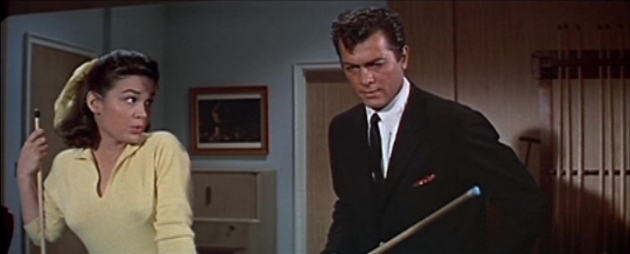
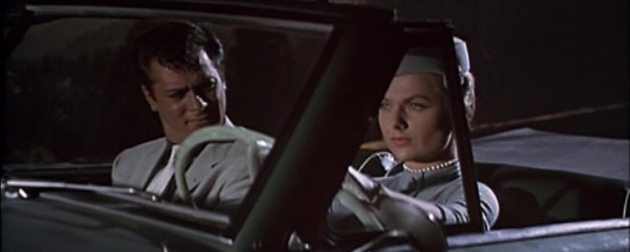
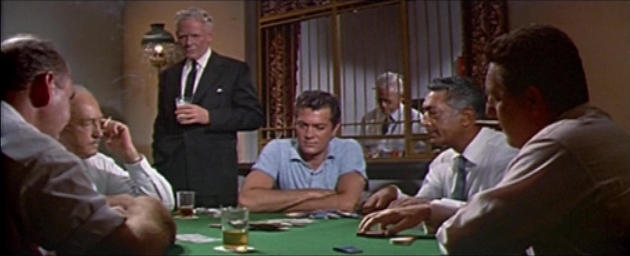
Mister Cory has had DVD releases in France, Spain and Italy, and I strongly suspect all of them will be using the same source. I have the Italian release, which presents the movie in the correct ‘Scope ratio. It’s a colorful if rather soft transfer though and the images I’ve added above should give some idea of how it looks. I would love to see this film get a brush up because it really deserves better treatment. I hadn’t seen it before and I’ve never heard anything much about it either. Every year brings a few new discoveries for me and I feel this movie rates as the most enjoyable and worthwhile of them so far in 2023.