The Western Range

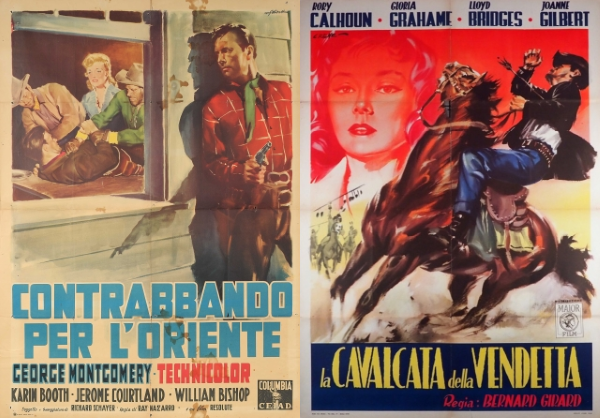
If one is to accept that the second string western, or the programmer or B movie depending on the terminology preferred, represented the bread and butter of the genre during its heyday in the 1950s (and I strongly believe that the assertion should be accepted) then it’s not unreasonable to assume those films would have much in common. Yet, leaving aside the personnel who turn up time again both in front of and behind the camera, there was in fact quite a wide variety on show. I recently watched Cripple Creek (1952) and Ride Out for Revenge (1957) back to back and was struck by how very different these two “lesser” westerns were. Both featured stars (George Montgomery and Rory Calhoun respectively) who are closely associated with such westerns and both work pretty well when taken on their own terms. Nevertheless, tonally, visually and with regard to aims, one might just as easily compare movies from two entirely different genres.

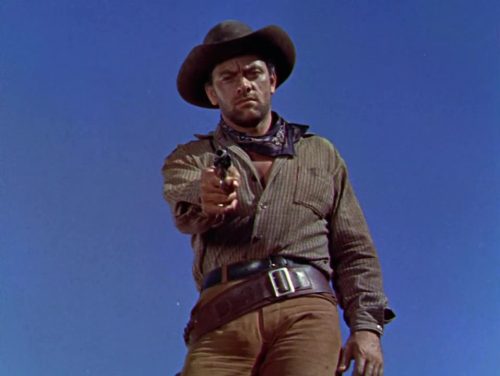
So what have these two pictures got in common? Well the 19th century setting and the locations (Colorado and the Black Hills) are fine for westerns, and both movies have the hunt for gold worked into their scripts. But that’s about as far as it goes. Cripple Creek is in essence a crime movie taking place against  western backdrop, all about gold robberies, smuggling and intrepid Secret Service agents working undercover. And despite a few harder edged scenes, it has a lighter feel to it overall – I’d hesitate to say juvenile, but it does have the kind of cut and dried ethical simplicity about it that means it can be enjoyed by just about anybody regardless of age. I can’t say for sure if I saw the movie myself when I was a youngster but it is the kind of Saturday matinee fare that I tended to lap up at an impressionable age. George Montgomery is heroically square-jawed as the gutsy G-man while William Bishop and John Dehner never leave the viewer in the slightest doubt that they are up to no good. Only Richard Egan, gradually working his way up the billing towards stardom, shows a bit of shading in his characterization. Ray Nazarro serves up a colorful and broadly frothy concoction, a frank piece of lightweight entertainment that never tries to  cajole the viewer into believing it’s anything more than that.
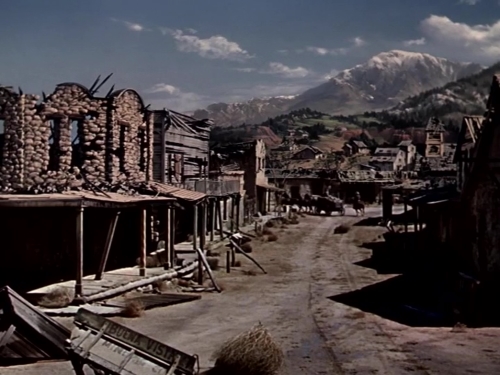
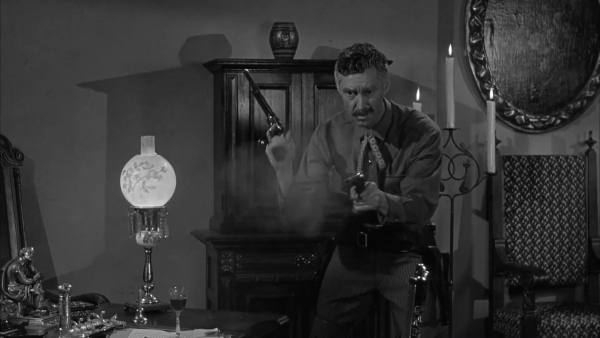
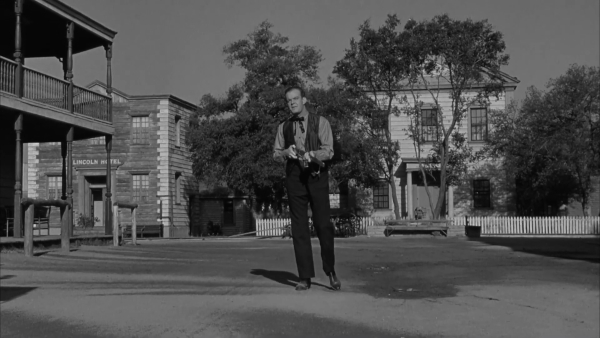
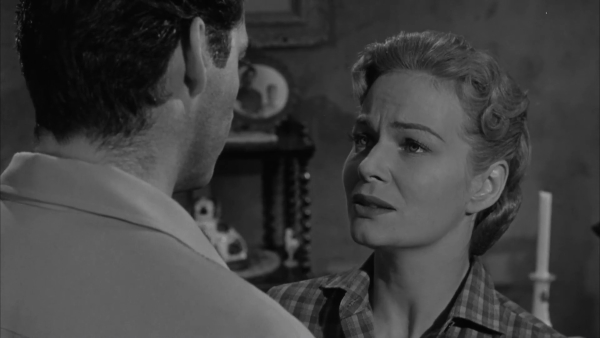
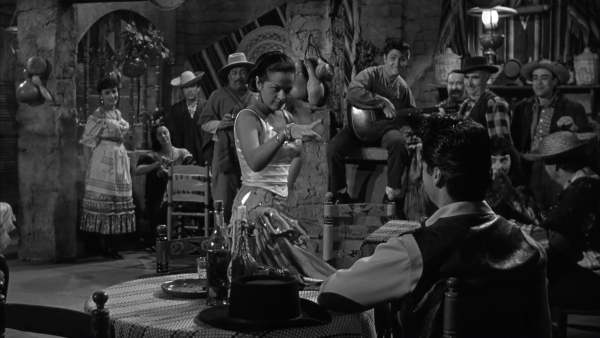
Conversely, Ride Out for Revenge is a much more serious affair. Bernard Girard is clearly shooting on a tight budget but making fine use of Floyd Crosby’s stark black and white cinematography. This is weightier stuff with conflicted marshal Rory Calhoun butting heads with a drunken and incompetent soldier played by Lloyd Bridges. The story explores greed, intolerance and the corrosive effects of unfettered hate on individuals and whole communities. There’s not much to smile about in this movie and there’s a hardness to it befits an exploration of the themes mentioned. There is an interracial romance which is central to the plot – sidelining Gloria Grahame, who appears so completely detached that hers is practically a non-performance – and has the guts to end on a far more hopeful note than is often the case with such storylines in westerns of the time. An early outing for Kirk Douglas’ Bryna Productions, Ride Out for Revenge challenges all types of prejudice and even the whole idea of manifest destiny.
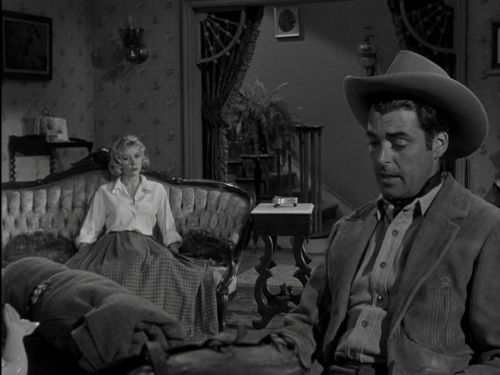
So, there you have it: two westerns made just five years apart, both a step below the A list yet both radically different in look, theme and mood. The sheer malleability of the western in the classic era has always struck me and I guess I could have chosen plenty of other examples from this general time period to illustrate this.
 

Domino Kid

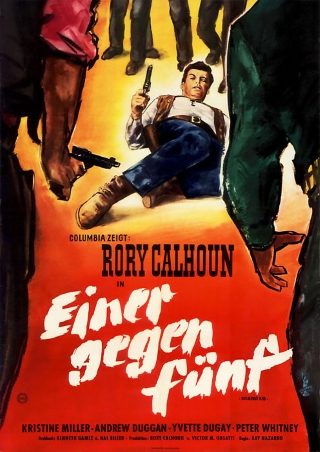
Domino Kid (1957) is a small movie, the kind of picture that that was relatively inexpensive to make and could be relied on to fill the bottom half of a bill. Somehow, probably due to the wealth of industry experience the people working on such features were able to bring to them, these films often managed to be briskly entertaining while at the same time there was a solid core that explored, to a limited extent at least, the themes one would anticipate from a bigger budget, more ambitious production. In this case, the theme that provides the backbone for the story is revenge, the ethical chasm it represents and the hollowness of the reward it promises those who would pursue it.

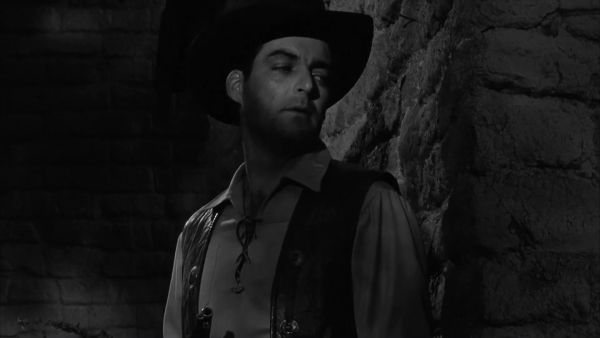
Domino Kid is a sparse movie, never putting more people on screen at any one time than is strictly necessary. And there is an urgency to it too, the opening shot is quite literally a shot, one delivered from one anonymous figure in a saloon bar and fatally received in the belly of another. The very abruptness of this beginning, its unsentimental, businesslike violence is an indication of the mood or tone of the story itself. Domino (Rory Calhoun) is a man with a powerful appetite for revenge. Having returned from the Civil War to find his family dead and his home raided, he lives now to visit retribution on those responsible. The first reel has a whiff of what was to come in the western genre about it: those bleakly deserted streets in mean looking towns, the lone avenger clad in a low profile black and white outfit, chewing on a cheroot and with a manner that is largely taciturn yet still capable of the occasional dry witticism, the succession of cold and calculated killings – isn’t there something suggestive of the early spaghetti westerns to that? Sure I may be reaching here, but the imagery and mood evoked had my mind drifting off in that direction, and of course nothing appears out of the blue in filmmaking, trends and styles evolve and are picked up on and adapted gradually, even from the unlikeliest of sources. Still, this feel doesn’t go much beyond the early scenes. It thereafter develops along more traditional lines, with Domino returning to the town of his birth and youth and realizing his reputation has preceded him, disconcerted to find himself greeted with open suspicion as opposed to open arms.

The story plays out as a personal conflict, Domino’s own struggle with his conscience, at once pulling him towards seemingly irreconcilable poles representing a cold and unnourishing revenge on the one hand and the warmth of acceptance and civilization on the other. The whole business is further complicated by the reemergence of his feelings for old flame Barbara (Kristine Miller), and the hostility he runs foul of in the shape of the newly arrived financier, and rival for Barbara’s affections, Wade Harrington (Andrew Duggan). There are a few unforeseen developments and detours before the end, but the point about the ultimately unpalatable nature of revenge, be it served hot or cold, is clearly and justifiably made.

Rory Calhoun had recently made the excellent Red Sundown with Jack Arnold at Universal-International but was keen to branch out on his own. He formed his own production company Rorvic in partnership with Victor Orsatti, and Domino Kid was one of the movies that came from that venture. The Rorvic productions I have seen, a number of which were directed by Ray Nazarro, were entertaining enough, but I still think they lacked something of what the bigger studio pictures could offer and I feel that a look at The Saga of Hemp Brown, which was made when Calhoun went back to work for Universal-International, highlights that. Nevertheless, Calhoun does put in a good performance in the lead here, blending the positive and negative sides of his character skillfully and endeavoring to present us with a fairly rounded individual.

A few months ago, I watched Kristine Miller playing the leading and pivotal role in Joseph M Newman’s remarkably ethereal war film Jungle Patrol. This movie doesn’t offer her such a memorable part, but she does bring a classy and effective presence to proceedings and Calhoun was obviously impressed enough to have her cast in a couple of episodes of his TV show The Texan. Andrew Duggan has an interesting and quite an ambiguous role as the newcomer who makes little effort to conceal his resentment of Domino. His career would see him cast as all kinds, and he had that ability to essay characters who could leave audiences guessing. James Griffiths turns up very briefly and bows out just as rapidly, but even so it’s never a chore to watch him on screen. Other supporting roles are filled by Yvette Duguay (The People Against O’Hara), the recently deceased Eugene Iglesias , Robert Burton and the hulking Peter Whitney. For a film with such a brief running time, Domino Kid offers opportunities for each one of those performers to make not only an impression, but an important contribution to the development of the story.

To the best of my knowledge, Domino Kid has never been released on DVD anywhere – of course, if anyone reading this knows otherwise, I should be delighted to be proved wrong. Fortunately though, it is not hard to track it down online, and it can be viewed in very good quality, from a nice widescreen print that displays little or no damage. To tell the truth, there are still a number of Rory Calhoun movies which have not been released on any form of disc. I’d like to think there’s still a chance to see a few of those gaps plugged, but even if we don’t I am pleased that the majority can be accessed. Domino Kid is, without question, a modest production that doesn’t try to overreach itself or aim too high. In spite of its inherent limitations, it takes a common western theme, indeed one which is very familiar from all types of drama, and uses it well. It’s worth remembering that B movies don’t have to be bad movies, and this is an example of one that is actually rather good.

Southwest Passage

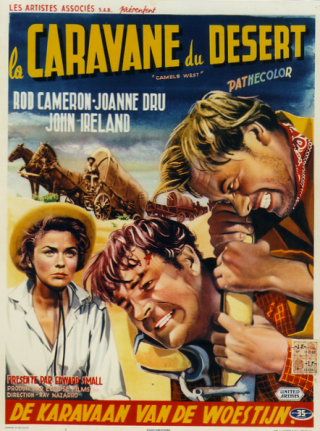
Southwest Passage (1954) is very much a product of its time. The end of the studio system and the growing competition from television saw Hollywood scrambling around to find some means of countering these threats. Promising greater spectacle and shooting movies in impressively wide ratios would eventually prove to be the most effective means of luring audiences back into the cinemas, but other approaches were tried out too. The 3-D process has always felt like a gimmick at heart to this viewer, and far too often saw filmmakers succumbing to the temptation to throw items at the camera to enhance the effect and elicit jumps from the bespectacled watchers. Southwest Passage has some of that self-consciousness on display, but goes a step further and presents a story with an unusual premise, namely the use of camels to forge a  new trail across the desert on the way to California and the west coast. This too gives the impression of writers casting round for as many hooks as possible to hang a fairly straightforward story on.

One thing this movie does not lack is pace and it gets off to a genuine flyer with a fired up and well armed posse hot on the heels of a trio of fugitive bank robbers. As horses and riders pound their away across the screen and across the wilderness, one of the pursuers pauses to take aim and loose off a speculative long-range shot. He finds the mark and one of the distant figures tumbles from the saddle. This unexpected casualty means a doctor is going to have to be located and, in brief, it provides the means by which the leader Clint McDonald (John Ireland) happens to bribe an alcoholic vet to hand over his identity and thus allow him to hide out as a member of an expedition heading west. It means he has to temporarily split up with his lover Lilly (Joanne Dru), but must needs and all that. The expedition this outlaw couple chance upon is no ordinary one; it’s being led by Edward Beale (Rod Cameron), a visionary type who has a theory that the hard desert crossing can be expedited by using camels rather than relying solely on mules and horses. As the party makes its way across the parched landscape the ever-present danger posed by the heat and lack of water is compounded by the tensions that bubble up within the group. This is partly down the need for McDonald to keep his true identity secret for as long as possible and also the fact Lilly is increasingly drawn to the selflessness and decency of Beale. To further complicate matters, a mean-spirited muleskinner (John Dehner) seems hell bent on stirring up trouble, while the Apache bands roaming the hills and rocks are just waiting for an opportunity to strike decisively.

The script by Harry Essex and Geoffrey Homes seems to be doggedly determined to dress up an essentially simple yarn of people rediscovering the path back to the straight and narrow via the hardships they endure in the course of a challenging trek. There’s a worthwhile parable in here about the way adversity can bring out the best in people, how even apparently lost souls can redeem themselves. In itself, that is enough to carry a picture and the cast is strong enough to make an audience care how or if this can be achieved. The added distraction of the camel expedition – and I’m firmly of the opinion that it is a distraction and nothing more – is wholly redundant and I have a hunch the writers realized this too as its impact on the development of the movie is slight in reality. Director Ray Nazarro was a journeyman, a competent professional who made (from what I have seen of his work anyway) entertaining but largely unremarkable pictures. Everything looks fine and he keeps it all humming along smoothly with a frequent smattering of action set pieces. These scenes are staged and shot well but, perhaps due to the faceless anonymity of the Apache warriors and their undefined motives, they do not deliver the level of tension I would have hoped for.

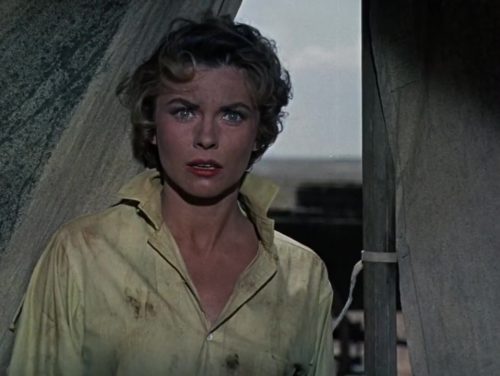
While he may not have had top billing, John Ireland’s character is by far the most interesting one on show. It is hinted early on that he isn’t merely a one-dimensional villain and the arc followed by this resourceful fugitive bears that out. By the end of the movie, you are rooting for him and want him to earn his salvation. Joanne Dru, his real life spouse at the time, not only looks good but she also makes for a feisty leading lady. She shoots at least as well as any of the men and doesn’t appear to have shied away from the more physically challenging aspects of the role. The way she plays that part and the gradual softening that occurs as the story progresses is key in coaxing Ireland back from the temptation of lawlessness and easy money.

If Dru was instrumental in facilitating or encouraging Ireland’s redemption, then Rod Cameron’s role could be said to have provided the motivation for rescuing her to begin with. Still, his is something of a thankless part, noble and steadfast and honest, but maybe he is too upright. Where Ireland’s conflicted robber and Dru’s disenchanted moll have nuance and shading, there’s none of that available to Cameron. He may be the lead and he may be the hero, and he plays both well and as written, but he winds up sidelined for all that. The real villain of the piece is played by the ever reliable John Dehner; sly, sleazy and spiteful, he wields a mean bullwhip and I only wish his role had been bigger still.

Southwest Passage is the type of movie which the producer seemed to throw everything bar the kitchen sink at, as though it was felt the core idea wasn’t strong enough. Personally, I take the opposite view and reckon that all the unnecessary embellishments detract from rather than enhance the finished product. All told, it is an entertaining way to pass an hour and a quarter but I do regret what I suspect was the lack of faith in the basic ingredients.

Indian Uprising

So many things seem to be connected.  And once you move into the field of the arts, and particularly cinema, this becomes all the more noticeable. Film fans tend to spend a fair amount of time griping about the latest remake and indeed the fact that more and more of that species seem to be appearing. I can appreciate that; there is that sense of laziness, of creative stagnation, and sometimes the trepidation that accompanies news that some personal favorite is about to be reimagined. Still, it’s not a new phenomenon and has been happening for about as long as people have been making movies. All of which brings me to Indian Uprising (1952), a modest yet engaging cavalry western, which is hardly the type you’d think anyone would have been clamoring to redo. Nevertheless, the writing team behind this picture are the same people whose names you will find attached to the very similar Apache Rifles, directed by William Witney more than a decade later.

The plot here is a familiar one for anyone who has seen more than a handful of westerns, but that’s not to be taken as a criticism since it’s the execution of  a story that matters more than how high or low it’s positioned on the originality scale. It’s Arizona in the 1880s and Geronimo (Miguel Inclan) is still free and more than a few steps ahead of General Crook’s cavalry. We see events from the perspective of Captain McCloud (George Montgomery), and the opening has his troops luring a band of Apache into an ambush which leads to the capture of Geronimo’s son. A valuable captive such as this offers an opportunity to draw the elusive war chief to the negotiating table, and McCloud is both humane and canny enough not to overplay his hand, ultimately setting the boy free to demonstrate good faith. What follows is a process that has often been observed. The Apache strike a deal and keep to it, but other interests are keen to make as much money as possible from the newly tamed territory. As expected, plans are set in motion to stir up latent racial antagonism, political pressure is applied, and the flames of a new conflict are kindled for the sake of a tidy profit.

The later Apache Rifles would focus on a different war chief, Victorio, and add a few other elements to the mix but the essence of that film and of Indian Uprising is the question of trust and good faith. These are eternal themes, ones that have resonance in all aspects of human interaction but are especially potent in movies looking at the Indian wars. The message conveyed here is a progressive one but it’s realistic enough not to allow its hopefulness blind us to the facts. The integrity and good intentions of the lead remain intact by the end but the ultimate shabbiness of the government line and its dissembling opportunism is confronted squarely and acknowledged, which is to the filmmakers’ credit. There are a mix of interiors and location work (including the often used Iverson Ranch and the instantly recognizable red earth of Arizona), with the latter showing director Ray Nazarro’s (Apache Territory) work off to best effect and also providing a dramatic backdrop for the major action set pieces.

If you take a look around any of the sites that devote time to classic westerns, it’s hard to avoid coming across some mention of George Montgomery. I’ve not featured him here before and the reason for that is down to the simple fact that I’ve not seen a lot of his films. This is somewhat remiss of me but I have taken steps to remedy that and have acquired a number of his movies – although in my defense, I will say that I’ve seen and enjoyed a number of episodes Cimarron City, his late-50s TV show. He’s a solid and personable lead, his part being a much more straightforward and less complicated one than the corresponding role Audie Murphy would take on in Apache Rifles, and an easy figure for audiences to identify with and root for.

The only woman in the picture is Audrey Long, and Indian Uprising would be her last movie before retiring and settling down to a long marriage to the creator of The Saint Leslie Charteris. She had a relatively brief career anyway although one which included a number of choice films; she played alongside John Wayne in Tall in the Saddle and also was cast in a couple of fine films noir Desperate and Born to Kill. A quick glance at her filmography drew my attention to another of her films I must look out for, Homicide for Three based on Patrick Quentin’s novel Puzzle for Puppets. This stood out for me because I’m a mystery fan and also due to the fact not many of Patrick Quentin’s Peter Duluth stories have been adapted for the screen, the Lex Barker and Lisa Gastoni vehicle Strange Awakening from Puzzle for Fiends being another example.

Thinking of cavalry movies nearly always brings John Ford to mind.  While Indian Uprising is certainly not in the same league as Ford’s work, there are a few common factors, quite aside from the general horse soldiers milieu. In the first place, Mexican actor Miguel Inclan appeared in The Fugitive and also, more notably, as Cochise in Fort Apache. One of Ford’s trademarks was his portrayal of the various army types and the domestic situation in the isolated outposts. The latter doesn’t get an awful lot of attention but, to me anyway, the stage Irish sergeants played by Joe Sawyer and John Call were not such distant relations of those of Victor McLaglen and Ward Bond.

Indian Uprising should be easy enough to locate. There’s a MOD DVD available in the US, a French DVD and the Spanish disc I picked up. I think it also turns up online in the usual places but I’m not positive on that. The image generally looks good with natural colors and minimal damage. While this is very much a second tier western it’s also an enjoyable one. These kinds of movies were the bread and butter affairs that kept the genre ticking over and are often better than some critics would have you believe. I liked the movie and I feel anyone who appreciates what such programmers have to offer will do so too.

Apache Territory

The low budget western was arguably as important a representative of the genre as it’s more illustrious and more expensive cousins. The sheer quantity of programmers and B movies means they deserve attention by anyone claiming an interest in the western. Given the prodigious output, it’s hardly surprising that the quality varied considerably; some managed to transcend the restraints of their budgets, others were just downright poor but most were average efforts, offering an entertaining way to pass the time despite the weaknesses inherent in their production. Apache Territory (1958) is an example of what I’m referring to: a combination of good and bad elements that add up to a moderately diverting hour and something.

As the title say the action takes place n Apache territory, where the hero, Logan Cates (Rory Calhoun), is passing through on his way to Yuma. By his own admission, Cates is one of life’s drifters, a guy  with no particular purpose moving wherever the mood takes him. In this instance, it leads him towards trouble, someone else’s trouble to begin with but it’s soon to become his too. Seeing a group of riders about to be attacked by a band of Apache, he warns them and draws off the assault. It’s only a short-lived respite though as the sole survivor, along with a trickle of other refugees from the renegade raiding party gradually come together in search of safety. A disparate group, including an old flame of Cates’ (Barbara Bates) and her venal fiance (John Dehner), gather in an isolated desert oasis and prepare to wait out the siege. Water is plentiful, food is not, while mutual trust and goodwill are virtually non-existent. As the Apache press and probe, tempers fray and nerves jangle beneath the pitiless desert sun, and the numbers of the defenders are whittled down bit by bit.

Ray Nazarro is a name which probably isn’t all that familiar to many people. I’d say I’ve had a reasonable amount of exposure to movies of every size and shape in most genres and I’ll freely admit that I’ve only seen a handful of examples of Nazarro’s work. I have viewed  Domino Kid and The Hired Gun also starring Rory Calhoun, Top Gun with Sterling Hayden, and a few episode of TV shows such as State Trooper and Mike Hammer, and that’s about it, although I do have a few more titles to hand but not yet watched. Now if anyone spends their career working in the B units, it’s only reasonable to expect them to have a thorough understanding of the concept of economy. Budget filmmaking of any kind is dependent on exploiting resources to the full and wasting as little time and money as possible. Apache Territory certainly has that sense of urgency and pace one typically sees in a B picture, the plot takes precedence over all and characterization not only takes a back seat but also never penetrates deeper than is absolutely essential. The positive side of this is that the story keeps moving along and there’s no shortage of incident.

On the other hand, there are some negatives to take into consideration too. The opening section makes use of locations in Red Rock Canyon but this aspect is short-lived and it’s not long before events move to a studio set, a backlot mock-up of the oasis. While this adds a layer of claustrophobia, giving it that sense of a frontier chamber piece, the contrast with genuine locations is both apparent and somewhat jarring. This is a purely budgetary matter and I don’t think the director can be criticized for any of that. Nor do I feel Nazarro can be faulted for some weaknesses in the script. The screenplay is an adaptation of Last Stand at Papago Wells  by Louis L’Amour, a book I read some years ago and which I recall as being fairly faithfully reproduced here. The problems with the writing, for me anyway, relate to the tendency to rely on some unconvincing dialogue for exposition instead of showing things using cinematic language.

The film was a Rorvic production, meaning it was made via Rory Calhoun’s own company and offered him a strong, heroic role. Louis L’Amour stories generally involved central characters who were relatively uncomplicated, his strengths lying in his descriptions of action and landscape, his ability to communicate an authentic sense of time and place. Calhoun’s character in Apache Territory is pretty much one of those “what you see is what you get” types and he plays this undemanding part fine. The villains in such tales may not have much more depth or added dimensions but they tend to be entertaining. This film has two to enjoy – firstly, we get a snarling turn from Leo Gordon as a resentful and insubordinate cavalryman before he departs abruptly and violently, and then there’s the always welcome John Dehner. His assured work raised many a mediocre movie and he does well as the self-absorbed rival to Calhoun for the affections of Barbara Bates. Ms Bates was good enough as the refined woman who starts to see that she may have made a serious mistake and has the resolve and strength to try to reverse that before it’s too late. The only other female role went to Carolyn Craig, playing a timid massacre survivor who latches onto Tom Pittman’s California-bound orphan. As a sad little aside, Pittman, Craig and Bates all passed away under sudden and tragic circumstances.

Apache Territory was a Columbia release and Sony have made it available on DVD in the US as part of their MOD program. It has also been released in Spain and Italy, and I have the Spanish edition myself. The disc presents the film in a solid enough 16:9 transfer that is quite satisfactory – Spanish subtitles are offered but are optional and can be disabled. Overall, the movie is what I’d describe as routine. Tales involving isolated groups besieged and threatened from without and within are usually good value and Apache Territory is a middling, low-budget example. The lack of money does affect how it’s executed but there’s some nice action and suspense to offset that.