Armored Car Robbery

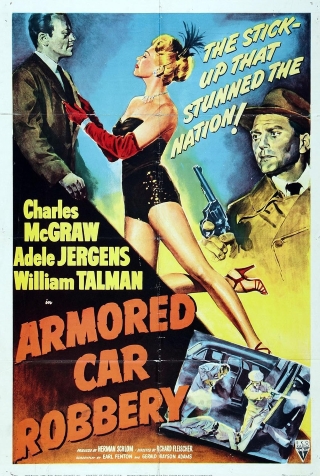
Sometimes a title will intrigue, sometimes it will beguile, and sometimes it’s just self-explanatory. Armored Car Robbery (1950) by Richard Fleischer lets us know exactly what the subject  matter will be right off the bat. I guess if one wanted to be pedantic, the real focus of the movie is on the aftermath of that robbery in the title. Even so, there’s not much doubt about what you’re going to get and the film itself is a model of the same kind of pared back economy. It is most refreshing to spend time with a movie that can tell an absorbing story in a little over an hour without the narrative feeling rushed or unduly compressed.
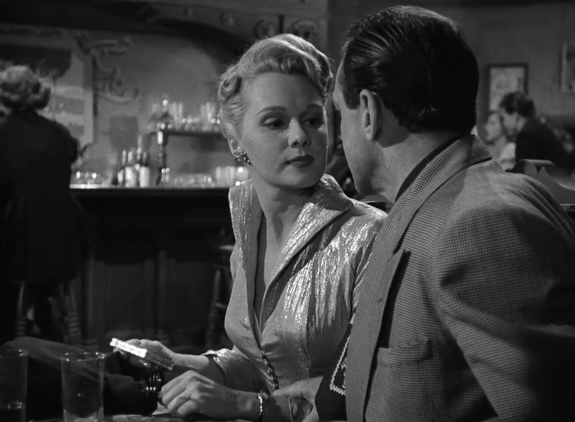
We are thrown straight into the tale from the off, witnessing the finishing touches to a plan being applied by its mastermind Dave Purvis (William Talman). Nevertheless, even as we  watch him recording the response time of the LAPD to a reported incident at Wrigley Field ballpark, there’s that sense that all will not go off exactly the way he’s reckoned. It’s the way of things in crime movies, and maybe more tellingly the way of things in relation to human interaction. No matter how meticulous the planning, there’s no getting away from the foibles and vagaries of that most incalculable of all elements, the human heart. The illogicality, and in this case perhaps the emotional dysfunction, of humanity is neatly illustrated when the attention shifts to Purvis’ associate Benny McBride (Douglas Fowley). He is first glimpsed in a box seat in a burlesque theater with a big grin all over his face. Why? Because he’s getting a massive kick out of watching his estranged wife Yvonne (Adele Jergens) stripping on stage. It’s apparent too that he’s maybe deriving even more enjoyment from the fact he’s looking at an auditorium full of baying strangers lapping up the view. When we learn that that she wants no more to do with him, the spectacle of a man reveling in the pleasure of strangers watching the woman he can no longer have undressing in public is quite sobering. You just know this cannot end well, and it’s hammered home with greater force when yet another wrinkle is added – Purvis is romancing Yvonne behind McBride’s back. As such, when the heist alluded to in the title hits the inevitable snag, there’s no real surprise to be had. Somewhat perversely, given the tangle of personal affairs, the glitch comes from the outside, the combination of an unexpected error in the timing as well as a couple of stray shots. The result is a dead detective, a mortally wounded McBride and a panicked getaway. The rest of the movie follows on from that, with the tough and rasping Lieutenant Cordell (Charles McGraw) hell bent on running in the hoods who have left his friend dead on the sidewalk. It devolves into what we would now term a police procedural, as clues are painstakingly collated and woven into a net that will be drawn inexorably tighter.
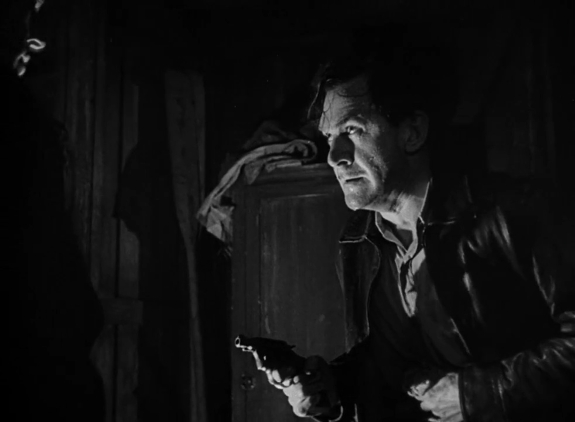
Richard Fleischer’s early films noir are all enjoyably pacy movies, all coming home at around an hour with only Trapped stretching as far as 80 minutes or thereabouts. There’s a directness to them, a kind of relentlessness that drives them on toward a no nonsense resolution. That’s obviously a product of their B status, but Fleischer brought a style to his presentations that wasn’t always apparent in other budget features. His close-up shots are particularly effective, that focus on Fowley’s reaction to his wife’s performance has a certain shock value once it’s known what their relationship is. And the director gets mileage too from having Talman, Steve Brodie and Gene Evans scuttling round piles of lumber and freight on a shadow drenched dockside while McGraw’s squad tries to ferret them out. The later interrogation of Steve Brodie after he’s been picked up is tightly framed, emphasising how little wriggle room he has, and when McGraw thrusts himself aggressively into the shot there’s no doubt whatsoever how neatly he has been snared. None of this requires expensive or complex setups, just a good eye for composition and lighting and the awareness of how to catch a mood and portray it on the screen.
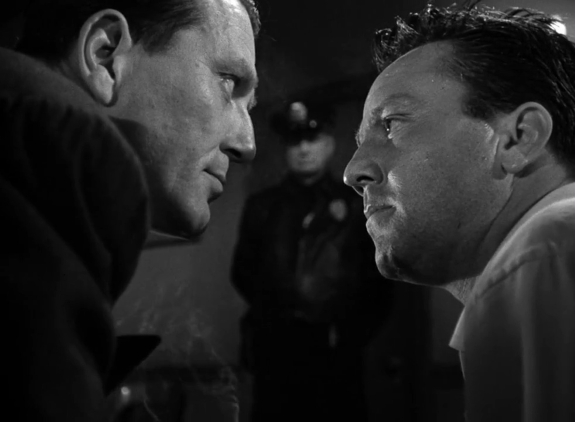
The best of the early Fleischer noirs are the two starring Charles McGraw – Armored Car Robbery and The Narrow Margin – both of which cast the hard-edged actor in what appear to be uncharacteristically heroic roles. So successful had he been as tough enforcer types for Anthony Mann and Robert Siodmak that he seems to have been born to inhabit such parts. Yet these two Fleischer movies use the man’s natural abrasiveness to excellent effect while still placing him on the side of the angels. The gruff, bulldog demeanor is fitting for a man in charge of a dangerous assignment, and one with a strong element of personal interest too owing to the death of his long-serving partner. He never comes across as unnecessarily belligerent, rather he is as forceful as any particular situation demands. William Talman was another of those supporting players who could shade his work according to the requirements of the script. He could be terrifyingly dangerous as in The Hitch-Hiker, combative and adversarial as Hamilton Burger in TV’s Perry Mason, or even selflessly heroic in The Racket. Adele Jergens had the right brassy quality as the femme fatale of the piece; maybe more could have been done with the triangle between herself, Talman and Fowley, but there’s enough on screen as it is and too wide a detour in that direction might well have slowed some of the story’s momentum. In support, one can’t ask for much better than people of the caliber of Douglas Fowley, Steve Brodie and Gene Evans.
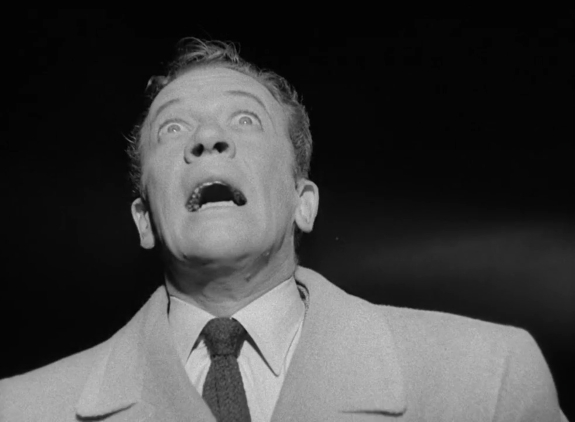
Armored Car Robbery is what might be termed a textbook RKO film noir, tough and tight as a drum, and immensely satisfying to watch. I think that studio’s B movies were in a class of their own with high levels of craftsmanship on show on many occasions, and no little artistry to found in some of them too. Armored Car Robbery may be a small movie and a modest one at that, but it’s also straight out of the top drawer.

These Thousand Hills

Innocent? Well, that depends on who the jury is. I’ll tell you a couple of things I ain’t guilty of. I ain’t prayed on Sunday. Bought cows cheap on Monday. I ain’t broke my word. I ain’t climbed up high on somebody else’s back or thought of myself better than another man. I ain’t double-crossed a friend or made a little tin god out of money. Sure, I’m innocent. I’m as innocent as you. Or ain’t you boys innocent?

Dreams, and loss, and discovery, these ideas amount to a fine framework around which to construct a drama. If they are not constants, then they are at least experiences common to all of us, situations which therefore resonate because of their universality. One could trace the course of many a life by following the line or arc punctuated and described by them, which is precisely what occurs over the hour and a half running time of These Thousand Hills (1959).

This is the story of Lat Evans (Don Murray), whom we first encounter signing on with  a cattle outfit and chafing at the bit to get ahead in the world. His is a poor background, and an unhappy one too, shaped by a father whose lack of professional success saw him turn to unbending religion and ruthless discipline. This has worked its way into the heart and soul of Lat, forging an inner steel that produces the kind of resilience necessary to rise in the world, but also encourages another colder hardness, the type that is capable of shattering the most intimate relationships. While Lat is without question the principle figure in the affair, those dreams and losses and discoveries I opened by speaking about also relate to others in the picture. Tom Ping (Stuart Whitman) is direct in his pursuit of a simple philosophy that life is for living, exuberant and reckless where Lat is driven and calculating, a man whose heart will always overrule his judgement. And finally, we have Callie (Lee Remick), a saloon girl possessed of a natural compassion and charity. Her love is of the simple and uncomplicated variety, and it founders on the rocks of sanctimony and abuse.

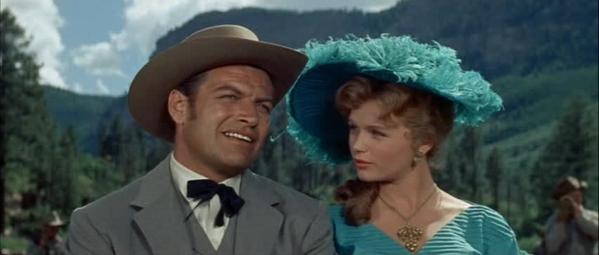
All that may sound like a rather grim business, and there’s certainly grief and tragedy on display. Nevertheless, those elements serves a purpose, without them the film’s central message about the triumph of the human spirit would be diminished. By the end of the 1950s the western had attained artistic synergy, a place where theme, story, and visuals all came together to form something splendid. Salvation and redemption are basic ingredients of all human endeavor, they are the prize sought by all and the way these movies integrated the concepts into their fabric with such subtlety remains one of their most enduring strengths. I haven’t read the A B Guthrie novel which this movie is  based on but the film Richard Fleischer directed and Alfred Hayes scripted is a fine piece of work. The Colorado locations are stunning at times and those magnificent vistas form a suitably epic backdrop for this tale of towering ambition and high ideals. Fleischer made some very good and visually striking movies in the 50’s, exploring all the possibilities afforded by the CinemaScope image and his use of rich, vibrant colors is immensely attractive.

The character of Lat Evans isn’t an easy one to portray on screen, requiring a maturing process to take place not only over a relatively short running time but in a fairly complex way too. It’s to Don Murray’s great credit that he manages to pull it off successfully, the shifting of his priorities and the corresponding drift of loyalties and allegiances never appears jarring or affected. What’s more, the nature of the man he plays is layered at all times – enthused yet reserved, ambitious and loyal while also prone to hypocrisy. When his moment of truth finally arrives and he heeds the voice of his own conscience, although arguably it’s a two stage affair, it’s never less than convincing. Stuart Whitman is also on good form as the flighty friend and turns in a performance of great charm. His best scene is the one where he shyly asks Lat to be best man at his wedding to saloon hostess Jen (Jean Willes), and he finds himself rebuffed by his friend’s puritanical propriety. His journey from confusion and hurt through to explicit anger is so well realized, and extremely effective.

There are two significant female roles, those played by Lee Remick and Patricia Owens. Remick got the plum part, that of the woman who loves Lat unconditionally and suffers the greatest indignities for her trouble. It’s her actions that set Lat on the initial path to success and, despite all she must bear, she is not only the one who triggers his ultimate redemption but proves herself to be his physical savior as well. Patricia Owens has a less sympathetic part; she comes over as somewhat spoiled and priggish, but there’s more to her character than that, which is made clear by the end. Richard Egan is at his callous and brutal best as the villainous Jehu. Cheating, conniving, provocative and sadistic, he uses his confidence and physical presence well and the build up to the final confrontation (shot amid the garish crimson decor of the saloon) has him sneering and positively dripping malignancy.  Among the supporting cast Albert Dekker and Royal Dano offer reassuringly recognizable faces.

These Thousand Hills was put out on DVD many years ago by Fox and it still looks strong and attractive – the studio was generally releasing a lot of exceptionally fine transfers back then – in crisp and colorful CinemaScope. I’m not aware of the movie ever having been released on Blu-ray anywhere and, given the ownership of the rights now, that does not seem likely to happen in the near future. As for the movie itself, I don’t believe those dreams mentioned above are fully realized by anyone while all of the main characters experience loss, and innocence is probably the chief casualty in this regard. Still, all of this is eclipsed by discovery and it applies to practically everyone involved, though most tellingly in the case of Lat. The epiphany he undergoes is what adds meaning, bears out the words of his old boss about nobody finishing up the same as they started out, and leaves the viewer with a sense of closure. The final year of the western’s greatest decade saw a number of superior movies produced (and this is true too across a range of genres if we’re being honest) and These Thousand Hills slots neatly in among them. I never cease to be impressed by the sheer richness of the western in these years and the apparently effortless artistry of those working within the genre. A superb film and highly recommended.

Violent Saturday

poster297

Stories about heists that invariably go wrong somewhere along the line have a kind of evergreen quality about them. I don’t think it’s anything as simple as the need to see the moral balance restored that’s the attraction, instead it’s more a kind of perverse wish fulfillment for all of us living in an imperfect world to witness even the most meticulous plans of smart guys turn pear shaped. Violent Saturday (1955) is one such movie, detailing the build-up, execution and aftermath of a bank robbery in a small town. It’s also a film which takes its time creating expectations about certain characters, only to show that those assumptions can frequently be misleading.

Essentially this is a film of two halves. The opening section is something of a darkly soapy melodrama, wherein the principal characters, and their roles in the community, are all established. The two people that are focused on most are Boyd Fairchild (Richard Egan), the heir to the local copper mining facility, and the mine foreman Shelley Martin (Victor Mature). These men are living in the brave new world of a booming 50’s America, all shining, chrome-laden automobiles and homes filled with the latest modern conveniences. Yet, despite the trappings of material success that surround them neither man is particularly at ease with himself. Fairchild is drinking too much in an attempt to blot out the inferiority complex that comes with being the son of a self-made millionaire, and keep his mind off the numerous affairs his wife has indulged in. Martin, on the other hand, is carrying round an entirely different set of baggage; his marriage is a happy one and his success is all of his own making but he’s burdened by a sense of guilt for not having seen active service in the war, a feeling of inadequacy compounded by his failure to appear heroic in the eyes of his young son. Additionally, we’re afforded glimpses into the lives of a few of the town’s other citizens – a financially pressed librarian driven to petty larceny, and the outwardly prim but repressed and voyeuristic bank manager. While these various strands of small town life are being laid before us, three strangers weave their way among them. These men (Stephen McNally, Lee Marvin and J Carrol Naish) are career criminals, come to a town they see as a soft touch to raid the bank. As the citizens go about their daily lives and try to cope with their personal issues, the three newcomers calmly and deliberately plan their heist. The second part of the movie, and the most gripping, sees the paths of all the disparate characters converge on a Saturday afternoon in an explosion of physical and emotional violence.

£29

Director Richard Fleischer’s career was on an upward curve at the time Violent Saturday was made; he’d come off making a number of interesting noir movies, two of which (Armored Car Robbery & The Narrow Margin) are especially noteworthy. While I don’t believe Violent Saturday is film noir, it does display some of the style/genre’s sensibilities – the doomed robbers and the facade of respectability concealing a darker reality. The structure of the film is clearly designed to provide a back story for the characters and flesh them out, thus heightening the impact of the abrupt intrusion of violence into their lives. As far as that goes it’s only partially successful; the introduction of the librarian and the bank manager has a dramatic potential that’s never fully explored, and in the former’s case the the plot leaves her fate dangling and neglected. The banker (Tommy Noonan) does at least play a pivotal role, albeit in a negative way. His creepy passivity undergoes a transformation in the course of the heist and he finally resolves to take some positive action in his life. It’s unfortunate, however, that his new found steel acts as the catalyst for the bloodletting that follows. Victor Mature was well cast in the role of the family man dogged by the shadow of cowardice. There was always an undercurrent of melancholy and sensitivity about him, and the film puts that to good use. He too experiences a reversal of fortune, where adversity reveals an inner strength and toughness whose existence he doubted. Having said that, the message that’s ultimately conveyed by his actions, and the reactions of others to them, isn’t one that sits entirely comfortably with me. Of the three criminals, both McNally and Naish perform competently without ever being particularly memorable. The real star is Lee Marvin. Dapper in appearance and ruthless in behaviour, he gets the better lines and makes the most of them. It says a lot for Marvin’s talents that he could take what was basically a minor supporting role and deliver the most telling performance in the whole movie. It’s also worth mentioning that Ernest Borgnine has a small, and incongruous, part as an Amish farmer who finds himself and his family drawn into the turbulent events.

To date, Violent Saturday has had three releases on DVD (in Spain, the US and Australia), none of which appear ideal. All of these discs offer the film a non-anamorphic scope transfer. The Spanish release is via Fox/Impulso and, the letterboxing aside, sees the movie looking quite nice. The lack of anamorphic enhancement does take away from the overall sharpness of the image but, on the plus side, the colours look strong and true, and the print doesn’t suffer from any significant damage. Extras, as on the majority of Fox/Impulso titles, consist of some text-based material on cast and crew along with a gallery. Subtitles on the English track can of course be disabled via the menu. The movie itself is a solid crime drama that builds nicely to a suspenseful and action-filled conclusion. It’s not quite top flight material, but it’s not too far off either. I’d rate it as a smoothly directed piece of entertainment that could have used a little extra polish on the script.


The Clay Pigeon

The issues faced by returning war veterans have been tackled by more than a few film noirs. Generally, the difficulties related to an inability to settle back into civilian life or the fact that the old familiar things had changed in their absence. The hero of The Clay Pigeon (1949), however, is presented with a set of circumstances that are of an altogether different nature. This movie falls into the nightmare/amnesia sub-genre, wherein a character has no memory of a crucial period and thus finds himself confronted by the consequences of actions that he has blocked out. This kind of storyline has enormous potential of course, but The Clay Pigeon never exploits it to the full.

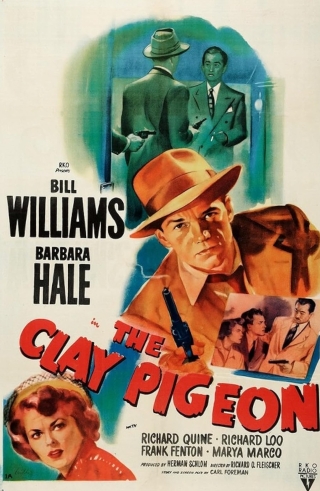
Jim Fletcher (Bill Williams) is a sailor, waking up in hospital after sustaining a bad head injury. He knows his name and most of the details about his past life, but he can’t recall what led to his being in hospital. And there’s the rub: Fletcher has been accused of treason during his time in a Japanese POW camp. What’s even worse is that his actions apparently led to the torture and subsequent killing of his friend. Knowing that he’s faced with a court martial at which he has little chance of clearing himself, Fletcher decides that his only alternative is to duck out and try to get to the bottom of it all by himself. Naturally, a penniless fugitive isn’t likely to make much headway without some assistance, so he takes a chance on contacting his friend’s widow. Unsurprisingly, this lady, Martha (Barbara Hale), is both suspicious and hostile initially. She grudgingly agrees to go along to Los Angeles though when a call to another old buddy, Ted Niles (Richard Quine) promises further help. Whatever doubts Martha may have had are gradually eroded on that long drive, particularly when an unknown car tries to force them off the road to their death. Their arrival in LA reveals just how complex and deadly a mess Fletcher has blundered into – a lethal conspiracy involving counterfeiting, war criminals and personal treachery. The whole thing culminates in a chase through Chinatown, followed by a train journey that exposes the real traitor.


The Clay Pigeon is a genuine B picture, coming in at little over an hour in length and never really pausing for breath. As such, there’s no time for any kind of character development amid the chasing and dodging. If anything, that’s probably the biggest weakness of the film: in these kinds of stories the audience needs to be kept guessing as to whether or not the hero is really as clean cut as he’d like us to believe. As it is, neither the audience nor the character of Fletcher has the least suspicion that he may indeed be the villain of the piece after all. I can’t honestly say that the fault lies with Bill Williams’ amiable playing as the part was written that way for him. I’d be more inclined to place the blame on Carl Foreman’s script (whose dearth of characters makes it pretty obvious who the traitor is right from the off) and the cheap-jack production values. That’s not to say there’s nothing positive to take away; Williams and Hale play well off each other, and the location filming is very welcome. This was one of Richard Fleischer’s earliest directorial efforts and he manages to create some nice angles and images, and does his best to create tension from a script that seems bent on draining away every vestige of suspense. The opening, the night drive to LA, and the Chinatown sequence are all ably handled and point to better things ahead for the director.

The movie comes to DVD from French distributor Montparnasse (I think there are Spanish and Italian editions out there too) and the transfer is one of their more typical efforts. It’s not especially bad, but there’s a slightly heavy-looking image that may have some contrast boosting, and it appears to be interlaced. Extras are confined to an eminently missable introduction. However the disc is certainly passable and the subs are not forced on the English track. It’s probably worth bearing in mind too that this film is likely to be a candidate for the Warner Archive in R1, so a vastly improved transfer isn’t something I’d be holding my breath for. All in all, The Clay Pigeon is pacy little B noir that passes the time painlessly. I just feel that a bit of fine tuning to the script might have added some much needed ambiguity and resulted in a more memorable film.