The Man with a Cloak

poster29_zps06a02646

Lots of different things draw us to movies. Personally, I’ve always been a fan of Gothic mysteries, particularly those where the Hollywood majors cooked up that special atmosphere that could only exist within the carefully crafted confines of a studio set. Add in a rare adaptation of the writings of John Dickson Carr and I’m hooked. The Man with a Cloak (1951) combines both of these elements, and it was a film that had intrigued and eluded me for years. It’s been quite some time since I read Carr’s short story The Gentleman from Paris, but I remember enjoying it and was keen to see how the film version worked.

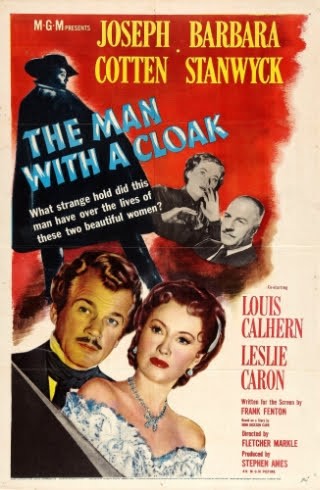
It’s 1848 in New York, the year that saw revolutions breaking out in so many parts of the world. Against this turbulent backdrop a young woman arrives in the US seeking help. She is Madeline Minot (Leslie Caron), a somewhat unlikely fundraiser for a political cause. Her mission is to seek out the assistance of her fiance’s uncle, Charles Thevenet (Louis Calhern), now living in dissipated and debauched exile in the wake of Napoleon’s downfall. Madeline had been expecting to be introduced to a distinguished gentleman, instead she finds a half-crippled drunkard seeing out his days in decaying splendor. Thevenet’s alcohol sodden existence is being overseen by a trio of servants and retainers under the supervision of Lorna Bounty (Barbara Stanwyck). Two things are clear right away: Madeline’s presence is unwelcome in this household, and Thevenet’s protectors are no more than vultures patiently circling their dying master. And so it all comes down to money, Thevenet’s got it and everybody else wants it. While Madeline cannot prove that Lorna and her cohorts are actively plotting to murder the old man, she knows that it’s clearly in their best interests to see that he doesn’t hang around long enough to make any changes to his will. Into this little circle of greed and deceit steps Dupin (Joseph Cotten), the mysterious poet of the title who spends his days cadging free drinks from a sympathetic barkeep. Dupin isn’t motivated by the promise of money, though he’s clearly badly in need of it, rather he’s drawn to the simple faith in life of Madeline and a desire to see an injustice averted. It’s Dupin’s arrival that forces Lorna’s hand and brings the two mysteries of the film center stage: the puzzle of Thevenet’s will, and the real identity of the enigmatic poet.

The Man with a Cloak was directed by Fletcher Markle, a man who is probably better known for his television work. There are some highly effective scenes and a handful of noteworthy visual flourishes, and yet I can’t help feeling that the potential of the story and its setting weren’t fully exploited. The film has that polished look that MGM typically brought to its productions, and the studio sets are faultless. Still, the tension is allowed to slacken too often and that’s partly down to the failure to make the most of the visual opportunities. As for the plot, it’s solid enough but it’s perhaps overly dependent on building up an aura of mystery around the character of Dupin. While it’s adapted from a reasonably entertaining Carr story, it’s not one that highlights the author’s real strengths. In short, there’s arguably too much emphasis on who Dupin actually is – the film is liberally sprinkled with clues and it shouldn’t prove all that difficult to work out for any fairly literate viewer.

While the direction and scripting of the movie are always competent, they are nothing exceptional either. What does give the film a boost though is the acting. Both Stanwyck and Cotten were seasoned professionals, capable of tackling a variety of roles. Cotten spends most of his time hovering around the borders of sobriety, and gets to deliver some witty and telling lines. His character displays a weary cynicism, a sort of metaphorical cloak for the unnamed sadness he carries within himself. Against this is ranged the steely pragmatism of Stanwyck. Her outer gentility and polish masks a barely repressed sensuality and a deep streak of bitterness – after all, we’re talking about a woman who feels she has been robbed of ten of the best years of her life. While Cotten and Stanwyck rarely put a foot wrong, Louis Calhern almost effortlessly steals just about every scene. I sometimes think that if you want to capture a visual representation of regret for a life of unfulfilled promise, then you need only watch one of Calhern’s performances from around this time. In the face of such stiff competition, Leslie Caron fades into the background most of the time. It’s not that her portrayal of a frightened and confused ingenue is especially poor, just that she lacks the presence to make her mark among these heavy hitters. It’s a rare film that doesn’t benefit from a strong supporting cast, and The Man with a Cloak is no exception. Margaret Wycherly looks like she had a ball as a cackling old crone, and Jim Backus is a delight as the Irish bartender trading philosophical jibes with Cotten.

The Man with a Cloak was until recently another of those films that I began to think I was fated never to see. However, it became available via the Warner Archive, and shortly afterwards was given a pressed disc release in Spain via Llamentol. I watched the Spanish disc the other day and, judging from some screen captures I’ve seen, it looks like a clone of the US disc. Generally, the transfer looks pretty clean and sharpness and contrast are quite acceptable. This release offers no extra features whatsoever, just the film with its original soundtrack and the option to watch it with or without Spanish subtitles. I’ve seen people allude to the film’s noir credentials before but I feel the link is tenuous at best, and it’s not a title I’d be comfortable labeling in this way. For me, The Man with a Cloak is simply a Gothic mystery with a generous dollop of melodrama added. Overall, I found this an enjoyable and entertaining movie, though it’s not without its faults. I guess the presence of some big name stars and the fact it was sourced from a John Dickson Carr tale raised my expectations perhaps a tad too high. Nevertheless, I couldn’t say I was especially disappointed. If the direction is a little flat at times, the performances do compensate. Anyone who enjoys these studio bound mysteries, likes Carr’s writing, or is a fan of Stanwyck and Cotten should find enough to satisfy them here.

Those seeking another take on the film should pop over to Paul’s place at Lasso the Movies.


The Mask of Dimitrios

poster7_zps3ff62743

To me the most important thing to know about an assassination is not who fired the shot – but who paid for the bullet.

The passage of time can have a nasty tendency to cloud the memory, to cast a kind of nostalgic haze over things and distort reality. On occasion I’ve found this to be the case with films, where fondly remembered movies, those which have earned themselves a special place in the heart over the years, fail to live up to their promise. It’s quite a crushing disappointment to discover that a film we thought was wonderful long ago falls far short of the stellar image we’ve built up in our imagination. Happily though, that’s not always the case, and sometimes it just happens that the film we saw all those years ago really is the little gem we’ve been yearning to see again ever since. The Mask of Dimitrios  (1944) is one such movie; I caught it once on a late night TV broadcast at some point during my teenage years and it made a big impression on me. However, it never seemed to show up again no matter how carefully I scoured the TV listing pages in the papers. It also remained stubbornly absent from DVD release schedules to the point I began to despair of ever seeing it again. In the interim I’d read the Eric Ambler novel from which it had been adapted, and that actually just served to increase my frustration. Anyway, when I finally learned of its DVD release this year I experienced a rush of excitement tinged with a hint of trepidation. Fortunately, the latter feeling turned out to be misplaced as I realized my memory hadn’t been cheating me. Ah, the ups and downs of being a movie fan!

It’s 1938 and the uncertainty and upheaval of the inter-war years will soon be swept aside by the approaching conflict. In Istanbul a group of children run happily along the shores of the Bosphorus. They halt abruptly, shocked by the gruesome sight before them. The body of a murdered man has washed up and now lies carelessly on the sand. The clothing and papers identify the remains as belonging to one Dimitrios Makropoulos, a Greek national and a man not unfamiliar to the authorities. Later that evening, at a party, the Turkish security officer in charge of the investigation falls into conversation with Cornelius Leyden (Peter Lorre), a mystery writer vacationing in the Levant. The tale of the shady character now lying on a mortuary slab intrigues Leyden and piques his writer’s interest. Armed with only a handful of dates and locations, Leyden takes it upon himself to satisfy his curiosity and make a stab at tracing the movements of this notorious figure. Leyden therefore sets out on a journey that will take him first to Athens, then on to Sofia, Belgrade, Geneva and finally Paris. Along the way, via a series of flashbacks narrated by an assortment of middle European types, he begins to piece together a picture of the mysterious and ruthless Dimitrios (Zachary Scott). At every turn though, Leyden’s path seems to cross that of Mr Peters (Sydney Greenstreet), a man whose interest in  Dimitrios surpasses that of the diminutive writer. It soon becomes apparent that the threat posed by men such as Dimitrios doesn’t end with death, and that his malignant influence may even extend beyond the grave.

£23

The Mask of Dimitrios is one of those pictures that sails awfully close to the boundaries of film noir; the fates of Dimitrios’ victims certainly moves it in that direction as does the shadowy photography and multiple flashbacks employed. However, despite the presence of these persuasive factors, it’s the mystery/espionage elements that dominate for the most part. The story comes from Eric Ambler’s finest novel (high praise indeed as the man rarely wrote anything weak) and I reckon the film stands as the best adaptation of his work to date. Generally, Ambler’s stories dealt with men who found themselves drawn unwittingly into the murky world of spying and underground politics. By having the bulk of the action play out in the Balkans, that hotbed of intrigue and shifting loyalties, The Mask of Dimitrios captures the mood of betrayal for profit beautifully. Both Ambler’s writing and Jean Negulesco’s atmospheric direction leave the viewer in no doubt that we’re being taken on a tour of a world of secrets, memories and confidences cherished for emotional and material value. For me there are two standout sequences in the movie. The first is the framing story in a cheap night club in Sofia. Faye Emerson is wonderfully weary and faded as she recounts her past with Dimitrios: the air is thick with a kind of smoky decadence, Emerson’s near lifeless eyes and drawn expression speak volumes, and the band plays Perfidia in the background. The other noteworthy episode is an extended flashback to an elaborate sting in Belgrade, where a minor government official has his own weakness manipulated in order to suck him into committing treason. The combination of Dimitrios’ cold slickness and Steven Geray’s portrayal of the poor dupe whose fragile ego, thwarted ambition and desperate desire to rise in his wife’s estimation makes it quite affecting.

Of the half-dozen or so movies that Greenstreet and Lorre made together in the 40s, The Mask of Dimitrios was the one that gave them the greatest opportunity to shine. Something like The Maltese Falcon handed them fascinating roles, but they were still only there to provide support for Bogart and Astor. This film, on the other hand, places the two men front and center and it’s their partnership as much as anything that carries the whole thing. As Peters, Greenstreet has the more ambiguous part, and gets to indulge in his patented trick of switching from jovial bonhomie to dark menace in the blink of an eye. Lorre acts as the viewer’s guide, half leading and half stumbling his way through the twisting tale. Zachary Scott is of course the true villain of the piece, and the movie offered him one of his best parts. He always had an oily charm that could be used to strong effect when necessary, but this time that quality remains largely buried beneath a cold, calculating facade. As the story progresses the full extent of Dimitrios’ foul character is gradually revealed, and Scott manages to convey very successfully just how dangerous this man truly is.

£24

As I said at the beginning of this short piece, The Mask of Dimitrios was a difficult film to see for a long time. Earlier this year though, it appeared on DVD via the Warner Archives. At the time I felt ambivalent about this fact; I wanted to get my hands on the film but I’ve never managed to completely overcome my aversion to buying DVD-R products. When I learned over the summer that Absolute in Spain were putting out their own pressed disc version of the movie, I decided that was the one I’d go for. Absolute can generally be relied on to produce solid, attractive releases, and this is no exception. The image doesn’t display any noticeable damage and has nice contrast levels to show off the noirish photography. As usual with this company, subtitles are no issue and can be deselected from the setup menu. Extra features consist of the theatrical trailer and a booklet (in Spanish naturally) containing notes on the film and a good selection of stills. OK, so I had been a little fearful that the film wouldn’t prove as entertaining as I hoped, but it ended up being every bit as satisfying as I recalled. Personally, I think it’s a terrific example of the magic that studio bound B thrillers could conjure up when the right cast and crew were handed promising material. Do yourselves a favor folks and check this one out – it comes highly recommended.


Shake Hands with the Devil

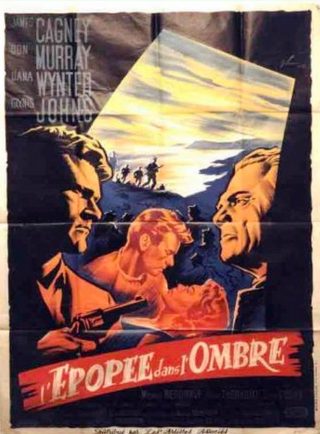
The conflict in Ireland has provided the backdrop for a number of quality movies over the years, and I’ve covered a few of them on this site: Odd Man Out & The Gentle Gunman. Those two films dealt mainly with the smaller mid-century campaigns in Northern Ireland or around the border. Shake Hands with the Devil (1959) steps a little further back to the early 20s and the War of Independence, concentrating on the south of the country. The “Tan War”, so named after the involvement of the British irregulars recruited to strengthen the RIC, remains an emotive subject in Ireland due to the atrocities perpetrated against the civilian population. I can clearly remember people of my grandparents’ generation, who lived through those turbulent and violent times, speaking with undisguised venom about the Tans. The film under examination here reflects that hostility, but doesn’t shy away from depicting the implacable fanaticism that characterized some elements within the Irish rebel movement at that time either.

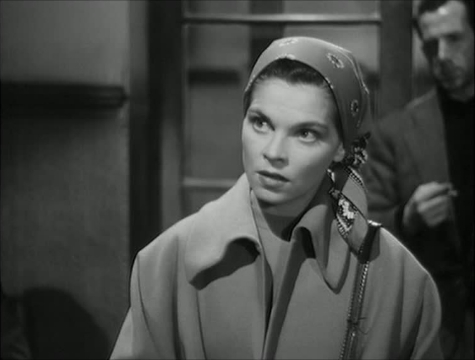
The prologue makes it clear that the Ireland of 1921 was a country in a state of war. The opening then takes place in a Dublin cemetery where a solemn funeral procession makes its way along paths lined with tombstones. Suddenly, a squad of Black and Tans appear and the cortege scatters amid the jarring sound of gunfire, leaving behind an upturned coffin spilling its load of rifles. This brief scene succinctly illustrates the nature of the war being fought: a covert organization facing off against a determined and ruthless enemy. The most interesting films dealing with the Irish conflict feature those caught somewhere in the middle, dragged into the fighting in spite of themselves. Kerry O’Shea (Don Murray) is such a man, an Irish-American studying medicine in Dublin in fulfillment of his late mother’s wishes. O’Shea happens to be visiting his parents’ grave when the Tans’ raid takes place, and he will find himself drawn deeper into the war as the story progresses. O’Shea’s father had been an old-time republican and he had fought in WWI himself; as such, we see a young man who has had his fill of killing. Still, circumstances don’t always allow a man to follow the path he would prefer – sometimes just being in the wrong place at the wrong time alters the course of a life. This is what occurs with O’Shea; he is walking along a street when an IRA ambush leads to the shooting of his friend and the subsequent leaving behind of his notebook at the scene during his flight from the violence. A direct consequence of this is the revelation that O’Shea’s lecturer and eminent surgeon Sean Lenihan (James Cagney) is a commandant in the IRA. As O’Shea, now regarded as a suspected terrorist, goes on the run, the combination of the brutality of the Black and Tans and the fact that Lenihan once saved his father convinces the young student that his place is standing shoulder to shoulder with the rebels. Yet despite O’Shea’s belief in the essential nobility of his cause, he becomes increasingly disturbed by the harsh, fanatical side of Lenihan. This feeling of unease is further strengthened when Lenihan’s customary dislike for and distrust of women is magnified after the taking of an important hostage; Jennifer Curtis (Dana Wynter), the daughter of a high British official, is abducted in reprisal for the imprisonment of an elderly republican sympathizer. Lenihan’s near pathological hatred of the young woman, and his keenness to see her executed, may prove the ultimate test of O’Shea’s loyalty.

Politically, Shake Hands with the Devil wears its heart on its sleeve, and makes no bones about its critical appraisal of the role of the Black and Tans in Ireland. The Tans are explicitly cast as the villains of the piece, their commander being portrayed as a quasi-fascist figure with a strong sadistic streak. The way O’Shea’s interrogation and beating is photographed, in a highly subjective manner, emphasizes the cold brutality of his tormentor. However, if there is a sustained effort to romanticize the rebels – most notable in the characterizations of Cyril Cusack, Michael Redgrave and Sybil Thorndike – it needs to be pointed out that we’re not looking at a whitewash job either. The internal discipline mechanisms of the IRA are shown in all their toughness, and the unyielding aspect of what would become the anti-Treaty forces – as represented by Cagney – is one of the major themes of the film.

Michael Anderson was a director capable of great visual flair – I’ve commented in the past on the Hitchcock-style touches present in a couple of his films – and Shake Hands with the Devil offers further evidence of his eye for interesting compositions. Aside from having a knack for capturing the correct mood, he staged and shot the action sequences very fluidly.  The early part of the movie was shot on location in a mean and moody Dublin, all expressionistic shadows and dripping in noir atmosphere. Later, the action moves out of the city to Bray and the coast, and again Anderson, aided by cameraman Erwin Hillier, makes the most of the windswept seaboard. The use of the lighthouse, where the rebels have set up a makeshift headquarters, gives a nice claustrophobic feel to the scenes where Dana Wynter is held captive. Generally, the authentic locations contribute to the sense of realism and, while the script does meander a little in the middle, Anderson’s assured and inventive direction holds the attention throughout.

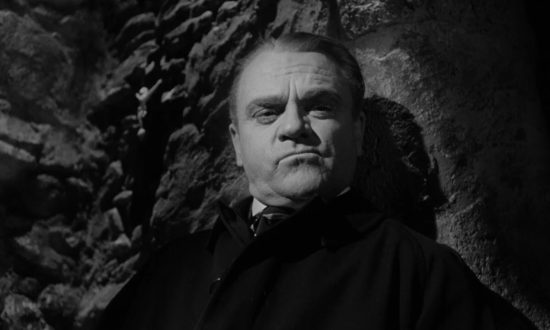
What can one say about James Cagney? From gangster to song and dance man, and just about everything in between, he was and remains one of the greatest Hollywood stars ever. Shake Hands with the Devil was one of his last films before entering a retirement that he refused to be persuaded out of for over twenty years. The film saw him surrounded by top class performers and expert scene stealers, yet it’s Cagney who carries it and he’s the one who sticks in your mind. The tough little New York Irish pug had been strutting and swaggering across the screen for thirty years by that time and his presence was such that it positively demanded you sit up and pay attention. He was always an actor capable of great intensity, although there was always a liberal sprinkling of charm and humor just below the surface too, and he honed and perfected that quality over the years. The part of Sean Lenihan gave Cagney a chance to flex his not inconsiderable acting muscles; it’s a complex role where the character alternates between a sympathetic, gutsy figure and a dangerous obsessive with deep and dark personal issues.

Cagney was certainly the name at the top of the bill, but there was a long list of talented and big name performers filling the other roles. Michael Redgrave was credited simply as The General, a character who seems to have been based on the real life Michael Collins. Aside from a moment of ruthlessness, Redgrave imbues this man with a sense of dignity, nobility, and just the appropriate touch of tragedy. There’s also an excellent turn from Cyril Cusack as the poet turned revolutionary who befriends the lead; it’s a thoughtful performance and a pivotal one, anchoring the film and acting as a bridge between the driven Cagney and the more reluctant Murray. Frankly, Don Murray was handed something of a thankless task when he had to square off against such a battery of talent. Having said that, Murray is good enough and, while he hadn’t the same depth of experience as some of his co-stars, acquits himself very well indeed. Richard Harris would of course go on to great things and his part as one of the more thuggish and self-absorbed rebels was an early opportunity to show what he was capable of. As for the women, Glynis Johns and Dana Wynter have the meatiest parts. Johns was the loose and brassy barmaid while Wynter was the demure and well-bred gentlewoman. Both actresses were convincing and quite touching in these contrasting roles, coaxing the best and worst from the male characters. As has already been stated, the supporting players in this movie makes for impressive reading: Sybil Thorndike, Niall MacGinnis, Harry H Corbett, William Hartnell, Ray McAnally, John Le Mesurier, Allan Cuthbertson and Noel Purcell.

Shake Hands with the Devil is available on DVD in the UK via Metrodome. The film is presented in Academy ratio, which can’t be right for a 1959 production. I did try zooming to around 1.66:1 at a number of points and the image generally looked fine so I guess we’re looking at an open matte transfer here. Leaving aside the matter of the aspect ratio, the transfer isn’t bad in other respects – print damage is minimal and contrast levels and sharpness all look acceptable. The only extra features on the disc are a handful of trailers for other Metrodome releases. Regular visitors to this site will be aware that I try to highlight movies that aren’t always widely acclaimed. Naturally, some are of better quality than others and I feel comfortable in asserting that Shake Hands with the Devil really is something of a forgotten gem. It’s an interesting film from a historical perspective, focusing on a conflict and period that doesn’t get a lot of attention. Michael Anderson’s smooth direction is very attractive with the imagery frequently reminiscent of film noir. Add in some excellent acting and complex characterization, especially from Cagney, and we’re talking about a first-rate thriller.

High Treason

There’s a tendency to view the Red Scare of the 1950s, as represented in the movies, as a purely American phenomenon. The whole HUAC affair and the subsequent blacklist encourage us to view this as something unique to Hollywood, and there can be no doubt that the paranoia reached its zenith there. However, this offshoot of the Cold War spread elsewhere, albeit in a diluted form. High Treason (1951) provides an example of the British film industry tackling the matter of reds under the bed at the same time. The result is a well made espionage thriller that catches the mood of the period, but also one that contains overtones that can come across as a little unpleasant when you stop and think about them; I’ll address those aspects later.

It’s the early days of the Cold War and the lines between what in official wartime parlance would be referred to as fifth columnists and the kind of spies and double agents that would become a staple of the genre are not yet clearly defined. High Treason affords a glance into the lives and activities of a handful of subversive operatives who straddle those lines. The opening has an apparently meek civil servant, Ward (Charles Lloyd Pack), returning home to his flat, admonishing some boisterous kids along the way, feeding the cat, and then sitting down to transcribe a munitions manifest which will be handed on to a group of saboteurs. This is the stuff of the typical spy story, the outwardly harmless apparatchik beavering away unobtrusively in the service of his foreign paymasters. However, the film then moves to the men of action, the agents who actually put the information to use in spectacular and violent fashion. A wave of sabotage has been sweeping the country, taking lives and creating instability. There’s a dramatic depiction of the bombing of the ship carrying those munitions Ward had told his confederates about. In the aftermath of the carnage and destruction we’re introduced to the men charged with putting an end to this internal terrorism: Commander Brennan (Liam Redmond) and Supt. Folland (Andre Morell) of Special Branch and Major Elliott (Anthony Bushell) of MI5. The film follows their investigation, detailing the meticulous nature of the surveillance of known suspects, the lucky breaks that are needed to crack such cases, and the trail of corruption and ambition that leads to betrayal at the very heart of government. Police procedural stories, even those as intricate and involved as this, can be a dry affair at the best of times. There’s a tendency to pass over or lose touch with the human aspects that are the necessary ingredients of good drama. However, High Treason avoids falling into this trap by alternating between the men from the ministry and their investigation and the daily agonies suffered by a reluctant member of the spy ring, Jimmy Ellis (Kenneth Griffith), and his immediate family. As gripping as the investigation and the gradual closing of the net is, it’s the focus on Ellis’ doubts and fears that adds real punch to the tale.

The terrific Seven Days to Noon came out a year earlier and Roy Boulting followed up that suspenseful Cold War nightmare with this tale of spies, sabotage and spooks. Boulting carried over a similar sense of pace and atmosphere to High Treason. The two films benefited enormously from the use of authentic London locations, and both also featured the character of Supt. Folland. However, there are some important differences: while Seven Days to Noon achieved a timeless quality that still resonates today, High Treason is more dated by being firmly rooted in the politics and concerns of its time. Which leads me on to the criticism that I alluded to in the introduction. The foreign power for which the spy ring is working is never explicitly named yet, through the frequent use of ominous newspaper headlines and other pointers, it’s clear enough that it is the Soviet Union. Fair enough, Cold War thrillers naturally used the eastern bloc as the bogeyman villain and to expect anything else, or criticize that practice, would be naive in the extreme. Having said that, I did raise an eyebrow at the way the script seems determined to hammer home the point that artistic types and intellectuals were easy prey for communist propaganda – that those with even a vaguely liberal bent were at best foolish dupes and at worst dangerous fanatics obsessed with undermining their own country. Despite that criticism, there’s a whole lot to admire in the movie. It acts as a wonderful snapshot of a Britain that has long disappeared, where heavy industry was an integral part of the economy and the threat of blackouts shutting it down, even for a time, would have spelt chaos. Aside from the historical and sociological insights offered, High Treason is a tightly plotted thriller that grips you from the opening right through to the excitingly shot climactic battle within Battersea power station.

High Treason isn’t the kind of film that could be described as a star vehicle. Essentially, it’s an ensemble piece but, even so, there are a few noteworthy performances that stand out. Irish actor Liam Redmond was a character specialist, looking a good deal older than the 38 years old he was at the time. He brought a quiet, whimsical intelligence to the part of Brennan, and it’s his doggedness that draws together all the disparate strands of the complex investigation. Andre Morell reprises the role of Folland that he played in Seven Days to Noon with his customary charm and urbanity. It’s not a showy part by any means, deferring to Redmond’s authority, yet it’s a typically classy piece of work by Morell. Probably most memorable of all though is Kenneth Griffith as the tortured wireless man who sees his dreams of a better world twisted and subverted by his cynical and opportunistic companions. Griffith gave a very real, honest performance where the agonies of conscience he endures never appear the least bit affected. I was also quite impressed by the work of Mary Morris, in one of the few female roles in the film, as the dedicated and driven spy with few scruples. There’s also strong support on view from Geoffrey Keen, Joan Hickson and Anthony Nicholls.

High Treason was a film that was difficult to see for a long time but is now available on DVD in the UK from Spirit. The film is correctly presented in academy ratio and the transfer is quite good. There is the odd speckle here and there but the print used is generally in good condition with nice contrast levels to show off Gilbert Taylor’s moody cinematography. There are no extra features whatsoever on the disc. The movie represents a welcome companion piece / follow-up to Seven Days to Noon, and although it’s not as good as the earlier production it still has enough going on to recommend it. As a stand alone film it works perfectly well on its own terms, and really ought to be judged as such. I’ll admit I’m not crazy about certain aspects of the subtext, but that doesn’t mean I dislike the film or rate it any lower as a consequence. Whatever way you approach it, High Treason is an effective, satisfying and exciting espionage movie.

Eyewitness

poster71_zps72hqlekp

British attempts at producing noir thrillers have tended to be a hit and miss affair, the greatest stumbling block generally being an inability to strike the right tone. The nuts and bolts are easy enough to put in place: the city setting, the night, the shadows and key lights, some criminal enterprise to provide a framework. However, British movies of the classic noir period (the 40s and 50s) struggle to escape the rigid class structures that remained firmly in place at the time. American films benefited enormously from the more flexible social structure of the country, which allowed filmmakers to blend in characters from a variety of backgrounds. Despite its best efforts, British noir tends to be forever trapped in a middle-class world and, consequently, loses something of the edge of danger that helped elevate pictures from across the Atlantic.

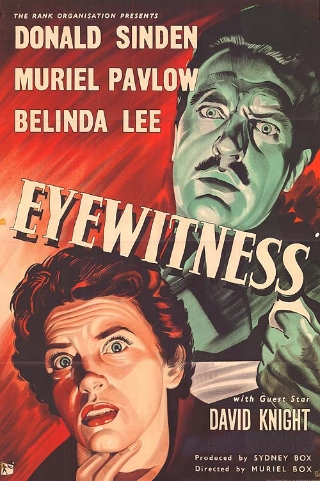
Eyewitness (1956) opens in these typically middle-class surroundings, with a minor domestic spat involving a young couple.  Jay (Michael Craig) and Lucy (Muriel Pavlow) are two young suburbanites who have run into a bit of a crisis in their marriage. Jay is a guy who wants to live better than his income allows and has been accumulating a bit of debt buying stuff on credit. His latest acquisition, a brand new TV set, proves to be the straw that breaks the camels back though. Lucy is not at all impressed, such apparent profligacy failure to think of tomorrow going against the grain with her. In a foul temper, and threatening to leave for good, Lucy stalks out of the house to try to cool off.

While Jay sits home, toying with his new purchase and reflecting on the injustices of married life, Lucy’s wanderings take her to a movie theater. And it’s at this point the story starts to take shape. Jay’s feelings of frustration drive him out in search of a drink and some sympathetic male company, just at the moment Lucy’s conscience pricks at her and she decides to call him up. Getting no answer on the phone, Lucy is making her way through the theater when she chances upon a robbery in progress.

It’s Lucy’s misfortune to witness two men, Wade (Donald Sinden) & Barney (Nigel Stock), in the process of cracking the safe and roughing up the manager. Barney sets off in pursuit of the panic-stricken woman as Wade goes about settling matters with the ill-fated manager. Lucy’s terrified flight takes her out of the cinema, onto the street, and straight into the path of an oncoming bus. The situation leaves Wade and Barney in a quandary; is the unexpected witness going to live? And if she does, how much will she recall?

Wade reveals himself to be not only a cool customer, but a nasty piece of work to boot. His primary concern is his own self-preservation, and he coerces the meek Barney into falling in with his schemes. Wade has no intention of leaving any loose strands that may, in time, weave themselves into a noose to hang him. Following the ambulance that carries the comatose Lucy to a local hospital, Wade has in mind to dispose of this potential threat. Despite Barney’s protests, Wade takes it upon himself to stalk the now helpless Lucy and ensure nothing can be traced back to him. And so the bulk of the movie involves Wade’s attempts to gain entry to the communal ward where Lucy is taken. The suspense of the film derives from Wade’s determination, and increasing frustration, to silence this inconvenient witness. All the while, the net draws closer, time is running short and the opportunities grow fewer. Everything builds relentlessly towards a dramatic finale in a deserted and vaguely sinister operating theater.

Muriel Box was one of those rarities in classic era cinema, a female director. After writing some strong British movies – The Seventh Veil (1945) and The Brothers (1947) – she began directing in 1949. However, her career was closely linked to her husband, producer Sydney Box, and the break up of their marriage also signaled an end to her time behind the camera. Eyewitness sees Box making good use of the inherent suspense generated by the setting. A hospital at night is full of dramatic potential, the random comings and goings, the relative anonymity, that sense of disquiet aroused by the sight of mask-wearing professionals silently padding along starkly lit corridors. As the story progresses, Box ensures the tension grows in increments and the visuals reflect the increasing darkness of what we’re watching.

I think the biggest weakness stems from a basic flaw in the script. The success of pretty much any film, and especially a thriller, depends on having if not a hero then a recognizable figure that the viewer can identify with or root for. Eyewitness suffers in this respect; since it’s clearly intended that we should side with Lucy. However, she spends the bulk of the running time either unconscious or semi-conscious, effectively taking her out of the equation. There’s a similar problem with Barney, another whose presence ought to draw sympathy, but who ends up sidelined much of the time. In the end, we see things predominantly from Wade’s point of view, and he’s such a thoroughly bad lot, without a single redeeming feature, that it’s impossible to view him even in an anti-heroic light When it comes to the performances, Donald Sinden is pretty good as the twitchy killer with a slightly manic air. Still, the best work is probably done by Nigel Stock as the deaf safe-cracker whose dream of moving to New Zealand has seen him roped into a scheme that’s a whole lot more than he bargained for. Pavlow and Craig are so-so as the young couple whose marital tiff pitches them into a perilous situation, but there’s no great depth to their characterization.

In the final analysis, Eyewitness is a mid-range British crime thriller. The story is gripping enough but the lack of a sympathetic central character does damage it somewhat. The movie is available on DVD in the UK as part of a Donald Sinden box set from ITV. It’s a reasonably good transfer, presented in the correct 1.66:1 aspect ratio, though without anamorphic enhancement for widescreen TVs.

Note: I originally published an edited version of this piece as a Noir of the Week for The Blackboard.

Robbery

£27

Films centered around heists generally fall into two categories – those which take a light-hearted, comedic approach such as Ocean’s Eleven, The Italian Job or Gambit, and the darker morality tales to be found in film noir like The Asphalt Jungle, The Killing and others. Peter Yates’ Robbery (1967) takes an entirely different tack, and tells its tale in a semi-documentary style. The movie is inspired by (and I use that term deliberately rather than saying it’s based on real events) the Great Train Robbery of 1963. Yates’ film uses the famous crime as a template but it shouldn’t be seen as an exact reconstruction of what happened. The style of storytelling used is probably the strength of the production, but I think it’s fair to say that it also accounts for its main weakness.

The bulk of the running time concentrates on the planning and execution of the raid on the mail train, and merely touches on its aftermath right at the end. The first quarter-hour sets the exciting yet impersonal tone of what is to follow by detailing a daring diamond snatch in central London. The purpose is to secure sufficient funds to set everything in motion, and it’s a terrific piece of filmmaking. The highlight is the intensely shot car chase that takes place after the diamonds have been grabbed. The whole idea of a car chase is one that has been used, and arguably overused to the point of cliché, in countless thrillers over the years. There are, however, instances where this standard element has been shot and employed to great effect, and Robbery is certainly one of those. After this heart-pounding sequence, the pace relaxes somewhat as we watch Paul Clifton (Stanley Baker), a recently released convict, begin to piece together the team of underworld types he needs to pull off the one big score that will allow him to bow out and retire. However, such things never run entirely to plan and little obstacles and issues arise right from the beginning. Taken in isolation, none of these flaws or setbacks amount to much in themselves; however, the cumulative effect as the story develops is what ultimately counts. While we’re afforded glimpses into the lives of all the principals involved, most of the action plays out from the perspective of Clifton and the policeman, Langdon (James Booth), who is on his trail from early on. The robbery itself is carried out in the style of a military operation, with everyone having their roles clearly defined and the timing judged to the second. As viewers, we’re just as aware as the protagonists of the importance of all the details falling into place and the risks inherent in any deviation from the plan. This knowledge, and the script’s focus on it, is what creates the tension on which the story relies. Nevertheless, despite the most meticulous preparation, such things inevitably start to unravel. As I mentioned before, there are numerous weaknesses in the plan that build up and become magnified over the course of the movie, and it’s impossible to identify any one as the most critical. I found the ending of the film quite satisfactory – it has the kind of moral ambiguity that both fits the era in which it was made and also acts as a truer reflection of real life.

£25

I guess Peter Yates really made his name as a director when he took charge of Bullitt. That film featured an iconic car chase sequence through San Francisco, and it appears that his work directing the opening chase in Robbery played an important part in securing his participation in the McQueen movie. In terms of visuals and pacing, it’s hard to fault Yates – the film has a gritty and realistic feel and moves smoothly along. The main set piece, the actually taking of the mail train, is superbly filmed and cut together to heighten the sense of urgency of the gang. The same can also be said of the subsequent sorting and dividing up of the takings in the bunkers below a disused air force base; the claustrophobic set is used to good effect to emphasize the isolation of the gang and their distance, emotionally at least, from the dragnet that has been cast. Generally, the film does a good job of capturing the flavor of that late 60s era, not the swinging, carefree one which seems to be the popular perception now, but the grim and tough one that was familiar to most working-class people. I said in the introduction that one of the picture’s strengths, perhaps its greatest, was the brisk, documentary tone which simultaneously, and paradoxically, weakens it too. The point is that by concentrating on the nuts and bolts aspects of the robbery a lot of the human drama is absent. We don’t really learn a great deal about the characters involved, aside from their role within the gang, and this means we never get the opportunity to feel strongly for them. I don’t think this is a failing of Yates really as some of his subsequent work, especially The Friends of Eddie Coyle, is basically character driven.

Robbery features a strong line up of British actors, although the focus is mainly on Stanley Baker and James Booth (both of whom, coincidentally, starred in producer Joseph E Levine’s earlier movie Zulu) and they dominate proceedings. Booth is pretty good as the man from the Flying Squad who cottons on to what may be happening before anyone else. Having said that though, the script allows for no sense of who this man is beyond his job – he’s just a cop, albeit a likeable one. Baker does get a little more back story to help flesh out his character, but again this is strictly limited. Baker was a fine actor, one of the best Britain produced, yet he’s handed a fairly one-dimensional part here. We do learn that he’s desperate to avoid a return to prison, and the scenes between him and his wife (a very attractive Joanna Pettet) give at least a glimpse of the private man. Still, by and large, Baker spends most of his time playing it strong, silent and tough. I guess the most rounded character is to be found among the supporting players – Frank Finlay is excellent as the timid banker, an embezzler who finds himself drawn into Baker’s scheme. Finlay gives a very sensitive portrayal of a man torn by personal guilt and his longing to contact his wife, even for the briefest moment, is quite touching. Barry Foster is underused as one of the senior gang members, although William Marlowe gets a slightly meatier part as Baker’s right hand man.

£26

A few years ago, Robbery was released on DVD in the UK by Optimum. Despite its faults, it’s a movie I’ve always liked a lot and so I was keen to pick it up. However, I was disappointed to find that Optimum’s disc had a full frame, open-matte presentation of the film. Anyway, I had to make do with that compromised edition since there didn’t appear to be any other option available. Recently though, I noticed that Regia Films in Spain had put out a disc, and I decided to take a chance and see if it was any improvement. I was pleasantly surprised to find an excellent transfer of the film that presented it in the 1.66:1 ratio with anamorphic enhancement. The disc has no extra features whatsoever, but the subtitles don’t cause any problems and can be switched off from the setup menu. The fact that the movie is now available in anamorphic widescreen is the most important advance as far as I’m concerned. I don’t think the film is a perfect one, but it does have a fine cast and shows off Yates’ flair for action and tense situations. Despite its flaws, I’d still recommend this title to anyone keen on British crime pictures, or just crime movies in general.

The Verdict

poster192-1

Some films just seem to work for me, to click if you like. They need not necessarily be movies of any extraordinary depth or have any abiding influence. The Verdict (1946) is one of these; it’s a small movie, a B picture really, but through a happy combination of elements it just checks most of the boxes for me. Firstly, there’s the setting: Victorian London as only Hollywood of the 1940s could depict it. Then there’s the fact that the plot revolves around a classic impossible crime, a locked room puzzle. And finally, a star pairing who worked so well and so memorably in tandem that they almost created a little sub-genre of their own. Mixing all these ingredients together results in a delightful little film that has no pretensions of greatness, that seeks only to entertain, and achieves that, not inconsiderable, goal admirably.

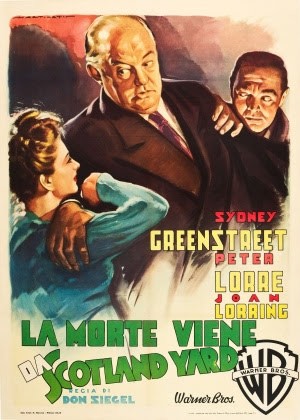
The opening is a first class piece of moody and atmospheric scene setting. The caption informs us that we’re in London in 1890, a dark and brooding place, as the camera tracks in to focus on Newgate prison, the last stop for many a condemned man. With the fog clinging to the gas street lamps and a bell solemnly tolling the hour of execution, the story’s protagonist looms into view. Superintendent Grodman (Sydney Greenstreet) is, quite literally, the big man in Scotland Yard. His lumbering bulk and sombre features speak of a man deeply contemplating his actions and his role in the world. Grodman’s latest investigation has drawn to a close and a convicted murderer is on his way to the gallows. Yet Grodman takes no pleasure in this, reflecting that success for a man in his position leaves only a bitter taste. In a sense, Grodman is condemned too, and we’re soon made aware of this paradox as the tale unfolds. Fate, circumstance and the pettiness of a rival have conspired to bring bout a dreadful miscarriage of justice. Grodman has sent an innocent man to the gallows. His professional disgrace is only one aspect of the matter though; a fine little montage succinctly sums up the guilt and paranoia Grodman suffers. Now settled into retirement, Grodman finds himself drawn back into his old life when a curious murder takes place in the boarding house opposite his own quarters. A reprehensible young man (Morton Lowry) had been found stabbed in his room under inexplicable circumstances: the door is locked from the inside and all the windows are sealed up. Grodman’s rival and successor at the Yard, Buckley (George Coulouris), is stumped and reluctantly calls on him for advice. Aside from the baffling mechanics of how the crime was committed, there are a clutch of fascinating suspects: Peter Lorre as an illustrator with a macabre sense of humour, Paul Cavanagh as a stiff-necked politician, June Lorring as Music Hall girl, and Rosalind Ivan’s hysterical housekeeper. Additionally, the possible motives for the murder form a complex web that encompasses jealousy, passion and blackmail. While Grodman strides in his stately manner through this labyrinth of suspicion, it emerges that history is in danger of repeating itself, with the possibility of another innocent victim being ground up by the wheels of blind justice.

The Verdict is adapted from The Big Bow Mystery by Israel Zangwill, one of the classic texts on the problem of the locked room – my thanks to Sergio of Tipping My Fedora for pointing out to me that this is available free as an e-book here & as an audiobook here. This particular form of impossible crime has been a staple of detective fiction for a long time, although its heyday was around the middle of the 20th century. At its best, the locked room problem depends more on the subtle art of misdirection than mechanical hoaxing. As such, this form of the detective story doesn’t always translate well to the screen and is generally far more effective in print. Still, I think Zangwill’s contribution to the canon does hit the mark and should succeed in confounding those not well-versed in this school of trickery. John Dickson Carr, the undisputed master of the locked room, also details the murder method used here in chapter 17 of The Three Coffins – the wonderful lecture on all things impossible delivered by Dr Fell – in case anyone wants spoilers without reading the Zangwill book.

The Verdict was Don Siegel’s first full length movie as director, although he had had extensive experience working in montage and the second unit in the years leading up to it. As a debut feature, it’s an impressive piece of work and demonstrates this was a talented individual with a future. While the film doesn’t bear much relation to what we might think of as a typical Siegel production, it does show that he already had a flair for visuals and pacing. The story is told economically, without unnecessary or tedious exposition, and maintains a consistent rhythm. With cameraman Ernest Haller making the most of the shadowy setups, Siegel uses a variety of interesting angles, dissolves and montage to keep things moving and strike the right tone. Aside from the excellent opening sequence, there’s a fine little section involving a late night exhumation that wouldn’t look out of place in a horror feature. The whole movie is a studio bound affair but, like the best B efforts, it turns this limitation to its advantage. The foggy London streets and mews where the action takes place may be no more than a Hollywood confection yet they have enormous charm, and the controlled environment leaves Siegel and Haller free to extract the maximum level of menace.

Peter Lorre and Sydney Greenstreet established a great on-screen partnership in the 1940s at Warner Brothers, earning themselves the nickname “The Laurel and Hardy of Crime”  – although that term seems to have been developed in retrospect. I remain of the opinion that The Mask of Dimitrios represents their best work together but The Verdict, their final collaboration, isn’t that far behind. Both these men had the knack of injecting a vein of comedy into their playing, of adding a human face to the menacing characters they so often portrayed. In this film, it’s Lorre who gets to indulge in a bit of sly black humour as the philandering cartoonist with a penchant for the gruesome. In contrast, Greenstreet cuts a much more tragic figure, his heavy features reflecting the regret and despair of his character. While Greenstreet’s huge physical presence, frequently emphasized by low angle shooting, dominates every frame he appears in, it’s the scenes he shares with Lorre that tend to be the most memorable. These two brought out the best in one another and seemed very comfortable working together. The main support came from George Coulouris, another actor who specialized in telling character roles, and he has just the right touch of venality as Buckley. In some ways he can be seen as the true villain of the piece, the blustering career cop whose inaction sets the whole affair in motion. Joan Lorring does fine as the blowsy entertainer who may know too much for her own good and ends up as one of Buckley’s chief suspects. Paul Cavanagh, who appeared in three Universal Sherlock Holmes films, has the ideal kind of patrician bearing for the part of the honour bound politician carrying around a guilty secret. Rosalind Ivan is essentially a caricature, a noisy, brittle busybody consumed by unfulfilled passion. The minor parts are filled by Morton Lowry as the slimy cad who becomes the murder victim and Arthur Shields playing yet another of his intense, tight-lipped clergymen.

The Verdict was made available on DVD in the US a while back through the Warner Archive. Additionally, the film has just recently been given a release on pressed disc by Sinister Films in Italy and that’s the edition I own. The transfer is pretty good, although there are plenty of minor speckles and blemishes on show. Some scenes are sharper than others but there’s no serious inconsistency or distraction either. The only extra on the disc is labeled as the theatrical trailer, but it’s actually the opening few minutes of the feature. The film is presented with three audio options: the original soundtrack and no subtitles, an Italian dub, or the original track with Italian subs. The movie is an excellent piece of entertainment, featuring fine central performances, atmospheric direction and an engrossing mystery story. It’s highly recommended for fans of Lorre and Greenstreet or those who like noirish thrillers. The fact that it features a classic locked room problem is an added bonus in my eyes, although those viewers especially familiar with that detective story variant shouldn’t have too much difficulty figuring out the method used.


Experiment in Terror

poster286

The common consensus holds that classic film noir came to an end with Orson Welles’ Touch of Evil. Some argue it lasted a little longer, but it’s pretty much universally accepted that the movement was essentially defunct in the 60s. However, film styles rarely have rigidly defined start or stop points; the nature of filmmaking is too fluid for that, and this is especially true of something as nebulous as film noir. So, even if the new decade saw the emphasis shift and other sensibilities start to take hold, there was still some residue of the old noir influence at play. Blake Edwards’ Experiment in Terror (1962) pointed towards the way the thriller movie was to evolve in the coming years yet it still bore some of the hallmarks of the works that preceded it – a dangerous urban environment, a dour and downbeat mood, and ample use of striking, high contrast photography. I’ve always been fascinated by transitional cinema, those pieces which seem to straddle eras, and I enjoy seeing how different styles and movements merge, blend and grow. As such, I think Edwards’ film is an interesting example of the phenomenon.

A nighttime view of San Francisco accompanied by Henry Mancini’s cool and slightly menacing score opens the movie. Gradually the camera tracks in and focuses on one car and its driver; Kelly Sherwood (Lee Remick), a teller in a downtown bank, is making her way home to the suburbs – as it happens, my friend and fellow blogger Michael has just posted a piece on that very opening here on his site It Rains…You Get Wet, and you can check out his full review of the film here. To borrow his words: “…the high contrast images of traffic as lights dancing in the nightfall, beside the luminosity in the landscape of the city by the bay, established its film noir bona fides through pure dark imagery”. As she pulls into her garage a series of quick cuts and close-ups make it clear that something is not quite right. Kelly senses danger and, sure enough, a figure emerges from the shadows to grab the terrified girl and set her nightmare in motion. The intruder’s face is never fully visible but his rasping, asthmatic voice breathes his plans into his captive’s ear. Kelly’s job places her in a somewhat unique position – she has access to money, a lot of it, and  there’s nothing to stop her stashing away a tidy sum and simply walking off with it. And that’s exactly what her assailant wants; Kelly will leave her job with $100,000 in her purse and bring it to him. In return, he promises to cut her in for 20% of the takings, and his generosity even extends to letting her and her kid sister live. As this sinister figure melts back into the night, Kelly slowly starts to regain her senses after the initial trauma. She puts a call through to the FBI and gets connected to an agent, Ripley (Glenn Ford), before the connection’s broken and the wheezing mystery man, pinning her helplessly to the floor, makes it clear that the consequences of any further contact with the authorities will be most unpleasant. However, the Feds are no fools, and once that initial contact has been made it’s only a matter of time before they manage to track its source. Kelly now finds herself in the unenviable position of acting as both bait for the G-men and the stooge for her unseen intruder. What follows is a cat and mouse game with Ripley and his agents lurking the background hoping to use Kelly to draw the would-be bank robber into the open. Kelly’s taking one silkily threatening call after another and relaying them to the FBI, while they in turn are racing against time in an effort to identify and locate the suspect. The first part, the identification, proves reasonably easy – it’s a guy by the name of Red Lynch (Ross Martin) – but tracking him down is another matter entirely. The suspense builds slowly and inexorably as the pressure on Kelly mounts and Ripley’s men scour San Francisco for the whereabouts of Lynch. The tale powers its way along towards a memorable finale at a thronged baseball game at Candlestick Park.

Blake Edwards is arguably most famous for his comedic films, and the bulk of his work as a director lies in that area. Even though he created the iconic TV show Peter Gunn, I don’t believe many people associate him with crime stories. Regardless of that, Experiment in Terror offers strong and convincing evidence that he was more than capable of handling dark, suspenseful movies. The opening scenes of the film pitch the viewer straight into an edgy and unpredictable world where danger seems to lurk in even the most innocuous settings. I think there’s always something very effective about films which highlight the fact that characters can never feel genuinely secure even in their own homes. Here, Kelly Sherwood finds herself under virtual siege, and the proximity of FBI watchers does little to assuage the suspicions of the character, or the viewer, that Red Lynch can get to her any time he pleases. Edwards made great use of real San Francisco locations to help ground the movie but the interior work particularly stands out. There’s a palpable sense of menace throughout, but there are also moments that go beyond that and become positively creepy. I’m thinking mostly of the scenes in the apartment of one of Lynch’s girlfriends – a maker of mannequins whose home is more a chamber of horrors with dummy body parts and impassive visages literally stacked to the rafters. While I guess these scenes could be viewed as a stylistic indulgence that don’t do much to further the plot, they add a lot to the atmosphere of unease. Visually, the film is impressive from first to last and I feel that it’s only a few lapses in the writing that let it down somewhat. I’m referring here to characterization of the villain; Lynch is clearly a bad man, a felon with a long and varied record. Yet, the introduction of a young Asian woman and her son suggests there’s more depth here, another layer to Lynch that’s neither fully explored nor explained. Perhaps the novel from which the film was adapted went further into this aspect but, never having read it, I’m not able comment one way or the other.

Although Glenn Ford gets top billing in this one his is honestly more of a supporting role. He’d started to take on a middle-aged appearance by this time and brought a certain gravitas to the part of Ripley. Movies where menace and hysteria simmer just below the surface need a figure of stability to prevent everything from flying off into melodramatic territory. That’s essentially the function of Ford in Experiment in Terror, and he’s fine as that strong point of reference at the heart of it all. The two most significant roles are those of Lee Remick and Ross Martin, with the former having to do the lion’s share of the work and carry the film for long stretches. Remick didn’t always get the chance to show what she was capable of as an actress and sometimes found herself cast in indifferent roles. Experiment in Terror placed her front and centre though and gave her a meatier part. Rather than going for the easy option and playing it as a stereotypical damsel in distress, Remick brings a lot of welcome resilience to her character. By doing so, she gives a bit more punch to those scenes where she’s in real danger and fearing for her life. Ross Martin’s villain is excellent too, he looks the part and has just the right sinister air about him. Edwards’ decision to shoot his early scenes in a way that concealed his identity works very well and, although the script would have required a major revision to facilitate it, it’s a pity the faceless nature of Lynch couldn’t have been sustained for longer. There’s good support from a very young Stefanie Powers as Remick’s kid sister, one of the main levers Lynch uses to ensure compliance with his plans, and she brings an appropriate sense of innocence to her role. Ned Glass could usually be relied on to add a touch of sleazy charm to any movie he appeared in, and that’s exactly what he does as a chiseling reporter reluctantly helping the Feds. Finally, there’s a touching little cameo from Patricia Huston as Lynch’s ill-fated girlfriend – if nothing else, her presence serves to highlight the ruthless and callous nature of her lover.

Experiment in Terror, as a Columbia picture, is a Sony property. It was long out of print on DVD in the US but has been reissued as a MOD disc and there is a Blu-ray on the way from Twilight Time. I have the inexpensive Sony disc that’s been released in the UK, and I find it more than satisfactory. It’s quite a basic effort with no extra features but the image is very clean and sharp and is presented 1.85:1 with anamorphic enhancement. I think this is a first class example of the evolving nature of crime movies at the time, featuring some of the look and feel of earlier film noir while looking forward to the more explicit realism that was to come. A fine thriller that I strongly recommend checking out.


Foreign Intrigue

poster292-1

When television was still in its infancy, and for quite some time afterwards, it was quite common to see the appearance of small screen shows inspired by their big screen cousins. Today it seems like a reversal of that trend has taken place with a fair number of big budget productions hitting the cinema that have spun off from TV series. This phenomenon was noticeable in the 1970s when British TV shows frequently found themselves becoming movie features. However, even as far back as the 50s this was not unheard of, though it tended to be less pronounced in Hollywood. One early example of the US studios raiding their rival medium to produce a feature film is Foreign Intrigue (1956). I’ve never seen the TV show but I understand the movie isn’t really an adaptation in the strict sense of the word – it borrows the title and general concept, but that’s about it.

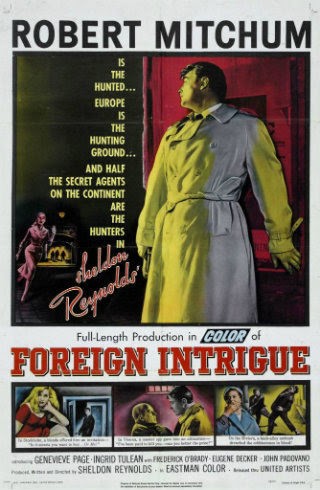
The movie opens on the French Riviera, with a man sauntering round the beautiful grounds of his equally beautiful villa. As he passes into his library and begins to browse the bookshelves, he’s struck down by a massive heart attack. The man is Victor Danemore and the first person to come upon him as he draws his dying breath is Dave Bishop (Robert Mitchum), his publicist. It’s soon revealed that Danemore was a genuine mystery man, one of those characters that could really only be a product of the 50s. Bishop was hired to fabricate an identity for his enigmatic employer and he knows no more about him than the inventions he’s been feeding the outside world. One would think the dead man’s young widow, Dominique (Genevieve Page), could fill in a few gaps but no, she knows nothing of the years before her marriage. So Bishop takes it upon himself to delve into Danemore’s past, to find out who this man was and why a Viennese lawyer is seeking confirmation of the circumstances surrounding his death. The quest moves from France to Austria and then on to Sweden, with Bishop encountering a variety of shady characters and dangerous situations as he tries to piece together Danemore’s fractured history. As he chases the shadows of the past down the murky, cobbled alleys of post-war Europe, a picture begins to emerge. The tale involves murder, blackmail, Nazis and collaborators, and how a legacy of treachery can poison the futures of the unsuspecting. Foreign Intrigue is a film that is very much of its time, sharing some of the characteristics of The Third Man and Mr Arkadin, yet never attaining the levels of suspense or artistry of either. There are some nicely crafted set pieces and atmospheric moments but the end result isn’t entirely satisfying. In short, the build-up promises much more than the pay-off can hope to deliver.

Foreign Intrigue was brought to the screen by Sheldon Reynolds – he wrote, directed and produced the movie – after Robert Mitchum expressed an interest in working with him. Reynolds had had some success with his TV show of the same name, and hastily knocked out a script. As I understand it, a good deal of the appeal of the show was its use of authentic European locations, and the movie employs the same tactics. This aspect is probably the greatest strength of the film, lending it an air of glamour and reality that even the most lavish studio mock-ups couldn’t hope to achieve. Leafing through Lee Server’s biography of Mitchum certainly gives the impression that the movie was an enjoyable one to make, and the star seems to have had a good time hopping around Europe. Reynolds and cameraman Bertil Palmgren compose some very attractive images and create atmosphere and suspense here and there, but the script fails to provide adequate backup. There’s too much shallow characterization to generate real interest in the people involved, and there are too many plot holes and unresolved questions. Even the finish is weak, its open-ended quality betraying Reynolds’ television background – it actually comes off like a pilot where the groundwork is being laid for the forthcoming episode.

Mitchum was the biggest name in the film and the whole thing revolves around his star power. While this could never be counted among his better roles, he’s good enough in the part. His trademark nonchalance is used well and he handles the thick-ear moments with the kind of toughness that makes it feel believable. Amid all the shadowy cloak and dagger stuff, he gets involved in two romantic sub-plots, but I didn’t feel either of these worked especially well. The two females in question, Genevieve Page and Ingrid Thulin (here billed as Ingrid Tulean), certainly look attractive yet the performances are just passable. Page is poorly served by a role that’s seriously underwritten and underdeveloped, while Thulin simply appears uncomfortable and unsure – disappointing when you consider her later success with Ingmar Bergman. However, there’s some fine support offered by Frédéric O’Brady as the double-dealing foil to Mitchum. A quick look at O’Brady’s IMDB entry reveals the man led a life that could comfortably be described as quirky, fascinating and off-beat. A good deal of this unpredictable quality shines through in his performance and some of the film’s best moments occur when Mitchum and he share the screen.

Foreign Intrigue is a film that I’d never had the opportunity to view until recently. It was one of those titles that you see included in filmographies and wonder what it’s like. Being a United Artists production, it’s part of the MGM library and recent arrangement with TGG Direct has seen it making its DVD debut. The movie is presented in anamorphic widescreen I’d describe it as typical of many MGM releases we’ve seen down the years. I mean that the transfer is about medium, some dirt and speckles, fair enough colour and no visible restoration. There are no extra features whatsoever and the movie shares disc space with an non-anamorphic version of The Quiet American. However, the fact that the title has been made available at last, and the very attractive price, should be taken into consideration. All in all, I found Foreign Intrigue to be a reasonably pleasant, if unremarkable, way of passing the time. The movie isn’t anything special and, realistically, will probably appeal mainly to Mitchum completists like myself. Still, bearing in mind how cheap the DVD is, it’s worth a look at least.


The Tall Target

I’ve mentioned before that I’m a big fan of thrillers taking place in isolated or self-contained settings such as old dark houses, ships or trains. The restrictions necessarily imposed are a marvelously effective way of maintaining focus, both for the filmmakers and the viewers. It also makes for effortless suspense as the options open to the characters involved are narrowed down, and a tense, claustrophobic atmosphere is easily achieved. The bulk of the action in The Tall Target (1951) takes place on a train, and the movie uses this cramped stage to enact its dramatic events to great advantage. What makes the film all the more impressive in my view is the fact that there’s not much of a mystery to solve. Nevertheless, what unfolds on the screen holds the attention from beginning to end.

The story is one inspired by a real event – a plot to assassinate Lincoln before his inauguration coud take place. It’s 1861 and the president-elect is due to make a short stop in Baltimore, Maryland before heading on to Washington to take power. Naturally, these are troubled times and talk of secession and war is on everyone’s lips. With Lincoln’s elevation to the highest office in the land it’s only a matter of time before the South declares independence, and war has to be the next logical step. As such, there are those with a vested interest in seeing that the man never gets to Washington. John Kennedy (Dick Powell) is a detective who feels sure he’s stumbled onto a plot to assassinate Lincoln as soon as he sets foot in Baltimore. The problem is no-one wants to believe him, and his chief even goes so far as to threaten him with dismissal if he insists on pursuing the matter. Unfazed by this stonewalling, Kennedy turns in his badge and hotfoots it to the station. His intention: to board the Baltimore train, foil the conspiracy and discover the identity of the ringleaders. However, he immediately hits a snag; his contact, along with his ticket, has disappeared and someone else is claiming to be the real John Kennedy. A quick inspection reveals that the detective’s friend has been murdered, but there’s no way he can prove this. Such an inauspicious start would give most men pause for thought, but Kennedy is nothing if not resourceful and he turns to an acquaintance to back him up. Colonel Jeffers (Adolphe Menjou) is the one man aboard the train who can identify Kennedy and vouch for his credentials. So the soldier and the policeman form an uneasy alliance – Jeffers is no lover of Lincoln’s politics – in the hope of flushing out the would-be killers. The list of suspects is a relatively short one: Jeffers himself, a blowhard industrialist (Will Wright), a young brother and sister apparently traveling on to Georgia (Marshall Thompson & Paula Raymond). Although the villain’s identity is revealed around the halfway mark, I’m not going to spoil things for any people who have yet to see the movie. Anyway, that’s not the point of the film. The greatest anxiety is generated by the doubts over whether Kennedy can prevent the assassination from taking place. Now anyone with even the most rudimentary knowledge of American history knows the answer to that one, but where the script really triumphs is in its ability to leave you hanging on the edge of your seat in spite of this.

Although Anthony Mann had already embarked on his western phase by this time, The Tall Target harks back to the tight little noir thrillers with which he had made his name throughout the preceding decade. Instead of the wide open spaces of the frontier where the drama was played out against a harsh landscape, this film is a closed affair that was shot on sound stages. The actors don’t have a lot of room to move around freely, and that’s entirely fitting for a story where the characters’ capacity for manoeuvre in any sense is severely limited. There are also a lot of typically disconcerting low-angle shots and close-ups of strained faces. Mann seemed to be blessed with good cameramen through most of his career, and Paul Vogel did some excellent work on this movie. Vogel had already shot a number of noir pictures – Lady in the Lake, High Wall, Dial 1119 – and brought that sensibility to The Tall Target. This couldn’t be termed a film noir yet it has the look and feel of one. What we get is primarily a suspense thriller, and it’s a combination of good writing and characterization, as well as atmospheric direction and photography, that ensures it remains gripping. When Kennedy finds himself facing the twin dilemma of being pursued by both the assassins and the suspicious authorities, Mann gets a lot of mileage from such a simple setup as the search for a berth to hide in. Time and again he draws the maximum degree of tension from situations that the viewer knows deep down are going to be resolved favourably. It’s no mean feat to deftly turn potentially trite circumstances into something that has you biting your nails – in fact, I’d say it’s one of the factors which sets the artist apart from the mere journeyman.

Compared to the kind of stuff he’d been doing before, Dick Powell took his career in a completely different direction when he was cast in the role of Marlowe in Murder, My Sweet in 1944. I like the way he worked on the tough guy persona in the following years and carved out a little niche for himself. The Tall Target was one of his last cinema roles before he turned his attention to directing and TV, and he handles the part just fine. Playing a professional detective meant he had to do a bit of a balancing act, conveying the increasing desperation of a lone cop in a race against time yet still keeping just the right side of panic. He got some excellent support from Adolphe Menjou as the newly commissioned colonel. He adds some of his trademark polish to his performance and has the kind of ambiguous quality that helps round out his character. Will Geer brought a lightness of touch to the part of the frustrated conductor, and it’s a welcome contribution amid all the severity. I was also impressed by the sensitivity that Ruby Dee displayed as the slave girl torn between loyalty to her owners and a natural sympathy for Powell’s cause. Paula Raymond and Marshall Thompson were less effective, the former having the misfortune of being handed pretty much a nothing role, while the latter just seemed wooden. To be honest, I’ve never been all that taken with Thompson in anything I’ve seen him in; he always appeared too stiff and repressed for my liking. The cast was filled out with a whole host of character actors who should be familiar faces, including Florence Bates, Will Wright and Percy Helton.

To the best of my knowledge, the only DVD of The Tall Target is the MOD disc available via the Warner Archives. The transfer on that disc isn’t bad; it doesn’t appear to have had any work done on it but it’s in reasonable condition. There are the usual cue blips and the like to be found on unrestored movies though the image is satisfactorily sharp. With MOD discs you generally don’t get any extra features, but this one has the trailer included. I’m a great admirer of Anthony Mann’s work and The Tall Target is a good, solid effort. It has to be said that it’s neither as famous nor as complex as his best films. The lack of complexity shouldn’t be taken as any criticism of Mann, that’s just the way the characters are written, but it may partly explain why it’s not better known. Anyway, it’s a finely crafted little thriller that moves at a good pace and offers plenty of entertainment value. I have no complaints.