Breakheart Pass

poster233

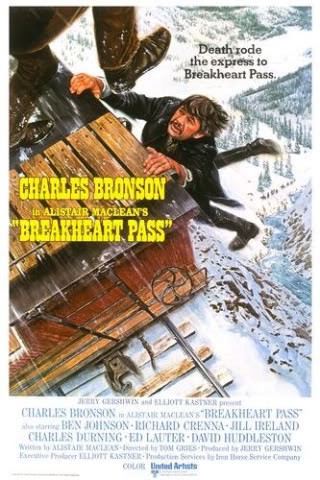
A Charles Bronson western written by a Scotsman and combining elements of a whodunnit and an espionage thriller sounds very much like a recipe for disaster. Despite that, Breakheart Pass (1975) actually works quite well; it’s never going to be considered a classic but it is wonderfully entertaining and looks great. A fine cast and some first class talent behind the camera have a lot to do with this of course. For me, the fact that a significant part of the action takes place aboard a train adds to the pleasure, as I’m a huge fan of anything that exploits the dramatic possibilities of having a group of suspicious characters all cooped up together and denied the opportunity to escape.

A military train carrying reinforcements, and medicines is bound for Fort Humboldt, where a diptheria epidemic is raging out of control. Aside from soldiers, there’s a number of civilian passengers aboard, all with official reasons for being there. Their numbers are swollen right at the beginning though when Marshal Pearce (Ben Johnson) muscles his way through the protocol in order to get both himself and his newly acquired prisoner, a wanted murderer and arsonist, John Deakin (Charles Bronson) a couple of berths. Before the train has even pulled away from the halt two army officers have mysteriously vanished, and it’s clear from the shifty behaviour of practically every passenger that nothing is quite as it seems. While the locomotive chugs its way towards the stricken fort the unexplained incidents, and the bodies, start to pile up ominously. The senior army officer, Major Claremont (Ed Lauter), is growing uneasy while the Marshal and the most prominent passenger, Governor Fairchild (Richard Crenna), seem reluctant to treat matters as anything more than ill fortune and coincidence. All the while, Deakin moves surreptitiously from carriage to carriage pursuing some undefined agenda of his own. It’s only when the troop cars are sheared off and sent careening away into mid-air and subsequent carnage that it becomes clear to everyone how grave the danger is, and that a ruthless killer is in their midst. The movie trades heavily on the fact that all the passengers are potential suspects; it’s a constant guessing game for the viewer to try to figure out who’s behind the ever increasing mayhem. Just about everyone appears to have something to hide yet it’s difficult to see how any individual could wreak such havoc. Of course all is eventually revealed before a slam bang finish draws the curtain on an hour and a half of solid entertainment.

Most of Alistair MacLean’s books which were adapted for the big screen have something to keep you interested. While his writing was fairly formulaic, it’s not hard to see why so many of his stories ended up being filmed; they tend to have a cinematic quality in that the plots are definitely to the fore and the characters usually have a shadowy aspect that’s only gradually revealed. The biggest failing tends to be in the dialogue, his later work suffering especially. Breakheart Pass has a few such instances, when characters come out with lines that just don’t ring true in any way. Director Tom Gries had already directed a couple of very enjoyable westerns, the one of particular note being Will Penny with Charlton Heston. His shooting of the action scenes is hard to fault and, apart from the free-for-all finale, the fight atop the moving train is one of the best parts of the movie. Bronson and former light-heavyweight champion Archie Moore get to slug it out in an excellently choreographed scene that’s tense, exciting and real looking – no doubt the presence of the great Yakima Canutt, as stunt coordinator had something to do with it too. Of course, the aforementioned crash of the runaway troop cars is another of the big set pieces that’s both mesmerizing and horrifying. Furthermore, Lucien Ballard was on lens duty and, as you would expect, the photography of the outdoor scenes is quite spectacular. And rounding out the crew is Jerry Goldsmith, who provided another of his memorably upbeat scores that draws you in from the moment the title credits roll.

As far as the acting’s concerned, Bronson is his usual laconic self, speaking only when there’s a need to but holding off on the physical stuff for long stretches. His character is no brainless lug and he plays him with restraint and enough thoughtfulness to make him believable. Although the wife was also in the cast there’s, mercifully in my opinion, no contrived romance to take the attention away from the twisty plot. Ben Johnson is always a pleasure to watch and just got better and better with age. His character isn’t the best defined one that he played but he still manages to make his mark on the movie – all his little gestures and his characteristic delivery keep reminding you that you’re watching a genuine westerner in action. Richard Crenna and Ed Lauter, as the Governor and the Major, have just enough oily charm and nervy anxiety respectively to keep the viewer guessing about their motives too.

MGM’s UK DVD of Breakheart Pass is a reasonably good effort. The anamorphic transfer is the kind that’s not especially remarkable but doesn’t have any major issues either. The colour looks true enough to my eyes and there’s no notable damage to the print – the image doesn’t pop off the screen but nor does it disappoint. The only extra included is the trailer, along with a variety of subtitle options. So, we’re talking here about a movie that’s best described as good, competent entertainment. It doesn’t offer anything groundbreaking but there are far worse ways to spend an hour and a half. It’s the kind of film that will obviously grip the viewer more the first time it’s seen, however, there’s enough in the action scenes, acting and visuals to ensure it’s worth revisiting.

 

Ramrod

Range wars have always been a favorite backdrop for westerns, men struggling over a piece of land upon which they have built their dreams being an ideal source of conflict. It’s not so common though to see a woman as one of the aggressors, and certainly not one as petite and vulnerable looking as Veronica Lake. However, if there’s a lesson to be learned from Ramrod (1947) it’s surely that one should never be taken in by appearances.

This is a lean, brisk movie where things happen fast and no time is wasted. Within minutes of the opening the main protagonists of the story are introduced and their motivations laid out. Everything revolves around Connie Dickason (Veronica Lake), a headstrong young woman hell bent on establishing herself in her own right and independent of her rancher father. We’re pitched immediately into the middle of a potentially explosive situation where Connie’s betrothed, a sheepman, is about to confront her father and his enforcer, Frank Ivey (Preston Foster). Ivey is the man Connie’s father would like to see her paired off with and he’s not averse to the idea himself. When the the sheepman decides that he values his hide more and thus backs down Connie turns her attention to a drifting cowboy and former drunk, Dave Nash (Joel McCrea). Nash has no interest in involving himself in the Dickason’s affairs at first, but a run-in with the bullying Ivey leads to a change of heart. He decides to sign on with her as her foreman, or ramrod, and face down her father and Ivey. Nash wants to use the law to secure Connie’s rights but she has other ideas on how to go about things. At the heart of the picture are Connie’s machinations, seductively playing the men off against each other to achieve her own ends. All of this deceit inevitably leads to tragedy and the loss of many innocent lives, although Connie blithely dismisses the bloodshed as a necessary if distasteful step on the road to fulfilling her ambitions. It’s only at the end, when her dreams are almost within her grasp, that this scheming puppeteer realises that her self-absorbed ruthlessness has driven away the very thing she desired most.

Joel McCrea’s portrayal of Nash is spot on, his calm and inner strength fitting for a man who has come face to face with personal tragedy and dragged himself back from despair. His honest, straight shooting persona is also ideal for a man who finds himself duped and manipulated by Connie. In fact, every man in the film falls prey to her deceptions at one point or another. Lake was clearly trading on her film noir credentials as she plays what is essentially a femme fatale out west. Her diminutive stature obviously rules out the possibility of her involving herself directly in any of the violence but her awareness of and confidence in her own femininity, and its attendant power, ensures that she calls the shots at almost every point. Director Andre de Toth was married to Lake at this time and he handles not only her scenes but the whole film very well. While he couldn’t be classed as one of the great directors, de Toth was certainly competent and made enough good films to be worthy of more attention. Aside from a number of very enjoyable collaborations with Randolph Scott, he also made the superior Day of the Outlaw and a handful of quality noirs. He was especially good at shooting action and the stalking by night of McCrea’s friend is particularly well done. It’s also worth noting the tough edge he brought to proceedings with a cigar ground into a man’s hand to provoke a gunfight and a savagely brutal beating being some of the highlights.

While there are plenty of good things to say about Ramrod the film, unfortunately, that not the case with the DVD. The only edition that I’m aware of is the Suevia release from Spain, and it’s pretty poor stuff. The master looks to be taken from an old VHS cassette and all the expected faults are present in the transfer. The image is scratchy, dirty and lacking in definition, and the audio is weak too. Despite that, it remains quite watchable, although there is an especially bad section beginning on the hour mark and continuing for about two minutes. In terms of quality it’s reminiscent of a mid-range PD title. However, as things stand, it’s the only version available – I’m not sure where the rights for this reside but I have a hunch it could be with MGM. On the plus side it can be had for very little money and there are no forced subs on the English track. I think this is a neglected little western with noir undertones that is well worth a look; anything starring McCrea and directed by de Toth deserves that at least. I’d imagine a decent release would go some way towards elevating its status.

3 Godfathers


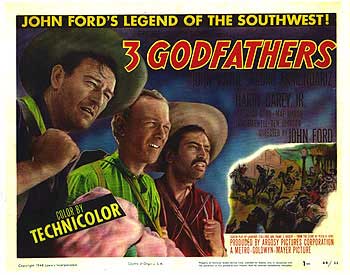
MPW-9143There haven’t been too many westerns that are set around Christmas, in fact I’m struggling to think of any others apart from 3 Godfathers (1948) and the earlier versions of the same story. While it starts out as a fairly standard western it soon turns into a play on the nativity story and the journey of the three wise men. It’s one of John Ford’s more sentimental pieces and the symbolism is laid on a little thick at times, but the cast and visuals carry it through the sticky patches. I’ll grant that the whole thing can seem a bit contrived yet the story, and its message of redemption and the good that lurks within all of us, remains affecting.
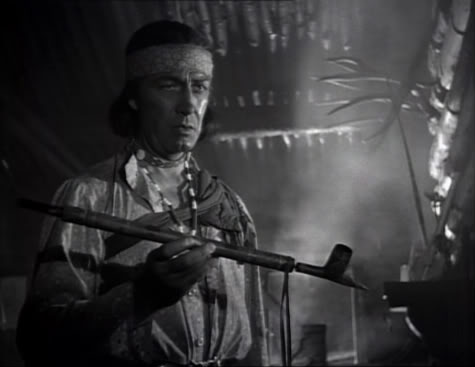
The movie opens in fairly conventional fashion, with the three main protagonists Robert Hightower (John Wayne), Pedro (Pedro Amendariz) and The Abilene Kid (Harry Carey Jr) surveying a town they’re about to enter and rob. Before they can get down to business, however, they get chatting to a local resident (Ward Bond) who turns out to be the local lawman. Thus far much of the action is played for laughs, and broad Fordian laughs at that, and the light heartedness even extends to the raid on the bank. The first really serious note is struck when The Abilene Kid takes a bullet to the shoulder as they attempt their getaway. As the three men race out into the desert with the law hot on their heels, one shot finds its target and punctures the vitally important water bag. Safe in the knowledge that no one is going to travel far in the parched wilderness with only a limited supply of water the lawman eases back and sets about laying a trap. That singe shot has essentially sealed the fate of the three outlaws, as they discover that the law (with the help of the railroad) is one jump ahead of them and bent on keeping them away from any source of water. In an effort to outsmart the authorities, the men double back but in so doing stumble upon a situation that will bring about profound changes within them all. They come across an abandoned wagon containing a pregnant woman who’s about to give birth. Their most basic human instincts are aroused by this pitiful scene and, after seeing that the baby is delivered, find themselves giving their oath to the now dying mother to protect her infant son. From this point on a gradual transformation takes place wherein each man suppresses his own selfish needs in order to ensure the fulfillment of their promise. As they trudge across the gruelling desert, shedding their possessions along the way, they come to view the protection of their new godson as the only purpose in their lives. As such, their trek turns into a kind of pilgrimage to cleanse themselves of the evil that had motivated them until that time. As I said the symbolism can be a little heavy handed (following a star to the town of New Jerusalem etc.) but the hardship of the journey and the fact that these hardened criminals are willing to sacrifice themselves for the sake of an innocent and a promise prevents the film from becoming a parody.

John Ford opened the film with an onscreen tribute to his departed friend Harry Carey Sr and then took the further step of casting the latter’s son in the pivotal role of The Abilene Kid, the conscience of the three bad men. However, that’s about as far as the old man’s sentimentality went for it’s well documented that he drove his cast mercilessly in the searing heat of Death Valley. Despite, or maybe because, of this the performances of the three leads are first rate. Carey in particular is touching as the callow youth who’s simultaneously running from and striving to retain some of his boyish innocence. The way he calmly accepts his fate before such thoughts enter his companions’ heads is a fine piece of acting. In fact, Ford granted the young man some of the best scenes in the movie: singing over the grave of the baby’s mother and then his own death scene. Both Armendariz and Wayne were handed more straightforward roles as the older and more experienced men and they don’t disappoint either. The part of Robert Hightower has none of the complexity of Wayne’s more famous and prestigious performances yet he does all the script and director ask of him, and carries the picture alone for a significant time. The bulk of the action takes place outdoors on location in Death Valley and Ford creates some beautiful and bleak images – the dust storm (with all its attendant symbolism) being a particular highlight. The support cast is filled up with all the familiar faces from the “Stock Company”, Ward Bond and Mae Marsh getting the lion’s share of the screen time.

3 Godfathers is widely available on DVD from Warner. I have the R2 disc, but I’ve heard that the US version is the same, and the transfer is a good one. Print damage is minimal and the colour is strong, the outdoor scenes faring best to my eyes. The only extra included is the theatrical trailer, and a variety of subtitle options. While this is not one of Ford’s very best, it remains a top film by anyone’s standards. In a way, it’s what you might call a typical Ford movie in that it contains most of his trademark visual and thematic motifs. All in all, it’s a satisfying and uplifting production that works well both as a seasonal film and as a traditional western.

Finally, as this will be my last post before the holidays I want to take the time to wish all those who have followed, commented or just stopped by a very happy and peaceful Christmas. Be seeing you again in the New Year.


Devil’s Doorway

poster229

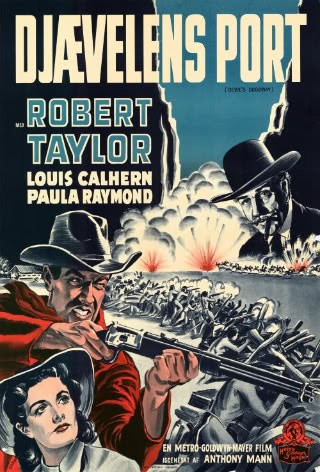
Before 1950 the injustices visited upon the Native American people were essentially ignored, or at the very least only touched on, in the cinema. However, in the space of a year two major Hollywood productions would use the plight of the Indian as their central theme. Delmer Daves’ Broken Arrow was notable for its sympathetic portrayal of the Apache, but Anthony Mann’s Devil’s Doorway (1950) went even further by concentrating on the naked and ugly racism confronting those Indians who had done their best to embrace the ways and laws of the white man. It’s a much more tragic film than Broken Arrow and consequently more powerful; the fact that this power remains undiminished even for a modern audience demonstrates just how radical a picture this must have been sixty years ago.

Lance Poole (Robert Taylor) is a Shoshone who has decided to adopt the classic American mindset i.e. looking to the future rather than dwelling on the past. Not only has he anglicized his name but he has also taken a huge leap of faith by enlisting in the white man’s army and fighting in the Civil War. Returning home to Wyoming as a highly decorated veteran (having won the Congressional Medal of Honor no less), he is full of optimism and hopes for a bright future. He’s confident that the recent horrors of the battlefield will have purged the nation of its desire for further bloodshed. However, soon after his triumphant return he has to face the fact that not everything or everyone has changed as much as he might have hoped. The old grudges and prejudices still live on in the hearts of some, notably an eastern lawyer, Verne Coolan (Louis Calhern), who’s moved to Wyoming for his health. Coolan’s snide comments are only a foretaste of what’s to come though, as the local doctor’s refusal to attend to Poole’s ailing father until it’s too late proves. While Poole busies himself building up his cattle ranch and his fortune, Coolan is angling for a chance to seize the ancestral land and teach the red man a lesson on climbing above his station in life. Coolan’s opportunity comes with the Homestead Act, which allowed for the breaking up of former tribal land into individual claims, and he encourages a mass migration of sheepmen in the hopes of forcing Poole off his land. Although Poole is  initially persuaded to hold his fire and try for a compromise by female lawyer, Orrie Masters (Paula Raymond), the scene is set for violent confrontation between the Shoshone and the sheepmen that Coolan is ruthlessly manipulating. As tensions rise, and the viewer’s outrage at the double standards and open bigotry on display similarly escalate, Poole must finally concede that his dreams of peaceful co-existence are nothing more than the foolish longings of a man too eager to buy into the glib promises of pragmatic politicians. When he dons his old uniform, with his medal proudly pinned in place, to face the same army that he once served with distinction there is a poignancy and irony that drives the message of the film home most eloquently.

£20

Anthony Mann had spent the 40s building up his reputation with a series of tight little noirs frequently lensed by master cameraman John Alton. Both men brought their style and sensibility to a western setting in Devil’s Doorway. Given Mann and Alton’s background it’s not altogether surprising that the movie has both the look and feel of a film noir; there are plenty of dark, shadowy scenes and an abundance of low angle shots. One scene that highlights this perfectly is the fist fight that Poole is goaded into in the saloon by Coolan and one of his cohorts. Everything is shot in the cramped confines of the bar with smoke and shadow blending together as the two men hammer each other savagely – there’s no musical accompaniment to distract from the sound of the punches landing, and the quick cutting alternates between the increasingly battered faces of the fighters and the even more grotesque visages of the rubbernecking customers. Having said that, there’s no shortage of more traditional genre imagery either, and Mann demonstrates a breadth of vision and skill with large-scale action scenes that would be further developed in both his later westerns and epics. For me, Robert Taylor was convincing as the Shoshone warrior caught between two camps. He injected a huge amount of humanity into the role of Lance Poole and produced a fully rounded character that transcended the “noble savage” caricature. I guess the black and white photography helps, but I never caught myself thinking that this was just a guy in dark make-up playacting. Louis Calhern also did sterling work as the slimy lawyer who uses convenient statutes as a means of disguising his own prejudices. Paula Raymond was good enough as the woman caught in the middle, but the script shies away from depicting an all-out romance with Poole – the movie was in all honesty already pushing the envelope as far as could be expected for the era. I might also mention the strong support particularly from Spring Byington and Edgar Buchanan.

Currently, there are only two editions of Devil’s Doorway available on DVD. There is an MOD disc from the Warner Archive in the US and a Region 2 pressed disc from Warner/Impulso in Spain. From the perspective of international customers neither one is ideal – the US disc being both expensive to acquire and on potentially suspect media, while the Spanish release is exclusive to El Corte Ingles for who knows how long with the attendant shipping costs. I viewed the Spanish disc, and the transfer is generally a strong one with good contrast and detail. However, it is unrestored and there are the usual scratches, nicks and blemishes – though never to the point of distraction. There is English and Spanish audio with removable Spanish subs. The disc comes in a slip case with a 34 page booklet, in Spanish naturally, that contains a very nice selection of still photographs and original advertising material. When one considers the development of the western, and the career of Anthony Mann too, this is an important title. As such, it’s disappointing that it should be marketed so restrictively on both sides of the Atlantic. However, the Spanish disc does at least afford the film a degree of respect that’s lacking in the US release. Devil’s Doorway seems to have got lost between Mann’s earlier noir pictures and his subsequent psychological westerns, but it actually acts as something of a bridge. It’s a film that’s intellectually and emotionally satisfying while it also provides solid western entertainment. Recommended.

Saskatchewan

Cinema is action, action, action, but it must always be in the same direction – Raoul Walsh.

That maxim from the veteran director could be applied to many of the movies he made, and Saskatchewan (1954) genuinely lives up to it from beginning to end. In a lot of respects this is a routine film with no special message to sell. However, as with most of Walsh’s work, it remains enjoyable for it’s total lack of pretension and the pacy shooting style.

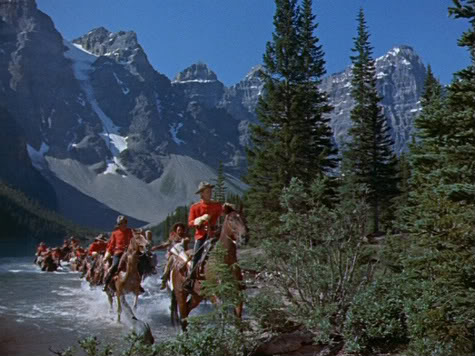
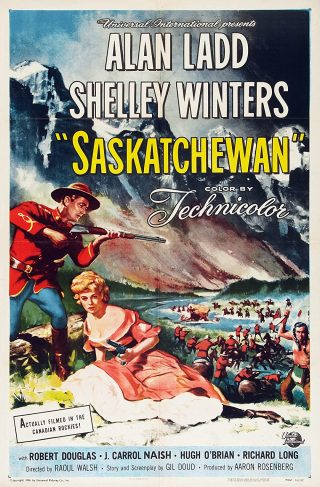
The plot concerns O’Rourke (Alan Ladd), a Mountie with close connections to the Cree due to his being adopted by them as an orphan. This affinity for the natives is made clear right from the start when O’Rourke and his Cree half-brother, Cajou (Jay Silverheels) are seen hunting together. Their sport is interrupted though when they stumble upon the site of an ambush by Sioux fleeing north after routing Custer’s 7th Cavalry at the Little Big Horn. There is only one survivor, an American woman called Grace (Shelley Winters), who escaped death by hiding herself at the onset of the attack. She proves reluctant to return to the fort at Saskatchewan with her rescuers, the reason being she’s wanted across the border in Montana for murder. With the threat of the Sioux forging an alliance with the Cree and fomenting trouble in Canada growing all the time, the Mounties are ordered to proceed south and link up their colleagues in an effort to drive the newcomers back to the US. That trek is beset with difficulties in the shape of constant Sioux harrying, a volatile and intolerant marshal bent on returning Grace to Montana, and a fresh off the boat commander with a firm grasp of regulations but woeful ignorance of the local conditions. As the possibility of the total annihilation of the command looms ever larger, O’Rourke has little choice but to stage a mutiny and try to get as many people as possible back to safety. All the while the Sioux and Cree are inching their way towards a pact that would surely guarantee war with the Canadians. There’s plenty of bad history in here, not least the fact that those Sioux who did run north had no intention of starting an uprising in Canada, but the sheer pace of the movie and the relentless action make it easy to ignore this and simply wallow in some of the stunning images on view.

Raoul Walsh had a real talent for making watchable and entertaining films from thin, and sometimes pretty trite, material. He was always at his best when filming on location and staging actions set pieces, and Saskatchewan offered ample opportunity for indulging in both. The Canadian scenery provided a breathtaking backdrop and the director’s sure touch meant that events rattle along, peppered with well staged battle scenes. I always find it odd that Alan Ladd’s greatest and most iconic role also signalled his decline. His post-Shane roles were a mixed bag ranging from mundane to reasonably interesting, with Saskatchewan falling somewhere in the middle. The part of O’Rourke doesn’t call for him to dig especially deep or stretch himself, despite the fact that the opening set-up suggests that there will be some inner conflict to deal with. The pull of conflicting loyalties is explicit enough in the script, but there’s never any real sense of the turmoil this must necessarily evoke in O’Rourke. Ladd’s performance is by no means bad, it’s just not particularly involving. The only female of note in the movie is Shelley Winters as the fugitive O’Rourke grows increasingly attached to. I’ve never been a fan of Winters – even when she got to play fairly independent characters such as Grace there was still that slightly whiny and self-pitying quality about her that turns me right off. As the marshal determined to extradite Winters back to the US, Hugh O’Brian makes a satisfying villain. He’s clearly burdened by some dark secret, and is suitably mean when shooting Indians in the back and slugging Winters. For me, the most enjoyable role in the movie was the one handed to J Carrol Naish. His buckskin-clad Frenchman has a good line in quick fire wit and it’s hard not to smile at his self-confessed ambition to start his own tribe, already producing six children in the first six years of marriage to a Cree squaw. Naish was one of those unsung character actors who turned up in countless movies and rarely disappointed.

There are DVD releases of Saskatchewan in Germany, France (although this is almost sure to have burnt-in subs) and Australia. I have the German edition from Koch Media and the transfer is a very pleasing one. The film is presented 1.33:1 and is generally clean with colours that really pop. There are no forced subs on the English track and extras consist of the trailer, a gallery and a booklet (in German of course). I’d describe the film as entertaining without being anything special. Both acting and direction are competent and professional and it’s a lovely movie to look at. This is a lower tier western that sets out primarily to offer pacy and colourful diversion – taken as such it delivers successfully.

Lone Star

poster219

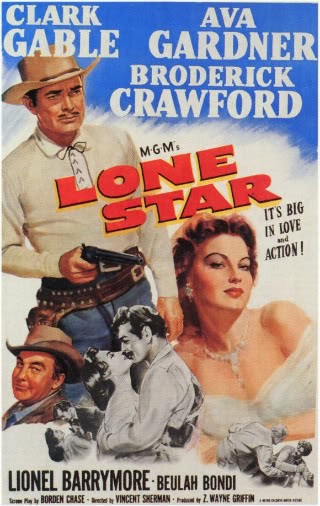
Last time I found myself singing the praises of a movie that represents some of the best that westerns in the 1950s had to offer. Now I’m looking at another western, also from the 50s, but not at all in the same class. Lone Star (1952) is one of those pseudo-historical pieces that frequently end up skating on thin ice due to their vaguely pompous air. The problem with this one could be summed up in one word – politics. When a film sets out to glorify a political position, any political position, it almost always does so at the expense of pace and drama. Lone Star isn’t an especially long movie – about an hour and a half – but it just plods along.

The plot revolves around the question of whether Texas was to allow itself to be absorbed into the US or go it alone as an independent republic. Now this was a fairly complex issue, and one worthy of some research. However, by placing this at the centre of a western that badly wants to be an action picture a rare feat is accomplished: the facts are merely skimmed over, the characters are stripped of personality, the narrative drive is killed stone dead, and the viewer becomes apathetic. Dev Burke (Clark Gable) is a Texas cattleman with a patriotic background – it’s mentioned that he fought against Santa Anna – and the trust of prominent men. With the annexation of Texas hanging in the balance, Burke is handed the task of heading south to try to head off the challenge of those clamoring for a republic. The chief mover and shaker in the anti-annexation camp is Thomas Craden (Broderick Crawford), and he needs to be silenced if Andrew Jackson and Sam Houston are to achieve their goal. En route to Texas, Burke comes to the aid of Craden who’s running hard from a Comanche war party.

£2

There’s an exciting and well filmed sequence where the two men hold off the Comanche through brutal hand-to-hand combat. If only there were more of this then we’d be looking at a superior movie. But no, no sooner has the fight ended than we’re back to the turgid business of arguing the pros and cons of statehood. Burke hasn’t revealed his identity to Craden and thus finds himself welcomed into his inner circle. Everything would seem to be going according to plan for Burke, were it not for the fact that he meets Martha Ronda (Ava Gardner). She is Craden’s woman and a rabid opponent of annexation. Inevitably, both Burke and Martha are attracted to each other but the path of true love can never be smooth. It’s not unreasonable to expect some kind of triangle to emerge, and it does indeed happen. But the sticking point is not a question of conflicting emotional loyalties – no, it all comes down to appeasing one’s political allegiances! In the end, everything is resolved in a slam bang finish involving a well staged siege and assault. However, the final scene is a real cack-handed affair that runs contrary to all that’s gone before.

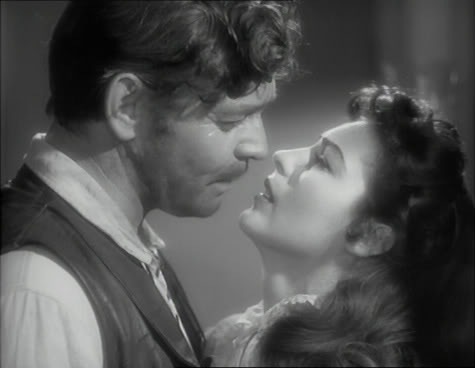
Vincent Sherman was a genuine journeyman director, a man capable of turning out a pretty good movie when the material was right. Unfortunately, Borden Chase’s script is a real dog and I’d be hard pushed to imagine anyone managing to rise above it. Still, there are a few good action scenes and the outdoor stuff looks quite good. The cast do what they can – and there’s no shortage of strong support from Lionel Barrymore, Moroni Olsen, William Conrad, Ed Begley and Beulah Bondi – but they’re ultimately hamstrung by the quality of material they have to work with. Gable plays the kind of honourable rogue that was his trademark and Gardner looks exceptionally good. The problem is the frankly ridiculous romance they are required to blunder through – the whole will-they-won’t-they thing stretches credibility to breaking point given the framework in which it’s set. Crawford’s not bad either, and he’s not an actor I’ve ever been especially fond of, but is also let down by the writing.

I’m pretty sure that the only DVD of Lone Star is the Warner/Impulso release in Spain. The image on the disc isn’t bad, but there are scratches and speckles throughout and I suspect it’s undergone some contrast boosting. There are no extras whatsoever and the Spanish subs are removable on the English track, regardless of what the menu appears to claim. To be honest, this is not a good film and it’s not representative of 1950s westerns. What it does have going for it is the star power of Gable and Gardner and a handful of action set pieces. In all good faith, I couldn’t recommend this to any but the most diehard Gable or Gardner completists.

Last Train from Gun Hill

pa98nyp

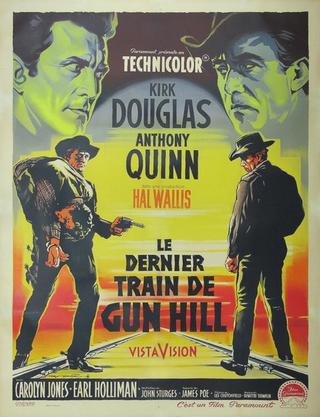
I love the complexity of westerns from the 1950s. Moreover, I love the fact that this complexity could be contained within the framework of relatively simple and compact stories and still lose nothing in the telling. Take Last Train from Gun Hill (1959): on the face of it we have a fairly standard pursuit and revenge tale, yet it successfully tackles the themes of racism, loyalty (both to friends and to family), justice and the father/son dynamic. Not only that, but it wraps the whole thing up in a run time of an hour and a half or thereabouts. The result is tight, intense moviemaking that draws you in from the very first shot and only relinquishes its grip when the final credits roll.

Matt Morgan (Kirk Douglas) is a US Marshal with a Cherokee bride and a young son. Within minutes of the opening Morgan’s wife has been assaulted, raped and murdered by two young thugs. This is a brutal and shocking way to begin any story, and despite the camera mercifully cutting away none of its power is diminished. The point is further hammered home when Morgan arrives to survey the terrible aftermath, horror, sorrow and outrage all flitting across his features. Morgan’s grief is compounded by his realisation that a saddle left behind at the scene of the crime points the finger of guilt at an old friend and comrade Craig Belden (Anthony Quinn). Morgan doesn’t for one moment believe that Belden himself could have been directly involved in this heinous act, but the presence of the saddle means some member of his entourage must have been. The sting in the tail comes from the fact that the chief culprit is Belden’s son and heir Rick (Earl Holliman), a spoilt and inadequate young man living hopelessly in his father’s shadow. The perverse and damaging nature of this father/son relationship is eloquently summed up in a short scene at Belden’s ranch house. When the foreman ribs the boy about the reason for a cut on his face Belden goads him into fighting for the honour of the family name – Rick is soundly beaten, causing humiliation to him and disappointment to his father. When Morgan learns the truth the scene is set for a confrontation between the two old friends. The bonds between the two men are strong but the events that have taken place put an intolerable strain on them. Morgan is determined to take Rick back to stand trial while Belden is equally determined to stop him. As Morgan and his prisoner wait in a cramped hotel room for the arrival of the last train, Belden and his men lay siege outside. There’s more than a passing resemblance to Delmer Daves’ 3:10 to Yuma at this point, although Rick lacks the charm of Ben Wade and Morgan’s personal loss lends him more inflexibility than Dan Evans. As the clock ticks inexorably towards the arrival of that last train the pressure mounts on Morgan, and the issue is raised of whether he too might have to face the same situation as Belden somewhere down the line – for Morgan (like his former friend) is now a widower faced with the unenviable task of trying to raise a boy alone.

£2

John Sturges always knew how to shoot an action scene and there can be no complaints on that score here. However, this movie isn’t a string of back to back shoot-em-up set pieces, and it’s sometimes forgotten how good Sturges was at coaxing strong performances from his cast. Both Douglas and Quinn give convincing portraits of men unaccustomed to ceding ground to anyone and torn between conflicting loyalties. The few scenes where they actually share the screen are a pleasure to watch – the initial meeting at the ranch when both men realize who really killed Morgan’s wife, and what the consequences must inevitably be, contains some marvellous work with an enormous amount of feeling conveyed simply through subtle glances. As good as Quinn is, Douglas steals the show with his grim determination and suppressed fury boiling just below the surface. He’s playing a man for whom respect for the law and the badge he carries is paramount, even to the extent that his own personal grief is subordinated to duty. There are only two occasions when his professionalism is allowed to slip momentarily, both triggered by racial slurs directed at his murdered wife. The first is a reflexive burst of physical violence against a local loudmouth. The second, however, is merely vocal but has a sadistic quality that is quite chilling – his deliberate and detailed description to a shackled and cowed Rick of how the judicial process that will lead to his certain death will be as slow and protracted as any Indian execution is the only time he permits himself to savour the taste of revenge.

Earl Holliman played Rick as a whining, craven creature who never elicits the least sympathy from the viewer. This seems to be largely down to the writing, and if any particular criticism is to be made of the film it’s that Rick’s character is just too unlikeable. If there had been something even vaguely attractive about him it would have added yet another layer to the story, but that’s really just nitpicking on my part. Carolyn Jones has the only female role in the movie (not counting the extremely brief appearance by Morgan’s wife) as the on/off lover of Belden. Aside from providing a counter to all the machismo on display, she occupies (for most of the film at least) a place similar to that of the viewer i.e. watching from the sidelines while feeling some sympathy for both the protagonists. In the end, it’s her respect for Morgan and his motivation, and her disillusionment with Belden and his son’s brutality, that leads to the decisive shift in the balance of power.

The R1 DVD from Paramount has Last Train from Gun Hill looking just great. The vistavision elements have been transferred beautifully at 1.78:1 anamorphic, with colours looking rich and saturated. I can’t say I noticed any damage or flaws worth mentioning and the image is sharp and detailed. There are no extras whatsoever on the disc, and that’s a pity as this is a movie that would seem to be just begging for an intelligent commentary track. This is a movie – like many by Sturges in fact – that knows how to keep the tension simmering and the viewer hooked. There’s no preaching or tiresome moralising yet the messages are all communicated clearly and seamlessly without impeding the narrative or the entertainment. In short, it’s a high class film.


The Wonderful Country

I often find myself at a loss to understand why certain films get shunted aside and miss out on the attention that others seem to attract effortlessly. And I’m not talking about trite, derivative time wasters here, I mean quality movies that just get passed over and forgotten. One such case is The Wonderful Country (1959) which quite possibly contains some of Robert Mitchum’s best work. Actually, maybe I’ve answered my own question there; the 50s positively overflow with so many classy westerns it’s hard to keep count of them, and Mitchum was the kind of actor for whom the phrase “undervalued performer” might have been specially coined.

Martin Brady (Mitchum) is a gunman, an enforcer, in the employ of the Castros, a powerful Mexican family. On a rare sojourn across the border to purchase arms for his masters he meets with an accident and finds himself laid up with a broken leg. It’s during this convalescence that we learn a little about Brady’s past, and how he came to be a hired gun south of the border. This is his first time back in the US since his youth, having gone on the run following the killing of his father’s murderer. By this time Brady has become Mexican in all but name, dressing, speaking and acting like those with whom he has chosen to live. The kindness shown him (by the local doctor, a German immigrant, the local commander of the Texas Rangers, and most especially the wife of the garrison commander) causes Brady to reflect on his life thus far. Two things in particular colour his perceptions – the first being the fact that the Ranger captain informs him that he’s no longer considered a wanted man; the second, and more influential, is the attention he draws from Mrs Colton (Julie London), a woman trapped in an unsatisfactory marriage to a stiff-necked soldier. However, life’s never that simple, is it? When an argument with a local roughneck leads to a fatal shooting, Brady finds himself back at square one. There’s a nice piece of filming at this point as the camera zooms in on Brady’s face to catch the moment when he realizes he’s thrown it all away again – great naturalism and reaction from Mitchum. So, he’s left with no choice but to hightail it back to Mexico, the wonderful country, again. But if he thinks he’s left his troubles behind he’s mistaken. His return plunges him into a deadly power struggle between the two Castro brothers that will finally force this former drifter to decide where true allegiance lies. This, the question of where a man really belongs, constitutes the core of the film, and I’m not sure it’s completely resolved by the end. Throughout the movie, those from both sides of the border lay claim to Brady and try to entice him back. Brady himself professes to have no home, and at one point his enraged patron screams at him that he belongs nowhere. Surely that’s not true though – doesn’t every man have the right to find some place that he might reasonably call home? In the end, Brady makes his choice but, as he sets off on foot towards his new life, there’s still a lingering doubt as to whether he’s taken the right path.

The Wonderful Country is a real slow burner, beautifully directed by Robert Parrish. The contrast between the US and Mexico is highlighted by the filming styles adopted for the respective locales. While the scenes based in the US are framed tighter and more cramped, as soon as the action moves to Mexico the aspect opens out and thus gives a sense of freedom and space. The location work around Durango not only looks good but also adds to the feeling of realism and grit. Mitchum (who also served as executive producer) found in Martin Brady a role that fitted him like a glove. The character of Brady is a quiet, introspective one – an essentially lonely man (as I think all the great western heroes are) trying to find his place in the world. Mitchum was often, and to an extent still is, unfairly criticized for his apparent non-acting, but he was a master of underplaying and everything is there in the eyes and face. Brady isn’t a character given to showing off or expansiveness, and Mitchum subtly conveys all of his melancholy and uncertainty. I never thought Julie London was anything exceptional as an actress and she doesn’t really have much to do here beyond looking sultry and hungry, but she carries that off satisfactorily. Gary Merrill, as her husband, has a pretty one dimensional part as the cold fish army commander. Pedro Armendariz, on the other hand, gets one of the choice roles as Cipriano Castro, the initially sympathetic brother. In his few scenes he brings a marvelous urbanity to his part that seems at odds with his true ruthless nature. It’s also worth mentioning that Charles McGraw appears in what amounts to little more than a cameo role – a pity since it’s always a pleasure to see him rasping and swaggering his way through any film.

To the best of my knowledge, The Wonderful Country has only had two releases on DVD, one in Spain and one in Australia. I once owned the Australian disc but binned it, from memory it was a drained and blurry P&S mess. The Spanish disc from Suevia, however, presents the film quite nicely. The transfer is widescreen 1.66:1, though unfortunately not anamorphic. There isn’t any noticeable damage, colours are generally very good, and the image is sharp except for a very few shots. Oh, and subtitles are not forced on the English track. All in all, this release is acceptable and, bearing in mind this is a MGM/UA property, probably as good as the film is going to look on DVD in the foreseeable future. I’d rate this movie very highly as one of the top westerns of the 50s – in other words, we’re looking at a top-flight production here.

Yellow Sky

spmzuhf


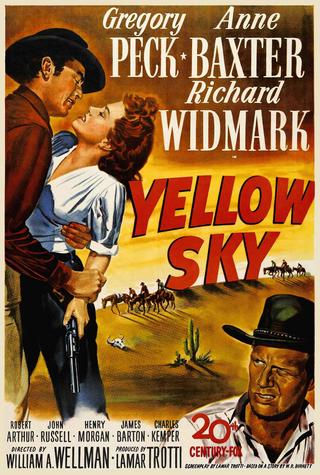
OK, so I’ve taken a break from this thing for a while now. I’ve generally found that I need to take a step back from time to time and allow myself a chance to recharge the batteries before starting anew. My last post was on a western, and my latest one is also another oater – for the sake of continuity if nothing else. Yellow Sky (1948) is a typically stylish William Wellman movie that trades on those perennial themes of greed and honor.

The film opens with a bank raid in a small town and concludes, with a quirky twist, in that same town. However, the robbery plays only a small part in the story; it’s the events that it leads to that form the core of the movie. Stretch Dawson (Gregory Peck) is the laconic leader of a band of outlaws who think they’ve just made an easy killing. While their initial getaway appears to have been clean there is a troop of soldiers on their trail, and the outlaw gang find themselves forced onto a barren and punishing expanse of salt flats in an effort to elude capture. From this early stage the first cracks appear in the group. Stretch is the acknowledged boss but his authority begins to be challenged by Lengthy (John Russell) and especially by Dude (Richard Widmark). As these men haul themselves painfully across the hellish landscape they are driven to the very limits of human endurance. Just as they are about to succumb to the effects of exhaustion and dehydration they stumble into the abandoned former mining town of Yellow Sky, and this is the point at which the story becomes most interesting. The old ghost town is not all it seems – for one thing it’s not strictly a ghost town at all. There are two inhabitants, an old half-crazed prospector and his daughter ‘Mike’ (Anne Baxter). Even in their weakened state the outlaws are not so dumb as to believe these two are living there for the good of their health. Putting two and two together, they decide that there’s only one reason anyone would choose to live in a dead town – gold. What remains to be seen is how far each individual is prepared to go in order to satisfy his craving for riches, and whether or not the notion of honour among thieves has any basis in truth. Like all the best westerns, it raises questions about one’s word of honour and, in this case, if that has any value for those who live outside the law.

£19

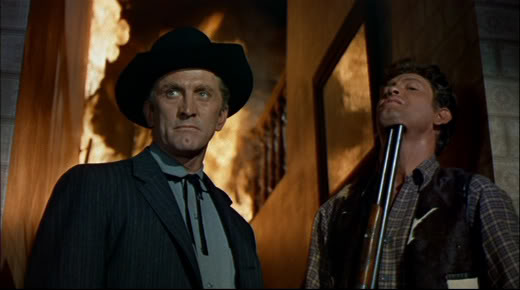
William Wellman’s direction offers a lesson in style, utilizing close-ups, long shots, deep focus, shadows and high contrast. There’s also an especially notable shot down the smoothly rifled barrel of a gun (see pic. above) which foreshadows the famous 007 pre-credits sequences. I’d also like to mention the climactic shootout between Peck, Widmark and Russell that takes place in the gloomy ruins of the town saloon – all the gunplay is unseen by the audience with only the bloody aftermath revealed. The location photography is another positive feature, with the inhospitable Death Valley occupying the first half before the action moves to Lone Pine for the scenes around the titular town. When looking at the characters, the first thing that jumps out is that every single one is known only by a nickname from beginning to end – the sole exceptions being Peck and Baxter, whose full names are revealed to the viewer. Peck handled his leading role competently as the reluctant hero who eventually finds a kind of redemption. John Russell and Richard Widmark make for a worthy couple of adversaries, the former consumed by pure animal lust and the latter with a hunger for wealth and the power to visit retribution on those he feels have slighted him in the past. Widmark in particular is the epitome of villainy, still at that stage in his career when he tended to get typecast as nasty pieces of work for the hero to vanquish. Anne Baxter’s role called for her to be a kind of self-sufficient tomboy who still remains sexually provocative. To her credit, she managed this balancing act and emerged as a fully rounded character that you can believe in. Throughout the film she proves herself the equal of the male cast members and her only concession to the traditional image of femininity comes at the very end when she dons a frivolous little hat that Stretch has brought her as a gift.

The R1 DVD from Fox presents Yellow Sky in a handsome full frame transfer that’s clean and sharp for the most part. Extras on the disc consist of galleries of advertising material and a selection of trailers. The film itself is absorbing and well paced and it was only at the end that I realized how little violence is present, and how even that takes place off screen. This is one of those late-40s westerns that helped usher in the more complex works that dominated the following decade. Recommended.


El Dorado

poster208

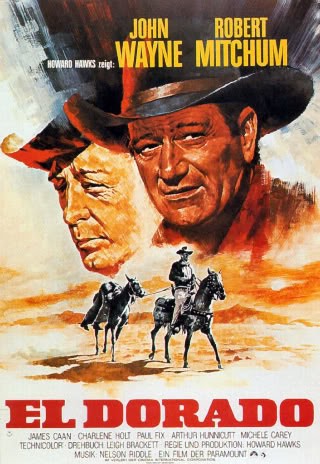
A while back I mentioned directors remaking their own movies, citing Hitchcock and Walsh at the time. However, they’re not the only ones; Howard Hawks reworked the same material that he originally used for Rio Bravo no less than three times. In this case, I think the law of gradually diminishing returns applies – although I’m aware that there are those who might disagree. Hawks’ second trip to the well resulted in El Dorado (1966), a film that improved on its predecessor in one or two ways but ultimately remains a less satisfying work. Ok, it’s not a straight remake of Rio Bravo since it opens the story up a little more in terms of people and locations but it does use the same core situation and characters. There’s the tough professional, the drunk, the old coot and the green kid all holed up in a dingy jailhouse and under siege.

Cole Thornton (John Wayne) is a professional gunman who hires his skills out to the highest bidder. After accepting an invitation from one of the parties involved in a range war he discovers that the job would mean facing off against an old friend. Sheriff J.P. Harrah (Robert Mitchum) is the lawman caught between the feuding factions, and it’s his presence that dissuades Thornton from signing any contract. However, before Thornton can take his leave an accidental shooting leads to an ambush that results in his getting a bullet lodged perilously close to his spine. When he returns some months later he finds that Harrah has taken to the bottle in the wake of an ill-judged love affair. To make matters worse, the nearly incapacitated sheriff is in no position to cope with the ongoing range war that’s about to come to a head. Therefore, it’s left to Thornton to take charge of a rapidly deteriorating situation provoked by an attempted murder and the subsequent arrest of one of the feud’s main players. Up to this point the plot has its own reasonably unique slant. However, once Thornton, Harrah et al find themselves barricaded in the jail it’s Rio Bravo all over again. Where the original had a gentle humour, a gradually built sense of camaraderie and a frisson of sexual tension (thanks to Angie Dickinson), El Dorado rushes things a bit and lays the humour on too thick. Actually, it’s the comedic elements that do the most damage in my opinion. Much of this is based around the character of Mississippi (James Caan) – in particular, his incompetence around firearms and his questionable taste in hats. What’s worse, though, is a cartoonish fight between Thornton and a drunken Harrah that wouldn’t have looked out of place in a Three Stooges short. The climax is also disappointing, the pyrotechnics of Rio Bravo being replaced with a contrived showdown that’s not much more than a damp squib.

In a sense, if you’ve seen one Howard Hawks picture you’ve seen them all. The same themes crop up again and again, namely professionalism and loyalty to one’s comrades. El Dorado is no exception in this respect, we have the tight knit group defying the odds and getting moral support from no-nonsense women. However, there’s a certain flatness to El Dorado, both in the visuals and the reworking of a tried and tested story. The areas where it does score over Rio Bravo are a few of the performances. I can’t honestly fault Dean Martin’s Dude, but Mitchum does bring more weight to his take on the broken down drunk if only because he’s Robert Mitchum. The biggest improvement is the casting of James Caan as the young man taking his first steps in the presence of the big boys. Although the forced jokiness of his character does tend to grate a little after a while he is certainly an actor, something that couldn’t be said for Ricky Nelson. Wayne, of course, is Wayne and it matters not a jot whether he’s playing the sheriff or the hired hand, his star quality ensures that he dominates proceedings. It is interesting to note though that the plot device concerning the bullet in his back was a convenient way to make allowances for the effects of the passage of time and the major health problems he had endured. As for the others, let’s just say that Arthur Hunnicutt, Charlene Holt and Ed Asner were no match for Walter Brennan, Angie Dickinson and Claude Akins. While I’m drawing comparisons, I might just add that Nelson Riddle’s score isn’t a patch on Tiomkin’s – although the title song played over Olaf Wieghorst’s paintings is very memorable.

El Dorado got a 2-disc release not long ago in the US as part of Paramount’s Centennial Collection. I never bothered to pick that one up so I can’t comment on the picture quality, but I do know it offered a variety of extras. The old UK R2 that I have presents the film 1.78:1 anamorphic and it’s not a bad transfer. The image could, I suppose, be a little sharper but there’s really not much to complain about. Image quality aside, the big difference between the old and new releases relates to bonus features, with the earlier disc boasting nothing but a theatrical trailer. Reading back through this, I might seem a little hard on El Dorado. The truth is it’s not at all a bad western and makes for entertaining viewing – the problem is that it’s damned near impossible not to compare it to Rio Bravo, and that’s where it comes up short.