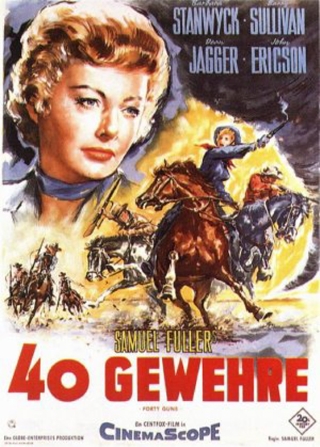
How does one describe the cinema of Samuel Fuller? Words like brash and bold tend to be used, perhaps even overused, when his name is brought up. Nevertheless, those adjectives fit, they capture the essence of his filmmaking, the energy, the almost primal disregard for convention and taste. Fuller didn’t make that many westerns altogether, but they are all interesting and memorable, not least for the way they show a director at work who was in love with that work. Forty Guns (1957) is an invigorating example of Fuller’s filmmaking, pummeling and assaulting the senses right from that famous opening shot; the movie charges at us head-on with fury and passion, a visual and aural challenge that is as neat an example as any of how much breadth and confidence the western genre had attained in the late 1950s.
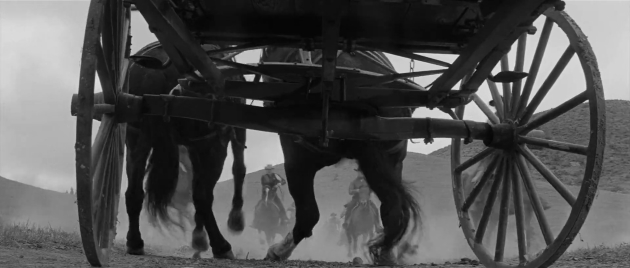
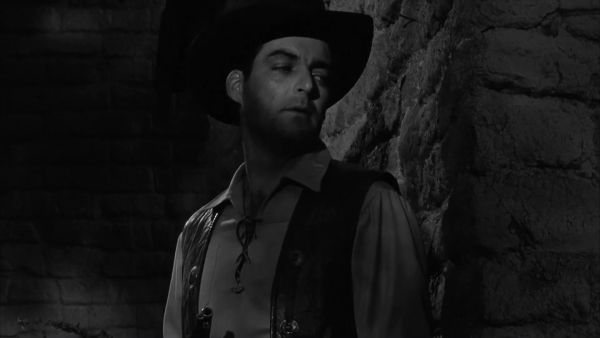
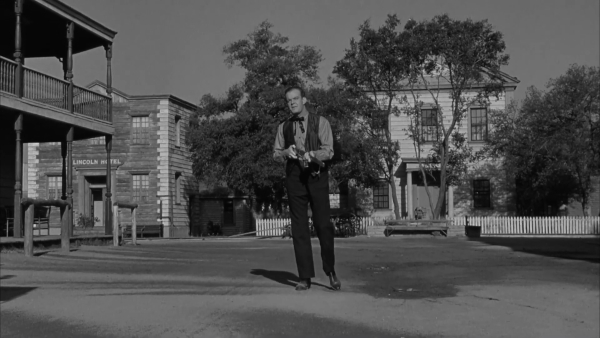
That opening sequence sets the tone, and indeed the pace for everything that follows, a pounding, intimidating and disorientating sensation that rarely lets up till the movie reaches its shockingly unexpected climax a mere eighty minutes later. One hour and twenty minutes to introduce viewers to Griff Bonnell (Barry Sullivan), a Wyatt Earp style figure who is on his way to Cochise County to arrest a man. He’s accompanied by his two brothers, Wes (Gene Barry) who acts as his backup and Chico (Robert Dix) who is due to be packed off to California and a less hazardous life. The forty guns of the title (or forty thieves as Sullivan later refers to them, evoking the One Thousand and One Nights and thus adding to that fantastic unreality which the film wholeheartedly embraces) are in the employ of Jessica Drummond (Barbara Stanwyck), the de facto boss of the territory. Brockie (John Ericson) is her younger brother, a spoiled, psychopathic wastrel who uses his sister’s influence and the implied threat of her private army to terrorize women, the town marshal, and frankly anyone who attracts his attention with impunity. Jessica Drummond’s reputation precedes her, her riders have as near as not run the Bonnell brothers off the road, and then her brother’s anarchic spitefulness threatens to lay waste to the whole town. It is here that Griff Bonnell has his hand forced; coolly pistol whipping Brockie into submission and tossing him into jail, he lays down his marker even before riding out to the Drummond ranch with his warrant to arrest one of the hired guns.
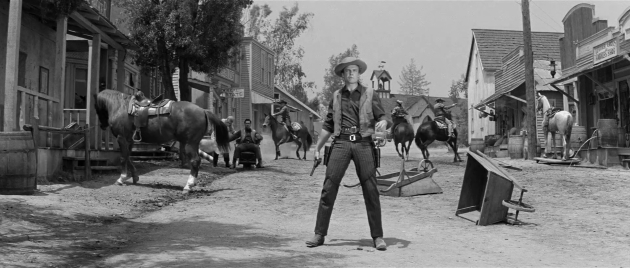
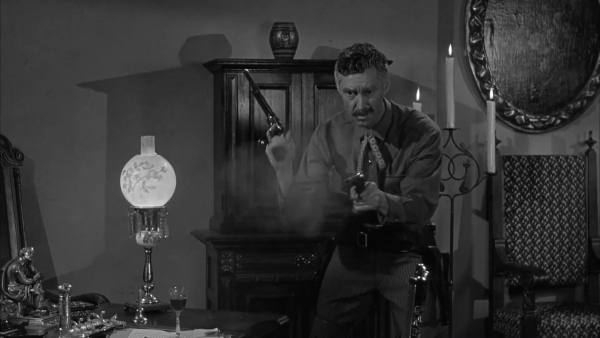
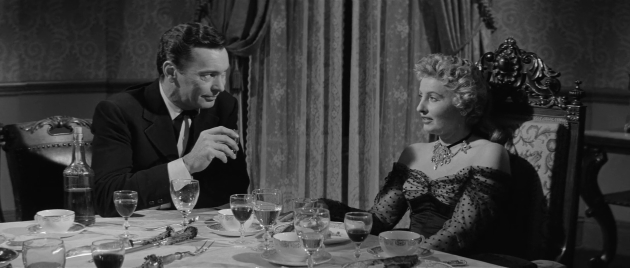
It now builds toward a battle for supremacy, both of the heart and the land. The whole setup at the Drummond house continues this theme of the fantastic and if not unreality then perhaps hyperreality. Even if the table is rectangular rather than round, there is something positively Arthurian about the image of Jessica lounging like royalty at the head of that table, flanked on her left by the aggressive and unpredictable Brockie while taking pride of place at her right hand is the soft-spoken but cunning and tragically devoted sheriff Ned Logan (Dean Jagger). In a movie with more than its fair share of visually memorable tableaux, a long tracking shot leads into the kind of double entendre laden conversation one wouldn’t normally expect to find in a western from the 1950s, with an exchange about the potency and volatility of Griff’s weapon. How that got past the censors, I’ll never know.

The whole thing then winds its way through a number of Earp/Clanton allusions towards a conclusion which is not so much a gunfight at the OK Corral as a daring example of Fuller’s characteristic audacity, flipping one of the cardinal conventions of not only the western but cinema in general in a movie which has already stampeded across so many viewer expectations. The director never really lets up in this movie, goading and provoking at every opportunity, painting his picture with the kind of broad brushstrokes that only supreme self-confidence permits, and only a man who lives for making movies would even countenance the kind of risks such an approach runs. Frankly, this is not a movie that will appeal to everyone, it is, perhaps like Fuller himself, too vivid and stylized to gain universal approval. I guess it comes down to this, you either “get” Fuller and his filmmaking or you don’t, and there’s little or no room for equivocation about it. He may be said to have produced a good deal of stylized work but, unlike directors less committed to their art, it was not a case of style over substance. If realism was of little concern to him, then what did matter was getting at the reality of the feelings that dwell at the heart of the movie. That cocksure presentation eschews prosaic realism for a pulpy assertiveness. His demands for the viewer’s attention might seem cartoonish on occasion, but once he has captured that attention there is no doubting the sincerity of the emotion he has been striving to highlight.
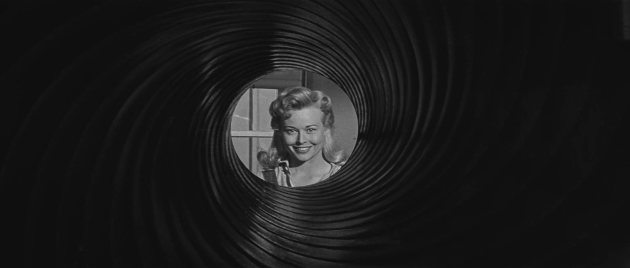
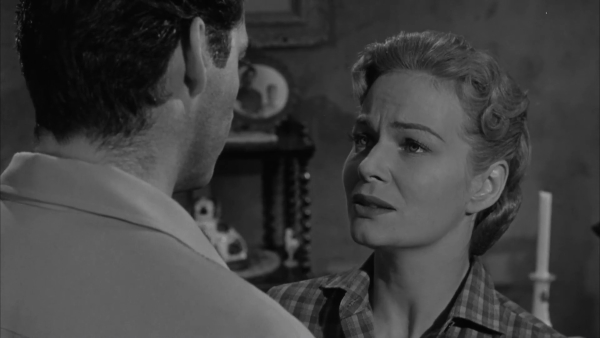
That sincerity is apparent on a number of occasions, most notably in the scenes which see Dean Jagger interacting with Stanwyck. There is his slow departure from the dinner table when Sullivan pays his first visit to the Drummond ranch, a dragging reluctance to leave where Stanwyck’s dismissal and his compliance is achieved without a word being spoken, merely an exchange of glances that express a world of regret. Then there is that final three way scene, part confrontation and part confession that gives Jagger his finest moments in the movie. We get to see a character who has previously traded heavily on the ersatz and the disingenuous coming face to face with the consequences of his longing and loss, and at that moment understanding that the truth he can no longer avoid leads to only one destination.
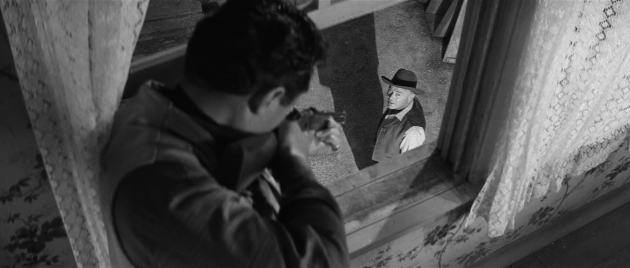
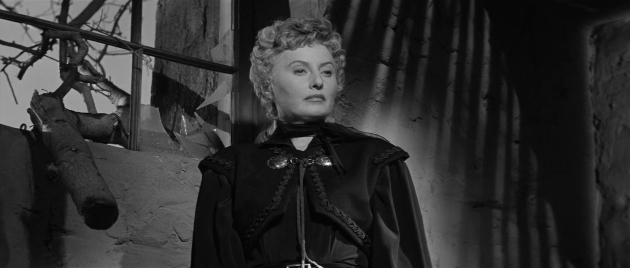
Late on, there is a funeral scene, following hard on the heels of one of those startling and abrupt instances of violence. The contrast with what preceded it is marked, showing off Fuller’s restraint and Joseph Biroc’s cinematography. The camera tracks sedately from one side to the other against a lead gray sky, broken only by a short close up on Jidge Carroll as he softly sings “God Has His Arms Around Me“, beginning and ending with the widow as she stands motionless and terrible in her dignity and composure.
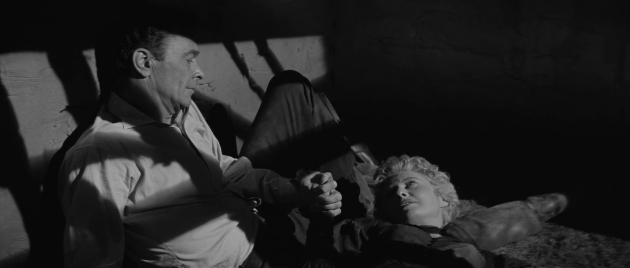
Forty Guns was the third time Barry Sullivan and Barbara Stanwyck appeared together in a movie and they play off each other well. Sullivan’s confidence matches that of his leading lady and his terse, clipped style of delivery hits the right note for a character who is painfully aware of how his time is running short, how a rapidly changing society is in the process of overtaking him. Stanwyck’s fondness for westerns is well documented; she could tap into the kind of insolence that befits her character, showing off her riding skills as she gallops imperiously over the land she has claimed, as well as having the grit to take on a particularly dangerous looking stunt that sees her horse drag her across rough terrain in the midst of a tornado.
Forty Guns always looked good any time I caught it, and the UK Blu-ray from Eureka, which may now have gone out of print if the prices I’m seeing online are any guide, certainly boasts a fine presentation. There is a lot of Fuller in this movie and that is a plus as far as I am concerned, although those who are less attuned to his style and sensibility will probably get less from a viewing. To my mind, this is a significant addition to Fuller’s credits and to the western genre itself, a film I never tire of revisiting.



















 Riding the High Country