Sirocco

ndcvzcm

Just think of the concept: Humphrey Bogart, an exotic location, gun-runners, freedom fighters, black marketeers, a love triangle, and a beautiful femme fatale. Sounds like a sure fire winner, right? I mean, it should be a given that throwing all these elements into the mix would produce a memorable movie, maybe even a bona fide classic. Superficially, it may seem like I’m referring to Casablanca; unfortunately, I’m not. No, what I’m talking about is Sirocco (1951), a poor, distant relation of Michael Curtiz’s much loved film. Now I count myself a big fan of Bogart, I even like those one dimensional thugs and heavies he played during the late 1930s, but Sirocco is a movie I really struggle to take anything positive from.

The story takes place in Damascus in 1925, during the period of French control. The end of WWI saw the carving up of the old Ottoman Empire, with modern day Syria being governed by France under a mandate from the League of Nations. But these are troubled times, and the nights are filled with the sounds of sporadic small arms fire as the Syrians launch periodic attacks against the occupying army. In the wake of one such attack, which has wiped out yet another patrol, the French military commander decides to crack down hard on the insurrection. Despite a tight blockade, shipments of weapons are making their way into the rebels’ hands. It is the task of Intelligence chief Colonel Feroud (Lee J Cobb) to halt this traffic, and this means rounding up the top black marketeers. Harry Smith (Bogart) is an American with a chequered past who uses his food imports as a cover for the more lucrative business of running guns into Damascus. While Feroud stalks Smith through the serpentine passages and subterranean catacombs of the ancient city, the relationship between the two men becomes further complicated by the fact that both have fallen under the spell of the beautiful, yet shallow and self-obsessed, Violette (Marta Toren). With the French troops hot on his heels, Smith finds himself a fugitive in a city of curfews and hastily organized ambushes. Just when escape to Egypt and safety seems within his grasp, Harry Smith finds that fate has one more twist to serve up.

£7

Throughout the ’40s Bogart was the very epitome of weary cynicism, the poster boy of film noir. Those hangdog features and his lisping delivery were perfect for expressing the pessimism and disillusionment of the time. However, his portrayal of Harry Smith is almost too weary and cynical for its own good. For the first hour or so we see a man without a shred of decency, a man who would sell out anybody or anything as long as the price was right. In itself, that’s not a problem, although there is only the vaguest hint given of what led him to this. The bigger problem is that in the final twenty minutes the viewer is expected to buy the notion of this self-serving profiteer undergoing a change of heart, and laying everything on the line in order to save the life of the man who has hounded him. In short, it doesn’t work; the character shift is too great and too abrupt to be believable. Lee J Cobb does better as the soldier whose conscience drives him to place his life in danger, and whose honor and bravery contrasts sharply with the venal amorality of Harry Smith. Marta Toren certainly looks good as the faithless Violette, but her character is a deeply unattractive one; after a horrendous bombing incident in a crowded bar, her only concern is for the damage inflicted on her dress and stockings. In truth, her role doesn’t serve any particular purpose except to add an edge to the rivalry between Smith and Feroud. In supporting parts, there’s some good work done by Everett Sloane, Zero Mostel and Nick Dennis. Curtis Bernhardt directs competently enough but the story plods in places and is only lifted by the camerawork of Burnett Guffey, who creates some atmospheric shots in the shadowy alleys and catcombs. It’s in these scenes that the film is most effective and they save it from being a complete failure.

Sirocco is available on DVD from Columbia in an excellent transfer. The print used doesn’t seem to have any damage and there’s a healthy, but not excessive, amount of natural looking film grain. Extras are limited to galleries of promotional material. The film was made for Bogie’s own production company Santana, which he set up after leaving Warners. The company made only a handful of pictures and, with the exception of In a Lonely Place, none of them set the world alight. Sirocco isn’t so much a bad film as a run of the mill one, a formula piece that’s never especially involving. One for real Bogart fans, and even they will likely endure it rather than enjoy it.
Rawhide

$5

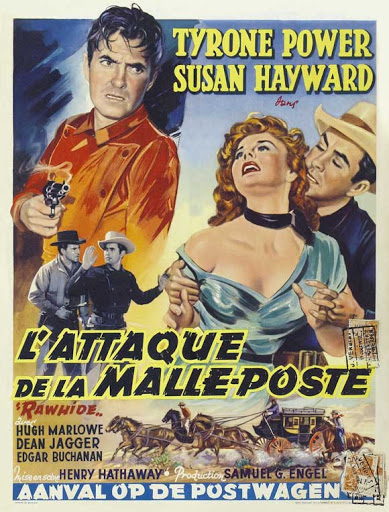
No, we’re not talking about the TV series featuring Clint Eastwood and Frankie Laine’s memorable theme song. This is Henry Hathaway’s claustrophobic western from 1951 with Tyrone Power and Susan Hayward. It’s one of those pictures that seems to have fallen through the cracks and is rarely talked about. I think the reason Rawhide doesn’t enjoy a better reputation can be traced to one essential weakness in the script, or more accurately the characterization, which I’ll look at later.

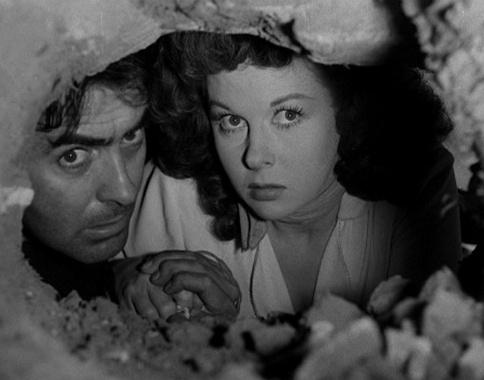
Tom Owens (Power) is a man with a lot to learn; he’s the son of the stagecoach owner and has been sent west to learn the business. With his apprenticeship nearing its end he’s eager to escape the confines of the isolated swing station which he’s been sharing with stationmaster and ‘tutor’ Edgar Buchanan. The first whiff of danger comes with the news that a notorious outlaw called Zimmerman (Hugh Marlowe) has broken out of prison and has already committed a murder. The first consequence is that Owens now finds himself saddled with task of putting up a disgruntled female passenger (Susan Hayward) and her child, since company policy dictates that the stage can’t carry them in these circumstances. It should come as no surprise that Zimmerman and his men duly arrive and take control of the station. So far this is all fairly standard fare, but the second half of the film really cranks up the tension as Owens has to play a cat and mouse game with Zimmerman to ensure not only his own survival but that of the woman and child also. The real surprise is who comes to dominate proceedings and gains the upper hand in the end.


$6

Susan Hayward was one of those strong women who seemed to dominate the screen effortlessly. From her first appearance in Rawhide, she grabs hold of the viewer’s attention and never lets go until the credits roll. People often use, and indeed overuse, the term powerhouse performance but it’s no exaggeration to say that Hayward delivers one here. She proves herself tough and resourceful enough to be a match for any of the male characters. However, if this is one of the great strengths of the film it’s also the factor that damages it. While it’s no criticism of Hayward, both Power and Marlowe pale in comparison. Power’s character is a weak one from the outset and remains so for the duration. In certain films that’s not necessarily a bad thing, but westerns tend to suffer when the male lead appears ineffectual. There is a similar problem with Hugh Marlowe’s villain, who is a bit colorless and just doesn’t appear to have the steel required to control a band of desperadoes. In fact, Marlowe looks completely out of place in this setting, although he is given a backstory to help explain the cultured nature of Zimmerman. Now, this kind of thing could hamstring a film, but it’s saved by the performances of Zimmerman’s sidekicks, particularly Jack Elam and Dean Jagger. Elam was an actor who was prone to hamming it up and devouring the scenery, and his turn as the depraved Tevis does just that. However, given Marlowe’s shortcomings, this adds some much needed meat to the outlaws’ threats.

Fox put Rawhide out on DVD in R1 last spring in a box which bundled it together with Garden of Evil and The Gunfighter. Typical of much of Fox’s output, the transfer is excellent and the disc has some nice extras, including a short featurette on Susan Hayward and another on the Lone Pine locations. All told,  Rawhide is a fine western with some very tense and genuinely dramatic moments. It’s not quite in the top tier, largely for the reasons I mentioned above, but is well worth an hour and a half of anyone’s time. It’s been suggested to me that there are some similarities to Boetticher’s The Tall T, and I can see where that may be the case. However, the similarities are really only plot points and both the characterization and direction mark them out as quite different films. Having said that, I do think that those who enjoyed Boetticher’s spare tales of tight knit groups in a tense situation would definitely take something positive from Rawhide.

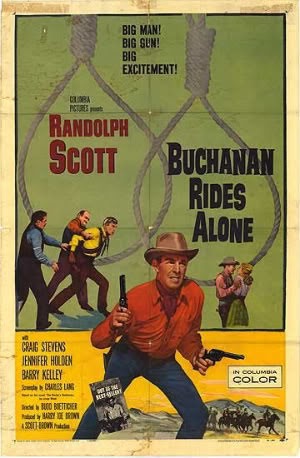
Buchanan Rides Alone

poster80

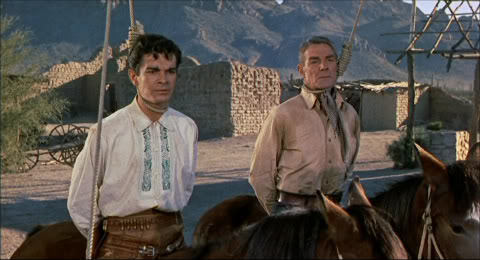
When one thinks of the Boetticher/Scott films the image that generally springs to mind is that of a tough loner haunted by a past hurt and struggling to make his peace with the present. The drama is typically played out against a sparse backdrop with a small cast, among whom there is a woman who has a significant role. Buchanan Rides Alone (1958) dispenses with all these elements, and stands out as a unique entry in the series. It has a lighter, almost comedic tone, women barely figure, and Randolph Scott’s character has no back-story to speak of. For all these reasons I deliberately left it to the end of this short series of pieces on the recently released Ranown titles. I think that, for anyone planning to watch these movies as a group, it is probably better to save Buchanan Rides Alone for last. After the sombre, and sometimes tragic, mood of the other pictures it rounds things off in an upbeat fashion.

The movie derives from a story entitled The Name’s Buchanan, and the line is used by the hero (Randolph Scott) when he rides into a small border town on his way back to west Texas, having made his money fighting in the Mexican revolution. The town in question has effectively been sewn up by the three Agry brothers, who hold the positions of sheriff, hotel proprietor and judge respectively. The most powerful is the judge, Simon Agry (Tol Avery), although they’re all equally corrupt, grasping and manipulative. The killing of the judge’s son by a young and wealthy Mexican sees Buchanan wrongly accused of complicity, and he finds himself drawn into the machinations of the brothers who pragmatically view the family tragedy as a means of extorting a hefty ransom. What follows is a series of crosses and double-crosses as the members of the Agry clan jockey for position and try to gull each other out of said ransom. It is this greed and sibling rivalry, rather than any especially adept maneuvering on Buchanan’s part, that finally brings about their downfall during a botched prisoner exchange. Unlike Boetticher’s other westerns, the motivation for Scott’s character is not based on any grudge but merely on his efforts to secure the release of the Mexican and recover his own money.

£6

Buchanan Rides Alone afforded Scott the opportunity to put in his most amiable performance of any of the Ranown series. There’s an element of self parody in the way he acknowledges his own ineptitude at being unable to formulate a coherent plan of action, and he even quips about his lack of progress when he ends up behind bars for a second time. The film is full of dry humour, courtesy of Charles Lang’s pithy script; some of the best coming when L Q Jones delivers a memorable eulogy over a body he’s just laid to rest atop a tree. The three Agry brothers are almost caricatures although Barry Kelley brings a more malevolent streak to his role as the profiteering sheriff. No Ranown western would be complete without a charming villain, and Craig Stevens supplies that ingredient as the black-clad enforcer with a stronger sense of honour than his reptilian employer. Boetticher uses a good combination of exteriors and interiors for this film and it works pretty well. The town has a more authentic feel and you don’t get that cheap, artificial look that weakens Decision at Sundown. Taylor Hackford points out on the accompanying featurette that the idea of a lone stranger riding into a corrupt town and presiding over the destruction of its rival factions could be seen as a kind of forerunner for A Fistful of Dollars. However, even granting that Leone was admittedly influenced by the style of Boetticher, I’m not sure I’d want to go too far down that road.

Well, that brings me to the end of this brief series, and I have to say that getting the chance to watch these films one on top of the other has been an enormous pleasure. I had seen them all at various points over the years, but watching them as a group allows one to better appreciate them as a body of work. The themes running through them seem to blend together, as Scott’s character evolved and Boetticher’s style became more apparent. They may have been B films in terms of budget, but they’re A films in terms of style and execution. Furthermore, they’re important films for those interested in the development of the western. In his book Horizons West (named after a Budd Boetticher movie, incidentally), Jim Kitses makes the point that the evolution of the western can be traced in a direct line from Ford and Mann, through Boetticher and Peckinpah, right up to Leone and Eastwood. That in itself should tell you that these films form an essential link. If anyone has been following these pieces and toying with the idea of picking up this set, then I can only say that you should do so; your western collection is incomplete without them.

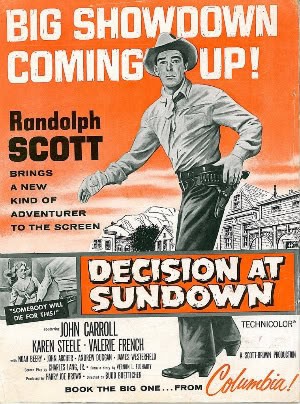
Decision at Sundown

poster84

The Ranown westerns that I’ve looked at so far all made ample use of their Lone Pine locations and Burt Kennedy’s sublime scripting. Decision at Sundown (1957) is a bit of a departure in that those two ingredients are absent. In their place we get a tense town based tale from the pen of Charles Lang; as a result, it ranks lower than The Tall T, Ride Lonesome and Comanche Station. However, even a lesser Ranown film is a cut above most movies and, despite some shortcomings, Decision at Sundown has much to recommend it.

Once again Budd Boetticher and Randolph Scott offer up a story about revenge, but this one has an unexpected sting in the tail. Bart Allison (Scott) arrives in the town of Sundown with the aim of killing a man. The man in question is the local big shot Tate Kimbrough (John Carroll), and it just happens to be his wedding day. Given a situation like this it’s hard not to be reminded of High Noon, but the roles appear to be reversed here. Before long Allison and his friend Sam (Noah Beery) find themselves holed up in the livery stable and under siege from Kimbrough’s cronies. As the day wears on, a whole series of developments forces the viewer to radically re-evaluate his assumptions. Gradually, it is revealed that nothing is quite as clear cut as would seem to be the case at the beginning of the picture. The result of this is the shifting of the viewer’s sympathy as Allison and Kimbrough, both now stripped of friends and allies, stride out to face one another at the climax. The film ultimately highlights the pointless and self-destructive nature of revenge, but it also has things to say about the consequences of apathy and the need for communities to face up to their collective responsibilities. By the end, everybody involved has learned some hard lessons and nothing can ever be the same again for them.

£5

Scott plays a highly complicated man in this film, a far cry from the basically decent and honourable characters one expects from him. Essentially, he’s a hollow man whose only reason for existing is to settle the score for a wrong he feels was done to him. At the end of the movie, when his own folly finally dawns on him, he seems a slightly pathetic figure. As the dishevelled and bewildered man shambles off the screen it’s hard not to feel pity for him. One suspects he has allowed his desire for a reckoning to consume him to the point that he no longer has a reason to go on; a sombre ending indeed. John Carroll is another of those personable villains that people Boetticher’s films. He may have strong-armed his way into a position of power, and held on to it ruthlessly, but there’s a lot to admire in the manner in which he swallows his own fear and doubts to finally face off man to man with Scott. The two female characters (Karen Steele and Valerie French) are of the typically gutsy variety favoured by the director, and Miss French gets to have a significant hand in the resolution of the story. Of the support players, Noah Beery and Ray Teal (who gets to play a good guy for a change) stand out, but there’s also some good work from Andrew Duggan as the amoral sheriff.

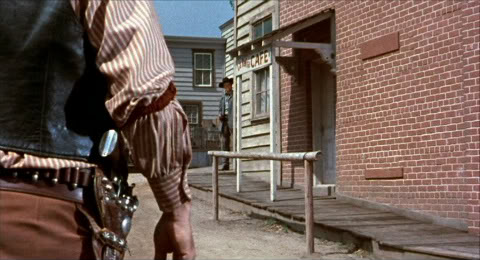
Boetticher moves things along at a fair lick once again, with not a shot wasted. The setting lends a claustrophobic feel to the events on screen, but this is also one of the weaknesses of the picture. Location shooting was able to paper over the lack of cash available for the other Ranown productions whereas the reliance on interiors here tends to emphasise it. However, there are still plenty of Boetticher’s trademark shots on view, such as the screencap above. Knowing that Sergio Leone voiced his admiration for the Ranown films, it’s easy to see where he got the inspiration for some of his own set-ups. While Charles Lang’s script offers an interesting alternative take on the usual Scott persona I feel that it still comes out second best compared to Burt Kennedy’s efforts, perhaps because it lacks the latter’s memorable dialogue.

Decision at Sundown is yet another excellent presentation on DVD from Sony. There’s no commentary track on this disc, but there is the usual short featurette on the film. Although it only runs for around six minutes, Taylor Hackford manages to provide a few interesting observations. So, even if the movie is a touch below the standard set by some of the other Ranown titles it’s still a fine piece of work. Seeing Scott in anti-heroic mode should be enough of a recommendation on its own.

Ride Lonesome

A man needs a reason to ride this country…

In Ride Lonesome (1959) the reasons are vengeance, bounty and amnesty. The penultimate Ranown western serves up all three but the focus remains firmly on the first. The notion of a lone man driven on by the pain of a past trauma is a recurring theme in Boetticher’s westerns, and is explored in depth in Ride Lonesome. Of the seven films Boetticher and star Randolph Scott made together, I would say this is the best; the plot, dialogue, imagery and performances all mesh to perfection. Nothing is wasted in this picture, where every shot, every gesture and every word is loaded with significance.

The viewer is immediately pitched into the action from the opening shot of the starkly familiar rocky landscape of Lone Pine, and the tension and pace never let up until the final credits roll. Ben Brigade (Scott) is introduced as a lone bounty hunter, and within minutes of appearing on screen has captured a young outlaw. Moving on to the nearest stagecoach swing station, with the outlaw’s brother in pursuit, he finds himself in another dangerous situation. The only occupants are the station master’s wife (Karen Steele) and two wanted men, Boone and Whit (Pernell Roberts and James Coburn), looking to find a way out of their current situation. Turning in the young prisoner would allow them to take advantage of an offer of amnesty, but that also necessitates their disposing of Brigade. The lone hero now finds himself part of an uneasy group and facing threats from three fronts; his new companions, the chasing pack of outlaws and a rampaging Mescalero war party. As the story progresses it becomes apparent that Brigade’s determination to see his captive to Santa Cruz, and an appointment with the hangman, is only part of his motivation. It’s fairly clear that the boy is merely the bait with which Brigade hopes to hook a bigger and more personal catch, although the exact reason for this isn’t revealed until the climax. In these moments, as Brigade stands and gazes impassively at the twisted hanging tree, the full power of the tale strikes home. The cold, unemotional hunter of men is no longer just a bounty killer but a figure lifted straight from classical tragedy.

Ride Lonesome offered Scott one of his harshest characters in Ben Brigade. There’s very little humour on display and even in those moments when he shows some modicum of tenderness towards Karen Steele it’s of the gruff and brusque variety. However, this is absolutely in keeping with a man who’s carrying around deep scars. Burt Kennedy supplied him with his finest, most distinctive dialogue and Scott delivers it in a suitably terse fashion. Pernell Roberts and James Coburn (in his screen debut) are excellent as the bad men who aren’t all bad – the real villain of the piece is Lee Van Cleef, and the only complaint that could be made about him is that he gets so little screen time. Karen Steele looks good and plays the typically tough and stoical Boetticher heroine whose only moment of weakness comes when she learns the fate of her missing husband. This was the director’s first film in cinemascope and he employs the wide lens to great effect. The action takes place exclusively outdoors and once again highlights Boetticher’s gift for disguising the limited budget he had to work with. There’s a Fordian quality to the tiny figures dwarfed by an expansive landscape which mirrors the scripts nods to the old master. Isn’t there something vaguely familiar about that story of the embittered, driven man on a vengeful quest only to find himself alone and apart from society at its end? There’s also a degree of religious symbolism in the climactic scenes with Scott standing before the hanging tree which resembles a crude cross. It’s as though he has borne his own cross for years and now returns to his personal Golgotha to lay the past to rest before the final cathartic act of burning the tree.

Ride Lonesome is another strong DVD transfer by Sony. Like the other titles in the Films of Budd Boetticher set, the colours are strong and true, and the picture looks suitably filmic. There  is a commentary track provided, and another of those short featurettes with Martin Scorsese. As I said earlier, I think this is the best of the lot – Boetticher’s finest film, and a real treat for western fans.

The Tall T

Some things a man can’t ride around…

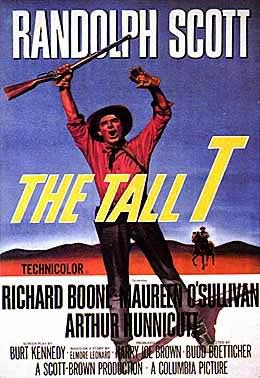
The first official entry in the Budd Boetticher / Ranown cycle of westerns is The Tall T (1957). The story here was adapted by Burt Kennedy from an Elmore Leonard short story called The Captives. That makes for an impressive set of credits and, in truth, the end result is a near perfect film. Once again Boetticher and Kennedy boil the western down to its absolute essentials, and the bulk of the action involves just five people and how they all relate to one another. Everything from location and plot to dialogue is pared right down and the film is all the better for that. What is left is a raw and visceral western with a strong moral current running through it and characters who we actually care about.

For a film with a short running time – under 80 minutes – it’s really a story with two distinct parts. The opening section introduces the character of Pat Brennan (Randolph Scott), a happy-go-lucky type in the process of building up his newly acquired ranch. He comes across as a gently charming sort who stops off on his way to town to pass the time of day with the local stationmaster and his young son. He even takes the time in town to pick up some candy for the boy as he had promised to do. When he visits his former employer, and loses his horse in an ill-judged wager, you start to wonder how such a hapless innocent could survive in a harsh environment. It is from this point on though that the depth of Brennan’s character begins to become apparent. Hitching a ride on a private stagecoach, hired for the honeymoon of Mrs. Mimms (Maureen O’Sullivan) and her gold-digging chiseller of a husband, he stops off to deliver the candy to the stationmaster’s boy. The station has been taken over by outlaw Frank (Richard Boone) and his two sidekicks (Henry Silva and Skip Homeier) with the aim of holding up the regular stage. Faced with the horror of what has just taken place, and the likely fate awaiting him and the other hostages, the character of Brennan undergoes a sea change. Almost immediately the easy-going ex-ramrod is transformed into a cool, calculating avenger who knows he must now play for time while waiting for the opportunity save himself and the woman. It’s a credit to all involved that this transition appears so natural as to be nearly seamless.

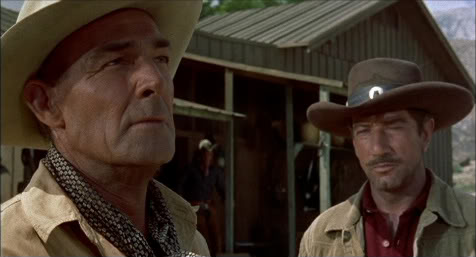
Scott’s flinty features once again blend in with the bleak Lone Pine locations which dominate the picture. The character shift I mentioned is magnificently achieved in the scene where the fate of the stationmaster and his boy is revealed in cold, matter-of-fact fashion by Henry Silva. Scott’s face hardens almost imperceptibly yet the meaning is all too clear. This kind of thing makes for great screen acting and the lead was a pastmaster in the art of underplayed emotion. Richard Boone was always interesting to watch, and in Frank he gives a fascinating performance as the outlaw you want to sympathise with. When he dispatches Mrs. Mimm’s husband, whose craven character offends his own personal morality, it’s difficult not to feel some grudging admiration. The two subsidiary villains are of less interest, but Silva manages to tap into a vaguely detached psychosis that works very well. Maureen O’Sullivan has an unglamorous role which offers her the chance to play something which is a cut above the standard damsel in distress. The fact that we get such well rounded characters in a short run time speaks volumes about the writing skills of Burt Kennedy. Boetticher again excels at making a cheaply produced picture look far more expensive. The framing and camera placement are miles away from the usual point and shoot style employed in low budget fare; this man had a real flair for the quirky and the unexpected. His handling of the action scenes is again exemplary, and they have both a frankly brutal quality and an odd humanity that make them stand out from other pictures of this vintage. There’s something deeply satisfying about Randolph Scott turning to the sobbing woman at his side, after the violent climax, and quietly intoning: Come on now, it’s gonna be a nice day.

Sony’s presentation of The Tall T on DVD is another excellent one. Some may carp at the amount of grain on view but I don’t regard that as a bad thing. The anamorphic widescreen picture is bright and colorful throughout. The disc also carries a short featurette with Martin Scorsese praising the film. Best of all, there’s the feature length documentary Budd Boetticher: A Man Can Do That. So, we get a great movie which is presented with care and respect – what more could you ask for.

Where Danger Lives

poster71

The films produced at RKO under the stewardship of Howard Hughes were a mixed bag to say the least; the billionaire’s’s involvement lending a crass, juvenile quality to more than one movie. While he led the once great studio along the path to bankruptcy and oblivion, he also introduced the cinema-going public to number of new starlets such as Jane Russell and Faith Domergue. Miss Domergue never made that many memorable pictures, save for Where Danger Lives, This Island Earth and It Came from Beneath the Sea. Of those three, Where Danger Lives (1950) has the slightly odd distinction of presenting her with her best role while also being the least known. In fact, this is a fine movie all round with stylish direction by noir stalwart John Farrow, a powerful lead performance by Robert Mitchum, moody cinematography by Nicholas Musuraca, and a Charles Bennett script.

At first glance the film may seem like a standard lovers-on-the-run yarn, but that’s merely the framing device for a tale of obsessive love, deception and madness. Jeff Cameron (Robert Mitchum) is introduced as an overworked but dedicated doctor who, at the end of his shift, is called upon to treat an attempted suicide. He is immediately attracted to the patient, Margo (Faith Domergue), and soon embarks on an affair. The immediate effect of this is that Cameron develops a callous disregard for both his job and his devoted sweetheart, played by director’s wife Maureen O’Sullivan. The whole point of the story is how lust can blind a man to reality and allow him to be deceived and manipulated. The film is packed with lies and liars and it seems that just about everyone is prepared to bend the truth to suit their own agenda, right down to ambulance drivers and small town doctors. When Cameron receives a blow on the head in a struggle, the resulting concussion gradually impairs his judgement and allows him to be more easily duped. In a marvellously surreal passage, the fleeing couple arrive in a town where everyone is bearded and dressed in western apparel. For a moment it looks as though the action has taken a detour into the Twilight Zone, until it is revealed that Mitchum and Domergue have stumbled into a local festival. The idea of nobody being quite what they appear is nicely highlighted when a local boy draws facial hair onto a photograph of Domergue, while muttering that everyone has to have a beard. From first to last, the movie concentrates on shifting identities and false perceptions.

Robert Mitchum was an old hand at playing noir anti-heroes and the role of Jeff Cameron offers him the opportunity to flex his acting muscles. He goes from being an upstanding professional at the beginning of the film to a shambling brain damaged wreck of a man by the climax. In the hands of a lesser actor the part could easily have descended into eye-rolling histrionics, but Mitchum’s deceptively lazy style ensures that credibility is maintained as his character’s mental state deteriorates and he floats between clarity and confusion. Faith Domergue’s Margo is a fine femme fatale in the classic mould. Her performance isn’t as controlled as Mitchum’s but she still manages to be convincing. It’s obvious from the start that there’s something not quite right about Margo, but you can’t really put your finger on what. Claude Rains appears in a small but significant part, and adds some real class to proceedings; in his few minutes of screen time he shows us another psychologically twisted character, and his playing is every bit the equal of that of his co-stars. John Farrow always seemed comfortable in noir territory, and does a good job of holding together a story that could have easily spun out of control. Farrow is ably assisted by his director of photography Nicholas Musuraca, whose camera does good things with the bleak desert backdrops and shadowy small towns that dominate the film.

Where Danger Lives comes to DVD, paired on disc with Tension, from Warners in R1 via their fourth noir set. It’s a fine, clean transfer which shows Musuraca’s excellent black and white photography at its best. The film comes with a trailer and a short featurette on the movie. This is a  film that I wasn’t at all familiar with until I picked up the box set. I can’t think why it has been such an obscure and hard to see movie since I’d rate it as an excellent example of classic era noir. Highly recommended.

The Long Memory

hhrbybb

I seem to be on a bit of a Robert Hamer kick at the moment. Having recently enjoyed Pink String and Sealing Wax, I decided to give The Long Memory (1952) a spin. While the former is a Gothic/Victorian noir which may stretch the definition for purists, the latter is the real deal. It has the contemporary setting, stark photography and relentlessly downbeat moodiness that should satisfy all who have a penchant for dark cinema. The story is classic noir wherein an innocent man is persecuted for a crime he has not committed and subsequently finds himself consumed by his thirst for revenge on those responsible for his plight.

Phillip Davidson (John Mills) has just been released from prison, having served twelve years for murder. An early flashback establishes that he had been wrongfully convicted, and that the false testimony of his then fiancee (Elizabeth Sellars) played a significant part in securing that conviction. In a neat twist, it also transpires that the treacherous fiancee has, in the intervening years, married the policeman originally in charge of Davidson’s case (John McCallum). Aware of the fact that Davidson still bears a grudge, the authorities track him Kent where he takes up residence in an abandoned barge along the desolate Thames estuary. As Davidson grimly sets about the task of seeking out his former tormentors the action alternates between his search and the slow unravelling of the idyllic domesticity of the policeman’s life. Running parallel to this is the development of a relationship between Davidson and a refugee girl (Eva Bergh) working as a waitress in a dingy cafe. This plot thread is not mere romantic padding but an essential element that clearly demonstrates just how deep Davidson’s scars run. By the end of the movie the quest for revenge has transformed into more of a journey towards spiritual redemption.

£6

The acting is out of the top drawer all round with the only weak link in the chain being Elizabeth Sellars. Her performance comes across as even more wooden given the emotional depth shown by almost everyone else around her. John Mills does a fine understated turn in the lead role. The scenes he plays in the old barge with Eva Bergh have such a touching and heartrending quality. These are two people who have spent so long living within themselves that the effort of reaching out to another is close to physically painful. John McCallum is also fine as the decent cop who gradually comes to realise that the woman he married is not all she seems, and who must resign himself to the fact that his career cannot continue if he’s to come out of it all with any sense of honour intact. There’s plenty of good support from a selection of familiar British character actors; special mention going to Michael Martin Harvey as Mills’ slightly kooky neighbour.

Where Pink String and Sealing Wax suffered from an undisciplined and unfocused script, The Long Memory can boast tighter writing and pacing. Hamer moves his camera around effectively and makes maximum use of the barren Kent coastline. He also controls the flow of the story very well, and cuts tellingly between the gradual flowering of the Mills/Bergh relationship and the simultaneous disintegration of Sellars and McCallum’s. All of this is backed up by the excellent cinematography of Harry Waxman who manages to throw in some welcome deep focus shots.

The Long Memory is currently only available on DVD as part of the John Mills Centenary Collection II from ITV DVD in R2. The set is a bit pricey but it does offer a good selection of Mills films and is worth checking out. This movie comes on its own disc and, while not perfect, gets a pretty good transfer. There’s optional subs, production notes and a gallery included. I hadn’t seen this film for a number of years and had forgotten what an underrated little gem it is. I give it a big thumbs up and recommend it wholeheartedly.


Tread Softly Stranger

The last year or so has seen the release on DVD of a number of British crime pictures that I had almost given up hope of ever seeing again. Tread Softly Stranger (1958) falls into film noir territory courtesy of the shadowy photography and the focus on a three way releationship between the good-for-nothing characters.

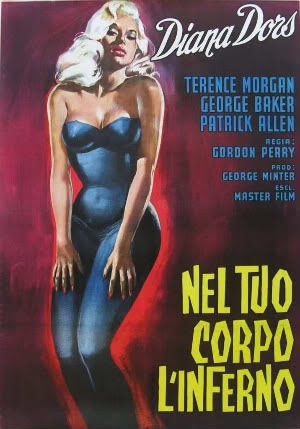
Johnny Mansell (George Baker) is a small time gambler who, after a run of bad luck at the racetrack, goes on the lam to save his hide. He heads back to the town in the north of England where he grew up, and where his brother still lives. The brother, Dave (Terence Morgan), works as a bookkeeper in the local foundry and has got himself involved with a night club hostess called Calico (Diana Dors). Right from the beginning Johnny takes an interest in Calico – not that anyone could blame the man for that – but holds off doing anything about it. It’s abundantly clear that Calico is more attracted to this flashier London-based brother than to the dull, bespectacled Dave. It’s also abundantly clear (Calico sports a diamond watch) that Dave’s infatuation is leading to him living beyond his means. Matters come to a head when the foundry faces an audit and Dave reveals that he’s been borrowing from the company accounts to finance his lifestyle. With only a week to make good the deficit on the books Johnny hopes to win enough at the track while Calico, still smarting from Johnny’s rejection of her advances, suggests breaking into the foundry and cleaning out the payroll. From here everything starts to go badly wrong, leading to murder, suspicion and psychological breakdown.

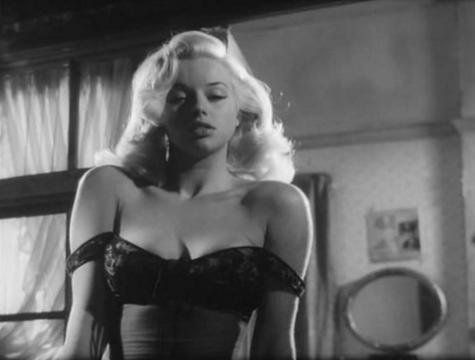
Diana Dors’ femme fatale is easily the best thing in this movie, oozing sex appeal as she wiggles and pouts her way round the sets, driving both the brothers up the walls with desire. The two male leads are just about adequate, but never completely convincing. George Baker can’t quite nail the charming scoundrel bit, while Terence Morgan overdoes it as the nervy brother with the cork too tight in the bottle. One of the pleasures of British films of this period is the selection of support players available. This is especially important here, given the shortcomings of both Baker and Morgan. Joseph Tomelty brings a paternal warmth to his role as a doomed watchman. And Patrick Allen is fine as Tomelty’s son, and the brothers’ childhood friend, whose suspicions and snooping create the tension of the latter half of the film. There’s also a nice, offbeat little cameo from Wilfrid Lawson, whose distinctive voice makes his affection for his pet rabbits all the more startlingly macabre. Gordon Parry does a competent job of directing and moves the camera nicely to set up some interesting shots. He is ably supported by cinematographer Douglas Slocombe’s atmospheric shooting of the shadows and smog enveloping the northern town.

Tread Softly Stranger is available on DVD in R2 from Odeon in a fair enough transfer. For the most part  the print used is in reasonable condition, although there is a significant scratch which shows up around the half way mark and lingers for a few minutes. I don’t feel the need to be too critical of Odeon for not cleaning this print up more as the film is a pretty obscure title, and I can’t imagine it shifting enough  copies to justify costly restoration. These kinds of titles are purely niche material and I’m just happy to see the likes of it available at all. There’s also a version out in R1 from VCI in a box of British B titles. I have only seen a few small screencaps of the R1 so can’t really comment other than to say it looked a bit hazy and with a greenish tint compared to Odeon’s release. I’d recommend this release to anyone who enjoys British crime/noir pictures of the period – not a great movie but a highly enjoyable one nonetheless.

Ride, Vaquero

poster52

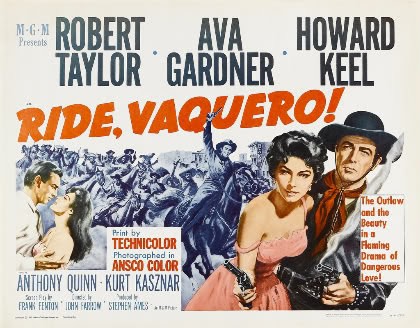
Ride, Vaquero (1953) was one of those films that always seemed to elude me. I’d read about it and heard about it often but, somehow, could never manage to see it. Well, I’ve finally got around to it. Robert Taylor may not be the first actor some would think of as a western character but the fact is he made a good number of oaters in his time. I’ve been watching quite a few of his westerns recently (the ones in the R1 westerns set, and a TV broadcast of The Hangman) and I quite enjoyed this.

Rio (Taylor) is the right hand man for bandit chief Jose Esqueda (Anthony Quinn), operating along the Texas/Mexico border in the aftermath of the Civil War. The end of the war has thrown up new challenges for these men, namely the arrival of new settlers and the renewed interest of the army and the federal government. Esqueda understands that such developments will spell the end of his reign as the undisputed master of his territory. His preferred course of action is a simple one; drive out the settlers before they have had a chance to put down permanent roots. The toughest proposition Esqueda has yet to face comes in the form of King Cameron (Howard Keel), who has come west with his wife (Ava Gardner) to build a new life. An abortive raid on the Cameron ranch leads to the capture of Rio. Instead of handing him over to the law, Cameron offers Rio the opportunity to switch allegiances and become his partner. He accepts, but the question remains whether his decision is based on a desire to embrace a more lawful lifestyle, or just a desire to embrace Camerons wife.

Director John Farrow manages to throw a number of big themes into the mix – the old ways vs progress, loyalty and betrayal, and a man’s need to hold onto what he has won. Taylor gives a good performance as a man who’s in search of his place in the world. He may seem cold and aloof, but that’s surely an essential part of the character. His precise relationship with Esqueda is not fully revealed until the end, and it goes a long way towards explaining the alienation his character feels. Anthony Quinn gives the lusty, larger-than-life treatment to his role of the bandit king, and it’s very enjoyable. Ava Gardner naturally looks great and brings a credibility to her part as the rancher’s wife with the wandering eye. Howard Keel is just about adequate but, since I believe this was his first non-musical role, I won’t be too harsh on him. There are also small yet memorable parts for Jack Elam and Ted De Corsia.

Ride, Vaquero has recently been released on DVD by Warners in France. The disc is a barebones affair with removable French subs and, unfortunately, boasts a weak transfer. The image doesn’t seem to have undergone any restoration and looks soft throughout. The biggest problem though is the colour, which has faded badly. The film was shot using the cheap Anscocolor process and if you’ve seen the recent R1 of Escape form Fort Bravo you’ll have some idea of what to expect. That said, the film is well worth 90 minutes of anybody’s time and I’d recommend it, if you can get past the deficiencies in the DVD transfer.