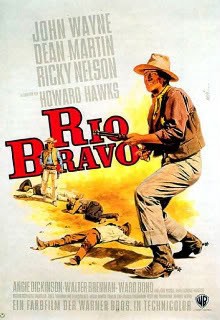
Rio Bravo

wayne1

“A game-legged old man and a drunk. Is that all you got?”

“That’s what I’ve got.”


When Sheriff John T Chance (John Wayne) hands that laconic reply to the question from his friend Pat Wheeler (Ward Bond), it more or less sums up what the whole film is trying to say. Anybody who has ever seen a few Howard Hawks movies will know just how much store he set by the idea of professionalism. The small group of self-contained professionals is a recurrent theme in his work, and Rio Bravo may be the best example of this.

I won’t go into the plot in great detail here since it is, frankly, a little thin for a film with a running time creeping up towards two and a half hours. Chance arrests Joe Burdette (Claude Akins) for murder and must hold him in the town jail until the Marshal arrives. All the time, the town is under a virtual state of siege from the hired gunmen of Joe’s brother, Nathan (John Russell). Throw in a typically Hawksian romance between Chance and a poker playing drifter called Feathers (Angie Dickinson), and that’s it. However, this is really a character driven movie, and the plot functions mainly to provide the necessary circumstances to allow the characters to interact. It is this interaction that elevates Rio Bravo to the status of one of the great westerns. I’d challenge anyone to sit through this and not feel for these people by the end; more than that, you actually get the sense of coming to know them. Think about Chance’s coolly competent lawman who’s reduced almost to an awkward schoolboy when confronted with a sassy, attractive woman; Dude’s (Dean Martin) drunken deputy who must face down his personal demons if he’s ever to retrieve his self-respect from the whiskey bottle where he left it; and let’s not forget Stumpy (Walter Brennan), the trigger-happy cripple whose cackling and complaining adds so much warmth and humour to it all.

John Wayne gives one of his most relaxed performances in this film and while this has been criticised by some, I think it fits the pace of the piece. The acting is understated and just plain likable from a man whose talents many are quick to criticise and slow to acknowledge. It’s hard to imagine any other actor playing this part with the natural confidence displayed by Wayne. Dean Martin’s Dude remains convincing as the character gradually transforms himself from a pitiful rummy fishing for drink money in spittoons into a man proud enough to enter by the front door once again. When the doubts and temptations assail him and threaten to haul him back into oblivion, you can’t help rooting for him. The great Walter Brennan has a high time with his role as Stumpy and manages to steal nearly every scene he appears in. The only weak performances come from Angie Dickinson and Ricky Nelson. But if you remember that Dickinson was meant to provide eye candy, Nelson was there to draw in contemporary youth, and that the real focus was on Chance, Dude and Stumpy then it doesn’t seem so important.

While most western directors liked to get out into the wide open spaces, Hawks opted to shoot the entire film within the confines of the town. This has the effect of creating both a claustrophobic tension and a comfortable coziness. In keeping with the theme of professional lawmen, the film itself exudes a slick professional feel. The maturity of Hawks direction can be seen in the first five minutes of the movie, when the status of the main characters and the basis of the plot are presented clearly and explicitly without one word of dialogue being spoken. The script by Jules Furthman and Leigh Brackett may develop at a leisurely pace, but it’s always logical and it’s packed full of memorable lines. Mention should also be made of the score by Dimitri Tiomkin; it complements the action perfectly and the use of the Deguello is yet another of the joys the film has to offer.

I can’t finish this piece without referring to the fact that Rio Bravo was Howard Hawks’ riposte to High Noon. Hawks took exception to the idea of a lawman running around town desperately seeking help from a scared and apathetic citizenry. This was anathema to a man who worshipped at the altar of the professional ethic. To Hawks, a man ought to play the cards dealt to him regardless of the odds stacked against him. Now I have no interest in discussing the politics, either implicit or explicit, of these two films but I do find myself drawn more often to Rio Bravo. While I like and admire High Noon, it concentrates on the selfish fears of men where Rio Bravo celebrates the camaraderie and warmth of humanity – I know which I find more appealing.

For a long time Rio Bravo was only available on DVD on a bare-bones edition. Last year saw the release of a 2-disc SE with a commentary and lots of special features. Initial reports were that the transfer was significantly darker than the old version and I was wary of the upgrade. However, I eventually decided to take a chance and was pleasantly surprised. The new transfer is darker but then the old one was too washed out and faded anyway. It’s not perfect but I do feel it’s an improvement on the original and I have no regrets whatsoever about purchasing it. Maybe Rio Bravo isn’t the best western ever made but, if not, it’s only a few paces behind. Over the years, I’ve probably viewed this film more than any other and I continue to enjoy it – that’s as good a recommendation as I can offer.



The True Story of Jesse James


Almost twenty years after scoring a hit with Jesse James Fox tried to repeat their success in 1957. With a screenplay based on and crediting Nunnally Johnson’s 1939 effort, the studio tagged ‘The True Story’ onto the title and director Nicholas Ray was handed the task of trying to offer a fresh perspective on this oft-told tale. So, does this one actually tell the true story? Well, not exactly since the time-line is more than a bit suspect, although it does get quite a few things right which the earlier version didn’t.

The film pitches the viewer straight into the action as it opens during the raid on the Northfield bank. After the dramatic escape of Jesse (Robert Wagner) and brother Frank (Jeffrey Hunter) the film proceeds to narrate events via a series of flashbacks which lead up to the climactic and doomed heist. The True Story of Jesse James, as I said, manages to correct a few of the errors of the earlier version. In this film the James gang are, more accurately, shown to be driven towards a life of crime as a result of the conditions that prevailed after the Civil War. The treatment of the other characters is also a good deal closer to reality. The 1939 film had the James home being bombed by railroad agents, resulting in the death of Jesse’s mother. Nicholas Ray’s movie has the attack being carried out by Pinkerton men (referred to here as Remington agents) and causing not the death of the old woman but the loss of her arm – again this is pretty much as it happened. It is no bad thing either that the Younger brothers are actually portrayed here, although the emphasis on them is slight.


The biggest weakness of the movie lies in the casting, and particularly that of the lead. While earlier incarnations showed Jesse James as a lovable rogue (Tyrone Power) or a saintly, avuncular type (Reed Hadley), here he has evolved into more of a trigger-happy glory seeker. The trouble is that Robert Wagner just doesn’t have the necessary edge or grit to carry this off successfully. Although he does give a pleasant enough performance he is simply too lightweight. Jeffrey Hunter, on the other hand, is excellent as Frank; so much so that it seems a pity he wasn’t given the lead. Agnes Moorehead adds some class as the mother but her scenes are few. Even though Alan Hale’s Cole Younger is played mostly for comic relief it lends a touch of realism to see the character appear and be shown as a figure of some influence within the gang. John Carradine turns up again (how many  movies did this man make?), not as Bob Ford but as the preacher who baptises Jesse.

While I generally enjoyed this movie there were a few things that did get up my nose. These mostly involved the inclusion of footage from the 1939 Henry King film. The train robbery sequence blends in fairly seamlessly but another example proved especially distracting to me. During the well filmed Northfield raid, as the lead flies and men are falling all around, Frank and Jesse take the time to ride into an alley and divest themselves of their long dusters. Why, you might well ask, would two men caught in a firefight pause to do this? Well, the answer is that we’re about to see recycled footage of Power and Fonda riding through a plate glass window and later jumping their horses off a cliff – and our heroes hadn’t been wearing dusters in the ’39 film! Now those scenes were great the first time round but it smacks of a certain cheapness to wheel them out here again. Another problem I had was at the end of the film. You know that Bob Ford is going to shoot Jesse as he stands on a chair to straighten that picture. Well, here Ford gives it to him in the back of the head at point blank range – and instead of dropping to the floor like a sack of potatoes, Jesse swivels around to glare reproachfully at his assassin before succumbing to his wound. Bah!

The True Story of Jesse James is available on DVD from Fox in R1 and Optimum in R2. I watched the R1 and the presentation of this scope film is excellent with no major faults worth mentioning. I can’t comment on the quality of the R2 disc but I would imagine that it has been cut by the BBFC for the aforementioned scene of the jump off the cliff – I understand one of the animals was killed during the filming of that stunt. So, despite some quibbles, I would say this is not a bad movie – just not a great one.

Attack

attack_zps7cxft2gs

Robert Aldrich made one of many people’s favorite war movies in The Dirty Dozen. In fact he made all kinds of great movies encompassing almost every genre. By 1956 he had turned out a handful of fine pictures, including Kiss Me Deadly and Vera Cruz. That year he turned his hand to the war movie and came up with the superior and intense Attack. This came at a time when the war film was transitioning from the flag-waving efforts of the forties to more bitter and realistic portrayals of combat.

The story focuses on the strains within a WWII company of US soldiers during the Battle of the Bulge. The company is under the command of Capt. Cooney (Eddie Albert), a privileged man who joined the army to satisfy the wishes of his father. However, Cooney is an undisguised coward whose position only remains tenable due to his friendship with Col. Bartlett (Lee Marvin), the battalion commander. The situation in the company has reached crisis point after Cooney’s inaction has caused the death of a squad of Lt. Costa’s (Jack Palance) men. When orders come through that a small town must be taken and held, Costa delivers an ultimatum to his superior – if he fouls up again then Costa will kill him.

Jack Palance reaches the breaking point

The film was adapted from a stage play and, as is often the case, is a real actor’s movie. Both Palance and Albert hold centre stage and the focus is on the duel between these two. Palance’s performance is raw and painful to watch as his endurance is fully tested. The latter part of the movie, when betrayal and the pointless slaughter drive him to the edge of reason, is something to behold. Eddie Albert gives him a good run for his money, forcing the viewer to both pity and despise Capt. Cooney. Lee Marvin’s colonel is at once cunning, ambitious, cynical, and the absolute epitome of cool machismo. Of the support cast, Buddy Ebson, Robert Strauss and Richard Jaeckel all give entertaining turns.

This is one of the finest war movies of the fifties and bears comparison to the best of Sam Fuller. It is probably one of Aldrich’s least known films but deserves a much wider recognition. It is on DVD in R1 and R2 from MGM and the full screen image looks very good. Being an MGM release the only supplement is a trailer. However, a movie as good as this should have a place in any self-respecting war collection.

Plunder of the Sun

poster104-1

It is notoriously difficult to pin down what exactly constitutes Film Noir. Everybody seems to have their own list of titles that will variously include or omit a number of marginal entries. This 1953 movie would seem a likely candidate since it has a number of noir characteristics. The action, for the most part, takes place in Mexico, the lead is a down on his luck type drawn into intrigue, and the plot bears more than a passing resemblance to The Maltese Falcon. Furthermore, the director (John Farrow) had a fair noir pedigree, having overseen the likes of Where Danger Lives, Night Has a Thousand Eyes, and The Big Clock. So, does it qualify? I’m inclined to think not, but I can’t quite put my finger on the reason. The upbeat ending crossed my mind, but I don’t really buy into the theory that the style of everything gone before can be negated by the last few minutes – that would rule something like The Woman in the Window out of consideration as noir. Well, let’s just say that I don’t feel comfortable calling it noir – maybe someone else can offer a definitive answer.

The story opens in Oaxaca, Mexico and – via flashback and a noirish voice-over narration – takes us to Havana to introduce the main character, Al Colby (Glenn Ford), as a man on the bum and desperate to find the means to pay his debts and get back to the States. His hopes seem to be answered when he’s approached in a bar by a girl (Patricia Medina) in the employ of a crippled collector of artifacts (Francis L. Sullivan). Colby accepts the offer to book passage on a ship bound for Mexico with the aim of smuggling in a small package containing an old parchment. On board he meets the other main players, a spoiled rich girl (Diana Lynn) and a sinister archaeologist (Sean McClory). From there the action moves to Mexico and a treasure hunt ensues. So, there’s a race to possess a fortune, some dubious history, a fat man and a pair of duplicitous females – like I said, it all sounds like a cousin of The Maltese Falcon.

Glenn Ford is always an enjoyable actor to watch and he handles his fairly undemanding part well enough. Irish character actor Sean McClory looks a little startling with bleached blond hair and sunglasses, but his disbarred archaeologist (can an archaeologist be disbarred?), alternating between between charm and menace, is probably the best thing in the movie. Patricia Medina looks exotic and seductive and certainly fares better than the other female star, Diana Lynn, who has little more to do than impersonate Gloria Grahame.

Much of the film was shot on location in and around Oaxaca and makes good use of the ancient Zapotec ruins and pyramids. Paramount put this out on DVD a while back (before they decided to completely ignore their back catalogue) as part of the Batjac line. It looks very good and boasts a fine selection of extras, including a commentary,  featurettes on Sean McClory and the Zapotec locations, trailer etc. Bearing in mind that the movie clocks in at around 80 minutes, it’s a pleasant enough way to pass the time.


The Steel Helmet

jm0aujv

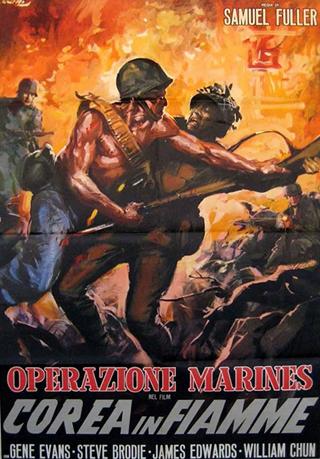
If you look at that small subgenre that is the Korean War movie, the efforts of Sam Fuller stand head and shoulders above the others. That’s not intended to disparage those other films which deal with that largely forgotten conflict such as Lewis Milestone’s Pork Chop Hill or Anthony Mann’s Men in War. However, Fuller’s Korean movies have that gritty believability that really set them apart. Both The Steel Helmet and the later Fixed Bayonets! deal with small groups of grunts caught up in desperate battles against overwhelming odds. Fuller’s presentation of war is a bleak one where there are no false heroics; just a bunch of regular guys doing what they have to in order to stay alive.

The Steel Helmet opens with Gene Evans’ Sgt. Zack, bound hand and foot, dragging himself along the ground amid the bodies of his massacred comrades. He’s just had the luckiest of lucky escapes – an execution squad bullet having entered his helmet and rattling round inside before exiting harmlessly. From here on the story follows Zack and the rag-tag bunch of stragglers he picks up as they make their way to an abandoned Buddhist temple to set up a forward observation post. Fuller never relents and the intensity of the story builds satisfyingly to the climactic assault on the temple by the communist forces.

Along the way the members of the group are revealed to us, and through this we get a glimpse of post-WWII American society. Among this odd group there’s a black medic and a Japanese-American veteran who serve to point up the racial prejudice prevalent at the time. There are also the quirky characters of the young soldier who lost all his hair through scarlet fever, and the silent G.I. whose only dialogue comes, poignantly, at the point of death. The locals are presented through the contrasting figures of “Short Round”, the South Korean boy who befriends Zack, and the malevolent, rat-like North Korean major. It is the sneering and callous reference to the boy’s fate by the red major that provokes Zack into an uncharacteristic, yet very understandable, reaction.

Which brings me to Gene Evans. His portrayal of Zack is the lynch-pin that holds the whole thing together. He is the consummate professional soldier – weary and cynical but dedicated to getting the job done and undeniably human. Evans would give a similar performance in Fuller’s next Korean drama Fixed Bayonets! and you have to wonder why his career never really took off from here. He plays the kind of three dimensional man’s man that is sadly absent in today’s cinema – well, that’s progress for you.

I’m not sure if anyone has seen any parallels between Fuller’s work and that of Howard Hawks. To me, both directors were attracted to the concept of the small group under siege and the emphasis on professionalism. However, while Hawks would use a lightness of touch, Fuller’s direction is like a pile-driver battering your senses.

Released by Criterion last year as part of their Eclipse series, The Steel Helmet comes in a set with I Shot Jesse James and The Baron of Arizona. While the film doesn’t appear to have undergone any restoration, it looks just fine and is worth the price of the set on it’s own.


Night Passage

pound8_zps0j825if3

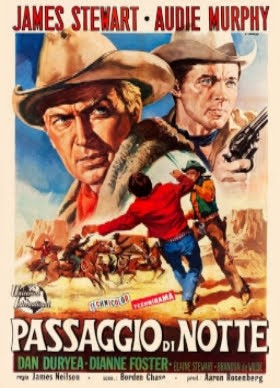
Two brothers, one an outlaw and the other a former railroad troubleshooter in disgrace, square off. That’s the basic premise of  Night Passage.

Jimmy Stewart is the honest man who is now reduced to scratching out a living as an accordion player after letting his no-good sibling Audie Murphy escape five years previously. He gets a last chance to redeem himself when his ex-boss hires him again. The railroad payroll has been repeatedly robbed by a gang of outlaws led by The Utica Kid (Murphy) and Whitey Harbin (Dan Duryea) – Stewart is assigned to see that the next one gets through. So the stage is set for a showdown.

Night Passage is the Anthony Mann western that never was. Mann was slated to direct Jimmy Stewart once again but pulled out at the last minute. His replacement was James Neilson (a debut director) and he managed to produce a serviceable movie, but fails to properly use the edgy quality that Mann always seemed to extract from his lead.

There are a number of weaknesses present, not least the overuse of Stewart’s accordian playing! The plot tries to pack in too many ideas and never really develops any of them sufficiently; Murphy and Stewart’s battle for the soul of Brandon De Wilde could have been expanded upon. It is shown early on that Stewart’s old flame is now married to his boss, but again nothing much is made of this.

Nevertheless, there are lots of good things here. The cinematography of William H. Daniels shows off the Colorado scenery to breathtaking effect in some beautiful shots and Dimitri Tiomkin provides one of his great trademark scores. I’ve heard it said that his music is sometimes too overpowering and in-your-face but I can’t think of any examples of his work that I didn’t like. Murphy is good in the role of the black sheep; he always seemed to give better performances when playing anti-heroic characters (No Name on the Bullet and John Huston’s The Unforgiven come to mind). There’s also a fine array of familiar support players in Jay C. Flippen, Jack Elam, Olive Carey, Hugh Beaumont and Paul Fix.

The film is available on DVD from Universal and looks very nice indeed in anamorphic scope – I have the R2 but I imagine the R1 uses the same transfer. Recommended.


Garden of Evil

pound2_zpscs4r15df

Look at her! Taking four men like us to a mountain of gold.

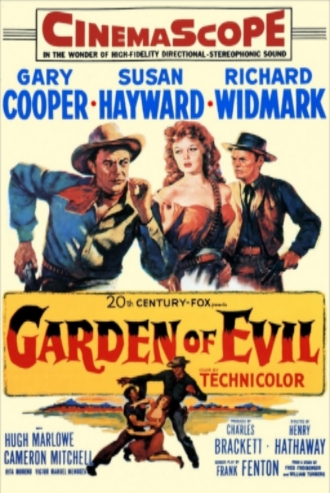
So says Richard Widmark’s Fisk, and in so doing he about sums up the plot of the movie. In a nutshell, a desperate woman (Susan Hayward) hires four men (Widmark, Gary Cooper, Cameron Mitchell and Victor Mendoza), who are all hanging around a dead-end Mexican town, to accompany her into the badlands on a mission of mercy; her husband is lying trapped in a mine deep in Apache country. What follows is an adventure tale that ties in some weighty themes such as, loyalty, greed, lust and infidelity. There are also some fairly explicit religious-moral allusions with the only features visible in a lava covered town being the church steeple and the entrance to the gold mine. Why, there’s even a crucifixion!

However, the film is never heavy-going and there is more than enough action to satisfy genre fans. The climactic chase and battle with the Apache is especially well-handled by veteran director Henry Hathaway. In fact, the whole thing moves along at a good pace and, at a little over an hour and a half, never outstays its welcome.

9189dab5-37c6-4b3f-83ae-08113175b540_zpszgfo6vzm

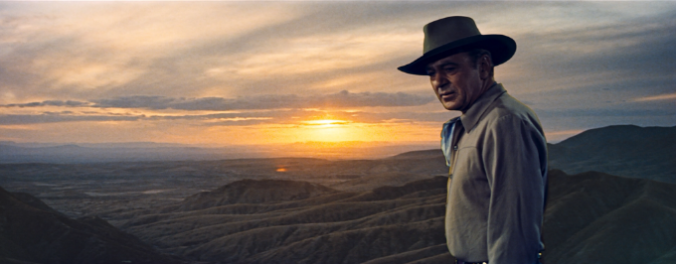
I love these early scope films from Fox, and this a great looking picture. Hathaway makes fine use of the widescreen process to show off the Mexican locations; some of the photography on the high mountain pass is simply stunning. The score is a bit of an unexpected one, by Bernard Herrmann no less. Herrmann, being Hitchcock’s composer of choice, is not a name you’d automatically associate with westerns. Nevertheless, the combination of soaring and ominous tones fits the mood of this movie perfectly.

There is, though, one very odd aspect to this film. Now, I won’t claim to be highly knowledgable of American Indians but the Apache we see here are the strangest looking bunch I’ve ever come across – surely the Apache never had Mohican haircuts!

That aside, I highly recommend this movie. How can you not love a western with Gary Cooper and Richard Widmark. I think both men give excellent performances, although I may be a little biased since I’m a huge fan of Coop. He gets to deliver the last line of the film while squinting into the sunset –

The garden of evil – if the earth was made of gold, I guess men would die for a handful of dirt.

Great stuff!