Storm Fear

Confinement breeds volatility. And confinement, be it physical, emotional, spiritual or social, is a key element in film noir. As space is limited, so is the room for maneuver and so are the options available to the protagonists. This is provides a situation ripe with dramatic potential – take a small group of characters menaced by an external threat and simultaneously squeezed by internal pressures and sit back to watch what happens. This is the essence of Storm Fear (1955), and it’s a formula which has been employed on and off by filmmakers in productions as diverse as Day of the Outlaw, The Small Voice and Key Largo.

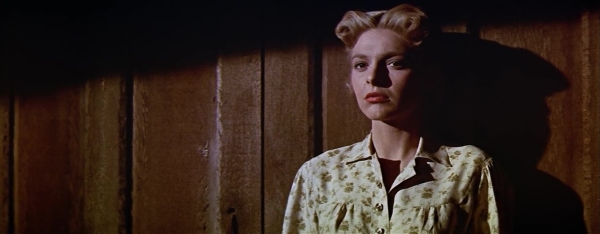
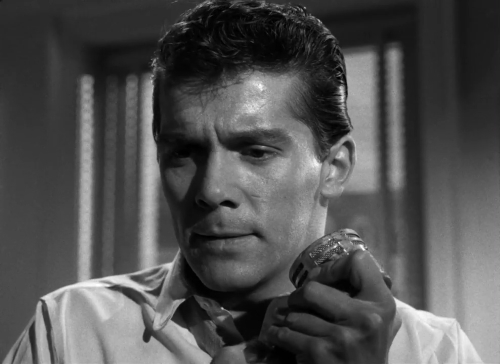
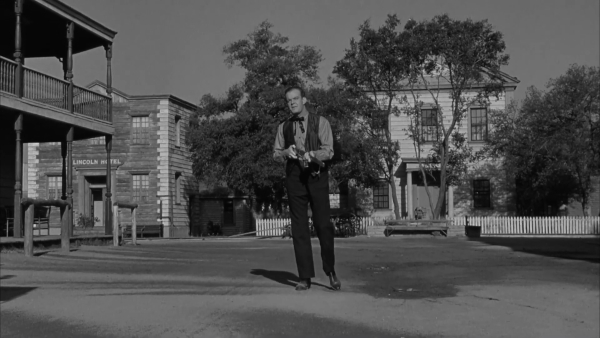
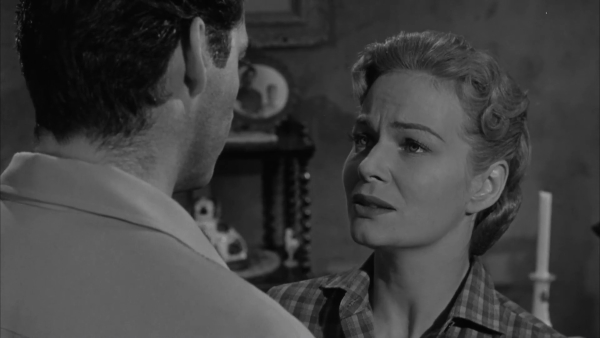
Storm Fear has its characters in uncomfortable places all the way through, right from the beginning when young David Blake (David Stollery) and Hank (Dennis Weaver), the hired help, come in from the snow, into the remote mountain cabin. David’s mother Elizabeth (Jean Wallace) is guarded and somehow restrained while her husband Fred (Dan Duryea) is even more detached. The mood and atmosphere of the cabin and its occupants is wrong, discontent and dissatisfaction pervade like some insidious form of emotional dry rot. Fred is a man bowed and broken by personal and professional failure, a shuffling, shambling figure forever burrowing deeper into the oversized scarf he twists and kneads, his comfort blanket in a world from which he has retreated. Elizabeth is a martyr to duty and disenchantment, going through the motions in a barren and loveless marriage. Suddenly, this chill facade is shattered by the arrival of Fred’s brother Charlie (Cornel Wilde). Charlie is a hood, a no-good type with a long history of crime following him around, and on this occasion he’s also got two accomplices in tow (Lee Grant & Steven Hill). He is on the run after a bank raid has netted him a sack full of money, a bullet in the leg and a looming murder rap. All of that ought to amount to a fair amount of pressure within and without yet there is the added complication of the tangled relationship which links Charlie, Fred and Elizabeth.

Cornel Wilde made his debut as a feature director with Storm Fear. He was also the producer and had Horton Foote adapt the novel of the same name by Clinton Seeley for the screen. In fact, Wilde assembled some impressive talent behind the cameras, with Elmer Bernstein providing the score and Joseph LaShelle taking care of the cinematography. As a result, this movie has a polished and highly professional look. Wilde paces everything well, drawing ample tension from the lengthy scenes within the cabin as the characters fume and feud. The climactic scenes out on the mountain, as the cold and weariness takes their toll, open things up somewhat, but that’s only in a superficial sense. The stark landscape and harsh conditions impose their own restrictions and in classic noir fashion the poor choices these people have been making throughout their lives narrow all their avenues of escape. It’s not so much a matter of being unable to stop what’s coming as being unable to outrun what went before.

Wilde’s acting is solid, he adds a slight stammer to his character’s delivery to indicate his core insecurity. It’s an affectation of sorts but it fits the character and he never makes it feel forced. Jean Wallace, who was married to Wilde, is especially strong in a difficult and multifaceted role. She is called upon to range from guilt and remorse to resilience and resolve. It amounts to a tricky balancing act on her part and she carries it off successfully all told. I guess most viewers will be accustomed to seeing Dan Duryea take on showy parts. As such, his portrayal of Fred Blake could be regarded as something of a departure. It’s a comparatively quiet role, contemplative and reproachful to the point of being ineffectual, with a hint of puritanism lurking below the surface. I’m not sure it works though. Lee Grant, making a rare screen appearance in the middle of those lost years when she was victimized by the blacklist, is almost unrecognizable as the bleached moll with a considerable thirst. I’ve seen largely positive reactions to Steven Hill’s turn as Wilde’s psychotic sidekick, but I can’t say I appreciated his work here. Hill was an alumnus of the Actors Studio and that is very apparent here. I’ve never been a fan of method acting although I’ll concede some such as Montgomery Clift made it work for them. Hill, a little like Rod Steiger at his most excessive, never leaves the viewer in any doubt that he is giving a Performance, and not for one moment did I feel he was anything other than an actor playing a part.
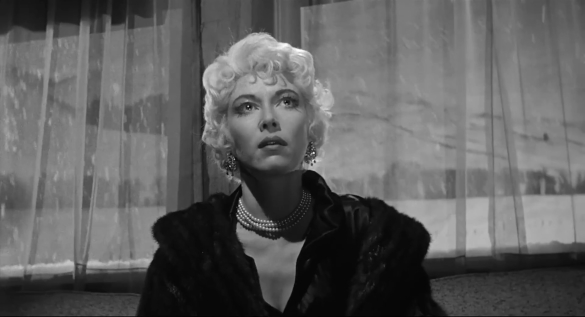
Kino released Storm Fear in the US years ago and it’s a handsome looking production. LaShelle’s crisp cinematography comes across well and the pacy, self-contained story never outstays its welcome. It’s a late-era film noir that harks back to the previous decade’s focus on personal rather than wider societal conflicts. While I have some reservations about a few of the performances, there are a lot of good things going on and the movie is certainly worth a look.

The Last Frontier

“Civilization is creepin’ up on us…”

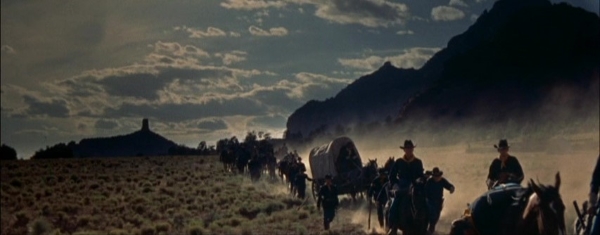
There’s a similar sentiment, and indeed similar words, expressed at the start of Raoul Walsh’s The Tall Men. Indeed it could be said that variations on this theme run all through the western genre. Can it be said then that the western is at heart an unfolding elegy? One would certainly be justified in applying that label to many of those movies made in the late 1960s and on into the following decade, what have come to be referred to as revisionist works. Yet the roots of that can be found in the classic era, the golden age of the genre in the 50s, when the spirit of celebration, of hope and redemption, were just beginning to be tinged with a hint of regret at the gradual drift away from an ideal. Even the title of Anthony Mann’s The Last Frontier (1955) catches a flavor of that crossing of the Rubicon. Granting that the notion of the Old West as some pastoral idyll was as much myth as reality, it seems fitting that the process which plays out before the viewer is not framed in terms of tragedy, although there are clearly tragic elements woven into it all, but is instead presented as a natural and perhaps desirable step towards the inevitable.

The opening of The Last Frontier presents an image of perfect wilderness, of a land largely untouched by man. Yet we see three men making their through the rocks and trees. This is Jed Cooper (Victor Mature) and his two companions Gus and Mungo (James Whitmore and Pat Hogan), and before long the earth around them seems to take on another form as an encircling band of Sioux rise up from the grass and scrub as though they were children of the soil itself. The thing is both groups, the trappers and the Sioux alike, give the impression of being just another natural extension of their environment. Nevertheless, the trappers are made aware of the fact they have come to represent the intruder, are promptly deprived of their weapons, horses and bearskins and warned to stay clear of the forests. Why? In brief, the arrival of the army and the construction of a fort has altered the way the Sioux now perceive them. Indignant and resigned yet still alive, Cooper makes for the fort in search of some form of compensation for the loss of a year’s worth of hides. What he gets, however, is the offer of employment as a scout under the young acting commander Captain Riordan (Guy Madison). Despite the reservations of his friends, Cooper is beguiled by the thought of a blue tunic with brass buttons and wonders if he might not get to wear one at some point. Thus he begins to fall under the spell of civilization, a feeling further enhanced when he makes the acquaintance (albeit in a drunken and rambunctious state) of Mrs Marston (Anne Bancroft), the wife of the absent senior officer. Colonel Marston (Robert Preston) is at that point on the other side of Red Cloud’s Sioux, which by Cooper’s calculation means he’s probably dead.

As it turns out he’s very much alive and Cooper’s efforts to guide him and what remains of his command back to the safety of the fort earn him little in the way of gratitude. Marston is far from being a well man, psychologically at least. He carries the scars of shame and defeat, haunted by the ghosts of the 1500 souls he led to their graves at Shiloh. The western is full of men in desperate need of redemption, though as often as not the wounds they seek to heal are neither so deep nor so raw as those which afflict Marston. His goal is to excise the pain of defeat through victory over Red Cloud. Unwittingly, Cooper’s growing need to embrace civilization and all he perceives it as offering leaves him pinned at the center of both an emotional and military crisis that Marston is hell bent on engineering. Ultimately, all the elements will be drawn together in a swirling maelstrom of dust and death.

The westerns of Anthony Mann are among the greatest of the classic era. They typically feature driven and obsessive heroes, and of course the concept of redemption is never far from the surface. That sense of redemption, of restoring oneself spiritually, of paying one’s debts and regaining one’s rightful path in life is a powerful one and Mann spent a decade exploring it. In The Last Frontier the character most noticeably driven is Marston, a man who has hounded himself to the brink of sanity and even of humanity. He is not the hero of the piece, though one could say that if he doesn’t quite redeem himself he does get to earn his peace, although it comes at a considerable cost to others. Cooper is the undoubted hero, a crude and unfinished product of nature, one who doesn’t need redemption in the sense of making atonement but rather one who has reached a critical point in life and requires guidance. I guess there’s something ironic in the figure of the pathfinder in the wilderness threshing around at the gates of civilization and needing help to regain his course. Yet that is what happens.

I think that the message of this movie is that no state or situation is to be sought in itself, that the myth of the free and open west is only sustainable and valid if it’s viewed as a stage in a process, an attractive stage in many ways but not a permanent destination. Marston’s relentless drive toward confrontation comes to the only end that it can, and of course history leaves us in no doubt that the staunch resistance to change of Red Cloud was similarly doomed. So what then of the other options? There is a strong feeling that the settler can only go so far till the siren call of civilization drowns out the pull of the untamed land. There is a pivotal moment late on when Mature, having abandoned the fort in the wake of one of those brutal fights so typical of a Mann film, must confront the fact that he can go no further. His journey is going to have to continue along a different path, one which leads back to civilization or whatever form of it he cares to shape for himself. Mungo, the native, is not restrained in the same way and is thus free to proceed on his own trek, one which is expressed in Mann’s characteristic cinematic language as a journey forever upwards, always ascending and always seeking to attain some higher place. Maybe both are heading for the same destination, just taking different routes to get there?

I haven’t given a lot of attention to the performances in this movie, which is a bit of a departure from my usual formula. That’s mainly due to my choosing to focus more on the themes and ideas underpinning the movie, as well as the fact that all of the principals are uniformly excellent. However, I would like to single out some remarkable work from the often maligned Victor Mature – he really gets into the character of the unpolished trapper, investing the part with a passion and raw energy that is wholly convincing as he cannons back and forth between confusion, wonder and enthusiasm. I think it’s a terrific performance. A word too for the cinematography of William C Mellor, where he and Mann fashion a neat juxtaposition of dark and claustrophobic conditions within the (confining, civilizing or both?) walls of the fort and the bright, open airiness of the surrounding landscape. As far as I know, the only Blu-ray release of The Last Frontier is the German edition. It is a good if not great transfer, certainly a step up from the rather indifferent DVD but I must say I’m mystified why this interesting Anthony Mann film remains unreleased in the US or UK with the kind of supplementary material it surely warrants.

As an aside, and for what it’s worth, yesterday marked sixteen years to the day since my first uncertain blog entry.

Drum Beat

The idea that in order to resolve a problem one ought to have first hand knowledge of it appears sound. That’s the theory that Drum Beat (1954) puts forward, that a the best man to negotiate a peace is one who has been intimately involved in the hostilities. It’s a variation of sorts on the notion of setting a thief to catch a thief, only imbued with the kind of latent optimism that characterizes the work of writer and director Delmer Daves. It takes some real events and people from the Modoc War and uses them as the basis for a story that champions the need for rapprochement, hammering home the point that the harder it is to win, the more meaningful it becomes. The movie shares some similarities with Daves’ groundbreaking Broken Arrow, although it’s not as good that earlier film. Nevertheless, all of the director’s westerns are worthwhile in my opinion and even if Drum Beat doesn’t quite measure up to his stronger efforts, that is not to say there is nothing to recommend it.

The movie opens in Washington, in the White House in fact. There’s a marvelous informality to this, something that is hard to conceive of nowadays, as Johnny MacKay (Alan Ladd) simply walks right in and states that he has an appointment to see President Grant. It’s all about a new initiative aimed at bringing the Modoc War to an end. Washington wants to see the conflict resolved through negotiation and diplomacy, and that is where McKay comes in. His brief is to make contact with the Modoc chief Captain Jack (Charles Bronson) and attempt to coax him back to the reservation. MacKay would appear to be an odd choice for the role of peacemaker given his history as a famed Indian fighter, not to mention the fact his family had been slaughtered in an earlier massacre. Yet he’s the one selected and it’s precisely because of his background that he has made the cut. Jack is not the type to be swayed by professional purveyors of platitudes, he too is a man of action and as such more likely to pay heed to someone whose fearsome reputation precedes him. MacKay is of course aware of the magnitude of the challenge facing him and once back on the frontier it quickly becomes apparent to the viewer too. When two antagonistic cultures are living in close proximity then resentment can easily flare into something much more dangerous as a result of pettiness and relatively minor gripes getting out of hand. That proves to be the case as slights and harsh words lead to aggression and then senseless killing, only to be followed up by more tit for tat revenge before exploding into full on warfare. All the while, MacKay has to maintain his own self-discipline and sense of duty, partly as he’s given his word and partly because he gradually realizes that his mission represents the only way out of the impasse.

Drum Beat was the second western for Delmer Daves, following on from Broken Arrow and sharing some common themes, including the quest for some kind of peaceful co-existence between settlers and the native population, and also the idea of interracial relationships. Broken Arrow dealt with both more effectively, perhaps because of the characterizations of Jeff Chandler and Charles Bronson as Cochise and Captain Jack respectively, and also because the leads in both films approached their roles in a different way, but I’ll come to that a little later. Daves would go on to write the script, but did not take on the director’s responsibilities, for the following year’s White Feather and that too is a more satisfying movie all round. While there are aspects of this movie which are less successful, what does work is the director’s eye for a beautiful composition. There are some terrific shots of the Arizona locations on view, the mythic landscape dominating the CinemaScope frame and the frequently minuscule figures within it in a way that recalls Ford.

I’ve read some critiques of the movie that state it presents a far less favorable image of the Modoc than Daves’ previous western. I can see how that impression can be formed and I’ll admit there are some grounds for it, but I’m not convinced it’s entirely accurate. Jack’s faction is shown as reckless, mercurial and belligerent, but that’s as much a reflection of the character of the man as anything. The other side of the coin is presented by Marisa Pavan and Anthony Caruso as the siblings who favor reaching some kind of accommodation. What’s more, the whole point of the story, as I see it at least, is the that the drive for peace between two implacable forces is never going to be an easy process and it’s difficult to convey such a message without emphasizing warlike tendencies. Admittedly, Jack’s Modocs do appear more violent and their grievances receive precious little attention while the inherent prejudice and shortsightedness of the other side is mainly confined to Robert Keith’s hot headed character. What Daves does eschew is piety and self-righteousness. The character of the easterner Dr Thomas is portrayed as pompous, priggish and ultimately ineffectual, while the preacher who attends Jack in his cell at the end is given short shrift.

What then can we say about the actors? Alan Ladd had just made one of the great westerns in Shane and his career was at its peak. For all that, his performance here is decidedly subdued, not just the usual quiet understatement he often brought to the screen, but a calm detachment that seems overdone. I get that his character is a man who has had to rein in his emotional reactions in order to fulfill the mission he’s been handed, but all the provocation, tragedy and bubbling passions that are erupting around him arguably call for a more dynamic response. Charles Bronson fares better in a showy part as the Modoc warlord, strutting and powerful and with a gleam in his eye. It’s an entertaining turn, but there’s not a lot of nuance to it. Daves typically got good results from the female cast members and I think Marisa Pavan in particular comes across well in her selfless devotion to Ladd’s character. I find it pleasing that Pavan (the twin sister of Pier Angeli) is still with us and I hope to feature more of her work here – The Midnight Story is a film I plan to get round to in the (hopefully) not too distant future. Happily, Dubliner Audrey Dalton is another screen veteran who is still going strong. She represented the other point in the romantic triangle alongside Pavan and Ladd, although I don’t feel that whole subplot really plays out in an especially compelling way. That coolness and distance displayed by Ladd does it no favors. As for support, we’re somewhat spoiled with a long list of names drifting in and out including Warner Anderson, Rodolfo Acosta, Elisha Cook Jr, Frank Ferguson, Willis Bouchey, Robert Keith, Isabel Jewell and more.
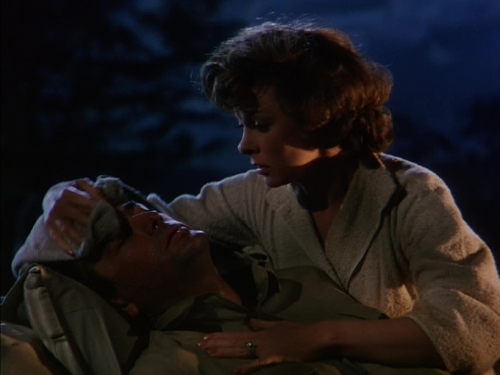
Drum Beat was impossible to see in its correct ‘Scope ratio  for a long time until it came out via the Warner Archive. I’ve not yet seen a movie by Daves that I dislike, and most of them are films I unreservedly love. However, Drum Beat is a bit disappointing, not least when it is set beside the towering achievements of his other westerns. It looks beautiful in places and it has that intuitive feel for the Old West that one expects. Still, his trademark sensitivity only appears sporadically, not surprisingly most evident in those scenes where his female characters are prominent – Pavan’s sacrifice and its aftermath, the dignity and regard she and Dalton extend to each other, Isabel Jewell’s cameo, and so on. I’d term it a good western for the most part, but only a moderate entry among this director’s credits.

Time Lock

The simplest stories can sometimes be the most absorbing. Having just spent a very rewarding hour and a half viewing Time Lock (1957), I reckon it would also be fair to say such films can be among the most suspenseful too. In this case it really is down to the quality of the story itself. The budget must have been slight, the cast is limited and has no especially big names, and the direction is not particularly showy. However, the subject matter is such that it grabs the attention and then holds it in a steely grip right up to the moment the end credits roll.

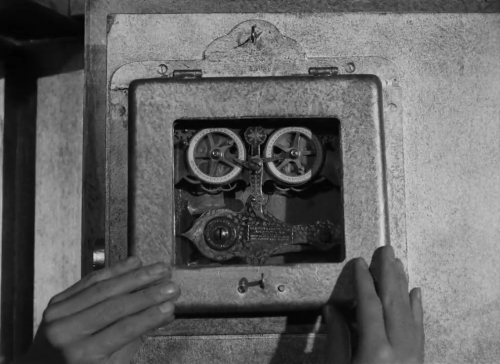
Toronto on a sleepy Friday afternoon in the middle of July. It’s a time when most people will be thinking of the days ahead, pleased to have left the trials and pressures of another working week behind them. In a sense, all the danger signs are present in that period of time, a soporific blend of relief at what’s been relegated to the past and anticipation for what the future may hold leading to casualness or indeed carelessness in the present. It should come as no surprise then that the arrival of Lucille Walker (Betty McDowall) at the bank where her husband Colin (Lee Patterson) works is accompanied by a degree of laxness on the part of everyone there. Pretty much all of the staff, the manager (Alan Gifford) included has at least half an eye on something other than work. It’s also the Walkers son’s sixth birthday and he’s naturally being treated with even more indulgence than usual.  As he scampers around the bank clutching his new flashlight and seeking out various nooks and crannies to test its effectiveness, there is the sound of a collision on the street outside. It draws the attention of everyone, even the manager and Colin Walker, who are in the process of setting the time lock on the vault. A quick glance through the windows shows that nothing serious has occurred, not outside anyway. And then the vault door is swung shut and the locks activated. Just as the heavy, unyielding steel seals itself, an even heavier realization descends on those in the bank – the boy is nowhere to be seen, and has clearly been shut up tight in a strongroom that cannot be opened till Monday morning. Disbelief is soon shooed aside by panic, which in turn finds itself chased away by a gnawing sense of desperation. The air supply is finite, the vault virtually impenetrable, and the only man who might know how to get in (Robert Beatty) is off for a weekend of fishing.

It’s a very simple and uncomplicated story, a small boy trapped in a vault and a race against time to free him. However, it is the simplicity that makes it work so well. It is a situation that is both unthinkable yet also entirely credible. These two factors add an edge to the suspense that grows naturally from any race against the clock tale. At first, I was a little surprised to see that the script was derived from a play by Arthur Hailey. There is the temptation to see his bestselling novels and their adaptations for the big and small screen as large scale, sprawling affairs – Airport and Hotel certainly spring to mind.  Yet even those are quite contained in a sense, and there’s no getting away from the fact that his subject matter favored scenarios where unexpected drama was wrought from essentially mundane circumstances.

Perhaps more surprising is the production team behind Time Lock. When the credits announce that the feature is directed by Gerald Thomas and written and produced by Peter Rogers, well one would be forgiven for jumping to the conclusion that a ribald comedy was on the cards. After all, those two were responsible for the long running Carry On series of movies. You’d never know that from a viewing of this film though, the tone remaining deadly serious all the way through as befits such a tense premise.

Looked at from today’s perspective, the movie had one big star – Sean Connery. However, this was right at the start of his career and his role is small, as one of the workmen called in to see if there was any chance of their oxyacetylene cutting gear making an impression on the vault door. The main parts are filled by Lee Patterson and Betty McDowall as the helpless parents who are unable to anything other than wait and hope and pray. Alan Gifford, who shared the screen with Patterson the same year in the rather good The Flying Scot, gets a reasonably juicy part as the guilt-ridden bank manager. Robert Beatty heads the cast, even though he only enters proceedings about half way through, as the expert on safes. When he does appear he ushers in a sense of even greater urgency, brisk and brusque in his management of a situation whose margins of error have by then been shaved right down to the bone.

I don’t think Time Lock has ever had a DVD release in the UK, although it has appeared in the US, included in one of Kino’s British Noir sets, and in Australia in the past. It would have been a good title for Network’s British Film line, but the company’s sad and sudden demise means that will never happen now. Anyway, it remains a terrific little suspense yarn that manages to do a lot with limited resources. I definitely recommend the film to anyone who is not yet familiar with it.

X the Unknown

I’m going to have to confess that I’ve drifted away from contemporary Sci-Fi movies, or maybe they have drifted away from me. It’s a tricky genre in many respects; there is the obvious need to make movies that entertain, but in order to rise above mere popcorn fare it is necessary to have a story underpinning it all that asks questions or offers ideas for consideration. Now one could say that this applies to all genres and I’d tend to agree. Yet what sets Sci-Fi apart is the fact its inherent inventiveness and malleable boundaries allow for a more enticing examination of themes that might appear dull if presented in other genres. I guess it boils down to the need to strike a balance between the entertaining and thought-provoking aspects.

Growing up, I was entranced by classic Sci-Fi, and the entertainment quotient was what grabbed my attention back then. Later, I came to appreciate the way that many of these movies wove social and philosophical commentary in among the thrills. Of course filmmaking has changed a lot over the years, and the visual effects that enhance and enrich the wondrous nature of Sci-Fi have advanced impressively. Sometimes I think that this huge improvement also conceals behind its cloak of digital magic the seeds of my gradual dissociation from the genre. Has the balance shifted a little too sharply, and has the superabundance of visually startling imagery and whizz-bang effects obscured some of the thoughtfulness that once characterized the best of the genre? I found myself wondering about such things as I watched Hammer’s X the Unknown (1956) the other day, the type of cheaply made movie that fascinated my younger self, and still does in fact.

Paranoia fueled so many of the great classic era Sci-Fi movies with the concept of the enemy within growing out of the Cold War and the fears and misunderstandings that accompanied it. Often the enemy within was presented as an infiltration of society, either on an individual or communal level. X the Unknown takes a different path, one leading not to the heart of mankind but to the heart of our planet itself with the implication that our greatest threat comes not only from a fatalistic and seemingly unstoppable force of nature, but one which has been festering away deep below the surface, practically written into the DNA of our world. It’s a fine idea in itself and the execution offers a lesson in how to extract as much suspense and implied horror as possible on a shoestring. It all begins during a tiresomely routine military exercise, the random placement of a mildly radioactive object causing the sudden appearance of a mysterious fissure and the consequent death and destruction that is unleashed. The frequency of fatal encounters with whatever broke free of that fissure gradually picks up pace and even leads to the leveling of that old charge that scientific tinkering and dabbling lies at the root of it all. That notion, happily, is given short shrift, dismissed almost the moment it is uttered and both challenged and disproved by the close. I have an unpleasant feeling though that were this movie to be remade today, in a climate where quackery is all too often hailed while science is belittled, the reverse might actually be the case.

In all honesty, however, I don’t see how a movie like this would be made at all nowadays. The cast is almost exclusively male and middle-aged at that. There is nothing remotely glamorous about leads such as Dean Jagger and Leo McKern, but what they do bring is a sense of calm authority and a reassuring coziness (and I use that term without any pejorative undertones) amid all the mayhem. The source of the danger is kept out of sight for most of the running time, only glimpsed very briefly before the one hour mark and sparingly and sporadically thereafter. It works on the principle that what exists in the mind’s eye is apt to be more unsettling than full exposure to creaky effects. A modern version would feel obliged to conjure up and highlight some effect that would undoubtedly dazzle yet would also be less likely to capture the suspense that comes from dread unseen.

Hammer had just made and enjoyed success with their version of Nigel Kneale’s  The Quatermass Xperiment and so were looking to capitalize on that with a follow up. Kneale appears to have objected to the name of his lead scientist being used and so Jimmy Sangster’s script has Adam Royston rather than Bernard Quatermass desperately seeking a way to battle the terror seeping from the Earth. Had Kneale been involved, it seems likely the plot would have involved some kind of alien presence or interference. That would undoubtedly have been a literate and intelligent approach, but I have to say I rather like the fact that what we got is a wholly terrestrial and primal threat – somehow the notion of danger emanating from that which we know best and which is dearest to us adds an attractive twist to it all. If you’ll forgive the pun, it serves to ground the story. While I wouldn’t quite categorize it as an early Eco-thriller, it does raise questions about our symbiotic relationship with the planet itself. Leslie Norman directs efficiently and briskly enough, though it is tempting to wonder how it might have turned out had first choice Joseph Losey not dropped out. It has been said that the blacklisted Losey was removed at the insistence of Jagger, but there are also claims that it was actually down to a health problem suffered by the director.

X the Unknown was given a Blu-ray release in the US back in 2020. I’ve only seen some images from that version and they look appealing, sharp and in a 1.75:1 ratio. My own copy is a long out of print UK DVD that appears to be open matte. While it won’t have the crispness of the BD, it’s not a bad effort and, in my opinion anyway, remains perfectly watchable. This is the kind of Sci-Fi I adore, modest in scale yet expansive enough in vision and imagination to override its technical limitations.

Mister Cory

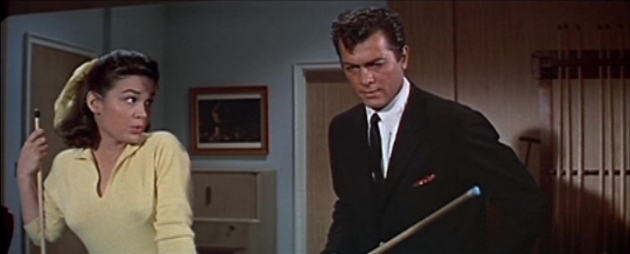
Another day, another movie that appears to defy categorization. Of course, there is no good reason why anyone ought to feel it is necessary to categorize a movie, but it is a pastime that we film fans like to indulge in.  Mister Cory (1957) does not comfortably wear any of the labels I’ve seen hung on it, not that there are many people who have actually commented on the film one way or another. It has been referred to variously as a crime picture, a drama, even as a film noir. I guess there are elements of all those genres and styles to be found there, but none of them are entirely satisfactory. Perhaps one could call it a Blake Edwards film. However, I’m not sure I would be able to define that either, certainly not for something coming at this early stage of his career as a director/writer. So what is it? There is a hint of The Great Gatsby about the setup, it maybe even casts a glance in the direction of Dreiser’s An American Tragedy (and Stevens’ adaptation A Place in the Sun), and there is too a touch of the humor that Edwards brought to so many of his films. If anyone can produce a convenient label out all that, I salute them. Frankly, I’m happy enough to just think of it as a good movie that is not as well known as it might be.

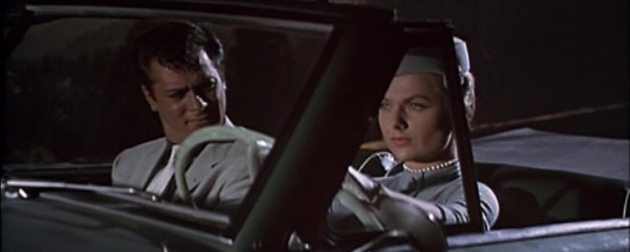
The first view of Cory (Tony Curtis) is of a young man making his way along a heaving sidewalk in Chicago, one of those tenement slums where all human life is to be found, the kind of place where hope can all too often wither or where the seeds of all-consuming ambition can take hold. Cory is a man with ambitions, and the first steps towards realizing them are going to see him keep right on walking out of the neighborhood he grew up in. They carry him out of the city to one of those exclusive lakeside resorts where only those with blue blood, deep pockets and an Ivy League education can afford to lunch and lounge with poise. Now Cory may not have any of the usual qualifications to hang out in such environs, but he does have poise, even if his is borne of audacity. He’s hired as a busboy, right down at the bottom of the pecking order. However, he has no intention of remaining in that lowly position and employs a combination of cunning and chutzpah to hobnob with the cream of society and keep an eye on the main chance. To be precise, he has set his sights on Abby Vollard (Martha Hyer), an ice cool society blonde, and for a time it looks as though he might just pull off the deception and bag the prize he so craves.

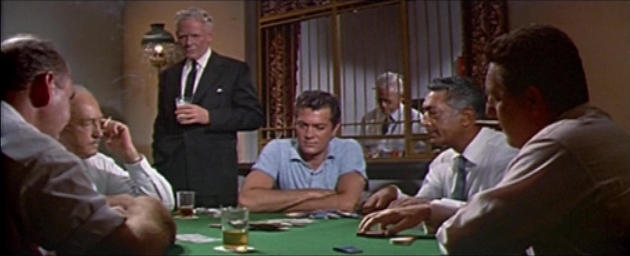
However, that would be too simple and dramatically, not to mention ethically, unsatisfying. No, a tale requires a twist if it’s not to become too predictable. So, with his imposture revealed and his scheme shattered, Cory is forced to move on. He does so, and moves far and wide, returning to his roots in a way as he falls back on the skills as a gambler he acquired early in life. All of which segues into the second part of the story, the rise of Cory as a slick and smooth front for Ruby Matrobe (Russ Morgan), a big man in the Chicago underworld. With money no longer an object, prestige and deference (even from those who once demanded the same of him) his constant companions, he would appear to have fulfilled his ambitions. Yet there is still the ever present itch that he yearns to scratch – Abby. That he is now in a position to woo her successfully is complicated by both the need to conduct the business and romantic equivalent of a high wire act. Her long time fiancé (William Reynolds) is the son of a man with significant political clout, capable of delivering a knockout blow to Cory’s backers and by extension to Cory himself. And then there is the sneaking suspicion he begins to have that maybe Abby’s now grown up sister Jen (Kathryn Grant) is the one he should have been pursuing.

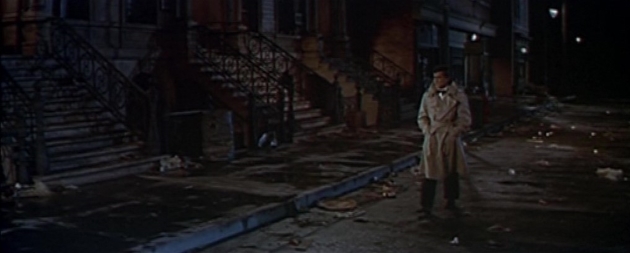
Mister Cory was adapted from a Leo Rosten novella, which Tony Curtis bought the rights to and had Blake Edwards adapt for the screen. It has a classic “rise and fall” structure that makes for good drama. There is a lot of emphasis placed on the nature of ambition, the old exhortation to be careful what one wishes for never being far from the surface, as well as other maxims regarding all that glitters and so on. This is all very well, but not that compelling at the same time. On the other hand, the movie is on much firmer ground when it posits the theory that human nature is immutable, rendering notions of grasping ambition, social climbing, and all the deceit and falseness that tend to accompany those wraiths redundant. At the heart of the story is the belief that running away from one’s true self, denial of one’s nature in essence, is a doomed enterprise. Sooner or later, this dawns on pretty much every character. It can be seen in Charles Bickford’s veteran gambler, a man who intuitively knows when the game has grown stale. Cory may be one of the last to fully grasp this, though it does grow on him gradually; there is a terrific scene where, with success won, he wanders back to the old neighborhood where he grew up, strolling down the middle of the empty nighttime street, gazing at the building he was born in, the locations that spelt loss and tragedy and the places he learnt his trade. Lost in the cool solitude of reminiscence, surrounded by the echoes of voices long gone and words drifting across time, his past and present knit together in a moment that marks the beginning of his acceptance of self.

Curtis deftly captures the many facets of the character, the roguish charm that never really deserts him, the drive concealed behind this, and the awareness that all the polish and front is simply that, a veneer that does nothing to shrink the distance between the one-time street urchin and the elegantly clad dream merchant he has cast himself as. Again, I’m drawn back to that scene I mentioned above, so much of the character is encapsulated in it after all, with Russell Metty’s camera tracking the lone figure via a crane shot that shifts from cool objectivity to intimacy and serves to highlight the contrast between the slick facade Cory has adopted and the grimy background that produced him. With the lens focused on his troubled features, it’s clear to see that he hasn’t traveled so very far. Martha Hyer was an actress who flirted with true stardom yet never quite broke through. Around this time she had roles in some good movies – Battle Hymn for Douglas Sirk, and she earned an Oscar nomination for her work in Minnelli’s Some Came Running. The part of Abby called for someone who was able to convey chilly snobbery in tandem with a weakness for slumming  and hypocrisy, which Hyer gets across successfully.

Kathryn Grant graced some fine films throughout the 1950s and she brings a liveliness that is quite infectious to the part of the younger Vollard sister. Playing the third arm of a romantic triangle frequently proves to be something of an unrewarding task, but William Reynolds takes it on manfully and achieves a degree of pathos as the flawed fiancé. The reliably crusty Charles Bickford brings dry humor coupled with down to earth wisdom to the table and acts as a stabilizing influence on his often hot-tempered protégé. Another interesting piece of casting is band leader Russ Morgan as the Chicago hood, something which sounds like an odd choice but which ends up working out just fine. Finally, a word for Henry Daniell, a man whose long career saw him regularly playing highly cultured villains. He brings great suavity to his work here, insisting on good manners and propriety at all times, the very personification of moral rectitude. And then he gets to deliver a genuinely killer punchline to wrap up the climactic confrontation in the casino.

Mister Cory has had DVD releases in France, Spain and Italy, and I strongly suspect all of them will be using the same source. I have the Italian release, which presents the movie in the correct ‘Scope ratio. It’s a colorful if rather soft transfer though and the images I’ve added above should give some idea of how it looks. I would love to see this film get a brush up because it really deserves better treatment. I hadn’t seen it before and I’ve never heard anything much about it either. Every year brings a few new discoveries for me and I feel this movie rates as the most enjoyable and worthwhile of them so far in 2023.

Domino Kid

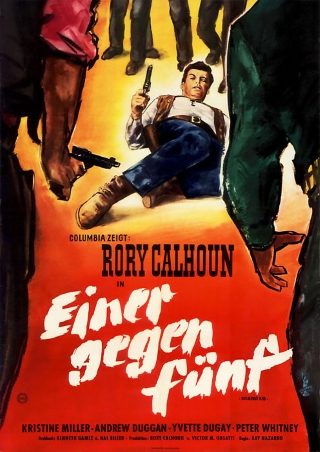
Domino Kid (1957) is a small movie, the kind of picture that that was relatively inexpensive to make and could be relied on to fill the bottom half of a bill. Somehow, probably due to the wealth of industry experience the people working on such features were able to bring to them, these films often managed to be briskly entertaining while at the same time there was a solid core that explored, to a limited extent at least, the themes one would anticipate from a bigger budget, more ambitious production. In this case, the theme that provides the backbone for the story is revenge, the ethical chasm it represents and the hollowness of the reward it promises those who would pursue it.

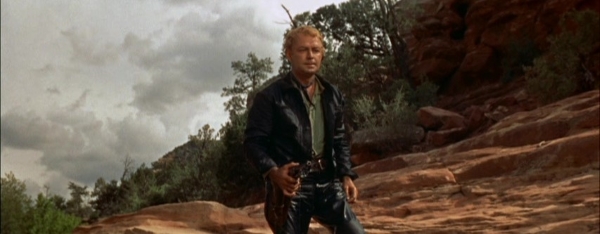
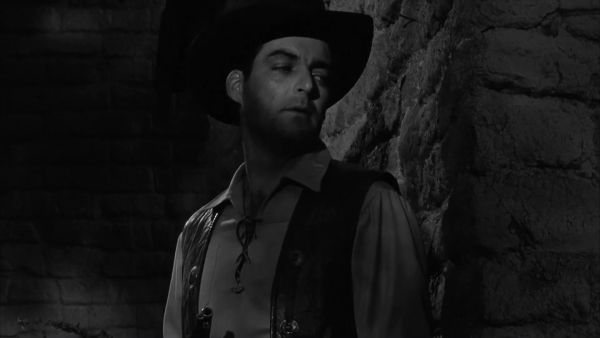
Domino Kid is a sparse movie, never putting more people on screen at any one time than is strictly necessary. And there is an urgency to it too, the opening shot is quite literally a shot, one delivered from one anonymous figure in a saloon bar and fatally received in the belly of another. The very abruptness of this beginning, its unsentimental, businesslike violence is an indication of the mood or tone of the story itself. Domino (Rory Calhoun) is a man with a powerful appetite for revenge. Having returned from the Civil War to find his family dead and his home raided, he lives now to visit retribution on those responsible. The first reel has a whiff of what was to come in the western genre about it: those bleakly deserted streets in mean looking towns, the lone avenger clad in a low profile black and white outfit, chewing on a cheroot and with a manner that is largely taciturn yet still capable of the occasional dry witticism, the succession of cold and calculated killings – isn’t there something suggestive of the early spaghetti westerns to that? Sure I may be reaching here, but the imagery and mood evoked had my mind drifting off in that direction, and of course nothing appears out of the blue in filmmaking, trends and styles evolve and are picked up on and adapted gradually, even from the unlikeliest of sources. Still, this feel doesn’t go much beyond the early scenes. It thereafter develops along more traditional lines, with Domino returning to the town of his birth and youth and realizing his reputation has preceded him, disconcerted to find himself greeted with open suspicion as opposed to open arms.

The story plays out as a personal conflict, Domino’s own struggle with his conscience, at once pulling him towards seemingly irreconcilable poles representing a cold and unnourishing revenge on the one hand and the warmth of acceptance and civilization on the other. The whole business is further complicated by the reemergence of his feelings for old flame Barbara (Kristine Miller), and the hostility he runs foul of in the shape of the newly arrived financier, and rival for Barbara’s affections, Wade Harrington (Andrew Duggan). There are a few unforeseen developments and detours before the end, but the point about the ultimately unpalatable nature of revenge, be it served hot or cold, is clearly and justifiably made.

Rory Calhoun had recently made the excellent Red Sundown with Jack Arnold at Universal-International but was keen to branch out on his own. He formed his own production company Rorvic in partnership with Victor Orsatti, and Domino Kid was one of the movies that came from that venture. The Rorvic productions I have seen, a number of which were directed by Ray Nazarro, were entertaining enough, but I still think they lacked something of what the bigger studio pictures could offer and I feel that a look at The Saga of Hemp Brown, which was made when Calhoun went back to work for Universal-International, highlights that. Nevertheless, Calhoun does put in a good performance in the lead here, blending the positive and negative sides of his character skillfully and endeavoring to present us with a fairly rounded individual.

A few months ago, I watched Kristine Miller playing the leading and pivotal role in Joseph M Newman’s remarkably ethereal war film Jungle Patrol. This movie doesn’t offer her such a memorable part, but she does bring a classy and effective presence to proceedings and Calhoun was obviously impressed enough to have her cast in a couple of episodes of his TV show The Texan. Andrew Duggan has an interesting and quite an ambiguous role as the newcomer who makes little effort to conceal his resentment of Domino. His career would see him cast as all kinds, and he had that ability to essay characters who could leave audiences guessing. James Griffiths turns up very briefly and bows out just as rapidly, but even so it’s never a chore to watch him on screen. Other supporting roles are filled by Yvette Duguay (The People Against O’Hara), the recently deceased Eugene Iglesias , Robert Burton and the hulking Peter Whitney. For a film with such a brief running time, Domino Kid offers opportunities for each one of those performers to make not only an impression, but an important contribution to the development of the story.

To the best of my knowledge, Domino Kid has never been released on DVD anywhere – of course, if anyone reading this knows otherwise, I should be delighted to be proved wrong. Fortunately though, it is not hard to track it down online, and it can be viewed in very good quality, from a nice widescreen print that displays little or no damage. To tell the truth, there are still a number of Rory Calhoun movies which have not been released on any form of disc. I’d like to think there’s still a chance to see a few of those gaps plugged, but even if we don’t I am pleased that the majority can be accessed. Domino Kid is, without question, a modest production that doesn’t try to overreach itself or aim too high. In spite of its inherent limitations, it takes a common western theme, indeed one which is very familiar from all types of drama, and uses it well. It’s worth remembering that B movies don’t have to be bad movies, and this is an example of one that is actually rather good.

The Snows of Kilimanjaro

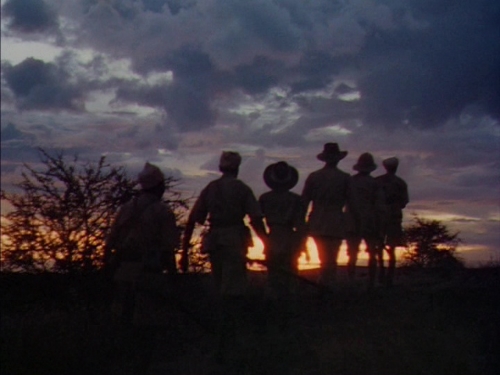
Kilimanjaro is a snow-covered mountain 19,710 feet high and is said to be the highest mountain in Africa. Close to the western summit, there Is the dried and frozen carcass of a leopard. No one has explained what the leopard was seeking at that altitude.

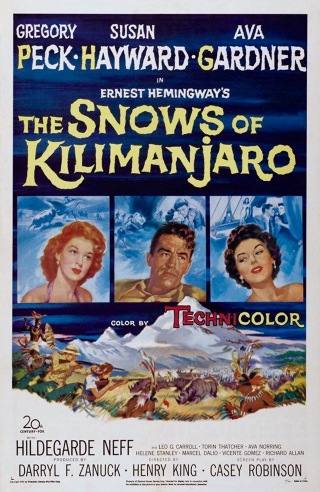
Those are the words which are spoken at the beginning of The Snows of Kilimanjaro (1952), words which are by and large the same as those which open the Ernest Hemingway short story of the same name. There’s something of a paradox in the fact that the above quote is slightly abridged, whereas the story brought to the screen greatly expands upon the author’s original text. Hemingway is said to have been displeased with the end result, allegedly because Casey Robinson’s script folds in elements of so many of the author’s other works, and perhaps partly because the fleshing out that occurs shifts the emphasis of the narrative. It alters the ending too, quite radically in fact, and I’m of the opinion that it is for the better. Hemingway aficionados (and I count myself as one) may find that hard to swallow, but I shall try to work my way through my reasoning as we go along.

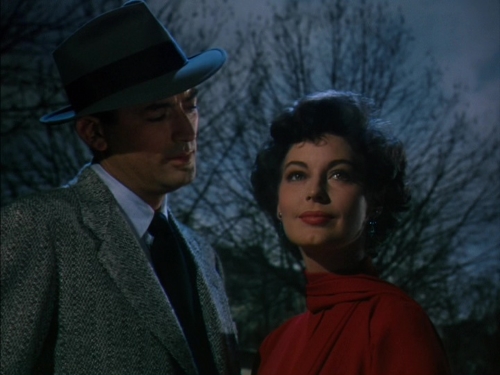
Harry Street (Gregory Peck) is a writer, but what is more important is that he is a dying man. He knows this, he can hardly fail to do so as he’s laid up in camp with the poison from an infected leg wound slowly pumping its way round his body. He’s being tended to by Helen (Susan Hayward), a rich woman whose company he needs and desires even as he spurns her attention and her affection. Not unnaturally for a man whose future is limited, Harry spends a lot of his time casting his mind back. The primary focus of those reminiscences is on the women in his life. While there does appear to be a degree of spitefulness or baiting to his revisiting the memories of his late loves and then telling Helen about them, the overriding sense is one of wistfulness, a kind of regret for opportunities not so much missed as elbowed aside in the ongoing quest for artistic success. Hemingway’s story, partly on account of its brevity, only touched on those memories, sights, sounds and flavors of a time that cannot be recaptured. However, where Hemingway drew attention to the words never written and the tales never told, the movie (while not actually ignoring those omissions) has Harry lamenting the loves he let slip away.

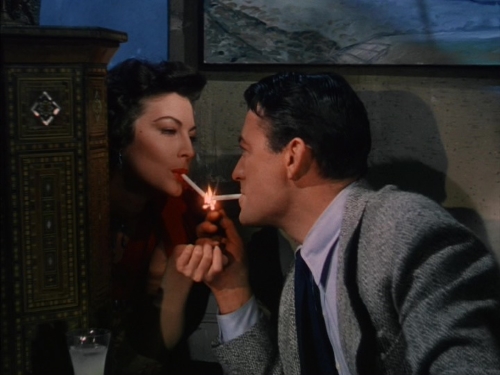
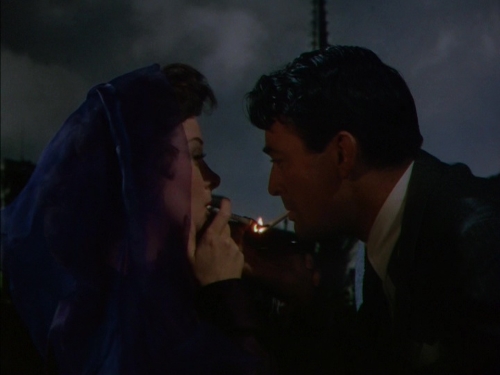
Harry’s flashbacks to those earlier days take in interludes in the USA and on the Riviera, but the bulk of the time is devoted to his stays in Paris and Spain, and to the woman who captured his heart, became his muse and then whose loss consumed him. Cynthia Green (Ava Gardner) is first encountered in a bar in Paris, dancing and laughing and stealing Harry’s heart in the half minute or so available to her. Then later in some improvised jazz club, in an atmosphere laden with intellectualism and melancholy, swept along by a slow and sultry saxophone, they embark on the affair that will define them, sealed by the simple expedient of lighting their cigarettes off a shared match. It’s a beautifully shot scene, Henry King’s painterly mise en scène bathed in Leon Shamroy’s blue and golden hues evoking a smoky eroticism that is both heightened and tempered by the gently charged flirtation of a woman merely “trying to be happy” and a man who has maybe found the essence of his own truth in that moment.

Those sequences charting the course of the relationship between Harry and Cynthia constitute the heart of the movie, and they are at best only alluded to in Hemingway’s story. Some of the description that Harry imparts via voiceover is directly lifted, but the events and their development and integration into the story is the work of Casey Robinson, an impressive piece of work in that it skillfully draws in strands of other Hemingway writings and captures the flavor and spirit of the author. For this viewer it not only works, but works well. Between them, King, Robinson and Darryl F Zanuck manage to turn what was a fine short story into a movie that adds new layers and nuance.

Then there is the ending, which is where the biggest departure from the source material is to be found. Hemingway wrote a lot about life and death, his whole attitude to hunting and bullfighting being closely tied to his feelings on this. His story sees Harry pondering the work he will not now complete, of what he had thought of doing but never actually did. And then he dies and his final thoughts take him up the peak of Kilimanjaro to commune with or perhaps even in some sense become that leopard referred to in the opening lines. He is then in his last moments a man making peace with his restlessness and his creative spirit, dreaming his way to the high ground.

The film takes a different path, presenting Harry with a salvation that is more comprehensive, more human. His creativity remains intact simply due to the fact that he is saved. What I feel is more important though, and it’s a big part of what I prefer about the movie, is that the higher plane achieved is not that conjured within the dreams of a dying man, instead it is a tangible one that can only exist in the living. It is a rediscovery of life, the will to live and the purpose of that life, coming about largely through his spiritual reconciliation with the women,  both in the past and in the present, who have shaped his work and his character. Where the story on the page suggested fulfillment attained through death, the movie offers a vision of fulfillment won through living.

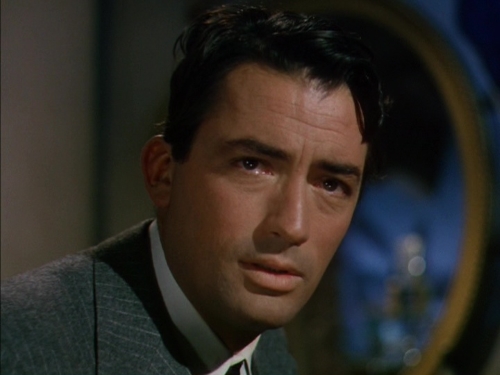
In the lead role Gregory Peck grows into the part, the character of Harry proving to be a complex one, and not an especially admirable one in many respects. There’s a good deal of self-regarding pomposity to him and Peck gets that across well. It’s that central part of the film, however, that solid dramatic core, where he explores the part in greater depth. One sequence in particular stands out for me, coming after the traumas of his sojourns in the Riviera and in Spain, where Harry finds himself back in Paris, and to be specific back in the bar where he and Cynthia first glimpsed each other. As he sits and thinks of those distant days, he turns around and fancies he sees the specter of Cynthia dancing from out of the mists of his past, laughing and full of joie de vivre. And the blend of emotions that chase across his features – hope jousting against regret and despair in an uneven contest – strike right to the heart of the man at that point.

The real strength of the movie, in terms of performances anyway, derives from Ava Gardner. Her role is essentially a riff on Lady Brett Ashley, the character she would go on to play for Henry King in his adaptation of The Sun Also Rises a few years later, albeit with less of the emotional bruising present. In her own words, Cynthia represented the first role she understood and felt comfortable with and that she truly wanted to play. That desire to have the part is always in evidence in her unaffected and naturalistic playing, and the inherent truth of that performance seems somehow appropriate for a character in a Hemingway adaptation. Susan Hayward was the other big star name and she too was well cast in a role that drew on her strengths as an actress, that characteristically tough resolve built as a shield around her vulnerability. In support Hildegarde Neff, Leo G Carroll, Torin Thatcher and Marcel Dalio all do creditable work.

I think I first caught The Snows of Kilimanjaro as a TV broadcast some time in the early to mid-1980s. I liked it well enough then, even if all aspects of the movie didn’t resonate with me to the same extent as they do now. I held off getting any home video version for a long time as the movie spent years as one of those dreadful looking public domain staples. Eventually, Fox released their own official version, one which is generally very pleasing to view. Hemingway purists might feel put out at the changes made to the story, but I feel the efforts of Zanuck, Casey Robinson and Henry King (helped along by the scoring of Bernard Herrmann)  work and the result is a movie that stands up on its own terms, and brings out themes and ideas that the brief nature of the original material did not allow.

The Tall Men

Every story takes its characters on a journey, and invites the viewer along for company too of course. Those narrative journeys must bring the protagonists to some new place in life, another staging post from which they can embark on the next leg of wherever it is fate or destiny has offered up as a choice. It’s not always a literal journey, one involving actual travel from point A to point B, but it sometimes is and that sense of real physical movement can he a handy way to highlight the more important shifts that occur. The Tall Men (1955) is what we might call a trail drive western from one of the pioneers of the form; Raoul Walsh had directed the impressive and innovative The Big Trail a quarter of century before and there’s even a nod toward that production in the lowering of covered wagons on ropes down a sheer cliff face at one point. In pursuit of dreams that are both competing and complementary, Walsh takes his characters up and down the length of the United States, and even further than that emotionally.

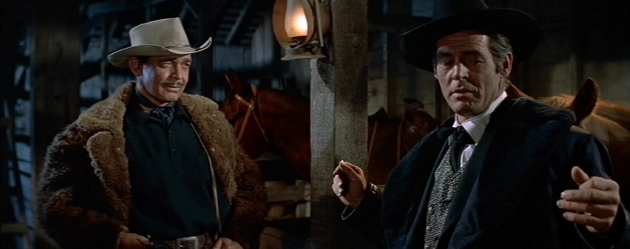
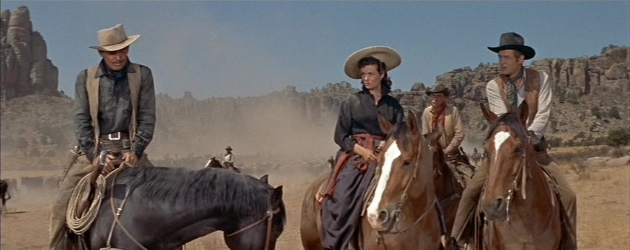
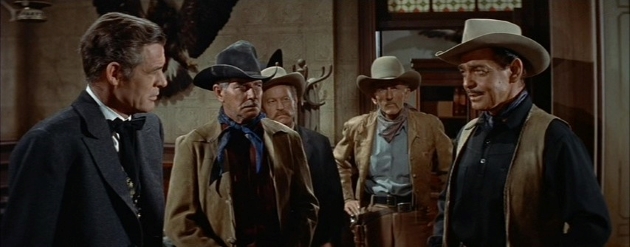
It opens in the snow, a chill and bleak backdrop with the color drawn out and starkness and bleakness to the fore once the blood red credits have faded from the screen. It is 1866 and the aftermath of years of conflict has left some men cast adrift, men such as Ben Allison (Clark Gable) and his younger brother Clint (Cameron Mitchell). That beginning deftly informs the viewer of the cynical and detached perspective of the lead characters – the sight of a hanged corpse in the wilderness prompting a throwaway line about civilization that is ripe with bitterness. Yet Walsh was not a cynic, he was at heart a romantic (even if he might never have wanted to admit that in public) and his best movies all set his characters off on grail quests for the truth and fulfillment that they must ultimately find within themselves. Ben Allison and his brother seem to be searching for nothing more than quick and easy money at the outset, staking out and executing a cheap and tawdry bit of banditry when they hold up and abduct a man they figure is both moneyed and green. That man is Nathan Stark (Robert Ryan), and while he may be carrying plenty of crisp new banknotes, he’s far from being a fool. He wrong-foots the brothers by offering them not a date with the law but a business proposal – help him drive a herd of cattle from Texas all the way up to Montana and share in the profits on completion. For men who are not by nature thieves, this offers them a way out, a chance to step away from the tantalizing vortex of crime and a life outside the law before it is too late. Setting out on that long ride back south to assemble a herd is the first step, and it also brings about a meeting with the other central character Nella Turner (Jane Russell), the woman who will bind all of them together and who prompts a reassessment among them of what they want and where they want to be in life.

The Tall Men was the first time Raoul Walsh worked with Gable, Russell and Ryan, and he would go on to make The King and Four Queens and Band of Angels with Gable, and The Revolt of Mamie Stover with Russell. There are many who would characterize Walsh’s filmmaking in terms of action and movement, and there is certainly plenty of that on display in The Tall Men. The sense of forward momentum, aided by the driving nature of the plot, is never far from the surface. Those action scenes, the seeing off of the Jayhawkers and the climatic stampede are shot and marshaled with considerable aplomb. Still, it is some of the quieter, more intimate moments that raise the movie and make it more than a simple shoot-em-up in the wilderness. The early scenes, after Gable has rescued Russell and they find themselves sheltering in an abandoned cabin, have great warmth and set the characters up for the developments that will follow. Gable and Russell form the core of the movie, the characters growing and changing in a way that feels very natural and the course of their relationship is first mapped out in that cabin sequence.

The use of music in this movie is artful and crafty too in the way the song – that vague ribaldry of the lyrics is characteristic of Walsh’s sense of humor – Russell sings, and appears to improvise according to circumstances, charts the peaks and troughs of her relationship with Gable. It’s not the first time a song has been used to punctuate a western, but it does feel different in the way its fluid lyrics alter depending on the singer’s mood while the theme itself remains constant.

“There goes the only man I ever respected. He’s what every boy thinks he’s going to be when he grows up and wishes he had been when he’s an old man.”

That line is uttered near the end by Robert Ryan’s Nathan Stark of Gable and it feels like screenwriters Sydney Boehm and Frank Nugent had the star himself in mind when they came up with it. The ageing Gable is used to good effect once more, that weariness that came along with the years, as well as the wisdom and philosophical self-awareness that is always lurking nearby, help to create a character who feels real, one whom the viewer can relate to and root for. Russell plays off him nicely, their moments together indicate chemistry and her role is of course key to making the plot work. Without her provocative and heartfelt performance the destination Gable, and Ryan too, arrives at would have little meaning.

Robert Ryan was one of the true masters of ambiguity, his heroes exhibiting bumps and cracks in their surface smoothness and his villains typically suggesting some grain of decency even if one would have to dig deep to find it. His Nathan Stark is a complex and nuanced portrayal, almost obsessively ambitious and capable of flat out ruthlessness, but he has a style about him, a kind of honest worldliness that is hard to resist. Once again, the script does the character justice, allowing the arc described to follow a natural path and, in the end, to reach a very satisfying destination. Cameron Mitchell was in the middle of a pretty good run at this time. Always more of a strong supporting actor than a natural lead, he had a knack for conveying callowness and occasionally suspect judgement. There is a point along the trail where it looks as though he may be heading down a disappointingly predictable route but the writing draws him back from that and his own skills make the turnaround credible.

The Tall Men has long been available on DVD, and it has always looked very nice too. The movie got a Blu-ray release in the US from Twilight Time and one in Germany via Koch Media, both of which are now out of print. Being a Fox title and therefore now owned by Disney, I guess hopes of a reissue on BD are slim at the moment. The movie is another of those classy pieces of filmmaking by Raoul Walsh which can be approached as both a slick entertainment package and also as a subtle commentary on the compromises people need to make if personal fulfillment is to be achieved. All told, a really fine bit of cinema.


A Trio of TV Episodes

It’s been a while since there have been any guest posts on this site, so here’s a television themed one from Gordon Gates highlighting a few episodes from three different shows, all from directors better known for their movie work.

A trio of early television episodes from directors we all know. I picked one each from Sam Peckinpah, Robert Altman and Phil Karlson.
The RiflemanThe Marshal (1958)Chuck Connors headlines this 1958 to 1963 western series that ran for 168 episodes. Connors is a world class hand with a Winchester rifle. This of course ends up getting him in no end of trouble. This is episode 4 from the first season. It is the first episode that future North Fork, Sheriff, Paul Fix is in.
Chuck Connors, a new resident to the North Fork area rides into town to grab a few supplies. While having a talk with the North Fork, Sheriff, R.G. Armstrong, a drunk is tossed out of the local beer hall. Armstrong and Connors pick the man out of the dirt and offer him a coffee. Armstrong recognizes the drunk as a former top lawman.
The drunk, Paul Fix, had lost his nerve and taken to the bottle. Connors offers the man a job building fence. Three squares and a chance to get sober is all that Connors offers him. Fix agrees and is soon at work on Connor’s ranch. The heebie jeebies are soon at work on Fix as he struggles to detox.
While this is going on, three gunmen, James Drury, Robert Wilke and Warren Oates ride into North Fork. Wilke and Oates are brothers looking to settle a several year old score with former lawman, Fix. They have tracked Fix to North Fork and do not plan on leaving till they kill him. The word soon gets around that the brothers are in town to do a killing, so Sheriff Armstrong pays the pair a visit. He however fails to realize that Drury is also part of the group. This costs him his life as Drury shoots the Sheriff in the back.
When Connors hears about the murder, he grabs his rifle and heads to North Fork. The just barely sober Fix likewise heads to town after arming himself with Connors’ big twin barrel.
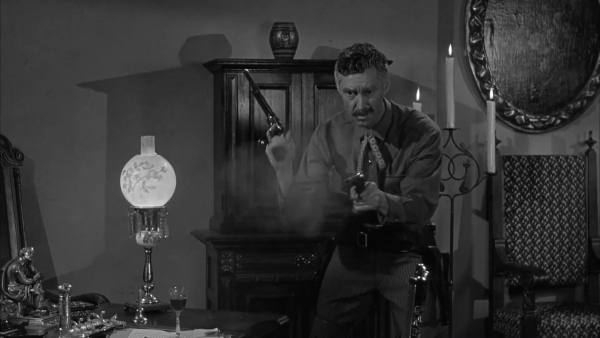
Connors runs into the brothers right off and lead flies with Wilke being knocked flat for the count. Connors collects a round in his side and goes down wounded. When Oates steps up to finish Connors, Fix walks up and blows Oates damn near in half with both barrels of the shotgun. He reloads and then steps out to meet the survivor, Drury. Drury is likewise soon making an express trip to boot hill.
Connors is patched up by the local doc. Fix has regained his self-esteem and takes over as the new town Sheriff.
A neatly done episode with plenty of gun-play involved. Handling the reins on only his second directing assignment is future big time director, Sam Peckinpah. Peckinpah is of course known to all western fans as the man behind, The Wild Bunch. Peckinpah received a best Oscar nomination for his screenplay on that film. Peckinpah also wrote the story for this particular television episode.
The look of the episode is quite sharp with two-time Oscar nominated, Pev Marley doing the cinematography.
This episode also was the beginning of the long time collaboration between actor Warren Oates, and director Peckinpah.
Next up on the playbill is…The Gallant MenPilot (1962)
The Gallant Men was an American television series that debuted on ABC in the fall of 1962. It followed a company of US soldiers from the Sept 1943 invasion at Salerno, and their battles up the toe of Italy. The series ran for a total of 26 episodes during 1962-63.
 Leading the cast is Robert McQueeney, who also narrates the story. McQueeney is a newspaper reporter who follows the company on their exploits. (Sort of an Ernie Pyle clone) The rest of the regulars are played by William Reynolds, Francis X Slattery, Eddie Fontaine, Roland La Starza, Roger Davis and Robert Gothie. There are the standard types sprinkled throughout, the joker, the card sharp, the loner etc.
This one starts with the company storming ashore at Salerno. They then end up in the mountains fighting for the village of San Pietro. Attack after attack is launched against the well-entrenched German defenders. These make ground, but only slowly and with many casualties. Newsman McQueeney notices that one man in the squad, William Windom, always seems to be first in the attacks. Almost as if he has a death wish.
McQueeney is sure he knows Windom from somewhere. Then he recalls, Windom had been a Major in North Africa. He had been relieved of duty after getting most of his command killed in a botched attack. What is he doing here as an infantryman?
McQueeney grills Windom and discovers that Windom had taken the identity of a dead man, and reported to this unit as a replacement. He begs McQueeney not to turn him in. He has to prove that he is not a coward or a foul up. McQueeney agrees to remain silent.
During the next attack, the officer in charge, William Reynolds, is wounded and carried to safety by Windom. Reynolds wants to put the man up for a medal but Windom says no thanks. Windom does however offer some advice on how to take the hill they are assigned to occupy.Reynold and his officers listen and like what they hear.
 That night, they infiltrate up the hill and launch an assault at first light. It is a hard fought go, but they manage to chase the Germans off the heights. Needless to say Windom is badly wounded taking out a machine gun nest single-handedly. He asks McQueeney to continue to keep his secret and dies.
A pretty good first episode which blends in plenty of live combat footage and film clips from other war films. Being in black and white of course helps this work. The series only lasted one year and lost out in the ratings to the same network’s other war series, Combat.The look of the episode is quite good with Robert Altman in the director’s chair. The cinematographer duties were handled by veteran Harold Stine. Stine would later work again with Altman as the d of p on the film, M*A*S*H.
The screenplay was by Halsted Welles. Welles was known for his work on numerous television series and the feature film, 3:10 to Yuma. William Reynolds would hit it big with 160 plus episodes of the series The F.B.I.
  Last, but by no means least, is one by RTHC fave, Phil Karlson
Ford TheatreThe Fugitives (1954)
This is an episode from the long running anthology series, Ford Theatre. The series ran for 195 episodes between 1952 and 57.
Raymond Burr plays a cop-killer who is on the lam after breaking out of death row. He has only one thing on his mind. And that is to get even with his ex, Mary Beth Hughes. Hughes had ratted him out to the police, which of course had not amused Burr.
Barry Sullivan is a newspaper reporter who gets the assignment to do a story on Burr. Sullivan has a wife, two young boys and is flat broke. For a $100 bonus, he tells his editor, Douglas Dumbrille, he will find Burr and get an exclusive story. The boss agrees.
Sullivan uses all his Police and underworld contacts to narrow down Burr’s possible hideouts. The Police however find Burr first. They have him cornered in a rundown rooming house. Sullivan rushes to the scene hoping to salvage enough for at least an article. The police are reluctant to close in as Burr has taken Mary Beth and a young neighborhood girl, Patsy Weil, hostage.
Sullivan needs that bonus so he offers to take a message from the Police into Burr. He figures he can help the Police and get his story at the same time.
Sullivan enters and finds Burr armed with a rifle. Burr is quite prepared to go out in a blaze of gunfire. Sullivan soon realizes that Burr is off his rocker and a story is the least of his worries. Sullivan unsuccessfully tries to persuade Burr to release the hostages. Burr then begins to beat Mary Beth. Sullivan decides to take a more physical approach and jumps Burr. A well-staged dust-up ensues with Sullivan getting wounded and Burr his well-deserved comeuppance.
This episode has noir fingerprints all over it with cast and crew all being noir vets. We have a story by Robert Hardy Andrews who worked on I Married a Communist.
Then there is the director of photography, Burnett Guffey, who worked on many noirs, including Nightfall, The Harder They Fall, Human Desire and In a Lonely Place.
Next up is the director, Phil Karlson. His films include, 99 River Street, Scandal Sheet, Hell’s Island, Behind the Mask, Tight Spot, 5 Against the House, The Brothers Rico, The Phenix City Story and Kansas City Confidential.
A well done bit of noir television.
Gordon Gates