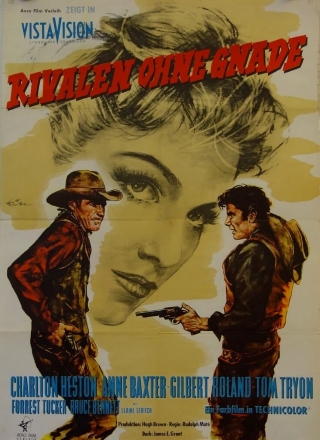
Three Violent People

There are movies with strong openings, those which grab one’s attention from the very first shot and never relinquish their grasp thereafter. Others are slow burners, seemingly leading viewers down drifting, meandering paths till they finds themselves inveigled into the story in spite of themselves. Then of course there are the uneven affairs, movies which could be said to suffer from an identity crisis, confidently striking out in one direction before abandoning that plan entirely and gradually transforming themselves in a wholly unexpected manner. Three Violent People (1957) falls into that latter category, the broad beginning flirts and teases then segues into a lengthy middle section that lacks energy, before hitting the home straight with renewed vigor and purpose.

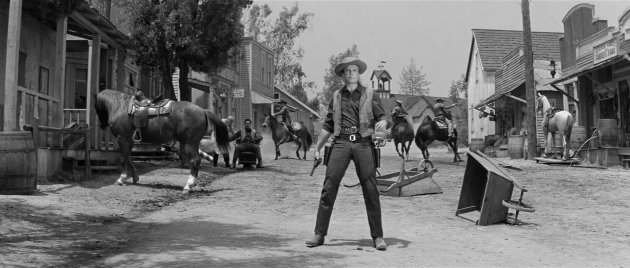
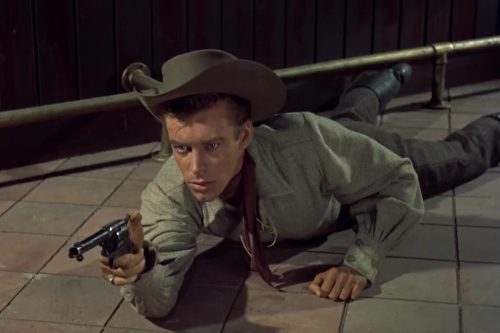
Colt Saunders (Charlton Heston) returns to Texas after the Civil War with three basic aims: to get his sprawling ranch back on a paying basis, to keep the grasping Carpetbaggers at arm’s length, and to find a woman to settle down with and make his wife. A brief dust-up with some of the aforementioned Carpetbaggers leaves him with a sore head, empty pockets and the strong suspicion that he’s just been rolled by newly arrived Lorna Hunter (Anne Baxter). She is one of those ladies discreetly referred to as “saloon girls”, though with a polished line in patter that creates the illusion of refinement and gentility. Her plan is to hook the well-to-do Captain Saunders and worry about the consequences of his finding out about her real past later. Well, she manages the first in record time and, not long after setting up home on the Saunders ranch, that deception does indeed come back to haunt her. In the meantime, Saunders finds himself butting heads with the crooked representative of the provisional government (Bruce Bennett) and his chief enforcer (Forrest Tucker).

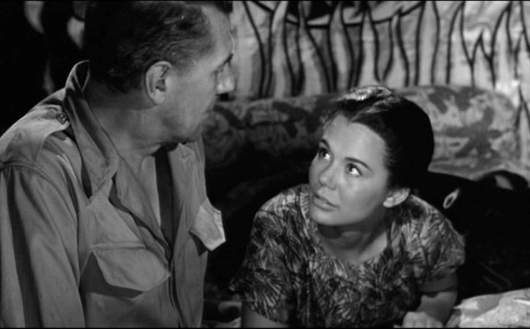
Three Violent People was written by James Edward Grant and it is a very inconsistent picture. The opening suggests we’re in for a relatively light confection and both Baxter and Heston play it accordingly at that stage. However, as soon as they are married and the action moves to the ranch, the tone alters radically, not least with the introduction of Heston’s one-armed brother (Tom Tryon). It morphs into something that borders on the Shakespearean; guilt, retribution and envy all jostle for position as honor, decorum and the weight of expectation gaze broodingly from out of the past, and quite literally down from the portraits hanging sternly above the hearth. The ingredients here are certainly tempting, strongly spiced by the complication provided by Baxter’s pregnancy, while the machinations of Bennett and Tucker act as a savory side dish. Still and all, the end result is a stodgy concoction, that overstuffed middle proving to be a little too rich. The last act saves it somewhat – a face-off timed by an upturned whiskey decanter, a brisk yet gratifying duel, and a wrap-up that blends vindication and personal growth.
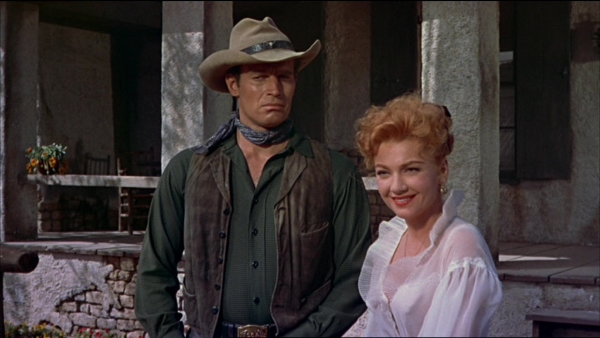
Three Violent People wouldn’t rank as Charlton Heston’s best role in westerns, but he still does what he can with it. He had a knack for walking that line between pride and implacable priggishness. That emotional puritanism is given a good run-out here and collides headlong with the natural compassion that arises from the plight that Baxter finds herself facing. As he finds almost everyone turning against him, he starts to unbend emotionally and morally and manages to redeem himself in the end. Baxter is fine as the woman looking for a way out in life, taking the kind of rash decision that fits the feisty and mischievous woman we first encounter and then finding that she has the requisite steel within when her deception is dragged out into the light.
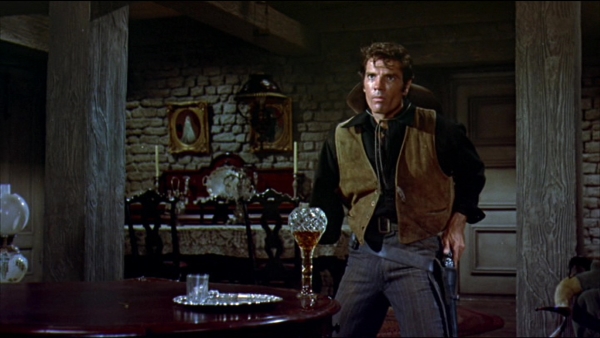
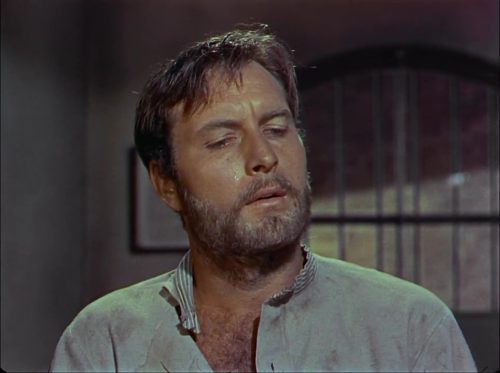
Tom Tryon, an actor I’ve never been that keen on excepting a good enough turn in Preminger’s In Harm’s Way, is much less effective as the maimed brother. His role is poorly defined, there is resentment there, as one would expect, and bitterness too. However, his demeanor is a little too glib and arch and it’s difficult to get a handle on his real motives. It doesn’t help either that his character’s disability looks hugely unconvincing – just like a man wearing a large and bulky sling under his shirt. Forrest Tucker is reliably mean as the hired gun, conniving and blustering in his characteristic style. One of the real standout performances, however, comes from Gilbert Roland as Heston’s foreman. I don’t believe I’ve ever seen Roland give a bad performance and his role in Three Violent People offers ample opportunity to display his unique style, that suave, man of the world wisdom and shrewdness. He brings a touch of grandness to the part, offering Heston’s stiff prude an object lesson in dignity and true honor in one of the key scenes late in the movie as he disdains a tainted toast following the birth of his employer’s child. It is a terrific moment and Heston’s stung and startled countenance as the man he has esteemed all his life excoriates his pompous moralizing is something to behold. It is his holding up of a mirror to Heston’s sanctimony that sets the character on the road to salvation. In support, Bruce Bennett is a bit colorless and lacks bite, while Jamie Farr (who I will always think of as Klinger from MASH) and the controversial and recently deceased Robert Blake both appear as sons of Gilbert Roland.

The movie was released on DVD by Paramount many years ago and the widescreen transfer looks acceptable, but maybe not a strong as some of the studio’s other titles do. Generally, I am fond of the films of Rudolph Maté, but Three Violent People is a weaker effort. It’s not a bad film, and I certainly hope I haven’t slated it here, but it is not all it might have been either. The writing needed to be tighter and some of the internal conflict lacks the punch it ought to have. This, in conjunction with some rather lackluster work from Tom Tryon in a pivotal role, diminishes the overall effect of the production.
Forty Guns

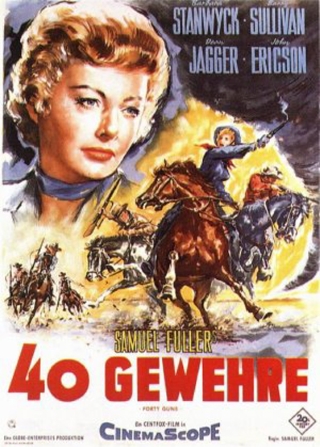
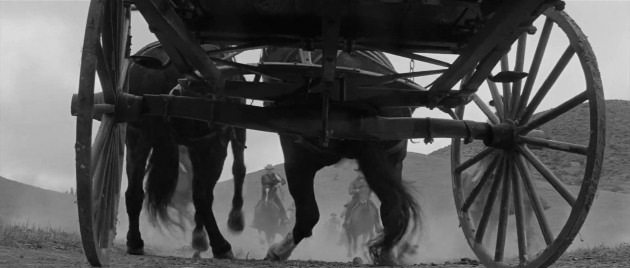
How does one describe the cinema of Samuel Fuller? Words like brash and bold tend to be used, perhaps even overused, when his name is brought up. Nevertheless, those adjectives fit, they capture the essence of his filmmaking, the energy, the almost primal disregard for convention and taste. Fuller didn’t make that many westerns altogether, but they are all interesting and memorable, not least for the way they show a director at work who was in love with that work. Forty Guns (1957) is an invigorating example of Fuller’s filmmaking, pummeling and assaulting the senses right from that famous opening shot; the movie charges at us head-on with fury and passion, a visual and aural challenge that is as neat an example as any of how much breadth and confidence the western genre had attained in the late 1950s.

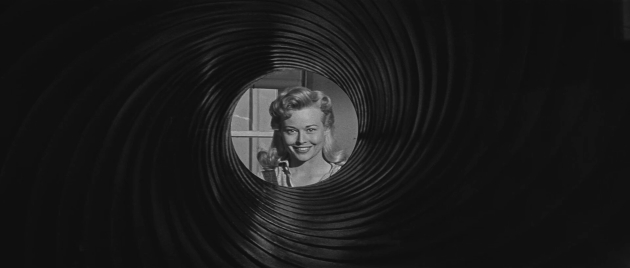
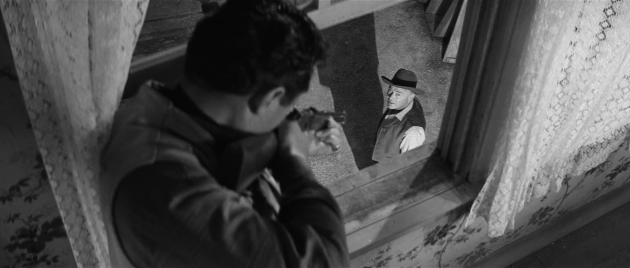
That opening sequence sets the tone, and indeed the pace for everything that follows, a pounding, intimidating and disorientating sensation that rarely lets up till the movie reaches its shockingly unexpected climax a mere eighty minutes later. One hour and twenty minutes to introduce viewers to Griff Bonnell (Barry Sullivan), a Wyatt Earp style figure who is on his way to Cochise County to arrest a man. He’s accompanied by his two brothers, Wes (Gene Barry) who acts as his backup and Chico (Robert Dix) who is due to be packed off to California and a less hazardous life. The forty guns of the title (or forty thieves as Sullivan later refers to them, evoking the One Thousand and One Nights and thus adding to that fantastic unreality which the film wholeheartedly embraces) are in the employ of Jessica Drummond (Barbara Stanwyck), the de facto boss of the territory. Brockie (John Ericson) is her younger brother, a spoiled, psychopathic wastrel who uses his sister’s influence and the implied threat of her private army to terrorize women, the town marshal, and frankly anyone who attracts his attention with impunity. Jessica Drummond’s reputation precedes her, her riders have as near as not run the Bonnell brothers off the road, and then her brother’s anarchic spitefulness threatens to lay waste to the whole town. It is here that Griff Bonnell has his hand forced; coolly pistol whipping Brockie into submission and tossing him into jail, he lays down his marker even before riding out to the Drummond ranch with his warrant to arrest one of the hired guns.

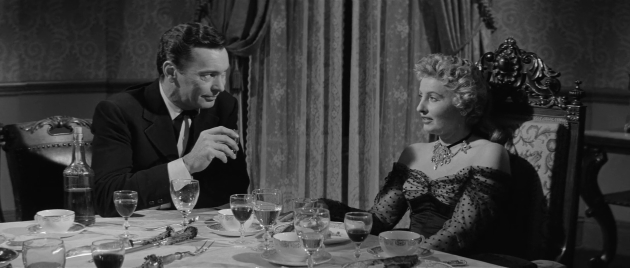
It now builds toward a battle for supremacy, both of the heart and the land. The whole setup at the Drummond house continues this theme of the fantastic and if not unreality then perhaps hyperreality. Even if the table is rectangular rather than round, there is something positively Arthurian about the image of Jessica lounging like royalty at the head of that table, flanked on her left by the aggressive and unpredictable Brockie while taking pride of place at her right hand is the soft-spoken but cunning and tragically devoted sheriff Ned Logan (Dean Jagger). In a movie with more than its fair share of visually memorable tableaux, a long tracking shot leads into the kind of double entendre laden conversation one wouldn’t normally expect to find in a western from the 1950s, with an exchange about the potency and volatility of Griff’s weapon. How that got past the censors, I’ll never know.

The whole thing then winds its way through a number of Earp/Clanton allusions towards a conclusion which is not so much a gunfight at the OK Corral as a daring example of Fuller’s characteristic audacity, flipping one of the cardinal conventions of not only the western but cinema in general in a movie which has already stampeded across so many viewer expectations. The director never really lets up in this movie, goading and provoking at every opportunity, painting his picture with the kind of broad brushstrokes that only supreme self-confidence permits, and only a man who lives for making movies would even countenance the kind of risks such an approach runs. Frankly, this is not a movie that will appeal to everyone, it is, perhaps like Fuller himself, too vivid and stylized to gain universal approval. I guess it comes down to this, you either “get” Fuller and his filmmaking or you don’t, and there’s little or no room for equivocation about it. He may be said to have produced a good deal of stylized work but, unlike directors less committed to their art, it was not a case of style over substance. If realism was of little concern to him, then what did matter was getting at the reality of the feelings that dwell at the heart of the movie. That cocksure presentation eschews prosaic realism for a pulpy assertiveness. His demands for the viewer’s attention might seem cartoonish on occasion, but once he has captured that attention there is no doubting the sincerity of the emotion he has been striving to highlight.

That sincerity is apparent on a number of occasions, most notably in the scenes which see Dean Jagger  interacting with Stanwyck. There is his slow departure from the dinner table when Sullivan pays his first visit to the Drummond ranch, a dragging reluctance to leave where Stanwyck’s dismissal and his compliance is achieved without a word being spoken, merely an exchange of glances that express a world of regret. Then there is that final three way scene, part confrontation and part confession that gives Jagger his finest moments in the movie. We get to see a character who has previously traded heavily on the ersatz and the disingenuous coming face to face with the consequences of his longing and loss, and at that moment understanding that the truth he can no longer avoid leads to only one destination.

Late on, there is a funeral scene, following hard on the heels of one of those startling and abrupt instances of violence. The contrast with what preceded it is marked, showing off Fuller’s restraint and Joseph Biroc’s cinematography. The camera tracks sedately from one side to the other against a lead gray sky, broken only by a short close up on Jidge Carroll as he softly sings “God Has His Arms Around Me“, beginning and ending with the widow as she stands motionless and terrible in her dignity and composure.

Forty Guns was the third time Barry Sullivan and Barbara Stanwyck appeared together in a movie and they play off each other well. Sullivan’s confidence matches that of his leading lady and his terse, clipped style of delivery hits the right note for a character who is painfully aware of how his time is running short, how a rapidly changing society is in the process of overtaking him. Stanwyck’s fondness for westerns is well documented; she could tap into the kind of insolence that befits her character, showing off her riding skills as she gallops imperiously over the land she has claimed, as well as having the grit to take on a particularly dangerous looking stunt that sees her horse drag her across rough terrain in the midst of a tornado.

Forty Guns always looked good any time I caught it, and the UK Blu-ray from Eureka, which may now have gone out of print if the prices I’m seeing online are any guide, certainly boasts a fine presentation. There is a lot of Fuller in this movie and that is a plus as far as I am concerned, although those who are less attuned to his style and sensibility will probably get less from a viewing. To my mind, this is a significant addition to Fuller’s credits and to the western genre itself, a film I never tire of revisiting.

The Square Jungle

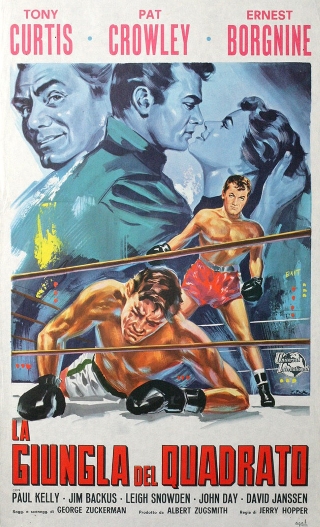
Hollywood in the 1950s seemed to fall in love with the idea of jungles, metaphorical ones at any rate. They ranged from the Asphalt to the Human, from the Blackboard to the Female, and those titles always carried at least a hint of film noir about them. The Square Jungle (1955) has been marketed as noir, but I don’t believe it fits in that category. Sure the trajectory followed by the protagonist takes a detour into the darker corners of despair and disgust, but it is ultimately headed in a different direction and is arguably best approached as a sporting melodrama that charts the sometimes painful journey from hubris to humility.

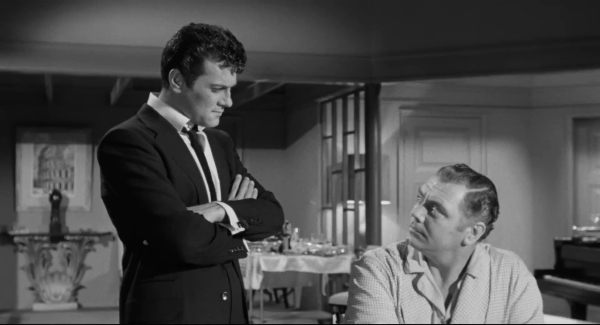
Eddie Quaid (Tony Curtis) is a man with ambitions, albeit modest ones at first. He’s working as a grocery store clerk and doing his best to offer moral support to his father, Pat (Jim Backus), who is weighed down by an unholy trinity of widowhood, unemployment and alcohol dependence. Desperate to haul his old man back from the brink after he’s been arrested for a drunken assault, and smarting from the consequent break-up of his relationship with Julie Walsh (Pat Crowley), he stumbles into the world of prizefighting. Since Eddie is clearly showing aptitude for the fight game, his father along with a sympathetic cop, McBride (Paul Kelly), persuade him to give it a go as a professional boxer. Under the watchful tutelage of Bernie Browne (Ernest Borgnine), an atypically learned and thoughtful man who is almost Socratic in his approach to training, Eddie (or Packy Glennon as he is known in the ring) rises fast through the ranks to earn a shot at the world title. This all occurs in the first twenty minutes or so of the movie, cutting through a lot of potentially tedious build-up and allowing the focus to rest firmly on Eddie’s period at the top, the three fights and their consequences that define him as a champion and, more importantly, as a man.

Many a boxing drama has focused on the corruption and underhanded shenanigans taking place in that shadowy world beyond the stark and floodlit square where the modern gladiators jog out to do battle with the promise of riches, glamor and celebrity always just one punch away. Yet there is little if any of that on display in The Square Jungle. Instead, it is replaced by a kind of ragamuffin romanticism, where pride, honor and self-respect are put to the test and are seen to win the day as opposed to the self-regarding venality that one normally associates with the fights.

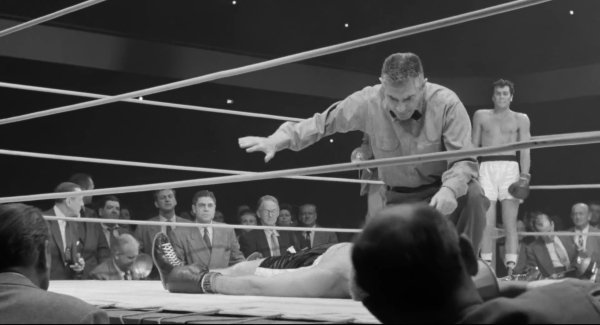
I guess director Jerry Hopper would be classified as a journeyman, although that is not a term I am especially fond of due to that air of drabness it carries with it. He is never going to be regarded as a great and there isn’t any one film he made that commands our attention. Then of course there is also the fact that he worked so extensively in television, with many more credits in that medium than in the cinema, and that was rarely a career route that brought critical praise, or which permitted the creative breathing space essential to it for that matter. For all that though, I don’t think I have watched anything Hopper made which I didn’t enjoy on some level and those often undervalued television credits include some exceptionally fine work. One welcome feature of The Square Jungle is the pacing, the story maintains a strong sense of forward momentum all the way through, and I’ve already mentioned the brisk and efficient way the early part of the story is handled. Naturally, a boxing film needs to have well staged fight scenes and I think that is the case here, with the three major bouts being shot and edited in such a way as to impart a kind of brutal intimacy. The aftermath of each successive fight is vital to our understanding of the emotional, and indeed the spiritual, development of Eddie in particular. It’s quite subtly achieved given the nature of the subject matter and the brash milieu of fighters, trainers, promoters and sundry hangers-on. Personally, I was taken by the marvelous stillness that Hopper brought to the end of the fateful third fight, an all-encompassing silence that descends abruptly, the gravity of it all perfectly captured in the terseness of the referee and the wordless, tear-stained anguish of one woman’s face.

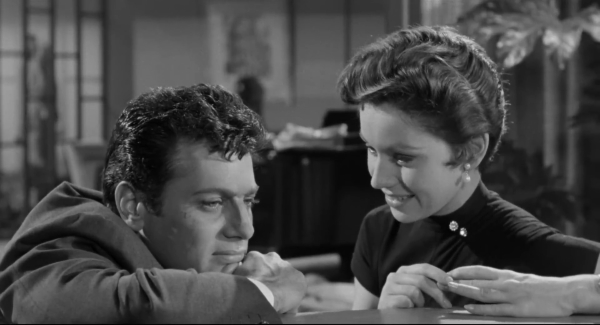
Eddie Quaid/Packy Glennon was the second time Tony Curtis would play a fighter, having already done so a few years earlier in Joseph Pevney’s Flesh and Fury. It is a good performance, charming throughout and moving smoothly from the open, selfless young man of the early scenes to the conceited and vaguely boorish champion he becomes before finally attaining wisdom and warmth, and winning a far more valuable prize in the process. Pat Crowley is quietly supportive as the girl he loves and who helps anchor him.

However, this is not a love story, but rather a look at how men can reach an accommodation with themselves, with their own masculinity in all its forms. As such, the relationship Eddie has with his father is a key one, the older man – who has tasted failure many times – living vicariously through his son’s success and the way that impacts on the younger man. Jim Backus was good in that kind of role. I find I tend to hold onto my first conscious impressions of actors and in the case of Backus that would have been his part as James Dean’s father in Rebel Without a Cause, so he is someone I automatically associate with weak but well-meaning figures. Then there is Ernest Borgnine, who could do no wrong around this time, as the saturnine philosopher carrying his own private guilt. In smaller roles, Paul Kelly, David Janssen, John Day, John Marley (long before he would wake up next to a horse’s head in The Godfather) and Leigh Snowden all make telling contributions. There is also a very brief cameo from former heavyweight champion Joe Louis.

Gradually, it is becoming easier to catch up with Universal-International titles that had long been hard to see. The Square Jungle has been released on Blu-ray in the US by Kino in one of their film noir collections and I’d like to think it might turn up in Europe or the UK at some point.It is a solid boxing drama with an attractive cast and a reliable director, and it’s well worth watching.

The Quiet American

The Quiet American (1958) is an adaptation by Joseph L Mankiewicz of Graham Greene’s novel of the same name and it, unintentionally from the filmmaker’s point of view, poses the question of whether a movie is best approached or evaluated on an emotional or an intellectual level. Greene was very unhappy with the changes Mankiewicz made to his book, particularly with the alterations to the political sentiments the author had written into his story. Greene’s objection highlights what I think of as the intellectual approach, for viewing a film and assessing its worth or success in terms of its political perspective strikes me as a coldly intellectual exercise. Conversely, examining how a movie deals with the human interactions that underpin the story is surely a more emotional approach. Given that I have long been convinced that art is much more closely related to the heart than the head, it probably won’t come as any surprise to learn which view I tend to favor.

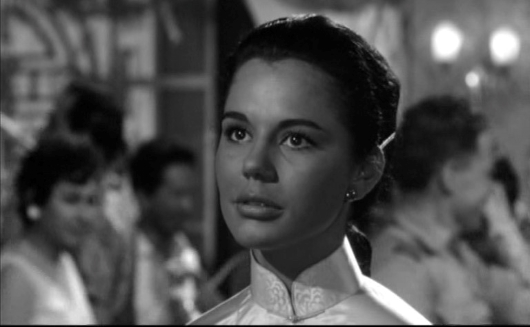
The Quiet American opens near the end of the story and works back from there in search of a beginning that will allow all the events and personalities involved to fall into place. The titular character (Audie Murphy) who remains unnamed throughout, unlike in Greene’s novel, is already dead when we viewers come on the scene. His body is floating face down near the banks of the river in Saigon, discovered by chance by revelers celebrating Chinese New Year. From here we are taken back to the months before his demise, to the time when he first arrived in Vietnam. So the bulk of the movie is related via flashback, unfolding from the point of view of Thomas Fowler (Michael Redgrave), a British journalist and acquaintance of the anonymous American, as he conducts a one-man wake in the morgue, reflecting on the life and death of the young man reposing on the slab before him. Those few months defined the course of the lives of three people: Fowler, the American, and Phuong (Giorgia Moll), the young Vietnamese girl who is loved by both of them. Regardless of the political background of the tale, and the points about the role of foreign intervention in South East Asia that Greene wanted to make, this is a love story first and last; remove that element and there is nothing to relate that has any resonance beyond contemporary concerns. What matters here, and what the movie focuses on, is the triangle formed by those three people, with Phuong acting as the anchor.

As I mentioned above, Greene felt aggrieved at the way the script radically altered the points he wanted to make in his book. I can understand that frustration on the part of the author, and I can sympathize with what he must have seen as wholesale distortion of his vision. I read and enjoyed his novel many years ago yet I still appreciate this movie for what it is, for what it does rather than what it does not. Basically, I see the changes that Greene disliked as only background details as far as the movie is concerned – those elements might be integral to the aims of the novel, but Mankiewicz was making a movie and both his medium and the aims he had were very different. I am of the opinion that any filmmaker who emphasizes the purely contemporary elements of a story at the expense of the timeless aspects is straying into the realms of commentary. In short, I see film as a form of artistic expression, an analysis of the human condition, and that is something eternal rather than ephemeral.

Ultimately, what counts is whether or not the movie works on the terms by which it was conceived. I regard it mainly as both a love story and as a contemplation of the way we frequently project visions of ourselves and the world around us onto those we love. As such, I consider it to have succeeded in achieving it aims. Of course one can dig deeper and read more into it all, seeing different slants on relationships adopted by the old world and the new, the contrasting views of young and old, and so on. Nevertheless, it all comes back to the portrayal and interpretation of love and what that means to various individuals in the end. The background of the story operates in relation to the characters like the MacGuffin in a Hitchcock film, but even then only up to a point. After all, when Fowler makes his fateful decision, he is motivated by a toxic cocktail of pride, jealousy, fear and thwarted passion and not something as prosaically dreary as political convictions.

On paper, one would say that having Audie Murphy face off against Michael Redgrave would lead to an uneven and unfair contest. On celluloid and in fact , however, the contest is a remarkably even and productive one. Murphy had grown steadily as an actor by the late 1950s and this kind of dramatic role was well within his capabilities. There is still a lot of fresh energy about him, and that quality is used to superb effect when placed in contrast to Redgrave’s worn and dissipated cynicism. That fresh faced enthusiasm always cloaked a deeper steel and there is never any doubt about the resilience of the idealistic young man he was portraying. When he trades words with Redgrave’s weary writer, the latter may indicate disdain for their naivety but he never really questions their sincerity, and nor do the viewers. Redgrave is every bit as good as the complete opposite, a tired and spent man whose surface smugness masks chronic insecurity and desperation. We believe it when Murphy shows drive and positivity, and that sense of credibility is just as strong when Redgrave paints his own picture of desolation and emptiness.

Italian actress Giorgia Moll is wonderfully unknowable as the focal point for the affections of those two very different men. There is a lot of passivity about her character, right up till the end anyway. Her final scene adds a great deal of punch and power though, largely because of the apparent indifference and insouciance she displays earlier. The cast is fairly self-contained, but Claude Dauphin lends attractive support as the deceptively relaxed policeman who misses very little. Bruce Cabot has what amounts to a cameo as an American journalist and Richard Loo, who popped up all over the place throughout the 40s and 50s whenever an Asian character was required, is coolly efficient as Redgrave’s contact with the insurgents.

The Quiet American was given a release on Blu-ray by Twilight Time some years ago but I never got around to picking it up and have had to make do with less than stellar DVD versions. It’s a shame no company in the UK has been able to put this film on the market on BD so far. The story was filmed in 2002 by Philip Noyce, with Michael Caine and Brendan Fraser in the Redgrave and Murphy roles, and it stuck closer to the sentiments of the novel. I saw it at the time and while I thought it was fine (although I should say I’ve never been able to warm to Fraser in anything) I don’t think it was improved by being more faithful to its source. I can only say that I have never felt the need to revisit the 2002 film in twenty years whereas I’ve seen the Mankiewicz version multiple times.

Where the Sidewalk Ends

Otto Preminger’s Where the Sidewalk Ends (1950) has the feel of something that might have been cooked up had Cornell Woolrich and William P McGivern ever decided to collaborate on a story. There is that quality of the inescapable nightmare, a fatalistic vortex relentlessly dragging the protagonist down, while he is one of those big city cops who appears to be as uncomfortable in his own skin as he is in the department he works for. The end result is a form of psychological trial by ordeal, where the moral fiber of a man is measured by his ability to meet the challenge laid down by his own past.

Right from the beginning it is clear that Mark Dixon (Dana Andrews) is a man in trouble. The patience of his superiors in the police department with his brutal, two-fisted approach to the job is wearing perilously thin. What is perhaps more dangerous though is his appraisal of himself. It’s not voiced yet the truculence that pervades features, manner and posture clearly announces a deep-rooted dissatisfaction. With a final warning still ringing in his ears, he sets out to investigate the death of a rich out of town businessman. The victim ought to have been the mark in a rigged game of dice, but a bit of bad luck on the part of the mobsters running the racket leads to a misunderstanding, which leads to a scuffle, which leads to a murder. So Dixon is one of the bulls sent to investigate and is soon on the trail of the man being lined up as fall guy for the killing. Seeing as this is a story that is full to the brim with ill fortune and bad judgement calls, it is somehow inevitable that a man with a hair trigger temper such as Dixon is going to get into deeper strife when he finds himself alone with an antagonistic suspect. That’s exactly what happens, blows are traded and the suspect, a war veteran with a metal plate in his head, winds up dead on the floor. And it’s here that everything begins to spiral completely out of control. Shocked and panicked, Dixon attempts to cover up the accidental killing, but once he sets the ball rolling the momentum generated threatens to crush everything and everyone in its path, not least the dead man’s father-in-law.

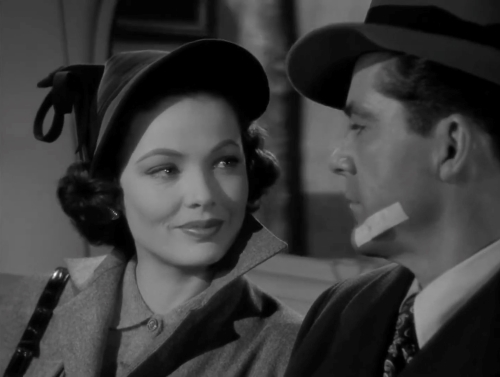
The entire business is further complicated by the fact Dixon finds himself falling in love with the estranged wife (Gene Tierney) of the man he’s just killed. What follows is a variation on that noir trope of a man investigating a killing he is responsible for, the hunter essentially hunting himself. The personal angle and the need to see that blame is not wrongly placed on an innocent man adds some spice, as does the fact Dixon is all the time fighting an internal battle borne of the fact his own father was a career criminal. It sets up an intriguing study of the concept of justice and how it may be best achieved, as well as looking at the potential for attaining personal and professional redemption.

Where the Sidewalk Ends feels like something of a watershed movie. That whistling intro with the opening bars of Alfred Newman’s Street Scene playing over credits chalked on the sidewalk, suggestive of the casual impermanence of a crime scene and the expedience of the methods used to mark it out, as anonymous citizens stroll past seems apt given the way film noir – that genre that wasn’t even aware of its own name at the time – was moving along into other areas. As the new decade went on noir would move gradually away from those tales of personal misfortune and shift its focus onto wider societal ills, organized crime and institutional corruption. The director too would soon be on his way, leaving behind the restraints imposed by being under contract to a major studio.

Recently, after revisiting Preminger’s Anatomy of a Murder I was watching one of the supplements on the Criterion Blu-ray where Foster Hirsch was commenting on the directors insistence on shooting that movie on authentic Michigan locations. Some of that fondness for using real locations comes through in Where the Sidewalk Ends too with much of the film shot on familiar Fox studio sets, but also taking the cameras out onto the streets of New York where possible to give it an air of genuine urban grit. The whole picture has a strong noir aesthetic, canted angles, telling close-ups, characters clustered in tight, claustrophobic spaces framed by doorways and windows, and plenty of shadows carefully lit and photographed by Joseph LaShelle.

Where the Sidewalk Ends was the fourth of five films Dana Andrews would make with Preminger. All of their collaborations are interesting and there’s not a bad movie among them. Andrews has always been a favorite of mine whatever genre he happened to be working in and I’m sure I’ve spoken before of that marvelous internalized style he used so effectively on so many occasions. The part of Mark Dixon allowed him to tap into that: his rage and hunger for violence barely contained every time he encounters Gary Merrill’s conceited gangster, the appalled horror at what he has done when he realizes the murder suspect is lying dead before him, and then the sickening, sliding sensation as he witnesses the net cast by the law drawing tighter around those who least deserve it. These are all different emotions and reactions yet all of them are perfectly conveyed with great subtlety and quietness by Andrews – superb screen acting. Gene Tierney was another veteran of Preminger’s movies, making four in total for the director over the years. One might say her character isn’t as directly involved in the story yet her presence is one of the primary drivers of the plot – the initial killing stemmed partially from her attendance at the dice game, her father called on her abusive ex and placed himself at the scene of the crime as a result of what happened to her, and Dixon’s journey back from the brink towards redemption could not take place without her.

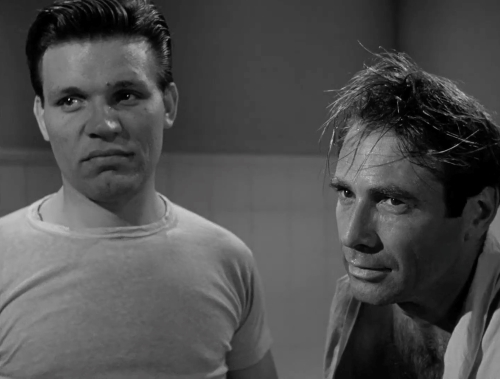
Gary Merrill is good enough in the role of the villain, although he is off screen quite a bit. In a sense though, one could argue that Merrill is not the main villain, that honor belonging to Dixon’s father, the ghost of a long dead hoodlum haunting his son’s conscience and putting a hex on his character. An uncredited Neville Brand makes for a memorable sidekick, superficially tough but easy to crack under pressure. That pressure is applied not only by Andrews but also by Karl Malden as the newly appointed lieutenant who is keen to make a quick arrest. As Tierney’s cab driver father, and Malden’s prime suspect, Tom Tully is hugely endearing. Both Tully’s playing and Tierney’s devotion to him lend credibility to the conflict which assails Andrews as the plot unfolds. All of the supporting actors turn in good work, including Bert Freed, Craig Stevens and Ruth Donnelly. I want to add a brief word too for Grayce Mills, who only appears in one scene. Many of these studio productions contained seemingly throwaway moments, little vignettes that are easily overlooked yet frequently stick in the memory. Such is the case with the old widow living the basement below the apartment where Andrews runs into trouble – there is something touching and memorable about this old lady’s few telling lines about the insignificance of time to the aged, and how she sleeps in the parlor with the radio softly playing to assuage her loneliness.

Some years ago the Bfi released a Blu-ray set of three Otto Preminger films noir comprising Where the Sidewalk Ends, Whirlpool and Fallen Angel, but it now seems to have gone out of print. Anyone fortunate enough to have picked that set up will know that this movie (and the other two titles) looks exceptionally good so it’s worth keeping an eye out should it be reissued, or if a competitively priced used copy pops up.

So, this year ends with Where the Sidewalk Ends. My thanks to all of you who came along for the ride, and I hope I’ll be seeing you again in 2023.

The Angry Hills

If I were to offer the choice of a movie with a thin plot stretched beyond the point of endurance or one so crowded and packed with incident that breathing space is at a premium, which one would you choose? Well, the wise viewer would most likely pick neither and instead plump for something more balanced. As one whose curiosity typically allows wisdom to be elbowed aside, I would probably try the overloaded option. I mean, that one ought to be pacier and potentially more exciting, right? Not necessarily. The Angry Hills (1959) is a movie that has some weighty themes baked into it, but there is frankly too much going on, too many plot developments and too many characters drifting in and out of proceedings. In the end, it loses focus, simultaneously reducing the entertainment value and blurring or trivializing the more serious points it might have made.

The Angry Hills takes place in 1941, on the eve of and then in the period just following the German invasion of Greece. It starts with the arrival in Athens of  journalist Mike Morrison.The situation in the city could charitably be described as fluid and he’s keen to move on as soon as possible, or as soon as he’s had the opportunity to clean up and sample some of the local night life at least. Journalists get to know all kinds of people in the course of their work and an old acquaintance of Morrison’s passes on a list of Greeks who will be able to filter information through to British Intelligence in the months and years ahead. The idea is that a pressman will be in a better position to smuggle such a list out of the country before the city is occupied. Morrison frankly wants no part of this but he gets stuck with the list nonetheless. As a result, the movie develops into what is essentially a long chase back and forth across the country with the Germans, and those who would collaborate with them, in hot pursuit of the reluctant courier. As Morrison tries to dodge the Gestapo commanded by the enigmatic Conrad Heisler (Stanley Baker), he is plunged into the interior of the country where he becomes involved with the fledgling partisans trying to organize resistance and has a brief and tragic romance with a peasant girl (Gia Scala). By the by, he ends up back in Athens, still hunted by Heisler and his local stooge Dimitrios Tassos (Theodore Bikel), still looking for a way out and still endangering all those who cross his path.

Director Robert Aldrich was apparently unhappy with the film being recut by producer Raymond Stross, losing 10 minutes or more of footage. He felt it unbalanced the movie, which may be so but I’m not sure it really needed additional scenes. While I can’t claim to know exactly what was trimmed, I suspect it was material that related to Morrison’s first exit from Athens, a section that is papered over somewhat via a voiceover and a few brief shots indicating a longer journey. I do think the film is a little disjointed and there is a clumsiness to the narrative, but more footage in that sequence wouldn’t fix any of those problems. I’d actually go so far as to say the entire in country section with Gia Scala and the partisans could have been excised and not have really harmed the movie. In fact, it might have tightened it up considerably. There are themes touching on betrayal and trust, on the lengths people will go to for the sake of those they love which appear at various points, indeed the whole climactic sequence hangs on just this premise. However, a movie that uses the mechanism of the chase to power its narrative needs to keep moving, and preferably in one direction. What happens in The Angry Hills is that Morrison flees Athens with his enemies in hot pursuit, gets chased through the mountains, and then doubles back to the capital to essentially finish up where he started. It’s all too circular and means that too much happens to too many people for too long and to increasingly little effect. The story is an adaptation, by A I Bezzerides, of a Leon Uris novel; I’ve never read any of the man’s work so I can’t say if that contributes to the general muddle and torpor of it all, but I do know that screen versions of his books tended to be pretty lengthy affairs. Exodus is worthy but that running time of three and a half hours is incredibly taxing, while Topaz remains, in my opinion, by far the dullest and least involving of Alfred Hitchcock’s movies.

While there is no escaping the fact that there are problems with the scripting and structure, the movie does have positives. A glance at the cast list alone ought to attest to that. Robert Mitchum tops the bill as the newsman who claims to believe in little, to have seen too much, yet who experiences something of a spiritual or ethical reawakening. The seeds of a compelling character arc are certainly present but, once again, it’s never given the attention it ought to have received. Mitchum only seems truly involved emotionally in the latter stages, when the effects of the relationship with Gia Scala and the subsequent turn of events become clear. It arrives late and I’m not convinced it’s fully earned. While Gia Scala herself is fine as the village girl who gets under his skin, the romance that grows up between them is a half-hearted one at best. That entire section of the movie should provide the emotional core that supports the final act but the combination of the slowing down of the plot and that slightly lackluster romance weakens it.

A starring role for Mitchum is always a draw, even when it’s not all it could be. Something similar could be said for Stanley Baker, who gets a nice meaty part as the conflicted Gestapo chief. It is the type of role that one would expect to be pretty one-dimensional yet it is far from that. Baker had great presence and he could add layers of menace with the most subtle of glances and gestures, but he could also use that finely modulated voice to inject a quiet authority, a hint of warped civility in this case that makes his character all the more fascinating. His Heisler is easily the most interesting character on show, a potentially cartoonish villain invested with much needed depth. Elizabeth Muller is the woman who connects Mitchum and Baker and as such it’s a pivotal role, but neither the writing nor the performance really exploits that. In support, Theodore Bikel is marvelously sinister and corrupt, willing even to use the charms of his sister to further his aims. As that sister, Jocelyn Lane is stunningly attractive and it’s a pity her part wasn’t expanded. Marius Goring flits in and out of the picture  as an effete but dangerous German officer. There are small parts too for both Sebastian Cabot and the recently departed Leslie Phillips, the latter clearly enjoying his view of a surprising (taking into account the era in which the movie was made) and earthily energetic topless cabaret performance by Marita Constantinou.

The Angry Hills has been released on DVD via the Warner Archives in a very  attractive anamorphic ‘Scope transfer. Both the cast and the setting caught my attention initially and, as someone who has lived for many years in Athens, I welcomed the fact that the location shooting offered a glimpse of the changes that have occurred to the look of the city over time. The movie overall is a decidedly mixed bag, an odd blend of overcrowded plot with too much incident yet not enough character development to allow the viewer to properly engage or empathize. In short, the cast and location work ensure it remains watchable despite the structural flaws.

Vicki

One thing leads to another. A few weeks ago a bit of discussion on remakes came up, or to be more precise the relative merits of both Thorold Dickinson’s and George Cukor’s versions of Gaslight. Not long before that I’d been looking at Richard Boone in a movie directed by Bruce Humberstone, and it then occurred to me that Boone had starred in a remake of one of Humberstone’s earlier movies. Anyway, that meandering thought process led me back to Vicki (1953), a reworking of the proto-noir I Wake Up Screaming. Generally, I like to approach or assess movies on their own terms, as discrete pieces of work, where possible. Remakes make that a little trickier of course, particularly when one is very familiar with the other versions. Viewed on its own, Vicki is a moderate noir thriller of ambition, obsession and murder.

Vicki Lynn (Jean Peters) is a model, something which is immediately apparent from the opening shots of billboards and sundry advertisements, all prominently featuring her name and image and urging Joe Public to buy whatever it is she happens to be selling. However, perhaps I should have started off by stating that Vicki Lynn was a model for, despite her fame and ubiquity, our first glimpse of the lady herself is of the toes of her shoes protruding from beneath the sheet covering her corpse as it’s about to head off to the morgue. So Vicki Lynn was a model who has been murdered, and the story that plays out on the screen tells of the investigation into her demise and of the people most intimately involved in her rise and fall. Much of what transpires comes via a series of flashbacks courtesy of the interrogations of the main suspects at police headquarters. Most of the information, and therefore the impressions of the events and personalities, comes through the eyes of PR man Steve Christopher (Elliott Reid) and the victim’s sister Jill (Jeanne Crain). With the narrative nipping back and forth between past and present, all kinds of petty jealousies and rivalries are exposed. All the while, moving in and out of the shadows that surround the death of Vicki is the menacing yet awkward figure of lead detective Lt Ed Cornell (Richard Boone).

Established wisdom tends to hold that remakes pale in comparison with the works they seek to reimagine. My own experience, however, tells me that is not always the case, although there’s no getting away from the fact all of that is highly subjective. Still, I doubt one would find many viewers who would claim Vicki adds to, much less improves on, the version filmed a dozen years before. Both films derive from Steve Fisher’s novel and Dwight Taylor’s script with very little divergence on show. Harry Horner was an occasional director and Vicki is something of a workmanlike effort, with the odd instance of flair set off by Milton Krasner’s photography. In the main, it rarely grabs the attention and too many scenes exhibit a flatness that is vaguely disappointing.

That same year Jean Peters did good work in Niagara for Henry Hathaway and was even more impressive for Sam Fuller in Pickup on South Street. Admittedly, her role in this movie is limited to some extent but I thought her performance was just serviceable. I mean she comes across as attractive but I don’t get the sense of raw ambition that ought to underpin the character. Jeanne Crain fares better in the bigger and more grounded part as the surviving sister, although it’s not an especially complex role. This brings me to Richard Boone and Elliott Reid, and it’s hard not to have Laird Cregar and Victor Mature in mind while watching them work. Boone brings a different quality to his portrayal of Cornell, adopting a more buttoned up and physically restricted aura than was the case with Cregar. He spends much of his time with his head tilted ever so slightly down and the arms and elbows drawn in, like a man forever on the defensive, forever reining in dangerous impulses.  It’s an interesting approach and a valid one too in a part which demands a significant amount of pathos.

Elliott Reid, on the other hand, represents a major weakness at the heart of it all. Frankly, I do not see him as a leading man. In fact, I think the only other movie where I’ve seen him take the lead is The Whip Hand, a risible effort which his presence did little to improve. Reid’s forte was in supporting roles, particularly those which required a degree of smugness – he was fine in Woman’s World for Jean Negulesco and even better as the unctuous assistant prosecutor in Stanley Kramer’s Inherit the Wind. Support in this film comes via the ever excellent John Dehner, Casey Adams and a marvelously creepy Aaron Spelling.

Vicki came out on DVD years ago from Fox as an entry in their film noir line. Those titles tended to be handsome looking presentations and the transfer still holds up well with not very much in the way of damage, to my eye at least. It is not as strong a film as I Wake Up Screaming but it does have points in its favor – for one thing, Boone’s reinterpretation of the role of Cornell is never less than fascinating, as one would expect of that actor. I have to say I’m pleased that this movie is and has been accessible, even if it may never become a favorite. It’s worth checking out if you should come across it, just so long as you don’t pitch your hopes too high.

The Texas Rangers

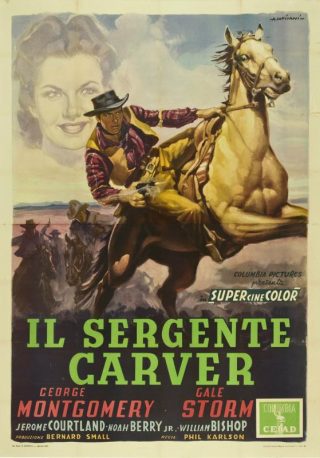
There is something wildly entertaining about dipping into that era when Hollywood thought nothing of gleefully ripping pages if not whole chapters out of the history books in order to mix and match the characters, events and consequences the writers had decided would feature in their story. What makes it especially enjoyable is the fact this unapologetic grinding up facts had no agenda whatsoever, no nods to knowing, joyless postmodernism, nothing more in fact than a desire to present a piece of straightforward entertainment. The Texas Rangers (1951) works on the principle that the key to success is to pack as many big name outlaws as possible into the plot and have the hero take on this rogues’ gallery. If you are after an accurate depiction of the past, then it’s probably best to give this one a miss. If, on the other hand, you’re in the market for a pacy and uncomplicated western, this one will fit the bill.

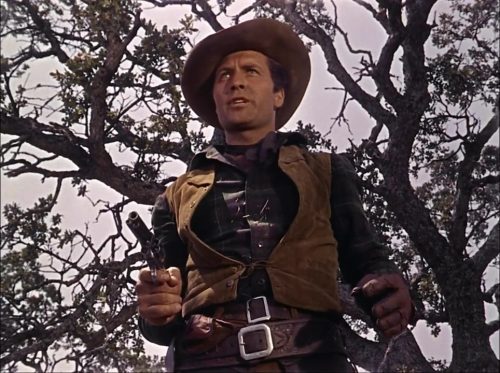
Somewhat at odds with the fanciful nature of the tale which will unfold, the opening scenes attempt to place the characters in some sort of context. Suffice to say that we’re in Texas in the years following the Civil War and the Reconstruction. There is then a brief introduction to the main outlaws: Sam Bass (William Bishop) looks to be a model of charm and courtesy, smiling as he efficiently robs a train, only allowing the facade of politeness to drop momentarily as he ruthlessly guns down a less compliant passenger; John Wesley Hardin (John Dehner) is dapper, cool and devious, a gentlemanly killer; the most sadistic of all is Dave Rudabaugh (Douglas Kennedy), grinning maliciously as he savagely drives a knife through another man’s hand in the course of a not so friendly card game. Then there is Johnny Carver (George Montgomery) who, along with Buff Smith (Noah Beery Jr), runs into trouble during a botched bank raid. Actually, he runs into a bullet fired by a treacherous Sundance Kid (Ian Macdonald) and consequently ends up serving hard time as an accessory to murder.
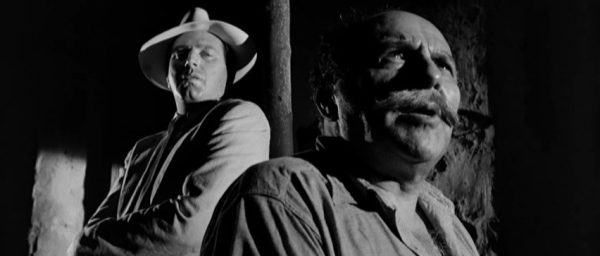
So, with Texas descending into near anarchy as a result of the activities of the gang headed up by Sam Bass, the authorities have to be seen to act. Desperate times call for desperate measures, and Major John B Jones (John Litel) of the Texas Rangers has Carver and Smith released on probation, on condition they serve under him with the aim of smashing the power of the Bass gang. And that is essentially what it is all about, a not unfamiliar story of men with an unsavory past given an opportunity to redeem themselves by taking on and ultimately infiltrating a criminal organization. Along the way, there are enough  brawls, chases, shootouts, betrayals and twists to satisfy even the most demanding viewer.
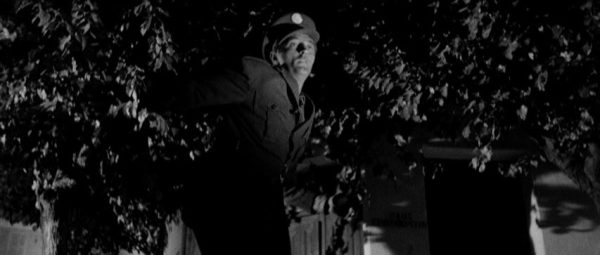
Phil Karlson, working from a story by Frank Gruber and a script by Richard Schayer, rarely lets the action portrayed on screen pause for breath. Incident piles on top of incident and no situation is allowed to hang around till it grows unwelcome. The plot is tied to that classic theme of redemption which is never far from the surface in so many westerns of the 1950s, but it’s never particularly emphasized here. Nevertheless, it is present for those who want it, and I’m certainly a person who appreciates this aspect, even when (or perhaps because) it serves to ground the most escapist fare. For a movie that is almost determinedly lacking in pretension and which prides itself on its sense of urgency, The Texas Rangers looks both handsome and stylish. Karlson never misses a chance to employ a telling close-up, to shoot from an unexpected angle or to frame a scene in an interesting way.

George Montgomery’s laid-back style is used to fine effect in this movie, there’s an assurance coupled with exuberance about him, and when you factor in the easy grace with which he moves around the frame it’s evident how comfortable he was in a western setting. His two big dramatic scenes, played out with Jerome Courtland and Noah Beery respectively, are handled competently enough but the fact is that area wasn’t his strongest suit. Beery is his usual homespun self, appealingly diffident and upright. Of the outlaw band, William Bishop gets more screen time as befits his role and he’s fine, although there’s not the menace about him one might expect. However, that is certainly not the case with Douglas Kennedy. He looks and acts implacably mean, being responsible for, and seeming to relish, some of the more reprehensible pieces of villainy. John Dehner rarely fails to impress, even in minor roles, and he adds some scene-stealing polish to his part as the untrustworthy killer. Ian Macdonald scowls effectively and Jock Mahoney takes another step on the path that would lead him from stuntman to star. The only woman in the film is Gale Storm but her part as a newspaperwoman whose father was murdered by the Sundance Kid is sadly underdeveloped, tracing an arc from hostility to devotion that never feels the least bit convincing.

The Texas Rangers doesn’t appear to be available as a DVD or Blu-ray anywhere, or at least I haven’t been able to come across any releases. If anybody reading this happens to know of one, I’d be pleased to hear about it. However, it can usually be viewed online, and with satisfactory picture quality too. A good many of George Montgomery’s westerns are now available, although there are still a few notable absences such as this. Generally speaking, I think a lot of Columbia’s second string westerns don’t get a lot of love. Sure many of them are pretty frugal affairs, shot fast and sometimes featuring casts that won’t have the name recognition to make them easily marketable to a modern audience. That said, it’s worth remembering that movies of this type were the staples that kept the genre going for so long. The Texas Rangers is not a classic, but it is an attractive film that never wastes a moment of its 75 minute running time. Perhaps the biggest compliment I can pay is to say that it is simply a pleasure to watch.

Hell on Frisco Bay

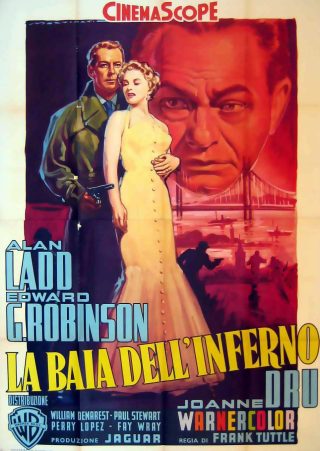
So what do you want from a movie? Most of us will probably settle for an entertaining and competent piece of work that keeps us engaged for as long as the reels are turning. If there happens to be something in the mix that encourages us to think about some matter in a different light, or even simply encourages us to think, then that’s all to the good. Plenty of movies fulfill the first half of that equation and a respectable number will have enough of the second to elevate them above the routine or the run-of-the-mill. And then there is promise, and its deadly first cousin potential. Both of those may be hard to define but are, nevertheless, instantly recognizable, and both have colored responses to more than a few movies over the years. Hell on Frisco Bay (1955) certainly promises much, what with that cast and a plot derived from a William P McGivern novel. The end result? Well, it’s passable as entertainment and has a handful of themes sprinkled through the script that ought to have been explored further, but there is something vaguely unsatisfying about the whole affair.

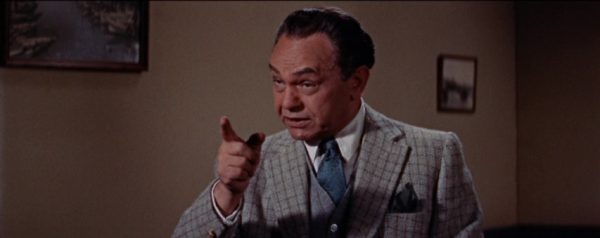
Steve Rollins (Alan Ladd) is fresh out of San Quentin, having done five years for a crime he didn’t commit. He is still smarting over the loss of his freedom, the loss of his job and reputation, and also the loss of respect for his wife Marcia (Joanne Dru). She succumbed to weakness while he was inside and was unfaithful, meaning that Rollins’ dogged desire for vindication has an extra edge. He knows that the boss of the waterfront rackets Vic Amato (Edward G Robinson) was the figure responsible for the frame-up but finding a way to clear his name and bring it home to the mobster means tracking down certain men. One of them has disappeared, and is later confirmed to be dead, while his main dockland contact won’t be long in joining him. Despite the setbacks and the bitterness that is never far from the surface, Rollins bulldozes his way though the hoods and enforcers till he finds an opening. It will come as no surprise to anyone familiar with crime stories to learn that this opening gets busted wide open not merely as a result of the external pressure applied by Rollins, but via the scheming and antagonism seething within the criminals’ own closed circle.

I’ve seen Hell on Frisco Bay billed as a film noir, but I’m not convinced it really is. It is a crime story for sure, but neither the colorful ‘Scope visuals nor the overall tone of the piece recall noir to this viewer. I guess the presence of the leads, and the name of William P McGivern (Odds Against Tomorrow, Rogue Cop, The Big Heat) loom large and fuel that impression. While I don’t particularly care how or even if the movie is labeled, I will admit that those aforementioned factors raised my expectations. The plot, a typical McGivern tale of compromised cops, isn’t going to provide major surprises but a bigger problem is the flatness, the absence of (for the want of a better word) passion in its telling, and that’s not what I normally think of when approaching a Sydney Boehm script. There is of course an undercurrent of sadism to the needling relationship between Robinson and his top boy played by Paul Stewart. As well as that, the hypocrisy highlighted by Robinson’s outwardly devout domestic arrangements and his lusting after Stewart’s girlfriend (Fay Wray) adds another layer, but none of it feels especially compelling.
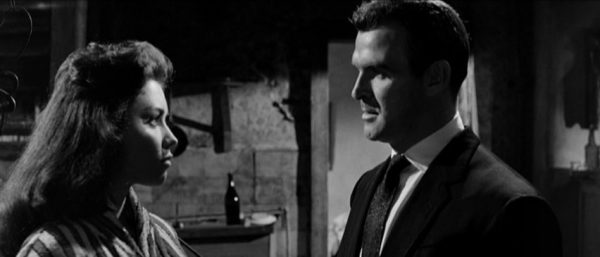
Director Frank Tuttle and cinematographer John Seitz enjoyed great success more than a decade earlier when they made This Gun for Hire with Alan Ladd. However, there is none of the freshness of that movie about Hell on Frisco Bay. Ladd was starting to look tired and dissipated at this point, not a major problem in itself given the background of his character, but despite his best efforts, I didn’t feel much of a spark about his quest for justice along the waterfront. Robinson fares better as the villain and there are a few nicely shot scenes juxtaposing the religious iconography around his home and the murderous intent he harbors there. He shares a few mean-spirited moments with Paul Stewart’s reluctant killer; the scene with them setting up a fateful hit as they verbally fence with one another while prowling around Fay Wray’s  tastefully feminine lounge as well as a subsequent piece of lethal horse-trading in Robinson’s kitchen gives another meaning to the term domestic suspense.

Joanne Dru was the top-billed actress in the movie and is handed an interesting back story, although this is never as fully explored as it might have been. Her role as a nightclub chanteuse means she gets to sing The Very Thought of You and It Had to Be You, although apparently dubbed by Bonnie Lee Williams on both. I don’t know if it’s down to the way Ladd’s character reacts to her throughout, but she seems ill-served by the script. Fay Wray is given a little more to work with as the former starlet now reduced to slumming with the waterfront hoods. In support, it is good to see William Demarest, Nestor Paiva, Willis Bouchey, Anthony Caruso, and a young Rod Taylor. I might also mention that Jayne Mansfield pops up in a brief bit part.

Hell on Frisco Bay has been released by the Warner Archive on both DVD and Blu-ray, so it’s easily accessible. I picked up the movie a few years ago based on the cast, the crew and the source material. I wouldn’t say I came to it hoping to have stumbled on some neglected gem – after all, those are not as common as we might like to believe – but I did think credits such as those it boasted would make it worthwhile viewing. Ultimately, while it is moderately entertaining and watching it is hardly a chore, it is not something I can see myself racing to return to. One to look out for should it appear in the broadcast schedules perhaps.

Some other views on the movie can be found at:
Vienna’s Classic Hollywood
Laura’s Miscellaneous Musings

Ten Wanted Men

Ever wonder why some movies don’t quite work even when everything one might reasonably associate with success seems to be in place, on paper at least. I’m not talking about outright flops here, failures where all the flaws are appear to be almost proudly displayed. No, I mean those vaguely disappointing films, the kind we come to initially with all kinds of heightened and elevated expectations due to the pedigree of the people involved. When those expectations aren’t met there is often an aftertaste to the experience that has a tartness and bitterness to it. Such films can rankle in a way a more brazen turkey never will. Ten Wanted Men (1955) was one of those titles that had provoked dissatisfaction in me when I viewed it. The deficit between what it promised and what it delivered was a source of discontent for me for a long time, and so I thought I might revisit it to see how it would fare when approached in a different frame of mind. Read on…

Western movies whose plots revolve around range wars are legion, that collision of ambition, greed and vanity providing storylines and thematic possibilities that are ripe for exploitation. When a little extra spice in the form of romantic rivalry or sexual obsession is added to the mix, it’s not unreasonable to think that what is finally served up will be even more tantalizing. Such is the case with Ten Wanted Men, where after an exciting and tense yet ultimately deceptive opening, the character of John Stewart (Randolph Scott) is introduced. He’s just had a harmless laugh at the expense of his greenhorn brother (Lester Matthews) and nephew Howie (Skip Homeier). Stewart is a big man in the territory, and the lavish party he is hosting is a testament to his generosity and largesse. As this is a fairly quick moving picture not much time is wasted in presenting the main source of conflict which will carry the viewer through till the climax. This is embodied in the person of Wick Campbell (Richard Boone), a neighbor of Stewart’s and a rival for the right to dominate the land.

If that all sounds somewhat feudal, the theme is further alluded to by the fact that Campbell not only yearns for but also feels himself entitled to the affections of Maria Segura (Donna Martell), the young Mexican girl he has nurtured. That she does not reciprocate that feeling is one thing, but matters are brought to a head by the interest Howie shows in the girl. When she seeks sanctuary and protection under Stewart’s roof all of Campbell’s pent up resentment and thwarted passion burst forth. Emotionally burnt and humiliated, he must have vengeance, and now it won’t be enough to merely supplant Stewart as top dog, there is a debt that must be repaid in full and in kind. So it is that Campbell hires a crew of gunmen led by Scavo (Leo Gordon) with the aim of drawing his rivals into a shooting war.

So, did Ten Wanted Men fare better this time round? Well, yes and no. It is not some misunderstood and unfairly maligned gem. However, it’s not an irredeemable dud either. Director Bruce Humberstone is not someone with extensive experience of the western, I mainly think of him as the man in charge of a handful of entertaining Charlie Chan features as well as the proto-noir I Wake Up Screaming. That said, his handling of this movie is fine, if not especially remarkable. The Old Tucson locations are attractively shot by Wilfrid Cline, who has the frequently used interiors looking good too, while the essentially minimalist score by Paul Sawtell has a moody and vaguely melancholy quality to it that I found appealing. These are all more or less pluses with the sharp pace and abundance of incident contributing a little more weight to that side of the scales.

Nevertheless, it’s not a wholly satisfying experience, certainly not in the way the level of talent involved might encourage one to believe. I think it stems from the writing, or aspects of it at any rate. The script is by Kenneth Gamet from a story by Harriet Frank and Irving Ravetch. Gamet had scripted a number good westerns, many featuring Randolph Scott – A Lawless Street, Coroner Creek, Man in the Saddle, The Doolins of Oklahoma to name just a few. Harriet Frank had a compact but extraordinarily strong list of credits. She was a writer on the underrated Silver River, provided the story for Nicholas Ray’s Run for Cover, would go on adapt two Martin Ritt/Paul Newman pictures in Hud and Hombre (the latter offering a memorable role for Richard Boone) from novels by Larry McMurtry and Elmore Leonard respectively, and scripted a Vincente Minnelli film I’m particularly fond of in Home from the Hill. As such, we are not talking about writers with a poor track record here. And yet some things don’t quite gel.

There is not much to fault in the performance of Randolph Scott, and in fairness there rarely was in his work throughout the 1950s, but the character itself is a  little lacking. He starts out with that characteristic gallantry firmly to the fore and then later lets the harder core become more apparent as circumstances conspire to try him. However, there’s a flatness to the arc this character describes, as though the experiences he has do not appear to shape him and there is no sense that I can detect of his having learned anything  about himself by the time the credits roll. Then there is Boone, a brooding and truculent presence early on, he grows more tightly coiled and repressed as he relentlessly applies pressure to his enemies. It’s only near the end though that another dimension makes an appearance, when his desperation and frustration strip away restraint as he confronts Martell and confesses the full extent of his infatuation. This is one of the better and more intense moments yet it comes too late in proceedings. Of course Scott and his producing partner Harry Joe Brown clearly saw enough in what Boone put on screen to hire him for the pivotal role of Frank Usher in The Tall T.
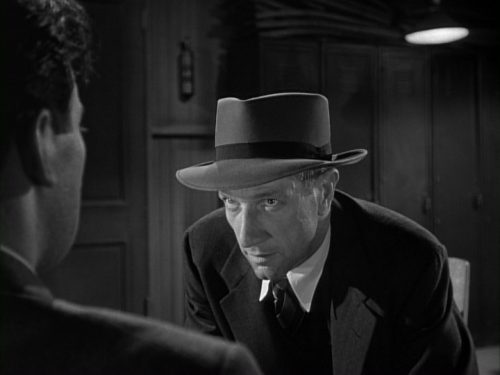
Skip Homeier must have made an impression too as he would also get cast in both The Tall T and the later Comanche Station. Jocelyn Brando has the biggest female role in the picture but her romance with Scott has little spark about it and it’s largely superfluous. In a crowded field of talented supporting players Leo Gordon is as malevolent as ever and one could hardly ask for a finer chief henchman. Lee Van Cleef makes the most of a showy bit part and Denver Pyle exits relatively early, but not before his slyly provocative troublemaker brings matters to a head. Finally, mentions ought to be made for the likes of Kathleen Crowley, Dennis Weaver, Tom Powers and Alfonso Bedoya.

Ten Wanted Men came out on DVD from Sony years ago, looking sharp and colorful in an open-matte presentation. If it has subsequently appeared anywhere in high definition, I don’t recall hearing about it. To the best of my knowledge, I’ve never heard anything especially positive about this movie and I can’t say it enthused me much when I first saw it. Returning to it now after the passage of a good many years, I still wouldn’t go so far as to say it deserves reassessment. Nevertheless, it’s far from an objectively bad piece of work. Certain aspects of the writing and characterization lack the fire it needs to raise it yet there are points of interest and enjoyment to be found as there are in almost all of Scott’s westerns. All told, I can’t say I regretted revisiting this title.