Ride Clear of Diablo

Revenge, or at least the quest for justice, is a theme frequently featured in westerns. Relentless duplicity, on the other hand, is more often to be found in crime movies. Ride Clear of Diablo (1953) is a pretty good example of a conventional western that blends both of the aforementioned elements into its brief running time. By using the revenge motif mainly as a device to drive the narrative, rather than indulging in any especially deep analysis, and thus keeping the focus firmly on the various double-crosses, the film manages to provide plenty of exciting, pacy entertainment.

Everything revolves around Clay O’Mara (Audie Murphy), a railroad surveyor based in Denver, who receives a wire informing him of the murder of his father and brother as a result of a raid on their ranch by rustlers. Returning home to bury his family, O’Mara is cautioned against seeking retribution by the local preacher (Denver Pyle), and reassures the man of the cloth by letting him know he’s interested in a meeting with the sheriff. What O’Mara doesn’t know, but we the viewers do from the opening moments, is that Sheriff Kenyon (Paul Birch) and the family lawyer, Tom Meredith (William Pullen), are the men responsible for the murder. Meredith is clearly the brains of the outfit, and he’s the one who advises Kenyon to accede to O’Mara’s wishes and swear him in as a deputy with a view to tracking down the killers. Meredith’s idea is to set O’Mara on a false trail and send him off in pursuit of a man who he figures will gun him down. To that end, Meredith and Kenyon tell him that notorious wanted outlaw Whitey Kincade (Dan Duryea) is one of the leading suspects. O’Mara sets off for the neighboring town of Diablo where Kincade is believed to be hiding out. This is just the first in a series of crosses and double-crosses fill the movie, and none of them seem to work out quite the way any of the conspirators hope. While slightly unnerved, O’Mara isn’t the kind of man to back down from a challenge, particularly not one in which he has as much personally invested as this. As it turns out, he’s no slouch with a gun either and, to the surprise and near mortification of Kenyon and Meredith, manages to outdraw Kincade and haul him back to town for trial. That O’Mara should pull off such a coup is bad enough as far as the villains are concerned, but what’s more troublesome is the fact Kincade has taken a shine to the gutsy deputy. Kincade has his own suspicions regarding the motives of these outwardly law-abiding citizens, but he’s no saint and also has a perverse sense of humor. Rather than put O’Mara on the right track straight away, Kincade toys with him and offers only oblique hints, preferring to sit back and watch pleasurably as Meredith and Kenyon fail time and again to ensnare O’Mara. However, such games can only be played out so far, and O’Mara must sooner or later come upon the truth, while Kincade must also make a decision as to where he really stands.
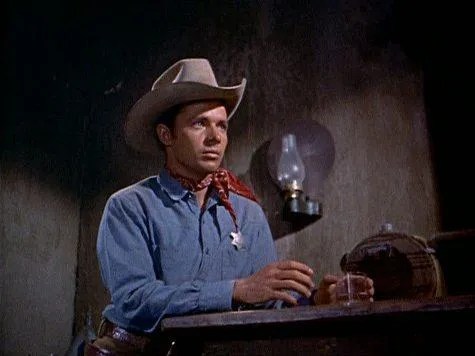
Director Jesse Hibbs spent many years working in the second unit, and had a relatively short career in charge of feature films before moving into television. Ride Clear of Diablo was one of his earliest directorial efforts, and his first with Audie Murphy – both men would work together a number of times in the years to come. Stylistically, this movie is fairly unremarkable, although there are some extremely atmospheric scenes such as the opening in a near deserted saloon, where an alluring singer (Abbe Lane) ensures a couple of hapless cowboys remain distracted while her rustler friends slip away to round-up the herd. Even though some of the action was filmed on location around Lone Pine, Hibbs arguably does his best work during the interior scenes – which seems a little odd for a western director. The first appearance of Dan Duryea, after his character has been given a strong build-up, and Murphy’s subsequent face-off with him is also particularly well realized. Despite what the events that take place at the beginning may suggest, Ride Clear of Diablo lacks the kind of psychological complexity that is often found in revenge/quest westerns. Still, that shouldn’t be taken as a criticism of the movie as a whole; it never intends to go down that route, and achieves what it wants perfectly well without doing so.

I imagine synopsis I included makes it clear that Dan Duryea’s role as Whitey Kincade makes a significant contribution to the film. I’d go so far as to say that although Audie Murphy receives top billing and gets the lion’s share of the screen time, it’s as much Duryea’s picture as anyone’s. Duryea was one of the finest screen villains ever, even better when he was given the opportunity to play up the character’s ambiguity. With Whitey Kincade he was handed the chance to portray an extremely engaging anti-heroic figure. Duryea always had an enormous amount of charm and could never be characterized as unlikable. Ride Clear of Diablo highlights his playful menace, and he steals every scene he appears in. By the end of the movie your greatest regret is the fact he wasn’t allowed more time to cast his skewed, cynically amused glance over proceedings. In contrast, Murphy is far more stoic and traditionally heroic, and it creates a nice balance. However, even in a pretty straight and limited part such as this, Murphy brought some of that nervy unease, a kind of edgy watchfulness, that made him an interesting lead on so many occasions. Susan Cabot was cast as Murphy’s love interest and, to make matters more intriguing, the niece of the corrupt sheriff. She handled the conflicted aspects of her role well and her presence is both an attractive and important element in the story. Abbe Lane’s saloon girl is equally enjoyable, despite her part offering less depth and impact. The remainder of the supporting cast – Jack Elam, Paul Birch, Russell Johnson and William Pullen – constitute a fine bunch of out and out villains and fall guys.
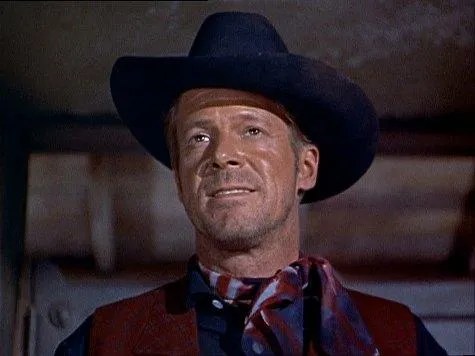
Ride Clear of Diablo is now available on DVD fairly widely. There have been various European options for some time and the movie was then released in the US, initially as part of a four movie set of Audie Murphy westerns and then later as an individual DVD-R. I have the German version that came out via Koch Media some years ago. The transfer on that disc is a little variable, but satisfactory overall. For the most part it’s sharp enough but there are instances where it briefly takes on a soft, dupey appearance. The technicolor is well reproduced and print damage, despite what looks like an obvious lack of restoration, is limited. The soundtrack offers a choice of the original English or a German dub – there are no subtitles at all. Extra features on the disc consist of the trailer and a gallery, along with liner notes in German. I consider the film to be a very entertaining outing for Audie Murphy and it ought to satisfy his fans. The icing on the cake though is the marvelous performance by Dan Duryea – anyone who has yet to discover the man could hardly ask for a better introduction, and those already familiar with him will have a ball renewing their acquaintance.
Criss Cross

poster319

“From the start, it all went one way. It was in the cards, or it was fate or a jinx, or whatever you want to call it.”

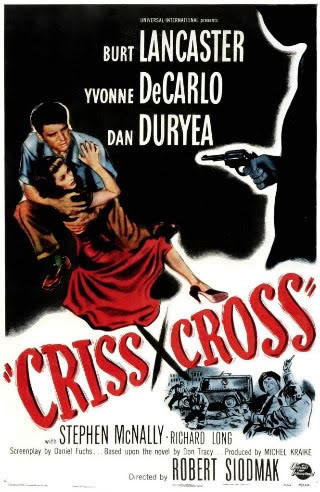
Burt Lancaster, Robert Siodmak, a heist, a hero doomed by fate and his own stupidity, and a rotten to the core femme fatale – all of this sounds a little like a brief synopsis of The Killers. In fact, it refers to Criss Cross (1949), a near relative of that earlier work and a film that vies with it for the honor of being hailed Siodmak’s best movie. Apart from the pairing of director and star, both these films share a similar theme and structure, and I find it almost impossible to decide which is the better one. Ultimately, it doesn’t matter – I like them both and they are two of the strongest noir pictures to come out of the 1940s.

The title of this movie is a highly appropriate one for a tale where the paths of all the main characters are continually intersecting in a web of deceit and betrayal, each crossing up the other at the first opportunity. At the centre of it all are three people – Steve Thompson (Burt Lancaster), Anna (Yvonne De Carlo) and Slim Dundee (Dan Duryea) – bound together by an unholy combination of love, lust and greed. The opening shot, with the camera swooping ominously down from the night skies of LA, sees Anna and Steve caught in a clinch in the parking lot of a nightclub. As the lights suddenly pick them out, their startled and guilty reaction indicates that this is an illicit rendezvous. The fact is further underlined by the terse, tense dialogue – this couple is planning something dangerous, and the possibility of discovery holds a terrifying threat for them. Anna is married to local hood Slim Dundee, but she and Steve were once wed too. Their passionate embrace makes it clear that they have rekindled their old relationship, with the flame burning brightest for Steve in particular. And it’s from the point of view of Steve that the story is primarily seen, with the others moving in and out of the picture at various intervals. He’s a classic noir protagonist, a fairly ordinary guy with limited prospects and a blind spot where no-good females are concerned. A lengthy flashback sequence, accompanied by a suitably weary and resigned voiceover by Steve, spells out exactly how the lives of these three characters converged and the complex ties that continue to bind them together. In short, Steve’s job as a guard for an armored car company has led to his conspiring with Dundee to raid one of the secure vehicles. However, in the noir universe there’s no such thing as honor among thieves and everyone has his own hidden agenda. Steve is the only one of the trio whose motives have some semblance of decency – he’s driven by a kind of desperate love for Anna – and the aftermath of the heist shows just how deep the fault lines of treachery run in this uneasy alliance.

£5

Apparently the untimely death of Mark Hellinger meant that the original script was revised and certain aspects of the story were changed. Be that as it may, the movie that we ended up with is almost impossible to fault and Daniel Fuchs’ script successfully blends the heist and Steve’s obsessive love to powerful effect. Flashback structures can sometimes be confusing or upset the mood of a film but in this case it works perfectly, coming at precisely the right point and filling in the background details that are vital to understanding the nature of Steve and Anna’s relationship. With a tight script, and Franz Planer’s photographic talents, in place, director Robert Siodmak was free to put it all together with his customary visual flair. The opening, which I referred to earlier, pitches the viewer headlong into this complex tale of dishonor and betrayal in incredibly stylish fashion. And it never really lets up from that moment, with one memorable and superbly shot scene following hard on the heels of another. Siodmak uses every trick up his sleeve to manipulate the mood and perspective, from coldly objective overheads to disconcerting low angles and close-ups, interspersed with fast cuts and dissolves. For me, the real stand out scenes, although there’s hardly a poor moment throughout, are the ones in Union Station and in the hospital. The former not only gives a fascinating glimpse of contemporary LA bustle, but also shows the director’s skill in composing a complex series of shots in a crowded environment while retaining control of the geography. In the latter, he uses the reflection from the mirror in Steve’s room to break up the static nature of the setup and extract the maximum amount of tension at the same time.

If the technical aspects of the film are straight out of the top drawer, then the same can also be said for the acting. Burt Lancaster kicked off his career with some finely judged playing as the doomed Swede in The Killers, and Siodmak got him to tap into that same vibe to coax another wonderfully nuanced and sensitive performance from him. Once again he hits all the right notes as the big palooka whose dark romanticism sees him suckered by the machinations of a conniving woman. Every emotional state the script calls on him to display is carried off convincingly, from fear and disenchantment right through to the calm acceptance of his fate at the end – from the dumbfounded look of a guy who’s just had his guts kicked out by the woman he loves to the cloying sense of panic of a man under sentence of death and trapped in an anonymous hospital ward.

£4

Yvonne De Carlo didn’t have to go through quite as many stages, yet she’s still excellent alternating between the sassy, sensual broad that forms her public persona and the nervy, desperate woman she becomes in private. When she drops all pretense in the climax and reveals her true character to Steve and the audience there’s a tangible shock to be felt. Dan Duryea was an old hand at taking on the role of the slimy villain, and to that he adds a layer of menace as Slim Dundee. He manages this so well that it’s easy to understand the level of fear and trepidation he provokes in Steve when he contemplates the consequences of crossing him. While these three actors carry the movie, there’s real depth in the  supporting cast too. Stephen McNally is solid and sympathetic as the cop whose friendship for Steve leads him to inadvertently push him into crime. In fact, there are lovely little cameos all through the movie: Percy Helton’s chipmunk featured barman, Joan Miller’s garrulous barfly, Griff Barnett’s kindly and lonely father figure.

Criss Cross has been out on DVD for many years now, and the US disc from Universal is an especially strong effort. It offers a near perfect transfer of the film with clarity, sharpness and contrast all at the high end of the scale. My only disappointment comes from the absence of any extra features, bar the theatrical trailer, for such a quality movie. One shouldn’t really complain, in these days of bare bones burn on demand discs, but this film does deserve a commentary track at the very least. Still, we have got an excellent piece of the filmmaker’s art looking great. Criss Cross is a highly rated production that occupies a prominent position in the noir canon, and it has earned that honour. It’s one of those rare films that checks all the boxes and never puts a foot wrong from its dramatic opening until it’s darkly cynical final fade out. Those who are familiar with the picture will know exactly what I’m talking about, and those who are not owe it to themselves to discover this little treasure. This is unquestionably one of the real jewels of film noir.


Black Angel

poster248

Time for another neglected and half-forgotten gem, one of those movies that seem to slip beneath the radar of even the most ardent movie buffs. Black Angel (1946) is a great little film noir that doesn’t get a lot of attention but really delivers the kind of perversely satisfying payoff that the genre is noted for. There are plenty of familiar noir names in the cast, but none of them are or were exactly “stars” and the director was a man who spent his time on B programmers, so that may go some way towards explaining the relative obscurity of the film.

The opening is very self-consciously stylised, showing a lone figure on the sidewalk before panning up an artificial looking building exterior and in through the window to establish an overhead shot of a woman in her bedroom. The woman, Mavis Marlowe (Constance Dowling), is a singer and, as we soon learn, a blackmailer. While she prowls her apartment waiting for a caller to arrive, the man on the street below is revealed to be songwriter and pianist Martin Blair (Dan Duryea), the estranged husband who still carries a torch and hopes to see her since it’s their anniversary. Although the lovesick Blair gets stiff armed by the concierge, on his wife’s orders, the audience gets to witness two different men entering the building to see Miss Marlowe. One is night club owner Marko (Peter Lorre), and the other is a mark called Kirk Bennett (John Phillips). It’s the latter who discovers the strangled body of Marlowe and, despite protestations of innocence, is arrested, tried and sentenced to the gas chamber for her murder. As viewers, we know that Bennett is innocent – we can’t be positive who the murderer was but suspicion casts a very long shadow over Marko. The rest of the movie is essentially a race to try and nail the true culprit before the wrong man is executed. Blair and Bennett’s wife, Catherine (June Vincent), form an alliance to track down the clues the police have either missed or ignored in the course of the initial investigation. This curiously matched duo naturally focus their attention on the sinister Marko but, as the old saying goes, there’s many a slip twixt the cup and the lip, and the outcome is far from certain.

£23

Director Roy William Neill is hardly a household name, and he’s probably best known for helming some of the better entries in the Rathbone/Bruce Sherlock Holmes series for Universal. In those movies he showed a real talent for conveying atmosphere and suspense on a budget. He brought that same sense of dark foreboding to Black Angel, which unfortunately proved to be his last picture, and delivered a pacy and stylish thriller. The script derives from a Cornell Woolrich story and has that twisted, nightmarish quality that characterised his work.

In a rare opportunity to take on the lead role, Dan Duryea excels as the down and out loser who looks like he’s been given a second chance in life and grasps it, only to see his dreams slide away. Duryea was always a first rate villain but here he shows he had more range when necessary, and he creates a character in Martin Blair who’s actually quite touching and affecting. June Vincent, as the loyal wife, is the principal female lead but it’s such a stock role, and one devoid of anything in the way of complexity, that she fails to make much of an impression. The same can’t be said of Constance Dowling though – despite having her character killed off right at the beginning, the spectre of this striking looking woman haunts the rest of the film. Peter Lorre isn’t asked to do anything spectacular as Marko except play his standard variation on the slimy underworld type. Still, he had a nice line in menace that few could rival and he’s quite effective as the chief suspect. The supporting cast is rounded out by veteran Wallace Ford, as Blair’s friend, and a very restrained Broderick Crawford as the dubious detective.

Universal’s R1 DVD of Black Angel presents the film quite well. The transfer’s not exactly pristine but there’s no major problems either and it’s nice and sharp. The only extra on the disc is a trailer for the movie. More than one film noir has been let down by a weak or contrived ending, but this picture finishes up with a real kick in the guts that ensures none of the power is diminished. Don’t let the lesser known credentials put you off, this is a good one.


The Woman in the Window

poster13

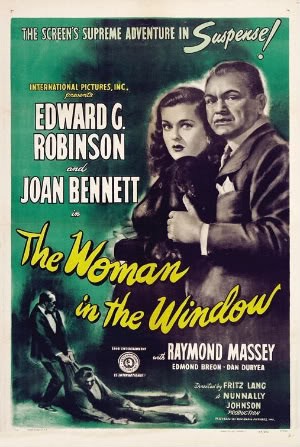
In many ways Fritz Lang’s The Woman in the Window (1944) plays like a dress rehearsal for his production of Scarlet Street the following year. Both films feature the same three stars – Edward G Robinson, Joan Bennett and Dan Duryea – and tell the story of a married, middle-aged man whose chance meeting with a young woman leads him into a vortex of murder, blackmail and ruin. However, where Scarlet Street is relentlessly grim, The Woman in the Window is a paler shade of noir – and not just because of its ending.

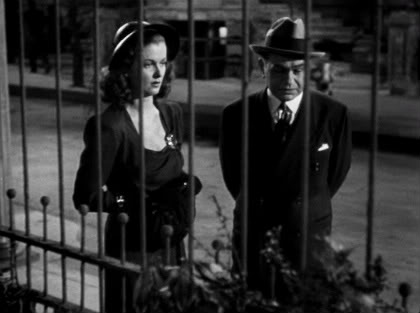
Richard Wanley (Robinson) is an assistant professor at a New York college whose wife and family have gone off on a trip, leaving him to his own devices. After an evening spent at his club with a couple of friends, including the District Attorney (Raymond Massey), he pauses on his way home to admire a portrait of a woman in the window of an adjacent art gallery. As he’s gazing through the window, the subject of the portrait, Alice Reed (Joan Bennett), appears by his side and, one thing leading to another, he ends back at her apartment. Up to this point everything seems innocent enough, but the abrupt and violent arrival of Reed’s lover sends the situation spiralling out of control. Although Wanley is left with no alternative but to kill his assailant out of self defence, he is also aware that his story is unlikely to be accepted and, even if it is, his life will be ruined. The solution – dump the body, destroy all the evidence and make like it never happened. Naturally, all of Wanley’s well laid plans start to unravel before his eyes as the police investigation starts to build up a body of forensic evidence that may soon cast suspicion on the hapless professor. The greatest danger, however, is posed by a shady ex-cop (Dan Duryea) with blackmail on his mind. The plot builds inexorably towards a suitably downbeat climax, yet this film has one last sting in its tail. I won’t spoil things for anyone who hasn’t seen this, but suffice to say that this ending has led some to question the noir credentials of the movie. Personally, I don’t share this view but I can see why it remains a bone of contention with some.

£37

As I said above, The Woman in the Window comes off as a lighter form of noir than Scarlet Street, and a good deal of this, aside from the ending, comes down to the portrayal of the characters. It is much easier to sympathise with Robinson’s character here, somehow his decisions, while questionable, seem more understandable. Bennett, too, is much less repugnant than would be the case in Scarlet Street. She is clearly a kept woman and a femme fatale, in the sense that she leads the protagonist into a dangerous, doomed situation, yet her motives are neither malicious nor wholly selfish. It’s only Dan Duryea, in another trademark role as a smirking villain, who fails to endear himself to the audience. There was something about the man – I think it relates to the casually mocking note in his voice – that led to his being typecast in such parts. There’s lots of noir imagery on show with a good deal of the action taking place at night and on rainy city streets. One recurring motif throughout the film is the number of shots which follow events through a series of open doors, symbolising (I suppose) the characters’ deepening crisis. The more I watch and re-watch Lang’s American films, the higher he grows in my estimation – I’d definitely rank him up among my top five directors.

The film was released on DVD last summer, along with a few other noir titles, by MGM in R1. The disc is totally barebones but the transfer is very good, maybe a little soft. There is a R2 available from Spain (I’m not sure about other countries) which, despite an English soundtrack and removable subs, is nowhere near this in terms of picture quality – fortunately, I managed to offload my copy on a friend who remains stubbornly locked into region two. If you’re a fan of noir or Lang then the R1 is the way to go, and I have no hesitation in recommending the movie.


Winchester 73

Down through the years there have been a number of significant collaborations between directors and actors, such as Ford and Fonda, Ford and Wayne, and Huston and Bogart. In 1950 another such partnership was born, that of Anthony Mann and James Stewart. Their work together was to change the direction of both their careers, and produce some of the best cinema of the decade. Anthony Mann had made his reputation with a series of fine noirs in the last half of the 40s, but he had never done a western. James Stewart’s name had been built on the light leading man roles he excelled in before the war; with the exception of the comedic Destry Rides Again he was another relative stranger to the Old West. However, as a result of the success of Winchester 73 the names of both men would be forever linked to the oldest genre of them all. They went on to make eight films together, five of them westerns.

The story concerns Lin McAdam (Stewart) who arrives in Dodge City on July 4th 1876 and enters a sharpshooting contest presided over by none other than Wyatt Earp (Will Geer), Virgil Earp and Bat Masterson. The contest’s first prize is the famous rifle of the title, and it soon comes down to a run-off between McAdam and Dutch Henry Brown (Stephen McNally). There’s clearly a history of bad blood between the two men, and when McAdam wins it’s not long before Dutch Henry robs him and makes off with the gun. The film then chronicles McAdam’s search for his stolen rifle, and his pursuit of the man who took it. But that’s really only a plot device, a kind of Hitchcockian McGuffin – something of greater significance to the characters than it is to the audience. While the gun is admired, valued and coveted by everyone who comes across it, it is not the sole, nor even the most important reason for McAdam’s dogged quest. This is a dark tale of revenge and the settling of old scores and, despite the dropping of a number of hints, the cause is not stated explicitly until the end.

James Stewart’s pre-war career consisted mainly of Mr Nice Guy roles, while the years following his return found him floundering around in search of a niche. Although It’s a Wonderful Life and Rope offered him roles with a greater complexity, Lin McAdam was a complete departure for him. This part, and subsequent ones with Mann, allowed him to display a cold ruthlessness that the public hadn’t seen before. In addition, he seems so completely at home in the saddle that it’s hard to believe this was his first serious western character. The film boasts a marvellous cast of character actors and up and coming talent: Stephen McNally and Dan Duryea (playing Waco Johnny Dean – lots of exotic character names in this movie) as villains, Shelley Winters as a luckless saloon girl, Millard Mitchell, John McIntire, Jay C. Flippen, and early parts for Tony Curtis and Rock Hudson.

The character of Wyatt Earp is really only incidental to the story here. His appearance is limited to the first twenty minutes or so and doesn’t add much to the narrative. Earp was an assistant marshal in Dodge at around the time the story takes place but the film suggests he was the principal lawman in the city. Will Geer portrays him as a folksy, down home type which seems at odds with the popular conception of the man. When McAdam challenges his authority early on, he fumbles around in his vest pocket for his tin star before almost sheepishly revealing his identity. One would have expected the real Earp to have kicked the upstart’s butt up and down the street.

Winchester 73 is a Universal release on DVD in R1 and R2, and it’s a fine looking disc. Not only is the transfer clean and tight, but there’s one fantastic extra. The film comes with a feature length scene specific commentary by James Stewart. I’m not usually one who gets too excited by extras in general, especially commentaries – but this kind of stuff is cinematic gold dust. Most of the stars of this period were long gone by the time the idea of recording commentaries occurred to anyone, so this is one to be treasured.


Ministry of Fear

poster60

The ‘entertainments’ of Graham Greene have provided a rich source of material for makers of Film Noir. The Third Man, This Gun for Hire and Brighton Rock have all been derived from his works and, if you want to stretch the point, a case could also be made for the inclusion of The Fallen Idol and Confidential Agent. This all goes to prove that there is enough darkness and pessimism in Greene’s writings for them to lend themselves to the shadowy world of noir. And so we come to Fritz Lang’s 1944 adaptation of Ministry of Fear, where a frightened Ray Milland blunders through the bombed out streets of wartime London in pursuit of fifth columnists.

Stephen Neale (Milland) has just been released from an asylum after having been confined for the mercy killing of his wife and, naturally, is anxious to avoid any further entanglements with the law. As he waits to catch a train to London, he wanders into a charity fete where a palmist helps him to guess the weight of a cake and win it. With this seemingly innocuous incident Neale finds himself drawn into a nightmare world of murder and espionage. It turns out that the fake spiritualist had mistaken Neale for a Nazi agent (Dan Duryea) and that the cake contained something worth killing for. Neale’s curiosity leads him to follow up the matter in London where he attends a seance in the company of, among others, the aforementioned agent. When the spy is murdered Neale is falsely accused.  He believes that due to his past conviction no one will believe him innocent of the murder and so he goes on the run. His only assistance comes from an Austrian refugee (Marjorie Reynolds), and while the pair try to seek out the truth they are all the time dogged by a shadowy figure in a bowler hat.

Ray Milland’s star was in the ascendancy at this point and he would win an Oscar for his performance in The Lost Weekend the following year. His role here allows him to get in a bit of practice in psychological anguish and the natural affability of the man means that it’s easy to sympathize with the plight of his character. Marjorie Reynolds is fine as his Girl Friday but the forced Austrian accent does begin to grate a little at times. Dan Duryea is always good value as a villain and the only complaint that could be made is that his character is not given nearly enough screen time. Indeed the same could be said for much of the support cast who seem to breeze in and out of the picture, but all leave lasting impressions. A notable feature of so many films of this period is the marvellous gallery of eccentrics that cropped up time and again. These people, whose faces are immediately recognizable yet whose names escape us, were character specialists who usually played similar parts in every movie and their presence added enormously to the enjoyment.

Fritz Lang’s background in expressionist film-making serves him well here and is most notable in the early scenes of the picture. The charity fete provides that slightly surreal quality that continues throughout the film. The parts with the fake blind man on the train and the ensuing chase over the fogbound moor are also beautifully photographed. Everything seems to have been shot on studio sets but this is no criticism as it helps heighten the unreal, otherworldly feel of the movie.

Optimum released Ministry of Fear on DVD in R2 last year. The transfer is not bad but it could use a clean up. All in all, this is a highly enjoyable mix of noir and espionage and it’s always good to see more of Fritz Lang’s movies making it out onto the market.

Night Passage

pound8_zps0j825if3

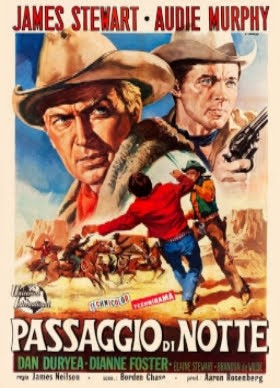
Two brothers, one an outlaw and the other a former railroad troubleshooter in disgrace, square off. That’s the basic premise of  Night Passage.

Jimmy Stewart is the honest man who is now reduced to scratching out a living as an accordion player after letting his no-good sibling Audie Murphy escape five years previously. He gets a last chance to redeem himself when his ex-boss hires him again. The railroad payroll has been repeatedly robbed by a gang of outlaws led by The Utica Kid (Murphy) and Whitey Harbin (Dan Duryea) – Stewart is assigned to see that the next one gets through. So the stage is set for a showdown.

Night Passage is the Anthony Mann western that never was. Mann was slated to direct Jimmy Stewart once again but pulled out at the last minute. His replacement was James Neilson (a debut director) and he managed to produce a serviceable movie, but fails to properly use the edgy quality that Mann always seemed to extract from his lead.

There are a number of weaknesses present, not least the overuse of Stewart’s accordian playing! The plot tries to pack in too many ideas and never really develops any of them sufficiently; Murphy and Stewart’s battle for the soul of Brandon De Wilde could have been expanded upon. It is shown early on that Stewart’s old flame is now married to his boss, but again nothing much is made of this.

Nevertheless, there are lots of good things here. The cinematography of William H. Daniels shows off the Colorado scenery to breathtaking effect in some beautiful shots and Dimitri Tiomkin provides one of his great trademark scores. I’ve heard it said that his music is sometimes too overpowering and in-your-face but I can’t think of any examples of his work that I didn’t like. Murphy is good in the role of the black sheep; he always seemed to give better performances when playing anti-heroic characters (No Name on the Bullet and John Huston’s The Unforgiven come to mind). There’s also a fine array of familiar support players in Jay C. Flippen, Jack Elam, Olive Carey, Hugh Beaumont and Paul Fix.

The film is available on DVD from Universal and looks very nice indeed in anamorphic scope – I have the R2 but I imagine the R1 uses the same transfer. Recommended.