Secret Beyond the Door

poster302

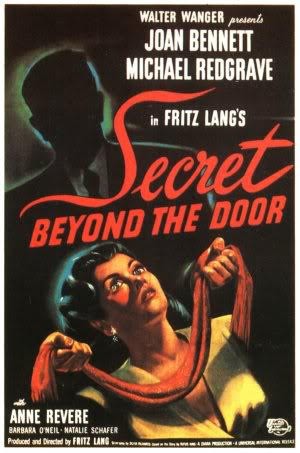
In the past I’ve written about a few Freudian thrillers from the 40s, Spellbound and The Dark Mirror for sure. The decade has many examples though as it was such a fashionable subject and seemed to blend effortlessly into the world of film noir. Looked at now, from a modern perspective, the cod psychological mumbo jumbo of these films is fairly risible. However, films are first and foremost an entertainment medium; we don’t watch them to gain, for example, a deeper insight into psychoanalysis. So, when a movie like Secret Beyond the Door (1947) presents us with a dubious scientific explanation for the odd behaviour of its characters it’s not really fair to criticize it too heavily on that score. Fritz Lang’s film really is an exercise in style over substance – the look, feel and mood of the picture is what carries it, not the plausibility (or lack of it) of the story or the questionable motives of the main characters.

The basic premise is a familiar one, various forms having been used over the years in a variety of films. There’s a young woman on vacation who meets a mysterious yet attractive stranger, falls in love, marries and, after a time, discovers that all is not what it initially seemed. The woman in this particular movie is Celia (Joan Bennett), an heiress who’s recently found herself alone in the world and has taken off on a trip to Mexico before returning to the States and settling down to a life of bland respectability. However, Celia is not the usual, run-of-the-mill innocent abroad. Contrary to appearances, there’s a darker, almost perverse, side to her nature that soon becomes apparent. Quite by chance, she witnesses the flare-up of a knife fight between two local men. This isn’t some matter of slighted honour, more a duel of passion; the men are vying for the affections of a woman. Instead of doing the sensible thing and walking away, Celia is rooted to the spot, fascinated by the events before her. The viewer isn’t the only one struck by the hungry, predatory look in Celia’s eyes as she absorbs this primitive ritual – another bystander’s attention is drawn to her. He is Mark Lamphere (Michael Redgrave), an architect of patrician background.

To cut to the chase, Celia and Mark fall in love, marry and move back to his out-of-town home in the States. Even before they leave Mexico though, it’s apparent that all isn’t well with Mark; he has a tendency to withdraw from intimacy without explanation. As the couple embark on their new life the skeletons begin to rattle in the family cupboard and, bit by bit, secrets and hints of a dark past start to emerge. Celia’s husband is a deeply troubled man who appears to have a morbid obsession both with historical murders and the rooms in which those crimes took place, while questions linger over the death of his first wife. The true roots of the problem are not immediately obvious but, even so, the new bride slowly comes to suspect that her own life may be in danger.

The script calls for a good deal of irrational behaviour on the part of the main characters, enough to sink many a movie. Despite that, the film still works and is pretty successful as a piece of highly strung noir melodrama. This is largely due to the work of director Lang and cameraman Stanley Cortez, between them creating a stylish and stylized visual experience. The opening segment in Mexico has a dreamy, unreal quality that perfectly fits the mood of the lovestruck Celia. As soon as the action switches to the Lamphere estate the look and feel alters too, the uneasy romanticism of the south of the border scenes switches to something more akin to the gothic nightmare that begins to unfold in Celia’s shadowy and threatening new home. It’s this aspect of the film that leads to comparisons being drawn between it and Hitchcock’s Rebecca. On the surface, there are parallels: newlyweds haunted by the spectre of the husband’s murky past, a family home where unwelcome memories seem to lurk in every shadow, and a distinctly odd household.

£6

For all that, the two movies are really quite different in essence, chiefly as a result of Joan Bennett’s characterization of Celia. Unlike Joan Fontaine’s second Mrs DeWinter, Joan Bennett is a tougher and more worldly woman. I’ve already mentioned the dark side of Celia that’s apparent from early on, but the perverse side of her character is further developed as the story progresses. A weaker, and maybe a saner, woman would likely hightail it back to the safety of the city when her husband first begins to exhibit signs of serious psychological imbalance. But not Celia; she chooses to stand her ground, whether through raw courage or her own fascination with danger, and stick it out to the bitter end. One of Bennett’s great strengths as an actress, and very likely the reason Lang chose to work with her so often, was her ability to combine feminine allure with the grit necessary to hack it in a grim world. I found Michael Redgrave’s performance much less satisfactory though. My biggest issue was that I never felt entirely convinced by his transition from the cool aristocrat to bug-eyed loon. However, in all fairness, this kind of thing is rarely especially easy to pull off. His best moment occurs in the short fantasy scene where he imagines himself on trial for murder. With a jury of literally faceless men looking on, Redgrave plays both prosecutor and defendant in the ultimate trial of conscience.

For a long time Secret Beyond the Door was one of Lang’s most elusive titles on DVD, at least in an acceptable form. As the rights in the US now appear to reside with LionsGate it’s probably not a good idea to hold your breath waiting for anything to appear from that source. There’s been a French disc available for a while but it suffers from the old problem of forced subtitles. However, last year saw two releases that fit the bill: a budget disc from Italy and a nicely packaged edition from Exposure in the UK. Both seem to use the same transfer for the movie, but the UK release sees more effort put into overall presentation. The movie gets a nice remastered transfer with very good contrast (vital for a film like this) and only the odd speckle here and there. For extras we get an extensive gallery and filmographies. There’s also a 12 page booklet that reproduces the original poster art on the cover and contains three separate articles by David Hughes, James Oliver and Claudette Pyne. In this era of cost-cutting MOD programmes, it’s a credit to a small outfit like Exposure that they have both the will and ability to produce a thoughtful edition like this. Anyone interested in collecting classic movies really ought to consider putting a bit of business their way and support such efforts. This film tends to be glossed over somewhat when Lang’s work is discussed, probably due to the absurdity of certain aspects of the plot, but it’s actually very enjoyable. Joan Bennett gives a good performance in the lead and Lang directs with great skill and style. Anyone who is interested in film noir, Fritz Lang, or just classy 40s movies should have a copy of this in their collection.

This Gun for Hire

poster301

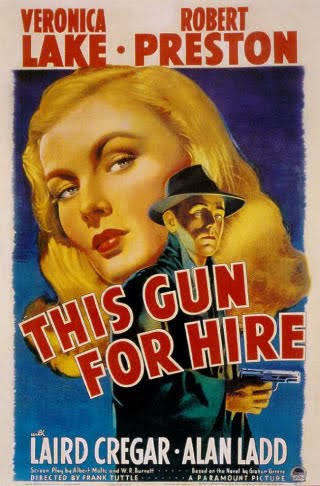
The MacGuffin: a plot device that’s of the utmost importance to the characters in a film, shaping their decisions and driving them on, yet of only marginal interest to the viewer. Hitchcock used the term to refer to various objects and motives in his movies – the uranium in Notorious, the stolen money in Psycho and so on. Of course, it appears in lots of other films apart from Hitchcock’s: the letters of transit in Casablanca for example, and the espionage/blackmail letter in This Gun for Hire (1942). Just as the aforementioned movies have nothing to do with nuclear weapons, loot or visas, except on the most superficial level, neither is This Gun for Hire a spy story. Instead, it’s the tale of a sociopathic contract killer and his gradual transformation into something resembling humanity.

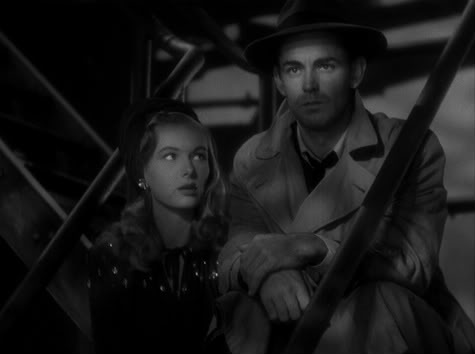
The strong and stylish opening introduces Raven (Alan Ladd), as a solitary and taciturn individual existing on the fringes of society. He lives alone in a beat up boarding house, avoiding human company whenever possible and barely tolerating it when necessary. His casual contempt for a slatternly chambermaid and contrasting affection for a stray cat eloquently points out where his fellow men rank in his estimation. So, if it’s not any empathy with the people around him just what is it that makes Raven tick? If anything, it’s his cool, unemotional professionalism; his whole sense of self is bound up in the way he calmly goes about dispatching those he’s been paid to kill. As he ventures out to fulfill a hit we get a fleeting glimpse of conscience. He unexpectedly runs into a disabled young girl sat alone on a flight of stairs. and pauses briefly. We’re unsure what exactly he’s thinking about this unwelcome witness to his presence, but he passes on. Having done his grisly work on the floor above, Raven again encounters the same girl on his way out. This time she asks him to retrieve a lost toy for her, and for one heart stopping moment it looks like he might just finish the girl off rather than risk identification. Ultimately he doesn’t, leaving her to her lonely games – it’s as though the weak (the cat, the crippled child) stir a feeling of kinship somewhere inside; he has a deformed wrist, the result of a childhood punishment. This suggests that, despite the passive mask he adopts, there is some decency lurking within, and it develops further when he happens to meet a girl on a train. The girl is Ellen Graham (Veronica Lake), a night club performer who’s travelling with a dual purpose; she’s been recruited as a federal agent in order to dig up some evidence of her new employer’s suspected espionage activities. It’s here that the tale takes on a twisting, complex quality – the girl’s employer is Willard Gates (Laird Cregar), and he also happens to be the go-between who double crossed Raven after his last job. So, both Ellen and Raven are on the trail of the same man, but for different reasons, and with different goals in mind. One wants to expose him, while the other merely wants to kill him.

£31

The opening credits “introduce” Alan Ladd, but he’d been playing small parts in movies for some time by this point. The nominal lead was Robert Preston, as Ellen’s policeman fiance, but it’s Ladd’s show all the way. In Raven he creates a memorable anti-hero, one who acts as a template for the many hitmen who have graced the screen since, and who fits in as one of Graham Greene’s tormented souls. His set features have a chilling calm to them that impart a real threat far more effectively than a more emotive performance would have done. Everything is contained within the eyes and the voice, the quick spark and slight quaver hinting at the seething emotions which he refuses to allow his expression to betray. The only time he cuts loose is in the railroad yard with Ellen when he recounts the recurring dream of an abusive childhood that haunts him. Veronica Lake, in her first (and possibly best) pairing with Ladd, is fine if unremarkable as the resourceful and faithful Ellen. She wasn’t a great actress by any means, but her work with Ladd in this movie and their subsequent collaborations show her at her best. While Ladd is the dynamo at the heart of the picture, Laird Cregar is also memorable as his squeamish paymaster. Before his untimely death, Cregar was one of those menacing “big men” who seemed to populate so many 40s movies. Unlike the tougher and brasher Sydney Greenstreet, Cregar (and maybe Raymond Burr too) could not only easily convey a threatening presence but also hint at a more vulnerable, weaker side. Director Frank Tuttle isn’t noted for his noir pictures but he captures that elusive spirit on This Gun for Hire. The film may be an early example of noir but it contains many of the characteristic visual motifs, low angles and shadows bisecting the actors’ features in particular. Of course, he’s aided enormously by the photography of John Seitz, and the Graham Greene source novel adapted by W R Burnett. The story benefits greatly from the reduced emphasis on the espionage elements in favour of focusing instead on Raven’s personal quest for vengeance. It’s also refreshing that Raven, even when he does the “right” thing, acts out of what he sees as personal obligation as opposed to falling back on anything as crass or facile as a sudden realization of patriotic duty.

This Gun for Hire was released on DVD years ago by Universal in the US as part of their film noir line. The transfer remains a top notch effort with excellent contrast and clarity. The print has no significant damage or distractions on show. The disc itself is of the very basic variety with no extras whatsoever offered – a pity when you consider the quality of the movie. This is a fine, tightly paced film with a powerful central performance by Alan Ladd and a stylish look. If that’s not enough in itself then it deserves a viewing for being the first teaming of Lake and Ladd, and the influential nature of its characterization. Highly recommended.


Sunset Boulevard

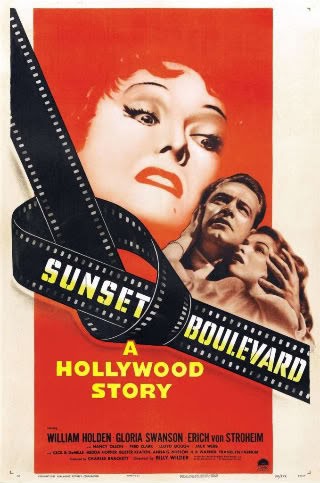
The Hollywood of the 1950s was a fascinating time from the perspective of movie fans. It was a period of innovation, upheaval, recrimination and soul searching. The decade counts as my favorite (although the 1940s runs it a close second) due to the consistent quality of product that it rolled out. It was very much a transitional era, when television would mount a serious and sustained assault on the movies in its effort to become the predominant medium for mass entertainment. When combined with the increasingly paranoid political climate, the looming break up of the studio system, and the fact that a new generation of filmmakers were beginning to assert themselves a certain maturity could be seen developing. As in all aspects of life, maturity often brings reassessment, an examination of self. So it’s hardly surprising that the 1950s saw a number of pictures where Hollywood turned the lens back upon itself. Sunset Boulevard (1950) – along with later examples such as The Bad and the Beautiful and The Big Knife – saw Billy Wilder casting a jaundiced eye over the industry.

The Hollywood of Sunset Boulevard is a far cry from the glittering glory days of the 20s, despair and the fear of failure having replaced the opulence and optimism of the early years. This is the world Joe Gillis (William Holden) inhabits; both his apartment and car are beyond his means while his career as a screenwriter has ground to a virtual halt. With the debts piling up, his attempts at hawking his hackneyed scripts coming to nothing and the repo men breathing down his neck, a sudden blow out on a tire sees him taking an unscheduled detour into the driveway of a crumbling mansion on Sunset Boulevard. Despite appearances, this isn’t just some derelict throwback. It’s the home of former silent star Norma Desmond (Gloria Swanson), living in decaying splendor with her butler, Max (Erich von Stroheim), as her sole companion. To a man like Gillis, faced with the humbling prospect of slinking back to Ohio with his tail between his legs, Norma Desmond represents a second bite at the cherry. Cocooned from the modern world by both her wealth and the careful attention of Max, she has allowed her delusions to run wild and convinced herself that the world is waiting with baited breath for her return to the screen. She even has a script prepared, a retelling of the tale of Salome with her, naturally, playing the lead. When Gillis is offered the job of editing her screenplay into something presentable, he senses an opportunity; he knows it’s ludicrous trash but a drowning man will grasp at anything. Thus he finds himself drawn ever deeper into a macabre world as Norma’s companion, plaything and muse. Yet despite the comforts of his new lifestyle, Gillis finds himself repelled by the parasitic, introspective existence he’s tangled up in. The more Norma’s dependence on and love for Gillis grows, the greater is his need to break free of his gilded cage and return to the living. The stifling, closeted world of Norma, Max and Gillis can be seen as a microcosm of Hollywood itself: a self-contained community whose members readily humiliate and lie to themselves in order to perpetuate a dream, ultimately losing touch with that blurred line between fantasy and reality.

I adore the films of Billy Wilder. His caustic take on life could strip characters and situations right down to the bone. Yet he also understood people, understood what made them tick and he sympathized with them. Even his grotesques and monstrosities have a human heart that can be wounded. For all the dark sourness of Sunset Boulevard, the main characters are all fully rounded people who earn our compassion at one point or another. Wilder doesn’t ask the viewer to stand in judgement of these damaged individuals but rather his criticism is leveled at the system that has brought them to this pitiful state. Even here, his vision of Hollywood is a complex one; on the one hand, he paints a depressing picture of the hazards of living in the past and subsisting on former glories, while he also takes merciless shots at the ephemeral nature of the motion picture business and its fondness for forgetting its roots and those who made it what it is. The film is full of innuendo and references: Norma sitting playing bridge with the ‘waxworks’ (Buster Keaton et al) and watching herself in Queen Kelly while Max runs the projector. The latter is a wonderful touch when you bear in mind that von Stroheim’s directing career came to an end when that film ran into difficulties – the irony becoming even more shocking when the true nature of Max and Norma’s relationship is revealed later on. And in the midst of all the tragedy and bitterness, there are moments of marvelous black humor too: Gillis arriving on the very day Norma’s pet chimp is to be laid to rest; one monkey coming to replace another.

Sunset Boulevard is one of those movies where almost everything seems to blend seamlessly. The script and direction are full of riches but the performances of the three lead players hold it all together. William Holden was a good choice as Gillis, the former golden boy whose career was just starting to languish must surely have identified with the character of the struggling writer. Superficially, Gillis may appear the least complex of the trio but there a number of sides to him. He’s both a chiseler and a dupe, initially weaseling his way into Norma’s household but then failing to appreciate how much she has come to love him. He’s also a cynic (his floating corpse’s narration is loaded with hard boiled idiom) while remaining a kind of noble innocent, his final actions being motivated by a sense of personal honor as much as anything else. Erich von Stroheim’s Max is a very restrained portrait of selfless devotion. I don’t want to say more than that in case anyone hasn’t seen the film – his conversation with Gillis in the shadow drenched garage is a powerful and quite shocking reveal that shouldn’t be spoiled. What I will say is that while all that stony Germanic reserve remains intact throughout the film, his eyes convey perfectly the depth of his feelings for his mistress. However, the real star of the show is unquestionably Gloria Swanson. Her features have all the dramatic expressiveness that befit a veteran of the silents and it’s entirely appropriate that she should make use of this quality in the context of the character she plays. Norma Desmond is a woman who’s never really moved on from her heyday in the 1920s, and Swanson’s incorporation of silent techniques into her performance captures that. There’s a larger than life theatricality about her because that’s the way Norma Desmond sees herself. Additionally, Swanson nails the brittle vulnerability of a woman who’s balanced on the very edge of reason. The final scene may well be a famous one, but it’s Swanson who ensures that its fame is justified.

Generally, I write about movies that I’ve been watching at home. In this case, however, I had the pleasure of seeing Sunset Boulevard projected on the big screen at an outdoor cinema in Athens last night. There’s always something that bit special about seeing classics presented the way they were supposed to be viewed, and it was particularly enjoyable to be part of a full house too. There was a very nice and clean print used – the old R1 DVD (I can’t speak for the newer Centennial Edition) from Paramount is said to suffer from compression issues, although I can’t say I ever noticed anything especially bad about it. The movie is easily one of Wilder’s best in a long line of first class pictures – rewarding, satisfying and oozing class.

The Woman in Question

Years ago, when I was growing up anyway, television offered the opportunity to see lots of obscure and half-forgotten movies. The fact that the choice of channels was limited, in contrast to the dizzying array available today, meant that you ended up exposed to these films regardless of whether you would have originally opted for them or not. Of course that’s all changed now; mainstream channels stick rigidly to the mainstream, and viewers have to make a conscious effort to seek out the rarities – supposing they even have the desire to do so in the first place. DVD has gone some way towards plugging this gap, and it’s especially important when it comes to vintage British cinema. Apart from the better known titles, the British movies that were once a staple of off-peak TV schedules have virtually disappeared from view. The Woman in Question (1950) is a good example of what I mean: a well crafted thriller, full of immediately recognizable faces, and now pretty much unknown. This isn’t a film that occupies a position in the front rank of British cinema but its construction and a fine lead performance mean that it’s worthy of some attention.

It’s the story of a murder investigation, opening with the discovery of a woman’s strangled body in her seaside flat. There’s no shortage of suspects or apparent motives, but the key to the whole affair lies in the character of the victim. This woman is Astra (Jean Kent), a fairground fortune teller. Normally, murder stories like this develop along the lines of a police procedural, but here we stray a little from the standard formula. It soon becomes clear that the only things we can say for certain about the victim are her name and occupation. In the course of the police interviews we get to see Astra from five different perspectives, and each one presents a contrasting portrait of the dead woman. The landlady (Hermione Baddeley) remembers a sophisticated lady who’s fallen on hard times, the sister (Susan Shaw) recalls her as a slatternly tramp, the would-be showbiz partner (Dirk Bogarde) feels she was a predatory opportunist, the lovelorn shopkeeper (Charles Victor) nurses visions of a virginal ideal, and the rough Irish sailor (John McCallum) carries a torch for a woman who’s not wholly bad but could stand a little reforming. So, there we have the woman in question, and the real question is: which of these contradictory perceptions is the correct one? Before the police can discover who killed Astra, they must first establish who she really was and, therefore, why someone would want her dead.

Anthony Asquith did a really polished job as director on The Woman in Question, working in tandem with lensman Desmond Dickinson he taps into the slightly seedy and down at heel world his characters inhabit. The shadow of WWII hangs over the drab boarding house where much of the action plays out, and there are frequent references to the aftermath of those painful years. There aren’t too many show-off type shots in evidence but there is a necessarily shabby ambience about everything. What stands out most though is the structure of the film, a collection of flashback sequences that are tied together by the ongoing police investigation. Each successive character describes events in the way that he or she remembers them, offering varied interpretations of the same scene. The chronology remains clear throughout and the shifts of emphasis and characterization are excellently handled. Thus we see essentially the same scenes being shot from different angles, with different lighting and subtly altered performances to reflect the bias of whoever is narrating at any given time.

Asquith’s real skill, however, was in coaxing the best out of his cast, and that’s particularly noticeable with Jean Kent (who just turned 90 the other day). Her role as Astra was a very demanding one, requiring her to pull off five variations on the same character – from saint to slut, and everything in between. It’s quite a feat, demanding adaptations of wardrobe, hairstyle and tone of voice, to create someone who’s both markedly different and recognizably familiar at the same time. This storytelling technique obliges most of the cast members to shift the tone of their performances too to some extent, but it’s Ms Kent who is asked to bear the greatest burden, and she does so very successfully. There’s plenty of good support on view though from Bogarde, Shaw, Baddeley, McCallum and Victor, not to mention the likes of Anthony Dawson and Duncan Macrae.

The DVD of The Woman in Question from Odeon in the UK is a fine presentation of the film. The cover says it’s been remastered and it does look very good indeed. Aside from a few speckles here and there, the print is clean and sharp with nice contrast and definition. As usual with most Odeon titles, there’s not a lot in the way of extras – a collection of trailers for other releases and a booklet providing brief notes on the movie and potted biographies of the director and principal cast members. The film is one of the more interesting British noir/thrillers, a picture that’s not talked about a lot but is definitely worth watching.

As a postscript, I just want to say that it’s almost time for me to take a holiday. As such, I won’t be posting anything for a while – maybe late August, maybe September. Anyway, thanks to all of you who have read and followed/commented on my stuff – it really is rewarding to get so much feedback and information. Cheers for now folks, and I’ll see you again soon.

Pickup on South Street

Movies that focus on the post-war obsession with the Red Scare can be a bit trying to watch with modern eyes. The forced patriotism and tendency towards speech-making rarely add up to a satisfying viewing experience. But on occasion, they can work and rise above the poisonous politics of the time to present a genuinely good film. Pickup on South Street (1953) is an excellent example – Sam Fuller’s commie baiting has a cynical, sardonic edge that makes it almost refreshingly subversive, especially given the climate in which it was produced.

Skip McCoy (Richard Widmark) is a small time grifter, a pickpocket back plying his trade on the subway just after being released from prison. He’s also a three time loser (one more conviction and he gets life) and may have taken a step too far this time. In one of the most erotically charged pieces of larceny committed to film, he eases a wallet out of the purse of a girl in a crowded carriage. The girl, Candy (Jean Peters), unfortunately happens to be under observation by the FBI, who want to trace the man she’s to deliver the contents of the wallet to. McCoy’s light-fingered work leaves everyone in a spot: Candy can’t make the drop and has to break the bad news to her communist boyfriend, the Feds have had the perfect sting snatched away from them, and McCoy finds himself with a piece of microfilm that both the law and the reds are prepared to nail him to get. The result is that McCoy winds up walking an especially precarious tightrope, holding the cops at arm’s length while he attempts to extort $25,000 from the communists. All the while, Candy is asked to use her ample charms to retrieve the coveted microfilm one way or another. In the end, McCoy does what the Feds want and eventually gives up both the film and the spy ring. What distinguishes this movie from the standard anti-communist fare of the time though is the attitude and motivation of McCoy throughout. He quite literally sneers at the earnest appeals to his patriotism that the FBI man naively hopes will sway him. When he does finally look beyond narrow self-interest it’s not because he just thought about the flag and suddenly felt all mushy inside, it’s because he has witnessed the brutality of the people he’s trying to bargain with and owes a debt of loyalty and gratitude to friends. So, while McCoy ultimately “does the right thing”, his own personal integrity and disdain for authority remain more or less intact.

Pickup on South Street represents Sam Fuller at or near his best; the stripped down plot, the cheap, hard-boiled idiom of the dialogue that snaps like a whip, and the pulp trashiness of the characters all combine with the director’s gut-punching bluntness to deliver eighty minutes of great cinema. Some of the best scenes in the movie take place in McCoy’s waterfront shack, where Joe MacDonald’s camera makes the most of the shadows and confined space to create mood and atmosphere. Of particular note is the sequence when McCoy returns to find Candy searching the place by torchlight. Not even suspecting that it’s a woman, he slugs the half seen figure full on the jaw and lays her out, then casually brings her to by pouring his river chilled beer over her. What follows is a sexy and darkly romantic scene, where McCoy gently massages Candy’s bruised face as the two of them draw ever closer, and the camera moves in for an increasingly tight close-up. In a completely different but equally effective scene, Fuller and MacDonald have the villain holed up in the smallest, darkest space imaginable – a dumb waiter stalled between floors as the Feds peer through the openings above and below – and once again use the tight framing to great effect.

Pickup on South Street was the first of two movies Richard Widmark would make with Sam Fuller (the other was the following year’s Hell and High Water – a glossier, more cartoonish and less interesting work) and it provided him with one of his better roles. He’d moved on from playing out and out villains and seemed to enjoy the anti-heroic status of the part. Skip McCoy is an unapologetic thief, with a streak of mild sadism too, who revels in his life outside the law and normal society. Widmark was probably the ideal choice as a character whose default reaction to noble ideals and patriotic fervor was a curled lip and stinging sarcasm. As the foil, and romantic interest, for this cocky and contemptuous figure, Jean Peters was another fine piece of casting. As Candy, she exudes a kind of earthy sexuality that’s incredibly attractive in a cheap, slightly sleazy way. It’s never made exactly clear what her background is, but there are allusions to a tawdry past that she’s trying to live down. Also, the fact that she endures fairly rough treatment at the hands of McCoy (including a full-on punch in the face) and a bad beating from her boyfriend without a whimper of self pity indicates that she’s familiar with the unsavory side of life.

While these two dominate the film’s narrative, the show is damned near stolen every time Thelma Ritter’s Moe makes an appearance. Her world weary stoolie, who dreams only of scraping together enough cash to ensure she avoids a pauper’s funeral, is highly memorable. Aside from the fatalism and melancholy of her character, she draws a huge amount of sympathy from the viewer just by appearing plainly human. As such, it’s no surprise that it’s the fate of Moe which affects McCoy deeply enough to take decisive action. The main villain is Candy’s boyfriend, played by Richard Kiley. He’s the stuff of stereotypes, all sweaty and gutless, but the movie needs such a figure to act as the focus for the audience’s resentment.

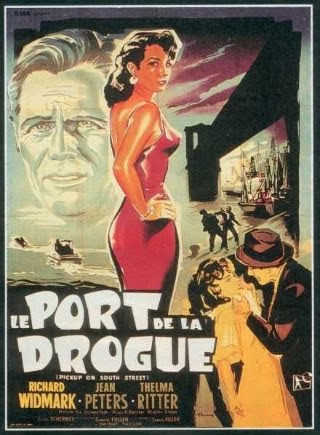
The UK DVD from Optimum offers a very strong transfer of the film. It’s clean, sharp and has good contrast. Unfortunately, there are absolutely no extras included on the disc. In terms of supplementary material, the US Criterion release is clearly the way to go. However, if you just want to see the film itself given a fine presentation then it’s hard to beat the Optimum release – especially if you take the difference in pricing into account. Pickup on South Street remains one of the best examples of Sam Fuller’s talents, a first rate film noir where he never allows the political backdrop of the tale to bog down or derail things. In fact, the picture was initially released in France in a dubbed version where all references to the red spy ring were excised in favor of a storyline involving narcotics – which goes to show that the core narrative is strong enough to stand alternative interpretations being welded on. An excellent movie all round.

Black Angel

poster248

Time for another neglected and half-forgotten gem, one of those movies that seem to slip beneath the radar of even the most ardent movie buffs. Black Angel (1946) is a great little film noir that doesn’t get a lot of attention but really delivers the kind of perversely satisfying payoff that the genre is noted for. There are plenty of familiar noir names in the cast, but none of them are or were exactly “stars” and the director was a man who spent his time on B programmers, so that may go some way towards explaining the relative obscurity of the film.

The opening is very self-consciously stylised, showing a lone figure on the sidewalk before panning up an artificial looking building exterior and in through the window to establish an overhead shot of a woman in her bedroom. The woman, Mavis Marlowe (Constance Dowling), is a singer and, as we soon learn, a blackmailer. While she prowls her apartment waiting for a caller to arrive, the man on the street below is revealed to be songwriter and pianist Martin Blair (Dan Duryea), the estranged husband who still carries a torch and hopes to see her since it’s their anniversary. Although the lovesick Blair gets stiff armed by the concierge, on his wife’s orders, the audience gets to witness two different men entering the building to see Miss Marlowe. One is night club owner Marko (Peter Lorre), and the other is a mark called Kirk Bennett (John Phillips). It’s the latter who discovers the strangled body of Marlowe and, despite protestations of innocence, is arrested, tried and sentenced to the gas chamber for her murder. As viewers, we know that Bennett is innocent – we can’t be positive who the murderer was but suspicion casts a very long shadow over Marko. The rest of the movie is essentially a race to try and nail the true culprit before the wrong man is executed. Blair and Bennett’s wife, Catherine (June Vincent), form an alliance to track down the clues the police have either missed or ignored in the course of the initial investigation. This curiously matched duo naturally focus their attention on the sinister Marko but, as the old saying goes, there’s many a slip twixt the cup and the lip, and the outcome is far from certain.

£23

Director Roy William Neill is hardly a household name, and he’s probably best known for helming some of the better entries in the Rathbone/Bruce Sherlock Holmes series for Universal. In those movies he showed a real talent for conveying atmosphere and suspense on a budget. He brought that same sense of dark foreboding to Black Angel, which unfortunately proved to be his last picture, and delivered a pacy and stylish thriller. The script derives from a Cornell Woolrich story and has that twisted, nightmarish quality that characterised his work.

In a rare opportunity to take on the lead role, Dan Duryea excels as the down and out loser who looks like he’s been given a second chance in life and grasps it, only to see his dreams slide away. Duryea was always a first rate villain but here he shows he had more range when necessary, and he creates a character in Martin Blair who’s actually quite touching and affecting. June Vincent, as the loyal wife, is the principal female lead but it’s such a stock role, and one devoid of anything in the way of complexity, that she fails to make much of an impression. The same can’t be said of Constance Dowling though – despite having her character killed off right at the beginning, the spectre of this striking looking woman haunts the rest of the film. Peter Lorre isn’t asked to do anything spectacular as Marko except play his standard variation on the slimy underworld type. Still, he had a nice line in menace that few could rival and he’s quite effective as the chief suspect. The supporting cast is rounded out by veteran Wallace Ford, as Blair’s friend, and a very restrained Broderick Crawford as the dubious detective.

Universal’s R1 DVD of Black Angel presents the film quite well. The transfer’s not exactly pristine but there’s no major problems either and it’s nice and sharp. The only extra on the disc is a trailer for the movie. More than one film noir has been let down by a weak or contrived ending, but this picture finishes up with a real kick in the guts that ensures none of the power is diminished. Don’t let the lesser known credentials put you off, this is a good one.


Macao

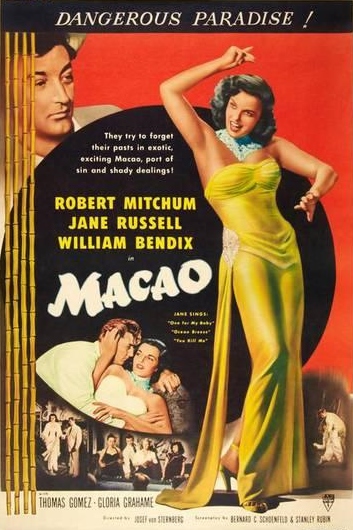
If there were such a term as noir-lite then Macao (1952) would have to feature as a prominent example. Taking its lead from the likes of The Big Steal and, more especially, His Kind of Woman, the movie uses some standard characters and situations but drops the harder-edged cynicism and fatalism that one normally expects to find. As a result, we wind up getting a moderately entertaining picture that passes the time but never delivers the kind of sickening gut punch a film noir ought to. The chaotic nature of the production probably contributed significantly to the less than satisfactory final product. However, there are casting issues involved too, but more on that later.

Exotic settings have long been a favourite of Hollywood movies, and the Orient has a special flavour and mystique of its own. Macao, the Portuguese colony, had the kind of murky reputation that suits the world of noir down to the ground. The story revolves around the arrival of three strangers – Nick Cochran (Robert Mitchum), Julie Benson (Jane Russell) and Lawrence C Trumble (William Bendix) – in this corrupt and largely lawless locale. What’s not clear is the reason for these individuals turning up; Julie says she’s looking for a job as a singer, Trumble says he’s a salesman, and Cochran says he’s just hoping to turn a buck whatever way he can. Regardless of what they say, it’s soon apparent that one or more of this ill-matched trio is out to bring down local underworld and gambling kingpin Vince Halloran (Brad Dexter). He’s wanted by Interpol but can’t be touched as long as he remains within Macao’s three mile limit; so a plot involving stolen diamonds is cooked up to appeal to his avaricious nature and lure him far enough out for the authorities to nab him. At the heart of the story is the dynamic between Cochran and Julie – he helps her out of a tight spot and she repays him by lifting his wallet, he gets threatened with deportation and she bails him out, and so on. This cagey romance runs parallel to the business with Halloran, and it seems at times like there are two different movies fighting for dominance. In the end it’s the lighter elements that prevail and the more sinister aspects are only dealt with during the climax. Generally, it’s a schizophrenic kind of picture that fails to deliver adequately through its lack of decisiveness. There are a number of effective scenes that, taken individually, prove satisfying either for their smart-ass comedic dialogue or their tense stylishness. However, they sit uncomfortably side by side and the shift of emphasis is a clumsy affair.

It’s rarely good news when a film experiences a change of director during production, and the further along it is when the switch takes place the greater the damage is likely to be. Josef von Sternberg had already shot a significant amount of the script when on set disagreements led to his departure and replacement by Nicholas Ray. The credits show von Sternberg as the director but it’s hard to be sure how much of the finished movie is down to him; Cochran’s escape from Halloran’s clutches and subsequent pursuit through the docks at night do seem to carry his stamp though. That’s easily the most visually impressive sequence in the whole movie, as Cochran stumbles and slips through a set draped with trawler nets that resemble some massive spider web that’s been spun across the waterfront to ensnare him. Additionally, the scenes in Halloran’s gambling house hark back to von Sternberg’s The Shanghai Gesture, but never achieve anything like the intoxicating decadence of the earlier film. On top of all the other turmoil, the script was undergoing constant revision and being written on the fly, with Mitchum apparently contributing. Mitchum and Russell were essentially playing to type and their chemistry is a large part of what ensures Macao remains watchable. I enjoy seeing William Bendix in anything but he overdoes the mugging in this one and his part suffers as a result. A bigger problem with the casting though concerns Brad Dexter and Gloria Grahame: Dexter is simply too wooden and passive to convince as the threatening figure he’s supposed to be, and Grahame is criminally wasted in an underwritten role that she reportedly didn’t want to play in the first place.

The R1 DVD of Macao from Warners is a good one that is sharp and has strong contrast in the crucial night scenes. If the film itself is a weak one then the disc extras go some way towards making up for that. There’s a nice commentary track with Eddie Muller, Jane Russell and Stanley Rubin. Also, we get a half hour of TCM Private Screenings with Russell and a very ill Mitchum chatting to Robert Osborne. I couldn’t recommend the movie to anyone just getting into film noir as it’s too watered down to be in any way representative. While it’s passably entertaining, it’s realistically more likely to appeal to Mitchum/Russell/von Sternberg (delete as appropriate) completists.

Dead Reckoning

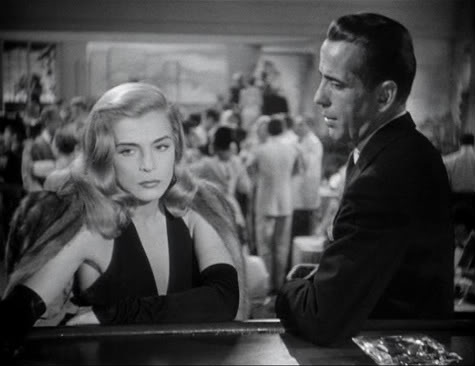
I guess when you watch enough films it’s almost inevitable that a certain degree of familiarity with plot and characters creeps in. Leaving aside the matter of remakes and such, this is often simply a false perception on the viewers part. However, every once in a while, a movie like Dead Reckoning (1947) comes along where familiarity is not just a case of perceived similarity but a clear rehash of characters, themes and even dialogue from earlier works. This picture borrows heavily from two previous Bogart vehicles – The Big Sleep and The Maltese Falcon, the latter being the most obvious with lines of dialogue getting recycled by the very man who made them iconic in the first place. Although Dead Reckoning never manages to attain the heights of its source of inspiration, it remains an entertaining (if slightly cheesy) film noir.

It opens strongly with a battered and desperate Captain Murdock (Humphrey Bogart) dodging the cops along the dark, rain slicked pavements of Gulf City. Symbolically seeking sanctuary, he slips into a Catholic church and melts into the protective shadows. Recognising the returning priest as a former army padre, he takes the opportunity to unburden himself and tell his tale in an improvised confession. This introduces the flashback structure that dominates the bulk of the film’s running time. In brief, Murdock is now running scared in Gulf City as a result of his attempt to locate an old army pal who decided to take a powder rather than face exposure as a wanted man when he learns that he is to be awarded the Medal of Honor. The plot follows Murdock’s efforts to clear the name of his friend for a murder that he believes was out of character. The friend in question ends up burnt to a crisp in a car wreck before Murdock even has a chance to contact him, so he must feel his way in the dark in a strange town and among an assortment of shady figures. The closest link to his friend, and the person most likely to hold the key to his fate, is a husky voiced cabaret singer by the name of Coral Chandler (Lizabeth Scott). Murdock’s innate distrust of women means he starts off sceptical of the sincerity of this lady, and her apparent closeness to the smoothly repellent night club owner and gambler Martinelli (Morris Carnovsky) merely serves to heighten his suspicions. Throughout the movie Murdock blows hot and cold in relation to Coral, his attitude varying from doubt to acceptance and back again, even as he finds himself increasingly attracted to her. It’s only after Murdock turns Martinelli’s office into a raging inferno that the truth behind his friend’s demise finally comes to light.

£7

Bogart’s character in Dead Reckoning is a detective in the Spade/Marlowe mold in all but name; he frequents the same kind of places, mixes it with the same mobsters and duplicitous types and speaks in the same hard-boiled idiom. He even brings matters to a head in a way we’ve seen before – as he tosses the deadly incendiary grenades around Martinelli’s office to loosen tongues you almost expect to hear him snarl “That’s one, Eddie…”, and the climactic scene with Lizabeth Scott borders on a pastiche of the payoff in The Maltese Falcon. Despite the lack of originality in the script (I’ve also read that the movie was initially planned as a kind of follow-up to Gilda) it still stands up as a medium grade noir. A lot of this is due, I think, to Bogart’s strong performance, his cynicism and toughness papering over the weaknesses in other aspects of the movie. The short scene in the morgue – the one cool place in town – highlights this through its combination of smart-ass dialogue and implied violence. In fact, there’s a good deal of violence in the movie, although much of it takes place off screen. The savage beating Murdock receives from Marvin Miller’s sadistic thug, all carried out to the accompaniment of dance time music, is never shown but the damage to the hero’s face makes it clear enough what’s been going on. Morris Carnovsky’s Martinelli makes for an interesting villain, reminiscent of George Macready’s Ballin Mundson in the aforementioned Gilda, as a lowlife with a veneer of sophistication and mock delicacy. The weakest link in the whole chain is ironically the one person who’s presence ties all the strands together – Lizabeth Scott. She was clearly supposed to act as a kind of surrogate Bacall, a sultry foil for Bogart’s two-fisted protagonist. She looks the part and pitches her voice low enough to promise heaven and honey, but her overall performance is a poor one. At one point she spins Bogart one of those hard luck yarns so beloved of femme fatales and then, not reading the result she wanted in his features, asks if he doesn’t believe her. And that’s the problem; there’s a lack of conviction and credibility when she delivers some of the most crucial lines in the movie. Leaving aside the performers, John Cromwell’s direction is mostly effective and there are some darkly moody scenes. The tense opening and the subsequent flashback power things along, but the return to “normal” time lets the momentum slow a little, and a little too early, before the final reveal.

The R2 DVD from Sony/Columbia is reasonably good but not without some faults. The transfer is generally clean, but there are moments of softness and a few occasions when scratches and light damage prove mildly distracting. The only extra feature offered is a gallery consisting of a few posters. Generally, this is a pretty respectable noir, though not quite top flight material. The script is too much by the numbers and unquestionably derivative of other pictures. Still, it does hold one’s interest and has rewatch value if only to enjoy again some fine, snappy lines. That, and a typically gritty Bogart performance, earns it a recommendation.

Kiss of Death

poster230

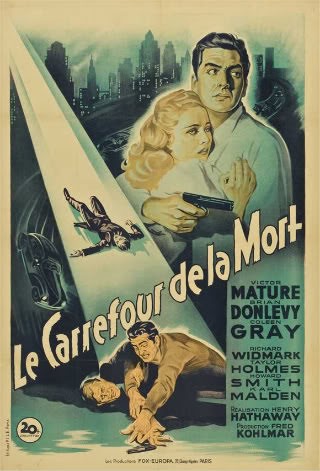
Stool pigeon, squealer, informer – these words all evoke images of weak, low-life types who are willing to spill it all and damn their friends for personal gain. It’s not easy to portray such people without resorting to stereotypes like the tragic, pitiful dupe, or maybe the moral/political crusader. Kiss of Death (1947) is the tale of a man who happily shops his partners in crime, but he comes across as the hero mainly because his actions are guided by his devotion to his family and not greed or some trite ethical principle.

Nick Bianco (Victor Mature) is a career hood who’s spent his life on the wrong side of the law. The opening voiceover narration establishes the fact that Bianco’s record now precludes him from holding down any meaningful job, and thus limits his choices. When a pre-Christmas jewel robbery goes wrong he finds himself on a downward spiral where his already restricted options will be narrowed even more. Initially, Bianco holds firm to the doctrine of honour among thieves and spurns the approaches of Assistant DA D’Angelo (Brian Donlevy). So he takes the jail time and the criminal kudos that comes with it, choosing to leave things up to his crooked lawyer. It’s only when he hears of the suicide of his wife (who’s never seen incidentally) and the subsequent packing off of his two daughters to an orphanage that he undergoes a change of heart. Both his lawyer’s ineffectiveness and the news of the inappropriate behaviour of his former comrades cause him to reassess his position. Striking a deal with D’Angelo gets Bianco out on parole but that’s not the end of it. The law demands more from him and Bianco finds himself drawn deeper into the DA’s plans. The ultimate goal is to secure the conviction of one Tommy Udo (Richard Widmark), a ruthless hoodlum with a psychopathic streak. Although Bianco secures the evidence the trial is a failure and Udo walks. It’s now that the real nightmare begins; Bianco has a new wife and a new identity, and all that will surely be swept away when (not if) Udo tracks him down and exacts his revenge. It’s in this second half of the story that the film shows its true noir credentials and moves away from the early melodramatic gangster movie feel. Bianco’s world shrinks to the point where he is eventually left with only one viable course of action.

£22

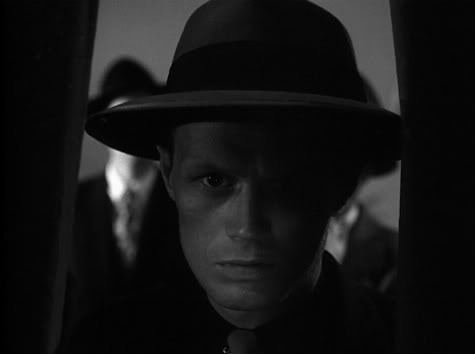
Kiss of Death is a good movie for many reasons, but over the years it’s come to be remembered mainly for the debut of Richard Widmark. The performance is so intense and memorable that it’s hard to believe Widmark had never been on screen before. The fact that this giggling maniac who delights in shoving a crippled woman to her death down a staircase has featured in so many clips through time has maybe drained some of the shock value away. However, there’s no denying the chilling quality that Widmark brings to every scene he’s in – whether it all came down to the actor’s own nervousness or not he has a kind of electric menace that demands you give him your full attention. In contrast, Victor Mature is like a rabbit caught in the headlights when confronted with this raw aggression. That’s not meant as a criticism of Mature’s performance; his role is that of man trapped by his own past and some poor decisions, and he brings off the mounting sense of isolation, desperation and fear that any man in Bianco’s position must surely experience.

In the supporting parts, Donlevy is his usual strutting and brusque self as the Assistant DA who’s not averse to bending the law his way in order to achieve his ends. Coleen Gray, who also provides the voiceover, is the new wife who finds herself thrust into a perilous situation – although she must surely have expected that her life with Bianco would be less than smooth given her knowledge of his past – and she’s sweet and sympathetic in the role. Henry Hathaway’s no nonsense direction makes sure that the action moves along, and neatly avoids the kind of sermonising that could easily derail things. He also blends the extensive location work into proceedings and this does lend a touch of realism.

The US release of Kiss of Death on DVD (although it’s out in the UK too) via Fox’s noir line is a typically strong one, the transfer being crisp and clean throughout. There are some nice extras too: a commentary by James Ursini and Alain Silver, a gallery and the trailer. The movie has points to make about the inadequacy (and possibly the corrupt nature) of law enforcement, and the failings of the penal system. However, this stuff has all been done before and it’s therefore refreshing that the abiding memory one takes away from a viewing is that of Widmark’s sniggering nutjob. I think it’s fair to say that it’s this powerhouse performance that elevates the movie above other noir pictures.


Odd Man Out

Today is the third birthday of Riding the High Country, and for that reason I wanted to feature a movie that occupies a special place in my affections. Belfast isn’t a city that one would normally associate with film noir. Still and all, it’s not such an outlandish setting when you actually think about it a little. It’s a city with an especially dark past (and a future that remains far from certain for that matter) that’s seen more than its fair share of death and mayhem. Carol Reed’s Odd Man Out (1947) uses the shadowy post-war city as the backdrop for a story that’s a haunting mix of tragedy, love and intrigue. It’s also a very Irish tale, and perhaps that’s why it has always resonated with me and fascinated me.

It’s the story of one man’s last hours, and how this impacts on his friends, enemies and even those who are strangers. Johnny McQueen (James Mason) is the OC of the IRA in Belfast (the film never specifically identifies the name or the place, referring only to “the organisation” and “a Northern Irish city”, but that’s the what and the where in any case) who’s only recently escaped from prison. He’s been laid up in a safe house and is about to emerge again to lead a robbery. Although doubts are expressed about his suitability for the task, due to his having been out of circulation for so long, he shrugs them off and insists on going ahead with the plan. The raid proves disastrous through a combination of bad luck, physical weakness on Johnny’s part, and the incompetence and cowardice of his associates. The end result is that is a man is killed, Johnny is shot and wounded, and worst of all is abandoned on the streets of Belfast. As the light begins to fade and the temperature drops, one man sets out on his final journey around the city while the police cast their net and the avenues of escape are progressively narrowed. This torturous odyssey of a dying man takes on a dreamlike quality as he stumbles through darkly hostile backstreets and decaying tenements. Along the way he crosses paths with a motley selection of characters who respond variously with charity, pity and fear – but always with an undercurrent of suspicion and self-interest at the back of it. In a sense the film offers a sneak peak at the flip side of the Irish character that all of us born on that island know about but rarely acknowledge. The complex and frankly dangerous history of Northern Ireland, which frequently left many ordinary people caught precariously in the middle, probably intensified this. The resultant attitude was born of a combination of “whatever you say, say nothing” and “but what’s in it for me”, and was maybe the only alternative if you wanted to survive. If that all sounds a little negative, there’s something altogether finer at the heart of the picture though. Kathleen (Kathleen Ryan), Johnny’s girl, is driven on not by any base interest but by her love. She knows that she has no future with this doomed fugitive, but her devotion sees her scour the snowbound city for him so she can protect him and simply be with him. When the couple eventually unite on the icy docks in the shadow of the Albert clock, with the police closing in remorselessly, it’s Kathleen who takes the only option open to her to ensure they remain together. That finale has real emotional power that refuses to fade however many times it’s viewed.

Sometimes I think it’s strange that it should be a British crew, writer and leading man that managed to get so deeply into the Irish mindset. On the other hand, maybe it takes an outsider to see people as they are and thus it’s easier for them to strip away the superficial and get to the essence. Of course, author and screenwriter F L Green was married to an Irishwoman and lived in Belfast so he did have first hand knowledge to draw upon. Carol Reed’s commonly acknowledged masterpiece is The Third Man, and that film is regarded as the cornerstone of his reputation. However, over time, I’ve come to the conclusion that Odd Man Out is the better movie. Stylistically, both films use  similar techniques –  disconcertingly tilted angles, deep shadow, and a forbidding city as a backdrop. Odd Man Out is the more intimate story though and it’s plot is simpler and more emotionally involving, which gives it the edge for me. James Mason is simply immense as the dead man walking, and the role of Johnny McQueen remained the one he rated highest for the rest of his life. I also feel he gave his greatest performance in what was a very difficult part, conveying an enormous amount of pathos and emotion with only minimal dialogue. It’s heartbreaking to see this shambling figure shunted from person to person, with the only thought in most of their heads being how to get shot of this burden before disaster befalls them too. Kathleen Ryan’s work is memorable too as the only person who actually cares for Johnny. The scene in the priest’s house when she talks of her love and how it has consumed her totally is exceptionally moving and all the more effective and credible due to her understated acting. I’ve already mentioned the powerful finale and it’s worth noting that the restraint of both Mason and Ryan contributes significantly to its success. The rest of the cast is dominated by fine Irish character players with strong theatrical backgrounds. A few notable exceptions are William Hartnell as a nervy barman, and Robert Newton as a half-crazed artist bent on painting Johnny’s portrait in order to capture the truth about life as seen through the eyes of a dying man. Newton’s performance is probably the weakest part of the whole film, being far too hammy and ostentatious. The location filming in Belfast adds to the authenticity of the picture and Robert Krasker managed to capture the threatening feel of the city by night. As a footnote, it’s also worth mentioning that the Crown Bar featured in the film (although the interiors were actually a pretty accurate studio reproduction) still exists and looks the same. It’s across the street from the Europa, Europe’s most bombed hotel, and I drank there many times when I lived in Belfast as a student.

The UK DVD of Odd Man Out from Network is a wonderful presentation. It sports one of the best B&W transfers out there with deep, rich blacks and excellent contrast. It’s also loaded with quality extras including a documentary on Mason, an archive interview with the star, the script and a gallery. There’s also a 24 page booklet by Steve Rogers which is very detailed and full of great stills and advertising material. This title was also available as part of Optimum’s James Mason Collection, but I have no idea how that disc stacks up, and anyway it looks as though the Optimum set has gone or is about to go out of print. This film is one of my all-time favourites and I can’t praise it highly enough. Apart from the startling visuals and heartfelt performances, it’s notable that this picture succeeds in rising above the political minefield of its setting to tell a marvellously human story that’s not afraid of probing the darkness before ending on a note of hopeful tragedy…and that’s about as Irish a paradox as you can get. If you haven’t seen this film yet then you’ve been missing out on a piece of cinema that is exceptionally fine.