Pickup on South Street

Movies that focus on the post-war obsession with the Red Scare can be a bit trying to watch with modern eyes. The forced patriotism and tendency towards speech-making rarely add up to a satisfying viewing experience. But on occasion, they can work and rise above the poisonous politics of the time to present a genuinely good film. Pickup on South Street (1953) is an excellent example – Sam Fuller’s commie baiting has a cynical, sardonic edge that makes it almost refreshingly subversive, especially given the climate in which it was produced.

Skip McCoy (Richard Widmark) is a small time grifter, a pickpocket back plying his trade on the subway just after being released from prison. He’s also a three time loser (one more conviction and he gets life) and may have taken a step too far this time. In one of the most erotically charged pieces of larceny committed to film, he eases a wallet out of the purse of a girl in a crowded carriage. The girl, Candy (Jean Peters), unfortunately happens to be under observation by the FBI, who want to trace the man she’s to deliver the contents of the wallet to. McCoy’s light-fingered work leaves everyone in a spot: Candy can’t make the drop and has to break the bad news to her communist boyfriend, the Feds have had the perfect sting snatched away from them, and McCoy finds himself with a piece of microfilm that both the law and the reds are prepared to nail him to get. The result is that McCoy winds up walking an especially precarious tightrope, holding the cops at arm’s length while he attempts to extort $25,000 from the communists. All the while, Candy is asked to use her ample charms to retrieve the coveted microfilm one way or another. In the end, McCoy does what the Feds want and eventually gives up both the film and the spy ring. What distinguishes this movie from the standard anti-communist fare of the time though is the attitude and motivation of McCoy throughout. He quite literally sneers at the earnest appeals to his patriotism that the FBI man naively hopes will sway him. When he does finally look beyond narrow self-interest it’s not because he just thought about the flag and suddenly felt all mushy inside, it’s because he has witnessed the brutality of the people he’s trying to bargain with and owes a debt of loyalty and gratitude to friends. So, while McCoy ultimately “does the right thing”, his own personal integrity and disdain for authority remain more or less intact.

Pickup on South Street represents Sam Fuller at or near his best; the stripped down plot, the cheap, hard-boiled idiom of the dialogue that snaps like a whip, and the pulp trashiness of the characters all combine with the director’s gut-punching bluntness to deliver eighty minutes of great cinema. Some of the best scenes in the movie take place in McCoy’s waterfront shack, where Joe MacDonald’s camera makes the most of the shadows and confined space to create mood and atmosphere. Of particular note is the sequence when McCoy returns to find Candy searching the place by torchlight. Not even suspecting that it’s a woman, he slugs the half seen figure full on the jaw and lays her out, then casually brings her to by pouring his river chilled beer over her. What follows is a sexy and darkly romantic scene, where McCoy gently massages Candy’s bruised face as the two of them draw ever closer, and the camera moves in for an increasingly tight close-up. In a completely different but equally effective scene, Fuller and MacDonald have the villain holed up in the smallest, darkest space imaginable – a dumb waiter stalled between floors as the Feds peer through the openings above and below – and once again use the tight framing to great effect.
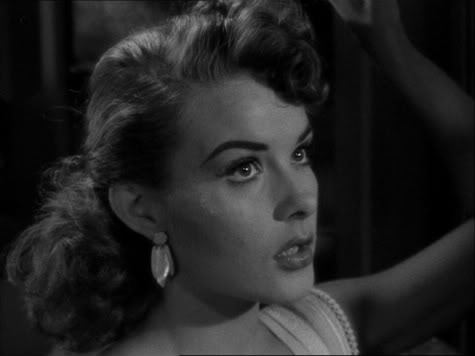
Pickup on South Street was the first of two movies Richard Widmark would make with Sam Fuller (the other was the following year’s Hell and High Water – a glossier, more cartoonish and less interesting work) and it provided him with one of his better roles. He’d moved on from playing out and out villains and seemed to enjoy the anti-heroic status of the part. Skip McCoy is an unapologetic thief, with a streak of mild sadism too, who revels in his life outside the law and normal society. Widmark was probably the ideal choice as a character whose default reaction to noble ideals and patriotic fervor was a curled lip and stinging sarcasm. As the foil, and romantic interest, for this cocky and contemptuous figure, Jean Peters was another fine piece of casting. As Candy, she exudes a kind of earthy sexuality that’s incredibly attractive in a cheap, slightly sleazy way. It’s never made exactly clear what her background is, but there are allusions to a tawdry past that she’s trying to live down. Also, the fact that she endures fairly rough treatment at the hands of McCoy (including a full-on punch in the face) and a bad beating from her boyfriend without a whimper of self pity indicates that she’s familiar with the unsavory side of life.

While these two dominate the film’s narrative, the show is damned near stolen every time Thelma Ritter’s Moe makes an appearance. Her world weary stoolie, who dreams only of scraping together enough cash to ensure she avoids a pauper’s funeral, is highly memorable. Aside from the fatalism and melancholy of her character, she draws a huge amount of sympathy from the viewer just by appearing plainly human. As such, it’s no surprise that it’s the fate of Moe which affects McCoy deeply enough to take decisive action. The main villain is Candy’s boyfriend, played by Richard Kiley. He’s the stuff of stereotypes, all sweaty and gutless, but the movie needs such a figure to act as the focus for the audience’s resentment.

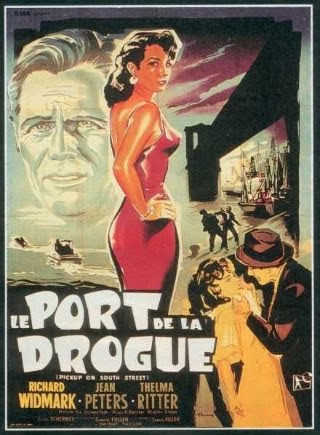
The UK DVD from Optimum offers a very strong transfer of the film. It’s clean, sharp and has good contrast. Unfortunately, there are absolutely no extras included on the disc. In terms of supplementary material, the US Criterion release is clearly the way to go. However, if you just want to see the film itself given a fine presentation then it’s hard to beat the Optimum release – especially if you take the difference in pricing into account. Pickup on South Street remains one of the best examples of Sam Fuller’s talents, a first rate film noir where he never allows the political backdrop of the tale to bog down or derail things. In fact, the picture was initially released in France in a dubbed version where all references to the red spy ring were excised in favor of a storyline involving narcotics – which goes to show that the core narrative is strong enough to stand alternative interpretations being welded on. An excellent movie all round.

Black Angel

poster248

Time for another neglected and half-forgotten gem, one of those movies that seem to slip beneath the radar of even the most ardent movie buffs. Black Angel (1946) is a great little film noir that doesn’t get a lot of attention but really delivers the kind of perversely satisfying payoff that the genre is noted for. There are plenty of familiar noir names in the cast, but none of them are or were exactly “stars” and the director was a man who spent his time on B programmers, so that may go some way towards explaining the relative obscurity of the film.

The opening is very self-consciously stylised, showing a lone figure on the sidewalk before panning up an artificial looking building exterior and in through the window to establish an overhead shot of a woman in her bedroom. The woman, Mavis Marlowe (Constance Dowling), is a singer and, as we soon learn, a blackmailer. While she prowls her apartment waiting for a caller to arrive, the man on the street below is revealed to be songwriter and pianist Martin Blair (Dan Duryea), the estranged husband who still carries a torch and hopes to see her since it’s their anniversary. Although the lovesick Blair gets stiff armed by the concierge, on his wife’s orders, the audience gets to witness two different men entering the building to see Miss Marlowe. One is night club owner Marko (Peter Lorre), and the other is a mark called Kirk Bennett (John Phillips). It’s the latter who discovers the strangled body of Marlowe and, despite protestations of innocence, is arrested, tried and sentenced to the gas chamber for her murder. As viewers, we know that Bennett is innocent – we can’t be positive who the murderer was but suspicion casts a very long shadow over Marko. The rest of the movie is essentially a race to try and nail the true culprit before the wrong man is executed. Blair and Bennett’s wife, Catherine (June Vincent), form an alliance to track down the clues the police have either missed or ignored in the course of the initial investigation. This curiously matched duo naturally focus their attention on the sinister Marko but, as the old saying goes, there’s many a slip twixt the cup and the lip, and the outcome is far from certain.

£23

Director Roy William Neill is hardly a household name, and he’s probably best known for helming some of the better entries in the Rathbone/Bruce Sherlock Holmes series for Universal. In those movies he showed a real talent for conveying atmosphere and suspense on a budget. He brought that same sense of dark foreboding to Black Angel, which unfortunately proved to be his last picture, and delivered a pacy and stylish thriller. The script derives from a Cornell Woolrich story and has that twisted, nightmarish quality that characterised his work.

In a rare opportunity to take on the lead role, Dan Duryea excels as the down and out loser who looks like he’s been given a second chance in life and grasps it, only to see his dreams slide away. Duryea was always a first rate villain but here he shows he had more range when necessary, and he creates a character in Martin Blair who’s actually quite touching and affecting. June Vincent, as the loyal wife, is the principal female lead but it’s such a stock role, and one devoid of anything in the way of complexity, that she fails to make much of an impression. The same can’t be said of Constance Dowling though – despite having her character killed off right at the beginning, the spectre of this striking looking woman haunts the rest of the film. Peter Lorre isn’t asked to do anything spectacular as Marko except play his standard variation on the slimy underworld type. Still, he had a nice line in menace that few could rival and he’s quite effective as the chief suspect. The supporting cast is rounded out by veteran Wallace Ford, as Blair’s friend, and a very restrained Broderick Crawford as the dubious detective.

Universal’s R1 DVD of Black Angel presents the film quite well. The transfer’s not exactly pristine but there’s no major problems either and it’s nice and sharp. The only extra on the disc is a trailer for the movie. More than one film noir has been let down by a weak or contrived ending, but this picture finishes up with a real kick in the guts that ensures none of the power is diminished. Don’t let the lesser known credentials put you off, this is a good one.


Macao

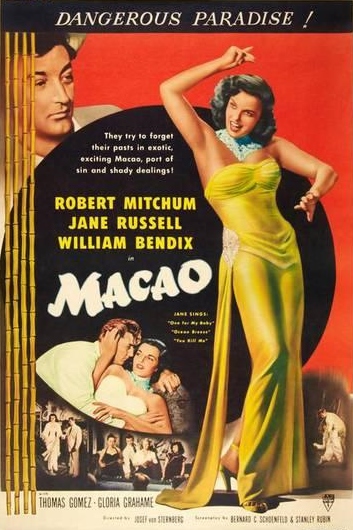
If there were such a term as noir-lite then Macao (1952) would have to feature as a prominent example. Taking its lead from the likes of The Big Steal and, more especially, His Kind of Woman, the movie uses some standard characters and situations but drops the harder-edged cynicism and fatalism that one normally expects to find. As a result, we wind up getting a moderately entertaining picture that passes the time but never delivers the kind of sickening gut punch a film noir ought to. The chaotic nature of the production probably contributed significantly to the less than satisfactory final product. However, there are casting issues involved too, but more on that later.

Exotic settings have long been a favourite of Hollywood movies, and the Orient has a special flavour and mystique of its own. Macao, the Portuguese colony, had the kind of murky reputation that suits the world of noir down to the ground. The story revolves around the arrival of three strangers – Nick Cochran (Robert Mitchum), Julie Benson (Jane Russell) and Lawrence C Trumble (William Bendix) – in this corrupt and largely lawless locale. What’s not clear is the reason for these individuals turning up; Julie says she’s looking for a job as a singer, Trumble says he’s a salesman, and Cochran says he’s just hoping to turn a buck whatever way he can. Regardless of what they say, it’s soon apparent that one or more of this ill-matched trio is out to bring down local underworld and gambling kingpin Vince Halloran (Brad Dexter). He’s wanted by Interpol but can’t be touched as long as he remains within Macao’s three mile limit; so a plot involving stolen diamonds is cooked up to appeal to his avaricious nature and lure him far enough out for the authorities to nab him. At the heart of the story is the dynamic between Cochran and Julie – he helps her out of a tight spot and she repays him by lifting his wallet, he gets threatened with deportation and she bails him out, and so on. This cagey romance runs parallel to the business with Halloran, and it seems at times like there are two different movies fighting for dominance. In the end it’s the lighter elements that prevail and the more sinister aspects are only dealt with during the climax. Generally, it’s a schizophrenic kind of picture that fails to deliver adequately through its lack of decisiveness. There are a number of effective scenes that, taken individually, prove satisfying either for their smart-ass comedic dialogue or their tense stylishness. However, they sit uncomfortably side by side and the shift of emphasis is a clumsy affair.

It’s rarely good news when a film experiences a change of director during production, and the further along it is when the switch takes place the greater the damage is likely to be. Josef von Sternberg had already shot a significant amount of the script when on set disagreements led to his departure and replacement by Nicholas Ray. The credits show von Sternberg as the director but it’s hard to be sure how much of the finished movie is down to him; Cochran’s escape from Halloran’s clutches and subsequent pursuit through the docks at night do seem to carry his stamp though. That’s easily the most visually impressive sequence in the whole movie, as Cochran stumbles and slips through a set draped with trawler nets that resemble some massive spider web that’s been spun across the waterfront to ensnare him. Additionally, the scenes in Halloran’s gambling house hark back to von Sternberg’s The Shanghai Gesture, but never achieve anything like the intoxicating decadence of the earlier film. On top of all the other turmoil, the script was undergoing constant revision and being written on the fly, with Mitchum apparently contributing. Mitchum and Russell were essentially playing to type and their chemistry is a large part of what ensures Macao remains watchable. I enjoy seeing William Bendix in anything but he overdoes the mugging in this one and his part suffers as a result. A bigger problem with the casting though concerns Brad Dexter and Gloria Grahame: Dexter is simply too wooden and passive to convince as the threatening figure he’s supposed to be, and Grahame is criminally wasted in an underwritten role that she reportedly didn’t want to play in the first place.

The R1 DVD of Macao from Warners is a good one that is sharp and has strong contrast in the crucial night scenes. If the film itself is a weak one then the disc extras go some way towards making up for that. There’s a nice commentary track with Eddie Muller, Jane Russell and Stanley Rubin. Also, we get a half hour of TCM Private Screenings with Russell and a very ill Mitchum chatting to Robert Osborne. I couldn’t recommend the movie to anyone just getting into film noir as it’s too watered down to be in any way representative. While it’s passably entertaining, it’s realistically more likely to appeal to Mitchum/Russell/von Sternberg (delete as appropriate) completists.

Dead Reckoning

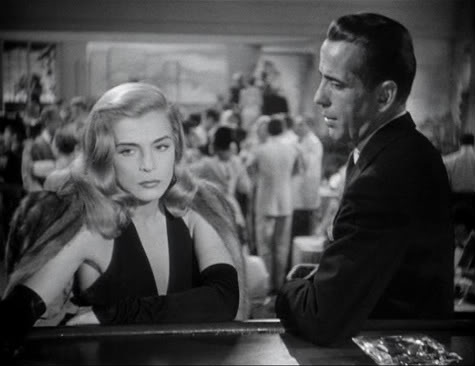
I guess when you watch enough films it’s almost inevitable that a certain degree of familiarity with plot and characters creeps in. Leaving aside the matter of remakes and such, this is often simply a false perception on the viewers part. However, every once in a while, a movie like Dead Reckoning (1947) comes along where familiarity is not just a case of perceived similarity but a clear rehash of characters, themes and even dialogue from earlier works. This picture borrows heavily from two previous Bogart vehicles – The Big Sleep and The Maltese Falcon, the latter being the most obvious with lines of dialogue getting recycled by the very man who made them iconic in the first place. Although Dead Reckoning never manages to attain the heights of its source of inspiration, it remains an entertaining (if slightly cheesy) film noir.

It opens strongly with a battered and desperate Captain Murdock (Humphrey Bogart) dodging the cops along the dark, rain slicked pavements of Gulf City. Symbolically seeking sanctuary, he slips into a Catholic church and melts into the protective shadows. Recognising the returning priest as a former army padre, he takes the opportunity to unburden himself and tell his tale in an improvised confession. This introduces the flashback structure that dominates the bulk of the film’s running time. In brief, Murdock is now running scared in Gulf City as a result of his attempt to locate an old army pal who decided to take a powder rather than face exposure as a wanted man when he learns that he is to be awarded the Medal of Honor. The plot follows Murdock’s efforts to clear the name of his friend for a murder that he believes was out of character. The friend in question ends up burnt to a crisp in a car wreck before Murdock even has a chance to contact him, so he must feel his way in the dark in a strange town and among an assortment of shady figures. The closest link to his friend, and the person most likely to hold the key to his fate, is a husky voiced cabaret singer by the name of Coral Chandler (Lizabeth Scott). Murdock’s innate distrust of women means he starts off sceptical of the sincerity of this lady, and her apparent closeness to the smoothly repellent night club owner and gambler Martinelli (Morris Carnovsky) merely serves to heighten his suspicions. Throughout the movie Murdock blows hot and cold in relation to Coral, his attitude varying from doubt to acceptance and back again, even as he finds himself increasingly attracted to her. It’s only after Murdock turns Martinelli’s office into a raging inferno that the truth behind his friend’s demise finally comes to light.

£7

Bogart’s character in Dead Reckoning is a detective in the Spade/Marlowe mold in all but name; he frequents the same kind of places, mixes it with the same mobsters and duplicitous types and speaks in the same hard-boiled idiom. He even brings matters to a head in a way we’ve seen before – as he tosses the deadly incendiary grenades around Martinelli’s office to loosen tongues you almost expect to hear him snarl “That’s one, Eddie…”, and the climactic scene with Lizabeth Scott borders on a pastiche of the payoff in The Maltese Falcon. Despite the lack of originality in the script (I’ve also read that the movie was initially planned as a kind of follow-up to Gilda) it still stands up as a medium grade noir. A lot of this is due, I think, to Bogart’s strong performance, his cynicism and toughness papering over the weaknesses in other aspects of the movie. The short scene in the morgue – the one cool place in town – highlights this through its combination of smart-ass dialogue and implied violence. In fact, there’s a good deal of violence in the movie, although much of it takes place off screen. The savage beating Murdock receives from Marvin Miller’s sadistic thug, all carried out to the accompaniment of dance time music, is never shown but the damage to the hero’s face makes it clear enough what’s been going on. Morris Carnovsky’s Martinelli makes for an interesting villain, reminiscent of George Macready’s Ballin Mundson in the aforementioned Gilda, as a lowlife with a veneer of sophistication and mock delicacy. The weakest link in the whole chain is ironically the one person who’s presence ties all the strands together – Lizabeth Scott. She was clearly supposed to act as a kind of surrogate Bacall, a sultry foil for Bogart’s two-fisted protagonist. She looks the part and pitches her voice low enough to promise heaven and honey, but her overall performance is a poor one. At one point she spins Bogart one of those hard luck yarns so beloved of femme fatales and then, not reading the result she wanted in his features, asks if he doesn’t believe her. And that’s the problem; there’s a lack of conviction and credibility when she delivers some of the most crucial lines in the movie. Leaving aside the performers, John Cromwell’s direction is mostly effective and there are some darkly moody scenes. The tense opening and the subsequent flashback power things along, but the return to “normal” time lets the momentum slow a little, and a little too early, before the final reveal.

The R2 DVD from Sony/Columbia is reasonably good but not without some faults. The transfer is generally clean, but there are moments of softness and a few occasions when scratches and light damage prove mildly distracting. The only extra feature offered is a gallery consisting of a few posters. Generally, this is a pretty respectable noir, though not quite top flight material. The script is too much by the numbers and unquestionably derivative of other pictures. Still, it does hold one’s interest and has rewatch value if only to enjoy again some fine, snappy lines. That, and a typically gritty Bogart performance, earns it a recommendation.

Kiss of Death

poster230

Stool pigeon, squealer, informer – these words all evoke images of weak, low-life types who are willing to spill it all and damn their friends for personal gain. It’s not easy to portray such people without resorting to stereotypes like the tragic, pitiful dupe, or maybe the moral/political crusader. Kiss of Death (1947) is the tale of a man who happily shops his partners in crime, but he comes across as the hero mainly because his actions are guided by his devotion to his family and not greed or some trite ethical principle.

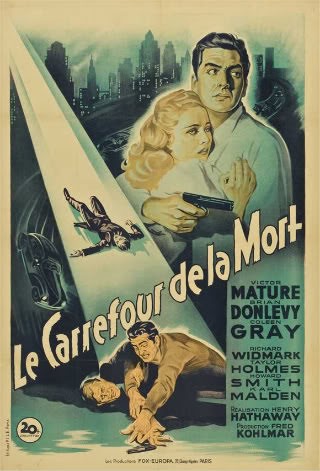
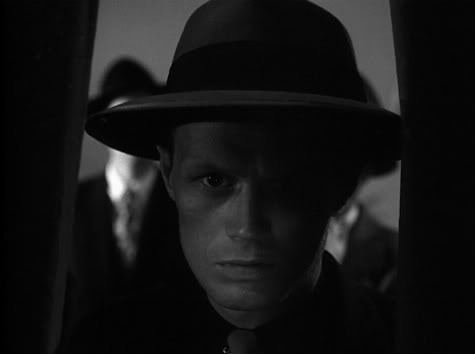
Nick Bianco (Victor Mature) is a career hood who’s spent his life on the wrong side of the law. The opening voiceover narration establishes the fact that Bianco’s record now precludes him from holding down any meaningful job, and thus limits his choices. When a pre-Christmas jewel robbery goes wrong he finds himself on a downward spiral where his already restricted options will be narrowed even more. Initially, Bianco holds firm to the doctrine of honour among thieves and spurns the approaches of Assistant DA D’Angelo (Brian Donlevy). So he takes the jail time and the criminal kudos that comes with it, choosing to leave things up to his crooked lawyer. It’s only when he hears of the suicide of his wife (who’s never seen incidentally) and the subsequent packing off of his two daughters to an orphanage that he undergoes a change of heart. Both his lawyer’s ineffectiveness and the news of the inappropriate behaviour of his former comrades cause him to reassess his position. Striking a deal with D’Angelo gets Bianco out on parole but that’s not the end of it. The law demands more from him and Bianco finds himself drawn deeper into the DA’s plans. The ultimate goal is to secure the conviction of one Tommy Udo (Richard Widmark), a ruthless hoodlum with a psychopathic streak. Although Bianco secures the evidence the trial is a failure and Udo walks. It’s now that the real nightmare begins; Bianco has a new wife and a new identity, and all that will surely be swept away when (not if) Udo tracks him down and exacts his revenge. It’s in this second half of the story that the film shows its true noir credentials and moves away from the early melodramatic gangster movie feel. Bianco’s world shrinks to the point where he is eventually left with only one viable course of action.

£22

Kiss of Death is a good movie for many reasons, but over the years it’s come to be remembered mainly for the debut of Richard Widmark. The performance is so intense and memorable that it’s hard to believe Widmark had never been on screen before. The fact that this giggling maniac who delights in shoving a crippled woman to her death down a staircase has featured in so many clips through time has maybe drained some of the shock value away. However, there’s no denying the chilling quality that Widmark brings to every scene he’s in – whether it all came down to the actor’s own nervousness or not he has a kind of electric menace that demands you give him your full attention. In contrast, Victor Mature is like a rabbit caught in the headlights when confronted with this raw aggression. That’s not meant as a criticism of Mature’s performance; his role is that of man trapped by his own past and some poor decisions, and he brings off the mounting sense of isolation, desperation and fear that any man in Bianco’s position must surely experience.

In the supporting parts, Donlevy is his usual strutting and brusque self as the Assistant DA who’s not averse to bending the law his way in order to achieve his ends. Coleen Gray, who also provides the voiceover, is the new wife who finds herself thrust into a perilous situation – although she must surely have expected that her life with Bianco would be less than smooth given her knowledge of his past – and she’s sweet and sympathetic in the role. Henry Hathaway’s no nonsense direction makes sure that the action moves along, and neatly avoids the kind of sermonising that could easily derail things. He also blends the extensive location work into proceedings and this does lend a touch of realism.

The US release of Kiss of Death on DVD (although it’s out in the UK too) via Fox’s noir line is a typically strong one, the transfer being crisp and clean throughout. There are some nice extras too: a commentary by James Ursini and Alain Silver, a gallery and the trailer. The movie has points to make about the inadequacy (and possibly the corrupt nature) of law enforcement, and the failings of the penal system. However, this stuff has all been done before and it’s therefore refreshing that the abiding memory one takes away from a viewing is that of Widmark’s sniggering nutjob. I think it’s fair to say that it’s this powerhouse performance that elevates the movie above other noir pictures.


Odd Man Out

Today is the third birthday of Riding the High Country, and for that reason I wanted to feature a movie that occupies a special place in my affections. Belfast isn’t a city that one would normally associate with film noir. Still and all, it’s not such an outlandish setting when you actually think about it a little. It’s a city with an especially dark past (and a future that remains far from certain for that matter) that’s seen more than its fair share of death and mayhem. Carol Reed’s Odd Man Out (1947) uses the shadowy post-war city as the backdrop for a story that’s a haunting mix of tragedy, love and intrigue. It’s also a very Irish tale, and perhaps that’s why it has always resonated with me and fascinated me.

It’s the story of one man’s last hours, and how this impacts on his friends, enemies and even those who are strangers. Johnny McQueen (James Mason) is the OC of the IRA in Belfast (the film never specifically identifies the name or the place, referring only to “the organisation” and “a Northern Irish city”, but that’s the what and the where in any case) who’s only recently escaped from prison. He’s been laid up in a safe house and is about to emerge again to lead a robbery. Although doubts are expressed about his suitability for the task, due to his having been out of circulation for so long, he shrugs them off and insists on going ahead with the plan. The raid proves disastrous through a combination of bad luck, physical weakness on Johnny’s part, and the incompetence and cowardice of his associates. The end result is that is a man is killed, Johnny is shot and wounded, and worst of all is abandoned on the streets of Belfast. As the light begins to fade and the temperature drops, one man sets out on his final journey around the city while the police cast their net and the avenues of escape are progressively narrowed. This torturous odyssey of a dying man takes on a dreamlike quality as he stumbles through darkly hostile backstreets and decaying tenements. Along the way he crosses paths with a motley selection of characters who respond variously with charity, pity and fear – but always with an undercurrent of suspicion and self-interest at the back of it. In a sense the film offers a sneak peak at the flip side of the Irish character that all of us born on that island know about but rarely acknowledge. The complex and frankly dangerous history of Northern Ireland, which frequently left many ordinary people caught precariously in the middle, probably intensified this. The resultant attitude was born of a combination of “whatever you say, say nothing” and “but what’s in it for me”, and was maybe the only alternative if you wanted to survive. If that all sounds a little negative, there’s something altogether finer at the heart of the picture though. Kathleen (Kathleen Ryan), Johnny’s girl, is driven on not by any base interest but by her love. She knows that she has no future with this doomed fugitive, but her devotion sees her scour the snowbound city for him so she can protect him and simply be with him. When the couple eventually unite on the icy docks in the shadow of the Albert clock, with the police closing in remorselessly, it’s Kathleen who takes the only option open to her to ensure they remain together. That finale has real emotional power that refuses to fade however many times it’s viewed.

Sometimes I think it’s strange that it should be a British crew, writer and leading man that managed to get so deeply into the Irish mindset. On the other hand, maybe it takes an outsider to see people as they are and thus it’s easier for them to strip away the superficial and get to the essence. Of course, author and screenwriter F L Green was married to an Irishwoman and lived in Belfast so he did have first hand knowledge to draw upon. Carol Reed’s commonly acknowledged masterpiece is The Third Man, and that film is regarded as the cornerstone of his reputation. However, over time, I’ve come to the conclusion that Odd Man Out is the better movie. Stylistically, both films use  similar techniques –  disconcertingly tilted angles, deep shadow, and a forbidding city as a backdrop. Odd Man Out is the more intimate story though and it’s plot is simpler and more emotionally involving, which gives it the edge for me. James Mason is simply immense as the dead man walking, and the role of Johnny McQueen remained the one he rated highest for the rest of his life. I also feel he gave his greatest performance in what was a very difficult part, conveying an enormous amount of pathos and emotion with only minimal dialogue. It’s heartbreaking to see this shambling figure shunted from person to person, with the only thought in most of their heads being how to get shot of this burden before disaster befalls them too. Kathleen Ryan’s work is memorable too as the only person who actually cares for Johnny. The scene in the priest’s house when she talks of her love and how it has consumed her totally is exceptionally moving and all the more effective and credible due to her understated acting. I’ve already mentioned the powerful finale and it’s worth noting that the restraint of both Mason and Ryan contributes significantly to its success. The rest of the cast is dominated by fine Irish character players with strong theatrical backgrounds. A few notable exceptions are William Hartnell as a nervy barman, and Robert Newton as a half-crazed artist bent on painting Johnny’s portrait in order to capture the truth about life as seen through the eyes of a dying man. Newton’s performance is probably the weakest part of the whole film, being far too hammy and ostentatious. The location filming in Belfast adds to the authenticity of the picture and Robert Krasker managed to capture the threatening feel of the city by night. As a footnote, it’s also worth mentioning that the Crown Bar featured in the film (although the interiors were actually a pretty accurate studio reproduction) still exists and looks the same. It’s across the street from the Europa, Europe’s most bombed hotel, and I drank there many times when I lived in Belfast as a student.

The UK DVD of Odd Man Out from Network is a wonderful presentation. It sports one of the best B&W transfers out there with deep, rich blacks and excellent contrast. It’s also loaded with quality extras including a documentary on Mason, an archive interview with the star, the script and a gallery. There’s also a 24 page booklet by Steve Rogers which is very detailed and full of great stills and advertising material. This title was also available as part of Optimum’s James Mason Collection, but I have no idea how that disc stacks up, and anyway it looks as though the Optimum set has gone or is about to go out of print. This film is one of my all-time favourites and I can’t praise it highly enough. Apart from the startling visuals and heartfelt performances, it’s notable that this picture succeeds in rising above the political minefield of its setting to tell a marvellously human story that’s not afraid of probing the darkness before ending on a note of hopeful tragedy…and that’s about as Irish a paradox as you can get. If you haven’t seen this film yet then you’ve been missing out on a piece of cinema that is exceptionally fine.

While the City Sleeps

poster226

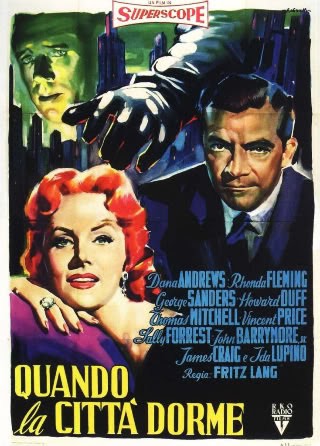
Crime, betrayal, duplicity and grasping, ruthless ambition. All these are ideal ingredients for any film noir, and when you throw in the hard-bitten and cynical milieu of the newspaperman it serves merely to add a little extra kick to an already potent cocktail. While the City Sleeps (1956) contains all of the above and boasts a cast that’s packed to the rafters with heavy hitters. As if that weren’t enough, it’s directed by a genre specialist whose pre-Hollywood influence on the look and mood of film noir is immense.

The plot involves two parallel stories that slowly converge – the first being an investigation of a serial killer on the loose in New York, and the second a cold appraisal of the backstabbing world of the media. What draws both strands together is the contest engineered by Walter Kyne (Vincent Price) to find a new administrator for his recently inherited media empire. Kyne is a spoiled and idle incompetent who hasn’t a clue how to run the business his father left him. But he’s no fool, and he hits on the idea of playing his top men off against each other with the prize of a newly created executive post up for grabs. Whoever can run down and nail the so-called “Lipstick Killer” will take the honours and the top job. Three men are desperate for this promotion: Mark Loving (George Sanders) – head of the wire service, John Day Griffith (Thomas Mitchell) – editor of the newspaper, and Harry Kritzer (James Craig)  – picture editor. The company’s star TV newscaster, Ed Mobley (Dana Andrews), also finds himself roped into this race to find a murderer and thus capture the spoils. The actual investigation of the crime takes a back seat – the audience knows who it is from the pre-credits sequence – and the main thrust is how these media types are prepared to tear each other, the ones they love, and their already slightly tarnished morals apart for the sake of professional advancement. To further complicate matters, the personal relationships of Mobley, Kyne, Loving and Kritzer all become hopelessly entangled as the pressure mounts and the killer remains at large and active. The hunt for the murderer draws to an exciting close in the subway tunnels below the city, but the question of who will walk away with the promotion remains unclear until the very last scene. Along the way, the audience is treated to a marvellous dissection of not only the flexible ethics of journalism, but also the mercenary nature of humanity.

£7

After spending twenty years making movies in Hollywood, Fritz Lang was nearing the end of his American career. In terms of look and style While the City Sleeps may seem like a watered down version of his previous noir pictures. However, what it lacks in visuals and budget is made up for in cynicism and sourness. None of the main characters behave in an honourable way either in their private lives or their professional ones. Many newspaper dramas down through the years have used the device of the story being everything, but this time not even that old chestnut holds sway. Everybody marches to the tune of ambition and they’re all ready to go to whatever lengths are necessary to achieve it. Dana Andrews, in between drinks, even sinks so low as to use his own fiancee as bait to smoke the killer out. He is the character the audience is supposed to identify most closely with, being persuaded to take part in the grotesque contest (at least initially) as a favour to a friend. However, he’s a shabby kind of hero who really only redeems himself at the end by finally speaking the truth regardless of the consequences. George Sanders very much conforms to type as the smooth and vaguely caddish wire service boss who knows all the right people but struggles to get to grips with the seedier characters likely to hold the key to this case.

Ida Lupino does great work as the gossip columnist and occasional girlfriend of Sanders, who agrees to do his spade work for him. She has some nice scenes with Andrews where they both let their wandering eyes off the leash while simultaneously trying to pump each other for information. In truth, there was far better chemistry between Andrews and Lupino than was the case with Sally Forrest, who played his fairly insipid girl. Vincent Price’s role is all effete indolence without any of the menace that he was capable of conveying. Right up to the end he’s blissfully unaware that his faithless trophy wife, Rhonda Fleming, is carrying on an affair with James Craig’s slippery picture editor. Out of this large ensemble cast, the most sympathetic performance came from Thomas Mitchell – the old school editor/reporter who chomps away on cigars and lacks only the press pass jammed into his hat band. Sure he’s every bit as consumed as the others, but back of those slightly wild eyes there remains a flicker of decency – and it’s him you find yourself really rooting for. The only seriously weak link is provided by John Barrymore Jr as the mother’s boy killer with some major issues. One of the best scenes in the movie – him watching the telecast where Andrews profiles the then unknown murderer in disparaging and insulting terms – is very nearly scuppered by Barrymore’s appalling mugging and overacting.

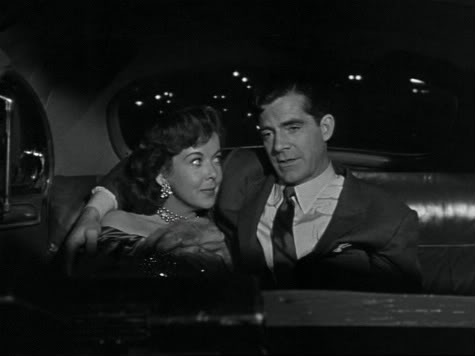
While the City Sleeps has finally made an appearance on DVD courtesy of Exposure Cinema in the UK. The film is presented in 1.33:1 ratio, and according to the distributors this decision was taken due to the condition of the elements – i.e. the image would have been too soft to matte and blow up for widescreen. It’s an open-matte presentation, the film should have been presented flat 1.85:1 in the US (and probably 2:1 Superscope in Europe), and was clearly protected for possible academy ratio showings. There is plenty of extraneous space top and bottom, which should be apparent from the screencap above, but it’s not seriously distracting. Apart from that, the image is quite clean and pleasing to look at and doesn’t display any major faults. The original trailer is included along with a selection of galleries. All told, the package is a worthy one, and it should be mentioned that while the title is rumoured to be in the pipeline from Warners in the US the chances are it will find it’s home in the Archive. This movie has long been one of my favourite Lang pictures and I’m pleased to have it at last in a worthwhile edition. I’ve heard it said that the film suffers from too much focus on the so-called soapy elements of the story, but I disagree. The real strengths of the film are to be found in those newsroom and bar scenes – the character interaction is what drives everything forward and it would be a poorer piece of cinema without them. I have no problem recommending this one.


The Clay Pigeon

The issues faced by returning war veterans have been tackled by more than a few film noirs. Generally, the difficulties related to an inability to settle back into civilian life or the fact that the old familiar things had changed in their absence. The hero of The Clay Pigeon (1949), however, is presented with a set of circumstances that are of an altogether different nature. This movie falls into the nightmare/amnesia sub-genre, wherein a character has no memory of a crucial period and thus finds himself confronted by the consequences of actions that he has blocked out. This kind of storyline has enormous potential of course, but The Clay Pigeon never exploits it to the full.

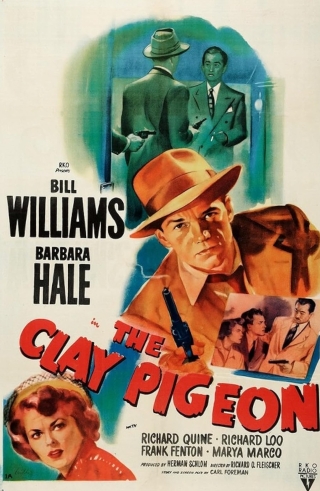
Jim Fletcher (Bill Williams) is a sailor, waking up in hospital after sustaining a bad head injury. He knows his name and most of the details about his past life, but he can’t recall what led to his being in hospital. And there’s the rub: Fletcher has been accused of treason during his time in a Japanese POW camp. What’s even worse is that his actions apparently led to the torture and subsequent killing of his friend. Knowing that he’s faced with a court martial at which he has little chance of clearing himself, Fletcher decides that his only alternative is to duck out and try to get to the bottom of it all by himself. Naturally, a penniless fugitive isn’t likely to make much headway without some assistance, so he takes a chance on contacting his friend’s widow. Unsurprisingly, this lady, Martha (Barbara Hale), is both suspicious and hostile initially. She grudgingly agrees to go along to Los Angeles though when a call to another old buddy, Ted Niles (Richard Quine) promises further help. Whatever doubts Martha may have had are gradually eroded on that long drive, particularly when an unknown car tries to force them off the road to their death. Their arrival in LA reveals just how complex and deadly a mess Fletcher has blundered into – a lethal conspiracy involving counterfeiting, war criminals and personal treachery. The whole thing culminates in a chase through Chinatown, followed by a train journey that exposes the real traitor.


The Clay Pigeon is a genuine B picture, coming in at little over an hour in length and never really pausing for breath. As such, there’s no time for any kind of character development amid the chasing and dodging. If anything, that’s probably the biggest weakness of the film: in these kinds of stories the audience needs to be kept guessing as to whether or not the hero is really as clean cut as he’d like us to believe. As it is, neither the audience nor the character of Fletcher has the least suspicion that he may indeed be the villain of the piece after all. I can’t honestly say that the fault lies with Bill Williams’ amiable playing as the part was written that way for him. I’d be more inclined to place the blame on Carl Foreman’s script (whose dearth of characters makes it pretty obvious who the traitor is right from the off) and the cheap-jack production values. That’s not to say there’s nothing positive to take away; Williams and Hale play well off each other, and the location filming is very welcome. This was one of Richard Fleischer’s earliest directorial efforts and he manages to create some nice angles and images, and does his best to create tension from a script that seems bent on draining away every vestige of suspense. The opening, the night drive to LA, and the Chinatown sequence are all ably handled and point to better things ahead for the director.

The movie comes to DVD from French distributor Montparnasse (I think there are Spanish and Italian editions out there too) and the transfer is one of their more typical efforts. It’s not especially bad, but there’s a slightly heavy-looking image that may have some contrast boosting, and it appears to be interlaced. Extras are confined to an eminently missable introduction. However the disc is certainly passable and the subs are not forced on the English track. It’s probably worth bearing in mind too that this film is likely to be a candidate for the Warner Archive in R1, so a vastly improved transfer isn’t something I’d be holding my breath for. All in all, The Clay Pigeon is pacy little B noir that passes the time painlessly. I just feel that a bit of fine tuning to the script might have added some much needed ambiguity and resulted in a more memorable film.

Shadow of a Doubt

There are people who will tell you that Hitchcock never made a true film noir, and they cite the presence of countless personal motifs littering his work as evidence that what we’re watching is a “Hitchcock movie” as opposed to noir. That’s a point of view I can understand, even sympathize with to some extent, but I still feel that there are a number of Hitch’s movies that do fit snugly into that category. Shadow of a Doubt (1943) is a prime candidate for inclusion due to the dark heart that beats beneath the deceptively bright surface, and the ambiguous attitude it displays towards the villain.

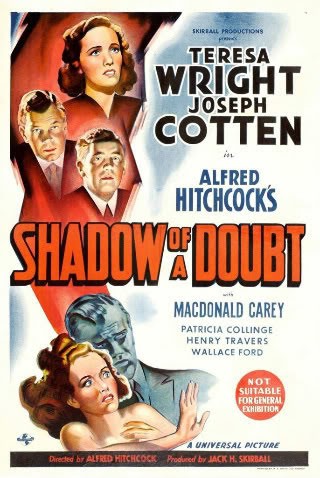
The opening is typical Hitchcock, starting with a cityscape and then zeroing in shot by shot to the window of a grotty tenement. Charlie Oakley (Joseph Cotten) is reclining on his bed, but is interrupted when his landlady comes to inform him that two strangers have been asking for him. It’s made clear that Charlie is being sought in connection with criminal activities. The exact nature of these crimes are only alluded to at first, but the viewers suspicions are allowed to build gradually until it’s finally revealed that Charlie is the killer of a series of wealthy widows – The Merry Widow Murderer. Of course, this isn’t just a standard did-he-or-didn’t-he, hunt-for-a-killer picture; the doubt of the title refers not so much to the viewers as to the villain’s family, and to his niece in particular. In order to find some respite from the relentless manhunt underway, Charlie goes to stay with his sister’s family in Santa Rosa, California. This unexpected arrival is a source of celebration for the sister and especially the niece, also called Charlie (Teresa Wright) in his honour. Young Charlie is on the cusp of adulthood, and bemoaning the fact that her family’s life has descended into a monotonous series of drab non-events. The appearance of the Uncle whom she idolises promises to inject some energy and excitement into her sleepy, small town existence. This certainly seems to be the case at first, as she parades her uncle around town like a trophy or a returning hero. Gradually though, this innocent adulation begins to be eroded by the seemingly insignificant occurrences that begin to pile up. When two detectives masquerading as reporters (Macdonald Carey and Wallace Ford) turn up Young Charlie has her suspicions confirmed. In a marvellously filmed sequence in a deserted public library, the full extent of Uncle Charlie’s crimes is revealed as his niece reads the truth in a newspaper, the camera standing in for her eyes as she has the ground yanked out from under her – the camera pulling back and away to leave her small, isolated and burdened with knowledge in this shrine to learning. The dilemma facing Young Charlie is that she cannot act upon this information without destroying her family, and especially her emotionally fragile mother (Patricia Collinge). The situation is complicated even further when she realizes that her outwardly affectionate uncle can’t afford to let her walk around knowing what she does.

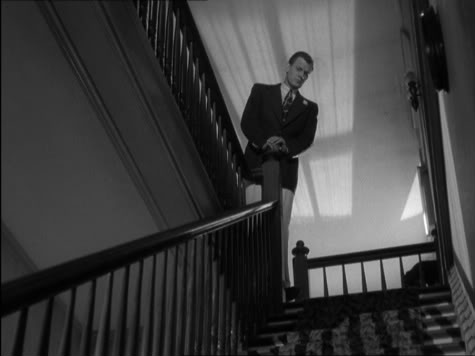
Shadow of a Doubt is commonly referred to as Hitchcock’s favourite film, and it’s easy to see why that would be the case. It’s a dark ode to Americana that’s reminiscent of Capra, an outsider’s view of an idealized world. Hitchcock’s Santa Rosa is not, as I’ve heard it suggested, the home to dark secrets but a wholesome community into which darkness steals (from it’s true origin, the urban center) before being duly expelled. Most of Hitchcock’s trademark visual style is on view, from high tracking shots to zooms and unnerving close-ups. The whole movie is chock full of memorable scenes and shots so it’s hard to pick out favourites. However, two sequences stand out for me: the first is Uncle Charlie’s arrival in Santa Rosa, the train rolling into the spotless station and pumping out a huge cloud of noxious black smoke to represent the evil it carries within; the other (less frequently mentioned) scene takes place when Uncle Charlie has just heard that the authorities have effectively cleared him. As the relieved man struts into the house and bounds up the stairs with a renewed vigour, he pauses halfway up, turns slowly, and sees the slight figure of his niece framed in the doorway below. It’s at this point that we know he’s going to kill her, he has no other alternative – it’s a subtle yet chilling moment that never fails to make the hairs on the back of my neck stand up, even after countless viewings.

Joseph Cotten had that kind of easy charm that meant he wasn’t chosen to play the heavy in too many films. He uses his natural affability to good effect here and is entirely believable as a man who seems to make friends everywhere he goes. It also makes our knowledge of his true nature all the more shocking and adds some real punch to those moments when he lets his mask slide a little. All in all, you can’t help but have a sneaking admiration for him – sure he’s evil, but his evil has such an urbane and attractive sheen that it almost wins you over. Playing against that and holding onto viewer sympathy is a big ask, but Teresa Wright pulls it off. She matures perfectly as the story progresses and the threats to her safety escalate. By the end the viewers are faced with their own dilemma, not really wanting to see harm come to either uncle or niece. The main support comes from Patricia Collinge as the vulnerable and trusting mother. It’s her trust in and deep adoration for her rotten brother that gives real substance to the film, and it’s to her credit that the part retains the requisite emotional pull without becoming cloying. Henry Travers and Hume Cronyn are cast mainly as a kind of macabre comic relief, needling each other of an evening about the best way to bump the other off. If I have any real criticism to make it relates to Macdonald Carey’s detective. It just feels like padding in a film that doesn’t require any; if his budding romance with Teresa Wright was included to strengthen the notion of her growing up then it’s unnecessary, that aspect being more than adequately covered by the meatier sections of the picture.

Universal’s UK release of Shadow of a Doubt on DVD is a very satisfactory one, showing little damage and staying sharp and clear for the most part. There’s a nice selection of extras including the trailer and galleries. Best of all is a half hour documentary on the making of the film that has contributions from Teresa Wright, Hume Cronyn and others. I won’t try and argue that this is Hitchcock’s best film, but it is a very accomplished work. It serves as a study on the loss of innocence and the darkness that lurks behind a polished facade – and it’s a highly entertaining movie.

Key Largo

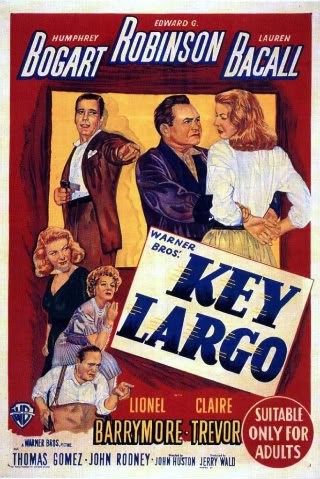
It’s hard to watch a film like Key Largo (1948) without being reminded of endings; it represented the final screen collaboration of Humphrey Bogart with both Lauren Bacall and Edward G Robinson, and it was one of the last movies he would make for Warner Brothers. Not only that, but it was also one of the last hurrahs for the old style gangster picture – but more about that later. It’s also a production that can be viewed from a number of angles: as a character driven drama, a gangster/noir mash-up, a commentary on the situation facing returning veterans, or as an allegory on fascism. Now this kind of multi-faceted approach can either lead to an unfocused piece or add to the rewatch value. I think the latter wins out here.

If the title and written prologue weren’t enough then the opening helicopter shot establishes the fact that the action takes place along the Florida Keys. As the camera zooms in on a bus making its way along the linking causeway we get our first glimpse of Frank McCloud (Bogart), a WWII veteran paying a visit to the relatives of a fallen comrade. McCloud’s destination is a hotel that, owing to the fact it’s the off-season, is virtually closed down. There is, however, one group of guests in residence when he gets there. None of these people seem especially friendly or anxious to welcome another visitor, and one of thier number, a Mr Brown, is conspicuous by remaining closed in his room. By and by, it emerges that McCloud’s companions are actually criminals, although that fact was unknown to the hotel owner, Temple (Lionel Barrymore), and his daughter-in-law Nora (Bacall). If McCloud had any suspicions, they are confirmed by the appearance of Mr Brown. Mr Brown isn’t his real name of course – he is one Johnny Rocco (Robinson), a one-time mob kingpin bent on rebuilding his criminal empire. At this point the already oppressive atmosphere grows heavier, both figuratively and literally, as an approaching hurricane threatens to tear up everything in its path. In the midst of all this, a duel develops between Rocco and McCloud – one that will finally be resolved on a motor launch bound for Cuba.

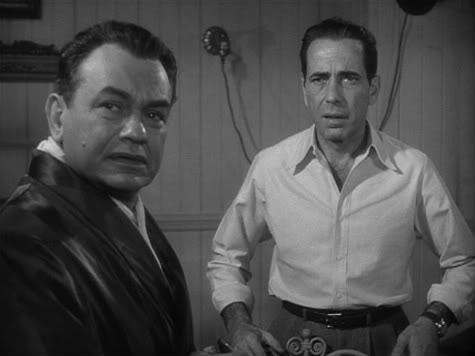
Key Largo was made at what was arguably the height of John Huston’s career, and its success is due to a combination of top class scripting (with Richard Brooks), photography, and acting. Bogart and Robinson occupy centre stage and their war of wills is what drives the whole thing forward. Eddie G’s Rocco is a devious and bullish creation, yearning for past glories that he must surely know in his heart are unattainable. Rocco and his cohorts are seen cowering before nature’s primal force and attempting to brass it out with a show of transparent bravado, pronouncing with unconvincing confidence that prohibition must surely come back and how things will be different this time. But these men are aware that they’re living out of time and it’s interesting to note that Al Capone, on whom Rocco was clearly based, was dead a year at that point. Bogart’s weary vet is one of his more complex characters, and could be compared to his Rick from Casablanca. Both men are initially reluctant to get involved or “stick their neck out” but do so eventually for the right reasons. The difference, however, is that Rick’s passivity was motivated by considerations of profitability whereas McCloud’s was the result of a deep disillusionment. That should have struck a chord with contemporary audiences: a whole generation of young men had marched off and risked their lives (and seen others lose theirs) in order to rid the world of oppression and fascism, only to return home and be confronted by a domestic version.

There are two key scenes that help define McCloud’s character. The first is a wonderfully photographed series of close-ups that show Rocco whispering suggestively into Nora’s ear (not a word is heard, but the inference is clear enough) before she spits contemptuously into his outraged face. With an unspoken dignity, McCloud moves across and quietly puts an arm around her shoulder before gently leading her away. I remember hearing Richard Brooks refer to this scene in a documentary as a moment of simple decency that everyone would like to emulate, and that’s hard to argue with. A similar situation takes place when Rocco humiliates his woman (Claire Trevor) by forcing her to sing unaccompanied as the price for the drink she craves. When he then goes back on his word, McCloud again does the right thing by pouring a whisky for the devastated woman despite the danger to himself. This is not a man who avoids confrontation due to cowardice or fear of personal injury but one who has grown apathetic and merely needs a prod to show his true colours. The aforementioned Claire Trevor deservedly won an Oscar for her role as the faded, alcoholic singer whose pride and self respect have been pushed into the background. That scene where she degrades herself in front of strangers through desperation is toe-curlingly effective and probably clinched the award for her. Lauren Bacall, in the only other significant female role, is much more subdued and is called on to do little more than gaze soulfully at Bogart. Of the four films Bogart and Bacall made together, this one is markedly different. The two Howard Hawks pictures had that director’s breezy playfulness about them, while Dark Passage was almost a study in bizarre coincidence. Key Largo has a grim, downbeat tone throughout that may surprise, or even disappoint, those hoping for a rerun of the couple’s previous work together.

Key Largo has been out on DVD for a long time now but the transfer still holds up well enough. I have the Warner UK version and the image is hard to fault, being pretty crisp all the way. I thought the dialogue levels were a little low but that’s probably just a feature of the film as there are a number of hushed conversations, and anyway Max Steiner’s atmospheric scoring doesn’t suffer. Extras are almost non-existent and are limited to the film’s trailer. The movie itself is a good example of how well Bogart and Huston worked together (it may come up wanting for those seeking out another Bogart/Bacall pairing though) and is the kind of picture that rewards multiple viewings. It gets the thumbs up from me.