Obsession

£2

Seeing as it’s really a style more than anything else, film noir has the ability to cross over and touch on many genres. Of course it’s most often associated with the crime thriller, but there are examples of noirs that are also melodramas, westerns and so on. Horror would seem a natural bedfellow, due to the nightmare quality frequently evoked by film noir, and Obsession (1949) – AKA The Hidden Room – although it’s not a full on horror picture, is what I’d definitely term a chiller.

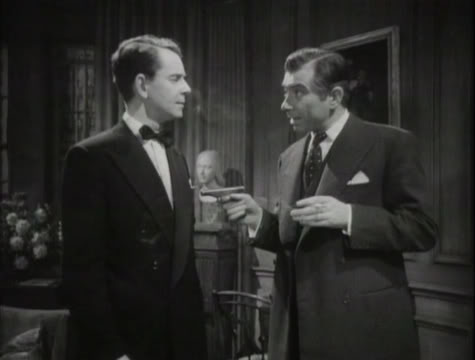
What we have is essentially a tale of jealousy and revenge plotted in the coldest and most unsettling way. Clive Riordan (Robert Newton) is a respected and successful psychiatrist with a problem in his private life – his wife Storm (Sally Gray) is a kind of serial adulteress. This cultured and rational man who spends his days attempting to cure the neuroses of others finds himself driven to the brink of tolerance and sanity by the faithless nature of his wife. On discovering Storm in a tryst with her latest admirer, an American called Kronin (Phil Brown), he calmly announces that he’s reached his limit and is going to kill the man. There are no histrionics, no outraged dignity, just that cool and grim assertion. It’s here that the story takes a detour into the macabre though. Instead of merely shooting Kronin on the spot, Riordan tells him that they’re first going to take a walk. This is only the beginning of Riordan’s plan and serves to leave his wife uncertain as to the fate of her lover, thus guaranteeing that she should suffer as much mental torment as he can muster. Kronin is kept chained up for months on end in a secret location for two reasons – firstly to allow Riordan to produce him unharmed should there be any chance that the police get on his trail, and secondly to ensure that he has ample time to prepare for the grisly disposal of the body when he finally gets round to doing the deed. The really chilling element is not only Riordan’s detached and matter of fact demeanour, but also the fact that he visits Kronin daily to feed him, ask after his well-being, and assure him of the absolute certainty of his imminent demise. Kronin starts off jaunty and confident but, bit by bit, that cockiness is eroded by his confinement, and his desperation grows as his hopes for salvation recede. All the while, Riordan is engaged in a game of cat and mouse with a deceptively bland Scotland Yard detective (Naunton Wayne) who may or may not be onto him.

£3

Obsession was made in England at a time when Hollywood was a place best avoided for someone like Edward Dmytryk; he could, for a time, put his HUAC troubles behind him and concentrate on making movies. He managed to bring a true noir sense to the film, although it has to be said that the ending is a little too upbeat and drains some of its power. Still, Dmytryk creates an atmosphere of dread and despair by concentrating much of the action in the decrepit cellar where Riordan keeps his rival captive. There aren’t that many outdoor scenes but what we do see of the bombed out city adds to the sense that Kronin is just marking time in a dead landscape. While Robert Newton tends to be remembered for his larger than life portrayals he’s admirably restrained here. The cool and collected facade that he presents is far more effective and frightening than any amount of grand guignol eye rolling. He seems to have every detail worked out and every eventuality covered, so much so that it’s impossible not to share in the desperation of his victim. Even so, there’s a temptation to sympathise a little with him too as his wife is a frankly unpleasant piece of work. Sally Gray invested her character with enough condescension and haughtiness to paper over a fairly wooden performance but, as I don’t think the intention was to have the audience side with her anyway, it works out reasonably well. Phil Brown was fine as the hapless lover taking the fall for his indiscretion, his gradual transformation from a kind of carefree playboy to a man counting down the hours to his death is convincingly done. He’s the one character in the whole set up that you really feel for and it’s hard not to think that he’s been incredibly unfortunate to stumble into such a nightmare. Naunton Wayne doesn’t show up until about the half way mark but he adds a lot to the film. He was excellent at putting over that quality of vagueness that you know is really only a blind to lower the defences of his quarry.

The only DVD of Obsession that I’m aware of is the UK release from Fremantle. The image is passable, there are the nicks, scratches and cue blips that you’d expect from an unrestored print, but the fact that it doesn’t seem to be a progressive transfer is more problematic. On the positive side, it’s fairly sharp and crisp and it’s certainly watchable. There are also cast and crew bios included in text form to round out the package. The film is a good example of British noir, from a director with an excellent pedigree, that is genuinely creepy. You could argue that the pay off isn’t as dark as the build up seems to demand, but it’s still a classy and suspenseful picture. I recommend it.

The Spiral Staircase

There are certain settings that immediately draw me to films, trains usually work work for me as do stories taking place in old, dark houses hiding even darker secrets. By happy coincidence, The Spiral Staircase (1945) derives from the pen of Ethel Lina White who also provided the source material for probably the finest example of a movie set aboard a train – The Lady Vanishes. I guess there’s something tremendously reassuring about watching a cast of characters in mortal danger in a spooky old mansion, lashed by fierce storms, for it’s a formula that’s been used again and again down through the years. The Spiral Staircase works very well as a gothic noir melodrama that’s strong on atmosphere. If it’s approached as a whodunit the effect is lessened considerably – the identity of the killer is pretty obvious right away – but I don’t believe it was ever conceived as such anyway.

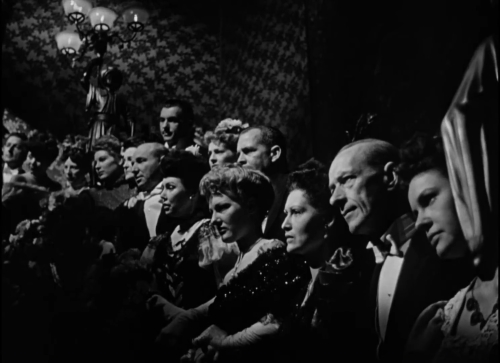
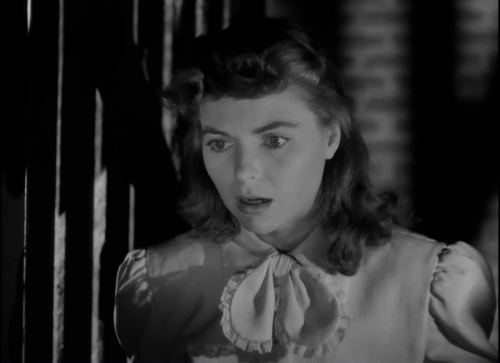
Events unfold at some unspecified time in the early years of the 20th century in a small American town. A serial killer is busy in this close community, specialising in the dispatch of young women displaying some physical defect or imperfection. The film opens with one of these murders, a girl with a pronounced limp is done in while downstairs a crowd of townspeople sit in rapt attention at the screening of a silent movie. Among the audience is Helen (Dorothy McGuire), housemaid for a local well-to-do family. Helen’s enjoyment of the silent picture is maybe heightened by the fact that she herself lives in a world of silence – we later learn that Helen is a mute as a result of a childhood trauma. It doesn’t require any great leap of deductive reasoning to see that Helen is likely to feature highly on the killer’s list of potential victims. Indeed, shortly after arriving back at her employers’ creaking old mansion just as a storm of near biblical proportions is breaking that fact is confirmed. As Helen pauses on the landing to check her appearance in the mirror the camera zooms in on the eye of the killer as he watches her secretly. This provides one of the film’s creepiest moments as we see the girl from the deranged perspective of the murderer, her face reflected back from the mirror without a mouth. As I said, the identity of the villain is fairly easy to spot when we’ve been introduced to the various occupants of the house. The owner is a bed-ridden old battle-axe, Mrs Warren (Ethel Barrymore), who shares her home with her two sons (George Brent & Gordon Oliver) – the former a serious minded academic, the latter a wastrel playboy with a roving eye. The rest of the household is made up of a motley collection of servants, although the spectre of Mrs Warren’s late husband hangs heavily over them all. It’s this unseen figure who actually provides the motive for the villain’s urges and forms the basis for the cod psychological explanation that’s practically obligatory in thrillers of this period. The story plays out in fairly standard form, with the heroine’s danger and isolation increasing incrementally as the subsidiary characters are lured away or disposed of one by one. Still and all, the whole thing is done with considerable style, the suspense and atmosphere building steadily towards a satisfying conclusion.

As far as the acting is concerned, The Spiral Staircase really belongs to the female cast – George Brent, Gordon Oliver and Kent Smith are all passable enough without being especially memorable – and Dorothy McGuire was excellent in conveying mounting fear and paranoia with nothing but facial expression and gestures at her disposal. Both Ethel Barrymore and Elsa Lanchester were inveterate scene stealers and never miss a trick when they’re on screen. Barrymore does tend to slice the ham a little thick on occasion but her scenes are immensely watchable and her verbal jousting with Sara Allgood, as her put upon nurse, is a pleasure in itself. Having said all that, the real star of the show is director Robert Siodmak who moves his camera around the elaborate sets with fluidity and makes optimum use of light and shadow. The climax, taking place largely on the rear staircase, constitutes a virtual checklist of noir motifs, from high and low angle shots through to the shadows of railings creating bars to pin the protagonists helplessly in place.

The UK DVD of The Spiral Staircase from Prism treats the film quite well. There’s good contrast and the image is reasonably clean and sharp with no damage to speak of. There’s a gallery included as well as text bios for members of the cast and crew. To me the movie represents an exercise in how to maintain suspense and atmosphere from a slightly predictable story. The combination of pleasing performances and Siodmak’s assured and professional direction adds up to a very enjoyable movie – it may not hold too many surprises but there’s a lot of fun to be had along the way.

The Man Who Watched Trains Go By

£3

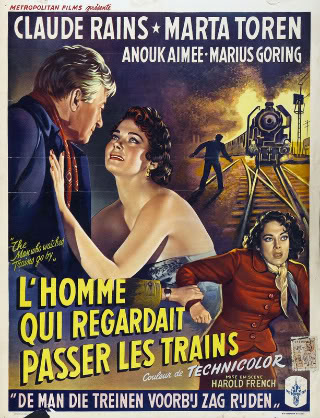
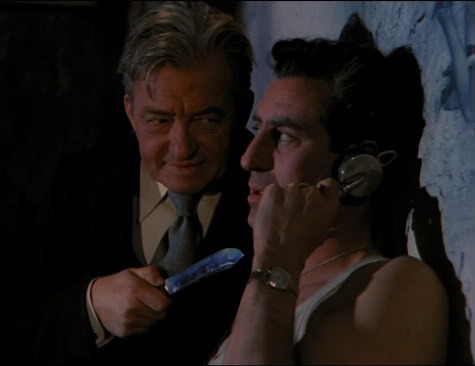
The Man Who Watched Trains Go By (1952) is a film that I’d imagine few people are aware of. Apart from the fact that it’s not well known, those who have seen it tend to be ill-disposed towards it. I think part of the problem is that the tone seems to change abruptly about half way through and that can have a jarring effect on the viewer. It is, of course, a film that has faults and it’s far from perfect, but I’m quite fond of it for all that. Despite being shot in colour, and not appearing in any listings that I’ve seen, I would categorise this as film noir, checking almost every one of the required boxes as it goes along.

Kees Popinga (Claude Rains) is a chief clerk for an old established Dutch firm, both the man and his employers appearing to be veritable monuments to respectability, integrity and honesty. Popinga is close to the epitome of middle-class values and circumspection, moving exclusively between his family and the workplace he’s dedicated his life to – in fact, he’s even gone so far as to invest all his savings in the company. However, Popinga is man who’s not really taken seriously, at least not as seriously as he takes himself, and cuts a vaguely comic figure cycling to work in his winged collars and homburg, pausing only to clock the passing of trains on their way to Amsterdam or Paris and romance. This is a man for whom accuracy and order are paramount, although even his children snicker secretly behind his back at his fastidious nature. Popinga’s employer, De Koster (Herbert Lom), is another paragon, albeit a more inflexible one for he dismisses out of hand the idea of hiring a man whose former company went bankrupt lest any whiff of scandal should attach itself to him. Of course two such pillars of moral rectitude cannot possibly exist without a few fault lines being present.

The first crack appears when a visiting Paris policeman, Lucas (Marius Goring), asks to view the company’s books as part of an investigation into a currency racket. From this point on Popinga’s strictly ordered life begins to unravel, though not because of any impropriety on his part yet. He first happens to see De Koster in a compromising position with a woman that Lucas asks about, and then later finds his boss burning all the company records. It turns out that De Koster has run the company into the ground to finance his affair, and the time has now come to cut and run. For Popinga, this is the ultimate betrayal; he’s given eighteen years of devoted service to De Koster and sacrificed his dreams in the process. When he sees this man whom he’s looked up to exposed as no more than a weak-willed embezzler who has ruined him, something snaps inside him. A minor scuffle sees De Koster dead, and Popinga in possession of a case of stolen money. Having repressed his desires for so long, Popinga now gives full rein to them. He catches the express to Paris with every intention of living the life he let slip away from him. However, he’s lived so long in his safe and proper world that he’s ill-prepared for the dangers that await and, as the Parisian sharks begin to circle around the little Dutchman, Lucas is now faced with a race against time to catch him and haul him back before it’s too late.

£2

Harold French isn’t a name that would be familiar to many, and I’ll have to say I’ve only seen a mere handful of his films myself. His direction of The Man Who Watched Trains Go By is fairly standard stuff, unremarkable but competent. There is a nice build up of suspense in the first half of the film, and a fine scene aboard the Paris train where Claude Rains and Marius Goring engage in some verbal fencing while playing a game of chess on top of the case of stolen money. The second half, the action having moved to Paris, is weaker due to the melodramatic turn of events but it remains gripping all the same.

Claude Rains really throws himself into the part of Popinga and creates a tragic figure who is both slightly ridiculous and sympathetic. He could be criticised for going over the top at times but then again he was playing a man whose whole world was brought down around him, whose very existence was rendered absurd by the criminal actions of his employer. Since the character of Popinga loses his equilibrium, becoming unhinged and irrational, it’s hard to see how Rains could have done much else with the role. Marius Goring is there as the counter to this descent into madness, making the calm and collected Lucas into a kind of guardian angel for the tortured Popinga. Marta Toren had a plum role as the archetypal femme fatale, displaying bucket-loads of seductiveness, insolence and dangerous contempt. Her manipulation of De Koster, Popinga and all the doomed men around her keep this firmly in noir territory. The support cast all do a fine job and include (among others) Herbert Lom, Ferdy Mayne, Eric Pohlmann and a very young Anouk Aimee.

The Man Who Watched Trains Go By has been released on DVD in the UK by Metrodome. It’s a pretty good 1.33:1 full frame transfer that has excellent colour. There is a little softness here and there but no notable damage. The disc itself is totally barebones, perhaps unsurprising given the obscurity of the movie. Otto Heller’s glorious technicolor photography might lead some to question the noir credentials of this movie but pretty much everything else about it remains relentlessly dark. The theme of fate causing the downfall of an unsuspecting man, the presence of a bona fide femme fatale and the bleak ending are all factors that nudge it towards film noir for me anyway. I haven’t seen many positive reviews of this film (in fact I haven’t seen many reviews of it at all) and I think that’s a bit unfair. It’s by no means a classic but it’s no turkey either. If nothing else it’s worth a rental (actually it can be bought pretty cheap too), and it may even prove to be more entertaining than expected.

The Dark Mirror

poster175

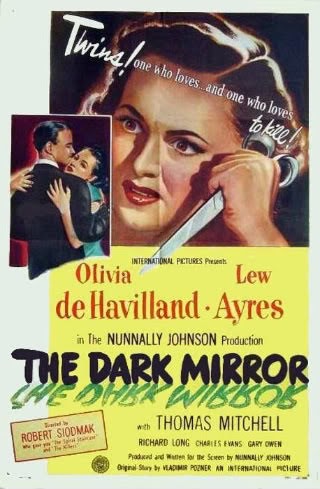
The 1940s saw a run of movies that attempted to cash in on the craze for psychoanalysis. Probably the most prominent among these was Hitchcock’s Spellbound, but there was no shortage of imitators (there was even an entire series based on this premise, namely Columbia’s Crime Doctor pictures starring Warner Baxter). Generally, such films used large dollops of cod Freudian psycho-babble to simultaneously jazz up and lend a touch of gravitas to the plot. Robert Siodmak’s The Dark Mirror (1946) is one of the more successful efforts, helped largely by an outstanding central performance from Olivia de Havilland.

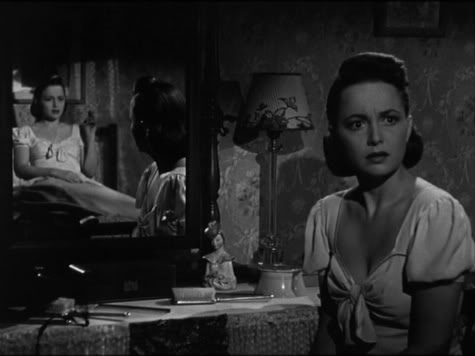
The Dark Mirror is basically a murder mystery that uses the gimmick of having a crime committed by one of a pair of identical twins – the problem for the authorities (and the audience) is working out which one did the deed, and how to prove it. The opening shot is of the apartment of the victim with the corpse lying sprawled before a symbolically broken mirror. At first the case seems clear cut as the detective in charge, Lt. Stevenson (Thomas Mitchell), has witnesses that can easily identify the woman seen leaving the scene of the crime. Well, we’d be looking at a pretty short movie if that’s all there were to it. The problem is that the woman in question is either Terry or Ruth Collins (Olivia de Havilland), one of whom has a cast iron alibi for the evening – but which one? With the official investigation grinding to a halt due to the impossibility of the circumstances, Stevenson turns to analyst Dr. Elliott (Lew Ayres) for help. Elliott agrees to undertake a private examination of the twins to try and discover which one has the psychological profile consistent with a murderess. In so doing he utilizes all the recognisable tools of the trade from ink blots and free association through to a polygraph. Although he satisfies himself as to which sister is the most likely culprit, the proof remains stubbornly elusive. What complicates the situation even further is the fact that Elliott finds himself becoming increasingly attracted to the “good” sister while the other jealously works behind the scenes to undermine her sibling’s sanity.

£5

From a purely technical point of view the illusion of having the same actress playing scenes in a dual role works extremely well. One scene in particular called for one of the twins to sit next to the other and rest her head on her sister’s shoulder, and it’s a compliment to the film’s level of technical accomplishment that this effect is carried off so believably. Personally, I was really only aware that I was watching process work in one slightly ropey shot late in the movie where one sister addressed the other, who was positioned behind her, via an artificial looking mirror setup. Aside from this, Siodmak’s direction is assured throughout, and he wraps the whole thing up in a tight and pacy 82 minutes (PAL). As I said at the beginning, Olivia de Havilland’s performance is one of this film’s great strengths. It’s no mean feat to play twins with markedly different characters and remain convincing, but she managed it with aplomb. Thomas Mitchell’s cop is there to help ground the story for the viewer, and he plays his part well enough – if I have any criticism it’s that he imbued it with a little too much lightheartedness. Lew Ayres, on the other hand, was the weak link for me, never completely selling me on the idea that he was an eminent psychiatrist.

Working out where the rights to a film lie can sometimes be akin to blundering one’s way through a minefield. This was originally an International picture, later to be combined into Universal International, but the R1 home video rights don’t seem to belong to Universal now. A few years ago, when the rights to the Republic library reverted back to Paramount from Artisan they announced this title (along with a few others complete with artwork) for release on R1 DVD. However, Paramount then promptly licensed the library to Lions Gate and those titles disappeared off the schedule. Bearing all that in mind, I’d imagine the chances of The Dark Mirror making an appearance on DVD in R1 are slim to non-existent at the moment. However, the film did get a release in Germany late last year via Koch Media (I think there’s also a French disc out there, but something tells me it suffers from the dreaded burnt in subtitles) and it’s a very attractive disc. It comes in a book style digipack with a booklet – 10 pages, but all in German – and boasts a nice transfer. The image is generally very strong and sharp, although there are a few instances of weakness and heavier grain. All told, it’s a pleasing disc of a hard to find movie. Slowly, more and more of Robert Siodmak’s noir films are making their way onto DVD and I found this latest addition very welcome. I’d place it somewhere in the mid-range of the director’s work, which should be recommendation enough in itself.


Christmas Holiday

poster156

Following on from my previous post I’ve decided to have a look at another seasonal noir. Christmas Holiday (1944) is a movie that seems to slip under many people’s radar, and that may be partly down to both the title and the casting which are apt to give a false impression. At first glance, this is a film that might appear to be horribly miscast but the fact is it works very well. Having said that, the production remains a little odd, but I can’t quite put my finger on the reason. Like Lady in the Lake, the  story unfolds over Christmas but, once again, that’s really nothing more than an incidental detail – the timing could easily be changed without affecting the plot in the least.

On Christmas Eve, a newly commissioned army officer, Lt. Mason (Dean Harens), is preparing to fly to San Francisco to marry his sweetheart. However, just before he leaves, he receives a cable informing him that the deal’s off and she’s married someone else. Regardless, he decides to board his flight anyway but neither he nor the audience can be quite sure what he hopes to achieve. As it happens he never makes it to his destination, bad weather forcing his plane to make an unscheduled stop in New Orleans. He allows himself to be talked into visiting an out of town club (basically a bordello, but you couldn’t come right out and call it that under the production code) by the establishment’s PR man/pimp. It’s here that Mason meets Jackie Lamont (Deanna Durbin) and later hears her story. The character of Mason doesn’t really serve any purpose other than that of a narrative device – he’s simply there to provide an everyman perspective, the eyes and ears of the audience as a tale of deception, murder and obsession unfolds. Jackie explains that she’s been using an assumed name, her real one being Abigail Manette, since her husband’s conviction for murder. Via two separate flashbacks she relates how she met, fell in love with and married Robert Manette (Gene Kelly). Manette turned out to be a wastrel blueblood, fallen on hard times, with unsavoury characteristics that are mentioned only in the vaguest terms. This is all pretty standard fare for a noir thriller, but it’s the creepy relationship between Manette and his mother (the Spiderwoman herself, Gale Sondergaard) and the stifling home atmosphere that sets this movie apart. I’ve come across a few theories which try to explain exactly what’s “wrong” with Manette and the nature of his relationship with his mother, but I’m not entirely convinced by any of them. The script makes it clear enough that this is a man with a deeply flawed character but that’s about it. However, I haven’t read the Somerset Maugham story on which the film is based so I don’t know if that casts any further light on the subject.

£4

Deanna Durbin is credited with being the saviour of Universal as a result of the popularity of her lightweight musicals in the 40s but Christmas Holiday was a major departure from the usual formula for her. She does get to sing two songs, in her role as night club “hostess”, but this is a straight dramatic role. I thought she performed very well, and managed to handle the necessary transition from wide eyed innocent to world weary fallen woman quite convincingly. Gene Kelly is another performer not normally associated with dark, dubious characters but his Robert Manette is not at all bad. Seeing this jaunty, amiable figure jarringly transformed into a mother-fixated murderer has an unnerving quality that’s highly effective. Gale Sondergaard always brought an eerie, otherworldly feel to the parts she played and it fits right in here. The middle section of the film, told in flashback, takes place mainly in the confines of the Manette house, where Sondergaard seems completely at home amid the relics of a faded past. It’s this part of the movie that lends the slightly odd sense that I alluded to at the beginning. Maybe it’s the curious family dynamic, or the feeling of stepping into a world removed from the present – I honestly can’t say, but everything just feels a little off-centre in these sequences. This was Robert Siodmak’s second Hollywood noir, following on from Phantom Lady. It’s not quite up to the standard of his previous picture and lacks a little of the visual flair that he usually brought to the table. However, he does some good work in the club scenes, and the unusual architecture of the Manette house offers opportunities for some interesting shots.

As far as I know the only DVD of Christmas Holiday is the UK R2 from DDHE (EDIT – it appears there’s a Spanish release also available – see comment #1 below). It offers a pretty good transfer of the movie with no major damage or distraction on view. The only extra feature provided is a gallery of production stills. All in all, this a satisfying little noir that moves along nicely and has good performances from all the main players. For me, the casting of Kelly and Durbin worked, although I can see how it might lead to the film being ignored by some – fans of the two leads may be alienated by the atypical roles and storyline, and noir lovers may be put off by their presence. Nevertheless, I think the movie has a unique quality and is definitely worth a look.

With the Christmas juggernaut bearing down ominously, I doubt if I’ll find the time to post another piece before the holidays. So, I’d just like to take the opportunity to wish all those who have followed, commented on, or simply dropped by this blog from time to time the best of everything over the holiday period. Here’s hoping you all enjoy a happy and peaceful Christmas.


Lady in the Lake

poster171

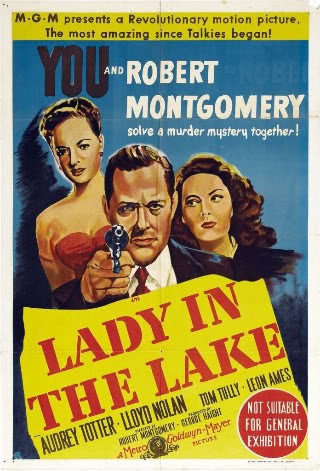
With Christmas fast approaching I thought I’d turn my attention to something which, if not exactly festive in content, is at least set around the holiday season. The hardboiled fiction of Raymond Chandler has been well represented on film down through the years, and after the commercial success of Murder My Sweet and The Big Sleep it was the turn of Lady in the Lake (1947). Unfortunately, this ended up being something of a gimmick picture as a result of the decision to shoot it entirely from a first person point of view, where the camera becomes the eyes of the protagonist. While it was an interesting experiment it does tend to become quite taxing after a time and it’s actually one of the biggest weaknesses of this film.

The first shot of the movie has Phillip Marlowe (Robert Montgomery) sitting in his office addressing the audience directly and explaining that, what with the private eye business being so tough and unrewarding, he’s decided to throw it all in and write crime stories instead. After establishing this slightly odd premise he proceeds to tell us, in flashback and from the aforementioned first person perspective, the details of the story. An appointment to see a publishing executive, Adrienne Fromsett (Audrey Totter), turns out to be something entirely different. Miss Fromsett only set up the meeting as a blind, an excuse to see Marlowe with the aim of hiring him to track down her employer’s runaway wife. Despite his initial reluctance to become involved in what he suspects is a fool’s errand, Marlowe finds himself drawn into the mystery surrounding the missing lady and the numerous shady characters that flit in and out of the tale. In the process, he falls foul of a local detective, DeGarmot (Lloyd Nolan), who’s every bit as tough and insolent as our hero. DeGarmot takes an almost instant dislike to Marlowe and even goes out of his way to have him framed on a drunk driving charge. In fact, that forms one of the best and most effective sequences in the movie – the point of view filming and haunting choral score working perfectly as Marlowe’s car is first pursued and then ruthlessly forced off the road. Then, as Marlowe slowly and painfully drags his battered body across the deserted road in an attempt to reach a phone box, the benefits of this unusual technique are most apparent. Going into the plot in more detail at this stage would be futile (and anyone familiar with Chandler’s work will know just how twisty, complex and downright confusing it can become) – suffice to say that by the end all the loose ends are pretty much tied up, and we get a happy ending that feels contrived and generally unsatisfactory.

As I said at the beginning, the filming method employed by star/director Robert Montgomery is one that loses its charm fast. It’s the kind of thing that works great in small doses, but not when it’s drawn out for the full duration of a movie. The same technique was used by Delmer Daves at the start of Dark Passage, but he wisely knew when to let it go and revert to more traditional cinematography. The simple truth is it doesn’t feel natural, and it ultimately has the effect of drawing you out of the picture – and that surely wasn’t the director’s aim. That’s one of the problems. The other is the performance of Montgomery in the lead role. Chandler envisioned Marlowe as a knight errant, a bruised and imperfect figure to guide us through a corrupt, violent noirish landscape. Most of the other interpretations of the character have given us a Marlowe who’s tough, honourable and smart enough to get away with the casual insolence he displays. Montgomery’s version, however, comes across as mean, callous and a little too dumb. Audrey Totter was always at home in noir parts and she doesn’t disappoint here – although her Adrienne Fromsett does veer from the grasping, mercenary vamp to the loyal girl friday type in a disconcertingly short space of time. For me though, the best performance comes from Lloyd Nolan, a criminally underrated actor. He never got to play the lead in A pictures but always lent solid and often memorable support. I think it would be fair to say that his presence in a movie always raised the quality and added a touch of realism.

Lady in the Lake is only available on DVD as part of Warner’s Film Noir Classics Volume 3. The transfer is reasonable but it’s dirty and there are damage marks, cue blips and the like that speak of no restoration being done. As for extras, we get the trailer and a commentary from authors Alain Silver and James Ursini. All in all, Lady in the Lake has to rate as one of the weaker outings for Phillip Marlowe. While it does have its moments it is a definite step down from both The Big Sleep and Murder My Sweet, so expectations need to be adjusted accordingly. The first time I saw this I found the filming style to be a major distraction, and frankly a pain. However, on subsequent viewings I would say it’s probably just mildly irritating now – but still annoying enough to hurt the film.


The Glass Key

poster130

The Glass Key (1942), from Dashiell Hammett’s novel, is a remake of of a 1935 picture. I have no idea how it compares since I’ve never seen the original, but this later movie does feature the trump card pairing of Alan Ladd and Veronica Lake in their second outing together. It came out hot on the heels of This Gun for Hire and cemented the screen partnership of the two leads.

Typical of its hardboiled, pulp source, the plot is a twisty and complex one with myriad interlocking strands. At its core, however, is the relationship between political kingmaker Paul Madvig (Brian Donlevy) and his assistant/minder Ed Beaumont (Alan Ladd). Madvig is one of those old-school, two-fisted ward bosses who’s made good and risen to a position of considerable influence. Beaumont hails from a similar background, although he displays a good deal more polish than his employer – or at least he’s learned the art of concealing his rough edges a little better. Madvig’s in the process of running a campaign to secure the election of a prominent blue blood, and simultaneously working his socks off to woo the the same gentleman’s daughter, Janet (Veronica Lake) – she’s got the hots for Beaumont though. However, this upper crust family has enough skeletons rattling around in the closet to fill up a good sized cemetery, not the least of which is a wastrel son who’s heavily in debt to the local mob. Now, this young man also happens to have a thing going on with Madvig’s kid sister (getting confused yet?), so when he turns up dead it’s no surprise who the finger of suspicion points to. To make matters worse, Madvig seems either unwilling or unable to do anything to clear himself. So, it falls to Beaumont to try and straighten out the tangled mess and get at the truth. Along the way the film casts a jaundiced eye over the inherently rotten nature of politics and those involved in it. It’s this examination of the filthy underbelly of outwardly respectable institutions and their corrupting influence, rather than the love triangle or the murder mystery, that mark The Glass Key out as film noir. The film also has a brutal edge that lends it a degree of authenticity – the savage and sustained beating handed out to Beaumont by the mob is genuinely uncomfortable to watch, and its aftermath is a tribute to the skill and creativity of the make-up department.

Maybe it’s just my impression, but Alan Ladd never seems to get the respect he deserves as an actor. There was nothing showy about him and it’s possible that his quiet restraint has been mistaken for a lack of ability. For me, it works very well though – especially in a role like that of Ed Beaumont. Ladd displays just the required degree of toughness when necessary and eases comfortably into a more relaxed mode in his scenes with Veronica Lake. It has to be said that Miss Lake was far from being the most expressive of actresses but this actually works to her advantage here. Her less than mobile features add the quality of ambiguity to her character that the script demands, and accentuate the arrogant condescension she feels for Madvig. Brian Donlevy was an excellent choice as the strutting, cocksure politico. He had the kind of natural dynamism that breathes life into the character of Madvig, and he was also capable of tapping into a sense of pathos that allows you to feel real sympathy for him in those moments when we see clearly the tolerant contempt with which he’s viewed by the supposedly respectable Henry family. Nevertheless, as was the case with the later The Blue Dahlia, William Bendix nearly steals the whole picture from beneath the noses of the principals. There’s a disconcerting whiff of the comedic about this menacing mob heavy; a bit like a psychotic teddy bear come to life. He comes across as one seriously sick puppy who positively relishes the hammering he metes out to Ladd and longs for an opportunity to do so again. Stuart Heisler’s direction is competent without ever being especially memorable but he has a good sense of pace and packs a lot of complicated plot into a fairly brisk running time. As with most hardboiled adaptations there’s plenty of snappy dialogue on show, and listening to some of the throwaway lines is half the pleasure. In the midst of pounding Alan Ladd into a nearly unrecognisable pulp, William Bendix and Eddie Marr break off to chow down on some steaks and the latter comments that: “My first wife was a second cook in a third rate joint on Fourth Street.”

The Glass Key came out on R2 DVD in the UK a few years ago from Universal. It’s a fairly typical Universal UK transfer in that it was just slapped on disc as is. There aren’t any major issues with the print save for the fact that it’s pretty grubby. Anyway, it is available and it’s cheap. For some unfathomable reason this film has never been given a release in R1 despite frequent requests from fans and, considering recent developments concerning Universal’s “vault” programme, it’s anybody’s guess what will happen now. The film itself remains a very enjoyable slice of early noir and should probably be regarded as an essential title. It doesn’t match up to that other famous Hammett adaptation, The Maltese Falcon, in terms of style or overall sourness but there’s still much to admire. As an aside, I couldn’t help noticing that the central relationship between Madvig and Beaumont (and their apparent falling out over a woman) bore more than a passing resemblance to that of Tom and Leo in the Coen Brothers’ great gangster/noir Miller’s Crossing.

Inferno

£9

A little suffering is good for the soul – that would appear to be the message of Inferno (1953). It’s a classic tale of man against nature with a liberal sprinkling of deceit, infidelity and murder thrown in for good measure. The movie is generally regarded as a film noir and I suppose that’s fair enough given its themes, although the visuals (technicolor and wide open spaces) suggest it should be the antithesis of that style.

The opening pitches you right into the middle of the plot with no time wasted on backstory or build-up. Within a few minutes the viewer knows exactly what’s going on and what led up to it. A man has broken his leg out in the desert and his wife and her lover have decided to abandon him and let nature take its course. The unfortunate victim is one Don Carson (Robert Ryan), a hard drinking businessman with plenty of money but few friends. Carson has gone out to a remote part of the desert in the company of his faithless wife Gerry (Rhonda Fleming) and a mining engineer, Duncan (William Lundigan), to scout for manganese deposits. When an accident presents Gerry and Duncan with a heaven sent opportunity to rid themselves of Carson they grab it with both hands. All they need do is manipulate the evidence and cook up a story about Carson going off on an alcoholic bender to be home free. However, the scheming  lovers underestimate their victim and his resourcefulness – Carson may have led a pampered life of privilege but he has a powerful will to live and an instinct for survival. The film twists and turns its way to the conclusion and, as it does so, the character of Carson moves smoothly from being initially an unsympathetic boor to a man the viewer can both admire and root for. The best scenes in the movie have Carson battling against the merciless desert, with nothing but his thoughts to keep him company. There’s also some clever cutting to point up the contrasting fortunes of the protagonists: while the hero grows desperate for water there’s a sudden jump to a shot of Duncan diving into a crystal clear pool; and when Carson finds himself on the verge of starvation the next scene has his wife delicately carving a roast back at the LA mansion.

Inferno saw Robert Ryan near the top of his game in a career that had more than its fair share of highs. He spends the bulk of his screen time alone in the vast wilderness, crawling and dragging his broken body over the unforgiving terrain. There’s no one else present to play off and that fact makes it even more remarkable that he managed to develop his character into a fully rounded human being that we actually care about. He starts out as a spoiled, sullen drunk petulantly taking pot shots at a discarded whisky bottle, but by the end of the picture his trials and torments have transformed him into a man of character and humility. Rhonda Fleming was well cast as the devious Gerry, brimming with a kind of loathsome sexiness. She is the typically heartless femme fatale with a perverse sense of morality, who doesn’t bat an eye at the thought of leaving a man to a slow, aching death but baulks at the idea of shooting him. William Lundigan was a fairly bland actor but a capable enough one for all that. Although Inferno would be one of his last major roles before moving into television he does a reasonable job with a basically one dimensional character. Director Roy Ward Baker made a handful of movies in Hollywood in the early 50s before moving back to Britain. Inferno was the last of them and it wasn’t a bad one to finish on. He makes wonderful use of the desert locations to emphasise the harshness of the environment and the lonely struggle of the hero. Of course it doesn’t hurt to have a cameraman of the calibre of Lucien Ballard on hand, and the two of them managed to turn out a film that’s tense, uplifting and visually arresting. This movie was originally shot in 3D, a process that sometimes led to gimmicky effects shots, but it never really intrudes too much here – though a lantern is fired directly at the camera during the climax.

A while back, when Fox was still in the business of issuing DVDs, it was rumoured that Inferno was due a release in the US, possibly as part of the noir line but nothing ever came of it. However, it has been given a release in R2 in Spain by a company called Impulso. They have licensed a number of titles and market them as Fox Cinema Classics. The transfer for Inferno is a generally pleasing one. Viewed on a 37 inch screen I thought it looked fine for the most part – the image is mostly smooth and sharp but there are instances of heavy grain (especially during the titles). The colour is quite strong but it can take on a slight pinkish hue at times. The disc itself is pretty basic with the only extra of note being a gallery. All told, I was satisfied with this one and it is the only way to get your hands on this title at the time of writing. Inferno is a tight, pacy little movie that clocks in at 80 minutes and rarely stops to take a breath. I’d rate it highly as a noirish thriller in an unusual setting, boasting classy performances and excellent visuals.

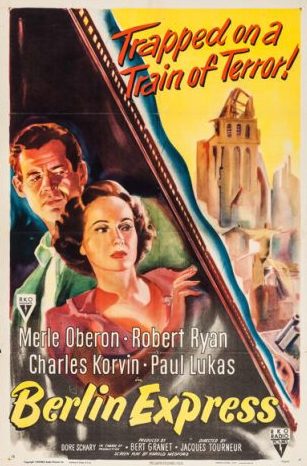
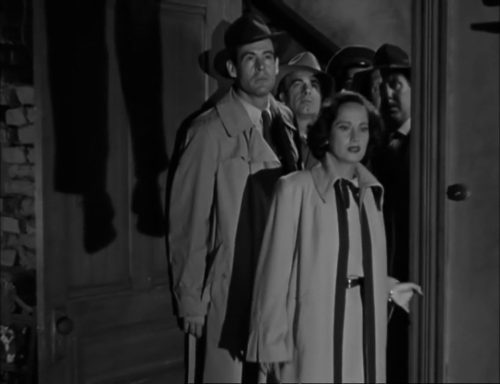
Berlin Express

Post-war Europe was an excellent setting for a noir picture – the bombed out ruins and a displaced, despairing population provided a near perfect backdrop for such films. Jacques Tourneur’s Berlin Express (1948) is a mix of spy story, noir and propaganda piece. That latter element is the one thing that knocks it down a peg and damages its noir credentials slightly; those repeated attempts to inject a kind of brave new world optimism into what should be a fatalistic film really work against it in the end.

The movie opens in the documentary style that was popular at the time, complete with the “voice of God” narration to set the scene and introduce the main players. Normally, I’m not averse to a good voiceover but the somewhat strident, Mark Hellinger-style commentary employed here does start to grate pretty fast. Fortunately, it doesn’t dominate things for too long and, once it’s been established that we’re following a group of international travellers on the military express bound for Berlin, regular cinema storytelling techniques kick in. Robert Lindley (Robert Ryan) is an American agriculturalist on his way to take up a position with the occupying forces, and the plot unfolds through his eyes. His companions are an Englishman, a Frenchman and a Russian – representing the four powers. Apart from military personnel, there are also a number of German nationals on board – one of whom is in mortal danger. The gentleman in question is a diplomat with a noble plan for peaceful coexistence in Europe. When a makeshift bomb kills his decoy, his identity is revealed to the audience but the danger remains. No sooner has the train deposited its passengers in the ruins of Berlin than the eminent diplomat is abducted. So, the four just men, bowing to pressure from the captive’s secretary (Merle Oberon), take on the role of amateur sleuths and the chase is on. Their hunt leads them through the rubble and backstreet dives of the fallen capital, and leads the audience into the best segment of the movie. This is a twilight world, full of people driven to the very brink – scrambling for discarded cigarette butts, scanning the ever present lists of missing persons, and hanging around stations pathetically trying to hawk their meagre possessions. As Lindley and his companions grope their way through this decaying world the speechmaking and in-your-face social comment is mercifully kept to a minimum, letting the visuals make the point much more eloquently.

Robert Ryan plays a role here that is very much that of the everyman bumbling his way into a situation that is over his head. His craggy careworn features were well utilized over the years in countless noirs and westerns, and I always regard his presence in any film as a big recommendation. Merle Oberon, on the other hand was an actress that I could take or leave. Having said that, she does well enough as the French secretary determined to track down her kidnapped boss. For me though, the real stars of the movie were director Tourneur and cameraman Lucien Ballard. Together they manage to turn a middling spy story into a visual treat. The location work helps enormously of course, but there’s no end to the interesting angles and memorable shots served up – low angles, overheads, reflections etc. Tourneur also handles the various set pieces beautifully; from the cabaret scene (reminiscent of the Mr. Memory sequence in Hitchcock’s Thirty-Nine Steps) and the confrontation in the abandoned brewery, to the tense climax aboard the train once more. Only the happy ever after coda rings false, hindsight allowing us to see that forty years of conflict and subterfuge would be the order of the day rather than the spirit of cheerful comradeship and cooperation that the film alludes to.

Berlin Express was an RKO production and a few years ago that would have meant that there was always the possibility of a shiny new transfer on the cards from Warners in R1. Unfortunately, those days are now gone and this film is on its way to the dreaded Archive. However, there is an alternative in the shape of a R2 release from French company Montparnasse. The R2 disc is typical of the company’s fare, in that it’s neither exceptionally good nor exceptionally poor. The transfer is adequate, there’s no serious print damage but, equally, there’s no evidence of any restoration and it looks to be interlaced. Still, the Archive offering is unlikely to be any improvement and the pricing, suspect media and restricted availability weigh heavily against it. Berlin Express is a film that flirts around the boundaries of noir, but I feel that there’s enough in the story, cinematography and direction to warrant its inclusion in the category. While it may not be up there with the greats of dark cinema it should be a welcome addition to anyone’s collection.

Phantom Lady

jxoodds

Most people are aware that revisiting a movie can be either a rewarding or a disappointing experience. For myself, subsequent viewings have more often than not proved to be positive. That may say something about me, or it may be a result of the kind of movies I tend to gravitate towards. Phantom Lady (1944) was a film I’d seen a good few years ago and one which, at the time, I thought was OK but nothing special. Anyway, having recently bought the DVD I decided to give it another go. I thought it was fantastic, like watching a completely different film – everything just seemed to click into place. I have a hunch that a large part of the reason behind this reappraisal is due to the use of one major plot device which bugged me on my first viewing. Naturally, I knew what was coming this time around, so it didn’t bother me in the least – in fact, I found it to be one of the film’s better ideas and, lo and behold, the whole thing worked for me.

The film begins much like a standard murder mystery. Scott Henderson (Alan Curtis) is an engineer with marital problems. After an argument with his wife he heads to a bar to drown his sorrows, and finds himself seated next to a woman with a big hat and her own troubles. Since he’s got a couple of theatre tickets and nothing better to do, he takes her along to the show. The lady in question sets just one condition – no names and no details. At the end of the night the two of them bid each other farewell, and that ought to be the end of that. However, on returning home Henderson finds his wife murdered and the police anxious to learn how he’s spent his evening. The woman who could furnish him with an alibi would seem to be an easy one to trace, after all she had drawn the attention of a number of people. But no, no-one remembers her, or if they do they’re not saying. So Henderson is tried and convicted of murder. Just when all seems lost, however, Henderson gets a lifeline. His loyal secretary (Ella Raines), his best friend (Franchot Tone) and a sympathetic cop (Thomas Gomez) take it upon themselves to try and find the mysterious Phantom Lady.

The idea of an innocent man pitched into a nightmare world where no-one believes him is a staple of noir, and Phantom Lady has an excellent pedigree as it originates from the pen of Cornell Woolrich (although this novel was written under his William Irish pseudonym). The plot device which I alluded to above is the revelation of the killer’s identity about halfway into the film. This has the effect of transforming the story from a straightforward mystery into a taut suspense picture, and it’s all the better for it. Since the viewer now knows more than the characters do, he is free to concentrate on other aspects of the film – and there’s much to admire here. The lengthy sequence where Kansas (Raines) mercilessly stalks a tight-lipped bartender is masterfully shot. From the long shot of her mask-like countenance staring at him down the length of the bar, along the slick and rainy sidewalks, on a deserted platform, to his final demise under the wheels of a truck, you can feel the tension rise and the man’s fear become palpable. This neatly reverses the roles one expects to see in a movie of this vintage, and has the effect of putting a fresh spin on a potentially trite situation. In fact, Phantom Lady is ahead of its time in a number of ways, not least the atmosphere of sexual tension it creates. Another memorable scene takes place in a back street jazz club, where a bunch of stoned and liquored up musicians do a little after hours improvisation. The edge here comes from the sight of Kansas, looking cheap and provocative, driving an ill-fated drummer (professional squirt Elisha Cook Jr) half crazy with lust. The close-up of the expression on his face as his drumming grows more and more frenzied is pure gold, and must have raised a few eyebrows at the Hays Office.

£8

Despite being billed second, the real star of the show is Ella Raines. Her part as Kansas (at the time it was a kind of fashion to hand nicknames to female leads in movies: Lauren Bacall becoming Slim in To Have and Have Not and Lizabeth Scott in Dead Reckoning getting saddled with Mike!) is the most substantial one in the movie and offered her ample opportunity to show what she could do. I’ve already mentioned a couple of scenes above but she holds the attention throughout, displaying a tough, almost masculine, determination without ever being anything less than a woman. Franchot Tone, who received star billing, does well enough even though the nature of his role was one that encouraged a touch of overacting. Alan Curtis generally gets overlooked or dismissed by critics of the film, but I feel that’s a little unfair as he doesn’t get the opportunity to do much in the second half. When he is on screen he performs capably and believably enough – he’s no standout but he is acceptable. Thomas Gomez and Elisha Cook Jr were fine character players in many films and their presence adds some more class to proceedings. Phantom Lady was Robert Siodmak’s first in a series of excellent noir pictures throughout the 40s. All of his films made fine use of atmosphere, imagery and lighting, and this was no exception. There are countless examples I could cite, including the weird, tortured sculptures dotted around the killer’s apartment. However, aside from those already mentioned, there’s a marvellously shot scene where the killer lectures one of his victims on the ways a man can use his hands for both good and evil. As he talks the camera concentrates on his own hands, picked out stark white by a spot, while the man himself blends into the background shadows.

For some reason Phantom Lady has yet to be given a DVD release in R1 by Universal. However, it is readily available in R2 (France & Spain) and R4 and, although I can’t be sure of this, I have a feeling all these versions are sourced from the same print. I watched the R4 from Aztec (licensed from Universal) and the transfer is a good one. There hasn’t been any work done on it, evidenced by the presence of some scratches and speckles and a fine vertical line that appears on the right of the screen at one point for six minutes or so, but it is very sharp and has strong contrast. The R4 comes on a barebones, single layered disc but the relatively short running time means it doesn’t appear to be over-compressed. I don’t believe I’ve seen a poor film noir from Robert Siodmak yet and my repeat viewing of Phantom Lady has elevated its value in my opinion. This is a movie I can see myself returning to fairly often and I would certainly recommend any noir fans pick up a copy.