The Blue Gardenia

poster128

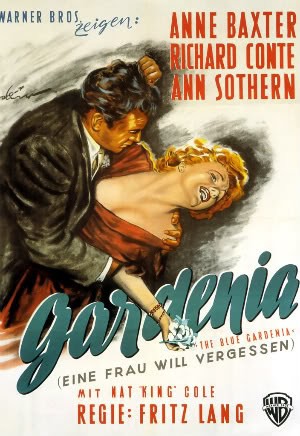
There are lots of sub-categories within film noir, and one of my favourites is what is sometimes termed nightmare noir. Fritz Lang’s The Blue Gardenia (1953) fits this description by presenting a protagonist whose world gets turned upside down after making one ill-judged decision. This kind of story offers all sorts of opportunities for some of the staple ingredients of noir – paranoia, suspicion, the idea that bad luck is waiting just around the corner, and the fact that the course of one’s life can hinge on something as simple and inocuous as a mix up over a phone call.

Norah Larkin (Anne Baxter) is a switchboard operator who leads a fairly humdrum life, sharing an apartment with two other single women and biding her time till her lover comes back from Korea. However, it doesn’t take long for things to start to unravel and for life to hand her the first in a series of unexpected kicks in the teeth. She’s just bought herself a new dress, cooked a special meal, and plans to sit down and share it with her absent G.I. boyfriend. So, with his photo propped in front of her, she opens his latest telegram and starts to read. It’s a brush off, he’s met a nurse, fallen in love and plans to marry her. Norah is naturally distraught and more than a little bitter, so when she takes a call meant for one of her flatmates she makes that one bad decision. On the rebound, she agrees to a date with the slightly sleazy ladies man Harry Prebble (Raymond Burr). During the course of dinner Prebble ensures that Norah gets well and truly tanked on cocktails before taking her back to his apartment. When he starts to get a little too friendly, Norah struggles with him but quickly blacks out. On awakening, she finds Prebble dead on the floor, his head smashed in with a poker. Panicking, and with only the haziest of memories of what went before, she flees the scene of the crime but leaves a few clues behind. The rest of the movie involves Norah’s attempts to evade the law, while playing a cat and mouse game with smooth newspaperman Casey Mayo (Richard Conte). The only real problem I had with the film was the fact that the element of doubt doesn’t really work for the viewer. While Norah and the characters around her cannot be sure of her guilt or innocence, it’s fairly clear to us. For this kind of story to work properly it’s preferable if the viewer experiences the same level of uncertainty the lead feels.

£14

Anne Baxter takes centre stage as the haunted and hunted Norah, and does a pretty good job of conveying her mounting sense of paranoia and isolation without resorting to histrionics. Richard Conte is reliable as usual in the role of the reporter who has his doubts. Raymond Burr was still at that stage of his career where he seemed to play nothing but heavies, but he did it well and his Harry Prebble has a nice touch of the sinister about him. However, while those three turned in fine performances, the picture really belongs to Ann Sothern. Her sassy turn as Norah’s seen-it-all-before flatmate is the highlight, and she walks away with just about every scene she appears in. Lang’s direction is as classy as one would expect, and the themes involved are right up his street. He seemed to have a thing for artists and reporters, and both play a prominent part here – although his most biting critique of the media, the ascerbic While the City Sleeps was still a few years down the road. There are strong noir credentials throughout the movie with Vera Caspary (Laura) providing the source material and Nicholas Musuraca working his magic behind the camera – the shadowy shots of the deserted newsroom at night being especially atmospheric.

The R1 DVD from Image is generally quite good, although there are a few damage marks here and there. It’s a totally barebones disc but should be available fairly cheap. The Blue Gardenia was originally distributed by Warner Brothers but is thankfully no longer controlled by them – I couldn’t imagine writing that just a few months ago, but this is the kind of film that might well be consigned to the appalling Archive programme now. All in all, it’s a fine noir that I’m happy to recommend.


Cry of the City

$1

He’s out there somewhere…in an alley, on a roof…looking for a way out.

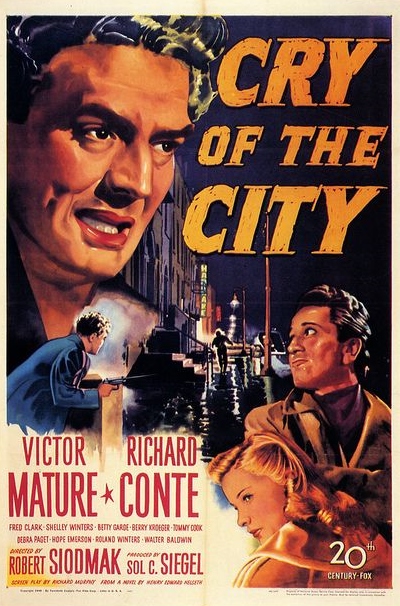
One of the most interesting, and the most enjoyable, aspects of the best noir pictures is the blurring of the lines between the hero and the villain. In a way, the noir world doesn’t have any real heroes, just people forced to make the best of whatever circumstances life pitches at them. Characters may be stylised, situations may be exaggerated, but the dilemmas and bad breaks that have to be faced are issues that most people can identify with on some level. I think it’s this ambiguity that ensures the enduring popularity of these films. While fashions, speech patterns and social attitudes are obviously changing all the time, human nature remains constant. Robert Siodmak’s Cry of the City (1948) is a classic manhunt thriller that toys with the viewer’s sympathy by presenting both hunter and hunted as two sides of the same coin.

Martin Rome (Richard Conte) is an Italian American hood who’s just taken one chance too many. A botched hold-up has left a policeman dead and Rome badly wounded and clinging to life. As his family and priest gather at his bedside to pray for him, the law in the shape of Lt. Candella (Victor Mature) hovers in the wings, waiting to hand down retribution. Rome is a doomed man, his killing of a cop can have only one outcome. But doomed men can be of value to desperate men, and so the vultures circle. With the knowledge that Rome has no future, crooked lawyer Niles (Berry Kroeger) tries to coax him into confessing to a murder that would let his client off the hook. When this approach doesn’t meet with any success, Niles makes the mistake of threatening Rome’s girl, Teena Riconti (Debra Paget). Now, he has a reason to live; both the police and Niles want to get their hands on Teena for their own ends. Rome needs to get out of the prison hospital, track down Niles and his accomplices, protect Teena, and try to make good his escape. All the while he’s dogged by his nemesis, the tenacious Candella, a man who seems to be on a personal crusade to run him to ground. As Rome runs and Candella pursues him, we get to see the contrasts and similarities between the two men. Both come from essentially the same background, namely poor immigrant families, but both have chosen different paths out of the urban squalor. Candella walks with the righteous, but the face of the law he presents is a rigid and largely inflexible one. He shows no mercy in his dealings with all the little people who offered assistance to the fugitive, promising instead only prosecution and punishment. As such, it is notable that Candella never receives any willing help whereas Rome has no shortage of people prepared to go the extra mile for him, albeit for their own reasons. Also, when Rome lay wounded in hospital he was surrounded by family and friends, but when Candella later suffers a similar fate his only visitor is his partner.

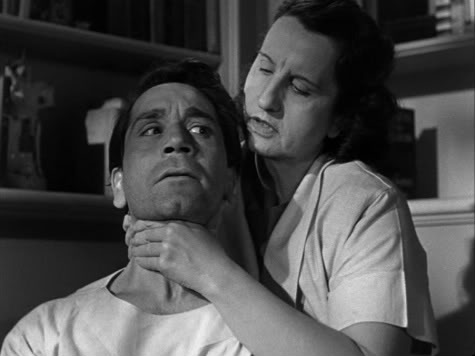
Richard Conte’s smooth talking gangster is a fine performance. You know he’s no good but can’t help rooting for him. The fact that he gets to deliver the best lines of the script and enjoys the lion’s share of screen time is helpful of course. It’s also significant that the killing for which he’s originally wanted is never shown and is only referred to briefly. When he does off someone on screen, that character is such an unpleasant slimeball that you feel he’s justified in doing so. Victor Mature’s persistent detective, on the other hand, is hard to like. He plays a cold, judgmental man with only a trace of humanity; the scenes where he visits Rome’s family are where he comes off best, yet even there his sincerity is open to question. It’s not really any surprise that his character has doors slammed in his face where Conte has them opened invitingly to him. The supporting cast is excellent, although the real stand out is Hope Emerson. This imposing figure of a woman is a genuinely unnerving presence, and you feel she could crush Conte’s ailing Rome just for the sadistic pleasure of it.

£2

Robert Siodmak made a lot of noir pictures, and I don’t believe any of them were poor. Cry of the City may not be his very best but it’s not far off. There are some beautifully framed shots on view, not the least of which is the final showdown between the two protagonists. He also handles the more suspenseful passages, such as Rome’s brazen escape from the hospital with a deft touch and excellent camera placement. The whole film exudes the noir atmosphere with plenty of wet sidewalks, flashing neon and wailing police sirens. I think what helps the film succeed the most is the inclusion of all the incidental characters and situations, from the Rome’s apartment with the Amercan and Italian flags hanging side by side above the mantle to the frightened immigrant doctor who’s willing to risk imprisonment to find the cash to care for his sick wife. I can’t help seeing some parallels between this film and Carol Reed’s Odd Man Out in terms of theme and narrative structure, although Conte never achieves the level of pathos seen in James Mason’s dead man walking. I’d also like to mention the great score by Alfred Newman; this music was used on a number of occasions in Fox movies but its melancholy notes are the ideal accompaniment to this fatalistic production.

Cry of the City is available on DVD in a number of editions in R2. I have the German release, and I understand it’s the pick of the bunch. It was previously only possible to buy this in combination with Sam Fuller’s House of Bamboo but it is now available in a stand alone edition. I couldn’t see anything wrong with the transfer which has very good contrast, is sharp, and displays next to nothing in the way of damage. There have been rumours for some time of this title getting the Criterion treatment but, at the time of writing, it still remains absent in R1. I’m not sure why Fox never went ahead and released this as part of their own noir line and, given recent reports of personnel changes taking place in their home video division, it remains to be seen what will be forthcoming from them in the future. Anyway, I give Cry of the City a big thumbs up, it’s an excellent film noir from a director at the top of his form.

Sirocco

ndcvzcm

Just think of the concept: Humphrey Bogart, an exotic location, gun-runners, freedom fighters, black marketeers, a love triangle, and a beautiful femme fatale. Sounds like a sure fire winner, right? I mean, it should be a given that throwing all these elements into the mix would produce a memorable movie, maybe even a bona fide classic. Superficially, it may seem like I’m referring to Casablanca; unfortunately, I’m not. No, what I’m talking about is Sirocco (1951), a poor, distant relation of Michael Curtiz’s much loved film. Now I count myself a big fan of Bogart, I even like those one dimensional thugs and heavies he played during the late 1930s, but Sirocco is a movie I really struggle to take anything positive from.

The story takes place in Damascus in 1925, during the period of French control. The end of WWI saw the carving up of the old Ottoman Empire, with modern day Syria being governed by France under a mandate from the League of Nations. But these are troubled times, and the nights are filled with the sounds of sporadic small arms fire as the Syrians launch periodic attacks against the occupying army. In the wake of one such attack, which has wiped out yet another patrol, the French military commander decides to crack down hard on the insurrection. Despite a tight blockade, shipments of weapons are making their way into the rebels’ hands. It is the task of Intelligence chief Colonel Feroud (Lee J Cobb) to halt this traffic, and this means rounding up the top black marketeers. Harry Smith (Bogart) is an American with a chequered past who uses his food imports as a cover for the more lucrative business of running guns into Damascus. While Feroud stalks Smith through the serpentine passages and subterranean catacombs of the ancient city, the relationship between the two men becomes further complicated by the fact that both have fallen under the spell of the beautiful, yet shallow and self-obsessed, Violette (Marta Toren). With the French troops hot on his heels, Smith finds himself a fugitive in a city of curfews and hastily organized ambushes. Just when escape to Egypt and safety seems within his grasp, Harry Smith finds that fate has one more twist to serve up.

£7

Throughout the ’40s Bogart was the very epitome of weary cynicism, the poster boy of film noir. Those hangdog features and his lisping delivery were perfect for expressing the pessimism and disillusionment of the time. However, his portrayal of Harry Smith is almost too weary and cynical for its own good. For the first hour or so we see a man without a shred of decency, a man who would sell out anybody or anything as long as the price was right. In itself, that’s not a problem, although there is only the vaguest hint given of what led him to this. The bigger problem is that in the final twenty minutes the viewer is expected to buy the notion of this self-serving profiteer undergoing a change of heart, and laying everything on the line in order to save the life of the man who has hounded him. In short, it doesn’t work; the character shift is too great and too abrupt to be believable. Lee J Cobb does better as the soldier whose conscience drives him to place his life in danger, and whose honor and bravery contrasts sharply with the venal amorality of Harry Smith. Marta Toren certainly looks good as the faithless Violette, but her character is a deeply unattractive one; after a horrendous bombing incident in a crowded bar, her only concern is for the damage inflicted on her dress and stockings. In truth, her role doesn’t serve any particular purpose except to add an edge to the rivalry between Smith and Feroud. In supporting parts, there’s some good work done by Everett Sloane, Zero Mostel and Nick Dennis. Curtis Bernhardt directs competently enough but the story plods in places and is only lifted by the camerawork of Burnett Guffey, who creates some atmospheric shots in the shadowy alleys and catcombs. It’s in these scenes that the film is most effective and they save it from being a complete failure.

Sirocco is available on DVD from Columbia in an excellent transfer. The print used doesn’t seem to have any damage and there’s a healthy, but not excessive, amount of natural looking film grain. Extras are limited to galleries of promotional material. The film was made for Bogie’s own production company Santana, which he set up after leaving Warners. The company made only a handful of pictures and, with the exception of In a Lonely Place, none of them set the world alight. Sirocco isn’t so much a bad film as a run of the mill one, a formula piece that’s never especially involving. One for real Bogart fans, and even they will likely endure it rather than enjoy it.

The Long Night

Hollywood has always been in love with the remake, not only of its own domestic product but those originating in other territories too. In the ’40s and ’50s a number of French movies were revisited, Lang’s Scarlet Street and Human Desire being prime examples, with a fair degree of success. Frequently these re-imaginings were (as in the previous examples) the work of directors and crews who had learned their craft in the French and other European cinema industries. Such was the case with The Long Night (1947); a remake of Le Jour Se Leve carried out by emigre director Anatole Litvak. Now I’ve never seen  the original, but a quick scan of the comments at the IMDb tell me that a number of people regard the Hollywood film as inferior. I’ve always been of the opinion that there are both good and bad remakes, and that there are those who display a knee-jerk reaction whenever the term is used. You pretty much have to judge any movie on its own merits and, as such, I think The Long Night stands up well enough.

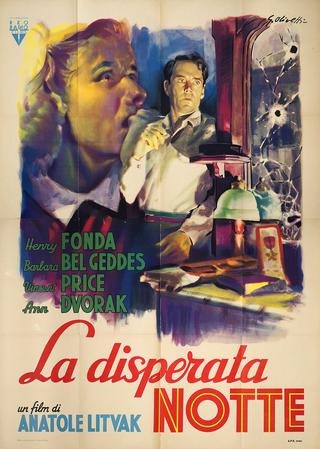
It’s late in the day in a nameless town and a blind man taps his way up the stairs to his room in a boarding house. His ascent is interrupted as a shot rings out. On the top floor a door bursts open, and a mortally wounded man stumbles out before pitching headlong down the staircase. This was The Great Maximilian (Vincent Price), a second rate conjurer plying his trade in a succession of low rent night clubs across the country. Now he lies dead on a seedy landing in a tenement, gutshot by factory worker Joe Adams (Henry Fonda). That’s how The Long Night opens, and before the end we will learn just how these two men came to this point. For the most part the story is told in flashback from the point of view of Adams, although at one stage there is what you might call a double flashback. Sound confusing? Well, it’s not really, since the story recounted is a fairly simple one. Naturally, there’s a woman involved who acts as the catalyst. She is Jo Ann (Barbara Bel Geddes), a virginal young innocent for whom both Adams and Maximilian fall – figuratively and literally. With Maximilian persisting in his attempts to seduce the girl and Adams simmering resentment growing, events slowly build towards the only possible outcome. Along the way, other characters flit in and out of the story, most notably Maximilian’s former assistant and lover Charlene (Ann Dvorak). Her streetwise presence serves both to provide a contrast to the gullibility of Jo Ann and to highlight just what a piece of work Maximilian is. His deceitful pursuit of Adams’ girl is one thing, but it’s a rare kind of S.O.B. who shaves the paws of puppies and burns the skin red raw in order to train them to perform.

Made at a time when noir pictures were beginning to move towards a wider use of locations and a more documentary approach, The Long Night is something of a throwback. Shot entirely in the studio and making extensive use of miniatures and forced perspective, the film takes on a dreamlike, otherworldly quality. This works pretty well since Joe Adams spends the film holed up in a bullet-riddled room living within his own mind and memories. Fonda does well in a role that demanded he be breezy and cheerful in the flashbacks, all the while growing more uneasy until he finally starts to lose his grip on reality. He always excelled in his portrayals of average guys who are put upon, and he manages to work in some post-war angst which must have struck a chord with the recently returned WWII vets. In contrast, Vincent Price hams it up in a bombastic performance as the villain who is sly, snide and sneering while retaining a certain pathos. Barbara Bel Geddes, in her debut role, was well cast as the youthful Jo Ann. Superficially, she doesn’t seem to fit the stereotypical image of the femme fatale, but her character certainly has a fatal effect on the men in the picture. Ann Dvorak’s wisecracking dame who’s seen it all is is a joy to behold as she picks away at Maximilian’s carefully arranged image, and seems to be having a ball casually humiliating him whenever and wherever the opportunity arises.

The Long Night was an RKO picture but it has been released on R1 DVD by Kino. While the film clearly hasn’t had any significant clean-up done it remains in pretty good shape. There are a variety of damage marks present but, with a few exceptions, the print is clear and very watchable. As is often the case with films like this, the audio can be a bit inconsistent but I can’t see anyone forking out for a full blown restoration so this is probably as good as it’s going to look and sound. The disc does boast some nice extras in the form of a text based feature detailing the meticulous work that went into the production design which gives the film its unique atmosphere. Alongside that, there are  a  couple of clips which compare scenes in the movie with virtually identical ones in the French original. All told this is a fine movie that should please anyone with a taste for noir.

Where Danger Lives

poster71

The films produced at RKO under the stewardship of Howard Hughes were a mixed bag to say the least; the billionaire’s’s involvement lending a crass, juvenile quality to more than one movie. While he led the once great studio along the path to bankruptcy and oblivion, he also introduced the cinema-going public to number of new starlets such as Jane Russell and Faith Domergue. Miss Domergue never made that many memorable pictures, save for Where Danger Lives, This Island Earth and It Came from Beneath the Sea. Of those three, Where Danger Lives (1950) has the slightly odd distinction of presenting her with her best role while also being the least known. In fact, this is a fine movie all round with stylish direction by noir stalwart John Farrow, a powerful lead performance by Robert Mitchum, moody cinematography by Nicholas Musuraca, and a Charles Bennett script.

At first glance the film may seem like a standard lovers-on-the-run yarn, but that’s merely the framing device for a tale of obsessive love, deception and madness. Jeff Cameron (Robert Mitchum) is introduced as an overworked but dedicated doctor who, at the end of his shift, is called upon to treat an attempted suicide. He is immediately attracted to the patient, Margo (Faith Domergue), and soon embarks on an affair. The immediate effect of this is that Cameron develops a callous disregard for both his job and his devoted sweetheart, played by director’s wife Maureen O’Sullivan. The whole point of the story is how lust can blind a man to reality and allow him to be deceived and manipulated. The film is packed with lies and liars and it seems that just about everyone is prepared to bend the truth to suit their own agenda, right down to ambulance drivers and small town doctors. When Cameron receives a blow on the head in a struggle, the resulting concussion gradually impairs his judgement and allows him to be more easily duped. In a marvellously surreal passage, the fleeing couple arrive in a town where everyone is bearded and dressed in western apparel. For a moment it looks as though the action has taken a detour into the Twilight Zone, until it is revealed that Mitchum and Domergue have stumbled into a local festival. The idea of nobody being quite what they appear is nicely highlighted when a local boy draws facial hair onto a photograph of Domergue, while muttering that everyone has to have a beard. From first to last, the movie concentrates on shifting identities and false perceptions.

Robert Mitchum was an old hand at playing noir anti-heroes and the role of Jeff Cameron offers him the opportunity to flex his acting muscles. He goes from being an upstanding professional at the beginning of the film to a shambling brain damaged wreck of a man by the climax. In the hands of a lesser actor the part could easily have descended into eye-rolling histrionics, but Mitchum’s deceptively lazy style ensures that credibility is maintained as his character’s mental state deteriorates and he floats between clarity and confusion. Faith Domergue’s Margo is a fine femme fatale in the classic mould. Her performance isn’t as controlled as Mitchum’s but she still manages to be convincing. It’s obvious from the start that there’s something not quite right about Margo, but you can’t really put your finger on what. Claude Rains appears in a small but significant part, and adds some real class to proceedings; in his few minutes of screen time he shows us another psychologically twisted character, and his playing is every bit the equal of that of his co-stars. John Farrow always seemed comfortable in noir territory, and does a good job of holding together a story that could have easily spun out of control. Farrow is ably assisted by his director of photography Nicholas Musuraca, whose camera does good things with the bleak desert backdrops and shadowy small towns that dominate the film.

Where Danger Lives comes to DVD, paired on disc with Tension, from Warners in R1 via their fourth noir set. It’s a fine, clean transfer which shows Musuraca’s excellent black and white photography at its best. The film comes with a trailer and a short featurette on the movie. This is a  film that I wasn’t at all familiar with until I picked up the box set. I can’t think why it has been such an obscure and hard to see movie since I’d rate it as an excellent example of classic era noir. Highly recommended.

The Long Memory

hhrbybb

I seem to be on a bit of a Robert Hamer kick at the moment. Having recently enjoyed Pink String and Sealing Wax, I decided to give The Long Memory (1952) a spin. While the former is a Gothic/Victorian noir which may stretch the definition for purists, the latter is the real deal. It has the contemporary setting, stark photography and relentlessly downbeat moodiness that should satisfy all who have a penchant for dark cinema. The story is classic noir wherein an innocent man is persecuted for a crime he has not committed and subsequently finds himself consumed by his thirst for revenge on those responsible for his plight.

Phillip Davidson (John Mills) has just been released from prison, having served twelve years for murder. An early flashback establishes that he had been wrongfully convicted, and that the false testimony of his then fiancee (Elizabeth Sellars) played a significant part in securing that conviction. In a neat twist, it also transpires that the treacherous fiancee has, in the intervening years, married the policeman originally in charge of Davidson’s case (John McCallum). Aware of the fact that Davidson still bears a grudge, the authorities track him Kent where he takes up residence in an abandoned barge along the desolate Thames estuary. As Davidson grimly sets about the task of seeking out his former tormentors the action alternates between his search and the slow unravelling of the idyllic domesticity of the policeman’s life. Running parallel to this is the development of a relationship between Davidson and a refugee girl (Eva Bergh) working as a waitress in a dingy cafe. This plot thread is not mere romantic padding but an essential element that clearly demonstrates just how deep Davidson’s scars run. By the end of the movie the quest for revenge has transformed into more of a journey towards spiritual redemption.

£6

The acting is out of the top drawer all round with the only weak link in the chain being Elizabeth Sellars. Her performance comes across as even more wooden given the emotional depth shown by almost everyone else around her. John Mills does a fine understated turn in the lead role. The scenes he plays in the old barge with Eva Bergh have such a touching and heartrending quality. These are two people who have spent so long living within themselves that the effort of reaching out to another is close to physically painful. John McCallum is also fine as the decent cop who gradually comes to realise that the woman he married is not all she seems, and who must resign himself to the fact that his career cannot continue if he’s to come out of it all with any sense of honour intact. There’s plenty of good support from a selection of familiar British character actors; special mention going to Michael Martin Harvey as Mills’ slightly kooky neighbour.

Where Pink String and Sealing Wax suffered from an undisciplined and unfocused script, The Long Memory can boast tighter writing and pacing. Hamer moves his camera around effectively and makes maximum use of the barren Kent coastline. He also controls the flow of the story very well, and cuts tellingly between the gradual flowering of the Mills/Bergh relationship and the simultaneous disintegration of Sellars and McCallum’s. All of this is backed up by the excellent cinematography of Harry Waxman who manages to throw in some welcome deep focus shots.

The Long Memory is currently only available on DVD as part of the John Mills Centenary Collection II from ITV DVD in R2. The set is a bit pricey but it does offer a good selection of Mills films and is worth checking out. This movie comes on its own disc and, while not perfect, gets a pretty good transfer. There’s optional subs, production notes and a gallery included. I hadn’t seen this film for a number of years and had forgotten what an underrated little gem it is. I give it a big thumbs up and recommend it wholeheartedly.


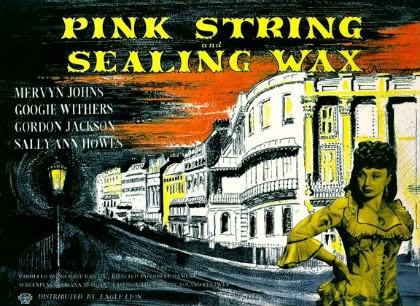
Pink String and Sealing Wax

poster59

Robert Hamer may well have been the best director to work for Ealing. The man who produced  Kind Hearts and Coronets cut his teeth on one of the segments in the grandfather of all horror anthologies, Dead of Night. He also made one of the most memorable British noirs in It Always Rains on Sunday (1947), featuring Googie Withers. One year before that, he used the same actress in the Victorian noir Pink String and Sealing Wax, the title of which refers to a chemist’s means of packaging his remedies. While I wouldn’t say this is the best of Hamer’s films, it is a solid enough effort hampered by an unfocused script.

Edward Sutton (Mervyn Johns) is a Brighton chemist, a self-made man who has clawed his way up from humble beginnings to attain respectability as a forensic analyst. He remains, however, a thoroughly objectionable prig and domestic tyrant. Returning from court in a thundering good mood, having just seen his testimony send a woman to the gallows, he proceeds to humiliate his lovelorn son, reduce first his younger daughter to tears by informing her (on her birthday no less) that he intends using the guinea pigs she thought were a present in some unmentionable experiments, and then draw a similar reaction from the elder girl by dashing her hopes of a career in music – and all this before lunch has even been served! So it’s no surprise when the eldest son, David (Gordon Jackson), decides to go out and get hammered in the seedier part of town. He finds himself in a pub run by Pearl Bond (Withers) and her brutish, alcoholic husband. It’s this part of the story, which concentrates on Pearl and her complicated and unhappy relationships, that makes up the real substance of the film. The action moves away from the twee and slightly soapy Sutton clan to the far more colorful and vital world of the lower classes. David finds himself attracted to Pearl and the loose living world she inhabits, and slowly, unwittingly, he is drawn into her plans to relieve herself of her increasingly abusive spouse. The real pity is that the script meanders too much and this straying from the point blunts the thrust of the narrative. Far too much time is wasted on the unnecessary subplot concerning the eldest daughter’s efforts to pursue her dream of becoming an opera singer. I guess the idea was to highlight the inflexible nature of Sutton senior, but in doing so much of the tension of the plot drains away and the whole picture suffers.

Googie Withers plays the part of the femme fatale to the hilt and manages to capture the sympathy of the viewer as effortlessly as she captures the affections of the men around her. She puts in a really fine piece of film acting, conveying as much of her thinking and emotion through her eyes and body language as through her words. A very young Gordon Jackson is quite appealing as the poor innocent sap who finds himself in over his head before he knows it. Mervyn Johns is always watchable, although his is pretty much a one-note performance as the rigid and domineering head of the house who sees his authority come under attack. Still and all, his final confrontation with Withers, as he calmly and coldly points out the fate awaiting her, is powerfully delivered and retains a chilling quality. Hamer directs smoothly and handles both the intimate scenes and the sourer and more bitter ones with equal skill. As I said, he’s only let down by the untidy script which should have left out some of the more pointless scenes.

Optimum’s R2 DVD is a fairly good if unspectacular affair. The print used is in reasonable condition but there does seem to be a bit of contrast and brightness boosting here and there. As usual with Optimum this is a barebones disc with no subs and just a chapter menu. All in all, Pink String and Sealing Wax is an enjoyably dark movie with some good acting and professional direction. It’s just a pity the writing couldn’t have been tightened up a bit.


Tread Softly Stranger

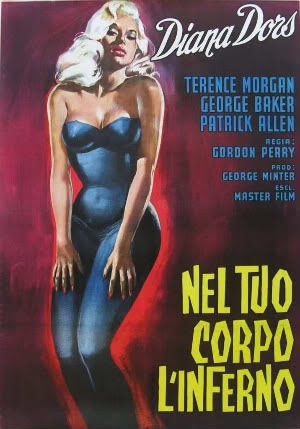
The last year or so has seen the release on DVD of a number of British crime pictures that I had almost given up hope of ever seeing again. Tread Softly Stranger (1958) falls into film noir territory courtesy of the shadowy photography and the focus on a three way releationship between the good-for-nothing characters.

Johnny Mansell (George Baker) is a small time gambler who, after a run of bad luck at the racetrack, goes on the lam to save his hide. He heads back to the town in the north of England where he grew up, and where his brother still lives. The brother, Dave (Terence Morgan), works as a bookkeeper in the local foundry and has got himself involved with a night club hostess called Calico (Diana Dors). Right from the beginning Johnny takes an interest in Calico – not that anyone could blame the man for that – but holds off doing anything about it. It’s abundantly clear that Calico is more attracted to this flashier London-based brother than to the dull, bespectacled Dave. It’s also abundantly clear (Calico sports a diamond watch) that Dave’s infatuation is leading to him living beyond his means. Matters come to a head when the foundry faces an audit and Dave reveals that he’s been borrowing from the company accounts to finance his lifestyle. With only a week to make good the deficit on the books Johnny hopes to win enough at the track while Calico, still smarting from Johnny’s rejection of her advances, suggests breaking into the foundry and cleaning out the payroll. From here everything starts to go badly wrong, leading to murder, suspicion and psychological breakdown.

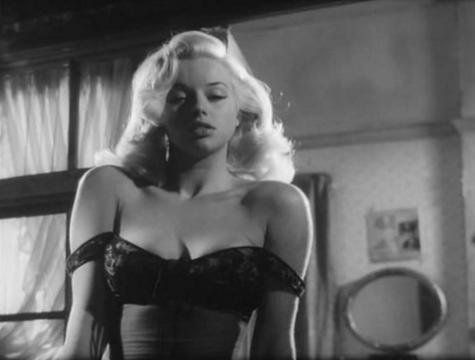
Diana Dors’ femme fatale is easily the best thing in this movie, oozing sex appeal as she wiggles and pouts her way round the sets, driving both the brothers up the walls with desire. The two male leads are just about adequate, but never completely convincing. George Baker can’t quite nail the charming scoundrel bit, while Terence Morgan overdoes it as the nervy brother with the cork too tight in the bottle. One of the pleasures of British films of this period is the selection of support players available. This is especially important here, given the shortcomings of both Baker and Morgan. Joseph Tomelty brings a paternal warmth to his role as a doomed watchman. And Patrick Allen is fine as Tomelty’s son, and the brothers’ childhood friend, whose suspicions and snooping create the tension of the latter half of the film. There’s also a nice, offbeat little cameo from Wilfrid Lawson, whose distinctive voice makes his affection for his pet rabbits all the more startlingly macabre. Gordon Parry does a competent job of directing and moves the camera nicely to set up some interesting shots. He is ably supported by cinematographer Douglas Slocombe’s atmospheric shooting of the shadows and smog enveloping the northern town.

Tread Softly Stranger is available on DVD in R2 from Odeon in a fair enough transfer. For the most part  the print used is in reasonable condition, although there is a significant scratch which shows up around the half way mark and lingers for a few minutes. I don’t feel the need to be too critical of Odeon for not cleaning this print up more as the film is a pretty obscure title, and I can’t imagine it shifting enough  copies to justify costly restoration. These kinds of titles are purely niche material and I’m just happy to see the likes of it available at all. There’s also a version out in R1 from VCI in a box of British B titles. I have only seen a few small screencaps of the R1 so can’t really comment other than to say it looked a bit hazy and with a greenish tint compared to Odeon’s release. I’d recommend this release to anyone who enjoys British crime/noir pictures of the period – not a great movie but a highly enjoyable one nonetheless.

Desert Fury

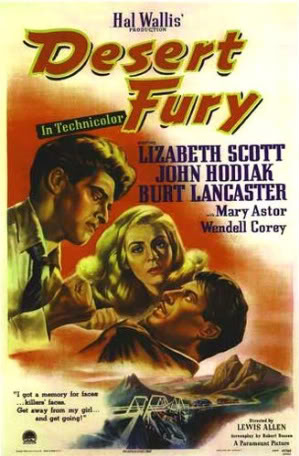
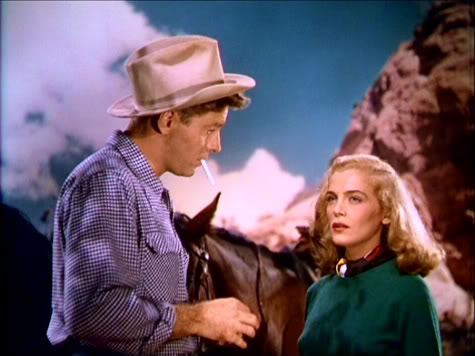
Can a technicolor movie be considered a film noir? I think so. Sure, the form lends itself better to the harshness of black and white photography where the light and shadows can be more skilfully manipulated. Having said that, film noir is more than just a photographic style – it’s a style of film making. To me, noir is a combination of many elements (theme, character, time, location, photography etc.) and the more boxes we can check, the closer we come to defining it. Photography is, undoubtedly, one of the major elements that needs to be present – I just feel that photographic style rather than color vs B&W is the clincher. As such, I feel Desert Fury (1947) is most definitely noir. Although the movie is shot in blinding technicolor, the themes and characterization place it firmly in the realm of dark cinema.

Paula Haller (Lizabeth Scott) returns to Chuckawalla, the small desert town where she was raised by her widowed mother Fritzi (Mary Astor). Paula is shown to be an outsider right from the off, snubbed by the locals due to her mother’s ownership of the town’s gambling joint. The only friend she has is Tom Hanson (Burt Lancaster), a former cowboy now working as town deputy after an accident put an end to his former career. Paula’s arrival back home coincides with the reappearance of a shady character called Eddie Bendix (John Hodiak), whose wife died years earlier in a mysterious road accident. When Paula falls for Bendix a whole hornet’s nest of passion is stirred up as Fritzi, Hanson, and Bendix’s partner Johnny (Wendell Corey) all, for their own reasons, try to keep them apart. What tilts this into noir, rather than straight melodrama, is the twisted nature of the relationships involved. Paula is said to bear a strong resemblance to Bendix’s late wife; Fritzi and Bendix were formerly lovers; there’s more than a hint of jealous competition between the two female leads; and there are strong suggestions that the relationship of Bendix and Johnny might involve some sexual undercurrents – heady stuff indeed for 1947. There’s also a nice cyclical form to the movie, which both opens and closes with characters staring over the rails of a bridge at the site of a fatal crash.

This is a picture that’s dominated by the performances of the women. Mary Astor is near perfect casting as the worldly and tough dame who rules the roost in a man’s world, yet struggles to tame the impulses of her headstrong daughter. Lizabeth Scott was born to star in films noir, and she does the business here as the troubled heroine with the whiskey voice who has to learn a few hard lessons. Burt Lancaster’s role is a bit of a thankless one; he seems to do little more than cruise up and down the desert highway, hoping to run into Scott on her return from Hodiak’s rented pad. Hodiak himself gives an interesting performance as man who’s clearly not all he seems. His initial detachment and suppressed aggression hint at some dark secret, and he gradually descends further into a kind of manic vindictiveness until his flaws and weakness are finally exposed by the sly and knowing Corey. Director Lewis Allen makes sure everything moves along smoothly and makes excellent use of the harshly beautiful locations. A word also for cinematographer Charles Lang, who makes those same desolate landscapes positively pop off the screen.

Desert Fury is available on DVD in R4 from a company called DV1. Their disc looks fantastic with strong color and detail, although there are some speckles and damage marks here and there. It is, however, totally barebones with not even subs offered. On the plus side there are some interesting liner notes  printed on the reverse of the cover – and it should be available cheaply. For me, this was pretty much a blind buy and I ended up enjoying it a lot. Recommended.

The Woman in the Window

poster13

In many ways Fritz Lang’s The Woman in the Window (1944) plays like a dress rehearsal for his production of Scarlet Street the following year. Both films feature the same three stars – Edward G Robinson, Joan Bennett and Dan Duryea – and tell the story of a married, middle-aged man whose chance meeting with a young woman leads him into a vortex of murder, blackmail and ruin. However, where Scarlet Street is relentlessly grim, The Woman in the Window is a paler shade of noir – and not just because of its ending.

Richard Wanley (Robinson) is an assistant professor at a New York college whose wife and family have gone off on a trip, leaving him to his own devices. After an evening spent at his club with a couple of friends, including the District Attorney (Raymond Massey), he pauses on his way home to admire a portrait of a woman in the window of an adjacent art gallery. As he’s gazing through the window, the subject of the portrait, Alice Reed (Joan Bennett), appears by his side and, one thing leading to another, he ends back at her apartment. Up to this point everything seems innocent enough, but the abrupt and violent arrival of Reed’s lover sends the situation spiralling out of control. Although Wanley is left with no alternative but to kill his assailant out of self defence, he is also aware that his story is unlikely to be accepted and, even if it is, his life will be ruined. The solution – dump the body, destroy all the evidence and make like it never happened. Naturally, all of Wanley’s well laid plans start to unravel before his eyes as the police investigation starts to build up a body of forensic evidence that may soon cast suspicion on the hapless professor. The greatest danger, however, is posed by a shady ex-cop (Dan Duryea) with blackmail on his mind. The plot builds inexorably towards a suitably downbeat climax, yet this film has one last sting in its tail. I won’t spoil things for anyone who hasn’t seen this, but suffice to say that this ending has led some to question the noir credentials of the movie. Personally, I don’t share this view but I can see why it remains a bone of contention with some.

£37

As I said above, The Woman in the Window comes off as a lighter form of noir than Scarlet Street, and a good deal of this, aside from the ending, comes down to the portrayal of the characters. It is much easier to sympathise with Robinson’s character here, somehow his decisions, while questionable, seem more understandable. Bennett, too, is much less repugnant than would be the case in Scarlet Street. She is clearly a kept woman and a femme fatale, in the sense that she leads the protagonist into a dangerous, doomed situation, yet her motives are neither malicious nor wholly selfish. It’s only Dan Duryea, in another trademark role as a smirking villain, who fails to endear himself to the audience. There was something about the man – I think it relates to the casually mocking note in his voice – that led to his being typecast in such parts. There’s lots of noir imagery on show with a good deal of the action taking place at night and on rainy city streets. One recurring motif throughout the film is the number of shots which follow events through a series of open doors, symbolising (I suppose) the characters’ deepening crisis. The more I watch and re-watch Lang’s American films, the higher he grows in my estimation – I’d definitely rank him up among my top five directors.

The film was released on DVD last summer, along with a few other noir titles, by MGM in R1. The disc is totally barebones but the transfer is very good, maybe a little soft. There is a R2 available from Spain (I’m not sure about other countries) which, despite an English soundtrack and removable subs, is nowhere near this in terms of picture quality – fortunately, I managed to offload my copy on a friend who remains stubbornly locked into region two. If you’re a fan of noir or Lang then the R1 is the way to go, and I have no hesitation in recommending the movie.