Where Danger Lives

poster71

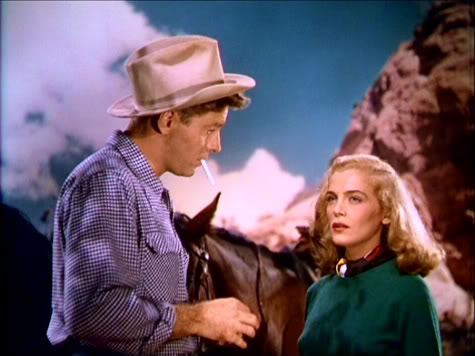
The films produced at RKO under the stewardship of Howard Hughes were a mixed bag to say the least; the billionaire’s’s involvement lending a crass, juvenile quality to more than one movie. While he led the once great studio along the path to bankruptcy and oblivion, he also introduced the cinema-going public to number of new starlets such as Jane Russell and Faith Domergue. Miss Domergue never made that many memorable pictures, save for Where Danger Lives, This Island Earth and It Came from Beneath the Sea. Of those three, Where Danger Lives (1950) has the slightly odd distinction of presenting her with her best role while also being the least known. In fact, this is a fine movie all round with stylish direction by noir stalwart John Farrow, a powerful lead performance by Robert Mitchum, moody cinematography by Nicholas Musuraca, and a Charles Bennett script.

At first glance the film may seem like a standard lovers-on-the-run yarn, but that’s merely the framing device for a tale of obsessive love, deception and madness. Jeff Cameron (Robert Mitchum) is introduced as an overworked but dedicated doctor who, at the end of his shift, is called upon to treat an attempted suicide. He is immediately attracted to the patient, Margo (Faith Domergue), and soon embarks on an affair. The immediate effect of this is that Cameron develops a callous disregard for both his job and his devoted sweetheart, played by director’s wife Maureen O’Sullivan. The whole point of the story is how lust can blind a man to reality and allow him to be deceived and manipulated. The film is packed with lies and liars and it seems that just about everyone is prepared to bend the truth to suit their own agenda, right down to ambulance drivers and small town doctors. When Cameron receives a blow on the head in a struggle, the resulting concussion gradually impairs his judgement and allows him to be more easily duped. In a marvellously surreal passage, the fleeing couple arrive in a town where everyone is bearded and dressed in western apparel. For a moment it looks as though the action has taken a detour into the Twilight Zone, until it is revealed that Mitchum and Domergue have stumbled into a local festival. The idea of nobody being quite what they appear is nicely highlighted when a local boy draws facial hair onto a photograph of Domergue, while muttering that everyone has to have a beard. From first to last, the movie concentrates on shifting identities and false perceptions.

Robert Mitchum was an old hand at playing noir anti-heroes and the role of Jeff Cameron offers him the opportunity to flex his acting muscles. He goes from being an upstanding professional at the beginning of the film to a shambling brain damaged wreck of a man by the climax. In the hands of a lesser actor the part could easily have descended into eye-rolling histrionics, but Mitchum’s deceptively lazy style ensures that credibility is maintained as his character’s mental state deteriorates and he floats between clarity and confusion. Faith Domergue’s Margo is a fine femme fatale in the classic mould. Her performance isn’t as controlled as Mitchum’s but she still manages to be convincing. It’s obvious from the start that there’s something not quite right about Margo, but you can’t really put your finger on what. Claude Rains appears in a small but significant part, and adds some real class to proceedings; in his few minutes of screen time he shows us another psychologically twisted character, and his playing is every bit the equal of that of his co-stars. John Farrow always seemed comfortable in noir territory, and does a good job of holding together a story that could have easily spun out of control. Farrow is ably assisted by his director of photography Nicholas Musuraca, whose camera does good things with the bleak desert backdrops and shadowy small towns that dominate the film.

Where Danger Lives comes to DVD, paired on disc with Tension, from Warners in R1 via their fourth noir set. It’s a fine, clean transfer which shows Musuraca’s excellent black and white photography at its best. The film comes with a trailer and a short featurette on the movie. This is a  film that I wasn’t at all familiar with until I picked up the box set. I can’t think why it has been such an obscure and hard to see movie since I’d rate it as an excellent example of classic era noir. Highly recommended.

The Long Memory

hhrbybb

I seem to be on a bit of a Robert Hamer kick at the moment. Having recently enjoyed Pink String and Sealing Wax, I decided to give The Long Memory (1952) a spin. While the former is a Gothic/Victorian noir which may stretch the definition for purists, the latter is the real deal. It has the contemporary setting, stark photography and relentlessly downbeat moodiness that should satisfy all who have a penchant for dark cinema. The story is classic noir wherein an innocent man is persecuted for a crime he has not committed and subsequently finds himself consumed by his thirst for revenge on those responsible for his plight.

Phillip Davidson (John Mills) has just been released from prison, having served twelve years for murder. An early flashback establishes that he had been wrongfully convicted, and that the false testimony of his then fiancee (Elizabeth Sellars) played a significant part in securing that conviction. In a neat twist, it also transpires that the treacherous fiancee has, in the intervening years, married the policeman originally in charge of Davidson’s case (John McCallum). Aware of the fact that Davidson still bears a grudge, the authorities track him Kent where he takes up residence in an abandoned barge along the desolate Thames estuary. As Davidson grimly sets about the task of seeking out his former tormentors the action alternates between his search and the slow unravelling of the idyllic domesticity of the policeman’s life. Running parallel to this is the development of a relationship between Davidson and a refugee girl (Eva Bergh) working as a waitress in a dingy cafe. This plot thread is not mere romantic padding but an essential element that clearly demonstrates just how deep Davidson’s scars run. By the end of the movie the quest for revenge has transformed into more of a journey towards spiritual redemption.

£6

The acting is out of the top drawer all round with the only weak link in the chain being Elizabeth Sellars. Her performance comes across as even more wooden given the emotional depth shown by almost everyone else around her. John Mills does a fine understated turn in the lead role. The scenes he plays in the old barge with Eva Bergh have such a touching and heartrending quality. These are two people who have spent so long living within themselves that the effort of reaching out to another is close to physically painful. John McCallum is also fine as the decent cop who gradually comes to realise that the woman he married is not all she seems, and who must resign himself to the fact that his career cannot continue if he’s to come out of it all with any sense of honour intact. There’s plenty of good support from a selection of familiar British character actors; special mention going to Michael Martin Harvey as Mills’ slightly kooky neighbour.

Where Pink String and Sealing Wax suffered from an undisciplined and unfocused script, The Long Memory can boast tighter writing and pacing. Hamer moves his camera around effectively and makes maximum use of the barren Kent coastline. He also controls the flow of the story very well, and cuts tellingly between the gradual flowering of the Mills/Bergh relationship and the simultaneous disintegration of Sellars and McCallum’s. All of this is backed up by the excellent cinematography of Harry Waxman who manages to throw in some welcome deep focus shots.

The Long Memory is currently only available on DVD as part of the John Mills Centenary Collection II from ITV DVD in R2. The set is a bit pricey but it does offer a good selection of Mills films and is worth checking out. This movie comes on its own disc and, while not perfect, gets a pretty good transfer. There’s optional subs, production notes and a gallery included. I hadn’t seen this film for a number of years and had forgotten what an underrated little gem it is. I give it a big thumbs up and recommend it wholeheartedly.


Pink String and Sealing Wax

poster59

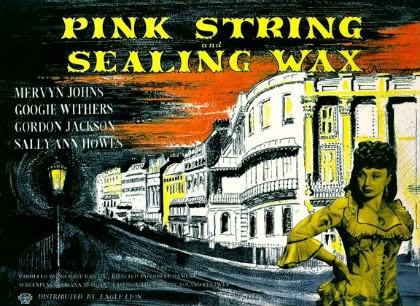
Robert Hamer may well have been the best director to work for Ealing. The man who produced  Kind Hearts and Coronets cut his teeth on one of the segments in the grandfather of all horror anthologies, Dead of Night. He also made one of the most memorable British noirs in It Always Rains on Sunday (1947), featuring Googie Withers. One year before that, he used the same actress in the Victorian noir Pink String and Sealing Wax, the title of which refers to a chemist’s means of packaging his remedies. While I wouldn’t say this is the best of Hamer’s films, it is a solid enough effort hampered by an unfocused script.

Edward Sutton (Mervyn Johns) is a Brighton chemist, a self-made man who has clawed his way up from humble beginnings to attain respectability as a forensic analyst. He remains, however, a thoroughly objectionable prig and domestic tyrant. Returning from court in a thundering good mood, having just seen his testimony send a woman to the gallows, he proceeds to humiliate his lovelorn son, reduce first his younger daughter to tears by informing her (on her birthday no less) that he intends using the guinea pigs she thought were a present in some unmentionable experiments, and then draw a similar reaction from the elder girl by dashing her hopes of a career in music – and all this before lunch has even been served! So it’s no surprise when the eldest son, David (Gordon Jackson), decides to go out and get hammered in the seedier part of town. He finds himself in a pub run by Pearl Bond (Withers) and her brutish, alcoholic husband. It’s this part of the story, which concentrates on Pearl and her complicated and unhappy relationships, that makes up the real substance of the film. The action moves away from the twee and slightly soapy Sutton clan to the far more colorful and vital world of the lower classes. David finds himself attracted to Pearl and the loose living world she inhabits, and slowly, unwittingly, he is drawn into her plans to relieve herself of her increasingly abusive spouse. The real pity is that the script meanders too much and this straying from the point blunts the thrust of the narrative. Far too much time is wasted on the unnecessary subplot concerning the eldest daughter’s efforts to pursue her dream of becoming an opera singer. I guess the idea was to highlight the inflexible nature of Sutton senior, but in doing so much of the tension of the plot drains away and the whole picture suffers.

Googie Withers plays the part of the femme fatale to the hilt and manages to capture the sympathy of the viewer as effortlessly as she captures the affections of the men around her. She puts in a really fine piece of film acting, conveying as much of her thinking and emotion through her eyes and body language as through her words. A very young Gordon Jackson is quite appealing as the poor innocent sap who finds himself in over his head before he knows it. Mervyn Johns is always watchable, although his is pretty much a one-note performance as the rigid and domineering head of the house who sees his authority come under attack. Still and all, his final confrontation with Withers, as he calmly and coldly points out the fate awaiting her, is powerfully delivered and retains a chilling quality. Hamer directs smoothly and handles both the intimate scenes and the sourer and more bitter ones with equal skill. As I said, he’s only let down by the untidy script which should have left out some of the more pointless scenes.

Optimum’s R2 DVD is a fairly good if unspectacular affair. The print used is in reasonable condition but there does seem to be a bit of contrast and brightness boosting here and there. As usual with Optimum this is a barebones disc with no subs and just a chapter menu. All in all, Pink String and Sealing Wax is an enjoyably dark movie with some good acting and professional direction. It’s just a pity the writing couldn’t have been tightened up a bit.


Tread Softly Stranger

The last year or so has seen the release on DVD of a number of British crime pictures that I had almost given up hope of ever seeing again. Tread Softly Stranger (1958) falls into film noir territory courtesy of the shadowy photography and the focus on a three way releationship between the good-for-nothing characters.

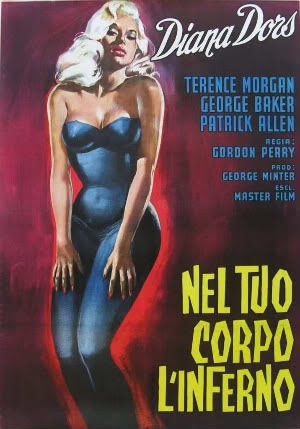
Johnny Mansell (George Baker) is a small time gambler who, after a run of bad luck at the racetrack, goes on the lam to save his hide. He heads back to the town in the north of England where he grew up, and where his brother still lives. The brother, Dave (Terence Morgan), works as a bookkeeper in the local foundry and has got himself involved with a night club hostess called Calico (Diana Dors). Right from the beginning Johnny takes an interest in Calico – not that anyone could blame the man for that – but holds off doing anything about it. It’s abundantly clear that Calico is more attracted to this flashier London-based brother than to the dull, bespectacled Dave. It’s also abundantly clear (Calico sports a diamond watch) that Dave’s infatuation is leading to him living beyond his means. Matters come to a head when the foundry faces an audit and Dave reveals that he’s been borrowing from the company accounts to finance his lifestyle. With only a week to make good the deficit on the books Johnny hopes to win enough at the track while Calico, still smarting from Johnny’s rejection of her advances, suggests breaking into the foundry and cleaning out the payroll. From here everything starts to go badly wrong, leading to murder, suspicion and psychological breakdown.

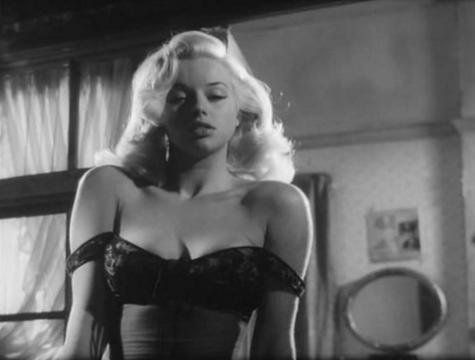
Diana Dors’ femme fatale is easily the best thing in this movie, oozing sex appeal as she wiggles and pouts her way round the sets, driving both the brothers up the walls with desire. The two male leads are just about adequate, but never completely convincing. George Baker can’t quite nail the charming scoundrel bit, while Terence Morgan overdoes it as the nervy brother with the cork too tight in the bottle. One of the pleasures of British films of this period is the selection of support players available. This is especially important here, given the shortcomings of both Baker and Morgan. Joseph Tomelty brings a paternal warmth to his role as a doomed watchman. And Patrick Allen is fine as Tomelty’s son, and the brothers’ childhood friend, whose suspicions and snooping create the tension of the latter half of the film. There’s also a nice, offbeat little cameo from Wilfrid Lawson, whose distinctive voice makes his affection for his pet rabbits all the more startlingly macabre. Gordon Parry does a competent job of directing and moves the camera nicely to set up some interesting shots. He is ably supported by cinematographer Douglas Slocombe’s atmospheric shooting of the shadows and smog enveloping the northern town.

Tread Softly Stranger is available on DVD in R2 from Odeon in a fair enough transfer. For the most part  the print used is in reasonable condition, although there is a significant scratch which shows up around the half way mark and lingers for a few minutes. I don’t feel the need to be too critical of Odeon for not cleaning this print up more as the film is a pretty obscure title, and I can’t imagine it shifting enough  copies to justify costly restoration. These kinds of titles are purely niche material and I’m just happy to see the likes of it available at all. There’s also a version out in R1 from VCI in a box of British B titles. I have only seen a few small screencaps of the R1 so can’t really comment other than to say it looked a bit hazy and with a greenish tint compared to Odeon’s release. I’d recommend this release to anyone who enjoys British crime/noir pictures of the period – not a great movie but a highly enjoyable one nonetheless.

Desert Fury

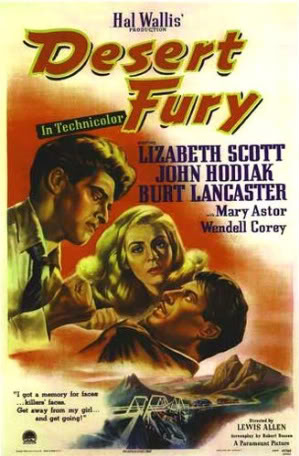
Can a technicolor movie be considered a film noir? I think so. Sure, the form lends itself better to the harshness of black and white photography where the light and shadows can be more skilfully manipulated. Having said that, film noir is more than just a photographic style – it’s a style of film making. To me, noir is a combination of many elements (theme, character, time, location, photography etc.) and the more boxes we can check, the closer we come to defining it. Photography is, undoubtedly, one of the major elements that needs to be present – I just feel that photographic style rather than color vs B&W is the clincher. As such, I feel Desert Fury (1947) is most definitely noir. Although the movie is shot in blinding technicolor, the themes and characterization place it firmly in the realm of dark cinema.

Paula Haller (Lizabeth Scott) returns to Chuckawalla, the small desert town where she was raised by her widowed mother Fritzi (Mary Astor). Paula is shown to be an outsider right from the off, snubbed by the locals due to her mother’s ownership of the town’s gambling joint. The only friend she has is Tom Hanson (Burt Lancaster), a former cowboy now working as town deputy after an accident put an end to his former career. Paula’s arrival back home coincides with the reappearance of a shady character called Eddie Bendix (John Hodiak), whose wife died years earlier in a mysterious road accident. When Paula falls for Bendix a whole hornet’s nest of passion is stirred up as Fritzi, Hanson, and Bendix’s partner Johnny (Wendell Corey) all, for their own reasons, try to keep them apart. What tilts this into noir, rather than straight melodrama, is the twisted nature of the relationships involved. Paula is said to bear a strong resemblance to Bendix’s late wife; Fritzi and Bendix were formerly lovers; there’s more than a hint of jealous competition between the two female leads; and there are strong suggestions that the relationship of Bendix and Johnny might involve some sexual undercurrents – heady stuff indeed for 1947. There’s also a nice cyclical form to the movie, which both opens and closes with characters staring over the rails of a bridge at the site of a fatal crash.

This is a picture that’s dominated by the performances of the women. Mary Astor is near perfect casting as the worldly and tough dame who rules the roost in a man’s world, yet struggles to tame the impulses of her headstrong daughter. Lizabeth Scott was born to star in films noir, and she does the business here as the troubled heroine with the whiskey voice who has to learn a few hard lessons. Burt Lancaster’s role is a bit of a thankless one; he seems to do little more than cruise up and down the desert highway, hoping to run into Scott on her return from Hodiak’s rented pad. Hodiak himself gives an interesting performance as man who’s clearly not all he seems. His initial detachment and suppressed aggression hint at some dark secret, and he gradually descends further into a kind of manic vindictiveness until his flaws and weakness are finally exposed by the sly and knowing Corey. Director Lewis Allen makes sure everything moves along smoothly and makes excellent use of the harshly beautiful locations. A word also for cinematographer Charles Lang, who makes those same desolate landscapes positively pop off the screen.

Desert Fury is available on DVD in R4 from a company called DV1. Their disc looks fantastic with strong color and detail, although there are some speckles and damage marks here and there. It is, however, totally barebones with not even subs offered. On the plus side there are some interesting liner notes  printed on the reverse of the cover – and it should be available cheaply. For me, this was pretty much a blind buy and I ended up enjoying it a lot. Recommended.

The Woman in the Window

poster13

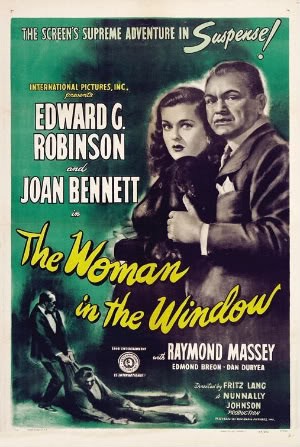
In many ways Fritz Lang’s The Woman in the Window (1944) plays like a dress rehearsal for his production of Scarlet Street the following year. Both films feature the same three stars – Edward G Robinson, Joan Bennett and Dan Duryea – and tell the story of a married, middle-aged man whose chance meeting with a young woman leads him into a vortex of murder, blackmail and ruin. However, where Scarlet Street is relentlessly grim, The Woman in the Window is a paler shade of noir – and not just because of its ending.

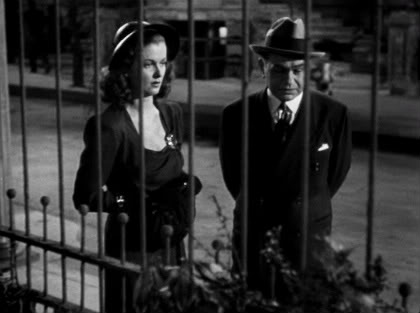
Richard Wanley (Robinson) is an assistant professor at a New York college whose wife and family have gone off on a trip, leaving him to his own devices. After an evening spent at his club with a couple of friends, including the District Attorney (Raymond Massey), he pauses on his way home to admire a portrait of a woman in the window of an adjacent art gallery. As he’s gazing through the window, the subject of the portrait, Alice Reed (Joan Bennett), appears by his side and, one thing leading to another, he ends back at her apartment. Up to this point everything seems innocent enough, but the abrupt and violent arrival of Reed’s lover sends the situation spiralling out of control. Although Wanley is left with no alternative but to kill his assailant out of self defence, he is also aware that his story is unlikely to be accepted and, even if it is, his life will be ruined. The solution – dump the body, destroy all the evidence and make like it never happened. Naturally, all of Wanley’s well laid plans start to unravel before his eyes as the police investigation starts to build up a body of forensic evidence that may soon cast suspicion on the hapless professor. The greatest danger, however, is posed by a shady ex-cop (Dan Duryea) with blackmail on his mind. The plot builds inexorably towards a suitably downbeat climax, yet this film has one last sting in its tail. I won’t spoil things for anyone who hasn’t seen this, but suffice to say that this ending has led some to question the noir credentials of the movie. Personally, I don’t share this view but I can see why it remains a bone of contention with some.

£37

As I said above, The Woman in the Window comes off as a lighter form of noir than Scarlet Street, and a good deal of this, aside from the ending, comes down to the portrayal of the characters. It is much easier to sympathise with Robinson’s character here, somehow his decisions, while questionable, seem more understandable. Bennett, too, is much less repugnant than would be the case in Scarlet Street. She is clearly a kept woman and a femme fatale, in the sense that she leads the protagonist into a dangerous, doomed situation, yet her motives are neither malicious nor wholly selfish. It’s only Dan Duryea, in another trademark role as a smirking villain, who fails to endear himself to the audience. There was something about the man – I think it relates to the casually mocking note in his voice – that led to his being typecast in such parts. There’s lots of noir imagery on show with a good deal of the action taking place at night and on rainy city streets. One recurring motif throughout the film is the number of shots which follow events through a series of open doors, symbolising (I suppose) the characters’ deepening crisis. The more I watch and re-watch Lang’s American films, the higher he grows in my estimation – I’d definitely rank him up among my top five directors.

The film was released on DVD last summer, along with a few other noir titles, by MGM in R1. The disc is totally barebones but the transfer is very good, maybe a little soft. There is a R2 available from Spain (I’m not sure about other countries) which, despite an English soundtrack and removable subs, is nowhere near this in terms of picture quality – fortunately, I managed to offload my copy on a friend who remains stubbornly locked into region two. If you’re a fan of noir or Lang then the R1 is the way to go, and I have no hesitation in recommending the movie.


Sorry, Wrong Number

I’ll start off by saying that I like films that employ flashbacks in the telling of the story. Of course, if this technique is going to be used it needs to be done well. An example of its misuse/abuse would be Passage to Marseille; where there are flashbacks within flashbacks within flashbacks to the point that the viewer is driven half crazy and loses all sense of time and place. Sorry, Wrong Number (1948) avoids falling into this trap. Here, those trips down memory lane are necessary to drive the story forward and they work perfectly.

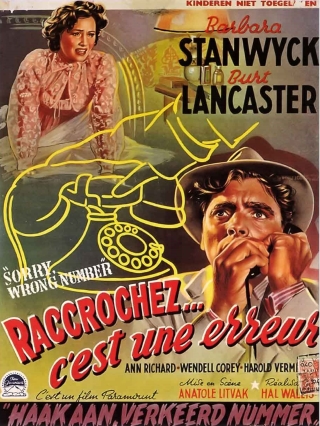
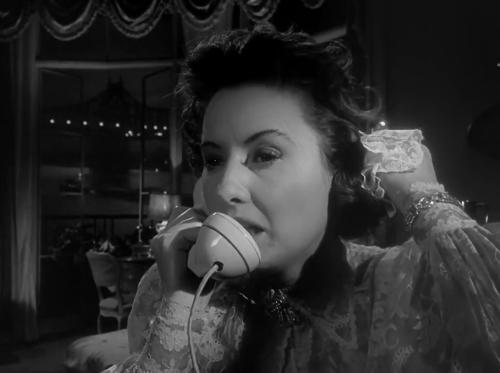
The film was adapted from a radio play and summarising the plot is not so easy without giving away too much, and thus ruining it for anyone who hasn’t seen it. Almost all of the action is played out via a series of telephone conversations involving Leona Stevenson (Barbara Stanwyck). Leona is introduced as a rich, pampered invalid who lives in luxury in Manhattan and, alone and bed-ridden, has only her telephone as a means of communicating with the outside world. As a result of a crossed line, she overhears a conversation between two unknown men as they finalise the details of a murder soon to be committed. Naturally alarmed, Leona first tries to tip off the police but they profess an inability to act given the sketchy information available. Her next thought is to get in touch with her husband Henry (Burt Lancaster), but that proves more difficult. Her attempt to contact him results in a series phone calls (and accompanying flashbacks) which gradually build up a complete picture of Leona, Henry and their life together. With each call another piece of the puzzle falls into place, and Leona slowly arrives at a horrifying realization.

Barbara Stanwyck has come to be regarded as something of a noir icon, largely through her icy portrayal of Phyllis Dietrichson in Double Indemnity. Where that film cast her as the archetypal femme fatale, Sorry, Wrong Number has her play the helpless woman in distress. She does well here with a character that starts off as an unsympathetic figure. As Leona moves from an initial petulance, through frustration to panicked terror, she manages to avoid the temptation to overact. All the emotions on display fit in with the type of woman revealed over the course of the film. Burt Lancaster was in the middle of a series of noirs, or noir tinged movies, at this point and he’s pretty convincing in the role of Henry. He begins as a blue-collar bit of rough who catches Leona’s fancy, becomes her pet plaything, and finally allows his simmering frustration and innate greed to draw him into criminality. There are also plenty of good turns from a support cast which boasts Wendell Corey, Ed Begley, Leif Erickson and William Conrad. While this is a movie full of flawed and unsavoury characters, the one sympathetic figure is Harold Vermilyea’s Waldo Evans. He’s the soft-spoken little chemist who dreams and saves in the hope of owning a farm where horses can roam free. When Henry spins him a tale that promises enough cash to realise this dream, the poor sap falls for it and his fate is sealed.

Sorry, Wrong Number fits the noir bill by delivering a story where there are no winners and no happy endings. We have a roster of characters whose greed, selfishness and weakness set them on a path towards their own self-destruction. The moody photography of Sol Polito is another essential ingredient, and it’s at its most effective in the scenes on Staten Island. This desolate setting, especially the decrepit 20 Dunstan Terrace, is a place where you just know darkness lurks.

The film has long been available on DVD in R1 from Paramount, and it’s a pretty good transfer. The print used is clean but it does display very heavy grain, particularly in the darker scenes. As usual from Paramount there’s not much in the way of extras, just a theatrical trailer. Still, the disc can be picked up for very little and the quality of the movie alone is more than enough reason to justify a purchase.

The Killers

I did something wrong…once.

So says the Swede (Burt Lancaster) as he lies in bed bereft of all hope, and calmly awaits his end. I love that scene near the beginning of the 1946 version of The Killers. It is one of the great moments of film noir and says so much about the genre – if you can even call it a genre. A good deal of its bleak power comes from the fact that it seems to run contrary to all normal human instincts. If someone were to burst into your room and breathlessly inform you that a couple of mean-looking hitmen had just rolled into town with the express aim of rubbing you out, most people would take the opportunity to make tracks fast. But Lancaster just remains prone in the shadows and delivers that line in the detached tone of a man already dead; when fate pays that last call there’s no ducking out.

Robert Siodmak’s film takes Ernest Hemingway’s short story (and it’s a very short story) and uses it merely as the jumping off point. The rest of the movie follows insurance investigator Reardon (Edmond O’Brien) as he tries to find out why the Swede ended up in a small New Jersey town waiting passively to greet a hail of bullets. The story is revealed by a succession of characters who had known the Swede, and a number of flashbacks gradually piece together all the events that brought about his demise. The Swede starts off as a medium grade fighter who, after breaking his hand and ending his career, begins the slow descent into the criminal underworld. This culminates in a payroll heist, the aftermath of which leads to the eventual downfall of just about everybody involved. The character of the Swede is basically a good-natured oaf whose desire for easy money allows him to be dazzled and duped by the grasping and predatory Kitty Collins (Ava Gardner). In a sense the whole film is as much about Kitty as anyone else; as we see her manipulations provide the catalyst for the betrayals that litter the story.

The Killers marked the screen debut of Burt Lancaster and his tough vulnerability is shown to good effect in the movie. There’s enough innocence in the Swede for you to genuinely sympathise with him and despair at the big lug’s stupidity as Kitty plays him for the ultimate sucker. Ava Gardner’s Kitty gets the classic femme fatale intro; we first see her as the Swede does – seductively clad in black satin and vamping for all she’s worth in a night club. Her character is rotten all the way through – effortlessly hooking the smitten Swede, playing the gang off against each other, and finally, tearfully begging a dying man to save her neck by damning himself. The role of Edmond O’Brien is to offer perspective and lead the viewer through the labyrinth of deceit; he’s really the linking device between all the small episodes that make up the whole. O’Brien’s own guide along the way is police lieutenant Lubinsky (Sam Levene from the Thin Man movies) and there is good support from gang members Albert Dekker, Jack Lambert and Jeff Corey. However, two of the most memorable turns come from William Conrad and Charles McGraw as Max and Al, the killers of the title. Their roles don’t extend much beyond the first ten minutes of the film, but those are ten truly magical minutes. They get some of the choicest dialogue (and deliver it perfectly) as they simultaneously mock and menace the occupants of the Brentwood lunch counter.

Robert Siodmak made some of the best noirs of the forties and I feel The Killers is his standout work. This is one of those films where plot, direction, characterization and photography all seem to come together harmoniously. Deep, dark shadows are everywhere and only the policeman’s terrace, where the ideal wife serves lemonade on a hot day, seems to rise above the murkiness. I should also say a word about the powerful score by Miklos Rozsa which is especially effective whenever Messrs Conrad and McGraw make an appearance.

The Killers is out on DVD from Criterion in R1 and from Universal in R2. I can’t comment on the presentation on the R2 disc as I haven’t seen it but bitter experience has taught that Universal’s UK releases are a hit and miss affair, with a high proportion of misses. The Criterion is everything you would expect from them with a beautiful, clean transfer to show off those deep, black shadows. As you would expect, the film comes packed with useful and informative extras – and, best of all, it is paired with Don Siegel’s 1964 remake (and Andrei Tarkovsky’s student film version). All in all, this represents the definitive presentation of what is probably my favorite film noir.

Ministry of Fear

poster60

The ‘entertainments’ of Graham Greene have provided a rich source of material for makers of Film Noir. The Third Man, This Gun for Hire and Brighton Rock have all been derived from his works and, if you want to stretch the point, a case could also be made for the inclusion of The Fallen Idol and Confidential Agent. This all goes to prove that there is enough darkness and pessimism in Greene’s writings for them to lend themselves to the shadowy world of noir. And so we come to Fritz Lang’s 1944 adaptation of Ministry of Fear, where a frightened Ray Milland blunders through the bombed out streets of wartime London in pursuit of fifth columnists.

Stephen Neale (Milland) has just been released from an asylum after having been confined for the mercy killing of his wife and, naturally, is anxious to avoid any further entanglements with the law. As he waits to catch a train to London, he wanders into a charity fete where a palmist helps him to guess the weight of a cake and win it. With this seemingly innocuous incident Neale finds himself drawn into a nightmare world of murder and espionage. It turns out that the fake spiritualist had mistaken Neale for a Nazi agent (Dan Duryea) and that the cake contained something worth killing for. Neale’s curiosity leads him to follow up the matter in London where he attends a seance in the company of, among others, the aforementioned agent. When the spy is murdered Neale is falsely accused.  He believes that due to his past conviction no one will believe him innocent of the murder and so he goes on the run. His only assistance comes from an Austrian refugee (Marjorie Reynolds), and while the pair try to seek out the truth they are all the time dogged by a shadowy figure in a bowler hat.

Ray Milland’s star was in the ascendancy at this point and he would win an Oscar for his performance in The Lost Weekend the following year. His role here allows him to get in a bit of practice in psychological anguish and the natural affability of the man means that it’s easy to sympathize with the plight of his character. Marjorie Reynolds is fine as his Girl Friday but the forced Austrian accent does begin to grate a little at times. Dan Duryea is always good value as a villain and the only complaint that could be made is that his character is not given nearly enough screen time. Indeed the same could be said for much of the support cast who seem to breeze in and out of the picture, but all leave lasting impressions. A notable feature of so many films of this period is the marvellous gallery of eccentrics that cropped up time and again. These people, whose faces are immediately recognizable yet whose names escape us, were character specialists who usually played similar parts in every movie and their presence added enormously to the enjoyment.

Fritz Lang’s background in expressionist film-making serves him well here and is most notable in the early scenes of the picture. The charity fete provides that slightly surreal quality that continues throughout the film. The parts with the fake blind man on the train and the ensuing chase over the fogbound moor are also beautifully photographed. Everything seems to have been shot on studio sets but this is no criticism as it helps heighten the unreal, otherworldly feel of the movie.

Optimum released Ministry of Fear on DVD in R2 last year. The transfer is not bad but it could use a clean up. All in all, this is a highly enjoyable mix of noir and espionage and it’s always good to see more of Fritz Lang’s movies making it out onto the market.

The Blue Dahlia

poster4 

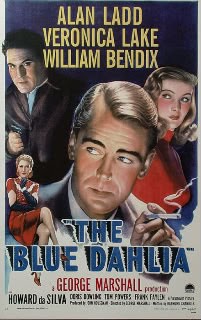
The Blue Dahlia (1946) was the third film that Alan Ladd and Veronica Lake had made together. While their two previous collaborations had been based on novels (This Gun for Hire by Graham Greene and The Glass Key by Dashiell Hammett) this one was from an original screenplay by Raymond Chandler. Anyone who has read anything by Chandler will know that plot always took second place to dialogue in his writing, and that’s certainly the case with this film. For me, the holes in the plot make this a less satisfactory affair than the earlier Ladd/Lake movies – I can’t comment on their last one Saigon since I have yet to see it.

The story concerns Johnny Morrison (Ladd), a navy veteran, returning from the war in the Pacific theatre. Arriving back in L.A. in the company of two of his former crew (William Bendix and Hugh Beaumont) he goes to meet his wife. Their reunion is not a happy one as his unannounced arrival finds her in the middle of throwing a party. Not only that, but he finds her to be having an affair with the shady owner of a night club, the titular Blue Dahlia. Unsurprisingly, he packs up and leaves. Later, the wife will be discovered shot dead with Johnny’s automatic and the suspicion naturally falls on him. The rest of the movie deals with his efforts to evade capture while trying to run down the real killer. The list of suspects is a long one, with just about every major character having either the motive or opportunity to have done the deed.

The performances are generally good and Ladd is convincing enough as the tough hero. Lake is not so good playing the estranged wife of the night club owner, although that may have something to do with the allegedly sour relationship between her and Chandler. Still, her screen chemistry with Ladd remains and they share some good scenes. The real standout turn, though, comes from William Bendix as the shell-shocked buddy with a steel plate in his head and a violent aversion to what he refers to as ‘monkey music’. The movie fits nicely into the noir category due largely to the trappings – clubs, cheap hotels and cheaper people, a neon lit L.A. and so on. As I said above, the dialogue was Chandler’s strong suit and helps to paper over the cracks and outrageous coincidences in the plot. The biggest problem of all is the ending. Chandler had originally written a different climax to that seen on screen but was forced to change it as a result of outside pressures. What we are left with doesn’t really work at all, for it makes a nonsense of much of what went before – it just comes across as weak and contrived.

The Blue Dahlia, whatever it’s weaknesses, was a title long desired on DVD by fans of noir, and Universal duly obliged with a release in R2 last year. However, the fact that it has been made available is about the only good thing I can say. The movie has not had any restoration work done and looks quite soft, worse than that is the ghosting which plagues the last half. So, I don’t think this is the best of the Ladd/Lake vehicles but it is stylish and fun – just not all that logical.