Man-Trap

By the 1960s film noir had had its day, at least that’s what the critical consensus tells us. Anything after that gets variously referred to as post-noir, neo-noir etc. I don’t know, age has made me less interested in labels and I find myself paying only scant attention to them these days; they are useful for marketing purposes and the like, but I’m not selling anything. So, all of that is just in the nature of a disclaimer lest anyone should object to my hanging the tag film noir on Man-Trap (1961) – I did so because the subject matter, resolution, personnel and general feel pointed in that direction for me.

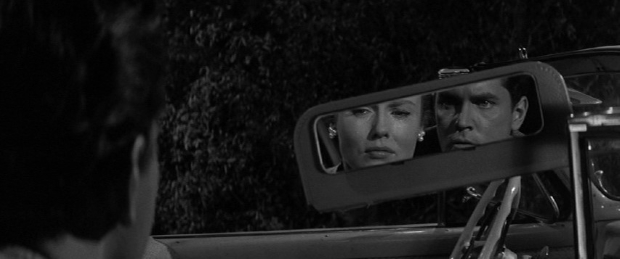
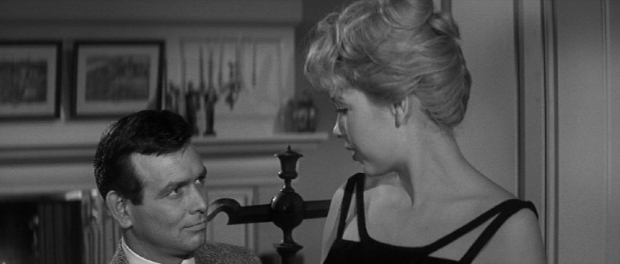
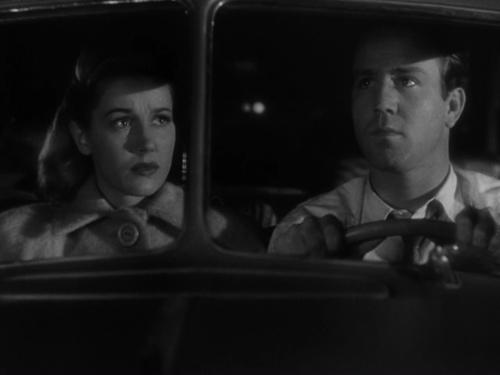
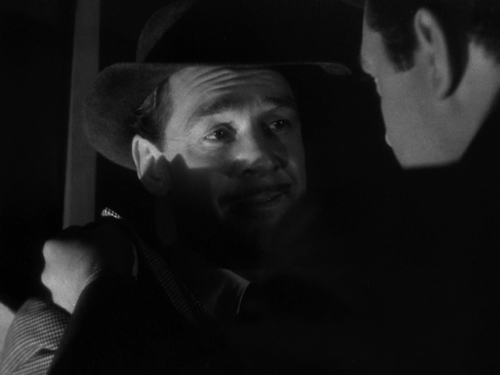
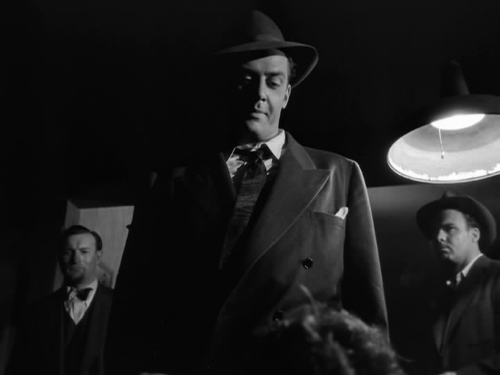
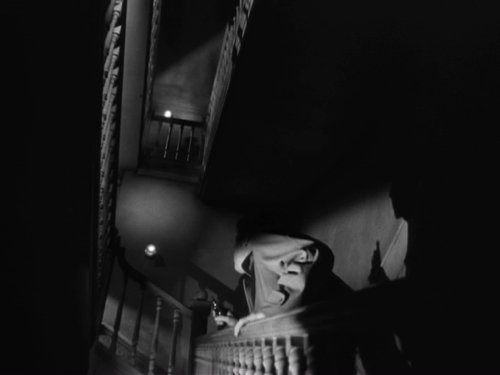
There’s a brief opening section, a prologue of sorts, which takes us back to 1952 and Korea. The purpose is to establish some facts that will influence the story to be told. We learn that Matt Jameson (Jeffrey Hunter) is a decorated war hero who got a medal pinned to his tunic and another piece of metal inserted in his skull while saving the life of his comrade in arms Vince Biskay (David Janssen). Years pass and Matt is trapped in an unsatisfying job and a marriage to the boss’ daughter Nina (Stella Stevens) that is even more toxic. He’s essentially been consigned to a suburban hell, an American nightmare of disillusionment and disenchantment. So, when Vince turns up, apparently out of the blue, brimming with roguish charm and a business proposition, Matt is moderately receptive to say the least. Vince has been hiring his services out to the highest bidder in Central America and in so doing has hit on a scheme to profit from political unrest and bag a cool $3 million dollars. As Matt’s relationship with the alcoholic and promiscuous Nina deteriorates, his desire for his secretary as well as the promise of full financial independence drives him to fall in with Vince’s scheme. All of this leads to a botched heist and a radical change of plan as the law, hitmen and domestic discord all begin to apply pressure.

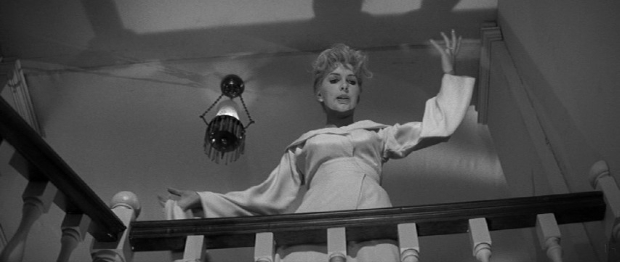
Man-Trap is full up of the kind of bad choices, ill fortune and empty opportunities that characterize film noir. Perhaps it doesn’t have the classic look, but that arguably evolved over time anyway and the slightly flat, TV movie appearance of the visuals is not entirely out of keeping with other late era offerings. Aside from a couple of television shows, this was only Edmond O’Brien’s second feature as director after his collaboration with Howard W Koch on Shield for Murder. It’s only a partially successful effort though, the low budget is always noticeable and the script isn’t all it could be. On the plus side, the heist sequence and its aftermath through the streets of San Francisco is well filmed and quite exciting. O’Brien manages to fit in some imaginatively framed shots here and there, but the writing remains problematic – the screenplay is an adaptation of a John D MacDonald (Cape Fear) story, which maybe creates unrealistically high expectations. The high point is the heist and the momentum is never regained after it takes place. That wouldn’t have to be a problem if the film wound up faster, but there’s still a whole lot of storytelling to get through before the credits roll.

I also get the impression that either O’Brien or the screenwriter Ed Waters wanted to make the movie a critique of the state of middle class America as much as a thriller, but ended up with those elements orphaned and only partially addressed. Matt and Nina’s rotten marriage feeds into this but it’s the portrayal of the appalling neighbors which hammers it home. This suburban degeneracy is peopled by a gallery of grotesques, sad swingers who spend their time boozing, leering and gossiping. It’s a snapshot of the moral decay simmering below the surface of the backyard barbecues. Maybe  it’s the presence of Jeffrey Hunter that had me thinking how it was vaguely reminiscent of aspects of Martin Ritt’s No Down Payment, though that is a far superior movie on every level and indeed almost like a Douglas Sirk film with the varnish scraped off. Man-Trap can’t aspire to that and although these aspects are diverting enough, I feel it might have worked better all round had it avoided them and kept its focus tighter.

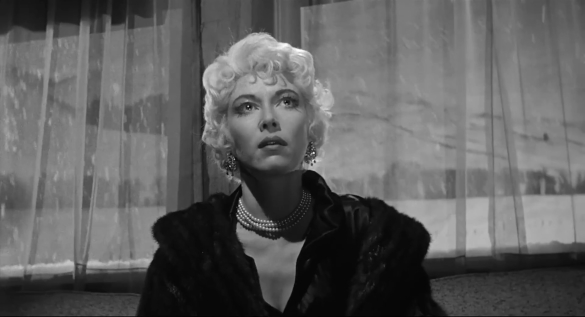
As for the acting, Jeffrey Hunter does reasonably well as the dissatisfied Matt, uncomfortable and unsettled for much of the running time, but the developments in the latter stages of the movie don’t succeed. Everything takes a detour into the type of ill-starred territory one would associate with a Cornell Woolrich tale yet it lacks the suspense that give such fatalistic fables their teeth. David Janssen, however, is excellent throughout. He nails the charm and duplicity that define the character of Vince, beguiling and bedeviling just about everyone he comes into contact with. On the other hand, the real weak link for me was Stella Stevens. She does well in the early scenes where her coquetry is to the fore, but the more her angst and desperation grow, the less convincing she becomes. In the end, it feels like a very transparent performance and it hurts the film as a result.
Man-Trap was a Paramount production and got a release in the US via Olive Films some years ago. That was a solid transfer, crisp and attractive in the way black and white ‘Scope movies tend to be. Olive are now defunct of course so I’m not sure how readily available the film is these days. All told, it’s a picture that works in places – Janssen’s characterization, the heist – but falls down due to scripting issues and some unsatisfactory work from the leading lady.

Storm Fear

Confinement breeds volatility. And confinement, be it physical, emotional, spiritual or social, is a key element in film noir. As space is limited, so is the room for maneuver and so are the options available to the protagonists. This is provides a situation ripe with dramatic potential – take a small group of characters menaced by an external threat and simultaneously squeezed by internal pressures and sit back to watch what happens. This is the essence of Storm Fear (1955), and it’s a formula which has been employed on and off by filmmakers in productions as diverse as Day of the Outlaw, The Small Voice and Key Largo.

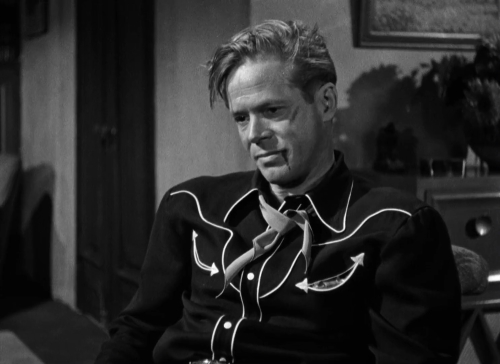
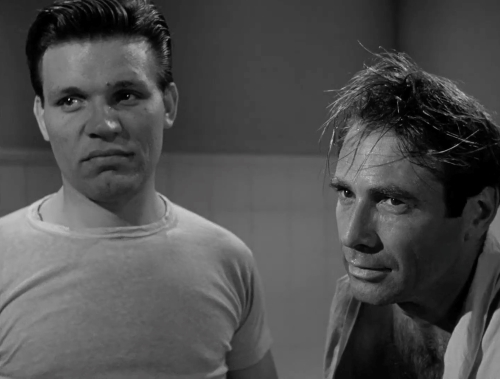
Storm Fear has its characters in uncomfortable places all the way through, right from the beginning when young David Blake (David Stollery) and Hank (Dennis Weaver), the hired help, come in from the snow, into the remote mountain cabin. David’s mother Elizabeth (Jean Wallace) is guarded and somehow restrained while her husband Fred (Dan Duryea) is even more detached. The mood and atmosphere of the cabin and its occupants is wrong, discontent and dissatisfaction pervade like some insidious form of emotional dry rot. Fred is a man bowed and broken by personal and professional failure, a shuffling, shambling figure forever burrowing deeper into the oversized scarf he twists and kneads, his comfort blanket in a world from which he has retreated. Elizabeth is a martyr to duty and disenchantment, going through the motions in a barren and loveless marriage. Suddenly, this chill facade is shattered by the arrival of Fred’s brother Charlie (Cornel Wilde). Charlie is a hood, a no-good type with a long history of crime following him around, and on this occasion he’s also got two accomplices in tow (Lee Grant & Steven Hill). He is on the run after a bank raid has netted him a sack full of money, a bullet in the leg and a looming murder rap. All of that ought to amount to a fair amount of pressure within and without yet there is the added complication of the tangled relationship which links Charlie, Fred and Elizabeth.

Cornel Wilde made his debut as a feature director with Storm Fear. He was also the producer and had Horton Foote adapt the novel of the same name by Clinton Seeley for the screen. In fact, Wilde assembled some impressive talent behind the cameras, with Elmer Bernstein providing the score and Joseph LaShelle taking care of the cinematography. As a result, this movie has a polished and highly professional look. Wilde paces everything well, drawing ample tension from the lengthy scenes within the cabin as the characters fume and feud. The climactic scenes out on the mountain, as the cold and weariness takes their toll, open things up somewhat, but that’s only in a superficial sense. The stark landscape and harsh conditions impose their own restrictions and in classic noir fashion the poor choices these people have been making throughout their lives narrow all their avenues of escape. It’s not so much a matter of being unable to stop what’s coming as being unable to outrun what went before.

Wilde’s acting is solid, he adds a slight stammer to his character’s delivery to indicate his core insecurity. It’s an affectation of sorts but it fits the character and he never makes it feel forced. Jean Wallace, who was married to Wilde, is especially strong in a difficult and multifaceted role. She is called upon to range from guilt and remorse to resilience and resolve. It amounts to a tricky balancing act on her part and she carries it off successfully all told. I guess most viewers will be accustomed to seeing Dan Duryea take on showy parts. As such, his portrayal of Fred Blake could be regarded as something of a departure. It’s a comparatively quiet role, contemplative and reproachful to the point of being ineffectual, with a hint of puritanism lurking below the surface. I’m not sure it works though. Lee Grant, making a rare screen appearance in the middle of those lost years when she was victimized by the blacklist, is almost unrecognizable as the bleached moll with a considerable thirst. I’ve seen largely positive reactions to Steven Hill’s turn as Wilde’s psychotic sidekick, but I can’t say I appreciated his work here. Hill was an alumnus of the Actors Studio and that is very apparent here. I’ve never been a fan of method acting although I’ll concede some such as Montgomery Clift made it work for them. Hill, a little like Rod Steiger at his most excessive, never leaves the viewer in any doubt that he is giving a Performance, and not for one moment did I feel he was anything other than an actor playing a part.

Kino released Storm Fear in the US years ago and it’s a handsome looking production. LaShelle’s crisp cinematography comes across well and the pacy, self-contained story never outstays its welcome. It’s a late-era film noir that harks back to the previous decade’s focus on personal rather than wider societal conflicts. While I have some reservations about a few of the performances, there are a lot of good things going on and the movie is certainly worth a look.

So Evil My Love

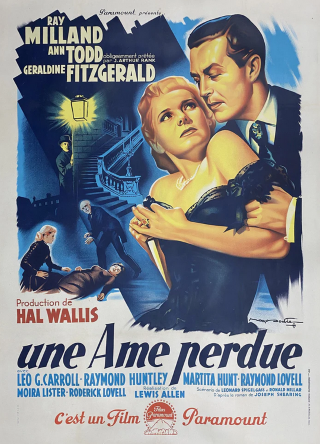
Guilt, corruption and obsession. That’s a heady mix for any movie, though it could be said to be nothing out of the ordinary for film noir. So Evil My Love (1948) is a kind of film noir, more Gothic melodrama I suppose yet it’s still dark and fatalistic enough, both visually and thematically, to just about make the cut as far as I’m concerned. It is something of a hybrid in more ways than one. Leaving aside any discussion of its noir credentials, the movie is one of those Hollywood funded and produced pictures that were made on location in the UK, and in this case making use of a cast of largely British and Irish actors – although all of the principals were working mainly in the US at this point. While there is much to enjoy and admire in the movie, there is a weakness which I feel ought to be mentioned. It has a marvelous visual sheen and well judged sense of atmosphere, but there’s also one central performance that I regard as deeply problematic, though fortunately it’s not as harmful overall as the issue that blighted Caught for me.

On a ship carving its way across the ocean from Jamaica to England a lone figure stands on deck, either oblivious to the spray on her face and the pitching deck beneath her or perhaps enjoying the experience. Olivia Harwood (Ann Todd) has been recently widowed, the death of her missionary husband leaving her with no option but to return home. She allows herself to be reluctantly coaxed into ministering to the ill on board the ship, chiefly one Mark Bellis (Ray Milland). On arrival in Liverpool it is immediately apparent to the viewer that Mark Bellis is perhaps not all he seems. He is ostensibly a painter, but his cautious probing to discover what, if anything, he revealed while in the throes of fever and then his determination to avoid the authorities set the alarm bells ringing. The fact is Mark Bellis (though that is merely one of the wide range of names he makes use of) is a genuine good-for-nothing, a swindler, a thief, a master manipulator, and apparently a murderer too. To such a man, a lonely, vulnerable and most likely gullible widow provides tempting game. And so it is he goes to work on Olivia Harwood, slowly worming his way into her heart while he sets about organizing his next robbery. However, the failure of that endeavor sees him altering his plans, and the beginning of his methodical and relentless corruption of Olivia. Under his tutelage, she finds herself not only taking advantage of an old friend, but also betraying and undermining her, taking a path that will inexorably lead to blackmail and murder.

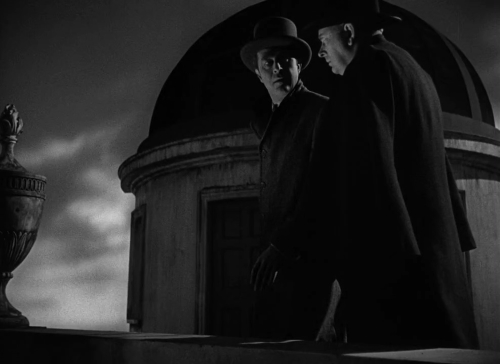
The film has bags of atmosphere, with ponies clipping along cobbled thoroughfares, discharging their silken passengers outside addresses that might be mean and unforgiving or forbidding in their splendor. Wherever the characters go, their surroundings seem to crowd them regardless of whether they are immense or cramped. Somehow there is a sense of all the hypocritical baggage of the late Victorian era forever pressing and suffocating. This feeds into or fuels the feeling of fatalism that pervades the movie. Right from that first scene on the deck of the ship there is an unmistakable air of characters trapped or hemmed in by a destiny shaped by their own weakness and frailty. Mark Bellis is unquestionably a bad lot and that is never in doubt, but it is Olivia’s downward spiral that is the focal point of it all. Director Lewis Allen made only a relatively small number of movies (just 18 over a period of fifteen years) but there are some real gems in among them – The Uninvited, The Unseen, Desert Fury, Suddenly and Another Time, Another Place are all good or better in my opinion.

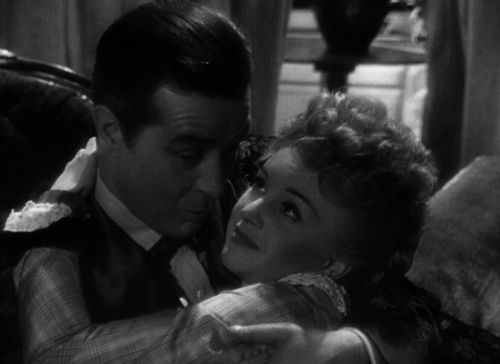
This is was a fairly productive and successful period for Ray Milland, coming only a couple of years after his Oscar winning turn for Billy Wilder in The Lost Weekend and he would follow this up with a pair of strong films noir for John Farrow in The Big Clock and Alias Nick Beal. This type of role, an oily and calculating charmer, was a good fit for Milland. He had the polish to carry it off convincingly and was also able to tap into a rich seam of desperation when the whispers of his typically dormant conscience grew more insistent. Geraldine Fitzgerald is characteristically fine too as Olivia’s ill-fated friend, brittle and foolish, quick to trust in her hunger for companionship and kindness, and touchingly meek in her willingness to accept her guilt.

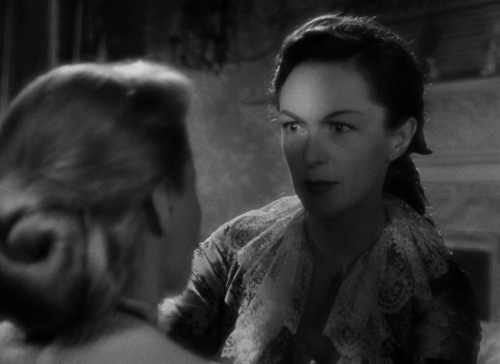
Nevertheless, as I alluded to above, there is an issue that damages the movie seriously. The behavior of Ann Todd’s character simply fails to convince me. She is right at the center of things, the heart of the movie in truth, and both her actions and the core characteristics need to ring true for it all to work. And for me this does not happen. I can accept that obsession and infatuation is capable of driving people to places they would not normally go, but I find Olivia’s sudden decision (remember, this is the widow of a Victorian missionary we’re talking about here) to betray her friend’s confidence and the consequent acceptance of the necessity for extortion to be so abrupt as to defy credibility. What’s more, there is then far too much inconsistency on display, the character’s morality and motivation shifting almost from scene to scene. This is a writing issue of course rather than an acting matter – the script is adapted from a story by Joseph Shearing (a pseudonym used by Marjorie Bowen) who also provided the source material for Blanche Fury and Moss Rose. The latter film does have some contrived or unrealistic elements, but there’s not that inconsistency which troubles me here.

On the other hand, there are some excellent supporting turns to help restore the balance. Martita Hunt is chillingly intense as the overprotective grande dame. It is a bit of a stretch to see Raymond Huntley as her son – he was only four years her junior after all – but his cold lack of compassion is neatly done. Moira Lister sashays in and out of the tale as a trashy model whose vanity and vulgarity bring matters to a head. Leo G Carroll’s low-key detective lurks around and does his bit to draw the net tighter. And Maureen Delany, Hugh Griffith and Finlay Currie all have small yet memorable parts.

All told, So Evil My Love is a movie that works in places. There is no doubt that it has style, and some of the acting is excellent – Geraldine Fitzgerald rarely fails to impress me, for example. Still, Ann Todd’s role is an issue. That zigzagging from demure respectability to coquettish scheming and back again on the way to grim vengeance is something I just can’t buy into. Others may well regard this as less problematic. As it stands, I guess it amounts to two thirds of a good movie, or maybe three quarters if I’m in a more generous frame of mind.

Caught

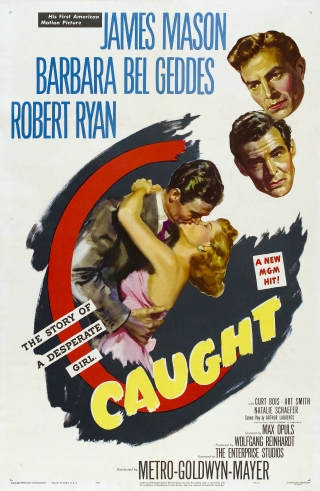
Seeing as Max Ophuls came up in some of the comments on the previous post, I decided to go back and have another look at one of his movies that I have struggled with in the past, namely the 1949 production of Caught. As a rule, I have enjoyed what I have seen of the director’s work, but this film has never worked for me. Anyway, with his name fresh in my mind, as well as the knowledge that the movie seems to be well regarded by many other viewers, I thought I should give it another chance. In brief, and this will be one of my shorter posts, I still have major issues with the movie. To be honest, the fact that I made it to the end was as much through a sense of obligation as anything.

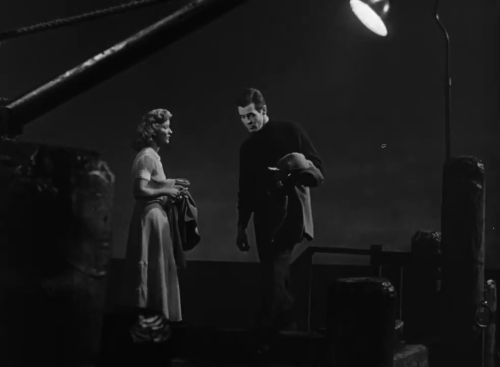
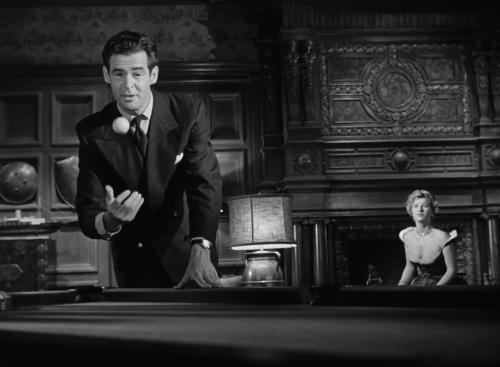
The whole thing is an examination of wish fulfillment and the consequent importance of being very careful indeed of what one wishes for. It opens with two sisters in a shabby tenement mooning over glossy magazines and browsing for dreams, a gem encrusted necklace here, a platinum bracelet there, and so on. As ever, money and the power it bestows matters very much to those who have little of it. Leonora (Barbara Bel Geddes) wants the security and the comfort that comes with wealth, and it does come her way as the result of an invitation to a party on a yacht, an invitation she very nearly turns down. This is the thing with Leonora – she wants things and then doesn’t want them when their real cost becomes apparent. When she makes the acquaintance of Smith Ohlrig (Robert Ryan), a tycoon with a deeply disturbed character, she is soon on the fast track towards the high life on Long Island. However, this is where it all goes wrong for just about everyone involved. Ohlrig is a domineering, controlling and cruel man, an obsessive soul at war with himself and the world in general. Leonora soon comes to see the stew she’s landed herself in and, wisely one would say, moves out and ends up working as a receptionist in a slum neighborhood for Dr Quinada (James Mason). From here the movie devolves into a series of sorties back and forth for Leonora as her indecision along with a deep-seated conviction that she has to “improve herself” at all costs winds up being a good deal more expensive in emotional and physical terms than she’d bargained for.

Max Ophuls’ direction is a pleasure – his camera swooping, swinging and panning, following his characters and sometimes sweeping past them to draw attention to the variously opulent or cheap surroundings while they debate, argue or simply muse out of shot. It’s a distinctive style and Lee Garmes’ cinematography adds to the eye-catching visuals. Attractive as all this may be, it’s not enough to paper over the paucity of genuine character at the heart of the movie. Robert Ryan’s Howard Hughes inspired sociopath is a showy piece of work, neurotic and foul and yet also somehow pitiful in his inadequacy. However, there’s a big hole in the middle of it all for me, and that’s the result of the role played by Barbara Bel Geddes. I started off feeling for her as she struggled to dig herself out of the poverty trap. The fact is though that she’s a playing a woman with essentially no character, a whiny, vacillating type who seems to revel in helplessness and indecision. This is the person who is the main focus and it’s very hard to like a movie where the central role presents such a moral vacuum. And the less said about the “happy ending” we’re asked to buy into, the better. James Mason’s first Hollywood starring role is fair, but he’s given little to do to stretch him –  he does have at least one good scene in the garage confrontation with Ryan and Bel Geddes. The support is mainly an attractively homespun turn from Frank Ferguson and a well observed peek at degradation and dissipation by Curt (“Tough, darling, tough.“) Bois.

Max Ophuls made far better films than this – The Reckless Moment, again with Mason, came shortly afterwards and is superior in every respect, and there are his great French movies such as  The Earrings of Madame de… and La Ronde. I honestly wish I could like this film more, but it just does not do it for me.

Desperate

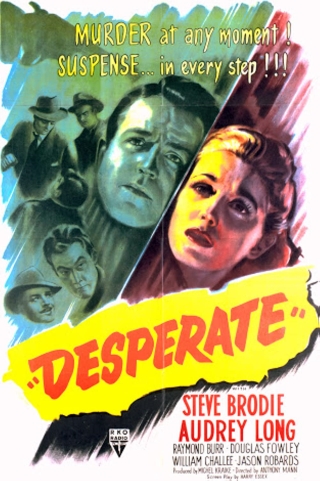
With a title like Desperate (1947) and a lead character who is a veteran striving to make a success of both his new marriage and his job, it might be reasonable to expect the focus to be on the desperation related to difficulties in settling back into civilian life. What we get, however, is a classic film noir scenario based on some dubious choices and flawed judgement. It is often said that the kind of maladjustment that appeared to dominate the post-war landscape was a major driver of film noir in the mid to late 1940s. I guess the initial poor call by the protagonist that sets everything in motion could be regarded as being tangentially influenced by that, but it’s really just a matter of a guy looking to make a bit of extra cash and how that draws him into one of those spiraling nightmares where it seems virtually impossible to catch a break.

Steve Randall (Steve Brodie) is trying to make a go of it as a trucker and makes what turns out to be a fateful decision to accept a job offer from an anonymous caller. He could have been enjoying a celebratory dinner with his new wife Anne (Audrey Long), and she could have broken the happy news that there was a baby on the way. However, a man just starting out needs money and so the prospect of some easy cash for an evening’s work is too alluring to pass up. That this is the first of Randall’s poor choices becomes abundantly clear when he turns up for the job only to be greeted by a shady old acquaintance, Walt Radak (Raymond Burr). He then discovers that he is expected to haul away the spoils of a warehouse heist. That would be bad enough in itself, but a bungled escape bid by Randall stirs up the thieves and leads to the shooting of a cop and Radak’s brother getting arrested.

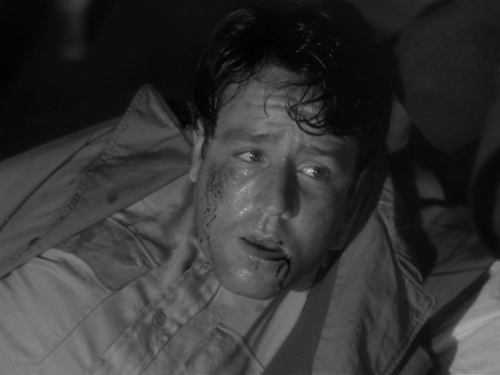
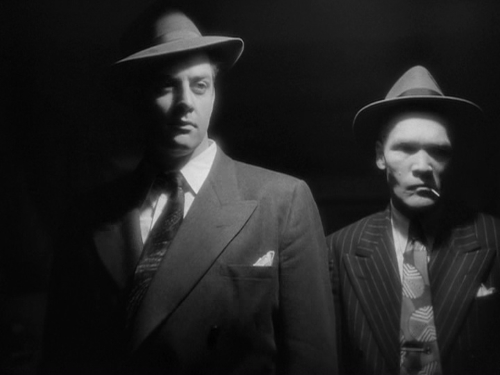
Radak is, not unnaturally, sore, sore enough to have his hoods hand out a brutal beating along with a warning that Randall’s wife will suffer too unless he is prepared to take the rap and by doing so exonerate the brother, who is now looking at a date in the death house on a murder rap. Now a smart guy would take the chance to go to the police at this point, say his piece, and let them provide the protection. However, Randall doesn’t do that; he proceeds to make the next of his poor choices and goes on the run, not to save himself but to find a sanctuary where he can stow his wife till the increasingly tangled skein can be unraveled.

So the story follows Randall as he tries to keep at least half a step ahead of the vengeful Radak, and to avoid further run-ins with the law. In a sense, everybody, all of the main characters anyway, grow progressively more desperate as the plot unfolds. Randall fears for his and for his family’s safety, Anne’s anxiety for her husband and child is a constant, and Radak’s hunger for retribution against the man he holds responsible for his brother’s plight becomes almost monstrous.


The tendency is to think of Anthony Mann’s films noir in terms of his work at Eagle-Lion in collaboration with cinematographer John Alton. However, Desperate was made for RKO and was shot by George E Diskant. Alton or not, Eagle-Lion or not, this is without question an Anthony Mann movie. Visually, it is inventive and disorientating – the beating of Randall, as the overhead lamp swings ominously like a blade slicing through the shadows as the hoodlums’ fists slice up the hero, has Radak dipping in and out of darkness like some malign bogeyman. Characters are frequently either squeezed by the frame or shot from unexpected angles, everything highly suggestive of people under pressure and facing circumstances that are fraught with peril and insecurity. Mann has a credit for the story, from which Harry Essex wrote the screenplay, and it is an incident packed affair. If anything though, the movie is probably overloaded with incident, something that becomes even more noticeable when one takes into account the brief hour and a quarter running time. That said, it does contribute to the sense of urgency of the production and perhaps could be seen as going some way toward explaining Randall’s questionable judgement on many occasions. Thematically too, there is much that we associate with Mann on display, notably the violence and brutality the characters must endure, and that typical sense of movement and direction, not so much forward as upward, that ever present striving to reach some high place, which in this case culminates in the shootout on the tenement stairway.

Steve Brodie was a perennial supporting player, a name and a face that will be familiar from countless movies and TV shows. That he never got the lead outside of Desperate is no slight on his acting abilities, he simply wasn’t the type physically to be cast in headline roles. What he had, however, was a recognizably everyman quality with the features and demeanor of a regular guy. As such, he was well chosen to play Steve Randall – it is easy to accept him as a man who can be worked over, one whose decisions will be flawed from time to time. Raymond Burr plays Radak as a relentless and driven figure, and Mann makes good use of his bulk, having him crowd and dominate the frame on multiple occasions. Audrey Long spends much of her time fending off a gnawing anguish and the script offers her little or no opportunity to do anything beyond that. In support, Douglas Fowley, another familiar face from countless movies as well as a recurring role as Doc Holliday on The Life and Legend of Wyatt Earp, is superbly seedy as an ill-fated private eye, while Jason Robards Sr playing the detached detective with the singsong delivery is unusual enough to make his relatively small role memorable.

Desperate came out on DVD from Warner Brothers on one of their later film noir sets and it looks very well. The films Anthony Mann made for Eagle-Lion from around this time draw more critical attention and their profile is correspondingly higher. I reckon the script is a little crowded and busy, but the movie is a good one overall with a strong sense of momentum and it stands as a solid example of the director’s noir work.

High Wall

Many a film noir has traded heavily on mistrust, betrayal, isolation. These are themes that breed doubt and underpin anxiety, and what better way to highlight doubts and anxieties than to tell a tale through the eyes of an amnesiac. Even partial loss of memory becomes a type of betrayal of self, a descent into the classic inky nightmare of the noir universe where a person can no longer feel confident in their own being, where awareness is forever tempered by a gnawing fear that there may be something contemptible lurking within one’s own heart. This notion of the unreliable narrator has enjoyed sporadic popularity and saw something of a revival in crime fiction and its adaptations a few years ago. High Wall (1947) toys with this concept, but it doesn’t really pursue it. Depending on the viewer’s own tastes, that may or may not be regarded as a strength.

We open on a club scene, one of jazzy music, well-heeled revelers clustered round tables or taking a turn on one of those characteristically small dance floors. The camera glides along, drinking it all in and then pauses on a figure at the end of the bar, perched there with his own drink in front of him. His entire demeanor screams disquiet, the cultured, patrician features rumpled and strained by some inner turmoil. He is Willard Whitcombe (Herbert Marshall), a publisher of virtuous literature. After establishing his identity, we cut to the interior of a speeding car, the driver’s countenance set and grim, hurtling down the highway while the lifeless body on the seat beside him lolls obscenely. And then he ploughs off the road, seeking to join the departed passenger who’s been keeping him company. This is Steven Kenet (Robert Taylor), one of those damaged veterans, a man not really recovered from a head injury suffered during the war. That corpse he had been taking on a ride across his own version of the Styx belonged to his wife, and his addled brain has convinced him he must have strangled her before blacking out.

Well, that’s not how things work out, and Kenet finds himself rescued and sent to a psychiatric hospital for assessment. This is the point where the plot kicks in properly, where the patient’s despair gradually transforms into doubt, partly due to the almost complete disintegration of his family and partly as a result of the efforts of Dr Lorrison (Audrey Totter). As we follow Kenet’s painfully slow quest for enlightenment regarding those lost hours, there is another strand unspooling in parallel. While our protagonist might be assailed by fear and uncertainty, there hasn’t been a great deal of doubt in the minds of the viewers as to who the guilty party really is. I don’t think it would amount to a significant spoiler to reveal the identity here  – allusions aside, the truth is explicitly spelt out on screen before long anyway – but I’ll refrain from doing so. Of course people can feel free to do so in the comments below if they wish.

Seeing as the script by Sydney Boehm and Lester Cole does reveal the culprit quite early, it is probably fair to assume that the intention was to make this less of a mystery or whodunit and more of a suspense picture. The viewer is not invited to follow a detective figure as he ferrets out leads to corner the killer. We already know who this is, and we also know that the hero is just that and not some cleverly disguised bogeyman waiting to spring a surprise. Somewhat similar to the inverted mystery, the suspense derives from our being a hop, skip and a jump ahead of everyone on the screen, knowing more than they do yet unsure of how or when they will acquire that knowledge. As a premise, this certainly has its merits, but my feeling is that it tends to draw some of the sting out of the amnesia plot, perhaps diluting the potency of the noir scenario in the process.

Curtis Bernhardt had a flair for both film noir and melodrama, and that strong run he embarked on from the mid-1940s, starting with Conflict and extending through to Payment on Demand, saw some of the sensibilities and trappings of both styles bleed into each other. While I have a few reservations about some of the scripting decisions, that is not to say the film is weak overall. Bernhardt’s atmospheric direction is a big part of what makes it work, elevating even the most mundane situations through sheer visual bravado. He manages to elicit tension and the hint of needle from something as simple and prosaic as two people squeezed into a phone booth in a diner, and then juxtaposes hope and despair by having the hero escape a full on deluge by taking a shortcut through a virtually deserted church on his way towards ultimate salvation. Brief, throwaway moments that employ the visual language of the cinema with wonderful eloquence.

There are a good many high points in the post-war career of Robert Taylor, and the quality of his work was remarkably consistent up till at least the start of the 1960s. Pretty much all of his films noir are enjoyable and High Wall is one of the better ones – personally, I’d place Rogue Cop and Party Girl ahead of it but that still leaves it occupying a very respectable third place. He gets the hunted intensity of the amnesiac, the primal guilt that the condition provokes, across very successfully. When this movie was made it seemed as though Audrey Totter was destined to be cast in nothing but film noir, which can be taken as a testament to how comfortably she slotted into that murky style. As a rule, I think I prefer her in unsympathetic roles where her pouty petulance can be so effective. However, she is very much the Girl Friday figure in High Wall, somewhat severe and sober, but loyal and resourceful too. Regardless of the part he was playing, be it hero, villain or anything in between, Herbert Marshall brought what I can only describe as an air of reassurance to the screen. His presence alone could typically be taken as proof that the movie would be a good one.

High Wall has been available on DVD for years as part of the Warner Archive, looking quite strong but sadly devoid of any supplementary material. It is a good, solid noir that falls just short of the very top flight, probably due to the nature of the script. However, it fits neatly into that tantalizing sub-genre of Freudian-influenced dramas and thrillers that flourished in the mid to late 1940s. While it has a few flaws, the direction of Curtis Bernhardt and the strong central performances of Robert Taylor, Audrey Totter and Herbert Marshall easily compensate. Highly recommended.

Johnny Stool Pigeon

It’s interesting to watch movies that might be described as halfway house efforts, they have an air about them of remote outposts on clinging on at the frontier of genres, one eye fixed on a particular set of circumstances and the other looking in a different direction like a sort of cinematic Janus. Johnny Stool Pigeon (1949) has a touch of that, casting ahead to the rapidly approaching decade where the focus would shift firmly to tales of a society under threat from shadowy but large scale criminal organizations while still retaining a concern for the battered and bruised individuals who represent the life blood of the genre.

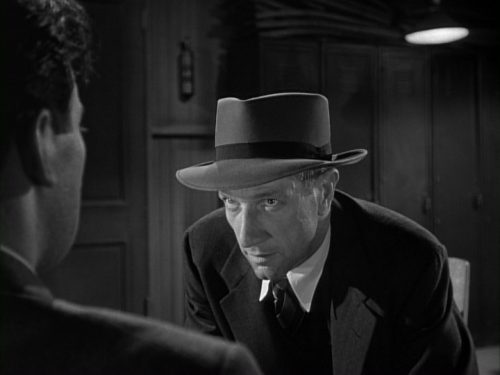
A federal sting aimed a netting a drugs courier just off a boat in San Francisco leads to the suspect taking a bullet during a chase through a dockside warehouse. The agent who had been hoping to make an arrest is Morton (Howard Duff) and he’s the insistent type. Running down the man who did the shooting is easy enough, but picking him up in order to apply a bit of pressure proves trickier. Organized crime is dependent on tip offs and betrayals, and so it is that word filters through of what the authorities have in mind. The result? Another mouth silenced and another link cut out of the chain leading back to the narcotics suppliers. This is all routine stuff so far, but the apparent brick wall confronting Morton calls for some creative thinking, and enlivens the story as a consequence. His reasoning is that if the organization can’t be broken from the outside, then it will have to be done from the inside. The problem of course is how to get in. The key to unlocking that particular door rests in the hands of Johnny Evans (Dan Duryea), a hood and gangster serving time in Alcatraz thanks to the efforts of Morton, and nursing the kind of deeply felt grudge one might expect. Conveniently, from Morton’s standpoint at any rate, Evans’ wife has recently died from the effects of drug addiction so there’s plenty of emotional leverage on hand. Forming an uneasy alliance, Morton (now going under the name of Doyle) and Evans head first to Vancouver in Canada and then back down south to Arizona on the trail of the head of the syndicate. While all this is taking place, there is an added complication provided by Terry (Shelley Winters), a girl keen to escape the clutches of the mob.

Frankly, the gangbusters element of the story is by the numbers stuff, well enough executed but hardly riveting. Any plot that makes use of the lawman going undercover trope naturally generates suspense and tension, and that is certainly true here. I guess the involvement of a potentially hostile figure such as that portrayed by Duryea adds a touch of uncertainty, although there aren’t really any jaw-dropping twists in store. For all that, the movie is entertaining in the way so many Universal-International crime pictures are. It displays a brisk lack of pretension, a utilitarian stylishness that is alluring. William Castle is best known these days for those horror and thriller movies he concentrated on from the late 1950s onward. However, his credits in the preceding years show the breadth of his body of work. He worked in many genres and deserves more recognition for the frequently tight and fast-moving westerns, adventures and crime movies he cut his teeth on. When Johnny Stool Pigeon was made he had just moved to Universal-International after spending years working on a number of series for Columbia, such as Crime Doctor (somebody please release a set of these enjoyable B pictures!) and The Whistler. The economical shooting and storytelling style of these low budget movies would stay with him and inform much of his subsequent work.

I have  seen and enjoyed so many Dan Duryea performances over the years. Broadly speaking, he tended toward two characteristic types. On the one hand, there was the sly, wheedling good-for-nothing, slouching from one cheap subterfuge to another. On the other hand, he could be a loud, booming braggart, a strutting peacock daring all to challenge his brashness. His role in Johnny Stool Pigeon is something of a hybrid, with a couple of real firecracker scenes that have him cutting loose and barking at Barry Kelley and Howard Duff respectively, as well as more subtle, yet paradoxically more powerful and affecting, moments such as his visit to the morgue to identify the body of his wife. Threaded trough the whole performance though is that air of tough melancholy he always wore. He had about him the aura of a man assailed by wry bitterness and relentlessly pursued by some nameless regret.

Howard Duff enjoyed a fairly successful run from the late 1940s till the middle of the next decade as a lead of the square -jawed variety. I wouldn’t say he had great range but he was an agreeable screen presence. He is rather aloof in Johnny Stool Pigeon, distant and frankly stiff in many scenes. In his defense, the role he was playing was that of a man in an especially precarious position, one who would have needed to maintain a cool and icy grip on himself at all times. Still, the contrast with Duryea’s full-blooded performance is marked. Shelley Winters weighs in with a credible mixture of street-smart and vulnerable, and her character’s influence on both her co-stars and the eventual resolution of the story is noteworthy. In support, John McIntire is typically impressive, his back-slapping bonhomie masking a dry, cold core. Tony Curtis, in one of his earliest appearances, has the role of a mute assassin. He may not have had any dialogue but he gets plenty of screen time to glower and brood.

Johnny Stool Pigeon was another movie that was impossible to view in anything other than the crummiest condition until Kino released it recently. It’s not going to make anyone’s list of the best films noir, and just about everyone involved would make stronger movies. Nevertheless, it is very watchable and enjoyable, brief and pacy and possessed of that appealing Universal-International vibe this viewer generally finds irresistible.

Where the Sidewalk Ends

Otto Preminger’s Where the Sidewalk Ends (1950) has the feel of something that might have been cooked up had Cornell Woolrich and William P McGivern ever decided to collaborate on a story. There is that quality of the inescapable nightmare, a fatalistic vortex relentlessly dragging the protagonist down, while he is one of those big city cops who appears to be as uncomfortable in his own skin as he is in the department he works for. The end result is a form of psychological trial by ordeal, where the moral fiber of a man is measured by his ability to meet the challenge laid down by his own past.

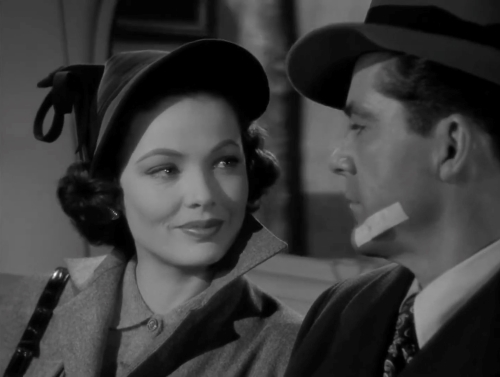
Right from the beginning it is clear that Mark Dixon (Dana Andrews) is a man in trouble. The patience of his superiors in the police department with his brutal, two-fisted approach to the job is wearing perilously thin. What is perhaps more dangerous though is his appraisal of himself. It’s not voiced yet the truculence that pervades features, manner and posture clearly announces a deep-rooted dissatisfaction. With a final warning still ringing in his ears, he sets out to investigate the death of a rich out of town businessman. The victim ought to have been the mark in a rigged game of dice, but a bit of bad luck on the part of the mobsters running the racket leads to a misunderstanding, which leads to a scuffle, which leads to a murder. So Dixon is one of the bulls sent to investigate and is soon on the trail of the man being lined up as fall guy for the killing. Seeing as this is a story that is full to the brim with ill fortune and bad judgement calls, it is somehow inevitable that a man with a hair trigger temper such as Dixon is going to get into deeper strife when he finds himself alone with an antagonistic suspect. That’s exactly what happens, blows are traded and the suspect, a war veteran with a metal plate in his head, winds up dead on the floor. And it’s here that everything begins to spiral completely out of control. Shocked and panicked, Dixon attempts to cover up the accidental killing, but once he sets the ball rolling the momentum generated threatens to crush everything and everyone in its path, not least the dead man’s father-in-law.

The entire business is further complicated by the fact Dixon finds himself falling in love with the estranged wife (Gene Tierney) of the man he’s just killed. What follows is a variation on that noir trope of a man investigating a killing he is responsible for, the hunter essentially hunting himself. The personal angle and the need to see that blame is not wrongly placed on an innocent man adds some spice, as does the fact Dixon is all the time fighting an internal battle borne of the fact his own father was a career criminal. It sets up an intriguing study of the concept of justice and how it may be best achieved, as well as looking at the potential for attaining personal and professional redemption.

Where the Sidewalk Ends feels like something of a watershed movie. That whistling intro with the opening bars of Alfred Newman’s Street Scene playing over credits chalked on the sidewalk, suggestive of the casual impermanence of a crime scene and the expedience of the methods used to mark it out, as anonymous citizens stroll past seems apt given the way film noir – that genre that wasn’t even aware of its own name at the time – was moving along into other areas. As the new decade went on noir would move gradually away from those tales of personal misfortune and shift its focus onto wider societal ills, organized crime and institutional corruption. The director too would soon be on his way, leaving behind the restraints imposed by being under contract to a major studio.

Recently, after revisiting Preminger’s Anatomy of a Murder I was watching one of the supplements on the Criterion Blu-ray where Foster Hirsch was commenting on the directors insistence on shooting that movie on authentic Michigan locations. Some of that fondness for using real locations comes through in Where the Sidewalk Ends too with much of the film shot on familiar Fox studio sets, but also taking the cameras out onto the streets of New York where possible to give it an air of genuine urban grit. The whole picture has a strong noir aesthetic, canted angles, telling close-ups, characters clustered in tight, claustrophobic spaces framed by doorways and windows, and plenty of shadows carefully lit and photographed by Joseph LaShelle.

Where the Sidewalk Ends was the fourth of five films Dana Andrews would make with Preminger. All of their collaborations are interesting and there’s not a bad movie among them. Andrews has always been a favorite of mine whatever genre he happened to be working in and I’m sure I’ve spoken before of that marvelous internalized style he used so effectively on so many occasions. The part of Mark Dixon allowed him to tap into that: his rage and hunger for violence barely contained every time he encounters Gary Merrill’s conceited gangster, the appalled horror at what he has done when he realizes the murder suspect is lying dead before him, and then the sickening, sliding sensation as he witnesses the net cast by the law drawing tighter around those who least deserve it. These are all different emotions and reactions yet all of them are perfectly conveyed with great subtlety and quietness by Andrews – superb screen acting. Gene Tierney was another veteran of Preminger’s movies, making four in total for the director over the years. One might say her character isn’t as directly involved in the story yet her presence is one of the primary drivers of the plot – the initial killing stemmed partially from her attendance at the dice game, her father called on her abusive ex and placed himself at the scene of the crime as a result of what happened to her, and Dixon’s journey back from the brink towards redemption could not take place without her.

Gary Merrill is good enough in the role of the villain, although he is off screen quite a bit. In a sense though, one could argue that Merrill is not the main villain, that honor belonging to Dixon’s father, the ghost of a long dead hoodlum haunting his son’s conscience and putting a hex on his character. An uncredited Neville Brand makes for a memorable sidekick, superficially tough but easy to crack under pressure. That pressure is applied not only by Andrews but also by Karl Malden as the newly appointed lieutenant who is keen to make a quick arrest. As Tierney’s cab driver father, and Malden’s prime suspect, Tom Tully is hugely endearing. Both Tully’s playing and Tierney’s devotion to him lend credibility to the conflict which assails Andrews as the plot unfolds. All of the supporting actors turn in good work, including Bert Freed, Craig Stevens and Ruth Donnelly. I want to add a brief word too for Grayce Mills, who only appears in one scene. Many of these studio productions contained seemingly throwaway moments, little vignettes that are easily overlooked yet frequently stick in the memory. Such is the case with the old widow living the basement below the apartment where Andrews runs into trouble – there is something touching and memorable about this old lady’s few telling lines about the insignificance of time to the aged, and how she sleeps in the parlor with the radio softly playing to assuage her loneliness.

Some years ago the Bfi released a Blu-ray set of three Otto Preminger films noir comprising Where the Sidewalk Ends, Whirlpool and Fallen Angel, but it now seems to have gone out of print. Anyone fortunate enough to have picked that set up will know that this movie (and the other two titles) looks exceptionally good so it’s worth keeping an eye out should it be reissued, or if a competitively priced used copy pops up.

So, this year ends with Where the Sidewalk Ends. My thanks to all of you who came along for the ride, and I hope I’ll be seeing you again in 2023.

Vicki

One thing leads to another. A few weeks ago a bit of discussion on remakes came up, or to be more precise the relative merits of both Thorold Dickinson’s and George Cukor’s versions of Gaslight. Not long before that I’d been looking at Richard Boone in a movie directed by Bruce Humberstone, and it then occurred to me that Boone had starred in a remake of one of Humberstone’s earlier movies. Anyway, that meandering thought process led me back to Vicki (1953), a reworking of the proto-noir I Wake Up Screaming. Generally, I like to approach or assess movies on their own terms, as discrete pieces of work, where possible. Remakes make that a little trickier of course, particularly when one is very familiar with the other versions. Viewed on its own, Vicki is a moderate noir thriller of ambition, obsession and murder.

Vicki Lynn (Jean Peters) is a model, something which is immediately apparent from the opening shots of billboards and sundry advertisements, all prominently featuring her name and image and urging Joe Public to buy whatever it is she happens to be selling. However, perhaps I should have started off by stating that Vicki Lynn was a model for, despite her fame and ubiquity, our first glimpse of the lady herself is of the toes of her shoes protruding from beneath the sheet covering her corpse as it’s about to head off to the morgue. So Vicki Lynn was a model who has been murdered, and the story that plays out on the screen tells of the investigation into her demise and of the people most intimately involved in her rise and fall. Much of what transpires comes via a series of flashbacks courtesy of the interrogations of the main suspects at police headquarters. Most of the information, and therefore the impressions of the events and personalities, comes through the eyes of PR man Steve Christopher (Elliott Reid) and the victim’s sister Jill (Jeanne Crain). With the narrative nipping back and forth between past and present, all kinds of petty jealousies and rivalries are exposed. All the while, moving in and out of the shadows that surround the death of Vicki is the menacing yet awkward figure of lead detective Lt Ed Cornell (Richard Boone).

Established wisdom tends to hold that remakes pale in comparison with the works they seek to reimagine. My own experience, however, tells me that is not always the case, although there’s no getting away from the fact all of that is highly subjective. Still, I doubt one would find many viewers who would claim Vicki adds to, much less improves on, the version filmed a dozen years before. Both films derive from Steve Fisher’s novel and Dwight Taylor’s script with very little divergence on show. Harry Horner was an occasional director and Vicki is something of a workmanlike effort, with the odd instance of flair set off by Milton Krasner’s photography. In the main, it rarely grabs the attention and too many scenes exhibit a flatness that is vaguely disappointing.

That same year Jean Peters did good work in Niagara for Henry Hathaway and was even more impressive for Sam Fuller in Pickup on South Street. Admittedly, her role in this movie is limited to some extent but I thought her performance was just serviceable. I mean she comes across as attractive but I don’t get the sense of raw ambition that ought to underpin the character. Jeanne Crain fares better in the bigger and more grounded part as the surviving sister, although it’s not an especially complex role. This brings me to Richard Boone and Elliott Reid, and it’s hard not to have Laird Cregar and Victor Mature in mind while watching them work. Boone brings a different quality to his portrayal of Cornell, adopting a more buttoned up and physically restricted aura than was the case with Cregar. He spends much of his time with his head tilted ever so slightly down and the arms and elbows drawn in, like a man forever on the defensive, forever reining in dangerous impulses.  It’s an interesting approach and a valid one too in a part which demands a significant amount of pathos.

Elliott Reid, on the other hand, represents a major weakness at the heart of it all. Frankly, I do not see him as a leading man. In fact, I think the only other movie where I’ve seen him take the lead is The Whip Hand, a risible effort which his presence did little to improve. Reid’s forte was in supporting roles, particularly those which required a degree of smugness – he was fine in Woman’s World for Jean Negulesco and even better as the unctuous assistant prosecutor in Stanley Kramer’s Inherit the Wind. Support in this film comes via the ever excellent John Dehner, Casey Adams and a marvelously creepy Aaron Spelling.

Vicki came out on DVD years ago from Fox as an entry in their film noir line. Those titles tended to be handsome looking presentations and the transfer still holds up well with not very much in the way of damage, to my eye at least. It is not as strong a film as I Wake Up Screaming but it does have points in its favor – for one thing, Boone’s reinterpretation of the role of Cornell is never less than fascinating, as one would expect of that actor. I have to say I’m pleased that this movie is and has been accessible, even if it may never become a favorite. It’s worth checking out if you should come across it, just so long as you don’t pitch your hopes too high.

Tension

“Everything, everybody’s got a breaking point. And when they get stretched so tight they can’t take it any longer…”

Complexity is one of the hallmarks of film noir. I’ve come across plots so dense it sometimes takes a second or third viewing to untangle just who has been doing what and why. Tension (1949) has plenty of complexity, but not the type that throws the viewer for a loop. No, it’s the lead character who gets wrapped up in the threads of a web he himself has spent some time spinning. The value here comes from watching a man laboriously construct the framework for what he confidently believes will be the perfect crime, only to have fate trip him up and land him right in the middle of his own trap. That is not to say this is some sour exercise in hollow schadenfreude for the protagonist here is not unsympathetic. The tension, from the viewer’s perspective, results from seeing someone driven by frustration into an increasingly perilous situation that it is hoped he can extricate himself from before it is too late.

Warren Quimby (Richard Basehart) is a textbook milquetoast, quiet, unassuming and slow to react to provocation. And provocation might as well be the middle name of his feckless and faithless wife Claire (Audrey Totter). Warren is manager of an all-night drugstore, toiling away and saving to secure a better and more comfortable future not only for himself but for the wife he adores. While he plans and pushes himself, looking forever to a brighter tomorrow, Claire is already bored with making do and yearns for the good life right now. When she’s not raiding the stock for expensive perfumes and treats she is flirting with all comers and parading her infidelity with cavalier disregard for her husband’s feelings. Clearly, this is not a sustainable situation, even Warren’s assistant (Tom D’Andrea) can see this and drops as many broad hints as he can muster. The critical point arrives when Claire heads off with her latest conquest claiming even wild horses couldn’t drag her back to the tedium, the drudgery and the cramped apartment over the drugstore. Thinking he might appeal to her better nature, Warren visits her at the Malibu beach house she’s sharing with her lover, leading to humiliation. Badly beaten, his glasses shattered and with sand literally and figuratively kicked in his face, he gathers what is left of his dignity and heads for home.

The tipping point has been reached. Something tore inside him with that whipping he just took. Chance always features strongly in the world of noir and so it is that a throwaway remark sets in motion the train of thought that will dig Warren into even deeper trouble. He decides to kill the man who shamed him and stole his wife, and thus he sets out to do so in a way that means suspicion will be directed away from him. He will temporarily adopt a different identity, create a character and build up a background for this cypher so that when the murder takes place the police will be on the trail of Paul Sothern and not Warren Quimby. However, there are no perfect crimes, just imperfect people living imperfect lives. Warren’s alter ego proves to be something of a success, romantically at least. He embarks on a relationship with his new neighbor (Cyd Charisse) and then finds that, faced with the cold reality of what he has been planning, he cannot bring himself to take another life. It is here that the tripwires are strung though: Claire decides to return unannounced and uninvited while her lover turns up dead and full of lead, and the police start asking all kinds of awkward questions.

The world of post-war film noir is one drenched in dissatisfaction and disenchantment, frequently though not exclusively seen through the eyes of the returning veterans. It is routinely a world where the expectations built up in the cauldron of conflict are brushed aside as a new order establishes itself. In Tension the label of disenchantment could conveniently be hung on Warren, a man who sees his dreams of idyllic domesticity ruthlessly ground to dust by a wife who frankly despises him. However, the one who is most deeply dissatisfied is that wife. Claire is the epitome of the disillusioned woman, bored and borderline desperate as she contemplates with dread the gradual slipping away of her youth, and with it any slim hope she retains of living in luxury and fulfillment. Claire is indeed a classic femme fatale, driving the men in her life to distraction and to the brink of murder.

Director John Berry was one whose career was seriously derailed by the blacklist and the HUAC hearings. His list of credits is unsurprisingly limited as a result; of his films I’ve only seen John Garfield’s last feature, the wonderfully cramped and claustrophobic He Ran All the Way. Here he creates a suitably noir atmosphere in the starkly overlit drugstore where Warren works, the gloomy apartment above it, as well as the Malibu home where  a tense showdown with Claire’s lover takes place. Of course this is made possible by the cinematography of Harry Stradling, not a man I’d normally associate with film noir although he would go on to shoot Preminger’s masterful Angel Face.

Perhaps none of the main cast members could be said to be at the very top of the heap but all of them were in a good place in terms of career trajectories at this point. Richard Basehart seemed to hit the ground running and he made Tension right in the middle of a succession of very good movies. Some of his early roles had him playing edgy and maladjusted types, men who were not quite right. Warren Quimby is largely meek, but with a taut quality buried somewhere deep. Basehart tapped into that aspect well in the first half of the movie, where his character is being pummeled emotionally and physically. Audrey Totter was something of a noir veteran and peddled a good line in vulgar sensuality, pouting and flirting between mouthfuls of cheap hamburger and apple pie.

If Totter was selling brass, then Cyd Charisse cornered the market in cool and elegant class. The contrast between these two women is marked with the poise and self-possession exhibited by Charisse’s character rubbing hard against Totter’s mercenary trashiness. I have to say, however, that this is another of those movies with an apparently yet inexplicably magnetic lead; I find myself at a bit of a loss to understand exactly what there was that not only drew both of these women to Quimby/Sothern in the first place but kept them coming back. The investigation of the murder is in the hands of Barry Sullivan and William Conrad, the former going by the extravagantly unlikely name of Collier Bonnabel. Sullivan could always put across smugness and assurance most effectively and there is a hint of an aggressive edge just below the surface. He combines nicely with Conrad and it occurred to me as I viewed the movie again the other day how both actors seemed to enjoy collaborating. They were good in Joseph H Lewis’ Cry of the Hunted, appeared in a couple of episodes of Cannon, and Conrad used Sullivan in a major role in one of his directorial efforts My Blood Runs Cold. In the smaller parts, Lloyd Gough is suitably brutish as the temporary object of Totter’s affections, and while Tom D’Andrea may not be quite as memorable as he was in Dark Passage he still scores as the sympathetic drugstore clerk.

Tension got a DVD release many years ago when Warner Brothers included it in one of their film noir sets, paired up on a disc with Where Danger Lives. It is an attractive movie, with a plot that remains twisty without becoming convoluted and a cast packed with people who seemed to feel right at home in film noir.