
There was a time when jungle adventures gave the impression of being all the rage in Hollywood. Most of these were shot locally so the budget was kept low and the air of exoticism was easily achieved. As a sub-genre of the adventure/thriller such movies rarely aspired to be more than entertaining diversions. Congo Crossing (1956) saw Joseph Pevney heading for an imaginary central African state in the company of Virginia Mayo, George Nader and Michael Pate, with a weary Peter Lorre popping in and out to add a touch of wry humor.

The setting is Congotanga, a place one character refers to as essentially a criminal colony on the western border of the then Belgian Congo. It is so labelled because its lack of extradition agreements has made it a magnet for various fugitives from justice the world over. The law is nominally represented by Colonel Arragas (Peter Lorre) but the real power lies in the hands of shady types like Rittner (Tonio Selwart). The main focus though is on David Carr (George Nader), who has been hired to carry out a river survey on behalf of the Belgian mining concerns. He’s puzzled by this as he’s of the opinion nothing will have changed since the last time one was carried out. Nevertheless, a job’s a job. As he sets off down the river he’s accompanied by one new arrival and one of the old hands. The former is Louise Whitman (Virginia Mayo), a one time model running from a murder rap in France, while the latter is O’Connell (Michael Pate) and he’s simply there due to the fact he’s been hired to kill the woman as soon as possible. Beset by tsetse flies, crocodiles and the murderous attentions of Rittner’s henchmen, the party has more than its share of hazards to navigate. The main plot point here hinges on shifting river courses and the consequent effects this has on borders and thus on jurisdictions. Basically, nobody wants to see Carr come back safely with the results of his survey. There are double-crosses, ambushes, some romance and the usual jungle thrills as the story makes its way to a literally explosive climax.

Congo Crossing is fine as a lightweight adventure, but it’s a minor affair for director Pevney and all concerned. I guess the premise of a border disappearing as a result of one of nature’s whims has some points in its favor, but it’s not something the viewer can get excited about. It’s a MacGuffin really and what matters more is the reaction of the characters to all this. Then again, that requires those characters should be more than stock variations and that isn’t really the case. The hero is honorable and dedicated, the leading lady may not be all she says she is and the villains are just out and out bad guys. It makes for a passable viewing experience, but nothing more than that.

Virginia Mayo is a highly decorative presence as she sashays through the wilderness and she’s an actress I’m always happy to watch. However, this is another of those roles where she is asked to do little that is important and even the touch of conflict written into her character is not all that unexpected. George Nader had a brief window where he was cast in a variety of leading parts at Universal-International. I prefer him in the noir/crime pictures he made as there was a bit more depth to those roles whereas this is much more standard fare. Again, he’s fine in the movie, it’s just that there is little scope for him to do anything beyond the routine heroics. Michael Pate does his usual solid work as the villain and he carries the attendant air of menace comfortably. Peter Lorre only appears at the beginning and then again during the climactic scenes, sweating and sighing and never seeming to take any of it too seriously.
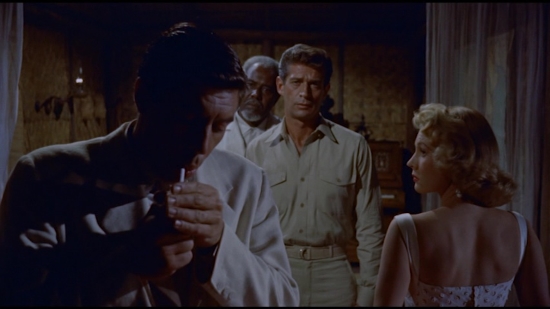
Congo Crossing has been released on DVD and Blu-ray in Germany and the movie looks attractive as Pevney’s films generally do, aided in this case by the cinematography of Russell Metty. I suppose I don’t sound all that enthusiastic about the movie although I have to say I did enjoy it well enough. It’s quite competently put together and passes the time satisfactorily, but the fact is just about everyone involved did better or more interesting work elsewhere. All in all, I’d say it’s a fun picture but slight and far from essential for the casual viewer.


 Riding the High Country