Devil’s Doorway

poster229

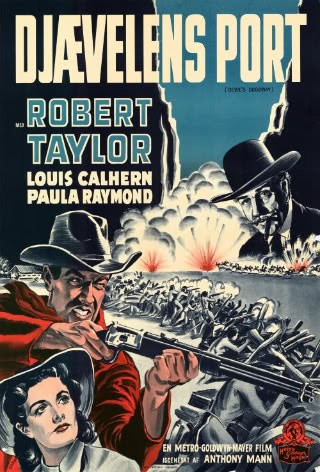
Before 1950 the injustices visited upon the Native American people were essentially ignored, or at the very least only touched on, in the cinema. However, in the space of a year two major Hollywood productions would use the plight of the Indian as their central theme. Delmer Daves’ Broken Arrow was notable for its sympathetic portrayal of the Apache, but Anthony Mann’s Devil’s Doorway (1950) went even further by concentrating on the naked and ugly racism confronting those Indians who had done their best to embrace the ways and laws of the white man. It’s a much more tragic film than Broken Arrow and consequently more powerful; the fact that this power remains undiminished even for a modern audience demonstrates just how radical a picture this must have been sixty years ago.

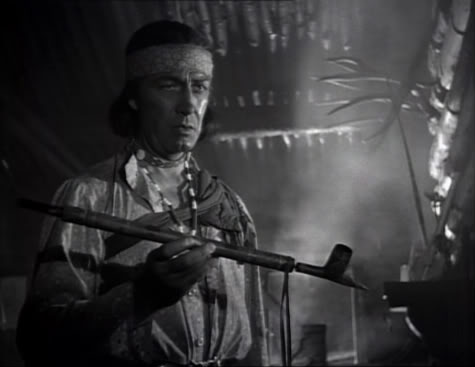
Lance Poole (Robert Taylor) is a Shoshone who has decided to adopt the classic American mindset i.e. looking to the future rather than dwelling on the past. Not only has he anglicized his name but he has also taken a huge leap of faith by enlisting in the white man’s army and fighting in the Civil War. Returning home to Wyoming as a highly decorated veteran (having won the Congressional Medal of Honor no less), he is full of optimism and hopes for a bright future. He’s confident that the recent horrors of the battlefield will have purged the nation of its desire for further bloodshed. However, soon after his triumphant return he has to face the fact that not everything or everyone has changed as much as he might have hoped. The old grudges and prejudices still live on in the hearts of some, notably an eastern lawyer, Verne Coolan (Louis Calhern), who’s moved to Wyoming for his health. Coolan’s snide comments are only a foretaste of what’s to come though, as the local doctor’s refusal to attend to Poole’s ailing father until it’s too late proves. While Poole busies himself building up his cattle ranch and his fortune, Coolan is angling for a chance to seize the ancestral land and teach the red man a lesson on climbing above his station in life. Coolan’s opportunity comes with the Homestead Act, which allowed for the breaking up of former tribal land into individual claims, and he encourages a mass migration of sheepmen in the hopes of forcing Poole off his land. Although Poole is  initially persuaded to hold his fire and try for a compromise by female lawyer, Orrie Masters (Paula Raymond), the scene is set for violent confrontation between the Shoshone and the sheepmen that Coolan is ruthlessly manipulating. As tensions rise, and the viewer’s outrage at the double standards and open bigotry on display similarly escalate, Poole must finally concede that his dreams of peaceful co-existence are nothing more than the foolish longings of a man too eager to buy into the glib promises of pragmatic politicians. When he dons his old uniform, with his medal proudly pinned in place, to face the same army that he once served with distinction there is a poignancy and irony that drives the message of the film home most eloquently.
£20

Anthony Mann had spent the 40s building up his reputation with a series of tight little noirs frequently lensed by master cameraman John Alton. Both men brought their style and sensibility to a western setting in Devil’s Doorway. Given Mann and Alton’s background it’s not altogether surprising that the movie has both the look and feel of a film noir; there are plenty of dark, shadowy scenes and an abundance of low angle shots. One scene that highlights this perfectly is the fist fight that Poole is goaded into in the saloon by Coolan and one of his cohorts. Everything is shot in the cramped confines of the bar with smoke and shadow blending together as the two men hammer each other savagely – there’s no musical accompaniment to distract from the sound of the punches landing, and the quick cutting alternates between the increasingly battered faces of the fighters and the even more grotesque visages of the rubbernecking customers. Having said that, there’s no shortage of more traditional genre imagery either, and Mann demonstrates a breadth of vision and skill with large-scale action scenes that would be further developed in both his later westerns and epics. For me, Robert Taylor was convincing as the Shoshone warrior caught between two camps. He injected a huge amount of humanity into the role of Lance Poole and produced a fully rounded character that transcended the “noble savage” caricature. I guess the black and white photography helps, but I never caught myself thinking that this was just a guy in dark make-up playacting. Louis Calhern also did sterling work as the slimy lawyer who uses convenient statutes as a means of disguising his own prejudices. Paula Raymond was good enough as the woman caught in the middle, but the script shies away from depicting an all-out romance with Poole – the movie was in all honesty already pushing the envelope as far as could be expected for the era. I might also mention the strong support particularly from Spring Byington and Edgar Buchanan.

Currently, there are only two editions of Devil’s Doorway available on DVD. There is an MOD disc from the Warner Archive in the US and a Region 2 pressed disc from Warner/Impulso in Spain. From the perspective of international customers neither one is ideal – the US disc being both expensive to acquire and on potentially suspect media, while the Spanish release is exclusive to El Corte Ingles for who knows how long with the attendant shipping costs. I viewed the Spanish disc, and the transfer is generally a strong one with good contrast and detail. However, it is unrestored and there are the usual scratches, nicks and blemishes – though never to the point of distraction. There is English and Spanish audio with removable Spanish subs. The disc comes in a slip case with a 34 page booklet, in Spanish naturally, that contains a very nice selection of still photographs and original advertising material. When one considers the development of the western, and the career of Anthony Mann too, this is an important title. As such, it’s disappointing that it should be marketed so restrictively on both sides of the Atlantic. However, the Spanish disc does at least afford the film a degree of respect that’s lacking in the US release. Devil’s Doorway seems to have got lost between Mann’s earlier noir pictures and his subsequent psychological westerns, but it actually acts as something of a bridge. It’s a film that’s intellectually and emotionally satisfying while it also provides solid western entertainment. Recommended.

Westward the Women

Trailblazing epics depicting the dangers and hardships that went hand in hand with the expansion of the frontier are far from uncommon among westerns. Westward the Women (1951) fits comfortably into that category, but there’s one important difference that sets it apart from others of that ilk: this movie tells its tale from an almost exclusively female perspective. This fact alone means that the film is pretty much unique; there have, of course, been other examples of westerns that focused on women, but they tended to be more of the exploitation or novelty variety. Westward the Women is certainly no exploitation picture, instead it’s a gritty attempt to celebrate the courage and the trials experienced by those early pioneer women, without whom the west could not have advanced.

The plot is a fairly simple one, essentially being a chronicle of a pre-Civil War overland trek. It’s 1851 and California landowner and visionary Roy Whitman (John McIntire) has realised that, despite having overcome a hostile land and prospered, his dreams will amount to nothing if there are no women to pair off with his settlers. In order to address this problem he hires Buck Wyatt (Robert Taylor) to assist him in first recruiting 140 mail order brides, and then escorting them on the gruelling trip from Chicago all the way back to California. The women who make up this matrimonial caravan are a disparate and, in some cases, a desperate bunch. The film doesn’t fully analyse the reasons why these women would readily agree to subject themselves to the harshest of conditions and potentially fatal circumstances just to marry a man they’d never so much as laid eyes on. For the most part, they are looking for a change in their lives and a new beginning (one has gotten herself pregnant out of wedlock, another is a widow, and there a couple of former good-time girls), and that’s about as deep as it goes. The full extent of the task ahead of them doesn’t really become apparent until the dozen or so men Whitman has hired decide to desert after Wyatt’s brand of iron discipline leaves two of their number dead. From this point on there are only four men left (Wyatt, Whitman, a comedic Japanese cook and a green youth) and the women must put aside their femininity and work harder than any man in their efforts to overcome the myriad obstacles the wilderness throws at them. Before they reach their promised land their numbers will be whittled down by accidents, nature and hostile Indians. However, this pruning simply stiffens their resolve and, by the time they reach the end of the trail, those who have survived emerge stronger than ever. In fact, it’s only at the very end that any concession to sentimentality is made – the surviving women meeting their selected partners to the accompaniment of the first notes of music heard since the opening credits rolled.

William Wellman was one of the hardest driving, most demanding and macho directors working in Hollywood. This was a guy who quit acting because he felt it was too soft and no fit profession for a man. Bearing all this in mind, it may seem surprising that he was able to produce a film that was so celebratory of the achievements of women. Of course his hard-bitten outlook is stamped all over the movie, and he has absolutely no qualms about killing off just about any of the characters. While the death toll is fairly high there isn’t an enormous amount of onscreen violence – the big Indian attack takes place while Wyatt is away chasing after the runaway, firebrand Frenchwoman that he finally falls for – and it’s frequently the tragic aftermath that the viewer gets to see. At times the film becomes seriously grim and there are one or two moments that are actually quite shocking, though I don’t intend to spoil it for anyone by identifying them. Nevertheless, Wellman knew his trade well enough to realise that he had to toss in the odd moment of comedy to avoid proceedings becoming relentlessly dour. The least successful of those lighter moments were provided by Henry Nakamura’s Japanese hash slinger and general dogsbody. Much more effective was the imposing Hope Emerson, in a role that was in complete contrast to the kind of threatening ones she was frequently associated with.

Robert Taylor also did some excellent work as the hard as nails trail boss who knows that he must push everyone to the limits of their endurance if they are to have even a slim chance of survival. The character of Wyatt grows along the way though, going from a kind of contemptuous dismissal of the green females he has to look out for to deep admiration for the courage and determination these same charges display time and again. There is a romance along the way between Taylor and Denise Darcel, though it’s a hard edged affair too – he even gives her a crack of the bullwhip at one point! All the women in the supporting parts were quite satisfactory, although the majority of their characters were only developed very slightly. I don’t believe that needs to be too heavily criticised though as the scale of the story and the constraints of the running time (just a little shy of two hours) meant deeper analysis was impractical.

Westward the Women is currently only available on DVD in R2, and there are two choices. There are editions out in both France and Spain from Warner Brothers. I have the French disc (chances are the Spanish release is from the same master) and the transfer is mostly pretty good, academy ratio and not much in the way of damage. There are moments when the image looks a little soft but nothing too distracting. There’s no extra content whatsoever and you get a choice of English or French audio – subtitles are optional with the English track. This is a good western from a director with a respectable pedigree in the genre (Wellman was of course proficient in many types of film, and you can browse an excellent series of articles on his early work at Judy’s blog here) and a star who got better with the years. If you think you’ve seen all the trail western has to offer then this is a film worth checking out. John Ford, another extremely macho director, never shied away from highlighting the vital role played by women in the settling and ultimate conquest of the frontier, and Wellman added his own song of praise to feminine grit with this unusual and very rewarding western.

Ride, Vaquero

poster52

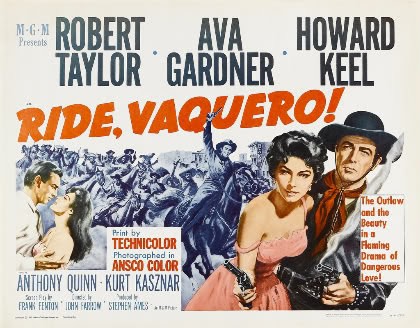
Ride, Vaquero (1953) was one of those films that always seemed to elude me. I’d read about it and heard about it often but, somehow, could never manage to see it. Well, I’ve finally got around to it. Robert Taylor may not be the first actor some would think of as a western character but the fact is he made a good number of oaters in his time. I’ve been watching quite a few of his westerns recently (the ones in the R1 westerns set, and a TV broadcast of The Hangman) and I quite enjoyed this.

Rio (Taylor) is the right hand man for bandit chief Jose Esqueda (Anthony Quinn), operating along the Texas/Mexico border in the aftermath of the Civil War. The end of the war has thrown up new challenges for these men, namely the arrival of new settlers and the renewed interest of the army and the federal government. Esqueda understands that such developments will spell the end of his reign as the undisputed master of his territory. His preferred course of action is a simple one; drive out the settlers before they have had a chance to put down permanent roots. The toughest proposition Esqueda has yet to face comes in the form of King Cameron (Howard Keel), who has come west with his wife (Ava Gardner) to build a new life. An abortive raid on the Cameron ranch leads to the capture of Rio. Instead of handing him over to the law, Cameron offers Rio the opportunity to switch allegiances and become his partner. He accepts, but the question remains whether his decision is based on a desire to embrace a more lawful lifestyle, or just a desire to embrace Camerons wife.

Director John Farrow manages to throw a number of big themes into the mix – the old ways vs progress, loyalty and betrayal, and a man’s need to hold onto what he has won. Taylor gives a good performance as a man who’s in search of his place in the world. He may seem cold and aloof, but that’s surely an essential part of the character. His precise relationship with Esqueda is not fully revealed until the end, and it goes a long way towards explaining the alienation his character feels. Anthony Quinn gives the lusty, larger-than-life treatment to his role of the bandit king, and it’s very enjoyable. Ava Gardner naturally looks great and brings a credibility to her part as the rancher’s wife with the wandering eye. Howard Keel is just about adequate but, since I believe this was his first non-musical role, I won’t be too harsh on him. There are also small yet memorable parts for Jack Elam and Ted De Corsia.

Ride, Vaquero has recently been released on DVD by Warners in France. The disc is a barebones affair with removable French subs and, unfortunately, boasts a weak transfer. The image doesn’t seem to have undergone any restoration and looks soft throughout. The biggest problem though is the colour, which has faded badly. The film was shot using the cheap Anscocolor process and if you’ve seen the recent R1 of Escape form Fort Bravo you’ll have some idea of what to expect. That said, the film is well worth 90 minutes of anybody’s time and I’d recommend it, if you can get past the deficiencies in the DVD transfer.