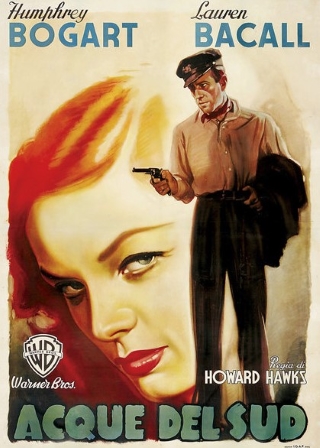
“Was you ever bit by a dead bee?”
It’s tempting to use the more familiar, suggestive lines about matches, whistling and so on as an opener to the Howard Hawks adaptation of To Have and Have Not (1944). However, that business with the bee, uttered several times by Walter Brennan’s craftily befuddled rummy and later parroted by a smokily seductive Lauren Bacall feels like a better way in. Howard Hawks favored movies about tight knit groups, like-minded types who were bound together by a commitment to do whatever has to be done as well as holding some shared notion of personal honor. They should be people who live by their own code, and who recognize almost instinctively those who belong in their club. Well any such club ought to have a code word or phrase, one known to or capable of being interpreted correctly by their comrades. And so it is with Brennan’s bee shtick – the select band of “right guys” is neatly delineated as those who see the question for what it really represents and who in turn just know how to respond. There’s a lot of Hawks in that line and what it signals. As such, it seems apt to use it to lead into a movie which has more of Hawks in it than Hemingway.
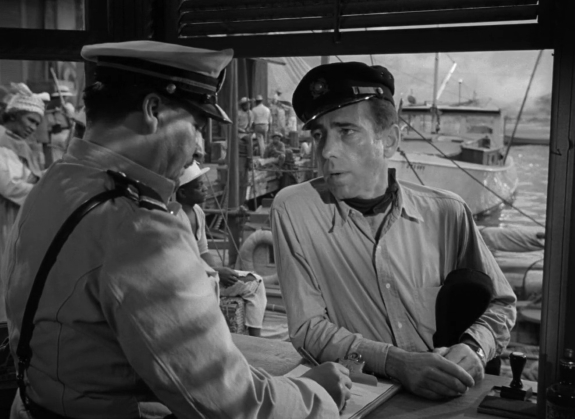
Is it noir? Is it a romantic thriller? Is it a slice of polished wartime propaganda? I guess To Have and Have Not is a little of all of these, but not only is it recognizably a Howard Hawks film, it’s also the movie that introduced Bogart to Bacall and the movie watching public to a cinematic partnership that transcended the silver screen. All of this would make it an important piece of work even if the film itself had been less than satisfactory. Fortunately though, that’s not the case as the whole concoction succeeds in checking every box. From the moment Franz Waxman’s instantly memorable score, dripping intrigue and danger, segues into the caption that informs us we’re about to descend on a delightfully ersatz Warner Brothers approximation of wartime Martinique we are hooked as fast as one of the marlins Harry Morgan’s clients pay big bucks to pursue. Morgan (Humphrey Bogart) is skipper of a charter fishing boat and our first glimpse of the man kind of sums up the classic Bogart persona – insolent, sardonic and independent, openly contemptuous of the pettiness of officialdom yet careful not to push what luck he has left too far.
Hemingway’s novel was a dark tale of a down on his luck man running anyone and anything that looked like turning a buck out of Cuba in the pre-war years. The story is that Hawks once told Hemingway that he reckoned he could make a successful movie out of the author’s worst book and he settled on To Have and Have Not to prove his point. Now I don’t know whether or not this was in fact Hemingway’s worst book – I tend to think nothing he wrote could be termed as objectively bad – but I can say it’s the one I enjoyed less than any of the others. It’s a short book, but the tone is largely grim and dour and I’ve not felt the urge to revisit it since I last read it perhaps a quarter of a century ago. Hawks’ movie, with a script that was worked on first by Jules Furthman and then later by William Faulkner, uses the novel as a jumping off point at best, where Morgan gets gypped out of a fee by a slippery client and a stray bullet fired by a Vichy gunman. It leaves him out of pocket and, having just made the acquaintance of fellow drifter Marie Browning (Lauren Bacall), of a mind to stick one in the eye of the Vichy collaborators.
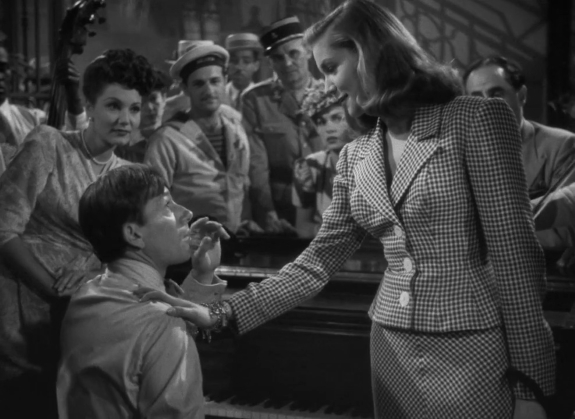
From this point on there’s not much of Hemingway in it but lots of Hawks, and of course the electric central pairing. It develops into a romantic adventure with a hint of Casablanca about it all – a totemic yet rather bland freedom fighter complete with attractive wife trying to stay a step ahead of the fascists, Axis villains, and a reluctant and essentially isolationist hero who comes to realize that this is an unsustainable position. Aside from an interlude on Morgan’s boat involving a near fatal encounter with a gunboat on a foggy night, most of the action takes place in the hotel, shifting from bedrooms to bar to cellar, all punctuated by a succession of provocative quips, as well as the shared ritual of lighting cigarettes and intermittently moody visuals, while Hoagy Carmichael tinkles away at How Little We Know in the background. There is that deeply satisfying feeling of convergence about it, watching an essentially ill-assorted group draw closer together and gel when faced with a common enemy. This was always attractive to witness, but nowadays it’s difficult not to feel even more wistful about a time when it was widely believed that the only decent thing to do was to oppose rather than lionize authoritarian bullies.
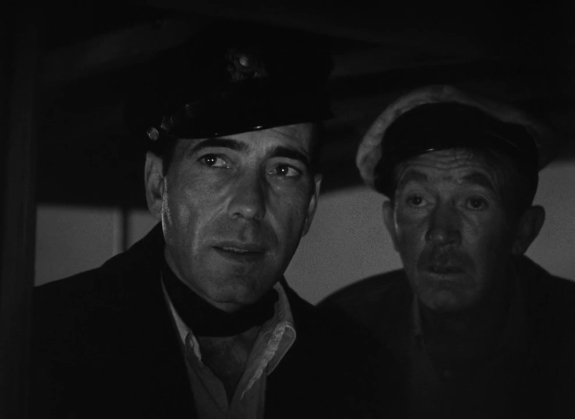
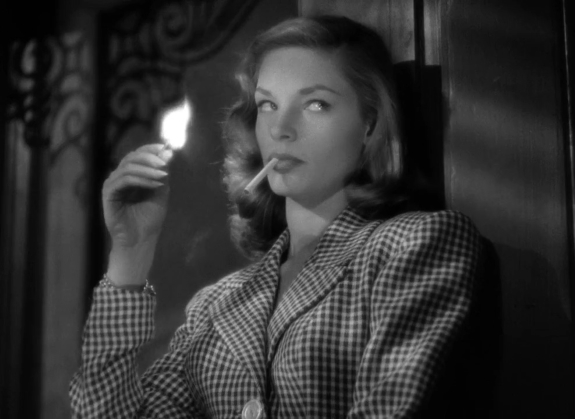
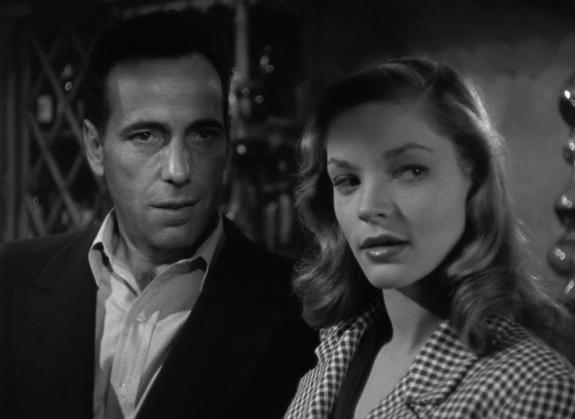
Bacall was, by her own admission, awed by the whole business and apparently hit on the “chin down, eyes up” pose she makes such effective use of as a means of holding those jitters in check. If so, it was a remarkably successful piece of improvisation and goes a long way to kindling those sparks struck whenever she shares the screen with Bogart. Her introductory scene, smouldering in the doorway, is as good as any actress ever got and I think it’s fair to say it followed her around for the rest of her life. Bogart was right at the top of his game at this point and probably at the height of his fame too. He displays such ease and composure in the front of the camera in this movie, every gesture timed to perfection, every beat of his dialogue struck – tough, lonesome and noble in spite of himself, this as much and maybe even more than Rick Blaine is his signature role.
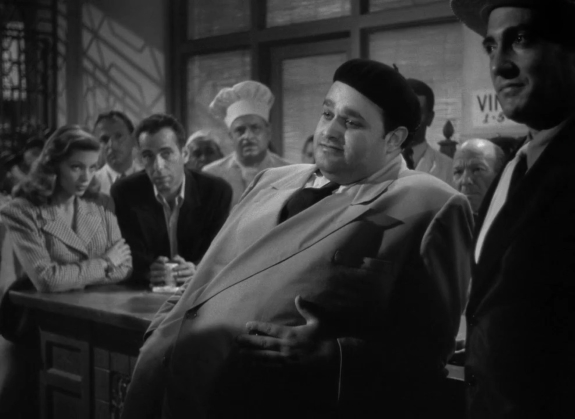
The A pictures of the classic era all benefited enormously from the hugely experienced crews that worked behind the cameras. It’s one thing to have someone like Hawks in the director’s chair, but having people like Furthman and Faulkner working on the script, Franz Waxman providing the score, and safe hands such as Sidney Hickox looking after the cinematography provide a solid base. And then there were the character players, moving from picture to picture, largely unsung but helping to hold it all together. Walter Brennan was one of the greats, a three time Oscar winner, and his twitchy rummy, veering from wide-eyed wonder to something approaching a sly worldliness makes for a terrific foil to Bogart’s slouching hero. Marcel Dalio as the hotelier with underground connections feels like a first cousin of the harried croupier he played in Casablanca. Another alumnus from that movie, Dan Seymour, plays the secret police boss Renard as though Sydney Greenstreet had swallowed Conrad Veidt, sinister, bulky and malignant. The frequently loud and boorish Sheldon Leonard is more subdued as Seymour’s lieutenant, tossing in the odd line but mostly alternating between glowers and leers in the background. Hoagy Carmichael is a memorable presence too, the wonderfully named Cricket forever chewing soulfully on a toothpick and dispensing tunes and philosophical advice as the mood strikes him.
As this will be my last entry for 2024, I wanted to finish the year with a look at a movie that never gets old for me. Surely there are few better ways to spend one’s time than hanging round a waterfront bar in Martinique learning how to whistle. So thanks for stopping in over the last twelve months and here’s hoping everyone has a good 2025.
Other posts I have written on the Bogart & Bacall movies can be found here:
The Big Sleep
Dark Passage
Key Largo
 Riding the High Country
The Hawks movie is very much sui generis, I agree – there are much better adaptations of the source book after all but this oddly theatrical film is enormously entertaining, focusing as it does so closely on the main characters. It has great panache too. Have a great New Year Colin.
LikeLike
Thanks, and here’s hoping you have a great 2025 as well.
This is far and away my favorite screen iteration of the book. Yes, panache is an apt choice of descriptor. I like the Curtiz version of the story, it is genuinely noir and is a more faithful adaptation of the novel, though I’m not sure that matters much. The fact both films take such a radically different approach means there is no temptation to compare and I rather enjoy that. The later Siegel version is less interesting and less successful, an OK watch but that’s about it.
LikeLiked by 1 person
I prefer the Curtiz as a drama as it just has more substance in terms of the characterisation and the themes explored. But the 1944 version is pure Hawks, totally artificial, very heightened – not plausible but s real “movie movie,” massively entertaining. Many of Hawks’ dramas tend to have a lot of laughs and feel like comedies structurally, which is well in evidence here. All very ritualistic.
LikeLike
Hawks did create his own movie world in a sense, maybe it’s not revisited in every one of his pictures, but it does reappear frequently and it’s awfully attractive in my opinion.
I wonder how much our first contact with any piece of work colors our subsequent view of it? Quite a lot I suspect. I know that the Hawks movie was my first experience of this story, I read the book many years later and then saw the other movie adaptations. Perhaps if I’d read the book first, or seen the Curtiz film, then I would feel different about this version. Maybe, or maybe not – the fact remains that it positively breathes cinematic passion, the telling of an engaging story in a way the filmmakers wanted and one that they seemed to intuitively know audiences would respond to.
LikeLiked by 1 person
But you are absolutely right about the world building.
LikeLike
It’s not a great book after all …
LikeLiked by 1 person
As I said, it’s been far too long since I read it for me to offer any cogent assessment of the book. The fact I’ve not felt the urge to reread it again in close to 30 years is suggestive though. And this is someone who would count himself a big Hemingway fan.
LikeLike
Thanks for the good year and may your next year be as fine.
LikeLike
Thank you, Don. I hope 2025 is kind to you too.
LikeLike
I haven’t seen “To Have and Have Not” in 50 years but I recall admiring it. Or course, it is an iconic film for many people. But I have to say that I prefer Michael Curtiz’ “The Breaking Point” which is also adapted from Hemingway’s novel, “To Have and Have Not.” To me, it is more serious, poignant, and tragic. Garfield considered his performance in “The Breaking Point” to be his best. Those who have seen it always remark how the ending is devastating and heartbreaking.
LikeLike
Nice to hear from you, Frank. Yes, I get where you’re coming from with the Curtiz movie, I don’t believe you’re along in your preference by any means. As I said above, I enjoy it too for the different direction it takes and the more sombre dramatic note it strikes. Garfield was always good of course and the ever excellent Patricia Neal played well off him. I just recently watched Garfield in a rather different movie Between Two Worlds, and adaptation of Sutton vane’s Outward Bound that some may regard it as excessively sentimental but it’s a film I thought very moving and affecting when I first saw it more than 40 years ago. I find it a genuine pleasure to revisit from time to time.
LikeLike
Ah Bogie. Thanks for the excellent review. I treasure my WAC Blu set of the Bogie-Bacall set with all the films looking like you have your own nitrate print without fear of catching fire. Speaking of fire wowsies on Bacall in this one of the all time debuts and to think she was scared. I am so glad they fell in love together and only wish he could have lived much longer. They were one of the best screen pairings ever. Happy Holidays!
LikeLiked by 1 person
Agree with all that, Chris. Perhaps the fact that Bogart passed so soon and that we only have those handful of movies he made with Bacall makes them even more special.
LikeLike
Another excellent look at a classic, Colin. You’ve done great work for the year, too, and this a good one to end 2024 with. Here’s looking forward to more great reviews. Happy New Year to you and yours, my friend.
LikeLiked by 1 person
Thank you, Michael. Wishing you all the best of everything for the coming year too.
LikeLiked by 1 person
Colin, top-notch write-up of TO HAVE AND TO HAVE NOT(1944). I first recall viewing this movie on the Arkansas Educational Television Network(AETN) Channel 6 in 1992 on THE GOODTIMES PICTURE SHOW hosted by Ray Neilsen. I really liked the movie then, and I still do. This one is my favorite of the several adaptions of Hemingway’s 1937 novel of the same name. There were also a couple of TV adaptions. One was the “Fury at Rio Hondo” episode of Warner Bros. CHEYENNE with Clint Walker, Peggy Castle, and Ralph Moody. It’s original airing was on April 17, 1956. The second was a live TV airing on January 17, 1957 with Edmond O’Brien, Beverly Garland, and John Qualen.
I liked your take on the use of, “Was you ever bit by a dead bee?’ Of course, the movie is made into a Hawksian world with a strong male character and his female counterpart. I viewed the movie first and read the novel years later and I prefer the reel version. The book version and the reel version are two different entities and that’s fine with me.
I like really like this movie because of the cool dynamic chemistry between Bacall and Bogart. Bacall made probably the most meteoric movie debut of all time with her sidelong glances and husky voice. This is some of the smoothest dialogue between two really cool characters. These moments between Bacall and Bogart are wrapped in gold. The scene with the famous “whistle” line is a masterpiece in sexiness on film without being vulgar. Today’s movie makers should study TO HAVE AND HAVE NOT to see how it’s done.
Colin to you and all the readers of RIDING THE HIGH COUNTRY a HAPPY NEW YEAR!
LikeLiked by 1 person
Good piece Walter.
LikeLike
Excellent write up. That ‘whistle’ scene definitely one of the sexy scenes ever. That look of bemusement on Bogart’s face is just real not acting. He’s loving being in this scene with this wonderful creature. Her sleekiness is superb in this picture. Spot on a star was born.
LikeLiked by 1 person
There’s a similar vibe, slick and classy professionalism from a similar core of personnel with the addition of Leigh Brackett, in The Big Sleep. That does of course stick a lot closer to its source material but, with all those involved, it is that recognizably Hawksian world.
Happy New Year, Walter.
LikeLike
Colin, Happy New Year to you and all your readers.
LikeLiked by 1 person
Thanks. Same to you, Chris.
LikeLike
Such genuine chemistry, you don’t the likes of it often. Also an all-time great screen debut, and Bacall just hit on a look and attitude that turned out to be eternally Cool. Want to add as a wrap on this year, Colin, that I always enjoy your insights and writing, even when I don’t stop to comment. Wishing you a good one ahead
LikeLiked by 1 person
Thank you, Kristina. Bacall did indeed make that cool, sassy allure all her own and it never got old. Funny in a way though how WB didn’t really seem to know what to do with her for a while. Aside from her Bogart pictures, her films were patchy till Minnelli and Sirk gave her good roles in The Cobweb and Written on the Wind respectively.
And I know exactly what you mean when it comes to not always commenting – in my own trips round the blogosphere I don’t always find the time to leave comments, but that doesn’t mean I don’t stop in various locations and read. I guess that’s true for a lot of us. You have a great New Year too and thanks for all the support over the years.
LikeLiked by 1 person
You call The Cobweb good?
LikeLike
Absolutely. I keep meaning to get round to writing something about it, but things keep getting in the way. I will at some point though.
LikeLike
The Cobweb is a great movie! A Vincente Minnelli-directed melodrama! He just did this sort of thing breathtakingly well. And it’s a movie about the craziness and absurdity of psychiatry.
Plus Gloria Grahame! In my review I said that in every scene she is hot and sweaty and behaves like a she-cat on heat. I stand by that. And nobody could do that better than Gloria Grahame.
LikeLiked by 2 people
I love The Cobweb as well dfordoom 🙂 I am also a huge fan of Vincente Minnelli 🙂
LikeLiked by 1 person
I believe I sent this to you some years ago:
https://x.com/FrankJGibbons/status/1877560080150761719
LikeLike
Yes, I remember you sending/mentioning that before. It’s something I had never noticed in the movie till it was brought to my attention.
LikeLike
I still can’t believe Bacall’s performance. She was a teenager, for goodness’ sake. And she had the sophisticated woman-of-the-world thing down pat. She was 18 going on 35.
I’m guessing that it helped a great deal having Hawks directing her. A director who was in tune with women.
LikeLiked by 1 person
Hawks certainly presented a particular type of woman very effectively on screen. It’s a stylized type of course, which is reflective of his characteristic movie world in general- that isn’t a meant to take anything away from Hawks’ approach, just acknowledging it for what it is. In Bacall, and in this movie in particular, we get an almost perfect distillation of that Hawks woman.
LikeLiked by 2 people
Colin, I could not have summed up what you said any better in what you say about Hawksian women 🙂 Speaking of which, I do not know If it is just me, but Ava Gardner’s character in John Ford’s Mogambo reminded me of a Hawksian woman and it is a shame that Gardner never got the chance to work with Hawks because she probably would have been dynamic based on Mogambo alone 🙂
LikeLike
Yes, I can see what you’re referring to, John. I’m a great fan of Gardner’s work, I think her beauty sometimes led to her being perhaps not exactly underrated as an actress but not always given the credit that she was due.
I like the way Hawks portrayed women on screen, that type he favored so much, but if I have a criticism it would be that he tended to focus on certain aspects and maybe didn’t dig as deep as he might have. Gardner was capable of a fair bit of depth and shading – Henry King coaxed good performances from her in his Hemingway adaptations.
I wrote a piece on Mogambo myself a few years ago here.
LikeLiked by 1 person
Mogambo isn’t as bad as its reputation suggests. Ava Gardner was apparently rather scornful of it. Its problem is that it just seems lifeless compared to Red Dust. And 1950s Clark Gable just didn’t have the dangerous uber-sexy bad boy charm of pre-code Clark Gable.
I don’t dislike Mogambo. Not at all. It just happens to be an inferior remake of a great film.
LikeLike
I could not disagree more. Mogambo as a major success, commercially and cfticially. If some know-it-all non-entity does not like it seventy years after the fact, the hell with him. Oh, Ava is good in it,but it is Gable’s picture. Thes scenario is about him and his character.
LikeLiked by 1 person
I think Ava Gardner is a bit underrated because some of her best movies are movies that are not as highly regarded by critics as they should be. Movies like Whistle Stop and Pandora and the Flying Dutchman.
And she often gave fine performances in movies that weren’t so great (such as The Snows of Kilimanjaro) or were truly awful (On the Beach).
LikeLike
I’m not the biggest fan of John Ford’s non-westerns. There are very few movies I dislike as much as The Grapes of Wrath.
LikeLike
Interesting how opinions differ. I think ‘Grapes of Wrath’ is one of the greatest films done by an American. I’ve seen the movie in the last year (the Blu is great) and love it as much as ever. Differing opinions are fun though.
LikeLike
Yes, I agree, and adapted from one of the great American novels.
LikeLiked by 1 person
I was thinking that maybe I should buy Mogambo on Blu-Ray and give it a rewatch. But apparently it’s not available on Blu-Ray. Which to me is pretty extraordinary.
LikeLiked by 1 person
I do not know If you have a Multi-Region DVD player dfordoom, but If you do, here is a reasonable price for a Mogambo dvd below 🙂
LikeLike
Yes, I have a multi-region DVD player (and a a multi-region Blu-Ray player). It’s just that I was hoping to see this one on Blu-Ray – I thought the enhanced picture quality might cause me to like the movie a bit more.
LikeLiked by 1 person
Gotcha dfordoom regarding DVD and Blu-Ray 🙂
LikeLike
It’s interesting to read Bacall’s account of Hawks shaping her performance. He told her not to mix with the crew like Stanwyck (who Bacall thought had given a great performance) in making ‘Ball of fire’. That Stanwyck was too chummy with the crew and Bacall needed aloofness like her character instead.
LikeLiked by 3 people
I could not have summed up that last paragraph of yours any better dfordoom 🙂
LikeLiked by 1 person
Great review Colin 🙂 I am a huge fan of director Howard Hawks and I love every single film that he directed 🙂 To Have and Have Not ranks high up there indeed 🙂 I read somewhere that Hawks made a bet with writer Ernest Hemingway that he could make a great film on one of his mediocre books and the result was To Have and Have Not 🙂 Interesting isn’t it? 🙂 I love Michael Curtiz The Breaking Point as well, which was also based on the same Hemingway source material. Colin, this year I hope to get to compose a ranking of all my favorite Howard Hawks films 🙂 Btw, I replied back to your reply under my blog entry regarding My Favorite Things that I composed a few weeks back 🙂
LikeLike
Ranking Hawks’ films sounds like a worthwhile project though difficult. I tend to find it hard to assign positions in such matters. Lists are one thing but ranked lists are incredibly tricky in my opinion.
LikeLiked by 1 person
Would ‘Only Angels have wings’ be toward the top?
LikeLiked by 1 person
Yes.
LikeLiked by 1 person
The version of the story I heard was that Hemingway assured Hawks that To Have And Have Not was by far his worst book.
I like pretty much all Hawks’ movies. I even love Land of the Pharaohs. And Man’s Favorite Sport? deserves a lot more love.
And I’m even tempted by the ludicrously shamefully overpriced Blu-Ray release of Red Line 7000.
LikeLiked by 1 person
dfordoom – gotcha regarding the story about Ernest Hemingway and Howard Hawks 🙂
I love Land of the Pharaohs and well and I am a huge Joan Collins fan 🙂 Man’s Favorite Sport? does indeed deserve a lot more love 🙂 One other thing that I will add is that If El Dorado was Rio Bravo for the 1960’s then Man’s Favorite Sport? is Bringing Up Baby for the 1960’s 🙂
Red Line 7000 (which I also love) was a 1960’s variation of an earlier Howard Hawks film from 1932 entitled The Crowd Roars 🙂
LikeLike
I agree with you about Man’s Favorite Sport? It’s pure 30s screwball comedy with a 60s aesthetic. I consider it to be the last true full-blown screwball comedy. It’s a total joy.
I’m always happy to see Land of the Pharaohs getting more love. And yeah, I’m a major Joan Collins fan as well.
I’ve seen The Crowd Roars and I thoroughly enjoyed it. I’ve already sent off my order for Red Line 7000.
LikeLiked by 1 person
Right on about everything dfordoom 🙂 Man’s Favorite Sport? really does come off as the last true screwball comedy. I do not know If this was Rock Hudson’s last comedy, but I do know that he was (for the most part) in more action-oriented stuff after Man’s Favorite Sport? Remember Ice Station Zebra? 🙂 Either way, he and Paula Prentiss were magical together 🙂
As for spectacle, I will happily take Land of the Pharaohs over something like Braveheart or Gladiator any day 🙂 Also, how much do you want to bet that If Joan Collins was born much earlier in life, she would have gotten just as many roles equal to that of Barbara Stanwyck, Marlene Dietrich and Bette Davis to name just three of the many female Classical Hollywood starts 🙂
I love both The Crowd Roars and Red Line 7000 – tell me, which DVD did you order? Was it the Region 1 or something else – just out of curiosity of course? 🙂
LikeLike
I do not care for the films mentioned, but completely agree about Joan Collins, who is stil lovely and very smart. She came close but would have been an icon at the Dietrich level, Davis, Stanwcyk and crawford,bu better looking. She may not have cracked into the IreneDunne or Carole Lombard universe.
LikeLiked by 1 person
Sorry to hear that Barry 🙂 Nevertheless, I am glad that we can agree on Joan Collins and your theory regarding where she would have stood during the earlier years of Classical Hollywood cinema had she been born much earlier 🙂 I too agree that she was a far different type from the Irene Dunne’s and the Carole Lombard’s 🙂 BTW, what is your opinion of Raoul Walsh? 🙂
LikeLike
A good but not great director,dependent as are most on script, cast and crew. In other words, more than a step behind John Ford,or WilliamWyler, but ahead of Dmytrk, Hathaway, but nowhere near Minnelli, Hitchcock, Capra, Hawks, Wellman, Borzage and maybe Edgar Ulmer. I might have included Budd Boetticher, but my view is with the excejtion of the Randolph Scott pcitures, and John Wayne’s production of Bullfighter and The Lady,he just competent. On the other hand,we all need strong support.
LikeLiked by 1 person
Oddly enough I think of John Ford the way you think of Budd Boetticher. Ford was a great great director of John Wayne westerns. His non-westerns and non-John Wayne pictures haven’t impressed me at all.
LikeLiked by 1 person
Well you are off base. Ford’s success answers that. In fact, he is th emsot succssful and honored film director in history. Budd si anon-entity without his Scott films and none of them, no matter how much we may enjoy them rival Jack Ford.
LikeLike
Everybody has their own view of course, but I find that a very odd stance, and one that would be difficult to defend. Just to pick a handful of titles, this would mean discounting, for example:
The Informer
The Prisoner of Shark Island
The Long Voyage Home
The Quiet Man
How Green Was My Valley
7 Women (I know a lot of people don’t rate this film, but they are wrong frankly)
They Were Expendable
As I say, that’s just a random selection but the fact is if Ford had only made those movies he would still be regarded as a great director.
I won’t get into the Boetticher part as I don’t see the need to compare these directors, nor do I think the fact both contributed some of the best western movies made means they are actually comparable.
LikeLiked by 2 people
‘Young Mr Lincoln’ was a beautiful film too. I always find things to like in ‘Drums Along the Mohawk’. His Will Rogers films have some magic in them. ‘The Whole Town Talking’ is a hoot. Why ‘Pilgramage’ doesn’t play every Memorial Day I have no idea. Such a lovely, powerful picture. Darn it I like ‘Tobacco Road’ for its ludicrous nature and that beautiful journey to the poor house.
LikeLiked by 1 person
Not The Grapes of Wrath or How Green Was My Valley?
LikeLiked by 1 person
Those too but was trying to mention the ones I like which Colin didn’t mention.
LikeLiked by 1 person
I’ve never seen able to see the appeal of Irene Dunne. She just leaves me cold.
LikeLike
It does not matter what you are or see, the determinants are talent, and bankability. Irene had both in spades.
LikeLike
Re Joan Collins: I feel her work on occasion is better than her reputation would lead one to believe. She did good work in an early role in Turn the Key Softly and I also thought she was fine in The Girl in the Red Velvet Swing.
However, she had her limitations – I think her part in The Bravados where she is adequate is a weakness in an otherwise great movie. So no, I wouldn’t put her in the same category as greats such as Stanwyck, Davis and so on. She was capable of good work in certain parts, but I wouldn’t go further than that.
LikeLiked by 2 people
I hear ya Colin 🙂 Nevertheless, the fact that she got a major role in a Howard Hawks film makes her one of the greats in my book 🙂
LikeLike
Joan Collins may be one of those stars who was born a decade too late. I think she might have shone very brightly in the kinds of movies and the kinds of female starring roles that flourished in the 40s.
She could have been quite something in movies like those glorious 40s Gainsborough melodramas.
LikeLiked by 2 people
I bought the Arrow Blu-Ray of Red Line 7000.
Joan Collins is one the last surviving movie stars in the old-fashioned sense of the world. Stars who careers were built on Star Quality. In fact the only other living movie star in that sense is Brigitte Bardot.
LikeLiked by 2 people
You are right on everything you have just said dfordoom 🙂 I could listen to both Joan Collins and Brigitte Bardot talk about various things all day. I do not know If they can get in touch with Bardot, but it would be awesome If Letterboxd (ever heard of them) asked Joan Collins what are her four favorite films of all time 🙂
LikeLiked by 2 people
Someone is a real star when the moment she appears onscreen your attention is riveted. It’s that mysterious magical magnetic quality that can’t be defined. It’s not just beauty. It’s not just sexual allure. It’s not acting ability.
Harlow had it. Dietrich had it. Liz Taylor. Gene Tierney. Bacall.
I can’t think of a single actress since Bardot who has had it.
Maybe it’s the way society has changed, Maybe it’s the way movies have changed. We’ve lost something. We’ve lost the magic and the glamour.
LikeLiked by 2 people
Just wanted to let everybody know the new 4K/Blu discs of ‘The Searchers’ is monumental. Please check it out. John Wayne and Monument Valley will be in your living room. For those not 4K capable the new restoration is on a Blu disc too and looks great. The 4K though is otherwordly.
LikeLiked by 2 people
That’s good to hear. Though I won’t be going down the 4K road myself it’s gratifying to know such a great and important movie is getting well treated.
LikeLiked by 1 person
Talk about Star Power. They knew how to find ’em.
LikeLiked by 2 people
Indeed. The finding of stars, and the shaping of their screen personas, was one of the great boons of the studio system.
LikeLiked by 2 people
One of the things one notices about actresses in the post-studio system era is how many of them destined for glittering careers but it never quite happens. They don’t have the sustained careers that stars like Davis, Crawford, Stanwyck had. And the reason often seems to be that their careers are not nurtured and intelligently guided and they’re not given the roles that would allow them to blossom.
Even the second-tier female stars of the studio system era, women like Ida Lupino, Lizabeth Scott and Gloria Grahame, often had better careers.
Of course another problem is that in the days of the studio system the studios were making so many movies that offered great roles for actresses. Roles that were so much more interesting and challenging than second-rate rom-coms and cliched action heroine roles.
LikeLiked by 1 person
Cream will always rise regardless, but one of the pluses of the studio system was the way it functioned as an “academy” of sorts even if it did limit freedom for the bigger names.
I think the fact the studio system guaranteed performers under contract a certain number of roles both kept them in the public eye and allowed them or the studio to find what parts were better fits for them. There are of course plenty of examples of those who fell foul of the whole process too.
Variety of roles? If that is more restricted now, it’s no doubt influenced by the sheer cost of flimmaking today. The bigger the budget, the less incentive there is to gamble, I’d have thought.
LikeLiked by 1 person
Yes, the insanely inflated budgets are a factor. Hollywood wants blockbusters. The movies of the past that offered great roles for women were not blockbusters. There were plenty of modestly-budgeted “women’s pictures” and melodramas and romances.
I also have a theory that in the late 60s Hollywood figured out that its audience had gone from being predominantly female to being predominantly male, due to TV. Hollywood started to lose interest in catering to a female audience.
You could also argue that by the 70s women were watching made-for-TV movies rather than feature films.
LikeLiked by 2 people
The studio system was destroyed the theSupreme Court who ruled in their mindless insane way that themajor studios must divest themselves of the their theatres, and having the means of production, distributions and exhibition, worked wonders. The film world has never been the same since this neanderthal ruling.
LikeLike
I agree, totally. A few of the very big stars benefited from the destruction of the studio system and started making insane amounts of money. But overall it was a catastrophe. And it was indeed a stupid and unnecessary decision.
People today don’t realise how much we lost when the studio system was destroyed.
LikeLiked by 1 person
At least they didn’t try to turn Bogie into a song and dance man.
LikeLike
No, his talents didn’t lie in that direction, fortunately for all concerned I suppose.
You have set me wondering now though – there were people who moved from light comedy and musicals to tougher drama, the likes of Dick Powell and John Payne. However, were there any examples of the reverse of that, moving from tough/action parts to lighter fare? I can’t think of any offhand.
LikeLike
Robert Preston made the transition.
LikeLike
Indeed he did, good call.
LikeLike
Talk about stark differing roles for an actor. How about the musicals of Gene Kelly in comparison to his dramatic performance as a WW2 POW in ‘The Cross of Lorraine’ (1943).
LikeLike
Kelly’s persona in Christmas Holiday was radically different to what one might expect from his more famous musical roles too.
But he was no stranger to dramatic parts all told: Black Hand, The Devil Makes Three, Inherit the Wind, for example.
LikeLiked by 2 people
I believe I sent this to you some years ago. Gene Kelly, a friend of Minnelli, was part of the scenery in “The Cobweb”.
https://twitter.com/FrankJGibbons/status/1877560080150761719
LikeLike
This is iconic, and it has Bogie and Bacall, but I thought the remake, The Breaking Point, was better. But, who says one has to make a choice? I like both movies.
LikeLiked by 1 person
Sometimes I think the word iconic gets overused, robbing it of some of its meaning and power. However, it is entirely appropriate here. The imagery of this movie capture much of the mood and feel of the era and creates a myth around those depicted.
I agree with you that there shouldn’t be any pressure to choose one movie over another. Both can be enjoyed and appreciated in different ways and for different reasons, which is as good a way to approach movies in general as any.
LikeLiked by 1 person
Pingback: Phantom Lady | Riding the High Country
Pingback: Blowing Wild | Riding the High Country
Pingback: The House of the Seven Hawks | Riding the High Country
Pingback: The Big Sleep | Riding the High Country