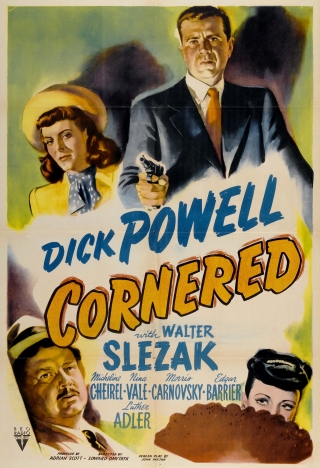
Post-war angst and the struggle to adjust to a world which has undergone rapid change has formed the basis of many a film noir, probably too many to count. Cornered (1945) could be placed in that category, but I reckon it goes a few steps further and draws not so much on the angst of the veteran as the psychological trauma he must endure, and not simply the difficulties of returning home but the impossibility. What’s more, it raises the unwelcome and uncomfortable idea that the roots of the conflict may not have been eliminated, merely pruned back and weakened, that they may in fact sprout again. And then there’s the way that the concept of revenge is presented, not critiqued just presented. In brief, the scenario placed before the viewer can best be described as bleak.
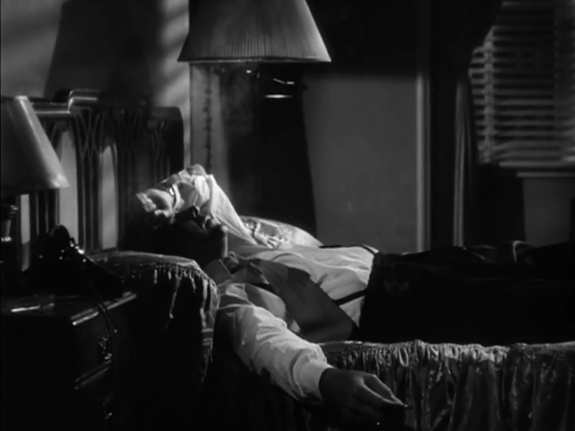
Laurence Gerard (Dick Powell) is first seen being demobilized. He’s collecting the pay accrued to him while he was a POW. This is in London and it’s expected that he will make his way back to his native Canada. It is soon made clear though that the tight-lipped and laconic Gerard has no intention of doing what others might have anticipated. His plan is to go to France, something he manages without official sanction and thus offers an early insight into the implacable nature of the man. The reason behind his determination to cross the Channel by hook or by crook is soon cleared up – his wife of only a few weeks was killed and his short sojourn in France reveals that her death, alongside an untold number of others, came about as a result of the actions of a collaborator named Marcel Jarnac. That individual is said to have died but Gerard is dubious.
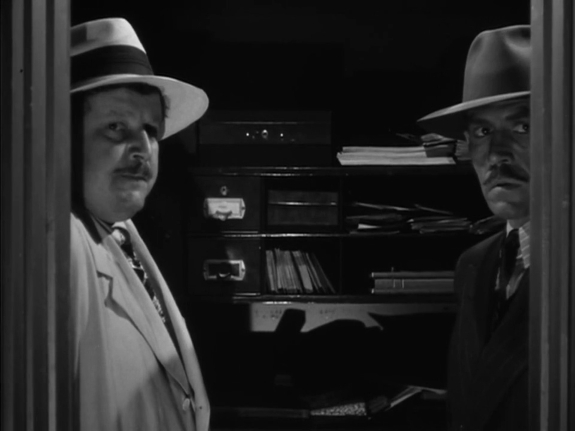
And here we have the basis for the remainder of the movie: Gerard wants revenge, a reckoning for the loss of his wife and he is prepared to go to the ends of the Earth to achieve this. Well, maybe not quite the ends of the Earth, but as far as Buenos Aires in Argentina at any rate. His theory is that if Jarnac is to be traced, then his widow is the one most likely to offer a lead. The quest brings him into contact with a host of suspicious characters, people whose allegiances and motives are hard to pin down. There is Melchior Incza (Walter Slezak), a self-declared “tour guide” of indeterminate origins, the wealthy and well-connected Camargos (Steven Geray & Nina Vale), Santana (Morris Carnovsky), Camargo’s uncle, and Mme Jarnac herself (Micheline Cheirel). Gerard is convinced that somebody from among this ill-assorted group can provide a link to the elusive Jarnac, and with a combination of blunder, bluster and the odd flash of guile, he finds him in the end.
Cornered was the third time director Edward Dmytryk worked alongside producer Adrian Scott and writer John Paxton. They would do one more movie together before the shameful HUAC fiasco put paid to all that. The film has a strong anti-fascist tone, and sounds a warning against post-war complacency, pressing home the point that all the sacrifices and hard won victories of the preceding years could easily be undone by failing to be alert to the patience and determination of totalitarian opportunists. The horrors that had been endured are never far from the surface – the early scene in the cave where the graves of the victims of Jarnac’s treachery are located is quietly poignant, and then there are the regular episodes of PTSD which strike at Gerard. That’s all retrospective though and the movie takes pains to point out the risks ahead. In the creepily effective climactic scene where Jarnac still exists only in the shadows, he softly intones how people like him are forever vigilant for dissatisfaction in society, for the opportunities to exploit disillusionment and turn misery and discontent to their advantage. Somewhat depressingly, the same kinds of people are still taking advantage of inequality and deprivation today and manipulating them to their own ends. Those lessons that ought to have been learnt 70 years ago remain relevant, sadly.
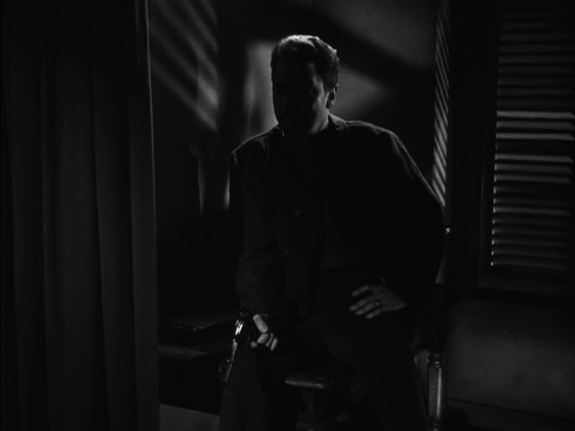
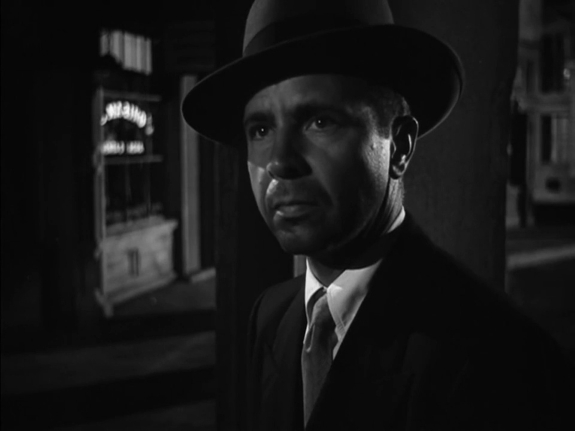
Dick Powell could play flippant and crack it wise with the best of them, but his performance in Cornered has none of that quality. Instead, there is a grim and driven sense to his work here, something entirely befitting a man who is not only grieving the loss of his wife but is also fighting against the effects of his injuries and experiences. His features are set throughout and there’s a severity to him that is highlighted by the crew cut he sports and the livid scarring at his temple. When he finally gets to confront Jarnac and gets to exact revenge, he becomes a personification of Nemesis. The climax of the picture has a brutality and starkness that still chills, but while it does offer some satisfaction it is problematic too. In the final analysis, revenge is unhealthy. It takes as much, if not more, from those who seek it as it does from those who face it and the best writing tends to emphasize how undesirable and even destructive it is. If Cornered has a weakness, it is the way revenge and its inevitable consequences fail to be adequately critiqued.
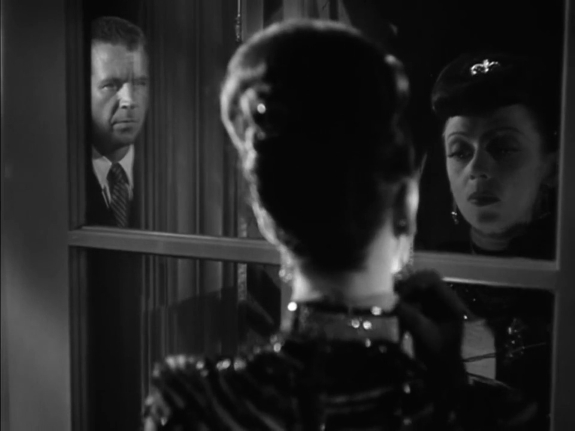
Walter Slezak was a fine villain in a number of movies – Lifeboat, The Fallen Sparrow – and was able to use his bulk and joviality in a way that was both effective and subversive. Morris Carnovsky, another of those who drew the attention of HUAC, brings a hawkish intensity to a role that appears ambiguous at first. Steven Geray drifts in and out of the action and had that soft, servile obsequiousness about him that is easy to despise. Micheline Cheirel is sympathetic as Mme Jarnac, but perhaps it would have been better, in terms of plotting and suspense, if she could have brought a bit more of an edge to her part. The only other female character of note is that played by Nina Vale, and she adds plenty of showy allure and sensuality. The actress only played in a handful of movies before disappearing entirely and I’ve not seen any information on why that was so. Intriguing. And that brings me to Luther Adler. He appears only at the end of the film, even then largely draped in shadow. I think the decision to keep him unseen for so long was a good one, it lends weight to the character and in some ways I would have preferred it if we had never been given the chance to see his face at all; in many ways, a faceless evil is even more powerful than one we can confront.
Cornered was released in the US on DVD by Warner Brothers in their now out of print Film Noir Collection Volume 5 paired up on disc with Anthony Mann’s Desperate. No supplements were offered. It is a movie with a lot going for it, although I do think the handling of the revenge aspect is disappointing. While the wrap up tries to address that to some extent it’s not entirely successful. So, what we have is a thought-provoking and solid noir with a flaw in the handling of one of the core themes. Well worth a viewing regardless.
As an Amazon associate, any purchases made through clicks on links to that site earn a small commission that assists in the upkeep of the blog.


One of my favourites. It features my favourite Dick Powell performance after Murder, My Sweet. It’s a shame that it isn’t as well known as it deserves to be these days.
LikeLiked by 1 person
Powell brings a real sense of relentlessness to the role, his character is very much consumed by what has happened in the war and it feels authentic.
I think the film is out of print in the UK (I know it did have a DVD release) as well as in the US so that kind of limited availability can affect how well known or otherwise a movie is.
LikeLiked by 2 people
I greatly enjoyed your insightful write-up, Colin. I saw Cornered only once, decades ago, and it wasn’t high on my list. After reading your take, I’m going to give it another whirl and see if the passage of time will improve my impression.
LikeLiked by 1 person
Yes, do try it again. I find it an absorbing thriller and a worthwhile one.
LikeLiked by 1 person
Great, a Dick Powell noir I haven’t seen. I’ve just downloaded it and look forward to viewing
LikeLiked by 2 people
In that case, I’m very happy to have been able to bring it to your attention, David. I hope you enjoy it.
LikeLike
Another film to put on my watch-list if I ever get the opportunity to watch it. I suppose there’s complications with copyright issues especially with old films from the 1940s and 1950s, but I do think its such a pity that streamers like Netflix etc don’t reserve parts of their content library for ‘classic’ or ‘forgotten gems’ like noir or westerns, dramas, crime films etc. They might be surprised regards the number of people who would watch such content, and in theory it wouldn’t cost very much to license it? Here in the UK we have a cable channel Talking Pictures TV which is something of an indie concern that has had considerable success screening very obscure/old films and TV shows from the 1940s and 1950s.
LikeLike
The film has been broadcast in the UK multiple times by the BBC, quite regularly in fact from the 1990s through the early 2000s with the last reference I can see being 2014. I know the BBC had access to most of the RKO library, and may still do so, which is the reason why many of the studio’s movies turned up quite often.
LikeLike
I’ve seen Cornered and I’m afraid I was very unimpressed. It was a while back but I recall it as being rather strident. There’s a tendency to wildly overrate blacklisted directors and writers.
LikeLiked by 1 person
Personally, I don’t see stridency in the tone of the movie. There’s certainly an intensity to it in places that is palpable, which is in keeping not only with the events that prompted the protagonist but also the time it was made and the rawness that came from that proximity. In fact, the climactic scene where Jarnac is still draped in shadow and quietly intoning his poisonous view is quite subtly achieved, avoiding histrionics and therefore far more chilling, not to say prescient.
That said, the movie won’t succeed for everyone, no film will for that matter. I maintain it would have been strengthened by a more trenchant critique of the revenge motif – it could be said that this happens to an extent when the problems posed by Gerard’s activities are brought up, but I’m thinking more of the way the psychological and spiritual effects on himself are essentially sidestepped. So, while it is not a flawless piece, I don’t feel describing it as strident is justified.
LikeLike
Surely so on all points. Thanks Colin for reviews I’ve enjoyed at least as much as upon viewing the film. And if that multi-disc Warner Archives set is OOP then people should send in DVD/BD release requests at websites for Kino Lorber, VCI Entertainment and Criterion Collection. And in the UK and Australia, Powerhouse Films, Arrow Films and Fabulous Films-but be sure to specify Region free releases.
LikeLiked by 2 people
Yes, no doubt the studios and distributors all have their own plans, but I reckon it never hurts to leave mentions of wanted titles on their social media feeds.
Warner Brothers have released a lot of old box set titles on spruced up Blu-rays and that seems to be an ongoing project, although I don’t think any of the Noir Vol 5 movies have been reissued yet.
LikeLike
That volume 5 is a great set. From the earlier sets I just recently took in the DVDs of ‘Born to Kill’, ‘Crime Wave’, ‘Act of Violence’, and ‘Decoy’. Wonderful stuff with some great commentaries too.
LikeLiked by 1 person
All of those noir collections were solid if you ask me, albeit with a few weak transfers sprinkled around. I think I’ve now featured 5 of the 8 titles in the volume 5 set.
LikeLike
Yes, most of the transfers were solid but I think the Fox noirs had an even better consistency with some excellent prints (recently been going through those too). Love Noir.
LikeLike
I think that’s probably right. The Fox line (which feels like a long time ago now) was very impressive visually, and had some good supplements too.
LikeLike
Yes, hard to believe that wonderful set was that long ago. Collecting them was fun.
LikeLiked by 1 person
Cy Endfield deserves his place in film history for TRY AND GET ME and HELL DRIVERS alone.
Great fan of Losey’s early Brit Flicks especially TIME WITHOUT PITY and THE SLEEPING TIGER The former film shows American Directors inability to reign in British (in this case Australian) Ham Actors. Later Brit Losey’s like THE CRIMINAL and THE DAMNED are fine by me;wouldn’t be without all four personally.
LikeLiked by 1 person
The above was a response to Dee’s comments on blacklisted directors.
LikeLike
I would also add Jules Dassin and Robert Rossen as blacklist victims whose work is deserving of the praise it often receives.
LikeLike
John K, I like Cy Endfield movies, also. TARZAN’S SAVAGE FURY(filmed 1951, released 1952), MYSTERIOUS ISLAND(filmed 1960, released 1961), ZULU(filmed 1963, released 1964), and ZULU DAWN(filmed 1978, released 1979), which he wrote the story and co-wrote the screenplay, but didn’t direct. All entertaining and noteworthy and well worth viewing.
LikeLike
Dee, we’ll have to agree to disagree concerning CORNERED “being rather strident.” I don’t think it really is, but that’s just my opinion.
Concerning that, “There’s a tendency to wildly overrate blacklisted directors and writers.” I’m sure you mean the politically blacklisted directors and writers. Personally, I think that directors and writers should be looked at by the results of their work and not their political views. That goes for today also, not just during the 1940’s and 1950’s. I remember viewing Charlton Heston on THE ARSENIO HALL SHOW in 1989, and Arsenio asked him who was the best actress that he had ever worked with, and he answered Vanessa Redgrave. Redgrave and Heston were polar opposites politically, but Heston looked at her work, not her politics. Charlton Heston set a good example.
Dee, I’ve been having trouble commenting on your blog site, once again. I liked your write-up on SARABAND FOR DEAD LOVERS(filmed 1947, released 1948), which is a movie that I’ve never viewed, but I would like to. I sent a testing and it went through, so I’ll attempt again.
LikeLiked by 1 person
You know, it’s hard to stay engaged in a film when it is a struggle to absorb what is being said. For me, I could not easily decipher the spoken delivery of words as they seem to run together thus sounding muddled. After watching and listening to the movie two times, I’ve come to the conclusion it’s either my issue or improper staging of the Sound Department. Anyone else experience this or possibly have other explanations?
LikeLike
It’s not something I noticed, although poor sound mixes in some current TV has bugged me before.
Was it Powell’s delivery that bothered you, or the cast in general? And if it was mainly Powell – his speech could take on a pretty rapid tempo at times – has his delivery been problematic for you in other movies?
LikeLike
Colin, all the players were difficult for me. Although, with Powell, I was better able to get some idea what he was saying mainly because of the familiarity with him, our dialect being the same and knowing his purpose in the film. With the others, when trying to figure out who was white hat or who was black hat it was frustrating for me not being able to understand them clearly nor distinctly throughout the movie. Maybe the issue is just a language barrier with many different dialects speaking their own form of English.
For the movie itself I like the premise it served. I would think the audiences in 1945 would be much more in-tunned to the evils of fascism and fascist leaders escaping to other parts of the world with the threat of renewing their evil. For them, I’m sure the ending sequence played by Luther Adler depicting the madness of French Vichy collaborator Marcel Jarnac struck home. But, in today’s world, it’s shameful that many have not a clue of WW2.
LikeLike
The plot does twist and turn quite a lot before the interests of the various players becomes clear, and there is a verbal fencing involved at times.
As for the core theme/message, it would be a relief to think it remains rooted in the past and carried greater significance for an audience in the immediate aftermath of WWII. However, the erosion of institutions, the barefaced corruption, and the determination to manipulate and profit from dissatisfaction is widespread now. Even more concerning, is the fact such people no longer feel it necessary to lurk in shadows.
LikeLiked by 1 person
Scott, I also think that it’s shameful that many haven’t a clue of WW II. For the life of me how can anyone have any understanding of the world of today without knowing about WW I, the Roaring 1920’s, the Great Depression, WW II, the Korean War, the Vietnam War, the Cold War, the Space Age, Desert Storm/Shield, the Twin Towers disaster, and much more. I hate to see our Cultural Memory fading away. That said, I think we should do our part in keeping our History and Culture alive for future generations. I’m in hopes that there will be enough folks from Generations Y, Z, and Alpha who actually care to keep things going into the future without forgetting the past.
William Faulkner in writing in REQUIEM FOR A NUN(1951) says, “The past is never dead. It’s not even past. All of us labor in webs spun long before we were born, webs of heredity and environment, of desire and consequence, of history and eternity.”
LikeLiked by 3 people
Walter, you are a true American patriot. I’m proud to have made your acquaintance.
Scott
LikeLiked by 1 person
Scott, I’m very proud to make your acquaintance here online. Thank you so much for your kind words.
LikeLiked by 1 person
I see that same quality of patriotism as well.
LikeLike
Barry, thank you. I think it’s a good thing to love your Country and its People.
LikeLiked by 1 person
I have studied the history of the US since I was five. First and favorite the Civil War. Then all different parts of it WWII being another favorite. History is the key because such vastness can be examined, the present is fleeting, and the future unknown. History is so important and fascinating.
LikeLiked by 1 person
Indeed, and Mark Twain’s comment, often misquoted as history rhymes, about the images of the present seeming to be made from the remnants of the past legends is worth remembering.
LikeLiked by 1 person
Twain was such a master. He and Ambrose Bierce are so relevant always to me.
LikeLike
Chris, Samuel Langhorne Clemens as Mark Twain is and always will be a relevant master wordsmith too me, personally. I think, and I’m not alone by any means, that Twain’s THE ADVENTURES OF TOM SAWYER(1876) and ADVENTURES OF HUCKLEBERRY FINN(1884) are masterpieces of American Literature.
Yes, when I think of Twain, I think also of Ambrose Bierce, Bret Harte, and Harriet Beecher Stowe.
LikeLike
Chris, I agree with everything in me with your statement, “History is so important and fascinating.” I’ve studied the History of the USA and the Civil War since before I could even read. I remember fondly looking at and savoring the CLASSICS ILLUSTRATED 1952 issue of THE RED BADGE OF COURAGE by Stephen Crane. The wonderful artistic illustrations by Gustav Schrotter and the cover by Maurice Del Bourgo. Kenneth W. Fitch wrote the script/captions. Also, in that issue was Maurice Del Bourgo’s illustrated AN OUTLINE OF THE CIVIL WAR. The writer of the script/captions of that segment isn’t credited. CLASSICS ILLUSTRATED wetted a many youngster’s introductions to the study of History back in the 1940’s, ’50’s. ’60’s, and ’70’s.
LikeLiked by 2 people
Excellent review. Ironically just watched Dick Powell’s Korean War directed Mitchum Korean war film ‘The Hunters’. Thought it was good if not in the class of ‘The Enemy Below’.
LikeLike
I’ve not yet seen The Hunters despite owning the DVD for an awful long time!
LikeLike
I have not seen CORNERED in quiet a while,but at the time I found it overlong and anti climatic. Though not Noir I found the same fault with CONFESSIONS OF A NAZI SPY which starts of in a remote Scottish post office of all places. There’s an amazing mid section piece where Nazi agent Francis Lederer plays cat and mouse with the feds. After that the film goes downhill, like CORNERED I felt that the film played it’s trump cards too soon. I guess my personal favourite Dmytryk Noir is CROSSFIRE.
Dmytryk tended to let many of his films suffer from overlength, which is odd since he started off in B Programmers, all very well made. The Dmytryk I’d love to see is UNDER AGE which has the mob forcing ex reform kids into a life of crime. I’ve requested this from Powerhouse and Australia’s Imprint as part of a “Crime Punishment & Social Reform-Proto Noir from Columbia Pictures” Geek that I am I made that up and like a previous comment I feel it does no harm to recommend obscure titles, in fact there is a pristine copy of UNDER AGE lurking in the vaults. UNDER AGE would make a great supplement to a future Blu Ray release of a more important Dmytryk film. At any rate I got a very nice reply from Powerhouse.
Any future Columbia Proto Noir set would have to include GIRLS OF THE ROAD a doozy of a B Movie-Columbia made a whole heap of these Crime/Social Comment B’s most very good indeed.
LikeLike
That’s a valid point about the pacing or structure of some of Dmytryk’s work. Even some of his relatively short movies can seem to drift, or lose some of their drive/focus in places at any rate. I remember thinking Warlock, which is a fine film overall, is weakened by seeming to reach one climax after another.
LikeLike
Colin, I have no problem with WARLOCK at all, it’s one of Dmytryk’s long films that fits together perfectly, for me at least.
Have you seen his Brit Noir OBSESSION (The Hidden Room) I enjoyed it but found the Phil Brown (another blacklist victim) character far too passive,he seems to just accept his fate with no resistance. Brown apart the film belongs in a select category of Brit Noirs that suggest highly educated,professional men are capable of becomming monsters. DEAR MURDERER, TAKE MY LIFE and WANTED FOR MURDER. I must admit in the latter title the poor chap is insane so we may forgive him, a top drawer Noir though.
LikeLike
Yes, I’ve seen Obsession and liked it a lot. I wrote a bit on it years ago: https://livius1.com/2011/12/12/obsession/
LikeLike
I rewatched “Cornered” after first viewing it 6 years ago. In fact, it was you who first told me back then where I could find it for viewing. I commented on it under your review of “Station West”. I think it is a terrific movie with strong performances from Powell, Adler, and the supporting cast. I attribute Laurence Gerard’s thirst for vengeance on his PTSD and while it drives the action, I certainly don’t believe the writers approved of it. Some think the plot is meandering, but I had no problems with it and found the pacing to be excellent. I’ve always maintained that Powell acted in 10 good films from 1944 to 1952. You used the phrase “to the ends of the Earth” in your review. “To the Ends of the Earth” was one of those 10 films that I enjoyed.
LikeLiked by 1 person
Always nice to hear from you, Frank. Just to pick up on what you say about the presentation of the vengeance angle, the issue I had is not so much any sense that the writers (Paxton, Wexley and an apparently uncredited Ben Hecht) approved of or condoned Gerard’s dogged pursuit of revenge, rather the way it’s just presented in a matter of fact way and the likely effect it would have on Gerard in the future is glossed over. I suppose I’m just conditioned to an extent with westerns (the better ones anyway) tackling the whole revenge question head on and typically laying out what a soul destroying path it traces. So, I guess my gripe would be that a rich theme such as this is not exploited as fully s it ought to be. If that makes sense…
To the Ends of the Earth remains stubbornly unreleased anywhere as far as I know. Now there’s a title some enterprising label might want to look into licensing.
LikeLike
Colin, good write-up of CORNERED (1945), which I think is an unusual drama of the Noir genre. By this I mean that World War II was usually in the background, but in this timely revenge drama it’s in the foreground. According to the American Film Institute(AFI) filming began in late June 1945 and ended in mid-August. The war in Europe officially ended May 8, 1945, and the war was still ongoing in the Pacific Theater. At the time, this movie’s setting was current events. History playing out before the audience’s eyes upon its world premiere at the RKO Golden Gate Theater in San Francisco on November 14, 1945. Dick Powell appeared in person at all the showings of the movie that day. Powell was accompted by his wife June Allyson, and he was happy that his fans approved of his change from starring in musicals and comedies to dramas.
I didn’t first view CORNERED back in the day, but I did finally catch it on TURNER CLASSIC MOVIES(TCM) in 2011. I enjoyed it, because I’ve always liked Dick Powell in movies and I’ve been very interested in the history of the flight of Nazi’s and their collaborators to Argentina and other South American countries during the aftermath of WW II. I first took noticed of this historical event when I first viewed Alfred Hitchcock’s NOTORIOUS(filmed 1945-46, released 1946) in 1968 on Memphis, Tennessee’s WREC Channel 3 EARLY MOVIE and I’ve been intrigued by the escapes of well-connected and wealthy Nazi’s to South America ever since my youngsterhood. My father, who was in the navy during WW II, told me about what a navy chief told him about being in Buenos Aires, Argentina before the war. The chief told my father that he felt like he was in Berlin, Germany. The Nazi military influence on the Argentine military was apparent because many admired not only Adolf Hitler, but also Italy’s Fascist leader Benito Mussolini. General Juan Peron, who became president of Argentina in 1946 was very much an admirer.
CORNERED was very much timely. My question is, how did screenwriters John Wexley and John Paxton know about the so-called “ratlines”(the network of large-scale escapes of Nazis and collaborators to South America) before the general public did? In May-June 1945 the public was primarily focused on the immediate aftermath of Victory in Europe (May 8), and the ongoing war in the Pacific Theater. The movie began filming in late June and as far as I know it’s the first movie made about the escapes of Nazi’s and their collaborators to South America. Apparently, in November 1944 Wexley was brought in to write a script from the treatment written by Ben Hecht. Wexley changed everything and made the script very political. Wexley’s script was submitted in March 1945, and he had Argentina shown as a Nazi base in which the Nazis controlled the country’s newspapers, social organizations, industries, secret police, and a haven for escaped Fascists. To the RKO executives, this script was a hot potato, because Argentina had finally declared war on the Axis powers by way of pressure from the USA, UK, and other Allies.
During a Washington D.C. press conference on September 7, 1944, USA Secretary of State Cordell Hull branded Argentina as a headquarters for the Fascist movement in the Western Hemisphere and a potential source of infection for the rest of the Americas. President Franklin Roosevelt denounced the Argentina government gas a Nazi-Fascist regime. As a hardline member of the Communist Party USA(CPUSA) screenwriter John Wexley saw this as an opportunity to write monologues with a distinctly Communist stance, thinly disguised as anti-fascist drama. Wexley’s script was read by Producer Adrian Scott and Director Edward Dmytryk in March 1945 and though they were both members of the Communist party they were dissatisfied with the heavily Communist ideological draft and knew this script had to be toned down a lot. John Paxton was brought in to overhaul and rewrite the screenplay, and he toned down the overt political manifestos, and the Nazi activity is confined to a small group of conspirators. It became a more psychological film Noir that RKO Radio Pictures eventually released to box-office success.
How did John Wexley feel about the changes to his CORNERED screenplay? Before the movie was released, Wexley brought fellow Communists Dmytryk and Scott to a Communist cell meeting where he lambasted them for having Paxton erase the Communist party rhetoric from the movie and then demanded their removal from the Communist party. In effect, Wexley and the Communist faithful were reprimanding Dmytryk and Scott for practicing their creative freedom. Dmytryk later said that this incident led him to leave the Communist Party. Keep in mind that during WW II the Communist lead Soviet Union(Russia) was our ally in the fight against Nazism and Fascism. Your enemy is our enemy, so to speak while at the same time the Soviet Union maintained a spy network of American citizens who passed USA secrets to the Soviet Union. The Communist Party USA(CPUSA) operated as an official section of the Communist International(Comintern), taking direct orders from Soviet authorities.
Two current event Incidents happened during the filming of CORNERED that really caught the media and the public’s attention concerning possible Nazi and their collaborators escapes to Argentina. The surrenders of German U-boats U-530 on July 10 at Mar del Plata, Argentina and U-977 on August 17 generated widespread media reports and rumors galore. These included claims that the U-boats had landed high-ranking Nazis, gold, or even Adolf Hitler and Eva Braun before surrendering. Argentine, USA, and international newspapers covered the stories extensively, and the FBI and other agencies investigated related tips. These events triggered early speculation and reporting that Nazis were fleeing to South America. So, by the time CORNERED premiered in November, I think these current events helped its box office returns, of which I’m sure RKO Radio Pictures was well pleased, and it continued to reinforce Dick Powell’s new tough guy image.
Later movies would have heroes hunting Nazis, but I think few matched CORNERED’s vigor in framing postwar Fascism as a future danger rather than just a WW II leftover. This contemplates the original goal of producer Adrian Scott and John Wexley’s screenplay, even after John Paxton’s rewrite toned down some of the broader Communist political messages. Even in its toned down version, I think that CORNERED still stands out because its political emphasis is unusually strong.
LikeLiked by 3 people
Lots of very interesting background info there, Walter, both on the script evolution and the timely nature of it all. That “ripped from the headlines” aspect, virtually as the headlines were being composed does lend it an urgency and authenticity that can still be sensed.
LikeLiked by 1 person
Colin, that’s what I like about CORNERED that as you say, “ripped from the headlines.” Although, I like some other things about the movie. It’s no masterpiece, but I like it well enough, probably because of the subject of World War II and the Nazi and collaborators escaping to South America and North America, or anywhere else for that matter. Also, I like Dick Powell in his tough guy roles. There is some really good snappy dialogue, especially between Laurence Gerard(Dick Powell) and Senora Camargo(Nina Vale-real name Anne Bradshaw Hunter) and I thoroughly enjoyed this temptatious back and forth. Nina Vale is one of those obscure actresses that I would have liked to have seen in more movies.
I don’t want to give away too much but CORNERED is a rather violent movie in both the mind and physically, especially toward the end. The movie has a bleak worldview, but that goes along with a Europe in ruins at the end of WW II. This was three years before USA’s Marshall Plan started in 1948 to help rebuild Western Europe and stop the evil spectre of Communism which was looming over Europe.
I think CORNERED is well worth viewing.
LikeLiked by 1 person
Walter, again without going into a lot of detail in case there are people reading this who haven’t seen the film yet, the climactic scene gets very dark indeed. Even today, it retains an ability to shock and I imagine that must have been amplified back when it was first screened.
LikeLiked by 1 person
I go for Zulu Dawn.
LikeLike
I think ZULU DAWN is a top-notch spectacle in all its grand photography(Ousama Rawi), production design(John Rosewarne), art design(Peter Williams), costume design(John Buckley), editing(Malcom Cooke), and the musical score(Elmer Bernstein). Story and screenplay by Cy Endfield and Anthony Storey. Endfield also wrote ZULU DAWN(1979) a novelization of the screenplay, which I haven’t read, but would like to.
ZULU DAWN is the kind of epic movie that I’ve always liked. I first saw this well-made blood and thunder epic in a UA Cinema in Little Rock, Arkansas in 1980. I’m glad that I first viewed this movie on the big screen. I remember the theater being packed and I had to sit on the front row, not the best seat in the house.
LikeLiked by 1 person
Fascinating story. I like ‘Zulu Dawn’. ‘Zulu’ is a favorite all time film. Classic, near perfection.
LikeLike
Chris, ZULU(filmed 1963, released 1964) is a favorite of mine, also. Another Epic War Spectacle that I like is KHARTOUM(filmed 1965, released 1966). I would have liked to have viewed it on the big screen. It was filmed in Ultra Panavision 70 and was shown in 70 mm Cinerama in premiere engagements.
LikeLiked by 1 person
Khartoum doesn’t get mentioned with the frequency of some of the other great epics – none of which I’ve been able to see on the big screen – but it holds its own among them. There is sweep and spectacle, and crucially it is built around a solid story with Heston delivering a measured and thoughtful performance.
LikeLike
Colin, I think KHARTOUM is a really good movie, and I haven’t viewed it recently, so I think it’s time for me to visit it again.
Robert Ardrey wrote a good screenplay, as you say, “crucially it is built around a solid story.” Ardrey was nominated for an Academy Award for best writing, story and screenplay-written directly for the screen for his original screenplay for this movie. He was a good screenwriter with several credits, although he is most famous for his controversial international bestselling books AFRICAN GENESIS(1961) and THE TERRITORIAL IMPERATIVE(1966).
Basil Dearden did a good job of directing and Edward Scaife’s photography is top-notch. Also, I think Charlton Heston shined in this type of role.
LikeLiked by 1 person
Just watched Heston in Mann’s ‘El Cid’ the other day. Excellent all around. Would love to see the epics on the big screen- ‘Waterloo’, for example.
LikeLiked by 1 person
Chris, I think EL CID(filmed 1960-61, released 1961) and WATERLOO(filmed 1969, released 1970) are excellent spectacles. Have you ever viewed Sergey Bondarchuk’s WAR AND PEACE(filmed 1962-66, released 1966-67)?
LikeLiked by 1 person
Walter,
I think that El Cid is a magnificent epic. I think it is overlooked or underrated by some film fans, but astute students of film like Martin Scorsese greatly admire it (he was involved in its restoration.) Anthony Mann does some marvelous work in it, especially in the filming of the joust scene where Mann’s typical depiction of the ferocity of violence may hit its peak. I know Heston thought Mann was in over his head, but, in this case, I strongly disagree with his take. Actor John Fraser, who played Prince Alfonso in El Cid, said that Mann had “a flair for the operatic which amounted to genius.”
LikeLike
Frank, I agree with you very much about Anthony Mann’s direction of EL CID. Yes, Charlton Heston thought William Wyler who directed BEN-HUR(filmed 1958-59, released 1959) was a better fit for EL CID. Mann called the movie a “Spanish Western.”
LikeLike
Yes, I was going to mention that one too. The depiction of the battle of Borodino is awe inspiring.
LikeLike
Chris, I agree that the filming of the battle of Borodino was awesome and inspiring. It was all done without any AI, CGI, or Industrial Light and Magic. 300 actors and 12,000 extras. This Soviet Union Mosfilm production was a mammoth production of Leo Tolstoy’s masterpiece novel WAR AND PEACE(serialized 1865-67, published entirely 1869). I first viewed it on television in August 1972 in the dubbed version shown over four nights on the ABC-TV Network. I had never seen anything like it.
LikeLike
I saw Zulu in the early ’80s at and old style theater in Somerville, MA. It was stupendous!
LikeLike
Frank, always good to hear from you. I envy you having viewed ZULU on the big screen. They just don’t make Epic War Movies like this anymore or Epic movies in general like this.
My daughter got to view LAWRENCE OF ARABIA (filmed 1961-62, released1962) on the big screen in the 2010’s in Oklahoma City and really enjoyed it.
LikeLiked by 1 person
Thank you, Walter. Unfortunately, I am not able to like comments and can’t figure out how to fix this issue.
Regards,
Frank G.
LikeLike
Wow, how great!
LikeLiked by 1 person