The Woman on the Beach

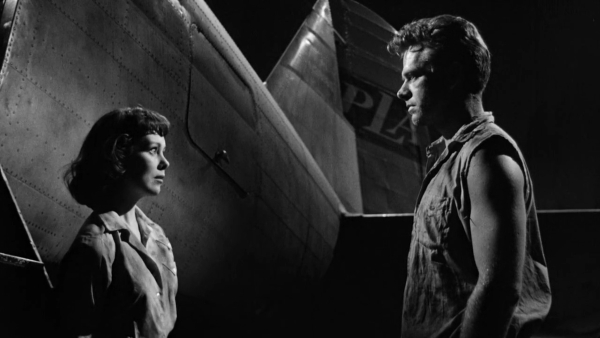
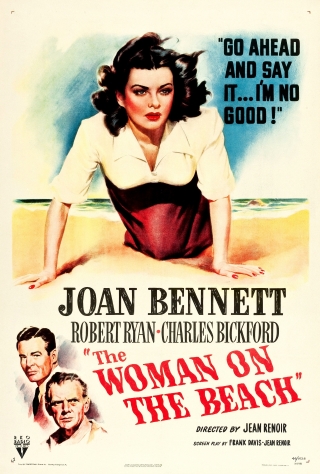
There’s something powerfully compelling about post-WWII cinema, the turbulence of a world still not healed of its wounds and the corresponding emotional discord that makes for great drama. Film noir was a terrific conduit for such storytelling, stemming from the willingness of that form to embrace instability and shadowy uncertainty, its ability to confront universal doubts within the easily identifiable framework of small scale personal crises. Of course not all of them worked out exactly as planned, but sometimes those that didn’t still exert their own curious attraction. The Woman on the Beach (1947) was made near the end of Jean Renoir’s time working in Hollywood and the reshoots and edits he had to complete before it was released probably contribute to some of the uneven quality it displays.
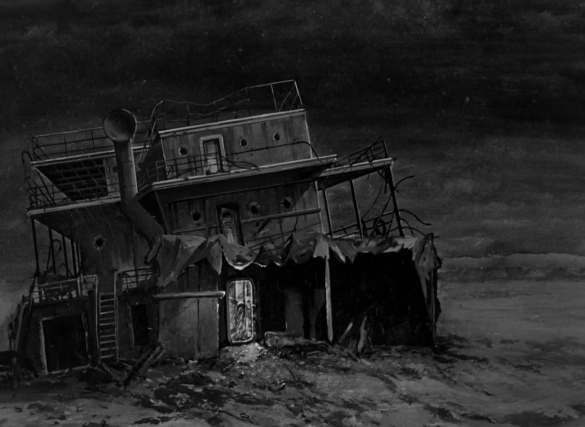
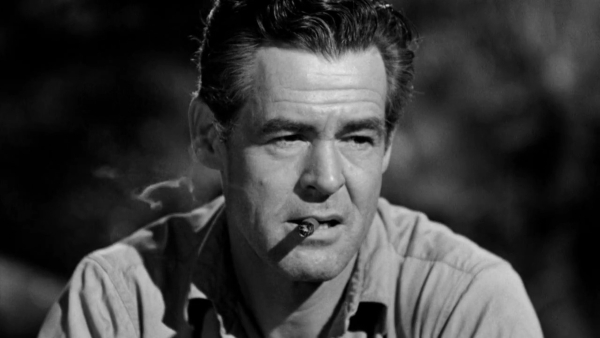
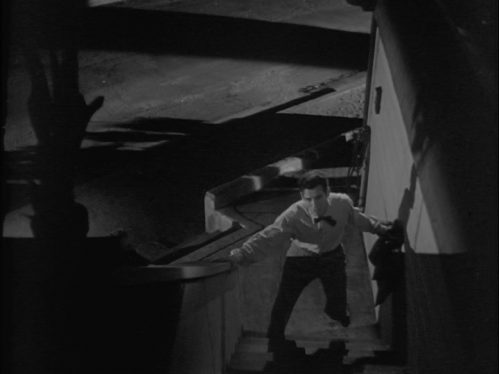
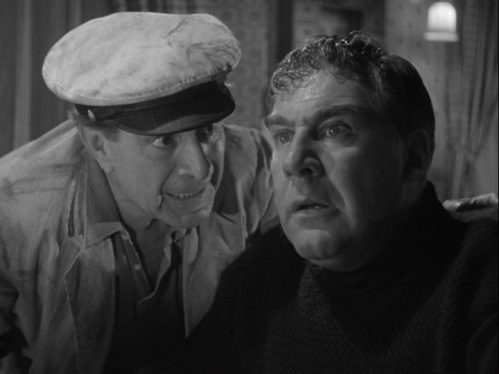
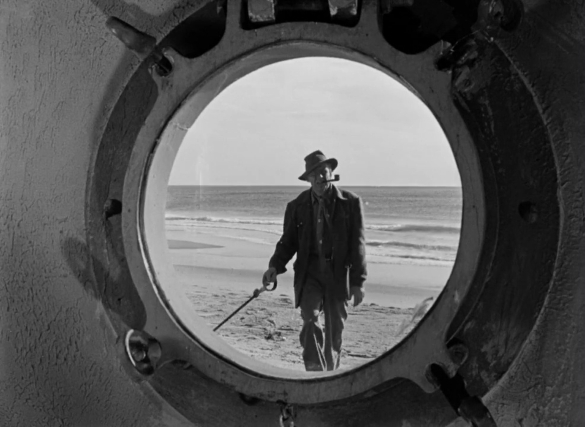
Films that are set in coastal locations have an atmosphere all of their own, the sense of being at the literal edge of the world can on occasion manifest itself in characters who are living on the edge emotionally. So it is with The Woman on the Beach, where the focus remains firmly on three characters throughout and the themes of guilt, bitterness, disappointment and betrayal are all probed and analyzed extensively. The main point of view figure is Scott Burnett (Robert Ryan), an officer in the Coast Guard struggling with PTSD. This is how he is first introduced, in the throes of a nightmare where he’s simultaneously drowning and walking the seabed among the dead, yet he is also tantalizingly close to a form of renewal, personified by a woman who approaches out of the murk to take hold of him. That woman is a representation of his fiancée Eve (Nan Leslie). All of this appears on screen in the oneiric opening scene, a wonderfully shot sequence that briefly fills in a significant amount of background detail by simply employing some imaginative visuals – very cinematic and very effective. Scott knows he’s not a well man, even though he’s recovered from his physical wounds the mental scars remain raw. On one of his habitual rides along the shore he comes across the hulking superstructure of a beached wreck. Alongside, and drifting out of the sea mist, is a woman. This is Peggy Butler (Joan Bennett), alluring, remote and with a troubled air, she is the wife of a former painter who has been rendered blind. Tod Butler (Charles Bickford) was once a prominent artist, now subsisting largely on a diet of jealousy and paranoia, washed down with a brandy chaser. What we have therefore are three damaged individuals thrown together by circumstance and it’s virtually inevitable that one of those eternal triangles, albeit an exceptionally toxic one, so beloved of dramatists will develop.
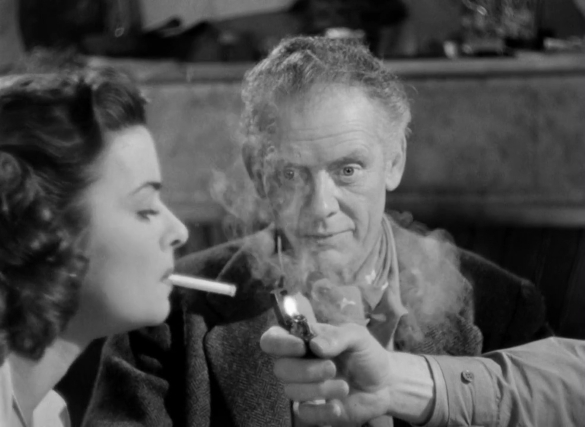
Now that I can’t paint anymore, this stuff of mine gets more valuable every day. There’s an old saying in my trade: a man never gets rich until he’s dead. I assure you a blind painter’s just the same as a dead man.

That’s a delicious piece of dialogue, communicating both the superficial observation about the supposed worth of artists and their work, and also a subtextual one about sexual potency that is highly apposite given the barren and unfulfilling relationship which has grown up between Tod and Peggy. It runs all through the movie, not least in Peggy’s unconcealed frustration, her contempt for the dull and domestic and her thirst for virility; in essence a yearning for all the elements of the past that have slipped from her grasp. Indeed all the three main characters are haunted by their pasts. This, along with the need to cease internal hostilities and lay ghosts to rest, is one of the major themes which is explored. By the end, a classic, cleansing conflagration is seen to have banished all those spirits while also tentatively pointing the way towards a hope for the future. Granted that finish may not be wholly convincing considering all the bile and bad feeling that preceded it, but it does bring a degree of satisfaction and ties up at least some of the loose ends.
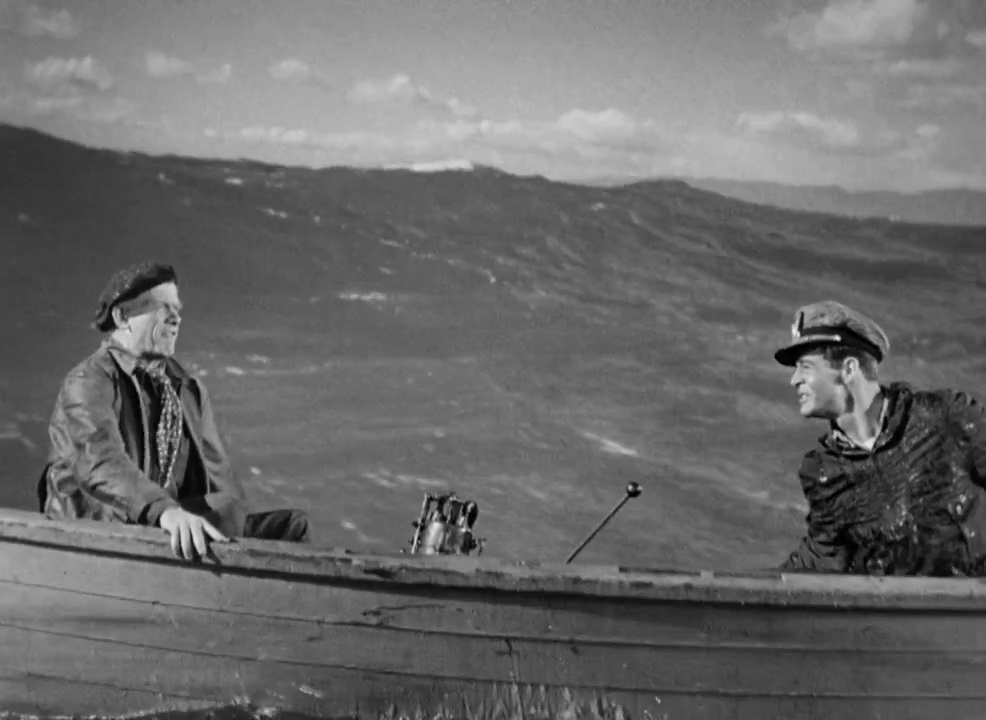
Last time, I posted on a movie which was made under the supervision of Val Lewton and this time we’re looking at one which was originally planned to be overseen by the same man. That didn’t come to pass though and Renoir ended up being granted a fairly free hand during production, but difficulties seem to have arisen when the primary shooting wrapped. I haven’t been able to ascertain the exact nature of the reshoots and edits requested by RKO but all indications are that they were extensive. Something which struck me as I watched the movie was the inconsistency, or maybe I should say the abruptness, of some of the character developments, but I’ll return to that. What does work well is the tone and emotional timbre, that rarefied atmosphere that grows out of isolation. All three characters become locked into a poisonous dependency that threatens to devolve into a virtual danse macabre. Renoir captures this shifting tone very effectively, from the breathless suspense of the walk along the treacherous cliff to the unbridled melodrama of Tod and Scott’s confrontation on the storm lashed fishing boat, and finally the psychological catharsis of the climax in the Butler house.
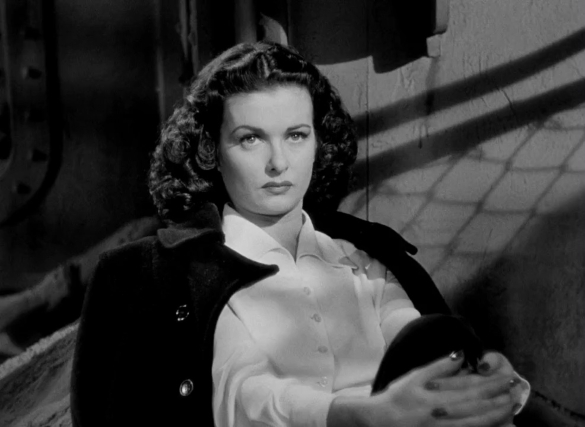
Unusually, I find the performances slightly tricky to assess, not because they are weak or ineffectual though. If anything, there’s a refreshing honesty on display. As a rule, the path of a given main character traces an arc from the opening of a movie right through to the close. Typically, there is a consistency to that arc, a logic that follows the dictates of the work’s internal logic and the traits of that character which have been presented. I won’t say that is absent here, but it’s certainly lacking at times. Maybe Ryan’s traumatized vet can be forgiven for veering off course occasionally yet it’s hard to reconcile the troubled but likeable and liked guy we meet at the start, a man with enough compassion to baulk at the idea of shunning the hospitality of a blind man who’s short of company, with the driven figure who both openly covets another man’s wife and is coldly dismissive of his own fiancée. Is it down to the survivor’s guilt gnawing away at him, the latent death wish he’s been nurturing? Perhaps, but it does feel like there is some connective strand missing. Similarly, Bennett’s crass coquetry appears to burst forth with little foreshadowing, only to retreat into grasping desperation before attaining a kind of redemption at the very end. Of the three protagonists, Bickford navigates a truer course, his bitterness and disgust for himself and others has a constancy that may not be at all admirable but does make more sense in context.
The Woman on the Beach is available as a Warner Archive title and the transfer is more than satisfactory, something that is particularly important with movies whose visuals are among their main selling points. Renoir’s eye for the arresting image, those visual beats that propel a story along in the most cinematic fashion are a pleasure to witness. The film is undoubtedly flawed yet it intrigues me and it beguiles me. Maybe that’s enough in the final analysis.

As an Amazon associate, any purchases made through clicks on links to that site earn a small commission that assists in the upkeep of the blog.
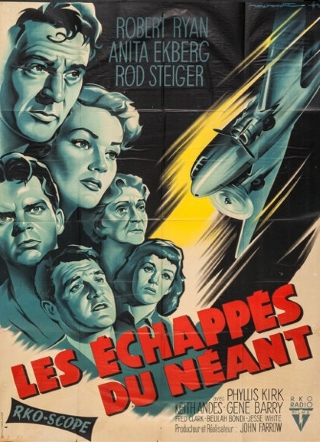
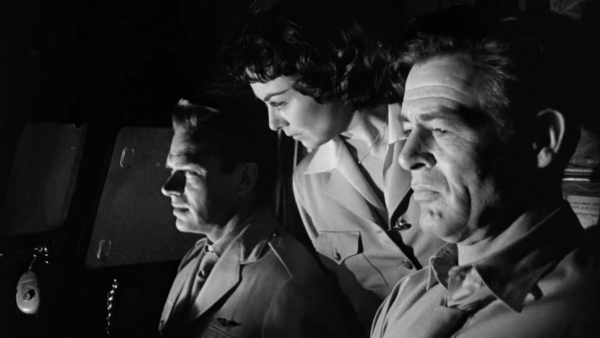
Back from Eternity

If there are really only seven basic plots or stories then that probably explains why remakes, which are practically as old as cinema itself, are so common. From a business perspective, something that has proven to be successful once may well do so again so the temptation is always there to take another trip back to the creative well. In among the virtual ocean of remakes there is to be found a more exclusive subset, that of a director redoing his own earlier films. Filmmakers as diverse as Alfred Hitchcock, Raoul Walsh and George Marshall did this over the course of their careers. In two of those cases ,The Man Who Knew Too Much and Colorado Territory, I know I like the later films better and if I wouldn’t go quite so far with Marshall’s Destry, I still feel it’s a worthwhile movie. In 1956 John Farrow remade his own Five Came Back (1939) as Back to Eternity, but I can make no comment on how it stacks up against its first iteration for the simple reason that I’ve not seen the earlier version.

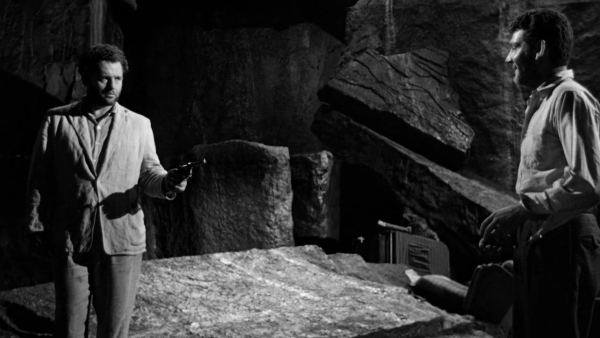
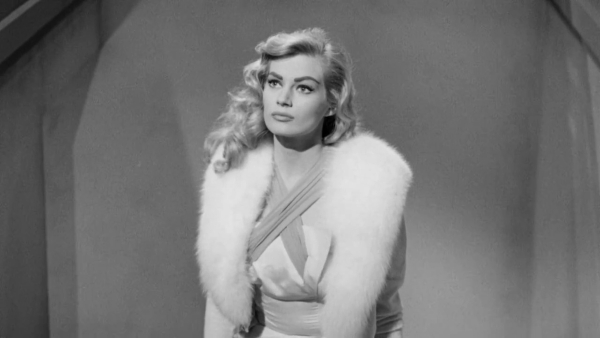
The “stranded in the wasteland” story is one which is ripe with possibilities. It promises danger, excitement and suspense, it allows for drama to grow out of shifting group dynamics, it acts as a platform for endurance and ingenuity, and it can also easily blend in themes of spirituality and even notions of redemption. Back from Eternity manages to combine all of those elements in its sub-100 minute running time. The first half hour or so is given over to the kind of character introductions that are necessary. Thus we see the eager new pilot (Keith Andes) and the older flyer (Robert Ryan) weighed down by the accumulation of a lifetime’s emotional baggage as well as a fondness for the whiskey bottle. There is a glamorous refugee (Anita Ekberg) now discarded by her shady lover and on her was to an even shadier future in what sounds like a South American bordello. Among the others there’s a brace of couples, one young and contemplating marriage (Gene Barry & Phyllis Kirk) and the other old and devoted (Beulah Bondi & Cameron Prud’homme), and a political assassin on his way to face execution (Rod Steiger). When a violent storm forces their plane down in the middle of an unexplored jungle in headhunter country, the real drama kicks in. They say that a crisis brings out the best and the worst in people and that is seen to be so here, selfishness and selflessness clashing like a couple of ethical knights in a jousting match of the conscience. Casting people back into a primal landscape and circumstances peels away their civilized veneer and reveals the true characters beneath. Everything comes to a head when the plane has been patched up but only to the point where it is capable of safely taking off and staying in the air with just five people on board. The question naturally arises as to who will go and who will stay, and all the while the unseen threat in the jungle inches ever closer.

Back from Eternity was scripted by Jonathan Latimer, a man who wrote a good many screenplays which John Farrow directed. He was a fine novelist too and his Bill Crane mysteries are a real delight and are highly recommended. As a novelist he was adept at weaving a rich thread of humor into his hard-boiled setups, however there is none of that on display here. Instead, there is a strong flavor of what I think of as Farrow’s influence. He was a director who frequently evinced a noticeably spiritual side to his work and it is clear to see in this movie. Aside from one overtly religious scene, there are the allied themes of sacrifice and redemption coursing through the fabric of the narrative. This is placed front and center in the decisions taken and the character arcs traced by the elderly Spangler couple and Rod Steiger’s Vasquel. It can be glimpsed too in the change of heart experienced by Jesse White’s former hood, in the renewed hope and motivation which stirs in Ryan’s disillusioned pilot, and also in the maternal protectiveness that a new found sense of responsibility draws forth in Ekberg.

All of this lends substance to the story, although it should be noted that it doesn’t arrive at the expense of the tension or danger that sustains the interest of the viewer. William C Mellor does some fine things with the lighting in the airplane and jungle scenes and I feel Farrow was wise to keep the headhunters off screen throughout. We only see the results of their handiwork on a couple of occasions and the rest of the time their oppressive presence is indicated only by the softly ominous beat of drums and a brief glimpse of a hand brushing aside some vegetation – out of sight yet very much on our minds.

What then of the acting? Rod Steiger is nothing if not interesting, a performer steeped in the Method and one who has garnered both fulsome praise and scathing criticism. Humphrey Bogart said his technique was of the “scratch your ass and mumble” variety, yet he was nominated for an Oscar in On the Waterfront, won one for In the Heat of the Night and did some remarkable things on screen in The Pawnbroker. Like him or loathe him, he was a talent, but he too often abandoned all restraint and seemed to tear movies apart with the sheer artificiality of his work. Fortunately, he holds himself in check in Back from Eternity, operating within his boundaries instead of trashing them. His one indulgence is his adoption of a frankly bizarre accent, a weird type of strangled German or middle European effort that calls unnecessary attention to itself. Robert Ryan is very subdued as the pilot, disenchanted and with a cool noirish cynicism, but never despondent. Anita Ekberg is largely decorative, a pleasingly pneumatic presence and Phyllis Kirk comes over rather starched and stuffy in comparison. Gene Barry is pretty good too as a slick type who quickly sees the polish wear off when he’s in jeopardy – it’s not at all a sympathetic role and I always admire actors who have the guts to take on that kind of part. Generally, the cast turn in professional work and all of them have their moments.

Back from Eternity was released by Warner Brothers on DVD as an Archive title. It looks solid throughout, presenting a crisp widescreen image which is in good shape overall. As I said at the top of this piece, I’m not in a position to draw comparisons with Farrow’s first go at telling this story, but I hope to get to that movie at some stage. Anyway, I’m a believer in taking films on their own terms and merits, and I can only say that I enjoyed this one.

The Professionals

La Revolución is like a great love affair. In the beginning, she is a goddess. A holy cause. But, every love affair has a terrible enemy: time. We see her as she is. La Revolución is not a goddess but a whore. She was never pure, never saintly, never perfect. And we run away, find another lover, another cause. Quick, sordid affairs. Lust, but no love. Passion, but no compassion. Without love, without a cause, we are nothing! We stay because we believe. We leave because we are disillusioned. We come back because we are lost. We die because we are committed.

Random musings on the nature of revolution, words which have an attractive feel, a weary patina lying somewhere just the right side of cynicism. That, I think, is the effect they are meant to convey, but therein is their problem, and by extension part of the problem of the movie they appear in. Hearing them spoken by Jack Palance’s wounded rebel and reading them back here leaves me with the impression that they have been crafted for just that, for effect rather than for truth or out of any real conviction. I watched The Professionals (1966) again the other day, a movie I’ve seen  fair few times now, and came away from it thinking it entertaining enough although somewhat lacking in substance. Like so many films by Richard Brooks, it doesn’t do much wrong, doing a lot right in fact, yet never actually amounts to as much as the filmmaker would have us believe.

During the latter half of the Mexican Revolution a group of four men, introduced via brief sketches during the opening credits, are hired by a wealthy businessman to get his kidnapped wife back. That’s the plot of the movie in a nutshell. It’s a simple enough setup, fleshed out by the colorful nature of a some of the leads as well as the dynamic created by their intertwined pasts, and of course the turbulent background of a country riven by internal conflict. The hired hands are led by Rico Fardan (Lee Marvin) a former associate of Pancho Villa, Bill Dolworth (Burt Lancaster) a womanizing rogue with a talent for blowing things up, Ehrengard (Robert Ryan) a diffident wrangler, and Jake (Woody Strode) a tracker and expert with a longbow. Their employer is one J W Grant (Ralph Bellamy), an ageing tycoon married to the much younger Maria (Claudia Cardinale). On the other side is Raza (Jack Palance), one of those bandits with a reputation approaching legendary status. The story is broken into a classic three act structure – the preparation and the journey out, the rescue, and the ride back leading to the denouement. If it sounds a bit formulaic, that’s because it is. There aren’t really too many surprises and the twist that is supposed to grab the viewer comes as more of a shock to the characters on screen.

This probably sounds more negative than I mean it to – the film is (as one would hope from the title) all very professionally shot and put together. It’s amiable and exciting in all the right places, the big set piece assault on Raza’s hacienda is filmed with style, the dialogue is peppered with memorable one-liners, and Conrad Hall photographs the desert locations beautifully. Yet when it all wraps up and the final credits roll, I can’t help feeling I’ve just had the cinematic equivalent of an attractively packaged fast food meal – pleasing and enjoyable while it’s there in front of you, but not something that is going to linger long in the memory when it’s finished.

A film scripted and directed by Richard Brooks (The Last Hunt) from a novel by Frank O’Rourke (The Bravados) inevitably raises expectations given the examples of the author’s and the director’s work cited. I guess that’s why it belongs in my own personal category of movies I like and enjoy even though I don’t believe they warrant an especially high rating. Films such as The Last Hunt and The Bravados stay with you long after they have been viewed, the performances and themes, the images and the very philosophy underpinning them have a way of boring into one’s consciousness and commanding attention. I guess what it comes down to is this – those are movies which touch on greatness, The Professionals is fun.

Lee Marvin and Jack Palance appeared in, by my count, four movies together – in additions to this, there’s Attack, I Died a Thousand Times and Monte Walsh. I feel confident that the latter is by far the best of them, closely followed by Aldrich’s intense study of men in war. The fact is all of the star players, and I’m counting Lancaster, Ryan, Cardinale, Strode and Bellamy here, all made much stronger films, all had roles that stretched them and highlighted their strengths to a greater degree than this. On the other hand, every one of these people are in essence playing types in The Professionals. This is not to say their performances are poor or weak, merely that the way the roles are written allow for next to no development – there are hints of back stories, mentions of experiences that would shape characters, but none of those characters grow over the course of the story. What we see at the start is pretty much the same as what we see at the end.

So, is The Professionals a good movie? The critics seem to have been kind over the years and its reputation remains strong. I like it well enough myself; I’ve watched it a number of times and I’m not in the habit of doing so with films which hold no appeal. Even so, I retain reservations about it, which I think is representative of my attitude to or how I respond to much of Richard Brooks’ work. Parts of his oeuvre hit the mark, have an impact beyond the immediate and provoke me in some way. On the other hand, all too often I find I’m left only half satisfied.

Caught

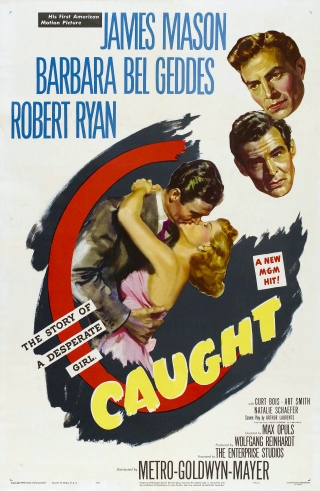
Seeing as Max Ophuls came up in some of the comments on the previous post, I decided to go back and have another look at one of his movies that I have struggled with in the past, namely the 1949 production of Caught. As a rule, I have enjoyed what I have seen of the director’s work, but this film has never worked for me. Anyway, with his name fresh in my mind, as well as the knowledge that the movie seems to be well regarded by many other viewers, I thought I should give it another chance. In brief, and this will be one of my shorter posts, I still have major issues with the movie. To be honest, the fact that I made it to the end was as much through a sense of obligation as anything.

The whole thing is an examination of wish fulfillment and the consequent importance of being very careful indeed of what one wishes for. It opens with two sisters in a shabby tenement mooning over glossy magazines and browsing for dreams, a gem encrusted necklace here, a platinum bracelet there, and so on. As ever, money and the power it bestows matters very much to those who have little of it. Leonora (Barbara Bel Geddes) wants the security and the comfort that comes with wealth, and it does come her way as the result of an invitation to a party on a yacht, an invitation she very nearly turns down. This is the thing with Leonora – she wants things and then doesn’t want them when their real cost becomes apparent. When she makes the acquaintance of Smith Ohlrig (Robert Ryan), a tycoon with a deeply disturbed character, she is soon on the fast track towards the high life on Long Island. However, this is where it all goes wrong for just about everyone involved. Ohlrig is a domineering, controlling and cruel man, an obsessive soul at war with himself and the world in general. Leonora soon comes to see the stew she’s landed herself in and, wisely one would say, moves out and ends up working as a receptionist in a slum neighborhood for Dr Quinada (James Mason). From here the movie devolves into a series of sorties back and forth for Leonora as her indecision along with a deep-seated conviction that she has to “improve herself” at all costs winds up being a good deal more expensive in emotional and physical terms than she’d bargained for.

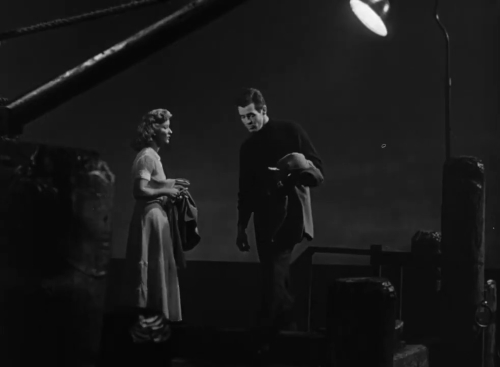
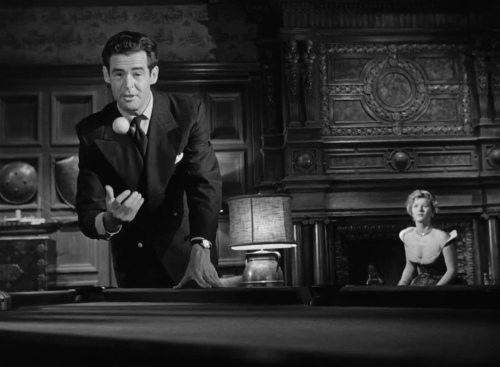
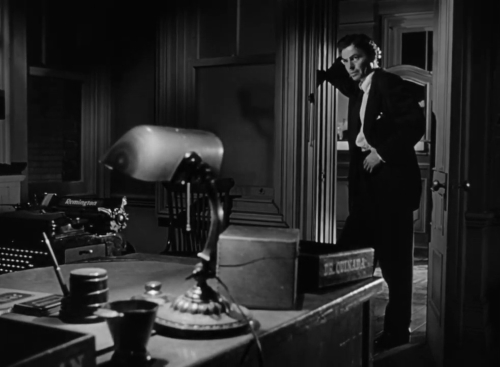
Max Ophuls’ direction is a pleasure – his camera swooping, swinging and panning, following his characters and sometimes sweeping past them to draw attention to the variously opulent or cheap surroundings while they debate, argue or simply muse out of shot. It’s a distinctive style and Lee Garmes’ cinematography adds to the eye-catching visuals. Attractive as all this may be, it’s not enough to paper over the paucity of genuine character at the heart of the movie. Robert Ryan’s Howard Hughes inspired sociopath is a showy piece of work, neurotic and foul and yet also somehow pitiful in his inadequacy. However, there’s a big hole in the middle of it all for me, and that’s the result of the role played by Barbara Bel Geddes. I started off feeling for her as she struggled to dig herself out of the poverty trap. The fact is though that she’s a playing a woman with essentially no character, a whiny, vacillating type who seems to revel in helplessness and indecision. This is the person who is the main focus and it’s very hard to like a movie where the central role presents such a moral vacuum. And the less said about the “happy ending” we’re asked to buy into, the better. James Mason’s first Hollywood starring role is fair, but he’s given little to do to stretch him –  he does have at least one good scene in the garage confrontation with Ryan and Bel Geddes. The support is mainly an attractively homespun turn from Frank Ferguson and a well observed peek at degradation and dissipation by Curt (“Tough, darling, tough.“) Bois.

Max Ophuls made far better films than this – The Reckless Moment, again with Mason, came shortly afterwards and is superior in every respect, and there are his great French movies such as  The Earrings of Madame de… and La Ronde. I honestly wish I could like this film more, but it just does not do it for me.

The Tall Men

Every story takes its characters on a journey, and invites the viewer along for company too of course. Those narrative journeys must bring the protagonists to some new place in life, another staging post from which they can embark on the next leg of wherever it is fate or destiny has offered up as a choice. It’s not always a literal journey, one involving actual travel from point A to point B, but it sometimes is and that sense of real physical movement can he a handy way to highlight the more important shifts that occur. The Tall Men (1955) is what we might call a trail drive western from one of the pioneers of the form; Raoul Walsh had directed the impressive and innovative The Big Trail a quarter of century before and there’s even a nod toward that production in the lowering of covered wagons on ropes down a sheer cliff face at one point. In pursuit of dreams that are both competing and complementary, Walsh takes his characters up and down the length of the United States, and even further than that emotionally.

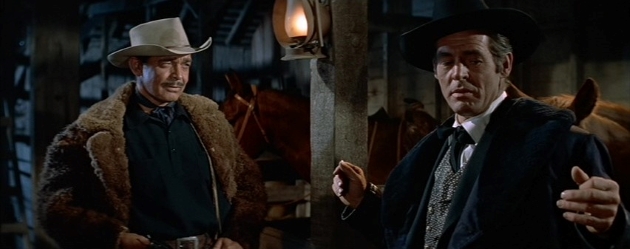
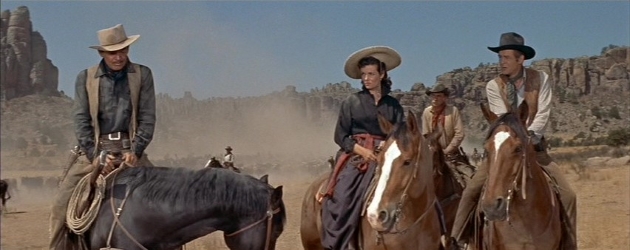
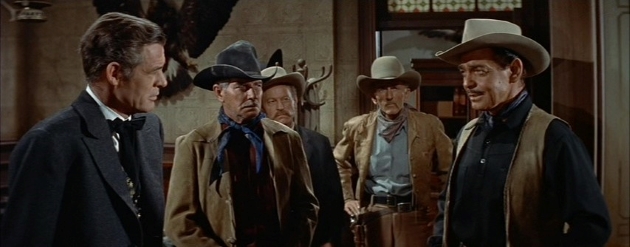
It opens in the snow, a chill and bleak backdrop with the color drawn out and starkness and bleakness to the fore once the blood red credits have faded from the screen. It is 1866 and the aftermath of years of conflict has left some men cast adrift, men such as Ben Allison (Clark Gable) and his younger brother Clint (Cameron Mitchell). That beginning deftly informs the viewer of the cynical and detached perspective of the lead characters – the sight of a hanged corpse in the wilderness prompting a throwaway line about civilization that is ripe with bitterness. Yet Walsh was not a cynic, he was at heart a romantic (even if he might never have wanted to admit that in public) and his best movies all set his characters off on grail quests for the truth and fulfillment that they must ultimately find within themselves. Ben Allison and his brother seem to be searching for nothing more than quick and easy money at the outset, staking out and executing a cheap and tawdry bit of banditry when they hold up and abduct a man they figure is both moneyed and green. That man is Nathan Stark (Robert Ryan), and while he may be carrying plenty of crisp new banknotes, he’s far from being a fool. He wrong-foots the brothers by offering them not a date with the law but a business proposal – help him drive a herd of cattle from Texas all the way up to Montana and share in the profits on completion. For men who are not by nature thieves, this offers them a way out, a chance to step away from the tantalizing vortex of crime and a life outside the law before it is too late. Setting out on that long ride back south to assemble a herd is the first step, and it also brings about a meeting with the other central character Nella Turner (Jane Russell), the woman who will bind all of them together and who prompts a reassessment among them of what they want and where they want to be in life.

The Tall Men was the first time Raoul Walsh worked with Gable, Russell and Ryan, and he would go on to make The King and Four Queens and Band of Angels with Gable, and The Revolt of Mamie Stover with Russell. There are many who would characterize Walsh’s filmmaking in terms of action and movement, and there is certainly plenty of that on display in The Tall Men. The sense of forward momentum, aided by the driving nature of the plot, is never far from the surface. Those action scenes, the seeing off of the Jayhawkers and the climatic stampede are shot and marshaled with considerable aplomb. Still, it is some of the quieter, more intimate moments that raise the movie and make it more than a simple shoot-em-up in the wilderness. The early scenes, after Gable has rescued Russell and they find themselves sheltering in an abandoned cabin, have great warmth and set the characters up for the developments that will follow. Gable and Russell form the core of the movie, the characters growing and changing in a way that feels very natural and the course of their relationship is first mapped out in that cabin sequence.

The use of music in this movie is artful and crafty too in the way the song – that vague ribaldry of the lyrics is characteristic of Walsh’s sense of humor – Russell sings, and appears to improvise according to circumstances, charts the peaks and troughs of her relationship with Gable. It’s not the first time a song has been used to punctuate a western, but it does feel different in the way its fluid lyrics alter depending on the singer’s mood while the theme itself remains constant.

“There goes the only man I ever respected. He’s what every boy thinks he’s going to be when he grows up and wishes he had been when he’s an old man.”

That line is uttered near the end by Robert Ryan’s Nathan Stark of Gable and it feels like screenwriters Sydney Boehm and Frank Nugent had the star himself in mind when they came up with it. The ageing Gable is used to good effect once more, that weariness that came along with the years, as well as the wisdom and philosophical self-awareness that is always lurking nearby, help to create a character who feels real, one whom the viewer can relate to and root for. Russell plays off him nicely, their moments together indicate chemistry and her role is of course key to making the plot work. Without her provocative and heartfelt performance the destination Gable, and Ryan too, arrives at would have little meaning.

Robert Ryan was one of the true masters of ambiguity, his heroes exhibiting bumps and cracks in their surface smoothness and his villains typically suggesting some grain of decency even if one would have to dig deep to find it. His Nathan Stark is a complex and nuanced portrayal, almost obsessively ambitious and capable of flat out ruthlessness, but he has a style about him, a kind of honest worldliness that is hard to resist. Once again, the script does the character justice, allowing the arc described to follow a natural path and, in the end, to reach a very satisfying destination. Cameron Mitchell was in the middle of a pretty good run at this time. Always more of a strong supporting actor than a natural lead, he had a knack for conveying callowness and occasionally suspect judgement. There is a point along the trail where it looks as though he may be heading down a disappointingly predictable route but the writing draws him back from that and his own skills make the turnaround credible.

The Tall Men has long been available on DVD, and it has always looked very nice too. The movie got a Blu-ray release in the US from Twilight Time and one in Germany via Koch Media, both of which are now out of print. Being a Fox title and therefore now owned by Disney, I guess hopes of a reissue on BD are slim at the moment. The movie is another of those classy pieces of filmmaking by Raoul Walsh which can be approached as both a slick entertainment package and also as a subtle commentary on the compromises people need to make if personal fulfillment is to be achieved. All told, a really fine bit of cinema.


Clash by Night

“People have funny things swimming around inside of them. Don’t you ever wonder what they are?”

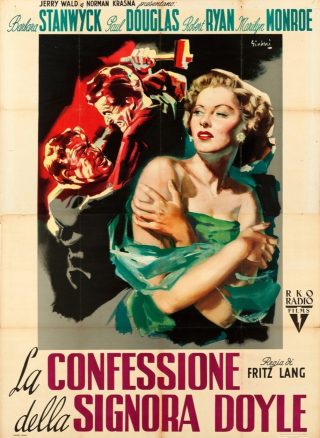
It’s odd the way casual, essentially throwaway pieces of dialogue have a habit of penetrating right to the core of the issue. Good dramatic writing will always seek to discover how and why  people react to certain circumstances, certain stimuli.  In melodrama, those reactions are by necessity heightened and may appear nonsensical or even contradictory when viewed with a cool, detached eye. Yet these contradictions and intensities are actually what validates the melodrama, the heightened feelings serving to draw all the illogicality of life itself into sharper relief. Fritz Lang’s Clash by Night (1952) is an example of a successful blend of film noir and melodrama in this adaptation of Clifford Odets’ play.

Mae Doyle (Barbara Stanwyck) is back home, back in Monterey after a decade in New York and points east, dressed up in disenchantment and drinking whisky for breakfast. She had been a dreamer once, setting out eagerly in search of her personal pot of gold labeled fulfillment. Time and disappointment have taken their toll though, leaving Mae long on regret and short on options. In fact, the only door remaining open to her, and it’s no more than ajar at best, is the one of the home she grew up in and then ran away from. Her younger brother (Keith Andes) offers a grudging welcome but there’s interest stirring in other quarters. Jerry D’Amato (Paul Douglas) is a fisherman, and her brother’s employer, all muscle and heart, and quickly smitten by Mae. However, there is bound to be a fly in the ointment and this one turns up in the shape of Jerry’s friend Earl Pfeiffer (Robert Ryan). Where Jerry is clumsy in his simplicity, Earl is brash and overbearing. Crucially though, his is a restless spirit, one which is drawn irresistibly to Mae, but she professes to be unimpressed by his shallow braggadocio and instead accepts Jerry’s heartfelt proposal. Nevertheless, just as those massive seas mercilessly pounding the coastline in the opening credits have foreshadowed, great emotional tumult lies ahead.

Film noir trades heavily on disillusionment, detachment and the ever-present threat of despair. Clash by Night taps into all of these, most especially a kind of gut wrenching disappointment and the awful sliding sense that all the positive things life might have to offer will forever remain just beyond reach. It’s like a head-on collision of post-war ennui and middle-aged malaise. Even as the protagonists sweat and struggle in the balmy atmosphere, on a personal level the first chills of autumn are already making themselves felt. I’ve no doubt the disenchantment and uncertainty over what direction to take in life would have struck a chord with a contemporary audience less than a decade after the end of a major global conflict, but the movie has a relevance beyond those immediate concerns. The idea that one can be tempted and seduced by superficiality isn’t confined to any particular era after all. At first, the material might seem atypical for Fritz Lang, but the idea of individuals trapped or restricted by (poor) choices and circumstances is entirely in keeping with his other work. Nobody is really free in this movie – even those who would have us believe they are free spirits are just as hemmed as everyone else – and practically everybody is straining against their respective bonds. Visually, Lang and cinematographer Nicholas Musuraca impress on the audience the claustrophobia felt by the characters first in Mae’s family home and then later in Jerry’s house, both of which are slightly elevated and therefore have a sense of remoteness about them. Consistent with the overall tone of the piece, however, there is at least a suggestion of an out, of an escape from the stifling ties that bind in the occasional shots of a moonlit sky or indeed of the vast ocean.

The casting works well, a trio of forty-something actors in the principal roles have that combination of a vaguely shopworn air, a burgeoning realization that time is not on their side, and enough of a spark and appetite for living to make their desperate snatching at the half chances flitting by appear credible. Robert Ryan always seemed to be the epitome of edgy, his characters existing on the periphery of society and civilization, like an interloper in his own home. Earl Pfeiffer is boastful, abusive and bullying; it is impossible to like a man who builds himself up by bawling out put upon waiters or forcing himself on women, but Ryan’s skill lay in his ability to add layers and dimensions to such boors, and his frustration at and awareness of his own flaws fleshes out the character and dismisses the caricature. Stanwyck is every bit as versatile in her own way, moving from pride to defiance, bitterness to fear, and all the time grounded by a frank admission of her character’s own weakness. Her role is both defined by her interactions with Ryan and Douglas and simultaneously creates a meaning and motivation for those two co-stars.

“Don’t say anything. Don’t make no promises. I’d have to trust you, that’s what the terrible thing is. You’ve got to trust somebody, there ain’t no other way.”

When Paul Douglas utters those lines right at the end of the movie there’s no doubting the essential truth of the words, for Jerry D’Amato and for the audience at large. This, coupled with the notion that a form of redemption could be attained by confronting and acknowledging the less savory aspects a person carries within, hints that the fatalism commonly regarded as being irrevocably wed to film noir may not be entirely insurmountable. Paul Douglas’ portrayal of non-judgmental decency, unbowed before loneliness and betrayal, is key to making this work. His scenes with Stanwyck range from the supercharged and fiery to the downright mundane, and the climactic one strikes a satisfyingly hopeful if not quite happy note. For all that, the one which lingers longest in my memory is an earlier interlude aboard his boat. He’s proposing, all awkward and shambling earnestness, and she’s resisting. There is some terrific screen acting on display from those two in that moonlit sequence, a pair of fine performers affording a glimpse of people teetering on the brink of temptation and trepidation. A magical moment of cinema.

While the three heavyweights in the leading roles naturally dominate proceedings, there is depth further down the cast list too. Marilyn Monroe was a rising star, just a year away from breaking through to the very top tier, and was billed fourth, just above the title. Even though she’s not the focus of attention she does get a few moderately memorable scenes, mostly sparring with a surly Keith Andes. This young couple are prey to some of that restiveness that plagues their elders; the shifting dynamics of post-war relationships, that realignment of social mores and roles, suggest that there is likely to be a good deal of friction, or even worse, ahead. J Carrol Naish was one of the most accomplished character actors of the classic Hollywood era, an instantly recognizable presence. As the wastrel Uncle Vince he occupies a small yet pivotal role, a Iago-like hobgoblin sowing unrest out of spite and whispering poison in his nephew’s ear at every opportunity.

Clash by Night was released on DVD long ago by Warner Brothers but I think it may have drifted out of print. It’s a pretty good transfer of the movie, and has a Peter Bogdanovich commentary track as a supplement, but any future upgrade to Blu-ray would be welcome. Fans of Lang’s work, and that of the leading players too, should find this an absorbing movie. It certainly earns a recommendation from this viewer.

The Naked Spur on Blu-ray

This is an especially pleasing piece of news and one I’m delighted to pass on. Anthony Mann’s movies with James Stewart rate as some of the finest works in the canon of classic Hollywood westerns. The Naked Spur has been available on DVD for a good many years but always looked a bit indifferent, and it’s a movie which doesn’t deserve to be described in such lackluster terms. Fortunately, and after what feels like a very long wait, it has been announced that the Warner Archive is bringing this important film out on Blu-ray on September 21. It’s a movie I have the highest regard for and I look forward to seeing it looking its best.

I wrote a piece on this film many years ago, which can be found here.

A Left and a Right

The fight game, with its allusions to glory and honor taking a ringside seat with corruption and manipulation, has often been featured in films noir, either peripherally or as a central plot element. Today, guest poster Gordon Gates focuses on a couple of boxing movies that don’t get talked about so much.

A double bill of boxing programmers with early Robert Ryan, Scott Brady and Richard Denning performances:
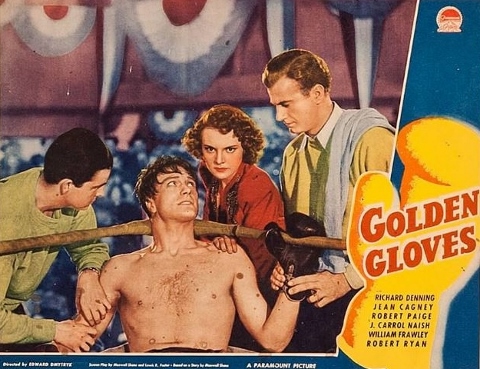
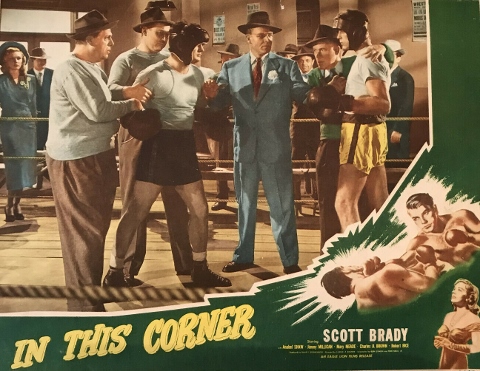
Golden Gloves (1940) & In This Corner (1948)
These two boxing films are early examples of what would become top flight noir films such as Champion, The Set-Up and The Harder They Fall.

First up is Golden Gloves from 1940

Richard Denning is an up and coming amateur boxer who makes a couple of bucks on the side, boxing for small time racketeer, J. Carrol Naish. Naish runs a string of boxing clubs that holds mismatched fights to packed crowds. “The people want knock-outs. So that is what i give them.” Robert Paige plays a newspaperman out to expose the racket which of course annoys Naish no end.

Paige arranges an amateur boxing tournament with straight up matches and proper refs, doctors etc. When George Ernest, the kid brother of Denning’s fiancée, Jeanne Cagney, is killed in one of Naish’s mismatches, Denning decides to join Paige and clean up the sport. Naish has other plans, and decides to wreck Paige’s next event by planting a ringer, Robert Ryan. (Ryan’s second credited role) Ryan’s job is to win the amateur event and then tell the papers he is really a pro.

This of course would destroy Paige’s attempt at cleaning up the sport. Naish now murders a boxer who threatens to spill the beans to the press. There is plenty of double dealing and knives to the back going on in this one. Edward Brophy, who plays a crooked manager, is a complete hoot to watch. Needless to say the last fight becomes a bout between Denning and the ringer, Ryan.

Denning manages to pull off a win to save the day while Naish and his gang are grabbed by John Law for the murder.

While I’m not saying this is an actual noir, there are plenty of flashes throughout the film. The cast and crew here would go on to be featured in many film noir.

The film was directed by Edward Dmytryk with help from an uncredited, Felix Feist. Dmytryk of course went on to helm the noirs Murder, My Sweet, Cornered, Crossfire, Obsession and The Sniper. Feist also dabbled in film noir with The Devil Thumbs a Ride, The Threat, The Man Who Cheated Himself, Tomorrow Is Another Day, The Basketball Fix and This Woman Is Dangerous included in his resume.

The D of P was Henry Sharp who lensed Ministry of Fear, The Glass Alibi, High Tide and Guilty.

The film was written by noir regulars Maxwell Shane, Fear in the Night, The Naked Street, The Glass Wall and Lewis R. Foster, who did Crashout and Manhandled.


Next up on the bill is In This Corner from 1948.
This one has Scott Brady in his third film and first lead, as a just out of the Navy scrapper who wants to become a pro boxer. He tells his girl, Anabel Shaw, that he is off to join an old Navy vet who manages a boxing club. Brady tells her that once he makes his fame and fortune, they can get married etc.

Brady finds the old vet has not managed a fighter in years and the club is just an old rooming house with himself as the only boxer. Brady sticks it out and is soon hired as a sparring partner at a club owned by a mobbed up manager, James Millican. Brady is soon signed to a contract by Millican after he decks a ranked fighter during a sparring bout.

Brady KO’s his first opponent and is soon moving up with 9 straight wins. His girl Shaw joins him and life looks good. That is till Millican informs him he is to take a dive in the next weekend’s fight. Millican’s mob is placing a large wager at long odds on Brady’s opponent, and his assistance is required. Brady is more than a little annoyed at this idea and tells Millican to get stuffed. Brady intends to win and to hell with the mob! Of course the mob has a back-up plan. They stick a punch-drunk boxer one step away from the morgue in with Brady to spar with. The boxer, Johnny Indrisano, goes down in a heap at the first punch and is hauled off to the hospital. It is the night of the fight, and Brady is getting ready to enter the ring when a telegram is delivered. It states that Indrisano has died from Brady’s punch to the head.

Needless to say this news throws Brady’s game off and he is savagely thrashed, just like the mob wanted. He asks for a re-match in 3 weeks and gets it. He trains hard but the death of Indrisano eats at him. The day of the fight, Brady sends Shaw off to see about helping out the dead boxer’s family. Imagine the surprise when Shaw finds no record of Indrisano’s death.

She digs deeper and discovers the whole thing was a mob ploy to upset Brady. She hunts down the quite alive Indrisano who is being stashed at Millican’s country house. Of course while all this is going on, Brady is again being pummeled in the ring. Shaw, the police and the just rescued Indrisano get to the arena just in time for Brady to rebound for a KO. Millican is grabbed up by the cops and the film is wrapped in just under an hour.

The director was Charles F. Riesner, whose claim to fame was Buster Keaton’s Steamboat Bill Jr and the Marx Brothers’ The Big Store. The D of P was Guy Roe who worked on noir such as, Railroaded, Behind Locked Doors, Trapped and Armored Car Robbery. The story is by Fred Niblo Jr who worked on Convicted, The Incident, The Bodyguard and The Wagons Roll at Night.

Ex-pug Johnny Indrisano sported a 64-9-4 record as a pro and beat several world champs during his career. He then became a character actor and a trainer for boxing films. He has bit parts in 99 River Street, Johnny Angel, The Bodyguard, Knock on Any Door, Tension, Borderline, Force of Evil, The Set-Up and about a dozen more noirs and numerous TV shows.

Nifty little low renter that is better than I make it sound.

——————————————————————————————————

Gordon Gates

Horizons West

poster59_zpsujbuh5ax

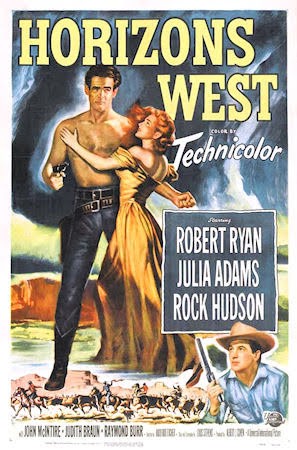
There are movies which look like they have everything going for them: a director with a substantial and significant reputation, a strong cast, and a promising script that is a blend of a couple of classic themes. All of this applies to Budd Boetticher’s Horizons West (1952) – add in the fact that the film was one of those handsomely shot Universal-International productions and one might reasonably expect it to be a cast iron winner.  However, the fact is it doesn’t quite live up to the build-up. It’s not a poor movie at all, just one which delivers a bit less than it could have – too much melodrama when more honest drama would have been preferable, and a series of conflicts which might have been more fully exploited.

The end of a war ought to signal a more peaceful era and maybe even a more hopeful one too. For the Hammond brothers, returning to their native Texas after taking part in the war between the states, the hopes are present although while Neil (Rock Hudson) wants nothing more than a return to the idyll he left behind when he signed on older brother Dan (Robert Ryan) is disgruntled enough to be in the mood for a different kind of struggle. By his own admission, Dan Hammond doesn’t like losing and almost immediately sets about changing the course of his fortune. This period of reconstruction in the vanquished South is one which can make men rich fast and, as always, draw the consequent attention of beautiful women. It just so happens that the allure of wealth and a woman crosses his path as soon as he enters Austin, and it also happens that both in this case belong to one man, Cord Hardin (Raymond Burr). It shouldn’t be any surprise that Dan will fall foul of this brash Yankee, nor that the clash is to set him on a path that tantalizes him with the promise of fulfilling his dreams but also creates a rift that threatens to irrevocably sour relations with his father (John McIntire) and Neil.

The title of the film – Horizons West – is both romantic and simple. Those two words pretty much encapsulate the spirit of the genre and I guess it’s no wonder that Jim Kitses used this as the title of his examination of the most influential figures in the western, a book I highly recommend to anyone who hasn’t yet read it. Yes, those two words conjure up all kinds of iconic imagery and it’s therefore difficult not to have heightened expectations. As I said above, this isn’t a bad little movie but everything from the title on down holds out the prospect of something greater and grander. Perhaps that’s a tad unfair as I have a hunch that were one to come to it after the credits had rolled, and unburdened by any great familiarity with director or stars, then it would prove a satisfactory and satisfying way to pass 80 minutes or so. I sometimes feel that approaching movies as “film buffs” means that all that associated baggage we bring along is simply adding an unnecessary degree of pressure to how we perceive films and assess their relative worth.

Director Budd Boetticher’s fame and reputation come principally from the films he made in the late fifties with Randolph Scott, what we refer to as the Ranown cycle. The greatness of those half-dozen westerns, a little interrelated cluster of bona fide masterpieces – cannot be disputed; they mark the director and his star out as giants of the genre. However, the flip side is the  way the towering reputation of those films tends to cast a deep shadow over the rest of Boetticher’s body of work. That his other, earlier movies do not attain those artistic levels shouldn’t be regarded as any particularly damning criticism. Generally, Boetticher had far less creative control over the films he was making as a contract director within the studio system, a fact which applied to almost all filmmakers. Boetticher, like any contract director, was employed to turn in a competently made product as efficiently as possible. This is what he did on titles such as Horizons West, the script of which lays the melodrama on thicker than it needed to and only scratches the surface of the theme of sibling rivalry and the differing perceptions of ambition within a family. The film always looks sumptuous (as Universal-International productions typically did) even if the on screen action is a little lacking at times. As usual, Boetticher shines brightest in the outdoor scenes and the action sequences, the final act being especially well-handled.

I’ve spent plenty of time singing the praises of Robert Ryan on this site before, and I’ll try to confine myself to pointing out the fact he rarely gave a disappointing performance and certainly didn’t do so in this instance. His edgy magnetism once again anchors the movie and he uses the duality of his character to great effect – I often think it was impossible for Ryan to play anything other than an interesting role. In terms of the development of the story, I would have liked to have seen more of the growing chasm between the two brothers. However, Rock Hudson was still in the early stages of his career and thus his part was limited somewhat – although each successive film would see his screen time expanded. Julie Adams was handed a good vampish role as the wayward wife of the northern carpetbagger and she makes for a very attractive presence. Raymond Burr was well on his way towards becoming virtually typecast as unsympathetic villains in these pre Perry Mason years – he played such parts very convincingly but he must surely have been bored by the dearth of variety at the same time. One of the delights of these studio vehicles was the richness of the supporting casts, and Horizons West certainly doesn’t disappoint on that score – John McIntire, Dennis Weaver, James Arness, Douglas Fowley, Tom Powers, Rodolfo Acosta and Walter Reed all add value to the viewing experience.

Some years ago, the only available copy of Horizons West was the German DVD by Koch Media, which I have. Since then, however, the movie has been released in the UK and the US, and probably in other territories as well. I can only comment on the Koch disc, which displays some genuinely eye-popping colors and is extremely sharp on occasion. There are some instances of softness though, and also some minor registration issues where the color can appear to bleed slightly. Overall though, I have to say the film looks very  fine. So, to sum up, we’re talking here about a solid movie featuring the talents of Boetticher and Ryan. Even if it has imperfections and isn’t up there with the very best work such people were capable of, it remains entertaining and worthwhile.


Lawman

It’s always the same. If you post a man, he has to come into town to prove he’s a man. Or you kill a man, he’s got a friend or kin – he just has to come against you… and for no reason… no reason that makes any sense. And it don’t mean a damn to the man already in the ground. Nobody wins.

Nobody wins – that quote taken from Lawman (1971) is a bit downbeat, but it does sum up the mood surrounding the film and maybe also feeds into the sentiments which would become increasingly common in the western in the 1970s. Last time out I was looking at a western, and at the same time musing about the genre itself, from the late 60s, a restless and hard to define era. The decade of the 70s followed on from that and gradually developed its own character – when we speak of the westerns of the 50s we often find ourselves referring to redemption, by the time we reach the 70s we’re more likely to encounter resignation.

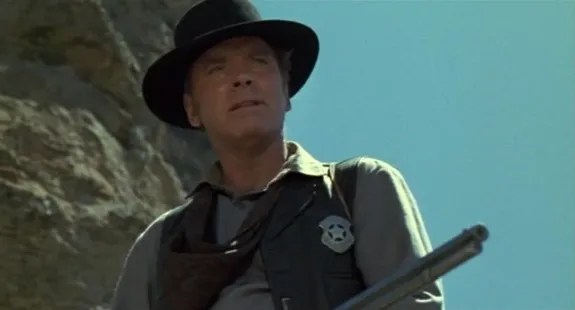
The figure of the lawman is integral to the western, the constant expansion of the frontier and the subsequent attempts to bring and maintain civilization via the rule of law is a constant factor, if not the underlying theme in itself. A bunch of weary cowboys let loose and whooping it up is another common sight, and the result of such celebrations was frequently violence. Such was the case in the town of Bannock, where the hands employed by Vincent Bronson (Lee J Cobb) had a little too much to drink, let their good sense abandon them and left a dead man lying on the street. And so the marshal of Bannock, Jared Maddox (Burt Lancaster), comes to Bronson’s patch with the goal of returning the guilty men to stand trial for the killing. Bronson is one of the old style pioneers, that tough breed who tamed a land and bent it to their will through the force of their personality, backed up by a loaded gun. Men like this are accustomed to getting their own way or, where that’s more difficult, to buying individuals who can smooth things out for them. Bronson has already bought and paid for his own marshal, Cotton Ryan (Robert Ryan), and believes that Maddox or those he represents have their price. In a way, he’s right as Maddox admits that he’s really only going through the motions – acquittals can be purchased in all likelihood. Yet Maddox’s own price isn’t quite the same; he might draw his wages from a corrupt source but he owes personal loyalty to another more idealistic paymaster – justice. So the drama and conflict therefore grow out of two situations: the reluctance of Bronson, or at least that of his men, to comply with Maddox’s wishes, and also the lawman’s own battles with  himself and the code he’s stuck by all his life.

The 60s was a decade when many questions were asked, the 70s kept at it and got some answers, but those answers weren’t always the ones people wanted to hear. Disillusionment was creeping in and many ideals seemed to be tarnished when dragged out into the cold light of day. Lawman dealt with that now familiar theme of changing times – clearly articulated by Lee J Cobb’s character – and the need to adapt, bend or be broken.The message seems to be that when all around you has been corrupted and debased by greed and self-interest, then the only sure or true thing one can hold onto is your personal code of honor. Maddox is the lawman, the one who has lived by that code refused to compromise. It raises him above the other characters, friends and enemies, colleagues and lovers, but isolates him too. Maddox questions the value of this, understands the fact it has sustained him through the years, but ultimately betrays it (and by extension himself) when confronted by the rank and venal behavior of the man who, in some respects, replaced him. It’s as though the knowledge of what he could become, if he were to submit to his desires, is too much for him and so must be banished.

Lawman was directed by Michael Winner, a man not noted for his subtlety either as a filmmaker or in any other area of life. It became fashionable to dismiss his work as crass and lacking in substance, but blanket judgements are rarely worthwhile and best avoided, in my opinion. Winner will never be regarded as a great filmmaker, which is fair enough, but it’s unjust to simply brush him aside as a hack. Some of his early work is very good – for example, West 11 is a neat little movie – and it wasn’t until  mid-70s that a significant decline in quality could be discerned. Lawman does have too many needless zooms and close-ups yet it also has pace and a kind of raw, brutal honesty that’s quite attractive.

Once again, we have a film whose stars hark back to the golden era of the genre – Lancaster, Ryan and Cobb were all involved in some of the finest westerns made and worked with the most talented directors, writers and cameramen. To browse their filmographies is to contemplate the heights cinema was capable of attaining, and their class is readily apparent in even the smallest gestures. There’s real pleasure and delight to be had from seeing these seasoned pros playing off each other and enjoying the nuances they could bring to parts effortlessly. Although that trio of heavy hitters would be enough to hold our interest by themselves there’s a terrific supporting cast to savor too – Albert Salmi, Joseph Wiseman, John McGiver, Richard Jordan, Robert Duvall, Robert Emhardt, J D Cannon, John Beck, Ralph Waite and more. It should be noted that the film is light on female representation; Sheree North is the only woman to play a part of any importance, but it’s a good role and one that impacts on the ultimate resolution.

Lawman is one of those United Artists titles released on DVD by MGM ages ago now. It’s typical of many such releases in that it’s just about passable but should look an awful lot better. On the plus side, the film is presented in the correct widescreen ratio and enhanced for 16:9 screens. On the other hand, there’s a softness about it and the usual artifacts and instances of print damage that need to be tidied up. The UK version I have has no extra features and I think the same can be said for the US edition too. Generally, I find I get on better with many (though not all) 70s westerns than the late 60s variety – it seems the genre settled down somewhat and made up its mind where it wanted to go by that stage – and I feel Lawman is deserving of a bit of attention. While it has suffered a bit due to the lackluster reputation its director earned over the years, it’s a good film and one that’s worth checking out.