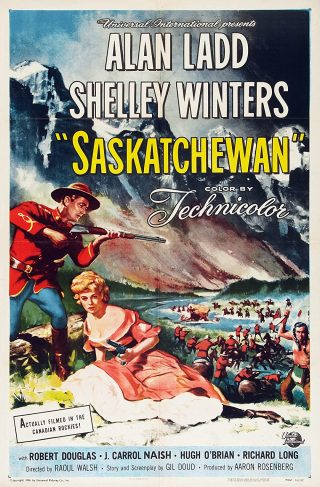
Saskatchewan

Cinema is action, action, action, but it must always be in the same direction – Raoul Walsh.

That maxim from the veteran director could be applied to many of the movies he made, and Saskatchewan (1954) genuinely lives up to it from beginning to end. In a lot of respects this is a routine film with no special message to sell. However, as with most of Walsh’s work, it remains enjoyable for it’s total lack of pretension and the pacy shooting style.

The plot concerns O’Rourke (Alan Ladd), a Mountie with close connections to the Cree due to his being adopted by them as an orphan. This affinity for the natives is made clear right from the start when O’Rourke and his Cree half-brother, Cajou (Jay Silverheels) are seen hunting together. Their sport is interrupted though when they stumble upon the site of an ambush by Sioux fleeing north after routing Custer’s 7th Cavalry at the Little Big Horn. There is only one survivor, an American woman called Grace (Shelley Winters), who escaped death by hiding herself at the onset of the attack. She proves reluctant to return to the fort at Saskatchewan with her rescuers, the reason being she’s wanted across the border in Montana for murder. With the threat of the Sioux forging an alliance with the Cree and fomenting trouble in Canada growing all the time, the Mounties are ordered to proceed south and link up their colleagues in an effort to drive the newcomers back to the US. That trek is beset with difficulties in the shape of constant Sioux harrying, a volatile and intolerant marshal bent on returning Grace to Montana, and a fresh off the boat commander with a firm grasp of regulations but woeful ignorance of the local conditions. As the possibility of the total annihilation of the command looms ever larger, O’Rourke has little choice but to stage a mutiny and try to get as many people as possible back to safety. All the while the Sioux and Cree are inching their way towards a pact that would surely guarantee war with the Canadians. There’s plenty of bad history in here, not least the fact that those Sioux who did run north had no intention of starting an uprising in Canada, but the sheer pace of the movie and the relentless action make it easy to ignore this and simply wallow in some of the stunning images on view.
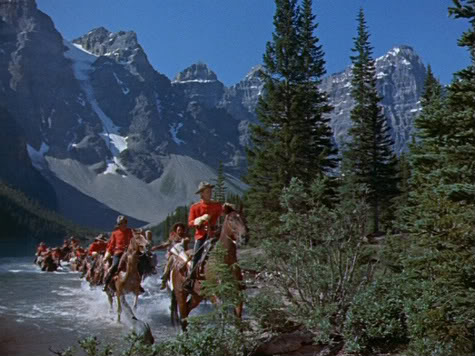
Raoul Walsh had a real talent for making watchable and entertaining films from thin, and sometimes pretty trite, material. He was always at his best when filming on location and staging actions set pieces, and Saskatchewan offered ample opportunity for indulging in both. The Canadian scenery provided a breathtaking backdrop and the director’s sure touch meant that events rattle along, peppered with well staged battle scenes. I always find it odd that Alan Ladd’s greatest and most iconic role also signalled his decline. His post-Shane roles were a mixed bag ranging from mundane to reasonably interesting, with Saskatchewan falling somewhere in the middle. The part of O’Rourke doesn’t call for him to dig especially deep or stretch himself, despite the fact that the opening set-up suggests that there will be some inner conflict to deal with. The pull of conflicting loyalties is explicit enough in the script, but there’s never any real sense of the turmoil this must necessarily evoke in O’Rourke. Ladd’s performance is by no means bad, it’s just not particularly involving. The only female of note in the movie is Shelley Winters as the fugitive O’Rourke grows increasingly attached to. I’ve never been a fan of Winters – even when she got to play fairly independent characters such as Grace there was still that slightly whiny and self-pitying quality about her that turns me right off. As the marshal determined to extradite Winters back to the US, Hugh O’Brian makes a satisfying villain. He’s clearly burdened by some dark secret, and is suitably mean when shooting Indians in the back and slugging Winters. For me, the most enjoyable role in the movie was the one handed to J Carrol Naish. His buckskin-clad Frenchman has a good line in quick fire wit and it’s hard not to smile at his self-confessed ambition to start his own tribe, already producing six children in the first six years of marriage to a Cree squaw. Naish was one of those unsung character actors who turned up in countless movies and rarely disappointed.

There are DVD releases of Saskatchewan in Germany, France (although this is almost sure to have burnt-in subs) and Australia. I have the German edition from Koch Media and the transfer is a very pleasing one. The film is presented 1.33:1 and is generally clean with colours that really pop. There are no forced subs on the English track and extras consist of the trailer, a gallery and a booklet (in German of course). I’d describe the film as entertaining without being anything special. Both acting and direction are competent and professional and it’s a lovely movie to look at. This is a lower tier western that sets out primarily to offer pacy and colourful diversion – taken as such it delivers successfully.

The Glass Key

poster130

The Glass Key (1942), from Dashiell Hammett’s novel, is a remake of of a 1935 picture. I have no idea how it compares since I’ve never seen the original, but this later movie does feature the trump card pairing of Alan Ladd and Veronica Lake in their second outing together. It came out hot on the heels of This Gun for Hire and cemented the screen partnership of the two leads.

Typical of its hardboiled, pulp source, the plot is a twisty and complex one with myriad interlocking strands. At its core, however, is the relationship between political kingmaker Paul Madvig (Brian Donlevy) and his assistant/minder Ed Beaumont (Alan Ladd). Madvig is one of those old-school, two-fisted ward bosses who’s made good and risen to a position of considerable influence. Beaumont hails from a similar background, although he displays a good deal more polish than his employer – or at least he’s learned the art of concealing his rough edges a little better. Madvig’s in the process of running a campaign to secure the election of a prominent blue blood, and simultaneously working his socks off to woo the the same gentleman’s daughter, Janet (Veronica Lake) – she’s got the hots for Beaumont though. However, this upper crust family has enough skeletons rattling around in the closet to fill up a good sized cemetery, not the least of which is a wastrel son who’s heavily in debt to the local mob. Now, this young man also happens to have a thing going on with Madvig’s kid sister (getting confused yet?), so when he turns up dead it’s no surprise who the finger of suspicion points to. To make matters worse, Madvig seems either unwilling or unable to do anything to clear himself. So, it falls to Beaumont to try and straighten out the tangled mess and get at the truth. Along the way the film casts a jaundiced eye over the inherently rotten nature of politics and those involved in it. It’s this examination of the filthy underbelly of outwardly respectable institutions and their corrupting influence, rather than the love triangle or the murder mystery, that mark The Glass Key out as film noir. The film also has a brutal edge that lends it a degree of authenticity – the savage and sustained beating handed out to Beaumont by the mob is genuinely uncomfortable to watch, and its aftermath is a tribute to the skill and creativity of the make-up department.

Maybe it’s just my impression, but Alan Ladd never seems to get the respect he deserves as an actor. There was nothing showy about him and it’s possible that his quiet restraint has been mistaken for a lack of ability. For me, it works very well though – especially in a role like that of Ed Beaumont. Ladd displays just the required degree of toughness when necessary and eases comfortably into a more relaxed mode in his scenes with Veronica Lake. It has to be said that Miss Lake was far from being the most expressive of actresses but this actually works to her advantage here. Her less than mobile features add the quality of ambiguity to her character that the script demands, and accentuate the arrogant condescension she feels for Madvig. Brian Donlevy was an excellent choice as the strutting, cocksure politico. He had the kind of natural dynamism that breathes life into the character of Madvig, and he was also capable of tapping into a sense of pathos that allows you to feel real sympathy for him in those moments when we see clearly the tolerant contempt with which he’s viewed by the supposedly respectable Henry family. Nevertheless, as was the case with the later The Blue Dahlia, William Bendix nearly steals the whole picture from beneath the noses of the principals. There’s a disconcerting whiff of the comedic about this menacing mob heavy; a bit like a psychotic teddy bear come to life. He comes across as one seriously sick puppy who positively relishes the hammering he metes out to Ladd and longs for an opportunity to do so again. Stuart Heisler’s direction is competent without ever being especially memorable but he has a good sense of pace and packs a lot of complicated plot into a fairly brisk running time. As with most hardboiled adaptations there’s plenty of snappy dialogue on show, and listening to some of the throwaway lines is half the pleasure. In the midst of pounding Alan Ladd into a nearly unrecognisable pulp, William Bendix and Eddie Marr break off to chow down on some steaks and the latter comments that: “My first wife was a second cook in a third rate joint on Fourth Street.”

The Glass Key came out on R2 DVD in the UK a few years ago from Universal. It’s a fairly typical Universal UK transfer in that it was just slapped on disc as is. There aren’t any major issues with the print save for the fact that it’s pretty grubby. Anyway, it is available and it’s cheap. For some unfathomable reason this film has never been given a release in R1 despite frequent requests from fans and, considering recent developments concerning Universal’s “vault” programme, it’s anybody’s guess what will happen now. The film itself remains a very enjoyable slice of early noir and should probably be regarded as an essential title. It doesn’t match up to that other famous Hammett adaptation, The Maltese Falcon, in terms of style or overall sourness but there’s still much to admire. As an aside, I couldn’t help noticing that the central relationship between Madvig and Beaumont (and their apparent falling out over a woman) bore more than a passing resemblance to that of Tom and Leo in the Coen Brothers’ great gangster/noir Miller’s Crossing.

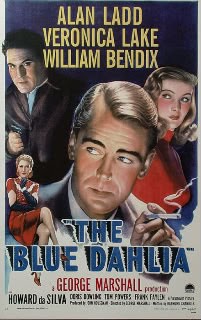
The Blue Dahlia

poster4 

The Blue Dahlia (1946) was the third film that Alan Ladd and Veronica Lake had made together. While their two previous collaborations had been based on novels (This Gun for Hire by Graham Greene and The Glass Key by Dashiell Hammett) this one was from an original screenplay by Raymond Chandler. Anyone who has read anything by Chandler will know that plot always took second place to dialogue in his writing, and that’s certainly the case with this film. For me, the holes in the plot make this a less satisfactory affair than the earlier Ladd/Lake movies – I can’t comment on their last one Saigon since I have yet to see it.

The story concerns Johnny Morrison (Ladd), a navy veteran, returning from the war in the Pacific theatre. Arriving back in L.A. in the company of two of his former crew (William Bendix and Hugh Beaumont) he goes to meet his wife. Their reunion is not a happy one as his unannounced arrival finds her in the middle of throwing a party. Not only that, but he finds her to be having an affair with the shady owner of a night club, the titular Blue Dahlia. Unsurprisingly, he packs up and leaves. Later, the wife will be discovered shot dead with Johnny’s automatic and the suspicion naturally falls on him. The rest of the movie deals with his efforts to evade capture while trying to run down the real killer. The list of suspects is a long one, with just about every major character having either the motive or opportunity to have done the deed.

The performances are generally good and Ladd is convincing enough as the tough hero. Lake is not so good playing the estranged wife of the night club owner, although that may have something to do with the allegedly sour relationship between her and Chandler. Still, her screen chemistry with Ladd remains and they share some good scenes. The real standout turn, though, comes from William Bendix as the shell-shocked buddy with a steel plate in his head and a violent aversion to what he refers to as ‘monkey music’. The movie fits nicely into the noir category due largely to the trappings – clubs, cheap hotels and cheaper people, a neon lit L.A. and so on. As I said above, the dialogue was Chandler’s strong suit and helps to paper over the cracks and outrageous coincidences in the plot. The biggest problem of all is the ending. Chandler had originally written a different climax to that seen on screen but was forced to change it as a result of outside pressures. What we are left with doesn’t really work at all, for it makes a nonsense of much of what went before – it just comes across as weak and contrived.

The Blue Dahlia, whatever it’s weaknesses, was a title long desired on DVD by fans of noir, and Universal duly obliged with a release in R2 last year. However, the fact that it has been made available is about the only good thing I can say. The movie has not had any restoration work done and looks quite soft, worse than that is the ghosting which plagues the last half. So, I don’t think this is the best of the Ladd/Lake vehicles but it is stylish and fun – just not all that logical.