Yellow Sky

spmzuhf


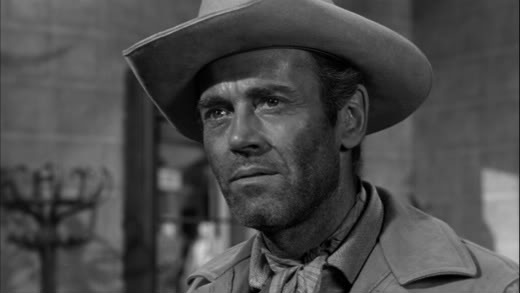
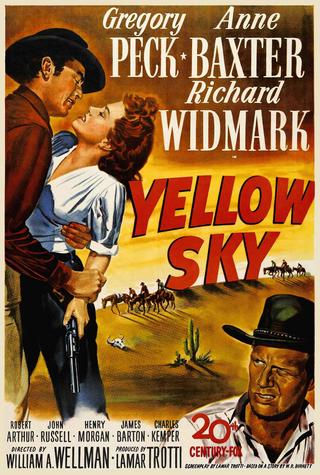
OK, so I’ve taken a break from this thing for a while now. I’ve generally found that I need to take a step back from time to time and allow myself a chance to recharge the batteries before starting anew. My last post was on a western, and my latest one is also another oater – for the sake of continuity if nothing else. Yellow Sky (1948) is a typically stylish William Wellman movie that trades on those perennial themes of greed and honor.

The film opens with a bank raid in a small town and concludes, with a quirky twist, in that same town. However, the robbery plays only a small part in the story; it’s the events that it leads to that form the core of the movie. Stretch Dawson (Gregory Peck) is the laconic leader of a band of outlaws who think they’ve just made an easy killing. While their initial getaway appears to have been clean there is a troop of soldiers on their trail, and the outlaw gang find themselves forced onto a barren and punishing expanse of salt flats in an effort to elude capture. From this early stage the first cracks appear in the group. Stretch is the acknowledged boss but his authority begins to be challenged by Lengthy (John Russell) and especially by Dude (Richard Widmark). As these men haul themselves painfully across the hellish landscape they are driven to the very limits of human endurance. Just as they are about to succumb to the effects of exhaustion and dehydration they stumble into the abandoned former mining town of Yellow Sky, and this is the point at which the story becomes most interesting. The old ghost town is not all it seems – for one thing it’s not strictly a ghost town at all. There are two inhabitants, an old half-crazed prospector and his daughter ‘Mike’ (Anne Baxter). Even in their weakened state the outlaws are not so dumb as to believe these two are living there for the good of their health. Putting two and two together, they decide that there’s only one reason anyone would choose to live in a dead town – gold. What remains to be seen is how far each individual is prepared to go in order to satisfy his craving for riches, and whether or not the notion of honour among thieves has any basis in truth. Like all the best westerns, it raises questions about one’s word of honour and, in this case, if that has any value for those who live outside the law.

£19

William Wellman’s direction offers a lesson in style, utilizing close-ups, long shots, deep focus, shadows and high contrast. There’s also an especially notable shot down the smoothly rifled barrel of a gun (see pic. above) which foreshadows the famous 007 pre-credits sequences. I’d also like to mention the climactic shootout between Peck, Widmark and Russell that takes place in the gloomy ruins of the town saloon – all the gunplay is unseen by the audience with only the bloody aftermath revealed. The location photography is another positive feature, with the inhospitable Death Valley occupying the first half before the action moves to Lone Pine for the scenes around the titular town. When looking at the characters, the first thing that jumps out is that every single one is known only by a nickname from beginning to end – the sole exceptions being Peck and Baxter, whose full names are revealed to the viewer. Peck handled his leading role competently as the reluctant hero who eventually finds a kind of redemption. John Russell and Richard Widmark make for a worthy couple of adversaries, the former consumed by pure animal lust and the latter with a hunger for wealth and the power to visit retribution on those he feels have slighted him in the past. Widmark in particular is the epitome of villainy, still at that stage in his career when he tended to get typecast as nasty pieces of work for the hero to vanquish. Anne Baxter’s role called for her to be a kind of self-sufficient tomboy who still remains sexually provocative. To her credit, she managed this balancing act and emerged as a fully rounded character that you can believe in. Throughout the film she proves herself the equal of the male cast members and her only concession to the traditional image of femininity comes at the very end when she dons a frivolous little hat that Stretch has brought her as a gift.

The R1 DVD from Fox presents Yellow Sky in a handsome full frame transfer that’s clean and sharp for the most part. Extras on the disc consist of galleries of advertising material and a selection of trailers. The film itself is absorbing and well paced and it was only at the end that I realized how little violence is present, and how even that takes place off screen. This is one of those late-40s westerns that helped usher in the more complex works that dominated the following decade. Recommended.
 

El Dorado

poster208

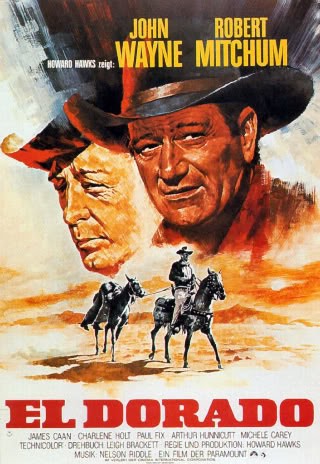
A while back I mentioned directors remaking their own movies, citing Hitchcock and Walsh at the time. However, they’re not the only ones; Howard Hawks reworked the same material that he originally used for Rio Bravo no less than three times. In this case, I think the law of gradually diminishing returns applies – although I’m aware that there are those who might disagree. Hawks’ second trip to the well resulted in El Dorado (1966), a film that improved on its predecessor in one or two ways but ultimately remains a less satisfying work. Ok, it’s not a straight remake of Rio Bravo since it opens the story up a little more in terms of people and locations but it does use the same core situation and characters. There’s the tough professional, the drunk, the old coot and the green kid all holed up in a dingy jailhouse and under siege.

Cole Thornton (John Wayne) is a professional gunman who hires his skills out to the highest bidder. After accepting an invitation from one of the parties involved in a range war he discovers that the job would mean facing off against an old friend. Sheriff J.P. Harrah (Robert Mitchum) is the lawman caught between the feuding factions, and it’s his presence that dissuades Thornton from signing any contract. However, before Thornton can take his leave an accidental shooting leads to an ambush that results in his getting a bullet lodged perilously close to his spine. When he returns some months later he finds that Harrah has taken to the bottle in the wake of an ill-judged love affair. To make matters worse, the nearly incapacitated sheriff is in no position to cope with the ongoing range war that’s about to come to a head. Therefore, it’s left to Thornton to take charge of a rapidly deteriorating situation provoked by an attempted murder and the subsequent arrest of one of the feud’s main players. Up to this point the plot has its own reasonably unique slant. However, once Thornton, Harrah et al find themselves barricaded in the jail it’s Rio Bravo all over again. Where the original had a gentle humour, a gradually built sense of camaraderie and a frisson of sexual tension (thanks to Angie Dickinson), El Dorado rushes things a bit and lays the humour on too thick. Actually, it’s the comedic elements that do the most damage in my opinion. Much of this is based around the character of Mississippi (James Caan) – in particular, his incompetence around firearms and his questionable taste in hats. What’s worse, though, is a cartoonish fight between Thornton and a drunken Harrah that wouldn’t have looked out of place in a Three Stooges short. The climax is also disappointing, the pyrotechnics of Rio Bravo being replaced with a contrived showdown that’s not much more than a damp squib.

In a sense, if you’ve seen one Howard Hawks picture you’ve seen them all. The same themes crop up again and again, namely professionalism and loyalty to one’s comrades. El Dorado is no exception in this respect, we have the tight knit group defying the odds and getting moral support from no-nonsense women. However, there’s a certain flatness to El Dorado, both in the visuals and the reworking of a tried and tested story. The areas where it does score over Rio Bravo are a few of the performances. I can’t honestly fault Dean Martin’s Dude, but Mitchum does bring more weight to his take on the broken down drunk if only because he’s Robert Mitchum. The biggest improvement is the casting of James Caan as the young man taking his first steps in the presence of the big boys. Although the forced jokiness of his character does tend to grate a little after a while he is certainly an actor, something that couldn’t be said for Ricky Nelson. Wayne, of course, is Wayne and it matters not a jot whether he’s playing the sheriff or the hired hand, his star quality ensures that he dominates proceedings. It is interesting to note though that the plot device concerning the bullet in his back was a convenient way to make allowances for the effects of the passage of time and the major health problems he had endured. As for the others, let’s just say that Arthur Hunnicutt, Charlene Holt and Ed Asner were no match for Walter Brennan, Angie Dickinson and Claude Akins. While I’m drawing comparisons, I might just add that Nelson Riddle’s score isn’t a patch on Tiomkin’s – although the title song played over Olaf Wieghorst’s paintings is very memorable.

El Dorado got a 2-disc release not long ago in the US as part of Paramount’s Centennial Collection. I never bothered to pick that one up so I can’t comment on the picture quality, but I do know it offered a variety of extras. The old UK R2 that I have presents the film 1.78:1 anamorphic and it’s not a bad transfer. The image could, I suppose, be a little sharper but there’s really not much to complain about. Image quality aside, the big difference between the old and new releases relates to bonus features, with the earlier disc boasting nothing but a theatrical trailer. Reading back through this, I might seem a little hard on El Dorado. The truth is it’s not at all a bad western and makes for entertaining viewing – the problem is that it’s damned near impossible not to compare it to Rio Bravo, and that’s where it comes up short.

The Omega Man

£7

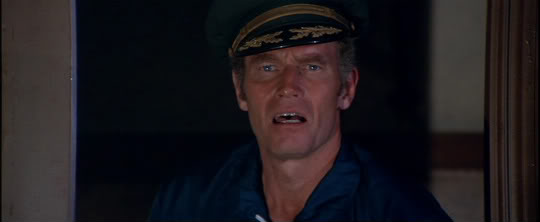
Up to now I haven’t touched on science fiction on this blog. The reason for that isn’t that I have any beef with the genre, rather that it tends to get plenty of attention elsewhere. The truth is I’m quite fond of sci-fi, at least the movies from the 50s through to the 70s, and watch a reasonable amount of it. One of my all time favourites in the genre has to be The Omega Man (1971), a film that’s not without its faults but whose strengths raise it up high. To the best of my knowledge, the story by Richard Matheson has been filmed three times now with The Omega Man being the second effort. It’s a movie very much of its time, but Charlton Heston’s central performance and a fantastic score by Ron Grainer power it on and help to divert attention from the weaknesses.

The story is pretty straightforward: a Sino-Russian conflict spreads westward and eventually engulfs the whole world, resulting in germ warfare that essentially wipes out humanity. The film opens with Robert Neville (Charlton Heston), a former army scientist, driving through a barren urban landscape. This scene, which never fails to give me goose bumps, has Neville cruising down deserted streets to the accompaniment of Percy Faith’s A Summer Place blasting out from the car stereo. For an instant, everything seems almost idyllic – but the illusion of an early morning spin in a still sleeping city is shattered violently as Neville stamps on the brakes and produces a machine pistol to rake the windows of a building where he’s just spotted a dark figure flitting silently by. From this point on it becomes clear what the real situation is; Neville is the last healthy human in a world of corpses and photo-sensitive mutants. The first three quarters of an hour are spent establishing the near hopeless situation Neville finds himself facing. He commands the city by day, hunting mutants and searching for their hive, but the nights belong to the black robed Family. It’s clear that the strain of his solitary existence and nights spent holed up in his fortress-like brownstone have begun to take their toll on Neville’s psychology. He spends his time conversing with himself and playing chess with a bust of Caesar, and he’s beginning to crack up. Were any person forced to live in such isolation and fend off regular night time assaults and taunts from the sinister Family, it’s not unreasonable that they’d start to imagine they could hear phones ringing and begin to question their own sanity. Neville has spent two long years ploughing this lonely furrow, until he catches a glimpse of what he thinks might be another normal human being. It’s only when a slip on his part leads to his being captured by the Family that he finds out he’s not as alone as he thought. That whole first half of the movie carefully builds up a picture of Neville’s world and the horror of living within it. The second part takes us in a new direction as we see him regain hope and perspective. The question is whether that new hope can be sustained, and the answer is left open when the movie reaches its conclusion with one of the most memorable (and touching) final shots and fade outs in cinema.


£5

I started off by pointing out that The Omega Man is not without its faults, and I’ll try and address those first. The thing that will strike any modern audience is that this is a 70s movie, and proudly so. The imagery and many of the themes are rooted firmly in that decade. The problem is that this lends it an air of kitsch that may be off-putting to some. The presence of Rosalind Cash and Lincoln Kilpatrick results in a curious mix of jive talking blaxploitation and more serious questions about race relations, and they don’t really sit comfortably together in retrospect. However, that stuff is more a matter of personal taste and could be seen as part of the movie’s charm. A bigger issue is the Family (this is probably the main weakness of all three versions of the story) who never come across as threatening as they should. They do attain a cult-style creepiness, and their malice is never in question, but there’s also a slightly comical air about them – not helped by a hammy performance by Anthony Zerbe as their leader Matthias – that dilutes the danger somewhat. On the other hand, Heston’s take on Neville really anchors the picture. He does very well in the opening half when he basically has no one to play off and has to earn the viewers’ sympathy and support single handed. I thought he brought the right balance of tough resilience and increasing despondency to the role. The other major plus is a score by Ron Grainer that evokes the mood of both the story and the characters beautifully. I think it would be fair to say that Grainer’s music plays a significant part in ensuring the movie remains eminently watchable – this is probably among the best pieces of film composing the decade offered.

The Omega Man is one of the gradually increasing number of classic films that’s made it onto Blu-Ray. Having said that, I’ve yet to buy into the format myself (partly because of a lack of attractive titles but mainly because I’m satisfied enough with the quality of the DVDs I own – but that’s a discussion for another time) so I’ll confine myself to saying that I’ve no doubt the BD adds to the overall visual presentation. The old Warner DVD was one that never gave me any cause for complaint, with a strong and detailed anamorphic scope image. For me, the film is an old favourite whose failings can be easily ignored when there’s the pleasure of seeing Heston near his best and hearing Ron Grainer’s haunting melodies.

Journey into Fear

I mentioned recently how films set on trains or in creepy old houses are some of my favorites, I should have also included ships and boats while I was at it. Mysteries and thrillers benefit enormously from these confined settings: the sense of claustrophobia is heightened, and then there’s the knowledge that the hero can only run so far. Journey into Fear (1943) has its hero boxed up on a decaying old freighter in the middle of the Black Sea, surrounded by a gallery of grotesques and living in fear of his life. For a film that runs only a little over an hour it’s packed full of memorable scenes, images and characters that tap into a strong noir vibe.

Howard Graham (Joseph Cotten), an engineer employed by an American armaments company, is in wartime Turkey on business. He’s a typical everyman character and, by his own admission, not a very exciting person. When the company’s local rep decides to take him out for a night on the town, Graham finds himself abruptly swept away into a world of intrigue, assassination and terror. It all begins in a night club where Graham narrowly avoids death. The local man, a fawning and obsequious type by the name of Kopeikin (Everett Sloane), has dragged the reluctant Graham into this slightly seedy cabaret, plying him with liquor and women. During an illusionist’s act, for which he has ‘volunteered’, a shot rings out in the darkness and the magician takes the bullet surely meant for Graham. Before the outraged and confused engineer even has time to draw breath he’s hauled off to a meeting with the chief of the Secret Police, Colonel Haki (Orson Welles), who has him bundled aboard a stinking old tub to spirit him safely out of the country. This is the pattern the movie follows, there’s always someone else making decisions for the increasingly bewildered Graham. Of course he tries to wrest the initiative but, in classic noir fashion, he’s always a victim of fate rather than a master of his own destiny. The scenes aboard the ship are full of menace, emphasised by the low angle shots and the deep, dark shadows that seem to follow Graham everywhere. The threat looms even larger when a short stopover allows the assassin Banat (Jack Moss) to come aboard. This character hasn’t one line of dialogue throughout the film but it’s that chilling silence and the bland countenance masked by pebble glasses and a vaguely ludicrous hat that add to his creepiness. When Graham finally disembarks he makes a break for freedom, but fails to get very far. This does, however, set up a thrilling climax atop a hotel ledge in the pouring rain that ties up most of the loose ends.

Journey into Fear is an adaptation of one of Eric Ambler’s finest novels with the screenplay credited to Joseph Cotten. Being a huge and unashamed admirer of Ambler I’m always pleased to see his work represented on the screen, and this movie retains much of the flavor of his writing. Aside from the scripting credit, Joseph Cotten turns in a good performance as the baffled engineer who’s always on his guard but never quite sure who to trust. His plight is one that’s frankly hard to swallow, and there’s a nice little scene where he tries to convince the ship’s captain of the danger he’s in only to have the grizzled old codger laugh in his face. Dolores del Rio (who had a relationship with Welles) first appears as a leopardskin clad dancer in the early night club scene and maintains that feline aura throughout as she slinks around sexily in pursuit of our hero. The rest of the cast (largely drawn from the Mercury players) mainly turn in small but memorable cameo roles. In particular, Jack Moss, who was in fact Welles’ accountant, turns the blood cold every time his ungainly bulk lumbers into the frame and his impassive assassin remains one of the highlights of the movie. Orson Welles plays another of those larger than life figures that seemed an extension of his own personality to great effect in the few scenes where he appears. His trademark slow-quick-slow delivery and the darting eyes that twinkle mischief one minute and glower thunderously the next are ideal for the shady yet menacing Colonel Haki – incidentally, the character of Colonel Haki is one that showed up again in Ambler’s The Mask of Dimitrios. In truth, Welles’ massive presence dominates the film and his fingerprints are to be found all over the production. Although Norman Foster is credited as director it’s clear to anyone familiar with his work that Welles, at the very least, exerted a huge influence over the shooting. For example, the climactic chase along the slick hotel ledge in the storm uses the kind of dizzying overhead angles that Welles was fond of.

For a number of years now Warners have been promising that a DVD with a restored print of Journey into Fear is on the way in the US, however it still remains a no show. The French company Montparnasse have released the movie in R2 though, and there’s really not much wrong with that edition. The print used is actually in pretty fair shape with good contrast and sharpness, sure there’s the odd scratch and speckle here and there but nothing to fret over. There aren’t any extras save a brief introduction (in French naturally), but if it’s a good print of the movie itself you’re after then the Montparnasse release is very definitely acceptable. Journey into Fear is a stylish little noir film that benefits from the Welles touch and has the quirkiness that’s often found in films he graced with his presence. The pace may feel a little rushed at times but I prefer to think of that as emphasizing the urgency of the situation and the danger the hero finds himself in. It certainly gets my recommendation.

The Spiral Staircase

There are certain settings that immediately draw me to films, trains usually work work for me as do stories taking place in old, dark houses hiding even darker secrets. By happy coincidence, The Spiral Staircase (1945) derives from the pen of Ethel Lina White who also provided the source material for probably the finest example of a movie set aboard a train – The Lady Vanishes. I guess there’s something tremendously reassuring about watching a cast of characters in mortal danger in a spooky old mansion, lashed by fierce storms, for it’s a formula that’s been used again and again down through the years. The Spiral Staircase works very well as a gothic noir melodrama that’s strong on atmosphere. If it’s approached as a whodunit the effect is lessened considerably – the identity of the killer is pretty obvious right away – but I don’t believe it was ever conceived as such anyway.

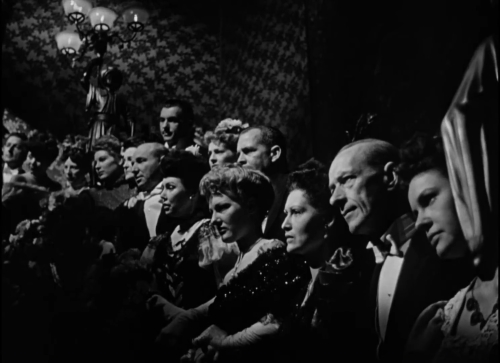
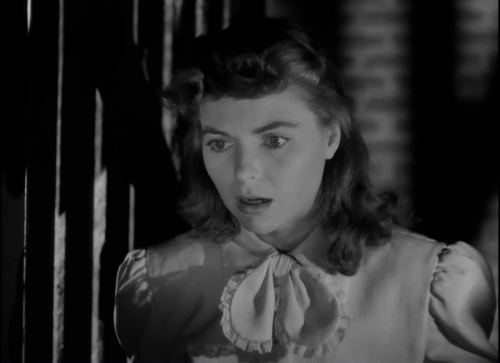
Events unfold at some unspecified time in the early years of the 20th century in a small American town. A serial killer is busy in this close community, specialising in the dispatch of young women displaying some physical defect or imperfection. The film opens with one of these murders, a girl with a pronounced limp is done in while downstairs a crowd of townspeople sit in rapt attention at the screening of a silent movie. Among the audience is Helen (Dorothy McGuire), housemaid for a local well-to-do family. Helen’s enjoyment of the silent picture is maybe heightened by the fact that she herself lives in a world of silence – we later learn that Helen is a mute as a result of a childhood trauma. It doesn’t require any great leap of deductive reasoning to see that Helen is likely to feature highly on the killer’s list of potential victims. Indeed, shortly after arriving back at her employers’ creaking old mansion just as a storm of near biblical proportions is breaking that fact is confirmed. As Helen pauses on the landing to check her appearance in the mirror the camera zooms in on the eye of the killer as he watches her secretly. This provides one of the film’s creepiest moments as we see the girl from the deranged perspective of the murderer, her face reflected back from the mirror without a mouth. As I said, the identity of the villain is fairly easy to spot when we’ve been introduced to the various occupants of the house. The owner is a bed-ridden old battle-axe, Mrs Warren (Ethel Barrymore), who shares her home with her two sons (George Brent & Gordon Oliver) – the former a serious minded academic, the latter a wastrel playboy with a roving eye. The rest of the household is made up of a motley collection of servants, although the spectre of Mrs Warren’s late husband hangs heavily over them all. It’s this unseen figure who actually provides the motive for the villain’s urges and forms the basis for the cod psychological explanation that’s practically obligatory in thrillers of this period. The story plays out in fairly standard form, with the heroine’s danger and isolation increasing incrementally as the subsidiary characters are lured away or disposed of one by one. Still and all, the whole thing is done with considerable style, the suspense and atmosphere building steadily towards a satisfying conclusion.

As far as the acting is concerned, The Spiral Staircase really belongs to the female cast – George Brent, Gordon Oliver and Kent Smith are all passable enough without being especially memorable – and Dorothy McGuire was excellent in conveying mounting fear and paranoia with nothing but facial expression and gestures at her disposal. Both Ethel Barrymore and Elsa Lanchester were inveterate scene stealers and never miss a trick when they’re on screen. Barrymore does tend to slice the ham a little thick on occasion but her scenes are immensely watchable and her verbal jousting with Sara Allgood, as her put upon nurse, is a pleasure in itself. Having said all that, the real star of the show is director Robert Siodmak who moves his camera around the elaborate sets with fluidity and makes optimum use of light and shadow. The climax, taking place largely on the rear staircase, constitutes a virtual checklist of noir motifs, from high and low angle shots through to the shadows of railings creating bars to pin the protagonists helplessly in place.

The UK DVD of The Spiral Staircase from Prism treats the film quite well. There’s good contrast and the image is reasonably clean and sharp with no damage to speak of. There’s a gallery included as well as text bios for members of the cast and crew. To me the movie represents an exercise in how to maintain suspense and atmosphere from a slightly predictable story. The combination of pleasing performances and Siodmak’s assured and professional direction adds up to a very enjoyable movie – it may not hold too many surprises but there’s a lot of fun to be had along the way.

The Last Sunset

poster188

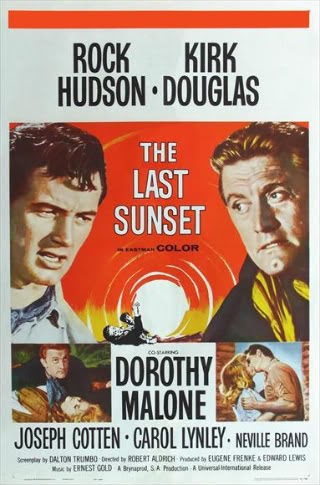
The Last Sunset (1961) is a film that seems to have all the credentials, all the ingredients that go towards making a top flight production: a highly talented director, a fine cast, and a script by a top writer. In spite of all this the final result is a movie that doesn’t quite gel and one that delivers a lot less than it initially promises. As is usually the case when a film proves disappointing, the fault lies with the script. There are some interesting elements which are introduced and then disposed of before they’ve had a chance to play out fully. Generally, this leads to both clutter and a lack of focus. In the end, we’re left with a film that’s not exactly bad but one that could and should have been a whole lot better.

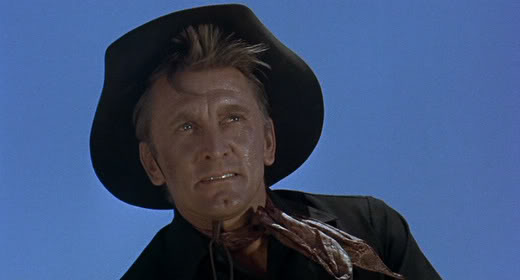
The opening credits play over a dogged pursuit across a southwestern landscape, down into Mexico where the bulk of the action will unfold. O’Malley (Kirk Douglas) is the black clad fugitive, a killer who carries a derringer instead of a six-shooter. Hot on his trail is Dana Stribling (Rock Hudson), a lawman with a personal interest in seeing his quarry brought back to Texas to hang. O’Malley is heading for a ranch run by a faded Virginia gentleman with a fondness for the bottle. The rancher, Breckenridge (Joseph Cotten), happens to be married to O’Malley’s old sweetheart Belle (Dorothy Malone) and it’s soon evident that he’s continued carrying a torch for her for years. The two men strike a deal whereby O’Malley will help Breckenridge drive his herd up to Texas, but he also claims he’s going to take his new partner’s wife off him. That in itself could have provided an interesting scenario, but the script has no intention of remaining so simple. Stribling’s arrival leads to an uneasy truce with hunter and hunted agreeing to pool their talents in order to ensure the success of the cattle drive before settling their own scores. With both newcomers being clearly interested in the charms of Belle the scene looks set for a juicy three-way contest for her affections. However, that’s not to be for Breckenridge soon departs the scene after being gunned down in a cheap cantina. What’s even more frustrating is the fact that moments before his death the audience is treated to revelations about Breckenridge’s shameful past. So, two potentially rich plot veins are left unmined. Instead we’re treated to the seemingly interminable drive to Texas with too much talk and too few sparks. It seems that the producers were aware that they were in danger of bogging the plot down, so three shifty and unscrupulous cowboys, who plan to get in on the white slavery racket, are introduced (Jack Elam, Neville Brand and James Westmoreland) to try to spice up proceedings. Again the opportunity is lost as these characters are killed off before they have the chance to make an impression. The script still has one hole card in reserve though, and it’s a real stinger. Nevertheless, in keeping with the rest of the picture, this gets handled poorly too. The problem is not with the nature of this final reveal, it’s suitably shocking, but the fact that we learn about it too soon. I won’t go into details here lest I spoil things for anybody, but the timing really draws all the tension and drama out of the climactic duel and leaves us with a flat and predictable ending.

£25

With a combination of Robert Aldrich directing and Dalton Trumbo writing, I don’t think it’s unfair to have high expectations. For whatever reason, neither man was at the top of his game on The Last Sunset. Trumbo’s script meanders all over the place and flatters to deceive, with too many plot turns and too many undeveloped ideas. Aldrich allowed the momentum to flag after the first half hour or so and he never really recovered it after that. There are some nice shots, a well filmed sequence during a dust storm, and an attempt to claw back some tension in the climax through quick cutting but none of it adds up to enough to save the film. On top of all this the performances of the two leads are nothing to write home about either. Douglas seemed to be trying for the kind of deadly rascal that Burt Lancaster pulled off in Aldrich’s Vera Cruz but it doesn’t really work for him. Hudson just didn’t convince at all as the driven lawman and he comes across as merely bland. Dorothy Malone and Joseph Cotten were altogether more successful as the Breckenridges; the former exuding a worldly sexuality that made the attention of her various suiters highly credible, while the latter provided a fine portrait of a broken and guilty man. Maybe if Hudson’s character had been the one to snuff it in the cantina we would have got a more compelling film. It’s also a shame that Jack Elam and Neville Brand had to disappear so soon since such character actors were capable of raising the quality of any production.

The Last Sunset was given a release a few years back by Universal in R1 in the Rock Hudson – Screen Legend set. The transfer is a fine anamorphic one and, apart from the odd speckle, there’s not much wrong with it. Colour and sharpness are both strong with good detail. There’s a trailer for the film provided but that’s it as far as extras go. This movie couldn’t be classed as anyone’s finest hour but it’s not a complete dud. There are a handful of worthy performances and the adult theme that becomes apparent as it draws to a close mean that it deserves a look. Let’s just say that it wouldn’t be an ideal introduction to the work of any of the principals


The Big Country

poster204

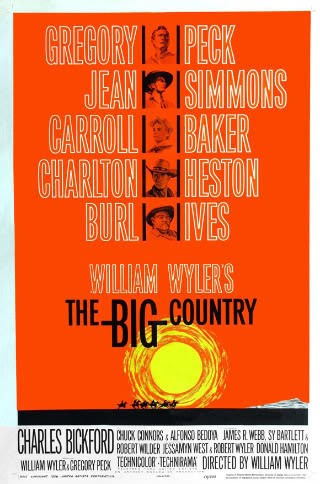
The Big Country (1958) has been described as a Cold War allegory, and I guess the reasons for that are fairly clear for anyone who wants to see them. It’s also been referred to as a traditional “stranger in a strange land” style tale, which is once again obvious enough. Whilst the latter is a theme that’s been visited too many times to mention, the former tends to date movies badly if that’s all there is on offer; one has only to compare a one-note diatribe like Ralph Nelson’s Soldier Blue to multi-layered works such as Peckinpah’s The Wild Bunch, Richard Brooks’ The Professionals, or Aldrich’s Ulzana’s Raid to see the difference. What raises The Big Country above a trite critique of contemporary politics and lends it a timeless relevance is the fact that it’s also an examination of man (or should I say men) and what he’s made of. The hero continuously has his masculinity questioned and challenged, and it’s his refusal to play others’ games and conform to preconceived ideas of how he should or should not act that builds up his stature in the viewer’s eyes while, conversely, it is diminished in the eyes of his fellow characters.

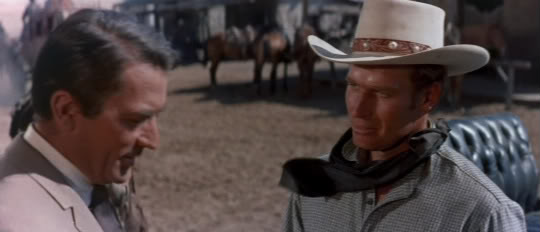
Jim McKay (Gregory Peck) is the archetypal easterner come west. His arrival is enough to literally stop the locals in their tracks, gazing in wonder at this alien figure with his trim suit and odd hat. McKay is a seaman who’s come to this new land to wed Pat Terrill (Carroll Baker), daughter of a wealthy rancher. Within a very short time McKay has a run in with Buck Hannassey (Chuck Connors) and his brothers, and so gets his first taste of the situation he’s landed himself in. The Hannassey’s are a rough and ready clan of ranchers engaged in an off and on vendetta with McKay’s future father-in-law Major Terrill (Charles Bickford). The cause of the feud is a piece of land that both families covet due to its providing that most valuable of commodities in the parched prairies of the old west, water. Having said that, the bitterness and venom that both Pat and the Major express when speaking of their not so welcome neighbours hints at some deeper source for the rivalry. Right away you can sense McKay’s unease at the raw hatred he’s exposed to, and the fact that he refuses to share in it and even backs off confronting the Hannassey’s shocks his bride-to-be. In fact, McKay seems to do nothing but disappoint his betrothed; he avoids taking a ride on the unbroken horse that’s traditionally wheeled out to give all newcomers a rough welcome, and worst of all turns his back on a fight that the Major’s foreman Steve Leech (Charlton Heston) goads him into. As far as Pat is concerned, these all amount to calculated insults and his shunning of such public displays of machismo cast doubts on his manhood and, by extension, on her pride and judgement. However, the viewer gets to see what Pat and her father don’t: that McKay is no coward, he’s merely a man with a deep sense of personal honour who’s offended by the act of showing off to others and proving to them that which he’s very sure of himself. When Pat rides off in a huff, and the Major and Steve go hunting vengeance, McKay quietly takes out that unbroken horse and sets about taming it. Time and again the animal hurls him into the dust of the corral, and time and again McKay gets back in the saddle until he finally bends it to his will.

The thing about McKay is he’s spent years sailing the oceans of the world and knows full well what hardships he’s capable of enduring. He feels no obligation to show the Major what a big man he is for the simple reason that he’s already proven that to himself. To McKay, that’s all that matters: that a man should know his own abilities and that his woman should believe in him just because she is his woman. For Pat, however, that’s not the case and she comes to feel shame for having chosen a man who regards acts of bravado as beneath him. If further evidence were needed of McKay’s physical courage then it comes in a remarkable night time scene. Having begged off a public brawl with Steve, McKay pays him a nocturnal visit to “say goodbye”. The two men walk out onto the moonlit prairie and engage in a brutal fist fight that was marvellously filmed and choreographed. Director William Wyler shot the whole scene without music and the only sounds heard throughout are the grunts and gasps of the two men punctuated by the thud of bone striking flesh. Wyler also made excellent use of the camera in that scene, alternating between close-up, medium and ever widening long shots that point up not only the isolation of McKay and Steve but also their insect-like insignificance (and indeed the insignificance of their struggle) in that vast landscape. By the end of their bout, as both men stand bruised and bleeding, McKay asks Steve what he thinks that has proved. In addition, there’s also the standoff with Buck late on, when he rides into the Hannassey’s place to try and rescue Julie Maragon (Jean Simmons) and head off a bloodbath in the making. As Rufus (Burl Ives), the patriarch of the Hannassey’s, does the honours the two men take the requisite number of paces and turn to face each other down the barrels of McKay’s antique duelling pistols.

£3

I’ve already mentioned William Wyler’s masterful use of the wide lens, but it’s to be seen all the way through the film. The whole thing is a visual delight that takes in both the sprawling prairie vistas and the blanched rocks of the canyon between Terrill’s ranch and the Hannassey’s place. Blanco Canyon is the setting for the scene that, for me at least, is just about the finest in the picture. The Major has decided that a showdown with the Hannassey’s is unavoidable and sets off to finish things for good. When it becomes apparent that he and his men will be riding into an ambush, the Major turns to Steve for support. However, this man has had his bellyful of mindless violence and says so. The Major rides off alone to meet whatever fate awaits him. Steve has looked on this man as a surrogate father all his life and you can see the anguish etched into his features as he watches him depart. He mounts up, and the camera moves to the mouth of the canyon and the lone figure of the Major. As Jerome Moross’ spine-tingling score slowly builds the angle shifts slightly and Steve gallops into view, drawing level with the Major he looks back to see the rest of the ranch hands come one by one round the rim of the canyon. There’s not a word exchanged between Heston or Bickford but the flickering glances and quickly concealed smiles speak volumes. To me this is cinema at its purest, where visuals, score and subtle expression tell the viewers all they need to know about the nature of a relationship, and in this case what masculinity is about – the importance of loyalty, affection and sheer guts even when good sense should dictate otherwise.

I honestly couldn’t criticise any of the performances and just about every major character felt fully rounded. Peck’s hero is maybe too straight down the line but that’s a minor complaint when you consider that such a role was necessary amid all the complexity elsewhere. Charles Bickford should be the guy to hiss at, but the raw courage and determination he invests in the Major tempers the less savoury aspects. There aren’t really any absolute villains in The Big Country, Chuck Connors comes the closest but even he is more to be pitied than anything. He shows himself to be only a step or two above an animal towards the end but it’s hard not to see him as something of a victim of circumstance in some respects too. I thought Charlton Heston gave one of his best performances in a role that ensured he got to act in a restrained and measured way, his lower billing probably contributing to that. Burl Ives picked up a Best Supporting Actor Oscar for his part and I’d say he deserved it on the basis of a couple of memorable scenes alone – his gatecrashing of Major Terrill’s party and the climax, where he is forced to do the unthinkable, immediately spring to mind. Both Jean Simmons and Carroll Baker did well portraying two opposite sides of the female character and made the most of their screen time.

MGM’s R2 DVD of The Big Country is slightly disappointing. The anamorphic scope image is generally clean and sharp with good colours but there are some really irritating instances of shimmer, especially when any of the wooden buildings are on view. What’s maybe more annoying is the fact that the disc is practically barebones. This is an important film, and not simply because it’s an epic production; it’s a movie that’s both visually and thematically rich and deserves better. Anyway, despite some reservations about the DVD the film itself is a genuine classic that ought to have a place on the shelf of those who consider themselves western fans, or even just fans of quality cinema.

The Tin Star

zufohaj

The westerns of Anthony Mann are generally among the highest regarded in the canon. It’s therefore a little odd that one of the movies he made during his purple patch in the 50s is frequently overlooked when his work is discussed. However, this certainly seems to be the case with The Tin Star (1957). I think this may be partly due to one of the casting decisions and, to a lesser extent, to the ending that is just too upbeat and out of touch with the events that preceded it.

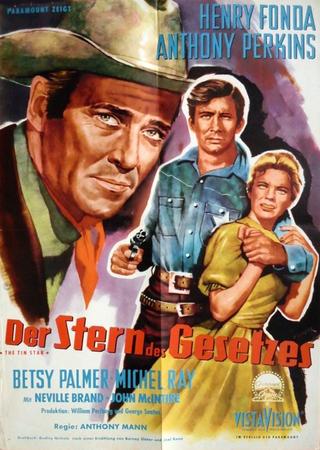
The dominant theme in The Tin Star is justice: the definition, mechanics and importance of justice in a frontier environment where civilization was still in its infancy. Parallel to this is the theme of maturity; the need for a man to learn judgement from those who have gone before, and by extension the need for a new society to learn from the past and thus achieve maturity. Ben Owens (Anthony Perkins) is a young sheriff who’s so green he’s unlikely to hold the position – or indeed stay in one piece – for long if someone doesn’t come to his aid fast. His saviour turns up in the unlikely guise of a professional bounty hunter called Morgan Hickman (Henry Fonda). When Hickman rides into town to deliver a corpse and collect the bounty he finds the sheriff in the back of his office practising his draw, looking for all the world like an overgrown schoolboy playing at being a grown-up. The truth is Owens isn’t much more than a juvenile when it comes to law enforcement and has only got his job because no one else wanted it. That’s not strictly true, there was one other candidate – local loudmouth and rabble-rouser Bart Bogardus (Neville Brand). Sooner or later a confrontation between Bogardus and Owens will have to take place, and it falls to Hickman to tutor the young lawman in the art of reading men and facing down threatening situations.

Along the way we learn more about the enigmatic Hickman; he too was once a sheriff before the callousness and hypocrisy of his employers drove him out of the job. Owens is danger not only of becoming the victim of Bogardus’ desire for his badge but also of suffering the same fate Hickman once did. The murder of one of the town’s prominent citizens leads to the capture of two outlaw brothers and the organisation of a lynch mob by Bogardus. It’s at this point that the townsmen show their true colours and, reminiscent of High Noon, turn tail and abdicate all responsibility for justice or law. There’s also a nasty undercurrent of racism running through this settlement, personified by the bullying and hate-filled Bogardus but tacitly accepted by the so-called pillars of society too. The two prisoners are stated to be half breeds (and almost damned for that reason alone) and the woman who Hickman’s been lodging with is an outcast due to her having married an Indian and borne his child. The fact that the movie ends on such a positive, optimistic note after Owens has had to prove himself to the craven and distasteful inhabitants of his town strikes a false note.

£18

Anthony Mann mixed up the location and studio work to good effect and produced a western that’s full of important ideas punctuated with the occasional burst of violent action. There are some nice stylistic touches too, such as the climactic duel with the loser falling back into the camera. At the beginning I mentioned what I felt were the two biggest flaws with the film; I’ve already alluded to the unsatisfactory ending, but the casting of Anthony Perkins in the central role of the naive young sheriff didn’t work for me. It’s understandable that an actor was required who could be convincing as a nervy greenhorn lacking in self-confidence, but Perkins does that so well that his later development into a competent town tamer just jars too much. Neville Brand played Bogardus as some kind of malign force of nature, bellowing and bullying his way to the head of a bloodthirsty mob. Again he nailed this perfectly, so much so that it’s really stretching credibility to have the slight figure of Perkins striding across a night time street to slap him into galled submission.

Henry Fonda was always at home in western roles and Morgan Hickman is another of his top class performances. He manages to invest some genuine sadness and melancholy into the role of a man who’s lost his family and seen his ideals bruised. There’s tenderness on view too, especially in the scenes where he interacts with the half Indian son of his landlady, and to round it all off he has the necessary mettle to be believable as a bounty killer. It’s also worth noting that while the bounty hunter came to be seen as a staple of the genre (particularly with the rise of the spaghetti western), that certainly wasn’t the case in 1957 and Fonda’s role was something of an exception.

The Tin Star is a Paramount property, and their R1 DVD provides a handsome 1.78:1 anamorphic presentation of the movie. The image is strong and clean with good contrast but the disc itself is totally barebones. Anthony Mann made better known, and indeed better, films than this but it’s still a remarkably strong western that’s only let down by the softened climax and less than convincing character arc of Perkins’ sheriff. It could have offered a scathing critique of a society that would rather pass on the dirty work of law enforcement to those it can then despise (and it does flirt with the notion) but bottled out in the end. Still, Mann’s direction of the material can’t be criticised and Fonda’s powerful performance anchors everything firmly. All things considered, there are more positives than negatives on show and this is a film I would definitely recommend.

The River’s Edge

Some movies are especially difficult to define or categorize. Allan Dwan’s The River’s Edge (1957) is certainly such a film; it’s a blend of modern western, noirish thriller, and lush and lusty 50s melodrama. While it’s possible to argue over which one of those labels comes closest to summing it up, it’s clear enough that this is a B movie which was given the glossy treatment. As such, this is an impressive piece of budget film production, dealing with those classic themes of money, greed, jealousy, love, and there’s a level of casual brutality not usually found in films of the period.

The story concerns three people: Ben Cameron (Anthony Quinn), his new wife Meg (Debra Paget), and Meg’s former lover Nardo Denning (Ray Milland). Right away we can see that Cameron’s relationship with his wife is not all it should be; she’s tottering around his ramshackle ranch house in high heeled slippers, struggling with the lack of modern conveniences, while he’s struggling with steers outside. The thing is Meg is a city girl, actually she’s con artist on the lam, while Cameron is a salt of the earth type whose greatest ambition is to make something out of his fledgling ranch. These two have hooked up together and are trying to make a go of it, but it’s starting to come unravelled. At the critical moment, who should turn up at Cameron’s door but his wife’s old flame Denning, apparently looking to hire a guide to take him on a hunting trip into Mexico. Meg takes off with Denning, at least as far as the nearest motel, and it’s unclear at this point whether she truly means to leave her husband for good. At any rate, she never gets to fully decide as a car ride results in Denning killing a border patrol man in a fairly shocking manner. With Meg now implicated in the crime, and with the knowledge that Denning is carrying a suitcase stuffed full of cash, Cameron has a change of heart and decides that he’ll take the two former partners over the border to safety. The rest of the film charts the shifting nature of the characters’ relationships and motives. At the begining none of them act out of anything but naked self interest: Denning just wants an out and doesn’t especially care who he has to buy or kill to achieve it, Meg wants to escape from the drudgery and dullness of the remote ranch, and Cameron has his hungry eyes on the cash. Everything is complicated by the fact that both men are still love with Meg, and she has no qualms about playing one off against the other and flitting back and forth between them. The real turning point, for her character at least, comes after she gets a serious infection from a cut arm. When Cameron hacks away the poisoned flesh in a storm ravaged cave it’s as though some of the poison also drains away from Meg’s heart. From then on, the positions are clearly defined and the only question remaining is who will survive the hazards of the wilderness and walk away with the money.

In the latter years of a very long career Allan Dwan specialised in churning out slick little B movies on a budget, and The River’s Edge is a good example of this work. He packs a whole lot of story into less than 90 minutes and makes it all look a good deal more expensive than it has any right to. The combination of location shooting and studio sets blends together well and the use of colour is stunning in places. He also displays what might be termed a more modern approach to violence and death than was normally the case at the time; the three killings which take place, although not graphic in the current sense, occur with an abruptness that retain the ability to shock. The three leads are very professional and do their level best to lift the movie above its pulp roots. Ray Milland was of course in his twilight years as a leading man but just about pulls it off, his charming sadist who may yet have a small grain of decency buried deep is effective enough to distract you from the fact that he was probably too old for the part. Debra Paget (with a flaming red hairdo) is a fine femme fatale who’s by turns calculating, ruthless and affectionate. Her character arguably goes through the greatest arc of the three, and she handles the move from a scheming bitch to a woman who’s regained some sense of honour quite capably. Anthony Quinn starts off as a basically weak loser who can’t even summon up the will to hang onto his woman, but by the end he comes good and redeems himself somewhat. I say somewhat because there’s still an element of doubt and a shadow of greed hanging over him.

The River’s Edge came out on DVD in the US a few years ago from Fox in a very attractive edition. The transfer is anamorphic scope and the print used is very clean and colourful. The disc has a commentary track from James Ursini and Alain Silver, and a few trailers and a gallery. This is the kind of movie that probably wouldn’t stand a cat in hell’s chance of seeing a DVD release in the current climate, all the more reason to appreciate its availability. There is no way that The River’s Edge could ever be termed a classic movie, but it is a tight and entertaining little thriller given a highly professional polish. Everything moves along at a lick and there are far worse ways of spending an hour and a half. All in all, it serves as a pretty good introduction to the later works of Allan Dwan.

Westward the Women

Trailblazing epics depicting the dangers and hardships that went hand in hand with the expansion of the frontier are far from uncommon among westerns. Westward the Women (1951) fits comfortably into that category, but there’s one important difference that sets it apart from others of that ilk: this movie tells its tale from an almost exclusively female perspective. This fact alone means that the film is pretty much unique; there have, of course, been other examples of westerns that focused on women, but they tended to be more of the exploitation or novelty variety. Westward the Women is certainly no exploitation picture, instead it’s a gritty attempt to celebrate the courage and the trials experienced by those early pioneer women, without whom the west could not have advanced.

The plot is a fairly simple one, essentially being a chronicle of a pre-Civil War overland trek. It’s 1851 and California landowner and visionary Roy Whitman (John McIntire) has realised that, despite having overcome a hostile land and prospered, his dreams will amount to nothing if there are no women to pair off with his settlers. In order to address this problem he hires Buck Wyatt (Robert Taylor) to assist him in first recruiting 140 mail order brides, and then escorting them on the gruelling trip from Chicago all the way back to California. The women who make up this matrimonial caravan are a disparate and, in some cases, a desperate bunch. The film doesn’t fully analyse the reasons why these women would readily agree to subject themselves to the harshest of conditions and potentially fatal circumstances just to marry a man they’d never so much as laid eyes on. For the most part, they are looking for a change in their lives and a new beginning (one has gotten herself pregnant out of wedlock, another is a widow, and there a couple of former good-time girls), and that’s about as deep as it goes. The full extent of the task ahead of them doesn’t really become apparent until the dozen or so men Whitman has hired decide to desert after Wyatt’s brand of iron discipline leaves two of their number dead. From this point on there are only four men left (Wyatt, Whitman, a comedic Japanese cook and a green youth) and the women must put aside their femininity and work harder than any man in their efforts to overcome the myriad obstacles the wilderness throws at them. Before they reach their promised land their numbers will be whittled down by accidents, nature and hostile Indians. However, this pruning simply stiffens their resolve and, by the time they reach the end of the trail, those who have survived emerge stronger than ever. In fact, it’s only at the very end that any concession to sentimentality is made – the surviving women meeting their selected partners to the accompaniment of the first notes of music heard since the opening credits rolled.

William Wellman was one of the hardest driving, most demanding and macho directors working in Hollywood. This was a guy who quit acting because he felt it was too soft and no fit profession for a man. Bearing all this in mind, it may seem surprising that he was able to produce a film that was so celebratory of the achievements of women. Of course his hard-bitten outlook is stamped all over the movie, and he has absolutely no qualms about killing off just about any of the characters. While the death toll is fairly high there isn’t an enormous amount of onscreen violence – the big Indian attack takes place while Wyatt is away chasing after the runaway, firebrand Frenchwoman that he finally falls for – and it’s frequently the tragic aftermath that the viewer gets to see. At times the film becomes seriously grim and there are one or two moments that are actually quite shocking, though I don’t intend to spoil it for anyone by identifying them. Nevertheless, Wellman knew his trade well enough to realise that he had to toss in the odd moment of comedy to avoid proceedings becoming relentlessly dour. The least successful of those lighter moments were provided by Henry Nakamura’s Japanese hash slinger and general dogsbody. Much more effective was the imposing Hope Emerson, in a role that was in complete contrast to the kind of threatening ones she was frequently associated with.

Robert Taylor also did some excellent work as the hard as nails trail boss who knows that he must push everyone to the limits of their endurance if they are to have even a slim chance of survival. The character of Wyatt grows along the way though, going from a kind of contemptuous dismissal of the green females he has to look out for to deep admiration for the courage and determination these same charges display time and again. There is a romance along the way between Taylor and Denise Darcel, though it’s a hard edged affair too – he even gives her a crack of the bullwhip at one point! All the women in the supporting parts were quite satisfactory, although the majority of their characters were only developed very slightly. I don’t believe that needs to be too heavily criticised though as the scale of the story and the constraints of the running time (just a little shy of two hours) meant deeper analysis was impractical.

Westward the Women is currently only available on DVD in R2, and there are two choices. There are editions out in both France and Spain from Warner Brothers. I have the French disc (chances are the Spanish release is from the same master) and the transfer is mostly pretty good, academy ratio and not much in the way of damage. There are moments when the image looks a little soft but nothing too distracting. There’s no extra content whatsoever and you get a choice of English or French audio – subtitles are optional with the English track. This is a good western from a director with a respectable pedigree in the genre (Wellman was of course proficient in many types of film, and you can browse an excellent series of articles on his early work at Judy’s blog here) and a star who got better with the years. If you think you’ve seen all the trail western has to offer then this is a film worth checking out. John Ford, another extremely macho director, never shied away from highlighting the vital role played by women in the settling and ultimate conquest of the frontier, and Wellman added his own song of praise to feminine grit with this unusual and very rewarding western.