I Walked with a Zombie

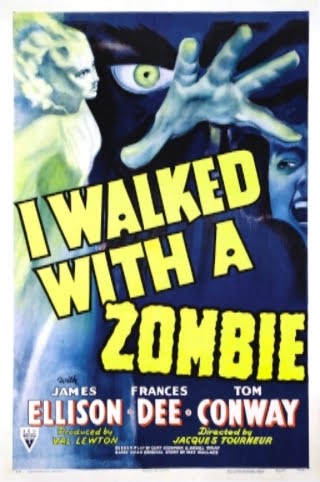
poster38_zpscnqfhfse

Everything seems beautiful because you don’t understand. Those flying fish, they’re not leaping for joy, they’re jumping in terror. Bigger fish want to eat them. That luminous water, it takes its gleam from millions of tiny dead bodies. The glitter of putrescence. There is no beauty here, only death and decay.

From time to time I like to revisit the films of Val Lewton, those nine macabre tales he made as head of his own production unit at RKO and upon which his reputation rests. I can’t say it’s ever an especially arduous task, they all have brief running times and I rank them among my favorite works since I first made their acquaintance as a young boy, alternating between fascination and fear during those late night TV screenings. One of the first I saw was I Walked with a Zombie (1943), a title guaranteed to fire the imagination of any young viewer. As with all of Lewton’s pictures, it’s not so much a shock-filled horror film as a dreamy study of unease and dread, where suggestion and atmosphere creep up behind you and softly whisper “Boo” in your ear.

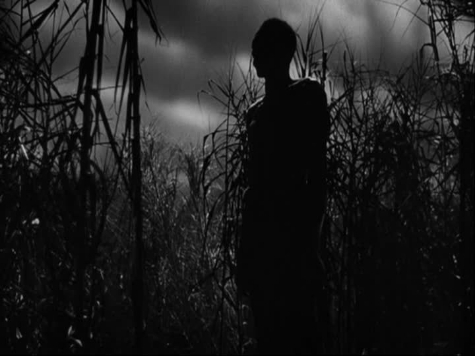
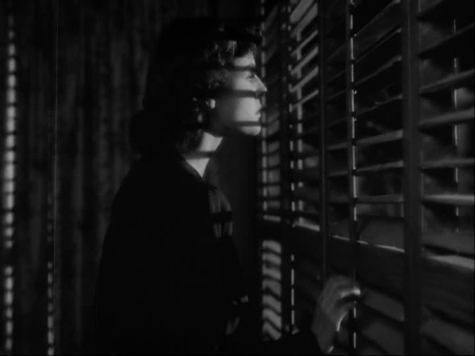
It all starts out bright and crisp, like the snow falling outside the window of the Ottawa office where Betsy Connell (Frances Dee) accepts the job of nursing an invalid woman on a West Indian island. It’s only when she’s aboard the ship that will transport across the sea to her new appointment that Betsy’s new employer Paul Holland (Tom Conway) makes that little speech which I used as an intro that darkness, along with its faithful companions doubt and suspicion, extends its shadowy fingers. Holland owns a sugar plantation and shares his home there with his half-brother Wesley Rand (James Ellison) and his wife Jessica (Christine Gordon), the zombie of the title. Jessica exists in a semi-catatonic state, awake but no longer aware of the world around her, apparently the result of a bad bout of fever. Holland is keen to impress on Betsy the melancholy history of the island, a place where the inhabitants, all descended from slaves, still live in thrall to the Voodoo religion. She finds herself fascinated by the reserved and withdrawn Holland, sympathetic to the hard-drinking Wesley, and simultaneously repelled and intrigued by the shattered beauty of the listless Jessica. As her attraction to her employer grows, the young nurse gradually learns more of the tragic history of this family residing on an island which itself is no stranger to suffering. In that contrary way that love often manifests itself, Betsy resolves to do all in her power to haul Jessica back to the living. That will involve putting her faith in the mysterious beliefs of the islanders and taking a nighttime walk through the cane fields that take on an eerie complexion in the twilight cast by a warm Caribbean moon. What she finds at the end of it will answer some of her questions but, paradoxically, raise as many more.

£9

Producer Val Lewton was tasked with running a low budget horror unit at RKO and it’s often said that his low-key approach and reliance on atmosphere and the inherent creepiness of the unknown was fueled by the lack of funds and the subsequent desire to avoid being seen as a cut-price version of Universal with its gallery of monsters and freaks, the only concession being the pulpy and frequently lurid titles of the pictures. I’ve no doubt this played a significant part in the process but I’d also like to think that Lewton’s own artistic sensibility entered into the equation too. For there is a high level of artistry involved in these movies, which beguile and chill the viewer in equal measure. The horror movie can be a rather obvious genre, only rarely restraining itself from the temptation to provide instant gratification via visual shocks and, as time has gone on the audiences more jaded, an over-reliance on gore. But that wasn’t Lewton’s style; he worked with three fine directors over the course of his nine RKO  horrors – Mark Robson, Robert Wise and Jacques Tourneur. All those films are good, but I feel that it’s with the latter that the best work was done. As far as I’m concerned, this is no coincidence as Tourneur was a master of subtlety. He was fully aware of the power of his camera and his compositions and pacing have a smoothness that belongs only to the truly talented. In truth, there’s not a bad shot in the whole movie, but the highlight has to be the trek through the cane fields, the recreation of which is a tribute to the art department, with the sense of dread and foreboding ever present but always that crucial step short of overwhelming.

The cast is led by Frances Dee and her performance hits exactly the right tone, vulnerable enough to make the threatening atmosphere believable yet grounded by a practicality that befits one charged with the task of caring for an essentially helpless woman. The film and role calls for a degree of nobility, or perhaps selflessness is a better term, and that’s not an easy thing to pull off successfully; there’s always the risk of it appearing somehow insufferable and it takes a fair bit of skill to dance around that particular pitfall. In short, it’s a balancing act and one which I feel Ms Dee negotiated with aplomb. Similarly, Tom Conway (who had the distinction of appearing in three of Lewton’s very best productions) plays it cool and keeps away from the histrionics. Like his brother George Sanders, suave and debonair were second nature to Conway and I’ve always enjoyed seeing him work – The Falcon movies are among my absolute favorites when it comes to series detective fare. However, a love story, and this is certainly as much a romance as a horror film, needs some overt passion to be displayed. That is provided by James Ellison as the volatile half-brother, an unpleasant part in many ways but well performed all the same. The supporting players are rounded out by Edith Barrett, James Bell, Sir Lancelot, Theresa Harris and the wonderfully spooky Darby Jones as the sinister, bug-eyed Carrefour.

£8

I Walked with a Zombie is pretty easy to see – I bought it years ago as part of the excellent Val Lewton box set released by Warner Brothers in the US, but there are a range of European editions on the market too. The US version has it paired on DVD with The Body Snatcher, and the transfer is reasonable. RKO titles can prove problematic and there are instances of print damage visible but I can’t honestly say I’ve been overly troubled by them – the film just kind of sweeps you along. The disc also includes a commentary track by Kim Newman and Steve Jones. Halloween is a good time of year to wheel out these kinds of movies but a classic tale like this is really timeless and works its magic regardless of the season – after all, I first saw it and fell in love with it on a July evening way back in 1981. Anyone wondering what to view as the witching hour draws ever closer could do worse than give this a spin, and those who have yet to experience the delightful art of Lewton and Tourneur should rectify that as soon as possible.


The Last Posse

poster29_zpsbmfn5fua

Small films with big themes, that’s perhaps as good a summation of the successful B movie as any. Low budget films were always capable of using a superficially simple tale to disguise layers of depth and complexity, the smarter and more skillful efforts using standard cinematic techniques to do so. The Last Posse (1953) is all about the past, both the recent and distant forms, and how the events which occurred drive the actions of men in the present, and indeed have shaped how they and others view themselves.

A posse is usually a group of residents sworn in as temporary deputies, charged with upholding the law via the pursuit of criminals. The film opens with one such group, tired, dusty and disheveled, making their way home to a small New Mexico town. Among them is one man who is clearly in considerably worse shape than his fellow riders. John Frazier (Broderick Crawford) is the town sheriff, a man  of once mighty reputation who is now gut-shot and dying. The drawn faces of the men, the mortally wounded lawman, and the tension writ large on the countenances of the townsfolk leave no doubt that something went badly wrong out there in the desolation of the desert. As the remainder of the posse head off to clean up we can see by their furtive manner and whispered conversation that all may not be the way they’re telling it. Their story has it that the fugitives died after a shootout which also claimed the leader of the posse and, most tellingly, that the $105,000 of stolen money was nowhere to be found. While these leading citizens reappear freshly scrubbed and suitably spruced up there’s no hiding the fact that there are other stains, those on the conscience, which can be neither washed away nor wished away. So what did happen out there in the wilderness? It seems wholly appropriate that a film which concerns itself so much with the past should be told and find its ultimate resolution by means of three lengthy flashback sequences seen from three separate perspectives. The Last Posse was directed by Alfred Werker, and it was the strong endorsement of both the filmmaker and this title by regular contributor John Knight which led me to view it. I was already familiar with a number of Werker’s other movies (The Adventures of Sherlock Holmes, He Walked by Night, Shock, Three Hours to Kill and At Gunpoint to name just a few) and I’m keen to see more, Repeat Performance in particular. He was a director capable of packing a good deal of atmosphere and tension into what were, for the most part, small productions. Here we get another fine piece of work, an hour and a quarter of sustained suspense delivered at a smart pace from a smooth script by Seymour Bennett, Connie Lee Bennett and Kenneth Gamet. In the best tradition of western filmmaking, the layers of hypocrisy and faux civilization are gradually stripped away to allow the truth to be revealed as the action moves away from the town, out into the desert and the rocks of Lone Pine. It’s here in this harsh and sparse landscape (beautifully shot by Burnett Guffey) that the illusions and cant are burned away by the merciless sun, and the deceit of the past collides with the brutal reality of the present.

Broderick Crawford is one of those actors I can take or leave, often depending on the kind of role he’s playing. He could have a loud, almost mechanical quality leading to some one-note performances. However, there was also something bruised and lived-in about him, I suppose you could call it the weariness of his years. Whenever he tapped into that, as he certainly does in The Last Posse, he had a lot more to offer. It could be argued that a few characters in the film are somewhat underwritten, more on that shortly, but Crawford doesn’t suffer in that respect. Frazier is a man who has been almost broken by life, propping himself up mainly with alcohol, and with little regard for the quality of men he now has to associate with. What comes across most powerfully is a sense of guilt and regret for a life badly lived, and a good deal of that seems connected to the relationship with Charles Bickford’s Sampson Drune character. The exact nature of the men’s hostility and enmity becomes slowly apparent the deeper they move into the desert but it also highlights one of the weaknesses in the script. Bickford always shone in villainous parts, those craggy features and penetrating eyes were ideal, and he’s suitably arrogant and cruel as Drune. The problem, as I see it though, is that the writing of his character allows for little else; it’s heavily alluded to that he’s also driven by fear and a kind of warped paternal instinct, but the script permits little if any of that to be actively shown. As a result, the vital backstory – the actual core of the movie – is of course ever-present yet lacks a little due to the presentation of the character.

John Derek is one of those actors whose contribution to the movies tends to be underrated or glossed over. I think I first saw him in his breakout role in Nicholas Ray’s Knock on Any Door and I’m of the opinion he was a perfectly competent performer. He recently came to my attention again during the Republic blogathon when The Outcast was featured, a film I’ve since acquired for future viewing. Derek’s role in The Last Posse is an important one within the context of the picture but he’s overshadowed for much of the running time by both Crawford and Bickford. Much of the cast is made up of familiar character players: notably Henry Hull, Warner Anderson, Will Wright and, as one of the trio of fugitives, Skip Homeier. This is very much a film dominated by the men and the only female role of note goes to Wanda Hendrix, although it’s really a nothing part – I was actually more intrigued by the uncredited Hispanic girl, the one with her eye on Anderson’s blowhard editor, as her two brief appearances hinted at an altogether more fascinating relationship.

The Last Posse is available as a MOD disc from Sony in the US, it was a Columbia production, and looks good. The film has been given a nice clean transfer and the crisp black and white photography is very attractive. Overall, this is a solid, pacy little western with plenty of depth, even if all aspects of that aren’t explored as fully as they might have been. Definitely worth checking out if the opportunity arises.


The Moonlighter

poster7_zpsmezab9k8

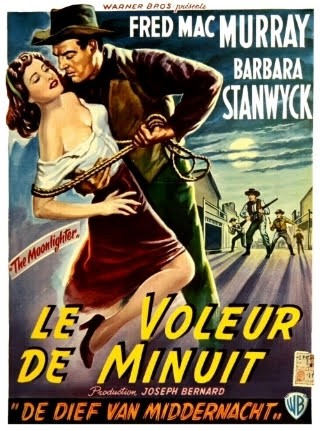
Over a sixteen year period, starting in 1940 and ending in 1956, Fred MacMurray and Barbara Stanwyck made four movies together, the most famous probably being Billy Wilder’s Double Indemnity. Their third collaboration, The Moonlighter (1953), was the only western and the least familiar of the titles. This is a film I’ve only recently caught up with, once again thanks to the assistance of regular contributor Jerry Entract, and I found it a slightly unfocused but generally enjoyable affair. Revenge and redemption, those two faithful old partners in so many westerns, dominate but one is only half explored before being quietly dropped while the other is slipped in as though an afterthought. My feeling is that if these two themes had been more fully, or at least more consistently, developed, then The Moonlighter would have been a much stronger piece of work.

Wes Anderson (Fred MacMurray) is the moonlighter of the title, a rustler who operates by night, and his opening narration places the action at the beginning of the 20th century, just as the frontier is about to finally close. As he tells us, civilization about to consign the myth of the wild west to the pages of history, but the beast’s claws haven’t been filed down totally yet. The concept of frontier justice still holds sway with some, and the crime of rustling continues to arouse strong feelings and attract harsh punishments. As Anderson sits in jail awaiting trial, a lynching party is arriving in town, impatient and aggressive. This first act of the film is the most powerful, soulful and threatening, and setting up a situation packed with potential. There’s an almost noirish, and indeed nightmarish, tone as the mob forces its way into the jail to demand its pound of flesh. There’s to be no heroic last-minute rescue as a man is mercilessly beaten, dragged from his cell, and hanged without ceremony. Only it’s the wrong man, the fates having conspired to save a guilty man while simultaneously dooming an innocent one. Anderson has been handed a new lease on life but with a bitter little proviso attached – his sense of guilt twisting itself into a thirst for revenge. However, it’s at this point, with the story part of the way down an intriguing avenue, that the focus of the script shifts and revenge drifts away to be replaced by, amongst other things, greed. With Anderson forced to rest up and recuperate in his old family home, other characters are added into the mix: Rela (Barbara Stanwyck), his former love is introduced along with his brother Tom (William Ching). This creates the possibility of a romantic triangle although it doesn’t really work out that way. Instead we meet Cole Gardner (Ward Bond), an old outlaw associate of Wes’ who is keen to talk him into going back into business. I won’t spoil the plot by revealing more about how it all pans out except to say that Wes gets to earn his redemption the hard way, suffering significant personal losses before regaining his sense of honor in the end.

£4

The Moonlighter was written by Niven Busch, a man known for his fondness for grand passions and dark psychology. The film hints at this, or perhaps flirts with it, both in the terrific opening and later in the relationship between Wes and Rela. Yet it doesn’t come off successfully; there’s none of the high melodrama of Duel in the Sun or The Furies, nor enough of the darkness of Pursued. Now I like Busch’s work, although I understand if it’s not to everyone’s taste, and the way it has of burrowing into the minds and motivations of characters. The main problem with The Moonlighter is that it never goes far enough, all the ingredients are present and paths are started on but abandoned or strayed from before the themes have a chance to breathe and expand. Then when the redemptive aspect kicks in at the end it feels rushed and loses some of its impact as a consequence.

The director was Roy Rowland, examples of whose work I’ve looked at here in the past, and his handling of the material is patchy too. Again, I refer back to the opening, where he and cinematographer Bert Glennon hit just the right chord and conjure up an atmosphere that’s menacing and quite poignant. But his direction lacks consistency, and as soon as the action moves to the Anderson homestead there’s a flatness that reflects the loss of momentum in the script. The scene where MacMurray and Stanwyck meet after years apart only touches on their shared passion, the actors doing what they can with the dialogue, but it needs a spark and intensity that’s not achieved. Some of that does come as the story progresses, but I don’t feel it ever reaches the heights necessary to make the redemptive payoff work as well as it should.

£5

MacMurray often made a fine anti-hero or villain, in this case I’d say he was playing the former though. When required he could tap into a kind of weary cynicism, and that’s exactly how he starts out – we first encounter him lazing in his jail cell awaiting what he fully expects to be an appointment with the hangman. The weariness falls away later, anger, distrust and bitterness coming along to displace it and MacMurray keeps it credible all the time. He also hangs onto a touch of decency too, despite his character’s criminal nature, which is vital if his eventual change of heart is to be at all convincing. Stanwyck was playing one of her signature tough broads and she’s perfectly satisfactory, as usual, though the role doesn’t have the kind of depth or shading which could bring out the best in her. She’s said to have enjoyed making westerns and the rugged outdoors stuff attracted her, something she got to indulge in here especially during the well filmed climax. Ward Bond doesn’t make an appearance until around the halfway mark, but impresses as the unscrupulous outlaw seeking out a partner to facilitate his schemes. Bond was typically most effective as bluff down-to-earth types or as an imposing physical threat. The movie gives him the chance to show off both of these aspects, moving smoothly from one to the other as the plot advances. Personally, I found William Ching the weakest link – his part is an important one yet he never really convinced me as the brother living in MacMurray’s shadow. In support, there are nice, if short-lived, turns by the likes of John Dierkes, Jack Elam, Charles Halton and Morris Ankrum.

The Moonlighter has been released as an MOD DVD in the US as part of the Warner Archive and is certainly worth a look. The turn of the century setting is potentially interesting but not a lot is made of this – the only real reference to the changing times is that Bond’s plan involves exploiting the possibilities afforded by the new motor cars. The movie was shot in 3D but I don’t know if that would add much to it (I’m no particular fan of the process myself) and it plays fine in standard 2D. Taken as a whole, the film is entertaining enough although it did need a script which retained a stronger focus and more character analysis. It starts off well and does have its moments later but meanders a little despite the short running time.


The Badlanders

It seems like everybody around here is stealing from everybody else.

A good heist movie is hard to beat in my opinion, there’s considerable potential for suspense and tension in the execution of a complicated robbery, and the aftermath or outcome is generally rife with possibilities too. The heist is typically used as a plot element in contemporary crime movies, both the serious and more lighthearted varieties, but it’s flexible enough to be applied to other genres as well. There’s arguably no more flexible type of film than the western, the setting being able to absorb and adapt aspects almost at will. The Badlanders (1958) is a remake of John Huston’s The Asphalt Jungle, adapted from the W R Burnett novel, moving the action back half a century and shifting from the urban milieu to the dusty Arizona landscape.

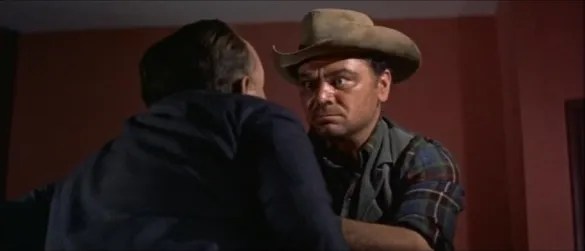
In the dying days of the 19th century two men are released from the prison at Yuma, one because his time has been served in full and the other earning early parole because he prevented the former from assaulting a guard. In fact, these two men, Peter Van Hoek (Alan Ladd) & John McBain (Ernest Borgnine) have quite a lot in common: both ended up behind bars either  directly or indirectly due to the treachery of others, and both hail from a similar part of Arizona. While they set off on apparently different paths they’re fated to meet again as their desire to right some of the wrongs of the past lead them to the small town of Bascom. The settlement is the center of a gold mining operation, beneath the land once owned by McBain before he was cheated out of it, and places have a way of calling men back even if they have no logical reason for returning. Van Hoek was a mining engineer and geologist, cheated in a different way, framed for a robbery and keen to get something back for the time he lost when he was wrongly incarcerated. Everything boils down to a plan to blast a rich vein of ore from an abandoned shaft and sell it back to the current owner, Cyril Lounsberry (Kent Smith). You might wonder why a man would buy what rightfully belongs to him – well Lounsberry is only nominally in charge as the mine is actually in his wife’s name, and he’s a man with a wandering and faithless eye. Such a man is obviously going to be drawn to the idea of an independent source of wealth. On the surface, the key to the whole operation is timing and disciplined organization, but there’s also the intangible element to be factored in, as tends to be the case in the affairs of man, and in this instance it’s the question of trust.

Anyone familiar with The Asphalt Jungle will know how things play out on screen, but there are significant enough differences to set the two films apart. Aside from the altered location, there’s the variation in tone and overall mood of the film. Huston’s film was a classic piece of fatalistic noir, where bad luck and the character flaws of the principals led to the ultimate unraveling of the best laid plans. In The Badlanders, however, the weaknesses of the leads in the earlier version are actually transformed into their strengths, and the resolution is upbeat and positive. I think a good deal of that is down to the director; Delmer Daves made films that mainly emphasized the positive characteristics and leanings of people, and you generally come away from his work with an enhanced appreciation of the inherent decency of humanity. If I were to draw direct comparisons between Daves’ and Huston’s take on the source material, something I’m reluctant to do as it seems s bit of a pointless exercise, then I’d have to say The Asphalt Jungle is clearly the superior film. Still, The Badlanders does have certain points in its favor, and those are mainly the touches which bear the characteristic fingerprints of Daves. There’s some strong cinematography from John Seitz too, especially the interiors but also the outdoors location work in Arizona and Old Tucson.

Alan Ladd underwent a noticeable physical decline in his last years, but that hadn’t really set in when he made The Badlanders. He was still vital and looked in reasonably good shape at that point. His role isn’t an especially complex one, there’s the back story of his being fitted up to provide motivation of course but it’s never expanded upon to any extent. While Ladd is the headline star the most memorable performances come from those billed below him, notably Ernest Borgnine and Katy Jurado. Borgnine was typically a powerful physical presence in movies and got to show off that aspect in a number of scenes, yet it’s another side of the man which has the greatest impact. He had a certain innocence below the surface, although this wasn’t always exploited. The character of McBain is remarkable for the way this vague social naiveté is woven into the plot. And the ever soulful charms of Katy Jurado are ideal for drawing out and playing off that. Despite the fact the heist, which it has to be said is filmed with some style, is the main focus of the plot, the tender and sensitive relationship which develops between Borgnine and Jurado is the living heart of it all. In support Kent Smith, Nehemiah Persoff, Robert Emhardt and Anthony Caruso do all that could be expected of them in their limited roles.

The Badlanders has been released on DVD in the US as part of the Warner Archive MOD program, and there are European editions available in France (non-anamorphic, I think), Spain and Italy. The Spanish copy I viewed presents the movie in the correct 2.35:1 CinemaScope ratio and the transfer is perfectly satisfactory – colors look accurate and the print is quite clean. There are no extra features included and the Spanish subtitles can be disabled from the setup menu. Speaking as a fan of Delmer Daves’ work, I would say this is a weaker film when stacked up alongside his other westerns. However, just to qualify that evaluation, it’s worth bearing in mind that his westerns rank among the finest produced in the 50s. As such, I think this film deserves to be seen, and is of interest as a rare western heist movie, a remake of The Asphalt Jungle, and finally as a worthwhile frontier drama in its own right.

Edge of Eternity

poster7_zpsdlam52hl

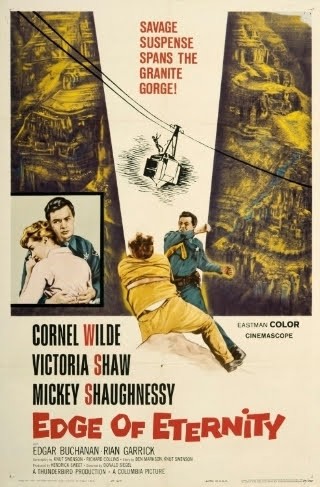
As a major fan of westerns I have great fondness for those films which, while not belonging in the genre proper, are set in the American west. It’s not at all uncommon to see mystery elements woven into the fabric of many a western tale, and so it’s not all that surprising to come across a whodunit which plays out against the backdrop of the west, even if it is the modern version of this setting. In the case of Edge of Eternity (1959) that setting is one of the most important ingredients, the breathtaking views of the Grand Canyon dominating the picture from the gripping opening right through to the spectacular conclusion.

A car draws up just short of the rim of the Grand Canyon and its driver, a middle-aged gent in a business suit, scurries forward to peer across the great chasm through a pair of binoculars. Before we even have the chance to ponder the object of his interest another, younger, man appears and carefully disengages the brake before pushing the car towards his unsuspecting victim. Alerted in the nick of time, the older man jumps aside and the vehicle plunges over the edge. These two figures struggle at the edge of the abyss, and soon both will be no more – one death we witness directly, the other will later be seen only after the fact. This dramatic opening sequence pitches the audience straight into the center of a murder mystery, grabbing our collective lapels and giving us a good threatening shake to ensure our attention doesn’t drift. We don’t know who these men are, why they fought, why they died, or who killed one of them. The task of finding the answers to these questions falls to Les Martin (Cornel Wilde), a deputy sheriff who has moved to Arizona with the hope of rebuilding a career he saw fall apart due to his own mistakes back in Denver. Aside from a natural desire to make up for past errors, Martin also wants to do what he can to help the sheriff (Edgar Buchanan), the man who hired him and offered him a second chance, get reelected. As he painstakingly assembles the pieces of the puzzle and attempts to fit them together so as to form a picture of what happened and why, he finds himself ever more attracted to Janice Kendon (Victoria Shaw), the daughter of a local mining magnate. What makes it more difficult for Martin though is the growing realization that there seems to be some connection between the deaths and the wealthy Kendon family.

The films of Don Siegel tend to be direct, no-nonsense, economical affairs. This is not to say they are devoid of artistry, rather the artistry on show is never overblown or self-consciously extravagant. Edge of Eternity, for example, is not an especially deep movie, it’s not a multi-layered affair and it doesn’t pretend to offer any particular insight into the human condition. Siegel was making a whodunit with an action element, and that’s exactly what the viewer is presented with. And of course he knew how to compose exciting sequences, not least the swooping, dizzying climax in the “dancing bucket” swaying precariously in mid-air. In addition, it’s a beautiful looking film, the primal awe-inspiring landscape of the Grand Canyon becoming a character in the drama itself, dwarfing the other players and demanding attention due to its natural wonder and danger. The cinematography of Burnett Guffey, probably most admired for his work on a range of noir pictures but here reveling in the glorious colors on display, really shows off the locations. Finally, there’s a typically strong and robust score provided by Daniele Amfitheatrof.

Cornel Wilde took the lead, an interesting role in ways but also a little underdeveloped in others. It’s made apparent that he’s trying to make a new life for himself after the loss of his wife and the subsequent derailment of his career. There was a good deal of potential for more internal conflict resulting from this and it is touched upon a few times, most notably during the short courtroom scene, but it’s never exploited to the full. There is a sense that Wilde is a man who wants to make amends for his past failings but it never goes much beyond that. In fairness, the film is first and foremost a mystery and the Knut Swenson screenplay concentrates primarily on that. I’ve only seen Victoria Shaw in a few films apart from this one – The Crimson Kimono and Alvarez Kelly. With the help of her striking and colorful costumes, Shaw brings a tough and feisty edge to her part, sassy and spirited throughout. Due to the nature of a whodunit and my wish to avoid any accidental spoilers for readers who haven’t seen this film I’ll be briefer than usual with my references to the other members of the cast. Let’s just say that there’s solid work turned in by Jack Elam, Rian Garrick, Edgar Buchanan, Mickey Shaughnessy & Alexander Lockwood and leave it at that.

I’m not sure how widely known Edge of Eternity is, all I can say is I was unfamiliar with this title myself until fairly recently. It’s been released on MOD DVD in the US and there’s also a Spanish disc, which I have. The movie was shot in CinemaScope and the transfer to DVD preserves this anamorphic widescreen ratio. A film like this depends heavily on the visuals and it’s important to see these reproduced as faithfully as possible. For the most part the image is acceptably clean and sharp, although some of the process shots (particularly a few during the airborne climax) look a little rougher. As usual with these Spanish releases, the subtitles are optional and can be disabled via the setup menu. For me, the movie represented a blind buy, mainly based on the director and star. I enjoyed it very much, and its short running time means it never outstays its welcome. I especially liked the fact it has a cross genre appeal – it’s a suspenseful mystery with some fine action scenes and a bit of western flavor thrown in for good measure. Overall, an entertaining film that I feel is worth checking out.


Dawn at Socorro

– Who’s coming after you?

– My past. Every dark, miserable day of it.

I guess that short exchange, coming near the end of the movie, sums up much of what Dawn at Socorro (1954) is all about. It’s a classic 50s western scenario, the hunger for a fresh start, a chance to slay the demons of one’s past once and for all. In the case of this film there’s the added interest of the disguised Earp/Holliday elements in the story, although this aspect is really only peripheral, and I think it’s no bad thing the names are changed and some of the events portrayed are used primarily as an inspiration – it allows the theme to develop without weighing it down with unnecessary historical baggage.

The story opens with a reminiscence, the words of an old man drawing us back into a past he experienced and into the lives of people he was once intimate with. Our point of entry comes in a cheap saloon, one of those basic drinking spots with low ceilings and lit by guttering lamps. The Ferris clan arrives en masse, planning to pick up the youngest member, Buddy (Skip Homeier), and head back to their ranch. But Buddy’s a hot-blooded guy, at that stage in life where he needs to show off in public how much of a man he is. Reluctantly, his kin leave him to his own devices, but still under the watchful eye of gunman Jimmy Rapp (Alex Nicol). The back room is occupied by the Ferris’ mortal enemies, Marshal McNair (James Millican) and ailing gambler Brett Wade (Rory Calhoun), and it’s only a matter of time before Buddy talks himself into a fight, one which will leave him dead and bring the feud between his family and McNair and Wade to a head. What we’re looking at here is a fictional account of the build up to the confrontation between the Clantons and Earps. It culminates in what is essentially the gunfight at the OK Corral in all but name. And the upshot of the killings is that the Holliday figure, Wade, is convinced of the folly of his lifestyle up to this point. He resolves to make a change, to get out of the territory and do something about his weakening health. Sharing a stage to Socorro with a bitter and self-loathing Rapp, he makes the acquaintance of fellow passenger, Rannah Hayes (Piper Laurie). Unknown to him, Rannah has been disowned by a father who believes the worst of her, and chooses to believe her lie that she’s on her way to meet her future husband. The truth is though that Rannah is going to become a saloon girl, working for Dick Braden (David Brian), a gambler whom Wade has clashed with before. It’s the realization of what is actually happening that leads Wade to put his plans to move on to Colorado on hold, to try to regain something of his youthful promise, to halt the waste and do something of worth before it’s too late.

There have been plenty of positive words about George Sherman on this site before, and Dawn at Socorro is another example of quality work from the director. The opening twenty minutes lays the groundwork for the Ferris (Clanton) and McNair (Earp) feud and the subsequent gunfight. The lengthy passage in the saloon, where the character dynamics are clearly defined, is beautifully shot and loaded with atmosphere. Sherman made good use of close-ups throughout the film, but these early scenes see them employed especially effectively. Although this is largely a town based, and therefore interior heavy, film, there is also some nice location work during the eventful stagecoach trip to Socorro. Also impressive is the shooting and composition of the key duel late in proceedings between Wade and Rapp – at the vital moment the camera is positioned high above both protagonists as they face off on the deserted Socorro street. The unusual angle chosen assigns the viewer the role of dispassionate observer gazing down on two regretful men, their individuality diluted by the distance as they become merely a pair of gunfighters on a dusty thoroughfare, their actions mirroring each other and the fatal shots appearing as simultaneous bursts of smoke.

So many westerns have concerned themselves with the dogged pursuit of individuals by the sins of their past, and the salvation, redemption or personal understanding or acceptance which grows out of this. It can be seen as a general western motif I suppose, but in the 50s in particular almost every genre entry of worth features these themes. I may be way off base here (so feel free to pull me up on this if it appears I’m mistaken) but I’m now of the opinion that this phenomenon has its roots in the post-war climate of coming to terms with the events of the past. The world had only recently recovered some kind of equilibrium after years of violence and uncertainty. Those war years represented a loss of innocence for a generation, a time of intense emotional and physical challenge, so it seems natural that the modern art form of the cinema should try to address that. I can imagine audiences of the time would have identified with tales of people struggling to escape the horrors of a violent past and by doing so perhaps regain at least a shred of their former innocence.

The Brett Wade character is very obviously based on Doc Holliday, featuring all the familiar traits which have become associated with Wyatt Earp’s ally in many films over the years. It always provides a strong role for whoever plays it and Rory Calhoun is given plenty to get his teeth into. The combination of swaggering bravado on the outside and corrosive introspection in private automatically rounds out the Wade figure – there’s that essential loneliness and otherness that the more intriguing western characters tend to display. But there’s solidarity too as most of the main players in the drama are consumed with a desire to get back to an imagined idyll, a simpler existence they still recall yet have misplaced through time. When Mara Corday’s disillusioned saloon girl wistfully inquires “How do you turn back the clock?” you know that nobody will be able to hand her a satisfactory answer.

Piper Laurie does some good work too as the young woman rejected by her father and facing a highly uncertain future, trying to convince herself of her suitability for the new life she’s prepared to take on while still dreaming of the one she’s been deprived of. And then we have Alex Nicol, an ever interesting actor, who plays a Johnny Ringo type. Nicol is embittered from the moment we first see him, drinking heavily to deaden some half-defined inner pain, and later overcome and ultimately destroyed by a sense of guilt and inadequacy – I find him the most fascinating figure in the whole movie. The real villain is played by David Brian, a man whose career started off very strong but seemed to stutter soon after. He’s suave, slippery and deadly, a guy with no redeeming features but an excellent foil for the hero. The supporting cast is full of fine actors and it’s pity there wasn’t more for some of them to do: James Millican Lee Van Cleef, Skip Homeier, Kathleen Hughes, Edgar Buchanan and Roy Roberts being the most notable of the long list of familiar faces.

The last few years have seen more and more frequently neglected films from this era getting releases, and Dawn at Socorro is now reasonably easy to get hold of. There was a box set of Universal-International westerns (Horizons West) put out a few years ago and this title was included. There’s also a Spanish DVD, which I have, and the film seems to be available to view on YT as well. I’d imagine a 1954 movie would be shot with some widescreen process in mind – IMDb suggests 2.00:1 – but my Spanish copy presents it full frame, as can be seen from the screen captures above. That aside, the transfer is generally strong, with the Technicolor looking vibrant and the image sharp. There are a few incidences of print damage, but nothing all that distracting. Dawn at Socorro is a western I like very much, with good work by Calhoun and director Sherman. The whole thing has a handsome look, is pacy and well scripted with characterization developed as the story progresses rather than through tiresome and unnatural exposition. One to look out for if you haven’t yet seen it, or to view again if you’re already acquainted.

The Silver Whip

poster203_zps7wmbybyt

As far as I’m concerned, one of the great pleasures of maintaining this site, maybe the greatest if I’m honest, derives from the feedback received. so many posts here have prompted discussion, debate, spitballing and recommendations. The latter has been invaluable to me by drawing my attention to movies of which I was either only vaguely aware or which were entirely new to me. There’s something quite invigorating about the realization that not only is one on a learning curve, but also that this curve continues to grow and expand as one moves along it. I guess all of that is just a long-winded way of saying there’s always new stuff to discover and appreciate. As a result of comments made here in the past I was particularly keen to see The Silver Whip (1953), and I’d like to offer a big thank you to John K for his help in making that possible.

What we have here is both a coming of age story and also a parable on the way mistakes and poor judgment can have both positive and negative influences on the lives of those concerned. The events in The Silver Whip are seen from the perspective of Jess Harker (Robert Wagner), a young man with ambition and dreams, for whom responsibility remains no more than an ill-defined word rattling round his consciousness. Harker’s opening narration makes it clear that his greatest desire is become a stagecoach driver, cracking the whip over a team of horses and pressing ever further at the boundaries of the frontier. However, it’s always been the case that one of the closest companions of youth is frustration, with impatience frequently tagging along in reserve, and it’s no different for Jess Harker. He’s stuck with a team of mules and a mail run that’s barely worth the name. What makes it worse is the fact he’s living in the shadow of men like Race Crim (Dale Robertson) and sheriff Tom Davisson (Rory Calhoun), guys who blazed trails back in the days when the law was simply something people talked about rather than lived by. Harker is restless, he’s got an itch that needs to be scratched, and he’s ready to pack up and move out. But, like most young men, he’s got a girl, Kathy Riley (Kathleen Crowley). This girl wants him badly, bad enough to go to Race Crim and beg him to do something to keep Jess in town. Race’s inherent decency leads him to use his influence to get Harker the job of driving the next stage, and it’s here that the mistakes start to be made. This run, along with passengers, will involve carrying a gold shipment, and gold has a habit of attracting the wrong kind of people. A hold-up is going to take place, people are going to die, and others are going to have to live with the consequences. Without going into further plot details, that’s what the movie is all about – the effect, on two men in particular, of a couple of poor decisions at vital moments.

The Silver Whip is adapted from First Blood by Jack Schaefer (who should be a familiar name for Shane and Monte Walsh among other films) and deals with the way those decisions lead one man towards the heart of darkness and another to enlightenment and maturity. In a sense it’s that eternal fork in the road, that choice of paths we’re all presented with, although perhaps not in such dramatic fashion, as we make our way through life. The hold-up pushes one man off course, or detours him at least, when he allows his base instincts to take control of him. Conversely, it signals an awakening in another, acting as a catalyst for his first steps towards manhood. And yet, while the routes chosen appear to diverge and head off in different directions, the final result is a convergence, an arrival at a common destination. Salvation and redemption are integral to the 50s western, they cannot be removed without taking away something of the soul of a film and the genre itself. The Silver Whip sets its characters on a journey away from their initial personae, testing them morally and spiritually, before drawing them back towards completion. Harmon Jones’ direction and composition alternately highlights the isolation of both Jess and Race, to draw attention to the uncertainty of the former and the cold determination of the latter. But there’s also the blending of both men into opposing camps too, where their individuality is at times absorbed into the groups they come to represent. And of course there’s the ultimate convergence right at the end, the meeting of mind and spirit which offers closure.

One of the first things you notice about The Silver Whip is the strength of the casting. A very young Robert Wagner was an excellent choice as the green and callow Jess Harper, and his gradual awareness of his place in the world and the results of his actions upon others is nicely realized. He acts as our point of reference, the one through whose eyes everything unfolds, and I think Wagner was fine at conveying the development of his character. Having said all that, Dale Robertson gets the plum role of Race Crim, and really runs with it. He moves seamlessly from an open and affable man to one totally consumed by a desire for revenge and weighed down by an enormous sense of guilt. Positioned between these two is Rory Calhoun as the sheriff whose duty puts him in conflict with his former friend. Calhoun’s role is essentially a supporting one but it’s no less important for being so. And also in support there’s another well-judged turn by James Millican, playing the stage boss whose tough edge hasn’t been quite worn away by his desk job. It’s sometimes thought that women get sidelined in westerns, but that’s rarely the case. While both Kathleen Crowley and Lola Albright have limited screen time, there can be no question about the significance of their respective parts. Crowley is marvelously tender in her understanding of Wagner’s foolishness and Albright impresses deeply in her three brief scenes. Her portrayal of the saloon girl, Waco, is pivotal in the transformation of Robertson – the scenes in the saloon and at the beginning of the stage trip establish his devotion to her, and then the aftermath of the hold-up is the moment when his destiny is mapped out.

The Silver Whip is a 20th Century Fox production and is now available as a MOD DVD via that studio. The transfer to disc looks like an off-the-shelf one where the elements were in reasonable shape but haven’t undergone any restoration. The image is acceptably sharp and detailed throughout but there is the odd scratch and mark visible. I also think the contrast is set a little high as whites can look a bit blown at some points. Overall though, the movie looks fine and is certainly quite watchable. I have to say I got a lot of enjoyment out of my first viewing of this film and I can easily see myself returning to it. There are strong performances from all the cast and Jones’ direction is both pacy and thoughtful. A very pleasant surprise for me, and a film I recommend seeing.

I Confess

Hitchcock films get mentioned and written about all the time, but it’s almost always the same dozen or so that receive all the attention and plaudits. A good many of his movies are really only spoken of in passing, often referred to as bridges between his major works and, while it’s rare to see them dismissed outright, it sometimes seems that the perceived flaws and (relative) lack of success is what draws most comment. I Confess (1953) probably belongs in this category, being regarded as a little too personal and flirting with inaccessibility as far as non-Catholics are concerned. Whatever the popular view might be, it’s a film I’m very fond of, and one which of course contains the now familiar wrong man theme.

The movie opens in a typically quirky and macabre fashion, a succession of street signs flashing before our eyes and leading inexorably to the scene of a murder. As the camera peers through the open window the corpse is laid out on the floor and the door is just closing on the exiting killer. We follow the murderer through the shadowy, cobbled streets, his silhouetted figure suggesting a clergyman. Then, as he casts off the soutane, it becomes apparent that the priestly garb was no more than a convenient disguise, no doubt inspired by the fact that this man earns his keep working for the church. When a man has committed the ultimate sin, has compromised his soul and is wracked with guilt and fear, then it’s not unnatural that he should seek solace and sanctuary in a holy place. The man in question is Otto Keller (O E Hasse) and his entering the church is witnessed by chance by one of the priests, Father Michael Logan (Montgomery Clift). Keller insists that Fr Logan hear his confession and the latter duly obliges. Much has been made of the fact that non-Catholics may have difficulty appreciating the seal of the confessional, the inability of a priest to ever reveal what he hears under such circumstances. I understand how there are those who might be unaware of this but the absolute confidentiality is made clear in the script so I think it’s not really reasonable to criticize the film on this score. Anyway, both the viewers and Fr Logan are aware of the identity of the murderer almost from the beginning, but further complications are to arise and cast official suspicion in a different direction. If all those signs in the opening sequence led us to a dead man, another set of pointers lead the police, headed up by the dogged and practical Inspector Larrue (Karl Malden), towards Fr Logan. The murderer’s literal cloak of convenience helps of course, but the priest’s connections with the victim, a blackmailing, shyster lawyer, fan the flames of suspicion. As the reasons for Logan’s seemingly odd behaviour are laid bare and the object of the blackmail becomes known, the priest’s refusal or inability to speak up damns him in the eyes of the law. With the wheels of blind justice now in motion, Logan finds himself morally trapped and apparently powerless to protect either himself or those he cares about.

Anyone who has ever read anything about Hitchcock will be aware of two facts: his Catholic upbringing, and the distrust he felt for the law and the institutions of justice. Both of these influences on the director’s life are very much to the fore in I Confess. Church dogma colors every aspect of Logan’s behaviour throughout, cutting down his options and, again through no fault of his own, leaving both him and those around him exposed to misguided moral outrage. And of course all this leaves him at the mercy of a justice system which is unsympathetic to what it’s unaware of. Essentially, Hitchcock is presenting us with an ethical conundrum, a true dilemma where betrayal (be it spiritual or emotional) lies in wait whichever path is chosen. Really, it’s a classic noir scenario, with fate seemingly laying a complex and delicate trap for the unsuspecting protagonist – every act, the noble and the innocent most of all, being misconstrued and misinterpreted. Robert Burks’ lighting and photography, particularly the night scenes, is bathed in expressionistic shadow and Hitchcock blends the tilted angles, telling close-ups, tracking shots and deep focus beautifully. You could say the symbolism is laid on a touch heavily at times – the allusion to the trek to Calvary springs to mind immediately – but it’s all so wonderfully composed that it sounds a little churlish to harp on it too much.

I’ve mentioned before that I’m not a fan of the Method approach to acting, finding it phony and distracting for the most part. However, there are always exceptions, and it’s nice to be able to highlight a positive example. Montgomery Clift was one of the first (perhaps the first?) practitioners of the Method on the big screen, and I feel he was generally very successful. I like internalized performances and I like subtlety, and Clift was a first-rate exponent of this. Great screen acting comes from the little things, the barely perceptible changes of mood and the altered thought processes which we sense as much as see. Clift had many blessings but among the most significant were his composure and his eyes. The early scene in the confession box is a marvelous bit of work with those eyes revealing so much. And the same can be said for every important plot development – the increasing desperation and hopelessness of the situation is perfectly conveyed but never exaggerated. At one time I felt that Anne Baxter was less than satisfactory as Clift’s former love, but I now feel she judged it well enough. Again, it’s a role that calls for as much to be held inside as freely expressed. The longish flashback which clarifies the nature of her relationship with Logan is told from her point of view and it’s probably here that she comes across best. Frankly, there are good performances all round: Malden’s probing and restless detective, Brian Aherne’s rakish prosecutor, O E Hasse as the craven yet pitiful killer, and of course Dolly Haas as his conscience-stricken wife.

A film like I Confess, one which is so heavily dependent on its visuals, needs to be seen in good quality. Fortunately, the Warner Brothers DVD offers a strong transfer that shows off the contrast between light and dark to good effect. It’s clean and acceptably sharp, a solid-looking presentation. The disc also has a “Making of” documentary included, which provides some analysis along with production and background information – a worthwhile extra in my opinion. The film continues to be underrated as far as I can tell, and that probably says more about the strength of Hitchcock’s body of work than it does about the movie itself. I reckon it accomplishes about all it sets out to do but others may disagree with that assertion. Either way, I’d urge people to give it a chance, or perhaps watch it again if they’re already acquainted with it – I believe there are plenty of positive aspects to  focus on.

It Came from Outer Space

– It’s alive.

– And yet it looks so dead out there.

– Oh no, it’s alive and waiting for you, ready to kill you if you go too far. The sun will get you, or the cold at night. A thousand ways the desert can kill. Where are you? What do you look like? What am I supposed to be looking for? I know you’re out there, hiding in the desert. Maybe I’m looking right at you and don’t even see you…

Visitors to this site might get the impression I only watch or appreciate a narrow range of movies, westerns and noir thrillers in the main. Well those happen to be my favorites, and therefore get featured a lot, but it shouldn’t be taken as a dismissal on my part of other genres. The fact is I watch all kinds of stuff, even if it doesn’t get written up here with any kind of regularity. Sci-Fi has only made one other appearance on the site, despite the fact I do enjoy it, and I feel it’s time to offer some company to that solitary post. I should also say that Kristina’s recent flurry of Sci-Fi and horror/fantasy related posts over at Speakeasy encouraged me to do something about it. Let me say right away that my favorites in the genre can be found among the classic era material from the 50s and, to a lesser extent, the 60s and early 70s. As such, I’ve decided to run with It Came from Outer Space (1953), one of the best and most literate of the “fear of the unknown” variety.

Any movie with a relatively short running time owes it to the viewers to grab the attention as abruptly as possible, and this movie does just that by having a glowing spherical object hurtle menacingly towards the screen right at the beginning. We soon learn that this strange sight is an extraterrestrial spacecraft careering blindly towards the desert on the outskirts of a small Arizona town. Sand Rock is one of those close-knit communities where everyone knows everyone else, and strangers generally have to toil in order to overcome the inherent suspicion of the locals. John Putnam (Richard Carlson), an astronomer and relative newcomer, finds himself in that position when, along with his fiancée Ellen (Barbara Rush), he witnesses what looks like a meteor blazing its way across the night sky and ploughing into the arid wastelands beyond the town limits. Fortunately or unfortunately, depending on one’s perspective, Putnam is the first to explore the crater gouged out by the impact and also the only one to see the clearly alien craft that caused it. A major rock slide succeeds in burying all trace of the find, and leaves him in the unenviable position of trying to convince others of the significance of what’s just happened. Perhaps not unnaturally, his claims are met with almost universal skepticism, Ellen being the only one not to doubt him, and borderline hostility from one particular quarter. Matt Warren (Charles Drake) is the local sheriff who clearly has feelings for Ellen and this arguably colors his reaction to Putnam’s assertions. However, something otherworldly has landed in Sand Rock, something capable of assuming the form of whoever suits its purposes. Aside from the neat mirroring of attitudes  – both Putnam and the alien interlopers are on the receiving end of essentially the same suspicion and paranoia – the plot develops in an interesting, and quite refreshing direction, in terms of the visitors’ motivations and objectives. Before all of this is resolved though, there’s plenty of opportunity for the suspense to build.

The 50s science fiction boom seems to have been a direct result of the mood of the times – a curious cocktail of fear and hope. There was the paranoia stemming from the dread of devastation raining down from the skies coupled with a wariness over the possibility of an enemy within. This was at least partly balanced by the optimism of the post-war era, where the flip side of the technological revolution was the realization that boundless possibilities for progressive discovery also existed. Putnam’s character, as much as the aliens themselves, could be said to represent these twin concepts, and I feel it’s to the filmmakers’ credit that it’s the positive rather than the reactionary aspect which is embraced in the end.

It Came from Outer Space was to be the first Universal picture shot in the new 3D process. I’ve only seen it flat and it plays fine that way, although there’s a documentary on the DVD which points out how certain shots (not just gimmicky, throwing stuff at the screen material) were carefully composed to highlight the added depth of the extra dimension. The film was shot in California, standing in for Arizona, and good use is made of the Mojave Desert locations. The sense of remoteness, and the attendant perils of such a harsh and bleak environment, is woven into the plot, notably through passages of associated dialogue retained from Ray Bradbury’s original screen treatment. Although he had worked on a number of shorts, this was one of Jack Arnold’s earliest full length features, and his assurance as a director is already evident. Clifford Stine’s moody cinematography obviously helps things along, but Arnold sets everything up and keeps the story moving forward smoothly. Initially, it was planned not to show the aliens to the audience (a principle which I feel probably should have been adhered to) and focus on a combination of reaction shots and first person filming via a distorted lens. As it stands, I think some of the most effective scenes in the film are those where the threat is unseen – the sinister figures of Joe Sawyer and Russell Johnson silhouetted in a doorway, or a simple jump scare provoked by a light suddenly illuminating as mundane an object as a Joshua tree.

Richard Carlson had appeared in a whole variety of movies, some memorable and others less so, by the time this picture was made, and it introduced him to the Sci-Fi genre. He had the kind of square-jawed yet thoughtful features that lent themselves to playing heroes with a brain, a quality which would see him cast in a number of other films in this genre in the years to come. In the role of Ellen, Barbara Rush is asked to do little more than provide a supportive and sympathetic presence at first, but she later gets to have a little more fun as her own doppelgänger in the final act. Ms Rush was near the beginning of her long career in this movie and I’ve no doubt her composed performance helped raise her stock as an actress. While her cinema credits are impressive enough, she has worked extensively on TV, including a highly memorable part in a show I can’t seem to get away from mentioning of late – yes, it’s The Fugitive again. Charles Drake took on all kinds of roles over the years, as was the lot of contract actors, though I always feel he was at his best when cast as weaselly or less than sympathetic types. As such, playing the hot-headed, resentful sheriff suited him well and added an intriguing layer to the relationships at the center of the movie.

My DVD of It Came from Outer Space is the old Universal UK release, which is serviceable enough but could be improved. Personally, I’m not that bothered about the absence of a 3D version, although others will likely feel differently, but the open matte transfer is more disappointing. A film like this really needs to get a Blu-ray release in the correct widescreen ratio, and also provide the option of viewing it in 3D for those who wish to do so. On the plus side, there are some good extra features: a commentary track with Tom Weaver and a half-hour documentary on the film and it’s place in 50s Sci-Fi filmmaking. The film remains important as Jack Arnold’s first science fiction project, the genre his name is now most strongly associated with, and also for its position as an early classic in what has become a very crowded field over the years. I think the best, or most interesting, Sci-Fi films use their fantastic or otherworldly elements to tell us something about ourselves above all. It Came from Outer Space neatly challenges expectations and prejudices and encourages us to look within as much as without, which is one of the reasons I enjoy revisiting it. Recommended.

A Lawless Street

The snarling beast… can’t you hear it growling out there? Listen! This town is like a wild animal in chains, Molly. It doesn’t fight back right away, it just lies there and snarls, waiting for a chance to pounce on you.

The hero stalked by his past, living with the legacy of a reputation earned the hard way but not actively sought out, is a common enough theme in westerns. Generally, the inevitable confrontation with the past is undertaken only with the utmost reluctance, with the full knowledge that destruction rather than salvation may await. What’s less common though is a scenario where it’s the cumulative effects of times gone by that are addressed, and where aspects of those times are actually yearned for. A Lawless Street (1955) has such a concept at its heart – a man haunted not by misdeeds but by missed opportunities, and slowly being worn down by conscience, regret and just a hint of fear.

Calem Ware (Randolph Scott) is the marshal of Medicine Bend, and was initially brought in to ensure this frontier town abides by the civilized values one of its leading citizens, Asaph Dean (James Bell), wants to see upheld. Ware is one of those itinerant lawmen sometimes referred to as town tamers, having worked some tough western settlements and built up a name for himself as a gunman of note in the process. One of the things I particularly like about the 50s western is the way such aspects of a man’s character or background are rarely glossed over or glamorized. The memorable opening scene has a lone horseman slowly ride along the empty main street, his body language and general demeanor suggesting he has something serious on his mind, and when the camera zooms in and focuses on his sidearm, then we know pretty well the exact nature of his business. This man is in town to settle a score with the marshal and word of what’s probably in store doesn’t take long to get around. Ware is the type who knows only too well the importance of maintaining a facade, he makes a big play of his apparent nonchalance, projecting an image of supreme confidence regardless of the danger that lie in his path, Yet the viewer knows this for what it is; the brief quote I added at the beginning is a line he lets slip to his landlady as she prepares breakfast for him before he sets off to do his duty. If we have any doubts though, it’s made clear when he returns to his office after the inevitable shooting – the stress of forever living in the shadow of violent threats and the debilitating effects of knowing he’s had to cut short another life are plain to see once he has closed the door against the prying eyes of the townsfolk. The local doctor (Wallace Ford) is aware  of this, and says as much when he later helps to tend to Ware’s injuries after a bruising encounter with the dead man’s brother. The point here is that there’s a marked contrast between the private and the public face of Calem Ware, something that’s further explored when a musical star, Tally Dickenson (Angela Lansbury), arrives to put on a show at the theater. Ware and Tally have a shared past, a framed photo of her stashed in his room alludes to that early on, but its true nature is only revealed gradually. While much of the plot revolves around the machinations of a couple of businessmen (Warner Anderson & John Emery) who want Ware out of the way, and hire gunfighter Harley Baskam (Michael Pate) to that end, the heart of the picture is driven by the relationship between Tally and the marshal, and indeed the marshal’s own intrapersonal relationship.

I don’t believe I’ve seen a film by Joseph H Lewis that wasn’t interesting, either in terms of theme or the visual language he employed in the telling. Although the plot of A Lawless Street isn’t especially original, the way Lewis goes about presenting it elevates it all considerably. Apart from one brief sequence, the entire movie plays out within the confines of Medicine Bend, with all the significant events taking place indoors. The director, and cameraman Ray Rennahan, creates a look and mood which approach film noir at some points and contain a fair amount of symbolism. The image below is, of course, a notable example — the wounded Ware hiding out in his own jail, the shadows of his past and his sense of duty pinning him in place just as surely as the shadows cast by the bars. Note too how the real man seems small and tense next to the solid and imposing image of himself. In fact, a great deal of this film is concerned with the concepts of illusion and reality; one of the main sets is the theater where Tally performs, and what is the theater if not a palace of illusion. As Tally plays her role on the stage, and the marshal assumes his watching from the box seat, the reality is only shown when they move backstage. In the same way, Ware’s office represents his “backstage”, the sanctuary which allows him to strip away the greasepaint of invincibility. Also, let’s not forget the notion of rebirth, the allusion to spirituality, which is frequently found in 50s westerns. The climax toys with the idea of resurrection, of a man back from the dead to reclaim his position in society, and by doing so attaining the spiritual and emotional equilibrium for which he’s been yearning.

Randolph Scott has been featured on this site more than any other actor and I guess most of the reasons for his enduring appeal as a western lead have been covered in depth. For me, A Lawless Street is yet another step along the path Scott was treading in the post-war years, a path that would culminate in the iconic roles he played for both Boetticher and Peckinpah. The part of Calem Ware has enough depth to make it interesting, and Scott had acquired sufficient gravitas by this stage in his career to render his portrayal credible. Angela Lansbury has had a long and distinguished career but the western isn’t a genre that she’s had much association with. A Lawless Street is the only genuine example as far as I’m concerned, as The Harvey Girls is a musical first and foremost. I understand Ms Lansbury has been dismissive of the film and her participation in it, which is a bit of a shame. Aside from the fact the whole production has much to recommend it, her own role is a pretty good one with enough drama and internal conflict to give her something to get her teeth into, and of course there’s the opportunity to show off her singing skills in the theater number.

Michael Pate, John Emery and Warner Anderson are a fine trio of villains: Pate gets across the cunning and menace of his character very successfully, and even outdraws Scott quite spectacularly, while Anderson and Emery are as slimy a pair of puppet masters as you could wish for. Wallace Ford is one of those character actors whose presence is always welcome, and he had a strong pedigree in westerns. As the town doctor, and Scott’s only true friend, he has a good share of screen time and is solid and reassuring throughout. Of the remaining support players, both Jeanette Nolan and Jean Parker deserve a mention for the sense of poignancy and pathos they bring to their small but pivotal roles.

A Lawless Street has been available on DVD for many years via Columbia/Sony, and looks reasonably good. The 16:9 transfer could use a bit more sharpness and some minor work but it’s quite acceptable as it stands. In my opinion, this film is as near the top tier of Scott westerns as makes no difference. The theme, built around a standard genre plot, is rich and has the kind of depth which makes it a pleasure to revisit. The direction by Joseph H Lewis has the pace, the eye for composition and the stylistic flourishes that make his work a rewarding experience. When you factor in the mature and assured performance of Scott, who was very close to hitting his peak, then the result is a deeply satisfying film. All things considered, I give this movie my strong recommendation.