The Steel Helmet

jm0aujv

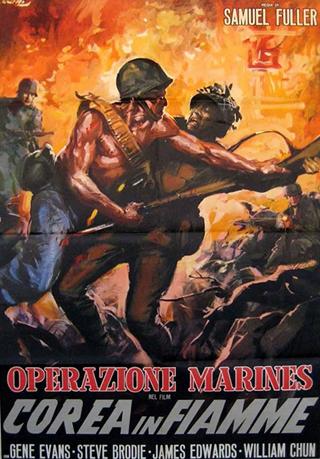
If you look at that small subgenre that is the Korean War movie, the efforts of Sam Fuller stand head and shoulders above the others. That’s not intended to disparage those other films which deal with that largely forgotten conflict such as Lewis Milestone’s Pork Chop Hill or Anthony Mann’s Men in War. However, Fuller’s Korean movies have that gritty believability that really set them apart. Both The Steel Helmet and the later Fixed Bayonets! deal with small groups of grunts caught up in desperate battles against overwhelming odds. Fuller’s presentation of war is a bleak one where there are no false heroics; just a bunch of regular guys doing what they have to in order to stay alive.

The Steel Helmet opens with Gene Evans’ Sgt. Zack, bound hand and foot, dragging himself along the ground amid the bodies of his massacred comrades. He’s just had the luckiest of lucky escapes – an execution squad bullet having entered his helmet and rattling round inside before exiting harmlessly. From here on the story follows Zack and the rag-tag bunch of stragglers he picks up as they make their way to an abandoned Buddhist temple to set up a forward observation post. Fuller never relents and the intensity of the story builds satisfyingly to the climactic assault on the temple by the communist forces.

Along the way the members of the group are revealed to us, and through this we get a glimpse of post-WWII American society. Among this odd group there’s a black medic and a Japanese-American veteran who serve to point up the racial prejudice prevalent at the time. There are also the quirky characters of the young soldier who lost all his hair through scarlet fever, and the silent G.I. whose only dialogue comes, poignantly, at the point of death. The locals are presented through the contrasting figures of “Short Round”, the South Korean boy who befriends Zack, and the malevolent, rat-like North Korean major. It is the sneering and callous reference to the boy’s fate by the red major that provokes Zack into an uncharacteristic, yet very understandable, reaction.

Which brings me to Gene Evans. His portrayal of Zack is the lynch-pin that holds the whole thing together. He is the consummate professional soldier – weary and cynical but dedicated to getting the job done and undeniably human. Evans would give a similar performance in Fuller’s next Korean drama Fixed Bayonets! and you have to wonder why his career never really took off from here. He plays the kind of three dimensional man’s man that is sadly absent in today’s cinema – well, that’s progress for you.

I’m not sure if anyone has seen any parallels between Fuller’s work and that of Howard Hawks. To me, both directors were attracted to the concept of the small group under siege and the emphasis on professionalism. However, while Hawks would use a lightness of touch, Fuller’s direction is like a pile-driver battering your senses.

Released by Criterion last year as part of their Eclipse series, The Steel Helmet comes in a set with I Shot Jesse James and The Baron of Arizona. While the film doesn’t appear to have undergone any restoration, it looks just fine and is worth the price of the set on it’s own.


The Big Clock

bpnijge

The Big Clock is a 1948 thriller about a race against time; a manhunt where the protagonist is essentially hunting himself. Does that sound complicated? Well, the plot is complex but it never becomes incomprehensible.

George Stroud (Ray Milland) is the overworked editor of a crime magazine who yearns for a holiday with his family. Just when this seems in sight his boss, time-obsessed media tycoon Earl Janoth (Charles Laughton), insists that he postpone his vacation and follow up on a breaking news story. In a fit of pique, he tenders his resignation and ends up spending a drunken evening with Janoth’s mistress. While exiting the girl’s apartment Stroud sees his boss arriving, while the boss sees only a silhouette. Goaded into a rage by the mistress, Janoth clubs her to death. On the advice of his reptilian chief executive (George Macready) he now plans to pin the deed on the shadowy stranger he glimpsed in the corridor. To this end, Stroud is recalled to co-ordinate the manhunt.

This is a great suspenseful picture, and you really sense Milland’s mounting horror as he is forced to use his own investigative team and techniques to gradually build up a profile of the mystery man; a man who he knows better than anyone. The two principal female roles are taken by Maureen O’Sullivan (who was married to director John Farrow) as Stroud’s wife, and Rita Johnson as the ill-fated mistress. I always enjoy anything with that inveterate scene stealer Charles Laughton, and he gives one of his more restrained performances here. There are lots of familiar faces in the support cast, not least Laughton’s real life spouse Elsa Lanchester as an eccentric artist and her turn damn near steals the whole show. Harry Morgan also shows up as a darkly menacing gunman on Janoth’s payroll, made all the more sinister by the fact that his character utters not a word on screen. Seasoned noir watchers may also recognise Harold Vermilyea who remains forever memorable, for me at least, as the doomed Waldo Evans from Sorry, Wrong Number.

If the plot to this movie seems slightly familiar that may be due to the fact that it was remade in the 80’s as No Way Out, with Kevin Costner and Gene Hackman in the Milland and Laughton roles respectively. That film was not bad but, to my mind at least, not a patch on the original – isn’t that usually the case?

The Big Clock is available in R1 as part of the now, apparently, defunct Universal Noir line. If any fans of classic noir/suspense don’t already own this, I can only ask – Why?


The Dark Corner

cfe6bdn 

I feel all dead inside. I’m backed up in a dark corner….and I don’t know who’s hitting me.

Those words are uttered by desperate private eye Brad Galt (Mark Stevens). He’s talking about the one lead that he’d hoped would get him out of a frame-up for murder; the one lead that’s just turned out to be another dead end. But those same words also go a long way towards defining the essence of Film Noir.

Contrary to popular belief, there weren’t all that many Noirs of the classic period that featured a private detective as the hero, however, Henry Hathaway’s 1946 movie does. Galt is a New York P.I. who was double-crossed by his ex-partner. When the partner turns up in town and the police call around to warn Galt not to cause any trouble, you can be sure just what’s coming. Or can you?

The slightly convoluted plot introduces us to a cast of characters who are rarely what they first appear to be. Clifton Webb is a wealthy gallery owner, reminiscent of his earlier Waldo Lydecker in Laura. Cathy Downs is his trophy wife. William Bendix (one of the screen’s most memorable heavies) is…a heavy. Kurt Kreuger is Galt’s ex-partner and Lucille Ball is his ever faithful secretary. By the end of the movie we get to see all these characters for what they really are, and the ride there is never a displeasing one. Hathaway directs tightly on location and keeps everything moving along like an old pro. The interiors are all well shot by Joe MacDonald – lots of inky black shadows, silhouettes, figures framed in windows and so on.

hxhsdyj

So, have I any criticisms to make? Well, there’s Lucy! I have to confess that I have never been a fan of Miss Ball. Even as a youngster her TV shows irritated the hell out of me, now that I’m all grown up I find her even less appealing. While I watched this film, I found myself thinking that almost any other actress would have preferable in the role of the resourceful girl friday.

Nevertheless, I consider this to be a highly entertaining entry in the Fox Noir line. The R1 transfer is very good (it’s also available in R2 and I assume the image should be the same) and well worth picking up if you’re a fan of vintage noir/crime/mystery movies.

Garden of Evil

pound2_zpscs4r15df

Look at her! Taking four men like us to a mountain of gold.

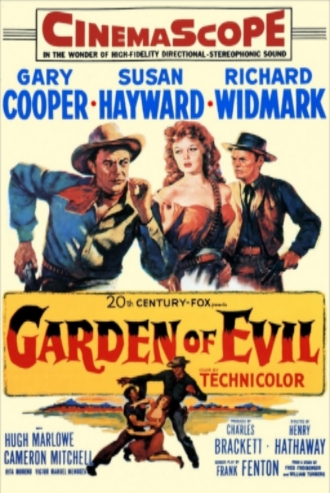
So says Richard Widmark’s Fisk, and in so doing he about sums up the plot of the movie. In a nutshell, a desperate woman (Susan Hayward) hires four men (Widmark, Gary Cooper, Cameron Mitchell and Victor Mendoza), who are all hanging around a dead-end Mexican town, to accompany her into the badlands on a mission of mercy; her husband is lying trapped in a mine deep in Apache country. What follows is an adventure tale that ties in some weighty themes such as, loyalty, greed, lust and infidelity. There are also some fairly explicit religious-moral allusions with the only features visible in a lava covered town being the church steeple and the entrance to the gold mine. Why, there’s even a crucifixion!

However, the film is never heavy-going and there is more than enough action to satisfy genre fans. The climactic chase and battle with the Apache is especially well-handled by veteran director Henry Hathaway. In fact, the whole thing moves along at a good pace and, at a little over an hour and a half, never outstays its welcome.

9189dab5-37c6-4b3f-83ae-08113175b540_zpszgfo6vzm

I love these early scope films from Fox, and this a great looking picture. Hathaway makes fine use of the widescreen process to show off the Mexican locations; some of the photography on the high mountain pass is simply stunning. The score is a bit of an unexpected one, by Bernard Herrmann no less. Herrmann, being Hitchcock’s composer of choice, is not a name you’d automatically associate with westerns. Nevertheless, the combination of soaring and ominous tones fits the mood of this movie perfectly.

There is, though, one very odd aspect to this film. Now, I won’t claim to be highly knowledgable of American Indians but the Apache we see here are the strangest looking bunch I’ve ever come across – surely the Apache never had Mohican haircuts!

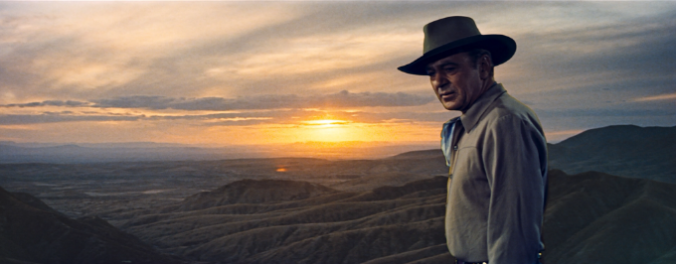
That aside, I highly recommend this movie. How can you not love a western with Gary Cooper and Richard Widmark. I think both men give excellent performances, although I may be a little biased since I’m a huge fan of Coop. He gets to deliver the last line of the film while squinting into the sunset –

The garden of evil – if the earth was made of gold, I guess men would die for a handful of dirt.

Great stuff!