The Hanging Tree

I came to town to search for gold
And I brought with me a memory
And I seemed to hear the night winds cry
Go hang your dreams on the hanging tree
Your dreams of love that will never be
Hang your faded dreams on the hanging tree. – Mack David & Jerry Livingston

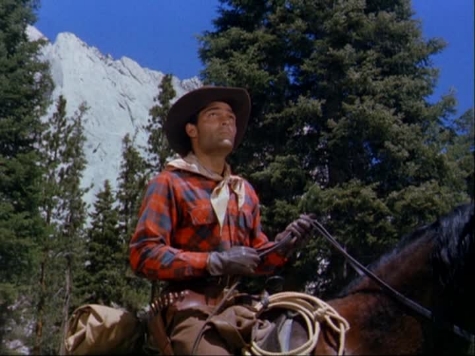
Redemption and its near relative salvation are in many ways the cornerstones of the classic western. These twin themes recur throughout the genre and lie at the heart of all the great westerns. Allied to these concepts is the notion of spiritual rebirth, the discovery of that indefinable something which serves to draw lost and damaged souls back from limbo. The Hanging Tree (1959) successfully explores all these elements and is a beautifully constructed piece, cyclical and symmetrical, and rich in the kind of life-affirming positiveness that I’ve come to see as one of the integral aspects of director Delmer Daves’ western work.

Montana 1873, the lure of gold has drawn all the flotsam and jetsam of humanity to the territory in search of riches. It’s a nomadic, rootless life for those following the gold trail, traipsing from one settlement to another as the hopes of making that big strike ebb and flow. Joe Frail (Gary Cooper) is one of those drifting through the  west, although his motives appear less certain. Frail is a doctor, and seems more interested in the opportunity to keep on the move than in any desire to become wealthy. Newly arrived in yet another shanty encampment that has sprung up around the prospectors’ claims, Frail has no sooner secured a place to stay than he finds himself saving the life of a young man. Rune (Ben Piazza) is a sluice robber, attempting to snatch nuggets from the workings, and running from a trigger-happy lynch mob. Frail takes him in, treats his wound, and keeps him on as a bonded servant in lieu of payment. Thus we have the first instance of salvation, Frail protecting Rune from the hanging tree which he eyes with an air of fatalism at the opening. As the doctor sets up practice it’s gradually revealed that this laconic and reserved man has a shadowy past and a reputation as an accomplished gunman. The second person to be saved is a Swedish immigrant Elizabeth Mahler (Maria Schell), the sole survivor of a stagecoach robbery. Suffering from exposure and temporarily blinded, Elizabeth is found by Frenchy Plante (Karl Malden), one of those amoral types that exist around gold camps, and nursed back to health by Frail. It’s at this point that the story becomes most involving. Prior to this there were only hints and oblique allusions to the doctor’s inner pain. Frail is a man buried in the past, emotionally entombed and haunting the world of the living rather than actually participating in it. As Elizabeth’s affection for Frail slowly blossoms into love, the doctor draws back and distances himself. Elizabeth’s confusion is shared by the viewer as it’s apparent that Frail is attached to her but unwilling or unable to take the leap of faith necessary. The reasons for this hesitancy masquerading as indifference do become clear as the tale progresses, but it’s only when Frail is also dragged before the hanging tree that a resolution is achieved. The film’s powerful and emotive climax sees the hero’s protective yet stifling armor stripped away and the ultimate redemption, salvation and rebirth realized.

Delmer Daves made some of the finest westerns of the 1950s and it’s only fitting that he should round off the decade with a work as layered, sensitive and complex as The Hanging Tree. As I said in my introduction, the structure of the film is carefully judged. Not only is it book-ended by Marty Robbins’ wonderful rendition of the title song, but it also opens and closes with the figure of Cooper, having undergone a major spiritual reawakening over the course of the story, beneath the hanging tree. The film is packed with symbolism, fire and trees being the most prominent. In both cases, we are encouraged to view these elements in a positive and negative light. Fire is initially referred to, though not seen, as representative of Doc Frail’s traumatic past. When it appears again near the end though it takes on a cathartic quality, burning away the negativity which has dogged him. And of course the focus on trees is even more significant. There are two trees of note: the hanging tree of the title and the one overlooking Elizabeth and Frenchy’s claim. The former naturally calls most attention to itself; the gnarled, clawing branches suggestive of guilt, punishment and death. And yet by the end it comes to symbolize something entirely different – renewal, permanence and the birth of a new life. That other tree, the one which eventually falls into the river, has to be viewed as a positive feature too. It’s destruction of the claim reveals the treasure hidden among its roots, the cache of nuggets which will both precipitate the final confrontation and eventually liberate the characters. Aside from all this, the location shooting and the camera positions of Daves and cinematographer Ted McCord also help focus on the subtext. The fact that Frail chooses a home high on a cliff above the swarming anthill of the mining camp serves to emphasize the remoteness and distance of the character.

Gary Cooper was an ideal piece of casting as the taciturn and aloof Joe Frail, his weathered features perfectly reflecting the emotionally desiccated man he was portraying. It’s not uncommon to read critical comments about Cooper’s acting, often failing to appreciate the subtle and understated nature of the man’s work. As with all the great screen actors, Cooper understood and used the little things, the twitch of a facial muscle or the quick glance that reveal more than pages of dialogue and overt emoting ever could. It’s not the first time that the point has been made that a good western is so often elevated by the presence of a strong female role, and Maria Schell’s performance in The Hanging Tree provides a good illustration of this. Frankly, she hardly puts a foot wrong at any point, from her initial helplessness and vulnerability, through the confusion prompted by her rejection, to her eventual emergence as an independent and complete woman. If the movie is really about Frail’s journey I think it’s also fair to say that it would be a meaningless and hollow affair had it not been for the strength of Schell’s character; she is vital to the story and Schell’s beautiful playing of the part gives it that little extra something that makes it special. While Frail’s own internal conflict is the main focus, Karl Malden as the lecherous prospector whose unwanted advances bring matters to a head adds another layer. Malden brought out the earthy, feral qualities of Frenchy and his uncouth impulsiveness makes for a fine contrast with Frail’s wounded gentility. In support, Ben Piazza gets a fair bit of screen time and is fair enough as the boy who first resents his savior’s cool arrogance before gradually warming to him and becoming a firm ally. The other parts of note are filled by Karl Swenson and Virginia Gregg as the sympathetic storekeeper and his shrewish wife. Additionally, the ever reliable (and always welcome) John Dierkes flits in and out of proceedings, as does George C Scott, making a showy debut as a venomous preacher/healer.

The Hanging Tree has been available on DVD from a variety of European sources for quite some time now, but always in faded, full-frame transfers. The MOD disc from the Warner Archive improves on these previous iterations in pretty much all areas. The print used is certainly not pristine, displaying the odd scratch and blemish, but it is in the correct widescreen ratio and is much more colorful than anything I’ve seen before. The only extra feature offered on the disc is the theatrical trailer. It’s fascinating to follow how the western grew and built upon its inherent strengths throughout the 1950s, and the end of that decade saw it reach full maturity. The Hanging Tree is certainly a mature work of art, a finely judged and multi-layered examination of human nature and human relationships. For me, these late 50s westerns demonstrate not only what the genre was capable of but what cinema itself had to offer. The more I watch, write and think about the westerns of Delmer Daves, the higher his stock rises. I guess it’s clear enough that I both like and respect The Hanging Tree a lot. I consider it one of my favorites in the genre and I haven’t the least hesitation in strongly recommending it. It’s an absolute must for anyone who appreciates or cares about the western.

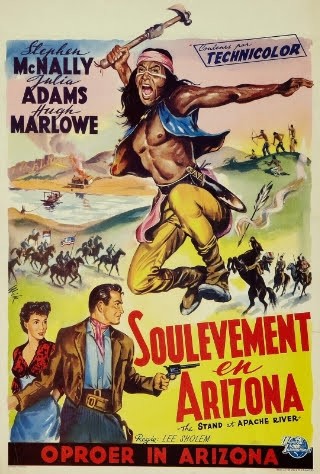
The Stand at Apache River

poster7_zps8995170c

Something I like to do on this site is feature a mix of the better and lesser known films. When it comes to the latter category there’s no shortage of candidates to be found among the output of Universal studios. Second features or programmers are of course a varied bunch in terms of quality, but it has to be said that Universal, of all the Hollywood studios, had a real knack for producing entertaining westerns on the cheap. These small-scale, unpretentious movies had a polish and tight professionalism to them that’s very attractive. There’s no doubt that these films were constrained by their budgets but that was often turned into an advantage in itself. The Stand at Apache River (1953) is a fair example of a western which both exploits its limitations and simultaneously suffers from them too.

The opening sees a horseman striking out across an expanse of barren country, nervously checking his back trail for signs of pursuit before heading for the rocky high ground and the promise of safety. This man is Greiner (Russell Johnson), a thief and murderer desperate to avoid a date with the hangman. Hot on his heels is Lane Dakota (Stephen McNally), a driven lawman with a personal interest in running down his quarry. When an unexpected skirmish with a couple of Apache leaves Greiner badly wounded, and Dakota without his much needed proof, the sheriff has no option but to seek temporary shelter until the prisoner is well enough to be brought back to face justice. And this brings us to the location where the remainder of the drama will play out – the Apache River ferry station. Dakota’s arrival coincides with that of a stagecoach carrying Valerie Kendrick (Julie Adams) and Colonel Morsby (Hugh Marlowe), the former being an uncertain bride-to-be on her first trip west while the latter is a veteran Indian fighter with a fearsome reputation. No sooner has this little band of travelers gathered at the isolated station than it’s revealed that a group of 50 Apache warriors has broken free from the San Carlos reservation and may be heading their way. This external threat is exacerbated by a number of internal conflicts, among which are Greiner’s eagerness to elude his captor and the friction that arises between Dakota and Morsby over matters of justice and their respective attitudes towards the Apache. When the station finds itself under siege and repeatedly attacked by the Apache all the tensions within are exposed and add to the danger.

While I was watching this movie I found it difficult not to be reminded of Apache Drums for a number of reasons. Firstly, there’s the presence of Stephen McNally in the lead and the fact that the title and credits play over the same footage and images as the earlier film. Additionally, both movies have a similar structure, gradually narrowing in focus and confining themselves to a single set as the story progresses. The Stand at Apache River also tries hard to recapture some of the terrifically claustrophobic atmosphere that characterized and elevated the Lewton/Fregonese film but director Lee Sholem doesn’t quite get there. The lighting and cinematography are similar but the same sense of menace isn’t achieved. Where Lewton and Fregonese kept the Apache largely unseen and thus built them up into frightening bogeyman figures, this movie presents them, or at least their leader, as more rounded characters. While this dissipates the threat somewhat, it does offer the opportunity for some consideration of the nature of the conflict between the settlers and the Apache, deftly highlighting the grievances of and injustices towards the latter group. However, this also feeds into what I see as the main weakness of the movie – essentially there is too much going on. You cannot have drama without conflict but it’s also possible to overdo it. The movie only runs for an hour and a quarter and tries to pack in a siege, commentary on settler/native relations, the problems faced by women in isolated frontier settings, and a love triangle to name just a few. In the end, there are too many themes and too little development – arguably, there’s enough material for a couple of movies here.

Stephen McNally and Julie Adams get the most screen time and both of them turn in perfectly acceptable performances. However, the overstuffed plot which I mentioned does work against them and means that their character development is necessarily limited. This is a shame as both of them have interesting back stories, and the acting chops to take advantage of them, but there’s just not enough time to explore it all further. Hugh Marlowe is fine too as the rigid martinet although his role is fairly one-dimensional. There’s also a nice intense turn by Jaclynne Greene as the frustrated and frightened owner of the river station. Russell Johnson (who passed away just last month) and Hugh O’Brian both play potentially interesting characters, though once again it has to be said they really don’t get the chances to show what they were capable of. The only disappointment for me was Edgar Barrier, who I found pretty unconvincing as the Apache chief.

I guess The Stand at Apache River has to count as a bit of an obscure film these days, and it certainly hasn’t been widely available for home viewing. However, there is a nice DVD out in Spain. Many Universal titles from the 50s seem to be in reasonably good shape and The Stand at Apache River is no exception. The print used isn’t perfect but it’s not at all bad either. While there are a handful of instances of age-related damage, they are few and I wouldn’t refer to them as a particular distraction. Generally, the transfer is smooth, colorful and acceptably sharp. The disc doesn’t offer anything in the way of extras but there’s no problem with subtitles either – there’s the option of French, Spanish or none. All in all, the movie provides plenty of entertainment and excitement. With its short running time it moves along briskly and, leaving aside the matter of the crowded plot, should satisfy those into westerns of this era.


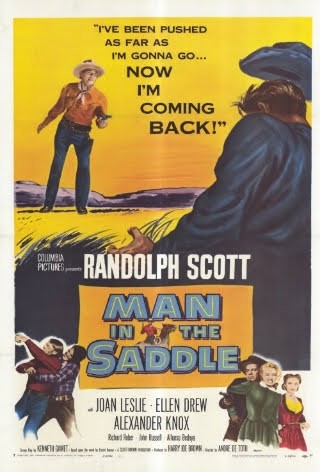
Man in the Saddle

The collaboration of actors and directors is a favorite area for analysis by film critics – Ford and Wayne, Mann and Stewart, Huston and Bogart readily spring to mind. That attention tends to get focused on these cinematic partnerships is I think understandable; they offer a reasonably self-contained block of work which can be examined easily. Mention Randolph Scott to western fans and the name that will probably come to their lips is that of Budd Boetticher, again understandable enough given the reputation their series of films together has deservedly earned. However, Scott also made a group of westerns with another director, Andre de Toth, just before he hit his late career peak with Boetticher. Man in the Saddle (1951) was the first, and arguably the best, of a half-dozen movies featuring de Toth and Scott.

The overall framing device is the classic western staple of the range war, the conflict over land and the need for expansion. But that’s actually the least interesting aspect of a story that involves a number of overlapping and obsessive relationships. Owen Merritt (Randolph Scott) is a man under pressure on two fronts; having already lost his woman, Laurie (Joan Leslie), to his powerful neighbor Will Isham (Alexander Knox), he’s now in danger of seeing his ranch go the same way. Isham is one of those typical western expansionists, a man never satisfied with owning half of anything and ruthless enough to use whatever means are necessary to get what he wants. Standing in the path of this irresistible force is the immovable object of Merritt. The only possible outcome of such a paradox is conflict, even though Merritt does his level best to avoid it for as long as possible. What makes this apparently simple tale fascinating though is the way these characters, and those around them, interact. Merritt clearly retains strong feelings for the ambitious and mercenary Laurie, yet he buries them deep, while Isham is fighting an internal duel with his own jealousy and self-doubt. Matters are further complicated by the presence of another neighbor, Nan (Ellen Drew). She quietly pines for Merritt and in turn is herself desired by Clagg (John Russell), a taciturn loner of brooding temperament. When Isham’s hired gunmen up the ante by stampeding Merritt’s herd and killing one of his men all the passions and obsessions of the principals are unleashed. Merritt is forced into taking a stand against his enemies, even those he was hitherto unaware of.

If one views the westerns of de Toth and Scott in relation to the work both director and actor did independently and with others, then it’s possible to undervalue them. But I think such comparisons, even if they’re inevitable, are unfair. Movies really ought to be evaluated on their own terms – do they achieve what they set out to do? Placing them within a wider context does of course serve some purpose but it ultimately does the films a disservice too. What all that’s leading up to is my belief that Man in the Saddle succeeds in telling its tale. Firstly, de Toth’s direction and Charles Lawton’s cinematography combine well and the tension builds nicely. Visually, it’s an interesting movie with a number of scenes taking place at dawn or dusk (perhaps using the half-light to underline the murky, shifting nature of the relationships) and the location work in Lone Pine and Thousand Oaks particularly enhances the latter half. The climax too is notable for the use of a dust storm as an accompaniment to the action and is suggestive of the elemental, swirling emotions of those involved. The only downside of the film, for me at least, was the slightly clumsy way the comedic parts were integrated. Generally, I have no objection to the introduction of a little comedy to lighten the load, but I’m not sure it’s handled all that successfully in this case.

By the end of his career Randolph Scott had almost elevated the depiction of the stoic acceptance of loss and regret to an art form in itself. One of the more rewarding things about watching those films leading up this is the ability to observe how that persona gradually evolved over the years. As Merritt, Scott touches on this idea of losing the woman he loved. That loss isn’t as fully defined or as final as would be the case in the later movies with Boetticher, but it’s there all the same. Alexander Knox isn’t an actor normally associated with westerns, making only three throughout his career, yet he’s fine as Scott’s rival. He’s very convincing as an emotionally repressed man and this is even more effective when he actually lets loose all his pent-up rage. In truth, all the main players acquit themselves very well: Joan Leslie as the hard-edged pragmatist, Ellen Drew as the calm Girl Friday, and John Russell as the outsider twisted by his unrequited passion. My only complaint is that Richard Rober is underused as the smiling gunman.

Man in the Saddle is readily available on DVD and has been for many years. The US disc from Sony/Columbia presents the film nicely in its correct Academy ratio. This older transfer comes from a good print and boasts strong, vibrant color with plenty of detail. The disc doesn’t have much in the way of extra features, just a standard preview reel for other Sony/Columbia movies available. However, the movie is the main thing and the presentation here should give no cause for complaint. The westerns that Randolph Scott made with de Toth have been overshadowed to a large extent by the later Ranown cycle, yet they’re enjoyable in their own right. Aside from allowing viewers to fill in some gaps in tracing the development of the Scott persona, these movies are good examples of the professionalism to be found in the Hollywood western of the 50s. Man in the Saddle may not be the best thing Scott or Andre de Toth ever did but it’s still a pretty good film and is worthy of the talents of all involved.

A Day of Fury

poster29_zps36678c4a

That man is a creature of hell. If he stays here, he’ll turn this town into a hell.

Quite a few westerns have served as social commentaries, using their frontier setting to focus the spotlight on a whole range of issues, as frequently acting as an allegory for the era in which they were made as much as a critique of the old west itself. A Day of Fury (1956) is an interesting case in that it’s less of a social commentary than an examination of human nature, and the less savory side of it at that. I think part of the beauty of the adult-oriented westerns of the 50s lies in the way programmers with modest budgets could tackle complex themes successfully while also telling entertaining stories. It sometimes feels like  current filmmakers have lost this once commonplace skill, either overtly preaching at the audience or veering sharply in the opposite direction and rolling out mindless popcorn fare where you’re required to check your brain at the door. As such, it’s genuinely refreshing to watch a movie like this where the makers have sufficient respect for their audience to present an entertaining film while simultaneously crediting them with a modicum of intelligence.

A Day of Fury opens by telling the audience that the Civil War has ended, the frontier is closing, and civilization is advancing. As such, the implication is that we’re in for another end of the trail western, another look at the passing of a way of life. Well that’s true enough up to a point, and yet A Day of Fury is good deal more than that. It’s neither an ode to lost innocence nor a celebration of a brighter future ahead. Instead the movie operates on a more spiritual level, holding up a mirror to the human soul and daring us to take a long hard look at what may be lurking within. Everything starts off in a fairly straightforward manner with a lone horseman, Jagade (Dale Robertson), stumbling into an ambush being set up. The proposed victim is Burnett (Jock Mahoney), the local marshal. When Jagade saves the lawman’s skin it looks like a lead in that’s been seen on many occasions. However, there is also a sense that this film is going to head off in a different direction, the terse dialogue between Jagade and Burnett hinting at something darker and less predictable. Jagade rides ahead into town, ostensibly to tell Burnett’s bride-to-be (Mara Corday) that her man has been delayed, but his real motives gradually become apparent. If there was a tension or edge to the initial meeting between Jagade and Burnett, it’s ramped up considerably as soon as the former sets foot in town. Jagade is a gunfighter, a lethal killer whose reputation precedes him. In fact everything about Jagade harks back to a rapidly disappearing era: from his own violent skills to his acquaintance with the marshal’s betrothed and her time as a saloon entertainer. For Jagade, this represents a last stand of sorts; the changing world around him has left him with no other place to go and he seems keen to turn the clock back. Still, that only amounts to a superficial interpretation of the film. We all know that the past is nothing more than a memory which, despite the strongest yearning, can never be recaptured. And so it is with Jagade; his true function is to confront the facade of respectability and gentility that the town has constructed. The pious righteousness is simply a veneer, and one so thin that it starts to crumble when the slightest pressure is applied. Jagade could, I suppose, be viewed as a kind of malignancy that will have to be cut out at some point, but he could reasonably be seen as the cure as much as the illness. Over the course of one Sunday, and there is significance to the fact that the Sabbath is chosen, the townsfolk begin to regress and descend into the type of amoral thuggishness they had frowned upon only a few hours before. And that’s what I feel the movie is all about – the question of whether our civilized values are so cheap they can be bought or traded away, or whether the roots are deeper and stronger.

£26

Aside from the first five minutes, director Harmon Jones keeps the action of A Day of Fury confined to the backlot western town. While I’m in no doubt budgetary considerations played a big part in that decision, I think it works well on an artistic level too. Everything is contained within a series of tightly controlled locations, heightening the tension and dread that grows as the story progresses. Recently, Toby published a fascinating article in which he revealed that Dale Robertson viewed his character in the movie as an incarnation of the Devil. As I said earlier, the film does have a definite spiritual element running through it and Robertson’s reading of the role is in line with that. Personally, the notion of the movie as a religious allegory makes sense and works: the initial meeting in the desert-like surroundings between Burnett and the left-handed Jagade, and the subsequent temptations that are variously succumbed to, resisted, and overcome. If I had any criticism of this approach, it would only be that I think the final shot of the film arguably lays the symbolism on a little too heavy, and that the message had already been successfully imparted without it. To return to the point I made in my introduction, besides all the ideas and food for thought offered up, the filmmakers never lose sight of the primary goal of presenting an entertaining and well-told tale.

£25

A Day of Fury boasts a strong cast of western players. Dale Robertson’s Jagade is clearly the center of attention, the catalyst for all that takes place. And it’s a marvelously ambiguous part, a character who provokes and toys with those around him. The fact that it all works so well is partly down to the scripting of course, but Robertson’s skill cannot be discounted. There’s an air of authority about the man, a calm self-confidence, tinged too with a touch of distaste both for himself and the weakness all around him. In the opposite corner is Jock Mahoney, stoic, reserved and cool. One could say there’s a passivity to Mahoney’s playing here, but it’s a vital aspect of his character – the only serious rival to Robertson’s satanic influence and the solid rock to whom the town must ultimately turn. And lying somewhere between these two is John Dehner as the preacher. Always a welcome face as far as I’m concerned, Dehner represents the most easily identifiable figure in the town, a man who’s not above weakness but who is also able to recognize that fact and actively work to resist it. As for the others, Mara Corday has a showy part as the former saloon girl whose past returns to haunt her and threaten her future happiness. I thought her weary acceptance of the fragility of so-called respectability was very well realized. In support, Jan Merlin had a pivotal role as the fawning, rat-faced acolyte whose actions finally cause the tide to turn while Carl Benton Reid, James Bell and Howard Wendell all turn in small but noteworthy performances.

A Day of Fury isn’t that difficult to see these days. There’s a Blu-ray available from France, although I’m unsure what the subtitle situation is seeing as it’s a Sidonis release. As a result, I ended up buying the Italian DVD. This may well come from the same source as the image is of excellent quality: the movie is presented in a 2.00:1 anamorphic transfer and comes from a print that exhibits little or no damage. The disc offers the movie either with the original English soundtrack or an Italian dub, subtitles are optional and can be deselected via the setup menu. Extra features consist of the trailer along with poster and photo galleries. The film itself is one I was eager to see as I had heard a lot of things about it from people whose opinions I greatly respect. I was delighted to discover it was every bit as good as I’d been led to believe. I’ve always enjoyed focusing some attention on pictures that are not so well-known, and I guess this one fits that description. I reckon this is a terrific little movie and should provide plenty to appeal to genre fans and those who simply like smart, well-made films.


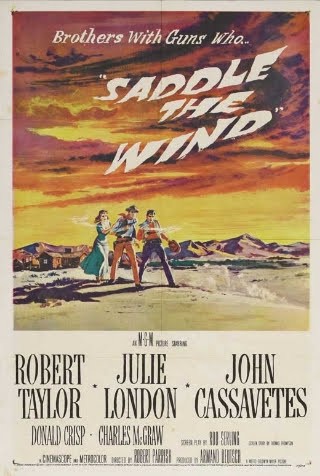
Saddle the Wind

poster20_zps613c7860

It’s a hell of a thing, killing a man. Take away all he’s got and all he’s ever gonna have. – Unforgiven (1992)

I decided to open with the above quote to prove a point of sorts. It’s a point about perception, the way cinema tricks us into believing certain things, or at least the way those who write about cinema shape our views. There are plenty of people who point to Eastwood’s Unforgiven and hold it up as the ultimate myth buster. I like the movie well enough but it does bring a wry smile to my face when I hear it lauded as a film which highlighted the corrosive effects of violence on men who lived by the gun. It’s easy to see how those unfamiliar with the genre, or even those with only limited exposure to it, could buy into the theory that Unforgiven is a bigger game changer than it really is. There is a tendency among some, probably fueled by the influence of the spaghetti western, to imagine the genre was all about cool, trigger-happy gunslingers prior to 1992. Somehow, the perception arose that the western shied away from or glossed over the consequences of violence and killing. Yet if one goes back to the golden decade of the 50s, it’s clear that the genre had already faced such themes head on. Saddle the Wind (1958) is a film about killing, a painful and probing examination of the repercussions of pulling a trigger and taking a life.

The opening sees a stranger (Charles McGraw) riding into town. He’s one of those bristly, hard-bitten types, the kind of guy who oozes insolence and aggression, who demands rather than asks. Men like this have a swaggering confidence born of the knowledge that they’re tough, mean and fast enough to carry it all off. Anyway, he makes it clear that he’s looking for a man, Steve Sinclair (Robert Taylor), and guys such as this don’t come looking for men just to be sociable. Steve Sinclair is now a respected rancher but he has a murky past that he’s trying to live down, having once been a famed gunman and killer. So what’s new, you may ask. Thus far the scenario is one that ought to be familiar to anyone who’s seen more than a handful of westerns. Well Steve is a man who has learned from the sins of his youth, he’s become a reformed character and has rejected violence. However, Steve has a younger brother, Tony (John Cassavetes), who appears to have inherited the worst traits of his elder sibling. Tony is more than just a cocksure kid with a gun and a point to prove; he’s a damaged human being, a walking stick of dynamite without a hint of remorse and a lust for killing. We first see Tony as he arrives home with a girl he intends to wed, former saloon singer Joan (Julie London), and a new gun. It’s immediately clear that there’s something itching away under Tony’s hide: he deposits his betrothed in the house, introduces her to all, and then proceeds to indulge his real passion. Where a normal guy would fawn and fuss over his newly acquired fiancée, Tony instead gets straight to work honing his shooting skills with his new six-shooter. Not only that, but there’s a manic, obsessive edge to his practice, rounded off by his blasting away at his own reflection in the water – which of course foreshadows the film’s climax. And this, more than anything else, is what the whole movie is really about, two very different brothers and their attitude to violence. The more Steve tries to rein in the excesses of his brother, the more Tony strains against that moderating influence. What finally brings the conflict to a head is the arrival of a former Yankee soldier (Royal Dano) bent on claiming his family’s legacy and stringing the dreaded barbed wire on the open range. Tony’s overreaction and stubborn refusal to heed Steve’s call for calm leads to a tragic confrontation. His neglect of Joan has already irritated Steve, but it’s his determination to usurp the authority of the local land baron (Donald Crisp) which finally forces the two brothers into a situation where only one can walk away.

£35

Robert Parrish isn’t a director whose name will be familiar to many these days. However, he made a string of fine films throughout the 50s, culminating in the truly excellent The Wonderful Country. I recall reading somewhere that Parrish was unhappy that he wasn’t given full control over the final cut of that movie; I don’t know if that’s true but the fact remains his career as a director appears to have slumped dramatically after hitting that peak. Anyway, Saddle the Wind (with its screenplay by Rod Serling of The Twilight Zone fame) comes awfully close to being his best work – I reckon The Wonderful Country just about pips it to the post but there’s not a lot in it – with some memorable visuals and an extraordinarily powerful theme. Pitting brother against brother always makes for good drama. When you mix in the simmering resentment left over from the Civil War, and a scathing critique of machismo and the culture of violence then it all adds up to something quite special. It’s that last point which I mentioned in my introduction, and I’d like to explore it a little further here.

Others have pointed out that the scene where Jack Palance gunned down Elisha Cook Jr in Shane was a pivotal moment in the development  of the western, and I’m not going to argue with that. That proved that gun play and violence was a mean, dirty business. Saddle the Wind follows on from that and literally hammers  the point home: apart from the heartfelt speeches delivered by Taylor and Crisp at various times, the killings that take place in the film, and there aren’t actually that many, are grim and brutal. No-one dies easily; as the bullets tear into bodies, the victims clearly suffer, twitching, kicking and coughing to the bitter end. And then there’s the aftermath, the consequences of taking a life. Two of the characters (Crisp & Taylor) bear the psychological scars of a violent past and their world view is shaped by that. For me, it’s this mature consideration of the effects of violence on the souls of men that marks Saddle the Wind out as one of the great westerns of the greatest decade of the genre.

£36

The more often I watch Robert Taylor’s westerns, particularly those of the late 50s, the more I come to view him as one of the most significant figures in the genre. I didn’t include him in my list of the top ten western stars which I compiled at the tail end of last year, and I tend to think now that it may have been a major omission. I guess Taylor is never likely to attain the status of Stewart, Scott or Wayne but his finest western roles made a big contribution to the genre. In Saddle the Wind he achieved a marvelously quiet dignity, a kind of pained courage that projected all-round masculinity as opposed to juvenile machismo. Taylor’s calm awareness of his own strengths and weaknesses contrasts well with the strutting bravado of Cassavetes. Now there’s a figure one wouldn’t normally associate with the west. Cassavetes had a very urban and modern air about him, a guy who it’s hard to imagine outside of a big city environment. Yet that otherness, that discomfort with his surroundings, works under the circumstances. Cassavetes’ character is a young man at war with himself, and by extension with the whole world around him. If Cassavetes doesn’t truly belong in this frontier setting then it’s merely a reflection of the character whose psychological flaws and displaced morality set him apart from those around him. He honestly comes across as some unbridled force of nature, and Taylor’s futile efforts to tame him could easily be seen as a fruitless attempt at saddling the wind. These two men unquestionably dominate the film but it’s also important to mention the work done by Donald Crisp and Royal Dano. Crisp was always good in patriarchal roles and his benign presence in this movie is every bit as touching and influential as the rather different yet comparable part he played in Anthony Mann’s The Man from Laramie. Royal Dano was one of those character actors who seemed to pop up all over the place, and his halting delivery and hunted look tend to stick in the mind. Saddle the Wind offered him a role to get his teeth into, a desperate man driven on by his private sense of honor and justice. And that brings me to Julie London. Her fame today derives from her singing (and she provides a beautiful version of the theme song of this film) but she also starred in three exceptional westerns around this time: The Wonderful Country, Man of the West and the film under discussion.

Saddle the Wind was an MGM production and so it was released on DVD by Warner Brothers a few years ago in their Western Classics box set. The film has been given a very good transfer to DVD, the anamorphic scope image looking bright, clean and colorful. The location photography in Colorado looks quite stunning in places and the audio is also strong with the gunshots packing a considerable punch, and Elmer Bernstein’s brooding score sounding rich. The only extra feature offered on the disc is the theatrical trailer. I believe this is a very fine western, although nowhere near as well-known as it deserves to be. I see it as further proof of how far the western had progressed by the late 50s. However, the fact that thoughtful films like this are only infrequently mentioned can also be regarded as evidence of the regression the genre experienced through the following decade. Anyway, next time someone claims that a film such as Unforgiven broke entirely new ground in terms of its critique of violent lifestyles, you can simply point them towards this production and tell them it’s not as new a concept as they first imagined.


Canyon Passage

poster10_zps537a0a41

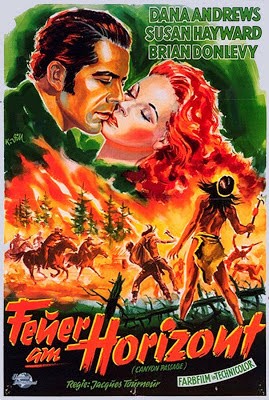
The western is a genre which, although it’s certainly not the only one, is sometimes accused of being overburdened by clichés.  This is understandable enough; genre pictures by definition have to feature elements that are immediately recognizable to viewers. Canyon Passage (1946) could be said to contain its fair share of these well-worn tropes (crooked financiers, restless wandering types, hostile natives) but part of what raises this film up among the best examples of the genre is the way they are handled. There’s an  air of authenticity about it all, and that filters through into some stock characters and situations, bestowing on them an originality that sets the whole production apart.

While I don’t have any statistics at hand to prove this one way or the other, I reckon it’s safe to say most westerns take place within a rough thirty year period beginning at the outbreak of the Civil War. Sure you’ll get examples set both before and after these dates, but they do appear to be slightly thinner on the ground. Canyon Passage tells a tale of Oregon in 1856, a time of growth and expansion before conflict engulfed the nation. Logan Stuart (Dana Andrews) is one of those thrusting, entrepreneurial types, never satisfied with what he has and always on the lookout for new opportunities to add to his fortune. Still, he’s not a greedy or grasping man; his ambition is just an integral part of his character, a restless need to range further and in some ways a reflection of the pioneering spirit of his country. Stuart is a man who is going places in every sense: his business is booming, he’s respected within the community and he’s courting Caroline Marsh (Patricia Roc), a beautiful English settler. However, there’s almost always a fly in the ointment, two in this case. The biggest and ugliest comes in the shape of the brutish Honey Bragg (Ward Bond), a muscle-bound giant of a man and an amoral counterpoint to Stuart. A further source of anxiety is George Camrose (Brian Donlevy), the local banker and Stuart’s best friend. Camrose is a compulsive gambler, a dangerous trait in a financier in any circumstances but doubly worrying when he’s caught in a run of spectacularly bad luck. While Camrose attempts a precarious balancing act his fiancée, Lucy Overmire (Susan Hayward), is increasingly  attracted to Stuart. Granted none of this is making his life any easier, but it pales into relative insignificance in comparison to the physical threat represented by Bragg. The hulking bully is borderline obsessive in his rivalry with Stuart, further enraged and embittered by his knowledge that his foe had (and passed up) the opportunity to see him hang. Fueled by hate and frustration, Bragg gives in to his animal instincts and thus imperils not only Stuart but the whole community when his base behavior sparks off a tragic Indian uprising.

£3

Adapted from a novel by prolific western author Ernest Haycox (Stagecoach, Union Pacific, Bugles in the Afternoon, Man in the Saddle etc) Canyon Passage was the first foray into the genre for director Jacques Tourneur. The versatile Frenchman took to westerns right from the beginning, crafting an intimate portrait of frontier society that comes close to the affectionate and mythic vision of John Ford. Cameraman Edward Cronjager captured some truly beautiful and breathtaking Technicolor images that Tourneur then directed with an expert touch. The sequence of the cabin raising is an ode to communal effort and gives a real sense of how inextricably linked the lives of these people were to those of their neighbours. Everything in the movie – the texture of the buildings, the condition of the streets, the language and attitudes of the characters – smacks of a realism that isn’t always present. However, the movie is more than a celebration of pioneering spirit and the social dynamic of the time. Above all, Tourneur was a master of atmosphere and an extraordinarily subtle, understated director. There is plenty of rousing action accompanying the narrative, and again the authentic feel comes across in the depiction of the violence. No doubt Tourneur’s experience working in Val Lewton’s horror unit at RKO shaped his approach to filming the more horrific scenes. There is very little explicit violence shown on screen, the director preferring to cut away or obscure the more visceral moments. Yet the effect, as was the case in those Lewton movies, is to force the viewer’s imagination to take over. In my opinion anyway, having to visualize the acts just off screen is more unsettling than seeing some unconvincing mock-up.

With strong source material and first class people operating behind the cameras, the final vital ingredient is the performers. Dana Andrews produced another of those deceptively quiet turns as Logan Stuart. Initially, you’d be forgiven for thinking this man was no more than a hard-nosed and pragmatic businessman. However, as the story progresses, Andrews, as he so often did, reveals new layers to the character. His early scenes with Patricia Roc hint at a tenderness of heart not apparent from his stoic visage, and this aspect is further developed as his relationship with Hayward grows. But really it’s his loyalty to Donlevy that proves how deep his humanity runs. Although Donlevy was of course a great heavy in countless movies, I wouldn’t actually class his George Camrose as a fully fledged villain. Despite some thoroughly reprehensible behavior, Donlevy brought a weakness and frailty to the role, a touch of corrupt romanticism if you like, which helps explain why Andrews stuck by him all the way. No, the real bad guy here comes courtesy of Ward Bond’s portrayal of the monstrous Honey Bragg. Bond did a fantastic job in capturing the physical power, the depravity and animal cunning of this figure. The two main female roles – those of Patricia Roc and Susan Hayward – are careful studies of contrasting women. Roc had the right kind of brittle gentility for an Englishwoman suddenly thrust into a new and dangerous world; her dazed and distant reaction to the aftermath of the Indian massacres struck just the right tone. Hayward, on the other hand, was feisty, tough and earthy – a true frontier gal. In supporting roles, there is some good work from Lloyd Bridges, Andy Devine, Onslow Stevens, and the wonderful Hoagy Carmichael.

£4

Canyon Passage is a Universal film, and there are plenty of DVD editions on the market from a variety of territories. I have the version included in Universal’s Classic Western Round-Up Vol. 1 which was released a number of years ago. The film shares disc space with The Texas Rangers but I can’t say I was aware that the presentation suffered from any compression issues. For the most part, the image is very strong with the Technicolor cinematography looking frankly spectacular at times. There are no extra features whatsoever available on the disc, something I think is disappointing as the movie is most certainly deserving of a commentary track at the very least. Regardless of that, this movie remains among one of the very best westerns made in the 1940s. Jacques Tourneur would go on to make a number of high quality pictures in the genre, though I feel this represents him right at the top of his game. There’s a complexity and maturity to the characters and their interactions that help distinguish the movie. Not only would I recommend Canyon Passage to anyone with an interest in westerns, I would go so far as to say it’s essential viewing.


The Man from Colorado

poster11_zps8d7fa5f9

The years following WWII saw a number of movies looking at the problems encountered by veterans returning home and the difficulties they faced in trying to assimilate themselves once again into society in peace time. This was a common enough theme in film noir, where the shadowy, paranoid and dangerous world of the dark cinema seemed ideally suited to such tales of detachment and disillusionment. Westerns, on the other hand, would appear an odd choice for exploring these particular issues. However, as I’ve tried to point out in the past, the western was a versatile and malleable genre capable of embracing just about any type of story. The Man from Colorado (1948) deals with a man coming home after experiencing the horrors of a different and more distant war – the Civil War – but the associated problems, especially the psychological ones, are sure to have struck a chord with contemporary audiences. Perhaps more importantly, the film remains relevant for modern audiences as, sadly, new conflicts have a nasty habit of rearing up to rob a little of the soul of almost every generation.

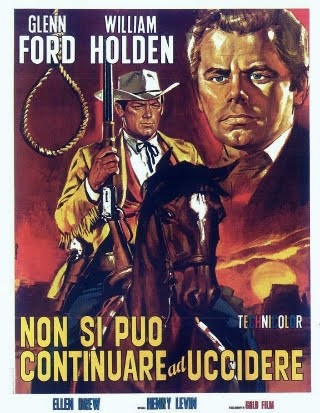
It all starts with a massacre. On the last day of the Civil War a small band of Confederate soldiers are holed up in a box canyon. Faced by a well equipped Union force, these demoralized troops have the choice of making a fight of it or surrendering. Their officer orders a white flag run up, and then watches in disbelief as the Union commander gives the word for his artillery to open up. Owen Devereaux (Glenn Ford) is the colonel who knowingly seals the fate of this group of doomed men. Devereaux is a man not only hardened by battle but psychologically damaged to the extent that his humanity has been all but stripped away. This calculated atrocity is witnessed by his friend and subordinate Captain Del Stewart (William Holden), but his sense of loyalty to his commander, and perhaps his charity to a man he feels has been scarred enough by conflict, leads to his surreptitiously burying the evidence. Devereaux himself recognizes the mental strain he’s suffering from but hopes that civilian life and freedom from official duties will offer him respite. However, that’s not to be; a man with his war record is attractive to those with a political agenda to push, and the local businessmen in his hometown convince Devereaux to take on the role of federal judge. Reluctantly, Stewart agrees to serve as federal marshal under Devereaux, partly because it affords him the opportunity to keep an eye on his disturbed friend. Nowadays, the condition affecting Devereaux would likely be referred to as post traumatic stress disorder and various treatments would be prescribed. However, we’re talking about 1865 and men had to simply soldier on, so to speak. The power and responsibility that Devereaux now holds seem only to exacerbate the problem, and the fact that Stewart is not only his deputy but a rival in love too doesn’t help matters any. As Devereaux, backed by grasping mining interests, develops a kind of callous megalomania that threatens to undermine all respect for the law among the locals, Stewart increasingly realizes that his friend has gone beyond the pale and it’s his duty to take a stand.

Borden Chase wrote the story that The Man from Colorado was based on, although I don’t know how much of that was altered in the finished screenplay. The dark characterizations certainly all bear Chase’s stamp, but the script shows the mine owners and authority figures in a pretty negative light, something that would appear to be at odds with his conservatism. The depiction of a man driven insane by the horrors of warfare and his inability to come to terms with a post-war life is the main theme of the movie, and it’s obviously the most interesting feature. However, the critique of a society shaped and driven by financial interests is never far from the surface either. Taken together, these two aspects are held up to the light in what is essentially an examination of how society treats those it relied on to defend its safety when the hostilities have come to an end. The inference is that, at the time anyway, a man had to deal with these matters himself, or with the help of a handful of close friends at best. Director Henry Levin is one of those figures who worked away within the studio system, making movies in all kinds of genres, without too much fuss or acclaim. His handling of the material in The Man from Colorado shows he was more than capable of telling an interesting story and keeping the pace tight. The film is a mix of interior and location work, with the former dominating for long stretches. For the most part, the action set pieces take place outdoors – particularly the opening and the fiery climax – while the sound stage interiors are used for the more psychologically complex character scenes. At times here, the lighting, composition and musical cues suggest the feel of a film noir, in spite of the sumptuous Technicolor used in the movie.

As far as the performances are concerned, the lion’s share of the work is carried out by Ford and Holden, with the former being the center of attention. The part of Owen Devereaux is arguably the least sympathetic of Glenn Ford’s many roles. He managed to get right into the dark heart of his character, but in doing so missed out on giving him too much dimension. That may be down to the writing as much as anything, but it still means that the central role is robbed of some much needed complexity. Basically, Ford becomes a villainous black hat for the audience to hiss at, and not a lot more. What this means is that Holden’s part is given added interest. A lawman who turns in his badge and joins a gang of outlaws isn’t usually seen as a hero in westerns of the period, but that’s precisely what Holden’s Del Stewart does. There’s considerably more conflict in this character – loyalty, love and social responsibility are all motivational factors for him – and Holden gets to explore his range a good deal more than Ford. Among the supporting cast James Millican has the plum role as the former soldier who insubordination sees him run foul of Ford’s Devereaux. Millican gets to play a great anti-heroic figure and eventually bows out in fine fashion – a terrific actor. Ellen Drew is the only woman in the movie, as the object of both Ford and Holden’s affections, and her role is a weak one; she’s not called on to do much more than look suitably distressed by Ford’s growing excesses. Other parts of note are filled by Edgar Buchanan as a sympathetic doctor and Ray Collins as the mercenary mine owner.

The Man from Colorado is a Columbia production so Sony are responsible for its release on home video. The UK DVD is a very basic disc, lacking a proper menu and boasting no extra features at all, apart from a plethora of language and subtitle options. That notwithstanding, the picture quality, which is ultimately the most important thing, is excellent. The print used for the transfer is in very good condition and displays no damage that I was aware of. The transfer is clean and sharp, and the Technicolor looks to be especially well reproduced – all in all, this is a handsome presentation. Westerns with a strong psychological storyline really came into their own in the 1950s but The Man from Colorado represents a fine late 40s example of this variant. While I think the film could have benefited from a more rounded portrayal of Ford’s character the roles played by Holden and Millican do compensate to some extent. In the final analysis, I consider this to be a solid, worthwhile western that I’d rate as above average.


The Last of the Fast Guns

I’ve met a lot of men in my time. A woman they forget, a mine busting with gold, even the faces of their own children. But I’ve never met a man who forgot a grave he dug.

The Last of the Fast Guns (1958) is set mostly in Mexico, and as a result it belongs to a smallish group of westerns that transplant their heroes south of the border. Generally, these films involve men searching for something or someone. In this case, the hunt is ostensibly for a man, but the reality is that the hero is on an altogether different quest – as he chases after shadows and memories he’s actually trying to pin down a kind of inner peace, looking to come to terms with his own demons and violent nature as the country changes around him.

The opening is stark, brutal and a little shocking in its cold abruptness. The first image we see is a cemetery with a freshly dug grave, and a man quietly riding away from it. At first glance, this scene has an almost supernatural quality, as though the rider has just risen from the earth before mounting up and moving off. However, the truth is that Brad Ellison (Jock Mahoney) has been making preparations, quite literally doing the spade work before heading off to find an occupant for that new grave. He enters the neighboring town and calmly guns down an unnamed man in a brief duel. Right away we know the type of character we’re dealing with, a man of few words with a dangerous reputation that can make him a fortune but is also something of a curse. No sooner has he removed a threat than he’s presented with a proposition: head over the border and track down a man named Forbes. The reason is Forbes’ brother is a wealthy man in poor health and wants to find him to avoid his estate passing on to a treacherous partner. The thing is men like Ellison don’t get hired unless there’s a high risk factor, and the disappearance of two previous messengers is testament to that. Forbes is an elusive figure, someone who’s spoken of in hushed, almost reverential and awed tones, and his shadowy, spectral presence hangs over the picture. Ellison’s mission brings him into contact with four people: Michael O’Reilly (Lorne Greene), his daughter Maria (Linda Cristal), his foreman Miles Lang (Gilbert Roland) and an old padre (Eduard Franz). These four, in different ways, have a powerful effect on Ellison, shaping his destiny as they help and hinder his efforts to catch up with the mysterious Forbes.

The Last of the Fast Guns is a very interesting piece of work from director George Sherman. It’s one of those late 50s westerns that is very much in the classical mold, but also looks forward to and anticipates some of the trends that would surface in the following decade. The dialogue is terse and economical, rapped out with the kind of staccato rhythm that wouldn’t seem out of place in a film noir, and loaded with existential undertones. The hero is much more of an anti-heroic figure than one typically associates with the 50s – the black clad, mercenary Mahoney recalling Burt Lancaster’s grinning rogue form Aldrich’s Vera Cruz, but not quite achieving the amorality that would characterize the bounty killers peopling many 60s westerns. In a sense the link here is not so much with the approaching spaghetti westerns as the regretful nihilism of Peckinpah. That aspect was reinforced for me by an early scene which sees Ellison stopping off at a type of outlaw refuge when he’s just entered Mexico. This is a lovely interlude as he sits around with James Younger and Johnny Ringo, reminiscing about the past and lamenting the passing of Jesse James and Billy the Kid. For all that, The Last of the Fast Guns is at heart a classic 50s production, concerning itself with notions of rebirth and redemption. And that brings me back to that haunting opening. Ellison can in fact be seen as something of a resurrected soul, a man striving to leave death behind him, to achieve or earn his place among the living. Perhaps it’s telling too that, like in The Wonderful Country, the implication is that this can only be realized in Mexico.

Former stuntman Jock Mahoney is probably best known for playing Tarzan, but he made a number of good westerns from the mid to late 50s. I guess it’s fair to say he wasn’t the most expressive actor around but he did have a lot of physical presence and was a good fit in westerns. His laconic style works very well here where he’s taking on the role of a tough gunman and killer. In complete contrast – even down to the predominantly white costume – Gilbert Roland is typically swaggering and arrogant. Roland cuts a much more ambiguous figure, leaving the viewer guessing for long periods of time just whose side he’s really on. Together, Mahoney and Roland balance each other out and their friendship/rivalry is one of the most attractive parts of the film. The casting also has a strong television connection: Lorne Greene being forever associated with Bonanza and Linda Cristal evoking memories of The High Chaparral for me at least. Personally, I don’t feel Ms Cristal had a huge amount of screen chemistry with Mahoney, although there is just about enough there for her role as his spiritual savior to work.

As far as I’m aware there are only two DVD editions of The Last of the Fast Guns available at present, from France and Spain. I have the Spanish release from Llamentol (currently on sale at a fairly good price here) which presents the movie in anamorphic scope and clearly comes from a strong source print. As is usual with this company’s releases, there are no extra features on the disc and subtitles can be removed via the main menu. I reckon a lot of George Sherman’s work is underrated and there’s a rich selection of material waiting to be mined for those unfamiliar with him. The Last of the Fast Guns is a good example of Sherman’s deceptively relaxed filmmaking style. The movie is a visual treat, runs for a lean 80 minutes and has a lot more depth than you might expect. Recommended.

The Proud Ones

22_zpsq5pfdja6

The minute you people smelled money, this town got an attack of larceny. I don’t blame it on Barrett; I blame it you. You’re supposed to be respectable. You talk about law and order; you’d sell out for a copper penny – any one of you. You’re robbin’ and stealin’ the same as he is, with your fifty dollar boots and your twelve dollar hotel rooms. If I was on this council, I couldn’t look in the mirror without vomiting!

Occasionally, there are films which I fully intend to feature but somehow they seem to slip through the net at the last moment. I’m not entirely sure why that happens as they’re rarely poor or unmemorable. For one reason or another they don’t get written up and I find my attention has moved on to something else. A good example of this is The Proud Ones (1956), although the fact this movie has cropped up in discussions and comments here a few times lately means it’s never been too far from my mind. As 50s westerns go The Proud Ones remains a pretty solid effort, using a fairly common town tamer storyline to look at a handful of people bound together by events from their pasts that can’t be shaken off, and also slipping in a few sly digs at the way progress and prosperity have a way of shepherding in the beginnings of moral decay.

Cass Silver (Robert Ryan) is one of those lawmen who moved from one hot spot to another, his latest port of call being the peaceful town of Flat Rock. However, Flat Rock is about to undergo something of a transformation as the arrival of the first cattle drive promises an upturn in economic fortunes, as well as the potential for increased lawlessness. Westerns tend to focus on the trouble stirred up by visiting cowboys eager to blow off some steam and cut loose after a long period in the saddle. In this case though the source of the problem isn’t the cowboys champing at the bit for whiskey and women; all the trouble that arises stems from the town itself, or its newest arrival anyway. “Honest” John Barrett (Robert Middleton) has just moved in and taken over the running of the saloon and the gambling tables. The thing is Barrett is a sharp operator, not averse to using hired guns and crooked dealers, and he has a bit of history with Silver. Both men locked horns in the past and the result was that Silver apparently ended up being run out of town. A further layer of pressure comes in the form of Thad Anderson (Jeffrey Hunter), another new arrival whose father was gunned down by Silver years before. While the marshal has to deal with the needling of Barrett and the alternating hostility and confusion of Thad, he’s faced with an altogether more serious danger. A man in such a position needs the full use of all his faculties at the best of times, but Silver comes to the sobering realization that he may be in danger of losing his sight just as matters are coming to a head.

21_zpsh77feqgs

I’ll have to admit that I’m not very familiar with a lot of director Robert D Webb’s work – apart from the neglected White Feather and the less satisfactory Seven Cities of Gold – but what I have seen indicates that he had a good eye for wide scope compositions. The wide screen tends to work best with films that are heavily dependent on the use of landscape – movies featuring a significant amount of location shooting. Arguably, films which contain a lot of interior shots, as is the case with this production, require greater care if they’re photographed in scope. An overeager or lesser director might  succumb to the temptation to pack out the frame with too many characters and movement, throwing the composition out of kilter and muddling the focus. It’s to Webb’s credit, no doubt aided by having Lucien Ballard as cameraman, that he resisted those temptations and went for clarity instead. Many scenes take place in Silver’s office/jail, and the wide frame is expertly used to highlight the character interaction of the principals whilst also drawing attention to the little gestures and reactions of the peripheral figures. Lionel Newman is the credited composer and the melancholy whistling theme is an understated and ideal accompaniment for the action on the screen.

I’m a big fan of Robert Ryan, a subtle actor of great depth and range who seemed equally at home in both westerns and film noir. A quick look through his credits for the 40s and 50s makes for impressive reading, with hardly a bad performance on view despite the variable quality of some of the projects he was involved in. The Proud Ones offered Ryan the opportunity to play a man whose outward toughness masks the uncertainties and regrets he really feels. His character’s back story is filled in gradually as we go along and, together with the failing eyesight angle, helps to build audience sympathy. Ryan also managed a good rapport, in contrasting ways, with both Jeffrey Hunter and Robert Middleton. While I’m not sure the relationship between Ryan and Hunter quite works, I wouldn’t lay the blame at the door of the actors. I reckon Hunter was and is criminally underrated and tends to get dismissed as a pretty boy who brought little of substance to his roles. Frankly, I don’t go along with that and find him more than satisfactory in most films – I’d go so far as to say he was excellent in Nicholas Ray’s The True Story of Jesse James for example –  succeeding in getting across the sense of confusion of his character here. Middleton was a versatile character actor, but always made an especially effective heavy. He brings a nice sense of smugness to his role that provides the necessary counterweight to Ryan’s edginess. There’s also a hint, never fully explored, that both Middleton and Ryan were former rivals for the affections of Virginia Mayo. Whilst Mayo gets a more fully developed character to work with here than was often the case, she seems to put a little too much into her performance. This is understandable for an actress who was frequently handed thankless parts, but it does jar a bit. The supporting cast is long and noteworthy with Walter Brennan (slightly wasted as Ryan’s laconic sidekick) and Arthur O’Connell as the distracted deputy heading it up. I mentioned the swipe the script takes at the greed and moral decline accompanying the financial boom, and the opening quote refers to that. Edward Platt and Whit Bissell catch the eye as representatives of the respectable citizenry easily corrupted by the promise of riches.

2_zps7yyxshri

Fox released The Proud Ones on DVD in the US some years ago but it remains a very strong transfer. The disc offers the film in its correct anamorphic scope ratio on one side while the reverse has a (redundant) pan and scan version. Color and detail are well rendered and the print used is very clean and practically undamaged. Extra features are limited to a handful of trailers. I don’t think Robert Ryan ever made a poor western and The Proud Ones, even though it may not be among his best known pictures, is a fairly strong effort. One could say it’s a generic 50s western and while it’s hard to argue with that assessment it shouldn’t be taken as a criticism either. I feel Mayo overcooks it a little and the central dynamic between Ryan and Hunter could have been improved by the writers. Still, despite these few quibbles, the movie does work when taken as a whole. I’d call it a solid, above average example of the genre.

P.S. – This is just one of those infrequent updates I’ll be adding to the site over the summer – full, normal service shall be resumed some time in September.

Will Penny

It’s just a case of too soon old and too late smart.

Choices and chances – life offers its fair share of both to all of us as it meanders along, and the way we react to them is frequently determined by timing. This could be regarded as no more than everyday stuff, but all good drama has such apparently mundane concerns as its foundation. In fact, the best examples of drama all have a timeless quality, containing some basic truth that transcends their age. Westerns, one could argue, are very much rooted in the time period they depict. Again though, the best western movies have at their core a theme that goes beyond time and place, one which addresses contemporary issues while also remaining relevant to modern life. Will Penny (1968) is one such film, focusing on a set of circumstances arising directly from its Old West setting, and also speaking to audiences of matters that are constants of the human condition.

Will Penny is a film that can be approached, and which works, on three different yet interrelated levels. It’s an absorbing adventure, an examination of a way of life approaching its twilight stages, and a tale about the power and promise of human relationships. Will Penny (Charlton Heston) is the archetypical western hero, a man alone, a self-reliant and capable character shaped by the landscape he occupies and the job he does. But Will is a man who’s growing old and, like the frontier itself, is fast approaching a point where he is going to be consigned to the past – tellingly, he’s the only rider at the end of the round-up who is illiterate to the extent he has to sign his name by marking a crude X in the ledger. Whatever the reality may have been, the fictional cowboy has always been a figure of nobility, a kind of latter-day knight bound by a personal code of honor. The first example of this, and also the first of a number of fateful decisions taken, comes when Will passes up the opportunity to move on to Kansas City and continued employment to make way for a younger man who wants to see his ailing father. Instead, Will sets off with two companions (Anthony Zerbe & Lee Majors) with only the slimmest of hopes of finding work to see them through the winter. In the course of their journey two significant events occur, one leading on directly from the other. Firstly, a fatal misunderstanding over the shooting of an elk sparks a feud with a crazed old man, Preacher Quint (Donald Pleasence), and his degenerate family. This violent encounter leaves one of the men seriously wounded, and necessitates a stopover at a remote swing station. It’s here that the seeds of the second, and more interesting strand, of the story are planted. Catherine Allen (Joan Hackett) is traveling west with her young son, and Will has his first, semi-comedic, meeting with this slightly prim woman as he tries to secure medical attention for his wounded companion. We come across all kinds of people all the time, and Will naturally thinks nothing more of it. However, having found employment as a line rider for a nearby ranch, Will chances upon the woman a second time, now occupying the cabin assigned to him for the long winter months ahead. Despite having explicit instructions to ensure that travelers must move on as soon as possible, Will lets his innate nobility get the better of him once again. His decision to let the woman and her son stay on till spring, coupled with the fact that the Quint clan remain loose and thirsty for revenge, is to have a profound effect on Will’s whole take on his life. As I said in the opening, everything boils down to chances, choices and timing.

Before 1968 Tom Gries worked extensively on television, and Will Penny – which he both wrote and directed – allowed him to break through into the cinema. It remains his best piece of work, mainly due to its authenticity. The movie captures the look and feel of its era very successfully – the loneliness, the drudgery of everyday life, and the sense of times changing fast. More significant than any of that though is the authenticity that Gries managed to draw from his characters and how they related to one another. It often feels like romantic sub-plots are injected into dramas almost as an afterthought, and consequently seem fake, forced and superfluous. Here however, the relationship that gradually builds between Will and Catherine, and her son, constitutes the beating heart of the picture. This touching and deeply affecting portrayal of lonely people glimpsing an opportunity for love and companionship is the factor that raises Will Penny up and lends it that timeless quality I referred to earlier. Historically speaking, Will Penny occupies that nebulous zone, as do many westerns of the 60s, straddling the classical and revisionist periods. The clear delineation of heroes and villains, and the focus on a kind of selfless nobility hark back to the likes of Shane and Hondo from the preceding decade. On the other hand, there’s also that melancholy feeling of a disappearing era that would be explored further in films such as Monte Walsh and Pat Garrett and Billy the Kid in the years to come.

Will Penny features a first-rate cast, and I don’t believe there’s a poor performance anywhere – Ben Johnson, Donald Pleasence, Slim Pickens, Bruce Dern, Lee Majors and Anthony Zerbe all do good work. Having said that, both Charlton Heston and Joan Hackett seem to connect with their respective roles in a way that elevates them far above those all around them. There are those who would assert that Heston wasn’t much of an actor – similarly ill-informed accusations are often leveled at John Wayne and Gary Cooper – and was more of an icon than a performer. In Heston’s case, this probably comes from his frequent casting as larger than life heroic figures. Will Penny saw him playing a simple human being though, the most reluctant of heroes, and was reportedly his favorite role. Heston gets deep inside his character here, investing him with an astonishing level of credibility. There’s genuine modesty on display, a kind of faltering fallibility about this performance that can be seen in all kinds of ways – the barely concealed shame over his illiteracy and lack of education, the physical suffering he undergoes, and his struggle to come to terms with an emotional awakening that has taken him completely by surprise. Joan Hackett didn’t possess traditional Hollywood glamor, but she too reached inside to find an inner truth that characterizes her performance. The fact that Heston was able to produce something so touching is largely down to Hackett’s playing opposite him. For me, there are two standout scenes: that sweet and beautiful business involving the Christmas tree and the boy; and the climactic scene in the cabin where Hackett and Heston bare their souls and break your heart. The resolution of the movie could be seen as a firm rejection of the standard happy ending, but that doesn’t necessarily mean it’s a downer. Personally, I like to think of it in positive terms; the overriding message for me is that there’s always hope for even the loneliest and unhappiest individuals. Whether one seizes that hope is, of course, another matter entirely.

Will Penny is a Paramount picture and the UK DVD, despite being released a long time ago now, is still a very strong disc. The film is given an excellent anamorphic widescreen transfer with natural colors and was obviously taken from a very clean print. There are two short features included on the casting and making of the film, with contributions from Charlton Heston and Jon Gries, the director’s son who also played Joan Hackett’s little boy in the movie. Will Penny probably represents Charlton Heston’s finest screen work, and the film is an immensely satisfying experience. It’s thoughtful, mature, at times exciting, and always affecting. For anyone who has yet to see the film, I recommend it wholeheartedly.