The Last Sunset

poster188

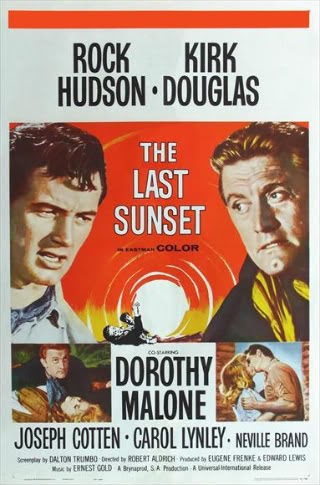
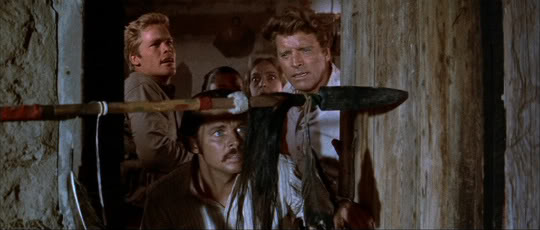
The Last Sunset (1961) is a film that seems to have all the credentials, all the ingredients that go towards making a top flight production: a highly talented director, a fine cast, and a script by a top writer. In spite of all this the final result is a movie that doesn’t quite gel and one that delivers a lot less than it initially promises. As is usually the case when a film proves disappointing, the fault lies with the script. There are some interesting elements which are introduced and then disposed of before they’ve had a chance to play out fully. Generally, this leads to both clutter and a lack of focus. In the end, we’re left with a film that’s not exactly bad but one that could and should have been a whole lot better.

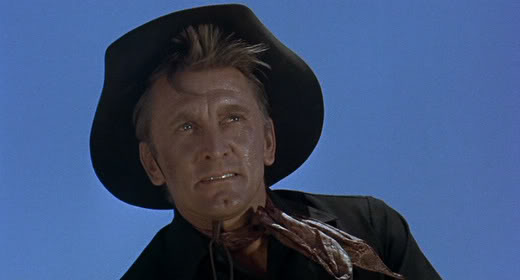
The opening credits play over a dogged pursuit across a southwestern landscape, down into Mexico where the bulk of the action will unfold. O’Malley (Kirk Douglas) is the black clad fugitive, a killer who carries a derringer instead of a six-shooter. Hot on his trail is Dana Stribling (Rock Hudson), a lawman with a personal interest in seeing his quarry brought back to Texas to hang. O’Malley is heading for a ranch run by a faded Virginia gentleman with a fondness for the bottle. The rancher, Breckenridge (Joseph Cotten), happens to be married to O’Malley’s old sweetheart Belle (Dorothy Malone) and it’s soon evident that he’s continued carrying a torch for her for years. The two men strike a deal whereby O’Malley will help Breckenridge drive his herd up to Texas, but he also claims he’s going to take his new partner’s wife off him. That in itself could have provided an interesting scenario, but the script has no intention of remaining so simple. Stribling’s arrival leads to an uneasy truce with hunter and hunted agreeing to pool their talents in order to ensure the success of the cattle drive before settling their own scores. With both newcomers being clearly interested in the charms of Belle the scene looks set for a juicy three-way contest for her affections. However, that’s not to be for Breckenridge soon departs the scene after being gunned down in a cheap cantina. What’s even more frustrating is the fact that moments before his death the audience is treated to revelations about Breckenridge’s shameful past. So, two potentially rich plot veins are left unmined. Instead we’re treated to the seemingly interminable drive to Texas with too much talk and too few sparks. It seems that the producers were aware that they were in danger of bogging the plot down, so three shifty and unscrupulous cowboys, who plan to get in on the white slavery racket, are introduced (Jack Elam, Neville Brand and James Westmoreland) to try to spice up proceedings. Again the opportunity is lost as these characters are killed off before they have the chance to make an impression. The script still has one hole card in reserve though, and it’s a real stinger. Nevertheless, in keeping with the rest of the picture, this gets handled poorly too. The problem is not with the nature of this final reveal, it’s suitably shocking, but the fact that we learn about it too soon. I won’t go into details here lest I spoil things for anybody, but the timing really draws all the tension and drama out of the climactic duel and leaves us with a flat and predictable ending.

£25

With a combination of Robert Aldrich directing and Dalton Trumbo writing, I don’t think it’s unfair to have high expectations. For whatever reason, neither man was at the top of his game on The Last Sunset. Trumbo’s script meanders all over the place and flatters to deceive, with too many plot turns and too many undeveloped ideas. Aldrich allowed the momentum to flag after the first half hour or so and he never really recovered it after that. There are some nice shots, a well filmed sequence during a dust storm, and an attempt to claw back some tension in the climax through quick cutting but none of it adds up to enough to save the film. On top of all this the performances of the two leads are nothing to write home about either. Douglas seemed to be trying for the kind of deadly rascal that Burt Lancaster pulled off in Aldrich’s Vera Cruz but it doesn’t really work for him. Hudson just didn’t convince at all as the driven lawman and he comes across as merely bland. Dorothy Malone and Joseph Cotten were altogether more successful as the Breckenridges; the former exuding a worldly sexuality that made the attention of her various suiters highly credible, while the latter provided a fine portrait of a broken and guilty man. Maybe if Hudson’s character had been the one to snuff it in the cantina we would have got a more compelling film. It’s also a shame that Jack Elam and Neville Brand had to disappear so soon since such character actors were capable of raising the quality of any production.

The Last Sunset was given a release a few years back by Universal in R1 in the Rock Hudson – Screen Legend set. The transfer is a fine anamorphic one and, apart from the odd speckle, there’s not much wrong with it. Colour and sharpness are both strong with good detail. There’s a trailer for the film provided but that’s it as far as extras go. This movie couldn’t be classed as anyone’s finest hour but it’s not a complete dud. There are a handful of worthy performances and the adult theme that becomes apparent as it draws to a close mean that it deserves a look. Let’s just say that it wouldn’t be an ideal introduction to the work of any of the principals


The Big Country

poster204

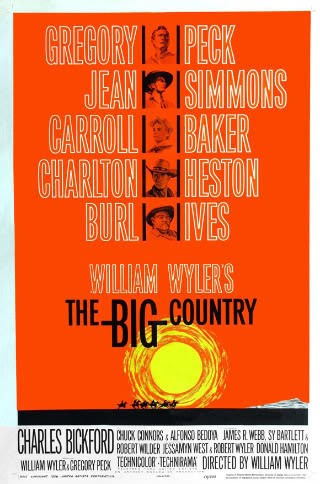
The Big Country (1958) has been described as a Cold War allegory, and I guess the reasons for that are fairly clear for anyone who wants to see them. It’s also been referred to as a traditional “stranger in a strange land” style tale, which is once again obvious enough. Whilst the latter is a theme that’s been visited too many times to mention, the former tends to date movies badly if that’s all there is on offer; one has only to compare a one-note diatribe like Ralph Nelson’s Soldier Blue to multi-layered works such as Peckinpah’s The Wild Bunch, Richard Brooks’ The Professionals, or Aldrich’s Ulzana’s Raid to see the difference. What raises The Big Country above a trite critique of contemporary politics and lends it a timeless relevance is the fact that it’s also an examination of man (or should I say men) and what he’s made of. The hero continuously has his masculinity questioned and challenged, and it’s his refusal to play others’ games and conform to preconceived ideas of how he should or should not act that builds up his stature in the viewer’s eyes while, conversely, it is diminished in the eyes of his fellow characters.

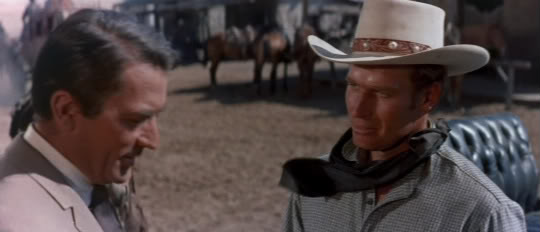
Jim McKay (Gregory Peck) is the archetypal easterner come west. His arrival is enough to literally stop the locals in their tracks, gazing in wonder at this alien figure with his trim suit and odd hat. McKay is a seaman who’s come to this new land to wed Pat Terrill (Carroll Baker), daughter of a wealthy rancher. Within a very short time McKay has a run in with Buck Hannassey (Chuck Connors) and his brothers, and so gets his first taste of the situation he’s landed himself in. The Hannassey’s are a rough and ready clan of ranchers engaged in an off and on vendetta with McKay’s future father-in-law Major Terrill (Charles Bickford). The cause of the feud is a piece of land that both families covet due to its providing that most valuable of commodities in the parched prairies of the old west, water. Having said that, the bitterness and venom that both Pat and the Major express when speaking of their not so welcome neighbours hints at some deeper source for the rivalry. Right away you can sense McKay’s unease at the raw hatred he’s exposed to, and the fact that he refuses to share in it and even backs off confronting the Hannassey’s shocks his bride-to-be. In fact, McKay seems to do nothing but disappoint his betrothed; he avoids taking a ride on the unbroken horse that’s traditionally wheeled out to give all newcomers a rough welcome, and worst of all turns his back on a fight that the Major’s foreman Steve Leech (Charlton Heston) goads him into. As far as Pat is concerned, these all amount to calculated insults and his shunning of such public displays of machismo cast doubts on his manhood and, by extension, on her pride and judgement. However, the viewer gets to see what Pat and her father don’t: that McKay is no coward, he’s merely a man with a deep sense of personal honour who’s offended by the act of showing off to others and proving to them that which he’s very sure of himself. When Pat rides off in a huff, and the Major and Steve go hunting vengeance, McKay quietly takes out that unbroken horse and sets about taming it. Time and again the animal hurls him into the dust of the corral, and time and again McKay gets back in the saddle until he finally bends it to his will.

The thing about McKay is he’s spent years sailing the oceans of the world and knows full well what hardships he’s capable of enduring. He feels no obligation to show the Major what a big man he is for the simple reason that he’s already proven that to himself. To McKay, that’s all that matters: that a man should know his own abilities and that his woman should believe in him just because she is his woman. For Pat, however, that’s not the case and she comes to feel shame for having chosen a man who regards acts of bravado as beneath him. If further evidence were needed of McKay’s physical courage then it comes in a remarkable night time scene. Having begged off a public brawl with Steve, McKay pays him a nocturnal visit to “say goodbye”. The two men walk out onto the moonlit prairie and engage in a brutal fist fight that was marvellously filmed and choreographed. Director William Wyler shot the whole scene without music and the only sounds heard throughout are the grunts and gasps of the two men punctuated by the thud of bone striking flesh. Wyler also made excellent use of the camera in that scene, alternating between close-up, medium and ever widening long shots that point up not only the isolation of McKay and Steve but also their insect-like insignificance (and indeed the insignificance of their struggle) in that vast landscape. By the end of their bout, as both men stand bruised and bleeding, McKay asks Steve what he thinks that has proved. In addition, there’s also the standoff with Buck late on, when he rides into the Hannassey’s place to try and rescue Julie Maragon (Jean Simmons) and head off a bloodbath in the making. As Rufus (Burl Ives), the patriarch of the Hannassey’s, does the honours the two men take the requisite number of paces and turn to face each other down the barrels of McKay’s antique duelling pistols.

£3

I’ve already mentioned William Wyler’s masterful use of the wide lens, but it’s to be seen all the way through the film. The whole thing is a visual delight that takes in both the sprawling prairie vistas and the blanched rocks of the canyon between Terrill’s ranch and the Hannassey’s place. Blanco Canyon is the setting for the scene that, for me at least, is just about the finest in the picture. The Major has decided that a showdown with the Hannassey’s is unavoidable and sets off to finish things for good. When it becomes apparent that he and his men will be riding into an ambush, the Major turns to Steve for support. However, this man has had his bellyful of mindless violence and says so. The Major rides off alone to meet whatever fate awaits him. Steve has looked on this man as a surrogate father all his life and you can see the anguish etched into his features as he watches him depart. He mounts up, and the camera moves to the mouth of the canyon and the lone figure of the Major. As Jerome Moross’ spine-tingling score slowly builds the angle shifts slightly and Steve gallops into view, drawing level with the Major he looks back to see the rest of the ranch hands come one by one round the rim of the canyon. There’s not a word exchanged between Heston or Bickford but the flickering glances and quickly concealed smiles speak volumes. To me this is cinema at its purest, where visuals, score and subtle expression tell the viewers all they need to know about the nature of a relationship, and in this case what masculinity is about – the importance of loyalty, affection and sheer guts even when good sense should dictate otherwise.

I honestly couldn’t criticise any of the performances and just about every major character felt fully rounded. Peck’s hero is maybe too straight down the line but that’s a minor complaint when you consider that such a role was necessary amid all the complexity elsewhere. Charles Bickford should be the guy to hiss at, but the raw courage and determination he invests in the Major tempers the less savoury aspects. There aren’t really any absolute villains in The Big Country, Chuck Connors comes the closest but even he is more to be pitied than anything. He shows himself to be only a step or two above an animal towards the end but it’s hard not to see him as something of a victim of circumstance in some respects too. I thought Charlton Heston gave one of his best performances in a role that ensured he got to act in a restrained and measured way, his lower billing probably contributing to that. Burl Ives picked up a Best Supporting Actor Oscar for his part and I’d say he deserved it on the basis of a couple of memorable scenes alone – his gatecrashing of Major Terrill’s party and the climax, where he is forced to do the unthinkable, immediately spring to mind. Both Jean Simmons and Carroll Baker did well portraying two opposite sides of the female character and made the most of their screen time.

MGM’s R2 DVD of The Big Country is slightly disappointing. The anamorphic scope image is generally clean and sharp with good colours but there are some really irritating instances of shimmer, especially when any of the wooden buildings are on view. What’s maybe more annoying is the fact that the disc is practically barebones. This is an important film, and not simply because it’s an epic production; it’s a movie that’s both visually and thematically rich and deserves better. Anyway, despite some reservations about the DVD the film itself is a genuine classic that ought to have a place on the shelf of those who consider themselves western fans, or even just fans of quality cinema.

The Tin Star

zufohaj

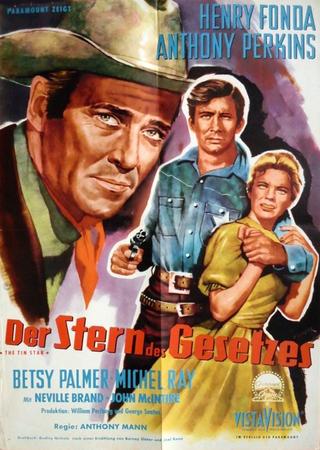
The westerns of Anthony Mann are generally among the highest regarded in the canon. It’s therefore a little odd that one of the movies he made during his purple patch in the 50s is frequently overlooked when his work is discussed. However, this certainly seems to be the case with The Tin Star (1957). I think this may be partly due to one of the casting decisions and, to a lesser extent, to the ending that is just too upbeat and out of touch with the events that preceded it.

The dominant theme in The Tin Star is justice: the definition, mechanics and importance of justice in a frontier environment where civilization was still in its infancy. Parallel to this is the theme of maturity; the need for a man to learn judgement from those who have gone before, and by extension the need for a new society to learn from the past and thus achieve maturity. Ben Owens (Anthony Perkins) is a young sheriff who’s so green he’s unlikely to hold the position – or indeed stay in one piece – for long if someone doesn’t come to his aid fast. His saviour turns up in the unlikely guise of a professional bounty hunter called Morgan Hickman (Henry Fonda). When Hickman rides into town to deliver a corpse and collect the bounty he finds the sheriff in the back of his office practising his draw, looking for all the world like an overgrown schoolboy playing at being a grown-up. The truth is Owens isn’t much more than a juvenile when it comes to law enforcement and has only got his job because no one else wanted it. That’s not strictly true, there was one other candidate – local loudmouth and rabble-rouser Bart Bogardus (Neville Brand). Sooner or later a confrontation between Bogardus and Owens will have to take place, and it falls to Hickman to tutor the young lawman in the art of reading men and facing down threatening situations.

Along the way we learn more about the enigmatic Hickman; he too was once a sheriff before the callousness and hypocrisy of his employers drove him out of the job. Owens is danger not only of becoming the victim of Bogardus’ desire for his badge but also of suffering the same fate Hickman once did. The murder of one of the town’s prominent citizens leads to the capture of two outlaw brothers and the organisation of a lynch mob by Bogardus. It’s at this point that the townsmen show their true colours and, reminiscent of High Noon, turn tail and abdicate all responsibility for justice or law. There’s also a nasty undercurrent of racism running through this settlement, personified by the bullying and hate-filled Bogardus but tacitly accepted by the so-called pillars of society too. The two prisoners are stated to be half breeds (and almost damned for that reason alone) and the woman who Hickman’s been lodging with is an outcast due to her having married an Indian and borne his child. The fact that the movie ends on such a positive, optimistic note after Owens has had to prove himself to the craven and distasteful inhabitants of his town strikes a false note.

£18

Anthony Mann mixed up the location and studio work to good effect and produced a western that’s full of important ideas punctuated with the occasional burst of violent action. There are some nice stylistic touches too, such as the climactic duel with the loser falling back into the camera. At the beginning I mentioned what I felt were the two biggest flaws with the film; I’ve already alluded to the unsatisfactory ending, but the casting of Anthony Perkins in the central role of the naive young sheriff didn’t work for me. It’s understandable that an actor was required who could be convincing as a nervy greenhorn lacking in self-confidence, but Perkins does that so well that his later development into a competent town tamer just jars too much. Neville Brand played Bogardus as some kind of malign force of nature, bellowing and bullying his way to the head of a bloodthirsty mob. Again he nailed this perfectly, so much so that it’s really stretching credibility to have the slight figure of Perkins striding across a night time street to slap him into galled submission.

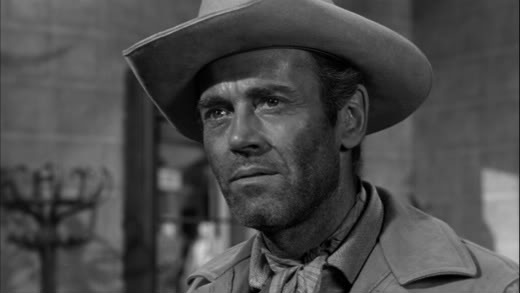
Henry Fonda was always at home in western roles and Morgan Hickman is another of his top class performances. He manages to invest some genuine sadness and melancholy into the role of a man who’s lost his family and seen his ideals bruised. There’s tenderness on view too, especially in the scenes where he interacts with the half Indian son of his landlady, and to round it all off he has the necessary mettle to be believable as a bounty killer. It’s also worth noting that while the bounty hunter came to be seen as a staple of the genre (particularly with the rise of the spaghetti western), that certainly wasn’t the case in 1957 and Fonda’s role was something of an exception.

The Tin Star is a Paramount property, and their R1 DVD provides a handsome 1.78:1 anamorphic presentation of the movie. The image is strong and clean with good contrast but the disc itself is totally barebones. Anthony Mann made better known, and indeed better, films than this but it’s still a remarkably strong western that’s only let down by the softened climax and less than convincing character arc of Perkins’ sheriff. It could have offered a scathing critique of a society that would rather pass on the dirty work of law enforcement to those it can then despise (and it does flirt with the notion) but bottled out in the end. Still, Mann’s direction of the material can’t be criticised and Fonda’s powerful performance anchors everything firmly. All things considered, there are more positives than negatives on show and this is a film I would definitely recommend.

Westward the Women

Trailblazing epics depicting the dangers and hardships that went hand in hand with the expansion of the frontier are far from uncommon among westerns. Westward the Women (1951) fits comfortably into that category, but there’s one important difference that sets it apart from others of that ilk: this movie tells its tale from an almost exclusively female perspective. This fact alone means that the film is pretty much unique; there have, of course, been other examples of westerns that focused on women, but they tended to be more of the exploitation or novelty variety. Westward the Women is certainly no exploitation picture, instead it’s a gritty attempt to celebrate the courage and the trials experienced by those early pioneer women, without whom the west could not have advanced.

The plot is a fairly simple one, essentially being a chronicle of a pre-Civil War overland trek. It’s 1851 and California landowner and visionary Roy Whitman (John McIntire) has realised that, despite having overcome a hostile land and prospered, his dreams will amount to nothing if there are no women to pair off with his settlers. In order to address this problem he hires Buck Wyatt (Robert Taylor) to assist him in first recruiting 140 mail order brides, and then escorting them on the gruelling trip from Chicago all the way back to California. The women who make up this matrimonial caravan are a disparate and, in some cases, a desperate bunch. The film doesn’t fully analyse the reasons why these women would readily agree to subject themselves to the harshest of conditions and potentially fatal circumstances just to marry a man they’d never so much as laid eyes on. For the most part, they are looking for a change in their lives and a new beginning (one has gotten herself pregnant out of wedlock, another is a widow, and there a couple of former good-time girls), and that’s about as deep as it goes. The full extent of the task ahead of them doesn’t really become apparent until the dozen or so men Whitman has hired decide to desert after Wyatt’s brand of iron discipline leaves two of their number dead. From this point on there are only four men left (Wyatt, Whitman, a comedic Japanese cook and a green youth) and the women must put aside their femininity and work harder than any man in their efforts to overcome the myriad obstacles the wilderness throws at them. Before they reach their promised land their numbers will be whittled down by accidents, nature and hostile Indians. However, this pruning simply stiffens their resolve and, by the time they reach the end of the trail, those who have survived emerge stronger than ever. In fact, it’s only at the very end that any concession to sentimentality is made – the surviving women meeting their selected partners to the accompaniment of the first notes of music heard since the opening credits rolled.

William Wellman was one of the hardest driving, most demanding and macho directors working in Hollywood. This was a guy who quit acting because he felt it was too soft and no fit profession for a man. Bearing all this in mind, it may seem surprising that he was able to produce a film that was so celebratory of the achievements of women. Of course his hard-bitten outlook is stamped all over the movie, and he has absolutely no qualms about killing off just about any of the characters. While the death toll is fairly high there isn’t an enormous amount of onscreen violence – the big Indian attack takes place while Wyatt is away chasing after the runaway, firebrand Frenchwoman that he finally falls for – and it’s frequently the tragic aftermath that the viewer gets to see. At times the film becomes seriously grim and there are one or two moments that are actually quite shocking, though I don’t intend to spoil it for anyone by identifying them. Nevertheless, Wellman knew his trade well enough to realise that he had to toss in the odd moment of comedy to avoid proceedings becoming relentlessly dour. The least successful of those lighter moments were provided by Henry Nakamura’s Japanese hash slinger and general dogsbody. Much more effective was the imposing Hope Emerson, in a role that was in complete contrast to the kind of threatening ones she was frequently associated with.

Robert Taylor also did some excellent work as the hard as nails trail boss who knows that he must push everyone to the limits of their endurance if they are to have even a slim chance of survival. The character of Wyatt grows along the way though, going from a kind of contemptuous dismissal of the green females he has to look out for to deep admiration for the courage and determination these same charges display time and again. There is a romance along the way between Taylor and Denise Darcel, though it’s a hard edged affair too – he even gives her a crack of the bullwhip at one point! All the women in the supporting parts were quite satisfactory, although the majority of their characters were only developed very slightly. I don’t believe that needs to be too heavily criticised though as the scale of the story and the constraints of the running time (just a little shy of two hours) meant deeper analysis was impractical.

Westward the Women is currently only available on DVD in R2, and there are two choices. There are editions out in both France and Spain from Warner Brothers. I have the French disc (chances are the Spanish release is from the same master) and the transfer is mostly pretty good, academy ratio and not much in the way of damage. There are moments when the image looks a little soft but nothing too distracting. There’s no extra content whatsoever and you get a choice of English or French audio – subtitles are optional with the English track. This is a good western from a director with a respectable pedigree in the genre (Wellman was of course proficient in many types of film, and you can browse an excellent series of articles on his early work at Judy’s blog here) and a star who got better with the years. If you think you’ve seen all the trail western has to offer then this is a film worth checking out. John Ford, another extremely macho director, never shied away from highlighting the vital role played by women in the settling and ultimate conquest of the frontier, and Wellman added his own song of praise to feminine grit with this unusual and very rewarding western.

Colorado Territory

The sun travels west…and so does opportunity.

Are remakes ever better than the originals? The common consensus usually says no and there are countless ill-judged and frankly cack-handed examples that would seem to back that up. However, once in a while, it is possible to come across those rare exceptions to the rule. John Huston’s version of The Maltese Falcon is a notable case in point, although that movie had the luxury of building on two predecessors that were markedly inferior. What’s altogether more difficult is to improve upon something that was pretty good in the first place, and it’s inevitable that opinion is going to be divided over the alleged improvement – Hitchcock’s two shots at The Man Who Knew Too Much being a good example. Colorado Territory (1949) is in a similar position since it’s a reworking by Raoul Walsh of his earlier hit High Sierra, and in my opinion the remake comes out on top this time.

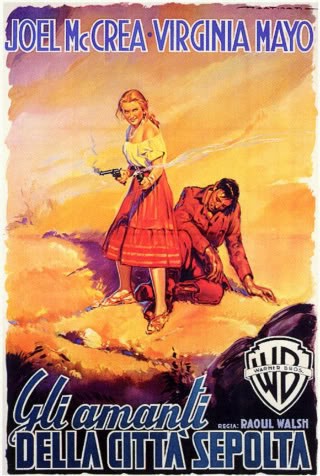
Wes McQueen (Joel McCrea) is a notorious outlaw, languishing in jail and awaiting a date with the hangman. However, a visit from an old dear professing to be his aunt leaves McQueen in possession of the articles he needs to effect his escape. It turns out that this was all arranged by an old associate who has need of McQueen’s services one more time. Making his way west by stagecoach he finds himself sharing the ride with a new settler and his daughter Julie Ann (Dorothy Malone). A deadly encounter with a gang of thieves en route highlights McQueen’s particular skills, and earns him the gratitude and (perhaps) the friendship of his fellow passengers. This sequence also draws attention to the fact that here we have a man grown weary of his profession, who dreams instead of starting a new life and sees in Julie Ann a reflection of the woman he once loved and lost. If he’s ever to have a crack at that longed for new beginning though he must first get this final job out of the way. It soon becomes apparent to McQueen that he’s going to have his hands full just keeping his shifty cohorts in line, and it’s not made any easier by the presence of a sultry half-breed called Colorado Carson (Virginia Mayo). The bulk of the movie’s mid section takes place in an old ruined town populated solely by the would-be robbers and the ghosts of the past. This bleak and desolate setting contributes enormously to the sense of doom and despair that hangs over the whole film, and it’s also a perfect backdrop for the escalating tension and jealousy among the characters. When the robbery does take place nothing goes according to plan (or at least not the way McQueen planned it) but it does give Colorado the chance to show her worth and her loyalty. Just when it looks like these two might have a chance to break out of the world they’ve spent so long locked into fate comes along and deals another blow, leading McQueen to comment: It means we’re a couple of fools in a dead village dreaming about something that’ll probably never happen. This leads to a powerful climax, atop a sun baked mountain and among the ruins of an ancient Indian settlement, that packs a real emotional punch and is sure to stick in the mind of anyone who’s seen it.

Raoul Walsh’s direction is highly assured and tight as a drum right from the beginning. A good portion of the movie takes place outdoors and with a liberal sprinkling of action, both elements playing to the director’s strengths. His handling of the attempted stagecoach hold-up near the start and the later train robbery is exemplary with editing, camera placement and pacing all judged to perfection. With Walsh you kind of expect him to get those things right, but he doesn’t disappoint in the more intimate scenes either. It helps a lot that his principal stars were all on form, and I couldn’t fault any of the performances of McCrea, Mayo or Malone. Joel McCrea was great in stolid parts and he put his talents to good use in this anti-heroic role. He had that low key quality that usually shines in westerns and the part of Wes McQueen seemed to fit him like a glove. The scene where he finally tumbles to the true nature and motives of Julie Ann is a fine example of his underplaying, and it’s all the better for that. Which brings me to Dorothy Malone; her role is that of a grasping and shallow woman and if it’s compared to Joan Leslie’s in High Sierra it would be fair to say that Malone invested it with considerably more depth. However, Virginia Mayo is the one that acts everyone else off the screen with her blend of toughness, vulnerability and sensuality. She truly owns the climax of the picture but she has other memorable moments too, not least the aftermath of the robbery when she has to operate on the wounded McCrea. Comparing the performances of the three leads in Colorado Territory to those in High Sierra, I’d say that McCrea just about holds his own against Bogart’s more famous and more intense playing (both men brought very different viewpoints and styles to their work) whereas both Mayo and Malone outshine Lupino and Leslie respectively.

As far as I can tell, there are currently only two ways to obtain Colorado Territory on DVD. I viewed the Warner R2 release from Spain, and the transfer to disc is no more than adequate. There aren’t any major issues like tears or splices and the image is generally quite detailed with good enough contrast. Nevertheless, the print is clearly in need of a good digital scrub as there are speckles, scratches and cue blips all the way through. From the few comments I’ve seen the Warner Archive disc from the US sounds like it suffers from the same sort of problems, so it may be they both used the same master. The R2 disc is completely barebones, with English and Spanish audio. The subs on the English version can be switched off via the remote – the main menu seems to suggest that the subs aren’t optional but that’s thankfully not the case. Colorado Territory is another first class western from Raoul Walsh, and I feel it generally trumps High Sierra. I’m very familiar with the Bogart picture and I like it an awful lot, but I have to give credit to Walsh for revisiting his earlier work and tweaking it successfully. This is an even darker and bleaker film with performances that are at least equal or, particularly those of the two actresses, superior to the original version. I recommend this one highly.

Warlock

Warlock (1959) is a movie that could be approached on a number of levels: as a psychological piece, an early example of revising the myth, an allegory and even as an apology. It’s an exceedingly complex film, which is paradoxically both its strength and its weakness, and also one that remains consistently fascinating. Essentially, this is a variation on the “town tamer” western – almost a sub-genre in itself – but the dense plotting takes it off in a number of directions.

The town of Warlock has become one of those wide open places where the law can only lurk in the shadows, hoping not to draw any unwelcome attention to itself. It has turned into a stamping ground for a band of murderous cowboys, referred to as San Pabloites, who have imposed a reign of terror on the seemingly ineffectual citizens. When one of their number is murdered and the sheriff humiliatingly run out of town the residents decide that the time has come for a positive response. A decision is taken, albeit grudgingly, to hire the services of one Clay Blaisedell (Henry Fonda) for the position of de facto town marshal. Blaisedell, a thinly disguised version of Wyatt Earp, arrives in town along with his friend Tom Morgan (Anthony Quinn) and sets about restoring law and order on his own terms whilst also overseeing the establishment of a gambling house and saloon. The no-holds-barred tactics of the new marshal soon see him in conflict not only with the San Pablo outlaws but also with those who have employed him, and by extension with the newly appointed sheriff. This man is Johnny Gannon (Richard Widmark), formerly one of the San Pabloites but now a reformed character – and in truth the film is as much about him as anything else. While all this is going on, Morgan is quietly scheming away in the background and manipulating events for his own ends. Sooner or later, a showdown (or more accurately a series of showdowns) will have to occur before matters can be resolved.

Warlock is a film with a whole lot going on, arguably too much for its own good. The parallel with the Wyatt Earp story is an interesting one in that it was, up to that point anyway, much closer to the reality of the situation. Blaisedell’s marshal is no shining hero bent on bringing law to the territory; he’s a professional gunman, ”handy with colts” in his own words, seeking out another pay day and raking in a little extra on the side via his saloon. If the relationship between Blaisedell and Morgan is supposed to hold up a mirror to that between Earp and Doc Holliday then it’s a skewed image that’s presented. Morgan is a crippled soul, both literally and physically, and considerably more dangerous than his partner. So far so good, but Morgan has taken friendship and loyalty to the extreme – to the point that it has twisted itself into a kind of jealous worship. Many commentators have stated that Morgan’s feelings for Blaisedell border on the homoerotic, and I can see where that notion comes from, but I don’t buy into it myself. For one thing, the director Edward Dmytryk said that that wasn’t a correct reading of the film. While Morgan’s obsessiveness towards his friend is clearly off-centre it seems to me more a product of his insecurities and self-loathing than anything else. The other main point of interest is the pivotal figure of Johnny Gannon. It’s hard not to see Dmytryk (one of the Hollywood Ten who became a “friendly witness”) projecting himself onto this character who turns his back on friends, family and associates to follow what he views as his own righteous path. Gannon’s conversion seems justified in a particularly intense scene where he confronts his old comrades in their lair in an attempt at conciliation. This gesture is spurned and results in the kind of brutal sadism that rivals James Stewart’s mutilation in The Man from Laramie.

This was Edward Dmytryk’s last good film, but that doesn’t mean it’s not without its problems. As I said, Warlock is a movie rich in plot but such richness can bring about a slightly hamstrung end product. The fact that there are so many plot strands, and the necessity to tie them all up, means that the film has three separate climaxes. The effect of this is to lessen the impact of all of them. That, of course, is more a problem with the scripting than Dmytryk’s direction, which is solid enough and contains some well thought out camera angles. The action, when it comes along, is handled competently and the gunfights are all suitably dramatic.

The three leads turn in good performances, with Henry Fonda putting a different spin on the part of the lawman to that which he created with John Ford the previous decade. Anthony Quinn keeps things fairly controlled as Morgan, though he does sail perilously close to the kind of scenery chewing that he was prone to lapse into on occasion. Richard Widmark is also especially good as the outlaw-turned-sheriff who visibly grows in stature and confidence as the story progresses. His faltering romance with a worldly Dorothy Malone (playing the fabulously named Lily Dollar) has enough realism to prevent it from merely being the kind of extraneous padding that is often the case.

As far as I can tell, Warlock should be available on DVD pretty much everywhere. Optimum’s UK disc presents the film in a very fine anamorphic scope transfer. It’s generally sharp as a tack throughout and the colours really do justice to Joe MacDonald’s classy cinematography. Unfortunately, there’s not a thing on the disc in the way of extras, but that’s about par for the course with Optimum releases. OK, this film may not be one of the front line classics in the western genre but it does help its development along. The movie’s greatest flaw is trying to pack in too much story, thus throwing itself off balance. However, there are still a lot of positives to take away from it.

Along the Great Divide

78_zpszloc5xwd

-You’re new in the territory.

-The law isn’t.

That exchange takes place during the tense standoff that opens Raoul Walsh’s Along the Great Divide (1951). This is a film that examines notions of law and justice and, like any quality western, also looks into the hearts of the characters and their motivations. The framework of the story is a fairly standard pursuit through vast open spaces but the fact that it’s got a relatively small cast allows time for the psychology of each of the main players to be thoroughly probed.

When Len Merrick (Kirk Douglas), a US Marshal, chances upon a mob of angry cattlemen bent on a lynching he’s duty bound to call a halt to proceedings. His dogged determination to see the law run its prescribed course will plunge him into a tangled mess of jealousy, revenge and violence. The man on the end of the rope is Pop Keith (Walter Brennan), a homesteader whose fondness for rustling has landed him in deep trouble. Keith has been accused of the murder of the local cattle baron’s son, and the father is keen to visit justice on the old man personally. With the reluctant help of his two deputies (John Agar and Ray Teal) Merrick takes the prisoner into custody and sets about escorting him back to what passes for civilisation, and a fair trial. However, the relentless pursuit of the lynch mob means that the lawmen, with Keith’s daughter Ann (Virginia Mayo) in tow, need to alter their plans. If their prisoner is to be delivered into the hands of the proper authorities then the only way to do so is by traversing the unforgiving desert in high summer. This punishing trek is further complicated by ambush, treachery and the psychological taunting of the marshal. Keith has stumbled upon a dark secret in Merrick’s past relating to his father, and baits him mercilessly every step of the way. The situation isn’t made any easier when Merrick not only finds himself becoming attracted to the daughter but he also realizes that his doubts regarding Keith’s guilt are growing by the day. By the time the climax rolls round, Merrick will have to face down both his enemies and the demons of his past before he can make peace with his own conscience.

£6

Along the Great Divide is typical Raoul Walsh fare, with hard men braving a hostile environment and battling both the elements and themselves. For the most part, the movie was shot outdoors on location at Lone Pine and the director made the most of what the landscape had to offer. The ambush among those familiar rock formations is skilfully handled, and the desert crossing has a realistically dusty and arduous feel. This was the first western role that Kirk Douglas took on and he seemed to slip very naturally into the genre. He portrays Merrick as a complex yet competent man who tries his best to do the right thing, even though he’s not always sure what that is. Walter Brennan is as reliable as usual as the wily old timer whose amiability and charm are undercut by a streak of malice that he freely indulges at Merrick’s expense. In the role of the tomboyish daughter Virginia Mayo is also highly effective, with her tough and feisty character giving a grittier edge to the romantic angle. As for the support cast, John Agar and Ray Teal are fine as Merrick’s deputies, the former loyal and steadfast while the latter is conniving and slippery.

This movie has made an appearance in R1 as part of the Warner Archive programme, but there’s an excellent pressed disc available in R2 from France. Warner obviously had a strong print to work with for that R2 disc presents the film very appealingly. The image is sharp and highly detailed (with the exception of a few zoom shots which are softer and have heavier grain) with little in the way of damage. Bearing in mind the short running time and the total absence of extras, it seems a bit odd that the movie has been granted a dual layer disc. However, this means that there’s no issue with compression. As with all Warner French releases I’ve seen, the subtitles are optional and can be switched off via the main menu. It’s hard to go wrong with a western directed by Raoul Walsh, and Along the Great Divide is one of his usual polished and well-crafted works. Recommended.


The Unforgiven

poster120

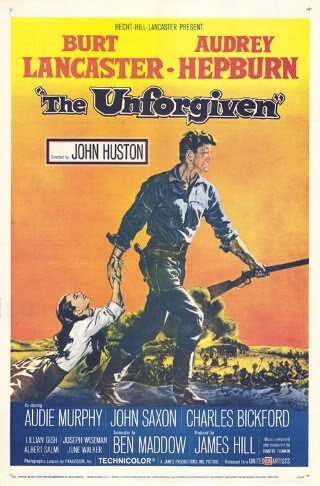
John Huston has to be one of my favourite directors but I’ve only just realised that, before today, I hadn’t written up any of his films on this blog. A quick browse through his lengthy and wide ranging filmography also drew my attention to the fact that he only made two westerns – I’m not counting The Misfits or The Treasure of the Sierra Madre, although some probably would – and I thought that seemed a little odd. The Unforgiven (1960) is a movie that doesn’t get talked up very much (the director professed a dislike of it which may have hurt its reputation some) but I believe it’s worthy of a bit of attention. The movie derives from a story by Alan Le May (The Searchers) and, perhaps unsurprisingly, concerns the fate of captives. What makes The Unforgiven a little different is the fact that the abduction that forms the background is a reversal of the usual white child spirited away by Indians one. In this case the settlers have taken a Kiowa baby and adopted her as one of their own. This storyline offers the opportunity to examine the effects of racism not only within the community but within the confines of the family as well.

The Zachary’s are a close knit frontier family who, with the father dead as a result of a Kiowa raid, are held together by eldest son Ben (Burt Lancaster). He, with the help of brothers Cash (Audie Murphy) and Andy (Doug McClure), has been putting together a herd of cattle to send to Wichita and make their fortune. The family’s future looks secure and there is a chance of marrying the only sister, Rachel (Audrey Hepburn), into a neighbouring family of fellow ranchers, thereby cementing their partnership. However, the Zacharys’ dreams are built on shaky foundations and are soon to be swept away. Into their midst rides a mysterious old man (Joseph Wiseman), clad in a decaying Civil War uniform complete with sabre. In between quoting scripture he tosses out casual innuendo relating to a dark secret held by the Zacharys. Before long, Ben and Cash find themselves having to hunt down this otherworldly figure, knowing as they do that he intends to destroy them. This leads to one of the most memorable scenes in the film, as the two brothers chase their ghostlike quarry through a swirling dust storm – the old man seeming to appear and disappear at will, and then rushing out of the clouds of windswept sand with his sabre swinging murderously. Nevertheless, despite their best efforts, their nemesis evades them and poisons their neighbours and former friends against them. By the time the Kiowa turn up outside the sod covered family home demanding the return of what they claim belongs to them the Zacharys are about to tear themselves apart. Cash is an unashamed racist haunted by visions of his father’s death at the hands of the Kiowa, and barely able to contain his contempt and hatred for the red men. Therefore, Ben must prove himself the rock upon which the others can depend in order to weather the gathering storm.

£3

I’ve read that John Huston may have been displeased with the final product due to the fact that Audrey Hepburn later suffered a miscarriage, possibly as a result of a fall during production, not to mention that Audie Murphy almost drowned etc. Be that as it may, the film remains a solid, professional piece of work from Huston. He and DOP Franz Planer made excellent use of the wide angle lens to capture the scenery around Durango, and it contrasts well with the dark and claustrophobic interiors of the Zachary home. Apart from the aforementioned dust storm, the action scenes during the climactic siege are quite impressive.

The cast as a whole acquit themselves very well, with Lancaster displaying his customary stoicism interspersed with the occasional witticism. Audrey Hepburn would hardly rank as anyone’s idea of a western heroine but I thought she was pretty convincing in a difficult role. Audie Murphy never gets a lot of credit as an actor but this movie, probably more than any other, shows just how capable he was. He invests the character of Cash with a simmering mix of conflicting emotions that enables him to steal almost every scene he’s in. Lillian Gish also has a high old time as the tough matriarch with a steely resolve, and has a wonderful scene where she sits playing the piano outside at night to counter the music of the Kiowa medicine men. Joseph Wiseman chews up everything in sight as the spectral (no pun intended) Abe Kelsey, a genuinely scary yet pitiful husk of a man driven insane by grief and a desire for vengeance on those he deems responsible for past wrongs.

Given the indifferent treatment MGM often handed their catalogue releases the R2 DVD of The Unforgiven is actually quite pleasing. It’s given a handsome anamorphic scope transfer that has little damage on show save for a bit of light speckling here and there. Since this film is not widely regarded as one of Huston’s greatest it’s no real surprise that the only extra available is the theatrical trailer. I think this movie has been unjustly maligned by many and, even if it never comes to be seen as vintage Huston, it does work well as a mature western that at least tries to tackle a complicated issue. All in all, I like it and feel the performances and photography are ample reasons to give it a go.

Two Rode Together

“The worst piece of crap I’ve done in twenty years.” Those were John Ford’s own words when assessing Two Rode Together (1961). Even now, critics never seem to have anything very positive to say about this film. Ford’s work in the 60s was certainly patchy, even more so when it’s held up for comparison against his earlier movies. I’m not sure this is as much of a dog as its reputation suggests; it’s a weak John Ford film for sure, but even a lesser work from the great man always had some points to recommend it.

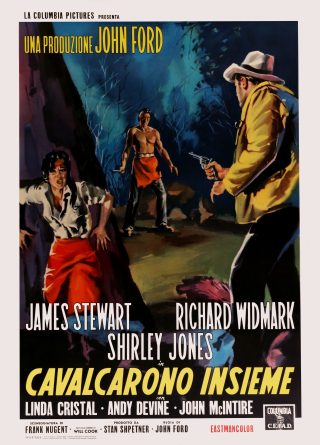
Two Rode Together is frequently referred to as a rehash of themes explored in The Searchers, and that’s one of the problems identified right away. Where the earlier classic had depth, gravity and passion this film feels superficial and, at times, cartoonish. However, I’m not convinced the two movies ought to be compared too closely. For one thing, The Searchers focused on the quest and those involved in it, whereas Two Rode Together is really about the consequences of rehabilitation for the rescued captives. Guthrie McCabe (James Stewart) is a marshal in the town of Tascosa, an enviable position in that it entitles him to a 10% cut of everything in the place. His idyllic lifestyle is interrupted, however, when Lt. Jim Gary (Richard Widmark) and his troops arrive to escort the dissipated lawman back to the fort. The army intend to press the reluctant McCabe into acting as a scout/intermediary in order to make contact with the Comanche Quanah Parker (Henry Brandon) and trade for the release of white captives. McCabe is nothing if not a coldly realistic man, and he knows full well that what the army is asking is basically a fool’s errand. Although his cynicism is viewed with contempt by the soldiers, subsequent events will prove that it’s his assessment that’s more grounded in reality. Lt. Gary is sent along to keep a watchful eye on McCabe (he’s regarded as an amoral mercenary at best), and in so doing has his eyes opened and his preconceptions challenged. When it becomes apparent that the surviving captives have been so deeply integrated into Comanche life as to be unrecognizable the decision is taken to return with only two captives: a teenager, Running Wolf, and a Mexican woman, Elena (Linda Cristal). Instead of being greeted as heroes and saviors, both McCabe and Gary find themselves viewed as being partly responsible for the tragedy that ensues. The fear, hatred and suspicion of the Comanche are so deeply ingrained in the whites that there can be no happy homecoming for anyone, and McCabe’s cynicism and skepticism that were initially painted as repugnant are now seen to be vindicated.

John Ford’s penchant for broad, knockabout comedy is very much an acquired taste, and you’re either OK with it or you’re not. I mention this because Two Rode Together is liberally laced with instances of trademark Fordian humor. A good deal of this is centered around Andy Devine’s grossly overweight Sgt. Posey and it’s of the hit and miss variety. What’s altogether more successful is the gentle jibing that takes place between Widmark and Stewart as it helps to flesh out and humanize their characters. Ford’s direction is unaccountably flat in general, and really only strikes home in the scenes that focus on the desperation and emotional pain of the homesteaders who yearn for news of their loved ones. Even the landscapes look dull and uninspiring, which is atypical for a Ford film. Of course, news came through during shooting of the passing of the director’s old crony and frequent collaborator Ward Bond, and that may go some way to explaining the slightly detached feeling that permeates the whole picture. If it weren’t for the performances of Widmark and Stewart then this movie would be a real tough slog. Their scenes together constitute the core of the film and help keep it afloat. Widmark is good enough but I didn’t get the impression that he was operating at full throttle, whereas Jimmy Stewart throws himself into the part completely. By this time Stewart had mastered the art of icy indignation and half-suppressed emotion, and it serves him well in the later scenes where he confronts the ugly face of naked racism back at the fort. Of the female characters Shirley Jones received third billing but her part is an undeveloped one and seems to peter out just when it should have taken center stage. Linda Cristal fares much better as the former captive who’s deeply unsure of her place in society; her discomfort is nearly tangible when she’s paraded in front of the army wives, and she visibly wilts before their prying eyes.

Two Rode Together remains absent on DVD in the US but it’s widely available in R2. Sony’s UK disc offers an anamorphic widescreen transfer that’s goodish without being in any way exceptional. It could use a bit of a clean up but there aren’t any serious flaws. Both colors and sharpness are reasonable enough but, like the movie itself, don’t exactly pop off the screen. There are absolutely no extras at all but this title can be picked up very cheaply, so one shouldn’t complain too much. Well, this is a long way from classic Ford but the playing of the two leads does raise it above the mundane and lends some class. The truth is it’s not a bad little western – it’s just not a great John Ford western.

Backlash

poster150

Backlash (1956) is one of those films that seems to have slipped through the cracks. I’m not sure if it would be correct to call it a forgotten film, but it’s certainly not one that you hear mentioned much when the genre’s notables come up for discussion. It fits neatly into the “psychological western” category due to its less than perfect hero and mature themes. At first glance it may appear to be just another tale of a man seeking revenge (not that that’s a bad thing in itself), but as the story develops it becomes clear that this is a film which is going to dig a little deeper.

The opening shots of the film, with a lone rider traversing a rugged landscape to come upon a man filling in a grave, set the tone for the movie and establish the isolation of the two principal characters. The fact that both of them are soon under attack from a gunman perched in the rocks high above underlines the danger of the quest they are about to set out upon. There is also an undercurrent of suspicion and mistrust that will follow them now as neither one can be sure that the other isn’t responsible for setting the ambush. The rider is Karyl Orton (Donna Reed) and the gravedigger is Jim Slater (Richard Widmark); both are in search of the truth, and maybe $60,000 in gold. Years before, five men died at this spot at the hands of the Apache but one other escaped with his life and the gold, leaving his partners to their fate. Slater believes the father he never knew was one of the five, and Karyl believes her estranged husband to be another. With Slater seeking vengeance and closure, and the woman with her eyes on the gold they set out to identify and track down the mysterious sixth man. The manhunt pitches both these characters into one perilous situation after another, from a murderous Apache raid to a range war. Along the way their relationship slowly develops, although it’s no smooth ride for either of them – at one point Slater hauls off and belts Karyl full in the face for putting his life in danger, and she later takes an almost perverse pleasure in sealing up his wounds with a heated blade. By the end of the movie both these people will have to face down their own personal demons and maybe take something of real value away from the experience.

£11

Backlash was made at a time when Sturges’ and Widmark’s stars were on the rise. John Sturges had just come off the magnificent Bad Day at Black Rock and would shortly go on to make Gunfight at the O.K. Corral. He was close to his peak at this point and handled just about every aspect of the picture perfectly. Action and suspense blend seamlessly together and the Arizona locations look particularly fine through the wide lens. Widmark was also doing some of his best work around this time and this film must have helped him along nicely. His bony features and distinctive nasal giggle had landed him plenty of villainous roles but they were also ideally suited to playing the kind of damaged men that psychological westerns thrived on. He turns in a great performance here, obsessively digging into the past, searching for the truth and searching for himself – all the while fearing what he might learn yet unable to stop himself. Conversely, Donna Reed’s movie career was soon to end and she was close to moving into a successful run on television. With an impressive list of credits behind her she does well as the feisty, courageous woman-with-a-past. The support cast are solid too with Barton MacLane and an eye-rolling John McIntire standing out especially. A good screenplay is key to the success of any film and having Borden Chase’s name attached never hurt any. It struck me that the episodic structure and the underlying theme bore at least a passing resemblance to the writer’s earlier Winchester 73. 

Backlash has had a number of releases on DVD in R2 but the UK disc appears to be the only one with a proper widescreen image – there’s a R4 available but I’m not sure how it’s presented. Optimum’s UK disc has the movie looking very nice in a 2:1 anamorphic transfer, and I’ve been reliably informed that this is indeed the correct ratio for the film. There’s very little damage to be seen and colors and detail all looked excellent to my eyes. Surprisingly, for an Optimum release, the theatrical trailer is included but that’s it as far as extras go. However, when the main feature is there in OAR and looking good then I’m not about to complain. Backlash is a good example of a high quality mid 50s western – one that I rate and recommend.