The Mask of Dimitrios

poster7_zps3ff62743

To me the most important thing to know about an assassination is not who fired the shot – but who paid for the bullet.

The passage of time can have a nasty tendency to cloud the memory, to cast a kind of nostalgic haze over things and distort reality. On occasion I’ve found this to be the case with films, where fondly remembered movies, those which have earned themselves a special place in the heart over the years, fail to live up to their promise. It’s quite a crushing disappointment to discover that a film we thought was wonderful long ago falls far short of the stellar image we’ve built up in our imagination. Happily though, that’s not always the case, and sometimes it just happens that the film we saw all those years ago really is the little gem we’ve been yearning to see again ever since. The Mask of Dimitrios  (1944) is one such movie; I caught it once on a late night TV broadcast at some point during my teenage years and it made a big impression on me. However, it never seemed to show up again no matter how carefully I scoured the TV listing pages in the papers. It also remained stubbornly absent from DVD release schedules to the point I began to despair of ever seeing it again. In the interim I’d read the Eric Ambler novel from which it had been adapted, and that actually just served to increase my frustration. Anyway, when I finally learned of its DVD release this year I experienced a rush of excitement tinged with a hint of trepidation. Fortunately, the latter feeling turned out to be misplaced as I realized my memory hadn’t been cheating me. Ah, the ups and downs of being a movie fan!

It’s 1938 and the uncertainty and upheaval of the inter-war years will soon be swept aside by the approaching conflict. In Istanbul a group of children run happily along the shores of the Bosphorus. They halt abruptly, shocked by the gruesome sight before them. The body of a murdered man has washed up and now lies carelessly on the sand. The clothing and papers identify the remains as belonging to one Dimitrios Makropoulos, a Greek national and a man not unfamiliar to the authorities. Later that evening, at a party, the Turkish security officer in charge of the investigation falls into conversation with Cornelius Leyden (Peter Lorre), a mystery writer vacationing in the Levant. The tale of the shady character now lying on a mortuary slab intrigues Leyden and piques his writer’s interest. Armed with only a handful of dates and locations, Leyden takes it upon himself to satisfy his curiosity and make a stab at tracing the movements of this notorious figure. Leyden therefore sets out on a journey that will take him first to Athens, then on to Sofia, Belgrade, Geneva and finally Paris. Along the way, via a series of flashbacks narrated by an assortment of middle European types, he begins to piece together a picture of the mysterious and ruthless Dimitrios (Zachary Scott). At every turn though, Leyden’s path seems to cross that of Mr Peters (Sydney Greenstreet), a man whose interest in  Dimitrios surpasses that of the diminutive writer. It soon becomes apparent that the threat posed by men such as Dimitrios doesn’t end with death, and that his malignant influence may even extend beyond the grave.

£23

The Mask of Dimitrios is one of those pictures that sails awfully close to the boundaries of film noir; the fates of Dimitrios’ victims certainly moves it in that direction as does the shadowy photography and multiple flashbacks employed. However, despite the presence of these persuasive factors, it’s the mystery/espionage elements that dominate for the most part. The story comes from Eric Ambler’s finest novel (high praise indeed as the man rarely wrote anything weak) and I reckon the film stands as the best adaptation of his work to date. Generally, Ambler’s stories dealt with men who found themselves drawn unwittingly into the murky world of spying and underground politics. By having the bulk of the action play out in the Balkans, that hotbed of intrigue and shifting loyalties, The Mask of Dimitrios captures the mood of betrayal for profit beautifully. Both Ambler’s writing and Jean Negulesco’s atmospheric direction leave the viewer in no doubt that we’re being taken on a tour of a world of secrets, memories and confidences cherished for emotional and material value. For me there are two standout sequences in the movie. The first is the framing story in a cheap night club in Sofia. Faye Emerson is wonderfully weary and faded as she recounts her past with Dimitrios: the air is thick with a kind of smoky decadence, Emerson’s near lifeless eyes and drawn expression speak volumes, and the band plays Perfidia in the background. The other noteworthy episode is an extended flashback to an elaborate sting in Belgrade, where a minor government official has his own weakness manipulated in order to suck him into committing treason. The combination of Dimitrios’ cold slickness and Steven Geray’s portrayal of the poor dupe whose fragile ego, thwarted ambition and desperate desire to rise in his wife’s estimation makes it quite affecting.

Of the half-dozen or so movies that Greenstreet and Lorre made together in the 40s, The Mask of Dimitrios was the one that gave them the greatest opportunity to shine. Something like The Maltese Falcon handed them fascinating roles, but they were still only there to provide support for Bogart and Astor. This film, on the other hand, places the two men front and center and it’s their partnership as much as anything that carries the whole thing. As Peters, Greenstreet has the more ambiguous part, and gets to indulge in his patented trick of switching from jovial bonhomie to dark menace in the blink of an eye. Lorre acts as the viewer’s guide, half leading and half stumbling his way through the twisting tale. Zachary Scott is of course the true villain of the piece, and the movie offered him one of his best parts. He always had an oily charm that could be used to strong effect when necessary, but this time that quality remains largely buried beneath a cold, calculating facade. As the story progresses the full extent of Dimitrios’ foul character is gradually revealed, and Scott manages to convey very successfully just how dangerous this man truly is.

£24

As I said at the beginning of this short piece, The Mask of Dimitrios was a difficult film to see for a long time. Earlier this year though, it appeared on DVD via the Warner Archives. At the time I felt ambivalent about this fact; I wanted to get my hands on the film but I’ve never managed to completely overcome my aversion to buying DVD-R products. When I learned over the summer that Absolute in Spain were putting out their own pressed disc version of the movie, I decided that was the one I’d go for. Absolute can generally be relied on to produce solid, attractive releases, and this is no exception. The image doesn’t display any noticeable damage and has nice contrast levels to show off the noirish photography. As usual with this company, subtitles are no issue and can be deselected from the setup menu. Extra features consist of the theatrical trailer and a booklet (in Spanish naturally) containing notes on the film and a good selection of stills. OK, so I had been a little fearful that the film wouldn’t prove as entertaining as I hoped, but it ended up being every bit as satisfying as I recalled. Personally, I think it’s a terrific example of the magic that studio bound B thrillers could conjure up when the right cast and crew were handed promising material. Do yourselves a favor folks and check this one out – it comes highly recommended.


Saddle the Wind

poster20_zps613c7860

It’s a hell of a thing, killing a man. Take away all he’s got and all he’s ever gonna have. – Unforgiven (1992)

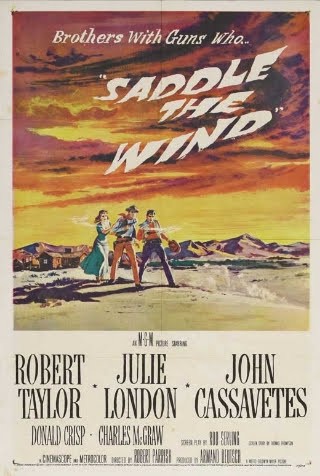
I decided to open with the above quote to prove a point of sorts. It’s a point about perception, the way cinema tricks us into believing certain things, or at least the way those who write about cinema shape our views. There are plenty of people who point to Eastwood’s Unforgiven and hold it up as the ultimate myth buster. I like the movie well enough but it does bring a wry smile to my face when I hear it lauded as a film which highlighted the corrosive effects of violence on men who lived by the gun. It’s easy to see how those unfamiliar with the genre, or even those with only limited exposure to it, could buy into the theory that Unforgiven is a bigger game changer than it really is. There is a tendency among some, probably fueled by the influence of the spaghetti western, to imagine the genre was all about cool, trigger-happy gunslingers prior to 1992. Somehow, the perception arose that the western shied away from or glossed over the consequences of violence and killing. Yet if one goes back to the golden decade of the 50s, it’s clear that the genre had already faced such themes head on. Saddle the Wind (1958) is a film about killing, a painful and probing examination of the repercussions of pulling a trigger and taking a life.

The opening sees a stranger (Charles McGraw) riding into town. He’s one of those bristly, hard-bitten types, the kind of guy who oozes insolence and aggression, who demands rather than asks. Men like this have a swaggering confidence born of the knowledge that they’re tough, mean and fast enough to carry it all off. Anyway, he makes it clear that he’s looking for a man, Steve Sinclair (Robert Taylor), and guys such as this don’t come looking for men just to be sociable. Steve Sinclair is now a respected rancher but he has a murky past that he’s trying to live down, having once been a famed gunman and killer. So what’s new, you may ask. Thus far the scenario is one that ought to be familiar to anyone who’s seen more than a handful of westerns. Well Steve is a man who has learned from the sins of his youth, he’s become a reformed character and has rejected violence. However, Steve has a younger brother, Tony (John Cassavetes), who appears to have inherited the worst traits of his elder sibling. Tony is more than just a cocksure kid with a gun and a point to prove; he’s a damaged human being, a walking stick of dynamite without a hint of remorse and a lust for killing. We first see Tony as he arrives home with a girl he intends to wed, former saloon singer Joan (Julie London), and a new gun. It’s immediately clear that there’s something itching away under Tony’s hide: he deposits his betrothed in the house, introduces her to all, and then proceeds to indulge his real passion. Where a normal guy would fawn and fuss over his newly acquired fiancée, Tony instead gets straight to work honing his shooting skills with his new six-shooter. Not only that, but there’s a manic, obsessive edge to his practice, rounded off by his blasting away at his own reflection in the water – which of course foreshadows the film’s climax. And this, more than anything else, is what the whole movie is really about, two very different brothers and their attitude to violence. The more Steve tries to rein in the excesses of his brother, the more Tony strains against that moderating influence. What finally brings the conflict to a head is the arrival of a former Yankee soldier (Royal Dano) bent on claiming his family’s legacy and stringing the dreaded barbed wire on the open range. Tony’s overreaction and stubborn refusal to heed Steve’s call for calm leads to a tragic confrontation. His neglect of Joan has already irritated Steve, but it’s his determination to usurp the authority of the local land baron (Donald Crisp) which finally forces the two brothers into a situation where only one can walk away.

£35

Robert Parrish isn’t a director whose name will be familiar to many these days. However, he made a string of fine films throughout the 50s, culminating in the truly excellent The Wonderful Country. I recall reading somewhere that Parrish was unhappy that he wasn’t given full control over the final cut of that movie; I don’t know if that’s true but the fact remains his career as a director appears to have slumped dramatically after hitting that peak. Anyway, Saddle the Wind (with its screenplay by Rod Serling of The Twilight Zone fame) comes awfully close to being his best work – I reckon The Wonderful Country just about pips it to the post but there’s not a lot in it – with some memorable visuals and an extraordinarily powerful theme. Pitting brother against brother always makes for good drama. When you mix in the simmering resentment left over from the Civil War, and a scathing critique of machismo and the culture of violence then it all adds up to something quite special. It’s that last point which I mentioned in my introduction, and I’d like to explore it a little further here.

Others have pointed out that the scene where Jack Palance gunned down Elisha Cook Jr in Shane was a pivotal moment in the development  of the western, and I’m not going to argue with that. That proved that gun play and violence was a mean, dirty business. Saddle the Wind follows on from that and literally hammers  the point home: apart from the heartfelt speeches delivered by Taylor and Crisp at various times, the killings that take place in the film, and there aren’t actually that many, are grim and brutal. No-one dies easily; as the bullets tear into bodies, the victims clearly suffer, twitching, kicking and coughing to the bitter end. And then there’s the aftermath, the consequences of taking a life. Two of the characters (Crisp & Taylor) bear the psychological scars of a violent past and their world view is shaped by that. For me, it’s this mature consideration of the effects of violence on the souls of men that marks Saddle the Wind out as one of the great westerns of the greatest decade of the genre.

£36

The more often I watch Robert Taylor’s westerns, particularly those of the late 50s, the more I come to view him as one of the most significant figures in the genre. I didn’t include him in my list of the top ten western stars which I compiled at the tail end of last year, and I tend to think now that it may have been a major omission. I guess Taylor is never likely to attain the status of Stewart, Scott or Wayne but his finest western roles made a big contribution to the genre. In Saddle the Wind he achieved a marvelously quiet dignity, a kind of pained courage that projected all-round masculinity as opposed to juvenile machismo. Taylor’s calm awareness of his own strengths and weaknesses contrasts well with the strutting bravado of Cassavetes. Now there’s a figure one wouldn’t normally associate with the west. Cassavetes had a very urban and modern air about him, a guy who it’s hard to imagine outside of a big city environment. Yet that otherness, that discomfort with his surroundings, works under the circumstances. Cassavetes’ character is a young man at war with himself, and by extension with the whole world around him. If Cassavetes doesn’t truly belong in this frontier setting then it’s merely a reflection of the character whose psychological flaws and displaced morality set him apart from those around him. He honestly comes across as some unbridled force of nature, and Taylor’s futile efforts to tame him could easily be seen as a fruitless attempt at saddling the wind. These two men unquestionably dominate the film but it’s also important to mention the work done by Donald Crisp and Royal Dano. Crisp was always good in patriarchal roles and his benign presence in this movie is every bit as touching and influential as the rather different yet comparable part he played in Anthony Mann’s The Man from Laramie. Royal Dano was one of those character actors who seemed to pop up all over the place, and his halting delivery and hunted look tend to stick in the mind. Saddle the Wind offered him a role to get his teeth into, a desperate man driven on by his private sense of honor and justice. And that brings me to Julie London. Her fame today derives from her singing (and she provides a beautiful version of the theme song of this film) but she also starred in three exceptional westerns around this time: The Wonderful Country, Man of the West and the film under discussion.

Saddle the Wind was an MGM production and so it was released on DVD by Warner Brothers a few years ago in their Western Classics box set. The film has been given a very good transfer to DVD, the anamorphic scope image looking bright, clean and colorful. The location photography in Colorado looks quite stunning in places and the audio is also strong with the gunshots packing a considerable punch, and Elmer Bernstein’s brooding score sounding rich. The only extra feature offered on the disc is the theatrical trailer. I believe this is a very fine western, although nowhere near as well-known as it deserves to be. I see it as further proof of how far the western had progressed by the late 50s. However, the fact that thoughtful films like this are only infrequently mentioned can also be regarded as evidence of the regression the genre experienced through the following decade. Anyway, next time someone claims that a film such as Unforgiven broke entirely new ground in terms of its critique of violent lifestyles, you can simply point them towards this production and tell them it’s not as new a concept as they first imagined.


Shake Hands with the Devil

The conflict in Ireland has provided the backdrop for a number of quality movies over the years, and I’ve covered a few of them on this site: Odd Man Out & The Gentle Gunman. Those two films dealt mainly with the smaller mid-century campaigns in Northern Ireland or around the border. Shake Hands with the Devil (1959) steps a little further back to the early 20s and the War of Independence, concentrating on the south of the country. The “Tan War”, so named after the involvement of the British irregulars recruited to strengthen the RIC, remains an emotive subject in Ireland due to the atrocities perpetrated against the civilian population. I can clearly remember people of my grandparents’ generation, who lived through those turbulent and violent times, speaking with undisguised venom about the Tans. The film under examination here reflects that hostility, but doesn’t shy away from depicting the implacable fanaticism that characterized some elements within the Irish rebel movement at that time either.

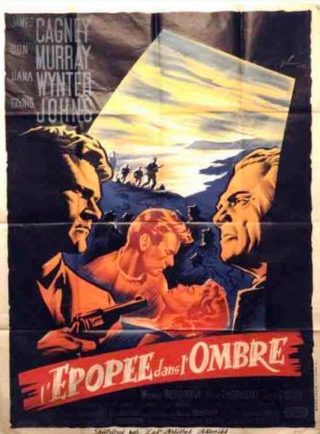
The prologue makes it clear that the Ireland of 1921 was a country in a state of war. The opening then takes place in a Dublin cemetery where a solemn funeral procession makes its way along paths lined with tombstones. Suddenly, a squad of Black and Tans appear and the cortege scatters amid the jarring sound of gunfire, leaving behind an upturned coffin spilling its load of rifles. This brief scene succinctly illustrates the nature of the war being fought: a covert organization facing off against a determined and ruthless enemy. The most interesting films dealing with the Irish conflict feature those caught somewhere in the middle, dragged into the fighting in spite of themselves. Kerry O’Shea (Don Murray) is such a man, an Irish-American studying medicine in Dublin in fulfillment of his late mother’s wishes. O’Shea happens to be visiting his parents’ grave when the Tans’ raid takes place, and he will find himself drawn deeper into the war as the story progresses. O’Shea’s father had been an old-time republican and he had fought in WWI himself; as such, we see a young man who has had his fill of killing. Still, circumstances don’t always allow a man to follow the path he would prefer – sometimes just being in the wrong place at the wrong time alters the course of a life. This is what occurs with O’Shea; he is walking along a street when an IRA ambush leads to the shooting of his friend and the subsequent leaving behind of his notebook at the scene during his flight from the violence. A direct consequence of this is the revelation that O’Shea’s lecturer and eminent surgeon Sean Lenihan (James Cagney) is a commandant in the IRA. As O’Shea, now regarded as a suspected terrorist, goes on the run, the combination of the brutality of the Black and Tans and the fact that Lenihan once saved his father convinces the young student that his place is standing shoulder to shoulder with the rebels. Yet despite O’Shea’s belief in the essential nobility of his cause, he becomes increasingly disturbed by the harsh, fanatical side of Lenihan. This feeling of unease is further strengthened when Lenihan’s customary dislike for and distrust of women is magnified after the taking of an important hostage; Jennifer Curtis (Dana Wynter), the daughter of a high British official, is abducted in reprisal for the imprisonment of an elderly republican sympathizer. Lenihan’s near pathological hatred of the young woman, and his keenness to see her executed, may prove the ultimate test of O’Shea’s loyalty.
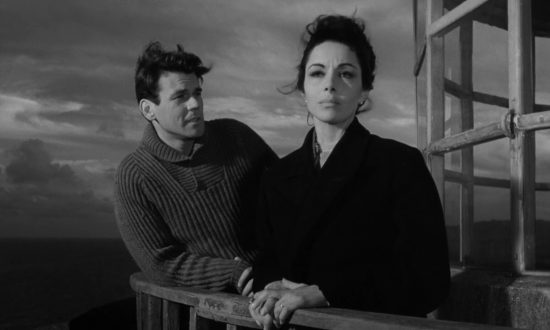
Politically, Shake Hands with the Devil wears its heart on its sleeve, and makes no bones about its critical appraisal of the role of the Black and Tans in Ireland. The Tans are explicitly cast as the villains of the piece, their commander being portrayed as a quasi-fascist figure with a strong sadistic streak. The way O’Shea’s interrogation and beating is photographed, in a highly subjective manner, emphasizes the cold brutality of his tormentor. However, if there is a sustained effort to romanticize the rebels – most notable in the characterizations of Cyril Cusack, Michael Redgrave and Sybil Thorndike – it needs to be pointed out that we’re not looking at a whitewash job either. The internal discipline mechanisms of the IRA are shown in all their toughness, and the unyielding aspect of what would become the anti-Treaty forces – as represented by Cagney – is one of the major themes of the film.

Michael Anderson was a director capable of great visual flair – I’ve commented in the past on the Hitchcock-style touches present in a couple of his films – and Shake Hands with the Devil offers further evidence of his eye for interesting compositions. Aside from having a knack for capturing the correct mood, he staged and shot the action sequences very fluidly.  The early part of the movie was shot on location in a mean and moody Dublin, all expressionistic shadows and dripping in noir atmosphere. Later, the action moves out of the city to Bray and the coast, and again Anderson, aided by cameraman Erwin Hillier, makes the most of the windswept seaboard. The use of the lighthouse, where the rebels have set up a makeshift headquarters, gives a nice claustrophobic feel to the scenes where Dana Wynter is held captive. Generally, the authentic locations contribute to the sense of realism and, while the script does meander a little in the middle, Anderson’s assured and inventive direction holds the attention throughout.
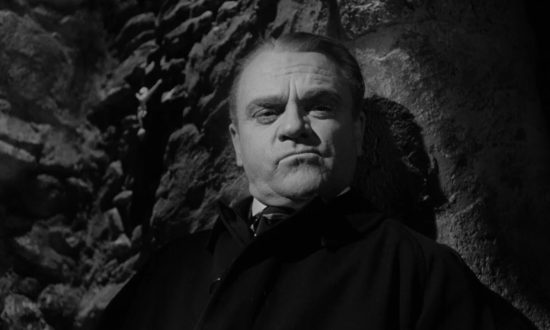
What can one say about James Cagney? From gangster to song and dance man, and just about everything in between, he was and remains one of the greatest Hollywood stars ever. Shake Hands with the Devil was one of his last films before entering a retirement that he refused to be persuaded out of for over twenty years. The film saw him surrounded by top class performers and expert scene stealers, yet it’s Cagney who carries it and he’s the one who sticks in your mind. The tough little New York Irish pug had been strutting and swaggering across the screen for thirty years by that time and his presence was such that it positively demanded you sit up and pay attention. He was always an actor capable of great intensity, although there was always a liberal sprinkling of charm and humor just below the surface too, and he honed and perfected that quality over the years. The part of Sean Lenihan gave Cagney a chance to flex his not inconsiderable acting muscles; it’s a complex role where the character alternates between a sympathetic, gutsy figure and a dangerous obsessive with deep and dark personal issues.

Cagney was certainly the name at the top of the bill, but there was a long list of talented and big name performers filling the other roles. Michael Redgrave was credited simply as The General, a character who seems to have been based on the real life Michael Collins. Aside from a moment of ruthlessness, Redgrave imbues this man with a sense of dignity, nobility, and just the appropriate touch of tragedy. There’s also an excellent turn from Cyril Cusack as the poet turned revolutionary who befriends the lead; it’s a thoughtful performance and a pivotal one, anchoring the film and acting as a bridge between the driven Cagney and the more reluctant Murray. Frankly, Don Murray was handed something of a thankless task when he had to square off against such a battery of talent. Having said that, Murray is good enough and, while he hadn’t the same depth of experience as some of his co-stars, acquits himself very well indeed. Richard Harris would of course go on to great things and his part as one of the more thuggish and self-absorbed rebels was an early opportunity to show what he was capable of. As for the women, Glynis Johns and Dana Wynter have the meatiest parts. Johns was the loose and brassy barmaid while Wynter was the demure and well-bred gentlewoman. Both actresses were convincing and quite touching in these contrasting roles, coaxing the best and worst from the male characters. As has already been stated, the supporting players in this movie makes for impressive reading: Sybil Thorndike, Niall MacGinnis, Harry H Corbett, William Hartnell, Ray McAnally, John Le Mesurier, Allan Cuthbertson and Noel Purcell.
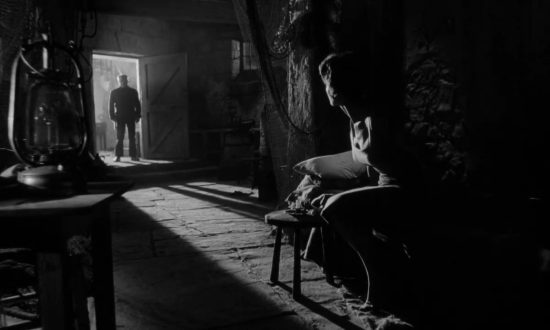
Shake Hands with the Devil is available on DVD in the UK via Metrodome. The film is presented in Academy ratio, which can’t be right for a 1959 production. I did try zooming to around 1.66:1 at a number of points and the image generally looked fine so I guess we’re looking at an open matte transfer here. Leaving aside the matter of the aspect ratio, the transfer isn’t bad in other respects – print damage is minimal and contrast levels and sharpness all look acceptable. The only extra features on the disc are a handful of trailers for other Metrodome releases. Regular visitors to this site will be aware that I try to highlight movies that aren’t always widely acclaimed. Naturally, some are of better quality than others and I feel comfortable in asserting that Shake Hands with the Devil really is something of a forgotten gem. It’s an interesting film from a historical perspective, focusing on a conflict and period that doesn’t get a lot of attention. Michael Anderson’s smooth direction is very attractive with the imagery frequently reminiscent of film noir. Add in some excellent acting and complex characterization, especially from Cagney, and we’re talking about a first-rate thriller.
Canyon Passage

poster10_zps537a0a41

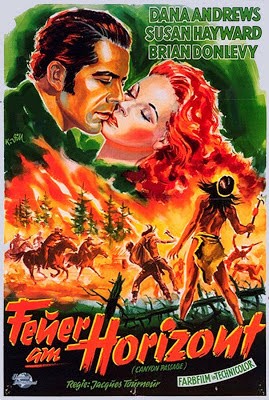
The western is a genre which, although it’s certainly not the only one, is sometimes accused of being overburdened by clichés.  This is understandable enough; genre pictures by definition have to feature elements that are immediately recognizable to viewers. Canyon Passage (1946) could be said to contain its fair share of these well-worn tropes (crooked financiers, restless wandering types, hostile natives) but part of what raises this film up among the best examples of the genre is the way they are handled. There’s an  air of authenticity about it all, and that filters through into some stock characters and situations, bestowing on them an originality that sets the whole production apart.

While I don’t have any statistics at hand to prove this one way or the other, I reckon it’s safe to say most westerns take place within a rough thirty year period beginning at the outbreak of the Civil War. Sure you’ll get examples set both before and after these dates, but they do appear to be slightly thinner on the ground. Canyon Passage tells a tale of Oregon in 1856, a time of growth and expansion before conflict engulfed the nation. Logan Stuart (Dana Andrews) is one of those thrusting, entrepreneurial types, never satisfied with what he has and always on the lookout for new opportunities to add to his fortune. Still, he’s not a greedy or grasping man; his ambition is just an integral part of his character, a restless need to range further and in some ways a reflection of the pioneering spirit of his country. Stuart is a man who is going places in every sense: his business is booming, he’s respected within the community and he’s courting Caroline Marsh (Patricia Roc), a beautiful English settler. However, there’s almost always a fly in the ointment, two in this case. The biggest and ugliest comes in the shape of the brutish Honey Bragg (Ward Bond), a muscle-bound giant of a man and an amoral counterpoint to Stuart. A further source of anxiety is George Camrose (Brian Donlevy), the local banker and Stuart’s best friend. Camrose is a compulsive gambler, a dangerous trait in a financier in any circumstances but doubly worrying when he’s caught in a run of spectacularly bad luck. While Camrose attempts a precarious balancing act his fiancée, Lucy Overmire (Susan Hayward), is increasingly  attracted to Stuart. Granted none of this is making his life any easier, but it pales into relative insignificance in comparison to the physical threat represented by Bragg. The hulking bully is borderline obsessive in his rivalry with Stuart, further enraged and embittered by his knowledge that his foe had (and passed up) the opportunity to see him hang. Fueled by hate and frustration, Bragg gives in to his animal instincts and thus imperils not only Stuart but the whole community when his base behavior sparks off a tragic Indian uprising.

£3

Adapted from a novel by prolific western author Ernest Haycox (Stagecoach, Union Pacific, Bugles in the Afternoon, Man in the Saddle etc) Canyon Passage was the first foray into the genre for director Jacques Tourneur. The versatile Frenchman took to westerns right from the beginning, crafting an intimate portrait of frontier society that comes close to the affectionate and mythic vision of John Ford. Cameraman Edward Cronjager captured some truly beautiful and breathtaking Technicolor images that Tourneur then directed with an expert touch. The sequence of the cabin raising is an ode to communal effort and gives a real sense of how inextricably linked the lives of these people were to those of their neighbours. Everything in the movie – the texture of the buildings, the condition of the streets, the language and attitudes of the characters – smacks of a realism that isn’t always present. However, the movie is more than a celebration of pioneering spirit and the social dynamic of the time. Above all, Tourneur was a master of atmosphere and an extraordinarily subtle, understated director. There is plenty of rousing action accompanying the narrative, and again the authentic feel comes across in the depiction of the violence. No doubt Tourneur’s experience working in Val Lewton’s horror unit at RKO shaped his approach to filming the more horrific scenes. There is very little explicit violence shown on screen, the director preferring to cut away or obscure the more visceral moments. Yet the effect, as was the case in those Lewton movies, is to force the viewer’s imagination to take over. In my opinion anyway, having to visualize the acts just off screen is more unsettling than seeing some unconvincing mock-up.

With strong source material and first class people operating behind the cameras, the final vital ingredient is the performers. Dana Andrews produced another of those deceptively quiet turns as Logan Stuart. Initially, you’d be forgiven for thinking this man was no more than a hard-nosed and pragmatic businessman. However, as the story progresses, Andrews, as he so often did, reveals new layers to the character. His early scenes with Patricia Roc hint at a tenderness of heart not apparent from his stoic visage, and this aspect is further developed as his relationship with Hayward grows. But really it’s his loyalty to Donlevy that proves how deep his humanity runs. Although Donlevy was of course a great heavy in countless movies, I wouldn’t actually class his George Camrose as a fully fledged villain. Despite some thoroughly reprehensible behavior, Donlevy brought a weakness and frailty to the role, a touch of corrupt romanticism if you like, which helps explain why Andrews stuck by him all the way. No, the real bad guy here comes courtesy of Ward Bond’s portrayal of the monstrous Honey Bragg. Bond did a fantastic job in capturing the physical power, the depravity and animal cunning of this figure. The two main female roles – those of Patricia Roc and Susan Hayward – are careful studies of contrasting women. Roc had the right kind of brittle gentility for an Englishwoman suddenly thrust into a new and dangerous world; her dazed and distant reaction to the aftermath of the Indian massacres struck just the right tone. Hayward, on the other hand, was feisty, tough and earthy – a true frontier gal. In supporting roles, there is some good work from Lloyd Bridges, Andy Devine, Onslow Stevens, and the wonderful Hoagy Carmichael.

£4

Canyon Passage is a Universal film, and there are plenty of DVD editions on the market from a variety of territories. I have the version included in Universal’s Classic Western Round-Up Vol. 1 which was released a number of years ago. The film shares disc space with The Texas Rangers but I can’t say I was aware that the presentation suffered from any compression issues. For the most part, the image is very strong with the Technicolor cinematography looking frankly spectacular at times. There are no extra features whatsoever available on the disc, something I think is disappointing as the movie is most certainly deserving of a commentary track at the very least. Regardless of that, this movie remains among one of the very best westerns made in the 1940s. Jacques Tourneur would go on to make a number of high quality pictures in the genre, though I feel this represents him right at the top of his game. There’s a complexity and maturity to the characters and their interactions that help distinguish the movie. Not only would I recommend Canyon Passage to anyone with an interest in westerns, I would go so far as to say it’s essential viewing.


The Man from Colorado

poster11_zps8d7fa5f9

The years following WWII saw a number of movies looking at the problems encountered by veterans returning home and the difficulties they faced in trying to assimilate themselves once again into society in peace time. This was a common enough theme in film noir, where the shadowy, paranoid and dangerous world of the dark cinema seemed ideally suited to such tales of detachment and disillusionment. Westerns, on the other hand, would appear an odd choice for exploring these particular issues. However, as I’ve tried to point out in the past, the western was a versatile and malleable genre capable of embracing just about any type of story. The Man from Colorado (1948) deals with a man coming home after experiencing the horrors of a different and more distant war – the Civil War – but the associated problems, especially the psychological ones, are sure to have struck a chord with contemporary audiences. Perhaps more importantly, the film remains relevant for modern audiences as, sadly, new conflicts have a nasty habit of rearing up to rob a little of the soul of almost every generation.

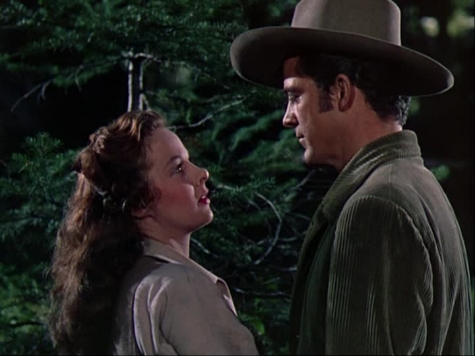
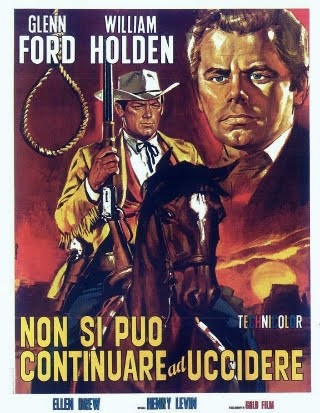
It all starts with a massacre. On the last day of the Civil War a small band of Confederate soldiers are holed up in a box canyon. Faced by a well equipped Union force, these demoralized troops have the choice of making a fight of it or surrendering. Their officer orders a white flag run up, and then watches in disbelief as the Union commander gives the word for his artillery to open up. Owen Devereaux (Glenn Ford) is the colonel who knowingly seals the fate of this group of doomed men. Devereaux is a man not only hardened by battle but psychologically damaged to the extent that his humanity has been all but stripped away. This calculated atrocity is witnessed by his friend and subordinate Captain Del Stewart (William Holden), but his sense of loyalty to his commander, and perhaps his charity to a man he feels has been scarred enough by conflict, leads to his surreptitiously burying the evidence. Devereaux himself recognizes the mental strain he’s suffering from but hopes that civilian life and freedom from official duties will offer him respite. However, that’s not to be; a man with his war record is attractive to those with a political agenda to push, and the local businessmen in his hometown convince Devereaux to take on the role of federal judge. Reluctantly, Stewart agrees to serve as federal marshal under Devereaux, partly because it affords him the opportunity to keep an eye on his disturbed friend. Nowadays, the condition affecting Devereaux would likely be referred to as post traumatic stress disorder and various treatments would be prescribed. However, we’re talking about 1865 and men had to simply soldier on, so to speak. The power and responsibility that Devereaux now holds seem only to exacerbate the problem, and the fact that Stewart is not only his deputy but a rival in love too doesn’t help matters any. As Devereaux, backed by grasping mining interests, develops a kind of callous megalomania that threatens to undermine all respect for the law among the locals, Stewart increasingly realizes that his friend has gone beyond the pale and it’s his duty to take a stand.

Borden Chase wrote the story that The Man from Colorado was based on, although I don’t know how much of that was altered in the finished screenplay. The dark characterizations certainly all bear Chase’s stamp, but the script shows the mine owners and authority figures in a pretty negative light, something that would appear to be at odds with his conservatism. The depiction of a man driven insane by the horrors of warfare and his inability to come to terms with a post-war life is the main theme of the movie, and it’s obviously the most interesting feature. However, the critique of a society shaped and driven by financial interests is never far from the surface either. Taken together, these two aspects are held up to the light in what is essentially an examination of how society treats those it relied on to defend its safety when the hostilities have come to an end. The inference is that, at the time anyway, a man had to deal with these matters himself, or with the help of a handful of close friends at best. Director Henry Levin is one of those figures who worked away within the studio system, making movies in all kinds of genres, without too much fuss or acclaim. His handling of the material in The Man from Colorado shows he was more than capable of telling an interesting story and keeping the pace tight. The film is a mix of interior and location work, with the former dominating for long stretches. For the most part, the action set pieces take place outdoors – particularly the opening and the fiery climax – while the sound stage interiors are used for the more psychologically complex character scenes. At times here, the lighting, composition and musical cues suggest the feel of a film noir, in spite of the sumptuous Technicolor used in the movie.

As far as the performances are concerned, the lion’s share of the work is carried out by Ford and Holden, with the former being the center of attention. The part of Owen Devereaux is arguably the least sympathetic of Glenn Ford’s many roles. He managed to get right into the dark heart of his character, but in doing so missed out on giving him too much dimension. That may be down to the writing as much as anything, but it still means that the central role is robbed of some much needed complexity. Basically, Ford becomes a villainous black hat for the audience to hiss at, and not a lot more. What this means is that Holden’s part is given added interest. A lawman who turns in his badge and joins a gang of outlaws isn’t usually seen as a hero in westerns of the period, but that’s precisely what Holden’s Del Stewart does. There’s considerably more conflict in this character – loyalty, love and social responsibility are all motivational factors for him – and Holden gets to explore his range a good deal more than Ford. Among the supporting cast James Millican has the plum role as the former soldier who insubordination sees him run foul of Ford’s Devereaux. Millican gets to play a great anti-heroic figure and eventually bows out in fine fashion – a terrific actor. Ellen Drew is the only woman in the movie, as the object of both Ford and Holden’s affections, and her role is a weak one; she’s not called on to do much more than look suitably distressed by Ford’s growing excesses. Other parts of note are filled by Edgar Buchanan as a sympathetic doctor and Ray Collins as the mercenary mine owner.

The Man from Colorado is a Columbia production so Sony are responsible for its release on home video. The UK DVD is a very basic disc, lacking a proper menu and boasting no extra features at all, apart from a plethora of language and subtitle options. That notwithstanding, the picture quality, which is ultimately the most important thing, is excellent. The print used for the transfer is in very good condition and displays no damage that I was aware of. The transfer is clean and sharp, and the Technicolor looks to be especially well reproduced – all in all, this is a handsome presentation. Westerns with a strong psychological storyline really came into their own in the 1950s but The Man from Colorado represents a fine late 40s example of this variant. While I think the film could have benefited from a more rounded portrayal of Ford’s character the roles played by Holden and Millican do compensate to some extent. In the final analysis, I consider this to be a solid, worthwhile western that I’d rate as above average.


Awards Time

It’s always nice when someone passes along an award. Sometimes these things have a whole raft of conditions attached which can be enormously time-consuming though. As such, it’s quite relaxing to get one which is relatively simple to accept and pass on. And that’s the characteristics of the award sent my way by blogger vinnieh today.

This one simply involves displaying the award logo (check), linking back to whoever gave it to you (check), nominating ten others to receive it (see below), and letting those ten know (OK, OK, just gimme a minute!) – and that’s it. Simple.

I’m not sure, but I think the award, mainly due to its name, is supposed to go to WordPress powered blogs. That gave me pause, there are plenty of worthy blogs out there – many I respect and like to visit – that operate on other platforms. On this occasion I’ve left out such sites and concentrated on WordPress ones. Maybe that’s not the correct reading of the award, but it’s the way I’ve chosen to interpret it. Anyway, having got that rationale out of the way, here are my ten worthy nominees:

Twenty Four Frames

Tipping My Fedora

It Rains…You Get Wet

Vienna’s Classic Hollywood

Speakeasy

Movie Classics

Lasso the Movies

Only Detect

In Search of the Classic Mystery Novel

ClassicMovieChat.com

The Last of the Fast Guns

I’ve met a lot of men in my time. A woman they forget, a mine busting with gold, even the faces of their own children. But I’ve never met a man who forgot a grave he dug.

The Last of the Fast Guns (1958) is set mostly in Mexico, and as a result it belongs to a smallish group of westerns that transplant their heroes south of the border. Generally, these films involve men searching for something or someone. In this case, the hunt is ostensibly for a man, but the reality is that the hero is on an altogether different quest – as he chases after shadows and memories he’s actually trying to pin down a kind of inner peace, looking to come to terms with his own demons and violent nature as the country changes around him.

The opening is stark, brutal and a little shocking in its cold abruptness. The first image we see is a cemetery with a freshly dug grave, and a man quietly riding away from it. At first glance, this scene has an almost supernatural quality, as though the rider has just risen from the earth before mounting up and moving off. However, the truth is that Brad Ellison (Jock Mahoney) has been making preparations, quite literally doing the spade work before heading off to find an occupant for that new grave. He enters the neighboring town and calmly guns down an unnamed man in a brief duel. Right away we know the type of character we’re dealing with, a man of few words with a dangerous reputation that can make him a fortune but is also something of a curse. No sooner has he removed a threat than he’s presented with a proposition: head over the border and track down a man named Forbes. The reason is Forbes’ brother is a wealthy man in poor health and wants to find him to avoid his estate passing on to a treacherous partner. The thing is men like Ellison don’t get hired unless there’s a high risk factor, and the disappearance of two previous messengers is testament to that. Forbes is an elusive figure, someone who’s spoken of in hushed, almost reverential and awed tones, and his shadowy, spectral presence hangs over the picture. Ellison’s mission brings him into contact with four people: Michael O’Reilly (Lorne Greene), his daughter Maria (Linda Cristal), his foreman Miles Lang (Gilbert Roland) and an old padre (Eduard Franz). These four, in different ways, have a powerful effect on Ellison, shaping his destiny as they help and hinder his efforts to catch up with the mysterious Forbes.

The Last of the Fast Guns is a very interesting piece of work from director George Sherman. It’s one of those late 50s westerns that is very much in the classical mold, but also looks forward to and anticipates some of the trends that would surface in the following decade. The dialogue is terse and economical, rapped out with the kind of staccato rhythm that wouldn’t seem out of place in a film noir, and loaded with existential undertones. The hero is much more of an anti-heroic figure than one typically associates with the 50s – the black clad, mercenary Mahoney recalling Burt Lancaster’s grinning rogue form Aldrich’s Vera Cruz, but not quite achieving the amorality that would characterize the bounty killers peopling many 60s westerns. In a sense the link here is not so much with the approaching spaghetti westerns as the regretful nihilism of Peckinpah. That aspect was reinforced for me by an early scene which sees Ellison stopping off at a type of outlaw refuge when he’s just entered Mexico. This is a lovely interlude as he sits around with James Younger and Johnny Ringo, reminiscing about the past and lamenting the passing of Jesse James and Billy the Kid. For all that, The Last of the Fast Guns is at heart a classic 50s production, concerning itself with notions of rebirth and redemption. And that brings me back to that haunting opening. Ellison can in fact be seen as something of a resurrected soul, a man striving to leave death behind him, to achieve or earn his place among the living. Perhaps it’s telling too that, like in The Wonderful Country, the implication is that this can only be realized in Mexico.

Former stuntman Jock Mahoney is probably best known for playing Tarzan, but he made a number of good westerns from the mid to late 50s. I guess it’s fair to say he wasn’t the most expressive actor around but he did have a lot of physical presence and was a good fit in westerns. His laconic style works very well here where he’s taking on the role of a tough gunman and killer. In complete contrast – even down to the predominantly white costume – Gilbert Roland is typically swaggering and arrogant. Roland cuts a much more ambiguous figure, leaving the viewer guessing for long periods of time just whose side he’s really on. Together, Mahoney and Roland balance each other out and their friendship/rivalry is one of the most attractive parts of the film. The casting also has a strong television connection: Lorne Greene being forever associated with Bonanza and Linda Cristal evoking memories of The High Chaparral for me at least. Personally, I don’t feel Ms Cristal had a huge amount of screen chemistry with Mahoney, although there is just about enough there for her role as his spiritual savior to work.

As far as I’m aware there are only two DVD editions of The Last of the Fast Guns available at present, from France and Spain. I have the Spanish release from Llamentol (currently on sale at a fairly good price here) which presents the movie in anamorphic scope and clearly comes from a strong source print. As is usual with this company’s releases, there are no extra features on the disc and subtitles can be removed via the main menu. I reckon a lot of George Sherman’s work is underrated and there’s a rich selection of material waiting to be mined for those unfamiliar with him. The Last of the Fast Guns is a good example of Sherman’s deceptively relaxed filmmaking style. The movie is a visual treat, runs for a lean 80 minutes and has a lot more depth than you might expect. Recommended.

High Treason

There’s a tendency to view the Red Scare of the 1950s, as represented in the movies, as a purely American phenomenon. The whole HUAC affair and the subsequent blacklist encourage us to view this as something unique to Hollywood, and there can be no doubt that the paranoia reached its zenith there. However, this offshoot of the Cold War spread elsewhere, albeit in a diluted form. High Treason (1951) provides an example of the British film industry tackling the matter of reds under the bed at the same time. The result is a well made espionage thriller that catches the mood of the period, but also one that contains overtones that can come across as a little unpleasant when you stop and think about them; I’ll address those aspects later.

It’s the early days of the Cold War and the lines between what in official wartime parlance would be referred to as fifth columnists and the kind of spies and double agents that would become a staple of the genre are not yet clearly defined. High Treason affords a glance into the lives and activities of a handful of subversive operatives who straddle those lines. The opening has an apparently meek civil servant, Ward (Charles Lloyd Pack), returning home to his flat, admonishing some boisterous kids along the way, feeding the cat, and then sitting down to transcribe a munitions manifest which will be handed on to a group of saboteurs. This is the stuff of the typical spy story, the outwardly harmless apparatchik beavering away unobtrusively in the service of his foreign paymasters. However, the film then moves to the men of action, the agents who actually put the information to use in spectacular and violent fashion. A wave of sabotage has been sweeping the country, taking lives and creating instability. There’s a dramatic depiction of the bombing of the ship carrying those munitions Ward had told his confederates about. In the aftermath of the carnage and destruction we’re introduced to the men charged with putting an end to this internal terrorism: Commander Brennan (Liam Redmond) and Supt. Folland (Andre Morell) of Special Branch and Major Elliott (Anthony Bushell) of MI5. The film follows their investigation, detailing the meticulous nature of the surveillance of known suspects, the lucky breaks that are needed to crack such cases, and the trail of corruption and ambition that leads to betrayal at the very heart of government. Police procedural stories, even those as intricate and involved as this, can be a dry affair at the best of times. There’s a tendency to pass over or lose touch with the human aspects that are the necessary ingredients of good drama. However, High Treason avoids falling into this trap by alternating between the men from the ministry and their investigation and the daily agonies suffered by a reluctant member of the spy ring, Jimmy Ellis (Kenneth Griffith), and his immediate family. As gripping as the investigation and the gradual closing of the net is, it’s the focus on Ellis’ doubts and fears that adds real punch to the tale.

The terrific Seven Days to Noon came out a year earlier and Roy Boulting followed up that suspenseful Cold War nightmare with this tale of spies, sabotage and spooks. Boulting carried over a similar sense of pace and atmosphere to High Treason. The two films benefited enormously from the use of authentic London locations, and both also featured the character of Supt. Folland. However, there are some important differences: while Seven Days to Noon achieved a timeless quality that still resonates today, High Treason is more dated by being firmly rooted in the politics and concerns of its time. Which leads me on to the criticism that I alluded to in the introduction. The foreign power for which the spy ring is working is never explicitly named yet, through the frequent use of ominous newspaper headlines and other pointers, it’s clear enough that it is the Soviet Union. Fair enough, Cold War thrillers naturally used the eastern bloc as the bogeyman villain and to expect anything else, or criticize that practice, would be naive in the extreme. Having said that, I did raise an eyebrow at the way the script seems determined to hammer home the point that artistic types and intellectuals were easy prey for communist propaganda – that those with even a vaguely liberal bent were at best foolish dupes and at worst dangerous fanatics obsessed with undermining their own country. Despite that criticism, there’s a whole lot to admire in the movie. It acts as a wonderful snapshot of a Britain that has long disappeared, where heavy industry was an integral part of the economy and the threat of blackouts shutting it down, even for a time, would have spelt chaos. Aside from the historical and sociological insights offered, High Treason is a tightly plotted thriller that grips you from the opening right through to the excitingly shot climactic battle within Battersea power station.

High Treason isn’t the kind of film that could be described as a star vehicle. Essentially, it’s an ensemble piece but, even so, there are a few noteworthy performances that stand out. Irish actor Liam Redmond was a character specialist, looking a good deal older than the 38 years old he was at the time. He brought a quiet, whimsical intelligence to the part of Brennan, and it’s his doggedness that draws together all the disparate strands of the complex investigation. Andre Morell reprises the role of Folland that he played in Seven Days to Noon with his customary charm and urbanity. It’s not a showy part by any means, deferring to Redmond’s authority, yet it’s a typically classy piece of work by Morell. Probably most memorable of all though is Kenneth Griffith as the tortured wireless man who sees his dreams of a better world twisted and subverted by his cynical and opportunistic companions. Griffith gave a very real, honest performance where the agonies of conscience he endures never appear the least bit affected. I was also quite impressed by the work of Mary Morris, in one of the few female roles in the film, as the dedicated and driven spy with few scruples. There’s also strong support on view from Geoffrey Keen, Joan Hickson and Anthony Nicholls.

High Treason was a film that was difficult to see for a long time but is now available on DVD in the UK from Spirit. The film is correctly presented in academy ratio and the transfer is quite good. There is the odd speckle here and there but the print used is generally in good condition with nice contrast levels to show off Gilbert Taylor’s moody cinematography. There are no extra features whatsoever on the disc. The movie represents a welcome companion piece / follow-up to Seven Days to Noon, and although it’s not as good as the earlier production it still has enough going on to recommend it. As a stand alone film it works perfectly well on its own terms, and really ought to be judged as such. I’ll admit I’m not crazy about certain aspects of the subtext, but that doesn’t mean I dislike the film or rate it any lower as a consequence. Whatever way you approach it, High Treason is an effective, satisfying and exciting espionage movie.

The Proud Ones

22_zpsq5pfdja6

The minute you people smelled money, this town got an attack of larceny. I don’t blame it on Barrett; I blame it you. You’re supposed to be respectable. You talk about law and order; you’d sell out for a copper penny – any one of you. You’re robbin’ and stealin’ the same as he is, with your fifty dollar boots and your twelve dollar hotel rooms. If I was on this council, I couldn’t look in the mirror without vomiting!

Occasionally, there are films which I fully intend to feature but somehow they seem to slip through the net at the last moment. I’m not entirely sure why that happens as they’re rarely poor or unmemorable. For one reason or another they don’t get written up and I find my attention has moved on to something else. A good example of this is The Proud Ones (1956), although the fact this movie has cropped up in discussions and comments here a few times lately means it’s never been too far from my mind. As 50s westerns go The Proud Ones remains a pretty solid effort, using a fairly common town tamer storyline to look at a handful of people bound together by events from their pasts that can’t be shaken off, and also slipping in a few sly digs at the way progress and prosperity have a way of shepherding in the beginnings of moral decay.

Cass Silver (Robert Ryan) is one of those lawmen who moved from one hot spot to another, his latest port of call being the peaceful town of Flat Rock. However, Flat Rock is about to undergo something of a transformation as the arrival of the first cattle drive promises an upturn in economic fortunes, as well as the potential for increased lawlessness. Westerns tend to focus on the trouble stirred up by visiting cowboys eager to blow off some steam and cut loose after a long period in the saddle. In this case though the source of the problem isn’t the cowboys champing at the bit for whiskey and women; all the trouble that arises stems from the town itself, or its newest arrival anyway. “Honest” John Barrett (Robert Middleton) has just moved in and taken over the running of the saloon and the gambling tables. The thing is Barrett is a sharp operator, not averse to using hired guns and crooked dealers, and he has a bit of history with Silver. Both men locked horns in the past and the result was that Silver apparently ended up being run out of town. A further layer of pressure comes in the form of Thad Anderson (Jeffrey Hunter), another new arrival whose father was gunned down by Silver years before. While the marshal has to deal with the needling of Barrett and the alternating hostility and confusion of Thad, he’s faced with an altogether more serious danger. A man in such a position needs the full use of all his faculties at the best of times, but Silver comes to the sobering realization that he may be in danger of losing his sight just as matters are coming to a head.

21_zpsh77feqgs

I’ll have to admit that I’m not very familiar with a lot of director Robert D Webb’s work – apart from the neglected White Feather and the less satisfactory Seven Cities of Gold – but what I have seen indicates that he had a good eye for wide scope compositions. The wide screen tends to work best with films that are heavily dependent on the use of landscape – movies featuring a significant amount of location shooting. Arguably, films which contain a lot of interior shots, as is the case with this production, require greater care if they’re photographed in scope. An overeager or lesser director might  succumb to the temptation to pack out the frame with too many characters and movement, throwing the composition out of kilter and muddling the focus. It’s to Webb’s credit, no doubt aided by having Lucien Ballard as cameraman, that he resisted those temptations and went for clarity instead. Many scenes take place in Silver’s office/jail, and the wide frame is expertly used to highlight the character interaction of the principals whilst also drawing attention to the little gestures and reactions of the peripheral figures. Lionel Newman is the credited composer and the melancholy whistling theme is an understated and ideal accompaniment for the action on the screen.

I’m a big fan of Robert Ryan, a subtle actor of great depth and range who seemed equally at home in both westerns and film noir. A quick look through his credits for the 40s and 50s makes for impressive reading, with hardly a bad performance on view despite the variable quality of some of the projects he was involved in. The Proud Ones offered Ryan the opportunity to play a man whose outward toughness masks the uncertainties and regrets he really feels. His character’s back story is filled in gradually as we go along and, together with the failing eyesight angle, helps to build audience sympathy. Ryan also managed a good rapport, in contrasting ways, with both Jeffrey Hunter and Robert Middleton. While I’m not sure the relationship between Ryan and Hunter quite works, I wouldn’t lay the blame at the door of the actors. I reckon Hunter was and is criminally underrated and tends to get dismissed as a pretty boy who brought little of substance to his roles. Frankly, I don’t go along with that and find him more than satisfactory in most films – I’d go so far as to say he was excellent in Nicholas Ray’s The True Story of Jesse James for example –  succeeding in getting across the sense of confusion of his character here. Middleton was a versatile character actor, but always made an especially effective heavy. He brings a nice sense of smugness to his role that provides the necessary counterweight to Ryan’s edginess. There’s also a hint, never fully explored, that both Middleton and Ryan were former rivals for the affections of Virginia Mayo. Whilst Mayo gets a more fully developed character to work with here than was often the case, she seems to put a little too much into her performance. This is understandable for an actress who was frequently handed thankless parts, but it does jar a bit. The supporting cast is long and noteworthy with Walter Brennan (slightly wasted as Ryan’s laconic sidekick) and Arthur O’Connell as the distracted deputy heading it up. I mentioned the swipe the script takes at the greed and moral decline accompanying the financial boom, and the opening quote refers to that. Edward Platt and Whit Bissell catch the eye as representatives of the respectable citizenry easily corrupted by the promise of riches.

2_zps7yyxshri

Fox released The Proud Ones on DVD in the US some years ago but it remains a very strong transfer. The disc offers the film in its correct anamorphic scope ratio on one side while the reverse has a (redundant) pan and scan version. Color and detail are well rendered and the print used is very clean and practically undamaged. Extra features are limited to a handful of trailers. I don’t think Robert Ryan ever made a poor western and The Proud Ones, even though it may not be among his best known pictures, is a fairly strong effort. One could say it’s a generic 50s western and while it’s hard to argue with that assessment it shouldn’t be taken as a criticism either. I feel Mayo overcooks it a little and the central dynamic between Ryan and Hunter could have been improved by the writers. Still, despite these few quibbles, the movie does work when taken as a whole. I’d call it a solid, above average example of the genre.

P.S. – This is just one of those infrequent updates I’ll be adding to the site over the summer – full, normal service shall be resumed some time in September.

Holidays!

Well, it’s that time of year again! I usually like to take a short break from things during the summer, to recharge the batteries and just kick back for a bit. Anyway, the point is I won’t be posting as regularly for a while – that doesn’t necessarily mean there won’t be any updates appearing here, just that there will be much longer intervals than normal between them. See you all soon – I’m off to pack!