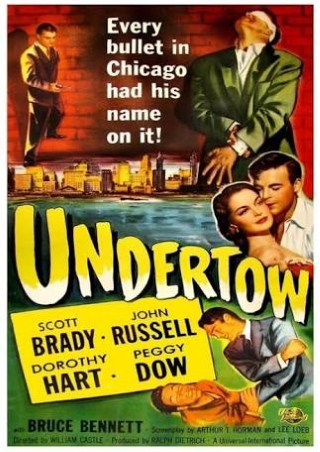
Undertow

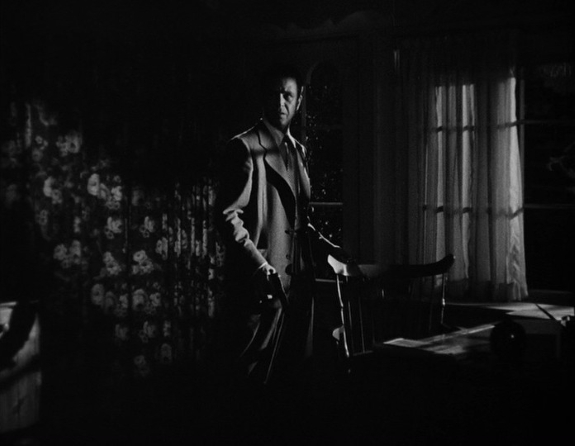
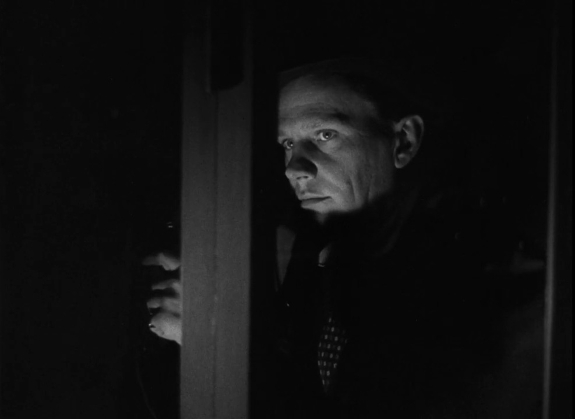
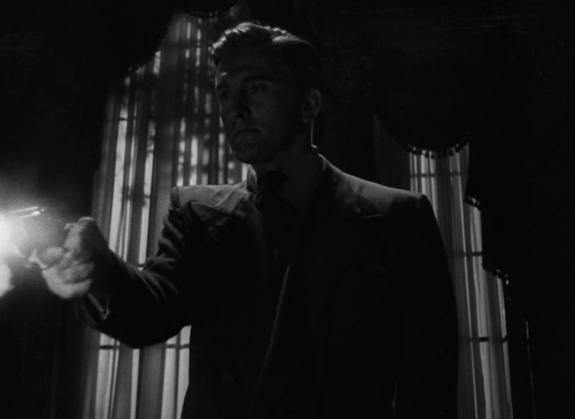
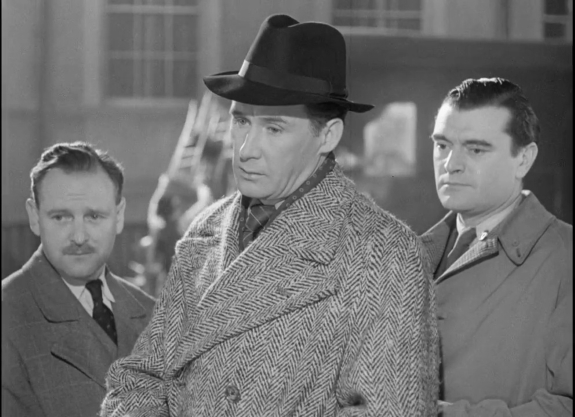
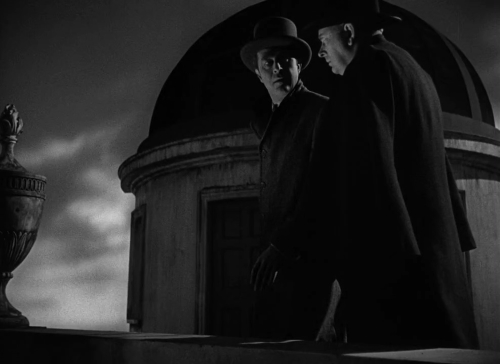
In an era where entertainment gives the impression of becoming ever more bloated and unwieldy, where books seem to be sold by the page count and thus by weight like some indigestible stodge, where even movies which tell essentially pulp stories have running times that defy both logic and the endurance of the human body, it is a true joy to watch a film which is tight and trim enough to take care of business in just an hour and ten minutes. That ought to be a recommendation in itself yet Undertow (1949) has the added bonus of being a remarkably entertaining film noir, William Castle’s best effort in the genre/style in fact.
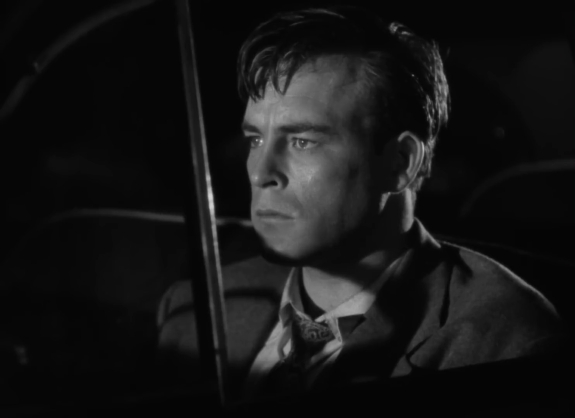
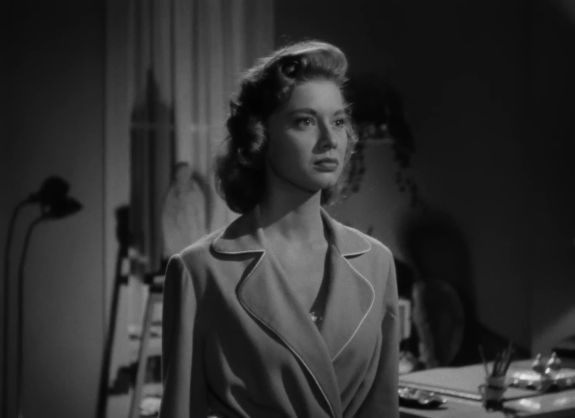
The war as a watershed – how many times has one come across that particular bromide? Yet its essential truth is undeniable. The image of the returning veteran, those men who dreamed of better days amid the waking nightmare of their years of service, is one familiar to the noir audience. Such men immediately draw sympathy by virtue of the sacrifices they made and this adds an edge to the dangers and depravities they confront on their return home. By 1949 the war was already slipping back into the misty corners of the past, the world was rushing ahead and wasn’t necessarily in any mood to slow down and wait for men trying to catch up with events that had bounded four years and more ahead of them. Tony Reagan (Scott Brady) is introduced as a classic postwar character. He’s a veteran with a vaguely shady past who has grown as a result of his experiences and is now focused on cementing a future for himself and the woman he hopes to make his wife. He has just bought a share in the hunting lodge business of a fallen comrade in arms, and is on his way to Chicago to propose to his fiancée Sally (Dorothy Hart). His last evening in Reno sees him briefly hooking up with a pal from his gambling past Danny Morgan (John Russell), as well as making the brief acquaintance of vacationing schoolteacher Ann McKnight (Peggy Dow). All of these people will cross his path when he lands in Chicago and also lands in deep trouble.  The classic noir protagonist frequently finds himself skewered on the horns of a dilemma, trapped somewhere between the pull of his past and typically bad choices going forward. This certainly fits Tony Reagan, a man who was told by crime boss, and Sally’s uncle, Big Jim Lee to stay out of Chicago and away from his niece.
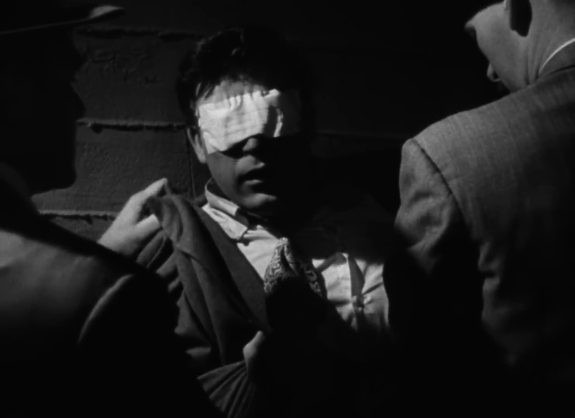
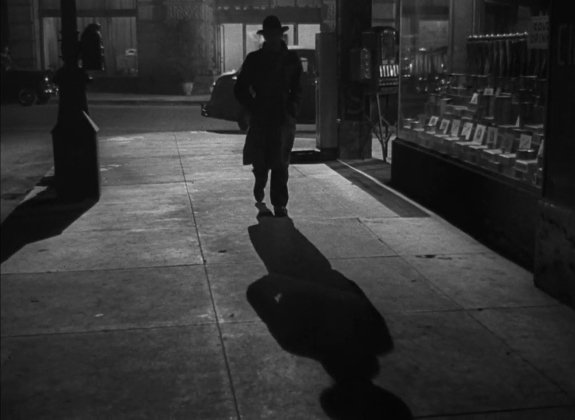
There’s to be no hero’s welcome for Reagan; on his arrival at the airport he’s met by cops who run him downtown for a bit of friendly advice from the precinct captain, namely that he shouldn’t waste any time unpacking. That he ignores this tip shouldn’t come as any surprise, nor should the fact that he is soon slugged, blindfolded and shot, all as a prelude to a frame that looks like fitting him very snugly. If the movie has a weakness it stems from the way it sets itself up as a kind of whodunit where there’s no great mystery with regard to the actual culprit. In this case certain character traits as well as the way a vital piece of information was only available to one person don’t so much point the finger at as turn the spotlight full force on one individual, and when you see who that is then the rest of it kind of falls into place. Still, none of that really matters as much of the pleasure derived from following Reagan on his nighttime odyssey through Chicago trying to keep a half a step ahead of the cops, calling in favors and only realizing the full extent of his peril at the last moment.
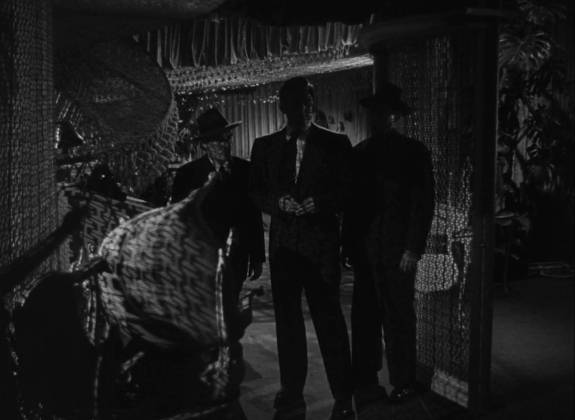
William Castle, like all studio era directors, worked in just about every genre but the bulk of his work fell into three categories: horror, crime and westerns. The horror movies have traditionally gained more attention from critics and fans alike, which arguably says as much for the enduring popularity of that genre as it does for the movies themselves. If I’m being honest, I don’t believe the quality of Castle’s films overall is commensurate with the level of attention they have received down the years. That may come across as somewhat curmudgeonly yet it’s not my intention to do so – I like Castle’s films for the most part and find the majority of them entertaining, just not necessarily always that good. Still, his better work does stand out and I’d have no hesitation in placing Undertow among those better pictures. At this stage in his career there was none of the gimmickry and clowning that would come to be seen as characteristic of the man. Instead, what we get is a compact and atmospheric piece of budget filmmaking that punches well above its weight.
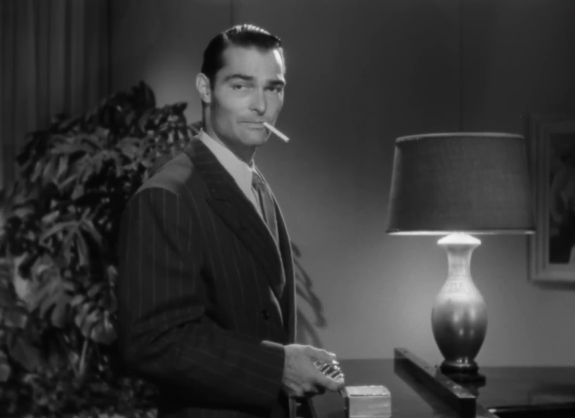
Shakespeare had Caesar remark that Cassius had a lean and hungry look and was therefore dangerous. Perhaps John Russell ought to have been cast as Cassius then at some point in his career for he surely fitted that description. Even though he had heroic leading roles on TV  in both Soldier of Fortune and then Lawman, his villainous parts on the big screen tend to be memorable and carry an edge of authenticity to them. He turned in a strong performance in De Toth’s Man in the Saddle and I watched him a while back in Hell Bound and was again impressed. The latter has that typical mean streak that can be found in Bel-Air movies and Russell managed to embody that successfully. Scott Brady was a suitable pick for the lead too, only a few years out of WWII service himself, he had the right combination of toughness and sympathy to be believable as someone with underworld connections but also with the nous to realize his future lay in a different direction. Bruce Bennett’s reassuring presence as the conflicted friend adds solidity to the supporting cast; his well played scenes with his boss and particularly the short interlude in the basement workroom of his home help to ground the story. The two female roles were filled by actresses who had very short screen careers. Peggy Dow appeared for a mere three years between 1949 and 1952 , while Dorothy Hart stretched it out a little longer, running from 1947 to 1952 in features and a couple more on TV. Both had a number of good movies to their credit with Dow possibly squeezing more memorable work in during her brief time as an actress.
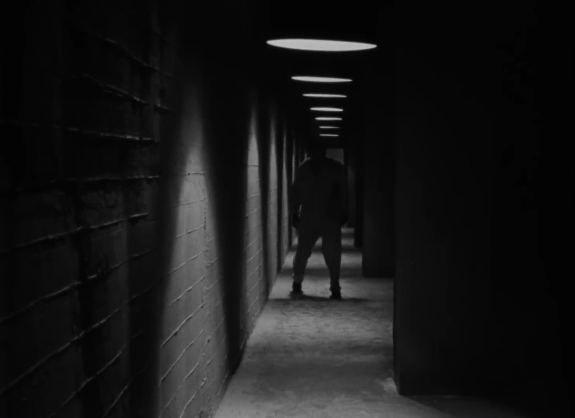
Undertow acts as a noteworthy example of the kind of well crafted crime and noir movies Universal-International was capable of producing. It’s gratifying that so many of these are now accessible and can be viewed in good quality, something fans of the studio’s output could only dream of a few years ago. Already released in the US in one of Kino’s box sets, the movie is getting an individual release here in the UK ( Amazon linkAs an Amazon Associate I earn from qualifying purchases) with plenty of supplementary features via Powerhouse/Indicator in January.
Viewing Notes – A Month with Hitchcock

Without having initially planned to do so, I ended up watching a selection of movies directed by Alfred Hitchcock all through September. I tried to choose those titles I had not seen for quite some time and have been jotting down and recording my thoughts on each in brief as I’ve gone along. Having done so, I figured I might as well assemble them here as an end of month round-up. So here goes:

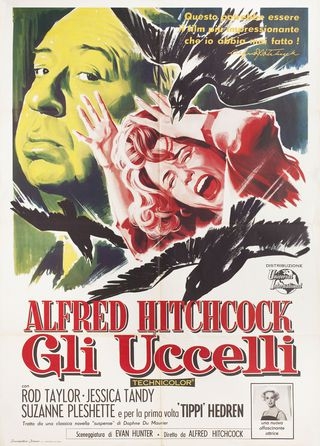
The Birds (1963)

It’s been many years since I last watched this and I’d forgotten just how well constructed it is, not to mention its technical proficiency bearing in mind the era.
That long, slow build-up is the work of a deeply confident filmmaker. It’s never boring or tedious and the gradual, estrogen-fueled tension, with all the cats among the pigeons, is drawn ever tighter in tiny but finely judged increments. When the full chaos is finally unleashed in the apocalyptic latter half Rod Taylor does get to flex bit of muscle, literally and figuratively.

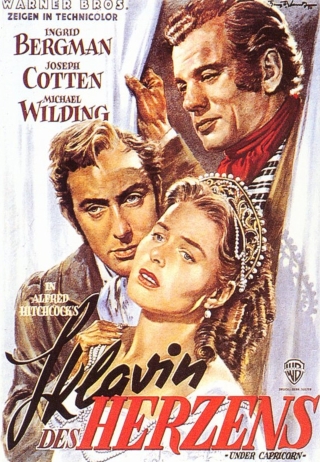
Under Capricorn (1949)

Very much lesser Hitchcock, a movie which barely anyone ever has a good word to say for. Well, I’ll at least say that it is handsomely shot, courtesy of Jack Cardiff, and the acting is fine even if Michael Wilding does lay the whimsy on with a trowel at times.
But yes, it is a problematic movie. And that is largely because it tells a story which is thin, not uninteresting in itself but too thin for its running time. It needed to be trimmed and compressed, which would have been hard to do because of the other great flaw – the director’s insistence at the time on experimenting with long takes. It hamstrung the previous year’s Rope (though that one has other issues dragging it down too) and was a technique that was antithetical to Hitchcock’s style.

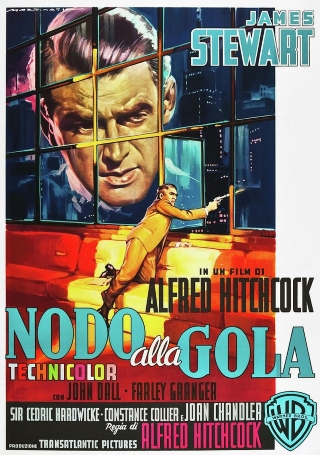
Rope (1948)

I’ve never especially liked this. The technical ambition is admirable, and I’ve always been somewhat hypnotized by the seamless skill involved in the gradual change in the lighting of the studio bound skyline as the tale unfolds in real time. However, the whole continuous take conceit imposes huge limitations on the cast and crew and the process must have been a genuine pain for everyone involved. As with Under Capricorn, the entire business works to undermine the director’s natural strengths.

The biggest problem I have with the movie though is the coldness and indeed the malice at its core. Nobody aside from Cedric Hardwicke’s anxious and compassionate father comes out of it well. That’s not to say it’s badly played of course. Granger could do that weak sister act with his eyes closed and Dall has the clinical and supercilious aspects down pat too – he always seemed to manage that though and there’s a hint of that inherent unlikeability also found in Laurence Harvey in all his parts. James Stewart nails the creeping suspicion that blossoms into horror and then outrage and (self?) disgust. But his character is not really sympathetic either – a man of his intelligence ought to have realized the kind of seeds his intellectual posing was planting.

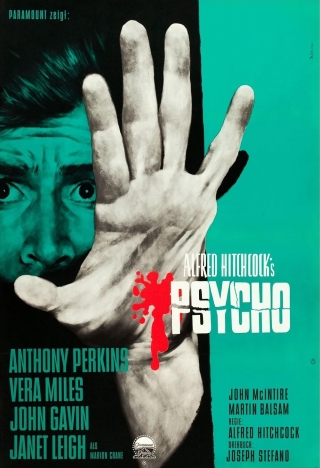
Psycho (1960)

It’s probably 15 years, maybe even more, since I last watched this. The first half always worked best for me and I still feel the same. The paranoia and gnawing guilt of Janet Leigh’s Marion is perfectly encapsulated in the minimalist style of that whole opening section – the rain, the ever more frantic musing, Herrmann’s nervy score and those seemingly permanent close ups of Leigh’s huge, expressive eyes.

And then there’s that frankly sublime sequence in the motel cabin. Cagey and uncomfortable, pathetically flirtatious and taut all at the same time. I reckon it’s the best scene in the entire movie. What follows in the last hour engages me less. It remains visually astounding and technically flawless, but too much of the artful subtlety drains away with the bath water. It still grips and shocks at times, just much more conventionally and it never again approaches the emotional precipice that was teased by the interaction amid stuffed birds, sandwiches and milk.

Nevertheless, it is still undeniably a great piece of cinema, the heights approached and attained in that first hour and the total assurance of a director genuinely in love with his medium are enough to ensure that.

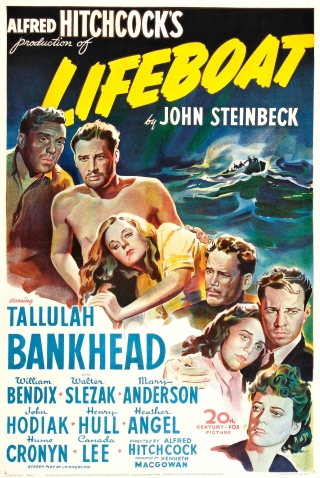
Lifeboat (1944)

A wartime propaganda picture from Hitchcock. Still, being a Hitchcock movie there’s more to it than that – by a circuitous route it winds up as something of a celebration of cohesiveness. Just about every stratum of western society is represented, from Henry Hull’s super rich kingpin to John Hodiak’s blue collar revolutionary, from the stoicism of Canada Lee to the louche decadence of Tallulah Bankhead. All the disparate characters are by turns gulled, threatened and finally drawn together by the malignant presence of Walter Slezak’s cool and cunning Nazi.

It’s another of the director’s challenges to himself, an exercise in the potential of confinement that makes up for in intensity what it arguably lacks in suspense. Alongside the more eye-catching dramatics of those further up the cast list, it’s satisfying to watch the slow development of a gentle romance between fairly regular Hitchcock collaborator Hume Cronyn and Mary Anderson, an actress who never much graduated beyond supporting roles except perhaps in the rarely seen but rather good Chicago Calling.

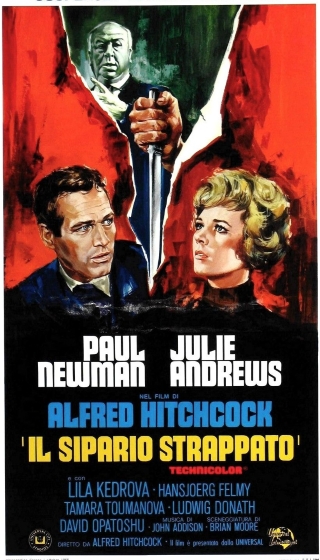
Torn Curtain (1966)

This is the point at which Hitchcock’s decline can be discerned. This Cold War thriller starts out as a double-cross drama where the bluff is drawn out too long before turning into a more successful cross-country chase, the kind of affair Hitchcock could make with his eyes closed.

The first half of the movie misses more than it hits, the brief bookstore scene in Copenhagen errs just on the right side of oddness, but the drab grey/green palate when events move to East Germany reflects the dullness of much of that section, not helped by a listless and detached performance by Paul Newman and an uncomfortable looking Julie Andrews. Some of it does work though – I like the entire build up to the farmhouse scene where the Stasi spook Gromek is laboriously disposed of, and Ludwig Donath is spikily entertaining as a caricatured professor.

The bus ride/pursuit has its moments, helped by John Addison’s slightly eccentric score and an earnest David Opatoshu. There are a few late flourishes too – the hiding among a crowd/creating a distraction ploy is revisited for at least the fourth time – off the top of my head variations thereof are employed in The 39 Steps, Saboteur and North By Northwest if not more.

So, a mixed bag all told. I guess it does more wrong than it does right yet I’ve always had a greater fondness for it than it probably deserves.

Pitfall

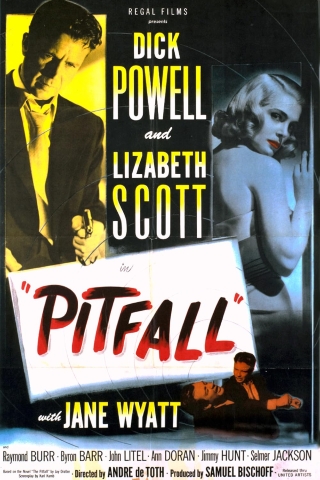
The daily grind, routine and repetitious. This is something most people can relate to, an integral part of all our lives just as much as sunrise and sunset. What does it represent though? Is it boon or bane? Well it certainly encapsulates the concept of security, and not just in a financial sense. That familiarity, that precise knowledge of where one is going to be at a given hour, perhaps even a given minute, of any day of the calendar offers reassurance. Yet reassurance is necessarily wedded to restrictiveness and at some point the balance between those two points of reference might just start to slip. That’s what happens in Pitfall (1948), a frank analysis of the way post-war suburban security and comfort could start to smother. Everything about it characterizes the classic film noir setup, the slow drift into dissatisfaction, the allure of the forbidden, the unwise choices and the way rapidly snowballing consequences threaten to smash everything in their path.

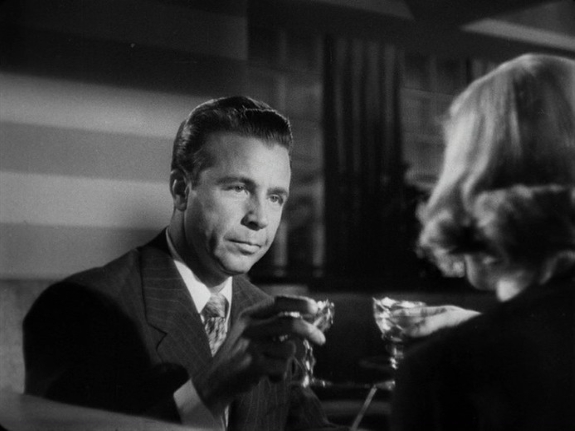
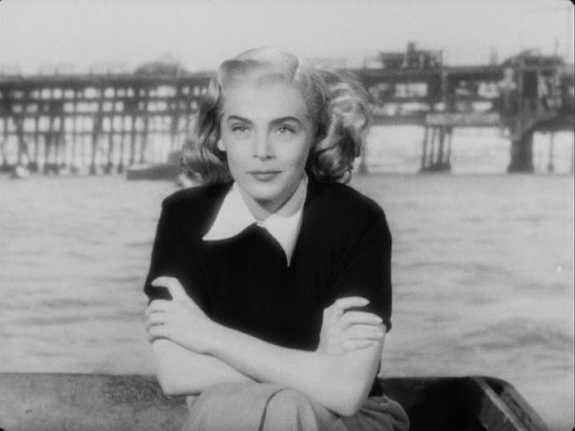
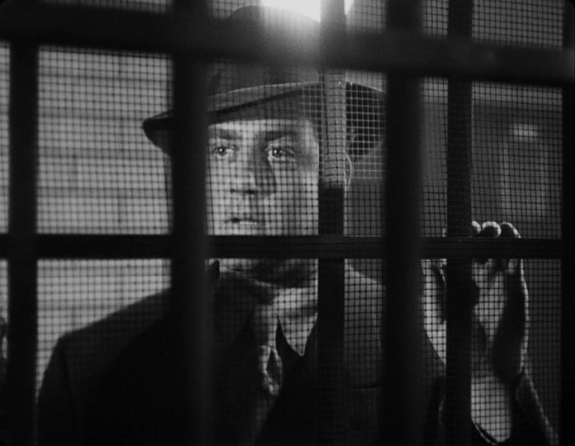
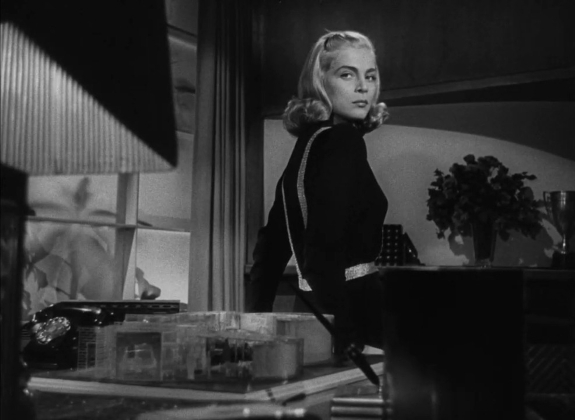
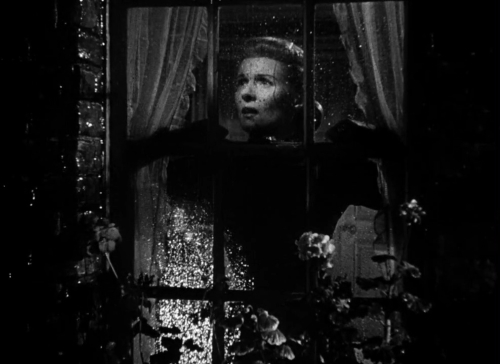
Johnny Forbes (Dick Powell) is a man who ought to be happy with his lot in life. He’s got a devoted wife (Jane Wyatt) and a bright young son. He’s got what appears to be a successful career in insurance and lives in a neat and attractive suburban home. What could be better than waking up to a breakfast that has been prepared and laid out before him, with his family around him, the sun pouring through the window and the promise of another relatively carefree day ahead. That’s how it should be, but the pain of predictability is etched into the hangdog features of Johnny Forbes as he contemplates it all. Both his demeanor and his conversation betray a man ripe for rebellion, a guy who has wearied of respectable averageness, of being part of the backbone of society. Such a man is just a step away from recklessness, he’s practically sleepwalking into peril. A visit to an embezzler’s ex in order to see how much can be recovered is all it takes. The ex in question is Mona Stevens (Lizabeth Scott), a model in a dress store. The hook that snags Forbes comes in the form of a trip to the marina to see the boat Mona’s boyfriend bought her with the money he stole. Just a smile from the girl and then a quick ride in the speedboat are enough – Forbes is soon asking her out for drinks, and it doesn’t take much imagination to realize where all this is heading. The affair itself only goes so far though, and not necessarily due to any moral qualms on the part of Forbes at this stage. A bigger issue is the fact that the private eye employed by the insurance firm to track down Mona Stevens in the first place (Raymond Burr) is besotted with her to the point he not only roughs up Forbes, but is also prepared to destroy anyone who stands in the way of his desires.

André de Toth made a handful of films noir and I think this is the best of them, although a strong case can be made for Crime Wave too. He perfectly captures the sheer ordinariness and regularity of suburban life, its bright and brisk order imparting a feeling of living on a well maintained social conveyor belt. Everything operates like clockwork, including the people. Dick Powell perfectly captures the ennui of a man gradually becoming just another obedient automaton. Everything about him screams normality, his quiet tailoring, his discreet briefcase, and the inevitable slow slide towards middle-aged and middle-class mediocrity that accompanies all that. This is no disillusioned veteran either – he was no decorated war hero like the father of his son’s friend, he rode out the war in Denver, Colorado – just an everyday guy who has come to the appalling conclusion that this is all he’s ever going to be. When he wrinkles his nose at the comic books he reckons have given his son nightmares it’s hard not to see a bit of resentment in it for not being one of those colorful figures himself. It is to De Toth’s credit that there is never any overt call to pass judgement on this man, no nudge towards any moral superiority or cheap finger pointing. Film noir works best when characters are portrayed as people with flaws who sometimes makes poor choices that the audience get to witness. Navigating life can be an ambiguous business at best and the better noirs seek to capture that incertitude rather than encourage self-righteousness.

The portrayal of the two female characters in Pitfall is interesting, and the movie offers good roles for both Jane Wyatt and Lizabeth Scott. There are those who say film noir must have a femme fatale, that it’s one of the vital ingredients. I’m not sure that’s true, and I’m also not sure if Lizabeth Scott’s Mona Stevens should be characterized as such. Yes, she draws the men in the movie into danger, fatally in one case at least and the ending leaves it open as to whether or not that’s going to apply to another as well. Still, if she is a femme fatale, she is surely a reluctant one and arguably a victim of both her own weakness and the limited options open to a woman like her at that time. She acts as a magnet for negative forces, drawing danger to her without actively wanting to. Jane Wyatt as the wife is a tougher, more grounded and practical creation. All the way through she remains focused on the security of the family unit. It’s quite a clinical piece of work by Wyatt and the cool way she appraises the benefits and drawbacks of each new development that assaults her existence contrasts with the reckless opportunism of Powell and the emotional helplessness of Scott. Raymond Burr gets the creepy obsessiveness of his character across well, manipulating everybody and maneuvering them like chess pieces towards an endgame that will profit only him. The scene where he stalks Scott in the salon where she works is masterly in the way he humiliates her in plain view yet maintains a wholly innocent air. His bulk and physicality is employed effectively too, filling and almost overwhelming Powell’s office when he visits.

1948 was a particularly strong year for film noir in Hollywood, maybe one of the strongest, and Pitfall sits comfortably among the leading pack. Nobody puts a foot wrong in this movie and the script has no flab or slackness about it. It is a tight, direct story that asks plenty of questions but offers up no easy answers. In short, it’s a good movie and one worth watching.

I Walk Alone

You know, Noll, I think you’re afraid now. And I’m not. Frankie with his bootleg liquor, me with those checks I forged, you with this set-up here. Everyone trying to get something for nothing. Frankie paid, I paid. It’s your turn now…

Checks and balances, adding a bit here, taking away a bit there. The books and the by-laws, a new post-war landscape where the sheen of legality is little more than a patina, a glossy veneer to add on top of the old rackets to create the illusion of respectability. I Walk Alone (1947) trades heavily on that highly polished hypocrisy, presenting a world of glamorous nightclubs where sharp suits and elegantly gowned ladies in superficially smooth surroundings seem to have taken the place of the rough and tumble hoods of Prohibition. Still, the high class tailoring and drapery only offer a limited disguise for the muscle, corruption and decadence. The world depicted here, at least that which is seen through the eyes of the protagonist, is one which has been flipped on its head, where none of the old certainties hold any longer and hoods hide and mask their actions with a web of financial chicanery. Plus ça change…

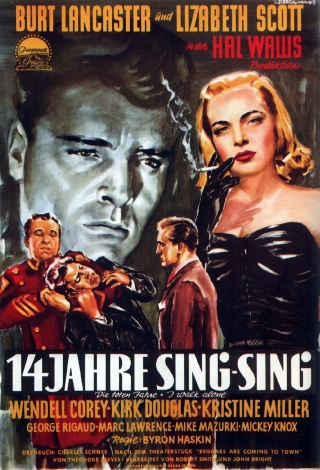
Frankie Madison (Burt Lancaster) is just out of prison and he’s sore. He has served 14 years and now he’s looking to collect on what he feels is his due. To that end he heads to the glitzy Regency, an upmarket nightclub run by his old partner in crime Noll Turner (Kirk Douglas). The fact is Frankie and Noll made a deal just before the former was picked up and sent up the river to split their profits straight down the middle. However, in all those years the only thing Frankie ever received from his old partner was a carton of cigarettes every month, not even one visit. He figures he’s owed, and there’s a little voice just starting to murmur insistently that maybe Noll plans to gyp him out of the rich pickings that have since come his way. Why? Well for one thing there’s the nervy attitude of his friend Dave (Wendell Corey), a man who has been becoming gradually more neurotic over the years and who visibly pales whenever any mention of the unfortunate fates of those who had crossed up old acquaintances crops up. Then there is Noll himself, genial and velvety in his solicitude yet watchful and calculating at the same time. When he arranges for his torch singer mistress Kay Lawrence (Lizabeth Scott) to charm Frankie and coax information from him over a carefully staged intimate dinner all the pillars of a setup have been put in place. Slowly the full extent of Noll’s self-serving duplicity dawns on Frankie, and he’s soon to discover that the, arguably more honest, strong-arm tactics he would once have relied on to get results are now hopelessly inadequate when faced with an updated criminality, one that subverts the law to serve his purposes.

I Walk Alone offers a classic noir framework: a man who has been away for an extended period of time returning to a world that is recognizable on the surface but which has in fact been radically altered at the core. If one is to see mature film noir as an artistic reflection of the post-war perceptions of the returning veterans, then this is something of a textbook example. It’s hardly a stretch to see parallels between Frankie Madison’s sense of being frozen out and the struggles of a whole generation to rediscover its place and role in a society that must now have felt odd and alien. There are two scenes which takes place in Noll’s office underlining the societal shifts that have taken place and the frustration of trying to deal with this.

First up, there is Frankie’s confrontation with Noll when he learns how he’s been stiffed and is getting the brush off. He resorts to his old two-fisted approach, laying one on his former buddy and storming out fired up with indignation and plans for retribution. Then later, having cobbled together a ragtag bunch of would-be enforcers courtesy of another old confederate (the instantly recognizable pockmarked Marc Lawrence), he sets about muscling what he’s owed out of Noll. However, this is the point where he comes face to face with what can only be viewed as a corporate minefield, an impenetrably complex series of cutouts that serve only to emphasize the absolute inefficacy of Frankie’s brute force methods in this brave new world. To witness his enraged impotence is akin to watching a bull elephant in its death throes, and the humiliation is compounded and completed when Mike Mazurki’s hulking doorman hauls him out to the back alley to hand him the beating of a lifetime.

Nevertheless, this acts as a catalyst, striking the scales from the eyes of Dave and Kay and helping to galvanize Frankie into taking genuinely effective action. As such, the movie tosses a lifeline of sorts to those ruing the passing of a more straightforward age. There is the hope held out that the conmen and the chiselers would get their comeuppance, that some sort of justice would prevail, which may be considered as diluting the noir sensibility. Maybe, or maybe the late 1940s didn’t fully encapsulate, or not as fully as we’re led to believe at any rate, the kind of existential despair that is frequently cited as the basis of noir. Perhaps the world today where gaslighting fraudsters and incompetents sit unchallenged at the top of the heap is the real noir era. Perhaps.

I Walk Alone was the first collaboration between Burt Lancaster and Kirk Douglas, and the fact they played so well off each other makes it easy to see why they appeared together with such regularity over the following four decades. Lancaster’s star rose faster and he was receiving top billing at this stage whereas Douglas was still working his way up, albeit strongly, in supporting roles. Lancaster uses his physical presence very effectively, and there is that vulnerability too beneath it all that was brought out very successfully in these early Hal Wallis productions. Douglas is less imposing in physical terms but he has that menacing air, principally via his voice and those sharp eyes. Lizabeth Scott is fair but that’s about it, her smoky-voiced allure is always welcome though and she was made for slinking around nightclubs singing throaty odes to ill-starred romances. Wendell Corey did a nice line in whey-faced fear, that and indignation were his strengths and he gets to exercise both as the guilt-ridden bookkeeper.

After a few early efforts as director Byron Haskin spent two decades as a cinematographer and effects man. I Walk Alone signaled his return to directing and from that point on, barring a few blips, he embarked on a remarkably solid run right up until Robinson Crusoe on Mars in 1964.  It is a very entertaining movie, well cast and beautifully shot by Leo Tover. It both links to and contrasts with the old 30s gangster movies and the film noir mood and aesthetic of the time. Until Kino brought the movie out some years ago it was one of those titles that appeared to be destined to remain mostly talked about or featured in books on noir rather than actually seen. Happily, that is no longer so and I recommend giving it a look.

The Fallen Idol

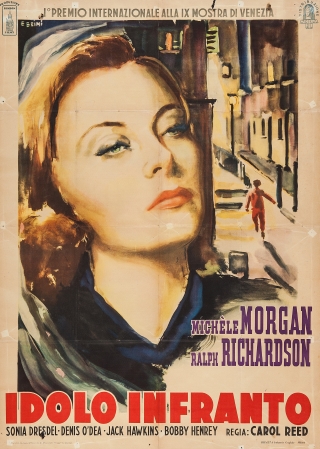
Is it possible to encapsulate the cinema of a nation in just a word or a phrase? I guess received wisdom, or maybe some sense of deference to the depth and breadth of most cultures, would nudge many people towards a negative answer. Still and all, I think that sometimes the essence of a nation’s approach to filmmaking (and the artistic temperament that lies back of that) can be neatly summarized thus. While this idea has occurred to me before, it was while I was revisiting Carol Reed’s The Fallen Idol (1948) the other day that I found myself mulling it over again. The movie itself is one of the director’s finest, a study in suspense and longing, a powerful melodrama observed primarily through the eyes of a fanciful child and shaded accordingly. And so it was that as I watched the drama play out the word “quiet” floated insistently into my thoughts. Somehow that quietness, or restraint if one prefers, that pervades the film felt like it was actually a byword for the best offerings of British cinema.

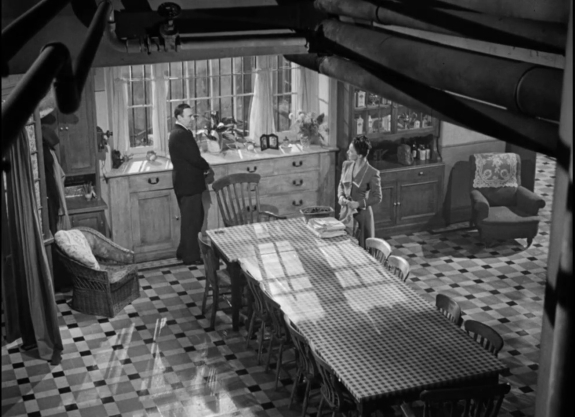
Belgravia, a location that exudes solidity, tradition and indeed diplomacy. Those imposing structures with their sense of permanency and the home to many an embassy have something of that quiet dignity I referred to about them. There’s an orderliness to it all, and what better way to put a human face on that concept than to represent it in the shape of a very proper English butler. Such a figure is familiar to almost everyone via literature, film and television if not in the flesh. He exists as a link of sorts, offering a vague connection between the present and some distant semi-feudal past, between high born aristocrats and the ordinary citizen. He is, in short, soft-spoken, impassive, dignified and authoritative, a paragon of decorum. Or is he? Is it right or reasonable to label any man a paragon of anything other than the mass of foibles and feelings that make up his inner self? Baines (Ralph Richardson) is the butler in the household of the ambassador of some unnamed nation. He is efficient and intelligent, diligent and charming. And his private life is a tangled mess of bitterness, betrayal and seemingly impossible passion. His marriage is a barren and loveless wasteland, a stale and frequently argumentative co-existence with a wife (Sonia Dresdel) who has grown suspicious and discontented. On the surface, his relief from this emotional desert comes via the whimsical and easy-going rapport he has developed with Philippe (Bobby Henrey), the lonely and over-imaginative son of the ambassador.

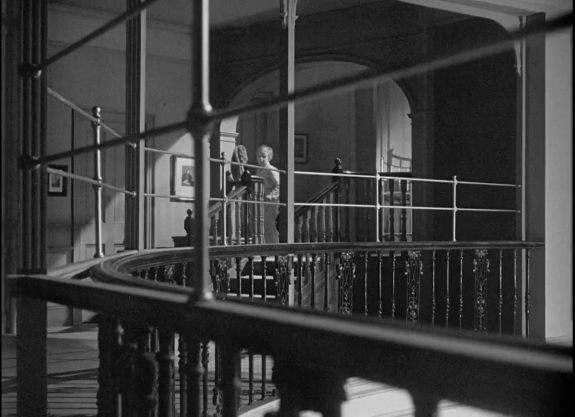
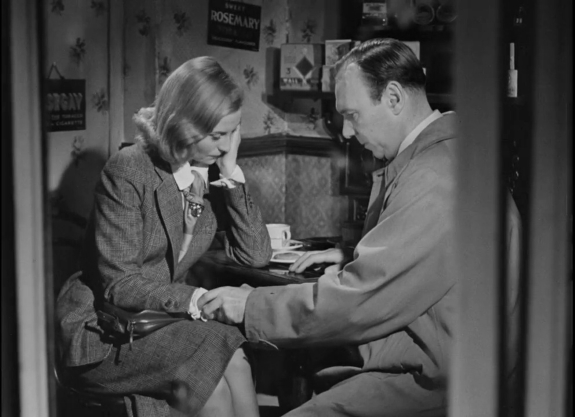
Nevertheless, as is so often the case in life, the image presented to the world at large tells only half of the tale. The Baines who ensures the smooth and comfortable running of his employer’s home, the spinner of yarns for the eager ears of a credulous and adoring Philippe has another outlet for the emptiness he experiences. He is quietly and discreetly engaged in an affair with Julie (Michele Morgan), a typist at the embassy. This fact is revealed by accident when Philippe innocently follows his hero one day and chances upon the lovers meeting quietly in the mundane setting of a nearby tea shop. Such is the simplicity and ingenuousness of childhood that the nature of the relationship is lost on the youngster and he happily and unquestioningly accepts that Julie is Baines’ niece. Still, the complications of the adult world must inevitably intrude as suspicion and desperation lead to confrontation. In that adult universe, jealousy and longing make for an explosive combination as the truth is inexorably brought to light. The audience see the argument between Baines and his wife all the way through and know how it resolves, but the boy (reflecting the half-understood perceptions of the very young) witnesses only part of it, fascinated and frightened by the heightened emotions laid bare before him. As he scrambles up and down the fire escape, peering in dread through the windows while the argument rages within, he misses out on the crucial moment and sees only the lethal consequences. Carol Reed’s direction is superb not only during these set piece scenes, but all the way through. The subsequent investigation, the possibilities that gradually emerge, the doubts and fears of all concerned are conveyed with marvelous subtlety. The master stroke of course is the way the entire thing is viewed and presented through the prism of a child’s faltering awareness and mounting despair.

Aside from that marital spat that leads to tragedy, the quietness of it all dominates. While I feel this is a quality that pervades British cinema of the era, it is clearly a deliberate stylistic choice on the part of the filmmakers here. Many key exchanges are only half heard, uttered softly and intimately, with the kind of discretion that is the specialty of lovers or close confidantes, or indeed professionals who live by a code of caution. The conversations are frequently sotto voce, heard in snatches and presented with the contrived nonchalance adults sometimes adopt to shield the very young from the harsh complexities of life. This air of calculated concealment sets the mood for the picture precisely because it is a story seen from the standpoint of a small boy. It’s evident in the interactions of the trio of policemen, not least Denis O’Dea’s gently probing inspector, though ably supported by a watchful Jack Hawkins and a humorous turn from Bernard Lee as the interpreter whose talents appear questionable.

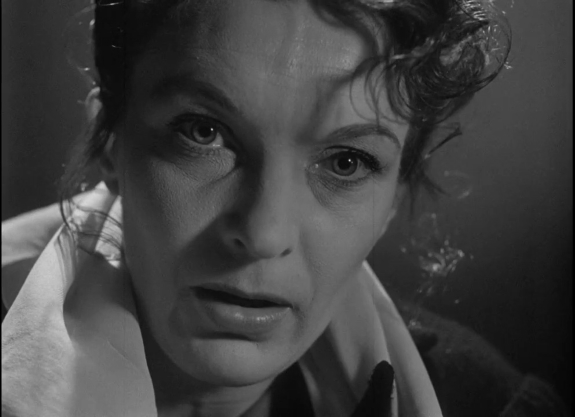
Ralph Richardson delivers a performance that is that is wholly authentic, displaying an outward bounce and buoyancy to charm and beguile a wide-eyed Philippe – so memorably portrayed by Bobby Henrey. Richardson sails rather close to eccentricity in these moments but he does so in such an attractive fashion that it doesn’t especially matter. He layers the character beautifully too and that sad little scene played out in the tea shop is heartbreakingly poignant in its restraint, and arguably because of it. It’s not just some stiff upper lip pose either but rather it’s a barely suppressed emotional crisis held in check largely due to the presence of the young boy who couldn’t possibly comprehend or grasp the powerful passions ebbing and flowing across the table before him were they to be let loose. Michele Morgan does fine things with her eyes and voice to supplement all this but it’s Richardson who owns the scene, who wrings truth out of the simplicity and ordinariness of the setting; that turning away when Julie exits, the fiddling with the newspaper, the shuffling round the shop his eyes downcast as he struggles to master the despair that threatens to overwhelm him is suffused with gut-wrenching pathos. But so very quietly.

The Fallen Idol was the first of three adaptations of works by Graham Greene that Carol Reed brought to the screen. The Third Man is undoubtedly the most highly regarded of those, but The Fallen Idol is every bit as good in its own way. Actually, when one pauses to remember that those two movies preceded by Odd Man Out were all made one after another between 1947 and 1949, it really does serve to highlight Reed’s greatness as a filmmaker. I don’t believe there’s any doubt that this is a movie everybody should make the time to see.

To Have and Have Not

“Was you ever bit by a dead bee?”

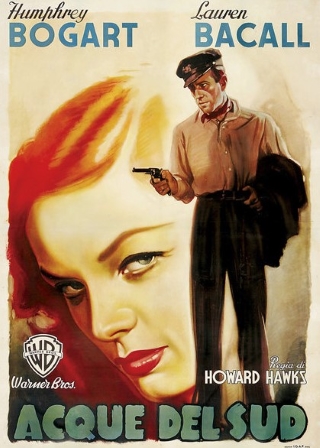
It’s tempting to use the more familiar, suggestive lines about matches, whistling and so on as an opener to the Howard Hawks adaptation of To Have and Have Not (1944). However, that business with the bee, uttered several times by Walter Brennan’s craftily befuddled rummy and later parroted by a smokily seductive Lauren Bacall feels like a better way in. Howard Hawks favored movies about tight knit groups, like-minded types who were bound together by a commitment to do whatever has to be done as well as holding some shared notion of personal honor. They should be people who live by their own code, and who recognize almost instinctively those who belong in their club. Well any such club ought to have a code word or phrase, one known to or capable of being interpreted correctly by their comrades. And so it is with Brennan’s bee shtick – the select band of “right guys” is neatly delineated as those who see the question for what it really represents and who in turn just know how to respond. There’s a lot of Hawks in that line and what it signals. As such, it seems apt to use it to lead into a movie which has more of Hawks in it than Hemingway.

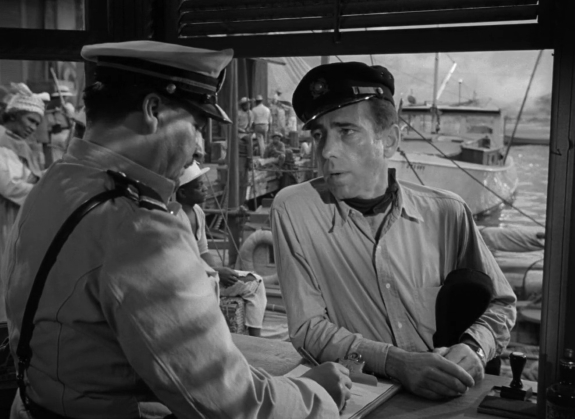
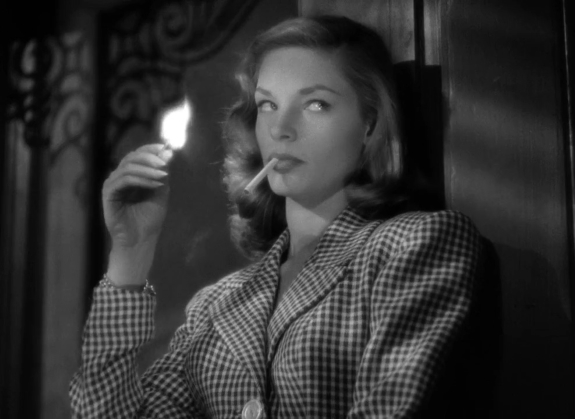
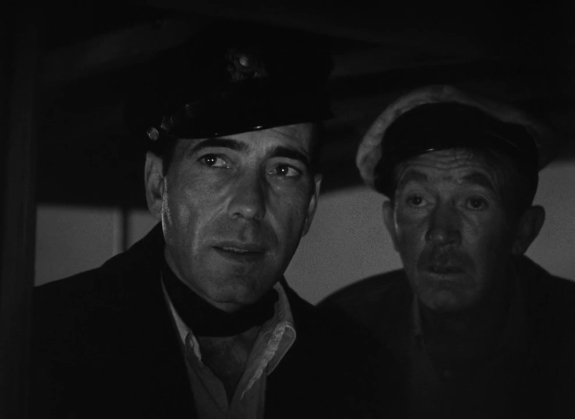
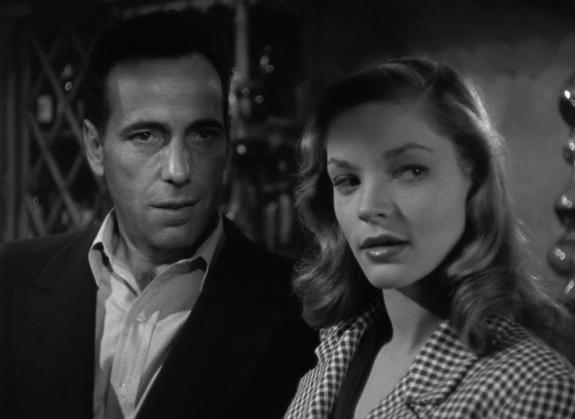
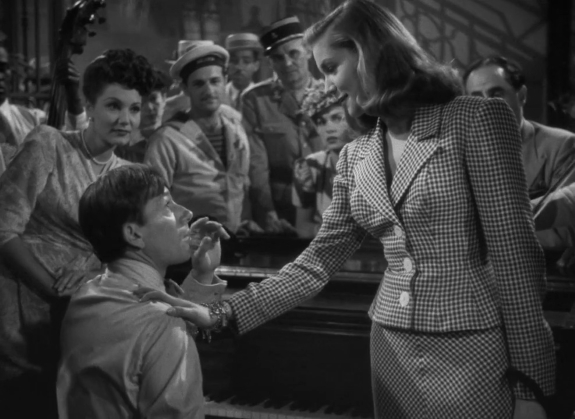
Is it noir? Is it a romantic thriller? Is it a slice of polished wartime propaganda? I guess To Have and Have Not is a little of all of these, but not only is it recognizably a Howard Hawks film, it’s also the movie that introduced Bogart to Bacall and the movie watching public to a cinematic partnership that transcended the silver screen. All of this would make it an important piece of work even if the film itself had been less than satisfactory. Fortunately though, that’s not the case as the whole concoction succeeds in checking every box. From the moment Franz Waxman’s instantly memorable score, dripping intrigue and danger, segues into the caption that informs us we’re about to descend on a delightfully ersatz  Warner Brothers approximation of wartime Martinique we are hooked as fast as one of the marlins Harry Morgan’s clients pay big bucks to pursue. Morgan (Humphrey Bogart) is skipper of a charter fishing boat and our first glimpse of the man kind of sums up the classic Bogart persona – insolent, sardonic and independent, openly contemptuous of the pettiness of officialdom yet careful not to push what luck he has left too far.

Hemingway’s novel was a dark tale of a down on his luck man running anyone and anything that looked like turning a buck out of Cuba in the pre-war years. The story is that Hawks once told Hemingway that he reckoned he could make a successful movie out of the author’s worst book and he settled on To Have and Have Not to prove his point. Now I don’t know whether or not this was in fact Hemingway’s worst book – I tend to think nothing he wrote could be termed as objectively bad – but I can say it’s the one I enjoyed less than any of the others. It’s a short book, but the tone is largely grim and dour and I’ve not felt the urge to revisit it since I last read it perhaps a quarter of a century ago. Hawks’ movie, with a script that was worked on first by Jules Furthman and then later by William Faulkner, uses the novel as a jumping off point at best, where Morgan gets gypped out of a fee by a slippery client and a stray bullet fired by a Vichy gunman. It leaves him out of pocket and, having just made the acquaintance of fellow drifter Marie Browning (Lauren Bacall), of a mind to stick one in the eye of the Vichy collaborators.

From this point on there’s not much of Hemingway in it but lots of Hawks, and of course the electric central pairing. It develops into a romantic adventure with a hint of Casablanca about it all – a totemic yet rather bland freedom fighter complete with attractive wife trying to stay a step ahead of the fascists, Axis villains, and a reluctant and essentially isolationist hero who comes to realize that this is an unsustainable position. Aside from an interlude on Morgan’s boat involving a near fatal encounter with a gunboat on a foggy night, most of the action takes place in the hotel, shifting from bedrooms to bar to cellar, all punctuated by a succession of provocative quips, as well as the shared ritual of lighting cigarettes and intermittently moody visuals, while Hoagy Carmichael tinkles away at How Little We Know in the background. There is that deeply satisfying feeling of convergence about it, watching an essentially ill-assorted group draw closer together and gel when faced with a common enemy. This was always attractive to witness, but nowadays it’s difficult not to feel even more wistful about a time when it was widely believed that the only decent thing to do was to oppose rather than lionize authoritarian bullies.

Bacall was, by her own admission, awed by the whole business and apparently hit on the “chin down, eyes up” pose she makes such effective use of as a means of holding those jitters in check. If so, it was a remarkably successful piece of improvisation and goes a long way to kindling those sparks struck whenever she shares the screen with Bogart. Her introductory scene, smouldering in the doorway, is as good as any actress ever got and I think it’s fair to say it followed her around for the rest of her life. Bogart was right at the top of his game at this point and probably at the height of his fame too. He displays such ease and composure in the front of the camera in this movie, every gesture timed to perfection, every beat of his dialogue struck  – tough, lonesome and noble in spite of himself, this as much and maybe even more than Rick Blaine is his signature role.

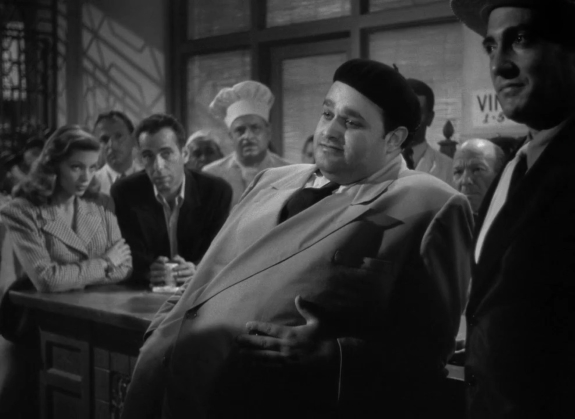
The A pictures of the classic era all benefited enormously from the hugely experienced crews that worked behind the cameras. It’s one thing to have someone like Hawks in the director’s chair, but having people like Furthman and Faulkner working on the script, Franz Waxman providing the score, and safe hands such as Sidney Hickox looking after the cinematography provide a solid base. And then there were the character players, moving from picture to picture, largely unsung but helping to hold it all together. Walter Brennan was one of the greats, a three time Oscar winner, and his twitchy rummy, veering from wide-eyed wonder to something approaching a sly worldliness makes for a terrific foil to Bogart’s slouching hero. Marcel Dalio as the hotelier with underground connections feels like a first cousin of the harried croupier he played in Casablanca. Another alumnus from that movie, Dan Seymour, plays the secret police boss Renard as though Sydney Greenstreet had swallowed Conrad Veidt, sinister, bulky and malignant. The frequently loud and boorish Sheldon Leonard is more subdued as Seymour’s lieutenant, tossing in the odd line but mostly alternating between glowers and leers in the background. Hoagy Carmichael is a memorable presence too, the wonderfully named Cricket forever chewing soulfully on a toothpick and dispensing tunes and philosophical advice as the mood strikes him.

As this will be my last entry for 2024, I wanted to finish the year with a look at a movie that never gets old for me. Surely there are few better ways to spend one’s time than hanging round a waterfront bar in Martinique learning how to whistle. So thanks for stopping in over the last twelve months and here’s hoping everyone has a good 2025.

Other posts I have written on the Bogart & Bacall movies can be found here:
The Big Sleep
Dark Passage
Key Largo

Daisy Kenyon

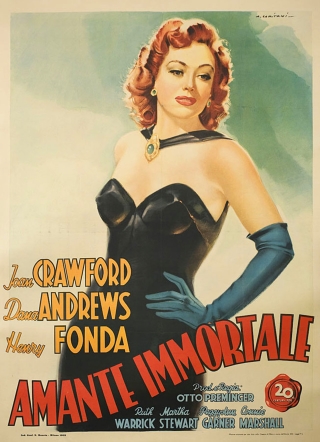
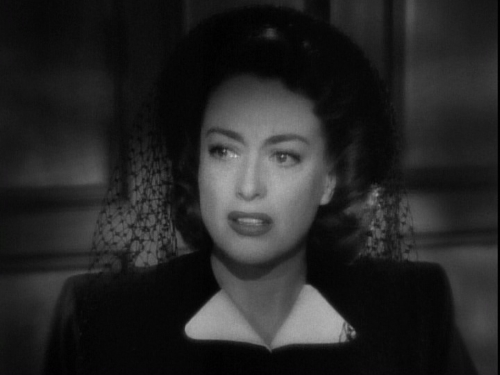
The magic of marketing – hang a label on a movie, point to the genre pedigree of the headline stars, and the director for that matter, and and there we have a film noir. Or actually we don’t, we have a film sold as such, at least it was back when Fox Film Noir was an ongoing line in the heyday of DVD releasing. Daisy Kenyon (1947) is a very well made and enjoyable post-war romantic melodrama but regardless of what it says on the tin, it’s certainly not a film noir. OK, having got that out of the way, I do want to take a look at a movie which sees three top stars all doing excellent work with one of Hollywood’s finest directors and getting plenty of mileage out of that frank openness about human relationships and bloomed in the years following WWII.

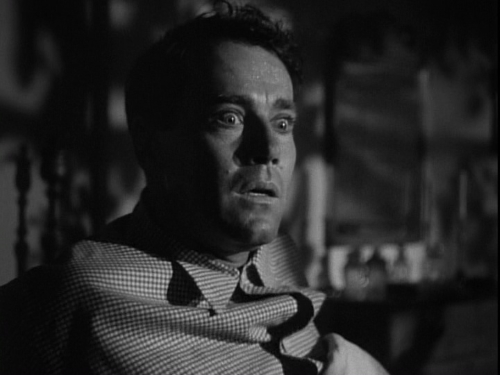
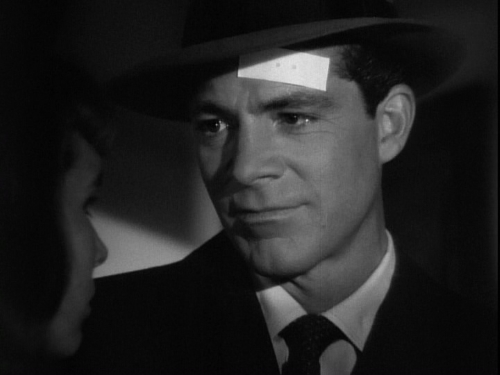
There is something attractive about frankness, especially with regard to those relationships that might be seen as falling below contemporary standards of propriety. Otto Preminger was always good at bringing such material to the screen and there’s a refreshing lack of judgement on display as we follow the complicated and meandering love lives of the three principals. At the center of it all is Daisy Kenyon (Joan Crawford), an unwed artist who has been carrying on an affair with a married hotshot lawyer, Dan O’Mara (Dana Andrews). Right from the first scene it’s apparent that this is unsatisfactory, from Daisy’s perspective anyway. She’s not stricken by guilt or remorse or any of the other trite reactions typically forced upon characters in this position. No, she’s just tired of taking second place whenever some important business or social engagement arises, and of course time is not in the habit of waiting around for anyone. With this in mind, she has one of her periodic spats with O’Mara and sets about preparing for a date with a new romantic prospect. Peter Lapham (Henry  Fonda) is a soldier and one time boat designer. In one of those delightfully quirky scenes that punctuate the movie, both her suitors run into each other in the doorway and wind up using the same cab to shuttle back and forth, just not together. The romantic rivalry between the two men hasn’t grown any teeth at this stage, that will come later but there is a quality to it from the off that I can only describe as screwball drama. If O’Mara is not the ideal pick for Daisy given his marital commitments, Lapham has other issues. it’s not explicitly stated but he’s clearly affected by PTSD, as well as a degree of guilt/remorse for the death of his wife. I don’t want to go into too many details here, suffice to say the story devolves into a kind of contest for Daisy’s heart with the well-being and contentment of O’Mara’s children as a form of collateral up for negotiation. Maybe the outcome isn’t entirely surprising but the road that takes us there is pitted with plenty of drama, a sprinkling of black humor and a liberal dose of good old-fashioned empathy.

Preminger blends this all expertly, getting first class performances from his three leads. Henry Fonda was rebuilding his Hollywood career after wartime service in the navy. He would make My Darling Clementine and The Fugitive for Ford and then Fort Apache, with this movie and The Long Night giving him the chance to work with other directors in between. He brings something slightly offbeat to his role, an attractive quality which while not quite offering the lush oddness to be found in William Dieterle’s wonderful Portrait of Jennie and Love Letters is satisfyingly quirky and somehow authentic. Andrews is more grounded, less ethereal in his part. He’s driven by a desire that feels vaguely juvenile in its approach – as Crawford tells him late on, he’s as much spurred on by a need to escape responsibility as any need to achieve stability. Still, that unrest that Andrews was so adept at harnessing is always bubbling just below the surface. Crawford was riding high after her success in Mildred Pierce and gives a performance that is confident and credible. The fact is all three play off each other in a way that engages rather than overwhelms the viewer. Add in Leon Shamroy’s evocative camerawork and a characteristically classy score from David Raksin and the result is a polished and meaningful piece of filmmaking.

As I said at the start, Daisy Kenyon is not a film noir and I’m not sure how it came to be marketed as such. Perhaps it’s the combination of the reputations of the stars and director alongside some shadowy cinematography. The old Fox DVD sported a middling transfer, with some very blurry sections. I can’t say for sure whether or not this was intentional yet I doubt it somehow. Even though I understand the later Kino Blu-ray exhibits the same, I suspect print damage of some kind is more likely at the back of it. However, none of that should spoil one’s enjoyment of the movie. The DVD (and I think the Blu-ray too) has some worthwhile supplements with short features on the making of the movie and on Preminger’s career. Among the contributors is the always welcome and interesting Foster Hirsch  – revisiting this movie and listening to his comments has reminded me that I need to pick up a copy of his book on Preminger. I think anyone who hasn’t seen this film will find it a rewarding watch. Just don’t go in expecting to see a film noir.

Viewing Notes – Woolrich

Cornell Woolrich was the king of nightmare noir, his fables of fate and downright rotten luck, where everything than can go wrong does go wrong,  follow his hapless characters on a perpetual downward spiral. The accompanying sense of dread and doom makes for first rate film noir and a fair number of his novels and stories have been adapted for the screen over the years. I’ve featured a few on this site:

The Leopard Man

Phantom Lady

Black Angel

Night Has a Thousand Eyes

No Man of Her Own

Recently, I found myself viewing a handful of other screen versions of his work and thought I’d just post a few brief comments on them rather than full scale write-ups of the individual titles.

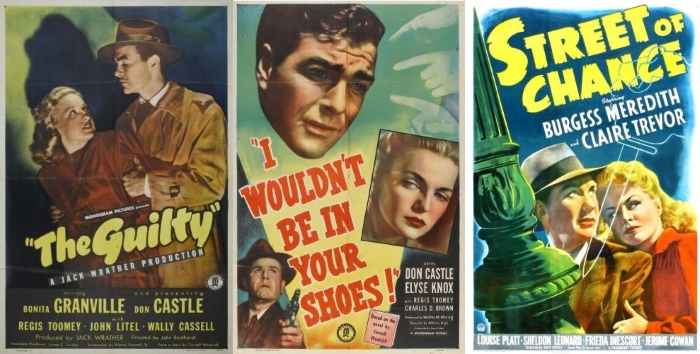
The Guilty (1947)

Jack Wrather was an oilman who decided to try his hand at producing films. While working on The Guilty he met and then married the leading lady Bonita Granville, a former child star who had drifted into B movies. She played identical twins in The Guilty, one of whom is a good girl while the other is most certainly not. The lead was taken by Don Castle, an old friend of Wrather’s whose career didn’t seem to be going anywhere after he’d returned from WWII service. Castle had what I’d term an effective noir persona, a slightly weary charm that felt as though it were only a step or two ahead of desperation. Granville is good enough in her dual role, and the ever reliable Regis Toomey makes for a credible cop. Director John Reinhardt makes the most of the budget and flashback heavy story, wrapping the whole thing up in little over an hour.

I Wouldn’t Be in Your Shoes (1948)

A year later both Castle and Toomey would appear together again in this adaptation, scripted by Steve Fisher and directed by William Nigh, for Monogram Pictures. The flashback technique features once more in this doom-laden tale that opens in the death house with Castle portraying another lucked out type, a dancer who can’t seem to catch a break. He spends his last few hours before that last lonely walk thinking back over how he got where he is. Meanwhile, on the outside his wife lurches between hope and despair as she tries to use what time is left to prove his innocence. Cats, shoes and obsessive love all figure strongly in a satisfying little movie.

Street of Chance (1942)

This movie opens with the main character getting clobbered by some debris falling from a building site. He’s not badly hurt but he does black out temporarily and subsequently discovers he’s not the man he thought he was. In brief, he’s suffering from amnesia and has been living a double life with two very different women, Claire Trevor and Louise Platt. In itself, this is hardly an ideal situation but it takes on that nightmare quality characteristic of Woolrich stories when he comes to realize he’s a wanted man, hiding out and on the run for a murder he has no recollection of committing. This is a strong premise (adapted from the novel The Black Curtain) and directed by Jack Hively, a man who called the shots with  George Sanders as The Saint on a number of occasions. Amnesia generally makes for an intriguing basis for noir and typically offers up lots of possibilities for drama and tension. Any picture with Claire Trevor is usually worthwhile too so the ingredients are undeniably promising. Overall, this is an enjoyable film although I have to say I don’t believe Burgess Meredith was leading man material – while I enjoy his work in character parts, I find he’s too quirky and frankly strange to be the lead. This same story was adapted again for television as part of The Alfred Hitchcock Hour and directed by Sydney Pollack. That version had Richard Basehart in the lead, another figure with strong noir credentials and I think he’s actually a better fit for the role.

There was a time when it was practically impossible to see these movies, and the thought of being able to do so in good quality was almost the stuff of fantasy. However, thanks to the efforts of Flicker Alley, Warner Brothers and Kino respectively all of them can now be enjoyed with excellent transfers. None of them could be classed as major films, but they are all very enjoyable and entertaining detours into the world of Woolrich.

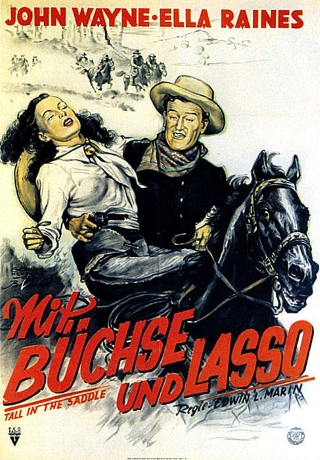
Tall in the Saddle

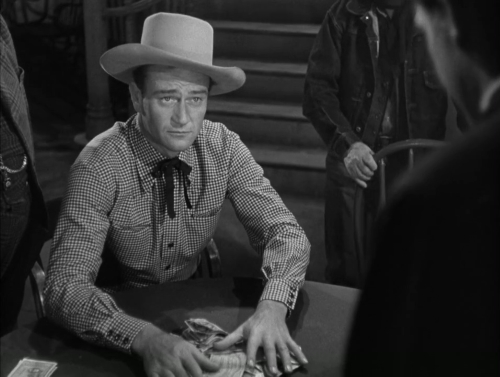
Maybe I should have been an engineer. Or perhaps not. Bridges and links and halfway houses in all their forms hold a fascination for me, just not in the structural sense. If you watch enough movies, patterns emerge and it’s difficult not to think in terms of eras and their associated styles. The western continues to draw me and over the years I’ve developed a deep affection, one might even say a love of the variety that came to fruition during the 1950s. Of course no genre reaches maturity suddenly or spontaneously, nor does it do so in a uniform fashion. It’s a gradual process and a fluid one, advancing and retreating from movie to movie and this is even discernible within individual movies themselves. I think that it was somewhere in the late 1940s, when that post-war sensibility had begun to make itself felt across a whole range of genres, that the western really found its feet. However, the preceding years hint at some of the bridge building that was underway, and a film such as Tall in the Saddle (1944) is of interest in that respect. There is a distinct flavor of the breezier 1930s western to parts of it, and also a hint of what would develop in the years ahead, that latter aspect possibly making itself felt as much in the visuals as anything else. And then there is the evolution of the screen persona of John Wayne to be considered.

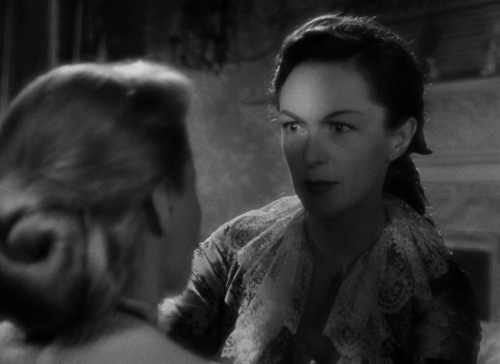
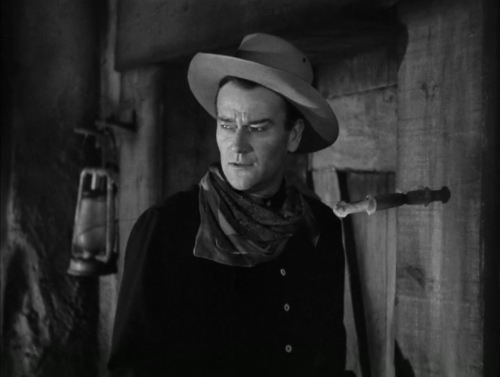
A mystery of one type or another is typically an attractive hook upon which to hang a story and a lead who is himself introduced as something of a mysterious figure is even better. Rocklin (John Wayne) is just that, a man with a surname and nothing more, hitching a ride on a stagecoach and on his way to start afresh. Bit by bit, a little more is revealed about him, but only very gradually and only that which it’s necessary for the viewer to know. This is very much in keeping with the western tradition, a figure striking out towards new frontiers, an identity defined by his actions and behavior in the present rather than any preoccupation with a past that is of no consequence. In a sense, Rocklin (and by extension the man playing him) is a representation of the West, resourceful and independent, forward-looking and unsullied by pettiness or corruption. He seems to fit right in with the ruggedness of his surroundings, simultaneously aware of the dangers and risks yet not intimidated by them. That his journey west has a purpose is never in doubt, but this is slowly revealed and only fully brought to light at the end of the picture. As we go along it’s enough for the viewer to be aware that Rocklin has been deprived of something that he had expected to find, and that he’ll not rest till he finds out who is responsible for this. The man he thought he’d be meeting has been killed and he’s now been cast adrift, the work he thought he’d be doing is no longer so appealing so he ends up accepting a job as foreman for the tomboyish Arly Harolday (Ella Raines).  I don’t want to go into too many plot details here – it’s a fairly convoluted business involving inheritances, land grabs and assorted betrayals – but suffice to say that Rocklin finds himself tangled up in local disputes and as well as one of those romantic triangles where there’s never the slightest doubt how it’s all going to turn out. I guess the point I want to make here is that the tale itself is of less interest or importance than the way it’s told and the people who are involved in the telling.

Edwin L Marin’s credits as director stretched back to the 1930s, but I think Tall in the Saddle marked the beginning of the more interesting phase of his career, one that would be curtailed by his untimely death in 1951. From this point on he would make a series of entertaining westerns with Randolph Scott, as well as a number of crime pictures with George Raft. None of these would be considered classics or anything but they are good movies overall. The script here (by Paul Fix, who also has a memorably sly supporting role) is arguably too busy, albeit with a few good lines, but Marin keeps it all moving along so that it never gets bogged down in the kind of intricacies that aren’t all that engaging. Surprisingly for a western, the interiors are more visually pleasing than the exteriors, which is probably due to the work of cinematographer Robert De Grasse, a man who filmed a string of fine genre pictures in the mid to late 1940s, such as The Body Snatcher, The Clay Pigeon, Follow Me Quietly, Crack-Up and The Window.

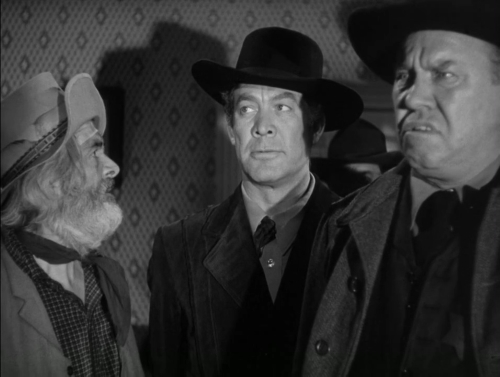
As I mentioned above, Tall in the Saddle comes across as something of a bridging exercise now, not least for the the way it slots into John Wayne’s career path. Both John Ford and Raoul Walsh had begun the process of molding that iconic image, but it would be the late 1940s before his full potential was realized. Still, Wayne’s growing confidence on screen was apparent here – his handling of himself in the action scenes, especially his confrontation of a hapless Russell Wade and the determined way he faces down and pistol whips Harry Woods, is exemplary. What’s more, there is a real spark between Wayne and Ella Raines, her spitfire allure demonstrating how well he responded to being paired off with leading ladies who were capable of giving as good as they got. Ward Bond provides good value too in one of those oily parts he excelled at. Audrey Long is an attractive if slightly ineffectual presence as the other side of the love triangle involving Wayne and Raines. In support Gabby Hayes is his usual self – personally, his shtick is something I can take or leave depending on my mood, but some will be more tolerant. Other familiar faces on display are Russell Simpson, Frank Puglia and George Chandler. A young Ben Johnson is supposed to be in there somewhere too, but I’ve never been able to spot him.
Tall in the Saddle can’t be classed as a great western, or a great John Wayne movie, but it is quite intriguing as a kind of cinematic pathfinder, strongly influenced by the films that preceded it and looking ahead to the riches the genre would unearth in the years to come as well. It’s also an entertaining and enjoyable watch, all of which makes it a worthwhile viewing experience.

So Evil My Love

Guilt, corruption and obsession. That’s a heady mix for any movie, though it could be said to be nothing out of the ordinary for film noir. So Evil My Love (1948) is a kind of film noir, more Gothic melodrama I suppose yet it’s still dark and fatalistic enough, both visually and thematically, to just about make the cut as far as I’m concerned. It is something of a hybrid in more ways than one. Leaving aside any discussion of its noir credentials, the movie is one of those Hollywood funded and produced pictures that were made on location in the UK, and in this case making use of a cast of largely British and Irish actors – although all of the principals were working mainly in the US at this point. While there is much to enjoy and admire in the movie, there is a weakness which I feel ought to be mentioned. It has a marvelous visual sheen and well judged sense of atmosphere, but there’s also one central performance that I regard as deeply problematic, though fortunately it’s not as harmful overall as the issue that blighted Caught for me.

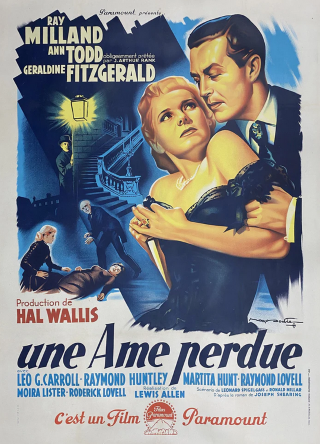
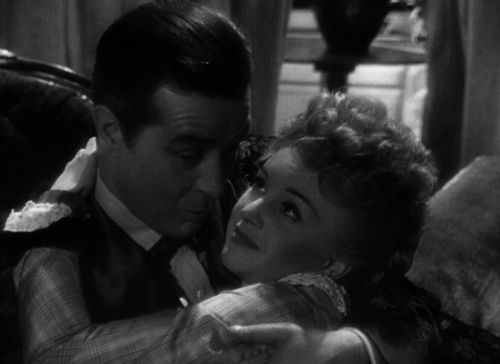
On a ship carving its way across the ocean from Jamaica to England a lone figure stands on deck, either oblivious to the spray on her face and the pitching deck beneath her or perhaps enjoying the experience. Olivia Harwood (Ann Todd) has been recently widowed, the death of her missionary husband leaving her with no option but to return home. She allows herself to be reluctantly coaxed into ministering to the ill on board the ship, chiefly one Mark Bellis (Ray Milland). On arrival in Liverpool it is immediately apparent to the viewer that Mark Bellis is perhaps not all he seems. He is ostensibly a painter, but his cautious probing to discover what, if anything, he revealed while in the throes of fever and then his determination to avoid the authorities set the alarm bells ringing. The fact is Mark Bellis (though that is merely one of the wide range of names he makes use of) is a genuine good-for-nothing, a swindler, a thief, a master manipulator, and apparently a murderer too. To such a man, a lonely, vulnerable and most likely gullible widow provides tempting game. And so it is he goes to work on Olivia Harwood, slowly worming his way into her heart while he sets about organizing his next robbery. However, the failure of that endeavor sees him altering his plans, and the beginning of his methodical and relentless corruption of Olivia. Under his tutelage, she finds herself not only taking advantage of an old friend, but also betraying and undermining her, taking a path that will inexorably lead to blackmail and murder.
The film has bags of atmosphere, with ponies clipping along cobbled thoroughfares, discharging their silken passengers outside addresses that might be mean and unforgiving or forbidding in their splendor. Wherever the characters go, their surroundings seem to crowd them regardless of whether they are immense or cramped. Somehow there is a sense of all the hypocritical baggage of the late Victorian era forever pressing and suffocating. This feeds into or fuels the feeling of fatalism that pervades the movie. Right from that first scene on the deck of the ship there is an unmistakable air of characters trapped or hemmed in by a destiny shaped by their own weakness and frailty. Mark Bellis is unquestionably a bad lot and that is never in doubt, but it is Olivia’s downward spiral that is the focal point of it all. Director Lewis Allen made only a relatively small number of movies (just 18 over a period of fifteen years) but there are some real gems in among them – The Uninvited, The Unseen, Desert Fury, Suddenly and Another Time, Another Place are all good or better in my opinion.
This is was a fairly productive and successful period for Ray Milland, coming only a couple of years after his Oscar winning turn for Billy Wilder in The Lost Weekend and he would follow this up with a pair of strong films noir for John Farrow in The Big Clock and Alias Nick Beal. This type of role, an oily and calculating charmer, was a good fit for Milland. He had the polish to carry it off convincingly and was also able to tap into a rich seam of desperation when the whispers of his typically dormant conscience grew more insistent. Geraldine Fitzgerald is characteristically fine too as Olivia’s ill-fated friend, brittle and foolish, quick to trust in her hunger for companionship and kindness, and touchingly meek in her willingness to accept her guilt.

Nevertheless, as I alluded to above, there is an issue that damages the movie seriously. The behavior of Ann Todd’s character simply fails to convince me. She is right at the center of things, the heart of the movie in truth, and both her actions and the core characteristics need to ring true for it all to work. And for me this does not happen. I can accept that obsession and infatuation is capable of driving people to places they would not normally go, but I find Olivia’s sudden decision (remember, this is the widow of a Victorian missionary we’re talking about here) to betray her friend’s confidence and the consequent acceptance of the necessity for extortion to be so abrupt as to defy credibility. What’s more, there is then far too much inconsistency on display, the character’s morality and motivation shifting almost from scene to scene. This is a writing issue of course rather than an acting matter – the script is adapted from a story by Joseph Shearing (a pseudonym used by Marjorie Bowen) who also provided the source material for Blanche Fury and Moss Rose. The latter film does have some contrived or unrealistic elements, but there’s not that inconsistency which troubles me here.

On the other hand, there are some excellent supporting turns to help restore the balance. Martita Hunt is chillingly intense as the overprotective grande dame. It is a bit of a stretch to see Raymond Huntley as her son – he was only four years her junior after all – but his cold lack of compassion is neatly done. Moira Lister sashays in and out of the tale as a trashy model whose vanity and vulgarity bring matters to a head. Leo G Carroll’s low-key detective lurks around and does his bit to draw the net tighter. And Maureen Delany, Hugh Griffith and Finlay Currie all have small yet memorable parts.

All told, So Evil My Love is a movie that works in places. There is no doubt that it has style, and some of the acting is excellent – Geraldine Fitzgerald rarely fails to impress me, for example. Still, Ann Todd’s role is an issue. That zigzagging from demure respectability to coquettish scheming and back again on the way to grim vengeance is something I just can’t buy into. Others may well regard this as less problematic. As it stands, I guess it amounts to two thirds of a good movie, or maybe three quarters if I’m in a more generous frame of mind.