The People Against O’Hara

“You can’t stop what’s coming.”

Near the end of the 2007 neo-noir No Country for Old Men the homespun truism quoted above is shared with the lead character, a man seeking to make some sort of sense out of a world that is not only passing him by but practically speeding off over the horizon. That feeling of inevitability, of random and relentless occurrences that cannot be avoided but only faced and dealt with if or when they appear, is something which has fueled film noir right from the beginning. The People Against O’Hara (1951) is one of those fatalistic studies of the inevitable, where the unraveling of a crime goes hand in hand with the unraveling of a man’s life.

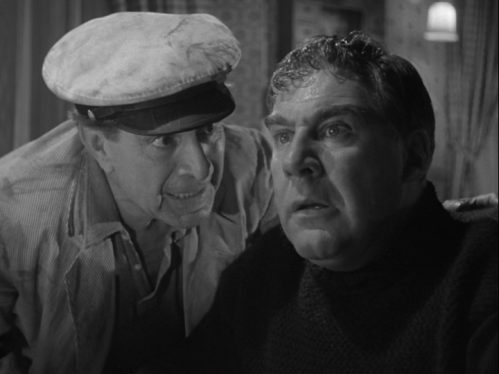
New York streets by night, rain slicked and neon drenched, a grizzled seaman contemptuous of the noisy jukebox drifts out of a bar that could have been painted by Edward Hopper. Out on the street he pauses by the kerbside and is startled by the sound of gunfire from across the way, where a killer and his victim are silhouetted in the glare spilling from a doorway overlooking the sidewalk. The identity of the dead man is soon established, and the forensics team are quick to quick to obtain evidence of who had been driving the car used for the getaway. There is no doubt about the name of the wheelman, but establishing who did the shooting may not be such a cut and dried affair. The prime suspect is the owner of that vehicle, Johnny O’Hara (James Arness). The viewer knows he can’t have done the deed as he is shown out of town trying to break up for good with a distraught and emotional girl. And there, in the words of a well-known prince of Denmark, is the rub: that clinging, desperate girl is the wife of a notorious gangland boss (Eduardo Ciannelli), a man known to visit unspeakable and horrific vengeance on anyone stupid enough to cross him. Under the circumstances, it should not come as any surprise to see O’Hara make a run for it when as yet unidentified but armed men approach him on his way home. Nor is it hard to understand his steadfast refusal to offer an alibi for the time the murder took place, not when he is charged, not when a blatantly crooked witness falsely implicates him, and not even when he finds himself on trial for his life.

Not to put too fine a point on it, this is an extraordinarily delicate situation, one requiring deft legal skills if the accused is to have any chance of beating the rap and remaining in one piece. The O’Hara family’s hopes are pinned on one man, noted attorney James Curtayne (Spencer Tracy). However, this may be a distinctly shaky foundation on which to build anything, least of all the fate of a man facing a capital charge. Curtayne has retreated from criminal trial work, the pressures and strains of which had exacerbated his alcohol dependency. Still, it’s a rare Irishman who can cast off the cloak of sentimentality with ease, and the pitiful entreaty of old acquaintances fallen on hard times is a siren call that is hard to resist. The odds are poor though; the case, despite being shored up by a wall of deceit, is a tough one, the client is paralyzed by an unholy combination of fear and nobility, the D.A. (John Hodiak) is sharp and dedicated, and Curtayne knows he is slipping, that the ground is falling away beneath him while he is too weary and damaged to regain a firm footing. It’s that inevitability, a remorseless sliding sensation, one which although it cannot be halted may yet offer one last shot at a form of redemption.

The People Against O’Hara was the first of three films that John Sturges and Spencer Tracy would make together, being followed by the better known Bad Day at Black Rock and The Old Man and the Sea. It hails from that relatively early period in Sturges’ career when he was working in all kinds of genres. He would really be in his element within a few years as the widescreen process took off and he quickly became one of its top practitioners with a wonderful eye for composition and placement. The pictures he moved on to direct often afforded him the opportunity to incorporate landscapes and outdoor shooting in general into his visual toolkit, and The People Against O’Hara also features some excellent use of genuine Manhattan locations. Having John Alton as cinematographer practically guarantees a strong visual aesthetic. Equally adept in color or black and white (his work with Anthony Mann is justly celebrated but he created some terrific images for Vincente Minnelli too, for example) he effortlessly brings a classic noir look to Sturges’ movie. The opening and closing scenes in particular are bathed in impenetrable, stifling shadow, characters in the foreground having their attention drawn into and fixed upon what Alton has highlighted deep within the background, and the viewer is hooked and reeled in in exactly the same way.
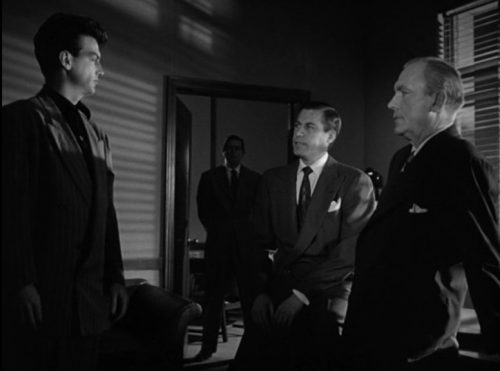
When I think of Spencer Tracy in legal dramas I automatically picture him in a couple of late career movies for Stanley Kramer (Inherit the Wind & Judgment at Nuremberg) and I suspect I’m not alone in doing so. As such, the image of characters with strong moral convictions and a deep-seated personal nobility is conjured up. Therefore, it’s something of a shock to see him don a rather tarnished crown in The People Against O’Hara. Here Tracy is not so much the staunch and steadfast pillar of legal ethics as a compromised, if not quite crumbling, monument to former greatness. He’s playing a man running on the fumes of a reputation, someone we get to meet on the downside of his career, shaken by alcoholism and ill-health and all the insecurities and frailties that come along for the ride. It’s perfectly clear that his heart is in the right place, although his willingness to head back into the criminal courts may be motivated not only by old loyalties and a sense of altruism, but also by an undeniable hunger for the old battleground and the possibility of new, revitalizing victories. So the honor and nobility are there, but they have acquired a vaguely seedy quality, coated by a film of failure and uncertainty, and Tracy communicates all that so well in those courtroom scenes where his frustration at his own faltering efforts and foggy thinking leave him humiliated and desperate, witnessing his hopes disintegrating before his eyes yet fully aware of his own impotence in the face of catastorophe. It’s that encroaching despair that drives him back towards the bottle and poor judgment, and opens the door to the dangerous road he ultimately opts for in order to justify his client’s faith and redeem himself.
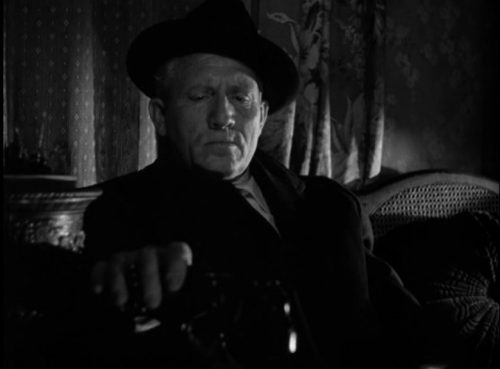
John Hodiak is quiet, competent and scrupulous to a fault as the D.A. whose professional life is, by contrast, following a very different trajectory. The easy option in a story such as this would be to have the D.A. detouring down devious or flat out dishonest legal byroads. However, the calm decency which Hodiak conveys so effectively emphasizes the crisis unfolding in the life of his rival. It is not only the clever writing though, the coolly underplayed performance makes what might have been just another clichéd role into something real and credible. Similarly, old pro Pat O’Brien portrays his veteran cop in a nuanced and sympathetic way, neither as saint nor thug but as a normal human being able to empathize with the flawed people around him. Diana Lynn’s turn as Tracy’s anxious and devoted daughter is attractively done too; her big scene confronting her father as he is on the point of crashing spectacularly off the wagon provided an opportunity to ramp up the drama and she hits the right emotional balance in those moments.

The trend in film noir in the 1950s saw a slow drift away from the dark personal dilemmas that had been commonly explored in the preceding decade towards the broader social malaise represented by organized crime. A movie such as The People Against O’Hara feels like something of a halfway house. The mob connection heavily impacts the lives of the characters but the main focus of the film remains on the trials of Curtayne, the literal one he’s fighting in the courtroom and the spiritual one being waged for his heart and soul. All told, it makes for an attractive blend. Mob related material has a tendency to lean into the showier side in general and one of the flashier performances comes courtesy of William Campbell’s cheap hood. He is all smirks and smarm, faux indignation jostling for position with sugarcoated insincerity, adding layers of slime and a sickening unctuousness. Considerably higher up the criminal food chain comes Eduardo Ciannelli. He brings real menace to his part, those saurian features hinting at medieval malice. Even little throwaway scenes like his sharp exchange with an apparent laborer careless enough to splash his expensive clothes, leading to him dismissively talking about this “paisano” and making cracks about cutting out tongues, before revealing that the pleading supplicant is in fact his own father carry a real chill. In support, Jay C Flippen’s broadly sketched Scandinavian sailor is a fun addition and there are small parts for Arthur Shields (who contributed many a telling and memorable moment in a number of films for John Ford among others), Richard Anderson and, in a practically “blink and you’ll miss him” role, a young Charles Bronson.

The People Against O’Hara was released on DVD in the US by Warner Brothers as part of the Archive Collection a decade ago, and there is a Spanish edition on the market too. It is not a film that gets talked about all that often, probably getting lost in among other more celebrated titles in the respective filmographies of Spencer Tracy and John Sturges. I like it quite a bit as it hits a lot of the themes and motifs that draw me to the movies, and the quality of the personnel involved makes it undeniably attractive.

The Man from Bitter Ridge

Treading well worn paths is a practice that tends to be looked on with a certain disdain with regard to any artistic endeavor, and with good reason. If familiarity does not necessarily have breed contempt, it can surely sap the enthusiasm and interest of the viewer. While that may be broadly true, it should also be acknowledged that watching movies is not an activity we indulge in for only one reason. As a rule, the better the film, the greater the challenge or stimulation offered, but that is not to say that  work providing the comfort and reassurance of the familiar has no worth. The Man from Bitter Ridge (1955) breaks no new ground, the situations and characters are all recognizable “types” that even casual western watchers will have seen on countless occasions. For all that though, it is the kind of movie that is hard to actively dislike.

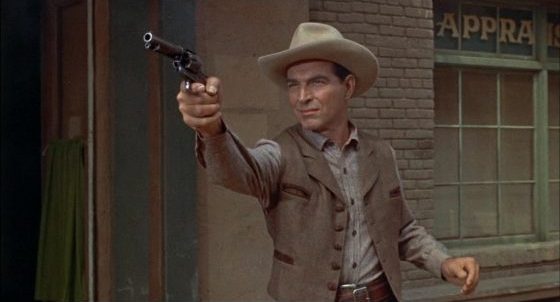
The story begins with something of a bang, namely the explosion that brings down a tree and blocks the trail of a stagecoach. The purpose is to facilitate a robbery, one carried out with precision and ruthlessness. A man ends up dead for noticing more than he ought to and the thieves make their escape. Perhaps it would be more accurate to say all but one of the thieves. A passing stranger suffers the misfortune of being held up by one of the fugitives who finds himself in need of a mount as his own horse has gone lame. This stranger is Jeff Carr (Lex Barker) and his ill-starred encounter means he almost winds up being lynched in error.  All of this happens in the first five minutes or so and a lot of plot detail is packed in here,  not least the fact the stage has been robbed by those working for Rance Jackman (John Dehner), local bigwig and candidate for sheriff in the upcoming election. To further complicate matters, the posse members who were so keen on stringing up Carr in a hurry are headed up by Jackman’s younger brother Linc (Warren Stevens). There’s probably enough story right there but the script is arguably overloaded as the idea of a corrupt man seeking ever greater power and influence is mixed in with a simmering feud between cattlemen and sheep herders, the latter group represented by Alec Black (Stephen McNally). Of course no yarn can be truly complete without some love interest, ideally involving conflict. That comes courtesy of a romantic triangle, the points of which are Carr, Black and Holly Kenton (Mara Corday), another of the sheep herders. As such, we have a decidedly tangled skein on our hands, although it is all unraveled (via brawls, gunfights, fire and fury) in a largely satisfactory manner by the time the credits roll about an hour and a quarter later.

Mention the name of Jack Arnold to movie fans and the chances are you’ll hear comments about such Sci-Fi classics such as It Came from Outer Space, The Incredible Shrinking Man or The Creature from the Black Lagoon. Nevertheless, as was the case with most directors of the time, he worked in a range of genres and turned out some fine pictures in all of them. Among his movies are a handful of westerns; Red Sundown and No Name on the Bullet are right out of the top drawer and are highly recommended. The Man from Bitter Ridge is, without question, a lesser effort. I prefer to look at a movie in terms of what it is and what it aims for as opposed to what it isn’t or doesn’t aspire to be. Still, there’s no denying that there’s not much depth to this one. I may be using the wrong label here, but I tend to think of films like this as matinee movies – straightforward, no-frills, unpretentious pictures that tell their stories in a pacy and entertaining way, no more and no less. Taken on those terms, it’s fine and does what it says on the tin. Another bonus is that “look” which is to be found in most Universal-International westerns, the visual aesthetic is appealing and (again) familiar, the very least one might expect from a cinematographer as talented as Russell Metty.

As for the performances, Lex Barker followed up his stint as Tarzan with a number of western roles and he would do further work in the genre when he later moved to Europe, especially in Germany. His role here is of a type – an undercover operative for the stagecoach company – that Randolph Scott played on more than one occasion. Of course Barker had previously been cast opposite Scott a couple of years before in the more interesting Thunder Over the Plains for André De Toth. He cuts a heroic figure and acquits himself just fine in the action scenes, of which there is no shortage, but he’s probably a bit too sunny and upbeat. Stephen McNally is his typically sharp self, assured and polished and enjoying his time as one of the good guys.

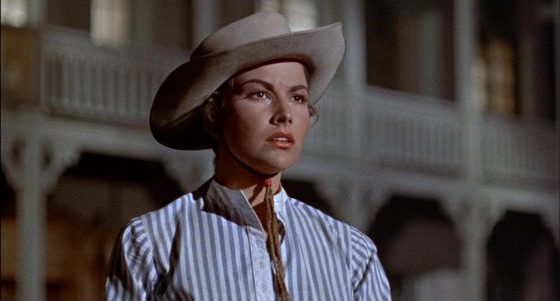
Mara Corday is an actress I am always happy to see and she is very appealing as the pistol-packing sheep farmer who finds her affections trapped betwixt and between McNally and Barker . She was in the middle of a run of generally good movies at this point, although I have to say she had a far more absorbing part in Joseph Pevney’s Foxfire that same year. With regard to villainy, it’s difficult to go far wrong when there is a solid lineup composed of John Dehner, Ray Teal, Myron Healey and Warren Stevens available. Their characters are all entirely one-dimensional, but most entertainingly so.

The Man from Bitter Ridge was released on a handsome DVD some time ago by Koch Media in Germany, but I think that may have drifted out of print now and it appears to have been replaced by a Blu-ray from the same company. The older disc looks pretty good, offering a colorful widescreen presentation of this brisk and undemanding western. I know Jack Arnold made better and more original movies and The Man From Bitter Ridge shouldn’t be seen as representative of his work in general, but it is a relaxing and mostly fun watch, and sometimes that’s good enough.

Cry of the Hunted

It could be argued that every story is at heart a tale of pursuit, a fictional quest where the prize sought might be material (money, treasure, etc) or spiritual (love, contentment, redemption, revenge, and so on), or the quarry might be of the classic, and slipperiest variety: a human being. For the viewer, the race to capture or recapture a fugitive always tends to raise the dramatic stakes, providing scope for shifting sympathies and asking questions about the role of, and indeed the relationship between the hunter and the hunted. Such should be the case with Cry of the Hunted (1953), where both parties involved in this particular game of hide and seek come to realize that their objectives might be different to what they had initially believed. Yet this is only partially fulfilled and the result of it all is that the movie ends up pulling some of its punches.

Speaking of pulling punches, there’s not much of that in the early stages, when Lieutenant Tunner (Barry Sullivan) tries to get convicted getaway driver Jory (Vittorio Gassman) to dish the dirt on his accomplices. The outcome is a bruising and punishing encounter, but one which makes it clear that both men, despite their entrenched positions on opposing sides of the law, have a grudging mutual respect. A traffic accident in downtown Los Angeles affords Jory the chance to escape, making use of the iconic Angels Flight in Bunker Hill, and he grabs his opportunity with both hands. The galled lawmen now have red faces to go with their grey suits and the only way to cool this situation is to arrange for the recapture of the prisoner as soon as possible. Jory is a man of the Bayou, the Louisiana marshland where the alligators aren’t the only threat, and it’s not hard to figure out he will be heading back there, back to his home and his wife. And so it is that Tunner is sent across the country to bring the fugitive back. He’s on top of things soon enough, almost laying Jory by the heels when he intercepts the freight train he is riding, and then tracks him to his shack in the swamps. A shade too much overconfidence is his undoing though, turning his back at the wrong moment leads to a concussion, a bellyful of filthy water, and a stay in hospital. All of this means the trail will need to be picked up once again, this time in the company of a colleague (William Conrad) who is keen to grab his job.

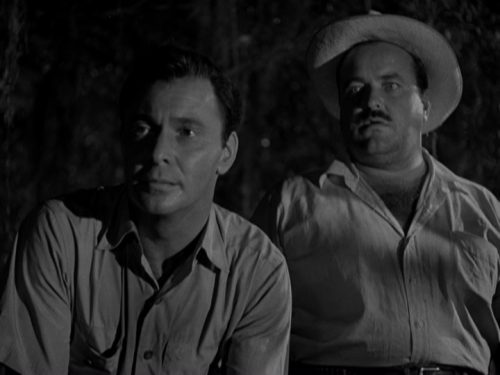
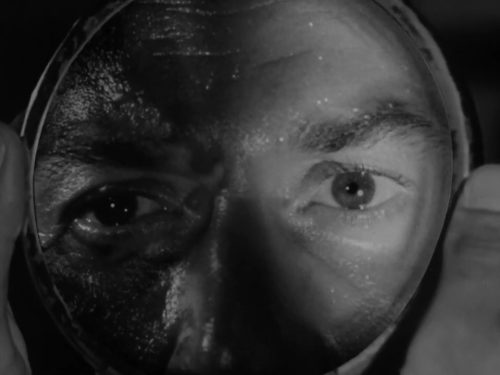
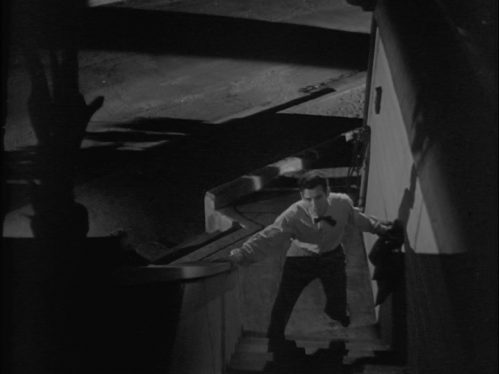
The entire setup here is most promising. The plot has a good deal of potential, the setting offers danger and atmosphere, and Joseph H Lewis as director always holds out the hope of some interesting visual flourishes. Lewis does get some value from the swampy surroundings, and the short sequence involving Sullivan’s fever dream (a shot from which can be seen above) is attractive even if it doesn’t actually add much to the story. However, for all that promise and potential, the finished movie falls a bit short. Now, it is never boring and Lewis keeps the pace up and the running time down, but the development of the plot is rather flat and predictable. Even a low budget effort such as The Ride Back (coincidentally, also featuring William Conrad in a prominent role) flips expectations to an extent by having hunter and hunted virtually changing places and gaining some personal insight as a result. In Cry of the Hunted, however, there is none of that.

Sullivan starts out as a well-meaning and conscientious guy with a hard edge and he never wavers or strays from that path, winding up in essentially the same place as he began. The part is a solid one, playing up the brash needling side of himself that Sullivan often showed and shoring it up with a strong core of decency and humanity. I haven’t seen a lot of Gassman’s work, which probably says much about my limited exposure to Italian cinema, but his character does get to undergo a touch more growth. I emphasize the fact that it is only a touch more though; there’s never really much doubt that his heart is in the right place or that he has it within him to come good. I reckon the writers missed a trick in the last act and should have had Sullivan laid up with an injury and needing to be saved by Gassman rather than the other way around. I seem to be on a bit of a William Conrad kick just now and he is good value as Sullivan’s subordinate and competitor. He seems to have been set to take on a meaner role (goading Gassman in the early stages, beating up a witness) but the script only leads him a short way down that particular path before allowing his better nature to take charge. Polly Bergen (Cape Fear, Escape from Fort Bravo) drifts in and out of the picture in a small role as Sullivan’s wife.

Cry of the Hunted is an MGM production, but it was not one of the studio’s top line pictures. It’s a small affair with some attractive location shooting and a tight, self-contained cast. Even second string movies from such a big studio have a fair bit of polish and it’s interesting to see MGM branching out into this more socially aware material, although it is nowhere near as challenging as it could have been when one takes into account the strong initial premise. I think it is fair to say it never really fires on all cylinders and it feels like a minor work from Lewis. Nevertheless, any opportunity to spend an hour and a quarter or thereabouts in the company of actors like Barry Sullivan and William Conrad is not something I would ever consider a chore. As for availability, it should be easy enough to locate seeing as the Warner Brothers Archive released a good-looking copy a few years ago. So, it’s definitely worth checking out and enjoyable enough as far as it goes, as long as it is approached with realistic expectations.

The Jayhawkers

Let’s start by looking at a list. Ride Lonesome, Rio Bravo, Last Train from Gun Hill, Day of the Outlaw, Face of a Fugitive, The Wonderful Country, The Hanging Tree, Warlock, No Name on the Bullet, These Thousand Hills. What do all these movies have in common? Well two things actually – they are all great westerns and they are all from 1959. The quality of those ten films is beyond doubt and while it’s arguably unfair and perhaps even pointless to make comparisons, it’s difficult not to do so when one realizes that The Jayhawkers also came out in 1959. Now it is not a bad film but it is a distinctly mediocre one, and that mediocrity is all the more apparent when one pauses and looks at that list above. Considering the heights the genre had scaled at that stage this feels like a minor effort indeed.

The Jayhawkers is set in Kansas in the period leading up to the Civil War. It concerns itself with machinations, manipulation and low-level empire building, these being the elements which frame in it in a wider context. On a more intimate level, and from my perspective a more engaging one, the film looks at issues of trust, betrayal and responsibility. Cam Bleeker (Fess Parker) has just broken out of jail, and is first seen wounded and exhausted, dragging his broken and bloody body back to the homestead he once shared with his wife. He has escaped because he’s heard his wife has died and, logically, wants to learn the truth. What he finds though is Jeanne Dubois (Nicole Maurey), a widowed Frenchwoman, and her two children living on what was his land. For a time, as he recovers from his wounds, it looks as though this is going to develop into a tale of a man reconnecting with the world and discovering something worthwhile via a surrogate family. That’s not to be, however, not for Bleeker and not for the audience either. In short, he is recaptured and offered a deal by the Governor to infiltrate the Jayhawkers, a gang of raiders led by one Luke Darcy (Jeff Chandler). What is the motivation? Well, it appears that Darcy was responsible for the debasement and death of Bleeker’s wife after his imprisonment, so we’re talking a classic revenge scenario. Yet it doesn’t quite develop in the way one might imagine; the revenge aspect is brushed aside in a perfunctory manner and the story evolves instead into an examination of the perils of rampant demagoguery as well as raising questions about the extent of personal loyalty.

With writing credits for director Melvin Frank as well as Frank Fenton, A I Bezzerides and Joseph Petracca, the political chicanery which underpins the story is frankly glossed over, the whole business of false flag tactics and the risks arising out of the cult of personality influence the development of the story but never overtake it. The focus throughout remains on the relationship which grows up between Bleeker and Darcy, and how that affects not only the fortunes of the two men but also those of Jeanne Dubois and her children. This is the area where I feel the movie falters, especially the writing of the character of Bleeker. Right from the beginning there is a feeling that he failed his wife, his imprisonment and consequent lack of support being a factor that led to her becoming involved with Darcy and all that followed on from that. Be that as it may, his determination then to make up for this would suggest a redemptive path, but it turns out to be one he treads for only a brief time. Instead, he finds himself first shamed by Darcy’s direct admission of his own culpability before being won over by the drive and ambition of his supposed enemy. Basically, the man set up as the hero at the center of the tale comes across as incredibly fickle and easily swayed. This is problematic enough, but what is worse is his inability to provide protection for those he professes to care about. He leaves Jeanne Dubois to fend for herself for much of the running time and, crucially, is absent when she is assaulted and abused by Darcy’s principal enforcer (Henry Silva). On top of that, he is indirectly responsible for serious injuries sustained by Jeanne’s little girl in the course of a botched raid.

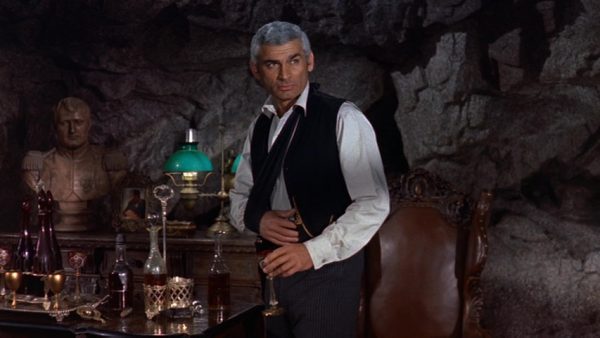
If the writing of the character of Bleeker is less than satisfactory, the performance of Fess Parker is what I’d term adequate. He’s fairly one-note throughout, giving little sense of the conflict and complexity the role requires. What saves the picture is Jeff Chandler as the man who would be king of Kansas. It is a typically intense and authoritative piece of work from Chandler, blending messianic zeal, ruthlessness and flashes of down-to-earth humanity to create a far more interesting figure than the nominal hero. He is supposed to be a character one is never quite sure of and I think that aspect is communicated quite successfully. Nicole Maurey is fine too as the woman trying to build a new life and offer some kind of security to her children. In supporting roles, Henry Silva is as sly and menacing as one could hope for while Leo Gordon’s sidekick is jittery, anxious, and ultimately doomed.

Olive Films released The Jayhawkers on both Blu-ray and DVD some years ago and it looks pretty good for the most part although there are scratches and some print damage. It is an odd film though, the themes it contains are weighty yet the handling of them isn’t all that successful nor is it as assured as it ought to be, and I’m not altogether convinced Melvin Frank and Norman Panama were the right team to have behind a story like this. The entire movie creates an impression of wanting to be big and grand, partially fueled by a terrific Jerome Moross score that recalls his work on The Big Country, but it contrives to look and feel much more restricted. All told, it entertains and passes the time, benefiting from a strong and energetic turn from Jeff Chandler. Still, bearing in mind the other genre offerings produced that year it is somewhat disappointing.

Kings Go Forth

There are simple, straightforward war movies, there are also films which see their stories played out against a backdrop of war, and then there are what I can only describe as genre hybrids. Kings Go Forth (1958) is one of those hybrids; it is not a full on war movie, meaning the plot is not driven solely, or even principally, by the battle scenes or the military strategy, yet these aspects are not relegated to the merely incidental either. In brief, it is a movie dealing with personal and social conflicts, all presented within the wider framework of the latter stages of the Second World War.

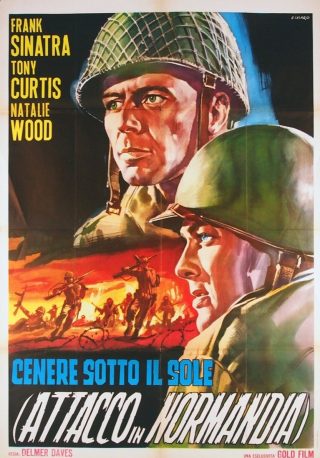
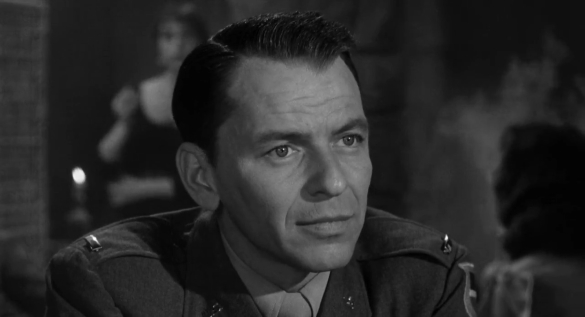
Not all wars are created equal, are they? While D-Day and the invasion of Northern France grabbed the headlines, and continues to garner attention, it is easy to forget that the drama and tragedy of WWII was also being played out in other theaters. Kings Go Forth unfolds in the south of the country where the US forces are in the process of trying to clear out the remaining pockets of Nazi resistance. Sam Loggins (Frank Sinatra) is a lieutenant in need of a new radio operator for his outfit. His voice-over narration in these early scenes make it clear that Britt Harris (Tony Curtis), the man who talks his way into the role, is a figure who will loom large in the subsequent events. He is brash and cocky, sure of himself yet essentially unknowable to others. Right from the beginning, Sam is aware that what is presented is largely a facade, an image offered up for public consumption with the goal of ensuring that what Britt wants, Britt gets. An apparently contradictory figure, he joined the army only as a last resort, having tried to bribe the draft board, but is not averse to indulging in showy heroics – dragging wounded men from a treacherous minefield, or braving machine gun fire to neutralize a pillbox. In short, as Sam himself noted at the outset, he is a man you notice. Well, it takes all kinds to make a world and the various peculiarities of character need not trouble anyone too much. Or that’s the way it seems for a time.

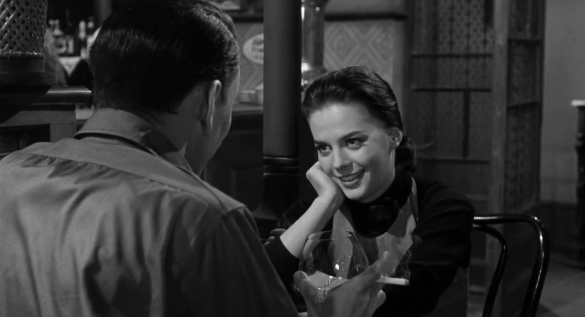
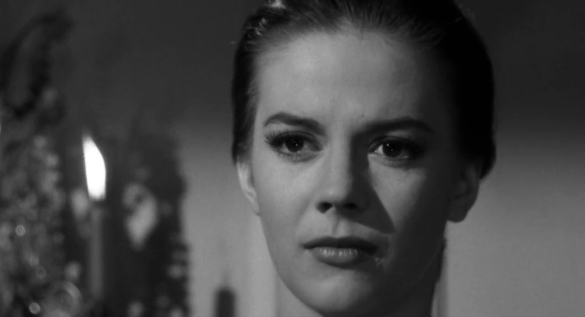
While these two central characters are shown  in sharp relief, the contrast only becomes an issue with the arrival on the scene of Monique (Natalie Wood). She was born an American, brought to Europe by her parents as a child, and is now practically a Frenchwoman. When Sam chances upon her during an impromptu leave he is smitten on the spot. He sees her again, and falls a little further, and all the while Monique remains half a step removed, charming and charmed yet cool. An evening in a cafe, where the wine and jazz form a potent cocktail has Britt meeting this pair, and so the final decisive point of the triangle is fixed in place. By the by, the reason for Monique’s reticence is revealed to be largely the product of her uncertainty of how Americans will react to her mixed race heritage. Sam is gradually accepting of this, having first forced himself to confront the prejudices he once entertained, but Monique finds herself dazzled by the glamor Britt seems to represent. In the end, the story boils down to a question of character and how it manifests itself. On an evening that promises death or glory deep in the enemy’s stronghold, truth emerges as the victor, but it is perhaps a bitter victory.

It has been some time since I last featured a movie from Delmer Daves. Over the years, I have developed a deep appreciation of this director and I count him among one of my favorites. His sympathetic handling of multifaceted and flawed characters caught up in situations which were correspondingly complex shows great maturity and I find his reluctance to sit in judgement enormously refreshing. Characters may be idealized by others within their world, but the viewer is presented with them as they are rather than as we might wish them to be. There is something soulful yet reassuring in the frank admission of imperfection and frailty; this is a filmmaker who not only understood but embraced humanity and sought to celebrate all its aspects. For me, such characteristics define the artist.

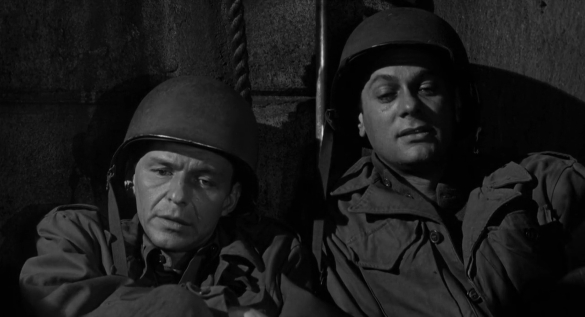
Kings Go Forth came in the middle of a particularly productive period in Frank Sinatra’s screen career. Some Came Running, The Joker is Wild and Pal Joey were all made in and around this time. It’s a fine performance, restrained, largely dialed down and frequently internalized. There is a good deal of pain in Sam Loggins, a hard-bitten personal diffidence riding side by side with a professional assurance, a tricky balance to achieve. I very much appreciate how the easy option of having the leading man simply do the right thing without thought was avoided, how he was made to look his own racial prejudices square in the face and acknowledge them for what they were. Perhaps we’re not talking redemption in the classical sense, but it is a matter of decency won after a hard battle, and the ending of the movie, in all its bittersweet melancholy and tantalizing optimism, is all the better for it. Nor is Natalie Wood asked to play any one-dimensional angel. Her hunger for acceptance draws her deep into a damaging and worthless relationship, blinding her to the artifice which is burrowing its way into her heart. It is an honest piece of work and, as with all forms of honesty, not always attractive. Tony Curtis is well cast too, coasting along on looks, style and polished patter, but never able to completely sell the lie to himself. As he sits in the clock tower with Sinatra, feeling the chill breath of fate creeping closer, his openness about his complete absence of character is very well realized – to watch him at this moment is to watch a man gazing deep within himself, and being appalled at the emptiness that he discovers. And finally, a word for Leora Dana, who is characteristically touching as Wood’s mother. If the only movies she had ever made were this one, 3:10 to Yuma and Some Came Running, then it would still constitute a fine career.

Kings Go Forth was an early release on DVD by MGM and looked good enough even though it was presented open-matte. There was a Blu-ray release by Twilight Time but I think that’s been out of print for some time now. However, there is a fine Blu-ray available in Germany, English-friendly, widescreen and generally very attractive. I freely admit that I am an unashamed fan of the work of Delmer Daves and I am well aware that this may color my view of his films. That said, I think Kings Go Forth is a terrific little movie and it comes highly recommended.

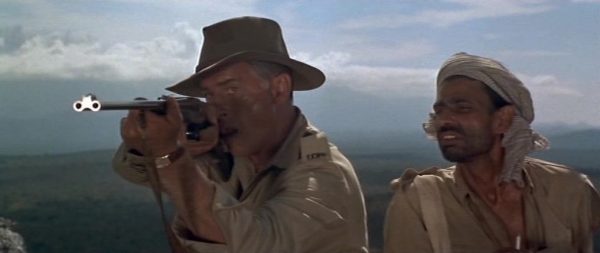
Southwest Passage

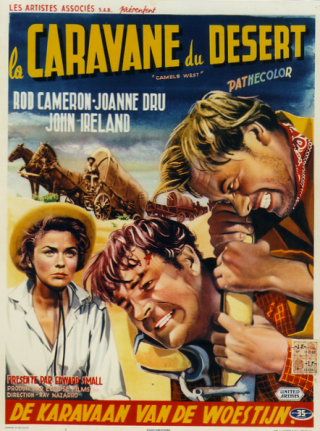
Southwest Passage (1954) is very much a product of its time. The end of the studio system and the growing competition from television saw Hollywood scrambling around to find some means of countering these threats. Promising greater spectacle and shooting movies in impressively wide ratios would eventually prove to be the most effective means of luring audiences back into the cinemas, but other approaches were tried out too. The 3-D process has always felt like a gimmick at heart to this viewer, and far too often saw filmmakers succumbing to the temptation to throw items at the camera to enhance the effect and elicit jumps from the bespectacled watchers. Southwest Passage has some of that self-consciousness on display, but goes a step further and presents a story with an unusual premise, namely the use of camels to forge a  new trail across the desert on the way to California and the west coast. This too gives the impression of writers casting round for as many hooks as possible to hang a fairly straightforward story on.

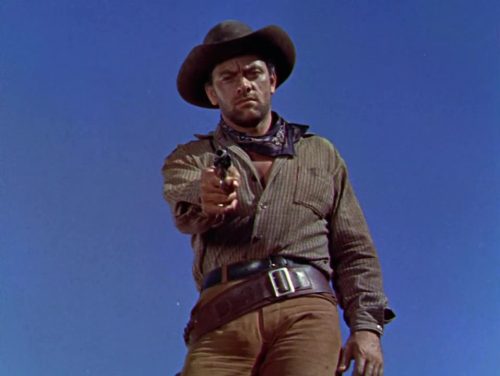
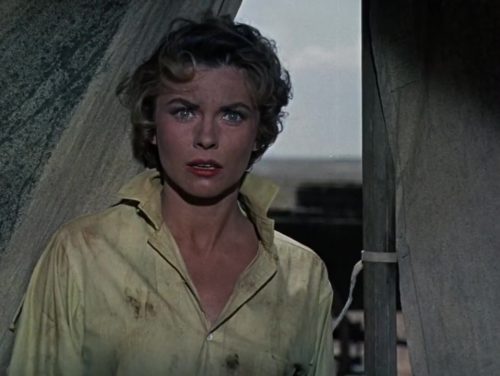
One thing this movie does not lack is pace and it gets off to a genuine flyer with a fired up and well armed posse hot on the heels of a trio of fugitive bank robbers. As horses and riders pound their away across the screen and across the wilderness, one of the pursuers pauses to take aim and loose off a speculative long-range shot. He finds the mark and one of the distant figures tumbles from the saddle. This unexpected casualty means a doctor is going to have to be located and, in brief, it provides the means by which the leader Clint McDonald (John Ireland) happens to bribe an alcoholic vet to hand over his identity and thus allow him to hide out as a member of an expedition heading west. It means he has to temporarily split up with his lover Lilly (Joanne Dru), but must needs and all that. The expedition this outlaw couple chance upon is no ordinary one; it’s being led by Edward Beale (Rod Cameron), a visionary type who has a theory that the hard desert crossing can be expedited by using camels rather than relying solely on mules and horses. As the party makes its way across the parched landscape the ever-present danger posed by the heat and lack of water is compounded by the tensions that bubble up within the group. This is partly down the need for McDonald to keep his true identity secret for as long as possible and also the fact Lilly is increasingly drawn to the selflessness and decency of Beale. To further complicate matters, a mean-spirited muleskinner (John Dehner) seems hell bent on stirring up trouble, while the Apache bands roaming the hills and rocks are just waiting for an opportunity to strike decisively.

The script by Harry Essex and Geoffrey Homes seems to be doggedly determined to dress up an essentially simple yarn of people rediscovering the path back to the straight and narrow via the hardships they endure in the course of a challenging trek. There’s a worthwhile parable in here about the way adversity can bring out the best in people, how even apparently lost souls can redeem themselves. In itself, that is enough to carry a picture and the cast is strong enough to make an audience care how or if this can be achieved. The added distraction of the camel expedition – and I’m firmly of the opinion that it is a distraction and nothing more – is wholly redundant and I have a hunch the writers realized this too as its impact on the development of the movie is slight in reality. Director Ray Nazarro was a journeyman, a competent professional who made (from what I have seen of his work anyway) entertaining but largely unremarkable pictures. Everything looks fine and he keeps it all humming along smoothly with a frequent smattering of action set pieces. These scenes are staged and shot well but, perhaps due to the faceless anonymity of the Apache warriors and their undefined motives, they do not deliver the level of tension I would have hoped for.

While he may not have had top billing, John Ireland’s character is by far the most interesting one on show. It is hinted early on that he isn’t merely a one-dimensional villain and the arc followed by this resourceful fugitive bears that out. By the end of the movie, you are rooting for him and want him to earn his salvation. Joanne Dru, his real life spouse at the time, not only looks good but she also makes for a feisty leading lady. She shoots at least as well as any of the men and doesn’t appear to have shied away from the more physically challenging aspects of the role. The way she plays that part and the gradual softening that occurs as the story progresses is key in coaxing Ireland back from the temptation of lawlessness and easy money.

If Dru was instrumental in facilitating or encouraging Ireland’s redemption, then Rod Cameron’s role could be said to have provided the motivation for rescuing her to begin with. Still, his is something of a thankless part, noble and steadfast and honest, but maybe he is too upright. Where Ireland’s conflicted robber and Dru’s disenchanted moll have nuance and shading, there’s none of that available to Cameron. He may be the lead and he may be the hero, and he plays both well and as written, but he winds up sidelined for all that. The real villain of the piece is played by the ever reliable John Dehner; sly, sleazy and spiteful, he wields a mean bullwhip and I only wish his role had been bigger still.

Southwest Passage is the type of movie which the producer seemed to throw everything bar the kitchen sink at, as though it was felt the core idea wasn’t strong enough. Personally, I take the opposite view and reckon that all the unnecessary embellishments detract from rather than enhance the finished product. All told, it is an entertaining way to pass an hour and a quarter but I do regret what I suspect was the lack of faith in the basic ingredients.

Whirlpool

Whirlpool (1950) is another borderline film noir. It is  a stylishly shot crime movie with a cast whose credentials speak of a strong pedigree in the school of dark cinema, directed by Otto Preminger, who was certainly no stranger to noir. I suppose it might be seen as more of a whodunit (or should that actually be a “how did he do it”, given the seemingly unbreakable alibi involved) and it might not feature all the classic ingredients, but the strong emphasis on the psychological aspects of the story as well as its examination of matters relating to trust and manipulation nudge it in the direction of film noir.

It takes a thief. Well, the story opens with a thief taken, even if it looks as though psychoanalyst’s wife Ann Sutton (Gene Tierney) is too classy and polished to fit that particular bill. Nevertheless, that’s what she is, having been spotted, trailed and then approached by a store detective after walking out of a shop with an expensive piece of jewellery stashed away in her purse. Since she is not short of money, it becomes evident that she is a kleptomaniac, acting under the influence of some private compulsion. This fact is pointed out by a convenient witness to the embarrassing episode, one David Korvo (Jose Ferrer). While he may not be clad in shining armor he does have a smooth line in persuasive patter, more than enough to allow him to ride to the rescue of this felon in distress. One might have thought that a woman married to an eminent psychiatrist (Richard Conte) would be ideally placed to obtain the finest treatment, but no film noir would be complete without the presence of secrets someone wants to keep buried. Such is the case with Ann Sutton, whose success in suppressing traumas suffered in the past has left her with little appetite for shattering the illusion of the perfect wife she has carefully constructed around herself.  So what is Korvo’s motivation in all this? Despite his protestations that he’s no blackmailer, and his very public determination to display his innocence, his money is made via fortune telling and hypnosis. What becomes increasingly apparent is that this man is a master manipulator, and that Ann Sutton is about to become just one more cog in a devious and murderous scheme.

Otto Preminger had memorably worked with Gene Tierney on Laura and they would collaborate again on Where the Sidewalk Ends and, somewhat later, on Advise & Consent. Preminger was good at tales of damaged people and as he moved into the 1950s he was drawn to scripts that featured ever more complex individuals and circumstances. Ben Hecht’s adaptation of a Guy Endore novel is characteristically slick and the plot, while twisty, always moves smoothly. In noir terms, Preminger would do much more interesting things with the idea of the troubled and criminally inclined female in the superlative Angel Face a few years down the line. In a sense, Whirlpool feels like something of a throwback; as much a puzzle plot murder mystery as regular film noir, it combines a critique of quackery and charlatanism, which had waxed and waned in popularity from the early years of the twentieth century on, with that kind of slightly reverential take on Freudian psychoanalysis that was in fashion in the post-war period. The focus is on the well-heeled and leisured classes, people with good jobs, nice clothes and the time and money to indulge in some lightweight self-analysis. If the idea of admitting that all may not be as idyllic as the shiny new decade promised to a psychiatrist (even if that person happens to be one’s spouse) was something to be reserved for a different type of person,  consulting some flimflam artist like Korvo was acceptable. Perhaps it was a way of acknowledging the existence of post-war angst without having to take it too seriously.

Knowing how hard Gene Tierney had to struggle with mental health issues in real life gives the movie a bit of an edge. It adds poignancy to those moments where she is expressing dismay at her instability, a feeling that this is not merely a woman playing a part but someone who is in fact living it out. Richard Conte comes across rather stiff at times, which is probably the way his part was written – too much empathy too readily expressed at too early a stage would not have made sense given the reluctance of Tierney’s character to confide in him. Nevertheless, he does seem a little too controlled and reined in, particularly in the scenes where he’s confronting Ferrer’s smugness. On the other hand, it could be said that this contributes to an air of tension. The meeting between a recuperating Ferrer, taunting and needling even as he sweats in pain, and a deeply wounded Conte does have a palpable undercurrent of menace. Ferrer is well cast, unctuous and dissembling, adept at the kind of emotional larceny that easily outstrips Tierney’s petty pilfering.

The main supporting part is filled by Charles Bickford, someone whose name pops up here from time to time and whose presence in a movie I generally welcome. The weathered features and gruff manner suited a range of roles and his dogged but fair-minded police lieutenant in Whirlpool represents one of those times when he made the most of a relatively small part. The script has him cast as a recent widower, which is a nice touch that serves to round out and humanize what might otherwise have felt like a purely generic character. That moment when he wakes at night, stung by his conscience, and then glances briefly at the small framed photo of his late wife on the bedside table before making up his mind to go along with Conte’s hunch is true and simple, and it helps to ground the movie beautifully.

Whirlpool is an interesting movie, fanciful in its telling (is the kind of hypnosis depicted even possible?) yet authentic in its presentation. I guess almost everyone involved has done better work elsewhere, but none of them could be said to have been below par either. The Bfi Blu-ray from some years ago looks excellent to me and the film can be accessed easily on DVD or even online depending on one’s preference.


Clash by Night

“People have funny things swimming around inside of them. Don’t you ever wonder what they are?”

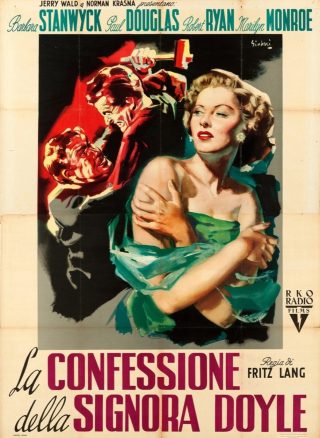
It’s odd the way casual, essentially throwaway pieces of dialogue have a habit of penetrating right to the core of the issue. Good dramatic writing will always seek to discover how and why  people react to certain circumstances, certain stimuli.  In melodrama, those reactions are by necessity heightened and may appear nonsensical or even contradictory when viewed with a cool, detached eye. Yet these contradictions and intensities are actually what validates the melodrama, the heightened feelings serving to draw all the illogicality of life itself into sharper relief. Fritz Lang’s Clash by Night (1952) is an example of a successful blend of film noir and melodrama in this adaptation of Clifford Odets’ play.

Mae Doyle (Barbara Stanwyck) is back home, back in Monterey after a decade in New York and points east, dressed up in disenchantment and drinking whisky for breakfast. She had been a dreamer once, setting out eagerly in search of her personal pot of gold labeled fulfillment. Time and disappointment have taken their toll though, leaving Mae long on regret and short on options. In fact, the only door remaining open to her, and it’s no more than ajar at best, is the one of the home she grew up in and then ran away from. Her younger brother (Keith Andes) offers a grudging welcome but there’s interest stirring in other quarters. Jerry D’Amato (Paul Douglas) is a fisherman, and her brother’s employer, all muscle and heart, and quickly smitten by Mae. However, there is bound to be a fly in the ointment and this one turns up in the shape of Jerry’s friend Earl Pfeiffer (Robert Ryan). Where Jerry is clumsy in his simplicity, Earl is brash and overbearing. Crucially though, his is a restless spirit, one which is drawn irresistibly to Mae, but she professes to be unimpressed by his shallow braggadocio and instead accepts Jerry’s heartfelt proposal. Nevertheless, just as those massive seas mercilessly pounding the coastline in the opening credits have foreshadowed, great emotional tumult lies ahead.

Film noir trades heavily on disillusionment, detachment and the ever-present threat of despair. Clash by Night taps into all of these, most especially a kind of gut wrenching disappointment and the awful sliding sense that all the positive things life might have to offer will forever remain just beyond reach. It’s like a head-on collision of post-war ennui and middle-aged malaise. Even as the protagonists sweat and struggle in the balmy atmosphere, on a personal level the first chills of autumn are already making themselves felt. I’ve no doubt the disenchantment and uncertainty over what direction to take in life would have struck a chord with a contemporary audience less than a decade after the end of a major global conflict, but the movie has a relevance beyond those immediate concerns. The idea that one can be tempted and seduced by superficiality isn’t confined to any particular era after all. At first, the material might seem atypical for Fritz Lang, but the idea of individuals trapped or restricted by (poor) choices and circumstances is entirely in keeping with his other work. Nobody is really free in this movie – even those who would have us believe they are free spirits are just as hemmed as everyone else – and practically everybody is straining against their respective bonds. Visually, Lang and cinematographer Nicholas Musuraca impress on the audience the claustrophobia felt by the characters first in Mae’s family home and then later in Jerry’s house, both of which are slightly elevated and therefore have a sense of remoteness about them. Consistent with the overall tone of the piece, however, there is at least a suggestion of an out, of an escape from the stifling ties that bind in the occasional shots of a moonlit sky or indeed of the vast ocean.

The casting works well, a trio of forty-something actors in the principal roles have that combination of a vaguely shopworn air, a burgeoning realization that time is not on their side, and enough of a spark and appetite for living to make their desperate snatching at the half chances flitting by appear credible. Robert Ryan always seemed to be the epitome of edgy, his characters existing on the periphery of society and civilization, like an interloper in his own home. Earl Pfeiffer is boastful, abusive and bullying; it is impossible to like a man who builds himself up by bawling out put upon waiters or forcing himself on women, but Ryan’s skill lay in his ability to add layers and dimensions to such boors, and his frustration at and awareness of his own flaws fleshes out the character and dismisses the caricature. Stanwyck is every bit as versatile in her own way, moving from pride to defiance, bitterness to fear, and all the time grounded by a frank admission of her character’s own weakness. Her role is both defined by her interactions with Ryan and Douglas and simultaneously creates a meaning and motivation for those two co-stars.

“Don’t say anything. Don’t make no promises. I’d have to trust you, that’s what the terrible thing is. You’ve got to trust somebody, there ain’t no other way.”

When Paul Douglas utters those lines right at the end of the movie there’s no doubting the essential truth of the words, for Jerry D’Amato and for the audience at large. This, coupled with the notion that a form of redemption could be attained by confronting and acknowledging the less savory aspects a person carries within, hints that the fatalism commonly regarded as being irrevocably wed to film noir may not be entirely insurmountable. Paul Douglas’ portrayal of non-judgmental decency, unbowed before loneliness and betrayal, is key to making this work. His scenes with Stanwyck range from the supercharged and fiery to the downright mundane, and the climactic one strikes a satisfyingly hopeful if not quite happy note. For all that, the one which lingers longest in my memory is an earlier interlude aboard his boat. He’s proposing, all awkward and shambling earnestness, and she’s resisting. There is some terrific screen acting on display from those two in that moonlit sequence, a pair of fine performers affording a glimpse of people teetering on the brink of temptation and trepidation. A magical moment of cinema.

While the three heavyweights in the leading roles naturally dominate proceedings, there is depth further down the cast list too. Marilyn Monroe was a rising star, just a year away from breaking through to the very top tier, and was billed fourth, just above the title. Even though she’s not the focus of attention she does get a few moderately memorable scenes, mostly sparring with a surly Keith Andes. This young couple are prey to some of that restiveness that plagues their elders; the shifting dynamics of post-war relationships, that realignment of social mores and roles, suggest that there is likely to be a good deal of friction, or even worse, ahead. J Carrol Naish was one of the most accomplished character actors of the classic Hollywood era, an instantly recognizable presence. As the wastrel Uncle Vince he occupies a small yet pivotal role, a Iago-like hobgoblin sowing unrest out of spite and whispering poison in his nephew’s ear at every opportunity.

Clash by Night was released on DVD long ago by Warner Brothers but I think it may have drifted out of print. It’s a pretty good transfer of the movie, and has a Peter Bogdanovich commentary track as a supplement, but any future upgrade to Blu-ray would be welcome. Fans of Lang’s work, and that of the leading players too, should find this an absorbing movie. It certainly earns a recommendation from this viewer.

Harry Black and the Tiger

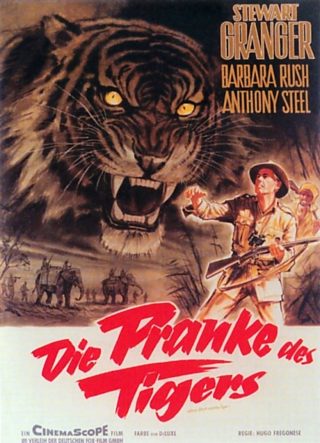
What should one aim for in life, passion or contentment? Ultimately, that is the question posed by Hugo Fregonese’s Harry Black and the Tiger (1958). The answer which is proposed is one heavily influenced by notions of honor, both honor earned and honor bestowed, and there is something very fine about the means through which this accommodation of heart and conscience is arrived at in the movie.

India, a vast country filled with sound and color; the opening sequence presents both as the camera roams through forest and grassland, accompanied by the chattering of monkeys, the susurration of parched vegetation, pierced violently by the screams of alarm and the final shocking spilling of blood. The beauty and the terror of nature are encapsulated succinctly in that scene, one which establishes the threat posed by the presence of a man-eating tiger. This hasn’t been the first outrage, nor will it be the last, but the district authorities have already taken steps to ensure the killer is stopped. To that end, another killer has been employed, one Harry Black (Stewart Granger). Harry is a former soldier, an officer in the British army who lost a leg after being wounded during an escape from a German POW camp in the last war. He now makes his living hunting down and killing those aforementioned man-eaters. In the course of stalking his prey, Harry comes upon Desmond Tanner (Anthony Steel) and his wife Christian (Barbara Rush), both of whom have played significant roles in his life. Desmond is the old friend whose fear and lack of nerve cost Harry his leg, while Christian had aroused forbidden passions within his heart during a brief visit to Scotland. All of this is told via a couple of flashbacks as Harry recuperates from the wounds he suffers in a botched attempt to shoot the tiger, a near tragedy once again resulting from Desmond’s weakness. This is the point at which Harry is himself cornered, maneuvered by fate and circumstance into a position requiring him to make potentially life-changing decisions, and forcing those around him to do the same.

In a sense, Harry Black and the Tiger is a very straightforward story, one which can be approached as simply a blend of exotic adventure and romantic drama. However, as with all good movies,there is a great deal of depth should one wish to seek it out. As I stated above, it raises the issue of what one wants out of life, and thus which path will have to be followed. The focus is on three less than satisfied people: Harry, Desmond and Christian. Harry is the one most conspicuously disillusioned, making a living from death and burying himself in the wilds a world away from his home. Something similar could be said for Christian and Desmond, the former claiming to have reached a place of contentment but quite clearly still haunted by regret, while her husband is weighed down by the dreadful burden of his own inadequacy. The dilemma facing this trio stems from the fact that the prize of fulfillment for any one of them threatens to cast the others into despair.

The role of Harry Black was a comfortable fit for Stewart Granger at this stage of his career, making good use of that quality of jaded introspection he was able to tap into. There is a telling moment during his convalescence when departing nurse Kamala Devi says: “Good luck with the tigers, Mr Black… inside and out.” Prior to this we have been viewing both the tiger and Harry, hunter and hunted (though which one occupies which role may be open to debate) wounded, recuperating and recovering. As I see it, the tiger is a reflection of Harry, or maybe a reflection of the predator lurking within, that formidable and potentially destructive power he carries inside him. It is a power which threatens to consume him because in recognizing the need to harness it and trap it Harry is steadily and ruthlessly tearing his own being apart.

What follows is a personal crisis for Harry, one brought on by the clash of desire, conscience and regret, leading to a kind of temporary moral surrender. In his physically and emotionally vulnerable state, he gives in to all those fears he had repressed and rejected, retreating into a whisky-fogged breakdown. His rescue is effected by the joint efforts of his friend Bapu (a terrific piece of comic/philosophical acting by I S Johar) and his soulmate Christian. Barbara Rush is characteristically impressive not only as the woman who has captured the hearts and of two quite different men but also as the devoted mother – her every move essentially a juggling act alternating between the call of head and heart, duty and desire. Nevertheless, his ultimate salvation lies in his own hands, his release can only be achieved by confronting his own demons. In essence, he must face down the tiger, he must face himself. Having done so, perhaps the greatest sacrifice of all must still be made.

This builds into the climactic scene of the movie, one which sees Granger, Rush and Steel all shine. After triumphing over nature, both in a broader and also in a more intimate sense, Granger returns to collect the reward he feels is now to be his. It is here that the choice between passion and contentment will be made, and it’s to the credit of the performers, director Fregonese and that ever masterful writer Sydney Boehm that there are no emotional pyrotechnics on display to blunt the effect. Instead, we get a beautifully judged and sensitively handled vignette where little is said explicitly yet much is conveyed subtly and surreptitiously via glance and gesture. The resolution is bittersweet yet gratifying in its inevitability and appropriateness.

Harry Black and the Tiger is a 20th Century Fox movie and was released on DVD in the UK almost a decade ago. That disc, which I understand is now out of print, was pretty good for the time. The anamorphic CinemaScope transfer still stands up quite well today but there is no denying that it is the kind of picture that would benefit from the higher resolution offered by Blu-ray. Of course the chances of Fox titles making it to Blu-ray these days are, shall we say, slim. This is the third film by Hugo Fregonese I’ve featured on the site this year and I find it is always a pleasure to view and write about his work, especially a strong effort such as this. Harry Black and the Tiger is film I have seen multiple times over the years and one I hope more people get the opportunity to become familiar with.

As an aside, yesterday it was 14 years to the day since I published my first tentative blog post. The site has evolved a bit since then, and I hope I have too, but it continues to be a pleasure and privilege to have interacted with such a wide range of movie lovers. Thanks all.

Band of Angels

“You talk about freedom. You think I’ve got freedom? I’ve got a past I’d like to forget, but I can’t run away from it. No more than you can run away from what you are.”

The essence of that piece of dialogue, if not the exact words, forms the bedrock of many a drama. As with a fly trapped in amber, cinematic drama gives us a moment captured on celluloid, preserved for our scrutiny, superficially isolated in time. Yet those moments we return to with every successive viewing give the lie to that; the poignancy or power of each example exists and is dependent on what came before, and on the suggestion of where it might lead. The latter is necessarily unknowable in the majority of cases, as in life. And as in life, the former, the touch and influence, perhaps even the bonds represented by the past, helps to shape the course of the present. Band of Angels (1957) explores this eternal link between that which has been and that which is; it is the collision of past and present, presented within the emotive framework of racial conflict and prejudice, which adds a timeless quality to the film’s core themes.

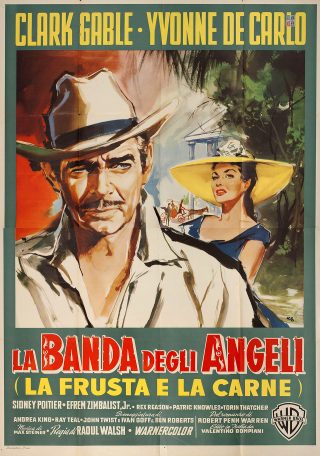
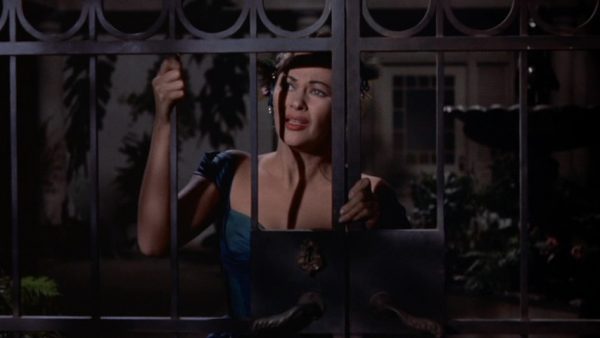
It seems appropriate that a movie so concerned with the idea of straining against the shackles of one’s former life should begin with the image of two slaves stumbling in desperation across a Kentucky plantation with overseers and hounds in hot pursuit. Flash forward some years and the daughter of the plantation owner Amantha Starr (Yvonne De Carlo) returns to attend the funeral of her father. It is at this point that her ordered and structured world is rent asunder, the significance of her mother’s grave being in a different section of the plantation brought home with jarring force as she learns that not only is she of mixed race but that the status she once took for granted is now forfeit. Instead she is now to be designated as property, denied full human dignity and sold as one might sell some personal belongings. Driven to the point of suicide by the shock and horror of what lies before her, this woman is thrown what at first appears to be an unlikely lifeline. She is bought by  Hamish Bond (Clark Gable), a wealthy man who installs her in his household under somewhat unusual terms. In truth, his domestic arrangements are generally unusual; his housekeeper (Carolle Drake) and his assistant Rau-Ru (Sidney Poitier) both have a complex, and in the latter’s case a volatile relationship with Bond. As the country lurches into the chaos and tumult of the Civil War, the nature of these varied relationships will be tested, torn and reshaped by the trauma of conflict, and the truths about the past lives of all the principals must be dragged under the spotlight to be confronted and addressed if freedom in any real sense is to be secured.

On one level Band of Angels can be approached as an examination of the Civil War and the racial conflicts that surround it, and this is certainly the aspect that is immediately recognizable. However, to dwell on that alone would make for a superficial reading of the movie, marrying it to the concerns of a bygone era in a way that distances it and so waters down the impact. Of course the period setting grounds the story and affords it an historical and practical value, but I would argue that this acts as a conduit for the deeper, more constant message concerning the probing of the past and the absorption of its lessons, thus allowing the future to be met with hope. All through the story the past is revisited, either implicitly via the lewd whispered reminiscences of a slave girl (a bit part for Juanita Moore and radically different to her famous role in Douglas Sirk’s Imitation of Life), or explicitly in the returns to various locations. Perhaps one of the most telling of these occurs when De Carlo finds herself back in the New Orleans house she first came to before the war – the structure is still there and she is even wearing the same costume but the fighting has brought significant changes, not only in terms of atmosphere (beautifully rendered by the subtle shifts in lighting by Lucien Ballard) but also personnel. There is considerable irony in both the fact that Poitier is seated in the chair once occupied by Gable and the way the passage of time has affected his attitudes.

The movie could have settled for some trite commentary on the way authority corrupts, or perhaps the dangers of becoming that which one despises. However, the central theme is much more engaging and forward looking. That theme, filtered through the prism of racial tension, is one of achieving growth and progression on a personal level, and I guess by extension on a wider societal level, not by cutting off or artificially isolating the past though; rather, it is about reaching an accommodation with what came before, whereby some emotional equilibrium may be attained.

The cast is strong and well chosen but Clark Gable dominates it all. There is much to appreciate in Gable’s late career performances, that indomitable spirit tempered by experience and loss was powerfully effective given the right material. Of his three collaborations with Raoul Walsh, only The King and Four Queens feels disposable and both Band of Angels and The Tall Men are fine movies. There are, to my mind, a number of standout scenes that give him an opportunity to shine. The first takes place in the courtyard of his New Orleans house and is almost stolen by a flamboyant Torin Thatcher. With a storm brewing in the background and Thatcher grandstanding for all he’s worth, Gable sinks into brooding intensity as the ghosts of his youth come scratching at his conscience. Next, when confronted by Patric Knowles’ craven braggart who is spoiling for a duel, he burrows mercilessly into the other man’s insecurities to destroy him psychologically. Later, after supervising the systematic torching of his own plantation, he delves deep into his own tortured past to explain to De Carlo why there can be no marriage between them. The matter-of-fact way he narrates the horrors he both saw and participated in is superbly delivered, as he sits ragged and spent amid the tarnished splendor his actions bought for him. Finally, there is the climactic confrontation with Poitier, the latter consumed with righteous hatred and hungry for retribution. It builds terrifically, with Gable’s calm resignation lulling both the viewer his co-star before the hugely satisfying resolution arrives. It’s a wonderfully played scene, a credit to the skills of Poitier and Gable.

Warner Brothers released a very attractive DVD of Band of Angels quite a few years ago and it still holds up well. My impression is that Raoul Walsh’s antebellum melodrama enjoys a mixed critical reputation at best. Personally, I rate it highly and regard it as one of the director’s best later works. There are those who say Walsh was a great action director, and there’s truth in that assertion. However, he was much more than that, he was a great observer and director of human drama, and this is a movie which has more than its fair share of that quality.