Christmas Holiday

poster156

Following on from my previous post I’ve decided to have a look at another seasonal noir. Christmas Holiday (1944) is a movie that seems to slip under many people’s radar, and that may be partly down to both the title and the casting which are apt to give a false impression. At first glance, this is a film that might appear to be horribly miscast but the fact is it works very well. Having said that, the production remains a little odd, but I can’t quite put my finger on the reason. Like Lady in the Lake, the  story unfolds over Christmas but, once again, that’s really nothing more than an incidental detail – the timing could easily be changed without affecting the plot in the least.

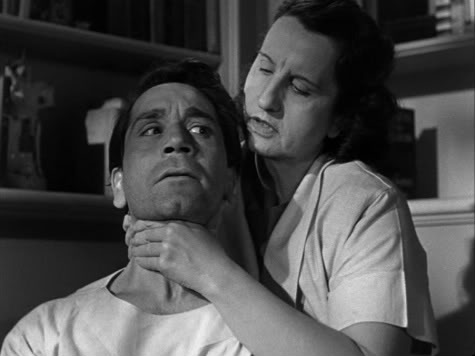
On Christmas Eve, a newly commissioned army officer, Lt. Mason (Dean Harens), is preparing to fly to San Francisco to marry his sweetheart. However, just before he leaves, he receives a cable informing him that the deal’s off and she’s married someone else. Regardless, he decides to board his flight anyway but neither he nor the audience can be quite sure what he hopes to achieve. As it happens he never makes it to his destination, bad weather forcing his plane to make an unscheduled stop in New Orleans. He allows himself to be talked into visiting an out of town club (basically a bordello, but you couldn’t come right out and call it that under the production code) by the establishment’s PR man/pimp. It’s here that Mason meets Jackie Lamont (Deanna Durbin) and later hears her story. The character of Mason doesn’t really serve any purpose other than that of a narrative device – he’s simply there to provide an everyman perspective, the eyes and ears of the audience as a tale of deception, murder and obsession unfolds. Jackie explains that she’s been using an assumed name, her real one being Abigail Manette, since her husband’s conviction for murder. Via two separate flashbacks she relates how she met, fell in love with and married Robert Manette (Gene Kelly). Manette turned out to be a wastrel blueblood, fallen on hard times, with unsavoury characteristics that are mentioned only in the vaguest terms. This is all pretty standard fare for a noir thriller, but it’s the creepy relationship between Manette and his mother (the Spiderwoman herself, Gale Sondergaard) and the stifling home atmosphere that sets this movie apart. I’ve come across a few theories which try to explain exactly what’s “wrong” with Manette and the nature of his relationship with his mother, but I’m not entirely convinced by any of them. The script makes it clear enough that this is a man with a deeply flawed character but that’s about it. However, I haven’t read the Somerset Maugham story on which the film is based so I don’t know if that casts any further light on the subject.

£4

Deanna Durbin is credited with being the saviour of Universal as a result of the popularity of her lightweight musicals in the 40s but Christmas Holiday was a major departure from the usual formula for her. She does get to sing two songs, in her role as night club “hostess”, but this is a straight dramatic role. I thought she performed very well, and managed to handle the necessary transition from wide eyed innocent to world weary fallen woman quite convincingly. Gene Kelly is another performer not normally associated with dark, dubious characters but his Robert Manette is not at all bad. Seeing this jaunty, amiable figure jarringly transformed into a mother-fixated murderer has an unnerving quality that’s highly effective. Gale Sondergaard always brought an eerie, otherworldly feel to the parts she played and it fits right in here. The middle section of the film, told in flashback, takes place mainly in the confines of the Manette house, where Sondergaard seems completely at home amid the relics of a faded past. It’s this part of the movie that lends the slightly odd sense that I alluded to at the beginning. Maybe it’s the curious family dynamic, or the feeling of stepping into a world removed from the present – I honestly can’t say, but everything just feels a little off-centre in these sequences. This was Robert Siodmak’s second Hollywood noir, following on from Phantom Lady. It’s not quite up to the standard of his previous picture and lacks a little of the visual flair that he usually brought to the table. However, he does some good work in the club scenes, and the unusual architecture of the Manette house offers opportunities for some interesting shots.

As far as I know the only DVD of Christmas Holiday is the UK R2 from DDHE (EDIT – it appears there’s a Spanish release also available – see comment #1 below). It offers a pretty good transfer of the movie with no major damage or distraction on view. The only extra feature provided is a gallery of production stills. All in all, this a satisfying little noir that moves along nicely and has good performances from all the main players. For me, the casting of Kelly and Durbin worked, although I can see how it might lead to the film being ignored by some – fans of the two leads may be alienated by the atypical roles and storyline, and noir lovers may be put off by their presence. Nevertheless, I think the movie has a unique quality and is definitely worth a look.

With the Christmas juggernaut bearing down ominously, I doubt if I’ll find the time to post another piece before the holidays. So, I’d just like to take the opportunity to wish all those who have followed, commented on, or simply dropped by this blog from time to time the best of everything over the holiday period. Here’s hoping you all enjoy a happy and peaceful Christmas.
 

Lady in the Lake

poster171

With Christmas fast approaching I thought I’d turn my attention to something which, if not exactly festive in content, is at least set around the holiday season. The hardboiled fiction of Raymond Chandler has been well represented on film down through the years, and after the commercial success of Murder My Sweet and The Big Sleep it was the turn of Lady in the Lake (1947). Unfortunately, this ended up being something of a gimmick picture as a result of the decision to shoot it entirely from a first person point of view, where the camera becomes the eyes of the protagonist. While it was an interesting experiment it does tend to become quite taxing after a time and it’s actually one of the biggest weaknesses of this film.

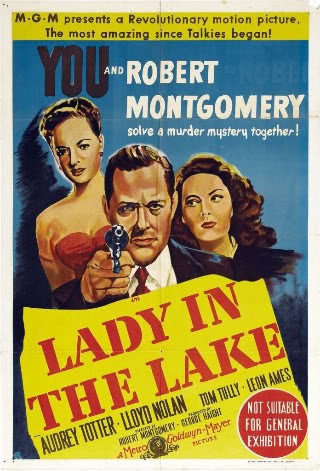
The first shot of the movie has Phillip Marlowe (Robert Montgomery) sitting in his office addressing the audience directly and explaining that, what with the private eye business being so tough and unrewarding, he’s decided to throw it all in and write crime stories instead. After establishing this slightly odd premise he proceeds to tell us, in flashback and from the aforementioned first person perspective, the details of the story. An appointment to see a publishing executive, Adrienne Fromsett (Audrey Totter), turns out to be something entirely different. Miss Fromsett only set up the meeting as a blind, an excuse to see Marlowe with the aim of hiring him to track down her employer’s runaway wife. Despite his initial reluctance to become involved in what he suspects is a fool’s errand, Marlowe finds himself drawn into the mystery surrounding the missing lady and the numerous shady characters that flit in and out of the tale. In the process, he falls foul of a local detective, DeGarmot (Lloyd Nolan), who’s every bit as tough and insolent as our hero. DeGarmot takes an almost instant dislike to Marlowe and even goes out of his way to have him framed on a drunk driving charge. In fact, that forms one of the best and most effective sequences in the movie – the point of view filming and haunting choral score working perfectly as Marlowe’s car is first pursued and then ruthlessly forced off the road. Then, as Marlowe slowly and painfully drags his battered body across the deserted road in an attempt to reach a phone box, the benefits of this unusual technique are most apparent. Going into the plot in more detail at this stage would be futile (and anyone familiar with Chandler’s work will know just how twisty, complex and downright confusing it can become) – suffice to say that by the end all the loose ends are pretty much tied up, and we get a happy ending that feels contrived and generally unsatisfactory.

As I said at the beginning, the filming method employed by star/director Robert Montgomery is one that loses its charm fast. It’s the kind of thing that works great in small doses, but not when it’s drawn out for the full duration of a movie. The same technique was used by Delmer Daves at the start of Dark Passage, but he wisely knew when to let it go and revert to more traditional cinematography. The simple truth is it doesn’t feel natural, and it ultimately has the effect of drawing you out of the picture – and that surely wasn’t the director’s aim. That’s one of the problems. The other is the performance of Montgomery in the lead role. Chandler envisioned Marlowe as a knight errant, a bruised and imperfect figure to guide us through a corrupt, violent noirish landscape. Most of the other interpretations of the character have given us a Marlowe who’s tough, honourable and smart enough to get away with the casual insolence he displays. Montgomery’s version, however, comes across as mean, callous and a little too dumb. Audrey Totter was always at home in noir parts and she doesn’t disappoint here – although her Adrienne Fromsett does veer from the grasping, mercenary vamp to the loyal girl friday type in a disconcertingly short space of time. For me though, the best performance comes from Lloyd Nolan, a criminally underrated actor. He never got to play the lead in A pictures but always lent solid and often memorable support. I think it would be fair to say that his presence in a movie always raised the quality and added a touch of realism.

Lady in the Lake is only available on DVD as part of Warner’s Film Noir Classics Volume 3. The transfer is reasonable but it’s dirty and there are damage marks, cue blips and the like that speak of no restoration being done. As for extras, we get the trailer and a commentary from authors Alain Silver and James Ursini. All in all, Lady in the Lake has to rate as one of the weaker outings for Phillip Marlowe. While it does have its moments it is a definite step down from both The Big Sleep and Murder My Sweet, so expectations need to be adjusted accordingly. The first time I saw this I found the filming style to be a major distraction, and frankly a pain. However, on subsequent viewings I would say it’s probably just mildly irritating now – but still annoying enough to hurt the film.


The Glass Key

poster130

The Glass Key (1942), from Dashiell Hammett’s novel, is a remake of of a 1935 picture. I have no idea how it compares since I’ve never seen the original, but this later movie does feature the trump card pairing of Alan Ladd and Veronica Lake in their second outing together. It came out hot on the heels of This Gun for Hire and cemented the screen partnership of the two leads.

Typical of its hardboiled, pulp source, the plot is a twisty and complex one with myriad interlocking strands. At its core, however, is the relationship between political kingmaker Paul Madvig (Brian Donlevy) and his assistant/minder Ed Beaumont (Alan Ladd). Madvig is one of those old-school, two-fisted ward bosses who’s made good and risen to a position of considerable influence. Beaumont hails from a similar background, although he displays a good deal more polish than his employer – or at least he’s learned the art of concealing his rough edges a little better. Madvig’s in the process of running a campaign to secure the election of a prominent blue blood, and simultaneously working his socks off to woo the the same gentleman’s daughter, Janet (Veronica Lake) – she’s got the hots for Beaumont though. However, this upper crust family has enough skeletons rattling around in the closet to fill up a good sized cemetery, not the least of which is a wastrel son who’s heavily in debt to the local mob. Now, this young man also happens to have a thing going on with Madvig’s kid sister (getting confused yet?), so when he turns up dead it’s no surprise who the finger of suspicion points to. To make matters worse, Madvig seems either unwilling or unable to do anything to clear himself. So, it falls to Beaumont to try and straighten out the tangled mess and get at the truth. Along the way the film casts a jaundiced eye over the inherently rotten nature of politics and those involved in it. It’s this examination of the filthy underbelly of outwardly respectable institutions and their corrupting influence, rather than the love triangle or the murder mystery, that mark The Glass Key out as film noir. The film also has a brutal edge that lends it a degree of authenticity – the savage and sustained beating handed out to Beaumont by the mob is genuinely uncomfortable to watch, and its aftermath is a tribute to the skill and creativity of the make-up department.

Maybe it’s just my impression, but Alan Ladd never seems to get the respect he deserves as an actor. There was nothing showy about him and it’s possible that his quiet restraint has been mistaken for a lack of ability. For me, it works very well though – especially in a role like that of Ed Beaumont. Ladd displays just the required degree of toughness when necessary and eases comfortably into a more relaxed mode in his scenes with Veronica Lake. It has to be said that Miss Lake was far from being the most expressive of actresses but this actually works to her advantage here. Her less than mobile features add the quality of ambiguity to her character that the script demands, and accentuate the arrogant condescension she feels for Madvig. Brian Donlevy was an excellent choice as the strutting, cocksure politico. He had the kind of natural dynamism that breathes life into the character of Madvig, and he was also capable of tapping into a sense of pathos that allows you to feel real sympathy for him in those moments when we see clearly the tolerant contempt with which he’s viewed by the supposedly respectable Henry family. Nevertheless, as was the case with the later The Blue Dahlia, William Bendix nearly steals the whole picture from beneath the noses of the principals. There’s a disconcerting whiff of the comedic about this menacing mob heavy; a bit like a psychotic teddy bear come to life. He comes across as one seriously sick puppy who positively relishes the hammering he metes out to Ladd and longs for an opportunity to do so again. Stuart Heisler’s direction is competent without ever being especially memorable but he has a good sense of pace and packs a lot of complicated plot into a fairly brisk running time. As with most hardboiled adaptations there’s plenty of snappy dialogue on show, and listening to some of the throwaway lines is half the pleasure. In the midst of pounding Alan Ladd into a nearly unrecognisable pulp, William Bendix and Eddie Marr break off to chow down on some steaks and the latter comments that: “My first wife was a second cook in a third rate joint on Fourth Street.”

The Glass Key came out on R2 DVD in the UK a few years ago from Universal. It’s a fairly typical Universal UK transfer in that it was just slapped on disc as is. There aren’t any major issues with the print save for the fact that it’s pretty grubby. Anyway, it is available and it’s cheap. For some unfathomable reason this film has never been given a release in R1 despite frequent requests from fans and, considering recent developments concerning Universal’s “vault” programme, it’s anybody’s guess what will happen now. The film itself remains a very enjoyable slice of early noir and should probably be regarded as an essential title. It doesn’t match up to that other famous Hammett adaptation, The Maltese Falcon, in terms of style or overall sourness but there’s still much to admire. As an aside, I couldn’t help noticing that the central relationship between Madvig and Beaumont (and their apparent falling out over a woman) bore more than a passing resemblance to that of Tom and Leo in the Coen Brothers’ great gangster/noir Miller’s Crossing.

Inferno

£9

A little suffering is good for the soul – that would appear to be the message of Inferno (1953). It’s a classic tale of man against nature with a liberal sprinkling of deceit, infidelity and murder thrown in for good measure. The movie is generally regarded as a film noir and I suppose that’s fair enough given its themes, although the visuals (technicolor and wide open spaces) suggest it should be the antithesis of that style.

The opening pitches you right into the middle of the plot with no time wasted on backstory or build-up. Within a few minutes the viewer knows exactly what’s going on and what led up to it. A man has broken his leg out in the desert and his wife and her lover have decided to abandon him and let nature take its course. The unfortunate victim is one Don Carson (Robert Ryan), a hard drinking businessman with plenty of money but few friends. Carson has gone out to a remote part of the desert in the company of his faithless wife Gerry (Rhonda Fleming) and a mining engineer, Duncan (William Lundigan), to scout for manganese deposits. When an accident presents Gerry and Duncan with a heaven sent opportunity to rid themselves of Carson they grab it with both hands. All they need do is manipulate the evidence and cook up a story about Carson going off on an alcoholic bender to be home free. However, the scheming  lovers underestimate their victim and his resourcefulness – Carson may have led a pampered life of privilege but he has a powerful will to live and an instinct for survival. The film twists and turns its way to the conclusion and, as it does so, the character of Carson moves smoothly from being initially an unsympathetic boor to a man the viewer can both admire and root for. The best scenes in the movie have Carson battling against the merciless desert, with nothing but his thoughts to keep him company. There’s also some clever cutting to point up the contrasting fortunes of the protagonists: while the hero grows desperate for water there’s a sudden jump to a shot of Duncan diving into a crystal clear pool; and when Carson finds himself on the verge of starvation the next scene has his wife delicately carving a roast back at the LA mansion.

Inferno saw Robert Ryan near the top of his game in a career that had more than its fair share of highs. He spends the bulk of his screen time alone in the vast wilderness, crawling and dragging his broken body over the unforgiving terrain. There’s no one else present to play off and that fact makes it even more remarkable that he managed to develop his character into a fully rounded human being that we actually care about. He starts out as a spoiled, sullen drunk petulantly taking pot shots at a discarded whisky bottle, but by the end of the picture his trials and torments have transformed him into a man of character and humility. Rhonda Fleming was well cast as the devious Gerry, brimming with a kind of loathsome sexiness. She is the typically heartless femme fatale with a perverse sense of morality, who doesn’t bat an eye at the thought of leaving a man to a slow, aching death but baulks at the idea of shooting him. William Lundigan was a fairly bland actor but a capable enough one for all that. Although Inferno would be one of his last major roles before moving into television he does a reasonable job with a basically one dimensional character. Director Roy Ward Baker made a handful of movies in Hollywood in the early 50s before moving back to Britain. Inferno was the last of them and it wasn’t a bad one to finish on. He makes wonderful use of the desert locations to emphasise the harshness of the environment and the lonely struggle of the hero. Of course it doesn’t hurt to have a cameraman of the calibre of Lucien Ballard on hand, and the two of them managed to turn out a film that’s tense, uplifting and visually arresting. This movie was originally shot in 3D, a process that sometimes led to gimmicky effects shots, but it never really intrudes too much here – though a lantern is fired directly at the camera during the climax.

A while back, when Fox was still in the business of issuing DVDs, it was rumoured that Inferno was due a release in the US, possibly as part of the noir line but nothing ever came of it. However, it has been given a release in R2 in Spain by a company called Impulso. They have licensed a number of titles and market them as Fox Cinema Classics. The transfer for Inferno is a generally pleasing one. Viewed on a 37 inch screen I thought it looked fine for the most part – the image is mostly smooth and sharp but there are instances of heavy grain (especially during the titles). The colour is quite strong but it can take on a slight pinkish hue at times. The disc itself is pretty basic with the only extra of note being a gallery. All told, I was satisfied with this one and it is the only way to get your hands on this title at the time of writing. Inferno is a tight, pacy little movie that clocks in at 80 minutes and rarely stops to take a breath. I’d rate it highly as a noirish thriller in an unusual setting, boasting classy performances and excellent visuals.

Berlin Express

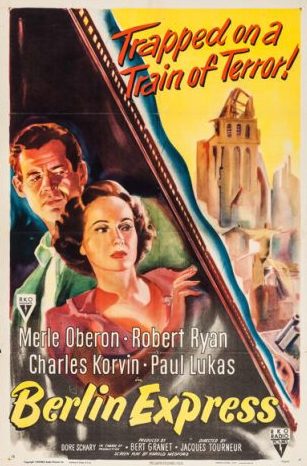
Post-war Europe was an excellent setting for a noir picture – the bombed out ruins and a displaced, despairing population provided a near perfect backdrop for such films. Jacques Tourneur’s Berlin Express (1948) is a mix of spy story, noir and propaganda piece. That latter element is the one thing that knocks it down a peg and damages its noir credentials slightly; those repeated attempts to inject a kind of brave new world optimism into what should be a fatalistic film really work against it in the end.

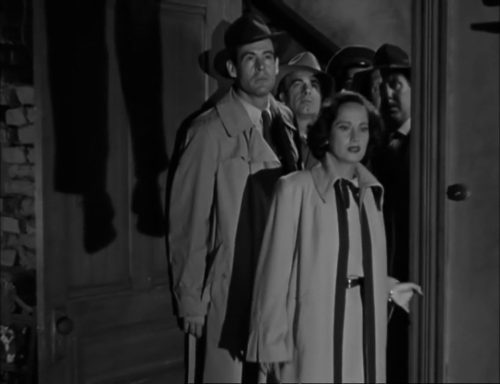
The movie opens in the documentary style that was popular at the time, complete with the “voice of God” narration to set the scene and introduce the main players. Normally, I’m not averse to a good voiceover but the somewhat strident, Mark Hellinger-style commentary employed here does start to grate pretty fast. Fortunately, it doesn’t dominate things for too long and, once it’s been established that we’re following a group of international travellers on the military express bound for Berlin, regular cinema storytelling techniques kick in. Robert Lindley (Robert Ryan) is an American agriculturalist on his way to take up a position with the occupying forces, and the plot unfolds through his eyes. His companions are an Englishman, a Frenchman and a Russian – representing the four powers. Apart from military personnel, there are also a number of German nationals on board – one of whom is in mortal danger. The gentleman in question is a diplomat with a noble plan for peaceful coexistence in Europe. When a makeshift bomb kills his decoy, his identity is revealed to the audience but the danger remains. No sooner has the train deposited its passengers in the ruins of Berlin than the eminent diplomat is abducted. So, the four just men, bowing to pressure from the captive’s secretary (Merle Oberon), take on the role of amateur sleuths and the chase is on. Their hunt leads them through the rubble and backstreet dives of the fallen capital, and leads the audience into the best segment of the movie. This is a twilight world, full of people driven to the very brink – scrambling for discarded cigarette butts, scanning the ever present lists of missing persons, and hanging around stations pathetically trying to hawk their meagre possessions. As Lindley and his companions grope their way through this decaying world the speechmaking and in-your-face social comment is mercifully kept to a minimum, letting the visuals make the point much more eloquently.

Robert Ryan plays a role here that is very much that of the everyman bumbling his way into a situation that is over his head. His craggy careworn features were well utilized over the years in countless noirs and westerns, and I always regard his presence in any film as a big recommendation. Merle Oberon, on the other hand was an actress that I could take or leave. Having said that, she does well enough as the French secretary determined to track down her kidnapped boss. For me though, the real stars of the movie were director Tourneur and cameraman Lucien Ballard. Together they manage to turn a middling spy story into a visual treat. The location work helps enormously of course, but there’s no end to the interesting angles and memorable shots served up – low angles, overheads, reflections etc. Tourneur also handles the various set pieces beautifully; from the cabaret scene (reminiscent of the Mr. Memory sequence in Hitchcock’s Thirty-Nine Steps) and the confrontation in the abandoned brewery, to the tense climax aboard the train once more. Only the happy ever after coda rings false, hindsight allowing us to see that forty years of conflict and subterfuge would be the order of the day rather than the spirit of cheerful comradeship and cooperation that the film alludes to.

Berlin Express was an RKO production and a few years ago that would have meant that there was always the possibility of a shiny new transfer on the cards from Warners in R1. Unfortunately, those days are now gone and this film is on its way to the dreaded Archive. However, there is an alternative in the shape of a R2 release from French company Montparnasse. The R2 disc is typical of the company’s fare, in that it’s neither exceptionally good nor exceptionally poor. The transfer is adequate, there’s no serious print damage but, equally, there’s no evidence of any restoration and it looks to be interlaced. Still, the Archive offering is unlikely to be any improvement and the pricing, suspect media and restricted availability weigh heavily against it. Berlin Express is a film that flirts around the boundaries of noir, but I feel that there’s enough in the story, cinematography and direction to warrant its inclusion in the category. While it may not be up there with the greats of dark cinema it should be a welcome addition to anyone’s collection.

Phantom Lady

jxoodds

Most people are aware that revisiting a movie can be either a rewarding or a disappointing experience. For myself, subsequent viewings have more often than not proved to be positive. That may say something about me, or it may be a result of the kind of movies I tend to gravitate towards. Phantom Lady (1944) was a film I’d seen a good few years ago and one which, at the time, I thought was OK but nothing special. Anyway, having recently bought the DVD I decided to give it another go. I thought it was fantastic, like watching a completely different film – everything just seemed to click into place. I have a hunch that a large part of the reason behind this reappraisal is due to the use of one major plot device which bugged me on my first viewing. Naturally, I knew what was coming this time around, so it didn’t bother me in the least – in fact, I found it to be one of the film’s better ideas and, lo and behold, the whole thing worked for me.

The film begins much like a standard murder mystery. Scott Henderson (Alan Curtis) is an engineer with marital problems. After an argument with his wife he heads to a bar to drown his sorrows, and finds himself seated next to a woman with a big hat and her own troubles. Since he’s got a couple of theatre tickets and nothing better to do, he takes her along to the show. The lady in question sets just one condition – no names and no details. At the end of the night the two of them bid each other farewell, and that ought to be the end of that. However, on returning home Henderson finds his wife murdered and the police anxious to learn how he’s spent his evening. The woman who could furnish him with an alibi would seem to be an easy one to trace, after all she had drawn the attention of a number of people. But no, no-one remembers her, or if they do they’re not saying. So Henderson is tried and convicted of murder. Just when all seems lost, however, Henderson gets a lifeline. His loyal secretary (Ella Raines), his best friend (Franchot Tone) and a sympathetic cop (Thomas Gomez) take it upon themselves to try and find the mysterious Phantom Lady.

The idea of an innocent man pitched into a nightmare world where no-one believes him is a staple of noir, and Phantom Lady has an excellent pedigree as it originates from the pen of Cornell Woolrich (although this novel was written under his William Irish pseudonym). The plot device which I alluded to above is the revelation of the killer’s identity about halfway into the film. This has the effect of transforming the story from a straightforward mystery into a taut suspense picture, and it’s all the better for it. Since the viewer now knows more than the characters do, he is free to concentrate on other aspects of the film – and there’s much to admire here. The lengthy sequence where Kansas (Raines) mercilessly stalks a tight-lipped bartender is masterfully shot. From the long shot of her mask-like countenance staring at him down the length of the bar, along the slick and rainy sidewalks, on a deserted platform, to his final demise under the wheels of a truck, you can feel the tension rise and the man’s fear become palpable. This neatly reverses the roles one expects to see in a movie of this vintage, and has the effect of putting a fresh spin on a potentially trite situation. In fact, Phantom Lady is ahead of its time in a number of ways, not least the atmosphere of sexual tension it creates. Another memorable scene takes place in a back street jazz club, where a bunch of stoned and liquored up musicians do a little after hours improvisation. The edge here comes from the sight of Kansas, looking cheap and provocative, driving an ill-fated drummer (professional squirt Elisha Cook Jr) half crazy with lust. The close-up of the expression on his face as his drumming grows more and more frenzied is pure gold, and must have raised a few eyebrows at the Hays Office.

£8

Despite being billed second, the real star of the show is Ella Raines. Her part as Kansas (at the time it was a kind of fashion to hand nicknames to female leads in movies: Lauren Bacall becoming Slim in To Have and Have Not and Lizabeth Scott in Dead Reckoning getting saddled with Mike!) is the most substantial one in the movie and offered her ample opportunity to show what she could do. I’ve already mentioned a couple of scenes above but she holds the attention throughout, displaying a tough, almost masculine, determination without ever being anything less than a woman. Franchot Tone, who received star billing, does well enough even though the nature of his role was one that encouraged a touch of overacting. Alan Curtis generally gets overlooked or dismissed by critics of the film, but I feel that’s a little unfair as he doesn’t get the opportunity to do much in the second half. When he is on screen he performs capably and believably enough – he’s no standout but he is acceptable. Thomas Gomez and Elisha Cook Jr were fine character players in many films and their presence adds some more class to proceedings. Phantom Lady was Robert Siodmak’s first in a series of excellent noir pictures throughout the 40s. All of his films made fine use of atmosphere, imagery and lighting, and this was no exception. There are countless examples I could cite, including the weird, tortured sculptures dotted around the killer’s apartment. However, aside from those already mentioned, there’s a marvellously shot scene where the killer lectures one of his victims on the ways a man can use his hands for both good and evil. As he talks the camera concentrates on his own hands, picked out stark white by a spot, while the man himself blends into the background shadows.

For some reason Phantom Lady has yet to be given a DVD release in R1 by Universal. However, it is readily available in R2 (France & Spain) and R4 and, although I can’t be sure of this, I have a feeling all these versions are sourced from the same print. I watched the R4 from Aztec (licensed from Universal) and the transfer is a good one. There hasn’t been any work done on it, evidenced by the presence of some scratches and speckles and a fine vertical line that appears on the right of the screen at one point for six minutes or so, but it is very sharp and has strong contrast. The R4 comes on a barebones, single layered disc but the relatively short running time means it doesn’t appear to be over-compressed. I don’t believe I’ve seen a poor film noir from Robert Siodmak yet and my repeat viewing of Phantom Lady has elevated its value in my opinion. This is a movie I can see myself returning to fairly often and I would certainly recommend any noir fans pick up a copy.

The Blue Gardenia

poster128

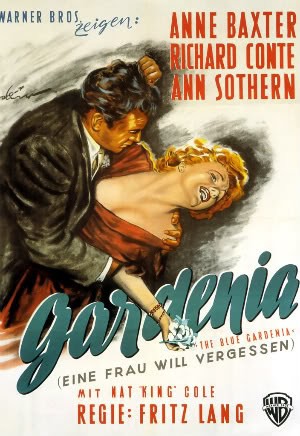
There are lots of sub-categories within film noir, and one of my favourites is what is sometimes termed nightmare noir. Fritz Lang’s The Blue Gardenia (1953) fits this description by presenting a protagonist whose world gets turned upside down after making one ill-judged decision. This kind of story offers all sorts of opportunities for some of the staple ingredients of noir – paranoia, suspicion, the idea that bad luck is waiting just around the corner, and the fact that the course of one’s life can hinge on something as simple and inocuous as a mix up over a phone call.

Norah Larkin (Anne Baxter) is a switchboard operator who leads a fairly humdrum life, sharing an apartment with two other single women and biding her time till her lover comes back from Korea. However, it doesn’t take long for things to start to unravel and for life to hand her the first in a series of unexpected kicks in the teeth. She’s just bought herself a new dress, cooked a special meal, and plans to sit down and share it with her absent G.I. boyfriend. So, with his photo propped in front of her, she opens his latest telegram and starts to read. It’s a brush off, he’s met a nurse, fallen in love and plans to marry her. Norah is naturally distraught and more than a little bitter, so when she takes a call meant for one of her flatmates she makes that one bad decision. On the rebound, she agrees to a date with the slightly sleazy ladies man Harry Prebble (Raymond Burr). During the course of dinner Prebble ensures that Norah gets well and truly tanked on cocktails before taking her back to his apartment. When he starts to get a little too friendly, Norah struggles with him but quickly blacks out. On awakening, she finds Prebble dead on the floor, his head smashed in with a poker. Panicking, and with only the haziest of memories of what went before, she flees the scene of the crime but leaves a few clues behind. The rest of the movie involves Norah’s attempts to evade the law, while playing a cat and mouse game with smooth newspaperman Casey Mayo (Richard Conte). The only real problem I had with the film was the fact that the element of doubt doesn’t really work for the viewer. While Norah and the characters around her cannot be sure of her guilt or innocence, it’s fairly clear to us. For this kind of story to work properly it’s preferable if the viewer experiences the same level of uncertainty the lead feels.

£14

Anne Baxter takes centre stage as the haunted and hunted Norah, and does a pretty good job of conveying her mounting sense of paranoia and isolation without resorting to histrionics. Richard Conte is reliable as usual in the role of the reporter who has his doubts. Raymond Burr was still at that stage of his career where he seemed to play nothing but heavies, but he did it well and his Harry Prebble has a nice touch of the sinister about him. However, while those three turned in fine performances, the picture really belongs to Ann Sothern. Her sassy turn as Norah’s seen-it-all-before flatmate is the highlight, and she walks away with just about every scene she appears in. Lang’s direction is as classy as one would expect, and the themes involved are right up his street. He seemed to have a thing for artists and reporters, and both play a prominent part here – although his most biting critique of the media, the ascerbic While the City Sleeps was still a few years down the road. There are strong noir credentials throughout the movie with Vera Caspary (Laura) providing the source material and Nicholas Musuraca working his magic behind the camera – the shadowy shots of the deserted newsroom at night being especially atmospheric.

The R1 DVD from Image is generally quite good, although there are a few damage marks here and there. It’s a totally barebones disc but should be available fairly cheap. The Blue Gardenia was originally distributed by Warner Brothers but is thankfully no longer controlled by them – I couldn’t imagine writing that just a few months ago, but this is the kind of film that might well be consigned to the appalling Archive programme now. All in all, it’s a fine noir that I’m happy to recommend.


Cry of the City

$1

He’s out there somewhere…in an alley, on a roof…looking for a way out.

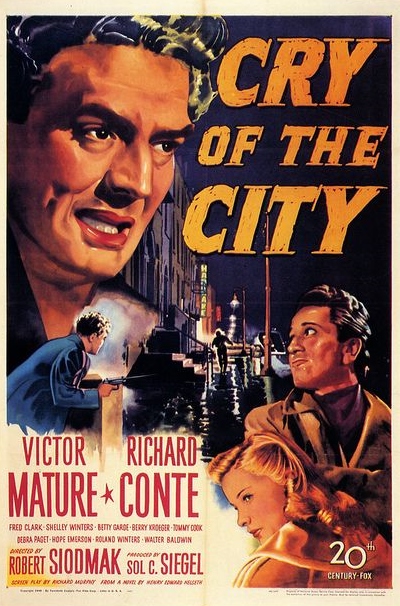
One of the most interesting, and the most enjoyable, aspects of the best noir pictures is the blurring of the lines between the hero and the villain. In a way, the noir world doesn’t have any real heroes, just people forced to make the best of whatever circumstances life pitches at them. Characters may be stylised, situations may be exaggerated, but the dilemmas and bad breaks that have to be faced are issues that most people can identify with on some level. I think it’s this ambiguity that ensures the enduring popularity of these films. While fashions, speech patterns and social attitudes are obviously changing all the time, human nature remains constant. Robert Siodmak’s Cry of the City (1948) is a classic manhunt thriller that toys with the viewer’s sympathy by presenting both hunter and hunted as two sides of the same coin.

Martin Rome (Richard Conte) is an Italian American hood who’s just taken one chance too many. A botched hold-up has left a policeman dead and Rome badly wounded and clinging to life. As his family and priest gather at his bedside to pray for him, the law in the shape of Lt. Candella (Victor Mature) hovers in the wings, waiting to hand down retribution. Rome is a doomed man, his killing of a cop can have only one outcome. But doomed men can be of value to desperate men, and so the vultures circle. With the knowledge that Rome has no future, crooked lawyer Niles (Berry Kroeger) tries to coax him into confessing to a murder that would let his client off the hook. When this approach doesn’t meet with any success, Niles makes the mistake of threatening Rome’s girl, Teena Riconti (Debra Paget). Now, he has a reason to live; both the police and Niles want to get their hands on Teena for their own ends. Rome needs to get out of the prison hospital, track down Niles and his accomplices, protect Teena, and try to make good his escape. All the while he’s dogged by his nemesis, the tenacious Candella, a man who seems to be on a personal crusade to run him to ground. As Rome runs and Candella pursues him, we get to see the contrasts and similarities between the two men. Both come from essentially the same background, namely poor immigrant families, but both have chosen different paths out of the urban squalor. Candella walks with the righteous, but the face of the law he presents is a rigid and largely inflexible one. He shows no mercy in his dealings with all the little people who offered assistance to the fugitive, promising instead only prosecution and punishment. As such, it is notable that Candella never receives any willing help whereas Rome has no shortage of people prepared to go the extra mile for him, albeit for their own reasons. Also, when Rome lay wounded in hospital he was surrounded by family and friends, but when Candella later suffers a similar fate his only visitor is his partner.

Richard Conte’s smooth talking gangster is a fine performance. You know he’s no good but can’t help rooting for him. The fact that he gets to deliver the best lines of the script and enjoys the lion’s share of screen time is helpful of course. It’s also significant that the killing for which he’s originally wanted is never shown and is only referred to briefly. When he does off someone on screen, that character is such an unpleasant slimeball that you feel he’s justified in doing so. Victor Mature’s persistent detective, on the other hand, is hard to like. He plays a cold, judgmental man with only a trace of humanity; the scenes where he visits Rome’s family are where he comes off best, yet even there his sincerity is open to question. It’s not really any surprise that his character has doors slammed in his face where Conte has them opened invitingly to him. The supporting cast is excellent, although the real stand out is Hope Emerson. This imposing figure of a woman is a genuinely unnerving presence, and you feel she could crush Conte’s ailing Rome just for the sadistic pleasure of it.

£2

Robert Siodmak made a lot of noir pictures, and I don’t believe any of them were poor. Cry of the City may not be his very best but it’s not far off. There are some beautifully framed shots on view, not the least of which is the final showdown between the two protagonists. He also handles the more suspenseful passages, such as Rome’s brazen escape from the hospital with a deft touch and excellent camera placement. The whole film exudes the noir atmosphere with plenty of wet sidewalks, flashing neon and wailing police sirens. I think what helps the film succeed the most is the inclusion of all the incidental characters and situations, from the Rome’s apartment with the Amercan and Italian flags hanging side by side above the mantle to the frightened immigrant doctor who’s willing to risk imprisonment to find the cash to care for his sick wife. I can’t help seeing some parallels between this film and Carol Reed’s Odd Man Out in terms of theme and narrative structure, although Conte never achieves the level of pathos seen in James Mason’s dead man walking. I’d also like to mention the great score by Alfred Newman; this music was used on a number of occasions in Fox movies but its melancholy notes are the ideal accompaniment to this fatalistic production.

Cry of the City is available on DVD in a number of editions in R2. I have the German release, and I understand it’s the pick of the bunch. It was previously only possible to buy this in combination with Sam Fuller’s House of Bamboo but it is now available in a stand alone edition. I couldn’t see anything wrong with the transfer which has very good contrast, is sharp, and displays next to nothing in the way of damage. There have been rumours for some time of this title getting the Criterion treatment but, at the time of writing, it still remains absent in R1. I’m not sure why Fox never went ahead and released this as part of their own noir line and, given recent reports of personnel changes taking place in their home video division, it remains to be seen what will be forthcoming from them in the future. Anyway, I give Cry of the City a big thumbs up, it’s an excellent film noir from a director at the top of his form.

Sirocco

ndcvzcm

Just think of the concept: Humphrey Bogart, an exotic location, gun-runners, freedom fighters, black marketeers, a love triangle, and a beautiful femme fatale. Sounds like a sure fire winner, right? I mean, it should be a given that throwing all these elements into the mix would produce a memorable movie, maybe even a bona fide classic. Superficially, it may seem like I’m referring to Casablanca; unfortunately, I’m not. No, what I’m talking about is Sirocco (1951), a poor, distant relation of Michael Curtiz’s much loved film. Now I count myself a big fan of Bogart, I even like those one dimensional thugs and heavies he played during the late 1930s, but Sirocco is a movie I really struggle to take anything positive from.

The story takes place in Damascus in 1925, during the period of French control. The end of WWI saw the carving up of the old Ottoman Empire, with modern day Syria being governed by France under a mandate from the League of Nations. But these are troubled times, and the nights are filled with the sounds of sporadic small arms fire as the Syrians launch periodic attacks against the occupying army. In the wake of one such attack, which has wiped out yet another patrol, the French military commander decides to crack down hard on the insurrection. Despite a tight blockade, shipments of weapons are making their way into the rebels’ hands. It is the task of Intelligence chief Colonel Feroud (Lee J Cobb) to halt this traffic, and this means rounding up the top black marketeers. Harry Smith (Bogart) is an American with a chequered past who uses his food imports as a cover for the more lucrative business of running guns into Damascus. While Feroud stalks Smith through the serpentine passages and subterranean catacombs of the ancient city, the relationship between the two men becomes further complicated by the fact that both have fallen under the spell of the beautiful, yet shallow and self-obsessed, Violette (Marta Toren). With the French troops hot on his heels, Smith finds himself a fugitive in a city of curfews and hastily organized ambushes. Just when escape to Egypt and safety seems within his grasp, Harry Smith finds that fate has one more twist to serve up.

£7

Throughout the ’40s Bogart was the very epitome of weary cynicism, the poster boy of film noir. Those hangdog features and his lisping delivery were perfect for expressing the pessimism and disillusionment of the time. However, his portrayal of Harry Smith is almost too weary and cynical for its own good. For the first hour or so we see a man without a shred of decency, a man who would sell out anybody or anything as long as the price was right. In itself, that’s not a problem, although there is only the vaguest hint given of what led him to this. The bigger problem is that in the final twenty minutes the viewer is expected to buy the notion of this self-serving profiteer undergoing a change of heart, and laying everything on the line in order to save the life of the man who has hounded him. In short, it doesn’t work; the character shift is too great and too abrupt to be believable. Lee J Cobb does better as the soldier whose conscience drives him to place his life in danger, and whose honor and bravery contrasts sharply with the venal amorality of Harry Smith. Marta Toren certainly looks good as the faithless Violette, but her character is a deeply unattractive one; after a horrendous bombing incident in a crowded bar, her only concern is for the damage inflicted on her dress and stockings. In truth, her role doesn’t serve any particular purpose except to add an edge to the rivalry between Smith and Feroud. In supporting parts, there’s some good work done by Everett Sloane, Zero Mostel and Nick Dennis. Curtis Bernhardt directs competently enough but the story plods in places and is only lifted by the camerawork of Burnett Guffey, who creates some atmospheric shots in the shadowy alleys and catcombs. It’s in these scenes that the film is most effective and they save it from being a complete failure.

Sirocco is available on DVD from Columbia in an excellent transfer. The print used doesn’t seem to have any damage and there’s a healthy, but not excessive, amount of natural looking film grain. Extras are limited to galleries of promotional material. The film was made for Bogie’s own production company Santana, which he set up after leaving Warners. The company made only a handful of pictures and, with the exception of In a Lonely Place, none of them set the world alight. Sirocco isn’t so much a bad film as a run of the mill one, a formula piece that’s never especially involving. One for real Bogart fans, and even they will likely endure it rather than enjoy it.

The Long Night

Hollywood has always been in love with the remake, not only of its own domestic product but those originating in other territories too. In the ’40s and ’50s a number of French movies were revisited, Lang’s Scarlet Street and Human Desire being prime examples, with a fair degree of success. Frequently these re-imaginings were (as in the previous examples) the work of directors and crews who had learned their craft in the French and other European cinema industries. Such was the case with The Long Night (1947); a remake of Le Jour Se Leve carried out by emigre director Anatole Litvak. Now I’ve never seen  the original, but a quick scan of the comments at the IMDb tell me that a number of people regard the Hollywood film as inferior. I’ve always been of the opinion that there are both good and bad remakes, and that there are those who display a knee-jerk reaction whenever the term is used. You pretty much have to judge any movie on its own merits and, as such, I think The Long Night stands up well enough.

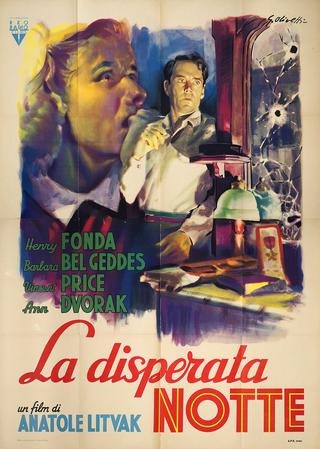
It’s late in the day in a nameless town and a blind man taps his way up the stairs to his room in a boarding house. His ascent is interrupted as a shot rings out. On the top floor a door bursts open, and a mortally wounded man stumbles out before pitching headlong down the staircase. This was The Great Maximilian (Vincent Price), a second rate conjurer plying his trade in a succession of low rent night clubs across the country. Now he lies dead on a seedy landing in a tenement, gutshot by factory worker Joe Adams (Henry Fonda). That’s how The Long Night opens, and before the end we will learn just how these two men came to this point. For the most part the story is told in flashback from the point of view of Adams, although at one stage there is what you might call a double flashback. Sound confusing? Well, it’s not really, since the story recounted is a fairly simple one. Naturally, there’s a woman involved who acts as the catalyst. She is Jo Ann (Barbara Bel Geddes), a virginal young innocent for whom both Adams and Maximilian fall – figuratively and literally. With Maximilian persisting in his attempts to seduce the girl and Adams simmering resentment growing, events slowly build towards the only possible outcome. Along the way, other characters flit in and out of the story, most notably Maximilian’s former assistant and lover Charlene (Ann Dvorak). Her streetwise presence serves both to provide a contrast to the gullibility of Jo Ann and to highlight just what a piece of work Maximilian is. His deceitful pursuit of Adams’ girl is one thing, but it’s a rare kind of S.O.B. who shaves the paws of puppies and burns the skin red raw in order to train them to perform.

Made at a time when noir pictures were beginning to move towards a wider use of locations and a more documentary approach, The Long Night is something of a throwback. Shot entirely in the studio and making extensive use of miniatures and forced perspective, the film takes on a dreamlike, otherworldly quality. This works pretty well since Joe Adams spends the film holed up in a bullet-riddled room living within his own mind and memories. Fonda does well in a role that demanded he be breezy and cheerful in the flashbacks, all the while growing more uneasy until he finally starts to lose his grip on reality. He always excelled in his portrayals of average guys who are put upon, and he manages to work in some post-war angst which must have struck a chord with the recently returned WWII vets. In contrast, Vincent Price hams it up in a bombastic performance as the villain who is sly, snide and sneering while retaining a certain pathos. Barbara Bel Geddes, in her debut role, was well cast as the youthful Jo Ann. Superficially, she doesn’t seem to fit the stereotypical image of the femme fatale, but her character certainly has a fatal effect on the men in the picture. Ann Dvorak’s wisecracking dame who’s seen it all is is a joy to behold as she picks away at Maximilian’s carefully arranged image, and seems to be having a ball casually humiliating him whenever and wherever the opportunity arises.

The Long Night was an RKO picture but it has been released on R1 DVD by Kino. While the film clearly hasn’t had any significant clean-up done it remains in pretty good shape. There are a variety of damage marks present but, with a few exceptions, the print is clear and very watchable. As is often the case with films like this, the audio can be a bit inconsistent but I can’t see anyone forking out for a full blown restoration so this is probably as good as it’s going to look and sound. The disc does boast some nice extras in the form of a text based feature detailing the meticulous work that went into the production design which gives the film its unique atmosphere. Alongside that, there are  a  couple of clips which compare scenes in the movie with virtually identical ones in the French original. All told this is a fine movie that should please anyone with a taste for noir.