Female on the Beach

The Gothic mystery / romance characteristically placed wide-eyed young females from generally sheltered backgrounds in perilous situations. As often as not, they found themselves alone, or practically so, in some rambling old pile they had inherited and threatened by some as yet unknown figure. It’s a hoary old trope, but a it’s also proved to be an attractive one and pretty successful as a consequence. The classic variant still turns up of course and it has also been tweaked and updated to make the standard formula a better fit for changing circumstances and the demands or tastes of audiences. Female on the Beach (1955) is essentially a modernized take on the Gothic mystery. Sure the trappings have been altered and the setting has waves gently lapping on sultry shores rather than launching raging assaults on mean and jagged rocks, but the core elements remain in place – there’s a lone woman taking up residence in an expensive house, a romance with a shadowy and potentially dangerous man, an escalating series of threats and a correspondingly mounting sense of panic and anxiety. As is frequently the case with a lot of this type of material, some of it works very well while other parts suffer from exposure to the overheated atmosphere.
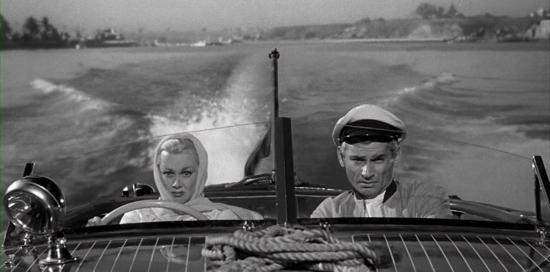
The first female seen on a beach in this movie is one who has just taken a swan dive off the veranda of her seafront home. She had been drinking, heavily, quarreling querulously with a lover and then in a fit of alcohol soaked remorse and self-pity rushed out onto the balcony to stumble and crash through the guard rail. The last we see is the final twitch of her hand, flicking farewell to the busted remains of a brandy balloon. The entire business had an air about it that was as much pathetic as it was tragic. One out, one in – the next arrival is the actual owner of the house. This is Lynn Markham (Joan Crawford), the widow of a big time gambler and a woman looking for nothing so much as solitude. What she ends up getting is the initially unwelcome attention of resident beach bum Drummond Hall (Jeff Chandler). He seems to be suspiciously familiar with the house, and there are little relics of his previous visits littering almost every corner of the place. None of this should be much of a surprise; Drummy (as everyone calls him) is an unapologetic gigolo, albeit something of a reluctant one. He was the man who exited the house pursued by the drunken entreaties of the last tenant just before she moved out permanently and suddenly. He appears to be set on continuing where he left off, business is business after all and a guy has to make a buck whatever way he knows best. Lynn Markham doesn’t intend to become the next mark to pick up Drummy’s checks though and tells him so in no uncertain terms. All of this recalls the tale of Zeus once realizing that the fox that can’t be caught and the hound that can’t lose its prey sets up a paradox of Olympian proportions. In short, something’s got to give. Well it does, love blossoms or lust triumphs – take your pick. And yet there’s a lingering doubt regarding the death of Lynn’s predecessor – accidents ,suicides and murders all produce the same result and it’s easy to mistake one for the other. With a persistent and dissatisfied police lieutenant lurking in the background, Lynn runs the gamut of passion, suspicion and outright fear as she falls for Drummy yet can’t shake the feeling that he may be looking to dispose of his catch as soon as he has secured all the wealth and benefits that come with it.
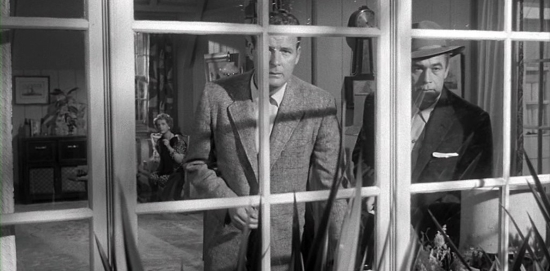
Director Joseph Pevney was on a solid and at times hugely impressive run of movies throughout the 1950s. There were some misfires and a few frankly humdrum efforts along the way, and some like Female on the Beach which look stylish despite an inherent modesty in terms of production, tease and flatter to deceive in scripting and development, and still manage to be entertaining despite some major flaws. The movie raises questions about the nature of love and betrayal, the importance of trust and the brittleness of human relationships. And the ending, the conclusions reached, is less than satisfactory. It ties everything up in a neat enough way but that doesn’t make it particularly convincing, nor I would argue does it offer a resolution with any promise. None of this is the fault of Pevney of course, the script being an adaptation by Robert Hill of his own play. Pevney, and cinematographer Charles Lang, create some attractive images despite or inspired by the natural staginess of the material. Somehow though, the melodrama and the thrills don’t blend as seamlessly as they might, curdling instead and leaving the finished product lumpy where it ought to have been smooth.
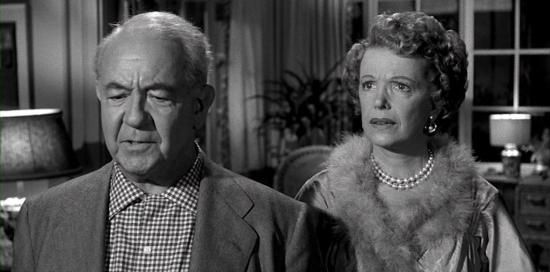
Jeff Chandler made a number of movies with Pevney and all that I’ve seen have been worthwhile on some level. Female on the Beach does have a certain superficiality to its sandblasted Gothic chic, but Chandler always brought an enticing mix of authority and vulnerability to his roles regardless. While dissatisfied self-awareness crossed with brooding calculation isn’t the easiest look to put across, he succeeds in doing so. Joan Crawford was nearing the end of her strong mid-career revival, the slightly trashy but very enjoyable Queen Bee and the very fine Autumn Leaves would soon be followed by a run of exploitative titles of gradually diminishing quality. Female on the Beach had her running on autopilot, suffering, emoting and tossing out some stinging barbs but never stretching herself. Jan Sterling was generally good value in any movie she appeared in and spars successfully with Crawford here. That said, the tone of her performance overall is ramped up a little too high, and again I feel the script is to blame for that. Cecil Kellaway and Natalie Schafer are wonderfully seedy as Chandler’s sponsors and handlers while Charles Drake is solidly unremarkable as the dogged detective – I think I prefer him in his more ambiguous roles.
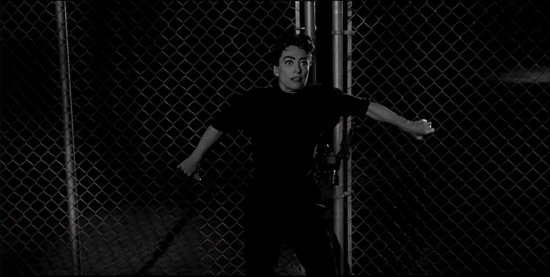
Female on the Beach is easy to access for viewing, as are so many Universal-International movies these days. It was released on DVD in the US long ago in a box of vaguely noirish thrillers and then on Blu-ray by Kino. I have the UK DVD that Odeon put out some years ago and I think it’s a more than satisfactory presentation. To sum up, Pevney does his customarily slick job, Chandler and Crawford add some star power, but the script rarely rises above the mediocre.

This launches a short series of posts on the movies of Joseph Pevney that will be featured this summer.
Daisy Kenyon

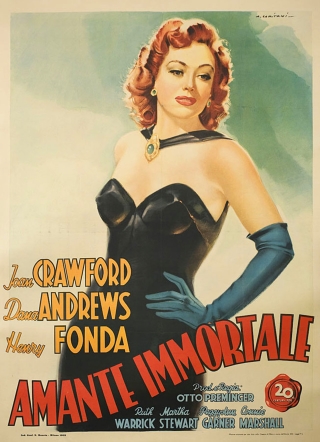
The magic of marketing – hang a label on a movie, point to the genre pedigree of the headline stars, and the director for that matter, and and there we have a film noir. Or actually we don’t, we have a film sold as such, at least it was back when Fox Film Noir was an ongoing line in the heyday of DVD releasing. Daisy Kenyon (1947) is a very well made and enjoyable post-war romantic melodrama but regardless of what it says on the tin, it’s certainly not a film noir. OK, having got that out of the way, I do want to take a look at a movie which sees three top stars all doing excellent work with one of Hollywood’s finest directors and getting plenty of mileage out of that frank openness about human relationships and bloomed in the years following WWII.

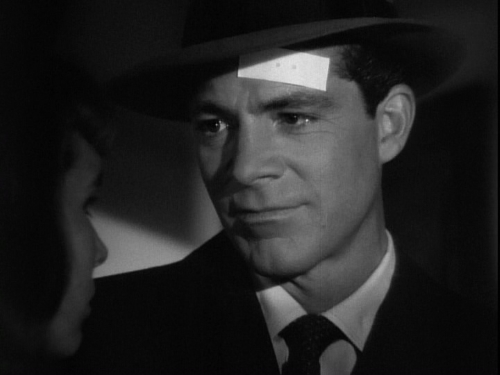
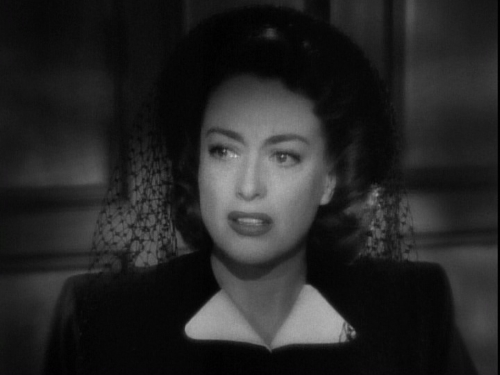
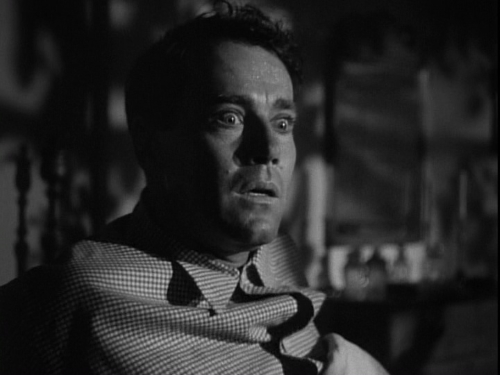
There is something attractive about frankness, especially with regard to those relationships that might be seen as falling below contemporary standards of propriety. Otto Preminger was always good at bringing such material to the screen and there’s a refreshing lack of judgement on display as we follow the complicated and meandering love lives of the three principals. At the center of it all is Daisy Kenyon (Joan Crawford), an unwed artist who has been carrying on an affair with a married hotshot lawyer, Dan O’Mara (Dana Andrews). Right from the first scene it’s apparent that this is unsatisfactory, from Daisy’s perspective anyway. She’s not stricken by guilt or remorse or any of the other trite reactions typically forced upon characters in this position. No, she’s just tired of taking second place whenever some important business or social engagement arises, and of course time is not in the habit of waiting around for anyone. With this in mind, she has one of her periodic spats with O’Mara and sets about preparing for a date with a new romantic prospect. Peter Lapham (Henry  Fonda) is a soldier and one time boat designer. In one of those delightfully quirky scenes that punctuate the movie, both her suitors run into each other in the doorway and wind up using the same cab to shuttle back and forth, just not together. The romantic rivalry between the two men hasn’t grown any teeth at this stage, that will come later but there is a quality to it from the off that I can only describe as screwball drama. If O’Mara is not the ideal pick for Daisy given his marital commitments, Lapham has other issues. it’s not explicitly stated but he’s clearly affected by PTSD, as well as a degree of guilt/remorse for the death of his wife. I don’t want to go into too many details here, suffice to say the story devolves into a kind of contest for Daisy’s heart with the well-being and contentment of O’Mara’s children as a form of collateral up for negotiation. Maybe the outcome isn’t entirely surprising but the road that takes us there is pitted with plenty of drama, a sprinkling of black humor and a liberal dose of good old-fashioned empathy.

Preminger blends this all expertly, getting first class performances from his three leads. Henry Fonda was rebuilding his Hollywood career after wartime service in the navy. He would make My Darling Clementine and The Fugitive for Ford and then Fort Apache, with this movie and The Long Night giving him the chance to work with other directors in between. He brings something slightly offbeat to his role, an attractive quality which while not quite offering the lush oddness to be found in William Dieterle’s wonderful Portrait of Jennie and Love Letters is satisfyingly quirky and somehow authentic. Andrews is more grounded, less ethereal in his part. He’s driven by a desire that feels vaguely juvenile in its approach – as Crawford tells him late on, he’s as much spurred on by a need to escape responsibility as any need to achieve stability. Still, that unrest that Andrews was so adept at harnessing is always bubbling just below the surface. Crawford was riding high after her success in Mildred Pierce and gives a performance that is confident and credible. The fact is all three play off each other in a way that engages rather than overwhelms the viewer. Add in Leon Shamroy’s evocative camerawork and a characteristically classy score from David Raksin and the result is a polished and meaningful piece of filmmaking.

As I said at the start, Daisy Kenyon is not a film noir and I’m not sure how it came to be marketed as such. Perhaps it’s the combination of the reputations of the stars and director alongside some shadowy cinematography. The old Fox DVD sported a middling transfer, with some very blurry sections. I can’t say for sure whether or not this was intentional yet I doubt it somehow. Even though I understand the later Kino Blu-ray exhibits the same, I suspect print damage of some kind is more likely at the back of it. However, none of that should spoil one’s enjoyment of the movie. The DVD (and I think the Blu-ray too) has some worthwhile supplements with short features on the making of the movie and on Preminger’s career. Among the contributors is the always welcome and interesting Foster Hirsch  – revisiting this movie and listening to his comments has reminded me that I need to pick up a copy of his book on Preminger. I think anyone who hasn’t seen this film will find it a rewarding watch. Just don’t go in expecting to see a film noir.

Autumn Leaves

The present is made up of little bits of the past.

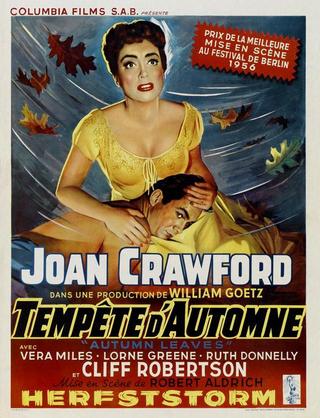
Recently, I spoke a little about filmmakers venturing outside of their perceived comfort zone and the how the ability to do so successfully can be taken as an indication of their artistic skill. The classic era of Hollywood moviemaking could be seen as a factory environment which encouraged specialization among performers, writers and directors. I say could because it’s not really the case at all and once one looks beyond a handful of headline titles it’s an assertion that rarely stands up to any scrutiny. Even the unsung journeymen were afforded the opportunity to try their hand at a range of genre pictures. I think the better or more interesting directors understood the challenge presented by these opportunities, that the form and conventions of genre (that frequently maligned term) could be adopted, applied or discarded as appropriate in the pursuit of their art. It’s easy to look at the films of Robert Aldrich and decide he was simply a classy purveyor of tough cynicism, and indeed I’ve been guilty of doing so myself in the past. However, I’d like to think that the years bring us if not exactly wisdom then at least a broader critical perspective. So in that spirit, let’s look at Autumn Leaves (1956), a superficially atypical offering from one of cinema’s great talents.

The story opens with Millie Wetherby (Joan Crawford) hard at work. She spends her days in her neat bungalow typing up manuscripts for writers, putting the finishing touches to the experiences and adventures of others, a vicarious existence if ever there was one. Her life is a mundane one, and a lonely one at that. When a satisfied customer passes on a couple of concert tickets he doesn’t need she accepts them and decides to treat herself to a rare evening out. A brief flashback sequence triggered by the familiar music makes it plain that Millie’s solitary life is the result of sacrifices she made to care for an ailing parent, that time and opportunity just passed her by. And yet her walk home takes her past a small eatery, a place that catches her eye for no special reason other than a reluctance to let the evening end. Still, taking those tickets and yielding to that impulse to stop off for a bite to eat before returning to the empty home prove to be pivotal moments in this humdrum and inconsequential life. As she sits alone in her booth, prim and composed, listening to the movie’s title song on the jukebox the shadow of a wistful smile plays across her features. Another shadow enters the frame at this point, another customer hoping to share some table space in the crowded restaurant. This is Burt Hanson (Cliff Robertson), a fresh-faced and talkative young man, one more soul adrift in the urban anonymity. Here we have the beginnings of a tentative and rather sweet romance, a predictable setup in many ways. Yet the tone and direction alter radically in the second half as a far from attractive past barrels its way into the fragile present, and the threat to that fragility is what forms the basis of the drama which subsequently unfolds.

The cinema of the 1950s is an endlessly fascinating subject for this viewer. There are of course the technical advances which were ongoing and literally changing the shape of the movies, but it’s the thematic probing that seems to characterize this decade of filmmaking which intrigues me most. The promise and potential, the surface gloss of this brave new post-war world seemed to offer so much food for artistic contemplation. Time and again we encounter the notion of rebirth and renewal in 50s cinema, and indeed the characters played by Crawford and Sheppard Strudwick openly discuss the concept of being reborn in what is otherwise one of the more prosaic scenes in this picture. However, I’m of the opinion that reinvention is perhaps a more appropriate word to describe the central theme of Autumn Leaves. Millie certainly reinvents herself in the role of carer which she appears to have occupied all her life, although one might argue the ending does look to a future beyond that. Burt is without doubt the most obvious source of reinvention; he adopts and discards aspects of his past and present at the drop of a hat, unconsciously creating whatever reality feels expedient on any given occasion. Of course the consequent psychological meltdown and the road back from the mental abyss into which he descends is another part of that process.

So what can one say about Aldrich, and is there cynicism on view here? Well yes and no. If one takes the view that peering beyond the veils of society to get nearer the truth is cynicism, then perhaps Aldrich can be said to be a cynic. I’m not sure that is the case though; for one thing cynicism suggests a sourness, particularly on a personal level. As I see it, Aldrich wasn’t going down that route. On the contrary, I see a man casting a sidelong glance at society on an institutional level, almost like a more abrasive version of Douglas Sirk. Unlike Sirk’s more sumptuous, glossy presentation of a flawed idyll, Aldrich’s visual approach is starker and more direct with Charles Lang’s noir-shaded cinematography and the canted angles and mise-en-scène emphasizing the narrow range of options open to his trapped and tormented characters.

Joan Crawford’s career on screen could be separated into distinct eras, with Autumn Leaves coming close to the end of a very successful run starting with Mildred Pierce. Her role as Millie Wetherby is a strong one and a good fit for her at this stage in her life and career. There’s an open acknowledgement of all the little (and not so little) insecurities that come with ageing. There are, as expected, a number of “big” moments but it’s actually some of the smaller, more intimate instances that stick in my mind, that early scene in the restaurant for example, or some of the exchanges with Ruth Donnelly. Cliff Robertson landed a plum part as the deeply disturbed Burt and his handling of the character’s slow disintegration is well done, with vague hints dropped from early on and casual lies imparted before their enormity is finally revealed.

Both Vera Miles and Lorne Greene are fine too as the calculating ex-wife and the frankly sinister father respectively. I mentioned before Aldrich’s less than reverent view of institutions and his take on an appallingly dysfunctional family is deeply shocking. Miles’ glacial turn as the entitled and contemptuous ex is marvelously mean – leaving that cigarette smouldering in the ashtray in Crawford’s bungalow is a nice touch. And Greene is on top form as the bullying, creepy patriarch. If family is seen as representing the bedrock of society, the horrors implicit in Burt’s domestic background offers as withering a criticism of the post-war American Dream as one could imagine. In support, the aforementioned Ruth Donnelly is a joy every time she appears and there are small parts for Maxine Cooper (Velda from Kiss Me Deadly) and, as a gloriously jaded and world weary waitress, Marjorie Bennett.

Autumn Leaves is one of Robert Aldrich’s early films that seems to get much less attention than his other work from around that time. Frankly, it deserves better as all those involved give a good account of themselves, not to mention the fact the movie tackles a tricky subject with confidence. Rather than resort to dry cynicism, Aldrich takes an unflinching look at the process of decay in certain institutional pillars but reserves a cautious optimism for the individuals at the heart of his drama and for their simple hopes. And, last but by no means least, there’s Nat “King” Cole’s superb theme song:

Johnny Guitar

jg1

“You know, some men got the craving for gold and silver. Others need lots of land, with herds of cattle. And then there’s those that got the weakness for whiskey, and for women. When you boil it all down, what does a man really need? Just a smoke and a cup of coffee.”

So says the eponymous hero of Johnny Guitar (1954) Nicholas Ray’s overwrought, subversive western. This is a simple philosophy, espoused by a deceptively simple man. And yet, the film itself is rich, complex and fascinating, both visually and thematically. Over the years, it’s come to be regarded as a cult item, a film so loaded with allegory and subtext that it positively demands analysis. For all that though, it’s a difficult film to try to analyse; there’s so much going on, both on and below the surface, that it’s hard to do it justice. I’ve toyed around with the idea of featuring this movie for a long time now and kept putting it off for one reason or another. However, after a recent viewing, I’ve decided to finally have a go at presenting my take on one of the most startling westerns to come out of the 50s, or any other decade for that matter.

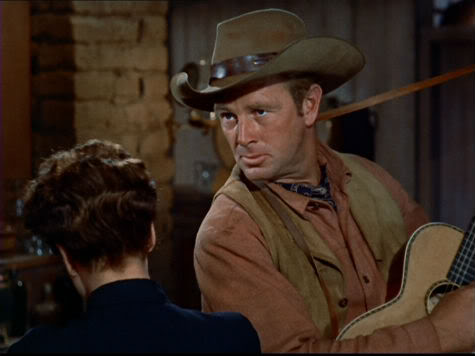
The action opens with a bang, literally. Johnny Logan (Sterling Hayden) – although using the pseudonym Johnny Guitar – rides along the base of a hill which the railroad company are in the process of blasting away. As he tops a ridge, his attention is drawn by the sounds of more violent activity; down below, a stagecoach robbery is taking place. Johnny merely watches passively, turning his mount away and continuing on his journey. His destination is an isolated saloon and gambling house, standing alone in the Arizona wastelands. He arrives right in the middle of a ferocious dust storm, the desert winds whipping the red earth up into a furious maelstrom. As he bursts through the doors of the saloon, he finds himself in a curiously still and peaceful world. But this is a brooding, intense stillness, like that found at the eye of the storm. In truth, that’s where we are, right at the centre of a devastating and destructive emotional storm that’s about to sweep across the screen and lay waste to all in its path. This incongruous establishment is run by the equally unusual Vienna (Joan Crawford), a gun-toting woman in jeans and boots who, in the words of one of her employees, thinks like a man and acts like a man.

It’s clear enough that Johnny and Vienna have a history, and it’s later revealed that they were once lovers before he abandoned her. However, things have changed now that Vienna’s in trouble and in need of protection: she’s built her saloon in anticipation of the arrival of the railroad and the business it will bring in tow, but elements in the neighboring town are hell-bent on ensuring that won’t happen. Vienna’s chief rival is Emma (Mercedes McCambridge), a repressed and frustrated spinster, backed up by the blustering and bullying McIvers (Ward Bond). Superficially, this opposition is based on a desire to prevent the railroad moving in and the hordes of new settler it must surely bring. In reality though, there’s an entirely different desire driving Emma on; it’s a potent and unpleasant mix of jealousy and hatred, jealousy of Vienna and the passions she’s capable of stirring and hatred of her own emotional vulnerability. Radically, from the point of view of the classic western, it’s these two women who are the active protagonists at the heart of the drama. It’s the actions and reactions of Vienna and Emma which power the narrative and shape events. And ultimately, in a complete reversal of the conventions of the genre, it will all come down to a face-off between two determined and driven women.

£2

Nicholas Ray made some pretty good films, but I reckon he was responsible for three great ones: In a Lonely Place, Bigger Than Life and Johnny Guitar. These movies are markedly different in terms of genre and theme, but they do all share an emotional intensity and feature obsessive lead characters. Johnny Guitar is the most self-consciously stylized, and therefore probably the most misunderstood, of the three. Ray wasn’t aiming for any kind of realism, rather he deliberately played up the heightened sense of unreality (what the critics usually refer to as the baroque aspects) to complement the fantastic nature of the story and characterization. With Harry Stradling operating the camera, Ray used the interiors, especially the main set of Vienna’s place where the back wall seems to be hewn from the living rock, to create an otherworldly feeling. A similar effect is achieved through the use of colour, particularly when it comes to the costumes. Vienna always appears in strong primary colours (scarlets, greens, yellows and whites) and contrasts sharply with the subdued tones of those around her. This is most notable in the case of Emma, who appears in all but one scene clad in funeral black, where the drabness of her dress emphasizes not only her pinched and cruel features but also marks her out as the visual antithesis of Vienna. The men in the film all appear in softer, less striking colours too, which serves to draw attention both to the softness of their character and to the subsidiary roles they play. Aside from the skewed representations of gender, Ray and writer Philip Yordan take a swipe at the McCarthyite politics of the time. The posse led by Emma gradually morphs into an implacable panel of self-appointed judges, contemptuous of the rule of law, using betrayal and deceit as a means to punish guilty and innocent alike. The masterstroke here was the ironic casting of Ward Bond (a prime mover in the Motion Picture Alliance for the Preservation of American Ideals) as Emma’s chief ally.

This leads me to the casting in general, an area where I can’t honestly find any fault. Joan Crawford is hardly a figure one would normally associate with the western, and Johnny Guitar represents one of her few forays into the genre. Crawford’s career can be roughly divided into three phases: her siren/starlet years up to the end of the 30s, her reinvention of herself as a noir/melodrama heroine in the 40s, and finally as a fixture of schlock horror pictures in the 60s. This movie came towards the end of her second phase, and it forms a kind of bridge between the tough post-Mildred Pierce roles and the gallery of grotesques still to come. While the western environment may seem an odd place to find Crawford, the feeling of otherness she brings is entirely appropriate in context. In addition, the years had hardened her looks and seen them take on that almost masculine aspect that fits the role of Vienna; I can’t think of another actress of the period who could have been plausibly been cast in the part. As Emma, Mercedes McCambridge was another ideal choice. She possessed the shrillness of voice and sharpness of features to perfectly embody a woman barely in control of the raging and conflicting emotions boiling away within her. I think it’s fair to say that no other actress has thus far managed to quite nail the corrosive, consumptive effects of twisted and repressed sexuality to such terrifying effect.

£3

Sterling Hayden in the title role, as the only man who displays anything approaching strength or dignity, made good use of both his physical presence and craggy face to impose himself upon all those around him. However, there’s more than just muscle and machismo to his playing; the scene where he and Crawford mull over their past reveals a sensitivity and shows him to be a fully rounded character, perhaps the only one in the film. Scott Brady as The Dancing Kid was the figure at the heart of Vienna and Emma’s rivalry, an essentially feminine role, and he gets across the kind of inherent weakness demanded. His cocksure confidence is basically a front to mask his essential impotence – he’s no match for Hayden’s easy assurance when the chips are down. Among Brady’s sidekicks, Ernest Borgnine remains the most memorable. His performance as the untrustworthy blowhard can be viewed as something of a dry run for a similar part in Bad Day at Black Rock.

To date the best DVD release of Johnny Guitar is the version available throughout continental Europe via Paramount. I have the French DVD and it’s a very pleasing transfer, a vast improvement on the UK release by Universal. There’s no noticeable damage to the print, sharpness is acceptable and, crucially for such a film, the colour is well rendered. Subtitles are not a problem, a range of languages are available and can be disabled on the original soundtrack via the setup screen. There are no extra features at all offered. The title will shortly be made available in the US by Olive Films on both DVD and Blu-ray, as a result of that company licensing the Republic catalogue, and I would imagine the same print will be used as a source. If so, it should look pretty good in high definition. Johnny Guitar is one of those movies that viewers are likely to either love or loathe; it’s too heady a cocktail to elicit a lukewarm response. I count myself among the former, and it’s a film I never tire of revisiting. This article I’ve written really only scratches the surface of what’s on offer and tries to give a flavour of this very rich concoction – I haven’t even gone into the resemblances the plot bears to Leone’s Once Upon a Time in the West, or the matter of the expansion of the railroad and the clash between progress and tradition. Like all the best pieces of cinema, Johnny Guitar reveals new things on each viewing. I’d say it’s a must for any serious western fan.