Johnny Guitar

jg1

“You know, some men got the craving for gold and silver. Others need lots of land, with herds of cattle. And then there’s those that got the weakness for whiskey, and for women. When you boil it all down, what does a man really need? Just a smoke and a cup of coffee.”

So says the eponymous hero of Johnny Guitar (1954) Nicholas Ray’s overwrought, subversive western. This is a simple philosophy, espoused by a deceptively simple man. And yet, the film itself is rich, complex and fascinating, both visually and thematically. Over the years, it’s come to be regarded as a cult item, a film so loaded with allegory and subtext that it positively demands analysis. For all that though, it’s a difficult film to try to analyse; there’s so much going on, both on and below the surface, that it’s hard to do it justice. I’ve toyed around with the idea of featuring this movie for a long time now and kept putting it off for one reason or another. However, after a recent viewing, I’ve decided to finally have a go at presenting my take on one of the most startling westerns to come out of the 50s, or any other decade for that matter.

The action opens with a bang, literally. Johnny Logan (Sterling Hayden) – although using the pseudonym Johnny Guitar – rides along the base of a hill which the railroad company are in the process of blasting away. As he tops a ridge, his attention is drawn by the sounds of more violent activity; down below, a stagecoach robbery is taking place. Johnny merely watches passively, turning his mount away and continuing on his journey. His destination is an isolated saloon and gambling house, standing alone in the Arizona wastelands. He arrives right in the middle of a ferocious dust storm, the desert winds whipping the red earth up into a furious maelstrom. As he bursts through the doors of the saloon, he finds himself in a curiously still and peaceful world. But this is a brooding, intense stillness, like that found at the eye of the storm. In truth, that’s where we are, right at the centre of a devastating and destructive emotional storm that’s about to sweep across the screen and lay waste to all in its path. This incongruous establishment is run by the equally unusual Vienna (Joan Crawford), a gun-toting woman in jeans and boots who, in the words of one of her employees, thinks like a man and acts like a man.

It’s clear enough that Johnny and Vienna have a history, and it’s later revealed that they were once lovers before he abandoned her. However, things have changed now that Vienna’s in trouble and in need of protection: she’s built her saloon in anticipation of the arrival of the railroad and the business it will bring in tow, but elements in the neighboring town are hell-bent on ensuring that won’t happen. Vienna’s chief rival is Emma (Mercedes McCambridge), a repressed and frustrated spinster, backed up by the blustering and bullying McIvers (Ward Bond). Superficially, this opposition is based on a desire to prevent the railroad moving in and the hordes of new settler it must surely bring. In reality though, there’s an entirely different desire driving Emma on; it’s a potent and unpleasant mix of jealousy and hatred, jealousy of Vienna and the passions she’s capable of stirring and hatred of her own emotional vulnerability. Radically, from the point of view of the classic western, it’s these two women who are the active protagonists at the heart of the drama. It’s the actions and reactions of Vienna and Emma which power the narrative and shape events. And ultimately, in a complete reversal of the conventions of the genre, it will all come down to a face-off between two determined and driven women.
£2

Nicholas Ray made some pretty good films, but I reckon he was responsible for three great ones: In a Lonely Place, Bigger Than Life and Johnny Guitar. These movies are markedly different in terms of genre and theme, but they do all share an emotional intensity and feature obsessive lead characters. Johnny Guitar is the most self-consciously stylized, and therefore probably the most misunderstood, of the three. Ray wasn’t aiming for any kind of realism, rather he deliberately played up the heightened sense of unreality (what the critics usually refer to as the baroque aspects) to complement the fantastic nature of the story and characterization. With Harry Stradling operating the camera, Ray used the interiors, especially the main set of Vienna’s place where the back wall seems to be hewn from the living rock, to create an otherworldly feeling. A similar effect is achieved through the use of colour, particularly when it comes to the costumes. Vienna always appears in strong primary colours (scarlets, greens, yellows and whites) and contrasts sharply with the subdued tones of those around her. This is most notable in the case of Emma, who appears in all but one scene clad in funeral black, where the drabness of her dress emphasizes not only her pinched and cruel features but also marks her out as the visual antithesis of Vienna. The men in the film all appear in softer, less striking colours too, which serves to draw attention both to the softness of their character and to the subsidiary roles they play. Aside from the skewed representations of gender, Ray and writer Philip Yordan take a swipe at the McCarthyite politics of the time. The posse led by Emma gradually morphs into an implacable panel of self-appointed judges, contemptuous of the rule of law, using betrayal and deceit as a means to punish guilty and innocent alike. The masterstroke here was the ironic casting of Ward Bond (a prime mover in the Motion Picture Alliance for the Preservation of American Ideals) as Emma’s chief ally.

This leads me to the casting in general, an area where I can’t honestly find any fault. Joan Crawford is hardly a figure one would normally associate with the western, and Johnny Guitar represents one of her few forays into the genre. Crawford’s career can be roughly divided into three phases: her siren/starlet years up to the end of the 30s, her reinvention of herself as a noir/melodrama heroine in the 40s, and finally as a fixture of schlock horror pictures in the 60s. This movie came towards the end of her second phase, and it forms a kind of bridge between the tough post-Mildred Pierce roles and the gallery of grotesques still to come. While the western environment may seem an odd place to find Crawford, the feeling of otherness she brings is entirely appropriate in context. In addition, the years had hardened her looks and seen them take on that almost masculine aspect that fits the role of Vienna; I can’t think of another actress of the period who could have been plausibly been cast in the part. As Emma, Mercedes McCambridge was another ideal choice. She possessed the shrillness of voice and sharpness of features to perfectly embody a woman barely in control of the raging and conflicting emotions boiling away within her. I think it’s fair to say that no other actress has thus far managed to quite nail the corrosive, consumptive effects of twisted and repressed sexuality to such terrifying effect.

£3

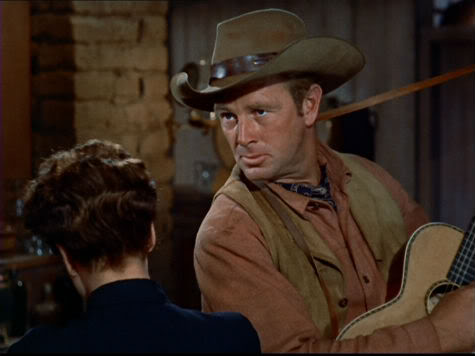
Sterling Hayden in the title role, as the only man who displays anything approaching strength or dignity, made good use of both his physical presence and craggy face to impose himself upon all those around him. However, there’s more than just muscle and machismo to his playing; the scene where he and Crawford mull over their past reveals a sensitivity and shows him to be a fully rounded character, perhaps the only one in the film. Scott Brady as The Dancing Kid was the figure at the heart of Vienna and Emma’s rivalry, an essentially feminine role, and he gets across the kind of inherent weakness demanded. His cocksure confidence is basically a front to mask his essential impotence – he’s no match for Hayden’s easy assurance when the chips are down. Among Brady’s sidekicks, Ernest Borgnine remains the most memorable. His performance as the untrustworthy blowhard can be viewed as something of a dry run for a similar part in Bad Day at Black Rock.

To date the best DVD release of Johnny Guitar is the version available throughout continental Europe via Paramount. I have the French DVD and it’s a very pleasing transfer, a vast improvement on the UK release by Universal. There’s no noticeable damage to the print, sharpness is acceptable and, crucially for such a film, the colour is well rendered. Subtitles are not a problem, a range of languages are available and can be disabled on the original soundtrack via the setup screen. There are no extra features at all offered. The title will shortly be made available in the US by Olive Films on both DVD and Blu-ray, as a result of that company licensing the Republic catalogue, and I would imagine the same print will be used as a source. If so, it should look pretty good in high definition. Johnny Guitar is one of those movies that viewers are likely to either love or loathe; it’s too heady a cocktail to elicit a lukewarm response. I count myself among the former, and it’s a film I never tire of revisiting. This article I’ve written really only scratches the surface of what’s on offer and tries to give a flavour of this very rich concoction – I haven’t even gone into the resemblances the plot bears to Leone’s Once Upon a Time in the West, or the matter of the expansion of the railroad and the clash between progress and tradition. Like all the best pieces of cinema, Johnny Guitar reveals new things on each viewing. I’d say it’s a must for any serious western fan.


Pursued

Anyone who has visited this site a few times must be aware of my fondness for both film noir and westerns, and it shouldn’t therefore come as any surprise to learn that I find myself drawn to what we might call crossover movies. The noir influence that can be detected in so many 40s films is especially noticeable in a number of westerns, and Raoul Walsh’s Pursued (1947) is one example where this is very evident. Now this is by no means a perfect movie; I’m not convinced that the basic premise of the story, which isn’t fully revealed until the end, is all that logical or capable of bearing too much close scrutiny. However, film noir, regardless of its setting, was never heavily dependent on wholly logical motivation or reactions. In terms of appearance, tone and mood, Pursued is a very stylish piece of western noir that emphasises and revels in its more melodramatic aspects.

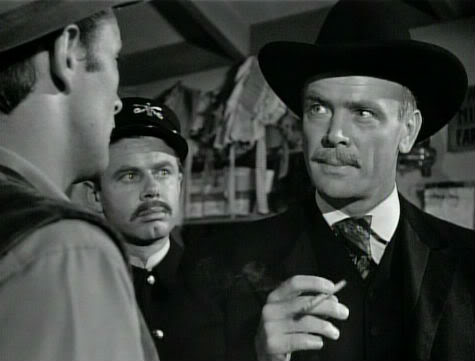
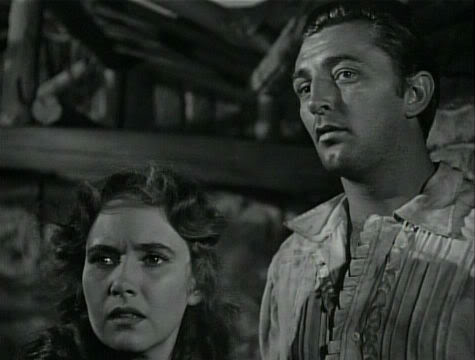
The opening has an edgy, breathless quality with Jeb Rand (Robert Mitchum) holed up in the ruins of a New Mexico homestead, waiting for some inevitable showdown. With the arrival of his girl, Thor (Teresa Wright), Jeb begins delving into their shared past in order to try to make sense of their current predicament. It’s abundantly clear that Jeb is in a heightened emotional state, and the lengthy flashback which occupies the bulk of the running time seems to take on the dizzying, disorienting characteristics of a fever dream at some points. The story traces Jeb’s life from childhood, from the point where he was found cowering and confused by Ma Callum (Judith Anderson) in his deserted home. She adopts the youngster and raises him as her own along with her two natural children, Thor and Adam (John Rodney). Young Jeb has no memory of his life before the night Ma Callum discovered him, and it’s clear that this is the result of some deeply traumatic events that occurred. The practice of employing Freudian theories about the roots of psychological issues and the whole process of memory recovery was woven into the plot strands of many a regular film noir, but it’s something of a departure to see it play such a prominent role in a western. Right from the beginning Jeb is seen to be a victim; not only does he feel a gnawing sense of self-doubt over his failure to fully recall his past, but his life is threatened on numerous occasions. Early on we learn that the principal danger is posed by Ma Callum’s brother-in-law, Grant (Dean Jagger), but the reasons for his apparent determination to see Jeb in his grave are only vaguely hinted at. Grant’s animosity stems from the existence of a vendetta between the Rand’s and the Callum’s and, like Jeb, the viewer has to wait and discover the meaning as the story unfolds. This element of mystery serves the twin purpose of maintaining our interest and also of emphasising the fatalistic nature of Jeb’s life – a man continually stalked by phantoms lurking in the shadows of his childhood.

The movie’s title is highly appropriate, in both a literal and figurative sense, as Jeb spends almost all of his screen time on the run from a variety of perils. Raoul Walsh’s direction, helped enormously by the masterly photography of the great James Wong Howe, hammers the point home by reducing the wide open spaces of the frontier to a series of dark, claustrophobic compositions. Even the exteriors have a tight, constricted quality to them – the ruins of the Rand homestead with broken and burnt rafters clawing despairingly at the lowering sky, and the huge, featureless rock formations that seem to dwarf the tiny riders scampering across their face. In addition, the cramped interiors are often filmed from low angles and bathed in expressionistic shadows, thus enhancing the mood of doom and paranoia. The action scenes, for which Walsh earned a lot of praise throughout his long career, are infrequent but well-shot and jarringly effective. All told, Pursued is arguably one of Walsh’s most artistic and stylized pieces of work. I think the director’s own macho dismissal of pretentious theorizing about subtexts or the artistic value of his vision goes some way towards explaining why he remains an underrated figure, although his reputation has seen some steady growth and reappraisal. The only major weakness I can detect lies in the script, or the resolution to be more precise. Niven Busch’s writing holds out the possibility of a big reveal that ought to shock, although close observers should more or less work things out for themselves anyway, yet fails to deliver on that promise. As I mentioned above, there’s a certain lack of logic to the climactic revelations that I found mildly disappointing.

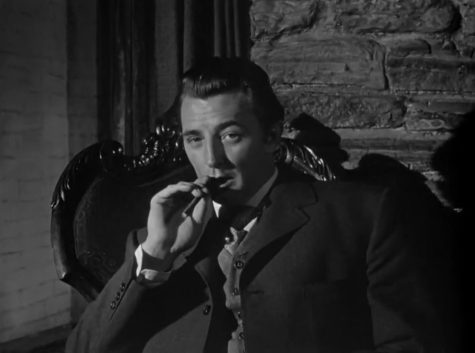
Pursued is probably the movie that saw Robert Mitchum really hit his stride as an actor, and his star was in the ascendancy from this point. His tough, laconic persona had already been put to use in westerns, and the underlying hint of vulnerability meant that he could move comfortably within the shadowy and uncertain world of film noir. This movie’s artful blending of the two filmmaking styles was therefore an ideal showcase for Mitchum’s talents. The sleepy-eyed passivity that he was able to project fits in with the fatalistic character who appears to have grown to accept the fact that life has and will continue to kick dirt in his face. As the architect of the ill-fortune that has dogged Mitchum’s footsteps, Dean Jagger makes for a formidable rival. He gives an electrifying performance as the driven man, consumed with hate for the Rand’s, who thought nothing of losing an arm to even up a score. There’s something chilling about the manic gleam that comes onto his eyes whenever the opportunity arises to compromise Mitchum further. Judith Anderson ought to be a cinematic legend if only for her turn as Mrs Danvers in Hitchcock’s Rebecca, and she’s very good here too. She didn’t feature in too many westerns – this and Anthony Mann’s The Furies being the most notable – but her role as Ma Callum represents another memorable characterization. She’s a pivotal figure in the development of the story and brings a strong sense of believability to her part. I have to say I was less impressed by Teresa Wright, whose evolution from Girl Friday to femme fatale and back again lacked both consistency and plausibility. Again, this may be more the fault of the leaps in logic demanded by the script than any particular deficiency on the part of the actress.

The R1 DVD of Pursued from Artisan is a middling effort at best. The disc carries a note that the film was restored by the UCLA but there’s inconsistency in the presentation. Early on, there’s a short section that’s noticeably weaker than the rest of the movie, and the sharpness and clarity varies throughout. There are no extra features offered. The film belongs in the Republic library, the recent acquisition of which by Olive in the US has seen the announcement of a number of titles on Blu-ray. I don’t know if this movie is seen as a candidate for a future release in the HD format but it would need to undergo some additional work for that to be a viable option. All in all, I see Pursued as an interesting attempt to fuse the western with film noir and throw some Freudian psychoanalysis into the mix. Personally, I like it and I reckon it should offer something to fans of both types of movie.

The Man from Laramie

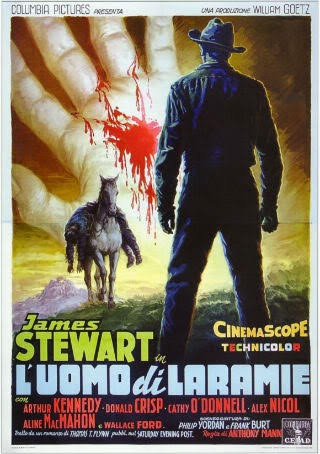
In 1950 James Stewart and Anthony Mann embarked on a series of groundbreaking and influential westerns that would play a significant role in shaping the evolution of the genre. Mann’s visual and narrative sense, honed by years spent producing tight and economical noir thrillers, and the painful angst that Stewart seemed to tap effortlessly into following his wartime experiences combined to push the western in new and exciting directions. Within five years though, this rich partnership had run its course and both men would go their separate ways. The Man from Laramie (1955) was to be the last picture they completed together, and it both built upon and expanded on the themes explored in their earlier collaborations. All of Mann and Stewart’s films exhibit a powerful intensity in the characterization, but The Man from Laramie adds a touch of violent sadism to the mix to achieve an even more potent result.

Once again we have a saga of a man seeking revenge, recompense for a loss he has suffered at the hands of others. Will Lockhart (James Stewart) is the titular character, a man whose real background is only revealed gradually throughout the course of the story and never fully even by the end. He’s first seen hauling a load of freight from Laramie to the small town of Coronado, but a brief stop on the way lets us know that his real purpose is something else. This short, early scene is a fine example of how a skillful filmmaker can impart vital plot details economically and with resorting to dialogue-heavy exposition. We’re shown Lockhart wandering round the burnt out remains of an army patrol that was ambushed and massacred by the Apache. All this information is gleaned from the visual clues and the telling use of some music cues. The way Lockhart gazes wistfully at the charred hat of a fallen soldier makes it clear that the events which unfolded at that lonely spot have some deep, personal significance for him. In time, it’s revealed that Lockhart’s younger brother was among the slain, and his reason for coming to Coronado is to find the man or men who brought about his death by supplying the Apache with repeating rifles. Before he can make any progress with his investigation, he finds himself drawn into conflict with the most powerful man in the territory. An unexpected and violent encounter with Dave Waggoman (Alex Nicol), the petulant and vindictive son of a local rancher, appears to temporarily distract Lockhart from his primary goal. However, as he’s drawn deeper into the complex relationship between Dave, his father (Donald Crisp) and top hand Vic Hansbro (Arthur Kennedy), it begins to dawn on Lockhart that this curious family arrangement may be connected to his own quest. Again in a 50s western, there’s an examination of the father/son dynamic and how men interact with other men. Alongside all this, there’s the inclusion of quasi-religious symbolism through the suffering and humiliation Lockhart has to endure – being bound and dragged through flames, and then the brutal mutilation of his hand that invokes overtones of crucifixion and the stigmata.

Philip Yordan and Frank Burt’s screenplay is beautifully constructed, with three strands playing out simultaneously and then folding neatly together to form the whole. Lockhart, Vic and Dave are all essentially men in search of some anchor in their existence, all homeless creatures to some extent. Lockhart never says where he comes from, claiming that home is wherever he finds himself; Vic has been taken in by old Alec Waggoman and treated like a surrogate son, but he’s aware that he’s an outsider and never quite comfortable or sure of his place in the world; and Dave is the overgrown boy who knows in his heart that he’s fallen far short of his tough father’s expectations. For both Lockhart and Vic, there appears to be the possibility of salvation or some grounding in the person of Barbara Waggoman (Cathy O’Donnell), but Dave is essentially a lost cause. These three also share a common character trait in that all of them are given to extremes of emotion under the right circumstances. At various times during the picture we get to see all of these men driven into situations where their balance is tested, and ultimately their ability or lack of it to rein in their feelings is the factor which will determine who emerges victorious.

Anthony Mann’s typical motifs are again in evidence in The Man from Laramie, particularly the idea of characters climbing and driving themselves to ever higher places. The structure of the movie follows this pattern, with the early scenes played out in the lowlands (especially the salt flats where Lockhart has his initial run in with Dave) before reaching its climax high among the barren rocks. Mann used this visual metaphor time and again to indicate both the struggle of his characters to reach up for something just beyond their grasp and to let the audience know when the point of redemption has been achieved. It also has the effect of distancing the men from the mundane, seeing them rise above the everyday concerns to do battle in lofty and remote locations. In fact, almost all the significant confrontations take place in isolated spots (the exception being the brawl in Coronado) which emphasises the private nature of their conflict. Mann, with cameraman Charles Lang, makes the most of both the New Mexico locations and the CinemaScope lens to blend character and landscape into a tough, lonely vision of the west. The only concessions to civilization come in the interior scenes in the homes of Barbara and Kate (Aline MacMahon), where the feminine influence softens the ruggedness that dominates elsewhere.

The Man from Laramie saw James Stewart taking another turn around the darker corners of his own personality. Where The Naked Spur had him portray a man filled with self-disgust at what he had become, this movie concentrates less on the negative aspects of the character. Lockhart is another lonely and driven figure but the anger and hatred that simmer just below the surface aren’t directed inwards. As such, this is a more straightforward and traditional characterization, albeit an especially intense one. The sudden outbursts of violence that punctuate the movie act as the trigger that sees Lockhart’s emotional balance tilted. I don’t know what demons Stewart let loose at these moments but the result is certainly mightily effective on film. There’s something quite startling about the way his eyes take on a desperate, maniacal cast and his voice fails him at these moments. In the middle of the brawl with Dave and later when his hand is mercilessly maimed, Stewart almost appears a man possessed. In contrast, Arthur Kennedy starts out as a much more composed character, tough but always in control. However, as the story progresses, and the pressure on all concerned mounts, cracks begin to appear too. Kennedy was playing a man who was much more self-absorbed than Lockhart, yet an equally volatile one given the right circumstances. He’s very good at channeling the kind of guilt and shifty paranoia that’s entirely appropriate for a character deeply uncertain about his position in life. No matter how many times I watch the film I can never make up my mind about Alex Nicol’s Dave. At times I feel he’s indulging in a piece of shouty overacting, and at others I’m convinced he’s really nailed the spoiled and perverse nature of his character – an odd yet interesting performance. Donald Crisp was a seasoned old pro who could handle a part like the aging and weakening Alec Waggoman in his sleep by this stage in his career. And now to the women in the movie: Aline MacMahon and Cathy O’Donnell. The former takes on the maternal duties in the film, ministering to men who have been damaged both physically and psychologically. O’Donnell, on the other hand, represents what would normally be termed the love interest, but this isn’t much of a romance. The only love that’s on view is the rough paternal kind that has warped both Vic and Dave. I think the roles of both MacMahon and O’Donnell, whose spinster lifestyles mirror each other, exist mainly to emphasise the emptiness of lives wasted waiting on men who are unattainable.

The UK DVD of The Man from Laramie from Columbia/Sony has been on the market for a long time now. The movie is presented in anamorphic scope and it’s a reasonable enough transfer, but a revisit wouldn’t hurt as I feel the colour can be a little inconsistent at times. The film saw Stewart and Mann’s partnership end on a high note and it’s one of the best of their collaborations. Some may claim it is their strongest work together, but I’m undecided. I still feel that The Naked Spur is difficult to surpass – it’s a tighter story, smaller and more self-contained, with greater depth and realism to Stewart’s character. Nevertheless, The Man from Laramie remains one of the great westerns to come out in the 50s and it’s capable of standing shoulder to shoulder with any of its rivals. It’s a fantastic piece of work, rich in drama and complexity, that never loses its appeal and encourages analysis. Very highly recommended.

Gunman’s Walk

I guess one of the most typical features of the western genre, both implicitly and explicitly, is the way it places the whole concept of masculinity under the microscope. The rugged nature of the environment and living conditions in the old west meant that traditionally male qualities were highly regarded, as such it’s only to be expected that western movies should frequently analyze and comment upon these. Even the humblest programmers tackled this theme, although not always in the subtlest of ways. Phil Karlson’s Gunman’s Walk (1958) approached the issue head-on using the framework of a family drama, and also worked in some interesting and important comments on evolving race relations and changing perceptions of law and civilization on the frontier.

Lee Hackett (Van Heflin) is an old-time rancher of tough frontier stock, one of that hard breed that carved out a niche for themselves in a hostile environment. Like many people who have had their character forged by adversity, Lee can’t quite let go of the past. Times have changed, the world has moved on, and Lee has risen to become a respected man in his community, yet he still retains an affinity for the rough and tumble days of his youth. The two sons, Ed (Tab Hunter) and Davy (James Darren), who he’s brought up alone – he appears to be a widower – have learned to address him by his first name, a clear attempt by this man to hang onto the identity he possessed in earlier times. On the surface, Ed seems closest in character to his freewheeling father, while Davy is gentler and more considerate. The story naturally deals with the contrast between Ed and Davy, but the real thrust of it all is the relationship both brothers have with their hard-as-nails father. Lee is a man of rigid principles, his own principles mind, and very firm ideas about the way a man ought to behave, and thus how he should raise his boys. Lee’s whole philosophy is built around the idea of standing on one’s own feet and accepting favours from no man; early on he berates Ed for accepting the ranch foreman’s offer to rub down his horse. This kind of tough individualism is an almost constant feature of the western, and it’s an admirable enough trait as far as it goes. Yet, taken too far, this tends to result in a degree of alienation and social isolation, particularly as the advance of civilization gradually renders the notion less desirable. If Lee has trouble getting to grips with this, then the problem is multiplied tenfold when it comes to Ed. In his eagerness to emulate the past glories of his illustrious father, Ed has both absorbed these teachings and twisted them around in the process. The result is that courage, determination and independence of spirit have distorted themselves into bravado, violence and cruelty. In his quest to outstrip his father’s achievements Ed is driving himself beyond the bounds of acceptable behaviour. We get to see examples of his arrogance, insensitivity and casual racism from he beginning, and it’s not long before this unsavoury combination leads to the killing of a half-breed hireling. From this point on, the movie charts Ed’s inexorable moral descent as his father and brother look on, powerless to haul this increasingly uncontrollable young man back from the edge.

Phil Karlson spent the majority of his directing career overseeing B movies, and made a number of very classy crime and noir films throughout the 50s. Therefore, it should come as no surprise that he brought some of that dark moodiness and pessimism to Gunman’s Walk, thematically, if not visually – although there is a sequence in the jail towards the end that has a look straight out of the classic film noir handbook. The emphasis on these fractured family relationships has a relentlessly downbeat tone that sets the movie a little apart from the usual genre pieces. It’s been stated before that the classic westerns of the 50s were guided by the idea of redemption for the protagonists. It could be argued that this is achieved in some small measure by the end, but the traumatic nature of the developments leading up to this point suggest to me that it will be short-lived. The way I see it, the character of Lee is left so emotionally devastated by the end of the movie that he’s essentially finished and washed up as a man. The final image does indicate that progress has been achieved, but only by reaching closure and burying the past and those associated with an outmoded way of life. As such, this is very much a bittersweet triumph; the next generation (Davy and his half-Sioux sweetheart) setting off to face the future and the final nail hammered into the coffin of the closing frontier.

Understandably enough, this movie is dominated by two strong central performances, those of Van Heflin and Tab Hunter. Of the two, Van Heflin had the more complex role and probably did the better work. He had to convey a range of emotions throughout, and also maintain a level of control and discipline consistent with playing a man of such iron resolve as Lee Hackett. As I alluded to earlier, his was not an altogether sympathetic part – the ingrained racism of his character, and his belief that he’d earned the right to be above the laws and conventions of lesser men is a bit hard to swallow. However, by the time we get to the final scene, and are confronted with a man whose spirit has been comprehensively broken, it’s difficult not to feel for him. The fact that the viewer is able to regard Lee in this light, after he’s displayed such negative traits, says much about the skills and abilities of Van Heflin. Angry and confused young men were very much in vogue in Hollywood in the 50s, and Tab Hunter’s role slots neatly into that category. The cause of this rebel is to be as big a man as his father, to surpass him in every way he can. Hunter seemed to be having a good time with the excesses of his character and did well with the sudden mood swings and violent outbursts. In retrospect, some of the era’s representations of misunderstood youth can be toe curlingly self-conscious and quite painful to watch, but Hunter managed to avoid the inherent pitfalls and created a convincing portrait of a guy with a hair-trigger temper struggling to emerge from the massive shadow of his father. As the younger brother, James Darren isn’t bad, although the script doesn’t call on him to take an especially active part and he’s pushed into the background somewhat. Kathryn Grant was the only woman in the movie and she too is mostly sidelined by the conflict between father and son that’s at the heart of the story. She does get one good scene though, at the hearing into her brother’s death. She hits just the right note when she demonstrates her indignation at the travesty of justice by flinging Lee’s blood money on the courtroom floor, and the contempt in her voice is palpable as she speaks contemptuously of the pervading racist attitudes of all those around her. The supporting cast also features a notable turn from perennial western lowlife Ray Teal; his small role as a chiseling horse dealer with a strong line in unctuous treachery is pivotal to the development of the plot.

Unfortunately, the two current DVD editions of Gunman’s Walk are problematic. Sony first released the film in Spain and, although it’s not a bad transfer, the disc is a non-anamorphic letterboxed affair. Shortly afterwards, Sidonis in France put the title out with an improved anamorphic scope transfer. However, and this is a major black mark as far as I’m concerned, the disc forces Spanish subtitles on the English language track. The only way around that issue is to make a backup copy with the subtitles disabled. This is particularly irritating when you bear in mind that the presentation is satisfactory in every other respect. Anyway, the movie is a very strong addition to the long list of quality westerns that came out of the 50s. All of the themes it touches on have been addressed in other productions but this picture handles them in a measured and mature way. Furthermore, Phil Karlson’s tight direction, anchored by two fine performances, ensures that everything blends together seamlessly. It’s an enjoyable and thoughtful western that pays off with a powerful emotional punch. I strongly recommend that genre fans give it a go – I can’t see it disappointing anyone.

Rancho Notorious

Hate, murder and revenge…

Those three powerful words succinctly describe what Fritz Lang’s Rancho Notorious (1952) is all about. It’s a curiosity – a western that seems to take pride in overturning genre conventions and defying viewer expectations. It’s also a highly stylized melodrama, bordering on parody in fact, a kind of baroque noir picture dressed up in western garb. Over the years I’ve seen the movie come in for some criticism, largely based on the atmosphere of artificiality or cheapness. Still, that’s a big part of what attracts me to it; the anti-realism of the film gives it a theatrical feel, and heightens the sense of watching a morality piece played out on an elaborate stage.

The plot is a fairly straightforward revenge yarn although, perhaps unsurprisingly with Lang occupying the director’s chair, it’s given a twist to keep it fresh. Vern Haskell (Arthur Kennedy) is an ordinary cowboy who sees his world turned upside down when a couple of outlaws ride into town, raid the assayer’s office where his fiancée works, and rape and murder the girl in the process. Inevitably, Vern wants justice and sets out with the hastily assembled posse to track down the criminals. However, the traumatic event has caused cracks to appear in the apparently mild exterior of this man, and an obsessive streak begins to emerge when the posse refuses to continue what looks like a fruitless pursuit. Having scornfully dismissed his former friends, Vern sets out alone in search of a reckoning. The first third of the film is thus played out in typically noir fashion, as we follow Vern’s painstaking combing of the country for a clue that will lead him to those responsible for the death of his girl. His progress is charted through interviews and flashbacks, as he slowly pieces together the clues and draws ever closer to his quarry. The final piece of the puzzle, or at least the piece that will bring him within striking distance of the murderer, comes when he contrives to have himself thrown in prison with notorious outlaw Frenchy Fairmont (Mel Ferrer). Along the way, Vern has learned that the key to the mystery lies with a woman by the name of Altar Keane (Marlene Dietrich) and a place called Chuck-A-Luck. His acquaintance with Frenchy, and his part in making good their jail break, ensures Vern’s smooth entry to the semi-mythical Chuck-A-Luck. This is a ranch, run by Altar, serving as a front for an outlaw refuge where no questions are asked so long as the proprietress is paid 10% of any and all takings. Vern is now in a position to work through a shortlist of possible candidates who may be the murderer. Yet, there is a price to be paid; his initial quest for justice has evolved into a thirst for vengeance and has transformed his character in the process. By the end, the hero has become as violent, manipulative and ruthless as the man he set out to find.

£2

Rancho Notorious was the last of three westerns that Fritz Lang made, and it’s arguably his most interesting. The idea of the ordinary guy overtaken by events and thrown into a world of violence and deceit that’s alien to him is one that can be found throughout Lang’s work. The central theme of how a desire for revenge can twist a formerly decent man and leave him on a par with the criminals he’s pursuing would be further, and more competently, explored when the director returned to it in The Big Heat a year later. Although all of Lang’s westerns contain elements of his trademark noir sensibilities, Rancho Notorious displays them most prominently. I’ve mentioned the use of the flashback in the first half hour of the picture, but the mood and photography all the way through help to cement the fatalistic and pessimistic sense that pervades the movie. One could, I suppose, complain about the overuse of painted backdrops and the ever-present ballad that serves as a stylized voiceover narration for the unfolding plot, but I prefer to see these as tools that Lang used to create his own vision of a dark frontier. The film is less concerned with showing any accurate portrayal of the west than it is with detailing the downward spiral of an essentially good man into a world of corruption and violence.

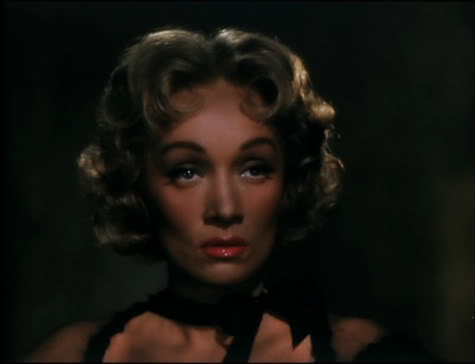
Marlene Dietrich had already played the archetypical bad saloon girl over a decade before in Destry Rides Again, and her role as Altar Keane comes off as an older but only slightly wiser version of that same character; between these two films she created the template against which all such portrayals would subsequently be judged. Dietrich apparently disliked the film and the reasons for that are detailed in a fine post by Toby at 50 Westerns here. Despite all the discord on the set, she turns in a fine performance as a woman who’s gained a lot of experience but little personal fulfillment. She may well rule the roost at Chuck-A-Luck, but there’s a weary, resigned air about her that indicates happiness has passed her by. Mel Ferrer was an actor I’m generally not that fond of, but I thought the mournful passivity that he possessed was used to good effect here, a nice counterbalance to Arthur Kennedy’s twitchiness. Kennedy wasn’t really a leading man at any point in his career – his best and most memorable work was usually done when he was playing the villainous supporting role – yet that actually makes his casting here more successful. His nondescript, everyman quality is suited to the role of Vern Haskell and he really taps into the obsessive, driven nature of his character as the movie progresses. As an aside, I’ve often seen it stated that Vern falls for Altar after his arrival at Chuck-A-Luck, but I’ve never thought that was the case at all. To me, he’s become so consumed by hate at this stage that he’s incapable of loving anyone and is merely feigning attraction to get nearer to his ultimate goal.

For a long time I had the UK DVD release of Rancho Notorious from Optimum, and it was never particularly satisfying – soft and with washed out colours. The movie then came out in the US as part of the Warner Archive series, sporting an altogether stronger transfer. Since then, I picked up the French release by Films Sans Frontieres which I’m very happy with. It’s a significant improvement on my old Optimum disc and, judging from screencaps, looks very close to the quality of the Archive disc. It’s sharper and more colourful but there’s still some print damage on view. Forced subtitles on the English track are always a concern with French releases but this disc allows them to be disabled via the setup menu. Rancho Notorious isn’t one of Fritz Lang’s better regarded films and tends to be criticised quite a lot. I think this is a little unfair; while it may not be his best work it’s still very entertaining. Much of the problem may come down to a question of expectations, with the film suffering from viewers approaching it with the thought that they will be getting a standard oater. If you accept that you’re in for a piece of high melodrama in a stylized western setting then the movie is unlikely to disappoint.

The Indian Fighter

poster322

Films like Broken Arrow and Devil’s Doorway broke new ground for the western by offering up portrayals of Indians which were more three-dimensional than had traditionally been the case. Andre de Toth’s The Indian Fighter (1955) treads a similarly sympathetic path, showing the Sioux in a generally positive light. Few of the white characters are shown to be particularly admirable, even the nominal hero is not without his faults, succumbing easily to prejudice and greed. In addition, the film has a pro-ecology subtext that’s blended into the story in a way that’s refreshing and unobtrusive. This is not as powerful a film as the examples by Delmer Daves and Anthony Mann which I mentioned, yet it still manages to get its message across without resorting to the po-faced piety of more recent revisionist pieces.

Johnny Hawks (Kirk Douglas) is the Indian fighter of the title, an army scout recently returned to the west after the Civil War. He’s been sent along to guide a wagon train bound for Oregon through potentially hostile country. Before he ever reaches his posting though, he’s distracted by two events that are to shape the story that follows. The first is a sighting of Onahti (Elsa Martinelli), the beautiful daughter of Sioux chief Red Cloud, bathing naked in a river. The second is when he stumbles upon a botched deal between two white men, Todd and Chivington (Walter Matthau and Lon Chaney Jr), and a Sioux warrior exchanging whisky for gold. Both of these occurrences illustrate Hawks’ inherent sympathy for his old enemies. The former, naturally enough, arousing his romantic instincts, while the latter emphasises his willingness to side with the Sioux when confronted with the exploitative behaviour of his fellow whites. What draws Hawks to the Sioux is the respect he shares with them for the land which they occupy. Red Cloud’s principal objection to white men on his land is based on his belief that their greed for the gold it contains will wreak environmental havoc on the unspoiled paradise. Although Hawks doesn’t voice such fears specifically, there’s a telling moment later on when he confides in a photographer that the reason he doesn’t share his evangelical zeal to publicize the beauty of the frontier is his knowledge that attracting more settlers, and the trappings of civilization that they will inevitably bring in their wake, will spell the end of the west he loves. Even so, Hawks agrees to guide the wagon train through Sioux territory. However, the presence of Todd and Chivington among the settlers soon leads to trouble and puts the lives of everyone in jeopardy. While Hawks’ desire for Onahti drives him to neglect his duty, the equally strong desire of Todd and Chivington for the yellow metal sparks off a Sioux uprising. Faced with suspicion and hostility from both sides, Hawks is desperate to find some way of averting an impending massacre, and the terrible consequences it will have for the Sioux.

£41

By the time he made The Indian Fighter, Andre de Toth had a string of westerns behind him (half a dozen starring Randolph Scott), and he’d developed into a highly competent genre director. He used the wide cinemascope lens to highlight the natural beauty of the Oregon landscapes where the picture was shot. These stunning images make it very easy to see why both Hawks and the Sioux want to do all in their power to preserve the land. The rich visuals are probably the biggest selling point for this picture, but de Toth was no slouch when it came to filming action scenes and his talent in this area is shown to great effect in the climactic Sioux attack on the besieged fort. Not only are the tactics employed innovative and surprising, but the way it’s shot gets across the excitement and danger too. Many of de Toth’s films display a matter of fact approach to physical violence and this one is no exception. Early on, we get to see two victims of Sioux justice strung up by the heels, though the camera mercifully avoids zooming in to focus on the exact nature of their demise. Then later, as the body of a cavalry officer is removed from the mount he’s been strapped to, his hat drops away to reveal the gory aftermath of his scalping.

The Indian Fighter came from Kirk Douglas’ own production company and, as was the case with Man Without a Star, he tends to overindulge himself a little. Generally though, Douglas manages to keep his vigor and enthusiasm within acceptable bounds this time. That is to say, he plays the role of Johnny Hawks with the level of energy that’s not unreasonable for the character. The outdoors nature of the shoot, and the degree of action involved, offered ample opportunity for him to show off his physical powers, which is just as well since Ben Hecht’s script never puts serious demands on his acting abilities. In the role of Onahti, Elsa Martinelli hasn’t a great deal to do beyond looking attractive, and she accomplishes that without too much effort; her introductory swimming scene is one of the more memorable openings for a western. Walter Matthau and Lon Chaney Jr are moderately effective as the heavies, the former faring best, but never pose any direct threat to the hero. The nature of this pair’s villainy comes from the repercussions of their actions rather than the actual menace they generate. Matthau is now best known for his comedic roles but he did make a handful of westerns at the beginning of his film career. He uses that calculating, scheming quality which came so naturally to him, and which he built up in subsequent years, to compensate for the absence of any real physical threat. Chaney’s career, on the other hand, was in decline by this time, and the truth is he cuts a rather shambling figure.

The Indian Fighter is widely available on DVD from MGM. I have the UK release, which I understand is a step up in terms of picture quality from the lacklustre US version. Although the disc offers nothing in terms of extra features, the image is quite pleasing. The anamorphic scope transfer is acceptably sharp, without noticeable damage, and represents the colours very nicely. A film that relies as heavily on its scenic views as this one does needs to look good, and I have no complaints about the presentation. Generally, this is a good and well-intentioned movie, although the villains are a little weak. Having said that, the action and the cinematography make up for such deficiencies. It’s interesting to note that with the exception of Douglas’ skittish lead and the thoughtful cavalry commander, the whites are portrayed as either grasping, prejudiced or duplicitous. The only truly honourable figures are the environmentally aware Sioux. which gives the movie a strangely contemporary feel. I liked it.


Hangman’s Knot

I just realized the other day that I’ve reached a small landmark as far as this site is concerned – this post will be the 100th western that I have written about. I had to think about what movie I ought to feature to mark the occasion, and it left me with something of a dilemma. My first instinct was to go for a big, important, genre defining picture, one which has stamped its authority all over the western landscape. But then I paused and thought again: is that really representative of the kind of movies I usually turn my attention to? Well not really. For the most part, I’ve written up the films that don’t always draw the attention of the critics, that don’t get ranked high in the “Best of” lists. Sure there are a few heavyweights in there, but they tend to be the exception. So in the end, I opted for something low-key, a bit of a sleeper and an imperfect work – Hangman’s Knot (1952). This might seem an offbeat choice but it reflects what I’d like to think of as the spirit of this site by being a movie from my favourite decade in cinema and featuring two of my favourite performers.

The plot concerns a dreadful mistake and its consequences for those involved. Major Stewart (Randolph Scott) is in charge of a small band of Confederate soldiers who we see setting up an ambush for a squad of Union troops. The aim is to relieve the Yankees of the gold shipment they’re guarding and thus shore up the war effort. The plan goes almost like clockwork and Stewart’s men wipe out the enemy. The sting in the tail though comes in the form of the dying words of their victims’ commanding officer – the war has been over for weeks. In that moment Stewart sees himself transformed from heroic military tactician into common criminal. A discussion with the surviving troops, and the reckless killing of the one man who could be made to testify to their innocence, leads to the decision to head home with the spoils in tow. However, gold is always a powerful draw, and it’s not long before others are on their trail. A self-appointed posse, bounty hunters in reality, have caught the scent and are in pursuit of Stewart’s little party. In desperation, a stagecoach is hijacked and the fugitives head for the temporary shelter of an isolated swing station. It’s here that the second part of the drama is played out, as Stewart and his men find themselves holed up in the stage halt and under pressure from both without and within. The posse have hemmed them in with little hope of a clean escape, while the atmosphere is growing ever more poisonous as both the hostility of the hostages and the men’s own personal differences raise tensions.

Roy Huggins is most famous as the writer of some highly successful and influential television shows (including The Fugitive and The Rockford Files), but his solitary effort as a cinema director plays out like a rehearsal for the Boetticher/Scott pictures that would come later in the decade. The theme, casting, locations and structure of Hangman’s Knot all contribute to the feeling that you’re watching a kind of unpolished Budd Boetticher movie. The opening scenes of the ambush shot around Lone Pine, with their bleak, fatalistic tone, immediately evoke such thoughts. This is especially true when the gung-ho mood abruptly turns into one of horrified realisation. Then there’s the theme of greed and it’s corrupting influence that is gradually expanded upon as the story progresses. With the second act, comes a change of location – the restrictive, almost suffocating, confines of the swing station – where the pressurized atmosphere brought on by greed for gold intensifies for those trapped inside and those laying siege outside. These rising tensions are further exacerbated by the presence of Donna Reed’s Northern nurse, provoking a three-way contest for her affections between Scott, Lee Marvin’s hot-headed subordinate, and Richard Denning’s would-be fiance. This brings to the surface a sentiment that can often be detected in westerns of the period; the contrast between the essential nobility of the southerner (personified by Scott) and the base materialism of the northerner (Denning in this instance), although it’s tempered somewhat by the fact that Marvin is also thrown into the mix to represent the less savoury side of the Confederacy.

It’s hard to find fault with the casting of the movie, though the oversimplified characterization is one of the main weaknesses. I’ve already tried to draw attention to what I see as the parallels between Hangman’s Knot and Scott’s later work with Boetticher, but the reasons why the movie isn’t quite in that class need to be addressed too. One of the features that distinguished the Ranown pictures was the complexity of the characters, both the heroes and the villains. In truth, there was a blurring of the lines defining the good and bad men in those films. That’s not really the case here, where everyone’s development follows a much more traditional path. Apart from a sense of guilt over the ill-timed ambush, Scott’s character carries none of the emotional baggage that made his best roles so memorable. That’s not meant as a criticism of his performance though – an actor can only play a part as it’s written, and the script doesn’t offer much opportunity to add depth. The same problem arises with Lee Marvin; where Seven Men from Now gave him the chance to play a layered and subversively attractive villain, Hangman’s Knot demands a more straightforward, and far less interesting, portrayal. Similarly, the posse in pursuit of Stewart’s band is a collection of stereotypical figures without charm, and lacking the necessary menace too. Perhaps the most successful character is the green youth played by Claude Jarman Jr, whose innocence symbolizes hope for the future and the possibility of a new beginning. Both he and the operators of the stagecoach stop are suggestive of the idea of America as a family torn apart by the Civil War. Of course they also represent the prospect of reconciliation, the offer of “adoption” at the end emphasizing this.

The R1 Columbia/Sony DVD of Hangman’s Knot, which has been available for a long time now, presents the movie in the correct academy ratio, and the image is reasonable although there are some issues with the transfer too. Colours are generally strong throughout but there is some damage to the print. This is most obvious during the indoor scenes in the second half of the movie, the earlier exterior work looks to be in much better shape. Even so, it’s not what I’d term a major distraction at any point. It’s a fast paced film which packs a lot of story into its brisk 81 minute running time and concludes most satisfactorily. I think it’s an underrated western, but I can understand the reasons why that may be so. Still, whatever deficiencies it has, there are plenty of positive points too, not least the way it looks ahead to the Ranown cycle. In fact, and I’m going to stick my neck out here, I think it’s a better and more rewarding movie than something like Westbound – others may disagree of course. Anyway, I recommend any fans of Randolph Scott, or Budd Boetticher for that matter, check this one out if they haven’t already done so.

Rough Night in Jericho

poster316-2

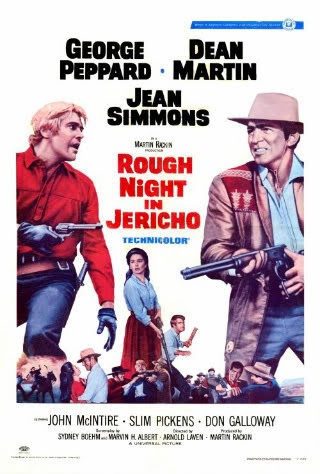
My last post looked at a superior little film scripted by Sydney Boehm, and that writer is the common thread linking into this one. Where The Raid was rich and fairly original in terms of theme, Rough Night in Jericho (1967) is an altogether simpler and, ultimately, less rewarding experience. That’s not to say it’s a bad movie, just that the plot treads a more worn path and the characterization has less depth and complexity. Generally, it’s a picture with lower ambitions, aiming for entertainment as opposed to any notions of profundity. What is does have in its favour are unusual casting, some instances of striking photography, and a couple of first class set pieces.

The tale told here is a familiar one: a town which, through weakness, has allowed itself to succumb gradually to the tyranny of one man. The town is Jericho and the man is Alex Flood (Dean Martin), a former lawman who has come to realize that there’s a better percentage (51% to be precise) to be had in simply ruling the roost. Bit by bit, Flood has acquired a controlling interest in just about every enterprise of value in the town. The one business he has yet to muscle in on is the stage line run by Molly Lang (Jean Simmons), twice widowed and Flood’s former lover. Working on the principle of fighting fire with fire, Molly has taken on a couple of partners she hopes will prove capable of facing down Flood. These men are Ben Hickman (John McIntire) and Dolan (George Peppard), two ex-peacekeepers who also want to try and turn a profit. The movie opens with Flood ambushing the new stagecoach driven by his would-be rivals, and establishes the confrontational tone that runs throughout. When the two men limp into town the first view to greet them is a graphic illustration of Flood’s handiwork – the corpse of a man who crossed him strung up from the hanging tree. With Hickman laid up in bed in Molly’s house recuperating from a gunshot wound sustained in the ambush, Dolan is essentially on his own. He’s a gambler, a man who always does the arithmetic in his head before acting, and he dislikes the odds stacked against him. While he neither likes nor approves of Flood and his tactics, he can’t see that anything’s to be gained in taking him on. The first half of the film basically involves these two natural rivals circling each other warily without either one of them wanting to overtly provoke the other. The scales are finally tipped by two factors: Dolan’s inability to crack the stubborn resolve of his aging partner, and a crude assault on Molly by Flood’s henchmen. When the gauntlet is thrown down, Dolan is bound to a path than can only lead relentlessly to a final showdown with Flood.

£10

Director Arnold Laven’s television credits far exceed his movie work, and I think that background is highlighted in certain aspects of Rough Night in Jericho. A large proportion of the action takes place within the confines of the town – particularly Molly’s home and Flood’s saloon – where both the filming and editing have a TV vibe about them. Whenever the characters venture out into the wilderness around Jericho there’s a far more cinematic atmosphere about it all, probably due to Russell Metty’s presence behind the camera. For the most part, Laven’s work on this picture is competent if not spectacular, though the final stalking scene in the brush is both overextended and clumsy in its editing. There are, however, two memorable sequences that raise the quality considerably. The first is a long, brutal fight between George Peppard and Slim Pickens with the weapons of choice ranging from a bullwhip to chains. Even now the scene carries some clout, and I can only wonder how audiences back in 1967 reacted to the savagery on display. The other notable scene comes towards the end when an exciting and well-staged shootout takes place in the saloon, John McIntire’s shotgun creating some particularly satisfying mayhem.

And now to the casting. Dean Martin is, somewhat unfairly I think, never going to lauded as a great actor, but his easy-going charm and natural affability meant he was never an unwelcome addition to any production. His portrayal of Alex Flood turns all expectations completely on their head though. Nearly all traces of the usual Dino persona are washed away as he plays Flood as a man without a shred of common decency. His actions right from the beginning – humiliating a deputy, orchestrating a lynching, sadistically beating a woman, back-shooting –  prove there can be no doubt as to his ruthlessness. While it’s certainly a shock to see him in such an unsympathetic role I think he just about carries it off. George Peppard is also effective as the reluctant hero up against Flood and his hired killers, his mostly sombre clothes and cheroot hinting at a reference to Leone and Corbucci. John McIntire was always a reliable presence in movies, especially westerns, and his cool professionalism acts as a stabilising force here. English actress Jean Simmons had already demonstrated her ability to slot comfortably into the world of the old west with her role in The Big Country, and does so again in this film. Her tough widow is the only significant female part amid all the macho posturing and she’s perfectly credible as a frontier survivor. It has to be said though that she – along with Peppard – is involved in one of the least successful scenes in the whole movie. It’s a comic interlude that sees Molly and Dolan matching one another drink for drink before collapsing into bed. The scene isn’t especially badly played or filmed, but it’s tone is completely at odds with the rest of the picture and it draws attention to itself for all the wrong reasons.

The German DVD of Rough Night in Jericho by Koch Media has the film looking wonderful in anamorphic scope. Colour and detail levels appeared acceptably high to my eyes, and I wasn’t aware of any significant print damage. The disc offers either the original English soundtrack or a German dub – there are no subtitles to worry about. Extras consist of the trailer, a gallery and an inlay card with notes in German. At this point, I ought to mention that the film is due to go in sale in the UK at the end of this month via Pegasus. If the transfer is up to the standard of the company’s other recent Universal releases then it should represent a viable (and more economical) alternative. This is a film whose plot offers nothing new or startling to western fans, who will have seen countless variations on the tale. Nevertheless, there’s a good deal of entertainment to be had along the way, and the cast all do a perfectly satisfactory job. It’s a solid and unpretentious late-60s western whose strengths and weaknesses just about balance each other out.

The Raid

poster312

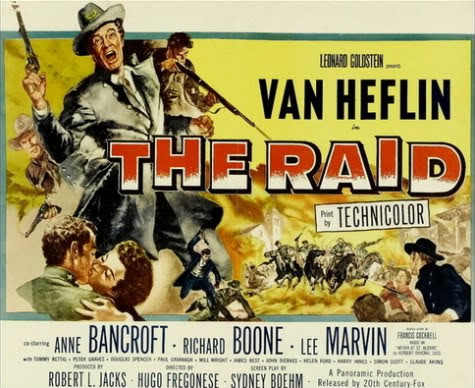
There is no conflict as dirty, socially corrosive and tragic as a civil war. Friends and neighbours, those whose similarities are every bit as pronounced as their differences, suddenly find themselves sworn enemies at one another’s throats. Any story which uses such a conflict as its backdrop automatically has an enormous amount of built-in dramatic potential. Yet despite that, there’s a hazard too – commercial success is by no means guaranteed. Movies based around the American Civil War were traditionally regarded as box office poison, and I don’t think such an aversion is some affectation confined to the United States. There are few nations which haven’t fallen victim to internal bloodletting, and the scars of these events never fully heal in the public consciousness – it’s hard to get past the essential ugliness of a country tearing itself apart from within. However, a movie can still remain compelling, and indeed worthwhile, in the face of these obstacles. The trick is to sidestep the cloying piety that can sink a script and instead focus on the real human effects of a land and people divided. The Raid (1954) is such a film.

The story is based on a real event during the Civil War – one of those peripheral actions that occur in most conflicts. It opens with a small band of Confederate POWs staging a breakout from a Union prison close to the Canadian border. The aim of the fugitives, under the command of Major Benton (Van Heflin), is to cross into neutral territory and reorganise themselves there. Benton has in mind using the neighbouring country as a springboard to attack the North. His plan is to marshal his forces and unexpectedly raid the border towns, both as an act of revenge for Sherman’s pillage of the South and as a means of drawing vital troops away from the front line and thus relieving the pressure on Lee. The target for the first of these incursions is St Albans, Vermont. Benton arrives in town posing as a Canadian businessman looking to invest in local property, but really scouting the lay of the land and paving the way for his comrades to join him. The basic plan is to clean out the banks, providing much needed funds for buying munitions, and then to torch the town and cause as much havoc as possible before beating a hasty retreat back across the border. On paper, this sounds like a viable proposition but complications inevitably arise. There are three troublesome flies in Benton’s jar of ointment: Katy Bishop (Anne Bancroft), the young widow running the boarding house where Benton’s lodging; Captain Foster (Richard Boone), the one-armed veteran in charge of St Albans’ small military force; and Lieutenant Keating (Lee Marvin), whose bitter hatred of the North means he’s something of a loose cannon among Benton’s otherwise highly disciplined force. These three people, and Benton, are a perfect illustration of the effects of civil warfare. All of them have been damaged, either physically or emotionally, by the war and all represent different aspects of the mindset it has created – Keating’s volatile sadism, Katy’s dignified struggle against loneliness, Foster’s self-loathing, and Benton’s juggling of professionalism and sentiment. One key scene highlights the moral dilemma faced by a man in Benton’s peculiar and precarious position. Having just saved the townsfolk from mortal danger (and himself too, as it happens), he returns to his lodgings only to be confronted with that which he least expected – the gratitude and acceptance of the local community. A combination of shock, humility, and horror at his own duplicity briefly flit across Benton’s features. In this moment, everything we need to know about how this kind of war divides loyalties, even internally, is deftly expressed. Still, Benton is a man of principle and, despite any moral qualms he may be experiencing, he forges ahead towards his objective. By the time the actual raid occurs the viewers have been granted a glimpse into the hearts and minds of those from both sides of the divide, making the climax all the more tense and charged.

£9

Argentine director Hugo Fregonese came to Hollywood in 1949 and made a number of films that have largely been forgotten outside of film buff circles. There may not be any masterpieces among his credits but he displayed a very strong visual sense and his work remains interesting at the very least. Apache Drums, produced by Val Lewton, is a little neglected gem that’s ripe for rediscovery, while Saddle Tramp and Harry Black and the Tiger have points in their favour too. The Raid is one of his best efforts, looking handsome and maintaining suspense throughout. The reenactment of the titular raid (a bit of research indicates that the real event resulted in considerably less damage) makes for an exciting climax and it’s well staged by Fregonese and his cameraman, Lucien Ballard. Van Heflin does very well as Major Benton, looking tough and authoritative enough to be believable as the commander of the raiders, and also showing the right degree of sensitivity when necessary. He hadn’t the looks to make a career as a romantic lead but his understated performances generally had a very attractive human quality. Once again, Richard Boone seems to get right into the character he’s playing; the gruffness of Foster initially seems to stem from his bitterness over his war injury but, as the story progresses, it’s apparent that his reserved demeanour has a deeper psychological root. Both actors bring quite subtle nuances to their respective characterizations and there’s nothing one-dimensional about either of them. Personally, I found it refreshing that Anne Bancroft’s widow was used as a softening influence on both Boone and Heflin, and wasn’t there merely to provide an excuse for some superfluous romance. Her presence is integral to the development of the plot and the shifting emotions of the two men staying under her roof, but not as a stereotypical Hollywood siren. Heading up an especially strong supporting cast, Lee Marvin turns in another memorable performance as the vengeful and dangerous Keating. His “bull in a china shop” approach acts as a counterweight to Van Heflin’s measured caution and helps to up the tension.

To the best of my knowledge, the only DVD release of The Raid is the Spanish edition from Impulso/Fox. Generally, whilst apparently unrestored, the disc is one of their reasonable efforts. The film may have been 1.66:1 originally, but this transfer presents it in Academy ratio (1.33:1) – if it’s open-matte it may be slightly zoomed as the framing looks a little tight to my eyes on occasion. However, I wouldn’t say it was seriously compromised. The colour and detail levels are quite strong, and it’s pleasing to look at. The extras are the usual gallery and text items, and the Spanish subtitles can be disabled from the setup menu. The film approaches its subject matter intelligently and avoids forcing judgements on the viewer. The combination of a strong, capable cast, a tight script and professional direction adds up to a pacy and entertaining look at an intriguing episode from the Civil War. Recommended.


Jubal

Shakespeare and westerns really don’t sound like they go together. However, in the case of the former, the universality of his themes means that the location and period in which the drama takes place is largely irrelevant. And as for the latter, the genre is so flexible that pretty much anything can be tackled within its framework. William Wellman’s Yellow Sky has been described as a reworking of The Tempest, while Jubal (1956) sees the ideas central to Othello transported to a ranch in Wyoming. In a way, the isolated simplicity of the west provides an ideal backdrop for the presentation of such timeless concepts. Like an uncluttered stage, the absence of the trappings of civilization helps to better focus attention on the more important aspects of the story.

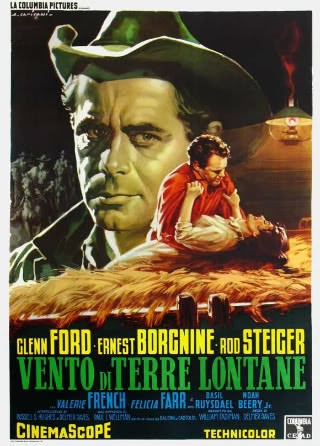
Jubal Troop (Glenn Ford) is a wanderer, a man who has spent his life running; he claims that he’s been trying to escape the bad luck that’s always dogged his steps. In reality though, he’s been running away from himself, or rather his own perceived inadequacies that stem from traumatic childhood experiences. When ranch boss Shep Horgan (Ernest Borgnine) takes him in and offers him a job and a chance to make a fresh start, it looks as though his streak of ill-fortune may be coming to an end. In spite of Jubal’s initial optimism, he soon realizes that he’s actually walked into a highly volatile situation. Shep is one of those salt of the earth types, brimming with hospitality and geniality yet lacking certain social graces. It’s this cheerful disdain for (or ignorance of) the niceties of polite society that has apparently pushed his young Canadian wife, Mae (Valerie French), away from him. I say apparently, because Mae merely uses this as an excuse – it’s clear enough that the remote ranch life and lack of social contact play an equally significant role in shaping her dissatisfaction. Almost as soon as Jubal arrives on the scene Mae begins to show an interest in the newcomer. On top of all this, there’s the problem of Pinky (Rod Steiger), Shep’s current top man and the previous recipient of Mae’s attention. Where Jubal resists Mae’s advances on the grounds that it would be a betrayal of the one man who ever handed him a break, Pinky never displayed such qualms. Now that he’s been sidelined by the new arrival, his resentment and natural antagonism bubble closer to the surface. Due as much to his own petty and spiteful nature as Jubal’s dedication to his job and his boss, Pinky finds himself falling out of favour both as a lover and an employee. It’s this displacement that triggers Pinky’s pent-up jealousy and latent misanthropy. When the opportunity arises, he slyly plants the seeds of doubt in Shep’s mind. And it’s from this point that the classical tragedy at the heart of the story starts to develop fully.

Delmer Daves had a real affinity for the western, his films within the genre all displaying an extremely fitting sense of time and place. In addition, he also had a great eye for telling composition and the use of landscape. His best movies look beautiful, and Jubal takes advantage of the breathtaking vistas that the location shooting in Wyoming offered. The exteriors have a kind of clean, bracing quality to them reminiscent of the mountain air their backgrounds suggest. These wide open spaces are representative both of the freshness of Jubal’s new life and also the remoteness of Shep’s ranch. However, Daves was no slouch when it came to interiors either; he, and cameraman Charles Lawton, create some extremely moody and tense imagery when the action moves indoors. It’s not always easy to achieve effective depth of focus and shadow density when filming in colour, yet Daves and Lawton manage to pull it off time and time again. When you’re telling a story as thematically dark as this it’s vital to keep the mood of the visuals in tune with the plot – Jubal always looks and feels just right at all the critical moments. What’s more, although Daves’ endings had a tendency to be a letdown in comparison to what went before, this movie maintains the correct tone right up to the rolling of the credits.

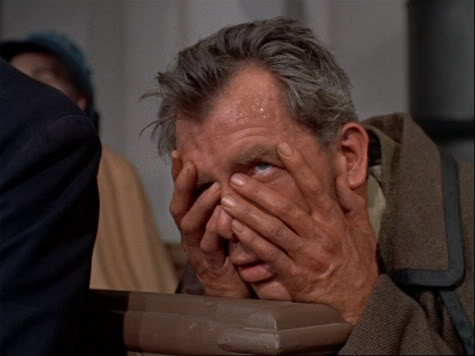
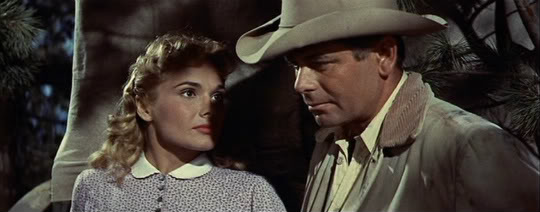
Glenn Ford was an excellent choice to play Jubal Troop, his edgy affability and that slight unease were well suited to the role. The character has an innate nobility and honesty, but there are demons lurking there too, torturing the man with personal doubt and a devalued sense of self-esteem. Ford had a gift for projecting all these qualities on the screen; perhaps that’s why he seemed at home playing in both psychologically complex westerns and film noir. In the following year’s 3:10 to Yuma, Ford and Felicia Farr played out one of the most touching and affecting romantic interludes it’s been my pleasure to see on film. This picture also features a romance between the two, just not as memorable or emotionally loaded as what was to come. Part of the problem is the weaker role handed to Ms Farr, but she still manages to convey something of that bittersweet tenderness in her scenes with Ford that would prove so effective in their next collaboration. The other, and much more substantial, female role was that of Valerie French. There was certainly nothing likeable about the part of Mae, whose infidelity (both real and imagined) sets three men at each other’s throats. Her frustrated sexiness is well realized and, by the end, in spite of her deceit, it’s hard not to feel some sympathy for her fate. Ernest Borgnine’s cuckolded husband draws even more pity though; the way he positively radiates a love for life means that his betrayal really hits home. His brash good humour makes him a favourite of the men, but also leaves him blissfully unaware of the coldness of his wife. When it suddenly dawns on Shep just how much of a fool he’s been, Borgnine’s highly expressive features show very clearly how deeply Mae’s playing around behind his back has affected him. Rod Steiger was always an extremely showy actor, forever in danger of allowing his intensity to spill over into inappropriate grandstanding. As the scheming and reprehensible Pinky, he just about manages to stay the right side of the line – although his tendency towards showboating does raise its head as the movie nears its climax. Among the supporting cast, Charles Bronson makes a strong impression as a hired hand who befriends Ford, and whose intervention at two critical moments help save the day.

Jubal has been available on DVD for a long time via Columbia/Sony in the US. The disc boasts a very good anamorphic scope transfer that looks rich and colourful. There are no extras offered, unless you count the preview snippets for other western titles from the company. The film remains an excellent example of Delmer Daves’ skill at telling a mature and thoughtful western tale. I think the fact that both the director and the star went on to make the better known 3:10 to Yuma a year later has overshadowed this picture to an extent. I’d say that anyone who enjoyed that movie will also appreciate the work on show here. This is yet another strong entry in the western’s golden decade, and fully deserving of any fan’s attention.