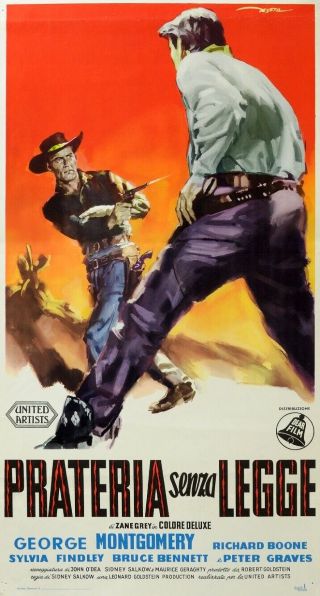
There is an interesting concept or ploy at work in Robbers’ Roost (1955), one which provides an intriguing setup for the movie but which ultimately fails to achieve what its architect envisaged. The character in question claims at one point that he is employing the principle of setting a thief to catch a thief. I don’t think that’s actually the case though or it isn’t an accurate description at any rate – sure there are two bands of criminals involved, but they are being used more as a counterbalance to each other than a trap. If anything, the idea is to play the two ends off against the center, thus neutralizing the threat of both. At the center stands a man with his own personal reasons for becoming involved. Adapted from a Zane Grey novel, the movie loosely prefigures the idea that would form the basis first of Kurosawa’s Yojimbo and then of Leone’s A Fistful of Dollars.
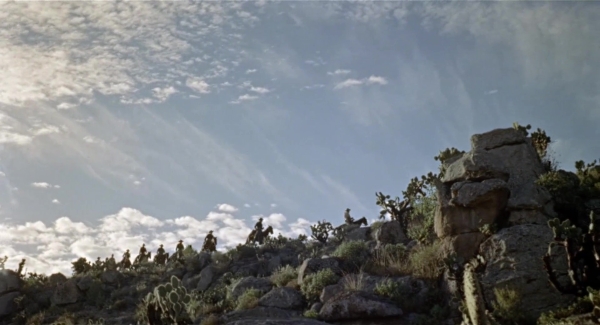
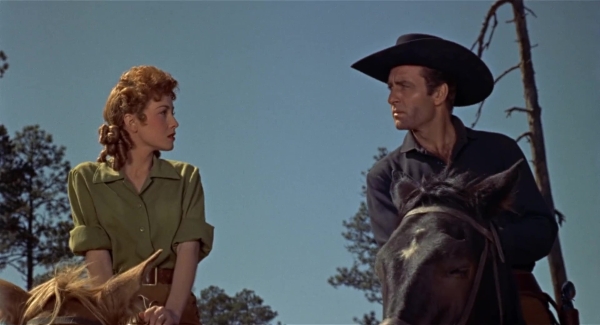
It begins with a lone rider (George Montgomery) checking the brands on horses after entering a new town, the kind of thing a man might do were he searching for someone. He proceeds to scan the wanted posters nailed on the wall, but there’s something furtive in his scrutiny, something a little too eager perhaps and then that quick turning away lest anyone catch sight of him doing so. Is he the seeker or the sought? Maybe a bit of both, but the viewer will have to wait a while before any real light is shed in that direction. The focus shifts to the two rival gangs of thieves mentioned above. They are led respectively by Heesman (Peter Graves) and Hank Hays (Richard Boone), and it’s the latter group that our protagonist throws in with. He claims to go by the dubious name of Tex and is reluctant to divulge any more personal details. Both these gangs have been hired by a local rancher, Bull Herrick (Bruce Bennett), who has been left paralyzed as a result of a riding accident and he has hit on the idea that the best way to keep the rustlers from decimating his herd is to employ them and trust to their mutual hatred ensuring they keep an eye on each other. A sound plan as far as it goes, and it does seem to be going the right way till they decide to cooperate in thinning out his herd and then there is the inevitable falling out – the myth of honor among thieves proving to be as fragile as all other myths. Throw in complications provoked by the presence of Herrick’s sister (Sylvia Findley), as well as the fact Tex has his own scores to settle, and the plot thickens satisfyingly.
Robbers’ Roost relies heavily on the twists and turns of its plot and characterization is relegated to a bit of an afterthought. The bad guys are bad just because they are and Montgomery’s ambiguous hero is on the side of the angels simply because he does mainly good deeds. Now I’ve never read the novel which the movie is based on – although I have picked up a free eBook of it so that can be remedied – and as such I’m not in a position to say whether the script cut much out. Nevertheless, as the movie stands the main interest is seeing how the gang conflict will play out and how Montgomery’s Tex will fare. I think one of the main strengths of the film is the extensive location shooting, an element which grows more prominent as the story progresses. To be frank, the early scenes around the town, and to some extent those around the Herrick ranch, are not especially inspiring. Sidney Salkow was a middling director at best, a safe pair of hands with extensive experience in B movies and supporting features, but no great visual stylist. That said, the Durango locations look quite splendid and the second half of the picture, with its abundance of action and outdoors shooting, makes for a particularly enjoyable watch.
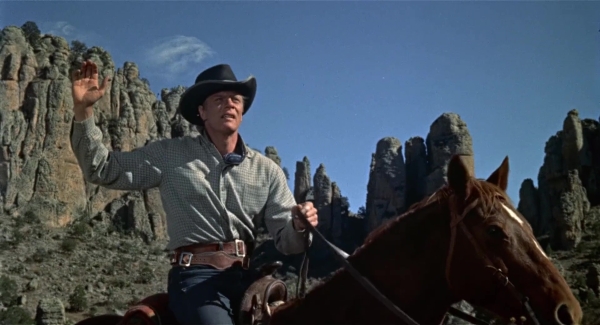
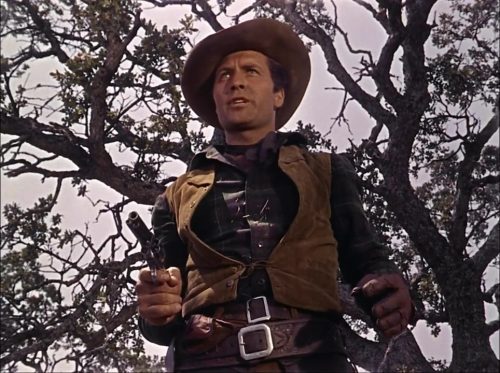
George Montgomery is on fine two-fisted form, riding tall in the saddle and walking tall to boot, he looks and sounds like a classic western hero. His character is carrying a secret, the movie does need a touch of mystery to keep everything ticking along, and he catches some of the reticence necessary in such a role. There’s nothing all that notable about his performance – the script doesn’t demand that, to be fair – but there’s nothing wrong with it either. In short, if you’re a fan of his westerns, then Robbers’ Roost will do just what you expect. As the pair of villains, both Peter Graves and Richard Boone are fine, although the latter has the showier part and was the stronger actor in general. As I said above, neither one sees his character develop beyond that which we see at the beginning. It’s worth pointing out, however, that there is always much pleasure to be derived from any flat out villainous turn by Richard Boone. It feels as though Bruce Bennett, ever a reliable supporting actor, is being set up to play a more significant part but he essentially disappears in the second half, reduced to peering belligerently from a window as friends and enemies alike ride off to squabble over his sister and his stock. Leo Gordon and Warren Stevens fare much better as opposing rustlers, but William Hopper (TV’s Paul Drake from the Perry Mason show) must have been left wondering what he’d been hired for. Sylvia Findley is the only woman in the movie, and apart from this her sole acting credit is in Hugo Fregonese’s long neglected Black Tuesday. There must be some reason for that.
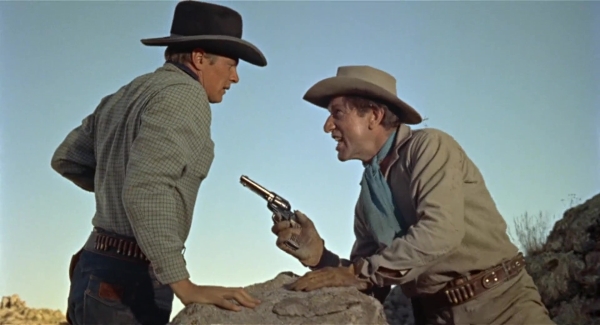
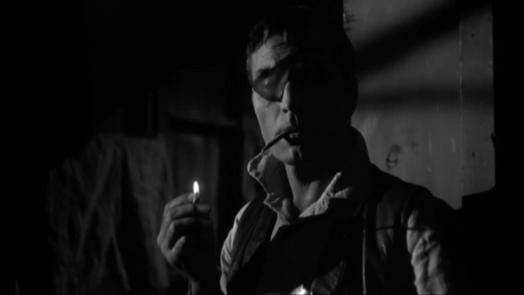
Over the years I’ve come to the conclusion that the condition a movie is in when viewed has an effect on the way we perceive it. Watching the German Blu-ray of Robbers’ Roost brought this home to me once more as I felt a lot better about the film than I had in the past. There is a lot of day-for-night shooting and that aspect never looked great on the old DVD copy I’d seen before. The Blu-ray has everything looking cleaner, clearer and sharper, just like watching a different movie. All in all, this is an unpretentious little western, nicely paced, well shot and pleasingly acted. I’m glad I revisited it.







 Riding the High Country