Mackenna’s Gold

£2

Well, time to roll out one of my guilty pleasures. Mackenna’s Gold (1969) is one of those movies I saw as a youngster and which has entertained me ever since. Everyone knows that the age at which you first see a film is a major factor influencing how much you appreciate it. When I was a little boy this film seemed like the best western I’d ever seen. It had everything you could ask for: a strong hero, a roguish villain, cavalry, Mexican bandits, menacing Apaches, and lots of action. I’m a good deal older and more jaded now and I no longer think it’s a great western, but it is a great fun western. Sure, I can see all it’s shortcomings now and, if I wanted to be coldly objective, I could probably savage it. But I  don’t feel like being objective; this movie was a genuine childhood pleasure and I intend to hang on to the memory.

There’s a great opening sequence with Joe MacDonald’s camera swooping and soaring over a primal western landscape to the accompaniment of Victor Jory’s narration and Jose Feliciano’s theme song. Ancient buttes and mesas rise up from the parched desert floor before the circling camera locks onto a lone figure and zooms in on an equally ancient Indian on horseback. This old man, Prairie Dog (Eduardo Ciannelli), is carrying a map that reveals the location of a mythical canyon of gold. Before dying he passes on the map to Marshal MacKenna (Gregory Peck), but the marshal has little faith in such tall tales and promptly burns the document. When he is subsequently captured by an outlaw band led by Omar Sharif, he is forced to lead them to the canyon whose whereabouts he has memorized. As the treasure hunt progresses more people are drawn in, notably a number of the leading citizens of the nearest town. There are ambushes, Indian attacks, betrayals and more before the whole thing wraps up with a psychedelic sunrise and a massive earthquake. And let’s not forget there’s the very welcome sight of Julie (Catwoman) Newmar stripping off for a swim in among all that.

dlcvhmz

The acting tends to come second in a piece of fluff like this, and that’s pretty much the case here. Gregory Peck is as stoic (those who wish to be unkind might say wooden) as usual in a part that doesn’t call for much more than that. Leaving aside the Egyptian cowboy and the Italian Indian, the best bits come from the starry citizenry of the town (Lee J. Cobb, Edward G. Robinson, Anthony Quayle, Burgess Meredith, Raymond Massey and Eli Wallach) although they have little more than cameo roles and don’t last too long before being massacred. Telly Savalas was generally worth watching when he got to play a villainous part and he’s not bad as a greed fuelled cavalry sergeant.

The direction of J. Lee Thompson, and Carl Foreman’s script keep things moving along fast enough to paper over many of the plot holes and gaps in logic. The action scenes are well filmed, but then you would expect that from Thompson. There’s also some fantastic location photography from veteran cinematographer Joe MacDonald but, despite that, there’s too much reliance on obvious back projection. The only real complaint I have is one shockingly bad effects shot which involves a rope bridge and what looks like an Action Man tied to a toy horse.

OK, this is no masterpiece of cinema but, as I said, it is a movie that I have fond memories of and I’m willing to overlook or forgive many of its faults. Perhaps others who came to it later in life would not be so generous. Sony’s DVD of Mackenna’s Gold is a reasonable transfer. I have the R2 which is anamorphic scope (I have heard that the R1 may be a pan and scan effort – if I’m wrong, feel free to correct me) and it is generally clear but the process shots do stick out like a sore thumb.

Broken Arrow

poster21

The 1950s were the heyday of the western. You can look at almost any other decade and find plenty of examples of exceptional westerns, but none can compare to the 50s in terms of the sheer number of intelligent, high quality productions. Broken Arrow (1950) was, to the best of my knowledge, the first western to portray the Indians as more than simple caricatures. This film doesn’t demonise them, nor does it present them as the mystical, tree-hugging hippies that our increasingly politically correct world seems to insist on. Instead it presents a people with their own way of life and their own system of values.

Tom Jeffords (James Stewart) is a former army scout who stumbles upon a wounded Apache boy and nurses him back to health. In doing so, he starts to regard the Apache as real people who think and feel, and who are not just inhuman killing machines that must be eliminated at all costs. When he is subsequently captured by a raiding party, his act of kindness, though viewed with suspicion, leads to his being spared. However, he is forced to witness three survivors of an ambush tortured to death; this is a war of attrition with no quarter given or asked for from either side. The point is made that these are a people with a strong sense of honor but there is no shying away from their capacity for brutality. Jeffords’ return to white society gives an insight into the cruelty and brutality on both sides, as the town’s residents display  both  shock and incredulity on hearing that he failed to take the opportunity to kill a wounded Apache. Sickened by the endless cycle of tit-for-tat violence, Jeffords takes it upon himself to seek out a meeting with Cochise (Jeff Chandler) in order to try to find some middle ground. The meeting does produce some limited results, and also brings him into contact with a young Apache maiden (Debra Paget). As Jeffords finds himself falling in love, so he seeks to broker a peace deal between Cochise and the army. The racism prevalent on both sides is shown clearly and the film, to its credit, doesn’t try to lecture the viewer on who was right and who was wrong. It assumes that adults are capable of making up their own minds – seems such an odd concept these days, doesn’t it?

£2

James Stewart gave one of his usual solid performances, and by the end of the movie you can see director Delmer Daves draw on some of the disillusioned bitterness that Anthony Mann would later exploit so successfully. Jeff Chandler’s portrayal of Cochise earned him an Oscar nomination (eventually losing out to George Sanders), and he is convincing in the role. Generally, the acting is fine all round with good work from Paget, Will Geer, and Jay (Tonto) Silverheels as Geronimo. Delmer Daves is a director who seems to be very underrated these days, but I feel he turned out some great movies (especially in the western genre) in the 50s. One criticism that could be levelled at him is that his endings were frequently a bit of a cop out, however, I don’t feel that it applies in this case.

Broken Arrow is a great example of a 1950s western and, if you have even a passing interest in the genre, it deserves a place in your collection. I watched the R2 DVD from Optimum which is far from a perfect disc. The colors vary from faded to strong and the image is generally soft. Having said that though, it’s by no means a terrible presentation and is certainly watchable throughout. There is a R1 release from Fox but I don’t own this and can’t comment on the transfer.


If anyone has been wondering where I’ve been, I just decided to take a little break from posting. As others have mentioned, you can reach the point where you post so often that it starts to feel like an obligation rather than a pleasure. As such, I’ve decided to post when I feel like it rather than try to fulfill some notional quota I’ve set myself. So, until the next time…

A Dandy in Aspic

poster19

Anthony Mann’s career as a director could be divided into three broad phases; his noirs of the forties, his westerns of the fifties, and his epics of the sixties. I think it’s fair to say that he mastered all of these and brought something new to each. A Dandy in Aspic (1968) would be his first Cold War spy thriller, although ironically it would also be his last film and he died before it was completed. Had he lived, I think it’s unlikely that he would have embraced the genre if this film is anything to go by. All told, it’s a tired, glum effort which offers nothing fresh; it falls back on endless cliches and tries to be too clever for its own good.

It opens brightly enough with a nice credits sequence featuring a puppet dancing on a string to the accompaniment of a cool Quincy Jones score. Alex Eberlin is a British spy who we are informed is a remote, sexless snob. Personally, I found this tidbit of information superfluous as the part was being played by Laurence Harvey, and those are the very words that spring to mind when I think of him. It turns out that Eberlin is really a double agent and a KGB assassin who has been living in Britain for twenty years but longs to return home. However, his controllers don’t want him to return just yet since he’s been performing well enough for them. A bigger problem for him, though, is the fact that his superiors in British Intelligence want him to take on a new task. They have grown weary of their operatives being knocked off and Eberlin is handed the job of eliminating the assassin, in other words eliminating himself. To this end, he is packed off to Berlin in the company of another agent, the openly hostile Gatiss (Tom Courtenay). There follows a series of confusing double-crosses, shot against a drab looking Berlin cityscape, until everything winds down to a vaguely unsatisfying twist ending. Along the way, there is time for a romance with an English photographer, Mia Farrow. I’m not quite sure what purpose this relationship is supposed to serve other than to add some swinging sixties atmosphere – if it’s supposed to help the viewer to connect with these characters in some way, then it fails.

The movie is essentially hamstrung with the casting Harvey and Farrow. Harvey’s role is hardly a sympathetic one to begin with as he shows no remorse for his betrayals, and he kills and uses people simply to preserve his own hide. On top of this, he was the kind of actor who could make the furniture around him seem interesting, those pinched facial reactions conveying all the intensity of a mild case of indigestion. Farrow is just vacant, although, in all fairness, she’s handed such a non-role that there’s no real opportunity to do anything with it. Tom Courtenay’s embittered, and belligerent Gatiss is better but it’s still pretty much a one note performance. He gets to stump around on his cane (which doubles as a rifle – shades of Bond amid all the dourness) and spit out his lines with a perpetual scowl on his face but there’s never any explanation for his anger. Lionel Stander has a clownish part as the cigar chomping KGB man in Berlin, and John Bird does his patented mugging act that will be familiar to anyone who’s ever seen a Rory Bremner show. Oh, and Peter Cook (who always seemed to find himself funnier than I ever thought he was) pops up for a small yet irritating role. One of my biggest regrets was that Harry Andrews wasn’t given more to do than chair a claustrophobic briefing session.

There are some interesting shots in the film which illustrate Anthony Mann’s good eye for strong composition, and there’s a nice set piece climax at a motor circuit, but they’re not enough. The plot is close to incomprehensible with all the twists and turns it takes and, in the end, it falls between two stools by trying to marry the grim aspects with too much contrived buffoonery. I think one’s fondness or lack of it for this film may come down to one’s level of tolerance for the performers involved, and I think I’ve made it clear enough where I stand. Basically, I feel I’ve seen all this done before and better but, if you’re a fan of this type of story or any of the actors, it is worth a look. For myself, I only wish Anthony Mann had signed off on a better note.

A Dandy in Aspic is available on DVD in R2 from Sony in a barebones edition, but it does have a pretty good anamorphic scope transfer.


The Woman in the Window

poster13

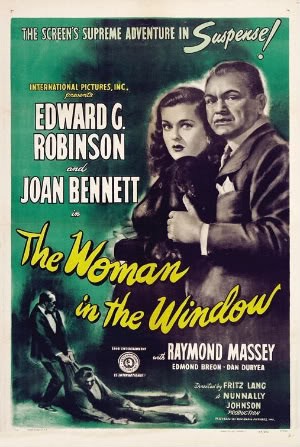
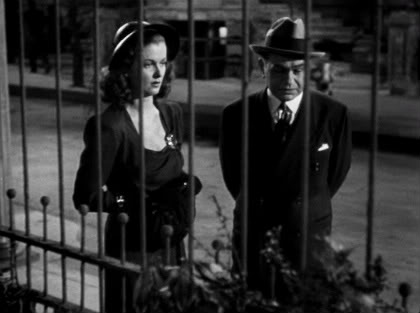
In many ways Fritz Lang’s The Woman in the Window (1944) plays like a dress rehearsal for his production of Scarlet Street the following year. Both films feature the same three stars – Edward G Robinson, Joan Bennett and Dan Duryea – and tell the story of a married, middle-aged man whose chance meeting with a young woman leads him into a vortex of murder, blackmail and ruin. However, where Scarlet Street is relentlessly grim, The Woman in the Window is a paler shade of noir – and not just because of its ending.

Richard Wanley (Robinson) is an assistant professor at a New York college whose wife and family have gone off on a trip, leaving him to his own devices. After an evening spent at his club with a couple of friends, including the District Attorney (Raymond Massey), he pauses on his way home to admire a portrait of a woman in the window of an adjacent art gallery. As he’s gazing through the window, the subject of the portrait, Alice Reed (Joan Bennett), appears by his side and, one thing leading to another, he ends back at her apartment. Up to this point everything seems innocent enough, but the abrupt and violent arrival of Reed’s lover sends the situation spiralling out of control. Although Wanley is left with no alternative but to kill his assailant out of self defence, he is also aware that his story is unlikely to be accepted and, even if it is, his life will be ruined. The solution – dump the body, destroy all the evidence and make like it never happened. Naturally, all of Wanley’s well laid plans start to unravel before his eyes as the police investigation starts to build up a body of forensic evidence that may soon cast suspicion on the hapless professor. The greatest danger, however, is posed by a shady ex-cop (Dan Duryea) with blackmail on his mind. The plot builds inexorably towards a suitably downbeat climax, yet this film has one last sting in its tail. I won’t spoil things for anyone who hasn’t seen this, but suffice to say that this ending has led some to question the noir credentials of the movie. Personally, I don’t share this view but I can see why it remains a bone of contention with some.

£37

As I said above, The Woman in the Window comes off as a lighter form of noir than Scarlet Street, and a good deal of this, aside from the ending, comes down to the portrayal of the characters. It is much easier to sympathise with Robinson’s character here, somehow his decisions, while questionable, seem more understandable. Bennett, too, is much less repugnant than would be the case in Scarlet Street. She is clearly a kept woman and a femme fatale, in the sense that she leads the protagonist into a dangerous, doomed situation, yet her motives are neither malicious nor wholly selfish. It’s only Dan Duryea, in another trademark role as a smirking villain, who fails to endear himself to the audience. There was something about the man – I think it relates to the casually mocking note in his voice – that led to his being typecast in such parts. There’s lots of noir imagery on show with a good deal of the action taking place at night and on rainy city streets. One recurring motif throughout the film is the number of shots which follow events through a series of open doors, symbolising (I suppose) the characters’ deepening crisis. The more I watch and re-watch Lang’s American films, the higher he grows in my estimation – I’d definitely rank him up among my top five directors.

The film was released on DVD last summer, along with a few other noir titles, by MGM in R1. The disc is totally barebones but the transfer is very good, maybe a little soft. There is a R2 available from Spain (I’m not sure about other countries) which, despite an English soundtrack and removable subs, is nowhere near this in terms of picture quality – fortunately, I managed to offload my copy on a friend who remains stubbornly locked into region two. If you’re a fan of noir or Lang then the R1 is the way to go, and I have no hesitation in recommending the movie.


Hour of the Gun

Ten years after making Gunfight at the O.K. Corral director John Sturges paid a return visit to Tombstone. Where his earlier film drew to a close with the shootout of the title, Hour of the Gun takes it as the starting point and proceeds from there. Although the 1967 movie is more or less a direct sequel, it is a very different production. Those intervening ten years had seen the western evolve away from a brighter optimism to become something much darker. The Wyatt Earp of Hour of the Gun is far removed from the upstanding representative of justice and honor that had previously been the standard. This is a driven, vengeful man who manipulates the law more than he upholds it.

The first half of the film sticks pretty close to the known facts and it is only towards the end that it drifts off into the realm of fantasy. It opens at the O.K. Corral and is quite accurate in depicting what actually happened; all those involved in the real incident are shown to be there and, for the first time, behave in the way that history has recorded. The story continues with the trial of the Earps and what would come to be known as the Earp vendetta. It is only the ending, where Wyatt and Doc Holliday track down Ike Clanton in Mexico for a final confrontation, that departs radically from the truth. However, aside from greater veracity, the most distinctive feature of this film is the way Wyatt Earp is portrayed. In all the previous versions he was a man whose primary motivation was the service of justice and the badge of office that symbolized it. In Hour of the Gun he starts off in much the same mode, but the attacks on his family bring about a rapid and drastic change. This Wyatt Earp is an anti-heroic figure paying only lip service to the law as he takes advantage of his position to exact a cold and bloody revenge on those he holds responsible for the shootings of his brothers. Although he carries arrest warrants, it becomes increasingly clear to his companions on the posse, and to the viewer, that he has no intention of ever serving them. One by one, the hired gunmen are shot down in what amount to legal executions.

If you’re only familiar with James Garner as the easy-going Jim Rockford, then his work here is a revelation. His Wyatt Earp doesn’t indulge in shy romances or offer fatherly advice to wayward teens – he is instead the angel of death. For the most part he comes across as aloof and unemotional, yet there is a maniacal, almost psychopathic, gleam in his eyes in those scenes where he blasts away his enemies. Jason Robards was frankly too old to play Doc Holliday although he brings a world-weary cynicism to the part that is attractive. The script makes a number of references to his deadly reputation but his main function in the film is to act as the conscience to Earps dark avenger, taking him to task for using the law to his own ends. Robert Ryan was always good value in any film which he graced with his presence, and his Ike Clanton is more of a politically savvy string-puller than an out and out gunslinger. There’s also a small role for Jon Voight (his big screen debut) as Curly Bill Brocius. The direction from Sturges is a solid, professional job and the story moves along at a nice pace. I’ve become very fond of Sturges as a director; he was no groundbreaker or innovator like Ford, Peckinpah or Leone but he almost always turned out strong, quality product. The film also benefits from a fine Jerry Goldsmith score, downbeat and relentless like the story itself.

Hour of the Gun seems to be the Wyatt Earp film that no one remembers, and that’s a pity. I think it’s a little hidden gem of a movie that deserves much more recognition. MGM have had this out on DVD in R1 for a few years now in a mediocre interlaced transfer. It’s recently had a R2 outing in what looks like the same print but this time it seems progressive – at least it runs a lot smoother on my system. All things considered, I’d say this is a worthy addition to the Earp canon and a film that I’m more than happy to have in my collection.

Cheyenne Autumn

poster11-1

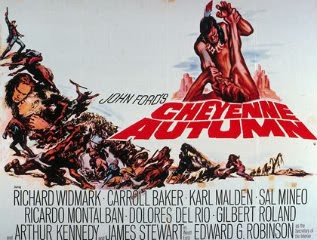
John Ford made Cheyenne Autumn in 1964 and with it he bade farewell to the western, the genre with which he was and is most frequently associated. By his own admission, Ford wanted this to be his attempt at setting the record straight with regard to the injustices visited upon the American Indians. Taken as such, it is fairly successful in depicting a people hounded almost to the point of extinction, without indulging in the politically correct schmaltz that more recent Indian centered epics have fallen prey to. Yet it is not a perfect film and does have its faults, not the least of which are the uneven tone and, to a lesser extent, some of the casting decisions.

The story concerns the Cheyenne who, having been moved to a reservation in Oklahoma, were dying a slow death as a result of disease, starvation and neglect. When a promised meeting with a Congressional committee fails to materialise, they take the bold and, in their minds the only viable, decision to strike out on a march back to their tribal homeland in Montana, 1500 miles to the north. Their journey is seen from the perspective of both the Cheyenne chiefs (Gilbert Roland & Ricardo Montalban) and the soldiers (under the command of Richard Widmark) charged with running them to ground. While the film’s sympathy lies with the hunted, the main focus is on the the various soldiers and civilians who pursue or encounter them. This is both a strength and a weakness of the film; a weakness because the characters of the Cheyenne are never explored in any great depth. The strength comes from the way the white characters are represented as holding a whole variety of, often conflicting, views on the fugitives.

The roles of the principal Cheyenne characters are filled by Mexicans (Montalban, Roland & Dolores Del Rio) and an Italian (Sal Mineo). In truth, this doesn’t work out too badly (I’ve never felt that a part can/should only be played by an actor of the same ethnic origin as the character – it’s called ‘acting’ fer chrissakes!) although Sal Mineo is far too much of a wuss to be taken seriously as a fiery Cheyenne warrior. Richard Widmark is good, as always, as the reluctant cavalryman who knows he has a job to do but also knows he doesn’t have to enjoy it. Pat Wayne is quite wooden as a young Lieutenant who experiences a “road to Damascus” type conversion, going from rabid bloodlust to outraged empathy over the course of the story. Karl Malden is a caricature of a Prussian officer whose blind devotion to duty and orders ultimately leads to tragedy. There are also small roles for George O’Brien (a ‘the-only-good-Indian-is-a-dead-Indian’ Major) and Sean McClory (a professional Irishman). Ben Johnson and Harry Carey Jnr appear as cavalrymen and get to show off some mighty impressive horse-riding skills – and there’s a nice running joke where Widmark can never remember that Carey is playing a character called Smith, referring to him variously as Jones, Murphy etc.

£36

Now a word about the Wyatt Earp scene in the movie. To be blunt, I hated it when I first saw it and I still hate it. The whole thing feels wrong, like it was grafted in from another picture. It’s the kind of sequence that wouldn’t be out of place in a ‘Carry On’ film – that bad! We get twenty minutes of Earp (James Stewart) and Doc Holliday (Arthur Kennedy) playing poker in Dodge City and having their game interrupted by the news of the Cheyenne being sighted nearby. There follows a Wacky Races type chase through the desert, culminating in a saloon girl losing her dress and winding up with her legs around Stewarts neck. Laugh, I thought I’d never start. In his biography of Ford, Joe McBride claims that the director used this sequence as a means of highlighting (through satire) the casual racism of the civilian population, but I don’t buy it. That bigotry had already been shown when a trail hand (Ken Curtis) callously murdered and scalped an Indian begging for food. In fact, the power of the aforementioned scene is effectively ruined by the subsequent clowning of Curtis in Dodge. I can’t think what came over Ford but this part of the movie definitely didn’t need to be shot.

Warners put Cheyenne Autumn out on DVD as part of their ‘John Ford Film Collection’. As far as I know it is still only available as part of that set. The transfer is probably the best of all the films in the collection. It’s anamorphic scope with no damage of any consequence and strong true colors. The disc carries a commentary from Joe McBride and a featurette on the film and the historical events that inspired it. Maybe it’s not Ford’s best film but it works well enough for the most part, offering a different perspective from the director yet retaining his trademark visual and narrative touches.

Gunfight at the O.K. Corral

poster8

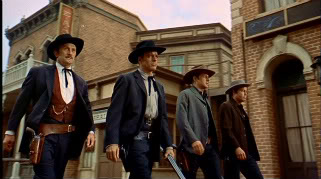
With Gunfight at the O.K. Corral (1957) John Sturges took his turn at putting Wyatt Earp’s story on the screen. When this film is compared to those which went before, there can be no doubt that it does come closer to the truth. There are more characters represented who actually played a part in the real events, small incidents which have a basis in fact are shown, and a little back story is provided. Having said all that, there are still lots of inaccuracies with names being changed and things not happening as they really did. Still, this is not a documentary, it’s a movie – and a highly polished and entertaining movie at that.

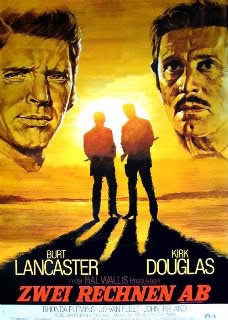
Frankie Laine’s rendition of the title song opens the movie as Wyatt Earp (Burt Lancaster) rides into Fort Griffin, Texas in pursuit of Ike Clanton. During his stay he meets Doc Holliday (Kirk Douglas), whom he subsequently saves from an angry mob intent on lynching him. This places Holliday in his debt and provides the basis for the two men’s friendship. As the film proceeds we see Earp and Holliday cross paths again in Dodge City before moving on to Tombstone, and the famous showdown. The fact that each segment is both punctuated and linked together by the theme song gives the film a slightly episodic feel. Mind you, that’s not a criticism; Laine’s vocals work almost as well as Tex Ritter’s do in High Noon (both of which, coincidentally, were scored by Dimitri Tiomkin). There are romantic sub-plots thrown in for the two leads – the one involving Earp and a lady gambler (Rhonda Fleming) is mostly superflous, while the stormy, abusive relationship between Holliday and Kate (Jo Van Fleet) works better since it does serve to drive the narrative forward.

£38

Gunfight at the O.K. Corral was the second film that Lancaster and Douglas made together and they work well in tandem, each playing nicely off the other. Lancaster’s Wyatt has more of a hard, grim edge to him than was seen in previous incarnations. At one point Holliday tells him, “You know Wyatt, you and I are pretty much alike actually. Both of us live with a gun – the only difference is that badge.” However, Sturges doesn’t explore this side of things too much, and it would be left to later films to point out the fact that Earp’s badge might have been used as a mere convenience. Kirk Douglas’ Doc Holliday follows the usual pattern of presenting him as a tortured and volatile soul, but his self-loathing has a greater pathos than either Romero or Mature brought to the role, and it’s a vast improvement. John Ireland makes his second appearance in an Earp film, playing Johnny Ringo (he was Billy Clanton in My Darling Clementine) and again comes to a sticky end. In fact there are lots of familiar faces: Dennis Hopper, Kenneth Tobey, DeForest Kelley (Star Trek’s ‘Bones’), Lee Van Cleef, Jack Elam etc.

Now a word about those items the movie got right, and those it didn’t. On the plus side we get a full complement of Clantons and McLaurys, Doc’s woman Kate is present, and Bat Masterson appears in Dodge City. Earp and Holliday are shown to meet in Fort Griffin and later in Dodge, where Doc saved Wyatt’s life as he attempted to stop a fight in a saloon. There’s also a brief reference to Old Man Clanton being shot dead as a result of his rustling activities. As for the negatives, James Earp is again falsely portrayed as the youngster of the family whose death is the catalyst for the gunfight – in truth he was the eldest and lived to a ripe old age. Ike Clanton and Johnny Ringo didn’t die at the O.K. Corral, Ringo wasn’t even there. Also, the corrupt County Sheriff has his name changed from Behan to Wilson.

The film is out on DVD from Paramount in R1 in a wonderful looking widescreen transfer. I haven’t seen the R2 to compare but I imagine it uses the same transfer. There is only very minor damage to the print and the colors are strong. Unfortunately, the disc is utterly barebones with not even a trailer present. The lack of supplements aside, this a great example of a 50’s western and one of the better movies about Wyatt Earp.


Winchester 73

Down through the years there have been a number of significant collaborations between directors and actors, such as Ford and Fonda, Ford and Wayne, and Huston and Bogart. In 1950 another such partnership was born, that of Anthony Mann and James Stewart. Their work together was to change the direction of both their careers, and produce some of the best cinema of the decade. Anthony Mann had made his reputation with a series of fine noirs in the last half of the 40s, but he had never done a western. James Stewart’s name had been built on the light leading man roles he excelled in before the war; with the exception of the comedic Destry Rides Again he was another relative stranger to the Old West. However, as a result of the success of Winchester 73 the names of both men would be forever linked to the oldest genre of them all. They went on to make eight films together, five of them westerns.

The story concerns Lin McAdam (Stewart) who arrives in Dodge City on July 4th 1876 and enters a sharpshooting contest presided over by none other than Wyatt Earp (Will Geer), Virgil Earp and Bat Masterson. The contest’s first prize is the famous rifle of the title, and it soon comes down to a run-off between McAdam and Dutch Henry Brown (Stephen McNally). There’s clearly a history of bad blood between the two men, and when McAdam wins it’s not long before Dutch Henry robs him and makes off with the gun. The film then chronicles McAdam’s search for his stolen rifle, and his pursuit of the man who took it. But that’s really only a plot device, a kind of Hitchcockian McGuffin – something of greater significance to the characters than it is to the audience. While the gun is admired, valued and coveted by everyone who comes across it, it is not the sole, nor even the most important reason for McAdam’s dogged quest. This is a dark tale of revenge and the settling of old scores and, despite the dropping of a number of hints, the cause is not stated explicitly until the end.

James Stewart’s pre-war career consisted mainly of Mr Nice Guy roles, while the years following his return found him floundering around in search of a niche. Although It’s a Wonderful Life and Rope offered him roles with a greater complexity, Lin McAdam was a complete departure for him. This part, and subsequent ones with Mann, allowed him to display a cold ruthlessness that the public hadn’t seen before. In addition, he seems so completely at home in the saddle that it’s hard to believe this was his first serious western character. The film boasts a marvellous cast of character actors and up and coming talent: Stephen McNally and Dan Duryea (playing Waco Johnny Dean – lots of exotic character names in this movie) as villains, Shelley Winters as a luckless saloon girl, Millard Mitchell, John McIntire, Jay C. Flippen, and early parts for Tony Curtis and Rock Hudson.

The character of Wyatt Earp is really only incidental to the story here. His appearance is limited to the first twenty minutes or so and doesn’t add much to the narrative. Earp was an assistant marshal in Dodge at around the time the story takes place but the film suggests he was the principal lawman in the city. Will Geer portrays him as a folksy, down home type which seems at odds with the popular conception of the man. When McAdam challenges his authority early on, he fumbles around in his vest pocket for his tin star before almost sheepishly revealing his identity. One would have expected the real Earp to have kicked the upstart’s butt up and down the street.

Winchester 73 is a Universal release on DVD in R1 and R2, and it’s a fine looking disc. Not only is the transfer clean and tight, but there’s one fantastic extra. The film comes with a feature length scene specific commentary by James Stewart. I’m not usually one who gets too excited by extras in general, especially commentaries – but this kind of stuff is cinematic gold dust. Most of the stars of this period were long gone by the time the idea of recording commentaries occurred to anyone, so this is one to be treasured.


My Darling Clementine

poster7

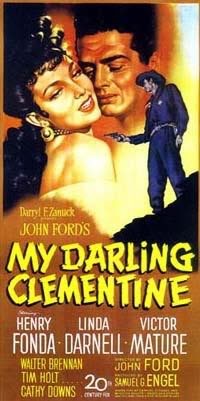
John Ford always maintained that his version of the events at the OK Corral was based on conversations that the director had had with Wyatt Earp himself. While Ford probably did know Earp (the old lawman reputedly spent a lot of time on and around the early Hollywood sets in his later years) and likely talked with him about what happened in Tombstone, the story played out in My Darling Clementine (1946) is most assuredly not the truth. Despite Ford’s grandiose claims of authenticity, his film is really a remake of Dwan’s Frontier Marshal. Both movies were based on the Stuart N. Lake book, and both are highly romanticized accounts. The difference is that, where Dwan’s film is a workmanlike effort, Ford’s take has all those little artistic touches that move it onto another level. Of course Ford was known for spinning the most outrageous yarns when it suited him, but the huge historical errors don’t change the fact that his film is still the best version by far of the famous story.

The Earp brothers actually feature in this film unlike the earlier version from Dwan. Wyatt (Henry Fonda), Morgan (Ward Bond), Virgil (Tim Holt) and James (Don Garner) stop off outside of Tombstone while on a cattle drive. On the recommendation of Old Man Clanton (Walter Brennan) they take a trip into town, leaving little brother James to stand watch over the herd. On their return the three older brothers find their cattle have been rustled and James killed. Suspecting the Clantons of perpetrating the crime, Wyatt accepts the position of town marshal. What follows is a picture of the emergence of civilization (most notably represented by the founding of the town’s first church), and the effects it has on the characters.

Wyatt is transformed from a dusty, unshaven trail hand into the coiffed and suit-wearing face of the law and civic respectability. The scene where Wyatt primly escorts Clementine Carter (Cathy Downs) along the main street of Tombstone towards the new church, with the strains of ‘Shall we gather at the river’ playing in the background, is deservedly famous and remains one of the most touching and romantic sequences ever put on film. This contrasts sharply with the Clantons, who are shown as a bunch of barely human barbarians. A marvelously sadistic moment takes place when Old Man Clanton savagely horse whips his sons before berating them : “When you pull a gun, kill a man.” The bridge between the two extremes is provided by Doc Holliday (Victor Mature) – a man with a cultured background (at one point quoting from Hamlet to help out a drunken actor) who is consumed with self loathing at the knowledge of what he has become.

Henry Fonda plays Wyatt with nobility and that quiet dignity that he seemed to bring to all his roles. The self-conscious diffidence he shows fits perfectly for a man who has been more accustomed to living rough in the wilds. It’s no bad thing either that Fonda always seemed comfortable in a western setting, able to mount and sit a horse naturally. I wish I could say the same thing for Victor Mature but, however hard I try, I just cannot accept him in western roles. I’ve seen Mature in many other genre films and thought him fine, but when it comes to westerns – no thanks. I know this is just a personal prejudice but, for me, his casting doesn’t work at all*. Walter Brennan’s Old Man Clanton makes for a wonderful villain, a figure of pure evil who has molded his sons in his own image – especially the leering Billy (John Ireland) and the slow-witted, and vaguely psychotic, Ike (Grant Withers). Linda Darnell’s Chihuahua is something of a caricature of the typical Mexican spitfire, but she does elicit a lot of sympathy as a woman passionately in love with a man who repeatedly spurns her.

Since the bulk of the story takes place in and around Tombstone, Ford makes less use of Monument Valley than he would in other pictures. However, there are a few scenes that feature his favorite location and they look magnificent as always. Much attention is paid to the town, to all the little rituals of frontier life, and the variety of characters who inhabit it. The celebration of community is pure Ford and you get the feeling he enjoyed recreating this much more than he did the action scenes. Having said that, the inevitable shootout at the OK Corral, though wildly inaccurate, is both stylish and excitingly executed.

My Darling Clementine has been available for some time now on DVD from Fox, but has recently been reissued with the addition of Frontier Marshal as an extra. The transfer is exactly the same on the new disc, but that’s not a criticism since there wasn’t much that needed improvement anyway. You get to choose between the final release version of the film and the pre-release cut, and I’m not really sure which I prefer. I feel the edited version is tighter but I also think Ford’s original cut of the farewell scene between Wyatt and Clementine is better. I suppose we should be grateful that we have both versions to compare. Either way, this is a special film and one that does reward repeated viewings.

*EDIT – Sometimes we speak dismissively of hindsight, but sometimes now I look back on pieces I wrote many years ago and see that old adage about the viewers changing but not the movies as gaining in truth all the time. I now feel that I was overcritical of Mature, and quite unfair in my assessment of his performance here,  when I first put this up well over a dozen  years ago.

Dangerous Crossing

How many people are familiar with the name John Dickson Carr? I suspect the answer is very few, yet from the 1930s through the 1960s he was one of the best known writers of mystery fiction. In the decades since he has faded into relative obscurity while his contemporary Agatha Christie has remained a recognizable commodity with the general public. Both of these writers specialized in detective stories that were notable not for their strong characterization but for their clever, and sometimes ingenious, plotting. However, one has remained highly marketable and the other has not – why? The changing taste of the reading public is no good as an explanation since the work of both of them is very much a product of its time. No, the answer may lie in the fact that, at least from the 1970s on, Christie’s writing has been regularly adapted for both television and the big screen. So, as a big fan of Carr, it’s refreshing to see a film available that was sourced from his work.

A newlywed bride (Jeanne Crain) stands on the dock waiting for her husband (Carl Betz). When he arrives they both board the transatlantic liner that will carry them off on their honeymoon. Their happiness, though, is destined to be a short-lived affair. While the husband goes off to see the purser, the wife agrees to meet him in the bar and waits there. It’s a long wait, and when she tries to find him it appears that no one else on the ship has ever laid eyes on the groom. As an increasingly paranoid Crain roams the fog bound ship in an effort to trace her missing spouse, and prove that she’s not some nut job, the characters whom she encounters range from the suspicious to the downright untrustworthy. That, in a nutshell, is the plot of Dangerous Crossing (1953), and the result is a neat and professional little mystery that reaches a satisfying conclusion in its short running time.

Since this is essentially a B picture, there are no major stars on view and the focus is firmly on Crain, and Michael Rennie (TV’s Harry Lime) as the seemingly sympathetic doctor. Crain’s best scenes come towards the beginning of the movie as it slowly dawns on her that her husband is not to be found on the ship and everyone, both crew and fellow passengers alike, treat her with what could be best described as indulgent scepticism. There are also enough doubts sown in the minds of the viewer as to whether the heroine is delusional or the victim of an elaborate plot to keep things interesting. Michael Rennie is solid, as always, playing the one character who may believe Crain’s story. The support cast doesn’t feature too many faces that would be immediately recognizable, but Willis Bouchey (who graced many a John Ford picture) has a nice turn as the ship’s captain.

While Dangerous Crossing has been released as part of the latest wave of noirs from Fox it does not, in my opinion anyway, really belong in that category. It is most assuredly a mystery, albeit one with a few noir touches such as the paranoid atmosphere and the shadowy photography of Joseph LaShelle. There are some nice sequences on the foggy nighttime decks, a tense cat-and-mouse scene in the baggage hold and a chase through a crowded ballroom. This is all handled competently, if unspectacularly, by director Joseph M. Newman. In the hands of someone more imaginative, Hitchcock for example, these set pieces could have been much more memorable. As it is, they seem a little flat – not bad, just not as good as they could have been.

For a fan of his work, it’s great to see some of John Dickson Carr’s work on the screen. Carr was a hugely prolific writer (he also worked under the pseudonym Carter Dickson since his output was so prodigious that he needed two publishers to handle it) yet few of his works have appeared  on film and I’m not sure why this is. I had been of the opinion that the tricky nature of his plotting might not translate well to film but I’m not so sure of that now. Anyone familiar with the TV series Jonathan Creek (certainly inspired by the locked room and impossible crime puzzles of Carr) will know that this kind of material can work successfully if approached in the right way. Whatever, fans of the master of detection – a kind of mix of Christie, Chesterton and M.R. James – will have to settle for this for now.

The DVD of Dangerous Crossing, part of the recently revived Fox Noir line, is fantastic looking and I’d be hard pressed to find any fault with it. Fox have been doing great work in offering rare and surprising titles in very nice and affordable editions. In addition to the film, there’s a commentary track, an isolated score from Lionel Newman, trailer etc. We also get a short featurette on the film with info on Jeanne Crain and on Fox’s recycling of their sets; I suggest watching the movie first, though, as the featurette does contain a spoiler. So, you get an entertaining, if minor film in a fine presentation from Fox – just remember, it’s not really noir.