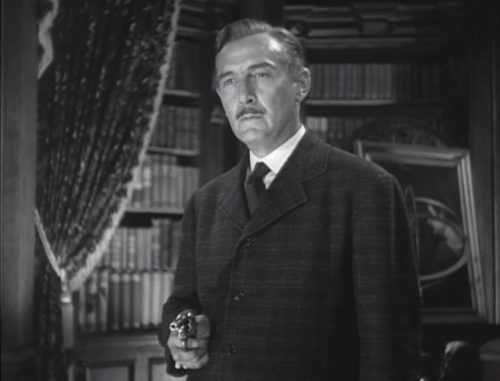
Experiment Perilous

Life is short and the art long. Decision difficult, experiment perilous.

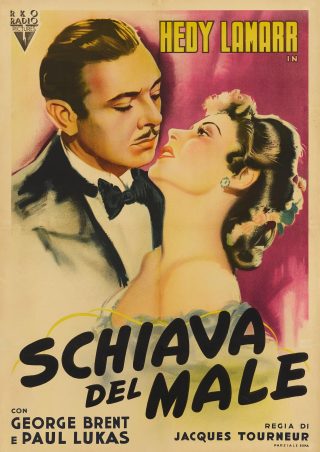
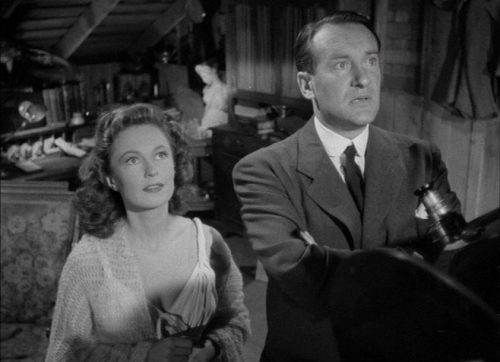
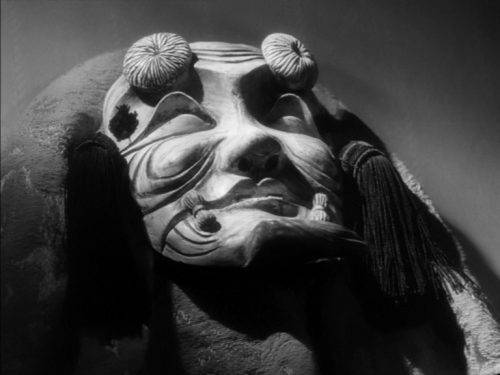
That’s a loose translation of the words of Hippocrates, words first written over two thousand years ago and borrowed so as to be uttered by one of the characters in Jacques Tourneur’s Experiment Perilous (1944). There’s truth in that quotation, as there is in so much of what has been passed down over the centuries from those great men of the ancient world. It could be seen to apply to the limited time the characters in the movie have to react and respond to the events that unfold around them. Looked at now in retrospect, it might even be said to act as a neat descriptor of the career of Jacques Tourneur himself. His fairly lengthy apprenticeship segued into the comparatively brief period of peak creativity, a period that could be roughly defined as starting from 1942 when he made the first of his stylish hauntings for Val Lewton with Cat People and running through to 1957 when he so successfully recaptured some of that sensibility in Night of the Demon.

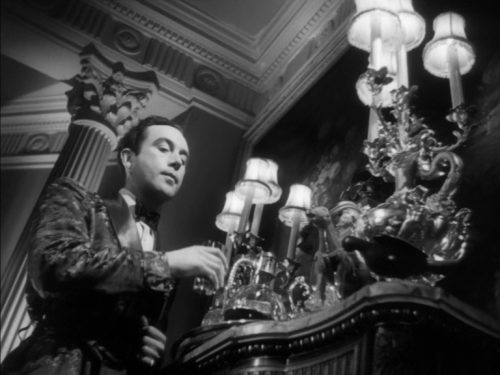
Experiment Perilous is a classic Gothic melodrama with a hint of film noir drifting around it, perhaps in the vague dissatisfaction that colors the moods and attitudes of its principals as much as anything. All through the movie there is a suspicion of something not quite right, of a group of people hurrying about their business and their lives amid an almost permanent state of flux and turbulence. Much of the story takes place in appalling weather, with only the brief flashbacks to the past appearing to offer a glimpse of brighter and calmer times. The present, on the other hand, seems to lurch from one stormy tableau to another, presenting a background that is forbidding enough to drive the characters indoors for much of the time, seeking shelter from the elements without yet finding other more insidious threats lurking within.

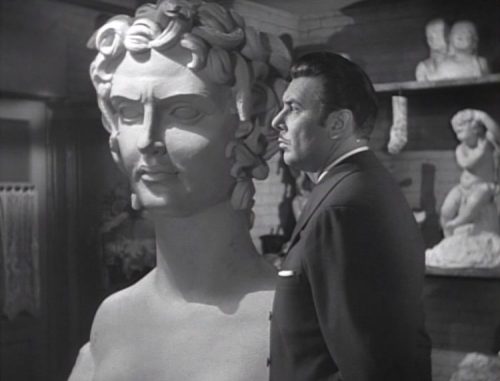
It all begins on a train, carving its way east through the night and assailed on all sides by a raging downpour. It is that lashing handed out by nature that provokes a fateful encounter between psychiatrist Hunt Bailey (George Brent) and a fluttery and nervy woman sharing the same car. Both are headed back to the city, back to work in the doctor’s case while the lady is on her way back to see her brother and his wife after a long absence. She is a faded type, ethereal and quirky enough to pique his interest and sympathy. Were it not for a mix up with the luggage on arrival in New York, and then the fact he later overhears a throwaway remark about the woman’s sudden death, he would most likely have thought no more of the incident. However, there was something in the woman’s words and manner, and of course her unexpected demise, that arouses his curiosity and prompts him to take advantage of an opportunity to meet the relatives she spoke of.

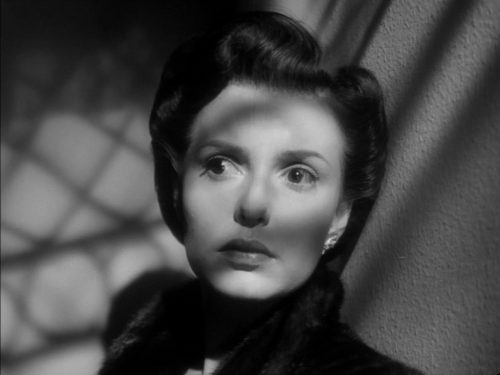
Nick Bederaux (Paul Lukas) fits the stereotype of the turn of the century European sophisticate, cultured, moneyed and impossibly debonair. There is something a little “off” about him though, his charm and politeness bordering on obsequiousness. Bailey senses that on their first meeting and it is further heightened when he is introduced to Bederaux’s wife Allida (Hedy Lamarr). She is a delicate beauty, like an exquisite piece of Dresden china which Nick has procured and now keeps on display in his oddly oppressive brownstone. Bederaux takes the opportunity to confide in Bailey that he worries about the psychological state of his wife, and the effect it may be having on their young son. More suspicious than convinced by these pleas, the doctor agrees to examine Allida with the unstated intention of delving deeper into the secrets of Bederaux himself and the tragic past which may be impinging on the future of his wife and son.

Experiment Perilous came out the same year as George Cukor’s Gaslight (which was a remake of Thorold Dickinson’s British movie), exploring a very similar theme and with a plot that follows a very similar arc. This does not have the gloss and polish of Cukor’s film, but the director brings his own special touch to it. One of Tourneur’s defining characteristics was his subtlety, never overcooking a situation of overstating a point. I appreciate that quality – it is a stylistic fingerprint to be found all over his work for Lewton and is evident too in his other productions – and what appeals most to me about such an approach is the fact that it shows a sincere respect for the intelligence of the viewer. The plot of Experiment Perilous is relatively straightforward and there are few surprises yet the stylish way in which Tourneur guides us through it all ensures it never drags. There is a refreshing frankness about the relationships too and the dynamics that power them. While the production code of the time would never permit such a direct admission, Tourneur’s sensitivity and assurance means the motivation at the root of Bederaux’s jealousy is alluded to in such a way that the observant viewer is led to believe that the character is essentially impotent. It speaks volumes about the director’s skill that he is capable of weaving such themes into the fabric of the narrative, of blending in layers of maturity, without needing to resort either to crudity or falseness.

Hedy Lamarr was of course a famous beauty but her acting ability should not be discounted. The role of Allida Bederaux called not only for vulnerability on her part but a degree of gullibility too. Bearing in mind what an intelligent and accomplished woman she was outside of the movie business, it’s all the more laudable how she managed to successfully essay the helplessness of her character – I guess that characteristic catch in her voice helps some. Anyway, her performance contains a lot of warmth and credibility. George Brent was a good choice for the lead, bringing his own brand of humility and empathy to a character who is not written as an especially interesting figure. Perhaps that was one of Brent’s great strengths, his knack for portraying essentially bland characters and investing them with a humanity it was easy to relate to. He was a solid and reliable presence in many a movie (I felt he was exceptionally good opposite Barbara Stanwyck in Curtis Bernhardt’s My Reputation) although he did not always appear to be the most exciting, which seems slightly odd if you stop to think that here was a man whose real life exploits saw him forced to leave his native Ireland during the War of Independence with a price on his head. Paul Lukas co-starred with Brent in two other movies – of those, I have Temptation lined up for viewing at some point in the future. There is great precision about his playing, an economy of expression if you like, that suits the buttoned up nature of Nick Bederaux so well. Of the supporting cast, Albert Dekker gets the mix of passion and dissipation just right as Brent’s artist friend, while Olive Blakeney is sweetly neurotic in her relatively brief screen time.

Experiment Perilous is not the hardest movie to access these days, having had DVD releases in the US (via the Warner Archive), the UK and France, and probably other territories too. As a long time fan of Jacques Tourneur’s work I consider it an easy recommendation.

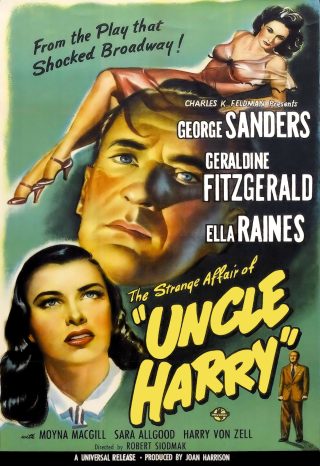
The Strange Affair of Uncle Harry

Let’s start at the end and work backwards to the beginning. And no, that’s not a mere ploy to try to grab your attention. There are some movies where, due in large part to the nature of their endings, it is hard to talk in detail about them without straying deep into the kind of spoiler territory that I prefer to avoid if at all possible. The Strange Affair of Uncle Harry (1945) is one such movie, a film which features a significant twist, some might even say an outrageous one. I shall do my utmost to allow those coming fresh to the film to experience it as it should be, the end titles even include a contemporary appeal to audiences to respect this aspect after all, although I see no reason why we cannot discuss any and all developments freely in the comments section below.

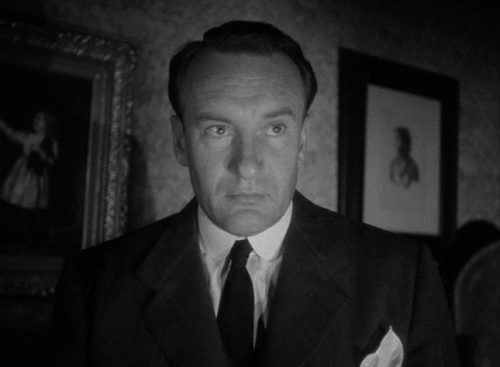
The prologue informs us that we are in New England, in a town called Corinth to be exact. It feels somehow appropriate that events should unfold in a town whose name alludes to a classical past, for New England (to an outsider such as myself at least) always seems to have an air being connected to the past. The town bridges different eras (just as Corinth in Greece acts as a physical bridge between the mainland and the Peloponnese), or could one say they clash? The main square has a statue of a famous general and the whole place is dominated by the hulking prison-like mill which provides the main source of employment. Within the walls of this forbidding edifice we see a man toiling away in his studio/office. This is Harry Melville Quincey (George Sanders), a descendant of that worthy positioned for posterity astride a marble horse in the square. His is a humdrum existence; the glories of his ancestors mean little in the thrusting industrial age and he must content himself with designing yet another variation on a rosebud pattern for an everyday textile. Harry is a man who is not so much drifting into staid and uneventful middle-age as one who is firmly mired in a world of stifling decorum. If the town is still shackled to a degree to what came before, then the house where Harry lives is practically a mausoleum, a burial chamber for one’s dreams. The furniture and decor recall a faded gentility, weighed down by the combined pressures of expectation and disappointment. He shares this space with his two sisters, Hester (Moyna Macgill) is a wittering and fussing old maid while Lettie (Geraldine Fitzgerald) is a manipulative malingerer.

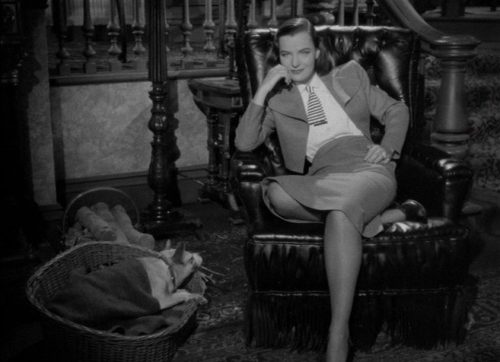
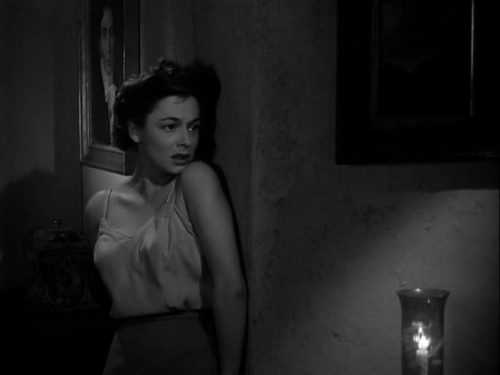
So Harry lives daily amid bickering and pettishness, punctuated by spells of tedium at a job which is eating away at his creativity and relieved only by his occasional star gazing via the telescope he has laboriously constructed in the summer house. This neatly sums up his character, the consummate ditherer and dreamer, forever focused on the faraway and the unattainable. Then all of a sudden that distant sparkle lands right in front of him in the form of Deborah Brown (Ella Raines), a designer from New York and a bracing breath of fresh air destined to blow away the cobwebs and wreak havoc in the plodding, predictable Quincey household. While love seeks Harry Quincey, something far less savory stirs in the heart of his needy and clinging sister Lettie. Passion, possessiveness and fear are set on a collision course, their meeting point to be decided by a man sat alone in his living room contemplating a small bottle of poison.

The tone of the movie shifts from a fairly light beginning, with some well-observed and self-deprecating humor provided by Sanders, Macgill and Sara Allgood, on through some tightly controlled melodrama towards a progressively darker destination. It is a smoothly blended process with no unseemly jarring observed, not till the very end anyway and the coda that is sure to displease some. I am willing to go out on a limb here and admit that I quite like this twist which occurs. It satisfies me on a number of levels and always has done. I feel sure others will disagree with me here , but I reckon it can be read or interpreted in a number of ways, not just the superficial and obvious one. I actually see it as a natural extension or growth of the character of Harry – one would hardly expect anything else of the man, and whether it is in fact meant to be taken at face value is, I think, left to the viewer’s discretion.

Robert Siodmak did as much as anyone to codify the look and conventions of film noir in that great run of movies in the 1940s from Phantom Lady right through to The File on Thelma Jordan. I imagine The Strange Affair of Uncle Harry will not be at the very top of the list of favorite films noir from the director for too many people yet it remains enjoyable and well crafted. Siodmak coaxed fine performances from all the main cast members with Sanders tapping into a diffidence that he often masked with his characteristic polished smugness. Here he allows that mask to slip and offers a peek at a man whose faltering weakness is recognizably human and sympathetic even if he’s not always likeable. Ella Raines , in her third of four collaborations with Siodmak, exudes a sexy, sassy big city confidence, her earthy frankness bowling Harry over from the very first moment. Harry’s character resides in a remarkably Irish household, with Belfast native Moyna Macgill (Angela Lansbury’s mother) alongside Dubliners Geraldine Fitzgerald and Sara Allgood. Macgill flutters delightfully and makes for a strong contrast to Fitzgerald’s intense self-absorption; the latter’s final confrontation with Sanders is overflowing with cracked malice and comes across as genuinely chilling. Sara Allgood is good value as the lugubrious housekeeper, clashing with the two sisters and giving as good as she gets while she philosophizes about her own longstanding engagement with gloomy resignation.

The Strange Affair of Uncle Harry has been released in the US on DVD and Blu-ray by Olive films, sporting an attractive albeit imperfect transfer. It took me many years to catch up with the movie as it was one of those titles that never seemed to get screened on TV. I finally got to see it when it was broadcast one summer when I was on vacation and I liked it immediately. Sanders’ low key characterization resonated with me and Ella Raines in her pomp could never be disappointing. While some (many?) viewers will gripe over the nature of the twist that I have attempted to dance carefully around, I believe there is more of an issue relating to what Deborah sees in Harry in the first place, and why she perseveres in the face of his inertia and his family’s obstructiveness. Ah well, love is… whatever one wishes it to be, I suppose. To borrow a repeated phrase from the film, that’s the way things are. Speaking as a dedicated fan of the films of Robert Siodmak, I obviously recommend seeing this movie. Sure there are weaknesses on show but it was made right in the middle of his best period and that alone ought to make it required viewing.

Lightning Strikes Twice

Melodrama is essentially just emotionally supercharged drama. Somehow it has garnered if not a bad reputation over the years then at the very least one which attracts a degree of critical sneering. Its defining characteristics, those heated and indeed often overheated passions and emotions, seem to embarrass a lot of cultural commentators, leaving them unable to assess the strengths and the draw of melodrama with any sense of proportion, something that rarely occurs with other genres. Would it not be odd to kick a western for featuring gunfights, a horror movie for including monsters, or a comedy for having the effrontery to raise a laugh? Yet there is no shortage of critics jostling for a prime place in the line formed up to sling brickbats at melodrama. As a result, few people want to associate their names or their company’s names with melodrama, preferring to slap another label on the product, one which is perceived as having more marketing clout and thus greater respectability. Lightning Strikes Twice (1951) is without doubt a melodrama, with all the heightened atmosphere and feeling that one would expect. However, I have seen it labeled film noir, which is both a disservice to the movie itself and a misleading descriptor for potential viewers.

The opening scene leads us to Death Row where a man, pacing his cell like some caged beast, awaits the hour of his execution after having been convicted of the murder of his wife. Then right at the last moment, following an oddly flipped situation which sees a priest seeking forgiveness from the condemned man, word comes through that a stay of execution has been granted in order to permit a retrial. It is soon learned that the new trial has ended with a jury split right down the middle and unable to reach a verdict. So Richard Trevelyan (Richard Todd) walks free, and promptly drops out of sight. It is here that the main point of view character is introduced: Shelley Carnes (Ruth Roman) is an actress on sabbatical for health reasons and riding a bus through Texas on her way to a dude ranch. By chance and coincidence, for no melodrama would be worth its name without a liberal sprinkling of both mechanisms, she runs into a middle-aged couple who are keen to extend help and hospitality, for reasons which will be revealed later. The upshot is Shelley winds up on a remote desert road in the middle of a huge downpour and is forced to seek temporary refuge in the first house she spies. The one person in residence, and he has only just arrived, is Trevelyan. As he tells his tale to Shelley, she is not unsympathetic. The story is incomplete though and the viewer, as well as the characters on the screen, is left unsure of exactly what happened.

So is this a film noir? Well no it’s not, and the fact is that, despite some gloriously inky cinematography by Sid Hickox, the script is not so much dark as muddy. It plunges the viewer into a dizzyingly complex set of interlocking, interlinking and interdependent relationships where jealousy, infidelity, despair and yearning all jockey for position. The screenplay by Lenore J Coffee packs in as much emotional tumult and turbulence as possible and the stark, broiling desert setting is a fitting location for it all. The ghost of Trevelyan’s late wife is ever present, haunting both the past and present of everybody involved. As in Hitchcock’s Rebecca, our never seeing this character lends her a power in death that is every bit as malignant as her influence in life is said to have been.

Perhaps there is a bit too much doubt or ambiguity injected into proceedings. The truth is that once one strips away the admittedly well rendered atmospherics the mystery at the heart of the film is not that hard to crack. Still,the direction of King Vidor (Duel in the Sun, Man Without a Star, Ruby Gentry) is a visual delight, exhibiting great style and creativity. He frequently captures characters either in reflection or in frames within frames. The effect here is that the full picture is never allowed to emerge, with something always obscured or placed strategically out of sight. This serves to heighten the sense of unease and suspicion, leaving viewers and characters unsure and feeling forever at a loss.

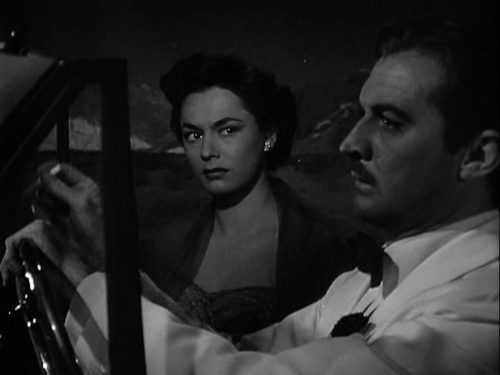
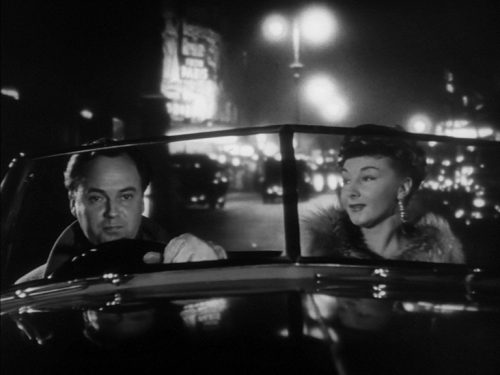
Both Richard Todd  and Ruth Roman were riding high at this point and getting some plum roles. Todd had just recently received great acclaim for The Hasty Heart and had taken the lead in Hitchcock’s Stage Fright. His career saw him take on a variety of square-jawed heroic parts but he was equally effective in more ambivalent roles too. Coincidentally, Ruth Roman was working with Hitchcock around this time as well, as the leading lady in the superlative Strangers on a Train. I’ve always felt she had an air of toughness about her, and while that quality is discernible here she never allows it to override the innate vulnerability which is essential for her role to make sense. If the careers of Todd and Roman were in the ascendancy, then the same cannot be said for Zachary Scott. His star was on the wane and this would be the  last movie he made at Warner Brothers. His part reflects this decline too, a supporting role at best which sees him only appear in the latter half of proceedings and with just one notable scene – an edgy nighttime drive across the desert with Roman. Mercedes McCambridge gives another masterclass in twitchy, quivering frustration as the owner of the dude ranch  – surely no other actress has been as accomplished at portraying dissatisfied, self-loathing types.

Lightning Strikes Twice is available on DVD via the Warner Archive and the transfer looks quite strong. Personally, I like this movie – the stars, director, genre and overall look and vibe appeal to me. However, I realize this type of thing is not going to work for everybody. Again, I feel it is a real stretch to call this a film noir and anyone approaching it on those terms is likely to come away feeling disappointed and short-changed. Sure it has the look of noir at times and one could say it does pause to light up a smoke and cast a glance down those murky cinematic alleys on occasion but it is melodrama all the way, and an enjoyable example of that genre for those who are happy to embrace it.

Drums Across the River

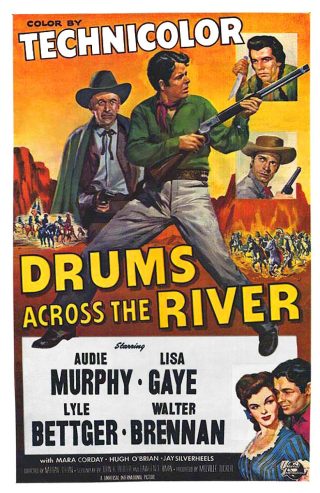
Revisiting Universal-International westerns is never a chore. While some are undoubtedly more challenging and engaging than others, there is a strong and distinctive visual aesthetic to them all. Add in the polish and pace of a well-oiled production system and there is usually much to savor. Drums Across the River (1954) was the last of three movies Audie Murphy made for director Nathan Juran and it is an enjoyable picture that blends a number of worthwhile themes into the action, although one could argue that there are too many of those themes for a sub-80 minute movie, too many to do full justice to at any rate.

Gary Brannon (Audie Murphy) and his father Sam (Walter Brennan) run a freight business in Colorado, one which is beginning to feel the pinch economically as the mines that had previously been the life blood of Crown City are yielding less and less. Desperate men naturally snatch at whatever straws of hope appear before them and in this case it is the neighboring land occupied by the Ute tribe, land which is known to be rich in gold reserves. This presents the main source of potential conflict in the movie and it is here that we dive into the action as Gary Brannon is about to defy his father and take part in an excursion onto Ute territory organized by Frank Walker (Lyle Bettger). Walker fully expects to encounter trouble, in fact he welcomes and pushes for it as his ultimate goal is to provoke a war with the Utes that will force the army to intervene and deliver the gold into his hands. Well, a skirmish does occur, despite the best efforts of Brannon Sr to broker peace, and the taking of captives by both sides means an exchange is going to have to take place.

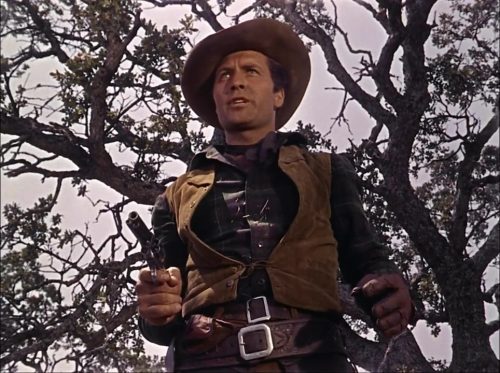
It is at this point that another source of conflict arises, one that is crammed with potential. Sadly, this is only partially fulfilled though, as the fact that Gary’s mother was killed by a Ute warrior in the past comes to light. This explains his hatred for the Indians and introduces a needling note between father and son since the older man has come to terms with his loss and grown to respect the tribe and the Chief (Morris Ankrum) who atoned for the killing at great personal expense. The exchange, negotiated by Gary as his father is nursing a wound, sees him alter his perspective and thus the ethical and philosophical sea-change he experiences is effected a little too quickly and too soon. That is not to say it is unconvincing, merely that it robs the picture of the opportunity to delve deeper into a strong and involving theme. What follows is more standard albeit entertaining fare as the focus shifts to a more direct confrontation between Walker and Brannon Jr, where the former is increasingly determined to remove the stone in his shoe that the latter now represents. As such, we get kidnapping, blackmail and a frame-up all interspersed with copious action sequences as we wind our way towards a satisfying if not altogether unexpected conclusion.

Westerns that lean heavily on subterfuge as plot devices need the right people in the villainous roles. Under the circumstances, it is hard to think of anyone better suited to the part of arch puppeteer than the unctuous and Machiavellian Lyle Bettger. His shifty, slippery persona is ideal for the role of Walker and contrasts well with Murphy’s clear countenance and upright demeanor. Murphy himself is never overtaxed but does well, as one would expect, in the action scenes and brings that edgy intensity of his to some of the tougher moments. Walter Brennan is sympathetic as the older man who has made peace with himself and his environment. If anything, he is absent, or held captive by Bettger and his henchmen, for too long and his character’s measured wisdom and innate decency is therefore only sporadically highlighted. And speaking of characters who are not on screen as much as I would like, there is Hugh O’Brian’s sardonic and sadistic black-clad gunslinger. He brings a real sense of stylish menace to his scenes and it is a genuine pity he wasn’t given more to do. Jay Silverheels fares well as the Ute warrior who grows into responsible leadership and his stoic sense of right and justice contrasts markedly with the venality of the villains.

It has been suggested before that women in westerns do not always get as many opportunities to shine or make their mark. Now I’m not convinced that is really true, or least not true enough to be presented as a blanket statement. There are many examples of interesting and pivotal roles for women in the films of Ford, Hawks, Daves, Mann and Boetticher, and this is frequently true of second tier productions as well. Sadly though, this cannot be said for Drums Across the River, where neither Mara Corday as a saloon girl nor Lisa Gaye as the insipid and unnecessary love interest for Murphy are given any chance by the script.

Nathan Juran’s direction of the movie is fine in that he keeps it tight and it’s what I’d term a solid and professional piece of work. Still, it feels a little impersonal. He makes ample use of the studio backlot, which typically looked attractive in most of the movies where it was employed and this is certainly true of the sequence featuring the gallows in the rain, but does get to head out to Red Rock Canyon and San Bernardino for a bit of welcome location work too.

Drums Across the River has had multiple releases on DVD over the years so it ought to be easy enough to track down a copy. I watched the UK release by Simply Media, which has the film looking handsome and colorful in its correct widescreen ratio. Overall, this is a good Audie Murphy western that offers food for thought on Indian-settler relations and presents the Ute as more than just convenient bogeymen. I guess my only complaint would be the fact that the script moves so fast and tries to pack in so much that some the more interesting and worthwhile themes do not have much chance to breathe. Nevertheless, this is a movie that works hard to please and hits the target most of the time.

Murder Without Crime

Looking at the beginning of a filmmaker’s career can be an eye-opener, either for good or bad reasons. Some directors start out with only a shadow of the confidence and assurance they would later develop, resulting in debut efforts that are clearly the work of a novice. Others hit the ground running, creating the illusion that they had been in this line of work forever. Murder Without Crime (1950) was the first feature directed by J Lee Thompson, a man whose subsequent career would be a lengthy and varied one. The movie has a great deal going for it in terms of both pacing and visuals, although there are other aspects of it which are more problematic. All told though it suggested that the man in the director’s chair had a promising future ahead of him.

Murder Without Crime is a self-contained affair following the fortunes of just four Londoners over the course of one evening. Stephen (Derek Farr) is, according to the narrator, an author of moderate success. He is married to Jan (Patricia Plunkett), but it does not appear to be a happy union. Jan suspects infidelity and Stephen doesn’t have the demeanor of an  entirely trustworthy man. They row, tempers become frayed, accusations and threats get tossed around, and Jan storms out vowing never to return. What then is a churlish and vaguely immature man supposed to do under the circumstances? Why, allow his smug and supercilious landlord Matthew (Dennis Price) to take him out on the town to drown his sorrows in a Soho night club. That then is the location where the fourth piece of the ensuing puzzle makes her appearance; Grena (Joan Dowling) is a hostess in the club and the lovelorn Stephen catches her attention. To cut to the chase, Stephen and Grena eventually end up back at his place, where he veers disconcertingly between maudlin and passionate while she is simply kittenish. Things take a nasty turn though with Grena feeling rejected and insulted before it escalates into a tussle over an antique dagger that sees Stephen shove her, causing her to fall and strike her head.

Such a turn of events would be enough to panic even the most levelheaded and self-assured individual, neither of which characteristic could be used to describe Stephen. His first thought is to conceal the deed, but he is not taking account of the suspicious and predatory nature of the ever vigilant Matthew in the flat below. The opportunity now exists to apply some pressure on the hapless Stephen, with Matthew sadistically teasing and tormenting him with allusions to his  guilt, toying with him pitilessly before blackmailing him.

J Lee Thompson had started out as a writer and one of his earliest plays went by the name of Double Error. It seems to have enjoyed some success, being performed in the West End as well as later revivals in the US. In 1950 Thompson had the chance to make his first movie and Double Error was adapted for the screen as Murder Without Crime. The stage origins are apparent in the small cast and limited locations but the cinema version has some very striking visual flourishes, with sharply canted angles and moody noir style cinematography helping to build up atmosphere and suggest a world where the mentality of the people we follow is as skewed and quirky as the imagery on the screen.

Everything moves along at a comfortable pace, scenes never drag and it all wraps up in a way that is brisk without being rushed. However, there are some weaknesses that shouldn’t be glossed over. Firstly, there is a voice-over that adds little to the proceedings and comes off as smug and smarmy where I suspect it was actually aiming for knowing sophistication. Then the score by Philip Green is one of those intrusive efforts, making its presence felt far too strongly and drawing attention to itself far too often – I have always felt a score ought to complement the visuals, enhance the mood rather than stomp all over it. Finally, there are the characters who people this drama. I don’t reckon it is necessary for audiences to be able to identify with the characters they watch but there should be someone they can at least sympathize with. The problem with Murder Without Crime is that nobody is actually all that likeable.

Dennis Price was a fixture of many British movies throughout the 1940s and 1950s, excelling at playing men at once remote and bilious. Kind Hearts and Coronets may well be his best work but there are numerous examples of delicious unpleasantness in his list of credits. As Matthew he is seedy, louche and superior, and downright mean-spirited. Up against Price is Derek Farr, in a role that really needs to have some feature we the viewers can root for. What we get, however, is a portrait of a weak and truculent type, a man who is struggling to save up to make a down payment on a chin. While Stephen surely feels sorry for himself and worries a lot about how everything will pan out, I was of the opinion that any misfortune he suffered was richly deserved.

The women fare only marginally better. Patricia Plunkett rightly walks out on Stephen at the beginning, but her resolve weakens far too quickly. When she returns it is hard to see how she is justified in helping out this man who is clearly unworthy of her. That she continues to do so even after she learns how he behaved had me scratching my head. The tragic Joan Dowling does some good work as the clinging hostess but, once again, it is difficult to like her. The fact is all four of these actors turn in good performances, but the the characters they play are for the most part distasteful.

Murder Without Crime is a modest picture, telling a simple yet twisty story economically. Network released the movie on DVD almost a decade ago and it looks like it has now gone out of print, although used copies can still be picked up at reasonable prices. That old DVD was quite strong and boasted the kind of transfer that did justice to the visuals. It is a tight little crime story from a director who was just starting out and even if it has some weaknesses (which I hope I haven’t overstated here), it still makes for an enjoyable way to spend eighty minutes of your time.

The Purple Plain

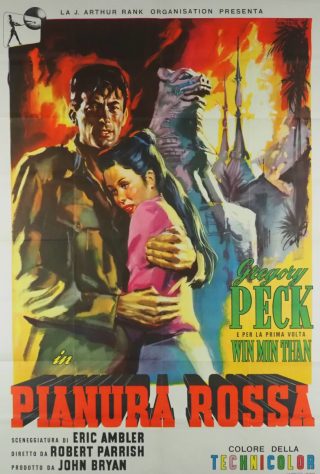
One of my reasons for starting up this blog in the dim and distant past was to try to drum up a  bit of interest in films that had been neglected to some extent. The passage of time has seen me broaden those aims of course, but I like to think I still focus sporadically on the kind of movies that don’t always get so much attention.  One such movie is The Purple Plain (1954) from Robert Parrish, a director whose work I find very appealing for the most part. It is a story of war, of survival, and of unexpected romance and has at its heart notions of renewal, rediscovery and rebirth, themes which have enriched so many classic westerns yet which are used skillfully and successfully here.

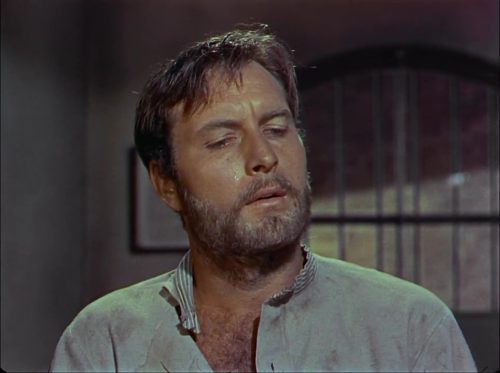
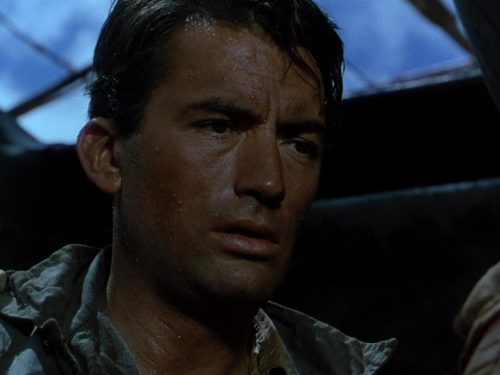
The on screen caption informs us that it’s Burma in 1945, the latter stages of WWII. Of course the war has not yet ended and the mental strain of the long years of combat and the attendant losses is brought into sharp relief by the opening scene. A man is shocked into wakefulness by the sounds of an imminent air raid. Startled, he darts out into the night, pounding along the primitive airstrip towards his plane, determined to get it aloft and to stand at least a fighting chance. His crew seem unaware of the danger though and as he struggles to sense this into them it becomes apparent that his grip on reality is tenuous. This man is Forrester (Gregory Peck), a Canadian pilot who is clearly suffering from PTSD.

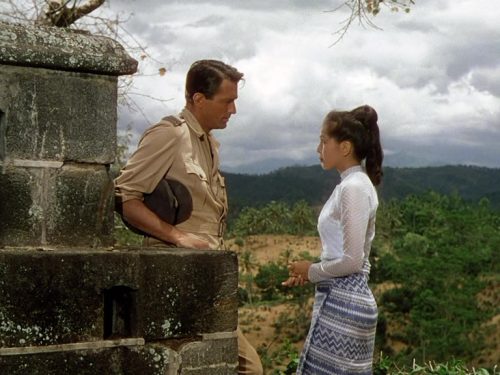
This is further highlighted when his moodiness, disassociation and recklessness are seen to alienate almost everyone he comes into contact with, all but two people anyway. The first is the medical officer Harris (Bernard Lee), a thoughtful, humanitarian type who regards Forrester as a challenge as opposed to some hopeless lost soul. It is through the efforts of Harris to encourage Forrester to establish contact with others again that he encounters the other person who is able to reach him. Anna (Win Min Than) is a resident of a local Christian mission and it is she more than anyone else who manages to penetrate the tortured cocoon which Forrester has constructed around himself.

Here we have the emotional hub around which the movie revolves, and it is a powerful one. It needs to be too because Forrester is shown to be a man who has abandoned life itself, who has not only been scarred by the war but has dedicated himself to dying. In short, Forrester is about to plunge into a spiritual abyss. For a man to haul himself back from such a precipitous position requires both iron resolve and an all-consuming motive. That motive is the simple love he has inspired and in turn been touched by. This has to be credible, credible enough to make a man start to regain an appetite for living, and credible enough too to sustain him when he finds himself cast into the wilderness and facing the twin trials of not merely surviving but ensuring the salvation of those dependent on him. In The Purple Plain it feels wholly credible at all times.

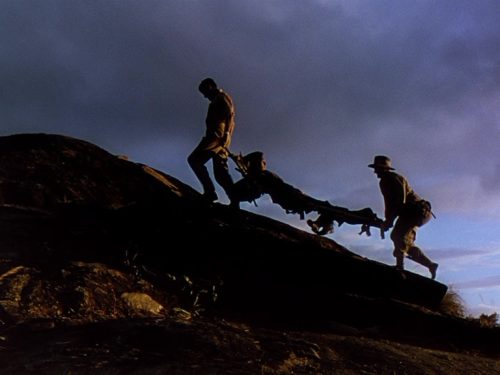
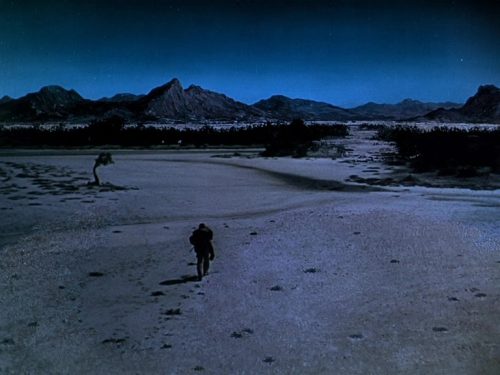
Given the right material, Robert Parrish was a director capable of great sensitivity, able to tap into some deep humanist reserve to produce works that linger in the memory. For me, The Purple Plain is one of those movies where direction, writing, cinematography and performances all mesh perfectly. Working from a story by H E Bates, Eric Ambler (one of the finest thriller/espionage novelists of the 20th century) fashions a script that is compact, accessible and absorbing. Geoffrey Unsworth’s photography is lush and evocative, using nighttime filters attractively (which is no mean feat), while future director Clive Donner edits the whole thing in such a way as to disguise the limitations of the budget. Parrish brings all of this together with great assurance and skill. The visuals have a style and economy that is is admirable, a case in point being an early flashback sequence, a fast cut montage combining love, chaos, destruction and loss. We are swept along from intimacy to devastation in just 90 seconds, the director concisely conveying all we need to know about the bleak despair of Peck’s character in that brief burst of action. Visually, Parrish captures and communicates the prevailing mood with aplomb throughout though, from the softness and warmth of the moments Forrester and Anna share to the stark and spartan atmosphere of the wilderness whether by day or by night.

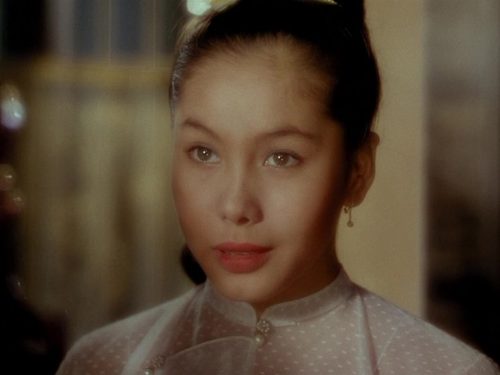
Peck does remarkably good work as a man existing on the periphery of desperation, thrown a lifeline and offered a chance to rebuild his life. He moves effortlessly from the remote detachment at the beginning to a halting, uncertain awareness of a fresh opportunity and then finally on to a grim determination to maintain a hold on life and hope. Underpinning all this is Win Min Than as the soft spoken Burmese with an unshakeable faith and devotion. Perhaps her contribution is even more remarkable given the fact she wasn’t really an actress and this would be her only film role. She brings what I can only describe as intense serenity to her part and the result is that her scenes with Peck have a power and tenderness that is very moving, attaining an almost oneiric quality that builds up to that final shot which is all the more satisfying for its subtlety.

Frankly, the movie is all about those two, which is not to say that Bernard Lee, Maurice Denham, Lyndon Brook or Brenda De Banzie should be overlooked. Each one of them brings something vital to the film and each one lays down a spiritual marker to assist Peck’s character on his path back to fulfillment.

I understand the US Blu-ray of The Purple Plain is presented in a 1.66:1 widescreen ratio. My own copy is the UK DVD, which is 1.33:1, and I can’t say it looked poorly framed. The colors are well rendered and it is sharp and clear. To reiterate what I said at the top of this piece, this is a film that I believe has been afforded less attention than it deserves. It is a fine effort, touching on some eternal themes and presented in a way that is positive, affirmative and cinematic.

The Films of Delmer Daves

Were one to run a poll on the best or most influential directors of westerns during the classic era, I feel sure that the “holy trinity” of John Ford, Anthony Mann and Budd Boetticher would come out on top. That, of course, is fair enough given the quality of work produced by that trio. Were the range to be widened to take in directors in general from that era, I feel less confident of predicting the outcome, although I would be surprised if Ford didn’t feature prominently once more. And while such exercises are fun and provide a useful launch pad for discussion and debate  among aficionados, there is that tendency for certain names to dominate and a corresponding likelihood of others getting swept aside or at least shunted further down the line to a point where attention among participants has faded or their enthusiasm has grown muted. All of which leads me to Delmer Daves, a director I have grown to regard as a personal favorite, and the subject of a new book by Douglas Horlock, The Films of Delmer Daves – Visions of Progress in Mid-Twentieth Century America.

As the title suggests, this is a study of the films as opposed to a biography of the man. It is also a book which takes a broadly academic approach too, which is consistent with the author’s background as a former history and education lecturer. This means there are copious footnotes and references to the writings and views of assorted academics, critics and commentators, including Joseph McBride, Andrew Sarris, Blake Lucas, Jim Kitses, and Pauline Kael to name just a few. It is divided into four main sections concentrating on the films in general, the political and social values represented, race, and gender.

Horlock opens with an overview of the films, those directed as well as those scripted by Daves, and takes a look at the critical response to the body of work. There is a presentation of some of the more dismissive or less appreciative critical reactions and an attempt to root out the reasons for such views. There is too an acknowledgment of positive responses, a viewpoint which is shared by Horlock and supported by reference to some of the most memorable and cinematically effective scenes in his films. Horlock also discusses the character of Daves and how he fostered a sense of positivity on the set, something I feel shines through in many of his movies.

Horlock examines Daves’ technical prowess, from his framing and spatial awareness in CinemaScope productions to his carefully rationed use of the subjective camera in Dark Passage. He takes pains to convey how Daves’ use of technical innovation was always backed by the need to create or enhance the humanity of what he was putting up on the screen. He also addresses the criticism sometimes leveled at the director’s endings, an area I once regarded as problematic myself. To my horror, it came to my notice that Bosley Crowther, the prince of critical curmudgeon, took such a view. In my defense, however, I’m pleased to say I have grown beyond that position. Thankfully.

“Daves’s stories are about physical or spiritual regeneration and redemption, and how characters can be fulfilled and benefit their community as well as be served by a society that has the potential for tolerance and benevolence. His films focus on the innate goodness of humans and their potential to make the world a better place, bringing together communities and individuals separated by prejudice and intolerance.”

The whole thrust of the book is, as its subtitle indicates, an effort to link the films of Delmer Daves to the mores and attitudes prevalent at the time they were made. Thus we have a detailed analysis of his war films, such as Destination Tokyo and Hollywood Canteen, and the way they reflect the war effort during WWII, as well as a title like Pride of the Marines, which tackles the difficulties of rehabilitating veterans in the aftermath of the conflict.

Personally, I found the sections which look at the director’s portrayals of both race and gender to be the most absorbing, possibly due to the fact there was increased scope for analysis of his westerns. Drum Beat, Broken Arrow, The Last Wagon and White Feather are all given in-depth and appreciative treatment in the section on race. The chapter on gender has interesting points to make on the way Daves portrayed men and women and their interactions on screen, with his late career melodramas being well represented as well as major works such as 3:10 to Yuma.

All told, the book offers a comprehensive analysis of Daves’ body of work, both as a director and as a writer. It’s fully indexed and sourced and it is at its best when Horlock is presenting his own theories and views, where the writing has more of a flow to it. Where it does feel drier and less readable (or less enjoyable at any rate) are the quoted sections from the writings of some academics. There are a smattering of black and white photos throughout and I feel a few more would have added to the visual appeal. As a fan of the director’s work,I enjoyed it for some of the insights presented and some of the background information I hadn’t been aware of, and it has to be said the author’s research is thorough, not least his use of Daves’ own papers.

The Films of Delmer Daves – Visions of Progress in Mid-Twentieth Century America by Douglas Horlock

242 pages Published 2022 by University Press of Mississippi

(Photos used in this article are for illustrative purposes only and, with the exception of the cover image, do not appear in the book)

They Rode West

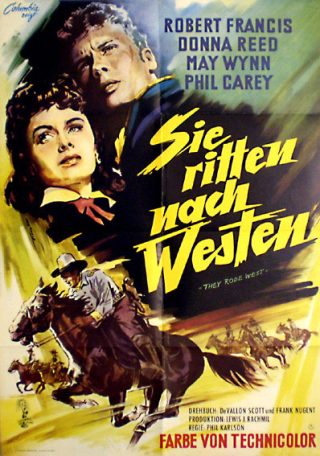
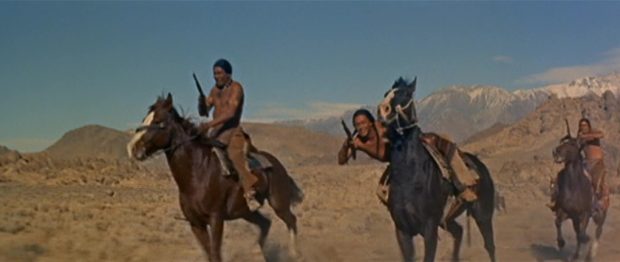
A movie is a journey, one undertaken by characters and observed by viewers, and the degree to which it can be considered a success depends on how much those characters have learnt about themselves and the world they occupy by the time they reach their destination. I think this holds true for most films, whatever the genre, but it plays an even more significant role in the western. The western, despite its frequent reliance on action, is very much a character driven genre. The great westerns achieve that quality through the development of their characters, emphasizing growth, renewal and redemption along the way. When I view a film like Phil Karlson’s They Rode West (1954) I am left thinking it is only partially successful, which of course is not to say that it fails to entertain or that it has no points of interest in plotting or approach. Ultimately though, the film feels more like an exercise in vindication as opposed to redemption, which is never as rewarding a payoff.

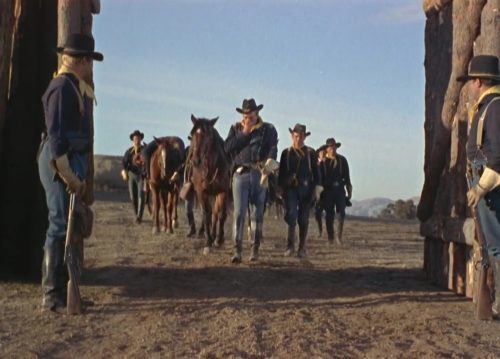
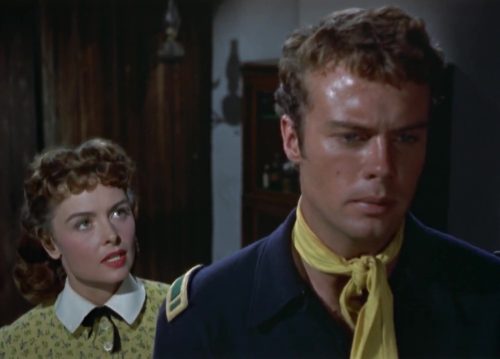
As is the case in any good drama, They Rode West presents multiple layers of conflict. From the beginning it is clear that Captain Blake (Phil Carey) has a strong dislike and distrust of the medical profession. The outpost has had the misfortune to be lumbered with a succession of incompetents, the last of whom has just killed Blake’s friend through drunken negligence. So, when the new replacement, Lieutenant Seward (Robert Francis), turns out to be a green recruit with neither military nor frontier experience, Blake is perhaps understandably antagonistic. This is the main source of conflict that runs through the movie and it is supplemented by a kind of stuttering rivalry over the affections of the Colonel’s niece Laurie (Donna Reed). Alongside that, there is further friction generated by Seward’s compassion and empathy for the plight of the Kiowa of the nearby reservation, feelings which are complicated by his obvious attraction to a white captive (May Wynn). Caught between the hawkish and inflexible Blake and the increasingly frustrated Kiowa, Seward soon finds the call of his conscience has led to him being labeled a traitor (a wood hawk) by the troopers.

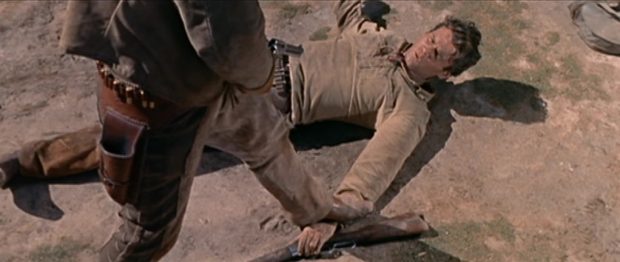
They Rode West is a handsome production with Charles Lawton’s cinematography making the best of the Iverson Ranch locations. I can’t find anything to confirm my suspicions, but the shooting style employed by Karlson gives the impression that the movie was shot for 3D presentation. He indulges in a fair few heavily canted angles, which may simply be a stylistic choice, but there are a number of scenes (predominantly action/battle sequences) where those telltale shots of people and objects leaning and falling onto the lens are on display.

Frank Nugent’s screenplay, from a story by Leo Katcher (The Hard Man, Party Girl, Between Midnight and Dawn) has Seward and Blake forever at daggers drawn, principally though not exclusively over their contrasting attitudes towards the Kiowa. This is well enough done and feeds into the more nuanced view of the Indian that an be found throughout westerns of the era, particularly those of Delmer Daves and George Sherman, and elements of this crop up in Karlson’s own later (and superior) Gunman’s Walk. Still, the handling, or maybe I should say the way the characterizations unfold, is not all that satisfactory. As I alluded to at the top of the piece, there is little of the redemptive spirit that enriches so many 1950s westerns. One could, I suppose, argue that Seward’s actions eventually lead to the restoration of trust between the warring sides and that the faith he manages to draw from the both sets of combatants has a redemptive effect on them. However, I feel that is reaching somewhat, that the truth is the tale winds its way to a vindication of the approach championed by Seward from the get go. While that is fine in itself, it means his character has undergone little change; he sees his ideals comes to be accepted and the criticism leveled at him firmly rebutted yet he remains essentially the man we first saw, albeit a little more worldly-wise.

Phil Carey seems like he should have had a bigger career. I guess his credits show he did fine in general, but the fact is, in spite of working for directors such as John Ford and Raoul Walsh, he never rose above second lead in anything other than programmers. Roles like that of Captain Blake can’t have helped, he starts out as abrasive and short-tempered (justifiably so under the circumstances) and basically stays that way till the end credits roll. As I said, there is no renewal or rebirth to be seen here and it’s an ambivalent part too, neither fish nor fowl. Robert Francis gets the noble part and he plays it well, with freshness and decency and he also conveys the doubts and guilt which assail him quite effectively. However, his was a short and tragic life and he would die in a plane crash just a year later at the age of 25 having made only four films. May Wynn (who worked opposite Robert Francis in The Caine Mutiny) has what I feel is the most interesting part in the movie. The role is not an especially taxing one but it is pivotal and, crucially, it offers an unexpected perspective on the life of a captive. She is not portrayed as someone who is seeking escape, but instead as a woman who has reconciled herself to life with the Kiowa and who has no intention of leaving. Donna Reed had just won an Oscar for From Here to Eternity but this film wasn’t going to capitalize on that. Although she has some fun showing a bit of coquetry from time to time, it’s all standard love interest stuff and never particularly memorable.

They Rode West has appeared on DVD in France and Spain and it can generally be tracked down for online viewing too. All in all, it is an enjoyable western, a solid cavalry yarn whose heart is in the right place. It’s attractively put together, has pace and includes some exciting action scenes. Had the scripting allowed some real growth in the characters to take place, I wouldn’t feel the need to offer caveats. So, whilst it won’t make anyone’s list of great westerns, it is still a good one.

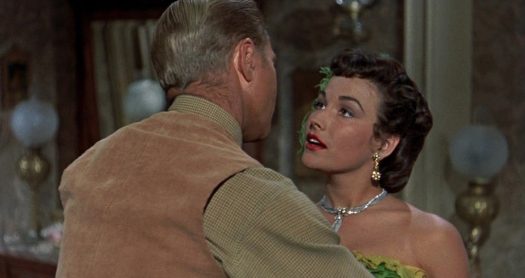
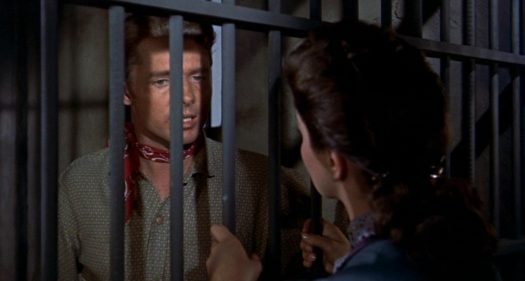
From Hell to Texas

“The best revenge is to be unlike him who performed the injury.” – Marcus Aurelius, Meditations

Revenge is a motif that is popular in the western, driving and challenging heroes, anti-heroes and villains. The better, or perhaps it would be closer to the mark to say the more thoughtful, westerns of the 1950s mined this theme extensively. The conclusion reached by these films is a virtually universal rejection of the concept of vengeance, an acknowledgment that nothing positive can ever be achieved by sitting down to dine with the Furies. Henry Hathaway’s From Hell to Texas (1958) makes this point very clearly by highlighting not only the corrosive effects of such a self-defeating quest on those who seek revenge, but also by presenting a hunted man who is both innocent of what is alleged and morally appalled by the violent situation in which he becomes mired.

It is all about pursuit and discovery. Tod Lohman (Don Murray) is a hunted man, first glimpsed leading his lame pony to water and some brief respite. He’s running from the sons and riders of Hunter Boyd (R G Armstrong), a local bigwig who has decided that Lohman must pay for the death of one of his sons. That the death was an accident and no fault of Lohman’s is irrelevant for Boyd is of that implacable and inflexible frontier breed, hard men who conquered lands and thrived by having no dealings with frivolities such as self-doubt. So Lohman’s only hope is to run and keep running. When his attempts to avert a deliberately engineered stampede leads to the fatal injury of the second of Boyd’s three sons, it looks as though Lohman has merely driven another nail into that coffin others seem hell bent on fashioning for him. So he’s off again, soon reduced to making his way on foot and feeling his energy sapping all the time. A short stop to rest up sees him making the acquaintance of Amos Bradley (Chill Wills) and his tomboyish daughter Nita (Diane Varsi). This represents a turning point for Lohman. Up to this point, he has been a man alone, one half step ahead of danger and dependent only on his wits. His meeting with Nita offers an ally and a sense of hope too, serving to open the character up in the eyes of the audience as well. Perhaps it isn’t too difficult to tell where the story is going but that’s not what matters. While the ultimate destination proves to be a satisfying one, the real reward is to be found on the road we follow in the company of these characters.

The pursuit I mentioned is present right from the beginning, stark and relentless and powering the narrative. However, there is the matter of discovery which develops in tandem, and which brings another layer of interest, a very welcome one. Lohman is portrayed as something of an innocent in the ways of the world, or at least in the machinations of those inhabiting it. Even as he’s running from Boyd and his would-be revengers, he too is searching for someone. His mother has passed and he sustains himself on a memory, a photo and an old Bible, all of which comprise her sole legacy to her son. His father had left to seek something  – perhaps fortune, maybe freedom, who can say? – while Lohman was still a boy. Now the boy has become a man and is casting around to find this absent father in order to make sense of his past. It is somehow fitting that his flight from the present towards the mysteries of the past actually brings him face to face with his future. Hence the discovery, that the closure attained with regard to what is over and done helps to open a young man’s eyes to how he can deal with the challenges of the here and now, and so move on to a better place.

All told, From Hell to Texas is an extraordinarily positive movie, as a result of the writing of Wendell Mayes and Robert Bruckner, and of course the performance of Don Murray too. The actor brings what I can only term a credible credulity to the role, that hard to define quality of a man grown big in a vast and unforgiving land yet remaining possessed of a simple faith in people. This is a tricky balance to achieve if it is not to ring false. To Murray’s great credit, the open-heartedness of his character is never in doubt, nor are his capabilities as a frontiersman. That he has skill with a gun is clear and it is demonstrated on a number of occasions, but his abhorrence of violence and its consequences is every bit as apparent. The first time that we see him placed in a position where he has been left with no option but to kill a man makes for a powerful if understated scene. The shock and disgust at how he was forced to act, and ultimately at himself for doing so, is conveyed perfectly by Murray. Then in the immediate aftermath among the familiar rocks of Lone Pine as he finds himself unable to take another life, that of the victim’s horse, the effect is crystallized. In fact, running all through this movie is an innate respect for the sanctity of life. It’s there in the heart of Lohman, it’s there in the selflessness of the Bradley family, it’s there in the way a priest tends to the memory of a man who was essentially a stranger to him, and it reaches its zenith in the fiery cathartic climax.

Diane Varsi worked well with Murray and their scenes together have a frankness and simplicity that is touching. Her star soared quickly after she made her debut in Peyton Place but the pressures of stardom saw her step back from the movies quite soon. She would return later but, sadly, her career wouldn’t be the same again. On screen, R G Armstrong often had an air about him of a man who would not be turned, and he brings that ruthless determination to bear on the part of Hunter Boyd. Sure he is a man in the wrong but his idiosyncratic concept of justice and the fact he also embarks on a journey leading to personal revelation (a journey that while different is just as important as that undertaken by Murray) makes him much more than a one-dimensional cutout villain. Chill Wills is, well, Chill Wills, but that really isn’t a bad thing. Jay C Flippen pops up for a time, looking crafty and faintly untrustworthy. Dennis Hopper, fresh off Giant and Gunfight at the O.K. Corral is a bit mannered as the last of Boyd’s sons and plays a pivotal role in how matters are eventually resolved. It has been said he had a less than harmonious relationship on set with Hathaway, which seems very possible given their markedly different approaches to filmmaking, although they would work together again on The Sons of Katie Elder and True Grit. John Larch, Rodolfo Acosta and Harry Carey Jr all make appearances as henchmen, however, their screen time is limited.

From Hell to Texas ought to be relatively easy to access these days. The old German Koch Media DVD I purchased over a decade ago appears to be long out of print but there are a range of other options available in other European markets as well as in the US. The image, on my copy at least, is softer than I’d like but I have to say Hathaway used the ‘Scope lens very effectively, and Daniele Amfitheatrof’s score sounds wonderful. To my mind, this is a fine western all round, albeit not one that is talked about much. Do check it out if you are not familiar with it.

The Four Horsemen of the Apocalypse

While literary adaptations come up for discussion on this site all the time, remakes of earlier movies are less common. The Four Horsemen of the Apocalypse (1962) is both an adaptation of the novel by Vicente Blasco Ibáñez and a remake of the silent film directed by Rex Ingram and starring Rudolph Valentino. In the interests of full disclosure, allow me to get it out of the way from the get go that I have neither read the novel nor have I seen Ingram’s movie. As such, I won’t be indulging in any comparisons here, which is something I try to avoid where possible anyway. After all, a work ought to be assessed on its own merits, to do otherwise is to rob it of its integrity.

This is a tale of family, war and division yet, in the final analysis, I think it is also a film about unity. The opening is celebratory, packed with dancing, music and, above all, color. It is 1938 in Argentina and Madariaga (Lee J Cobb), in a brazen repudiation of his years, is reveling in life, for its own sake and also in anticipation of the coming together of the two branches of his family. Madariaga has two daughters, one married to Karl (Paul Lukas), a German, and the other to Marcelo (Charles Boyer), a Frenchman.  The offspring of these two couples will all be present after a long absence, so it should be an occasion for joy. However, it is, as has been noted, 1938 and joy is about to take a long vacation. During the course of the evening, Karl’s son Heinrich (Karl Boehm) comes clean about his involvement in the Nazi cause, provoking outrage in his grandfather. To the accompaniment of elemental furies within and without, the old man has visions of the horsemen of the title, representing conquest, war, pestilence and death, charging across a lightning ripped sky. And then he dies. The story moves to Paris, seen largely through the eyes of Julio (Glenn Ford), the dissipated and pleasure-seeking son of Marcelo. That storm which toppled the head of the family half a world away has followed and has lost none of its strength on the long journey. Julio is a self-absorbed wastrel, quick to seduce the wife (Ingrid Thulin) of one of his father’s friends, complacent and secure in the apathy afforded by his neutral status. When the war finally breaks out and engulfs everyone, he gradually learns the value of love, of loyalty, of sacrifice and, crucially, of what it means to be part of a family, even a divided one.

War, love and hate, but family above all. We follow the fate of the two conflicting branches of the family, one half seduced by darkness and the other coddled by decadence. The war cleaves them, tearing the younger generation in particular apart and setting them at each other’s throats. Yet by the end, when the horsemen have done their worst, the intangible and eternal core of the family remains intact, in spirit if nothing else. That finale, with those lords of chaos riding triumphantly across the sky, has an unquestionably grim quality, an ancient malignancy pressing on in a relentless continuum. Still, there is a grain of hope there too – there are, it seems, two slightly different endings and it’s possible the viewer’s perceptions may shift depending on which one is seen – hinting at the ultimate resilience of the concept of family. Both sides of Madariaga’s clan have been devastated yet even in the moment of their greatest loss those who remain have been drawn back together. Perhaps that is the message running through it all, that family in its broadest possible sense, that of society of which we are all members, still endures. The rampaging horsemen may be forever with us, but so too are those unshakeable familial bonds that hold everything in place.

The Four Horsemen of the Apocalypse was poorly received on release, with a disappointing box office and a critical drubbing. Bosley Crowther of the New York Times, who never seems to have met a picture he liked, kicked the movie good and hard. Opinions are always varied and no more than an individual’s reaction to what is offered up, and of course there’s no getting away from the fact that I am simply presenting my own take here, but it is generally both poor form and somehow worthless to criticize a work for what it is not as opposed to what it is. Should anyone feel like seeking out Mr Crowther’s hatchet job on the film, it will be clear that he appeared most offended by a remake and adaptation not being a carbon copy of what came before. That type of criticism feels utterly redundant. However, what struck me as even more wrong-headed were the barbs aimed at Vincente Minnelli’s direction. To quote from that review:

“…most of it reeks of the sound stages and the painted sets of a Metro-Goldwyn-Mayer studio These, on wide screen in color and lighted like a musical show, convey no more illusion of actuality than did “Snow White and the Seven Dwarfs.”That much is the fault of the screen play, garbled grossly by Robert Ardrey and John Gay, and the staging of Mr. Minnelli, who should have looked at a couple of neo-realist films.”

That comment indicates to me that the writer either ignored or fundamentally misunderstood the director and his intentions. The artist is concerned with truth first and foremost. In order to address this, he searches for, he explores, and if he is truly fortunate, he finds himself in a position to present that truth via his chosen medium. Minnelli was an artist. For him, the quest for truth took precedence over any thoughts of adherence to realism. Cinema allows for the incorporation of a broad range of techniques and approaches, and there are those who try to reconcile artistic truth and realism. Minnelli, on the other hand, sought to achieve a separation, happily sacrificing the illusion of realism – and excepting documentaries, what appears on the screen can never be anything other than illusion – in order to break down those barriers which would stifle artistic expression.

All of those elements which have been pointed out as flaws or weaknesses are deliberate choices on the part of the director.  While Minnelli might have had some reservations with regard to aspects of the script and casting, the staging and presentation feel very characteristic of his work. He was a very visual director, making bold choices when it came to color and that balletic sense he brought to set piece scenes: the debauched Parisian parties, the Latin nightclub, the riot that leads to the initial arrest of Yvette Mimieux. There is a oneiric quality to all of this, heightened sensations brought to life on the screen in order to stimulate the viewer’s emotions. The striking colors are very effective too; the predominance of red is notable, from the drenched and saturated newsreel footage, suggesting danger and violence, to the decor of Glenn Ford’s apartment. The contrast of red and grey is marked in that set, and also in the costuming in one key scene. The color scheme of the apartment is reflected in the intense, passionate red of Ford’s smoking jacket and the cooler, more practical grey of Ingrid Thulin’s suit, mirroring their contrasting characters when they reluctantly acknowledge that circumstances have left them no alternative but to part.

In terms of casting, the most widespread complaint seems to relate to that of Glenn Ford, mainly due to his age. Admittedly, he is old for the part, in his mid-40s at the time. The early scenes in Argentina, and also pre-war Paris, where Ford is supposed to be gliding along fueled by youthful hedonism, feel a bit forced. However, the role of Julio is one which requires the character to mature fast as the war takes an increasingly heavy personal toll and the option of simply sitting on the fence becomes no option at all. It is here that Ford grows into the role, or it could be said the role grows around him. Either way, that internalized dissatisfaction which the actor was able to exploit so well in his classic western and noir roles in the preceding decades serve him well. As the character of Julio begins to live a double life, so Ford gets the requisite psychological squirming across. Minnelli is said to have initially wanted Alain Delon for the part and it’s interesting, if not especially productive, to speculate on how he would have handled the part. Ingrid Thulin (dubbed by Angela Lansbury) has a certain Scandinavian aloofness about her – Ava Gardner is said to have been the first choice for the role – but she plays well off Ford and their relationship feels credible.

Charles Boyer’s turn as the head of the French side of the family is nicely judged. He is as suave as one would expect of a man in his position, but there is discomfort too, and it comes out in two scenes with Ford, one where he confesses to the cowardice which has hounded him all his life, and then on a rain-soaked Parisian bridge, racked with grief after the death of his daughter, as he begs his son to be a braver and better man than he had ever been himself. Boyer also shares a poignant moment with Paul Lukas, where both men are screaming at each other in bewilderment as the horror of their personal tragedies mounts. Paul Henreid is simultaneously chilling and stoic as the hero of the resistance, slowly being destroyed, physically by the attention of the Gestapo and mentally by  the loss of his wife’s love. As for the others, Yvette Mimieux is fine as the impassioned younger child of Boyer, while Karl Boehm is a textbook Nazi. Finally, Lee J Cobb plays it large in the  opening scenes. Is it all too affected? Well, that is something the viewer will have to decide. For me, in a movie where many aspects are heightened and intensified with the aim of raising the dramatic temperature, Cobb’s performance can be considered to be just another dab of color.

The Four Horsemen of the Apocalypse can be found on DVD in the US as part of the Warner Archive, and editions are available in France, Italy and Spain. This is a film I came to relatively recently and one which I quite like. It has its flaws and it drifts in places but there are enough of Minnelli’s characteristic flourishes to draw me in, and Glenn Ford is someone I can always watch. It is not perfect but the pluses outweigh the negatives for me and I reckon it is a good deal better than some of the criticism leveled at it would have us believe.