Call Northside 777

To quote Henry Wadsworth Longfellow: “Though the mills of God grind slowly, yet they grind exceeding small.” But what happens if the person trapped between those relentless millstones is actually innocent? What if the pitiless wheels of justice are slowly crushing the wrong man? That’s the conundrum at the heart of Henry Hathaway’s Call Northside 777 (1948). It offers up a premise which is undeniably noir and is frequently referred to as such. I have hung that label on it myself here, not only for the sake of convenience but due to some of its visuals and, of course, that nightmarish scenario on which it is founded. To be honest, it is a socially aware crime picture first and foremost, and I quite understand that some may object to calling it anything else.

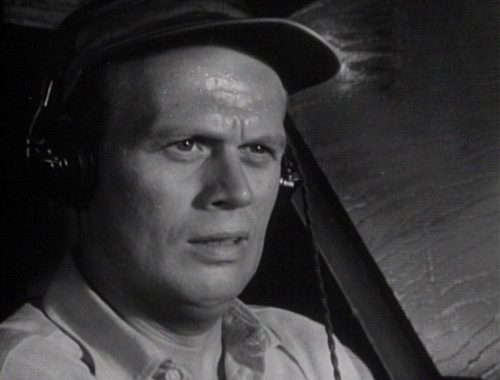
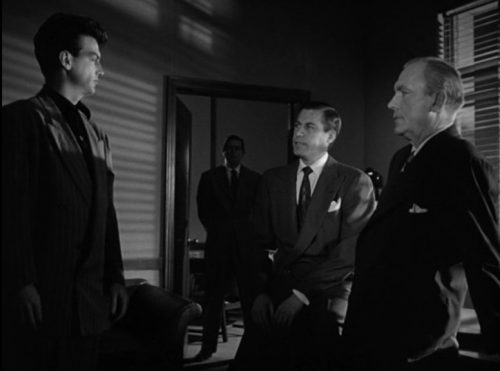
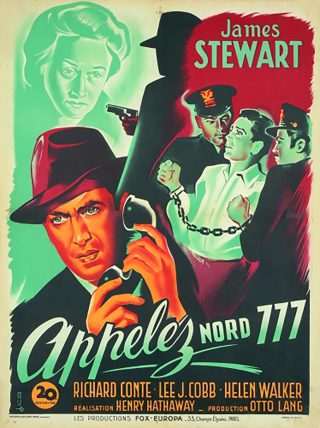
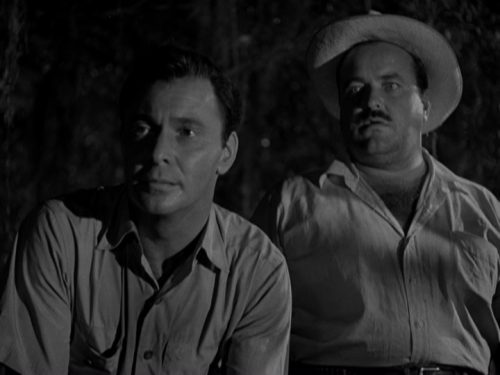
The credits are stark, with an austere, no-nonsense quality – crisply typed letters stamped clearly on plain white paper. It’s a matter-of-fact approach mirrored by the voice-over and the documentary tone of the opening, one which takes us back to the final days of the prohibition era in Chicago. In case anyone is unaware of the background, the violence and rampant lawlessness of those days is deftly evoked before attention is focused on one particular killing. The winter of 1932 saw the murder of a beat cop in the parlor of a dingy speakeasy. The bare bones of the affair are laid out before us as well as the arrest and assembly of evidence against the prime suspect, one Frank Wiecek (Richard Conte). Both he and his alleged partner in crime are duly convicted and sentenced to 99 years imprisonment. That’s that, one might say. However, this is only the beginning of our story, and the narrative really kicks in with the appearance of a classified ad in one of the city dailies offering a reward of $5000 for information leading to the exoneration of Wiecek. This catches the eye of newspaper editor Kelly (Lee J Cobb), who asks one of his reporters to look into it. The reporter is a man by the name of McNeal (James Stewart), one of those flip and casual hacks who has yet to hear a sob story he’s not dubious of. What he finds is an old Polish lady (Kasia Orzazewski) scrubbing floors; she’s spent the last eleven long years of her life doing this based on her unwavering faith in her son and her iron certainty that he is no murderer. Her idea was to raise enough money to spark someone’s interest in the case, and if it’s not enough then she plans to keep on skivvying till it is. McNeal is an old pro and has grown a thick hide of cynicism, but he’s not without a heart. True devotion and faith in people is a rare currency and being confronted with it like this plants a seed in what’s left of the reporter’s conscience. What follows is an absorbing search in the past and the present for the truth and a campaign to overturn a miscarriage of justice, starting out as a slow walk and gradually building up to a desperate sprint towards vindication.

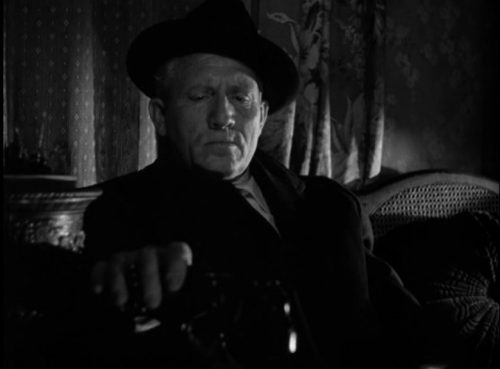
Henry Hathaway was a pioneer of the documentary noir approach in the post-war period, with The House on 92nd Street often cited as one of the, if not the, very first examples of this style of filmmaking. While I wouldn’t say I am a fan of the technique on all occasions, it can be powerful and effective when used well. Call Northside 777 is one such occasion, the measured pace and the confidence to allow the natural drama of the story sweep the viewer along is always in evidence. Hathaway was a genuinely great director, a man with a wonderful sense of cinema’s possibilities; he coaxed fine performances from actors time and again and had a way of drawing one into the stories he put up on the screen. The virtual absence of music outside of the credits and the ambient sounds of cheap bars, the assurance of his framing and shot selection, all combine to create suspense from something as mundane as a light flashing on a switchboard, or a needle flickering on a polygraph chart. His spatial awareness is superb too, surely no-one could have better communicated the cold despairing sterility of the prison complex than he did with that shot of endless blank cages opening out onto silent and empty gangways. Then in the latter stages, as the hunt moves to the seedy underbelly of the city, Joe MacDonald’s cinematography conjures fantastic visions of shadow-draped decay.

Without wishing to traipse over old ground yet again, there is such a richness to the screen work of James Stewart after he returned from service in WWII. Capra and It’s a Wonderful Life saw him burrowing into deep reserves and some of that comes through in Call Northside 777 too. Hitchcock and Mann got the very best out of him but Hathaway had him tap into some of his inner conflict as well, just not as far. The narrative requires a shift in his character’s position as the story plays out and it’s to his credit that this is achieved with a smoothness that feels wholly credible. Lee J Cobb could sometimes slip into “big” performances, which though enjoyable can be distracting too. However, he’s nicely restrained as the man whose quiet certainty keeps the investigation moving forward. There’s a playful aspect to his relationship with Stewart, highlighted by his tendency to bend the truth about his soft heart, and Stewart’s making sure he knows he won’t be taken in by it.

Richard Conte was another who was capable of brashness and showiness, but he keeps all of that carefully under wraps. His is a remarkably quiet performance, consistent with a man conditioned to keeping his head down and aware that taking the long view is the best way to survive. His one moment of breaking through that cautious front comes when Stewart has thoughtlessly jeopardized the cocoon of respectability he has painstakingly built around his former family, and even here his anger is contained and dignified.  Helen Walker has a simple role as Stewart’s wife, nothing demanding but she brings warmth to it. There are small parts for John McIntire and E G Marshall among others. I also want to mention the work of Kasia Orzazewski as Conte’s mother. It’s the kind of part where it would have been easy to allow an excess of sentiment to spill out. Yet the actress holds that in check, her pride and grit and sorrow are all apparent but they never overwhelm and consequently she touches the viewer’s heart every bit as much as she did that of Stewart’s skeptical reporter.
Call Northside 777 has long been available on DVD. To the best of my knowledge, the only version on Blu-ray is a German disc, which doesn’t sound as though it represents a major upgrade. Seeing as this is a Fox title , it’s hard to say if there is any possibility of further editions appearing. This is a movie I first saw back in my early teens. It gripped me at the time and the intervening years haven’t altered my opinion of it any. It is a fine picture and well worth a revisit.

The Man from Bitter Ridge

Treading well worn paths is a practice that tends to be looked on with a certain disdain with regard to any artistic endeavor, and with good reason. If familiarity does not necessarily have breed contempt, it can surely sap the enthusiasm and interest of the viewer. While that may be broadly true, it should also be acknowledged that watching movies is not an activity we indulge in for only one reason. As a rule, the better the film, the greater the challenge or stimulation offered, but that is not to say that  work providing the comfort and reassurance of the familiar has no worth. The Man from Bitter Ridge (1955) breaks no new ground, the situations and characters are all recognizable “types” that even casual western watchers will have seen on countless occasions. For all that though, it is the kind of movie that is hard to actively dislike.

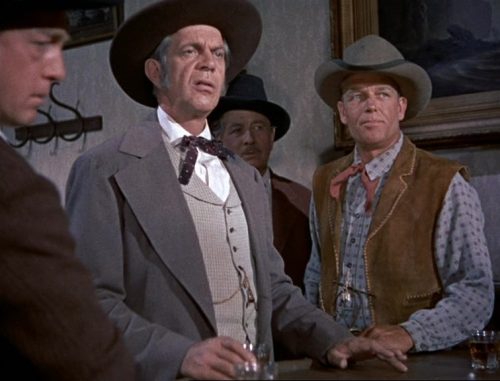
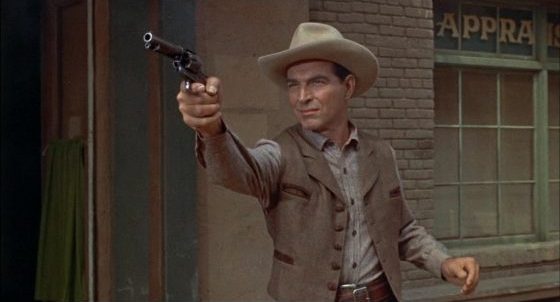
The story begins with something of a bang, namely the explosion that brings down a tree and blocks the trail of a stagecoach. The purpose is to facilitate a robbery, one carried out with precision and ruthlessness. A man ends up dead for noticing more than he ought to and the thieves make their escape. Perhaps it would be more accurate to say all but one of the thieves. A passing stranger suffers the misfortune of being held up by one of the fugitives who finds himself in need of a mount as his own horse has gone lame. This stranger is Jeff Carr (Lex Barker) and his ill-starred encounter means he almost winds up being lynched in error.  All of this happens in the first five minutes or so and a lot of plot detail is packed in here,  not least the fact the stage has been robbed by those working for Rance Jackman (John Dehner), local bigwig and candidate for sheriff in the upcoming election. To further complicate matters, the posse members who were so keen on stringing up Carr in a hurry are headed up by Jackman’s younger brother Linc (Warren Stevens). There’s probably enough story right there but the script is arguably overloaded as the idea of a corrupt man seeking ever greater power and influence is mixed in with a simmering feud between cattlemen and sheep herders, the latter group represented by Alec Black (Stephen McNally). Of course no yarn can be truly complete without some love interest, ideally involving conflict. That comes courtesy of a romantic triangle, the points of which are Carr, Black and Holly Kenton (Mara Corday), another of the sheep herders. As such, we have a decidedly tangled skein on our hands, although it is all unraveled (via brawls, gunfights, fire and fury) in a largely satisfactory manner by the time the credits roll about an hour and a quarter later.

Mention the name of Jack Arnold to movie fans and the chances are you’ll hear comments about such Sci-Fi classics such as It Came from Outer Space, The Incredible Shrinking Man or The Creature from the Black Lagoon. Nevertheless, as was the case with most directors of the time, he worked in a range of genres and turned out some fine pictures in all of them. Among his movies are a handful of westerns; Red Sundown and No Name on the Bullet are right out of the top drawer and are highly recommended. The Man from Bitter Ridge is, without question, a lesser effort. I prefer to look at a movie in terms of what it is and what it aims for as opposed to what it isn’t or doesn’t aspire to be. Still, there’s no denying that there’s not much depth to this one. I may be using the wrong label here, but I tend to think of films like this as matinee movies – straightforward, no-frills, unpretentious pictures that tell their stories in a pacy and entertaining way, no more and no less. Taken on those terms, it’s fine and does what it says on the tin. Another bonus is that “look” which is to be found in most Universal-International westerns, the visual aesthetic is appealing and (again) familiar, the very least one might expect from a cinematographer as talented as Russell Metty.

As for the performances, Lex Barker followed up his stint as Tarzan with a number of western roles and he would do further work in the genre when he later moved to Europe, especially in Germany. His role here is of a type – an undercover operative for the stagecoach company – that Randolph Scott played on more than one occasion. Of course Barker had previously been cast opposite Scott a couple of years before in the more interesting Thunder Over the Plains for André De Toth. He cuts a heroic figure and acquits himself just fine in the action scenes, of which there is no shortage, but he’s probably a bit too sunny and upbeat. Stephen McNally is his typically sharp self, assured and polished and enjoying his time as one of the good guys.

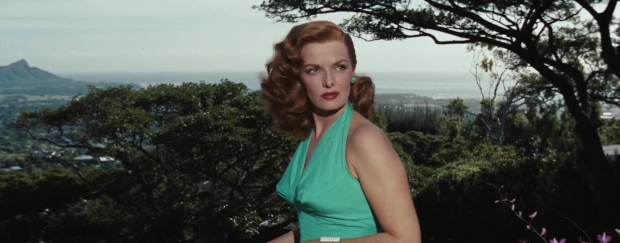
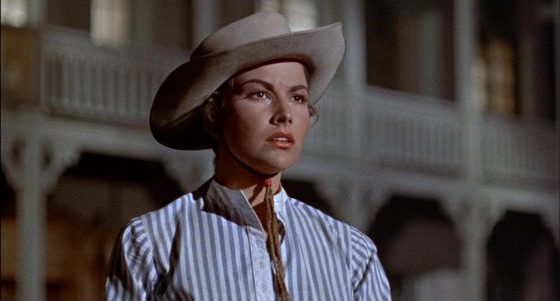
Mara Corday is an actress I am always happy to see and she is very appealing as the pistol-packing sheep farmer who finds her affections trapped betwixt and between McNally and Barker . She was in the middle of a run of generally good movies at this point, although I have to say she had a far more absorbing part in Joseph Pevney’s Foxfire that same year. With regard to villainy, it’s difficult to go far wrong when there is a solid lineup composed of John Dehner, Ray Teal, Myron Healey and Warren Stevens available. Their characters are all entirely one-dimensional, but most entertainingly so.

The Man from Bitter Ridge was released on a handsome DVD some time ago by Koch Media in Germany, but I think that may have drifted out of print now and it appears to have been replaced by a Blu-ray from the same company. The older disc looks pretty good, offering a colorful widescreen presentation of this brisk and undemanding western. I know Jack Arnold made better and more original movies and The Man From Bitter Ridge shouldn’t be seen as representative of his work in general, but it is a relaxing and mostly fun watch, and sometimes that’s good enough.

Cry of the Hunted

It could be argued that every story is at heart a tale of pursuit, a fictional quest where the prize sought might be material (money, treasure, etc) or spiritual (love, contentment, redemption, revenge, and so on), or the quarry might be of the classic, and slipperiest variety: a human being. For the viewer, the race to capture or recapture a fugitive always tends to raise the dramatic stakes, providing scope for shifting sympathies and asking questions about the role of, and indeed the relationship between the hunter and the hunted. Such should be the case with Cry of the Hunted (1953), where both parties involved in this particular game of hide and seek come to realize that their objectives might be different to what they had initially believed. Yet this is only partially fulfilled and the result of it all is that the movie ends up pulling some of its punches.

Speaking of pulling punches, there’s not much of that in the early stages, when Lieutenant Tunner (Barry Sullivan) tries to get convicted getaway driver Jory (Vittorio Gassman) to dish the dirt on his accomplices. The outcome is a bruising and punishing encounter, but one which makes it clear that both men, despite their entrenched positions on opposing sides of the law, have a grudging mutual respect. A traffic accident in downtown Los Angeles affords Jory the chance to escape, making use of the iconic Angels Flight in Bunker Hill, and he grabs his opportunity with both hands. The galled lawmen now have red faces to go with their grey suits and the only way to cool this situation is to arrange for the recapture of the prisoner as soon as possible. Jory is a man of the Bayou, the Louisiana marshland where the alligators aren’t the only threat, and it’s not hard to figure out he will be heading back there, back to his home and his wife. And so it is that Tunner is sent across the country to bring the fugitive back. He’s on top of things soon enough, almost laying Jory by the heels when he intercepts the freight train he is riding, and then tracks him to his shack in the swamps. A shade too much overconfidence is his undoing though, turning his back at the wrong moment leads to a concussion, a bellyful of filthy water, and a stay in hospital. All of this means the trail will need to be picked up once again, this time in the company of a colleague (William Conrad) who is keen to grab his job.

The entire setup here is most promising. The plot has a good deal of potential, the setting offers danger and atmosphere, and Joseph H Lewis as director always holds out the hope of some interesting visual flourishes. Lewis does get some value from the swampy surroundings, and the short sequence involving Sullivan’s fever dream (a shot from which can be seen above) is attractive even if it doesn’t actually add much to the story. However, for all that promise and potential, the finished movie falls a bit short. Now, it is never boring and Lewis keeps the pace up and the running time down, but the development of the plot is rather flat and predictable. Even a low budget effort such as The Ride Back (coincidentally, also featuring William Conrad in a prominent role) flips expectations to an extent by having hunter and hunted virtually changing places and gaining some personal insight as a result. In Cry of the Hunted, however, there is none of that.

Sullivan starts out as a well-meaning and conscientious guy with a hard edge and he never wavers or strays from that path, winding up in essentially the same place as he began. The part is a solid one, playing up the brash needling side of himself that Sullivan often showed and shoring it up with a strong core of decency and humanity. I haven’t seen a lot of Gassman’s work, which probably says much about my limited exposure to Italian cinema, but his character does get to undergo a touch more growth. I emphasize the fact that it is only a touch more though; there’s never really much doubt that his heart is in the right place or that he has it within him to come good. I reckon the writers missed a trick in the last act and should have had Sullivan laid up with an injury and needing to be saved by Gassman rather than the other way around. I seem to be on a bit of a William Conrad kick just now and he is good value as Sullivan’s subordinate and competitor. He seems to have been set to take on a meaner role (goading Gassman in the early stages, beating up a witness) but the script only leads him a short way down that particular path before allowing his better nature to take charge. Polly Bergen (Cape Fear, Escape from Fort Bravo) drifts in and out of the picture in a small role as Sullivan’s wife.

Cry of the Hunted is an MGM production, but it was not one of the studio’s top line pictures. It’s a small affair with some attractive location shooting and a tight, self-contained cast. Even second string movies from such a big studio have a fair bit of polish and it’s interesting to see MGM branching out into this more socially aware material, although it is nowhere near as challenging as it could have been when one takes into account the strong initial premise. I think it is fair to say it never really fires on all cylinders and it feels like a minor work from Lewis. Nevertheless, any opportunity to spend an hour and a quarter or thereabouts in the company of actors like Barry Sullivan and William Conrad is not something I would ever consider a chore. As for availability, it should be easy enough to locate seeing as the Warner Brothers Archive released a good-looking copy a few years ago. So, it’s definitely worth checking out and enjoyable enough as far as it goes, as long as it is approached with realistic expectations.

Conflict

Film noir meets Freud, presented as an inverted mystery. I suppose that just about sums up what viewers can reasonably expect to take away from Conflict (1945). It might also be helpful to keep in mind that this is a movie where plausibility is going to be stretched. In short, if you are the type of person who balks at the unashamed use of contrivance, who yearns for grit and realism, then this almost certainly is not the film for you. On the other hand, those looking for a relatively undemanding confection that plays around the periphery of film noir will probably enjoy themselves.

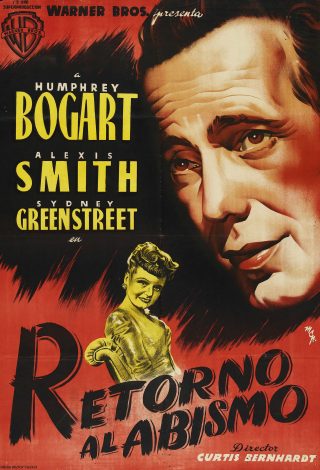
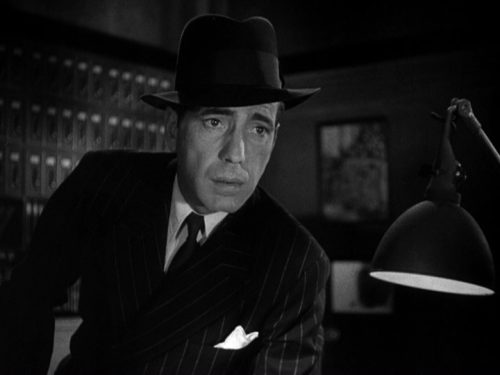
There is something quintessentially noir about rain. Perhaps it’s down to the heavy, brooding skies, swollen and sullen with the weight within, or that sense of some indefinable force lashing at us. Or maybe it’s just the way the cinematic version seems to smear and blur the lens, leaving our perception of characters and situations, and indeed the entire ethical universe laid out before us, a little unclear. Such is the case as the credits roll, just before the camera zeroes in on the finishing touches being added to a letter of invitation to Richard and Kathryn Mason (Humphrey Bogart and Rose Hobart). It’s from their friend Mark Hamilton (Sydney Greenstreet) on the occasion of their fifth wedding anniversary. Even if it’s a couple of years early, Richard Mason is already starting to feel that famed extramarital itch, in this case prompted by the presence of his wife’s younger sister Evelyn (Alexis Smith). This unsavory fact has just been hauled out in the open and so it’s with a certain sourness that the couple, and the unsuspecting sibling, head off for a night of food, drink and the kind of brittle civility that only the well-heeled and dissatisfied can carry off with aplomb. Well, having dined under a cloud of charmingly concealed bitterness, the drive back home is interrupted by an accident that segues into one of those sequences that has the protagonist’s thoughts and experiences reflected through the images and words of others, spinning as a vortex before the camera, drawing both him and us ever deeper.

On awakening, as the faces of doctor and nurse swim into view, we learn that Richard was the only one who suffered any significant injury. While recuperating from the broken leg that everybody believes has left him temporarily incapacitated, he hatches a plan to rid himself of his wife and leave himself free to pursue Evelyn. It’s no spoiler to point out that this is where the inverted mystery kicks in. We see Richard Mason go about the plotting of his wife’s demise and then get to see the gradual chipping away at his confidence, the doubts that circle and creep ever nearer till, finally, he can no longer be entirely sure how firm his grip on reality or sanity is. It is somehow fitting that he is drawn down into the darkness and despair of a literal and figurative abyss to confront his guilt and culpability before heading back towards the light, back to the fate he richly deserves.

Conflict is derived from a story entitled The Pentacle, co-written by Alfred Neumann and Robert Siodmak. Siodmak’s name is enough to catch my attention, although I suppose it was mainly the casting of Bogart that drew me to the movie when I first saw it some time back in the mid-1980s. As with most inverted mysteries, much of the enjoyment lies in seeing how the best laid plans can unravel, and the clue that first sets the hounds on Mason’s trail grows out of a delicious slice of hubris. Curtis Bernhardt would have a very strong run of melodramas and films noir from My Reputation right through to Payment on Demand, although I reckon Sirocco (also with Bogart) is a misfire. His direction here is impressive at times, with a few showy tracking shots to pulls the audience into the picture, and of course the set piece of the murder on the twisty and mist shrouded mountain pass.

It has been said that Bogart was not keen on the film and was actually reluctant to make it, but he gives a fairly solid performance for all that. He is good at getting across the abrasive and impatient aspects of his character, and the transition from cocksure killer to desperate paranoiac is well realized. The only point at which I felt he hammed it up and lost some credibility was the scene where he tries to emotionally browbeat Alexis Smith, and even there one could perhaps argue that the whole point was to highlight the driven creepiness of Mason. Alexis Smith seems a bit wasted in a role that asks her to do little more than wring her hands on cue and prevaricate, none of which is the fault of the actress herself. Conversely, Rose Hobart is given a juicier part with at least some wounded pride and suspicion to sustain her, but her screen time is necessarily limited. Sydney Greenstreet is never less than a joy to watch in anything and his sympathetic part as the avuncular doctor with a piercing, probing intelligence and a penchant for cultivating roses feels like a dry run for his later role on radio as Rex Stout’s Nero Wolfe – just remove the avuncular aspect and swap out the roses for orchids. Charles Drake would go on to do better things in the 1950s at Universal-International but his young suitor in Conflict never rises much above the level  of “aw shucks” guilelessness.

Conflict ought to be easy enough to track down for viewing, either from the Warner Archive or from various European labels. It isn’t the best example of Bogart’s work but he’s good enough in it and he is always watchable anyway. Sure the plot is contrived and the whole thing is loaded with the cod psychology which was popular at the time. However, for those happy to embrace these features and just go with the flow there is quite a lot of pleasure and entertainment to be had.

The Paradine Case

A Hitchcock film. This is a term which has become one of those key items of vocabulary common to all film fans. The director’s name is, I think it’s fair to say, universally recognized, which is no mean feat in itself when one remembers that he died over forty years ago and released his last feature a few years before that. In his lifetime and beyond the label “the master of suspense” was often applied, and it remains a fairly accurate descriptor. Is it a trifle restrictive though? Does it narrow the focus of his work too much? Perhaps. And perhaps it might be fairer, albeit admittedly lacking in poetry, zing, or just plain catchiness, to think of the Hitchcock film as a study of the moral dilemma. After all, his best works all present a range of ethical conundrums which both audiences and protagonists are tasked with navigating. While The Paradine Case (1947) is unlikely to figure in anyone’s list of best Hitchcock films, it does have some points of interest.

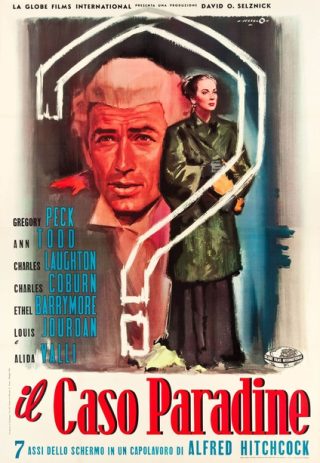
A beautiful young woman is accused of the murder of her blind husband and the barrister engaged to lead the defense becomes increasingly infatuated by her. That, in a nutshell, is the plot of The Paradine Case. By the time the film opens Colonel Paradine is dead. It feels somehow appropriate that a man who was unable to see, and whose life and death hold so much influence over the fate of the main characters, should himself remain unseen, save for the portrait which appears in the early scenes. As much as this is a Hitchcock film it is also a Selznick film and his presence hovers over proceedings just as the spirits of certain characters in his productions seemed to  haunt others. If this is a theme affecting a number of Selznick pictures, it is perhaps understandable as the man himself appears to have been haunted by earlier successes and was so often looking over his shoulder at those ghosts of his own past in an effort to reclaim them. Although it is a very different movie, there is something of the aura of Rebecca to be found, as if the tendrils of mist drifting and curling around the drive approaching Manderley continue to cling. Some of that comes from the familiarity of aspects of Franz Waxman’s score and the set of Mrs Paradine’s bedroom in the country retreat looking a lot like that of Rebecca’s. The past is never far from these characters lives, it may be frequently referred to obliquely but is always there in the shadows.

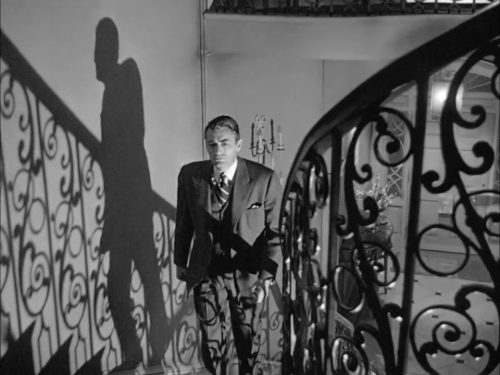
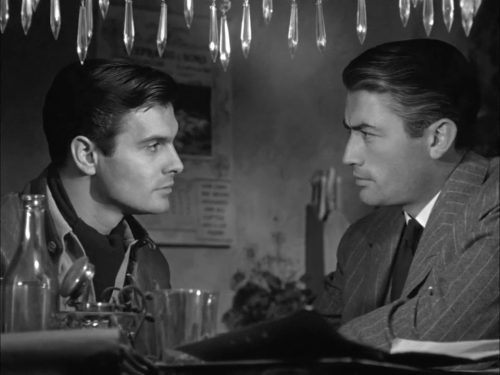
Whatever one may or may not think about the myriad theories propounded by critics, observers and biographers over the years regarding Hitchcock himself, there is no question that the characters peopling his tales of suspense and crisis are beset by their own obsessions. In The Paradine Case Anthony Keane (Gregory Peck) is instantly bewitched by the cool, enigmatic beauty of his client. From the very first meeting he is entranced, his gaze fixed and his heart effortlessly purloined, the course of the case, his career and his marriage will be indelibly marked by the experience. It is an extraordinarily unsympathetic role though; the man is pompous and a prig, so dazzled by Mrs Paradine (Alida Valli) that he is both oblivious of how appalling his behavior is and staggeringly insensitive to how hurtful it is. We the viewers can see it in the awkwardness of those around him, in the uncomfortable pauses, in the cringing displays of petulance. Yet Keane himself sees none of it, he has in essence become the second blind man in Mrs Paradine’s life, morally if not physically sightless and wholly unaware of the emotional devastation his actions are wreaking.

The entire picture is of course dominated by another “blind” figure, that of justice herself standing aloof atop the Old Bailey, remote and apart from the desperate passions being enacted in the chambers below. Is justice finally served at the end of it all? The viewer can decide that; for my part, I think perhaps only partially so as the verdict returned is clearly correct but the “rightness” of certain other consequences brought about both before and after this is moot. The murder that sets the whole train of events in motion is really a variation on Hitchcock’s MacGuffin, being of the utmost importance to the characters on screen but of lesser significance to the audience. We are naturally interested in seeing how it will resolve itself, but I’d argue the answer is never in serious doubt and the greater interest is inspired by the personal and ethical crisis which Keane experiences and the way it unfolds (or maybe unravels might be a more accurate term under the circumstances) in a packed courtroom. Peck was quite young at this point but he seems to be playing older with the greying hair and vaunted reputation indicating a man approaching, if not already in, middle age. There are references made by his wife (Ann Todd) to the way he has changed since his idealistic youth and just about every action is suggestive of someone having a mid-life crisis, someone seeing cages and bars all around, besotted by the unattainable Mrs Paradine and driven jealous to the point of mania by what he regards as a younger rival in the shape of Louis Jourdan’s intense valet.

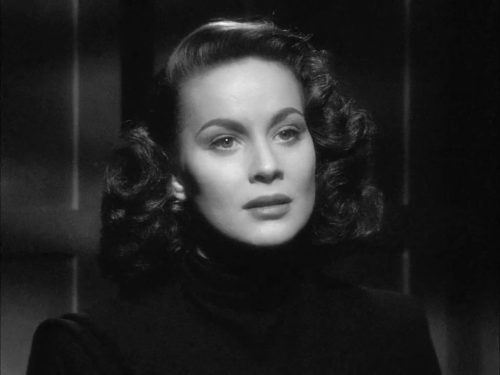
The eye of the storm throughout is Alida Valli’s unknowable widow. Her composure and control are remarkable and Lee  Garmes uses his characteristic skill to light and photograph her striking features in such a way as to heighten this aspect. This makes it very clear how she is able to cast a spell over every man she encounters, but it also has the effect of distancing her too much – by the end she has been characterized as saint, sinner and demon all rolled into one but I don’t think much of that conveys itself to the audience in any meaningful way. The impression created of her as representing all things to all men is so strong that none of it feels authentic. In combination with Peck’s unsympathetic lead, this has the effect of creating a hollow at the heart of the picture. When a movie trades heavily on the emotional tides pulling and driving its characters this way and that, it amounts to a serious flaw.

Both Ann Todd and Louis Jourdan fare better, the latter as the wife who is at first bemused and then later steely and determined as she realizes that she has a fight on her hands. Hers is one of the more genuine performances in the movie, her role being easy to understand and drawing sympathy precisely because it is clear she wouldn’t dream of asking for it. One could say it is a very “British” performance, deriving power and feeling from its restraint. Louis Jourdan, on the other hand, simmers with self-disgust. He is a mass of conflicting emotions in and out of the witness box, anger, indignation and shame all call to him simultaneously before eventually consuming him.

Charles Laughton was an actor who could practically eat a film alive, and came awfully close to doing so in Jamaica Inn, his previous collaboration with Hitchcock. The Paradine Case gave him a smaller part, but a juicy one nonetheless and his sardonic and spiteful  judge makes for an interesting comparison with the very different jurist he would essay for Billy Wilder a decade later in Witness for the Prosecution. Ethel Barrymore, playing his wife, turns in one of those fey, affected performances she was so adept at, clinging fearfully to the fraying threads of her own sanity. When she witters despairingly to her husband about how callous the years have made him it is hard not to imagine some foreshadowing of the path life has in store for Peck and Todd.  Also among the supporting cast are Charles Coburn and Joan Tetzel as Peck’s solicitor friend and his coolly perceptive daughter. Finally, there are small parts for Hitchcock regulars Leo G Carroll and John Williams.

I am of the opinion that there is no genuinely bad Hitchcock film between The Man Who Knew Too Much in 1934 and Torn Curtain in 1966, while there are a number of undoubted classics as well as a few masterpieces in there. Sure some of the others are weaker and less successful and I’ll admit there are one or two which I do not like all that much. The Paradine Case is one of those frustratingly weak efforts. It looks sumptuous, has a superb cast and a premise brimming with potential. Yet the finished product is less than the sum of its parts and proves disappointing overall, failing to engage as fully as one would hope. Personally, I believe the blame can be placed on the writing – and Selznick seems to have been responsible for much of this – where the courtroom scenes are lacking in sparkle and snap and the portrayal of the leads saps all sympathy. In the final analysis, while it is certainly worth watching and has its moments this is a mediocre film that, had circumstances been slightly different, might have been a great one.

Kings Go Forth

There are simple, straightforward war movies, there are also films which see their stories played out against a backdrop of war, and then there are what I can only describe as genre hybrids. Kings Go Forth (1958) is one of those hybrids; it is not a full on war movie, meaning the plot is not driven solely, or even principally, by the battle scenes or the military strategy, yet these aspects are not relegated to the merely incidental either. In brief, it is a movie dealing with personal and social conflicts, all presented within the wider framework of the latter stages of the Second World War.

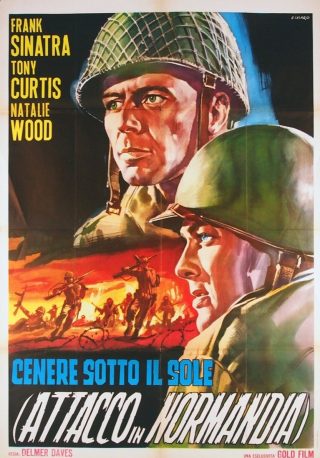
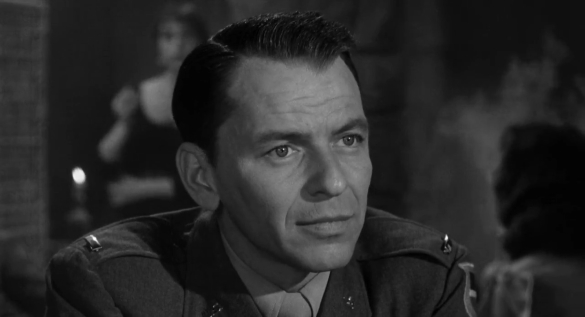
Not all wars are created equal, are they? While D-Day and the invasion of Northern France grabbed the headlines, and continues to garner attention, it is easy to forget that the drama and tragedy of WWII was also being played out in other theaters. Kings Go Forth unfolds in the south of the country where the US forces are in the process of trying to clear out the remaining pockets of Nazi resistance. Sam Loggins (Frank Sinatra) is a lieutenant in need of a new radio operator for his outfit. His voice-over narration in these early scenes make it clear that Britt Harris (Tony Curtis), the man who talks his way into the role, is a figure who will loom large in the subsequent events. He is brash and cocky, sure of himself yet essentially unknowable to others. Right from the beginning, Sam is aware that what is presented is largely a facade, an image offered up for public consumption with the goal of ensuring that what Britt wants, Britt gets. An apparently contradictory figure, he joined the army only as a last resort, having tried to bribe the draft board, but is not averse to indulging in showy heroics – dragging wounded men from a treacherous minefield, or braving machine gun fire to neutralize a pillbox. In short, as Sam himself noted at the outset, he is a man you notice. Well, it takes all kinds to make a world and the various peculiarities of character need not trouble anyone too much. Or that’s the way it seems for a time.

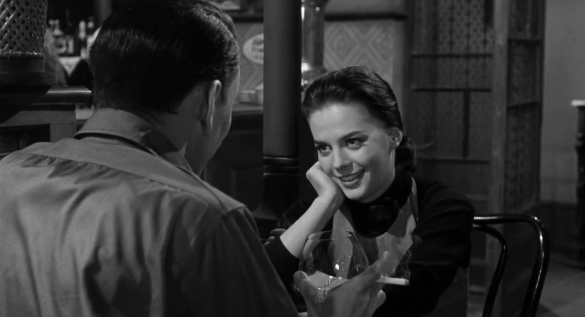
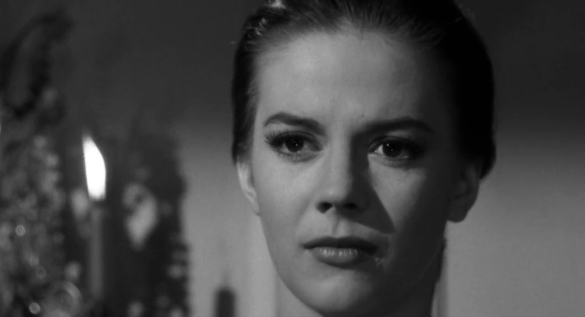
While these two central characters are shown  in sharp relief, the contrast only becomes an issue with the arrival on the scene of Monique (Natalie Wood). She was born an American, brought to Europe by her parents as a child, and is now practically a Frenchwoman. When Sam chances upon her during an impromptu leave he is smitten on the spot. He sees her again, and falls a little further, and all the while Monique remains half a step removed, charming and charmed yet cool. An evening in a cafe, where the wine and jazz form a potent cocktail has Britt meeting this pair, and so the final decisive point of the triangle is fixed in place. By the by, the reason for Monique’s reticence is revealed to be largely the product of her uncertainty of how Americans will react to her mixed race heritage. Sam is gradually accepting of this, having first forced himself to confront the prejudices he once entertained, but Monique finds herself dazzled by the glamor Britt seems to represent. In the end, the story boils down to a question of character and how it manifests itself. On an evening that promises death or glory deep in the enemy’s stronghold, truth emerges as the victor, but it is perhaps a bitter victory.

It has been some time since I last featured a movie from Delmer Daves. Over the years, I have developed a deep appreciation of this director and I count him among one of my favorites. His sympathetic handling of multifaceted and flawed characters caught up in situations which were correspondingly complex shows great maturity and I find his reluctance to sit in judgement enormously refreshing. Characters may be idealized by others within their world, but the viewer is presented with them as they are rather than as we might wish them to be. There is something soulful yet reassuring in the frank admission of imperfection and frailty; this is a filmmaker who not only understood but embraced humanity and sought to celebrate all its aspects. For me, such characteristics define the artist.

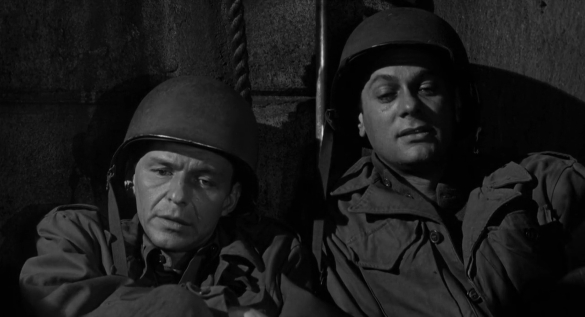
Kings Go Forth came in the middle of a particularly productive period in Frank Sinatra’s screen career. Some Came Running, The Joker is Wild and Pal Joey were all made in and around this time. It’s a fine performance, restrained, largely dialed down and frequently internalized. There is a good deal of pain in Sam Loggins, a hard-bitten personal diffidence riding side by side with a professional assurance, a tricky balance to achieve. I very much appreciate how the easy option of having the leading man simply do the right thing without thought was avoided, how he was made to look his own racial prejudices square in the face and acknowledge them for what they were. Perhaps we’re not talking redemption in the classical sense, but it is a matter of decency won after a hard battle, and the ending of the movie, in all its bittersweet melancholy and tantalizing optimism, is all the better for it. Nor is Natalie Wood asked to play any one-dimensional angel. Her hunger for acceptance draws her deep into a damaging and worthless relationship, blinding her to the artifice which is burrowing its way into her heart. It is an honest piece of work and, as with all forms of honesty, not always attractive. Tony Curtis is well cast too, coasting along on looks, style and polished patter, but never able to completely sell the lie to himself. As he sits in the clock tower with Sinatra, feeling the chill breath of fate creeping closer, his openness about his complete absence of character is very well realized – to watch him at this moment is to watch a man gazing deep within himself, and being appalled at the emptiness that he discovers. And finally, a word for Leora Dana, who is characteristically touching as Wood’s mother. If the only movies she had ever made were this one, 3:10 to Yuma and Some Came Running, then it would still constitute a fine career.

Kings Go Forth was an early release on DVD by MGM and looked good enough even though it was presented open-matte. There was a Blu-ray release by Twilight Time but I think that’s been out of print for some time now. However, there is a fine Blu-ray available in Germany, English-friendly, widescreen and generally very attractive. I freely admit that I am an unashamed fan of the work of Delmer Daves and I am well aware that this may color my view of his films. That said, I think Kings Go Forth is a terrific little movie and it comes highly recommended.

Southwest Passage

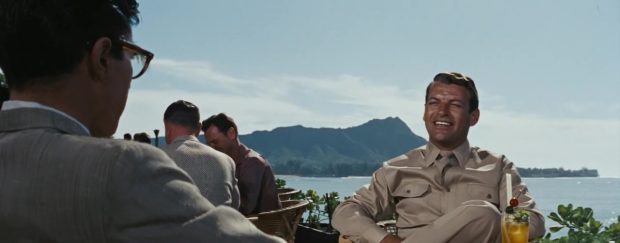
Southwest Passage (1954) is very much a product of its time. The end of the studio system and the growing competition from television saw Hollywood scrambling around to find some means of countering these threats. Promising greater spectacle and shooting movies in impressively wide ratios would eventually prove to be the most effective means of luring audiences back into the cinemas, but other approaches were tried out too. The 3-D process has always felt like a gimmick at heart to this viewer, and far too often saw filmmakers succumbing to the temptation to throw items at the camera to enhance the effect and elicit jumps from the bespectacled watchers. Southwest Passage has some of that self-consciousness on display, but goes a step further and presents a story with an unusual premise, namely the use of camels to forge a  new trail across the desert on the way to California and the west coast. This too gives the impression of writers casting round for as many hooks as possible to hang a fairly straightforward story on.

One thing this movie does not lack is pace and it gets off to a genuine flyer with a fired up and well armed posse hot on the heels of a trio of fugitive bank robbers. As horses and riders pound their away across the screen and across the wilderness, one of the pursuers pauses to take aim and loose off a speculative long-range shot. He finds the mark and one of the distant figures tumbles from the saddle. This unexpected casualty means a doctor is going to have to be located and, in brief, it provides the means by which the leader Clint McDonald (John Ireland) happens to bribe an alcoholic vet to hand over his identity and thus allow him to hide out as a member of an expedition heading west. It means he has to temporarily split up with his lover Lilly (Joanne Dru), but must needs and all that. The expedition this outlaw couple chance upon is no ordinary one; it’s being led by Edward Beale (Rod Cameron), a visionary type who has a theory that the hard desert crossing can be expedited by using camels rather than relying solely on mules and horses. As the party makes its way across the parched landscape the ever-present danger posed by the heat and lack of water is compounded by the tensions that bubble up within the group. This is partly down the need for McDonald to keep his true identity secret for as long as possible and also the fact Lilly is increasingly drawn to the selflessness and decency of Beale. To further complicate matters, a mean-spirited muleskinner (John Dehner) seems hell bent on stirring up trouble, while the Apache bands roaming the hills and rocks are just waiting for an opportunity to strike decisively.

The script by Harry Essex and Geoffrey Homes seems to be doggedly determined to dress up an essentially simple yarn of people rediscovering the path back to the straight and narrow via the hardships they endure in the course of a challenging trek. There’s a worthwhile parable in here about the way adversity can bring out the best in people, how even apparently lost souls can redeem themselves. In itself, that is enough to carry a picture and the cast is strong enough to make an audience care how or if this can be achieved. The added distraction of the camel expedition – and I’m firmly of the opinion that it is a distraction and nothing more – is wholly redundant and I have a hunch the writers realized this too as its impact on the development of the movie is slight in reality. Director Ray Nazarro was a journeyman, a competent professional who made (from what I have seen of his work anyway) entertaining but largely unremarkable pictures. Everything looks fine and he keeps it all humming along smoothly with a frequent smattering of action set pieces. These scenes are staged and shot well but, perhaps due to the faceless anonymity of the Apache warriors and their undefined motives, they do not deliver the level of tension I would have hoped for.

While he may not have had top billing, John Ireland’s character is by far the most interesting one on show. It is hinted early on that he isn’t merely a one-dimensional villain and the arc followed by this resourceful fugitive bears that out. By the end of the movie, you are rooting for him and want him to earn his salvation. Joanne Dru, his real life spouse at the time, not only looks good but she also makes for a feisty leading lady. She shoots at least as well as any of the men and doesn’t appear to have shied away from the more physically challenging aspects of the role. The way she plays that part and the gradual softening that occurs as the story progresses is key in coaxing Ireland back from the temptation of lawlessness and easy money.

If Dru was instrumental in facilitating or encouraging Ireland’s redemption, then Rod Cameron’s role could be said to have provided the motivation for rescuing her to begin with. Still, his is something of a thankless part, noble and steadfast and honest, but maybe he is too upright. Where Ireland’s conflicted robber and Dru’s disenchanted moll have nuance and shading, there’s none of that available to Cameron. He may be the lead and he may be the hero, and he plays both well and as written, but he winds up sidelined for all that. The real villain of the piece is played by the ever reliable John Dehner; sly, sleazy and spiteful, he wields a mean bullwhip and I only wish his role had been bigger still.

Southwest Passage is the type of movie which the producer seemed to throw everything bar the kitchen sink at, as though it was felt the core idea wasn’t strong enough. Personally, I take the opposite view and reckon that all the unnecessary embellishments detract from rather than enhance the finished product. All told, it is an entertaining way to pass an hour and a quarter but I do regret what I suspect was the lack of faith in the basic ingredients.

Whirlpool

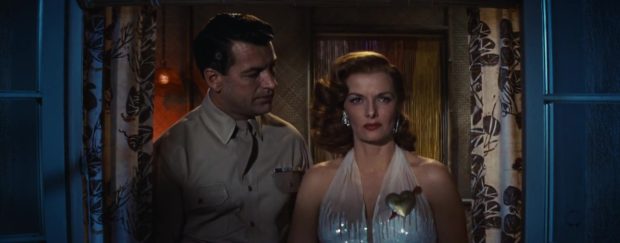
Whirlpool (1950) is another borderline film noir. It is  a stylishly shot crime movie with a cast whose credentials speak of a strong pedigree in the school of dark cinema, directed by Otto Preminger, who was certainly no stranger to noir. I suppose it might be seen as more of a whodunit (or should that actually be a “how did he do it”, given the seemingly unbreakable alibi involved) and it might not feature all the classic ingredients, but the strong emphasis on the psychological aspects of the story as well as its examination of matters relating to trust and manipulation nudge it in the direction of film noir.

It takes a thief. Well, the story opens with a thief taken, even if it looks as though psychoanalyst’s wife Ann Sutton (Gene Tierney) is too classy and polished to fit that particular bill. Nevertheless, that’s what she is, having been spotted, trailed and then approached by a store detective after walking out of a shop with an expensive piece of jewellery stashed away in her purse. Since she is not short of money, it becomes evident that she is a kleptomaniac, acting under the influence of some private compulsion. This fact is pointed out by a convenient witness to the embarrassing episode, one David Korvo (Jose Ferrer). While he may not be clad in shining armor he does have a smooth line in persuasive patter, more than enough to allow him to ride to the rescue of this felon in distress. One might have thought that a woman married to an eminent psychiatrist (Richard Conte) would be ideally placed to obtain the finest treatment, but no film noir would be complete without the presence of secrets someone wants to keep buried. Such is the case with Ann Sutton, whose success in suppressing traumas suffered in the past has left her with little appetite for shattering the illusion of the perfect wife she has carefully constructed around herself.  So what is Korvo’s motivation in all this? Despite his protestations that he’s no blackmailer, and his very public determination to display his innocence, his money is made via fortune telling and hypnosis. What becomes increasingly apparent is that this man is a master manipulator, and that Ann Sutton is about to become just one more cog in a devious and murderous scheme.

Otto Preminger had memorably worked with Gene Tierney on Laura and they would collaborate again on Where the Sidewalk Ends and, somewhat later, on Advise & Consent. Preminger was good at tales of damaged people and as he moved into the 1950s he was drawn to scripts that featured ever more complex individuals and circumstances. Ben Hecht’s adaptation of a Guy Endore novel is characteristically slick and the plot, while twisty, always moves smoothly. In noir terms, Preminger would do much more interesting things with the idea of the troubled and criminally inclined female in the superlative Angel Face a few years down the line. In a sense, Whirlpool feels like something of a throwback; as much a puzzle plot murder mystery as regular film noir, it combines a critique of quackery and charlatanism, which had waxed and waned in popularity from the early years of the twentieth century on, with that kind of slightly reverential take on Freudian psychoanalysis that was in fashion in the post-war period. The focus is on the well-heeled and leisured classes, people with good jobs, nice clothes and the time and money to indulge in some lightweight self-analysis. If the idea of admitting that all may not be as idyllic as the shiny new decade promised to a psychiatrist (even if that person happens to be one’s spouse) was something to be reserved for a different type of person,  consulting some flimflam artist like Korvo was acceptable. Perhaps it was a way of acknowledging the existence of post-war angst without having to take it too seriously.

Knowing how hard Gene Tierney had to struggle with mental health issues in real life gives the movie a bit of an edge. It adds poignancy to those moments where she is expressing dismay at her instability, a feeling that this is not merely a woman playing a part but someone who is in fact living it out. Richard Conte comes across rather stiff at times, which is probably the way his part was written – too much empathy too readily expressed at too early a stage would not have made sense given the reluctance of Tierney’s character to confide in him. Nevertheless, he does seem a little too controlled and reined in, particularly in the scenes where he’s confronting Ferrer’s smugness. On the other hand, it could be said that this contributes to an air of tension. The meeting between a recuperating Ferrer, taunting and needling even as he sweats in pain, and a deeply wounded Conte does have a palpable undercurrent of menace. Ferrer is well cast, unctuous and dissembling, adept at the kind of emotional larceny that easily outstrips Tierney’s petty pilfering.

The main supporting part is filled by Charles Bickford, someone whose name pops up here from time to time and whose presence in a movie I generally welcome. The weathered features and gruff manner suited a range of roles and his dogged but fair-minded police lieutenant in Whirlpool represents one of those times when he made the most of a relatively small part. The script has him cast as a recent widower, which is a nice touch that serves to round out and humanize what might otherwise have felt like a purely generic character. That moment when he wakes at night, stung by his conscience, and then glances briefly at the small framed photo of his late wife on the bedside table before making up his mind to go along with Conte’s hunch is true and simple, and it helps to ground the movie beautifully.

Whirlpool is an interesting movie, fanciful in its telling (is the kind of hypnosis depicted even possible?) yet authentic in its presentation. I guess almost everyone involved has done better work elsewhere, but none of them could be said to have been below par either. The Bfi Blu-ray from some years ago looks excellent to me and the film can be accessed easily on DVD or even online depending on one’s preference.


Somewhere in the Night

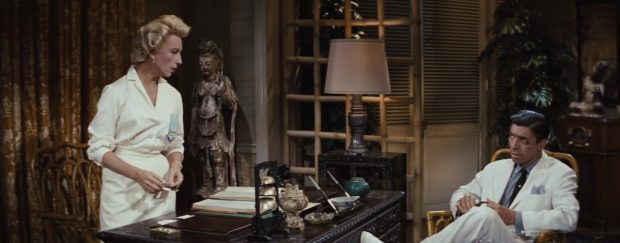
Somewhere in the Night (1946), that title alone is imbued with all the uncertainty and ambiguity that is such an essential ingredient of film noir. Add in the theme of amnesia and it’s tempting to imagine this movie might be the classic example of the form. Well, it doesn’t quite get there; the plot is twisty, the characters even more so and their motives are buried deep in a half-remembered past. Everything looks right, and at times sounds right too, but maybe there is too much going on, too many strands to follow with the result that the viewer is left to navigate the kind of fog our protagonist must battle his way through.

No time is wasted in the opening, a field hospital where all manner of wounds and injuries are being treated by stressed and weary medics. George Taylor (John Hodiak) is lying in bunk drifting in and out of a morphine induced haze, his jaw wired up and his memory wiped after a close encounter with a grenade. The fact is George Taylor isn’t even sure that’s his real name, the doctors call him that but he doesn’t really know, and he’s both puzzled and uneasy by the letter he finds among his belongings. It’s incomplete but there’s enough there to tell him it’s from a woman, one who is consumed with bitterness and recrimination, and all of it directed towards him. Well he eventually gets shipped back to the States and so begins his fumbling efforts to establish his identity, efforts which hint at large sums of money awaiting him, but few friends if any to guide him along. Conversely, the more he learns, the less he appears to know, and the more nonplussed he becomes. A letter from a guy called Larry Cravat tells him there’s cash in the bank in his name, but this only increases his suspicion. Who is Larry Cravat, and why does every question asked about him lead to further suspicion and violence? Taylor’s world is reduced to a stumbling quest through night clubs and slums, peopled by hoods and chiselers, where swank businessmen rub shoulders with dubious fortune-tellers and a convoluted trail involving Nazi loot and murder leads to a sinister sanatorium and a final showdown on the waterfront.

The films of Joseph L Mankiewicz have a tendency to be stylish but wordy, and I think that’s true of Somewhere in the Night. Norbert Brodine’s cinematography drapes the 20th Century Fox studio sets in very attractive shadows while Mankiewicz’s script (with uncredited contributions from Lee Strasberg and Somerset Maugham) and direction are characteristically polished. For all that though, the plot is packed tight and is of a density that hinders rather than helps. For every morsel of slick, hard-boiled idiom, there’s a side order of undercooked exposition to be dealt with. This kills the pace at vital moments, the complications unnecessary and the detours involved only sporadically interesting. While a predatory Margo Woode offers a masterclass in would-be sophisticated patter and burnished brass, her presence and interactions with a slippery and proudly amoral Fritz Kortner feel like they have blown in from a different movie.  In fact, the entire Nazi loot subplot has an air of pastiche to it, channeling elements of The Maltese Falcon to such an extent that by the time the confrontation in Kortner’s dingy flat rolls around I was half expecting Hodiak to lean over to Ms Woode and mutter: “Six, two and even they’re selling you out.”

I can’t help thinking tales of amnesia and 1940s movies seem to go hand in hand, a feeling that’s perhaps been heightened by the fact I watched another variation on this the other day in William Dieterle’s Love Letters. In that case, however, the loss of memory is suffered by Jennifer Jones’ traumatized heroine as opposed to Joseph Cotten’s returning veteran. Nevertheless, that tumultuous post-war world, where everything has been upended and all the old certainties swept aside, provides fertile ground for stories of recollections lost and the consequent pros and cons presented by the unknown and the uncharted. John Hodiak is a personable hero, getting across the self-doubt of his character, that need to learn more about the man he once was while also fearing what he may discover in the process.

Nancy Guild is fine as his Girl Friday, but her role is a touch bland and she makes only a limited impression compared to Margo Woode’s flashy turn.  Where Hodiak is necessarily cautious, Richard Conte is typically sharp and assured, rapping out his lines with a confidence that dares the world to challenge him. Lloyd Nolan is hugely enjoyable as the cop in the case, unflappable and unfazed by the deceptions and betrayals all around him, representing a beacon of sorts amid all the shifting currents. A word too for Josephine Hutchinson; hers is a small part and arguably not really essential in advancing the plot yet that one scene she has remains memorable. The movie makes a number of points about the effects of the war on those who have come back as different men to a radically changed society, but the effect on those who were left behind is no less important. That brief interlude which says so much about loss, loneliness and the hurt of missed opportunities is deeply touching, and Josephine Hutchinson’s sensitive and restrained work opposite Hodiak is quite wonderful.

Somewhere in the Night is a movie which has always felt like a bit of a companion piece for The Crooked Way. They do not tell the same story but there are definite points of similarity, enough to tie them together in this viewer’s mind at least. I think the latter is the more successful film due to its pared down nature and tighter focus overall. That said, Somewhere in the Night is entertaining, classy and has enough positives to offset its weaknesses. Perhaps it isn’t the quintessential film noir that the title alludes to, but it’s still a solid genre piece.

So, that brings me to the end of 2021. All that’s left to say is Happy New Year to all those who have spent time here. May 2022 bring only good things for all of us.

Red Canyon

Redemption – have I mentioned that concept before? Well, it would be practically impossible to maintain a site which has devoted so much space to the consideration of the classic Hollywood western for so many years and not do so. After all, that was one of the main drivers of the genre, the cornerstone on which everything else rests, and we cannot even approach the western in an intelligent way, let alone attempt to pin down its essence, until we acknowledge the primacy of this core ingredient. One of the more compelling attractions of the western is its multifarious nature, those layers and variations which are woven into the fabric of the genre. George Sherman’s Red Canyon (1949) offers yet another of those spins on the theme of redemption.

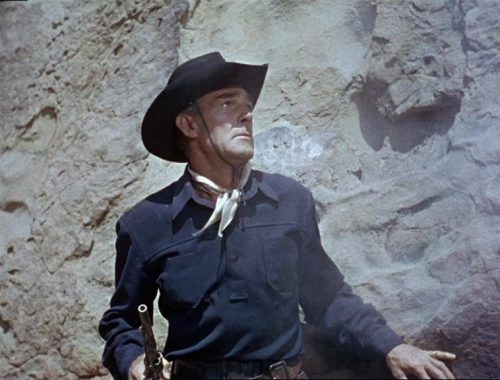
Many a movie has been built around the notion of the outlaw seeking to outrun his past deeds, the gunman grown weary of the endless challenges and the fame or notoriety which has come to be a curse. Yet what about a reputation foisted upon a man not through his own actions but second hand? What about the idea of guilt by association, or in this case as a result of one’s bloodline? This is the central theme of Red Canyon, the tale of a man looking to break loose from the shadows cast by his disreputable family. Such a task requires not only grit and resolve but money too for new beginnings come with a hefty price tag. To that end, Lin Sloan (Howard Duff) has determined to catch, break and race a famed wild stallion known as Black Velvet. This is the secondary thread running through the picture, the hunting and taming of this magnificent force of nature. And it is that quest which brings Sloan into contact with Lucy Bostel (Ann Blyth), the romantic angle which then develops forming the third plot strand and acting as a bridging device of sorts. That relationship starts out out in a lighthearted manner – Sloan’s arrogance results in Lucy temporarily losing face and losing her prized thoroughbred, while she seizes an unexpected opportunity to pass on some indignity by way of repayment – but folds into the main narrative when it deepens. It is complicated by the fact that Sloan’s family is responsible for the death of Lucy’s mother in a raid and her father (George Brent) has consequently sworn vengeance against the entire clan. A situation is thus set up whereby all the main players have no alternative but to defy their past histories, and one of them might perhaps earn that coveted redemption for his family name if nothing else.

Red Canyon ranges widely in tone, the lightness of the early scenes should by rights contrast sharply with the action of the finale and the deep-rooted schism which provokes it. It is a credit to George Sherman’s assured direction that all the tonal shifts which occur feel so smooth. Working from a Maurice Geraghty script which is an adaptation of a Zane Grey novel, Sherman seamlessly blends all the ingredients in this tale about breaking a horse and breaking with the past. Ultimately, Lin Sloan does redeem his family name by decisively cutting the bonds that have tethered him all his life. The movie celebrates the restoration of harmony and balance, in nature, relationships and in life itself. By reclaiming his identity, Sloan also ensures that the Bostels, both father and daughter, are freed from the shackles imposed by long held grudges. Of course the stallion is set free too, this symbol of unfettered nature has been instrumental in restoring the emotional equilibrium but it is patently clear that such a potent and primal force could only ever be tamed temporarily.

Howard Duff made a number of films with George Sherman and had a pretty good run in general up until the mid-1950s without ever breaking through to the very top rank of stars. He had that tough persona which made him a good fit for crime movies and westerns and Sherman gets good value from him in Red Canyon. An exuberant and vigorous Ann Blyth (who turned 93 earlier this year) plays off Duff’s ruggedness and deals credibly with both the romantic and more tomboyish aspects of her role. I guess she will be best remembered as Joan Crawford’s ungrateful daughter in Mildred Pierce but she did plenty of varied and interesting work well into the following decade.

As is the case with so many studio productions of the era, the supporting cast is positively crammed with talent and familiar faces. John McIntire gives one of his memorably mean performances as Duff’s no-good father while Denver Pyle and a rather vicious Lloyd Bridges are his siblings. George Brent, who is not an actor usually associated with westerns, is suitably stern and implacable as the head of the Bostel household. Among all the drama there is welcome comic relief provided by Jane Darwell, Chill Wills and the wonderful Edgar Buchanan as a delightfully self-aggrandizing windbag.

Red Canyon has had a Blu-ray release in Germany via Koch as part of a George Sherman collection also containing The Last of the Fast Guns and a DVD of River Lady. I still have to pick up a copy of that set but I should imagine it is a strong transfer as even standard definition copies of Red Canyon are hugely impressive with Irving Glassberg’s  stunning Technicolor cinematography looking terrific. Comparatively speaking, this movie will be regarded as a minor western. Sure there are bigger, bolder and unquestionably better films to be found in the genre, but it does have a great deal of charm and that attractive sensibility typically found in Sherman’s work.

While this might not be my final post of 2021, it will definitely be the last one to be published before Christmas is upon us. With that in mind, I want to take the opportunity to wish all the visitors here, both the regulars and those who have just come across the site, a merry and peaceful Christmas.