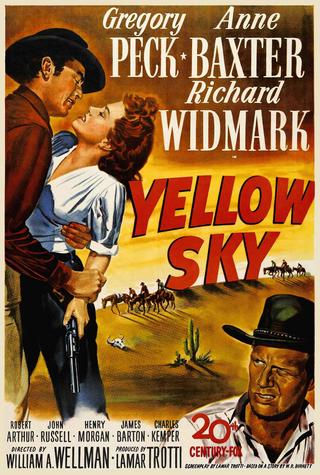
OK, so I’ve taken a break from this thing for a while now. I’ve generally found that I need to take a step back from time to time and allow myself a chance to recharge the batteries before starting anew. My last post was on a western, and my latest one is also another oater – for the sake of continuity if nothing else. Yellow Sky (1948) is a typically stylish William Wellman movie that trades on those perennial themes of greed and honor.
The film opens with a bank raid in a small town and concludes, with a quirky twist, in that same town. However, the robbery plays only a small part in the story; it’s the events that it leads to that form the core of the movie. Stretch Dawson (Gregory Peck) is the laconic leader of a band of outlaws who think they’ve just made an easy killing. While their initial getaway appears to have been clean there is a troop of soldiers on their trail, and the outlaw gang find themselves forced onto a barren and punishing expanse of salt flats in an effort to elude capture. From this early stage the first cracks appear in the group. Stretch is the acknowledged boss but his authority begins to be challenged by Lengthy (John Russell) and especially by Dude (Richard Widmark). As these men haul themselves painfully across the hellish landscape they are driven to the very limits of human endurance. Just as they are about to succumb to the effects of exhaustion and dehydration they stumble into the abandoned former mining town of Yellow Sky, and this is the point at which the story becomes most interesting. The old ghost town is not all it seems – for one thing it’s not strictly a ghost town at all. There are two inhabitants, an old half-crazed prospector and his daughter ‘Mike’ (Anne Baxter). Even in their weakened state the outlaws are not so dumb as to believe these two are living there for the good of their health. Putting two and two together, they decide that there’s only one reason anyone would choose to live in a dead town – gold. What remains to be seen is how far each individual is prepared to go in order to satisfy his craving for riches, and whether or not the notion of honour among thieves has any basis in truth. Like all the best westerns, it raises questions about one’s word of honour and, in this case, if that has any value for those who live outside the law.

William Wellman’s direction offers a lesson in style, utilizing close-ups, long shots, deep focus, shadows and high contrast. There’s also an especially notable shot down the smoothly rifled barrel of a gun (see pic. above) which foreshadows the famous 007 pre-credits sequences. I’d also like to mention the climactic shootout between Peck, Widmark and Russell that takes place in the gloomy ruins of the town saloon – all the gunplay is unseen by the audience with only the bloody aftermath revealed. The location photography is another positive feature, with the inhospitable Death Valley occupying the first half before the action moves to Lone Pine for the scenes around the titular town. When looking at the characters, the first thing that jumps out is that every single one is known only by a nickname from beginning to end – the sole exceptions being Peck and Baxter, whose full names are revealed to the viewer. Peck handled his leading role competently as the reluctant hero who eventually finds a kind of redemption. John Russell and Richard Widmark make for a worthy couple of adversaries, the former consumed by pure animal lust and the latter with a hunger for wealth and the power to visit retribution on those he feels have slighted him in the past. Widmark in particular is the epitome of villainy, still at that stage in his career when he tended to get typecast as nasty pieces of work for the hero to vanquish. Anne Baxter’s role called for her to be a kind of self-sufficient tomboy who still remains sexually provocative. To her credit, she managed this balancing act and emerged as a fully rounded character that you can believe in. Throughout the film she proves herself the equal of the male cast members and her only concession to the traditional image of femininity comes at the very end when she dons a frivolous little hat that Stretch has brought her as a gift.
The R1 DVD from Fox presents Yellow Sky in a handsome full frame transfer that’s clean and sharp for the most part. Extras on the disc consist of galleries of advertising material and a selection of trailers. The film itself is absorbing and well paced and it was only at the end that I realized how little violence is present, and how even that takes place off screen. This is one of those late-40s westerns that helped usher in the more complex works that dominated the following decade. Recommended.








 Riding the High Country