Ten of the Best – Women of the West

Over a decade ago (it really doesn’t seem that long… ) I posted a list of western actors. I followed that up with a post on western directors, film noir directors, and film noir stars. The latter included a mix of male and female stars and it has long been my intention to put up a list that would balance that first entry by turning the spotlight on the women who made significant contributions to the western. I’m not sure why I’ve left it so long, I guess other things just kept getting in the way and it got shunted off for another day. There are those who would say the western is an inherently masculine genre, but I don’t feel that’s a fair or just assessment. The western was and remains one of the greatest of all cinema genres precisely because it was so malleable, was so dependent on absorbing myriad influences, and drew highly creditable work from such a wide range of personnel. So, let’s cut to the chase and have a look at ten actresses who added immeasurably to my my enjoyment of my favorite genre.

Felicia Farr
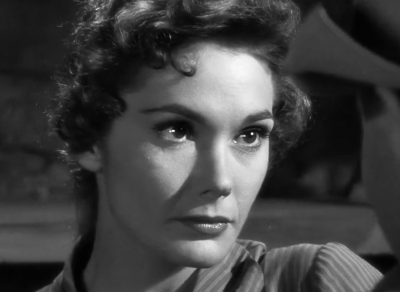
I can’t imagine opening this list with anyone else. Felicia Farr’s part in 3:10 to Yuma is comparatively small yet it’s a pivotal one. Those short scenes she shares with Glenn Ford’s outlaw are memorable and powerfully touching, adding another layer of yearning and regret to an already poignant movie. Director Delmer Daves also used Farr in two other fine westerns, The Last Wagon and Jubal, while George Sherman cast her to good effect in Hell Bent for Leather and Reprisal.

Virginia Mayo
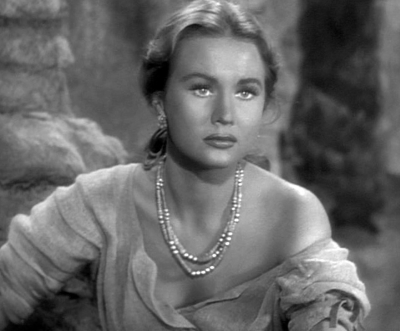
Making her western debut in Colorado Territory, Raoul Walsh’s remake of his own High Sierra, Mayo impressed herself on the genre right away. I won’t go into spoilers here for those who haven’t seen it but the climax of that film is as tragic as it is poetic, and Mayo’s actions give it its power. Walsh would cast her again in the underrated Along the Great Divide while she had other good parts in The Proud Ones, Great Day in the Morning and  Fort Dobbs to name just a few.

Dorothy Malone
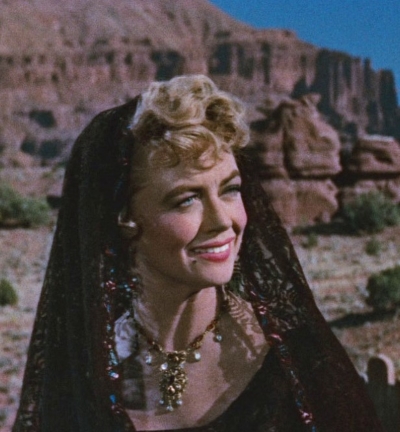
While Virginia Mayo was the passionate, beating heart of Colorado Territory, her rival for the affections of Joel McCrea’s doomed outlaw was a coquettish and calculating Dorothy Malone. She would take on some terrific roles throughout the 50s, including some very respectable films noir as well as a couple of plum parts for Douglas Sirk – the superlative The Tarnished Angels and an Oscar winning performance in Written on the Wind – and of course plenty of westerns. Among the highlights are At Gunpoint (why has this movie never had a decent release anywhere?), Pillars of the Sky, Quantez, The Last Sunset and Warlock.

Barbara Stanwyck

One of cinema’s great actresses, Stanwyck made  couple of westerns in the 1930s and 1940s (Annie Oakley, Union Pacific and California) but it was in the 50s that she made her mark on the genre, and fell in love with it in the process. Starting off with the emotionally charged and wondrously melodramatic The Furies for Anthony Mann, she would regularly return to the west. Some of those films were only partially successful, but a movie like The Violent Men has much to recommend it and Samuel Fuller’s Forty Guns is an enduring classic in my opinion.

Vera Miles

Anyone who worked with John Ford, and was cast in major roles in his films has to be worthy of consideration here. Vera Miles had started out in the genre with a part in The Charge at Feather River and in Jacques Tourneur’s Wichita. These are fine movies by any standard yet a top role in The Searchers, which is arguably the best western of all time, and one of the best films of any kind, lifted her into a different league. The fact Ford cast her again in The Man Who Shot Liberty Valance, one of the key films marking the close of the classic western era cements her place for me.

Maureen O’Hara

The Ford connection is strong with the next entry on the list, even if their western collaboration was limited. The fiery Irish redhead had already made Comanche Territory when Ford used her opposite John Wayne in Rio Grande, unfairly regarded by some as the least of the director’s Cavalry Trilogy. She would work memorably with Ford and Wayne again in other genres and went on to make good westerns such as War Arrow (George Sherman) and The Deadly Companions (Sam Peckinpah’s debut feature).

Claire Trevor

Sticking with Ford (and indeed Wayne) for the present, we now come to Claire Trevor. It’s hardly too much to say that Stagecoach was instrumental in boosting the status of the western, lifting it firmly and decisively into the A class where it would continue to hold a dominant position for the next quarter of a century. Trevor’s turn as Dallas, the “fallen woman” driven out of polite society only to find love, respect and a future with Wayne’s Ringo Kid, is a superb piece of work. Perhaps her subsequent westerns didn’t offer the same scope for her abilities – Texas, Dark Command (Raoul Walsh), The Desperadoes, The Stranger Wore a Gun – but she was a regular visitor to the cinematic west, and that ride on the Lordsburg stage counts for a lot.

Katy Jurado

The Mexican actress with maybe the most soulful pair of eyes in the business. The wistful look she bestows on Gary Cooper as he stands alone in an empty street in High Noon is as good a way to announce one’s arrival in the genre as I can think of. She brought her unique quality to such movies as Broken Lance, Man from Del Rio and The Badlanders throughout the 1950s. Her appearances in westerns tailed off after that, One-Eyed Jacks with Brando in the next decade and then a small but hugely affecting part in Sam Peckinpah’s Pat Garrett and Billy the Kid.

Julie Adams

Anyone familiar with my writing over the years will be aware of how much I enjoy the output of Universal-International, and the westerns that studio produced are among my favorites. Sometimes it feels as though it’s impossible to watch a U-I western and not see her. Budd Boetticher frequently used her in his movies for the studio – Wings of the Hawk, Horizons West, The Man from the Alamo – and she had good roles for Anthony Mann in Bend of the River and Raoul Walsh in The Lawless Breed and then later on in Joseph M Newman’s The Gunfight at Dodge City.

Debra Paget

Starting out with some small roles in notable films noir (House of Strangers, Cry of the City), Paget struck western gold in the influential Broken Arrow for Delmer Daves. In a sense, one could say she became typecast in westerns, finding herself playing yet again a Native American in White Feather (scripted by Daves) and the powerful and visceral The Last Hunt for Richard Brooks. Typecast or not, she brought a great deal of dignity to those parts and the western genre would be poorer without her performances.

So there it is, my list of ten actresses who have enriched the western over the years. I had to indulge in a bit of ruthless trimming to keep it down to ten, but that’s to be expected and I also anticipate that my picks aren’t going to satisfy everyone. Well, that’s the nature of lists and half the fun is hearing others point out who they would have included instead. Feel free to disagree in the comments section below.
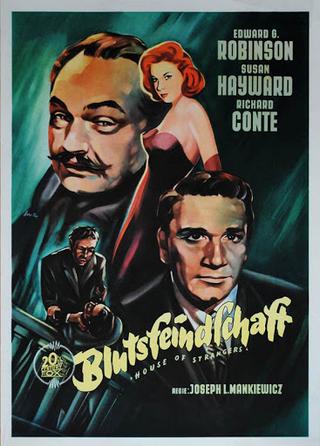
House of Strangers

Back in 2015 I looked at Broken Lance, a superior western and a remake of an earlier movie. I remarked at the time that I preferred the later version of the story and that’s still the case. Nevertheless, House of Strangers (1949), the original adaptation of Jerome Weidman’s novel, is an excellent piece of work when viewed in its own right. All versions and adaptations of stories bring something different to the table: the sensibilities of the filmmakers involved, themes added or removed, highlighted or suppressed. Where Broken Lance broadened and extended the scope of the material, House of Strangers retains a tighter focus overall.

A crowded sidewalk, bustling and bursting with life, and amid it all the eye is drawn to one solitary figure making his way through the vibrant mass, a detached and determined figure. He pauses before the imposing facade of a bank, the guard inside eyeing him fishily through the polished plate glass. This is Max Monetti (Richard Conte), once a sharp and arrogant lawyer but now just another ex-con. Actually, he’s a bit more than that; the bank was once the domain of his late father Gino Monetti (Edward G Robinson) before it was taken over by three of his sons, and before Max spent seven years as a guest of the state for jury tampering. Some of the brashness is still there though, and it’s enough to worry his siblings. It’s here that the lengthy flashback which occupies most the running time kicks in, showing how a family turned upon itself and slowly disintegrated, how rivalry and dissatisfaction became the seeds of hatred, how an old woman’s heart was broken and how a once grand home was transformed into a mausoleum to pernicious pride.

As in the image above, the past is forever peering over the shoulders of the characters. And it’s not just the malign spirit of Gino Monetti haunting his sons and poisoning their hearts, for even the old man in life was haunted by the specter of penury and subservience. The whole movie concerns itself with characters racing to keep a step ahead of their past, be it the stifling “old world” traditions that Gino professes to be desperate to throw off while apparently reveling in their trappings or another generation’s desire to be free of the too firm hold of an overcritical patriarch. Underpinning all of this is the concept of revenge or retribution, and the corrosive effect it has for all who drink from that particular cup.

I opened by speaking of a narrower focus, and I feel House of Strangers actively seeks to present a sense of restrictiveness. Instead of showing family as a symbol of fertility, it offers up a view of a stagnant and suffocating household, and I think it’s no coincidence that much of the action is rooted in the Monetti house and the old bank. Both structures have an old-fashioned ambience, a workplace where the sons are kept firmly in place – literally caged in the case of the elder brother Joe (Luther Adler) – and with limited options, and a home that is almost overpowering in the sheer weight and oppressiveness of its decor. The contrast with the light, spacious and airy apartment of Irene Bennett (Susan Hayward), the one person in the movie with an outward-looking perspective, and the one who represents the chance for a clean break with the past and new start on the west coast, is marked and unmistakable.

Susan Hayward’s presence adds much to this movie. Her drive, allure, and most of all her infectious self-confidence represent the best hope of salvation for Richard Conte’s Max. The frank and witty dialogue those two trade is a highlight, giving an edge to their passion and, in Conte’s case, allowing his character to become much more rounded. Joseph L Mankiewicz, who apparently had an uncredited hand in the writing alongside Philip Yordan, was noted for the use of sophisticated dialogue and it’s a real boon in this picture. The visuals and themes are well handled and well realized, but the smartness of the script gives everything extra vigor.

Richard Conte could always be relied on when you needed someone tough and streetwise, and he starts out incredibly sure of himself, unpleasantly so in fact. It’s largely through his interaction with Hayward though that he unbends gradually, looking out instead of in, realizing what to embrace and what to reject. Edward G Robinson plays a man it’s hard to like – even in his more expansive and beneficent moods there’s a shade of self-importance about him. As the story progresses, this latter quality develops, eventually running to bitterness and, ultimately, spite and vindictiveness. With a trio such as Robinson, Hayward and Conte headlining, there’s not a lot of space left for others to make their mark. That said, Luther Adler is subtly impressive, enduring the pettiness and humiliations as he broods and nurtures a deep resentment. In support Paul Valentine and Efrem Zimbalist Jr are the other two browbeaten offspring, while the imposing Hope Emerson seems an unlikely mother to the diminutive Debra Paget.

House of Strangers was released on DVD years ago as part of the Fox Film Noir line and the image is pleasing if not perfect, with a few trailers and a commentary track by Foster Hirsch as supplements. All told, this is the kind of highly polished picture one would expect from 20th Century Fox and Joseph L Mankiewicz. The shift to a western setting allowed Broken Lance to successfully explore other ideas and make it a more satisfying experience. However, I like to examine every movie on its own merits and I feel House of Strangers deserves to be praised for what it is rather than disparaged for what it isn’t.

The Indian Fighter

poster322

Films like Broken Arrow and Devil’s Doorway broke new ground for the western by offering up portrayals of Indians which were more three-dimensional than had traditionally been the case. Andre de Toth’s The Indian Fighter (1955) treads a similarly sympathetic path, showing the Sioux in a generally positive light. Few of the white characters are shown to be particularly admirable, even the nominal hero is not without his faults, succumbing easily to prejudice and greed. In addition, the film has a pro-ecology subtext that’s blended into the story in a way that’s refreshing and unobtrusive. This is not as powerful a film as the examples by Delmer Daves and Anthony Mann which I mentioned, yet it still manages to get its message across without resorting to the po-faced piety of more recent revisionist pieces.

Johnny Hawks (Kirk Douglas) is the Indian fighter of the title, an army scout recently returned to the west after the Civil War. He’s been sent along to guide a wagon train bound for Oregon through potentially hostile country. Before he ever reaches his posting though, he’s distracted by two events that are to shape the story that follows. The first is a sighting of Onahti (Elsa Martinelli), the beautiful daughter of Sioux chief Red Cloud, bathing naked in a river. The second is when he stumbles upon a botched deal between two white men, Todd and Chivington (Walter Matthau and Lon Chaney Jr), and a Sioux warrior exchanging whisky for gold. Both of these occurrences illustrate Hawks’ inherent sympathy for his old enemies. The former, naturally enough, arousing his romantic instincts, while the latter emphasises his willingness to side with the Sioux when confronted with the exploitative behaviour of his fellow whites. What draws Hawks to the Sioux is the respect he shares with them for the land which they occupy. Red Cloud’s principal objection to white men on his land is based on his belief that their greed for the gold it contains will wreak environmental havoc on the unspoiled paradise. Although Hawks doesn’t voice such fears specifically, there’s a telling moment later on when he confides in a photographer that the reason he doesn’t share his evangelical zeal to publicize the beauty of the frontier is his knowledge that attracting more settlers, and the trappings of civilization that they will inevitably bring in their wake, will spell the end of the west he loves. Even so, Hawks agrees to guide the wagon train through Sioux territory. However, the presence of Todd and Chivington among the settlers soon leads to trouble and puts the lives of everyone in jeopardy. While Hawks’ desire for Onahti drives him to neglect his duty, the equally strong desire of Todd and Chivington for the yellow metal sparks off a Sioux uprising. Faced with suspicion and hostility from both sides, Hawks is desperate to find some way of averting an impending massacre, and the terrible consequences it will have for the Sioux.

£41

By the time he made The Indian Fighter, Andre de Toth had a string of westerns behind him (half a dozen starring Randolph Scott), and he’d developed into a highly competent genre director. He used the wide cinemascope lens to highlight the natural beauty of the Oregon landscapes where the picture was shot. These stunning images make it very easy to see why both Hawks and the Sioux want to do all in their power to preserve the land. The rich visuals are probably the biggest selling point for this picture, but de Toth was no slouch when it came to filming action scenes and his talent in this area is shown to great effect in the climactic Sioux attack on the besieged fort. Not only are the tactics employed innovative and surprising, but the way it’s shot gets across the excitement and danger too. Many of de Toth’s films display a matter of fact approach to physical violence and this one is no exception. Early on, we get to see two victims of Sioux justice strung up by the heels, though the camera mercifully avoids zooming in to focus on the exact nature of their demise. Then later, as the body of a cavalry officer is removed from the mount he’s been strapped to, his hat drops away to reveal the gory aftermath of his scalping.

The Indian Fighter came from Kirk Douglas’ own production company and, as was the case with Man Without a Star, he tends to overindulge himself a little. Generally though, Douglas manages to keep his vigor and enthusiasm within acceptable bounds this time. That is to say, he plays the role of Johnny Hawks with the level of energy that’s not unreasonable for the character. The outdoors nature of the shoot, and the degree of action involved, offered ample opportunity for him to show off his physical powers, which is just as well since Ben Hecht’s script never puts serious demands on his acting abilities. In the role of Onahti, Elsa Martinelli hasn’t a great deal to do beyond looking attractive, and she accomplishes that without too much effort; her introductory swimming scene is one of the more memorable openings for a western. Walter Matthau and Lon Chaney Jr are moderately effective as the heavies, the former faring best, but never pose any direct threat to the hero. The nature of this pair’s villainy comes from the repercussions of their actions rather than the actual menace they generate. Matthau is now best known for his comedic roles but he did make a handful of westerns at the beginning of his film career. He uses that calculating, scheming quality which came so naturally to him, and which he built up in subsequent years, to compensate for the absence of any real physical threat. Chaney’s career, on the other hand, was in decline by this time, and the truth is he cuts a rather shambling figure.

The Indian Fighter is widely available on DVD from MGM. I have the UK release, which I understand is a step up in terms of picture quality from the lacklustre US version. Although the disc offers nothing in terms of extra features, the image is quite pleasing. The anamorphic scope transfer is acceptably sharp, without noticeable damage, and represents the colours very nicely. A film that relies as heavily on its scenic views as this one does needs to look good, and I have no complaints about the presentation. Generally, this is a good and well-intentioned movie, although the villains are a little weak. Having said that, the action and the cinematography make up for such deficiencies. It’s interesting to note that with the exception of Douglas’ skittish lead and the thoughtful cavalry commander, the whites are portrayed as either grasping, prejudiced or duplicitous. The only truly honourable figures are the environmentally aware Sioux. which gives the movie a strangely contemporary feel. I liked it.


The River’s Edge

Some movies are especially difficult to define or categorize. Allan Dwan’s The River’s Edge (1957) is certainly such a film; it’s a blend of modern western, noirish thriller, and lush and lusty 50s melodrama. While it’s possible to argue over which one of those labels comes closest to summing it up, it’s clear enough that this is a B movie which was given the glossy treatment. As such, this is an impressive piece of budget film production, dealing with those classic themes of money, greed, jealousy, love, and there’s a level of casual brutality not usually found in films of the period.

The story concerns three people: Ben Cameron (Anthony Quinn), his new wife Meg (Debra Paget), and Meg’s former lover Nardo Denning (Ray Milland). Right away we can see that Cameron’s relationship with his wife is not all it should be; she’s tottering around his ramshackle ranch house in high heeled slippers, struggling with the lack of modern conveniences, while he’s struggling with steers outside. The thing is Meg is a city girl, actually she’s con artist on the lam, while Cameron is a salt of the earth type whose greatest ambition is to make something out of his fledgling ranch. These two have hooked up together and are trying to make a go of it, but it’s starting to come unravelled. At the critical moment, who should turn up at Cameron’s door but his wife’s old flame Denning, apparently looking to hire a guide to take him on a hunting trip into Mexico. Meg takes off with Denning, at least as far as the nearest motel, and it’s unclear at this point whether she truly means to leave her husband for good. At any rate, she never gets to fully decide as a car ride results in Denning killing a border patrol man in a fairly shocking manner. With Meg now implicated in the crime, and with the knowledge that Denning is carrying a suitcase stuffed full of cash, Cameron has a change of heart and decides that he’ll take the two former partners over the border to safety. The rest of the film charts the shifting nature of the characters’ relationships and motives. At the begining none of them act out of anything but naked self interest: Denning just wants an out and doesn’t especially care who he has to buy or kill to achieve it, Meg wants to escape from the drudgery and dullness of the remote ranch, and Cameron has his hungry eyes on the cash. Everything is complicated by the fact that both men are still love with Meg, and she has no qualms about playing one off against the other and flitting back and forth between them. The real turning point, for her character at least, comes after she gets a serious infection from a cut arm. When Cameron hacks away the poisoned flesh in a storm ravaged cave it’s as though some of the poison also drains away from Meg’s heart. From then on, the positions are clearly defined and the only question remaining is who will survive the hazards of the wilderness and walk away with the money.

In the latter years of a very long career Allan Dwan specialised in churning out slick little B movies on a budget, and The River’s Edge is a good example of this work. He packs a whole lot of story into less than 90 minutes and makes it all look a good deal more expensive than it has any right to. The combination of location shooting and studio sets blends together well and the use of colour is stunning in places. He also displays what might be termed a more modern approach to violence and death than was normally the case at the time; the three killings which take place, although not graphic in the current sense, occur with an abruptness that retain the ability to shock. The three leads are very professional and do their level best to lift the movie above its pulp roots. Ray Milland was of course in his twilight years as a leading man but just about pulls it off, his charming sadist who may yet have a small grain of decency buried deep is effective enough to distract you from the fact that he was probably too old for the part. Debra Paget (with a flaming red hairdo) is a fine femme fatale who’s by turns calculating, ruthless and affectionate. Her character arguably goes through the greatest arc of the three, and she handles the move from a scheming bitch to a woman who’s regained some sense of honour quite capably. Anthony Quinn starts off as a basically weak loser who can’t even summon up the will to hang onto his woman, but by the end he comes good and redeems himself somewhat. I say somewhat because there’s still an element of doubt and a shadow of greed hanging over him.

The River’s Edge came out on DVD in the US a few years ago from Fox in a very attractive edition. The transfer is anamorphic scope and the print used is very clean and colourful. The disc has a commentary track from James Ursini and Alain Silver, and a few trailers and a gallery. This is the kind of movie that probably wouldn’t stand a cat in hell’s chance of seeing a DVD release in the current climate, all the more reason to appreciate its availability. There is no way that The River’s Edge could ever be termed a classic movie, but it is a tight and entertaining little thriller given a highly professional polish. Everything moves along at a lick and there are far worse ways of spending an hour and a half. All in all, it serves as a pretty good introduction to the later works of Allan Dwan.

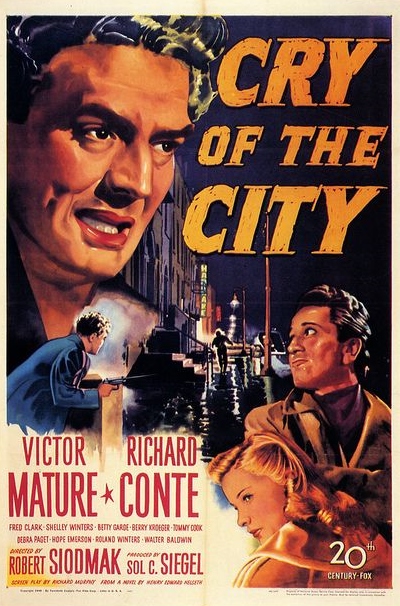
Cry of the City

$1

He’s out there somewhere…in an alley, on a roof…looking for a way out.

One of the most interesting, and the most enjoyable, aspects of the best noir pictures is the blurring of the lines between the hero and the villain. In a way, the noir world doesn’t have any real heroes, just people forced to make the best of whatever circumstances life pitches at them. Characters may be stylised, situations may be exaggerated, but the dilemmas and bad breaks that have to be faced are issues that most people can identify with on some level. I think it’s this ambiguity that ensures the enduring popularity of these films. While fashions, speech patterns and social attitudes are obviously changing all the time, human nature remains constant. Robert Siodmak’s Cry of the City (1948) is a classic manhunt thriller that toys with the viewer’s sympathy by presenting both hunter and hunted as two sides of the same coin.

Martin Rome (Richard Conte) is an Italian American hood who’s just taken one chance too many. A botched hold-up has left a policeman dead and Rome badly wounded and clinging to life. As his family and priest gather at his bedside to pray for him, the law in the shape of Lt. Candella (Victor Mature) hovers in the wings, waiting to hand down retribution. Rome is a doomed man, his killing of a cop can have only one outcome. But doomed men can be of value to desperate men, and so the vultures circle. With the knowledge that Rome has no future, crooked lawyer Niles (Berry Kroeger) tries to coax him into confessing to a murder that would let his client off the hook. When this approach doesn’t meet with any success, Niles makes the mistake of threatening Rome’s girl, Teena Riconti (Debra Paget). Now, he has a reason to live; both the police and Niles want to get their hands on Teena for their own ends. Rome needs to get out of the prison hospital, track down Niles and his accomplices, protect Teena, and try to make good his escape. All the while he’s dogged by his nemesis, the tenacious Candella, a man who seems to be on a personal crusade to run him to ground. As Rome runs and Candella pursues him, we get to see the contrasts and similarities between the two men. Both come from essentially the same background, namely poor immigrant families, but both have chosen different paths out of the urban squalor. Candella walks with the righteous, but the face of the law he presents is a rigid and largely inflexible one. He shows no mercy in his dealings with all the little people who offered assistance to the fugitive, promising instead only prosecution and punishment. As such, it is notable that Candella never receives any willing help whereas Rome has no shortage of people prepared to go the extra mile for him, albeit for their own reasons. Also, when Rome lay wounded in hospital he was surrounded by family and friends, but when Candella later suffers a similar fate his only visitor is his partner.

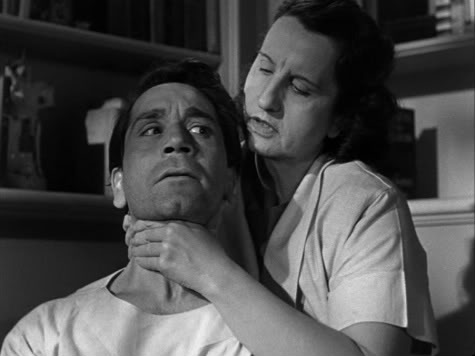
Richard Conte’s smooth talking gangster is a fine performance. You know he’s no good but can’t help rooting for him. The fact that he gets to deliver the best lines of the script and enjoys the lion’s share of screen time is helpful of course. It’s also significant that the killing for which he’s originally wanted is never shown and is only referred to briefly. When he does off someone on screen, that character is such an unpleasant slimeball that you feel he’s justified in doing so. Victor Mature’s persistent detective, on the other hand, is hard to like. He plays a cold, judgmental man with only a trace of humanity; the scenes where he visits Rome’s family are where he comes off best, yet even there his sincerity is open to question. It’s not really any surprise that his character has doors slammed in his face where Conte has them opened invitingly to him. The supporting cast is excellent, although the real stand out is Hope Emerson. This imposing figure of a woman is a genuinely unnerving presence, and you feel she could crush Conte’s ailing Rome just for the sadistic pleasure of it.

£2

Robert Siodmak made a lot of noir pictures, and I don’t believe any of them were poor. Cry of the City may not be his very best but it’s not far off. There are some beautifully framed shots on view, not the least of which is the final showdown between the two protagonists. He also handles the more suspenseful passages, such as Rome’s brazen escape from the hospital with a deft touch and excellent camera placement. The whole film exudes the noir atmosphere with plenty of wet sidewalks, flashing neon and wailing police sirens. I think what helps the film succeed the most is the inclusion of all the incidental characters and situations, from the Rome’s apartment with the Amercan and Italian flags hanging side by side above the mantle to the frightened immigrant doctor who’s willing to risk imprisonment to find the cash to care for his sick wife. I can’t help seeing some parallels between this film and Carol Reed’s Odd Man Out in terms of theme and narrative structure, although Conte never achieves the level of pathos seen in James Mason’s dead man walking. I’d also like to mention the great score by Alfred Newman; this music was used on a number of occasions in Fox movies but its melancholy notes are the ideal accompaniment to this fatalistic production.

Cry of the City is available on DVD in a number of editions in R2. I have the German release, and I understand it’s the pick of the bunch. It was previously only possible to buy this in combination with Sam Fuller’s House of Bamboo but it is now available in a stand alone edition. I couldn’t see anything wrong with the transfer which has very good contrast, is sharp, and displays next to nothing in the way of damage. There have been rumours for some time of this title getting the Criterion treatment but, at the time of writing, it still remains absent in R1. I’m not sure why Fox never went ahead and released this as part of their own noir line and, given recent reports of personnel changes taking place in their home video division, it remains to be seen what will be forthcoming from them in the future. Anyway, I give Cry of the City a big thumbs up, it’s an excellent film noir from a director at the top of his form.

Broken Arrow

poster21

The 1950s were the heyday of the western. You can look at almost any other decade and find plenty of examples of exceptional westerns, but none can compare to the 50s in terms of the sheer number of intelligent, high quality productions. Broken Arrow (1950) was, to the best of my knowledge, the first western to portray the Indians as more than simple caricatures. This film doesn’t demonise them, nor does it present them as the mystical, tree-hugging hippies that our increasingly politically correct world seems to insist on. Instead it presents a people with their own way of life and their own system of values.

Tom Jeffords (James Stewart) is a former army scout who stumbles upon a wounded Apache boy and nurses him back to health. In doing so, he starts to regard the Apache as real people who think and feel, and who are not just inhuman killing machines that must be eliminated at all costs. When he is subsequently captured by a raiding party, his act of kindness, though viewed with suspicion, leads to his being spared. However, he is forced to witness three survivors of an ambush tortured to death; this is a war of attrition with no quarter given or asked for from either side. The point is made that these are a people with a strong sense of honor but there is no shying away from their capacity for brutality. Jeffords’ return to white society gives an insight into the cruelty and brutality on both sides, as the town’s residents display  both  shock and incredulity on hearing that he failed to take the opportunity to kill a wounded Apache. Sickened by the endless cycle of tit-for-tat violence, Jeffords takes it upon himself to seek out a meeting with Cochise (Jeff Chandler) in order to try to find some middle ground. The meeting does produce some limited results, and also brings him into contact with a young Apache maiden (Debra Paget). As Jeffords finds himself falling in love, so he seeks to broker a peace deal between Cochise and the army. The racism prevalent on both sides is shown clearly and the film, to its credit, doesn’t try to lecture the viewer on who was right and who was wrong. It assumes that adults are capable of making up their own minds – seems such an odd concept these days, doesn’t it?

£2

James Stewart gave one of his usual solid performances, and by the end of the movie you can see director Delmer Daves draw on some of the disillusioned bitterness that Anthony Mann would later exploit so successfully. Jeff Chandler’s portrayal of Cochise earned him an Oscar nomination (eventually losing out to George Sanders), and he is convincing in the role. Generally, the acting is fine all round with good work from Paget, Will Geer, and Jay (Tonto) Silverheels as Geronimo. Delmer Daves is a director who seems to be very underrated these days, but I feel he turned out some great movies (especially in the western genre) in the 50s. One criticism that could be levelled at him is that his endings were frequently a bit of a cop out, however, I don’t feel that it applies in this case.

Broken Arrow is a great example of a 1950s western and, if you have even a passing interest in the genre, it deserves a place in your collection. I watched the R2 DVD from Optimum which is far from a perfect disc. The colors vary from faded to strong and the image is generally soft. Having said that though, it’s by no means a terrible presentation and is certainly watchable throughout. There is a R1 release from Fox but I don’t own this and can’t comment on the transfer.


If anyone has been wondering where I’ve been, I just decided to take a little break from posting. As others have mentioned, you can reach the point where you post so often that it starts to feel like an obligation rather than a pleasure. As such, I’ve decided to post when I feel like it rather than try to fulfill some notional quota I’ve set myself. So, until the next time…