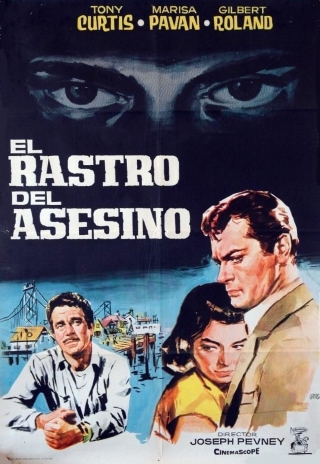
The Midnight Story

“Nothing is more wretched than the mind of a man conscious of guilt.”

 Titus Maccius Plautus

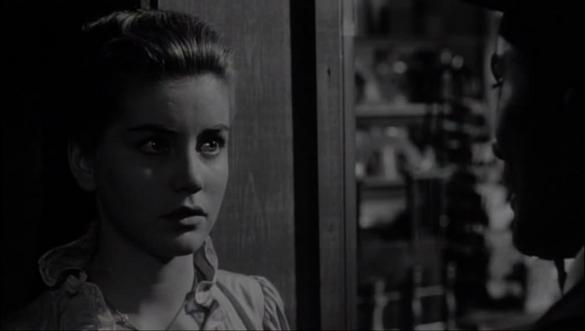
Guilt, doubt and suspicion are some of the key ingredients of dramatic tragedy. One of Aristotle’s four pillars of tragedy is suffering and the aforementioned features can certainly be said to form the basis of that. The concept of guilt runs all the way through The Midnight Story (1957), every major character is assailed by this feeling as it hounds, worries and tears at them insistently. Of course all tragedy really only has a point if it follows its natural path towards a sense of catharsis, a relief or clearing up granted to the characters, not to mention the audience, a lightening of the dramatic load. If guilt and all its gnawing associates can be viewed in a classical context, it can also be seen in religious terms too, especially from a Catholic perspective. In such cases the catharsis we move towards is frequently expressed as a form of redemption. The Midnight Story manages to fuse all of these ideas into a beautifully constructed film noir that draws the viewer deep into dark and despairing places before finally emerging in a brighter, more hopeful landscape.
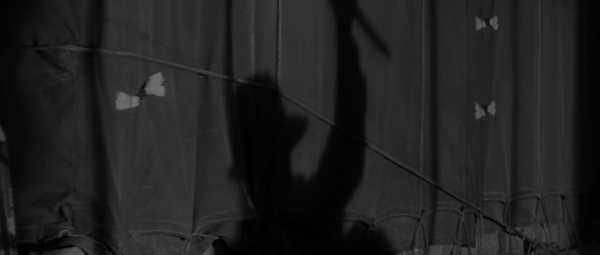
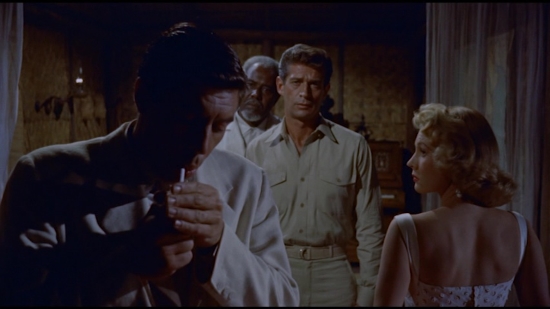
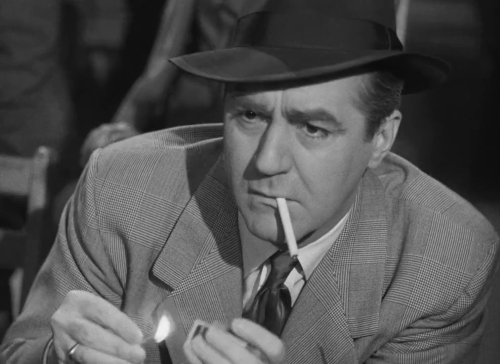
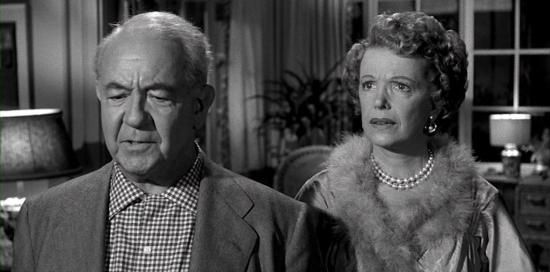
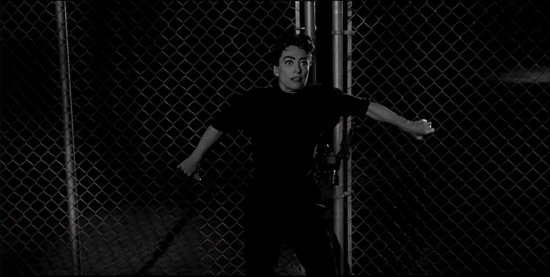
The opening is stark and shockingly abrupt, the caption informing us that the studio set represents an approximation of a side street on the San Francisco waterfront. A priest strolls out of the shadows towards the camera, his attention suddenly caught by a voice softly calling his name. We zoom in on his eyes as they register curiosity, maybe recognition and a touch of fear. This is  Father Tomasino and we’re witnessing his final moments as a knife-wielding assailant, seen only as a shadow cast against the tarpaulin of a truck, strikes him down. It’s one of those crimes that outrages people, particularly those who knew and respected the victim. One such person is Joe Martini (Tony Curtis), a young traffic cop who grew up in an orphanage and owes his job and much besides to the murdered priest. Martini wants the killer and he vainly presses his superiors to let him in on the investigation. At the funeral he notices a man who seems to be more deeply affected, tormented even, than the other mourners. There is something about the intensity of this man’s grief that gives Martini pause and indeed leads to him temporarily turning in his badge in order to pursue his own inquiries. The person who has attracted his attention is Sylvio Malatesta (Gilbert Roland), the owner of a seafood eatery and a familiar figure on the waterfront. Deftly and swiftly, Martini inveigles his way into Sylvio’s life, becoming a friend, employee and even a guest in his home.
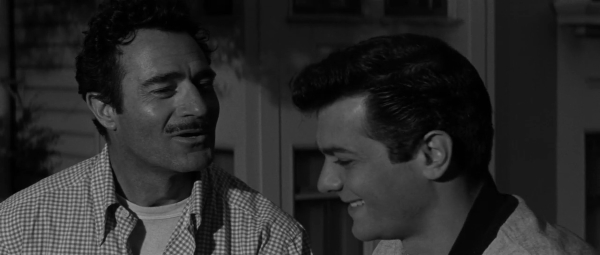
Guilt haunts the characters from start to finish. There is obviously the overarching guilt that stalks whoever the killer may be, but Martini carries it with him too all the way. As has been stated, he owes almost everything to Father Tomasino and there is surely a sense of guilt that, despite his job as a protector of society, he was unable to be there to ensure the safety of this man. One of the orphanage nuns he speaks to advises against going around with hate in his heart, but I’d argue that his guilt and shame, a feeling of inadequacy (albeit misplaced) due to his not being there at the crucial time, is his true motivation. Then that same feeling steals over him as he works his way into the affections of not only Sylvio but his family too. This is exacerbated by his falling for Anna (Marisa Pavan), the niece from Italy, and her clear devotion to him. All of this is further heightened by the accompanying doubts and suspicions: suspicions about Sylvio that ebb and flow with the depressing regularity of the ocean tides, and those corrosive doubts about the propriety of his own actions, the dubious morality of exploiting the love and trust of innocents regardless of the cause which is supposedly served. Soon every look and gesture is brought under the microscope, no word or comment is so trivial as to be discarded, no alibi can be relied upon or taken at face value. Everything has to be questioned, everyone suspected in some way. And still the guilt persists.
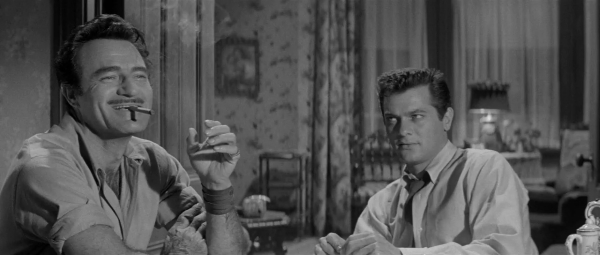
Besides probing its central theme, The Midnight Story functions both as an engrossing whodunit and as a snapshot of working class family life. There is irony in the fact Martini has only been able to achieve the bonding and acceptance that grows out of membership of a family though deception. In seeking justice for the death of his mentor and friend, not to mention a quest to make amends for imagined failings, Martini risks the loss of all that he most desires. The notion of only being able to win by losing everything is a sour-tasting one indeed. Consequently, there are moments of genuine, heartbreaking darkness in this movie, although it does aim for a redemptive quality, and I think it succeeds in that respect. The crushing burden of guilt is finally lifted in the end by the confession and then the quiet nobility of the final scene, where the feelings of the innocent are spared, absolving them of further undeserved shame, Martini simultaneously washing away his guilt for the deceit perpetrated.
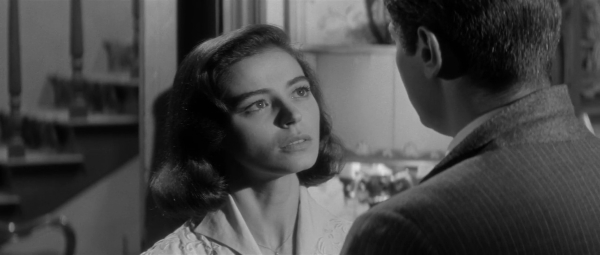
I think it’s fair to say The Midnight Story is Joseph Pevney’s best film. Working from a story and script by Edwin Blum (The Adventures of Sherlock Holmes, Stalag 17), he clearly had an affinity with both the themes explored and the subtle blend of film noir and melodrama. Those intimate little scenes in the Malatesta home, often around the dinner table, but not exclusively, reveal some fine character work from a hard-working cast. The spiritualism inherent in the story and its development is never far from the surface, sometimes overtly but frequently buried a bit deeper in the rambunctious and passionate instances of simple family interaction where the real sense of redemption resides and thrives. The final fade out encapsulates that eloquently as inner strength, belonging and renewal all collide and give meaning to everything that has gone before on screen.
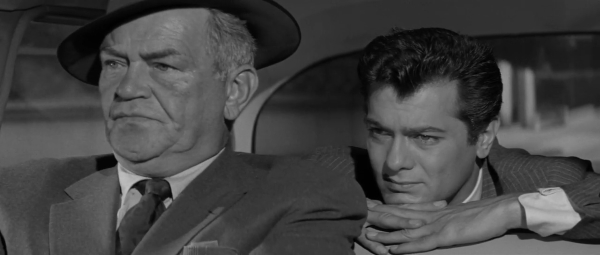
Once again, Tony Curtis is given the chance to prove how adept he was at straight drama and he carries it off successfully. I have probably mentioned this before, but I think it’s worth restating: when actors gain a reputation as skilled light entertainment or comedic performers they seem to get stuck with that label and regarded as capable of only that type of work. Sure some play up to it, and Curtis did choose poorly in his later roles yet it seems a pity that his dramatic work, which is generally very strong, is neglected or at best downgraded as a result. The sincerity and determination of his character is never in doubt and he handles the ups and downs experienced, depending on how his investigation happens to be progressing, most convincingly. Marisa Pavan, who only passed away last December, is very soulful and controlled as Anna. It is this control and emotional caution she displays that gives added fire to the scene where she succumbs to her true feelings as the dangerous game her betrothed appears to be playing is laid bare. There is solid support from Ted de Corsia and Jay C Flippen as the senior cops, the former typically bullish and aggressive while the latter gives another of his slightly dyspeptic avuncular turns.
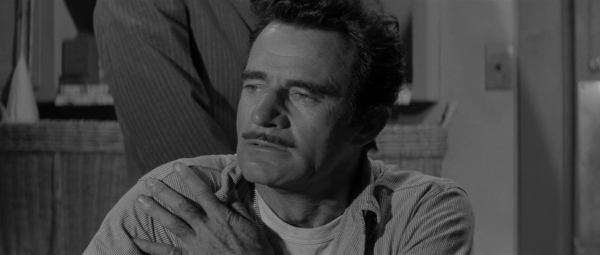
And that leaves only Gilbert Roland. His was long career and one which saw him get better as the years passed. The leading roles were not to be his at that stage but the presence of the man lent gravitas and truth to many a film. The part of Sylvio Malatesta was an extraordinarily difficult one to carry off, but he does so with considerable aplomb. While there is plenty of scope for his trademark bravura, the part is in fact complex and multi-layered, gradually revealing itself in increments over the course of the movie. The inner torments of the man, the history he hauls around inside himself, are subtly presented, held carefully in check and only occasionally allowed to make their presence known. Frankly, he gives a beautifully judged performance that is fully three dimensional – his work here is the rock which anchors the movie and provides real substance to the story.

This brings me to the end of my trawl through a selection of Joseph Pevney directed movies this summer. It’s something I’ve been wanting to put together for a while now and I’m pleased to have finally done so. I only hope it’s been as enjoyable for visitors to follow along as it has been for me watching and writing about these titles.

Congo Crossing

There was a time when jungle adventures gave the impression of being all the rage in Hollywood. Most of these were shot locally so the budget was kept low and the air of exoticism was easily achieved. As a sub-genre of the adventure/thriller such movies rarely aspired to be more than entertaining diversions. Congo Crossing (1956) saw Joseph Pevney heading for an imaginary central African state in the company of Virginia Mayo, George Nader and Michael Pate, with a weary Peter Lorre popping in and out to add a touch of wry humor.

The setting is Congotanga, a place one character refers to as essentially a criminal colony on the western border of the then Belgian Congo. It is so labelled because its lack of extradition agreements has made it a magnet for various fugitives from justice the world over. The law is nominally represented by Colonel Arragas (Peter Lorre) but the real power lies in the hands of shady types like Rittner (Tonio Selwart). The main focus though is on David Carr (George Nader), who has been hired to carry out a river survey on behalf of the Belgian mining concerns. He’s puzzled by this as he’s of the opinion nothing will have changed since the last time one was carried out. Nevertheless, a job’s a job. As he sets off down the river he’s accompanied by one new arrival and one of the old hands. The former is Louise Whitman (Virginia Mayo), a one time model running from a murder rap in France, while the latter is O’Connell (Michael Pate) and he’s simply there due to the fact he’s been hired to kill the woman as soon as possible. Beset by tsetse flies, crocodiles and the murderous attentions of Rittner’s henchmen, the party has more than its share of hazards to navigate. The main plot point here hinges on shifting river courses and the consequent effects this has on borders and thus on jurisdictions. Basically, nobody wants to see Carr come back safely with the results of his survey. There are double-crosses, ambushes, some romance and the usual jungle thrills as the story makes its way to a literally explosive climax.

Congo Crossing is fine as a lightweight adventure, but it’s a minor affair for director Pevney and all concerned. I guess the premise of a border disappearing as a result of one of nature’s whims has some points in its favor, but it’s not something the viewer can get excited about. It’s a MacGuffin really and what matters more is the reaction of the characters to all this. Then again, that requires those characters should be more than stock variations and that isn’t really the case. The hero is honorable and dedicated, the leading lady may not be all she says she is and the villains are just out and out bad guys. It makes for a passable viewing experience, but nothing more than that.

Virginia Mayo is a highly decorative presence as she sashays through the wilderness and she’s an actress I’m always happy to watch. However, this is another of those roles where she is asked to do little that is important and even the touch of conflict written into her character is not all that unexpected. George Nader had a brief window where he was cast in a variety of leading parts at Universal-International. I prefer him in the noir/crime pictures he made as there was a bit more depth to those roles whereas this is much more standard fare. Again, he’s fine in the movie, it’s just that there is little scope for him to do anything beyond the routine heroics. Michael Pate does his usual solid work as the villain and he carries the attendant air of menace comfortably. Peter Lorre only appears at the beginning and then again during the climactic scenes, sweating and sighing and never seeming to take any of it too seriously.

Congo Crossing has been released on DVD and Blu-ray in Germany and the movie looks attractive as Pevney’s films generally do, aided in this case by the cinematography of Russell Metty. I suppose I don’t sound all that enthusiastic about the movie although I have to say I did enjoy it well enough. It’s quite competently put together and passes the time satisfactorily, but the fact is just about everyone involved did better or more interesting work elsewhere. All in all, I’d say it’s a fun picture but slight and far from essential for the casual viewer.

Iron Man

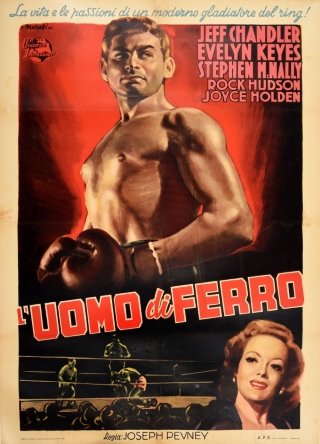
Everybody loves a winner, right? Well actually they don’t, there are those whose behavior draws crowds in the hope they are going to see them get a licking. It’s not just winning, rather it’s how a person wins and perhaps also why they win or even want to. Once upon a time, success in sports, and indeed life itself, was predicated not only on the results achieved or the prizes attained but also on the manner in which the game was played. Is boxing the ultimate sport? Perhaps it was at one point, or perhaps it only appeared to be so for a brief moment in time before sliding into a seemingly unrepentant morass of glitz and trash-talking. Still and all, there is at the heart of it all the seeds of nobility, and I think Iron Man (1951) attempts to tap into some of that. There is something about the image of two men pitting themselves against one another in a formalized setting, mathematically bounded spatially and in terms of timing, equipped with nothing but their guts, guile and sense of fair play. It appeals on an almost atavistic level, but that appeal is heavily dependent on both parties adhering to the rules, the rules of the game and by extension of humanity. It’s only when those rules are bent or warped either by the antagonists or those observing them that some of the purity is lost.

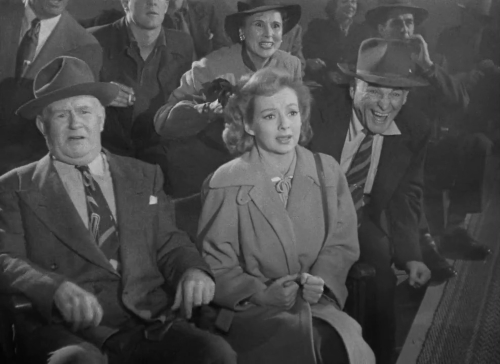
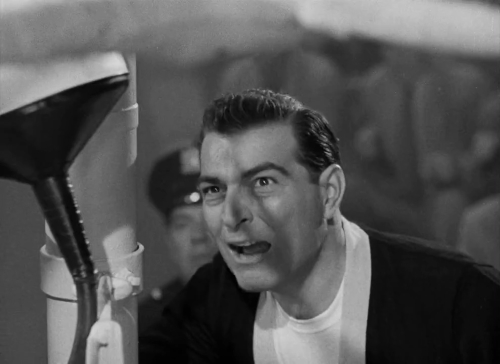
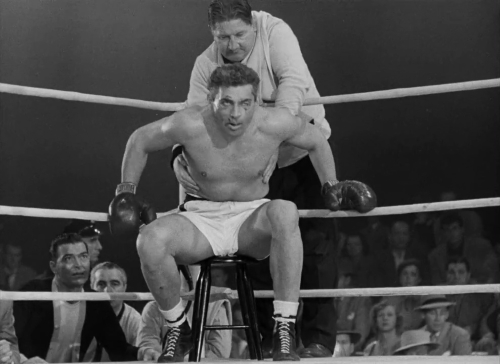
If the duel promises a contest of honor, the same quality cannot always be said to be evident among those watching it. One hears about the roar of the crowd, but what lies behind that?  Look at the eyes and listen, especially listen. All the passion that is embodied in the strained faces, the anxiety, the fear, the trepidation and for some the blood lust. And this is amplified in the sound, cheers and jeers, and if the latter dominates then what? This is the scene presented at the beginning of Iron Man – the announcer holding sway in the center of the ring, barking into the suspended microphone as the arc lights cast their harsh gaze, heralding the start of a world championship fight, calling out the names of the contenders. As the reigning champion steps up the voice of the thousands banked around the roped off area rises not in celebration but in reprobation. Coke Mason (Jeff Chandler) is the focus of this disapproval and he appears to drink it all in dispassionately, feeding off the negativity surrounding him. The view shifts to the spectators, one woman in particular. This is Rose (Evelyn Keyes), Mason’s estranged wife and she sits detached from the screams and boos, thinking back to how these circumstances came to be and of her own role in bringing them forth. We dissolve into a long flashback as Rose leads us back to the coal mines of Pennsylvania, to the man Coke Mason once was before he set out on the path that has led him to fortune and infamy. So we follow Mason as he embarks on the journey out of the grime and hazards of the mines, facing off against mindless prejudice from a belligerent co-worker, finding himself practically reborn after the trauma of a cave-in, on towards his early days as a rough and ready prize fighter egged on by Rose and his ambitious brother George (Stephen McNally). Right from the off Mason is a slugger without technique and, more crucially, without a true sense of why he is fighting. Maybe it would be more accurate to say, he does know why he’s fighting – for the money of course, but also as a reaction against his own deep personal insecurity – it’s just that he is incapable of controlling the fires in his soul. This is what drives him, the internal rages which once ignited are virtually unstoppable and threaten both his opponents and himself.

Iron Man boasts a George Zuckerman/Borden Chase screenplay from a novel by W R Burnett. Those are pretty impressive credentials right there and the movie moves smoothly through its hour and twenty minute run time to a conclusion that some might see as predictable but which  is deeply satisfying for its redemptive and restorative qualities. Director Joseph Pevney keeps it fluid and scenes are generally well paced. It’s the type of material that suited the talents of Pevney and the team around him and cinematographer Carl Guthrie creates some fine images, especially the early stuff below ground in the mine and then later in the fight sequences. Pevney and Guthrie shoot and cut expertly here, making use of starkly lit close-ups alternating with wider pans to draw the viewer into the fight and heighten the tension. The outcome might not be in serious doubt yet the stylish way it is presented is a pleasure to watch, and the emotional and thematic payoff is undoubtedly worth it.

Jeff Chandler handles the conflicted aspects of his character as well as one would expect. The reluctant fighter who is simultaneously motivated and frightened by what he carries around inside offers him plenty to play around with. He reportedly put in a fair bit of work on the practical physical aspects of the role and the fight scenes benefit from that. He never displays much grace in those moments, but that’s the part he’s portraying, a fundamentally awkward man who powers his way to dominance without bothering about the style. Rock Hudson is fine too, albeit in a lighter role as Chandler’s friend who moves from second in the corner to rival in the ring. Stephen McNally was never less than versatile and his flashy turn as the brother who rarely lets a scruple stand in the way of a fast buck is up to his typically high standard. His realization of the harm he has caused, alongside Evelyn Keyes’ similar conversion, is central to the resolution. Keyes cultivates her character nicely as the movie develops and her move from opportunism to remorse feels very natural. Jim Backus drifts in and out of proceedings as a reporter who ends up moonlighting as a promoter. It feels like an odd progression at first but it’s another key role and makes sense as the story unfolds.

Iron Man is another of those Universal-International titles which Kino have scrubbed up and marketed on Blu-ray in their impressive film noir line. The movie does undoubtedly highlight moral ambiguity and explores some dark places in the soul, and it’s a boxing film. Even so, I’m not sure I’d class it as film noir – others may see it differently and I can’t say labeling it or categorizing it in this way bothers me much one way or the other. It pleases me to see this film available in good shape and that’s really all that counts. In the final analysis, this is a good movie with the cast and crew all turning out very creditable work.

Female on the Beach

The Gothic mystery / romance characteristically placed wide-eyed young females from generally sheltered backgrounds in perilous situations. As often as not, they found themselves alone, or practically so, in some rambling old pile they had inherited and threatened by some as yet unknown figure. It’s a hoary old trope, but a it’s also proved to be an attractive one and pretty successful as a consequence. The classic variant still turns up of course and it has also been tweaked and updated to make the standard formula a better fit for changing circumstances and the demands or tastes of audiences. Female on the Beach (1955) is essentially a modernized take on the Gothic mystery. Sure the trappings have been altered and the setting has waves gently lapping on sultry shores rather than launching raging assaults on mean and jagged rocks, but the core elements remain in place – there’s a lone woman taking up residence in an expensive house, a romance with a shadowy and potentially dangerous man, an escalating series of threats and a correspondingly mounting sense of panic and anxiety. As is frequently the case with a lot of this type of material, some of it works very well while other parts suffer from exposure to the overheated atmosphere.

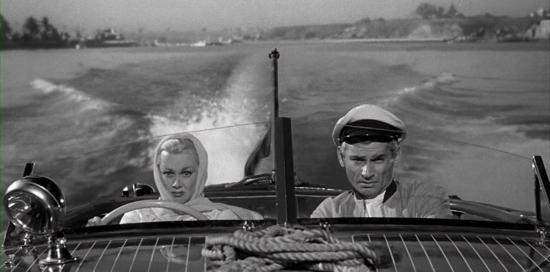
The first female seen on a beach in this movie is one who has just taken a swan dive off the veranda of her seafront home. She had been drinking, heavily, quarreling querulously with a lover and then in a fit of alcohol soaked remorse and self-pity rushed out onto the balcony to stumble and crash through the guard rail. The last we see is the final twitch of her hand, flicking farewell to the busted remains of a brandy balloon. The entire business had an air about it that was as much pathetic as it was tragic. One out, one in – the next arrival is the actual owner of the house. This is Lynn Markham (Joan Crawford), the widow of a big time gambler and a woman looking for nothing so much as solitude. What she ends up getting is the initially unwelcome attention of resident beach bum Drummond Hall (Jeff Chandler). He seems to be suspiciously familiar with the house, and there are little relics of his previous visits littering almost every corner of the place. None of this should be much of a surprise; Drummy (as everyone calls him) is an unapologetic gigolo, albeit something of a reluctant one. He was the man who exited the house pursued by the drunken entreaties of the last tenant just before she moved out permanently and suddenly. He appears to be set on continuing where he left off, business is business after all and a guy has to make a buck whatever way he knows best. Lynn Markham doesn’t intend to become the next mark to pick up Drummy’s checks though and tells him so in no uncertain terms. All of this recalls the tale of Zeus once realizing that the fox that can’t be caught and the hound that can’t lose its prey sets up a paradox of Olympian proportions. In short, something’s got to give. Well it does, love blossoms or lust triumphs – take your pick. And yet there’s a lingering doubt regarding the death of Lynn’s predecessor – accidents ,suicides and murders all produce the same result and it’s easy to mistake one for the other. With a persistent and dissatisfied police lieutenant lurking in the background, Lynn runs the gamut of passion, suspicion and outright fear as she falls for Drummy yet can’t shake the feeling that he may be looking to dispose of his catch as soon as he has secured all the wealth and benefits that come with it.

Director Joseph Pevney was on a solid and at times hugely impressive run of movies throughout the 1950s. There were some misfires and a few frankly humdrum efforts along the way, and some like Female on the Beach which look stylish despite an inherent modesty in terms of production, tease and flatter to deceive in scripting and development, and still manage to be entertaining despite some major flaws. The movie raises questions about the nature of love and betrayal, the importance of trust and the brittleness of human relationships. And the ending, the conclusions reached, is less than satisfactory. It ties everything up in a neat enough way but that doesn’t make it particularly convincing, nor I would argue does it offer a resolution with any promise. None of this is the fault of Pevney of course, the script being an adaptation by Robert Hill of his own play. Pevney, and cinematographer Charles Lang, create some attractive images despite or inspired by the natural staginess of the material. Somehow though, the melodrama and the thrills don’t blend as seamlessly as they might, curdling instead and leaving the finished product lumpy where it ought to have been smooth.

Jeff Chandler made a number of movies with Pevney and all that I’ve seen have been worthwhile on some level. Female on the Beach does have a certain superficiality to its sandblasted Gothic chic, but Chandler always brought an enticing mix of authority and vulnerability to his roles regardless. While dissatisfied self-awareness crossed with brooding calculation isn’t the easiest look to put across, he succeeds in doing so. Joan Crawford was nearing the end of her strong mid-career revival, the slightly trashy but very enjoyable Queen Bee and the very fine Autumn Leaves would soon be followed by a run of exploitative titles of gradually diminishing quality. Female on the Beach had her running on autopilot, suffering, emoting and tossing out some stinging barbs but never stretching herself. Jan Sterling was generally good value in any movie she appeared in and spars successfully with Crawford here. That said, the tone of her performance overall is ramped up a little too high, and again I feel the script is to blame for that. Cecil Kellaway and Natalie Schafer are wonderfully seedy as Chandler’s sponsors and handlers while Charles Drake is solidly unremarkable as the dogged detective – I think I prefer him in his more ambiguous roles.

Female on the Beach is easy to access for viewing, as are so many Universal-International movies these days. It was released on DVD in the US long ago in a box of vaguely noirish thrillers and then on Blu-ray by Kino. I have the UK DVD that Odeon put out some years ago and I think it’s a more than satisfactory presentation. To sum up, Pevney does his customarily slick job, Chandler and Crawford add some star power, but the script rarely rises above the mediocre.

This launches a short series of posts on the movies of Joseph Pevney that will be featured this summer.

Foxfire

On the outside looking in doesn’t do anybody any good.

That one casual line in Foxfire (1955), spoken by one of the most hard done by and neglected characters in the movie as it happens, goes a long way towards catching the spirit and flavor of the entire picture. In a sense, all of the characters are outsiders in their individual worlds, some by chance and others by choice or design. This is a strong theme, one many of us will be able to identify with at some point in our lives and thus a solid bedrock on which to construct this story which I’d say is three parts melodrama and one part modern western. That part picks up on and weaves into the blend perhaps one of the more interesting, challenging and progressive thematic threads to be found in the fabric of the 1950s western, the clash of cultures which was inevitable in a new land and the dramatic tension growing out of that.

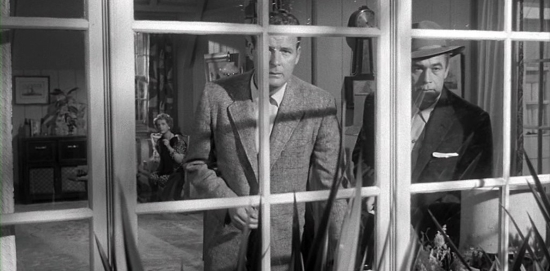
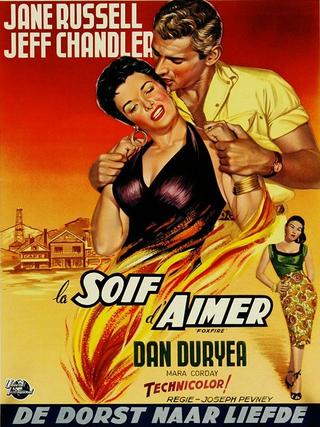
A desert highway, one of those arrow straight and seemingly endless thoroughfares that we viewers have traveled many times. Our companion on this occasion is a lone woman, Amanda Lawrence (Jane Russell), speeding along until she gets a flat tire. With no help available, she sets off on foot, burdened with what look like the assorted fripperies of a shopping expedition. There can’t be any doubt that this chic and carefully coiffed lady is very much an outsider in the primal landscape, a refugee from 5th Avenue cast adrift in the dust and heat of the southwest. Then out of that shimmering haze comes a jeep carrying two men – miner Jonathan Dartland (Jeff Chandler) and doctor Hugh Slater (Dan Duryea) – and we’re off. Amanda is clearly taken with Dartland and he’s at least interested in her.  What follows is a love story but it’s not a smooth one, and I think it’s questionable in the end what all of the protagonists are in love with. In fact, despite the relatively neat conclusion, those questions are only partly answered and I feel there’s a suggestion that they will rear their heads again.

As far as I can see, the characters are being pulled in different directions partly by their disparate backgrounds and partly by their status as outsiders. Beginning with Dartland, or Dart as everyone refers to him. We learn very early on that he is half Apache, with a mother who has returned to the reservation and wholly integrated herself back into tribal life after the death of her husband. He is forced to endure some bigoted and prejudiced attitudes – including one thoughtless gaffe on the part of Amanda before she learns about his heritage – but tends to brush them aside. He insists it means nothing to him but a couple of understated moments call this into question – the brief flash of hurt in his eyes when Amanda makes that crack about Indians, and then later the diffidence and self-consciousness he displays when entering the club for their first date, not to mention the haste with which he beats his retreat.

For all Dart’s claims of not being affected by his background, he’s very much aware that he is outside looking in. And he cannot fully break with his past; he avoids talking about his mother’s people, keeps his memories quite literally locked away and reacts with petulant sensitivity to their discovery. Nevertheless, the tone of his relationships, especially with Amanda is dictated by his upbringing, his instinctive prioritizing of self-reliance as well as his resorting to the physical as opposed to the emotional act of love when confronted with conflict. As I mentioned  above, I’m unsure whether he’s confident what he’s in love with – his wife or his ambition, and that siren song of kith and kin holds a powerful attraction.

What of Amanda? Is she any less an outsider? A socialite on vacation drawn to something attractive, and she does refer to Dart time and again as pretty in a neat subversion of traditional objectification. She labors hard to adapt to the harsh conditions of the mining town and also has to deal with the whispers of her own past tempting her to throw it all up in favor of the ease and plenty she was accustomed to. Again, does she really know what she wants – the rugged ideal of her imagination or the the reserved figure of reality?

You can always tell a script has depth when it adds meat to the bones of the supporting characters ; this one is from the pen of Ketti Frings, who had already written a few very good films noir as well as another Joseph Pevney / Jeff Chandler picture Because of You, and I’m keen to track that one down now. Dan Duryea’s boozy doctor could have been a mere caricature, a sidekick with a bottle who bumbles in the background. However, the character isn’t written with such broad strokes, there are layers present which are only gradually uncovered. He doesn’t truly belong either, another blow in from another world, a drunk as a result of personal trauma and casting around for a means to escape his circumstances. Duryea excelled at playing heels and it’s therefore not much of a surprise when his cunning and manipulative side rises to the surface. The one who arguably suffers this most, albeit with almost superhuman stoicism, is his nurse/lover played by Mara Corday. Like Dart, she is half Apache yet the barriers separating her from white society are even more entrenched. There’s something both outrageous and touching about her quiet patience and devotion to a man who habitually neglects her to the point of naked disrespect. Then there’s that wedding scene, where she is looking in in every sense, relegated to a place outside in the company of hookers and other undesirables. She is in a very real way a peripheral figure and is assigned only a limited amount of screen time, but her presence and its effect on the viewer is significant. Somehow, the casual acceptance (by herself as well as by the other characters, and perhaps even more so on her own part) of her regular social exclusion and the flippant exploitation of her affections do as much to highlight prejudice as some of the more direct and overt references involving  Dart.

I’ve watched and featured a number of Joseph Pevney movies this year and Foxfire is probably the most enjoyable one so far. I appreciated the understated way the drama unfolds and this is particularly true of the key scenes. The film has that appealing look that is so characteristic of Universal-International productions and William Daniels’ Technicolor cinematography honestly is quite breathtaking at times. The setting matters too, it feels entirely appropriate in this case that everything revolves around a mining settlement in the Arizona desert. The location offers a tangible link to the classic western and then there is that sense of the ephemeral, of a place hastily built amid a permanent wasteland – Chandler’s character dreams of making it a lasting settlement but there’s that nagging doubt again, as in his personal affairs, over how sure the foundations will be. Somehow the raw purity of the scorched backdrop offers a contrast to the transitory desires, ambitions, jealousies and angst of this group of people, none of whom appear to genuinely belong.

As for availability, there is a Blu-ray which has been released in the US and I understand it offers a fine presentation of the movie. Sadly, I’m Region B only when it comes to Blu-ray so I had to find other options. There has been a DVD release in Italy that is hard to fault as far as the picture quality is concerned. It might be standard definition but the 2.00:1 widescreen image is sharp as a pin, clean and colorful. Sure there are better melodramas to be found and the theme here may not have the kind of universal resonance that typically adds greatness. Nevertheless, this is a good movie, and it mostly worked for me, raising a number of issues I could relate to as well as providing an hour and a half of polished, solid entertainment. My recommendation is that anyone able to access this title should check it out.

Undercover Girl

A slight departure today, but one which I’m sure most who read and follow here will appreciate. In short, I’m honored to be able to host a guest post from Gordon Gates, a man who has contributed to many a discussion here over the years and who brings along a wealth of knowledge on genre pictures and television shows. He very kindly offered to do a guest write-up, and also floated the possibility of others in the future. I’m delighted to be able to offer Gord this space to highlight a movie of his choice, and I’ve no doubt other readers here will share those sentiments.
I would like to thank Colin for the chance to do a guest review. I am by no means an expert on film but I know what I like. Film Noir, westerns, war films, Sci-Fi and early television are at the top of the list for me. Up first, I’m going to dive into film noir. Undercover Girl  (1950) is a Universal-International B film that stars Scott Brady, Alexis Smith, Royal Dano, Gerald Mohr, Gladys George, Angela Clarke and Richard Egan. This was the second feature helmed by actor turned director, Joseph Pevney. The story was supplied by Harry Essex whose work includes, Desperate, The Killer That Stalked New York, The Fat Man, Bodyguard, I, The Jury and Kansas City Confidential.

This one starts out in Los Angeles where a Police informant is badly wounded in a vicious knife attack. Before he bites it, the informant tells his Police Detective contact, Scott Brady, there is a large shipment of drugs coming to town. The shipment is arriving from New York. He also manages to whisper there is a crooked New York cop involved.As this is going on in LA, back on the east coast, Police Detective Regis Toomey, the crooked cop, has had a change of heart. Toomey has a meeting with mobster, Gerald Mohr about the 10 large he took to look the other way. He tosses the cash back at Mohr and tells him he is taking him in. This does not go well for Toomey. A henchman of Mohr puts the kibosh on Toomey..

Now we meet Alexis Smith, Smith is a trainee with the NYPD following in her father’s footsteps. She takes Toomey’s murder hard and redoubles her efforts to make the force.

LA cop Brady is soon in New York to see if he can uncover anything about the drug shipment. Smith does not believe Brady that her father might have been a bent copper. She offers to help out Brady. Brady takes her up on the offer. He will send her in as an undercover type back in LA.

It is back to LA to fill in Smith on her new identity etc. They hook Smith up with an old time gangster’s moll, Gladys George. George is pumped by Smith for every bit of info she can get. This will help establish Smith’s criminal “bona fides” for her new identity. She is to play a buyer for a drug ring in Chicago.

Several weeks of studying are needed before Smith can be inserted into the local criminal crowd. Smith is put up in a downtown rooming house next door to Angela Clarke. Clarke is the former dolly of low level underworld type, Royal Dano. Clarke is a drunk always looking for a bottle. A few words in her ear from Smith, and a promise of some cash, soon does the trick.  Clarke agrees to put Smith in touch with Dano.
Dano shows up at Clarke’s apartment in a less than happy state. He is not amused that Clarke has set up the meeting with an out of town type. Clarke gets slapped around, then, shoved out the 3rd floor window. Dano beats the feet out the door and right into Miss Smith. She points to a back way out of the building.

Smith fills in Brady on the night’s events. Brady thinks the case is now far too dangerous to continue, but Smith still wants revenge for her father’s murder. She tracks down Dano and convinces him to introduce her to someone higher up the drug food chain. A promise of 1000 bucks quickly has Dano on side.

Miss Smith is soon shown into the office of a doctor. The man, Edom Ryan, has a sideline selling heroin. Ryan actually works for the same mobster, Mohr, who killed Toomey in New York. Keeping an eye on Doc Ryan is, “mad as a hatter” gunsel, Harry Landers. Also on Mohr’s payroll is Lynn Ainley.

Before Ryan agrees to any transaction, he needs to check out Smith’s identification etc. Smith knows all the proper answers to the right questions, and is bumped up the line. She meets the boss, Mohr. A deal is quickly arranged for a substantial amount of product for an equally substantial pile of cash.

Now of course the flies start to roost in the ointment. Miss Smith runs into her former beau from New York, Richard Egan. He blows her cover in front of Dano. Dano, an enterprising bottom feeder if ever there was one, decides to blackmail Policewoman Smith. Five large or he turns her over to Mohr. He gives a time and place to Smith for the exchange.

This lays out all the ground work for the film. Needless to say several double crosses, some flying fists, a barrage of bullets and a stack of bodies are needed to bring the tale to a proper end.

This is another of those Universal-International films that is rather difficult to lay one’s hands on. But it is well worth the time if it can be found.

Scott Brady was the younger brother of noir favorite Lawrence Tierney. Look close early and you can spot the third Tierney brother, Edward, in a small unbilled bit.

The cast is all quite good here, with the always entertaining Royal Dano in particular shining as the low-life grifter. This was director Pevney’s second foray into noir territory after the equally entertaining, Shakedown. He hits the mark all the way through. Pevney directed in several genres during the 1950′ s before making the move to television. Two of more well know TV episodes were from Star Trek. These were, Amok Time and The Trouble With Tribbles. Pevney’s film work includes: Desert Legion, Iron Man, Back to God’s Country, Yankee Pasha, Away All Boats and The Plunderers.

As for myself, I’m from Western Canada. Right now I’m based in Calgary Alberta though I have lived in British Columbia and the Yukon. Quite a few films have been make around here as we are only 60 miles from the Rocky Mountains. Eastwood’s Unforgiven, Costner’s Open Range are just a couple of the westerns made here.

Gordon Gates

Back to God’s Country

Rugged outdoor adventures have a timeless appeal and I think it’s true too that the cold weather variety carry with them an invigorating quality, as though the  crisp, chilled air blasting the protagonists on the screen adds a little freshness and energy to our viewing. A film such as Back to God’s Country (1953) is a largely formulaic affair yet is enlivened considerably by its sub-polar setting. Of course, following a formula need not necessarily be seen as a failing; handling and execution are key elements and, with the movie in question, I feel director Joseph Pevney brings a briskness to the piece that makes its hour and a quarter running time positively zip along.

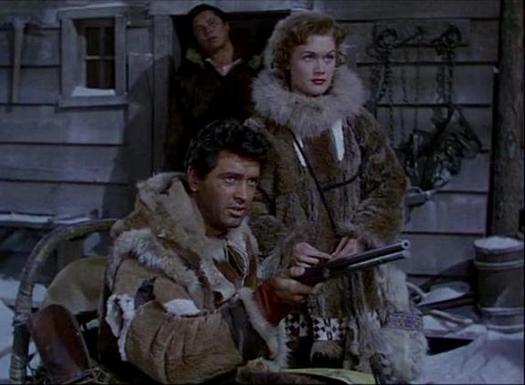
It’s the late 19th century and we’re  in the icy north of Canada. Peter Keith (Rock Hudson) is running a schooner trading fur pelts in the US and is keen to get underway before the winter freeze sets in and leaves his vessel unable to sail. As such, he’s vexed to receive an official letter ordering him to remain in port until an inspection can be made of his cargo. That would mean a delay which might well see him sealed in for the season and the consequent hit to his finances it would entail. While he and his wife Dolores (Marcia Henderson) have made up their minds to ignore the order and put to sea anyway, it comes to the attention of both that there might be something fishy about the whole thing. Local bigwig Paul Blake (Steve Cochran) is expansive and hospitable yet there’s an oiliness about him and it looks like he may be behind the request, partly for financial gain and partly (maybe even mostly) because he far from honorable designs on Dolores. Thus, with rivalry and subterfuge established, the scene is set for a showdown which will play out for the most part over a couple of enforced journeys through the frozen wastes.

Back to God’s Country appears to have been filmed twice before, back in the silent era, and I can see how the combination of adventure, melodrama and romance would have drawn filmmakers eyeing a source with reasonably wide appeal. Now I’ve no idea how Pevney’s movie compares with those earlier iterations, and indeed I don’t even know whether they still exist or are available for viewing. What I can say though is that this movie represents a marvelous piece of escapism, a no-nonsense slice of entertainment with that characteristic aesthetic one associates with Universal-International pictures. The combination of studio shooting and some location work in Colorado and Idaho is handled most attractively by cinematographer Maury Gertsman, with Pevney marshaling it all with pace and energy. The story holds no real surprises, and arguably has its fair share of cliches, but the meanness, the naked self-interest and almost perverse covetousness of the villain add an edge and an unexpected extra layer.

Steve Cochran was born to play villains, his self-assurance and grace offer a sheen of sophistication, while all the time there’s a gleam in his eye that hints at a ruthlessness any time the main chance wanders into view. By and large, he plays it cool but there is one scene in particular – an assault on Henderson – where he, unfortunately, cuts loose and indulges in the kind of eye-rolling, over-the-top hammy histrionics that would put many a mustache-twirling cartoon cad to shame. His character is of course a thoroughly bad lot, a blackmailer and master manipulator with a history of grabbing possession of whatever and whoever he wants. And there’s a sadistic side to him that goes beyond mere greed, his treatment of Hugh O’Brian’s forger is a case in point, holding him in what amounts to bonded labor. O’Brian does well in that part too, allowing his natural charm to soften his own villainy and act as a counterpoint to Cochran’s.

Pitted against these two are Rock Hudson and Marcia Henderson, and they make for an attractive and resourceful couple. Hudson was in the process of building his career at the studio (a career that Ross Hunter and Douglas Sirk would soon move to a whole different level) and this type of role, while not all that demanding dramatically, was the kind of thing  that couldn’t hurt. He gets to play it tough and heroic, even in the latter half of the movie when a broken leg sees him essentially confined to a sled. A good deal of the drama arises from a combination of Cochran’s machinations, the deteriorating weather conditions, and also some frankly poor decisions on the part of Hudson’s character. He makes amends for them, naturally, but this also gives Henderson the opportunity to prove her mettle. She too displays a hard edge when the chips are down, playing well off Hudson and holding her own quite convincingly when she has to.

Back to God’s Country may not be all that well-known but nor should it be all that difficult to locate. There seem to have been DVDs released pretty much everywhere – I have this Italian version which seems to have gone out of print and been replaced by another by the same company claiming a Hi-Def restoration  – still, I’d imagine all will be using the same transfer. Generally, it looks OK, but there is a bit of damage and overall ageing visible. Sometimes I think I could happily spend my days watching, and writing about, nothing but Universal-International movies; they’re that entertaining. There’s a polish and professionalism on show that mean even undemanding and average efforts like this offer a good deal of viewing pleasure.

Another view of the movie, from Laura, can also be accessed here.

The Plunderers

A new decade heralds change, or at least that would appear to be the received wisdom. It’s tempting to see it like Janus, as a point of transition gazing both ahead and back simultaneously. And no, this isn’t going to turn into some reflection on where we find ourselves today; it’s merely a coincidence that I happened to look at a movie which also appeared at the beginning of a new decade. The Plunderers (1960) came out just as the the western was about to enter a period of significant change. Could it be termed a transitional work? Well, for my money, it has much more in common with the works which preceded it, although perhaps there is a case to be made for it taking some tentative steps towards the post-classical era.

So, what’s it about? Conflict is naturally the key element of all drama and this movie presents it on a number of levels – interpersonal, intrapersonal and generational. On the surface, it’s a simple tale of four youthful drifters arriving in a tired and washed-up town, a place where all vigor has been abandoned and where the ageing population is unprepared for any challenge to the torpid complacency. These four are restless and dissatisfied, wearied from a cattle drive and emotionally raw at the realization that they just blew all their earnings in a week of indulgence in Dodge City. Right on the cusp of manhood, these youngsters need to reassert themselves, to make people sit up and take notice of their importance, but are singularly lacking in the maturity necessary to acquire that which they most desire, the respect of others. Thus, when an initial bit of minor roguery and mischief leads to the mildest of rebukes, their bravado is further stoked. It all leads up to threats, murder and, finally, a confrontation with a one-armed veteran, provoking a spiritual awakening of sorts.

There’s a lot going on here. We have the four interlopers trying to find their place in the world, but without the structure and guidance to point them in the right direction. This appears to be a throwback to the tales of rebellious youth that abounded in the previous decade, but the crucial difference here is that those earlier examples tended to push an essentially optimistic message whereas The Plunderers has an altogether sourer vision – the generational conflict depicted promises no positive outcome. Maybe this can be seen as a reflection of the stagnation that would begin to creep into the genre and give rise to a new and more nihilistic approach.  Or from a wider sociopolitical perspective it might be seen as holding up a mirror to the waning of the somewhat detached Eisenhower era which was about to give way to the more radical and energetic Kennedy years. Then again, I may well be trying to read too much into it all.

What is certain is that the movie charts the gradual reawakening of the conscience and sense of responsibility of its leading character. Jeff Chandler puts in a fine, understated performance as the  veteran who has been scarred both physically and psychologically by his wartime experiences. The fighting robbed him of the use of an arm and left him an emotional cripple as well. His withdrawal from his community is partnered by his distancing himself from his former lover (Marsha Hunt, happily still going strong at 102), and her needling of him for his lack of guts almost constitutes an assault on his masculinity. It feels as though his passivity and apparent impotence is being weaponized in both a literal as well as a figurative sense. What finally rouses him to action is the belief of the storekeeper’s young daughter (Dolores Hart). There is the suggestion that he has lost confidence in himself as a result of his injuries yet I think it’s clear enough that his fear is not based on an absence of self-belief as much as a reluctance to revert to the violence that he earned a fearsome reputation for indulging in during the war. While the classic 50s western built towards a spiritual rebirth, I think it’s telling that The Plunderers ends on a grimmer note with its emphasis on guilt and an inner monologue that’s actually a prayer for forgiveness.

Bit by bit, I’m getting round to featuring works by a variety of filmmakers who really ought to have been represented on this site earlier. Today it’s the turn of Joseph Pevney, an actor turned director who made a number of impressive genre movies throughout the 1950s before moving on to a long a successful career on television. The Plunderers was one of his last feature efforts and I think it’s a strong one. Almost the entire picture is shot within the confines of the town, keeping our attention focused and the dramatic tension ratcheted up. It’s very obviously a low budget affair, but Pevney’s interesting camera placements, along with the layered writing, help make a virtue of this. I feel it’s also refreshing to see the climactic duel making use of knives as opposed to the more traditional quickly-drawn pistols. All told, there is little on screen violence until quite late in the story – with  the exception of two tough and rather brutal beatings – and when it does take place it’s appropriately shocking in its abruptness and tragedy.

As far as options for anyone wishing to view this movie are concerned, there’s a manufactured on demand DVD available from the US via the Warner Archive and there had until recently been a release in Germany, but the latter seems to have gone out of print now. I’m an unashamed fan of low budget movies that punch well above their weight and I actively seek these out. Sometimes they work out fine and at other times they don’t; happily on this occasion, I felt The Plunderers was a success and I recommend checking it out. In fact, I enjoyed Pevney’s work so much here that I’m of a mind to feature a few more of his movies back to back. We’ll see…